Your devices are generating telemetry. Engineering needs to connect them to something. And stakeholders want reliable clinical and operational workflows without building every platform capability internally.
That tension defines most medical IoT projects. The global Internet of Medical Things market reached $99.55 billion in 2025, according to The Business Research Company, and 61% of healthcare organizations already manage between 1,001 and 10,000 IoT devices, per Eseye's 2025 survey. The infrastructure question is no longer hypothetical.
The harder question is which platform actually fits your device type, data pathway, and operating model. A cloud IoT infrastructure tool, a healthcare data engine, and a remote monitoring connectivity platform serve different stack layers. Choosing the wrong one means engineering debt, integration rework, and a maintenance burden your team will inherit for years.
This guide compares seven medical IoT software tools to help you shortlist candidates based on what your product actually needs: Device connectivity, data unification, fleet operations, clinical workflow integration, or hardware-layer reliability.
What's inside
This guide covers seven medical IoT software tools evaluated for connected-device programs, healthcare data operations, remote monitoring, and clinical workflows. It is written for product managers and technical buyers, not for consumers selecting a wearable.
Tools were selected based on four criteria:
- Device connectivity and lifecycle management: Registration, authentication, telemetry, firmware, and fleet operations
- Healthcare data integration and interoperability: FHIR support, EHR pathways, data normalization, and analytics
- Security, governance, and deployment controls: Identity, access, encryption, audit, and incident processes
- Scalability and engineering ownership: Maintenance model, integration dependencies, and total operating cost
Pricing and G2 ratings were verified against vendor pages and G2 listings in November 2026.
TL;DR
- Best for custom cloud IoT infrastructure: AWS IoT Core. Use it when your team needs flexible device connectivity backed by deep AWS cloud services.
- Best for Microsoft-centered healthcare stacks: Azure IoT Hub. Use it when FHIR, Azure data services, and enterprise identity already shape your architecture.
- Best for healthcare data unification: Google Cloud Healthcare Data Engine. Use it when normalizing clinical data for analytics is the main platform job.
- Best for packaged enterprise IoT operations: Cumulocity IoT. Use it when device management and dashboards matter more than assembling primitives from scratch.
- Best for clinical enterprise environments: Siemens Healthineers. Use it when the project centers on imaging systems, hospital workflows, or enterprise clinical technology.
- Best for device-agnostic remote monitoring: MedM. Use it when broad health-device connectivity across a remote care program is the core requirement.
- Best for hardware-layer connectivity: Digi International. Use it when the product includes device hardware, gateways, or managed wireless connectivity.
What is medical IoT software?
Medical IoT software connects medical devices, sensors, and healthcare systems so teams can collect, manage, analyze, and act on device-generated data.
The terms medical IoT software, healthcare IoT software, and IoMT software (Internet of Medical Things) are closely related. IoMT emphasizes the device-to-system network specifically. Medical IoT software is the platform layer that makes that network functional: Connecting devices, managing data, and supporting the workflows that depend on both.
What medical IoT software typically includes
- Device onboarding and identity management
- Data ingestion from sensors, wearables, and clinical equipment
- Connectivity protocols and gateway support (MQTT, BLE, LoRaWAN, REST)
- Device monitoring and lifecycle operations
- Data storage, transformation, and analytics
- Alerts and workflow automation
- EHR and healthcare application integration via APIs and FHIR
- Security controls and role-based access management
How platform types differ
Not every tool covers every layer. Matching the platform to your stack layer is the most important decision you will make.
| Platform type | Core job | Typical buyer |
|---|---|---|
| Cloud IoT infrastructure | Build and scale custom connected-device products | Medical-device software and engineering teams |
| Healthcare data platform | Normalize, govern, and analyze clinical data | Health systems, digital-health teams, informatics leaders |
| Device connectivity platform | Connect many device models to remote-care workflows | RPM vendors, care providers, connected-health teams |
| Hospital technology suite | Support specialized clinical or operational workflows | Hospitals, imaging centers, enterprise health systems |
The practical implication for PMs: Scoring a cloud IoT infrastructure platform against a healthcare data engine on the same rubric will produce a meaningless result. Define which layer your product needs, then evaluate within that category.
When to use medical IoT software
Connect a fleet of connected medical devices
Teams building connected diagnostic devices, monitoring equipment, glucose monitors, or infusion-related hardware need a structured device lifecycle. That means registration, secure authentication, telemetry ingestion, remote monitoring, firmware updates, and a plan for device retirement. Without this, engineering handles these problems one device type at a time, and the maintenance debt compounds with every new hardware model added to the catalog.
Build remote patient monitoring workflows
Remote patient monitoring (RPM) programs collect device readings outside the hospital, normalize the data, and route meaningful signals into care workflows. The infrastructure challenge is device-agnostic connectivity: Patients arrive with whatever home monitor they own, and the platform must handle the data regardless of manufacturer. If your product team is building or operating an RPM program, the platform decision determines how much per-device integration work you carry permanently.
Modernize hospital and clinical operations
Asset tracking, environmental monitoring, equipment telemetry, imaging connectivity, and operational dashboards all describe IoT in healthcare applied to the hospital setting. Smart hospital software projects often start with a single workflow and expand. The platform choice has to support that expansion without requiring a full re-architecture when the second use case arrives.
Use medical IoT software when:
- Your devices generate telemetry that needs to reach a downstream system
- You need to manage device identity, firmware, or configuration at scale
- EHR integration is a product requirement, not a future consideration
- Your team cannot build and maintain every connectivity layer internally
- Security review will gate your deployment timeline
Medical IoT software comparison
These seven tools serve different layers of the healthcare IoT stack. A cloud IoT platform, a healthcare data engine, and a remote monitoring connectivity tool are not interchangeable. Use this table as a first-pass orientation, then read the tool sections to understand the ownership model each one requires.
| # | Product | Best for | Key differentiator | Pricing | G2 rating |
|---|---|---|---|---|---|
| 1 | AWS IoT Core | Custom medical-device infrastructure on AWS | Deep device messaging, rules, and downstream AWS services | From $0.08/1M connection-minutes | 4.7/5 |
| 2 | Azure IoT Hub | Microsoft-centered healthcare architectures | Device connectivity paired with Azure and FHIR services | Free tier available; paid tiers quote-only | 4.3/5 |
| 3 | Google Cloud Healthcare Data Engine | Healthcare data unification and analytics | FHIR, HL7v2, DICOM harmonization on Google Cloud | From $38.00/GiB pipeline processing | 4.1/5 |
| 4 | Cumulocity IoT | Enterprise device operations | Packaged device management, dashboards, and IoT application tooling | From €215/month (Starter, billed annually) | 4.3/5 |
| 5 | Siemens Healthineers | Clinical enterprise and imaging-adjacent workflows | Healthcare technology portfolio with deep clinical integration | Contact vendor for most products | 4.3/5 |
| 6 | MedM | Device-agnostic remote monitoring | Bluetooth connectivity to 1,000+ health devices and wearables | From $100/month (Basic plan) | Not listed on G2 |
| 7 | Digi International | Hardware connectivity and device OEM needs | Embedded modules, gateways, and managed cellular infrastructure | Contact sales for subscription pricing | 4.3/5 |
Best medical IoT software tools for 2026
The rankings below reflect category fit for distinct healthcare IoT use cases, not a claim that any one vendor covers every deployment scenario. Each entry includes the ownership model your team should anticipate.
1. AWS IoT Core
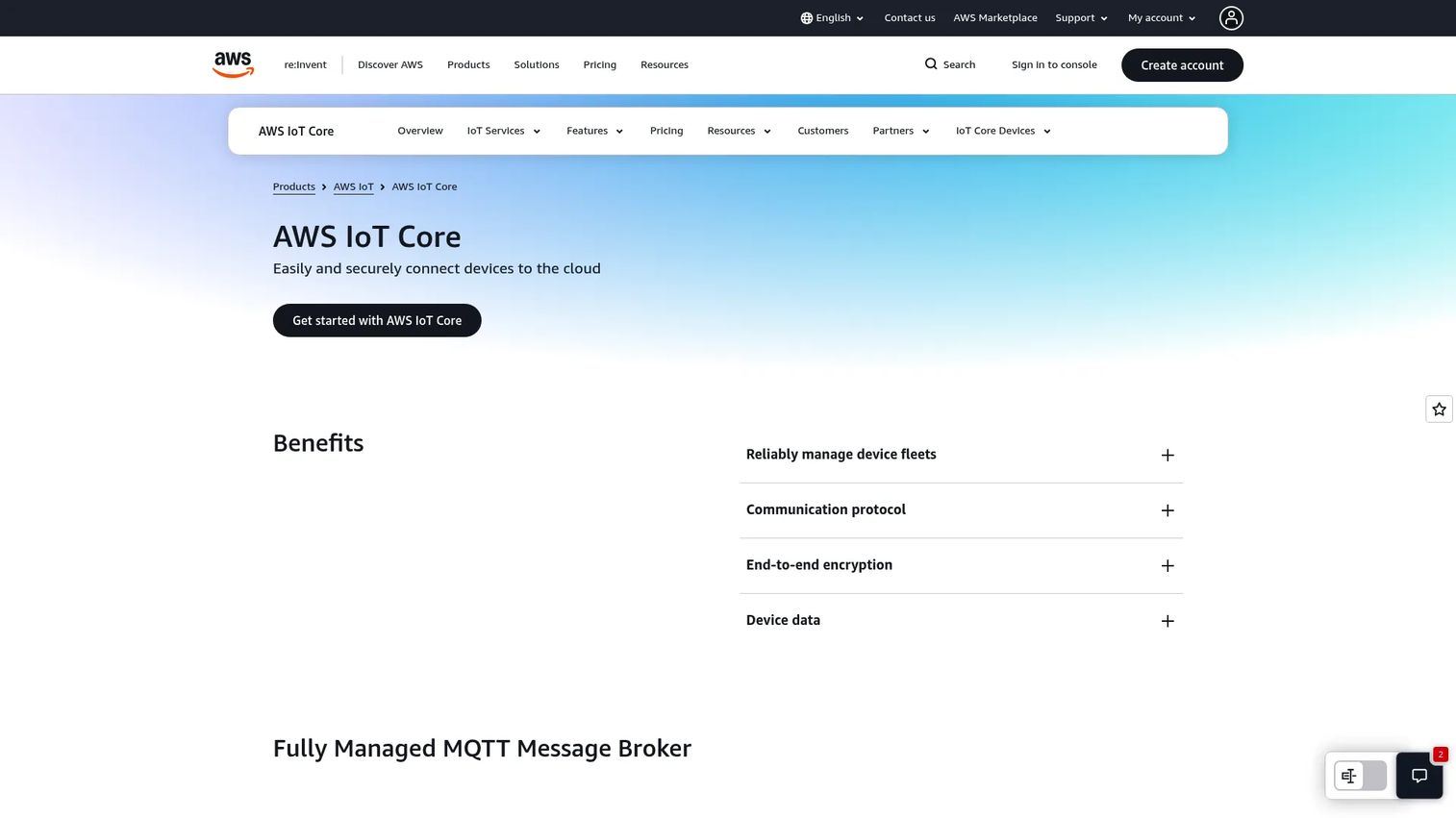
AWS IoT Core is a managed cloud service for securely connecting, managing, and communicating with IoT devices at scale. It handles device messaging, state management, and data routing without requiring teams to provision or maintain dedicated message brokers. For medical-device software teams already committed to AWS, it provides the connectivity foundation that links device telemetry to analytics, storage, alerting, and application services within the same cloud environment.
Best for: Medical-device and digital-health product teams building a custom cloud architecture on AWS who need flexible, scalable device connectivity.
Key features
- Secure MQTT, HTTPS, and LoRaWAN device messaging
- Device Registry for identity and metadata management
- Device Shadow for storing reported and desired device state
- Rules Engine for filtering, routing, and transforming device data
- Integration with AWS analytics, storage, and compute services
Why choose AWS IoT Core: Choose it when your roadmap requires control over data routing, custom application logic, and device lifecycle workflows. It is a building block, not a finished application, so the team carries the architecture and integration work.
AWS IoT Core pricing: AWS uses usage-based pricing with no minimum fee. The US East connectivity rate starts at $0.08 per 1,000,000 connection-minutes, with separate charges for messaging, Device Shadow operations, Registry calls, and Rules Engine actions. The AWS Free Tier covers specified monthly usage for new accounts in the first 12 months.
G2 rating: 4.7/5
2. Azure IoT Hub
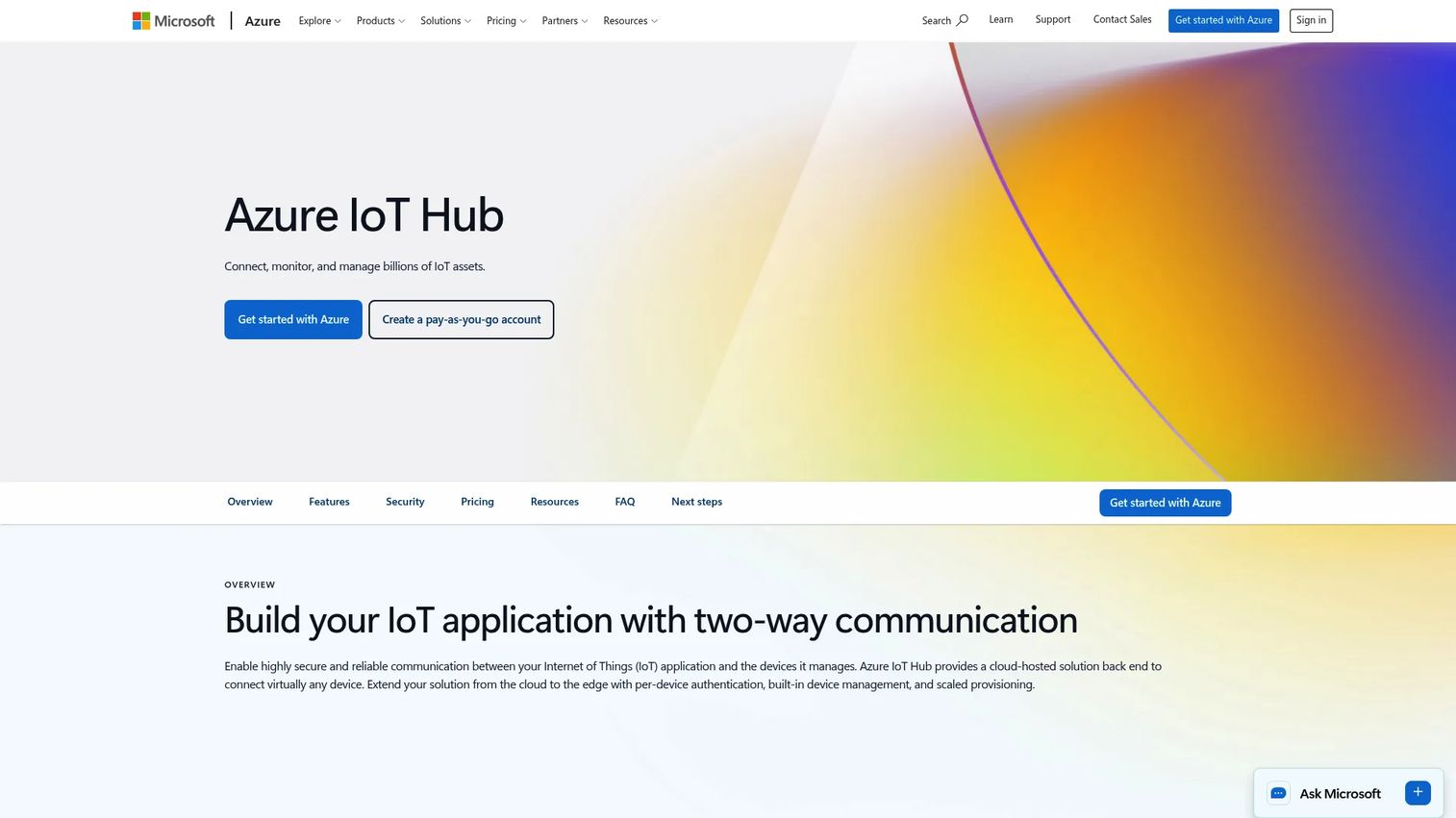
Azure IoT Hub is a cloud-hosted service for connecting, monitoring, and managing IoT devices at scale within the Microsoft ecosystem. It supports bidirectional device-to-cloud and cloud-to-device messaging, per-device authentication, device provisioning, and over-the-air updates. For healthcare organizations running Azure data services, Microsoft identity, and FHIR-oriented workflows, it provides a consistent connectivity model that fits an existing enterprise architecture.
Best for: Healthcare organizations and product teams with a Microsoft-first cloud strategy where device telemetry needs to flow into Azure applications, healthcare analytics, or FHIR-related systems.
Key features
- Bidirectional device-to-cloud and cloud-to-device messaging
- Per-device authentication and identity management
- Device twins for configuration state management
- Over-the-air firmware updates through Device Update for IoT Hub
- Event Grid integration for downstream routing
Why choose Azure IoT Hub: Choose it when Azure identity, data governance, and enterprise integration tooling already shape your technical environment. Plan the data destination and alert workflow before selecting the connectivity layer; device connectivity alone does not deliver clinical outcomes.
Azure IoT Hub pricing: A Free edition supports up to 8,000 messages per day at no charge. Basic and Standard paid tiers use usage-based pricing; Microsoft's pricing page displays paid tier amounts as "$-" rather than a fixed numeric rate, so contact Azure sales or check the pricing calculator for your expected message volume and device count.
G2 rating: 4.3/5
3. Google Cloud Healthcare Data Engine
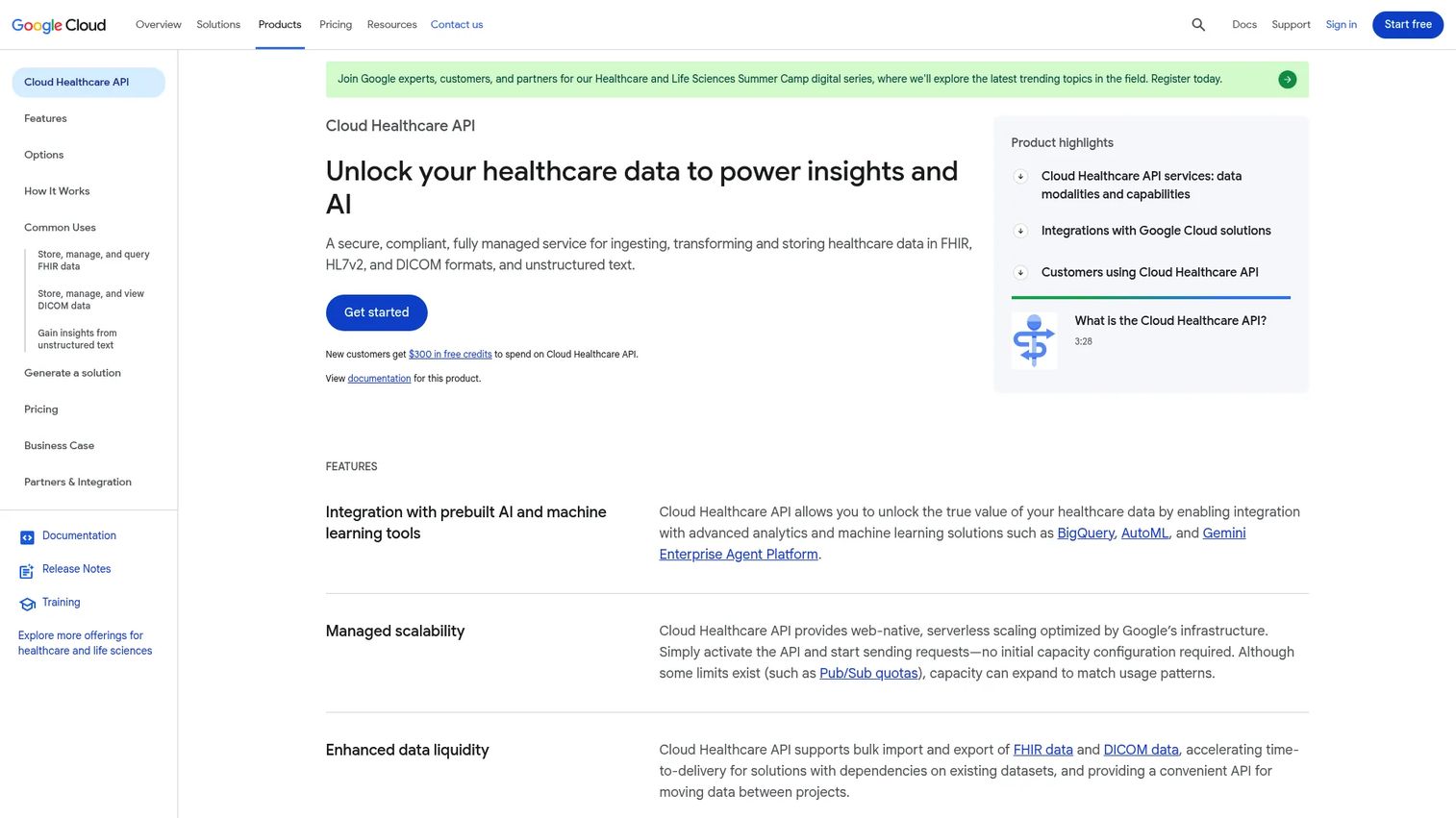
Google Cloud Healthcare Data Engine is a fully managed service for ingesting, transforming, harmonizing, and storing healthcare data for clinical analytics and AI applications. It supports FHIR, HL7v2, DICOM, and unstructured clinical text, and connects to BigQuery, AutoML, and the Gemini Enterprise Agent Platform for downstream analytics workloads. Where the problem is not device connectivity but fragmented clinical data, this platform addresses the normalization and interoperability layer.
Best for: Product and data teams that need to unify healthcare data from device, clinical, and operational sources so downstream analytics and applications can function reliably.
Key features
- FHIR, HL7v2, DICOM, and unstructured-text data support
- FHIR mapping-pipeline processing and harmonization
- De-identification API for data handling
- Bulk FHIR and DICOM import and export
- Fine-grained IAM policies and REST interfaces
Why choose Google Cloud Healthcare Data Engine: Choose it when the bottleneck is not device connectivity but usable clinical data. It is especially relevant when analytics, care coordination applications, or health data platform modernization are central priorities, and when devices already send data somewhere but that data cannot be normalized for downstream use.
Google Cloud Healthcare Data Engine pricing: Pipeline processing charges $38.00 per GiB of FHIR data generated by mapping pipelines. The platform also incurs Cloud Healthcare API storage and request charges, plus separately billed resources such as BigQuery and Spanner. There is no standalone free tier noted for Healthcare Data Engine pipeline operations.
G2 rating: 4.1/5
4. Cumulocity IoT
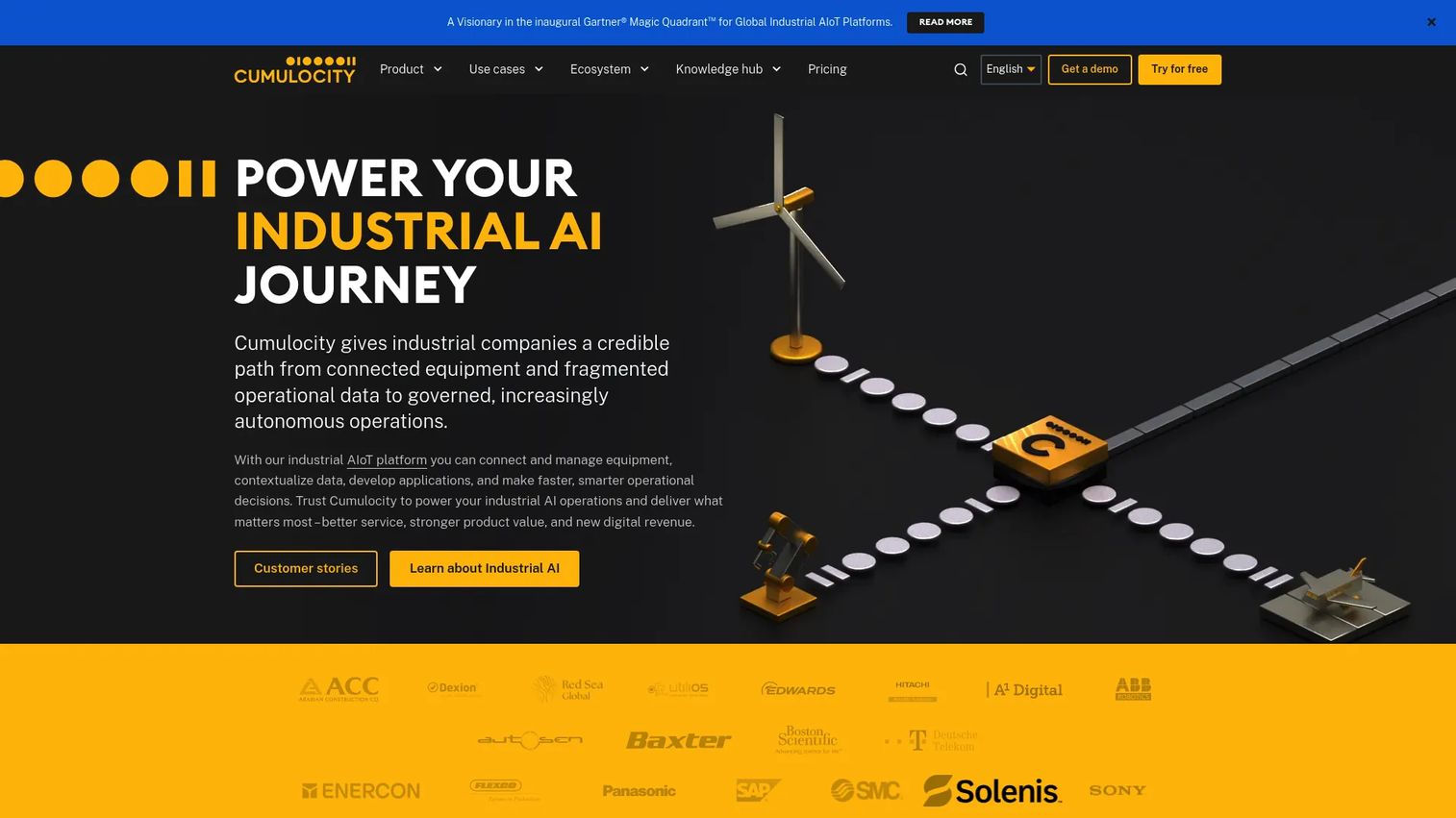
Cumulocity IoT is an enterprise IoT application platform that packages device management, real-time dashboards, analytics, and integration tooling into a configurable environment. It supports MQTT, REST, OPC UA, LWM2M, and LoRaWAN device connectivity, and includes edge and gateway capabilities for deployments that require on-premises or hybrid operation. For teams that need a functional device-management layer without assembling every component from cloud primitives, Cumulocity reduces time-to-operational coverage.
Best for: Product and operations teams managing connected-device fleets who need configurable device lifecycle management and operational dashboards without building the entire layer from scratch.
Key features
- Device lifecycle management: Onboarding, monitoring, remote access, and decommissioning
- Multi-protocol connectivity: MQTT, REST, OPC UA, LWM2M, and LoRaWAN
- Real-time dashboards, digital twins, and streaming analytics
- Edge and gateway support for hybrid deployments
- Application development tooling and API integration
Why choose Cumulocity IoT: Choose it when product differentiation sits in your care workflow or device experience, not in building commodity fleet-management functions. Validate healthcare-specific integrations, data models, and supported device protocols before committing to the architecture.
Cumulocity IoT pricing: The Starter plan starts at €215 per month billed annually, covering up to 2.5 million messages per month, one tenant, 30-day data retention, and up to three analytics models. Business, Enterprise, Connected, and Air-Gapped editions use custom pricing. A 30-day free trial is available.
G2 rating: 4.3/5
5. Siemens Healthineers
Siemens Healthineers is a healthcare technology company with a portfolio spanning medical imaging, laboratory diagnostics, point-of-care testing, healthcare IT, and digital health software. Its connected workflow capabilities are anchored in clinical environments rather than general IoT infrastructure. For large health systems, imaging centers, and medical technology teams operating in complex clinical environments, Siemens Healthineers provides software products aligned to those specific workflows.
Best for: Health systems, imaging organizations, and medical technology teams where connected-device needs sit inside a broader clinical or imaging technology environment.
Key features
- Clinical imaging workflow and equipment integration
- Laboratory diagnostics and point-of-care testing software
- Healthcare IT and enterprise services
- Digital health and AI-augmented clinical tools
- Remote collaboration capabilities for clinical teams
Why choose Siemens Healthineers: Choose it when your project is anchored in clinical imaging, hospital enterprise systems, or device-adjacent care operations. It is a poor fit for a startup that needs an open, developer-first IoT backend. Purchase decisions typically depend on installed clinical systems, service models, and procurement structures.
Siemens Healthineers pricing: Most software products use account-specific pricing or quotation-based arrangements. The Share360 Parts Club membership, one publicly verified product, is priced at $299 per Functional Location annually. Contact Siemens Healthineers directly for pricing on specific software products relevant to your clinical environment.
G2 rating: 4.3/5
6. MedM
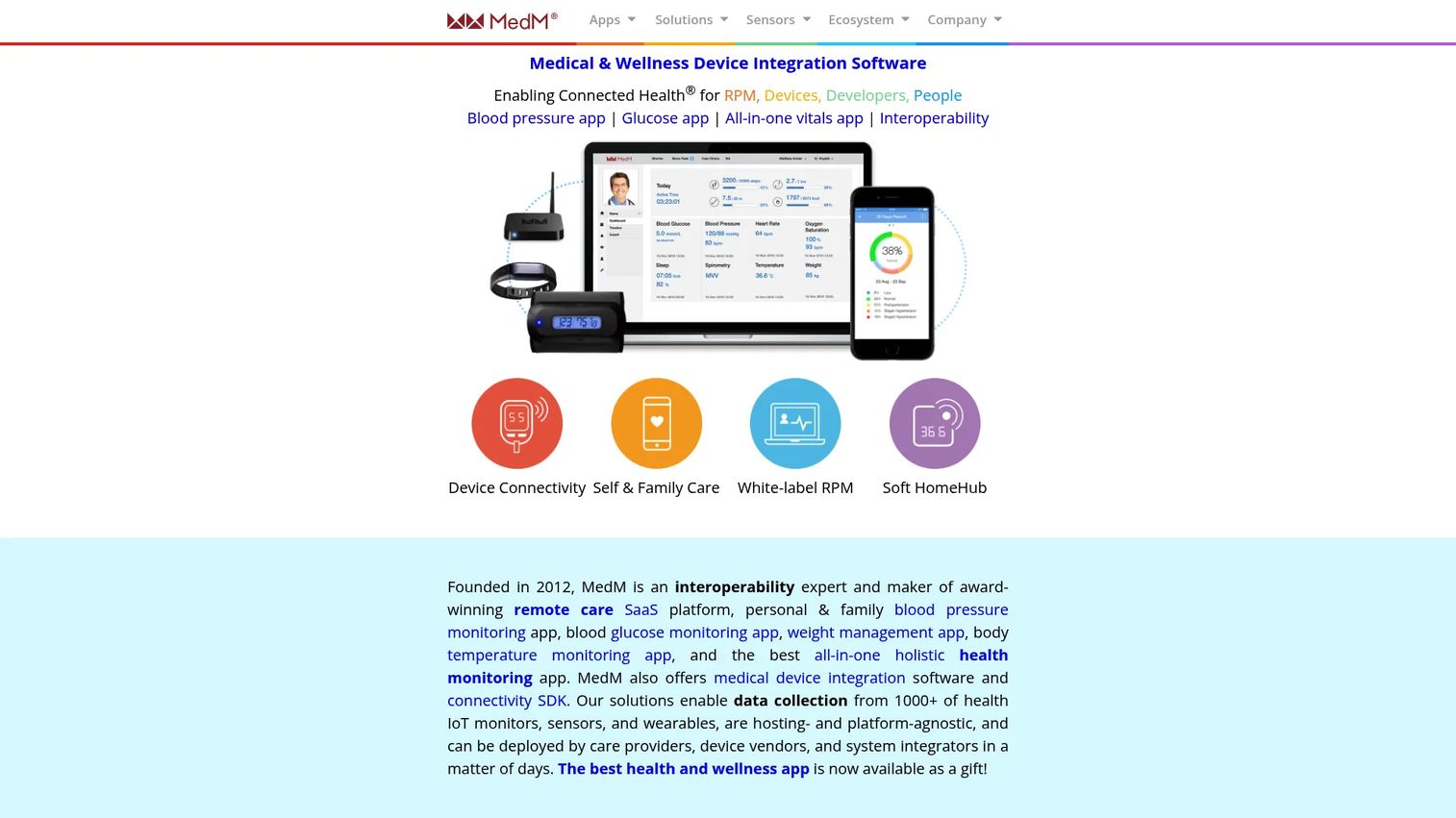
MedM provides connected-health software, remote patient monitoring SaaS, and medical-device connectivity tools. Its platform connects to more than 1,000 health devices, sensors, and wearables via Bluetooth and synchronizes with Apple Health, Google Health Connect, Samsung, Fitbit, and Garmin ecosystems. For remote monitoring programs that need broad device-agnostic connectivity across a diverse patient population, MedM reduces the per-device integration work that would otherwise fall on your engineering team.
Best for: Remote monitoring, chronic-care, and connected-health product teams that need to collect and normalize readings from many health-device types across a patient population.
Key features
- Bluetooth data collection from 1,000+ health devices and wearables
- Remote patient monitoring dashboards, notifications, and reports
- Health records with measurement history, trends, and sharing controls
- SDK and API integrations for custom application development
- Synchronization with major consumer health ecosystems
Why choose MedM: Choose it when the core challenge is the device-compatibility matrix. The platform is strongest when its existing device integrations match the hardware your patients already own or will receive. Validate supported device models, data formats, and integration pathways against your specific program requirements.
MedM pricing: The Basic plan starts at $100 per month and covers up to 10 patients at $10 per patient per month. The Pro plan starts at $1,000 per month for up to 100 patients. Enterprise pricing starts at $5,000 per month. A one-month free trial is available.
7. Digi International
Digi International provides embedded wireless modules, IoT gateways, cellular routers, remote device management, and managed connectivity infrastructure. Its Digi Remote Manager platform supports centralized monitoring, bulk configuration, firmware updates, and remote access across distributed device deployments. When a connected medical-device product depends on the physical connectivity layer as much as the application layer, Digi addresses both.
Best for: Device manufacturers and connected-product teams that own or influence hardware design, gateway deployment, and field connectivity for medical or clinical equipment.
Key features
- Embedded wireless modules for device-level connectivity
- IoT gateways, routers, and edge computing hardware
- Digi Remote Manager for centralized fleet monitoring and updates
- Managed cellular connectivity with carrier integration
- Secure remote IT and OT access through Digi Remote Reach
Why choose Digi International: Choose it when field reliability is a core product requirement. Connectivity decisions at the hardware layer affect device uptime, installation burden, firmware strategy, and customer experience when devices operate outside controlled hospital networks. It is less focused on patient-facing care workflows or healthcare data modeling than platform options built around those jobs.
Digi International pricing: Digi Remote Manager uses per-device subscription licensing on 1-year, 3-year, or 5-year terms. Hardware product pricing varies by SKU and quantity.
G2 rating: 4.3/5
Considerations when choosing medical IoT software
Match the platform to the stack layer you need
A platform strong at device messaging may require additional tools to handle data normalization, clinical workflow integration, or operational dashboards. Map your product's architecture before evaluating vendors. The goal is to avoid buying a device-management platform when your bottleneck is EHR interoperability, or investing in a data engine when your devices are not yet connected.
Validate device compatibility before architecture decisions
Request verified support documentation for your specific device types, communication protocols, gateway hardware, and data formats. Build a proof of concept against your hardest device integration, not a demo device in a controlled environment. Gaps surface in production, and rework at that stage is expensive.
Map data flow from device to action
Before selecting a platform, document where data originates, how it is authenticated, where it is transformed, which system stores it, which role sees it, and what event triggers an alert or downstream workflow. This instrumentation map is the PM's primary tool for evaluating whether a platform closes the loop or leaves engineering work on the table.
Review governance, privacy, and security controls
Evaluate device identity management, role-based access, encryption in transit and at rest, audit logging, vulnerability management, and incident response processes. No platform makes your organization compliant with any law or regulatory framework. Security posture is a shared responsibility. Your AI security posture management tools and broader security architecture also contribute to that outcome.
Price the operating model, not only the license
Costs include message volume, cloud storage, analytics processing, device connectivity, hardware, professional services, integration development, support tiers, and engineering maintenance. A lower platform subscription can produce a higher total operating cost if the team must build core lifecycle functions internally. Model costs over a three-year horizon, not just the entry price.
Choose the right medical IoT software for your product roadmap
Choose AWS IoT Core when your team has committed to AWS, owns the cloud architecture, and needs flexible device connectivity that routes into existing AWS analytics, storage, and compute services. It suits engineering-led teams with capacity to design and maintain the integration layer.
Choose Azure IoT Hub when Azure identity, data governance, and FHIR-oriented services already define your technical environment. The platform makes the most sense when device telemetry needs to move into Azure applications with a consistent security and integration model.
Choose Google Cloud Healthcare Data Engine when device connectivity already exists but the product stalls because health data is fragmented across systems. It addresses the normalization and interoperability layer, not the device messaging layer.
Choose Cumulocity IoT when your team needs configurable device lifecycle management and operational dashboards without assembling every component from cloud primitives. Validate healthcare-specific integrations and device protocol support before finalizing the architecture.
Choose Siemens Healthineers when the project is anchored in clinical imaging, hospital enterprise systems, or device-adjacent care operations. Procurement depends heavily on installed systems and existing service relationships.
Choose MedM when broad support for home-monitoring devices, sensors, and wearables matters more than owning every component of the monitoring infrastructure. Confirm that supported device models match your patient population's hardware before committing.
Choose Digi International when embedded modules, gateways, managed cellular connectivity, and field device reliability are part of the product's core scope. It is the strongest option when hardware and connectivity are product requirements, not just implementation details.
Conclusion
Medical IoT software is not a single product category. It spans cloud IoT infrastructure, healthcare data platforms, device connectivity software, hospital technology suites, and hardware-layer connectivity providers. The right platform is determined by which layer of the stack your product needs to own or rely on.
To recap the shortlist: AWS IoT Core for custom cloud IoT architecture, Azure IoT Hub for Microsoft-based healthcare environments, Google Cloud Healthcare Data Engine for healthcare data operations, Cumulocity IoT for packaged enterprise IoT, Siemens Healthineers for specialized clinical environments, MedM for device-agnostic remote monitoring, and Digi International for embedded connectivity and hardware-adjacent deployments.
The most practical next step is to pick one target workflow and test each shortlisted candidate against the same device, data pathway, and operational criteria. That test will surface integration dependencies, security requirements, and engineering ownership questions faster than any vendor demo.
For teams exploring how to present complex healthcare software workflows during internal evaluation or stakeholder alignment, Guideflow makes it possible to build interactive demos of device onboarding flows and sanitized dashboards without exposing live data.
Start your journey with Guideflow today!
FAQs about medical IoT software
Medical IoT software is the platform layer that connects medical devices and healthcare systems to collect, manage, analyze, and act on device-generated data. It can include device connectivity, fleet management, remote monitoring, analytics, and interoperability functions depending on the product category.
A medical device is the physical hardware that measures, monitors, or delivers a clinical intervention. Medical IoT software manages the connectivity, data, workflows, and integrations that make device-generated data useful. Most connected medical products require both hardware and software layers to function as intended.
Feature priorities depend on the use case. Device identity management, secure data ingestion, device monitoring, alerting, data transformation, role-based access, APIs, and interoperability capabilities are common across categories. Remote monitoring programs weight device-agnostic connectivity and data normalization. Hospital operations programs weight asset tracking, dashboards, and EHR integration.
Integration is possible through APIs and healthcare interoperability standards such as FHIR, but support varies by platform and by the specific EHR environment. Test a concrete workflow and data mapping with your actual EHR before selecting a platform. Generic FHIR support does not guarantee a working integration with your clinical system.
Evaluate device identity management, access controls, encryption in transit and at rest, audit logging, vulnerability disclosure practices, firmware update mechanisms, data retention policies, and vendor incident response processes. The platform is one part of the organization's security architecture. For a broader view of security tooling, see our guide to big data integration tools and related infrastructure security considerations.
Remote monitoring programs need device-agnostic connectivity, data normalization, patient workflow integration, and reliable support for home network conditions. MedM is designed for this use case, with connectivity to more than 1,000 health devices. AWS IoT Core and Azure IoT Hub can support RPM programs when engineering capacity exists to build the application layer. The right fit depends on your device mix, care-delivery workflow, and team's ability to own the architecture.
Pricing varies by data volume, messages processed, connected devices, storage, feature tier, hardware, connectivity plans, and professional services. AWS IoT Core and Google Cloud Healthcare Data Engine use usage-based models without fixed subscriptions. Cumulocity IoT starts at €215 per month. MedM starts at $100 per month. Azure IoT Hub, Siemens Healthineers, and Digi International require direct sales contact for paid tier pricing. Model total operating cost over a multi-year horizon, not just the entry rate.
The phrases are often used interchangeably in vendor positioning and analyst research. "Medical IoT" typically emphasizes connected medical devices, clinical data, and patient-facing workflows. "Healthcare IoT" can also cover hospital operations, environmental monitoring, asset tracking, and administrative workflows. Both point to the same platform layer and the same selection criteria.
FHIR (Fast Healthcare Interoperability Resources) is the standard that governs how healthcare data is structured and exchanged between systems. For product teams connecting device data to EHR, analytics, or care coordination applications, FHIR support determines whether data can flow into those downstream systems without custom transformation work. Check whether the platform supports FHIR R4, what data types are covered, and whether the EHR on the other end supports the same version. See our related guide on AI medical diagnostic platforms for context on how data standards shape adjacent healthcare software categories.