Running a marina means managing slips, fuel, service, seasonal billing, and transient reservations, often across disconnected tools that never quite talk to each other. Someone on the dock is changing a slip assignment while someone in the office is chasing an overdue invoice and a reservation request is sitting in a separate inbox. The reconciliation happens at the end of the month, if it happens at all.
The U.S. marina industry generated $6.9 billion in revenue in 2024, according to the Leisure Properties Group Marina Investment Report (2025). Behind that number are 11,180 marina businesses, 54.5% of which employ fewer than five people (U.S. Census Bureau, County Business Patterns 2023). Most of them are running operations that are far more complex than their headcount suggests.
The real decision is not which tool has the most features. It is which system can become the operational source of truth for your specific mix of slips, fuel, service, and customer workflows, without a six-month implementation project.
What's inside
This guide is for marina owners, operations leads, harbor masters, and vertical SaaS founders evaluating the marina management software market in 2026.
- 12 tools covering the full spectrum from reservation-first platforms to broad marine ERPs
- Selection criteria: slip and reservation depth, billing and payment workflows, service and inventory coverage, deployment model, and integration fit
- Buyer guidance for transient marinas, boatyards, dry-stack facilities, fuel docks, yacht clubs, and mixed-use properties
- Pricing notes where vendors publish entry figures, and quote drivers where they do not
- What to ask before committing to implementation
TL;DR
- Best for broad marina and boatyard operations: DockMaster, for teams that need slips, service, inventory, finance, and marine sales in one environment
- Best for transient reservations and revenue management: Dockwa, for operators focused on online booking, digital contracts, and marina billing workflows
- Best for cloud and desktop flexibility: Scribble Software, for teams evaluating both deployment models across marina, boatyard, POS, and fuel workflows
- Best for cloud-first operations: Molo, for browser and iPad-based workflows with online contracts, payments, and customer portals
- Best for dry-stack and launch-heavy operations: Speedy Dock, where launch requests and retrieval scheduling set the pace of the day
- Best entry-level option with a free tier: SlipBoss, for smaller marinas moving beyond spreadsheets with a plan that starts at $0
What is marina management software?
Marina management software is a system that helps marinas, yacht clubs, boatyards, and harbor operators manage slips, reservations, billing, customer records, service work, fuel, inventory, and related operations from a connected platform.
The category spans a wide range of operational depth. A reservation-first tool handles booking well but may not replace a full marina operating platform. A broad marine ERP covers more workflows but requires more setup, data migration, and staff adoption.
Core capabilities to look for:
- Slip and berth management: Visual maps, occupancy tracking, assignments, waitlists, seasonal agreements, and transient space
- Reservations and contracts: Online booking, deposits, digital signatures, cancellations, and booking changes
- Billing and payments: Recurring invoices, utility charges, auto-pay, ACH, card processing, statements, and collections workflows
- Point of sale and fuel: Ship-store sales, fuel pump integration, tax handling, fuel inventory, and reconciliation
- Boatyard service: Work orders, estimates, technician scheduling, parts, haul-outs, and customer approvals
- Inventory and purchasing: Parts, merchandise, serialized items, stock counts, and vendor management
- Customer communication: Portals, email, text messaging, notices, and document access
- Reporting and accounting: Revenue, occupancy, outstanding balances, fuel margins, inventory movement, and accounting sync
| Category type | Best for | Typical modules | Watch-out |
|---|---|---|---|
| Reservation-first platform | Transient-heavy marinas | Booking, contracts, deposits, payments, messaging | May need separate tools for service depth or accounting |
| Full marina operations platform | Full-service marinas and boatyards | Slips, billing, POS, fuel, service, inventory, reporting | Implementation involves more process change |
| Dry-stack and launch platform | Launch-heavy properties | Launch requests, queue management, member communication | May need extensions for finance or complex service work |
| Mixed-use property platform | Marinas with rentals, hospitality, or retail | Billing, rentals, POS, restaurant charges, slips | Validate each business line before consolidating |
When to use marina management software
Replace disconnected reservation, billing, and payment workflows
If your staff moves reservation details between email, spreadsheets, paper contracts, and accounting software, you are creating handoff errors and unclear customer balances. A marina management system consolidates those steps, so the record of a booking, its associated deposits, and the final invoice all live in one place.
Coordinate fuel, retail, and boatyard activity
Separate POS, fuel, and work-order systems create reporting lag. A fuel sale on Tuesday and a haul-out billed on Thursday should reconcile to the same customer account without a manual export. When those departments share a common platform, month-end reporting takes hours rather than days.
Scale multiple locations or absorb seasonal volume
Multi-location operators and marinas with heavy transient seasons need consistent data structures, shared customer records, and consolidated reporting. Adding a second property to a system built for one site often exposes the gaps in permissions, accounting sync, and operational visibility.
Marina management software comparison
The table below covers all 12 tools in this guide. Pricing reflects verified figures from each vendor's official pricing page as of October 2026. G2 ratings reflect current listings. Where a vendor does not display pricing and no G2 rating was verifiable, those cells indicate the situation plainly.
| # | Product | Best for | Key differentiator | Pricing | G2 rating |
|---|---|---|---|---|---|
| 1 | DockMaster | Full-service marinas, boatyards, and marine dealerships | Broad marine ERP: Slips, service, inventory, accounting, payments | Contact for quote | Not listed |
| 2 | Dockwa | Transient-heavy marinas | Modular reservation, contract, fuel, and POS platform | From $0/month (free Leads plan) | Not listed |
| 3 | Scribble Software | Cloud and desktop deployment | Marina, boatyard, fuel, POS, and accounting integrations | Contact for quote | 4.5/5 |
| 4 | MarinaOffice | Mixed-use marina and property operations | Slips, boatyard, rentals, restaurant billing, and launch scheduling | Contact for quote | 4.0/5 |
| 5 | Molo | Cloud-first marinas and municipalities | Browser and iPad access with contracts, payments, and repair management | Contact for quote | Not listed |
| 6 | HarbaMaster | Marinas and yacht clubs modernizing berth workflows | CRM, invoicing, and guest berth management with transparent pricing | From €2,700/year | 5.0/5 |
| 7 | Total Marina Package | Marinas and yacht clubs needing deep billing flexibility | 200+ reports, custom billing rules, and online bill pay | Contact for quote | 3.5/5 |
| 8 | MARINAGO | Marinas and boatyards wanting a connected cloud system | Reservations, fuel, POS, service, and billing in one platform | Contact for quote | Not listed |
| 9 | DocksBase | Modern harbors and berth operators | Berth maps, automated invoicing, boatyard workflows, and customer portal | From €299/month | Not listed |
| 10 | SlipBoss | Smaller marinas replacing spreadsheets | Free plan for up to 30 slips, with Pro and Ultimate tiers | Free; paid from $100/month | Not listed |
| 11 | MarinaWare | Small marina teams needing core dockside workflows | Slip and reservation administration with dockside staff input | Contact for quote | Not listed |
| 12 | Speedy Dock | Dry stacks, boat clubs, and launch-heavy marinas | Launch, retrieval, and reservation coordination | From $200/month | Not listed |
Best 12 marina management software tools for 2026
1. DockMaster
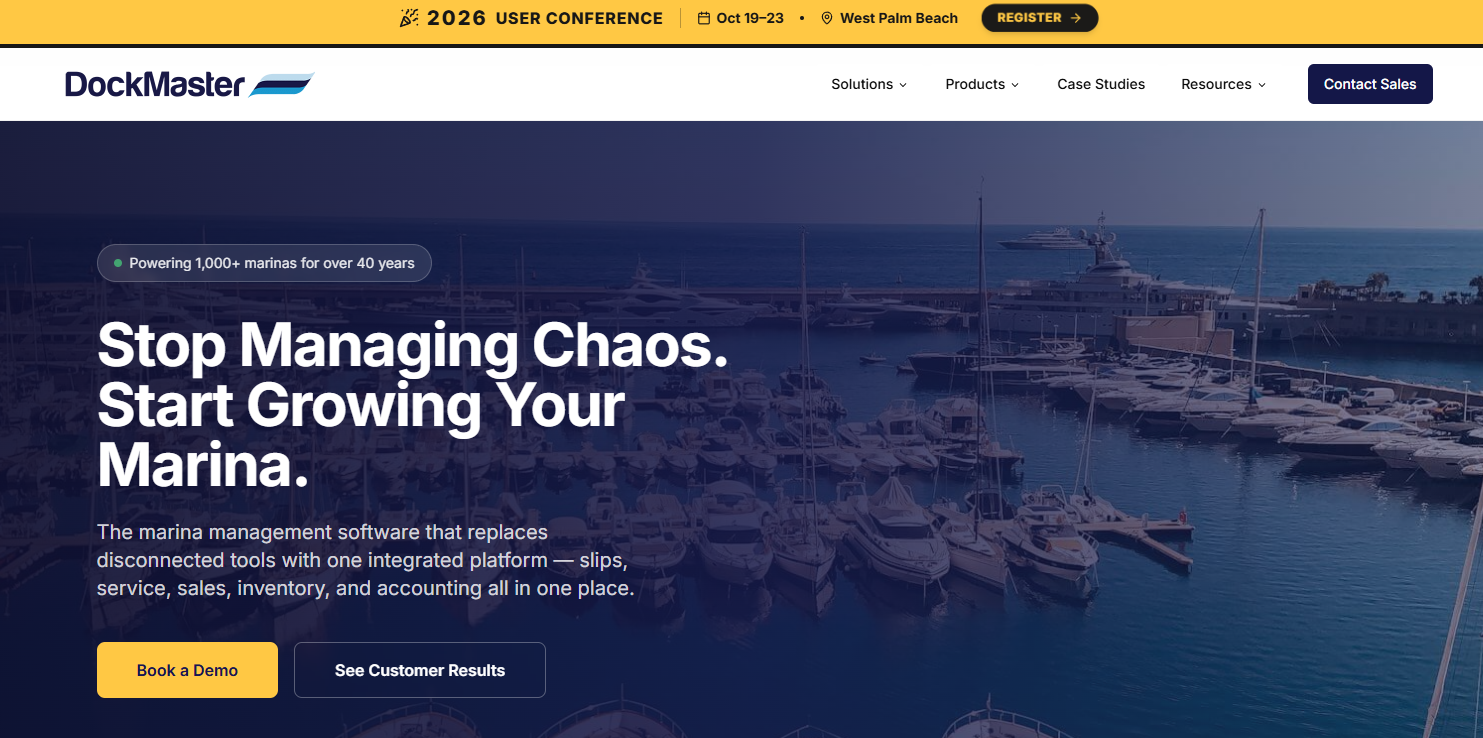
DockMaster is an all-in-one marine management platform built for marinas, boatyards, marine dealerships, and related marine businesses. It covers the full operating stack: Slip management, boatyard service, inventory, point-of-sale, financial workflows, and customer portals. For operations where data handoffs between departments create billing errors or reporting gaps, DockMaster is the most complete option on this list.
Best for: Full-service marinas, boatyards, and marine dealerships that need broad operational coverage across multiple revenue lines.
Key features
- Slip, storage, reservation, and billing management
- Boatyard work orders, estimates, scheduling, and digital payments
- Inventory with real-time tracking, purchase orders, and barcode printing
- Fuel dock and point-of-sale tools
- Customer portals and accounting integration
Why choose DockMaster: Choose it when your operation includes service labor, parts, fuel, retail, or marine sales alongside slip management. It earns its place on a shortlist when feature breadth is the deciding factor, not when you need the fastest path to a first win.
DockMaster pricing: DockMaster sells through a quote process. The price varies by marina size, number of locations, modules selected, and implementation scope. Contact the vendor directly to get a figure.
2. Dockwa
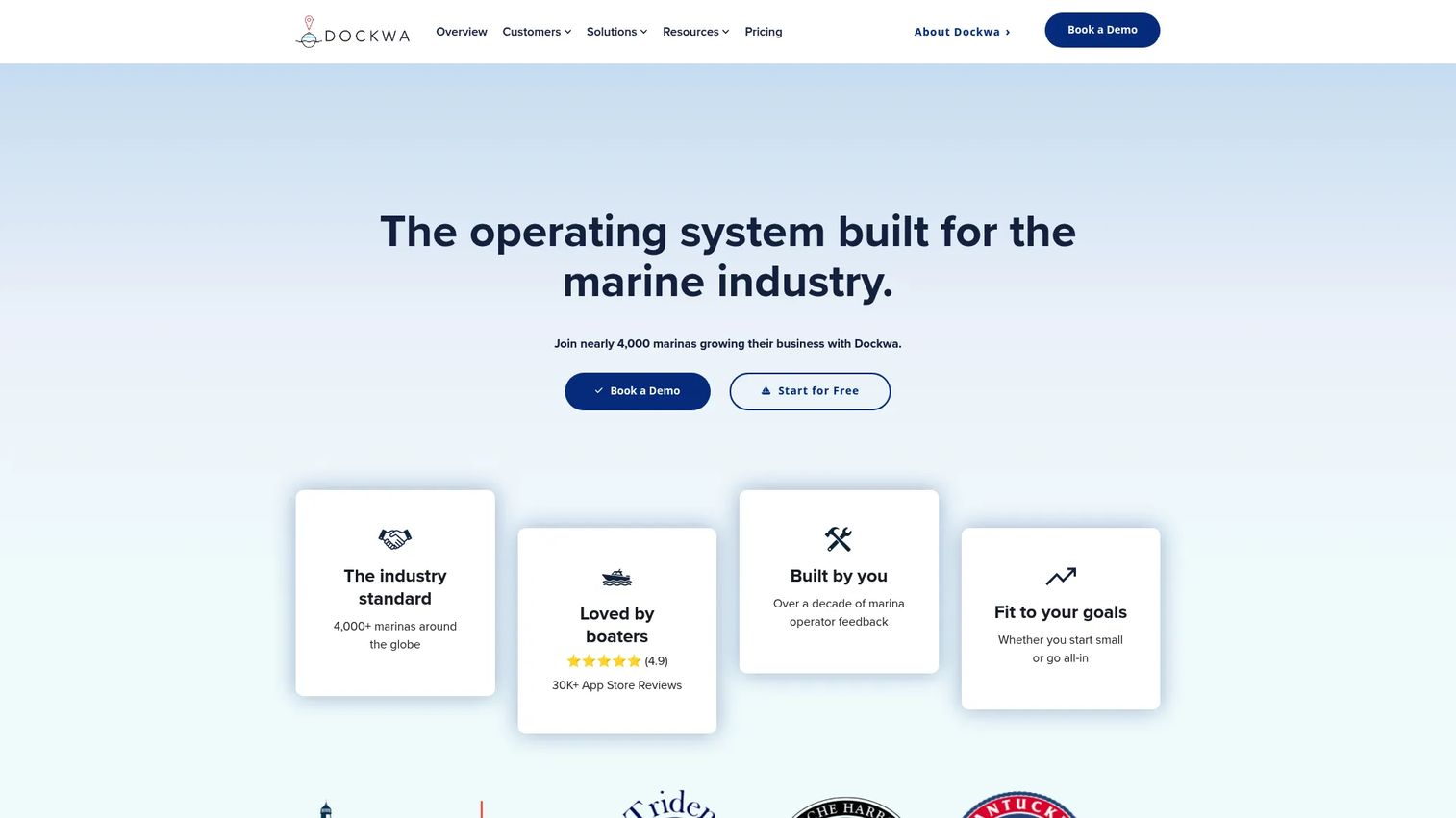
Dockwa is marina management software with an integrated boater marketplace for reservations, operations, contracts, payments, and related marina services. Its modular structure means you can start with transient reservations and add fuel management, dry-stack workflows, or POS as your operation grows. Marinas that want to reduce reservation back-and-forth and increase online booking conversion will find the most immediate value here.
Best for: Transient-heavy marinas focused on online reservations, digital contracts, and guest-facing payment workflows.
Key features
- Online transient slip reservations and waitlists
- Digital contracts, billing, invoicing, and payments
- Marina map, slip assignments, and occupancy tracking
- Fuel management and point-of-sale
- CRM, messaging, reporting, and accounting integrations
Why choose Dockwa: It is the strongest candidate when staff spend too much time coordinating short-stay availability, deposits, and booking changes. Confirm whether your service-yard and complex inventory requirements need additional tools before treating it as your complete operations platform.
Dockwa pricing: Dockwa's Leads plan is free. Paid modules are billed annually: Transient reservations start at $169/month, Captains & Contracts at $180/month, Point of Sale at $249/month, Fuel Management at $199/month, Dry Stack at $99/month, and Insights at $139/month. Modules can be mixed and matched, and portfolio pricing is available for multi-location operators.
3. Scribble Software
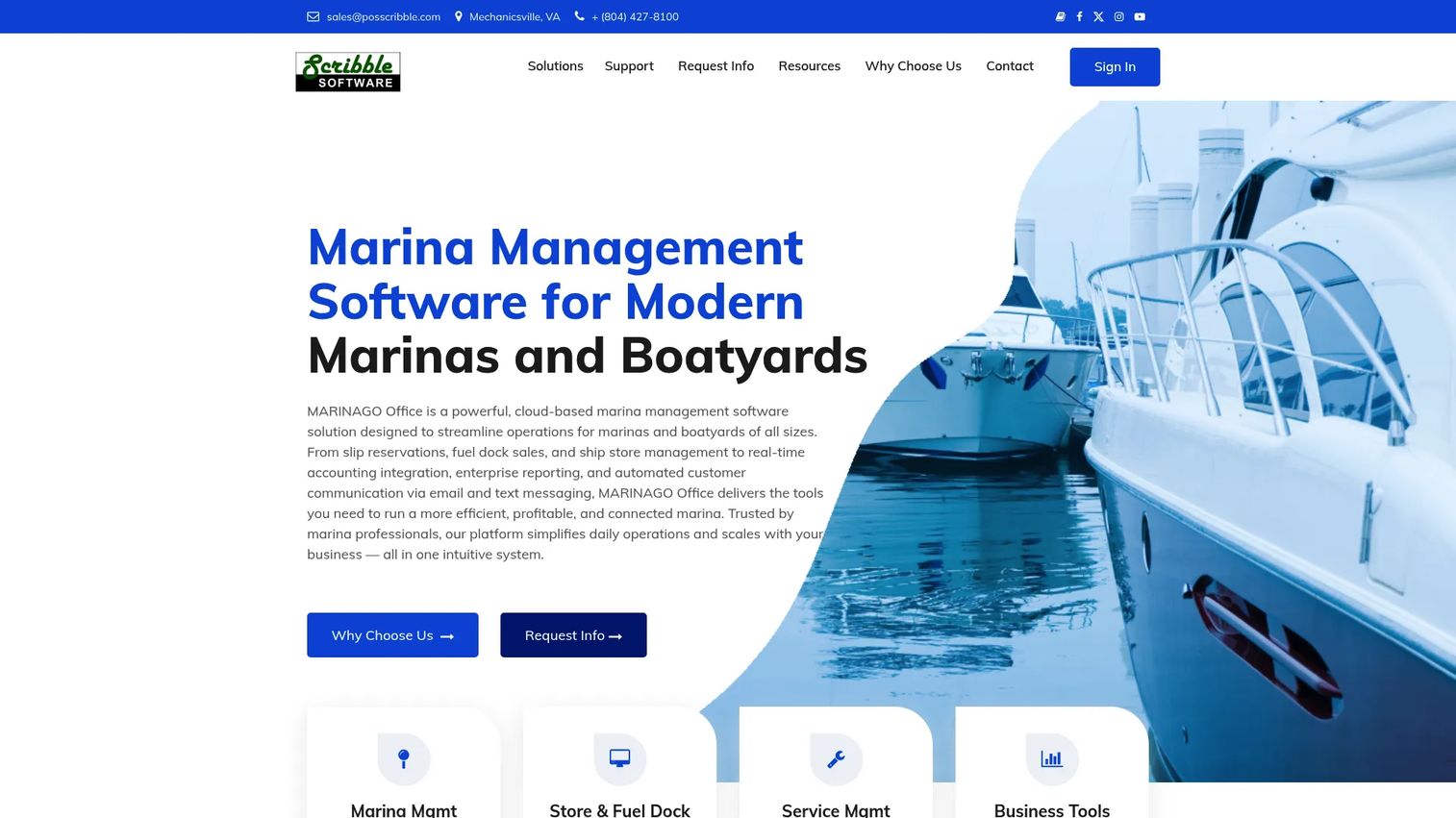
Scribble Software provides cloud-based and desktop marina management for marinas and boatyards. Its feature set spans slip and mooring reservations, billing, payment processing, point-of-sale, fuel dispenser integration, pay-at-pump fueling, boat service and work orders, accounting integrations (QuickBooks and Sage Intacct), and customer communications via email and text.
Best for: Operators that need broad feature coverage and want to evaluate cloud versus locally hosted deployment before committing.
Key features
- Marina location management and visual property maps
- Slip and mooring reservations
- Fuel dispenser integration and pay-at-pump workflows
- Boat service, work orders, and technician portal
- Accounting integration (QuickBooks, Sage Intacct), email, and text messaging
Why choose Scribble Software: The deployment angle is the differentiator. Teams in areas with unreliable connectivity, or with entrenched desktop workflows, should put it high on the shortlist. Test the specific deployment model you plan to use during the demo, because a cloud-first team and a legacy desktop operation will evaluate training, updates, and reporting differently.
Scribble Software pricing: Scribble Software does not display pricing on its website. Contact the vendor to get a quote. The price will vary by hosting model, modules, and implementation scope.
G2 rating: 4.5/5
4. MarinaOffice
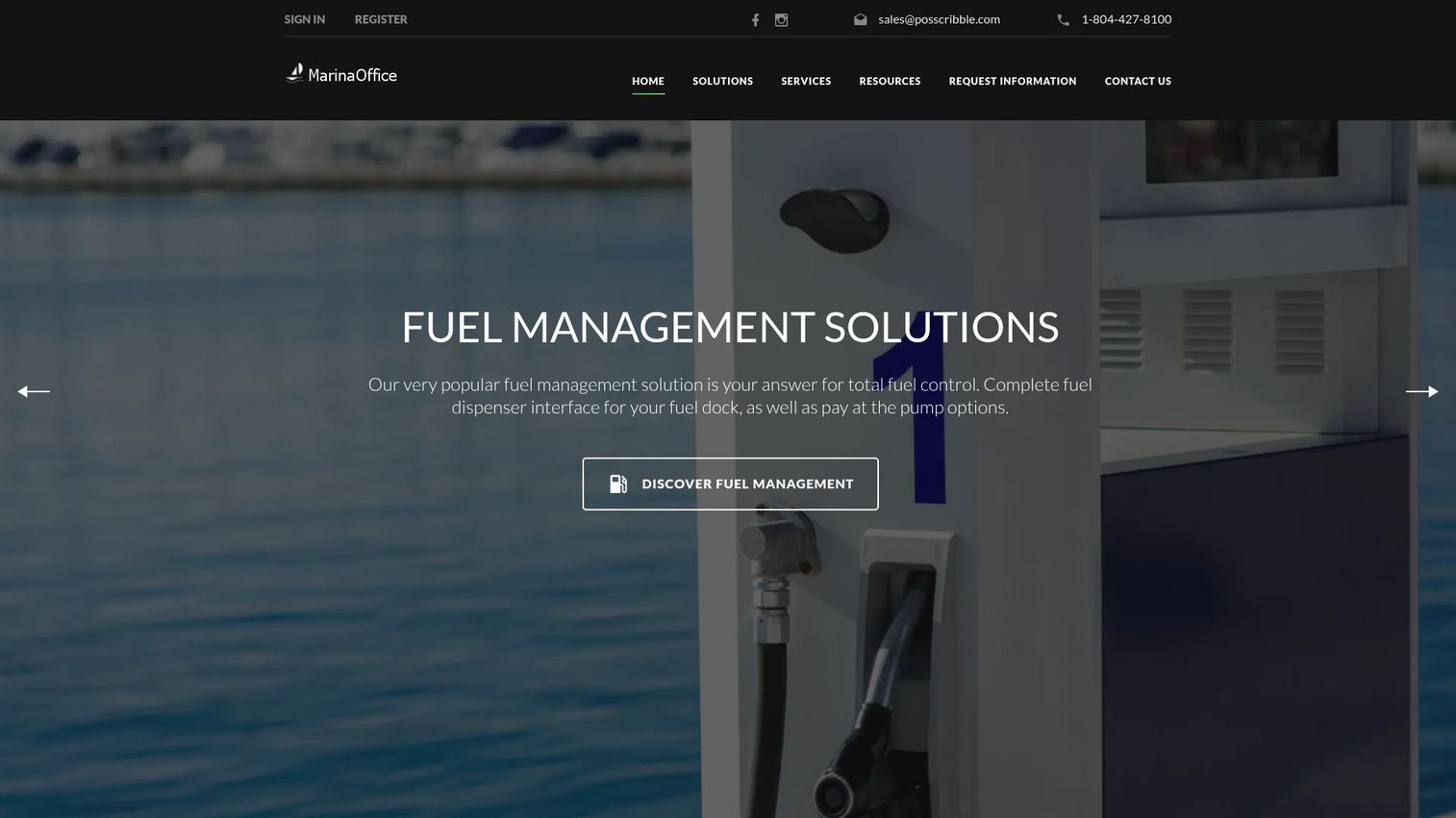
MarinaOffice is a marina management suite covering marinas, boatyards, yacht clubs, and related marine operations. Its breadth covers several business lines within one property: Slip management, boatyard work orders, retail POS, fuel dispenser integration, launch scheduling, boat rentals, restaurant billing, and QuickBooks integration. It stands out for mixed-use properties where customer charges span multiple departments.
Best for: Mixed-use marina properties that need unified billing across slips, service, retail, fuel, and ancillary operations.
Key features
- Marina and property management
- Retail point-of-sale and fuel management
- Boat yard service and work-order management
- Launch scheduling and boat rental management
- Restaurant point-of-sale and QuickBooks integration
Why choose MarinaOffice: Prioritize it when customer charges routinely span the marina, service yard, rental fleet, ship store, or hospitality operation. If your primary need is cleaner slip assignments without that broader scope, a narrower platform will cost less and require less setup.
MarinaOffice pricing: MarinaOffice does not display pricing on its website. Contact the vendor for a quote. The price typically varies by modules, property size, and implementation requirements.
G2 rating: 4.0/5
5. Molo
Molo is a cloud-first marina management platform for marinas, yacht clubs, boatyards, and municipalities. It runs in the browser and on iPad, covering slips, storage, contracts, fuel, online payments, credit card and ACH processing, accounting, invoicing, recurring payments, repair management, and customer-facing mobile apps. The operational model is built for staff who work from docks and yard spaces, not just an office desk.
Best for: Teams that want modern browser and tablet workflows, with unlimited users and no desktop-first operating model.
Key features
- Browser and iPad access with mobile apps
- Online contracts, signatures, and payments (credit card and ACH)
- Slips, storage, and fuel management
- Accounting, invoicing, and recurring payments
- Repair management and customer portal
Why choose Molo: Molo prices by business size and includes unlimited users, which matters for marinas where dock staff, office staff, and service technicians all need access. Ask the vendor to demonstrate seasonal billing adjustments, fuel reconciliation, and customer portal permissions before signing.
Molo pricing: Pricing is based on business size. Molo does not publish a numeric subscription price on its website. Contact the vendor for a quote.
6. HarbaMaster
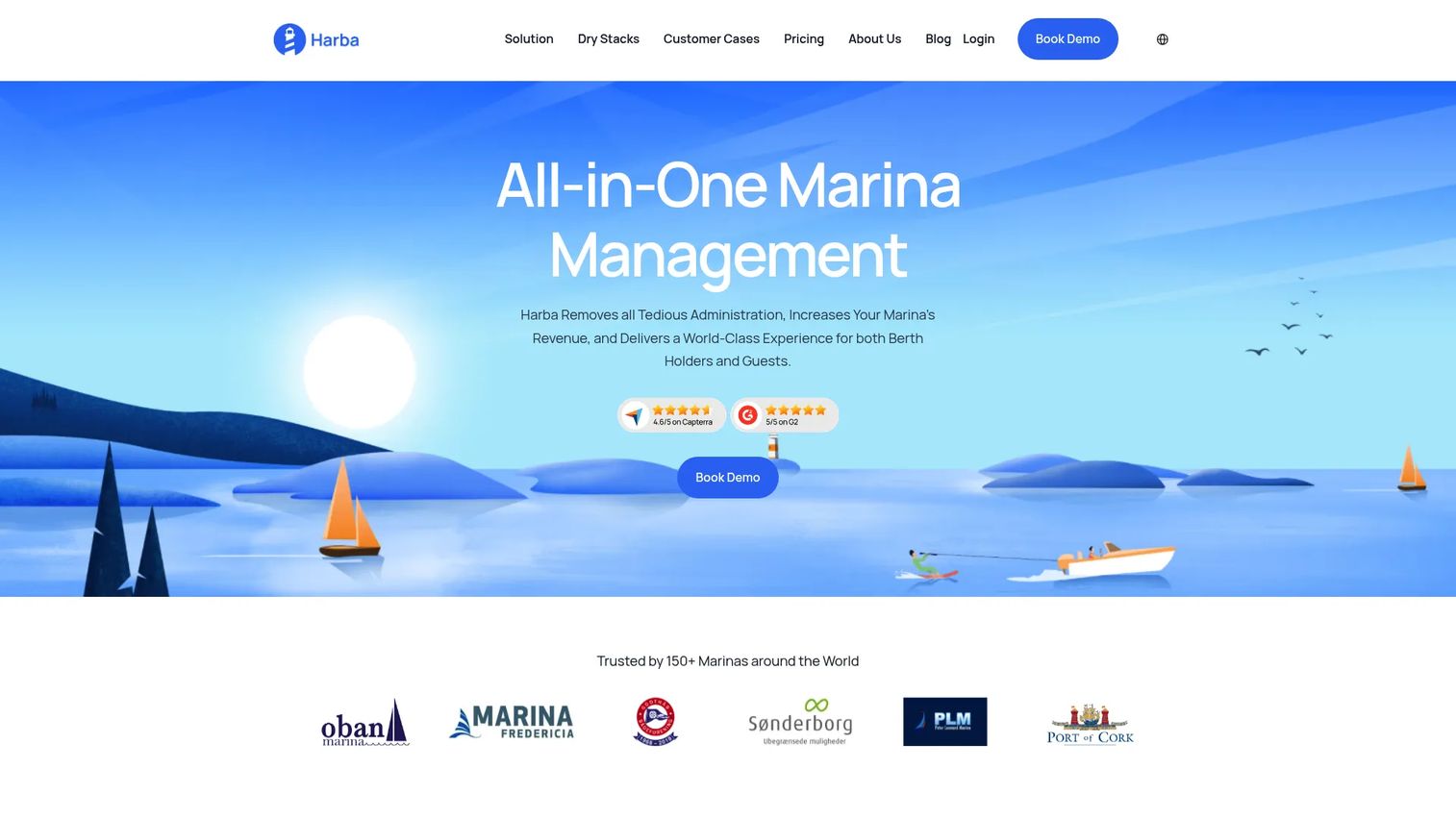
HarbaMaster is an all-in-one marina management platform for managing berth holders, guests, invoicing, payments, access, and related operations. Its CRM covers berths, boaters, and vessels. The platform includes a marina map and berth assignment tools, guest berth management with booking and payments via HarbaApp, invoicing automation, accounting and hardware integrations, and the ability to add ancillary products and services to customer accounts.
Best for: Marinas and yacht clubs seeking a modern cloud system with transparent, per-spot pricing and a clear path from trial to full rollout.
Key features
- CRM for berths, boaters, and boats
- Marina map and berth space assignment
- Invoicing and billing automation
- Guest berth booking and payments through HarbaApp
- Accounting and hardware integrations
Why choose HarbaMaster: Its published pricing structure is rare in this category, which makes budget planning straightforward before the demo. It carries the highest G2 rating on this list. Validate POS, fuel, and multi-location capabilities against your must-have list before committing.
HarbaMaster pricing: The Growth plan starts at €2,700 per year plus €5 per spot per year. The Professional plan is €6,000 per year plus €5 per spot per year. Enterprise pricing is available on request. One-time onboarding costs €1,350 and integration setup costs €400, with an annual integrations subscription of €270.
G2 rating: 5.0/5
7. Total Marina Package
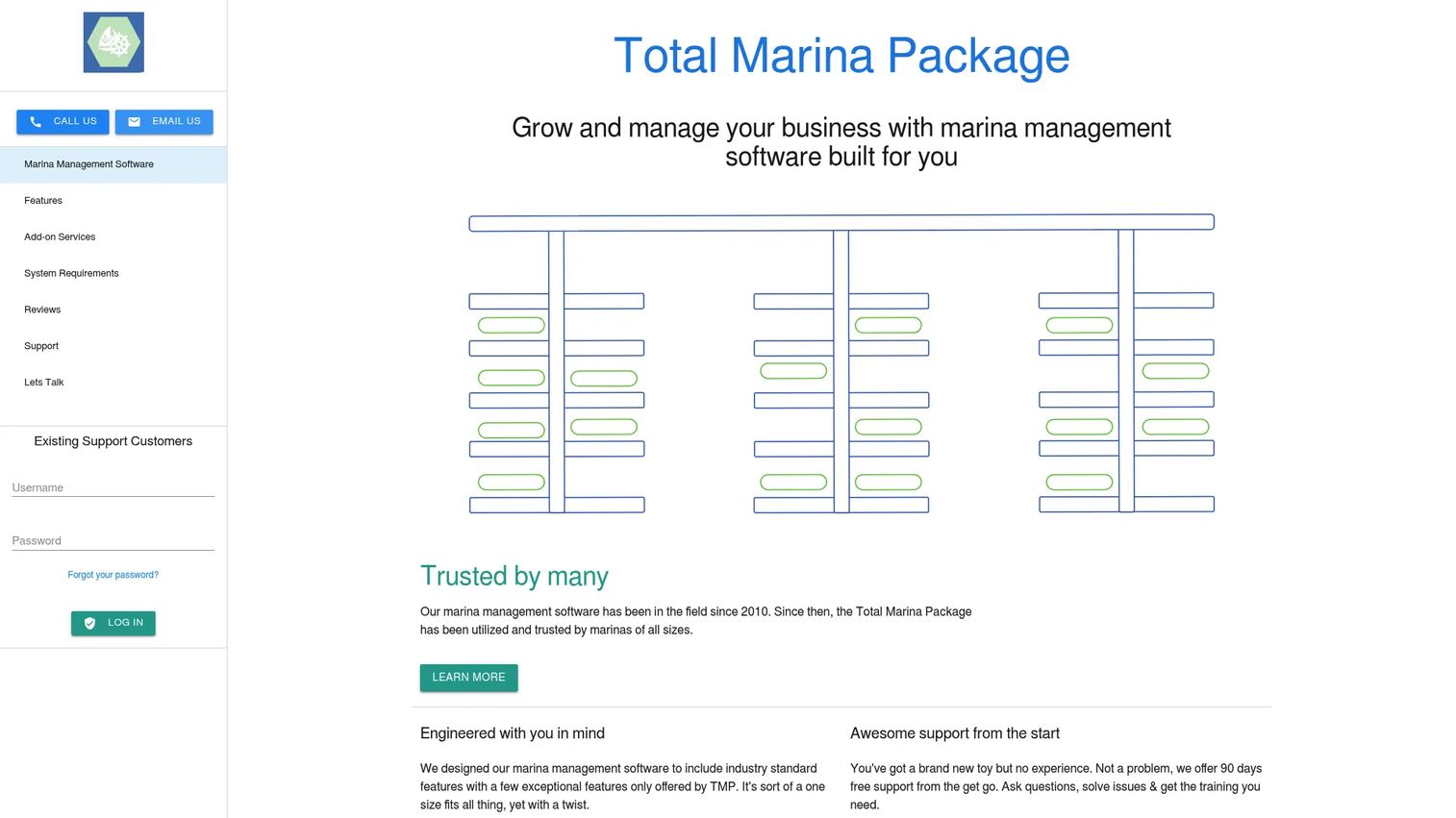
Total Marina Package is an enterprise-level marina management system for marinas, ports, harbors, and yacht clubs. Its core strengths are customer data, reservation management, flexible billing rules, and reporting depth. The platform includes over 200 report variations, in-application email communication, online bill pay, optional auto-pay integrations, and custom software modifications.
Best for: Marinas and yacht clubs that prioritize deep billing flexibility, reporting depth, and standard operational workflows without complex boatyard requirements.
Key features
- Interactive visual marina slip management with occupancy statuses
- Customer data, reservations, and document management
- Flexible billing rules and multiple payment methods
- More than 200 reports
- Online bill pay and optional auto-pay integrations
Why choose Total Marina Package: The reporting depth is the argument for it. If your team runs regular occupancy, revenue, and aging reports and needs custom billing rules for different customer categories, this platform earns its evaluation. For operations with heavy service-yard complexity or fuel dock requirements, test those modules specifically during the demo.
Total Marina Package pricing: Total Marina Package does not display pricing on its website. Contact the vendor for a quote.
G2 rating: 3.5/5
8. MARINAGO
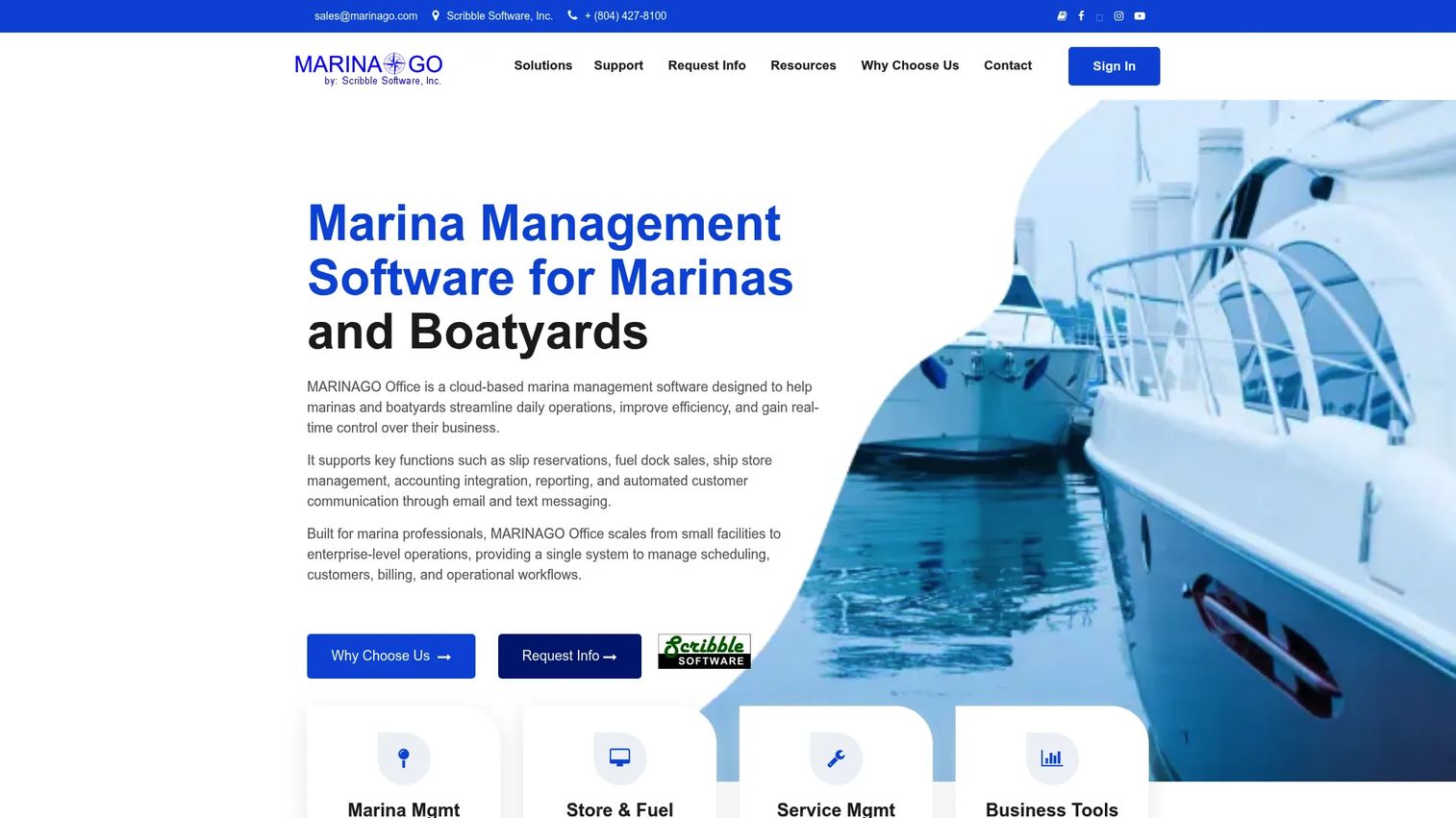
MARINAGO is a cloud-based marina management platform covering reservations, slip management, fuel dock management, point-of-sale, boat service work orders, billing, invoicing, customer portals, e-signature contracts, accounting integration, enterprise reporting, and customer communications. Its operational model connects front office, dock staff, fuel dock, and service operations in one system.
Best for: Marinas and boatyards that want a connected cloud platform reducing handoffs across departments.
Key features
- Marina location and slip management with visual property maps
- Reservations, billing, invoicing, e-signature contracts, and customer portal
- Fuel dispenser integration, pay-at-pump fueling, and inventory control
- Boat service work orders and technician portal
- Accounting integration, enterprise reporting, and email/text messaging
Why choose MARINAGO: The key test is cross-department reporting. Ask for a demonstration of how fuel, service, and slip billing data reconcile without manual exports. If that flow works cleanly in the demo, it deserves a serious evaluation.
MARINAGO pricing: MARINAGO does not display pricing on its website. Quote drivers include the number of locations, modules, user roles, and onboarding services. Contact the vendor directly.
9. DocksBase
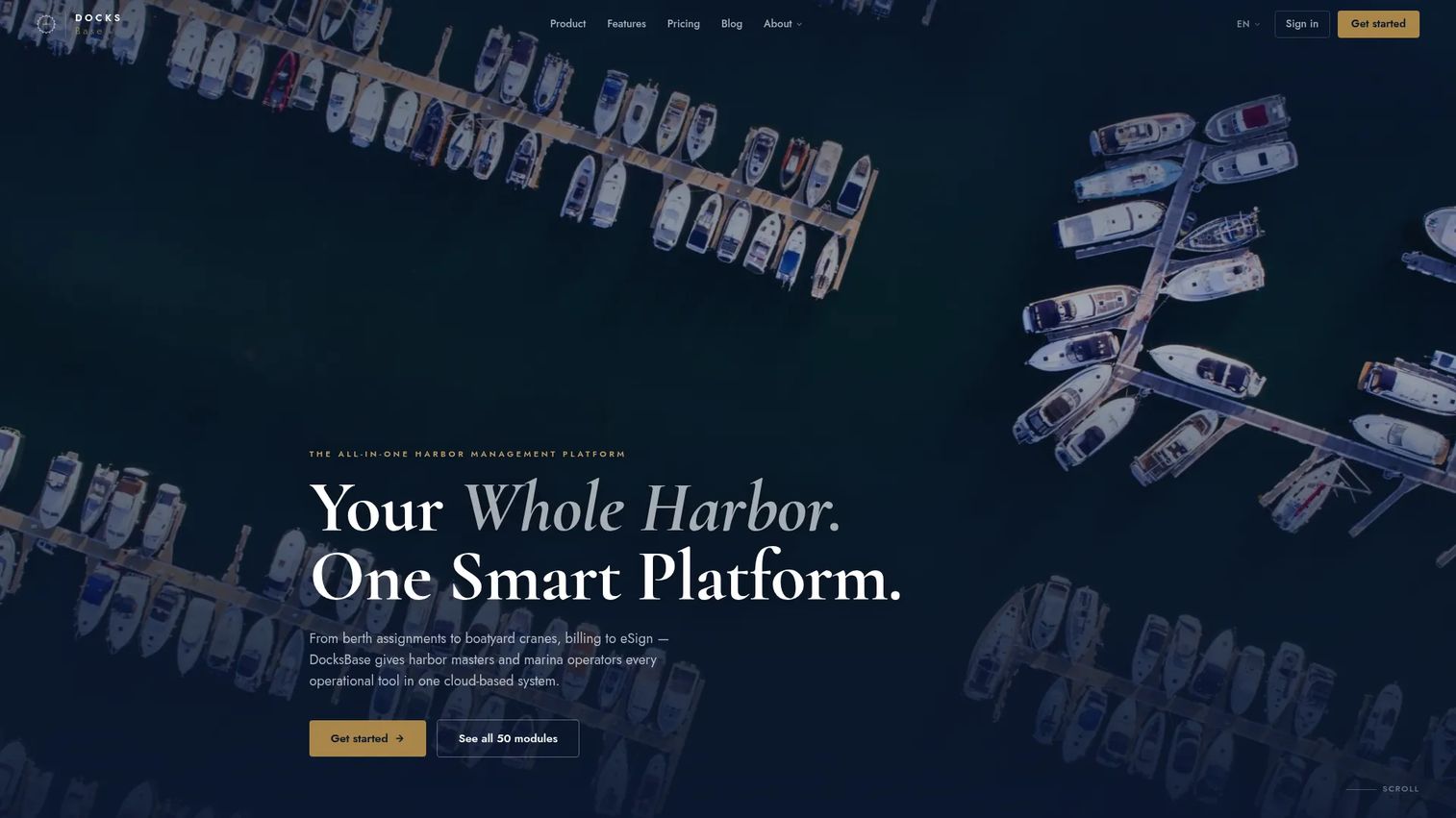
DocksBase is a cloud-based harbor and marina management platform covering berth operations, bookings, billing, boatyard workflows, and boater services. It offers a real-time berth map, automated invoicing and utility billing, an online booking engine with automatic berth allocation, boatyard work orders and haul-out queue management, dry storage management, a white-label boater portal, and a mobile field app.
Best for: Modern harbors and berth operators that want an all-in-one cloud environment with a visible customer-facing layer and transparent plan-based pricing.
Key features
- Real-time berth map and occupancy management
- Online booking engine with automatic berth allocation
- Automated invoicing, utility billing, and payment processing
- Boatyard work orders, haul-out queue, and dry storage management
- White-label boater portal and mobile field app
Why choose DocksBase: Its plan-based pricing structure (unlike most platforms on this list) makes it possible to evaluate fit before a sales conversation. Confirm regional payment processing availability, accounting integrations, and local tax requirements. Harbor operations vary significantly by geography.
DocksBase pricing: The Marina plan is €299/month (€249/month billed annually). Marina Pro is €599/month (€499/month billed annually). Marina Enterprise is €1,299/month (€1,083/month billed annually). Group pricing for multiple marinas is available on request. Plans are sized by berth count.
10. SlipBoss
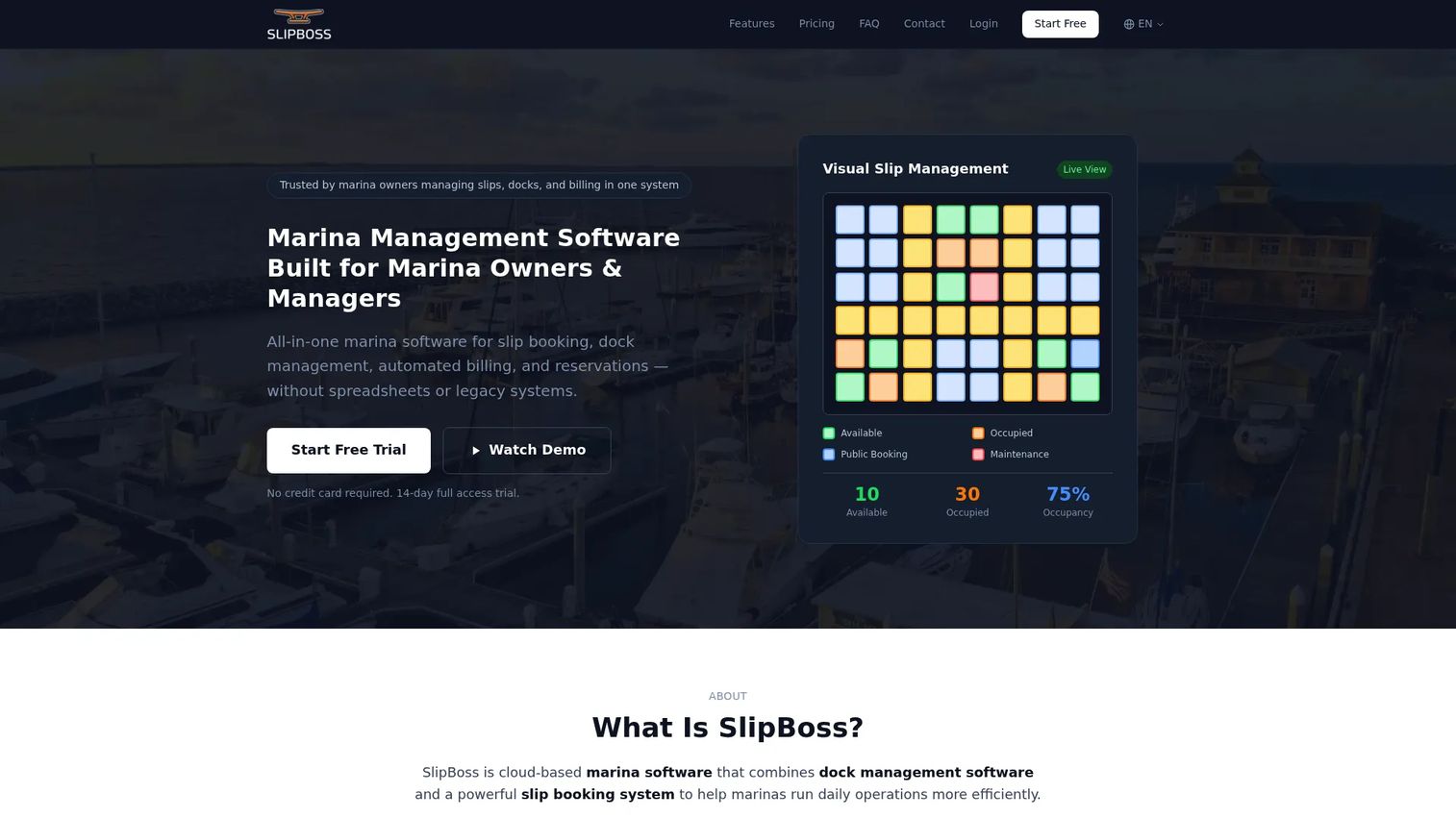
SlipBoss is a cloud-based marina management platform covering slip booking, dock management, automated billing, reservations, customer records, reporting, and financial operations. Its free plan supports up to 30 slips, making it one of the few platforms on this list where a marina can start without a contract. Paid tiers add unlimited slips, financial management, POS, and equipment rental management.
Best for: Smaller marinas replacing spreadsheets and disconnected billing tools, with a path to more capable tiers as the operation grows.
Key features
- Visual slip management and online booking with Stripe payments
- Automated monthly billing and deposit management
- Owner and vessel management with customer records
- Point of Sale and QuickBooks-compatible CSV export
- Equipment rental management (Ultimate plan)
Why choose SlipBoss: The free plan lets you validate the core workflow before spending anything. Test the limits before selecting it for a growing operation: Seasonal contracts, recurring utility bills, fuel pump integration, service work orders, and multi-location support all matter if your marina adds complexity over time.
SlipBoss pricing: The Free plan covers up to 30 slips at no cost. The Pro plan is $100/month with unlimited slips and expanded booking features. The Ultimate plan is $250/month and adds financial management, POS, billing, and equipment rentals. Enterprise pricing is available for custom integrations and dedicated support.
11. MarinaWare
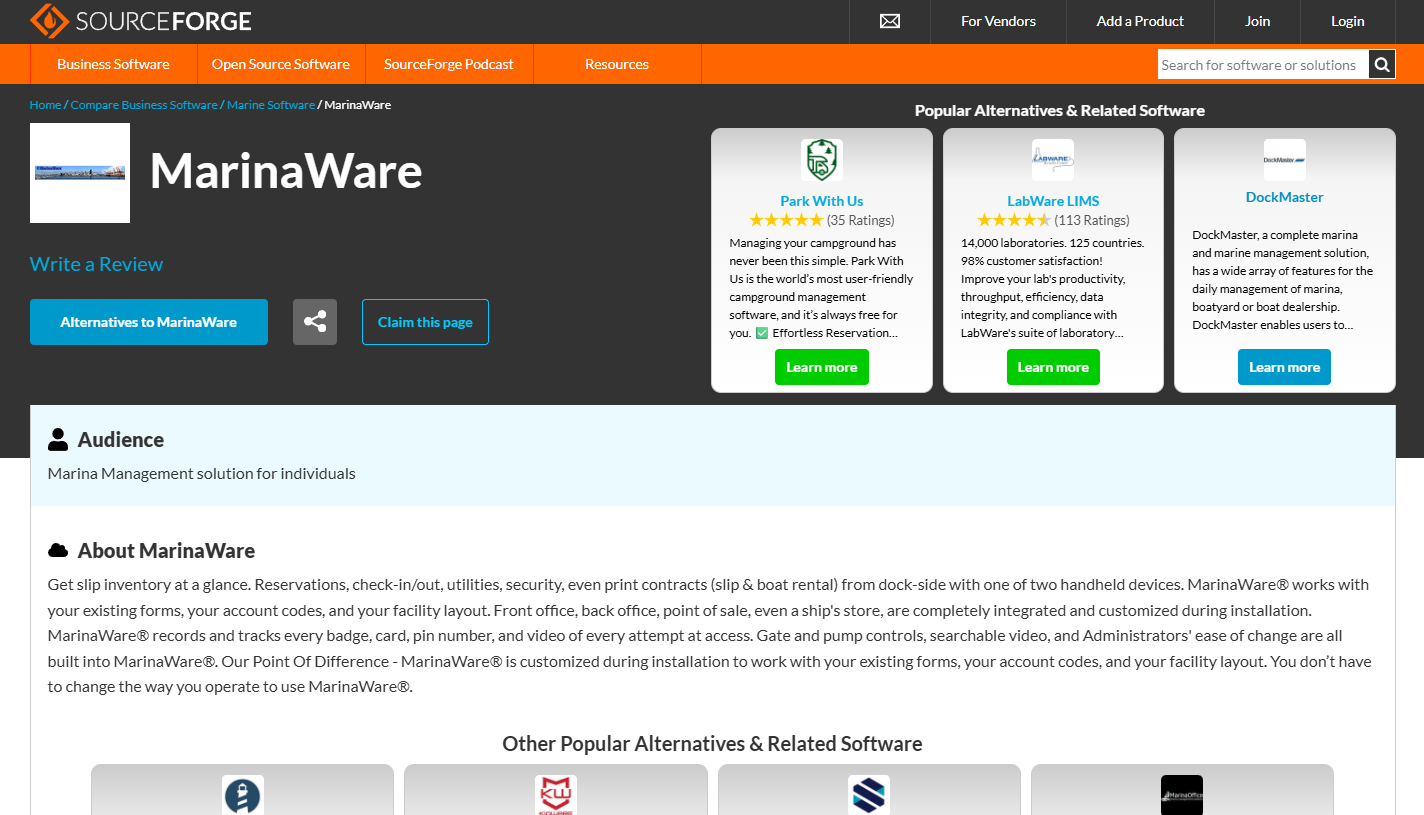
MarinaWare is a marina management option aimed at small teams needing accessible dockside administration and core marina workflow coverage. Based on available information, it covers slip and reservation administration, dockside staff workflows, customer management, and billing support.
Best for: Smaller marina teams seeking accessible dockside administration without needing a complex boatyard, fuel dock, or retail suite.
Key features
- Slip and reservation administration
- Dockside staff workflows
- Customer management
- Billing support
- Small-marina operational fit
Why choose MarinaWare: It can suit a smaller property that needs more structure than spreadsheets but does not run complex service or retail operations. Before selecting it, pressure-test integrations, advanced reporting, and scalability beyond a single site. Note that the vendor's website was inaccessible during research, so contact the vendor directly to verify current capabilities and pricing.
MarinaWare pricing: MarinaWare does not display pricing on its website. Contact the vendor for current pricing details.
12. Speedy Dock
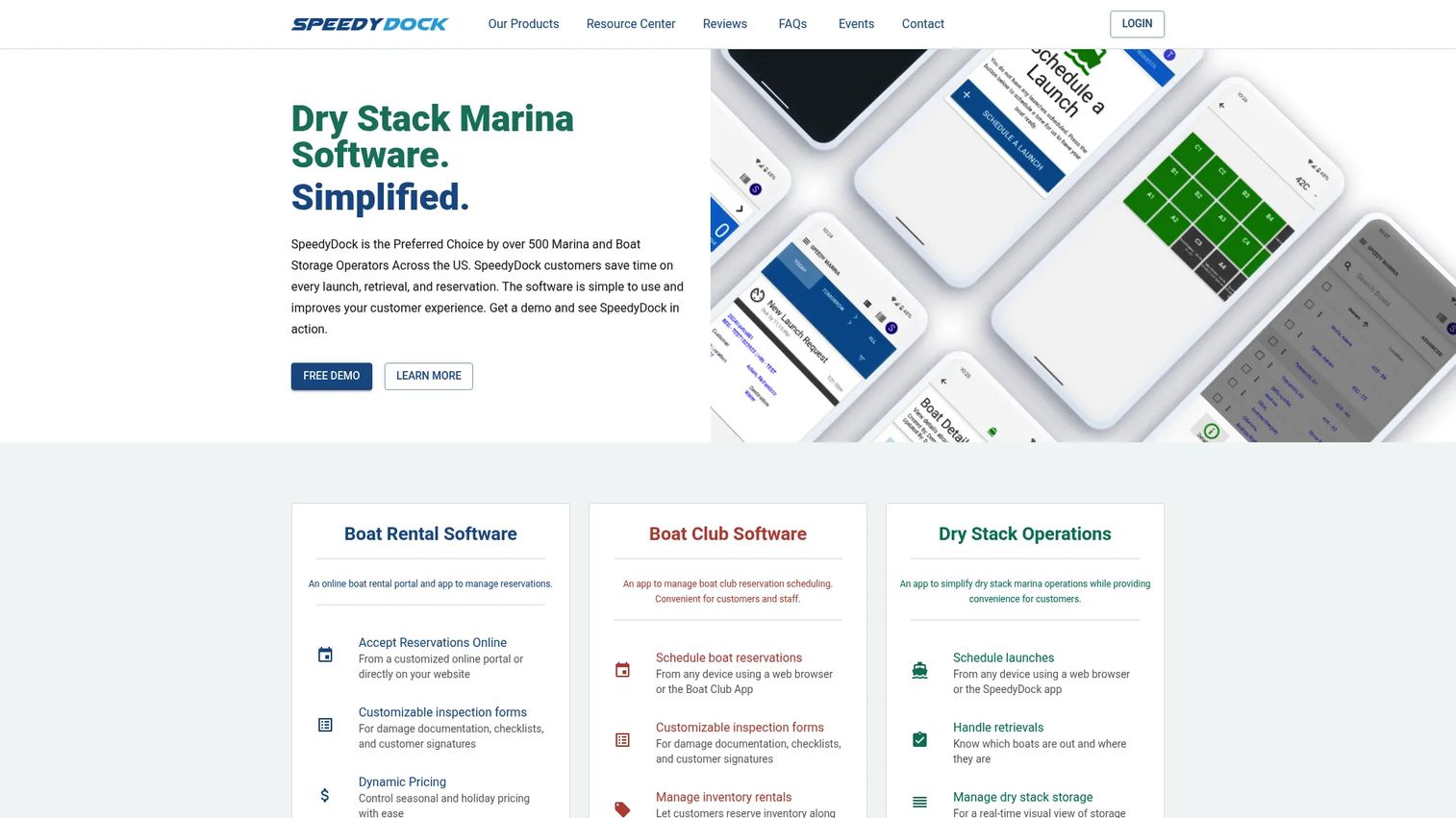
Speedy Dock serves dry-stack marinas, boat clubs, boat rental operators, and slip-reservation businesses. Its core strength is launch and retrieval coordination: Online boat and slip reservations with real-time availability, dry-stack launch and retrieval scheduling, boat-location tracking, digital waivers, inspections, automated communications, payment processing, and QuickBooks synchronization. Launch-heavy facilities have a fundamentally different operating bottleneck from wet-slip marinas, and Speedy Dock is built around that bottleneck.
Best for: Dry stacks, boat clubs, and marinas where launch requests and retrieval scheduling drive daily staff workload and customer experience.
Key features
- Online slip and boat reservations with real-time availability
- Dry-stack launch, retrieval, and boat-location tracking
- Digital waivers, inspections, and automated communications
- Payment processing and QuickBooks synchronization
- Customer request workflows for launch coordination
Why choose Speedy Dock: If coordinating the launch queue is the highest-friction workflow in your operation, this platform addresses it directly. Assess whether you need a specialist launch tool alongside a broader marina platform, or whether Speedy Dock's scope covers enough of your other workflows to stand alone.
Speedy Dock pricing: The Dry Stack Marina Software plan starts at $200/month. Pricing is customized and may vary by business needs. Contact the vendor for a full quote.
Considerations when choosing marina management software
Match the platform to your operating bottleneck
A transient marina and a full-service boatyard do not share the same center of operational gravity. Build your requirements list from the workflows that create revenue leakage, staff overtime, or customer disputes. The platform that solves your highest-friction workflow is the right starting point.
Audit the billing workflow before the final decision
Billing is where bad implementation decisions become expensive. Before signing anything, confirm how the platform handles recurring charges, partial payments, utility billing, refunds, ACH, aging reports, and accounting exports. A billing gap discovered after go-live costs far more than a longer evaluation cycle.
Test deployment under your actual connectivity conditions
Cloud access improves mobility and reporting, but unreliable internet changes the calculus. Ask exactly what functions still work during an outage, what syncs automatically when connectivity returns, and how fuel, POS, and dockside updates behave when the connection drops.
Plan data migration before the demo cycle ends
Do not wait until contract review to ask about customer records, vessel details, historical invoices, service history, inventory, and chart-of-accounts data. Migration scope often determines real implementation effort and timeline more than feature configuration does.
Demand reporting that matches how you run the business
Skip the generic dashboard tour. Ask to see occupancy by slip type, revenue by department, aging by customer segment, fuel margin, service backlog, and launch volume. If the vendor cannot produce those views during the demo, assume they are not easy to produce after go-live.
If you sell marina management software and want to show a reservation or work-order workflow to prospects without provisioning a live customer environment, an interactive demo can handle that use case. This is a product marketing tool for software vendors, not a substitute for the marina platform itself. Related resources on payment processing and vertical software evaluation are available on Guideflow's blog, along with coverage of adjacent categories like boat rental management software.
Conclusion
The best marina management software is the one that addresses your highest-friction workflow first. Start there, not with a generic feature checklist.
DockMaster is the strongest candidate for broad marine ERP coverage across marinas, boatyards, service departments, inventory, and marine sales. Dockwa leads for transient reservation and revenue management. Scribble Software deserves a look when cloud and desktop deployment are both on the table. Molo and DocksBase suit operators building cloud-native workflows from the ground up. HarbaMaster offers rare pricing transparency in a category that otherwise routes everything through a sales conversation. SlipBoss gives smaller operations a free starting point with a clear upgrade path. Speedy Dock belongs on the shortlist for any facility where launch and retrieval coordination drives daily operations.
Before your first vendor call, identify the workflow that causes the most operational friction or revenue leakage. Then ask each vendor to walk through that specific scenario using your business rules. That one exercise will tell you more than any feature matrix.
Start your journey with Guideflow today!
FAQs
Marina management software centralizes marina operations including slips, reservations, contracts, billing, payments, fuel, point of sale, customer records, service work, and reporting. Most platforms cover the core modules, but the depth of each module varies significantly by vendor. A reservation-first tool and a full marine ERP may both be called "marina management software," so evaluating module depth against your specific workflows matters more than category labels.
At minimum: Slip and berth management, online reservations, digital contracts, billing and payment processing, customer records, and basic reporting. Beyond that, the priority shifts by operation type. Boatyards need work orders, technician scheduling, and parts inventory. Fuel docks need pump integration, tax handling, and reconciliation. Mixed-use properties need POS and unified billing across departments. Build your must-have list from the workflows that currently create errors or delays.
Boatyards should prioritize work orders, labor tracking, technician scheduling, estimates, parts inventory, customer approvals, and haul-out scheduling connected to accounting. DockMaster, Scribble Software, and MARINAGO all cover boatyard service workflows. Test the full service cycle in the demo, including parts ordering, labor entry, customer approval, and final invoicing, before making a shortlist decision.
Dry-stack operators should focus on launch requests, retrieval scheduling, queue visibility, member or customer communication, reservation rules, and mobile staff workflows. Speedy Dock is built specifically for this operating model. If the facility also manages recurring contracts or complex billing, confirm whether Speedy Dock's financial features meet the need or whether integration with a separate billing tool is required.
Many platforms support fuel dock sales, inventory, pump integration, tax handling, pay-at-pump workflows, and ship-store POS. Dockwa, Scribble Software, MarinaOffice, and MARINAGO all include fuel and POS capabilities. Verify hardware compatibility and reconciliation reporting during the demo. The key question is whether fuel transactions reconcile to the same customer account as slip charges without a manual export.
Pricing in this category is driven by the number of locations, modules selected, user count, slip or berth count, hardware requirements, implementation scope, and payment processing arrangements. Platforms with published pricing include Dockwa (from $0/month for the free Leads plan, with paid modules from $99 to $249/month), SlipBoss (free to $250/month), DocksBase (from €299/month), and HarbaMaster (from €2,700/year). Most other platforms in this guide sell through a quote process.
Cloud software supports browser and mobile access, remote reporting, automatic updates, and easier multi-location oversight. Desktop or locally hosted options remain relevant where internet connectivity is unreliable or where legacy workflows require it. Scribble Software offers both paths. Before deciding, ask vendors specifically what functions require connectivity, how offline data syncs when the connection returns, and who manages updates and backups under each deployment model.
Several platforms on this list support accounting integrations. Scribble Software integrates with both QuickBooks and Sage Intacct. MarinaOffice includes QuickBooks integration. Speedy Dock syncs with QuickBooks. SlipBoss exports QuickBooks-compatible CSV files. For deeper integrations, confirm whether the connection handles invoices, payments, refunds, customer records, and inventory in both directions, and whether it requires a third-party connector or is built into the platform.
Ask the vendor to demonstrate your highest-friction workflow using your business rules, not a scripted product tour. Specific questions worth posing: How does seasonal billing handle mid-season slip changes? What happens to fuel and POS transactions during an internet outage? Can I see the aging report filtered by customer type? How long does customer record migration typically take? What is the process for updating a contract template after go-live?