

You bought a shiny origination tool last year. Then a separate servicing system. Then a spreadsheet to reconcile the two. Now every new loan product means another integration ticket, another vendor call, another thing to babysit.
That is the real problem with evaluating lending software. It is not feature count. It is whether one platform can run origination, underwriting, servicing, collections, and reporting without turning your operations into a stack of brittle point solutions taped together.
The stakes are getting higher. The digital lending platform market hit USD 10.55 billion in 2024 and is projected to reach roughly USD 13.1 billion in 2026, growing at a 27.7% CAGR through 2030, according to Grand View Research (2025). More lenders are modernizing, and the ones who pick a fragmented loan management system pay for it later in reconciliation drift, slow launches, and audit headaches.
This guide is built for founders and operators who need a repeatable lending operation, not a hero-driven workaround. We look at six platforms through a founder-friendly lens: lifecycle coverage, integration depth, implementation speed, and whether the tool reduces operational drag enough to support efficient growth.
What's inside
This guide is for founders, operators, and lending leaders shortlisting a loan management software platform in 2026. It covers six tools that span origination through servicing.
We selected each tool based on four criteria:
- Lifecycle coverage: how much of origination, underwriting, servicing, collections, and reporting it handles
- Integration depth: core banking, payments, KYC, data providers, and accounting
- Implementation speed: go-live model, migration support, and configuration effort
- Security and compliance: governance features that survive board and audit scrutiny
Pricing and ratings shift often, so verify both live before you commit.
TL;DR
- Best all-in-one loan software for lenders: LoanPro, for API-first origination through servicing in one system
- Best for fast deployment and broad lending automation: TurnKey Lender, for AI-driven decisioning across many verticals
- Best for large banking and corporate lending: Finastra, for lending plus adjacent banking workflows at institutional scale
- Best for structured, scalable lending operations: Pennant Technologies, for banks and credit unions modernizing end to end
- Best for institutional digital lending programs: Nucleus Software, for complex bank lending and transaction banking
- Best for configurable multi-lender flexibility: HES FinTech, for lenders needing workflow control across segments
What is lending software?
Lending software is the platform that automates the loan lifecycle: origination, underwriting and decisioning, servicing, repayment scheduling, collections, and reporting. It replaces manual workflows and disconnected point tools with one operational spine.
The category has confusing labels, so here is the plain version. A loan management system or loan management software handles the loan after it is booked: servicing, repayments, and account maintenance. A digital lending platform or lending platform software usually covers the front end too, from application intake through decisioning. Loan servicing software is the narrower slice focused on repayment, statements, and account operations. Most vendors now blur these lines and sell a suite, which is why buyers get confused about what "all-in-one" actually means.
Core capabilities buyers should expect
A credible lending management system should cover:
- Origination and application intake: capture, document collection, and workflow routing
- Underwriting and decisioning: credit rules, scoring, and automated approvals
- Loan servicing and repayment scheduling: amortization, statements, and account management
- Collections and delinquency management: dunning, workflows, and recovery tracking
- Reporting, analytics, and compliance support: dashboards, audit trails, and regulatory reporting
- Integrations, APIs, and data exchange: core banking, payments, KYC, and accounting
- Product configuration and credit rule flexibility: installment, revolving, secured, and business loan products
Why this category is consolidating
Teams are tired of stitching five vendors together. Every seam is a place where data drifts, reconciliation breaks, and a new hire has to learn another login. Consolidating onto one operational spine cuts risk, speeds up new product launches, and gives leadership a single source of truth for weekly decisions. For a founder trying to prove the business scales without founder heroics, that consolidation is the whole point.
When to use lending software
Automate the lending lifecycle
You know it is time when your team spends more hours reconciling systems than serving borrowers. Manual origination, spreadsheet servicing, and email-based collections do not scale past a few hundred loans. Moving to a single automated lending platform removes the handoff friction between stages.
Support multiple loan products
Growth usually means more loan types. Installment loans, revolving credit, secured and unsecured lending, business lending, and auto lending each carry different rules and repayment logic. When your current tool cannot model a new product without custom code, you need a configurable lending platform that handles product variety natively.
Modernize integrations and reporting
Fragmented data is the silent killer. When you cannot answer "what is our delinquency rate this week" without exporting from three systems, decision-making slows to a crawl. Adopting digital lending solutions with strong APIs and unified reporting turns that answer into a dashboard, not a fire drill.
Comparison table
Use this as a quick shortlist tool, not a final verdict. Pricing and G2 ratings change, so confirm both on the vendor site and G2 before you decide.
| # | Product | Best for | Key differentiator | Pricing | G2 rating |
|---|---|---|---|---|---|
| 1 | LoanPro | Configurable enterprise lending and servicing | API-first suite across origination, servicing, collections, payments | Quote-based | 4.4/5 |
| 2 | TurnKey Lender | Fast go-live, broad lending automation | AI-powered end-to-end loan lifecycle | Quote-based | 4.9/5 |
| 3 | Finastra | Large banks and corporate lending | Lending plus adjacent banking workflows | Quote-based | 3.2/5 |
| 4 | Pennant Technologies | Structured, scalable lending operations | Low-code lending factory with agentic AI | Quote-based | 5.0/5 |
| 5 | Nucleus Software | Institutional digital lending programs | Digital lending plus transaction banking suites | Quote-based | Not listed |
| 6 | HES FinTech | Configurable multi-lender flexibility | AI-driven, configurable lending automation | Quote-based | 4.8/5 |
Best lending software tools for 2026
1. LoanPro
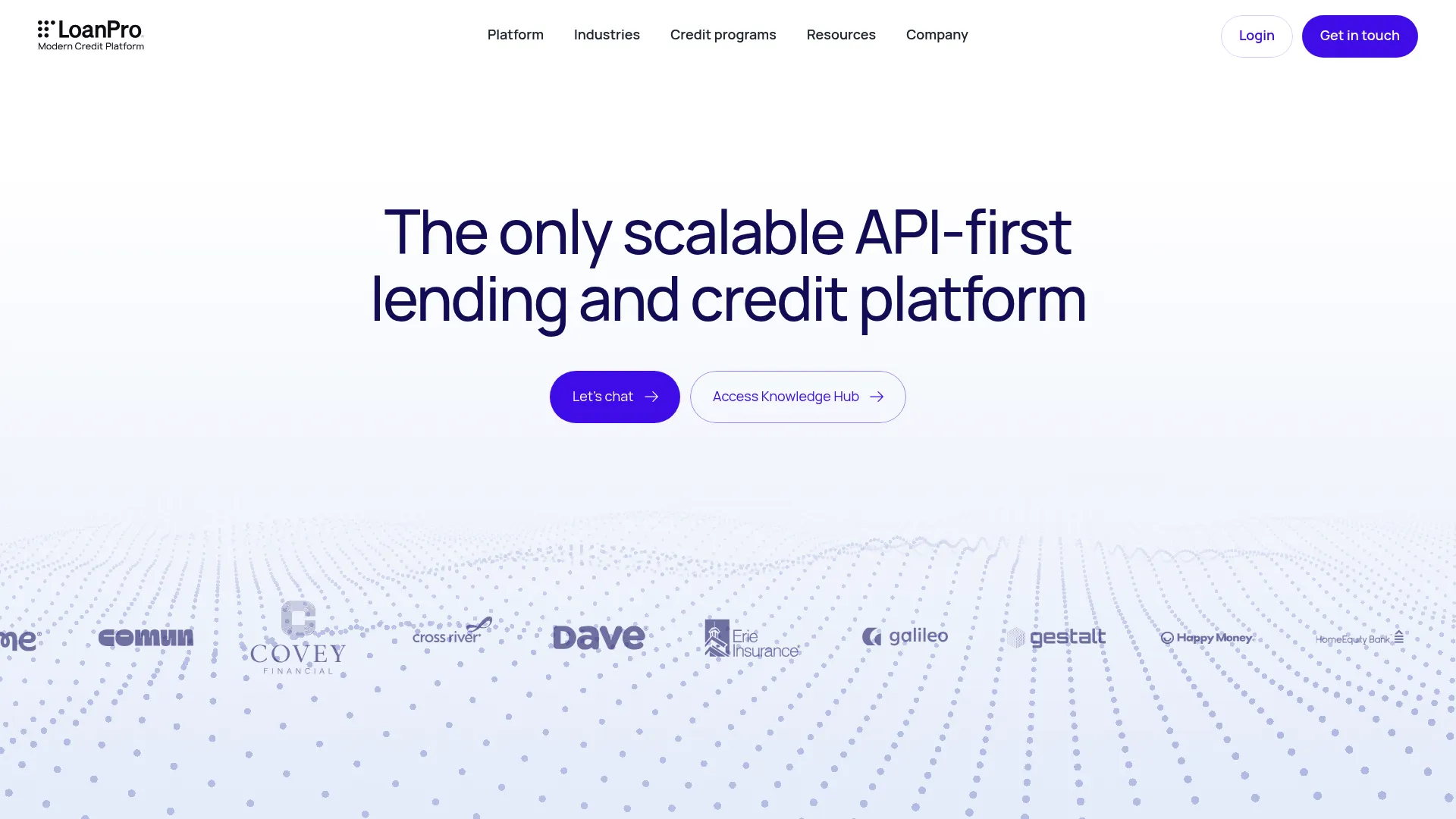
LoanPro is an API-first modern lending platform built to run origination, servicing, collections, and payments from one system. The composable, modular approach lets lenders and fintechs assemble the suite they need rather than buying a monolith. That architecture is why it fits teams that want a single spine for the full loan lifecycle instead of separate tools per stage.
Best for: Lenders and fintechs needing a configurable enterprise lending and servicing platform.
Key strengths
- API-first loan management system
- Origination, servicing, collections, and payments suites
- Borrower portal and automation workflows
Why choose LoanPro: If your growth plan involves adding loan products and connecting to your own stack, an API-first design keeps engineering in control without rebuilding for every new integration. It suits lenders that treat the platform as infrastructure, not a closed box.
LoanPro pricing: Pricing is quote-based. LoanPro says packages are determined by account volume and your service and support agreement, and directs prospects to sales.
2. TurnKey Lender
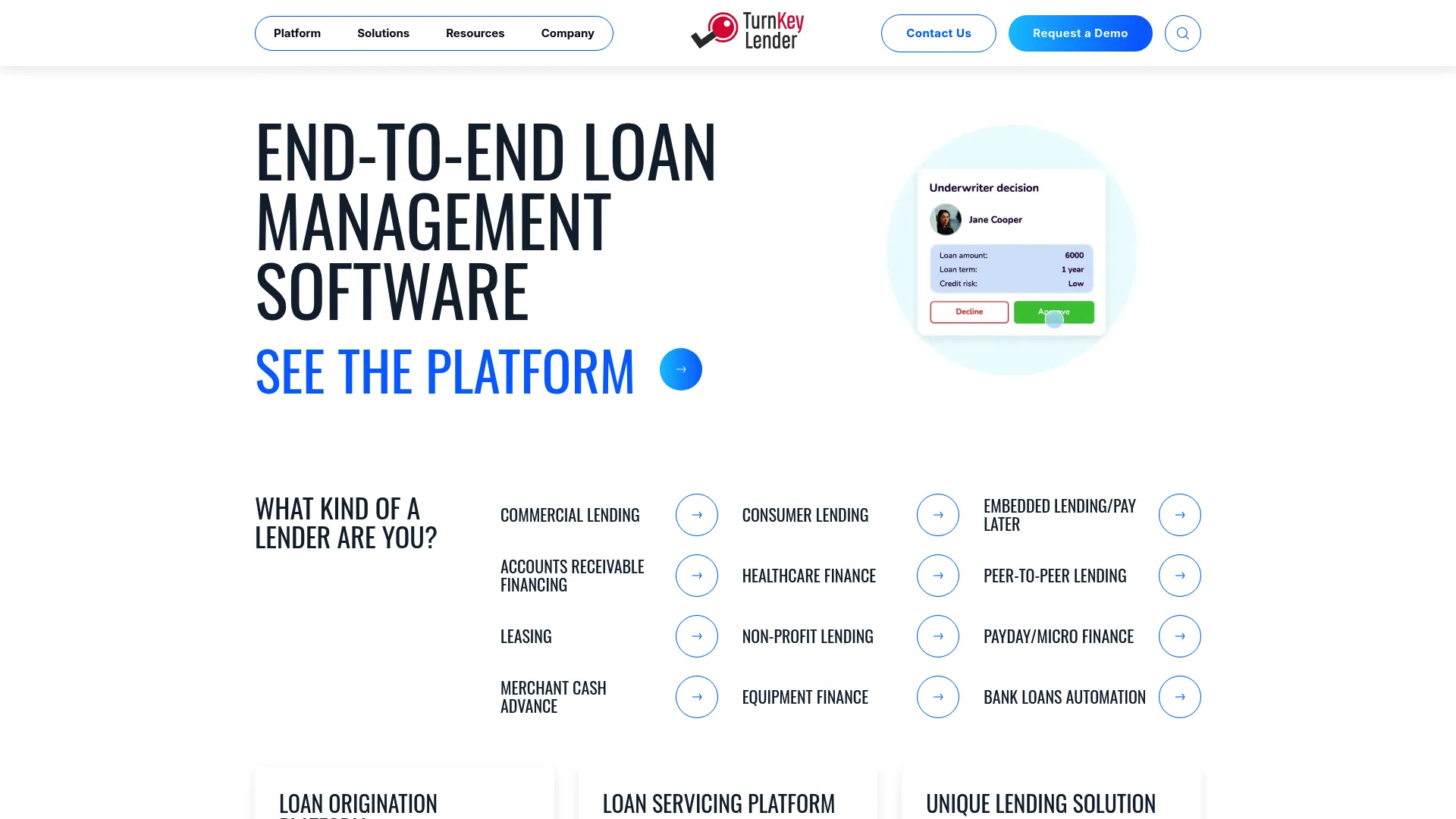
TurnKey Lender is a cloud-based lending automation platform for consumer and commercial lenders. It runs the full loan lifecycle with AI-powered credit decisioning, plus a flow builder and system configurator that let teams shape credit products without heavy custom development. That configurability is what earns its reputation for fast go-live across many lending verticals.
Best for: Lenders needing an AI-powered, end-to-end loan lifecycle platform.
Key strengths
- Loan origination, servicing, and debt collection
- AI-powered credit decisioning
- Flow builder and system configurator
Why choose TurnKey Lender: When speed to market matters and you want to launch new credit products without a long engineering cycle, the configurator and flow builder do the heavy lifting. It fits teams that value operational flexibility across consumer and commercial lending.
TurnKey Lender pricing: Pricing is not publicly listed. The company uses several licensing models based on portfolio size and platform functionality, and asks prospects to contact sales for a quote.
3. Finastra
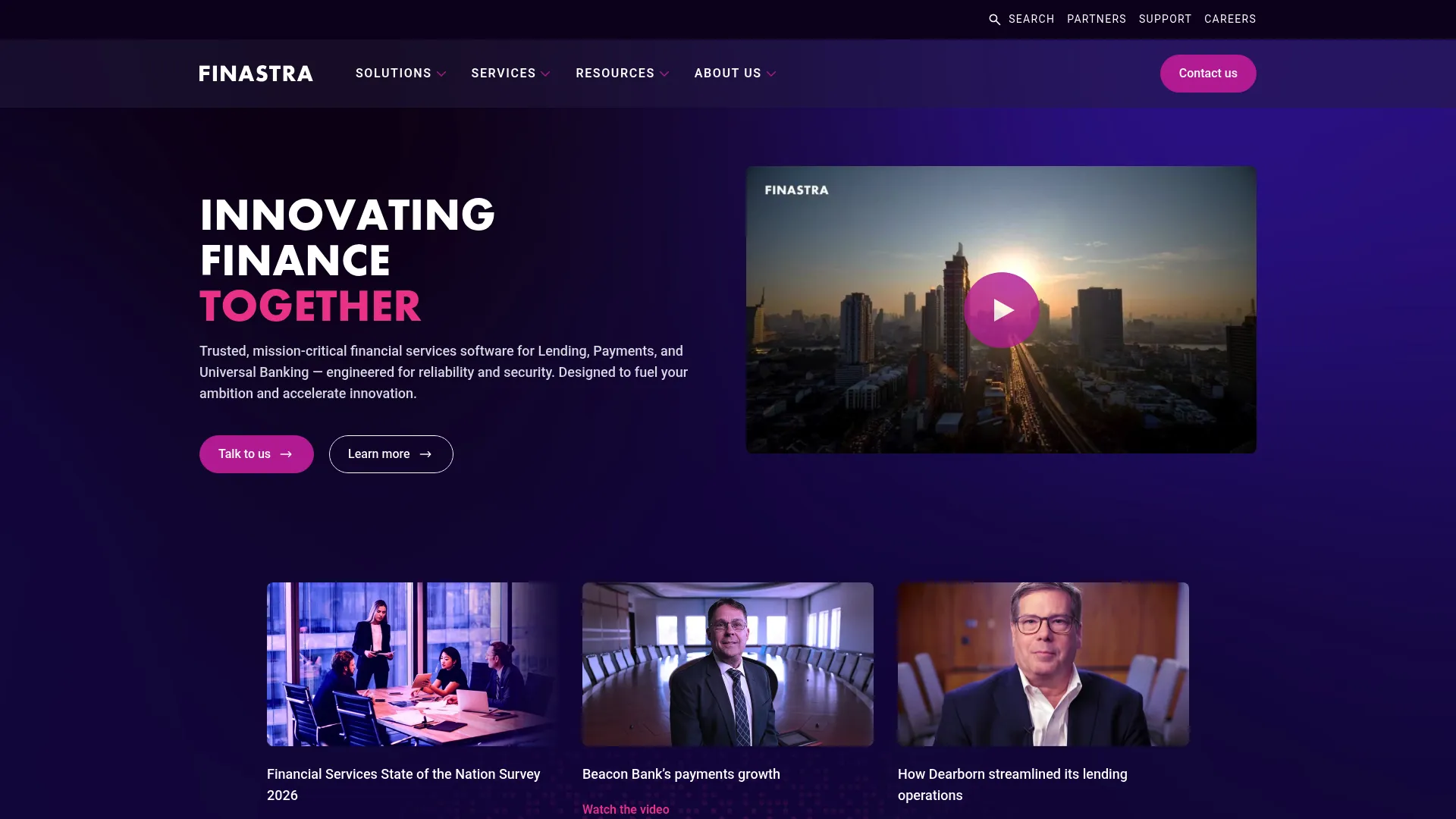
Finastra is a global financial software provider spanning banking, lending, payments, and treasury. Its lending footprint reaches beyond a single product into adjacent banking workflows, which is why larger institutions with complex operating environments tend to shortlist it. A retail lending solution store lets existing customers browse and buy products, and mortgage workflows connect point-of-sale to loan origination.
Best for: Banks and financial institutions needing lending, payments, and banking software in one provider.
Key strengths
- Retail lending solution store for browsing and buying products
- Mortgage lending workflows with POS-to-LOS integrations
- Payments, messaging, and core banking solutions
Why choose Finastra: If your operation is a bank that needs lending alongside payments and core banking, consolidating with one provider reduces vendor sprawl at institutional scale. It fits complex environments more than lean fintech teams.
Finastra pricing: Public pricing was not visible on the pages reviewed. Finastra describes a Solution Store for existing customers, but no public price list for core products was shown. Contact sales for a quote.
4. Pennant Technologies
Pennant Technologies builds AI-powered, API-driven lending software for banks and financial institutions. Its pennApps Lending Factory covers loan origination, management, and collections, while pennApps Studio adds a low-code, no-code, and pro-code platform for shaping lending workflows. An Agentic AI Studio layers AI into those workflows. The combination targets institutions modernizing structured, scalable lending operations.
Best for: Banks and financial institutions modernizing end-to-end lending operations.
Key strengths
- pennApps Lending Factory for origination, management, and collections
- pennApps Studio low-code, no-code, and pro-code platform
- Agentic AI Studio for AI-powered lending workflows
Why choose Pennant Technologies: If you need structured servicing depth and the flexibility to configure workflows without waiting on a full development cycle, the low-code and pro-code mix gives operations and engineering room to move. It fits banks and credit unions evaluating scalable lending.
Pennant Technologies pricing: No public pricing was verified on the vendor site. Contact the vendor to scope a quote for your institution.
5. Nucleus Software
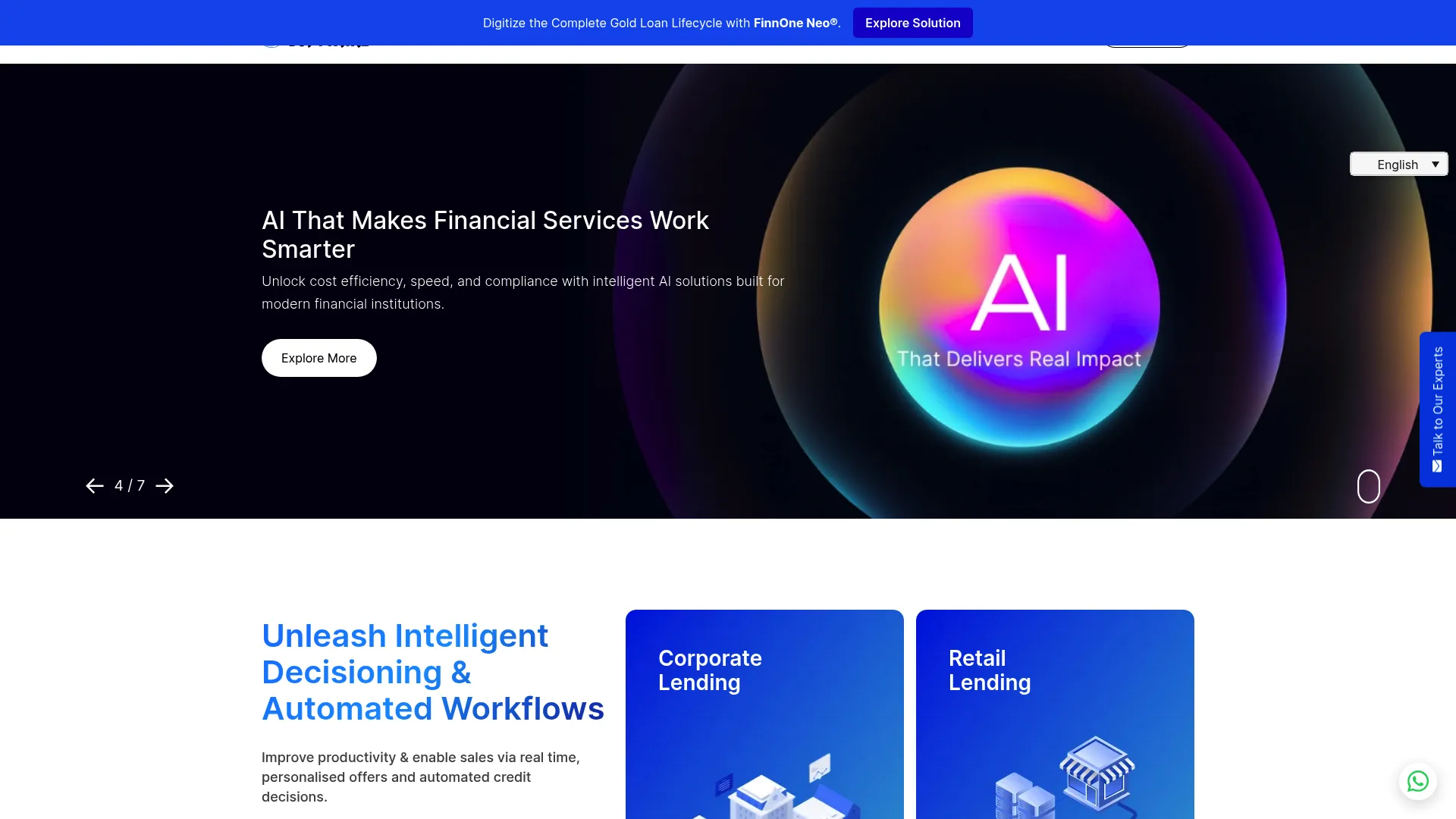
Nucleus Software provides digital lending and transaction banking software for financial institutions. Its FinnOne Neo digital lending suite handles credit workflows across the lifecycle, and FinnAxia covers transaction banking. API-backed, modular products let institutions run complex lending programs alongside broader banking automation. That breadth fits institutional lenders with real operational complexity.
Best for: Banks and financial institutions seeking lending or transaction banking software.
Key strengths
- FinnOne Neo digital lending suite
- FinnAxia transaction banking suite
- API-backed, modular banking and lending workflows
Why choose Nucleus Software: When your lending program sits inside a larger banking operation, having lending and transaction banking from one provider reduces integration surface area. It fits institutional programs that need depth across credit and banking workflows.
Nucleus Software pricing: No public numeric pricing was found on the vendor site. The AWS Marketplace listing provides pricing after registration, so contact the vendor to scope your needs.
6. HES FinTech
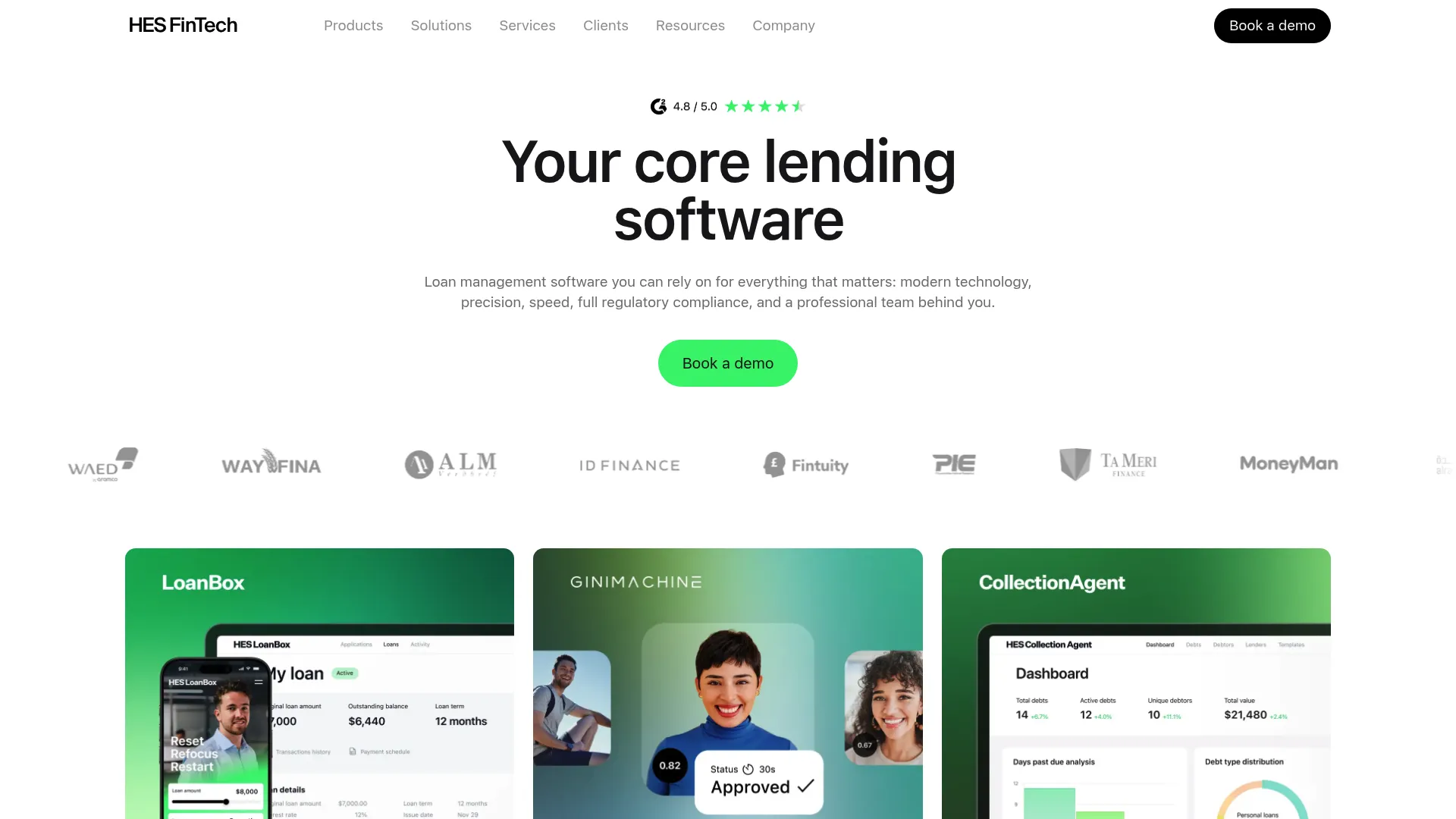
HES FinTech is a lending software company offering LoanBox and related AI-driven lending automation products. It covers end-to-end origination and servicing, AI-powered credit decisioning and scoring, and debt collection with workflow automation. Configurable workflows and integration support make it a fit for lenders that operate across multiple segments and loan products.
Best for: Banks, fintech lenders, and other financial institutions needing configurable lending automation.
Key strengths
- End-to-end loan origination and servicing
- AI-powered credit decisioning and scoring
- Debt collection and workflow automation
Why choose HES FinTech: If flexibility across segments matters more than a rigid template, the configurable workflows let you adapt the platform to how you actually lend. It fits lenders that need control over products and processes without heavy custom builds.
HES FinTech pricing: Pricing is not publicly displayed. HES FinTech says cost depends on the chosen plan and optional features, and directs prospects to contact sales.
Considerations
How much of the lending lifecycle does it cover?
Partial tools create stack sprawl. If a platform handles origination but not servicing, or servicing but not collections, you are back to integrating vendors and reconciling data across seams. Map your full lifecycle before you buy, then check where each platform starts and stops. Full lifecycle coverage matters most when volume is rising and manual handoffs are already breaking.
Can it handle your loan products?
Different products carry different logic. Installment, revolving, secured, unsecured, business, auto, and mortgage-adjacent lending each need their own rules and repayment behavior. Ask the vendor to model your actual products in a trial, not a generic template. If launching a new product requires custom code every time, that friction compounds as you grow.
How strong are integrations and APIs?
Your lending platform lives inside a larger stack. Check for real integrations with core banking, data providers, payments, KYC, and accounting. API-first platforms give your engineers control and keep new connections from becoming multi-week projects. Weak integration depth is where "all-in-one" promises quietly fall apart.
What does implementation really look like?
Ask hard questions about go-live. What is the migration path from your legacy system? How much configuration is required before launch? What training does your team need? Vendors that talk about fast go-live should show you the actual model, including data migration and configuration effort, not just a marketing claim.
How is security and compliance handled?
Treat this as a risk check, not a checkbox. Confirm audit trails, access controls, data protection, and regulatory reporting support. For a founder, clean compliance handling is what lets metrics and operations survive board scrutiny and due diligence. Ask how the platform handles the specific regulations your lending business faces.
Conclusion
The right lending software depends on your operating model, not a generic ranking. LoanPro fits lenders that want an API-first spine across the full lifecycle. TurnKey Lender suits teams prioritizing fast go-live and broad automation. Finastra fits large banks needing lending plus adjacent banking. Pennant Technologies and Nucleus Software fit institutions modernizing structured or complex lending programs. HES FinTech fit lenders that need configurable flexibility across segments and products.
The next step is not another demo call. It is building a shortlist around your actual lifecycle stages, your loan products, and your integration requirements. Score each platform on lifecycle coverage, integration depth, implementation speed, and governance. Then run a trial that models your real products, not a generic template. That is how you pick a loan software for lenders that reduces operational drag instead of adding another system to babysit.
FAQs
Lending software is the platform that automates the loan lifecycle, including origination, underwriting, servicing, repayment scheduling, collections, and reporting. It replaces manual workflows and disconnected point tools with a single operational system. Modern lending software solutions also add API integrations, analytics, and compliance support.
Loan management software typically covers the loan after it is booked, including servicing, repayment scheduling, and account maintenance. Loan servicing software is a narrower slice focused on repayments, statements, and account operations. A full lending management system usually spans origination through servicing in one platform.
A strong lending platform should include origination and application intake, underwriting and decisioning, servicing and repayment scheduling, collections, and reporting. It should also offer integrations with core banking, payments, KYC, and accounting. Product configuration flexibility matters if you plan to launch multiple loan types.
Most modern platforms use APIs to connect with core banking, payment rails, KYC and identity providers, credit bureaus, and accounting tools. API-first architectures make these connections faster to build and easier to maintain. Always confirm which specific integrations exist out of the box versus which require custom work.
AI in lending software often powers credit decisioning, scoring, and risk assessment, which can speed approvals and improve consistency. Some platforms use AI to automate workflows, flag delinquency risk, and support collections. Evaluate AI features on real outcomes and explainability, not marketing claims, especially where regulations require transparent decisioning.
Check the data migration path, how much configuration is required before go-live, and what training your team needs. Ask the vendor to walk through a real migration timeline and who owns each step. A clear go-live model separates a smooth transition from months of firefighting.
An all-in-one automated lending platform reduces integration seams and gives one source of truth, which suits teams consolidating fragmented tools. Point solutions can offer depth in a single stage but add reconciliation and vendor management overhead. Map your lifecycle and integration needs first, then choose the model that reduces operational drag for how you actually lend.