

You built an onboarding flow that converts. Then compliance added an identity check. Now 30% of new users stall at the verification step, and your support queue fills with "why was I rejected" tickets.
That is the real tension in KYC. Every check you add to catch fraud adds friction that costs you good customers. Every check you skip to speed onboarding raises regulatory and fraud risk. The job of KYC software is to hold both ends: verify identity accurately, screen against watchlists, and route the edge cases to a human, without turning activation into a bottleneck.
The stakes keep climbing. Juniper Research (2026) puts total KYC and KYB spend at $35.5 billion in 2026, growing to $53.0 billion by 2030. That spend is not going to slides and legal memos. It is going to software that automates verification, screening, and monitoring at scale.
This guide compares the KYC software vendors worth shortlisting in 2026. The angle is operational, not legal. You will see where each platform fits, how it handles identity verification and sanctions screening, and what to check before you commit.
What's inside
This guide is for product managers, RevOps operators, and compliance-adjacent leaders at SaaS, fintech, marketplace, lending, and crypto companies who need to choose a KYC platform without drowning in manual review.
We picked vendors based on four criteria that actually shape day-to-day operations:
- Verification depth: document verification, liveness detection, and biometric checks
- Screening coverage: sanctions screening, watchlist screening, and PEP screening
- Workflow and automation: CDD and EDD flows, case management, and API and SDK depth
- Global coverage: jurisdictions, document types, and languages supported
Every pick below solves a real onboarding or fraud problem. None is a generic feature dump.
TL;DR
Short on time? Here are the fast decision shortcuts.
- Best for high-volume onboarding automation: Sumsub, with configurable KYC verification software and public per-verification pricing.
- Best for AML screening and monitoring: ComplyAdvantage, when sanctions and watchlist screening are the priority.
- Best for global identity verification at scale: Trulioo, for broad reach across regions and entity types.
- Best for enterprise decision intelligence: Quantexa, for entity resolution and contextual risk.
- Best for one platform across KYC, KYB, and AML: Ondato, for regulated teams that want operational simplicity.
- Best for suite and ecosystem buyers: Moody's, for teams that want risk intelligence plus KYC in one place.
What is KYC software?
KYC software is a compliance and identity verification platform that confirms who a customer is, screens them against risk lists, and monitors them over time to meet know your customer and AML obligations.
In practice, KYC compliance software sits at the point of signup or account creation. It captures an ID, checks it is genuine, matches it to a live person, screens that person against sanctions and watchlists, and decides whether to approve, reject, or escalate to a human reviewer. Good KYC onboarding software does this in seconds, not days.
Core capabilities to expect from any KYC platform:
- Document verification: validate passports, driver's licenses, and national IDs
- Liveness detection: confirm a real person is present, not a photo or deepfake
- Sanctions screening: check names against global sanctions lists
- Watchlist screening: flag adverse media and law enforcement lists
- PEP screening: identify politically exposed persons and related associates
- CDD and EDD workflows: run standard and enhanced due diligence based on risk
- Workflow automation: auto-approve low-risk users, route the rest
- Audit trail and reporting: log every decision for regulators
The distinction that matters operationally: identity verification confirms the person is who they claim, while screening confirms the person is someone you are allowed to serve. Strong know your customer software does both in one flow.
When to use KYC software
Not every company needs the same depth. Here is how to pattern-match your situation.
Speed up customer onboarding
Manual KYC breaks at scale. When a compliance analyst reviews every ID by hand, approval takes hours or days, and users drop off while they wait. KYC verification software standardizes the flow: the same checks run every time, low-risk users clear automatically, and only exceptions reach a person. That cuts time to approval and lifts onboarding completion without adding headcount.
Reduce fraud and identity risk
Collecting a form field named "ID number" is not verification. When your product touches money, data, or regulated goods, you need proof the document is real and the person holding it is live. That means document verification, liveness detection, and watchlist screening working together. The gap between a form and a verified identity workflow is the gap between "we asked" and "we know."
Scale across countries and entity types
One-country coverage stops working the moment you expand. Different jurisdictions accept different documents, require different due diligence, and enforce different sanctions regimes. When you onboard across borders or verify businesses as well as individuals, global coverage and flexible workflows become the deciding factor. API and SDK depth and orchestration let you tune each flow per region instead of forcing one path on everyone.
Comparison table
The table below sorts vendors by relevance to broad KYC software buyers. Pricing and ratings reflect what each vendor publishes; several use quote-based pricing, so treat those as sales-led.
| # | Product | Best for | Key differentiator | Pricing | G2 rating |
|---|---|---|---|---|---|
| 1 | Quantexa | Enterprise decision intelligence | Entity resolution and graph analytics for contextual risk | Custom | Not listed |
| 2 | Moody's | Suite and ecosystem buyers | Risk intelligence plus KYC/AML in one platform | Custom | 4.2/5 |
| 3 | Sumsub | High-volume onboarding automation | Configurable KYC/KYB with public per-verification pricing | From $1.35/verification | 4.6/5 |
| 4 | GBG | Banks and regulated businesses | Identity and location intelligence with decision routing | Custom | Not listed |
| 5 | Trulioo | Global identity verification at scale | Broad person and business verification across regions | Custom | 4.4/5 |
| 6 | Onfido | Digital-first verification | Document plus biometric verification with workflow studio | Custom | 4.4/5 |
| 7 | Jumio | High-trust onboarding flows | Identity verification, liveness, and risk signals | Custom | 4.0/5 |
| 8 | ComplyAdvantage | AML screening and monitoring | Sanctions, watchlist, PEP, and adverse media screening | From $99/month | 4.3/5 |
| 9 | Ondato | One platform for KYC, KYB, and AML | End-to-end onboarding with modular pricing | From €0.50/verification | 4.8/5 |
1. Quantexa
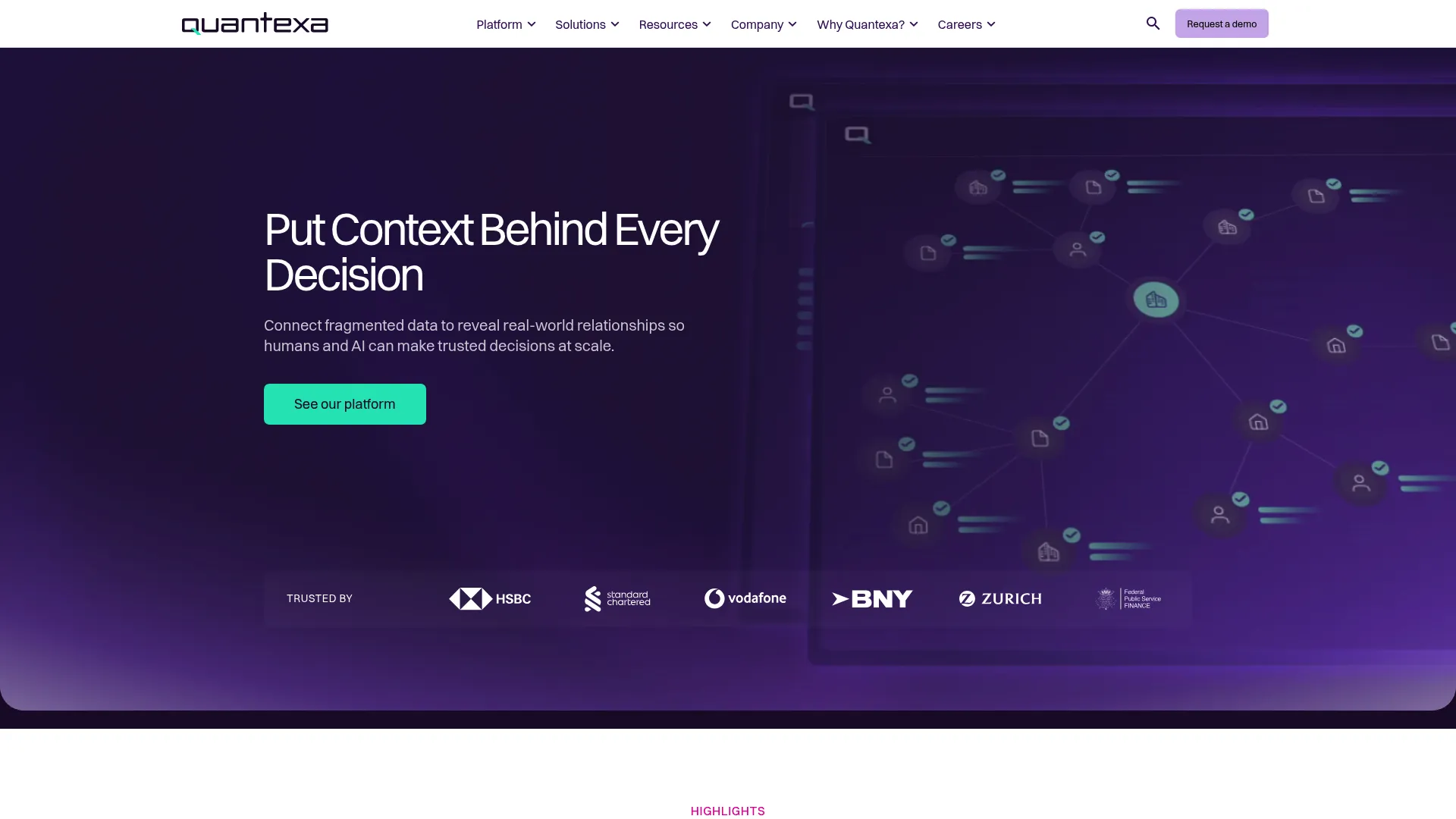
Quantexa sits at the research-heavy end of the KYC market. It is a decision intelligence platform that connects fragmented data to reveal relationships between people, organizations, and places. For KYC, that means you do not just verify one identity, you see how that identity relates to everything else your data knows.
This matters for buyers who treat KYC as a risk assessment problem, not a checkbox. Quantexa's entity resolution builds a 360-degree view of a customer, and its graph analytics surface hidden connections that single-record screening misses.
Best for: Enterprises and government teams that need contextual decision intelligence and entity resolution across KYC and AML.
Key strengths
- Entity resolution for complete views of people, organizations, and places
- Graph analytics to uncover relationships and context
- AI-ready decision intelligence platform with contextual analytics
- Strong fit for orchestration and broader risk decisioning
- Process visibility across the full customer lifecycle
Why choose Quantexa
Choose Quantexa when a flat name-match is not enough and you need to understand the network around a customer. It fits large, data-rich organizations more than lean teams that just need fast document checks. The tradeoff is scope: this is a platform decision, not a point tool.
Pricing
Quantexa does not publish public pricing. The site directs buyers to request a demo or contact sales, so pricing is sales-led and scoped to the deployment.
2. Moody's

Moody's brings a suite view to KYC. Beyond credit ratings and research, it offers KYC and AML process automation, entity and ownership data, and AI-enhanced screening with perpetual monitoring. The product family is organized as tiles, so teams can navigate from one KYC need to the next without switching vendors.
This is the pick for buyers who want an ecosystem rather than a single-point tool. If your compliance team already leans on Moody's risk intelligence, adding KYC keeps everything under one roof.
Best for: Large regulated organizations that want configurable KYC and AML plus broader risk analytics in one platform.
Key strengths
- KYC and AML process automation
- Entity, ownership, and control data access
- AI-enhanced screening and perpetual monitoring
- Credit ratings, research, and risk analytics in one suite
- Workflow orchestration across banking, insurance, and corporates
Why choose Moody's
Choose Moody's when the broader platform story matters more than a single verification feature. Teams that value consolidated risk intelligence and third-party risk data get the most out of it. It is less about lightweight onboarding speed and more about depth across the risk stack.
Pricing
Moody's does not list public pricing. It describes its risk management solutions as generally subscription-based and sales-led, so expect a scoped quote after a demo.
3. Sumsub
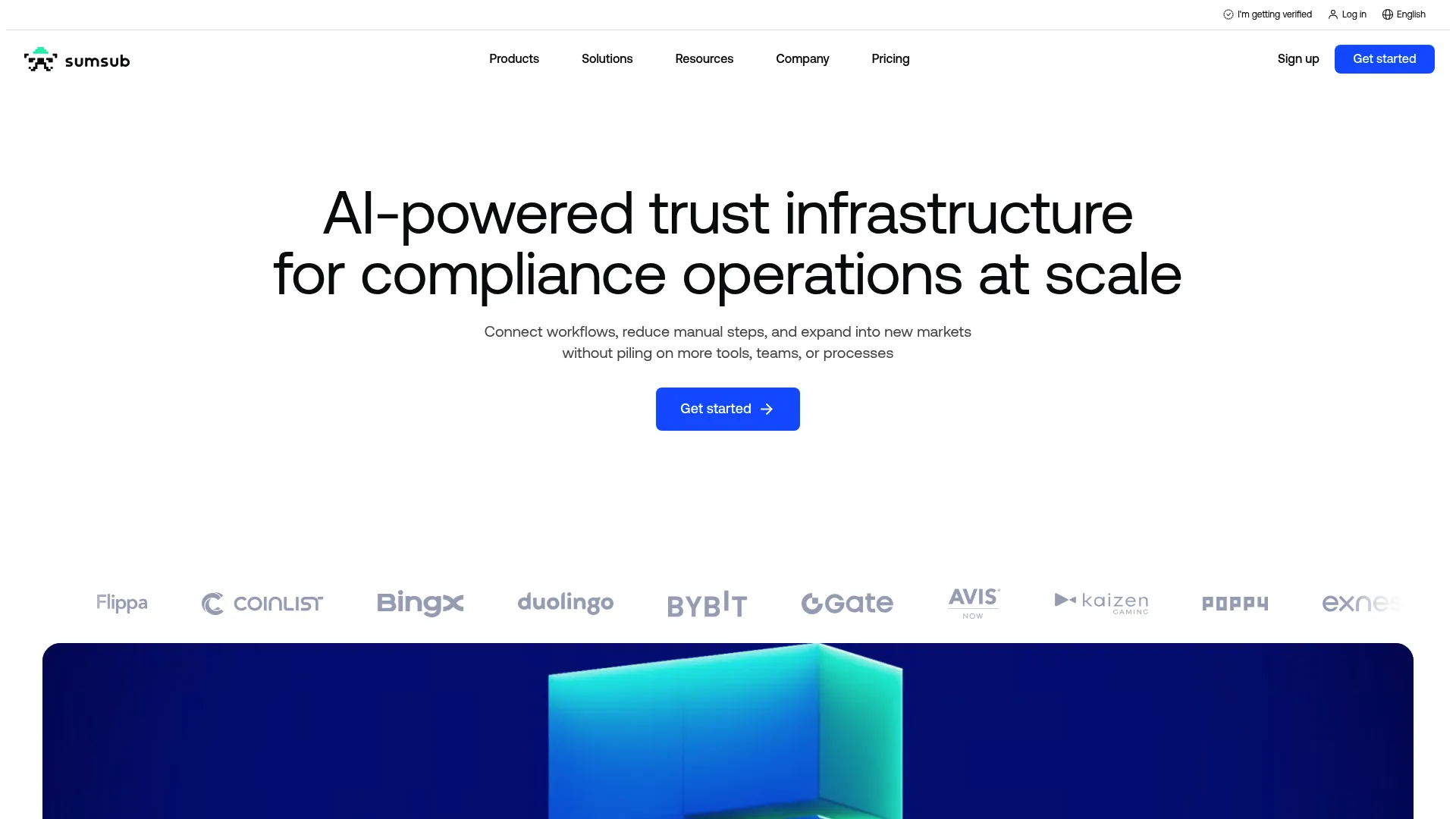
Sumsub is AI-powered trust infrastructure for KYC, KYB, AML, fraud prevention, and transaction monitoring. It stands out on breadth of verification methods and configurable workflows, so one platform covers many onboarding scenarios instead of forcing you to stitch tools together.
The verification stack is deep: ID verification, liveness and face match, email and phone checks, and reusable KYC that lets a returning user skip repeat verification. Integration depth is a strong point, which matters when you are wiring KYC into an existing signup flow.
Best for: Businesses that need configurable KYC verification software, KYB, AML, and fraud prevention at scale from one platform.
Key strengths
- User verification: ID verification, liveness and face match, email and phone
- Business verification and KYB
- Transaction monitoring, crypto monitoring, and Travel Rule support
- Reusable KYC to cut repeat verification friction
- Broad integration depth for existing onboarding flows
Why choose Sumsub
Choose Sumsub when you want one platform for many verification scenarios and you value transparent, usage-based pricing. It fits high-volume onboarding teams that need to tune flows without a heavy custom build. The public per-verification model makes it easier to forecast cost as you scale.
Pricing
The Basic plan starts at $1.35 per verification with a $149 minimum monthly commitment. The Compliance plan is $1.85 per verification with a $299 minimum monthly commitment. Enterprise is custom, and a 14-day free trial includes 50 free checks.
4. GBG
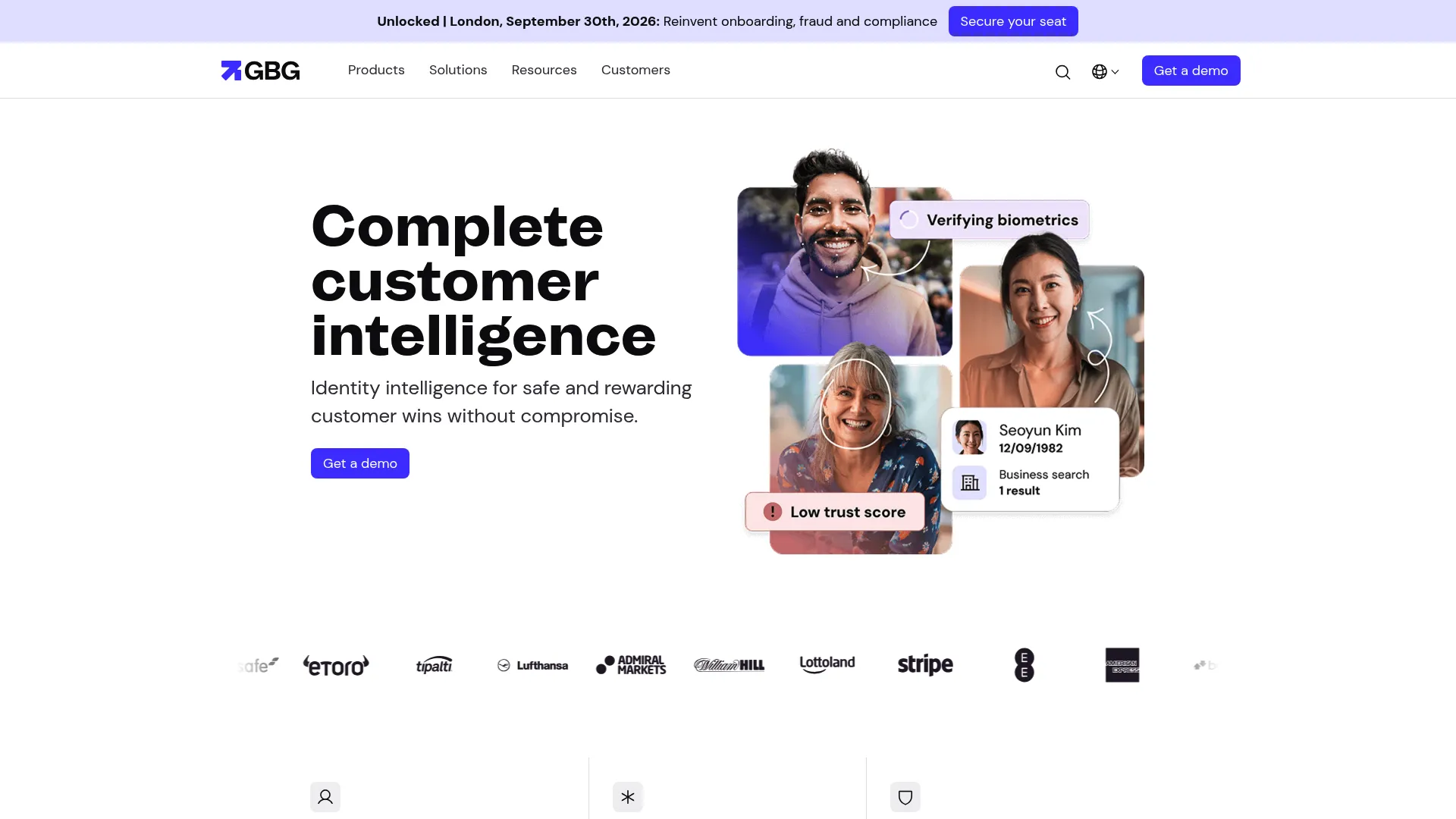
GBG is an AI trust intelligence platform built around identity and location intelligence. It leans toward bank-focused KYC orchestration, combining identity verification, fraud prevention, and decision routing so regulated businesses can move applicants through the right checks based on risk.
Banks and regulated firms tend to prioritize GBG for its global data reach and identity intelligence. The decision-routing angle helps teams that need transparent, auditable workflows rather than a black-box approve or reject.
Best for: Banks and regulated businesses that need identity verification, fraud prevention, and workflow transparency.
Key strengths
- Identity intelligence for verification
- Location intelligence for added risk context
- Identity verification and fraud prevention
- Customer onboarding support with decision routing
- Global data coverage for cross-border checks
Why choose GBG
Choose GBG when you operate in a regulated environment and value auditable decision routing over a single quick check. It fits banks and lenders that need identity intelligence layered with location signals. The strength is workflow transparency, which matters when a regulator asks how a decision was made.
Pricing
GBG does not publish public pricing on its site. Pricing is scoped through sales, so plan to request a quote based on volume and the checks you need.
5. Trulioo

Trulioo is a global identity verification platform for KYC, KYB, and AML. Its core strength is reach: person verification, business verification, and fraud intelligence across a wide range of countries and document types, exposed through flexible APIs.
Companies that need broad geographic coverage more than deep workflow polish tend to land on Trulioo. If you are onboarding users in dozens of markets and need one integration to cover them, that breadth is the selling point.
Best for: Enterprises that need global identity verification across KYC, KYB, and AML use cases.
Key strengths
- Person verification and KYC
- Business verification and KYB
- Fraud intelligence and document verification
- Wide country and document-type coverage
- Flexible APIs for a single global integration
Why choose Trulioo
Choose Trulioo when global reach is your first constraint and you want one API to verify people and businesses across many markets. It fits teams expanding internationally who need coverage breadth over bespoke case management. The tradeoff leans toward reach rather than deep workflow customization.
Pricing
Trulioo does not publish pricing. The site directs buyers to book a demo or contact sales, so pricing is scoped to your volume and regions.
6. Onfido
Onfido is identity verification software now part of Entrust's identity verification platform. It focuses on document verification, biometric verification, and workflow orchestration through a studio that lets teams build and adjust verification flows without heavy engineering.
Onfido fits digital-first verification workflows where reducing friction and raising verification confidence are the twin goals. The biometric plus document combination is aimed at onboarding flows that need to be fast for good users and hard for fraudsters.
Best for: Enterprises that need identity verification and fraud prevention across digital onboarding flows.
Key strengths
- Document verification for IDs and passports
- Biometric verification with liveness
- Workflow and studio orchestration for custom flows
- Digital-first onboarding focus
- Fraud prevention built into the verification path
Why choose Onfido
Choose Onfido when your priority is a smooth digital onboarding flow that still holds up against fraud. The studio orchestration suits teams that want to configure paths without deep engineering. Since it is now part of Entrust, buyers get access to a broader identity platform.
Pricing
Onfido does not publish pricing. Following its move into Entrust's platform, pricing is handled through sales, so request a scoped quote.
7. Jumio

Jumio provides identity verification, biometrics, risk signals, and AML screening for digital onboarding and authentication. It handles both physical and digital IDs, uses selfie and liveness-based biometrics, and layers in risk signals and cross-transaction checks.
Jumio fits high-trust onboarding flows where you need to verify identity fast at signup and again at login. The combination of document checks, liveness detection, and risk signals suits companies where getting identity wrong is expensive.
Best for: Enterprises that need identity verification and fraud prevention across onboarding and login flows.
Key strengths
- Automated identity verification for physical and digital IDs
- Selfie and liveness-based biometric verification
- Risk signals and cross-transaction risk checks
- AML screening alongside verification
- Coverage for onboarding and authentication moments
Why choose Jumio
Choose Jumio when you need fast, high-confidence verification at both signup and login. It fits use cases where identity and authentication both matter, not just one-time onboarding. The strength is speed paired with liveness and risk signals in a single flow.
Pricing
Jumio does not publish public pricing. It directs buyers to sales or a demo, so expect a quote scoped to your verification volume.
8. ComplyAdvantage
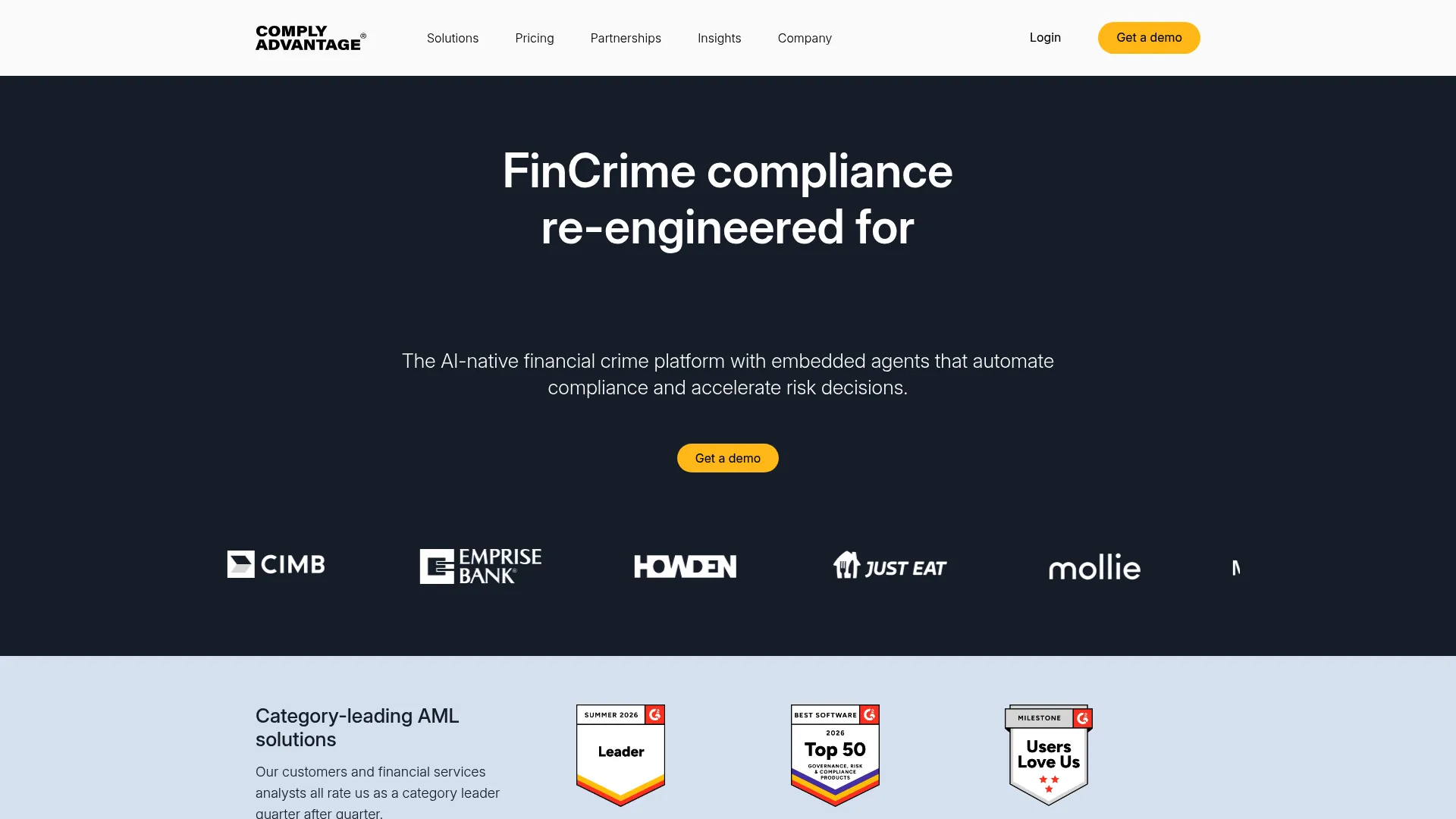
ComplyAdvantage is an AI-driven financial crime and AML risk detection platform. Where other vendors lead with identity verification, ComplyAdvantage leads with screening: customer and company screening, sanctions and watchlists, PEPs, and adverse media, plus ongoing and transaction monitoring.
Teams reach for ComplyAdvantage when sanctions screening and risk monitoring are the priority, not just onboarding. If your obligation is catching bad actors and monitoring them over time, this is the screening-first pick.
Best for: Financial services teams that need AML screening and ongoing monitoring.
Key strengths
- Customer and company screening
- Sanctions and watchlists, PEPs, and RCAs
- Adverse media screening
- Ongoing monitoring and transaction monitoring
- Agentic workflows for screening automation
Why choose ComplyAdvantage
Choose ComplyAdvantage when screening depth and monitoring are your core need and you want transparent, published pricing. It fits risk-sensitive operations that must screen continuously, not just at signup. The starter pricing also makes it accessible to smaller teams.
Pricing
The Essentials Starter Plan begins at $99 per month on annual billing, with monthly tiers scaling by monitored-entity volume (for example, $119/month for up to 100 entities). An Agentic Starter Plan starts at $149 per month on annual billing. Enterprise is quote-based, and ComplyLaunch offers free access for early-stage startups.
9. Ondato
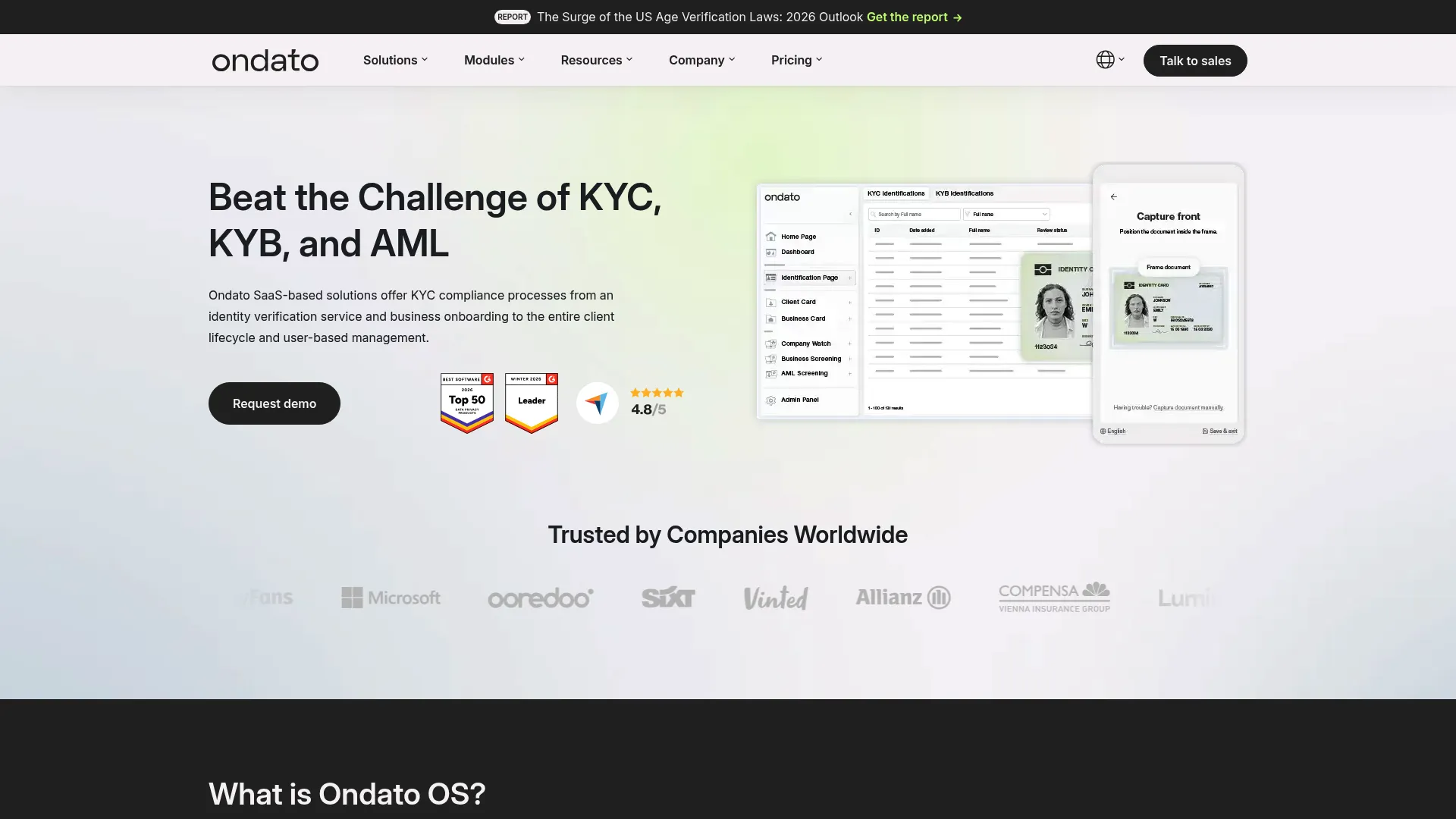
Ondato is KYC, KYB, AML, and digital identity verification software built around operational simplicity. It bundles AI-based identity verification, AML screening and monitoring, business onboarding, and video, NFC, biometric, and age verification into one platform.
Ondato suits regulated businesses that want one tool for identity verification, KYB, and AML workflows instead of assembling several. The modular pricing lets teams buy the checks they actually use.
Best for: Regulated businesses that need one platform for identity verification, KYB, and AML workflows.
Key strengths
- AI-based identity verification
- AML screening and monitoring
- KYB and business onboarding
- Video, NFC, biometric, and age verification
- Modular, solution-based pricing
Why choose Ondato
Choose Ondato when you want breadth across KYC, KYB, and AML in one platform with practical, module-based pricing. It fits teams that prefer operational simplicity over stitching multiple point tools together. The verification variety, including NFC and age checks, covers a wide range of onboarding needs.
Pricing
Ondato publishes solution-based pricing. Identity verification runs from €1.40 down to €0.50 per verification depending on volume, Know Your Business starts around €600, and age verification starts at €0.01. Pricing varies by the solutions and add-on modules you choose.
Considerations
Before you commit to a KYC platform, verify these against your actual operating model.
Coverage by geography and entity type
Check the exact countries, document types, and languages a vendor supports, not just the marketing map. Confirm whether it verifies businesses (KYB) as well as individuals if you onboard both. A platform that covers your launch markets today but not your expansion markets creates a re-integration project later.
Integration depth
Look at the API and SDK, not just the demo UI. Confirm which CRMs, data warehouses, and analytics tools it connects to, and whether webhooks and events fit your instrumentation. Shallow integration means engineering fills the gap, which is exactly the opportunity cost you are trying to avoid.
Security and data residency
Verify where identity data is stored and processed, and whether the vendor meets your data residency obligations. Ask about certifications, encryption, and retention controls. Identity data is the most sensitive data you will handle, so treat security review as a gate, not a formality.
Manual review load
Ask how much of the verification flow clears automatically versus how much routes to a human. Look at case management and risk routing quality, since that is where manual review reduction actually happens. A tool that flags everything for review just moves your bottleneck instead of removing it.
Pricing structure and scalability
Decide whether per-verification, subscription, or modular pricing fits your volume curve. Published pricing (Sumsub, ComplyAdvantage, Ondato) makes forecasting easier; quote-based pricing (Quantexa, Moody's, GBG, Trulioo, Onfido, Jumio) needs a scoping call. Model your cost at 10x current volume before you sign.
Conclusion
The right KYC software vendors depend on which problem dominates your roadmap.
If onboarding automation and predictable cost are the priority, Sumsub and Ondato give you configurable verification with published pricing. If screening and ongoing monitoring lead, ComplyAdvantage is the screening-first choice. For global reach, Trulioo covers people and businesses across many markets. For enterprise decision intelligence and entity resolution, Quantexa fits data-rich risk teams. And for a suite view, Moody's pairs KYC with broader risk intelligence.
Your next step: shortlist two or three based on your dominant constraint, then run a scoped pilot with real onboarding volume. Measure time to approval, auto-clear rate, and false-positive load, not just verification accuracy. The vendor that reduces manual review while holding fraud risk down is the one that pays for itself.
Faster onboarding, higher verification confidence, and less manual review are the outcomes that matter. Choose for those, not for the longest feature list.
FAQs
KYC software verifies a customer's identity, screens them against sanctions and watchlists, and monitors them over time. It captures and validates IDs, confirms a live person through liveness detection, then approves low-risk users automatically and routes exceptions to a reviewer. The goal is accurate identity verification with less manual work.
At minimum: document verification, liveness detection, sanctions screening, watchlist screening, and PEP screening. Strong KYC verification software adds CDD and EDD workflows, workflow automation, case management, and a full audit trail. API and SDK depth matters if you are embedding checks into an existing onboarding flow.
KYC focuses on confirming who a customer is at onboarding, while AML focuses on detecting and reporting suspicious activity over time. They overlap heavily, since screening and monitoring serve both. Many kyc aml software platforms, such as ComplyAdvantage and Sumsub, combine identity verification with ongoing AML monitoring in one system.
Fintech, banking, lending, marketplaces, crypto, and insurance are the heaviest users, along with any business handling money, sensitive data, or regulated goods. These sectors face both regulatory obligations and real fraud risk. The common thread is that getting identity wrong is expensive, whether in fines or losses.
Start with geography: confirm the vendor supports every country, document type, and language you onboard in. Then check whether it verifies businesses as well as individuals, and how deep the API and SDK integration goes. Global coverage and orchestration flexibility matter more than any single feature when you operate across borders.
Pricing models vary. Some kyc verification services publish per-verification rates, such as Sumsub from $1.35 per check or Ondato from €0.50, while others use monthly subscriptions like ComplyAdvantage from $99 per month. Enterprise platforms including Quantexa, Moody's, and Trulioo use quote-based pricing, so request a scoped estimate for your volume.
Customer due diligence (CDD) is the standard identity and risk check applied to most customers. Enhanced due diligence (EDD) is the deeper investigation applied to higher-risk customers, such as politically exposed persons or those in high-risk jurisdictions. Good KYC software applies CDD by default and triggers EDD automatically based on risk signals.
Yes, when it is configured well. Automation clears low-risk users instantly and risk routing sends only genuine exceptions to a human. The reduction depends on the quality of case management and how tightly you tune your risk rules, so measure auto-clear rate and false-positive load during a pilot before assuming the gains.