A faculty member submits a course change. It lands in someone's inbox, gets forwarded to a committee chair, appears on an agenda three weeks later, and eventually makes its way to the registrar through a chain of PDFs and reply-all threads. By the time the SIS gets updated, the printed catalog is already wrong.
This is not an edge case. It's the standard curriculum governance process at hundreds of institutions, and it creates real operational damage: Registration errors, advising confusion, accreditation documentation gaps, and academic staff spending hours reconciling records that should have stayed in sync.
The global curriculum management software market was valued at $2.35 billion in 2025 and is projected to reach $5.1 billion by 2034, according to Verified Market Reports. The growth reflects how many institutions are finally treating curriculum governance as an operational system, not an administrative side task.
This guide helps registrars, curriculum office directors, provost staff, and academic technology buyers shortlist platforms that can replace that process with something traceable and repeatable. For education technology leaders evaluating this market, it also applies a useful lens from the approval workflow software category: Does the platform create a reliable operating process, or does it just digitize the same friction?
What's inside
This guide covers 9 curriculum management platforms for 2026. Tools were selected based on:
- Curriculum proposal and approval workflow depth: Configurable routing, multi-step governance, and audit trails
- SIS and catalog integration fit: Bidirectional sync with Banner, PeopleSoft, Workday Student, and similar systems
- Curriculum impact and prerequisite analysis: Identifying downstream effects before a change is approved
- Institutional complexity fit: Community colleges, research universities, health sciences programs, and multi-campus systems each have different requirements
Pricing and ratings were verified against live vendor pages and G2 listings at the time of drafting.
TL;DR
- Best overall for connected academic operations: Coursedog Curriculum Management fits institutions that want curriculum, catalog, and scheduling data to share a single source of truth
- Best for deep curriculum impact analysis: CourseLeaf CIM is the choice when one course change can ripple across dozens of prerequisites, programs, and catalog entries
- Best for configurable governance workflows: Kuali Academic Operations covers institutions with distinctive committee structures that don't map to generic workflow tools
- Best for catalog-led curriculum operations: Modern Campus Curriculum works well when the catalog team owns the process
- Best for outcomes and accreditation alignment: Watermark Curriculum Strategy and eCurriculum connect curriculum decisions to assessment evidence and accreditation documentation
- Best focused starting point: Curriculog is the practical first step for institutions still running proposals through email
What is curriculum management software?
Curriculum management software is a higher education platform that centralizes the creation, review, approval, versioning, and publication of course and program changes.
What the software manages
The core data objects handled by a curriculum management system include:
- Courses and programs
- Certificates and micro-credentials
- Learning outcomes and competency alignments
- Prerequisites and corequisites
- Degree requirements and pathways
- Cross-listed courses
- Catalog entries and academic content
- Approval history and audit records
Core capabilities to look for
When evaluating any curriculum management software, verify these capabilities:
- Configurable curriculum proposal forms with auto-population and edit tracking
- Multi-step academic approval workflows with role-based routing
- Role-based permissions, automated notifications, and escalation rules
- Course and program version history with comparison views
- SIS and catalog integrations (bidirectional where possible)
- Curriculum impact and prerequisite analysis before approval
- Learning outcomes mapping against program and accreditation standards
- Reporting dashboards and governance audit trails
How it differs from adjacent systems
The distinction matters for procurement conversations:
| System | Core purpose | Relationship to curriculum management |
|---|---|---|
| SIS (Banner, PeopleSoft, Workday Student) | Store student and academic records | Downstream recipient of approved curriculum changes |
| LMS (Canvas, Blackboard) | Deliver instruction | Consumes finalized course structures |
| Degree audit tools | Evaluate student progress against requirements | Reads approved program requirements |
| Curriculum management software | Govern change before it reaches downstream systems | The source of record for what has been approved and when |
Think of curriculum management as the layer that governs what enters your SIS, not a replacement for it.
When to use curriculum management software
Replace email-based curriculum approvals
Faculty proposals routed through email threads lose revision history, miss deadlines, and leave no clear audit trail for accreditors. A curriculum approval workflow creates routing rules, automated reminders, and proposal status visibility so committee chairs and deans work from a shared queue rather than separate inboxes. For institutions evaluating what this governance layer looks like in practice, the catalog management software comparison covers adjacent systems.
Keep catalogs and academic records aligned
Approved curriculum changes that don't automatically flow into the course catalog create two versions of institutional reality. Students register against catalog information that hasn't caught up with what the curriculum committee approved. This misalignment is a genuine student-success risk, not just an administrative inconvenience.
Analyze downstream impact before approving changes
A single course modification can affect prerequisite chains, shared program requirements, cross-listed sections, and degree pathways simultaneously. Curriculum impact analysis tools map these dependencies and surface them during the review process, before the change gets approved rather than after.
Curriculum management software comparison
Choosing a curriculum management platform is a multi-year institutional commitment. Before signing, every institution should map its current workflow from faculty proposal through SIS update and catalog publication, then test each shortlisted platform against that specific path. The governance complexity, existing SIS, committee structure, and catalog process all change what "the right tool" actually means.
The table below reflects verified data from vendor pages and G2 listings as of October 2026. Contact each vendor for current contract terms.
| # | Product | Best for | Key differentiator | Pricing | G2 rating |
|---|---|---|---|---|---|
| 1 | Coursedog Curriculum Management | Connected academic operations (curriculum, catalog, scheduling) | AI-assisted proposals plus SIS-connected curriculum workflows | Contact sales | 4.8/5 |
| 2 | CourseLeaf CIM | Complex governance and curriculum impact analysis | Dynamic forms, configurable routing, and dependency analysis | Contact sales | N/A |
| 3 | Kuali Academic Operations | Configurable higher education governance workflows | Five-tier modular suite with AI-native workflow tools | Contact sales | N/A |
| 4 | Modern Campus Curriculum | Catalog-led curriculum lifecycle management | Curriculum workflows connected to catalog publishing | Contact sales | 3.6/5 |
| 5 | Watermark Curriculum Strategy | Curriculum approval and catalog publishing with SIS sync | Bidirectional SIS integration and automatic catalog updates | Contact sales | 2.0/5 |
| 6 | Curriculog | Replacing email and spreadsheet curriculum approvals | Focused digital proposal and approval workflow platform | Contact sales | N/A |
| 7 | Akari Curriculum Management | Curriculum lifecycle visibility and learning outcomes | Outcomes mapping, version control, and curriculum analytics | Contact sales | N/A |
| 8 | CourseLoop Platform | Program design, curriculum mapping, and lifecycle planning | Modular platform covering governance through publication | Contact sales | 4.3/5 |
| 9 | eCurriculum | Health sciences programs with competency mapping requirements | Accreditation alignment, gap analysis, and AAMC export | Contact sales | N/A |
9 best curriculum management software tools for 2026
The tools below are ordered by fit for curriculum governance breadth, academic operations integration, and institutional complexity. No single platform is the right fit for every institution.
1. Coursedog Curriculum Management
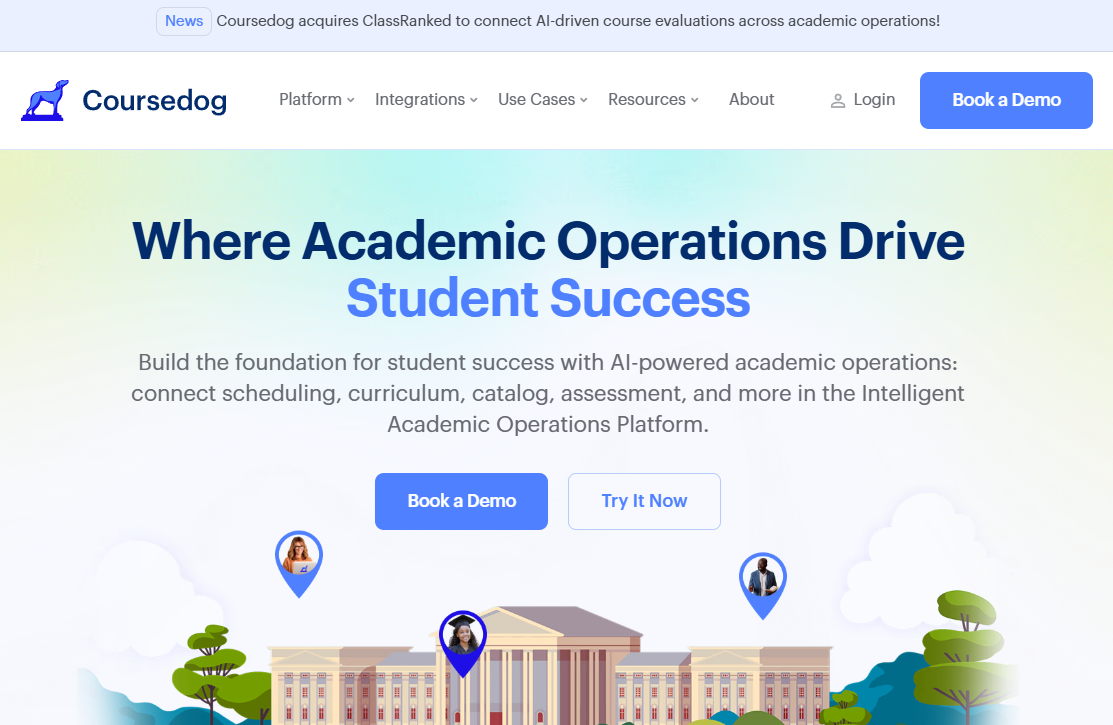
Coursedog is a higher education academic operations platform with curriculum management as one of its core modules. It connects curriculum proposals, approvals, and academic data to related functions including catalog management, scheduling, and course demand planning, all drawing from a shared institutional data layer. The platform's curriculum module handles configurable proposal forms, multi-step approval routing, learning outcomes management, and custom reporting.
Best for: Colleges and universities that want curriculum management connected to catalog, scheduling, and broader academic operations under a single system of record.
Key features
- AI-powered proposal summaries and tracking
- Drag-and-drop approval workflow builder
- Custom forms with data validation and auto-population
- Centralized course and program inventory
- Learning outcomes management and custom curricular reports
Why choose Coursedog: The case for Coursedog is strongest when the curriculum bottleneck is one part of a broader academic operations problem. If separate tools are producing separate versions of the same course data, Coursedog's integrated data model reduces the reconciliation work that falls on staff.
Coursedog pricing: Coursedog sells through annual institutional contracts. Pricing is not listed and depends on the modules selected, institution size, and implementation scope. Contact the sales team for a quote.
G2 rating: Coursedog holds a 4.8/5 rating on G2 based on 12 reviews
2. CourseLeaf CIM
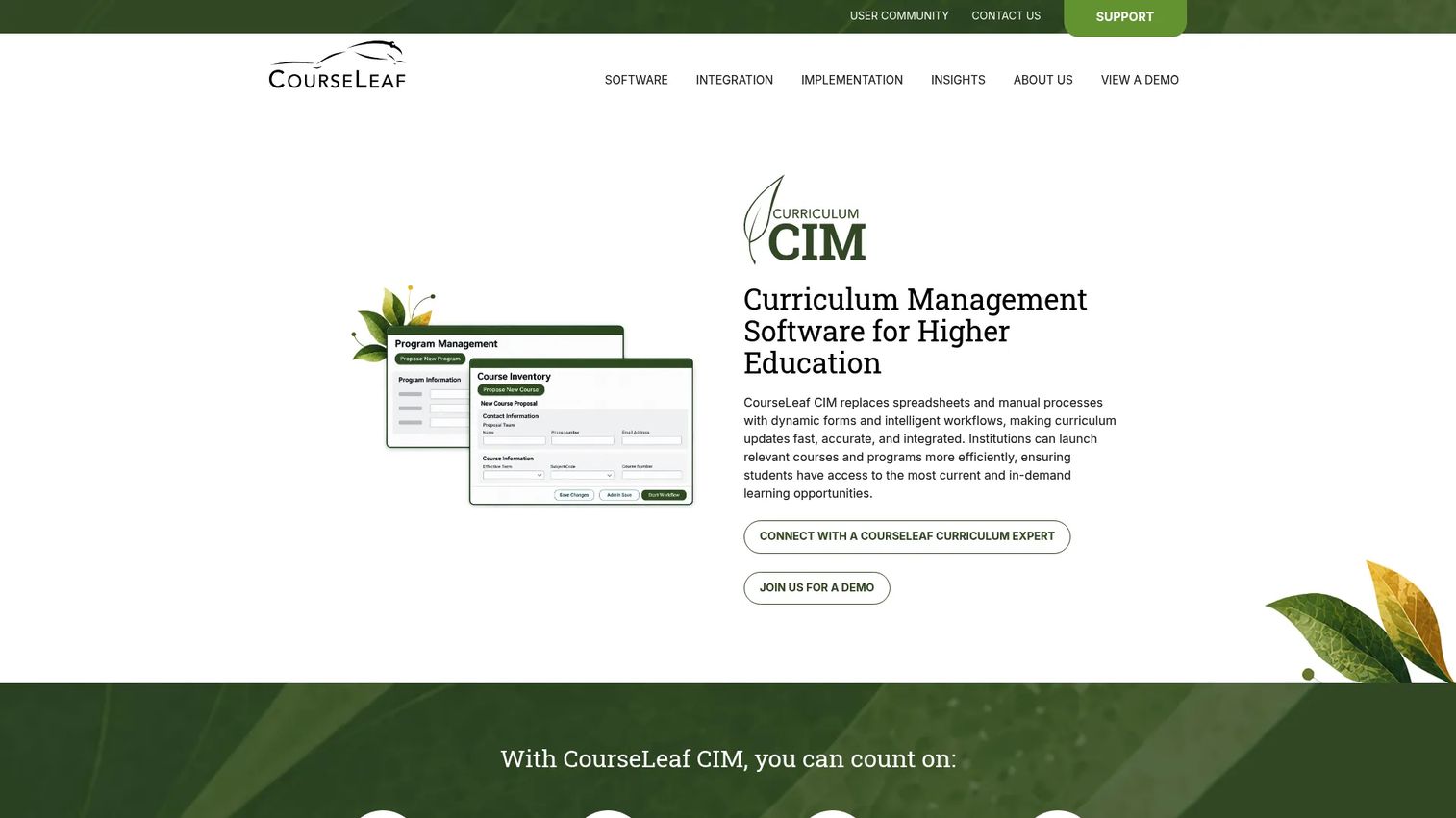
CourseLeaf CIM (Curriculum Inventory Management) is a dedicated higher education curriculum management product. It handles course and program proposal submission, multi-step approval routing, version history, and SIS synchronization through its SIS Sync technology. CourseLeaf CIM supports cross-listed courses, micro-credentials, learning outcomes mapping, and common course numbering, making it relevant for institutions with layered academic structures.
Best for: Research universities and large institutions with decentralized governance, complex prerequisite structures, or multiple academic units where one change routinely affects many downstream records.
Key features
- Configurable proposal forms with edit tracking and document attachments
- Approval workflows with automated email alerts and impact checks
- Bidirectional SIS integration via SIS Sync with SSO support
- Historical archive of edits and committee comments
- Support for cross-listed courses and micro-credentials
Why choose CourseLeaf CIM: CourseLeaf CIM is worth prioritizing when a single course modification can trigger prerequisite chain reviews across multiple programs. The impact analysis tools surface those dependencies during the approval process, which reduces surprises after the change goes live.
CourseLeaf CIM pricing: CourseLeaf contracts are institutional and quote-based. The price varies by institution size, SIS integration requirements, and the specific modules included. Reach out directly for a current estimate.
3. Kuali Academic Operations
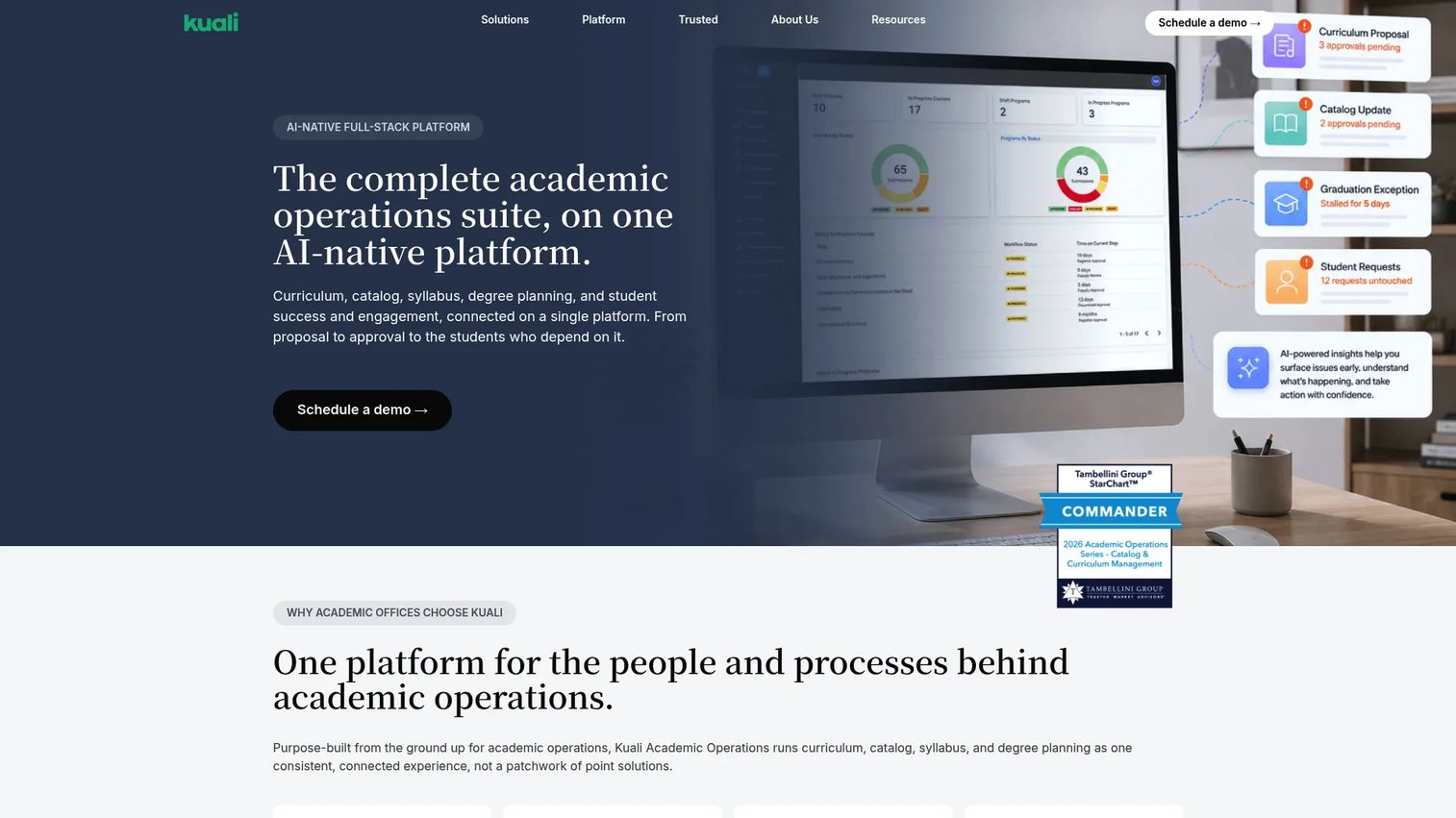
Kuali Academic Operations is an AI-native academic operations suite covering curriculum governance, catalog publishing, syllabus management, degree planning, and student success workflows. It offers five bundled tiers from AO Essentials through Build Enterprise Complete, with increasing scope across academic operations capabilities. The platform's AI features include natural-language search, workflow assistance, and approval automation.
Best for: Institutions with distinctive committee structures that need configurable approval paths and flexible workflow ownership across curriculum, catalog, and advising functions.
Key features
- Curriculum proposal, governance, approval, and workflow automation
- Catalog publishing connected to approved curriculum changes
- Configurable syllabus templates with versioning and review
- Real-time degree audit and what-if academic planning
- API-first integrations and centralized governance reporting
Why choose Kuali Academic Operations: Kuali's configurable workflow design makes it relevant when the institution's governance model doesn't fit the assumptions built into more rigid platforms. The modular tier structure also lets institutions start with essential curriculum features and expand into catalog, syllabus, or degree planning over time.
Kuali Academic Operations pricing: Kuali offers five named bundles (AO Essentials, AO Professional, AO Enterprise, AO Enterprise+, Build Enterprise Complete), all priced through direct sales conversations. No public price is listed. The right tier depends on which academic operations modules your institution needs.
4. Modern Campus Curriculum
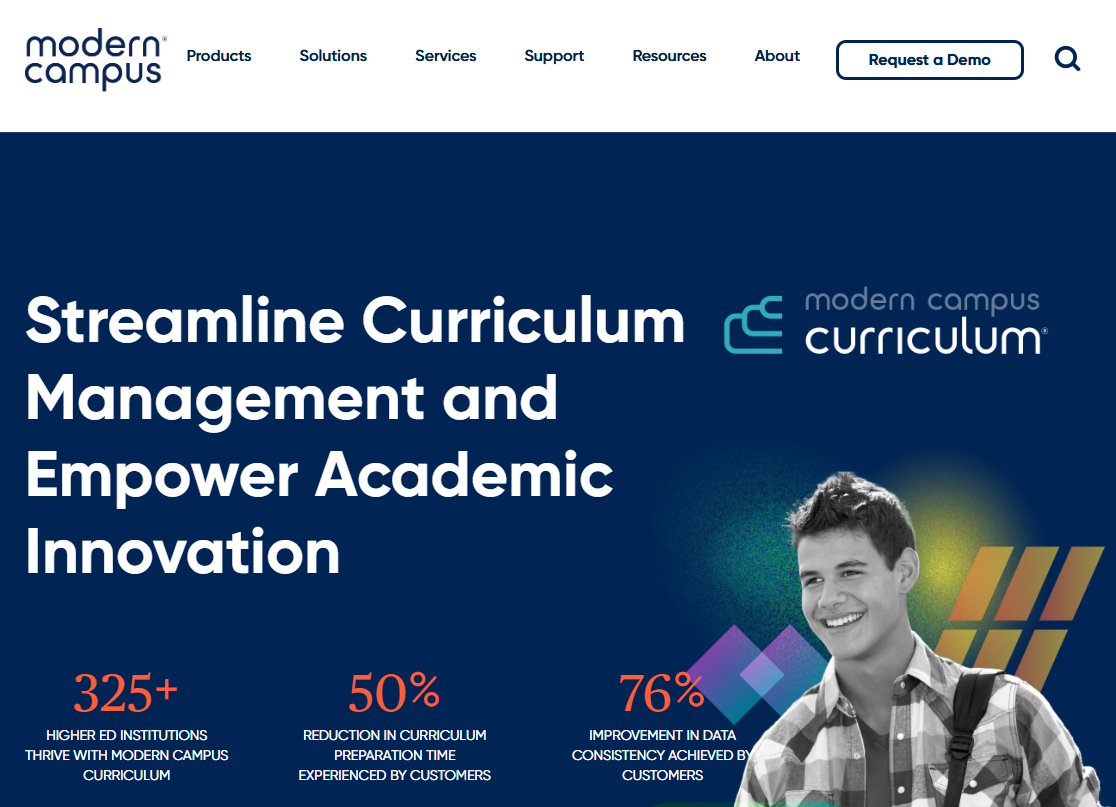
Modern Campus Curriculum is a curriculum management platform for higher education institutions that handles proposal submission, review, approval tracking, and compliance documentation. It connects curriculum workflows to catalog publishing within the broader Modern Campus suite, which also covers scheduling and student engagement products.
Best for: Catalog teams and academic affairs offices that need tighter coordination between approved curriculum changes and the published course catalog.
Key features
- Automated curriculum proposal workflows
- Centralized curriculum repository with compliance tracking
- Accreditation documentation support
- Catalog publishing workflow connection
- Approval notifications and status tracking
Why choose Modern Campus Curriculum: The platform is a practical fit for institutions already in the Modern Campus ecosystem, or for teams where catalog production creates the most operational friction. Reducing the handoff gap between approved changes and published catalog information is the core operating argument.
Modern Campus Curriculum pricing: Modern Campus sells through annual institutional contracts with pricing determined by institution size, modules selected, and implementation scope. Contact sales for current packaging details.
G2 rating: Modern Campus holds a 3.6/5 rating on G2
5. Watermark Curriculum Strategy
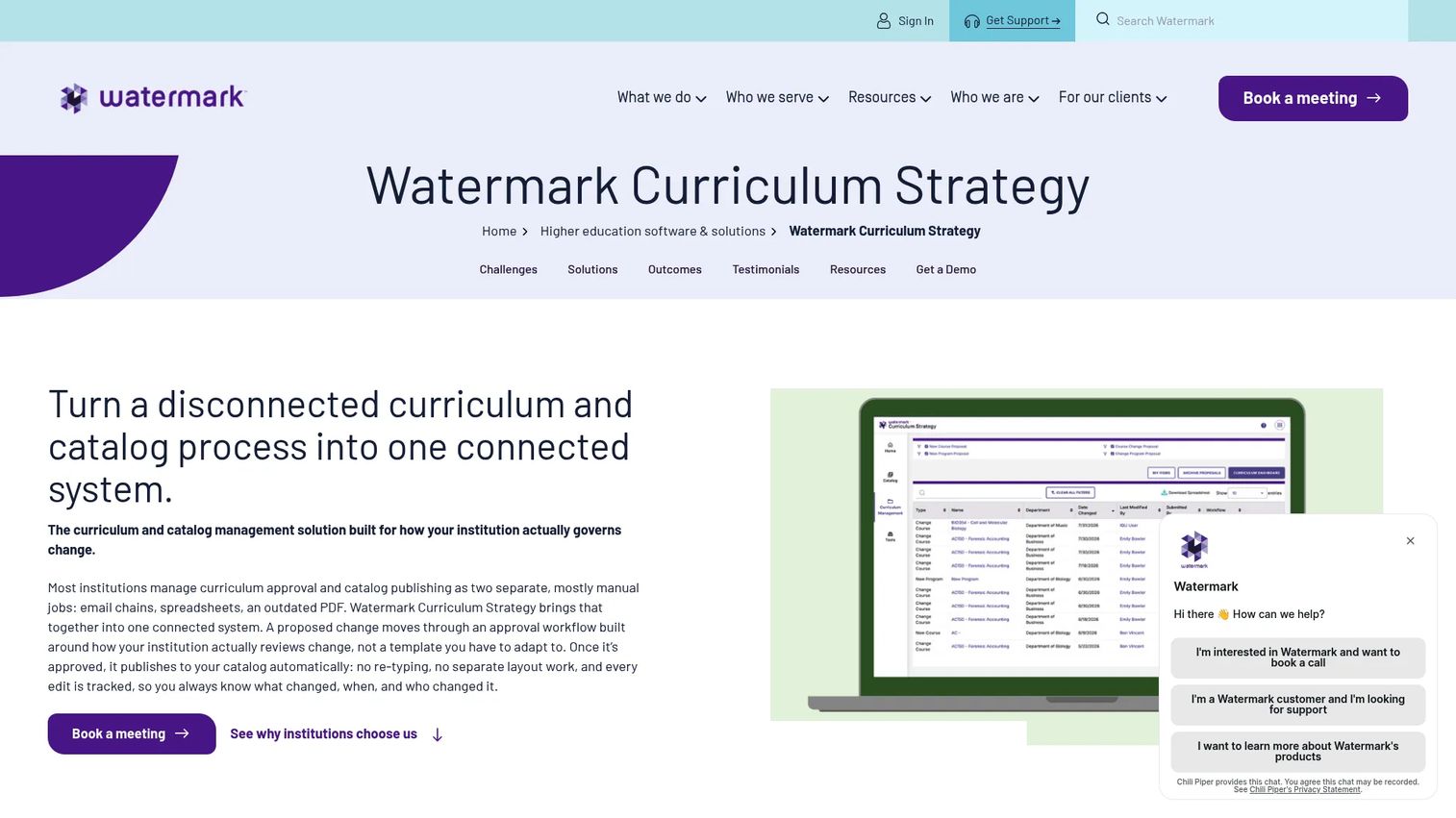
Watermark Curriculum Strategy handles collaborative curriculum proposals, configurable multi-step approval workflows, automatic catalog publishing upon approval, and SIS synchronization. The platform includes bidirectional integration with Ellucian Banner and Colleague, version comparison tools, and searchable mobile-accessible online catalogs. It positions curriculum management and catalog publishing as connected functions rather than separate systems.
Best for: Higher education institutions seeking to connect curriculum approvals, catalog publishing, and SIS data management within a single governed workflow.
Key features
- Auto-populated proposal forms with tracked collaboration
- Multi-step branching approval workflows with dependency visibility
- Automatic catalog publishing after approval
- Version comparison and permanent catalog archives
- SIS synchronization including Ellucian Banner and Colleague
Why choose Watermark Curriculum Strategy: Watermark is worth evaluating when the institution needs automatic catalog updates triggered by approvals rather than a separate publication step. The bidirectional SIS sync also reduces manual data entry between curriculum decisions and student-facing records.
Watermark Curriculum Strategy pricing: Watermark directs all pricing inquiries to direct sales conversations. Contract terms depend on institution size, modules, and integration requirements. Request a quote through their website.
G2 rating: G2 shows a 2.0/5 rating for Watermark Curriculum Strategy based on 1 review
6. Curriculog
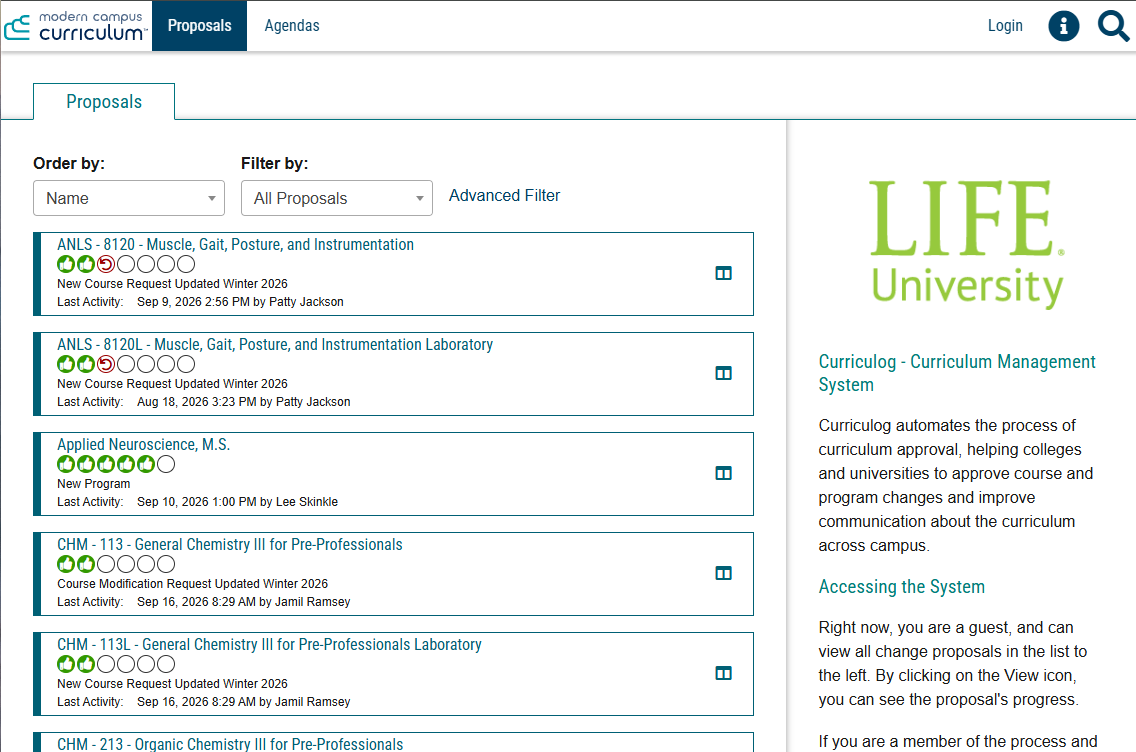
Curriculog is now part of the Modern Campus platform family and marketed as Modern Campus Curriculum. The Curriculog brand remains in use and continues to refer to the focused curriculum proposal and approval workflow product. It handles digital proposal submission, routing, committee collaboration, proposal tracking, and governance record-keeping.
Best for: Institutions replacing manual curriculum forms, email approval chains, and disconnected committee tracking with a structured digital workflow.
Key features
- Digital curriculum proposal forms
- Configurable approval workflow routing
- Real-time proposal status tracking
- Curriculum committee collaboration and commenting
- Historical proposal records for audit and accreditation
Why choose Curriculog: Curriculog is the clearest starting point for institutions that haven't yet digitized their curriculum approval process. The focused scope makes adoption more manageable than implementing a broader academic operations suite from the outset. Plan the integration with your catalog, SIS, and outcomes processes before implementation, so the workflow doesn't create a new data silo.
Curriculog pricing: Curriculog uses institutional annual contracts. No price is listed publicly. Contact the Modern Campus sales team for current terms, as packaging has evolved with the platform integration.
7. Akari Curriculum Management
Akari Curriculum Management is a higher education platform covering curriculum design, governance workflows, learning outcomes and assessment mapping, version control, and curriculum publication via API integrations. It supports learner pathway planning, micro-credential management, and curriculum analytics with business intelligence tooling.
Best for: Universities managing complex curriculum lifecycles where outcomes alignment, version control, and curriculum visualization matter as much as basic approval routing.
Key features
- Curriculum design, review, approvals, and workflow automation
- Learning outcomes and assessment mapping with validation
- Curriculum version control and single source of truth
- API-based publication and integrations
- Business intelligence, curriculum visualization, and analytics
Why choose Akari Curriculum Management: Akari suits institutions that want more than a proposal tracker. If the curriculum team also owns learning outcomes reporting, accreditation evidence, and program-level analytics, a platform that connects all of those within one data model reduces the manual aggregation work that otherwise falls on institutional research staff.
Akari Curriculum Management pricing: Akari does not publish pricing on its website. Pricing and deployment model depend on institution size and regional availability. Verify current support and implementation coverage for U.S. institutions before shortlisting.
8. CourseLoop Platform

CourseLoop is an end-to-end curriculum management platform organized into modular components covering curriculum data management, governance workflows, curriculum review and mapping, publication, and student study planning. Its curriculum data module maintains structured records, audit history, and versioning. The governance module handles configurable workflows, task automation, and approval processes.
Best for: Universities seeking a connected view of curriculum design, program mapping, and institutional planning beyond basic proposal routing.
Key features
- Curriculum data management with structured records and audit history
- Configurable governance workflows with task automation
- Curriculum review, mapping, and publishing modules
- Program planning and student study planning support
- Prerequisite analysis and course lifecycle visibility
Why choose CourseLoop Platform: CourseLoop is relevant for institutions that want curriculum management to extend into program design and strategic planning, not just governance tracking. Verify fit with your SIS, catalog, and specific governance process before treating it as a replacement for all academic operations systems.
CourseLoop Platform pricing: CourseLoop operates a modular pricing structure with no prices displayed on the website. Prospective buyers are directed to request a demo for current contract terms.
G2 rating: CourseLoop holds a 4.3/5 rating on G2 based on 2 reviews
9. eCurriculum
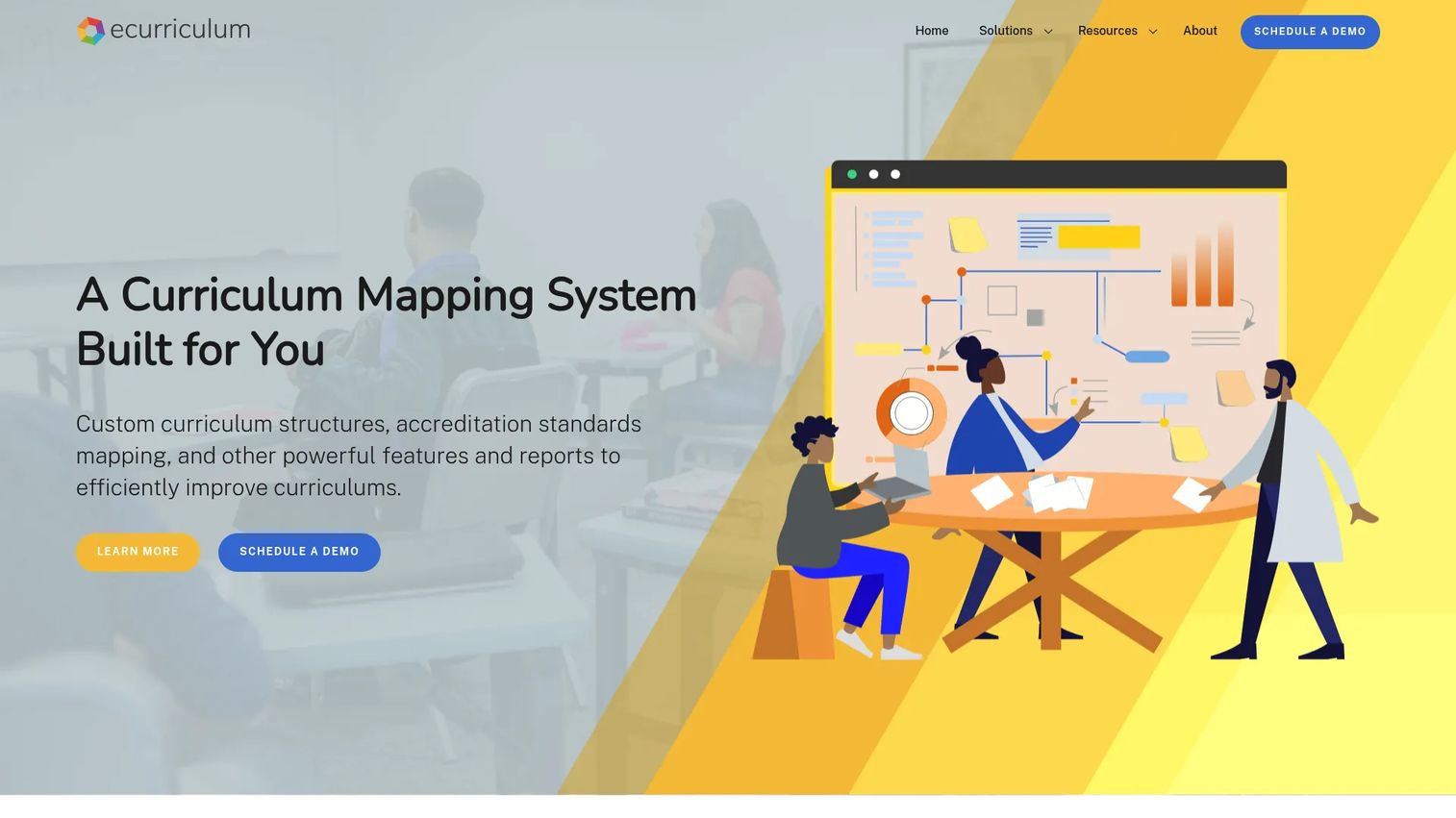
eCurriculum is a cloud-based curriculum mapping and management system with particular relevance to health sciences programs. It handles custom curriculum structures, course and session management, competency and accreditation standards alignment, gap and overlap analysis, and AAMC Curriculum Inventory exports. Integrations with Canvas and Blackboard are available.
Best for: Health sciences programs, medical schools, and institutions with detailed competency mapping, accreditation reporting requirements, and committee-driven governance processes.
Key features
- Custom curriculum structure and curriculum mapping
- Accreditation standards and competency alignment
- Gap and overlap analysis reporting
- AAMC Curriculum Inventory export
- Syllabus generation and public curriculum website
Why choose eCurriculum: Specialized health sciences programs often need competency mapping granularity, accreditation documentation depth, and rotation or session management that general curriculum tools don't support well. Confirm whether the platform fits institution-wide governance or works better as a college-level or discipline-specific solution before institutional deployment.
eCurriculum pricing: eCurriculum directs prospective customers to schedule a demo for pricing. Contract terms vary by school size, program scope, and implementation requirements.
Considerations when choosing curriculum management software
Match workflow depth to your governance model
A community college with a streamlined approval path has fundamentally different requirements than a multi-campus research system with separate undergraduate, graduate, and professional-school committees. The platform's configurability needs to reflect your actual committee structure, not a simplified version of it. Platforms that require governance redesign to fit the software create implementation risk before you've processed a single proposal.
Treat SIS integration as a project, not a checkbox
Verify the specific direction of data flow, the update frequency, who owns the field mappings, and how errors are handled. Support for Banner, PeopleSoft, Workday Student, or your current system should be confirmed with integration documentation, not just a sales deck. The gap between "we integrate with Banner" and "bidirectional sync that handles cross-listed courses and prerequisite fields" is where implementation projects stall. For buyers evaluating how academic operations software connects to broader institutional systems, the abstract management software category provides useful context on data governance patterns in higher education technology.
Confirm how catalog publication works
Whether approved changes flow automatically into the catalog, require a separate editorial review step, or need manual export and publication is a significant operational difference. Teams that expect automatic publication and get a manual process will create a new version of the same bottleneck they were trying to eliminate.
Test impact analysis with a real course change
Ask every vendor to demonstrate curriculum impact analysis using a realistic scenario from your institution. Choose a course with prerequisite dependencies, cross-listed sections, or shared program requirements. The platform should identify which downstream records are affected before the approval is finalized, not after. This single test eliminates more vendor ambiguity than any feature comparison document.
Price implementation alongside the license
Total cost includes configuration, integrations, data cleanup, governance design, training, and ongoing system ownership. For institutions with legacy SIS data or undocumented curriculum history, the data remediation work before go-live often matches the license cost. Require vendors to break implementation fees out from recurring software costs in any proposal.
How to choose the right curriculum management software for your institution
If your institution needs connected academic operations
Coursedog Curriculum Management fits institutions where curriculum management is one part of a broader operational bottleneck. If your SIS, catalog, and scheduling systems are producing different versions of course data, a platform built on shared academic data reduces the reconciliation work those silos create.
If your governance process is complex and highly decentralized
CourseLeaf CIM is the stronger choice when impact analysis depth matters and one course change regularly affects multiple programs, prerequisites, and catalog entries. Kuali Academic Operations is the alternative when the priority is configurable workflow design that can reflect your committee structure without compromise.
If catalog publishing drives the project
Modern Campus Curriculum addresses catalog-centered priorities. Verify your approval workflow and SIS requirements before choosing, since catalog-first platforms vary significantly in how much curriculum governance depth they offer alongside publishing controls.
If outcomes, assessment, or accreditation work drives the budget
Watermark Curriculum Strategy and eCurriculum are both worth evaluating when curriculum alignment and evidence structures matter alongside approval routing. eCurriculum is the narrower, more specialized option for health sciences programs with competency mapping and AAMC documentation requirements.
If the first priority is replacing forms and email approvals
Curriculog is the most focused starting point for institutions not yet ready for a broader academic operations platform. Map your future integration requirements before implementation, so you're building toward a connected system rather than creating a new data island.
Conclusion
The right curriculum management software depends on the institution's governance model, existing SIS, catalog process, and reporting obligations. Not one platform fits every institution, and the best procurement decision starts by mapping one real curriculum change from faculty request through published catalog and SIS record.
Use that workflow as your demo script. Ask every vendor to walk through it. The gaps that appear in that exercise will tell you more than any feature comparison checklist.
For institutions needing connected academic operations, Coursedog is the clearest overall fit. Complex governance with deep impact analysis points toward CourseLeaf CIM. Configurable workflow ownership without a rigid governance model leads to Kuali Academic Operations. Catalog-first teams should evaluate Modern Campus Curriculum. Outcomes and accreditation alignment pushes toward Watermark Curriculum Strategy and eCurriculum. Institutions still on email approvals have a practical first step in Curriculog.
Start your journey with Guideflow today!
FAQs about curriculum management software
Curriculum management software is a higher education platform that centralizes the creation, review, approval, versioning, and publication of course and program changes. It is distinct from an SIS, which stores student and academic records, and from an LMS, which delivers instruction. A curriculum management system governs what changes before it reaches those downstream systems.
Primary users include registrars, curriculum office directors, faculty proposers, department chairs, deans, academic senate and curriculum committees, provost staff, catalog managers, and IT administrators. Institutional research teams also interact with the data for accreditation reporting and academic planning.
Many platforms support SIS integrations, but the depth varies significantly. Some offer bidirectional sync across course, program, and prerequisite fields. Others support one-directional data export or require custom integration work. Validate the specific objects synchronized, the update frequency, and who owns the field mapping before selecting a platform.
A well-designed curriculum approval workflow includes dynamic proposal forms, configurable approval paths with role-based routing, automated notifications and deadline reminders, proposal status visibility, revision history, audit trails for accreditation documentation, and escalation handling for overdue decisions. Prerequisite and impact analysis during the review stage is a significant differentiator.
Approved curriculum changes can move into catalog workflows, but the mechanism varies by platform. Some tools publish automatically when a proposal clears its final approval stage. Others require a separate editorial review or a manual export step. Confirm the exact publication path with each vendor, including what happens to the SIS record and whether the catalog update is instant or batched.
Curriculum impact analysis identifies the courses, programs, prerequisites, degree requirements, shared program requirements, and catalog entries affected by a proposed academic change. When a required course is modified, for example, the impact analysis surfaces every program that lists that course as a prerequisite or requirement, so reviewers can evaluate the downstream effects before the change is approved.
Most higher education curriculum platforms sell through annual institutional contracts. License costs typically vary by institution size, the number of modules selected, campuses covered, and integration requirements. Implementation costs, which include configuration, SIS integration work, data migration, and training, are separate and often significant. Require vendors to break those out in any formal proposal rather than presenting a bundled total.
The connection is indirect. Accurate prerequisites, updated catalogs, and clear degree pathway information reduce the administrative friction that causes registration errors and advising confusion. Institutions with more reliable curriculum data can give students more accurate guidance on degree requirements and course sequencing. Avoid attributing specific retention or time-to-degree outcomes to curriculum software without a verified institutional case study to support the claim.
Curriculum management software covers the full lifecycle from proposal through approval, publication, and SIS update. Curriculum mapping is a specific function within that lifecycle, concerned with visualizing how courses, outcomes, and competencies align across a program. Many platforms include curriculum mapping as a module. Some tools, including Akari, CourseLoop, and eCurriculum, emphasize mapping depth alongside governance workflows.
Implementation timelines vary from a few months for focused curriculum workflow tools to a year or more for full academic operations suites that require SIS integration, catalog migration, and governance redesign. Data quality is usually the primary variable. Institutions with undocumented curriculum history or legacy SIS data requiring cleanup should budget additional time and cost before the platform goes live.