Registration opens Monday. By Tuesday afternoon, your staff is chasing 40 incomplete medical forms, your finance lead is reconciling partial payments in a spreadsheet, and three parents have emailed asking why their cabin assignment changed. None of this is a staffing problem. It's a systems problem.
When enrollment, health records, payments, and communications live in separate tools, the handoffs between them create the exact failures that hurt families and burn out operations staff. The risk isn't administrative inconvenience. It compounds during peak season, when errors become incidents.
G2 tracked 97 products in the camp management software category as of October 2026, which tells you the market has grown well past the point where a quick search narrows the field. This guide does that work for you: 10 platforms evaluated against the workflows that actually break under pressure, with verified pricing, current G2 ratings, and honest fit guidance by camp type.
What's inside
This guide compares 10 camp management software tools for program operators, camp directors, registrars, and operations leaders evaluating their stack for 2026. Tools were selected based on:
- Operational breadth: Registration, payments, health records, attendance, communications, and reporting coverage
- Camp-type fit: Day camps, overnight camps, sports clinics, conference centers, and year-round programs
- Pricing clarity: Whether costs are published or require a quote, and what drives total annual cost
- Review availability: Current G2 or Capterra ratings from verified user reviews
TL;DR
- Best for health-first operations: CampDoc, for programs where medical forms, medication tracking, and camper health records sit at the center of daily operations
- Best for overnight and residential camps: CampMinder, covering cabins, staffing, transportation, and parent-facing workflows alongside registration
- Best for visible entry pricing: iCampPro, with plans starting at $199 per month and a published tier structure that makes early budget estimates possible
- Best for complex, multi-program organizations: Campwise, for camps that also operate conference centers, facility rentals, or fundraising programs
- Best for children's activity businesses: Sawyer, for operators running camps alongside classes, drop-in sessions, and year-round programming
What is camp management software?
Camp management software is a system that helps camps and youth programs run enrollment, payments, participant records, health documentation, staff workflows, communication, and on-site operations from a single platform.
Registration-only tools handle enrollment well but typically stop there. A full camp management system goes further.
Registration-only tool vs. full camp management software:
| Capability | Registration-only tool | Full camp management system |
|---|---|---|
| Online enrollment | Usually included | Included |
| Payments and refunds | Often included | Included |
| Medical records | Varies | Often included |
| Cabin and group assignments | Rare | Common |
| Staff applications | Rare | Common |
| Attendance and check-in | Varies | Common |
| Reporting across operations | Limited | Broader |
Core functions to understand before evaluating:
- Registration and enrollment: Online registration portals, session capacity limits, waitlists, household accounts, waivers, and payment plans
- Health and safety administration: Medical histories, allergy details, medication records, immunizations, emergency contacts, and incident workflows
- Daily operations: Attendance, check-in and check-out, cabin assignments, camper groups, schedules, transportation, and staff coordination
- Finance: Payment processing, refunds, balance tracking, discounts, scholarships, and revenue reporting
- Family communication: Automated reminders, text alerts, email updates, and parent portals
- Operational reporting: Enrollment numbers, revenue, outstanding forms, payments, staffing gaps, and program performance
A camp registration system is one module inside a broader camp management system. The distinction matters most when your program has health requirements, overnight logistics, or multi-location operations that require shared data.
When to use camp management software
Replace spreadsheets before registration volume creates errors
Manual reconciliation works until it doesn't. When parent information, payment status, medical forms, and attendance are tracked separately, errors compound during seasonal enrollment spikes. A platform becomes necessary when one missed field during check-in could create a real safety issue.
Run health and safety workflows in one record
Programs with structured medical requirements need more than a form upload. Medication tracking, allergy visibility, incident documentation, and role-based access to health data all belong in the same system as registration. Evaluate which staff can see what, and how that information moves between the nurse's station and the director's dashboard.
Coordinate multi-program or multi-location operations
Day camps, overnight programs, sports clinics, retreats, and after-school programs do not run the same workflow. An organization operating across several of these needs shared records and consolidated reporting. That's where a broader account management software mindset applies: The goal is one source of truth, not five connected tools.
Camp management software comparison
Pricing models vary significantly across this category. Some vendors charge a flat monthly subscription, others layer per-registration fees, payment processing percentages, SMS credits, and onboarding costs on top. Calculate your total annual operating cost before comparing headline prices.
| # | Product | Best for | Key differentiator | Pricing | G2 rating |
|---|---|---|---|---|---|
| 1 | CampDoc | Health-intensive camps | Integrated electronic health records and medication administration | From $355/mo | 4.7/5 |
| 2 | CampMinder | Residential and overnight camps | Deep operations: Cabins, staffing, transportation, parent app | Custom pricing | 4.3/5 |
| 3 | iCampPro | Transparent starting price | Published tier structure with modular add-ons | From $199/mo | N/A on G2 |
| 4 | Campwise | Camps plus conference centers | Unified records across camps, facilities, donors, and retail | Custom pricing | 4.0/5 |
| 5 | CampBrain | Large and multi-program camps | Registration, medical, POS, fundraising, and conference management | Custom pricing | 3.8/5 |
| 6 | ACTIVEWorks Camp & Class Manager | Camps and class programs | Registration, attendance, waitlists, and parent portal in one | Custom pricing | 4.1/5 |
| 7 | Sawyer | Children's activity businesses | Camps, classes, and drop-ins managed from one scheduling hub | From $71/mo | 4.5/5 |
| 8 | Amilia SmartRec | Recreation organizations | Registrations, memberships, facilities, and billing in one platform | From $99/mo | N/A on G2 |
| 9 | UltraCamp | Configurable camp workflows | Registration, health, check-in, and staff tools with published tiers | From $275/mo | N/A on G2 |
| 10 | CampSite | Work communication (note below) | Async posts and organized discussions for distributed teams | From $8/member/mo | 4.7/5 |
Pricing and G2 ratings verified October 2026 from vendor pricing pages and G2 listings. Note: The brand research confirms that "CampSite" at campsite.com is a work communication platform, not a camp operations system. The camp-specific CampSite product should be verified against its current homepage before publication.
Best 10 camp management software tools for 2026
1. CampDoc
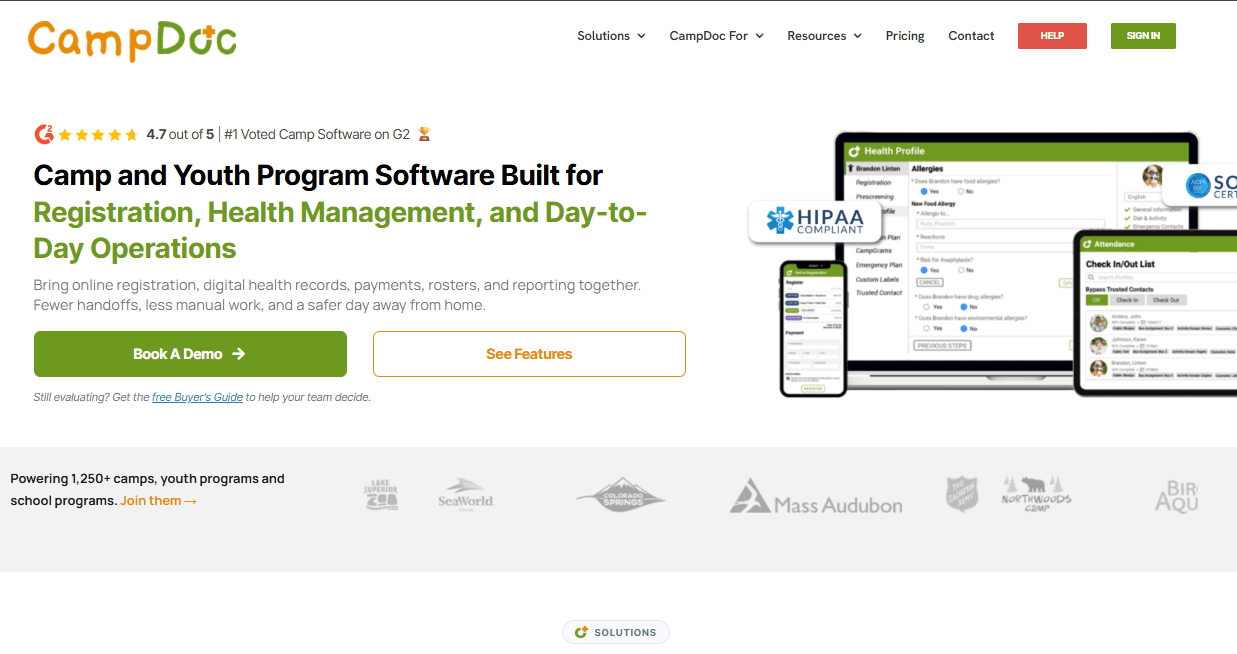
CampDoc is camp management software built around participant health. The platform handles online registration, digital forms, billing, communications, attendance, check-in, and incident reporting alongside its core electronic health record workflows. Organizations that need medication administration tracking, allergy alerts, and nurse documentation in the same system as enrollment will find CampDoc purpose-built for that combination.
Best for: Camps and youth programs where medical forms, medication workflows, and camper health records are central to daily operations.
Key features
- Online registration and digital forms with e-signature support
- Electronic health records and detailed medical profiles per camper
- Medication administration tracking and allergy alert workflows
- Check-in, attendance, and authorized pickup management
- Incident and injury reporting with nurse documentation
- Automated email and SMS reminders for families
Why choose CampDoc: Programs where health documentation is a liability concern, not just an admin task, benefit most from this depth. If your camp has minimal medical requirements and a simple daily schedule, the feature set may exceed what you need.
CampDoc pricing: Plans start at $355 per month. Pricing adjusts based on program size and needs, with onboarding, training, and support included. Verify current tier inclusions and any volume-based variables directly with the vendor before your budget cycle.
G2 rating: 4.7 out of 5 (verified October 2026 from G2).
2. CampMinder
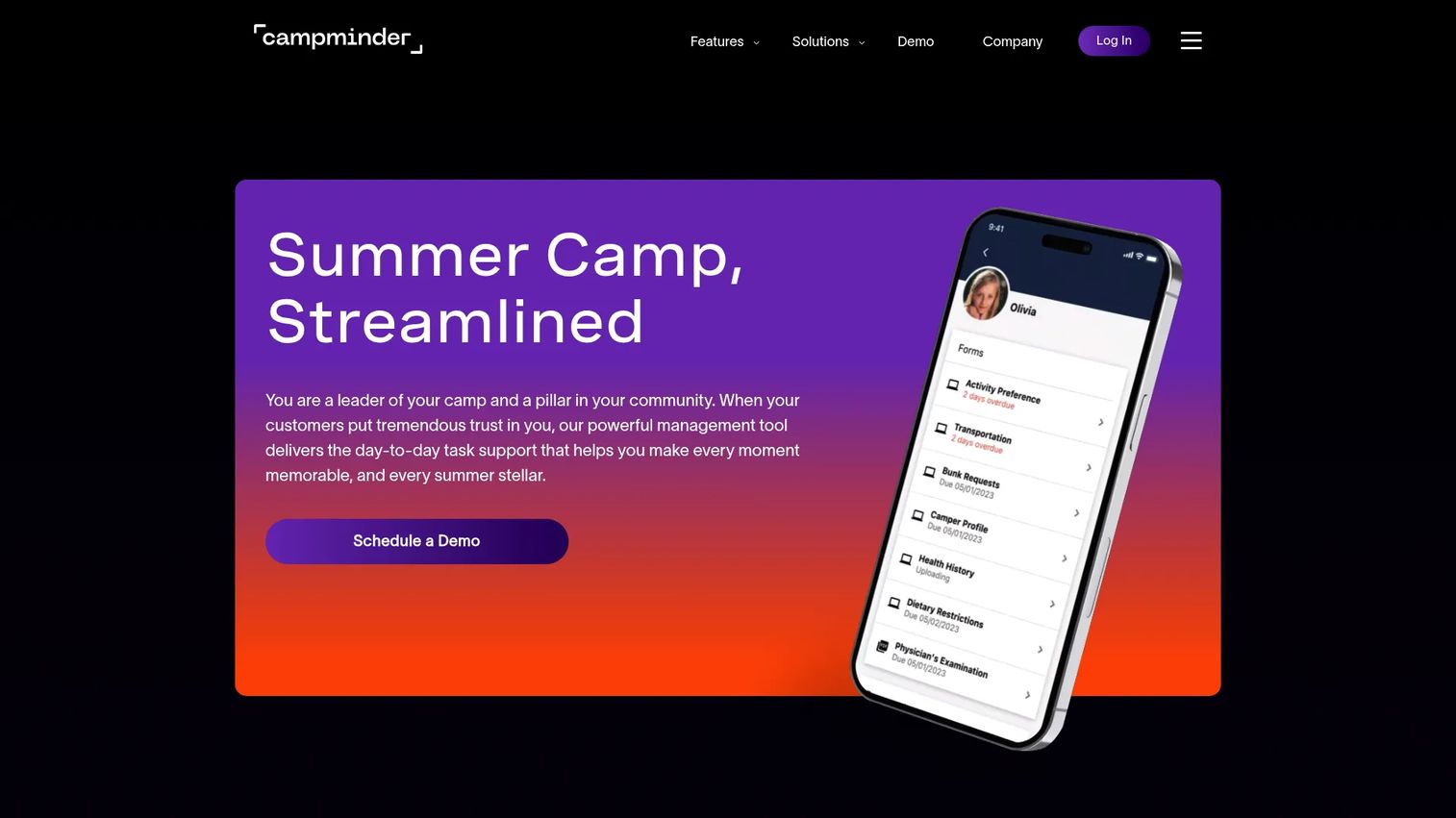
CampMinder is built for the operational complexity of residential and overnight camps. The platform covers online registration and payments, cabin and group assignments, integrated health center tools with eMAR, transportation and attendance management, staff application tracking, and the Campanion family app for photos and messaging. Its suite structure (Classic, Deluxe, and Professional) lets camps choose the coverage level that matches their season.
Best for: Established overnight and residential camps needing operational coverage beyond registration, including cabin logistics, staffing, and transportation.
Key features
- Online registration, forms, and payment processing
- Cabin and group assignment management
- Integrated health center with electronic medication administration records
- Staff management and online applicant tracking
- Transportation and attendance workflows
- Campanion mobile app for family communication and photo sharing
- API integrations and operational reporting
Why choose CampMinder: If your season involves cabin placements, daily transportation runs, and staff applications alongside enrollment, this platform is built for that model. Smaller day camps with straightforward schedules should compare the package inclusions against their actual workflow to avoid paying for coverage they won't use.
CampMinder pricing: Custom pricing based on camper enrollment and program scale. The vendor offers Classic, Deluxe, and Professional suite options. Contact the vendor for current suite inclusions and pricing structure before comparing against flat-rate options.
G2 rating: 4.3 out of 5 (verified October 2026 from G2).
3. iCampPro
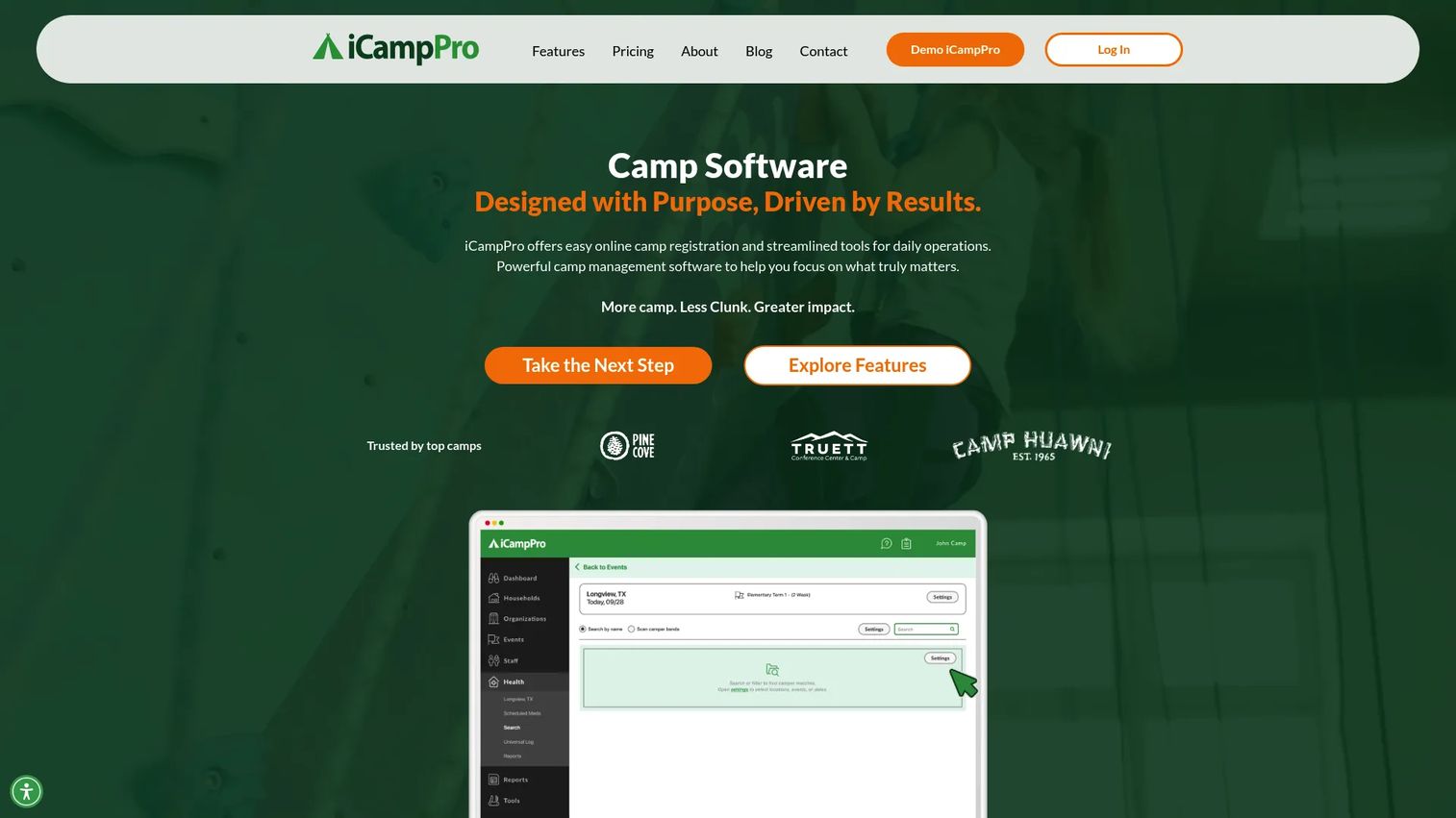
iCampPro gives buyers a published tier structure before they talk to a salesperson. The platform covers online camp registration, payment processing, camper groups and cabins, health management, attendance and check-in, seasonal staff hiring, communications, camp retail, and point-of-sale management. Its three main plans let programs match their subscription to enrollment volume, with optional modules available as operations expand.
Best for: Camps that want a transparent starting point for pricing analysis before committing to a sales conversation, with the option to add capabilities over time.
Key features
- Registration portal with household and session management
- Payment processing and financial reporting
- Camper groups, cabin assignments, and friend group tools
- Health management and custom digital forms
- Attendance, check-in, and staff scheduling
- Camp retail and point-of-sale management
Why choose iCampPro: The published tier structure makes early budget modeling straightforward, which matters when you're comparing options before a board or finance review. Build your full cost model before presenting: Subscription fees, per-registration charges, payment processing percentages, SMS use, and any optional modules all contribute to the annual total.
iCampPro pricing: Trailblazer starts at $199 per month, Summit at $499 per month, and Peak at $999 per month (billed monthly; annual billing saves 10%). Registration fees range from $2 to $4.50 per camper based on annual volume. Optional modules and payment processing fees are additional.
4. Campwise
Campwise goes beyond summer camp administration. The platform maintains unified records for campers, staff, donors, prospects, and conference guests in one system. Core capabilities include camp registration and payments, staff applications and contracts, facility rentals and retreat management, donor management, fundraising tools, point of sale, inventory tracking, and mobile check-in apps. Organizations with multiple operational lines find the shared data structure reduces the need for separate systems.
Best for: Organizations that operate summer camps alongside conference centers, facility rentals, fundraising programs, or retail operations.
Key features
- Camp registration, finance, housing, and activity scheduling
- Online staff applications, references, and contracts
- Conference and retreat management with facility bookings
- Donor management and fundraising workflows
- Point of sale and inventory tracking
- Medical management and mobile check-in apps
Why choose Campwise: The value is in the unified record. If your organization runs camps in summer and retreats or donor events the rest of the year, managing them through one platform reduces duplicate data entry and improves cross-program reporting. A standalone summer camp with a simple operating model likely won't use the full breadth of features, so evaluate fit carefully before committing to implementation.
Campwise pricing: Custom pricing based on organizational scope and components selected. Campwise offers monthly lease or upfront payment options and allows buyers to purchase individual components. Request a quote and ask about implementation services, mobile app access, and any per-user or per-program fees.
G2 rating: 4.0 out of 5 (verified October 2026 from G2, based on 5 reviews).
5. CampBrain
CampBrain serves a broad range of organizations, including camps, faith-based programs, schools, and conference centers. The platform covers online registration and payments, staff management, medical management, attendance tracking, a camp store and point-of-sale system, customizable reporting, fundraising, and conference-center management. Its breadth makes it a candidate for larger programs or multi-program operators who need depth across several operational areas.
Best for: Established camps, large youth organizations, and operators managing multiple program types or locations who need administrative coverage across registration, health, staffing, and retail.
Key features
- Online registration and payment processing
- Staff management and applicant workflows
- Medical management and health tracking
- Attendance and check-in tools
- Camp store and POS management
- Fundraising and conference-center management
- Customizable operational reporting
Why choose CampBrain: Organizations that need camp operations, a point-of-sale system, fundraising, and conference management in one platform find this breadth useful. Smaller camps seeking a lighter operational stack should confirm during evaluation whether the implementation scope and pricing structure align with their enrollment volume.
CampBrain pricing: The vendor directs prospects to schedule a demo. Contact CampBrain for current pricing and implementation requirements. Ask about any per-program or per-user fee structure.
G2 rating: 3.8 out of 5 (verified October 2026 from G2).
6. ACTIVEWorks Camp & Class Manager
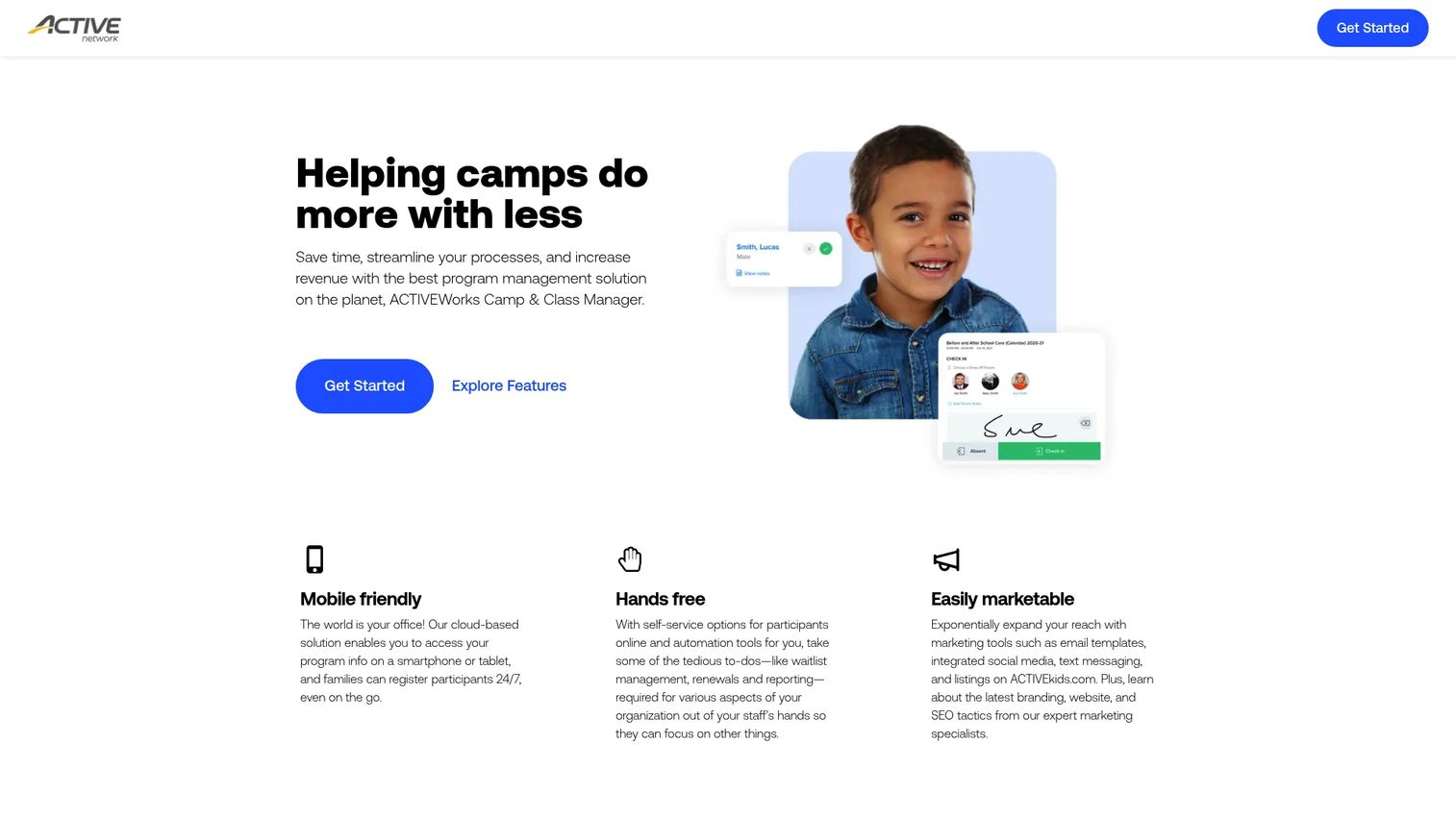
ACTIVEWorks Camp & Class Manager from ACTIVE Network is an online registration and camp management platform for organizations running day camps, overnight camps, sports clinics, after-school programs, and enrichment classes. It covers mobile-friendly registration, automated waitlist management, check-in and check-out tracking, electronic signatures, integrated payment processing, a parent portal, multi-child registration, and financial reporting alongside email and text communications.
Best for: Activity organizations managing camps alongside classes, clinics, and recurring programs that need one registration system across all program types.
Key features
- Mobile-friendly online registration with automated waitlists
- Check-in and check-out tracking
- Electronic signatures and online form management
- Integrated payment processing with payment plans
- Parent portal with multi-child registration support
- Email marketing and SMS communication tools
- Customizable financial and participant reporting
Why choose ACTIVEWorks Camp & Class Manager: If your organization runs a mix of day camps, sports clinics, and enrichment classes, having all registrations in one system simplifies reporting and reduces duplicate family records. Programs with deep overnight camp needs, such as cabins, eMAR, or complex staff applications, should confirm whether those specific workflows are supported at your required depth.
ACTIVEWorks Camp & Class Manager pricing: Contact an ACTIVE account manager for current pricing. Fees vary by program volume, registration model, and payment processing structure. The vendor does not display a public subscription price.
G2 rating: 4.1 out of 5 (verified October 2026 from G2).
7. Sawyer
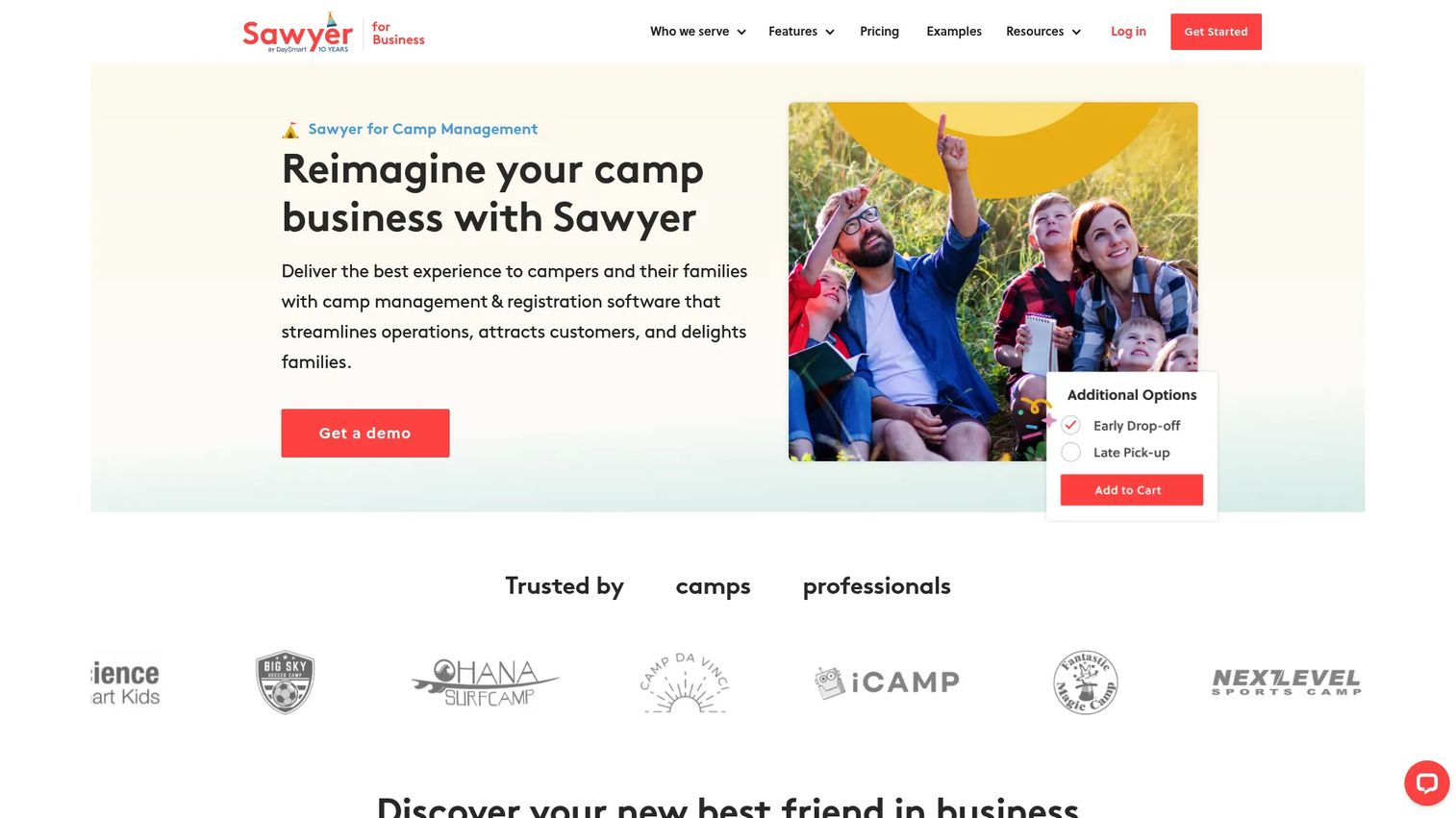
Sawyer is built for children's activity businesses that run camps as one offering among many. The platform manages camp scheduling and enrollment alongside classes, drop-in sessions, and private lessons. Core capabilities include scheduling across program types, parent communication and family profiles, flexible payment processing (credit cards and ACH), e-signature waivers, and marketplace and marketing integrations.
Best for: Children's activity providers running camps alongside year-round classes, drop-in offerings, and private lessons from a single scheduling and enrollment hub.
Key features
- Camp and class scheduling with enrollment management
- Parent communication and family profile management
- Credit card, ACH, and payment plan processing
- E-signature agreements and digital waivers
- Reporting dashboards and program analytics
- Marketplace and marketing integrations
Why choose Sawyer: Operators who need one enrollment workflow across seasonal camps and recurring offerings gain the most here. If your program is exclusively a residential camp with cabins, medication administration, and complex staff applications, confirm during evaluation whether those workflows are covered at the depth you need.
Sawyer pricing: Launch plan starts at $71 per month (billed annually) or $79 per month (billed monthly). Grow is $189 per month annually or $219 monthly. Scale is $379 per month annually or $399 monthly. Enterprise pricing requires contacting the sales team. Processing fees apply across all plans.
G2 rating: 4.5 out of 5 (verified October 2026 from G2).
8. Amilia SmartRec
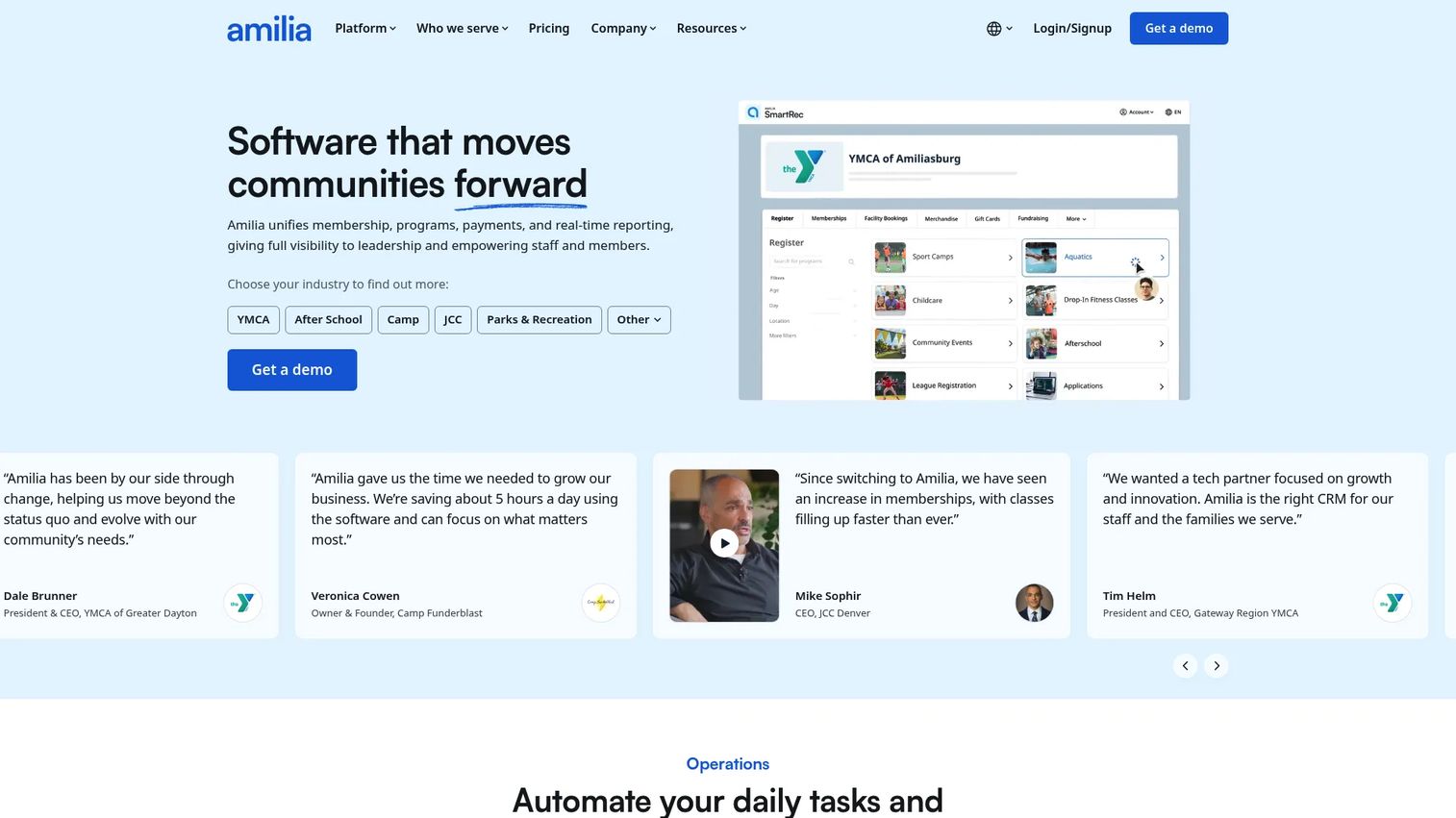
Amilia SmartRec is a recreation management and eCommerce platform for organizations that offer registrations, memberships, facility bookings, and merchandise alongside seasonal programs like camps. The platform serves YMCAs, JCCs, parks and recreation departments, nonprofits, and commercial recreation operators. It includes a branded online store, membership management, facility and staff management, automated billing and communications, and operational reporting.
Best for: Municipal, nonprofit, and commercial recreation organizations where summer camp is one program within a broader portfolio of memberships, classes, and facility operations.
Key features
- Branded online store with self-serve registration
- Membership management and renewal workflows
- Facility and resource scheduling
- Automated billing and payment processing
- Staff management and scheduling tools
- Reporting and participant analytics
Why choose Amilia SmartRec: Recreation operators who already manage memberships and facilities will find the integrated model reduces tool sprawl. A single-purpose summer camp without memberships or facility rental revenue may find the broader platform exceeds what the program actually uses. Confirm during evaluation whether camp-specific health and on-site workflows meet your requirements.
Amilia SmartRec pricing: Standard plan starts at $99 per month, covering one online store, up to 10 facilities, and up to 5,000 active accounts. Advanced is $499 per month, adding two premium add-ons, up to three stores, and up to 10,000 active accounts. Custom pricing is available for larger organizations. Payment processing and service fees are listed separately. Nonprofit pricing is also available.
9. UltraCamp
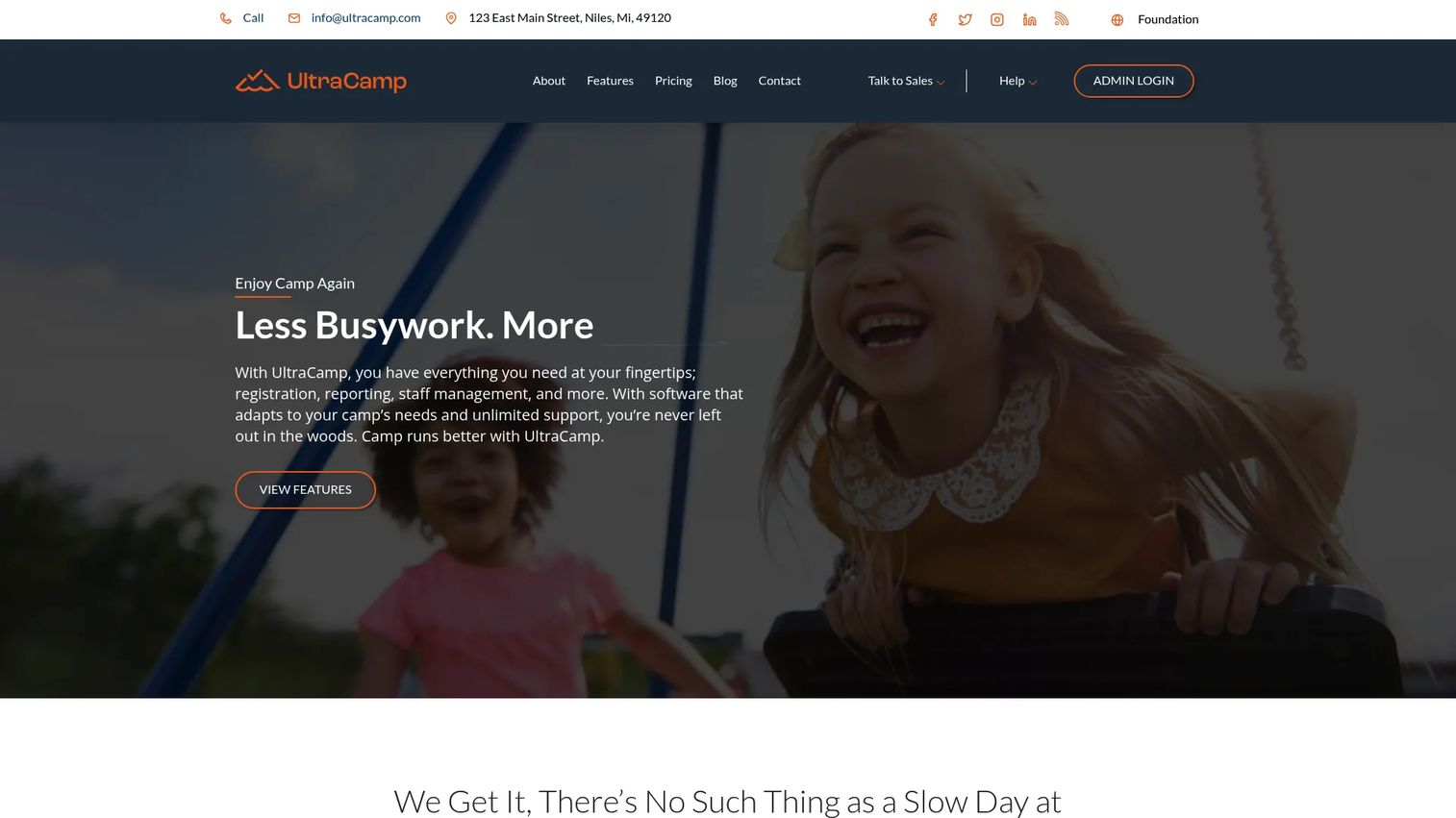
UltraCamp offers camp management software with published pricing tiers tied to participant volume, which makes early planning easier than fully quote-based competitors. The platform covers online registration with conditional options, payment plans, and e-signatures; health management including medication tracking, nurse logs, and incident reporting; multi-program management; check-in and check-out; attendance tracking; and communications tools.
Best for: Camp operators seeking configurable registration, health management, and participant workflows with published pricing they can evaluate before a sales conversation.
Key features
- Online registration with conditional options, payment plans, and waivers
- Health management including medication tracking, nurse logs, and incident reports
- Multi-program and session management with waitlists
- Check-in, check-out, and attendance tracking
- Staff application and management tools
- Parent communication and family account management
Why choose UltraCamp: The published tier structure tied to participant count means you can estimate annual cost before committing to a demo cycle. That transparency is useful when presenting options to a finance lead or board. Confirm integration options, mobile use for on-site staff, and reporting depth during your evaluation.
UltraCamp pricing: Basic starts at $275 per month (up to 500 individuals per year). Advanced is $475 per month (up to 1,250 individuals). Enterprise is $975 per month (up to 3,500 individuals). Additional individual fees and plan-specific feature differences apply. Pricing verified October 2026 from ultracampmanagement.com.
10. CampSite
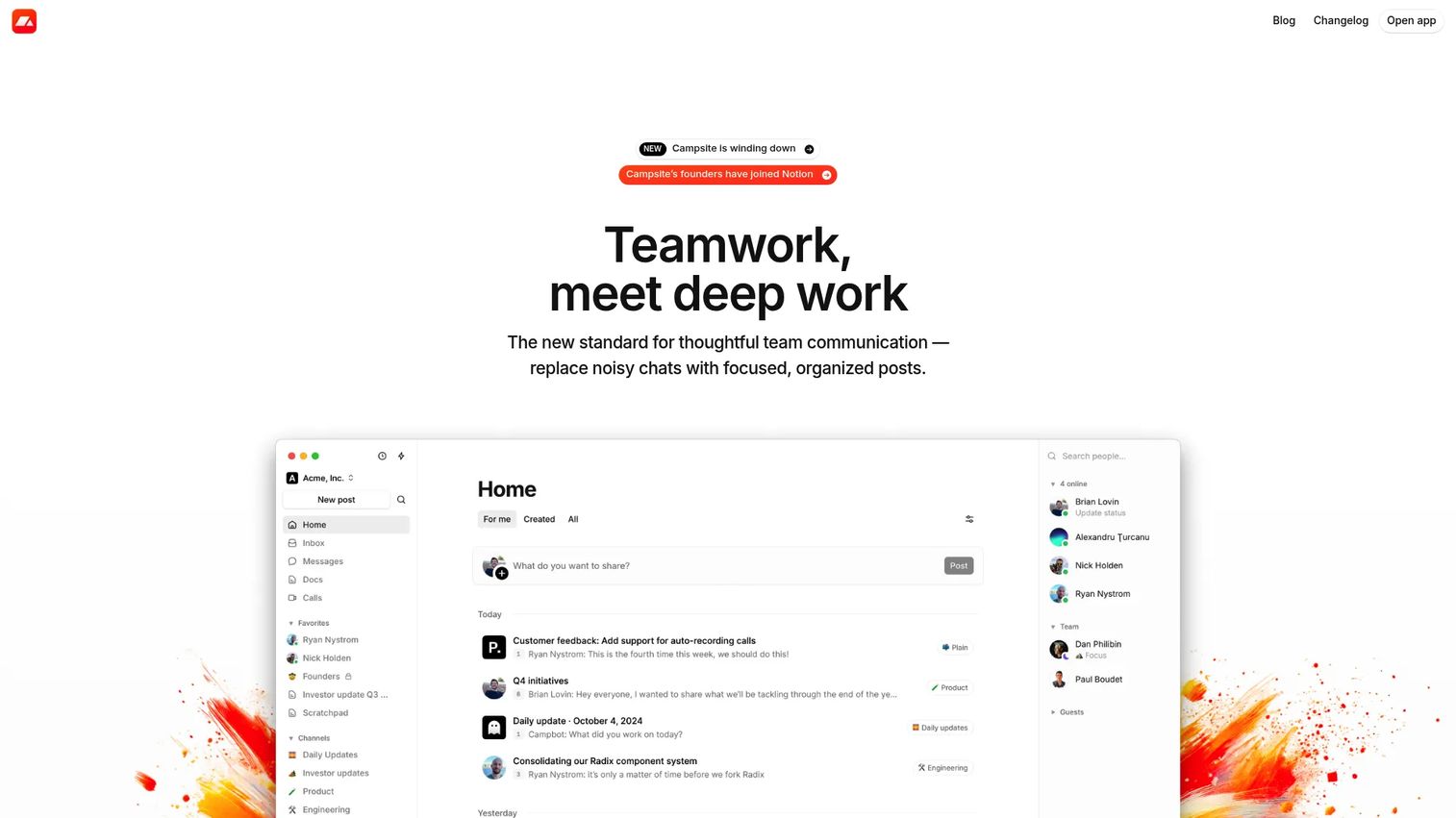
Editorial note for publication: The brand research for CampSite (campsite.com) confirmed that this domain now belongs to a work communication platform for distributed teams, not a camp operations system. The G2 listing for CampSite as a camp management product and the campsite.com domain appear to reference different products. Verify the current status of the camp-specific CampSite product and its homepage before publishing. The description below reflects what the brand research confirmed about the campsite.com product.
CampSite as currently verified is an asynchronous work communication platform built around organized posts, focused discussions, and structured team knowledge. It is primarily used by distributed software teams seeking an alternative to noisy chat tools. This product does not function as camp operations software for youth programs.
Best for: Distributed teams seeking async, organized internal communication rather than camp administration.
Key features
- Unlimited posts and direct messages
- Audio and video calls with automatic summaries
- Post resolutions and team-following features
Why choose CampSite (as a work communication tool): This platform suits teams managing knowledge asynchronously, not camp directors managing registrations, health records, or cabin assignments. If you searched for camp management software and landed on campsite.com, this is not the tool category you need.
CampSite pricing: Essentials starts at $8 per member per month. Pro is $16 per member per month. Business uses custom pricing. A free tier is available.
G2 rating: 4.7 out of 5 (verified October 2026 from G2).
Considerations when choosing camp management software
Total annual cost, not only the monthly price
Add up the subscription fee, per-registration charges, payment processing percentages, SMS credits, implementation, data migration, staff training, optional modules, and any annual contract minimum. A $199 per month entry price can reach several thousand dollars annually when registration volume and per-camper fees are factored in. Ask vendors to model your expected enrollment before you compare headline numbers.
Health, safety, and data-access requirements
Identify which staff roles need access to medical profiles, medication logs, allergy alerts, and incident records. Evaluate role-based permission controls and confirm how the system handles data export, retention, and emergency access for off-hours situations. This is also where you verify mobile workflows: Can a nurse log a medication administration from a tablet at a remote site?
Operational fit for your specific camp type
A day camp, a residential overnight program, a sports clinic, and a conference center do not share the same workflow. Test the exact processes that create operational risk at your program: Cabin assignments, friend group requests, transportation runs, staff credential tracking, facility rentals, authorized pickup controls, or medication administration. A live scenario test is more reliable than a feature checklist.
Implementation and migration support
Ask who imports your existing camper data, builds your registration forms, configures session rules, trains your staff, and supports your first registration cycle. The association management software evaluation discipline applies here: The system should be ownable by your operations team, not by the vendor or the founding team. Map the implementation timeline against your next registration open date.
Reporting and leadership visibility
Check whether the platform can answer the questions your leadership team asks weekly: Which sessions are filling fastest? Which families still have incomplete health forms? What payment balances remain outstanding? Where are registration drop-offs happening? If those answers require exporting data into a separate spreadsheet, the reporting layer needs to be part of your evaluation, not an afterthought.
How to choose the right camp management software for your team
If health records and medication workflows drive operational risk
Start with CampDoc. Health-intensive programs benefit most when medical information, medication administration, and incident documentation live alongside registration in a single record. Test a live scenario during your demo: Walk through a camper's medical form submission, a medication alert workflow, and how the nurse accesses that information on check-in day.
If you run an established overnight or residential camp
Lead your evaluation with CampMinder. The platform is built around the seasonal operating model that residential camps run, covering cabins, transportation, staff applications, and the Campanion parent app in one suite. Smaller programs should review whether the Classic or Deluxe package aligns with their actual enrollment volume before committing.
If pricing visibility matters before a board or budget review
iCampPro and UltraCamp both publish tier pricing, which makes early cost modeling possible without a full sales cycle. Model your total cost using their published per-registration fees and volume assumptions before presenting options to your finance lead.
If your organization combines camps with conferences, rentals, or fundraising
Campwise is the clearest fit when your operating model spans more than one revenue type. The unified record structure reduces the tool sprawl that comes from running separate systems for camps, retreats, and donor programs. A standalone summer camp operation likely won't need the full scope.
If camp is one program among classes, clinics, and recreation offerings
ACTIVEWorks Camp & Class Manager, Sawyer, and Amilia SmartRec all handle mixed-program operators. Match the choice to your specific mix: Sawyer fits children's activity businesses well; Amilia SmartRec suits recreation organizations with memberships and facilities; ACTIVEWorks fits programs that span day camps, sports clinics, and enrichment classes under one registration system. For broader operational context on evaluating software that centralizes fragmented workflows, the alumni management software evaluation framework offers a useful parallel for multi-record systems.
Conclusion
The camp management software category covers a wide range of operating models, and the right choice depends on your specific program type, not overall ratings. CampDoc is the strongest fit when health and medication workflows drive the buying decision. CampMinder suits established residential camps with complex seasonal operations. iCampPro and UltraCamp both offer published pricing for buyers who need a cost estimate before committing to a demo cycle. Campwise fits organizations combining camps with conferences, facilities, or fundraising. Sawyer and Amilia SmartRec serve operators running camps alongside year-round activity programs.
Before you shortlist, identify your highest-risk workflow: Registration errors, incomplete medical forms, payment reconciliation failures, check-in delays, or gaps in family communication. Test each finalist against that scenario specifically, not against a generic feature checklist.
For additional context on evaluating best payment processing software options that integrate with operational platforms, and for a broader look at how association management software handles multi-program record structures, those resources can sharpen your evaluation criteria before you begin vendor conversations.
FAQs
The best choice depends on whether your summer camp needs overnight logistics, health records, cabins, staff workflows, or year-round recreation tools alongside seasonal enrollment. Evaluate each platform against the specific workflows that create the most operational risk at your program, rather than comparing solely by overall ratings. CampDoc leads for health-intensive programs; CampMinder leads for residential camps with complex seasonal operations.
Core features include online registration, payment processing, digital forms and waivers, health information and medication tracking, attendance and check-in tools, family communication, operational reporting, and role-based user permissions. Specialized camps may also need cabin assignments, transportation management, staff hiring and credentialing, point-of-sale tools, facility rentals, or donor management depending on their operating model.
Camp registration software typically handles enrollment, payment collection, and form submission. A full camp management system adds operational workflows including health records, medication administration, attendance, cabin and group assignments, staff applications, family communication, and cross-program reporting. The distinction matters most when your program has overnight logistics, medical requirements, or multiple program types that need shared participant data.
Costs vary based on enrollment volume, included modules, payment processing rates, implementation, and contract terms. Published starting prices range from $71 per month (Sawyer) to $355 per month (CampDoc) for platforms with visible pricing. Quote-based platforms like CampMinder, Campwise, ACTIVEWorks, and CampBrain require direct contact for pricing. Total annual cost often differs significantly from the monthly subscription price once per-registration fees and processing charges are included.
Several platforms include participant medical histories, allergy profiles, immunization records, medication tracking, and incident documentation. CampDoc is specifically designed around these workflows, with electronic medication administration records and nurse logs as core features. CampMinder also includes integrated health center tools with eMAR. For any platform, confirm with the vendor which staff roles can access medical data, how permissions are configured, whether mobile access is supported, and how records are exported or retained after the season ends. This article does not constitute medical, legal, or compliance advice.
Day camps should prioritize enrollment, attendance, authorized pickup workflows, recurring session management, payment plans, and family communication. Programs that also run classes or clinics throughout the year may benefit from broader activity management systems like Sawyer or ACTIVEWorks Camp & Class Manager. If your day camp also tracks health forms and medication administration, CampDoc remains relevant regardless of program length.
Overnight camps need a deeper operational checklist than day programs: Cabin and group assignments, friend group requests, transportation management, staff application workflows, health records with eMAR, parent communication, and on-site reporting. CampMinder is designed specifically for this model. Request a live scenario demo covering your most complex on-site day, not just the registration portal, before committing.
Implementation time depends on the volume of existing camper records, the complexity of your registration forms, payment configuration, integration requirements, staff training needs, and the number of programs being migrated. Most programs should plan for several weeks of setup before a registration cycle opens, with dedicated time for data migration, form building, and staff onboarding. Assign one person as the accountable implementation owner. A system that requires the executive team to manage ongoing configuration is not the right fit for an operation trying to remove founder-level bottlenecks from day-to-day administration.