Most tokenization projects do not stall because the technology is immature. They stall because a team picked a platform that looked credible in a pitch deck but could not handle investor eligibility checks, jurisdiction-specific compliance, or lifecycle servicing once real capital was involved. The token gets minted. Then legal asks who can hold it, operations asks how transfers get restricted, and the whole thing grinds to a halt.
That selection risk is expensive. The global asset tokenization platforms market is projected to reach roughly USD 2.28 billion in 2026 and USD 5.25 billion by 2033, a compound annual growth rate of 12.6% according to DIResearch (2026). Tokenized money-market and Treasury products alone hit USD 7.4 billion in assets by mid-2025, an 80% year-to-date surge per IndustryResearch.biz. Institutional capital is moving into regulated tokenization faster than most vendor roadmaps anticipated.
For presales, product, and technical evaluators, that means the wrong platform choice creates legal, operational, and integration headaches you inherit later. This is a shortlist for teams comparing asset tokenization platforms in 2026, built to help you validate fit before you commit.
What's inside
This guide is for presales engineers, product leads, legal reviewers, and technical buyers who need to compare regulated asset tokenization platforms on the criteria that actually matter in diligence. It is not a crypto explainer. It assumes you have already decided tokenization is relevant and now need to validate which vendor is viable for your asset class and compliance posture.
We evaluated each platform on five criteria: compliance and regulatory posture, smart-contract automation, breadth of asset-class coverage, institutional trust and credibility, and the depth of supporting infrastructure around issuance, custody, and secondary market access.
TL;DR
- Best for regulated issuance and institutional credibility: Securitize.
- Best for standards-first, ERC-3643 tokenization across jurisdictions: Tokeny.
- Best for onchain infrastructure, data integrity, and interoperability: Chainlink.
- Best for private-market and alternative asset distribution: ADDX.
- Best for regulated trading plus tokenization in one venue: Archax.
- Best for exchange-grade market infrastructure: SIX Digital Exchange.
What is an asset tokenization platform?
An asset tokenization platform is the infrastructure used to issue, manage, and service tokenized real-world assets across their entire lifecycle, from creation through distribution, transfer, and ongoing reporting. It converts ownership rights in an asset, such as a fund, a bond, real estate, or private equity, into digital tokens that carry embedded compliance rules and can be held, transferred, or traded within regulated constraints.
The category sits at the intersection of financial infrastructure and blockchain, which is why buyer evaluation is dominated by trust, compliance, and operational depth rather than novelty. Here are the core functions a serious platform covers:
- Issuance and token creation: minting tokens that represent legal ownership, often using permissioned token standards that encode transfer restrictions.
- Compliance controls and KYC/AML: built-in investor identity verification, anti-money-laundering screening, and rule enforcement at the token level.
- Investor onboarding and eligibility: whitelisting, accreditation checks, and jurisdiction-aware eligibility gating so only qualified holders can transact.
- Custody and transfer workflows: secure holding of digital securities and controlled transfer logic that respects lock-ups, caps, and regulatory limits.
- Secondary market or distribution support: connection to trading venues, alternative trading systems, or distribution partners for liquidity.
- Lifecycle automation and reporting: corporate actions, dividend or coupon distribution, cap-table management, and audit-ready reporting powered by smart contracts.
The difference between a real world asset tokenization platform and a generic blockchain wrapper is that the platform treats compliance as a first-class function, not an afterthought. That is the line institutional buyers care about most.
When to use an asset tokenization platform
When you need regulated issuance
Regulated markets need far more than a token minter. If you are issuing a digital security, the platform has to enforce investor eligibility, restrict transfers to whitelisted holders, and manage the asset through its full lifecycle including redemptions and corporate actions. Token creation is the easy part. Compliance controls, permissioned transfers, and lifecycle management are where regulated tokenization succeeds or creates liability. Evaluate a platform on how it enforces rules at the token level, not on how quickly it can mint.
When you need to support multiple asset classes
Real estate, funds, commodities, and private equity each create different structuring, onboarding, and servicing requirements. A tokenization platform for real estate may need fractional ownership logic and rental distribution, while a private equity vehicle needs capital-call handling and long lock-up enforcement. A commodities program needs custody and reserve verification. If your roadmap spans multiple asset types, prioritize platforms with proven flexibility across asset structuring rather than a single-asset specialist.
When you need to reduce manual operations
Smart contracts and standardized workflows exist to remove the manual overhead that buries issuers, legal teams, and operations staff. Automated compliance checks, programmatic dividend distribution, and onchain cap-table management cut the reconciliation and paperwork that otherwise scale linearly with every new investor. If your team is drowning in spreadsheets and manual transfer approvals, the value of automation and lifecycle management is measured in headcount you do not have to add.
Comparison table
The shortlist below is ordered by how directly each platform serves core issuance and compliance needs, starting with regulated issuer platforms and moving toward market-access and infrastructure specialists. Pricing and ratings reflect verified public information where available; where a vendor gates pricing behind sales conversations, we note that plainly.
| # | Product | Intent | Key differentiation | Pricing | G2 rating |
|---|---|---|---|---|---|
| 1 | Securitize | Regulated issuance | Institution-facing digital securities and onchain markets | 1% per secondary trade (Markets) | 3.5/5 |
| 2 | Tokeny | Standards-first infrastructure | ERC-3643 permissioned tokens, portable compliance | From €3,000/month | 3.9/5 |
| 3 | QEDVault | Digital ownership and authentication | Blockchain product passports and lifecycle tracking | Not publicly listed | Not available |
| 4 | Chainlink | Onchain infrastructure | Data feeds, cross-chain interoperability, proof of reserve | Usage-based, not publicly listed | 3.8/5 |
| 5 | ADDX | Private-market access | Regulated distribution of alternative assets | From USD 1,000 subscription | Not available |
| 6 | Archax | Regulated trading and tokenization | Exchange, custody, and tokenisation engine | No minimum fee | Not available |
| 7 | SIX Digital Exchange | Exchange-grade infrastructure | Regulated issuance, custody, and settlement | From CHF 1.70 per settlement | Not available |
| 8 | Oasis Pro Markets | Digital securities and ATS | Issuance plus multi-asset secondary trading | Not publicly listed | Not available |
Asset tokenization platforms compared
1. Securitize
Securitize is a regulated tokenization platform built for issuing, managing, and trading real-world asset securities. It is one of the most recognized names in institutional tokenization, with public onchain signals from large capital-markets programs and a compliance-first posture that appeals to issuers who cannot afford regulatory ambiguity. For presales teams validating fit, Securitize is the platform that shows up when credibility and regulated infrastructure outweigh ecosystem storytelling.
Best for: Institutions and issuers that need regulated tokenization and digital securities infrastructure backed by real market credibility.
Key strengths
- Regulated digital securities: compliant issuance and management of tokenized securities under a recognized regulatory framework.
- Real-world asset tokenization: proven capacity to bring funds, credit, and other RWA structures onchain.
- Onchain secondary markets: integrated market infrastructure for compliant secondary trading of tokenized assets.
Why choose Securitize: Teams pick Securitize when regulated issuance matters more than breadth of ecosystem narrative. Its market positioning and public capital-markets activity give diligence teams tangible trust signals, which shortens the internal case for a platform that legal and compliance stakeholders will approve.
Securitize pricing: The publicly available broker-dealer fee schedule shows a 1% trade commission for Securitize Markets on secondary market transactions. Broader software pricing is not published, so plan to validate issuance and platform fees directly with their team during evaluation.
2. Tokeny
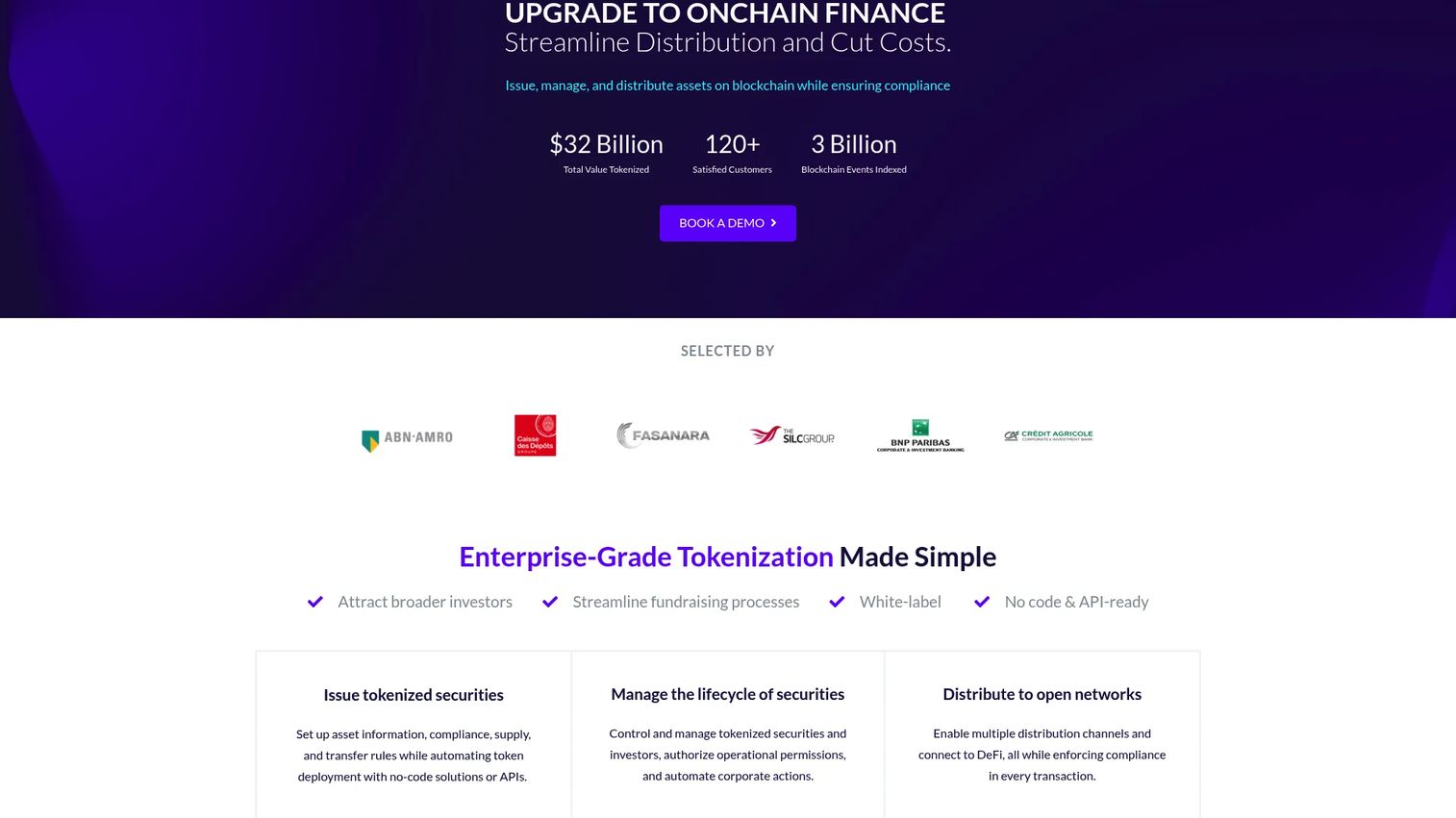
Tokeny is an enterprise onchain finance platform for issuing, managing, distributing, and transferring tokenized securities. It is the standards-first choice, built around ERC-3643, the permissioned token standard designed for regulated assets. Tokeny frames itself as an operating system for onchain finance, pairing a no-code white-label platform with an API-based engine so teams can embed portable compliance into every token they issue.
Best for: Financial institutions and asset managers tokenizing regulated assets who care about permissions, interoperability, and standards-based issuance across jurisdictions.
Key strengths
- ERC-3643 permissioned tokens: compliance and eligibility rules travel with the token, enabling regulated transfers across venues.
- No-code platform and API engine: issue and manage tokens through a white-label interface or embed the engine directly via API.
- Automated KYC/AML and whitelisting: investor onboarding, identity verification, and permissioned transfers handled at the protocol level.
Why choose Tokeny: In diligence-heavy deals, standards and interoperability matter. Tokeny's ERC-3643 foundation means compliance rules are portable rather than locked to a single environment, which is a strong signal for technical and legal reviewers who want to avoid vendor lock-in. Its ecosystem positioning makes it easier to defend as a long-term infrastructure choice.
Tokeny pricing: Tokeny publishes clear pricing across two product lines. The T-REX Platform starts at €3,000 per month for Standard and €5,000 per month for Advanced, with Enterprise available on request. The T-REX Engine follows the same structure, starting at €3,000 per month with custom Enterprise pricing.
3. QEDVault
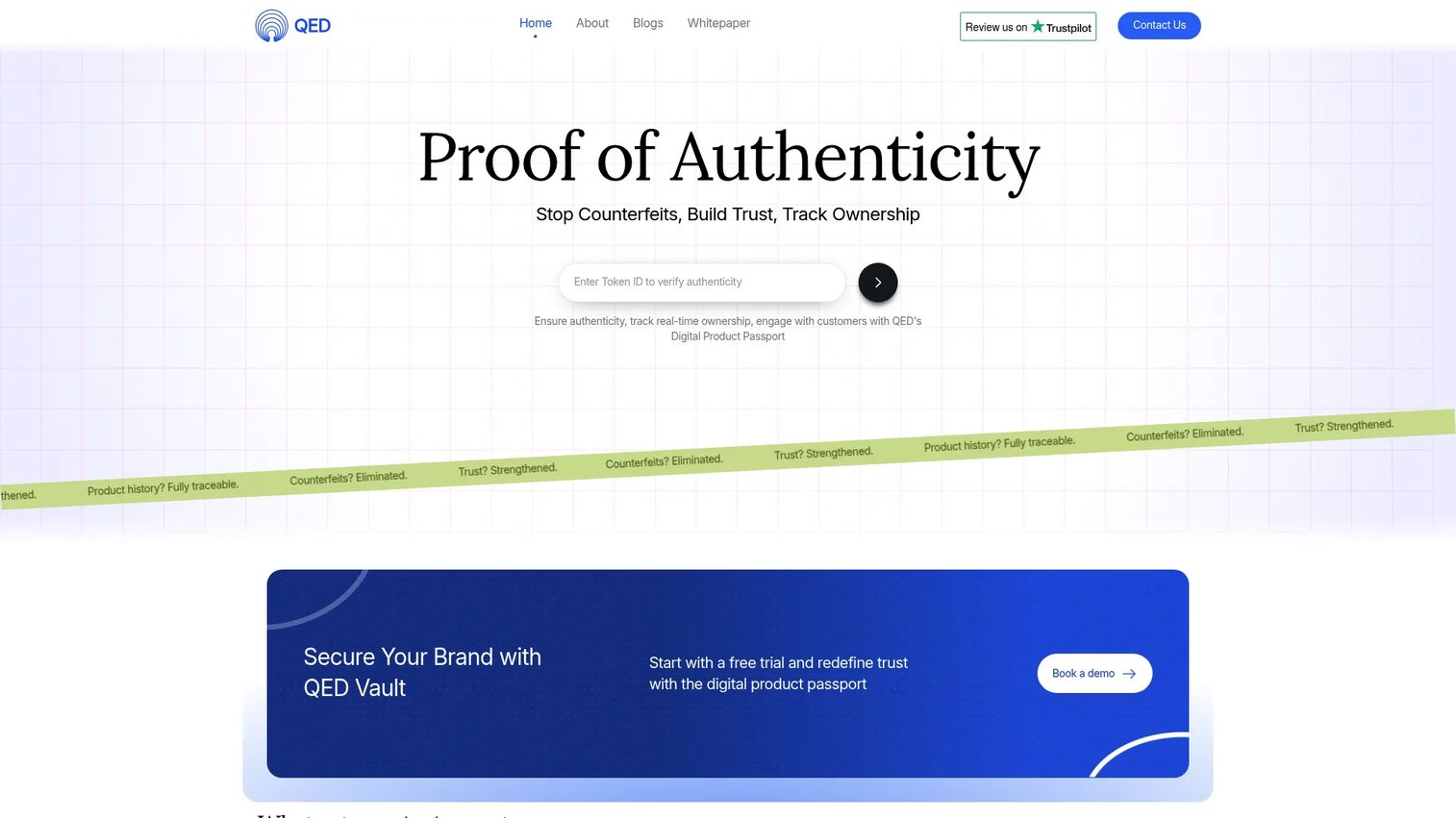
QEDVault is a blockchain-based platform focused on digital product passports, brand authentication, and lifecycle tracking. It uses a private blockchain to record authenticity, ownership, and lifecycle data, verifiable through QR scans or passport lookups. For teams exploring asset-specific tokenization and digital ownership use cases, QEDVault approaches the problem from the provenance and authentication angle rather than pure securities issuance.
Best for: Brands and teams that need anti-counterfeit authentication, digital product passports, and real-time ownership tracking tied to physical or digital assets.
Key strengths
- Private blockchain: controlled ledger for recording authenticity and ownership without public-chain exposure.
- QR and passport verification: instant lookup of an asset's authenticity and provenance through a scan.
- Lifecycle and ownership tracking: real-time visibility into an asset's history and current holder.
Why choose QEDVault: Teams evaluating tokenization for authentication, provenance, and digital ownership stories will find QEDVault's approach practical and web-conversion friendly. It fits use cases where proving authenticity and tracking lifecycle data matter more than regulated securities issuance.
QEDVault pricing: Public pricing numbers are not listed on the QEDVault site. The site references a free trial and demo, so plan to request a walkthrough and a quote directly to understand cost for your use case.
4. Chainlink
Chainlink is an oracle platform that connects blockchains to offchain data, systems, and cross-chain workflows. It is not an issuer-first UI. Instead, it is the infrastructure layer teams evaluate when their tokenization architecture depends on data integrity, proof of reserve, and interoperability across chains. If your smart contracts need trustworthy external data or your tokenized assets need to move safely between networks, Chainlink is the orchestration layer under the hood.
Best for: Teams building tokenization architecture that depends on secure data feeds, cross-chain interoperability, and onchain trust primitives like reserve verification.
Key strengths
- Data feeds and Onchain Data Protocol: secure, verifiable data delivered to smart contracts for pricing and compliance logic.
- Cross-Chain Interoperability Protocol (CCIP): move tokenized assets and messages safely across multiple blockchains.
- Chainlink Runtime Environment (CRE): automation and orchestration for complex onchain workflows.
Why choose Chainlink: Buyers choose Chainlink when their architecture hinges on data integrity and interoperability rather than a packaged issuance interface. It complements a dedicated issuance platform by providing the trust primitives, proof of reserve, and cross-chain plumbing that make tokenized assets credible and portable.
Chainlink pricing: Chainlink does not publish a public pricing page. The site describes network usage fees, protocol revenue share, and enterprise integrations, with pay-per-use or subscription models tied to ongoing network usage. Expect to scope pricing against your specific integration during evaluation.
5. ADDX
ADDX is a digital securities platform for investing in private markets and alternative assets. It gives accredited investors regulated access to private equity, hedge funds, private debt, unicorns, and other alternatives through a managed, market-facing experience with app access. For issuers who need a distribution channel into a qualified investor base, ADDX handles the onboarding and market layer rather than only the token creation.
Best for: Accredited investors and issuers seeking regulated access to private-market and alternative investments with a managed distribution experience.
Key strengths
- Alternative asset access: private equity, hedge funds, private debt, and unicorn exposure on one regulated platform.
- Regulated buy and sell: trade tokenized private-market assets through a compliant platform with app access.
- Fee-light structure: a one-time subscription model with no annual management fee.
Why choose ADDX: ADDX suits teams that value a regulated, investor-facing distribution layer over raw issuance tooling. If your goal is reaching accredited investors for alternative assets with fractional ownership and a polished onboarding flow, ADDX provides the market-facing experience that a pure infrastructure vendor does not.
ADDX pricing: ADDX states a one-time subscription fee with no annual management fee. Public pages reference investing minimums of USD 1,000 and USD 10,000 depending on the offering. A simple published pricing table is not displayed, so confirm current fees and minimums directly.
6. Archax
Archax is regulated digital asset infrastructure spanning crypto, tokenisation, custody, and trading. It differs from pure software infrastructure because it operates as a regulated venue, combining an institutional exchange and brokerage with a tokenisation engine and custody services. For firms that want issuance plus market access under one regulated roof, Archax reduces the number of vendors and counterparties in the stack.
Best for: Institutions that need regulated digital asset trading, custody, and tokenisation infrastructure in a single venue.
Key strengths
- Institutional exchange and brokerage: a regulated venue for trading crypto and tokenized assets.
- Tokenisation engine: create and manage real-world asset tokens with compliance built in.
- Custody and OTC services: institutional-grade custody and over-the-counter trading under one provider.
Why choose Archax: Teams prioritizing regulated trading, custody, and market access alongside issuance will value Archax's combined model. Consolidating exchange, custody, and tokenisation with one regulated entity simplifies counterparty diligence and can shorten the path from issuance to liquidity.
Archax pricing: Archax's public homepage states there is no minimum fee and references zero deposit and withdrawal fees. A full published fee schedule is not available on the pages reviewed, so request a detailed breakdown for your specific trading and issuance needs.
7. SIX Digital Exchange
SIX Digital Exchange is regulated digital asset market infrastructure and post-trade services from SIX, the operator behind Switzerland's primary financial market infrastructure. It provides institutional-grade issuance, custody, and settlement for digital securities, and integrates digital and traditional assets within SIX post-trade services. When a buyer needs exchange-linked infrastructure rather than a standalone software platform, SDX brings the weight of established market infrastructure.
Best for: Financial institutions that need regulated digital securities infrastructure with exchange-grade issuance, custody, and settlement.
Key strengths
- Regulated issuance and lifecycle management: digital securities issued and serviced within a recognized market infrastructure.
- Custody and settlement: institutional-grade holding and settlement for digital assets.
- Traditional and digital integration: digital assets connected into SIX's existing post-trade services.
Why choose SIX Digital Exchange: Consider SDX when you need the credibility and settlement rigor of established market infrastructure rather than a pure tokenization platform. For institutions where counterparty strength and regulatory standing are decisive, exchange-linked infrastructure is often the safer institutional choice.
SIX Digital Exchange pricing: SIX publishes fee documents rather than consumer-style plans. Public charges include a listed rate starting around CHF 1.70 per settlement instruction. Confirm the full schedule for issuance, custody, and settlement against your intended volume.
8. Oasis Pro Markets
Oasis Pro Markets is a regulated digital securities platform offering issuance, secondary trading, tokenization, transfer agent, and API services. It runs primary issuance and secondary trading through a multi-asset alternative trading system (ATS), and layers on transfer agent services with onchain and offchain cap-table management. For issuers who need both a compliant issuance path and a regulated venue for liquidity, Oasis Pro Markets covers the full arc.
Best for: Issuers and partners that need regulated digital securities infrastructure spanning issuance, trading, and transfer agent services.
Key strengths
- Multi-asset ATS: primary issuance and secondary trading through a regulated alternative trading system.
- Digital securities tokenization: compliant token creation for regulated assets.
- Transfer agent services: onchain and offchain cap-table management under one provider.
Why choose Oasis Pro Markets: Oasis Pro Markets belongs on an institutional shortlist when you want issuance, secondary trading, and transfer agent services combined. Teams that value consolidating the compliance, market-access, and record-keeping layers under a single regulated provider should evaluate it closely.
Oasis Pro Markets pricing: Public pricing is not listed on the Oasis Pro Markets site. Because pricing for regulated issuance and ATS services is typically scoped per engagement, request a tailored quote based on your asset type and expected trading volume.
Considerations before you commit
Before you sign, run each shortlisted platform through the same evaluation checklist. Selection risk is highest when teams weight the pitch over the diligence.
Compliance and regulatory posture
Confirm the platform enforces KYC/AML, investor eligibility, and permissioned transfers at the token level, not just in a UI. Ask which jurisdictions it supports and how it handles cross-border eligibility. Regulated tokenization lives or dies on whether compliance is embedded in the token logic.
Asset-class coverage
Match the platform to your actual roadmap. A tokenization platform for real estate needs fractional ownership and distribution logic; private equity needs capital calls and long lock-ups; commodities need custody and reserve proof. Verify the vendor has run programs in your asset class, not just a demo.
Smart-contract and lifecycle automation
Evaluate how much of issuance, corporate actions, dividend distribution, and cap-table management is automated versus manual. The value of smart contracts is in removing operational overhead. Ask to see how transfers, redemptions, and reporting work end to end.
Integrations and infrastructure depth
Check custody integration, secondary market support, and API access. Institutional tokenization rarely runs on one vendor, so confirm the platform connects cleanly to custodians, trading venues, and your existing systems.
Institutional trust and track record
Look for public onchain signals, named programs, and regulatory standing. In this category, credibility is a technical requirement, not marketing. The strength of a vendor's existing institutional relationships is a legitimate diligence signal.
Conclusion
The eight platforms here fall into three practical decision buckets. Regulated issuer platforms like Securitize, ADDX, and Oasis Pro Markets lead when compliant issuance and investor access are the priority. Standards-first infrastructure like Tokeny wins when portable compliance and ERC-3643 interoperability matter in diligence. Market-access and infrastructure options like Archax, SIX Digital Exchange, and Chainlink fit when you need trading, custody, settlement, or onchain data integrity built into the stack.
For presales and technical buyers, the next step is not another demo of token minting. It is a structured validation of the criteria that create risk later: compliance enforcement, asset-class coverage, integration depth, and investor onboarding workflows. Build a shortlist of two or three, then pressure-test each against your real regulatory and operational requirements before you buy.
FAQs
An asset tokenization platform is the infrastructure used to issue, manage, and service tokenized real-world assets across their lifecycle. It converts ownership rights in assets like funds, bonds, real estate, or private equity into digital tokens that carry embedded compliance rules, and it handles issuance, transfers, and reporting within regulated constraints.
Regulated platforms enforce KYC/AML by verifying investor identity, screening against anti-money-laundering lists, and whitelisting only eligible holders. With permissioned token standards, these compliance rules are enforced at the token level, so transfers are automatically restricted to approved, verified investors.
Common asset classes include real estate, investment funds, private equity, private debt, commodities, and money-market or Treasury products. Each class has different structuring, onboarding, and servicing requirements, so the right platform depends on which assets you plan to issue and how they need to be serviced.
A tokenization platform focuses on issuing and managing tokenized assets across their lifecycle, including compliance and cap-table management. A digital asset exchange provides a regulated venue for trading those assets. Some providers, such as Archax and SIX Digital Exchange, combine issuance and trading, while others specialize in one layer.
ERC-3643 is a permissioned token standard built for regulated assets. It embeds eligibility and compliance rules directly into the token, so those rules travel with the asset across venues. For diligence teams, that portability reduces vendor lock-in and makes regulated transfers more interoperable.
Prioritize compliance enforcement at the token level, proven experience in your asset class, lifecycle automation for corporate actions and reporting, and clean integrations with custody and trading venues. Institutional trust signals, such as public programs and regulatory standing, are also legitimate technical criteria.
Yes. A tokenization platform for real estate typically supports fractional ownership and rental or income distribution, while private equity vehicles need capital-call handling and long lock-up enforcement. Confirm the vendor has run programs in your specific asset class rather than relying on a generic demo.
The integrations that matter most are custody, secondary market or ATS connectivity, and API access to connect the platform to your existing systems. Data integrity and cross-chain interoperability, provided by infrastructure layers like Chainlink, also matter when tokenized assets need to move safely across networks.