Your front desk is handling 300 calls a day. Half are routine: Scheduling, reminders, prescription questions, directions. Meanwhile, patients who called at 9 a.m. are still on hold at 9:45. And the staff answering those calls are the same people who should be handling complex intake, verifying insurance, and following up on no-shows.
This isn't a staffing problem. It's a workflow problem.
Healthcare organizations that have deployed AI patient engagement software report measurable reductions in call volume, no-show rates, and administrative overhead. McKinsey's 2026 healthcare research found that 50% of U.S. healthcare organizations had implemented generative AI by late 2025. The adoption curve is real, and the operational gap between early movers and everyone else is widening.
The harder question isn't whether to adopt AI patient engagement software. It's which platform actually reduces operational load without adding compliance risk, EHR complexity, or a 12-month implementation cycle.
This guide cuts through the noise with 15 verified options for 2026, organized to help you pick the right fit for your organization's size, workflows, and stack.
What's inside
This guide is for healthcare operations leaders, medical practice executives, healthtech founders, and operators evaluating AI patient engagement platforms for 2026.
- 15 AI patient engagement software options reviewed and compared
- Best-fit guidance by organization type: Enterprise health systems, specialty practices, small practices, and AI-first teams
- Comparison across scheduling, messaging, intake, voice AI, payments, and care navigation
- Evaluation criteria for EHR integration, security governance, implementation speed, and ROI measurement
Selection criteria: AI automation depth, patient access workflow coverage, EHR or PMS integration quality, pricing transparency, and evidence of measurable operational outcomes.
TL;DR
- Best enterprise healthcare CRM: Salesforce for health systems needing patient engagement tied to CRM, care programs, and AI agents
- Best patient journey automation: Luma Health for access, scheduling, referrals, and outreach across the patient lifecycle
- Best specialty practice access platform: Clearwave for front-office automation tied to eligibility, registration, and payment workflows
- Best free tier for intake: Phreesia, with its intake platform available at no cost through spring 2027
- Best for small practice communication: OhMD starting at $300/month for texting, reminders, and AI-assisted calls
- Best AI voice automation: Hyro (rated 4.9/5 on G2) for call deflection and conversational patient access
What is AI patient engagement software?
AI patient engagement software uses automation, machine learning, conversational AI, or AI agents to help healthcare organizations communicate with patients, coordinate access, collect information, support care journeys, and measure engagement across digital and voice channels.
The category spans multiple workflow layers:
- Patient access: Scheduling, reminders, recalls, waitlists, and referrals
- Communication: SMS, voice, email, portal, web chat, and mobile messaging
- Intake and registration: Forms, check-in, insurance capture, and payment prompts
- Care navigation: Triage, program enrollment, follow-up, and chronic care outreach
- Healthcare operations: EHR or PMS updates, staff routing, analytics, and reporting
Core capabilities to look for
- AI voice agents and call automation
- Two-way patient messaging across SMS, portal, and web
- Self-scheduling, reminders, and waitlist management
- Digital intake, check-in, and insurance verification
- EHR and PMS integrations with bidirectional data flow
- Patient billing and payment prompts
- HIPAA-related controls, BAAs, and audit logs
- Multilingual and preferred-channel outreach
- Analytics tied to access, revenue, and staffing metrics
The category boundary matters: AI patient engagement software is not a basic chatbot or a static patient portal. The strongest intelligent patient engagement platforms connect communication to scheduling, records, workflow automation, and measurable operational outcomes. They reduce the number of humans needed for routine work while improving the experience for patients who need something more complex.
When to use AI patient engagement software
Reduce avoidable phone volume
Staff spending more than 40% of their day on routine calls, confirmations, and scheduling requests is a signal to evaluate AI voice agents and SMS automation. These tools handle appointment questions, reminders, rescheduling, and prescription routing without human involvement, freeing your front office for work that requires judgment.
Automate access, intake, and follow-up
Self-scheduling, waitlists, digital registration, and post-visit follow-up each represent manual work that can be systematized. Organizations with multiple locations and high appointment volume are especially good candidates, as the operational leverage compounds across every location rather than applying to just one.
Connect patient communication to measurable operations
If your board asks about no-show rate, appointment fill rate, or collections and you can't answer with current data, you're running blind. AI patient engagement software creates the measurement layer: Call deflection rates, response times, payment conversion, and staff hours saved. Evaluate these tools when you need metrics that survive scrutiny, not activity reports that look good but don't tie to revenue or capacity.
AI patient engagement software comparison
The table below is a shortlist tool. Pricing and G2 ratings are drawn from vendor pricing pages and live G2 listings. Verify integration coverage, security documentation, and EHR compatibility before contracting.
| # | Product | Best for | Key differentiator | Pricing | G2 rating |
|---|---|---|---|---|---|
| 1 | Salesforce | Enterprise healthcare CRM | CRM-native patient journeys and AI agents | From $25/user/month | 4.4/5 |
| 2 | Luma Health | Patient journey automation | Scheduling, referrals, reminders, and outreach | Custom pricing | 4.8/5 |
| 3 | Clearwave | Specialty practice access | Self-service registration, eligibility, and payments | Custom pricing | 4.7/5 |
| 4 | OhMD | Medical practice messaging | HIPAA-focused texting and AI call handling | From $300/month | 4.8/5 |
| 5 | Klara | Centralized patient communication | Team inbox and messaging across care access | Custom pricing | 4.6/5 |
| 6 | Phreesia | Intake, registration, and payments | Free intake platform through spring 2027 | Free until May 2027 | 5.0/5 |
| 7 | Weave | Independent practice communication | Phones, texting, reviews, and payment messaging | From $199/month | 4.6/5 |
| 8 | Solutionreach | Patient recall and retention | Recall campaigns, reminders, and surveys | Custom pricing | 4.3/5 |
| 9 | NexHealth | Scheduling and digital experience | Online booking, forms, payments, EHR sync | Custom pricing | 4.8/5 |
| 10 | TeleVox | Automated outreach at scale | Multichannel outreach and population messaging | Custom pricing | 3.9/5 |
| 11 | Artera | Enterprise patient communication | AI agents for omnichannel healthcare messaging | Custom pricing | 4.5/5 |
| 12 | Emitrr | Small practice automation | Texting, webchat, reminders, and voice agents | Custom pricing | 4.8/5 |
| 13 | Prosper AI | AI healthcare revenue-cycle workflows | Voice agents for scheduling and payer calls | Custom pricing | 4.7/5 |
| 14 | Orbita | Conversational AI for healthcare | Virtual assistants for access and care navigation | Custom pricing | 4.2/5 |
| 15 | Hyro | AI voice and chat automation | Adaptive conversational AI for calls and access | Custom pricing | 4.9/5 |
Best 15 tools for AI patient engagement software
1. Salesforce
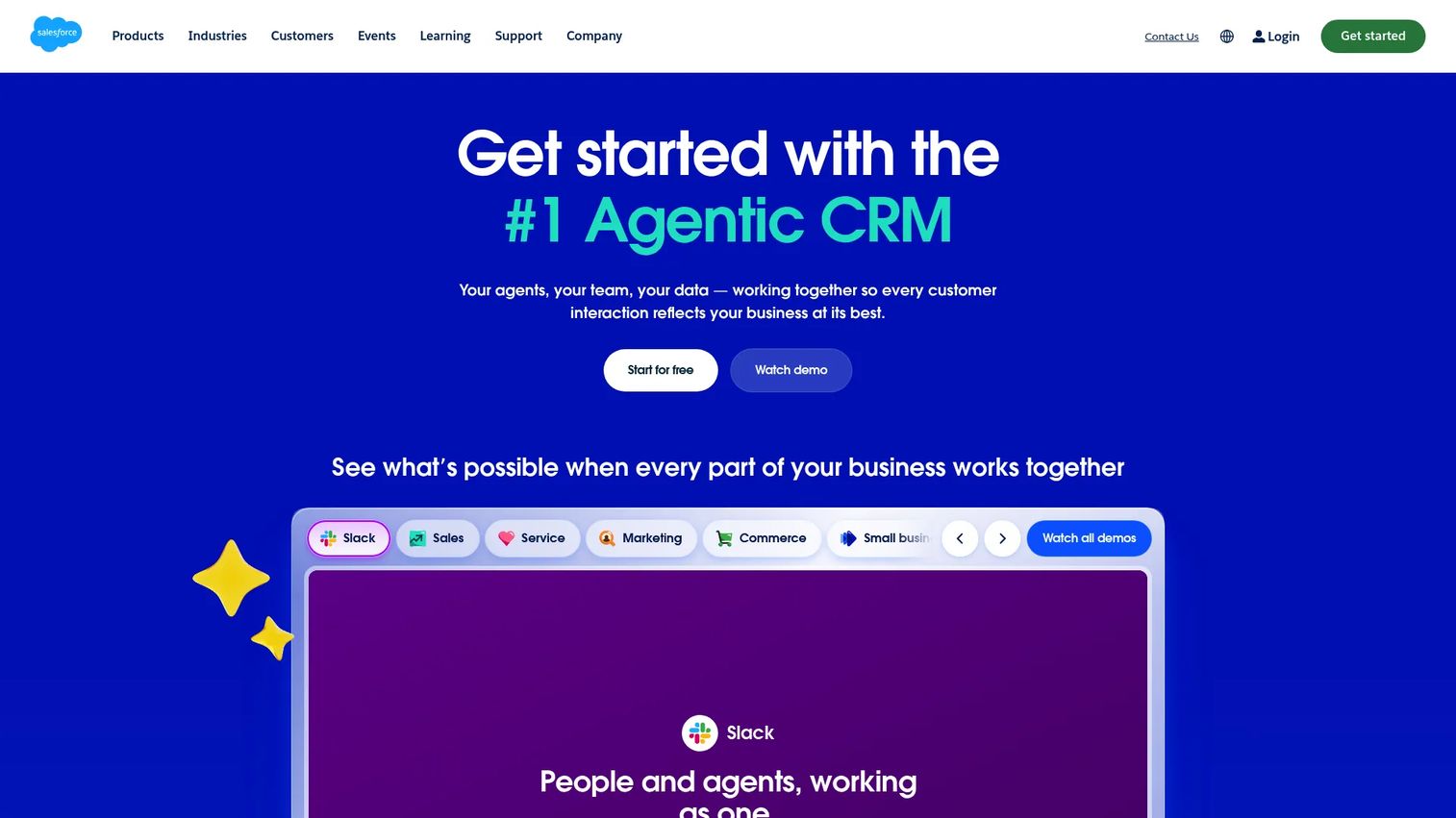
Salesforce is an enterprise CRM platform with dedicated healthcare capabilities through Health Cloud, including care program management, AI agents via Agentforce, and patient journey orchestration. It sits at the intersection of CRM, service, and clinical workflows, making it the strongest option for health systems that want patient engagement built on top of an enterprise data layer rather than bolted on.
Best for: Large healthcare organizations that need patient engagement connected to CRM, service, data, and care operations.
Key features
- Healthcare CRM and patient data management
- Agentforce AI care and service agents
- Patient journey and care program orchestration
- Multichannel communication across voice, SMS, and portal
- Lead, contact, and opportunity management with AI automation
Why choose Salesforce: Choose Salesforce if patient engagement is part of a broader enterprise strategy involving payer relationships, care coordination, and revenue. It's likely too large for independent practices that only need texting and reminders.
Salesforce pricing: Sales Cloud plans start at $25/user/month (Starter Suite, billed monthly) up to $550/user/month (Max, billed annually). Healthcare-specific Health Cloud pricing requires a quote from Salesforce's healthcare team.
G2 rating: 4.4/5
2. Luma Health
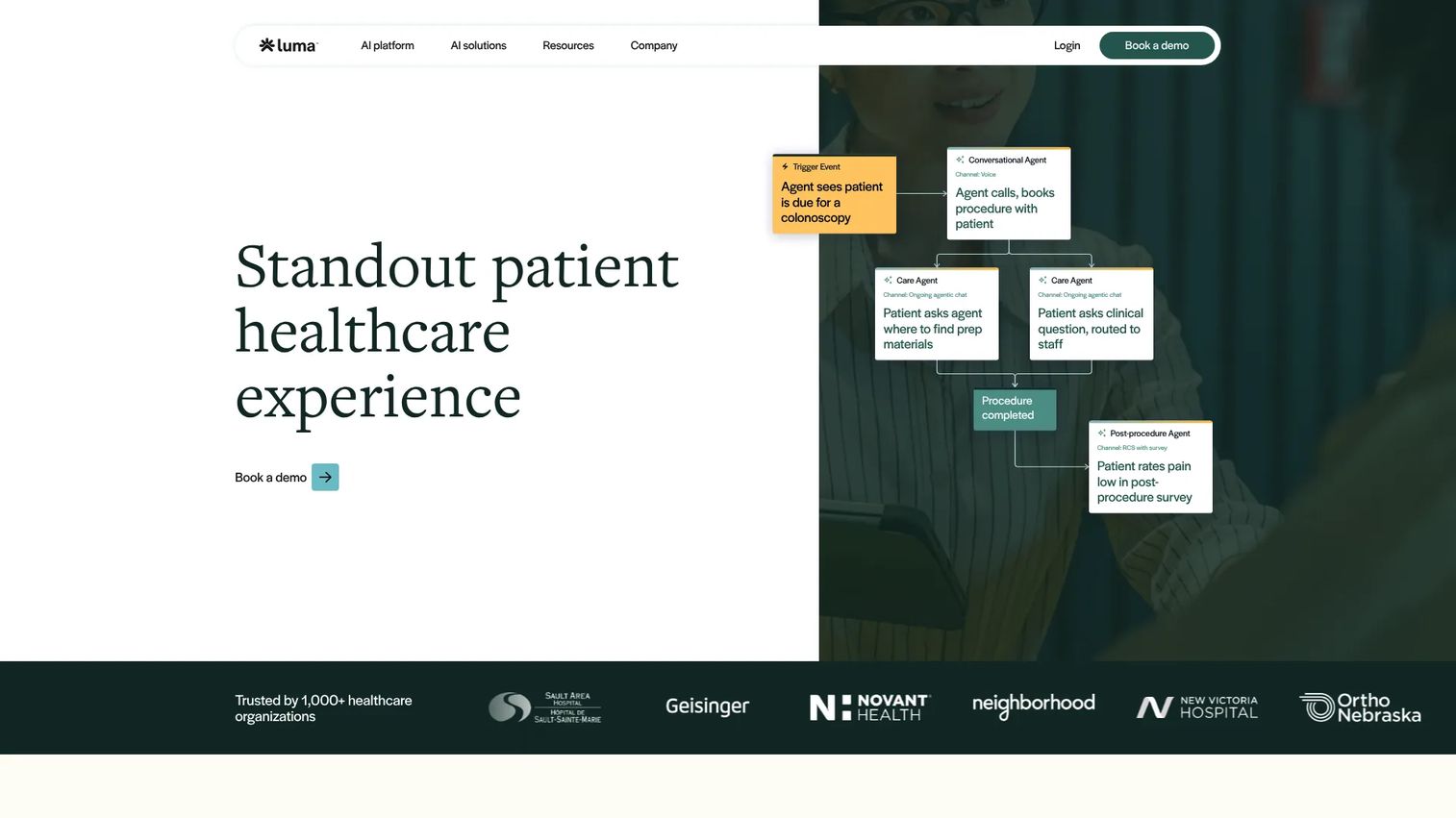
Luma Health is a patient access and journey automation platform built around scheduling, referrals, reminders, recalls, and patient outreach. It describes itself as an operational AI platform, with AI-powered workflows that coordinate the patient journey from first contact through post-visit follow-up. Multi-location groups and health systems use it to reduce referral leakage, improve appointment fill rates, and automate the communication touchpoints that typically require manual staff effort.
Best for: Healthcare organizations that need to orchestrate patient engagement across appointments, referrals, and follow-up at scale.
Key features
- AI-powered scheduling, rescheduling, and no-show recovery
- Referral management and intake coordination
- Appointment reminders and patient recalls
- Multichannel conversational AI and messaging
- Broadcast outreach for campaigns and population health
Why choose Luma Health: Luma Health performs best when access team capacity, appointment fill rate, and referral conversion are the metrics that matter. It's built for organizations managing volume, not just messages.
Luma Health pricing: Custom pricing. Quotes are based on organization size, workflows, and integration requirements. Contact Luma Health's sales team for details.
G2 rating: 4.8/5
3. Clearwave
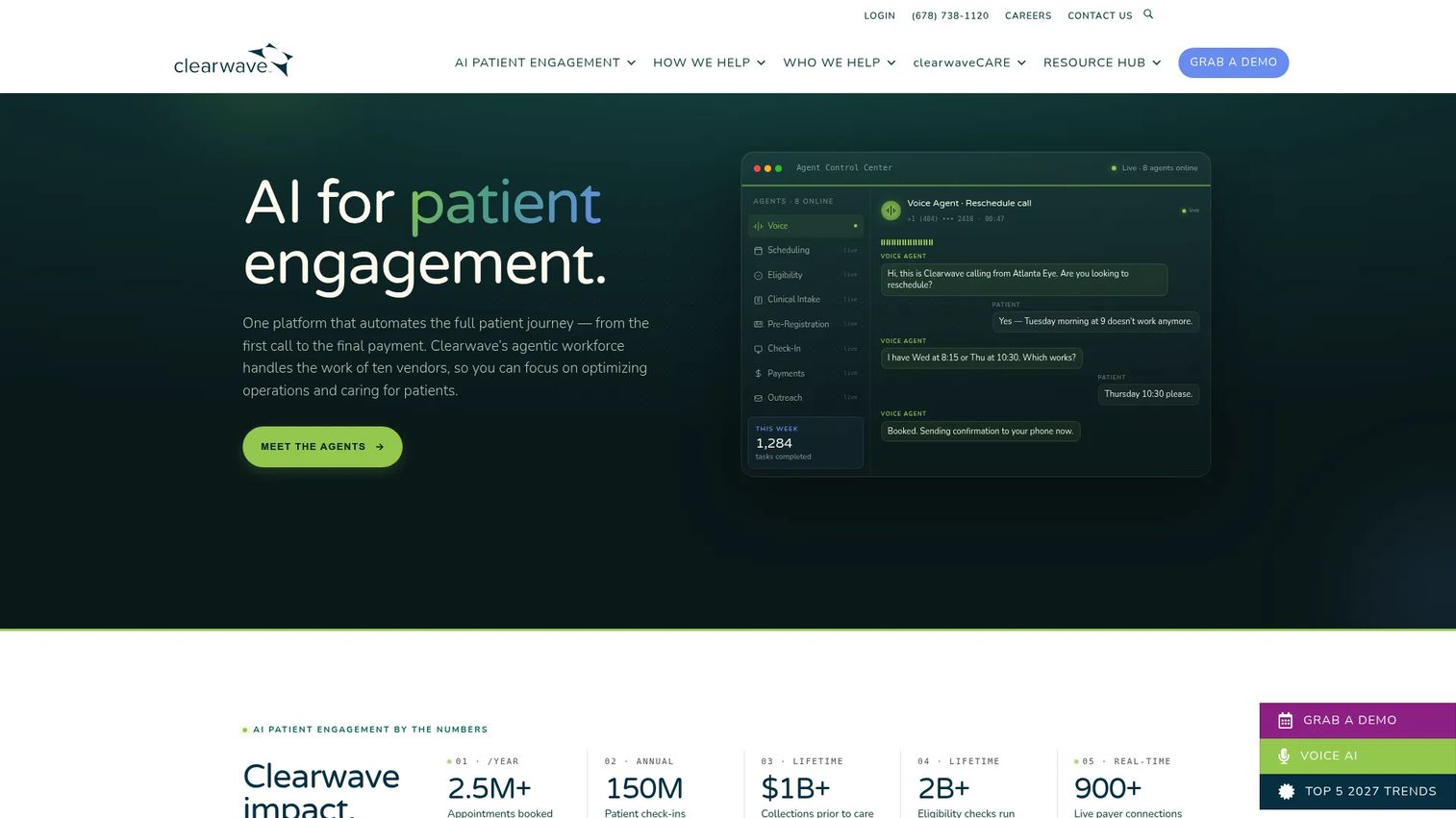
Clearwave is a patient engagement and patient access platform built for specialty practices and multi-location groups. It covers the full front-office workflow: AI-powered call handling, 24/7 self-service scheduling, digital pre-registration, eligibility verification across 900+ payer networks, digital check-in, and point-of-service payment collection. It integrates with more than 50 practice-management and EHR systems.
Best for: Specialty practices and multi-location groups that need front-office automation tied to access and revenue workflows.
Key features
- AI voice agent for call handling and scheduling
- Self-service registration and digital pre-registration
- Real-time insurance eligibility verification (900+ payers)
- Digital check-in via kiosk, mobile, and tablet
- Patient payment collection for co-pays and balances
Why choose Clearwave: The buying case is cleaner intake, fewer registration bottlenecks, reduced phone volume, and stronger point-of-service collections. Practices evaluating it should ask specifically which EHR or PMS systems are supported and what the write-back behavior looks like.
Clearwave pricing: Custom pricing. The quote process covers practice size, location count, specialties, integrations, and modules required.
G2 rating: 4.7/5
4. OhMD
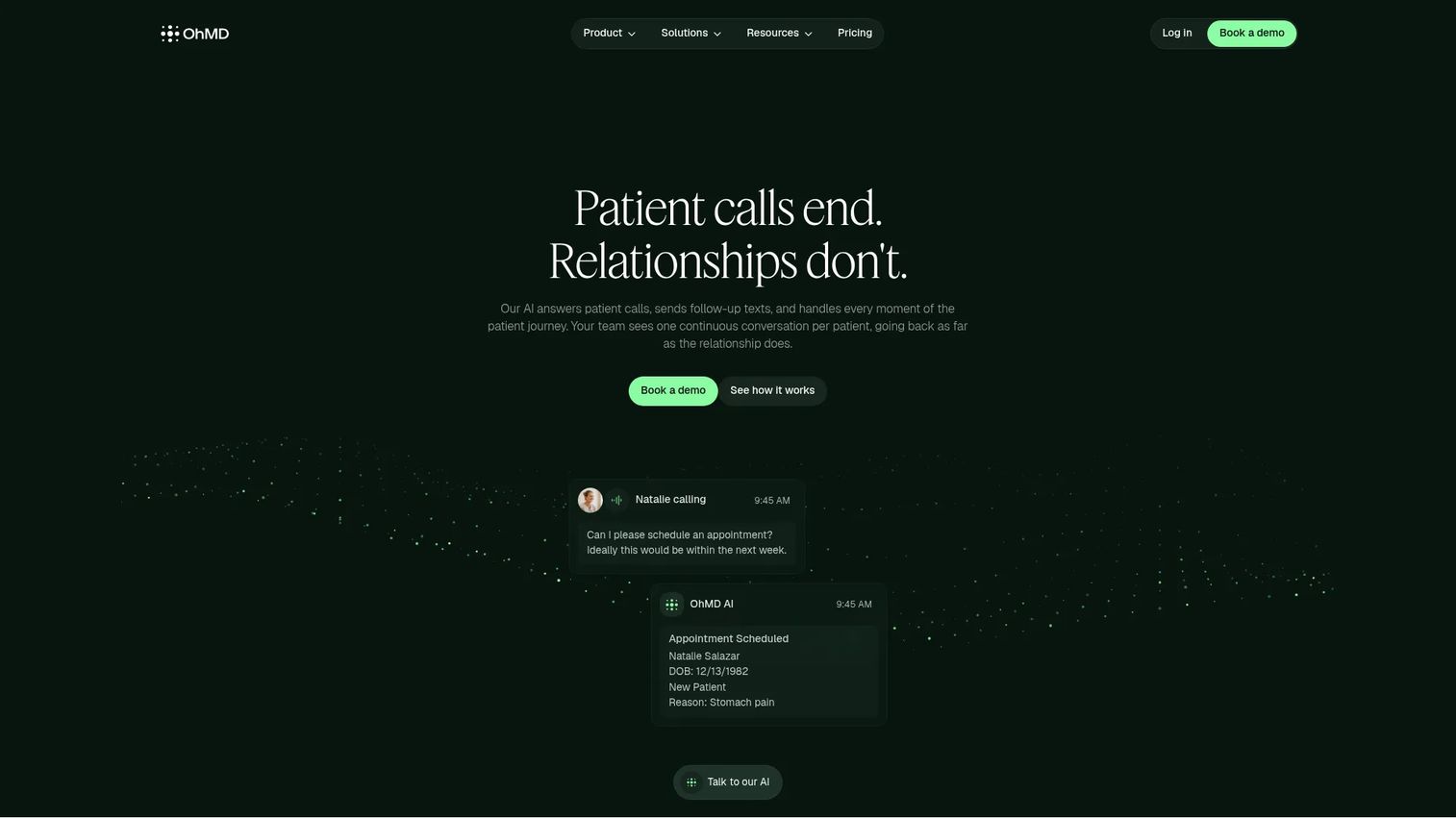
OhMD is AI-powered patient communication software that combines voice agents, two-way HIPAA-compliant texting, appointment scheduling, refill and referral handling, and EHR integration. The Communicate plan covers texting and communication tools; the Automate plan adds AI call handling and scheduling; Enterprise adds multi-location controls, SSO, and API access. It's one of the few platforms in this category with transparent entry-level pricing.
Best for: Medical practices that need HIPAA-conscious patient messaging and AI-assisted calls without a heavy enterprise rollout.
Key features
- AI voice and text agents for 24/7 patient calls
- Two-way HIPAA-compliant texting
- Appointment scheduling, rescheduling, and reminders
- Refill and referral request handling
- EHR integration and team inbox
Why choose OhMD: The value here is adoption speed. Practices can start with texting on the Communicate plan and expand to AI call handling on Automate as workflows stabilize. The transparent pricing model makes it easier to build a business case without a lengthy sales process.
OhMD pricing: Communicate starts at $300/month. Automate starts at $500/month, with calling usage billed separately. Enterprise pricing is custom.
G2 rating: 4.8/5
5. Klara
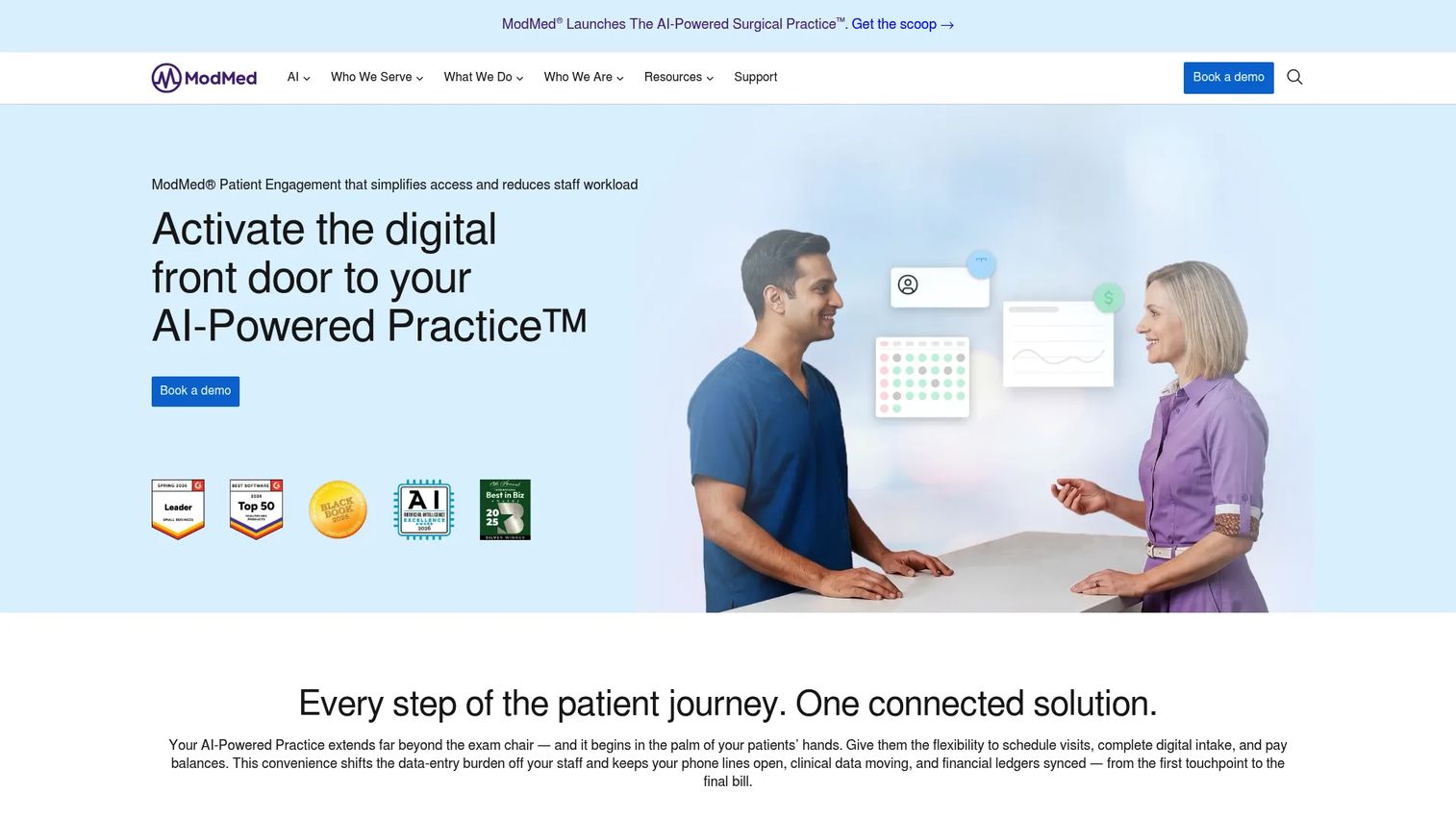
Klara is a patient engagement and communication platform, now part of ModMed, covering secure messaging, appointment communication, and care team coordination. It centralizes patient conversations that would otherwise be scattered across phone calls, voicemails, and individual staff inboxes, giving the care team a shared view of patient interactions.
Best for: Practices and healthcare groups that want a centralized patient communication hub connected to their practice management system.
Key features
- Secure two-way patient messaging
- Team collaboration and shared inbox
- Appointment scheduling and reminders
- Automated pre-visit and post-visit communication
- Patient access workflow support
Why choose Klara: Klara fits practices already in the ModMed ecosystem or those prioritizing care team coordination over heavy automation. Buyers should verify which EHR or PMS integrations are active and what data writes back to the record.
Klara pricing: Custom pricing. Contact Klara's sales team for quotes based on users, locations, and integration requirements.
G2 rating: 4.6/5
6. Phreesia
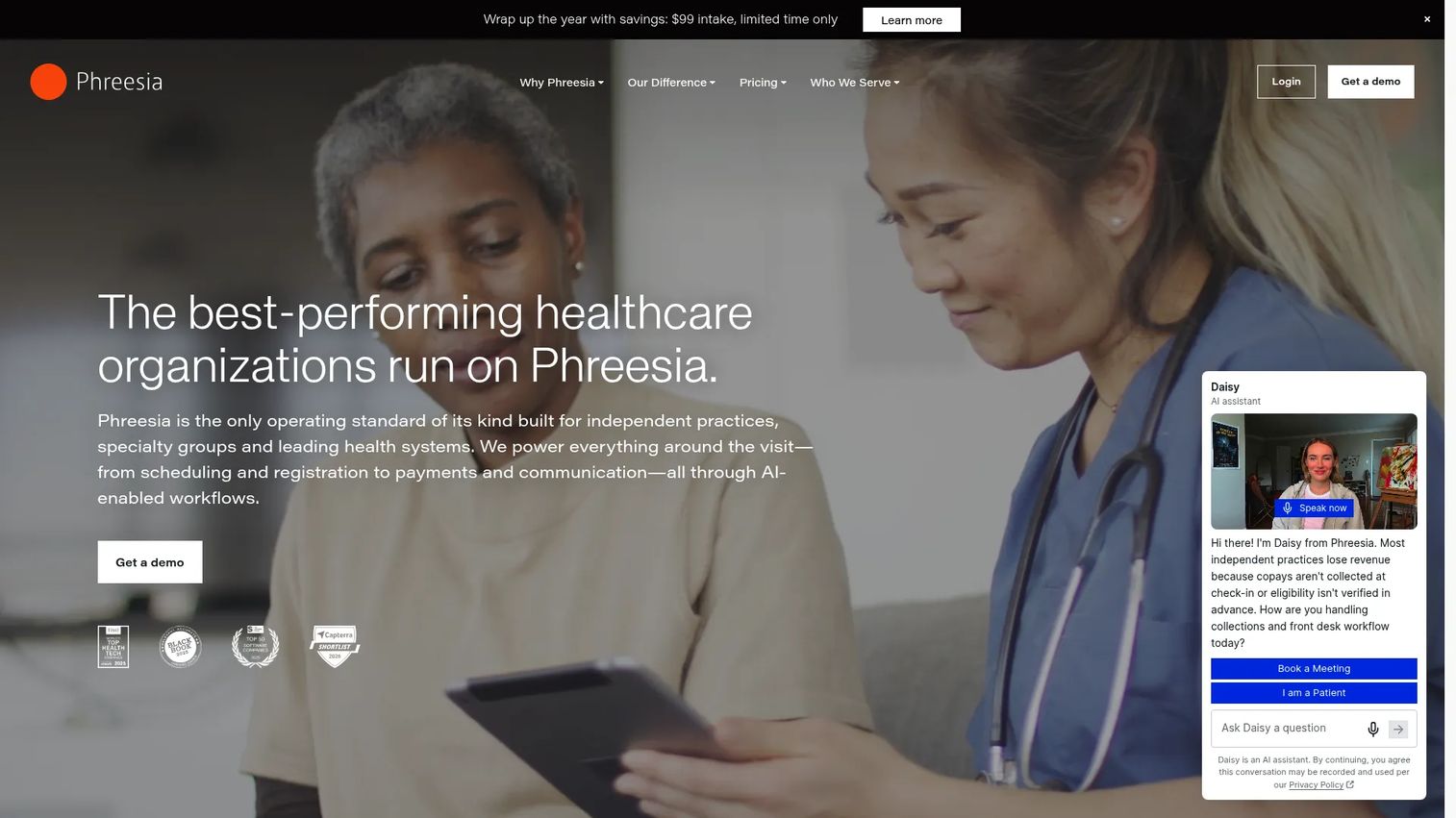
Phreesia is a patient intake and engagement platform covering registration, scheduling, payments, communication, and clinical workflows. It offers mobile self-check-in, VoiceAI for 24/7 call handling, in-office hardware, bidirectional EHR integrations, and analytics across the front office. For 2026, Phreesia's intake platform is available at no cost through spring 2027, making it one of the most accessible entry points in this category.
Best for: Healthcare practices prioritizing digital intake, registration, payments, and front-office activation before the visit.
Key features
- Mobile self-check-in, registration, and clinical screenings
- VoiceAI for call handling and appointment management
- In-office hardware: Phreesia PadX and Phreesia Arrivals
- Bidirectional EHR and PMS integrations
- Analytics across registration, payments, and appointments
Why choose Phreesia: Clean intake and payment workflows reduce staff rework and improve visit readiness. The free promotional period makes it straightforward to run a pilot without budget approval, though post-May 2027 pricing is quote-based.
Phreesia pricing: The Phreesia Intake platform is free through spring 2027 (standard pricing begins May 1, 2027). Post-promotional pricing is custom.
G2 rating: 5.0/5
7. Weave
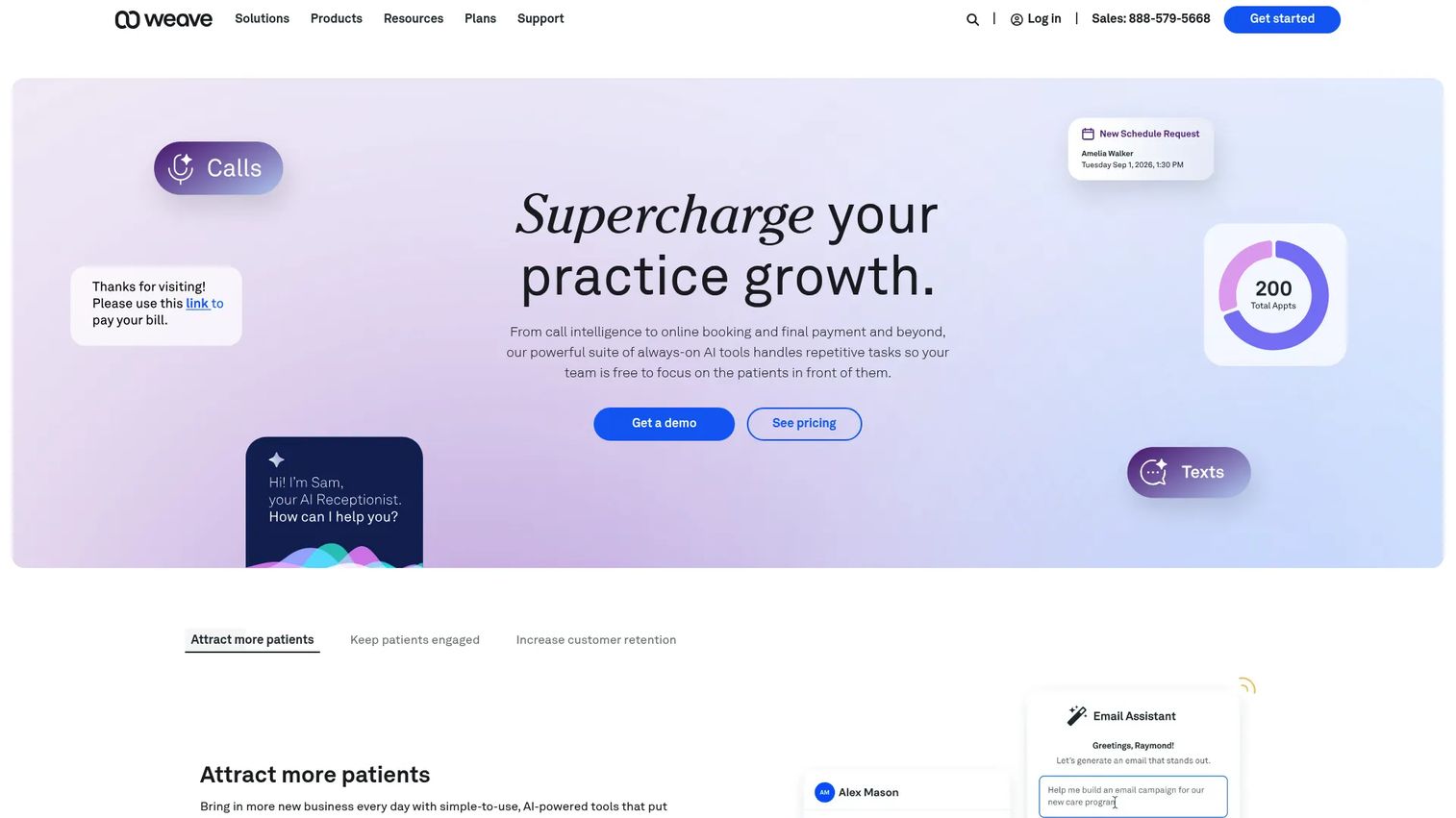
Weave is an all-in-one communication platform for healthcare practices, combining a cloud phone system, two-way texting, appointment reminders, online scheduling, digital forms, payment tools, review requests, and AI Call Intelligence. It's widely used in dental, optometry, and similar practice environments where the front desk handles phones, messaging, and payments in one place.
Best for: Small to midsize practices that want patient communication, phones, and payment workflows in one system.
Key features
- Cloud business phone system and VoIP
- Two-way texting and missed-call text responses
- Appointment reminders and online scheduling
- Digital forms, Text to Pay, and payment processing
- Review requests and AI Call Intelligence
Why choose Weave: Weave earns its place in the stack by replacing the phone system, messaging tool, and payment follow-up with one product. Practices should verify dental, optometry, or specialty-specific integrations before committing to implementation.
Weave pricing: Plans start at $199/month. Pro, Elite, and Ultimate tier prices require contacting Weave directly.
G2 rating: 4.6/5
8. Solutionreach
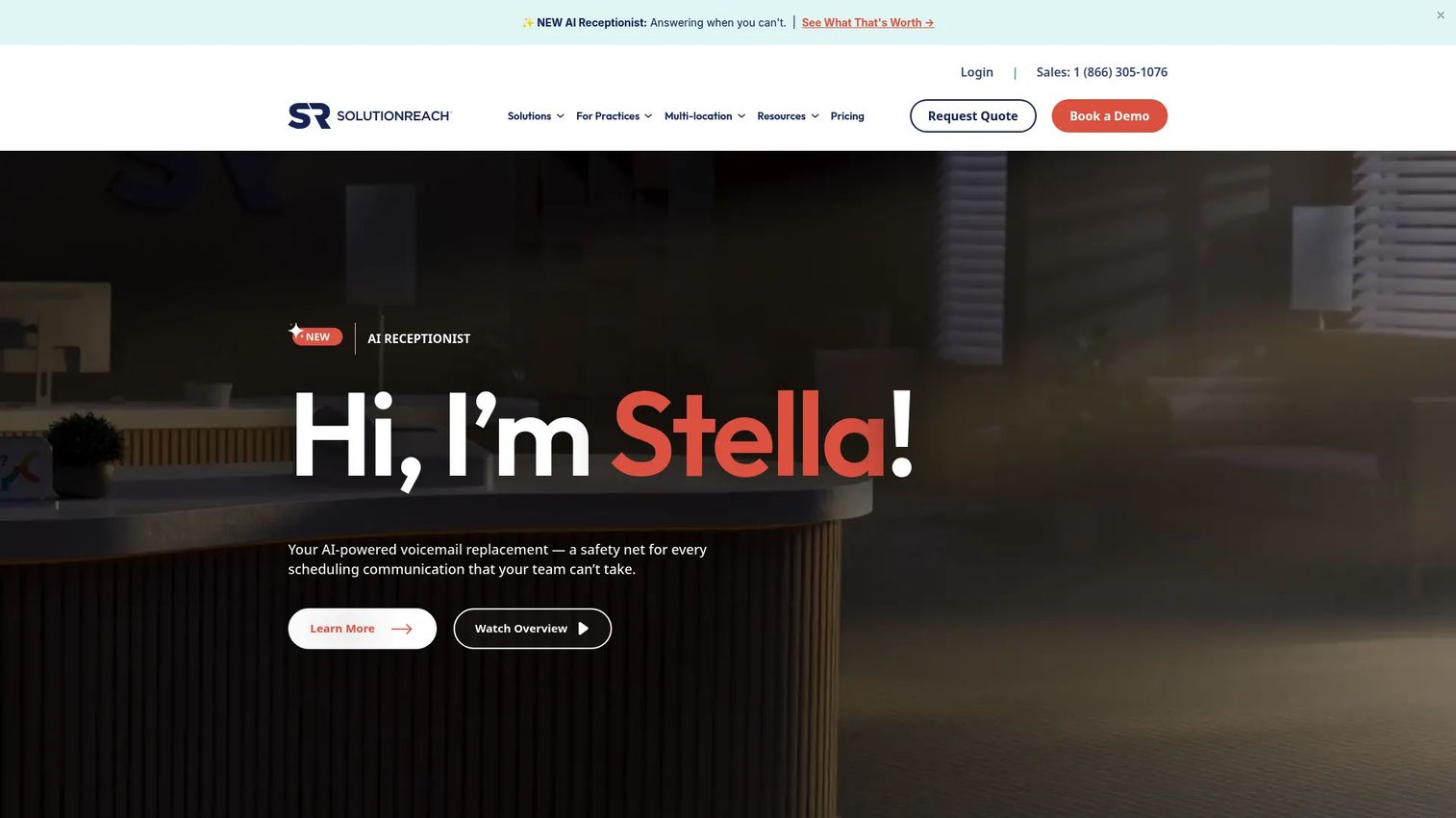
Solutionreach is a patient communication and relationship management platform for healthcare practices, covering reminders, recalls, surveys, two-way messaging, online scheduling, digital intake, reputation management, payment tools, insurance verification, and telehealth. It focuses on the ongoing relationship between patients and practices rather than acute access workflows.
Best for: Practices that need systematic recall, retention, and recurring patient communication.
Key features
- Appointment reminders and confirmations
- Patient recall campaigns
- Two-way messaging and patient surveys
- Online scheduling and digital intake
- Reputation management and payment tools
Why choose Solutionreach: The clearest use case is reactivating lapsed patients and improving retention through consistent follow-up. Practices evaluating it for new patient acquisition or high-volume scheduling should compare it against more access-focused options.
Solutionreach pricing: Custom pricing. Buyers should request a quote based on patient panel size, locations, and modules.
G2 rating: 4.3/5
9. NexHealth
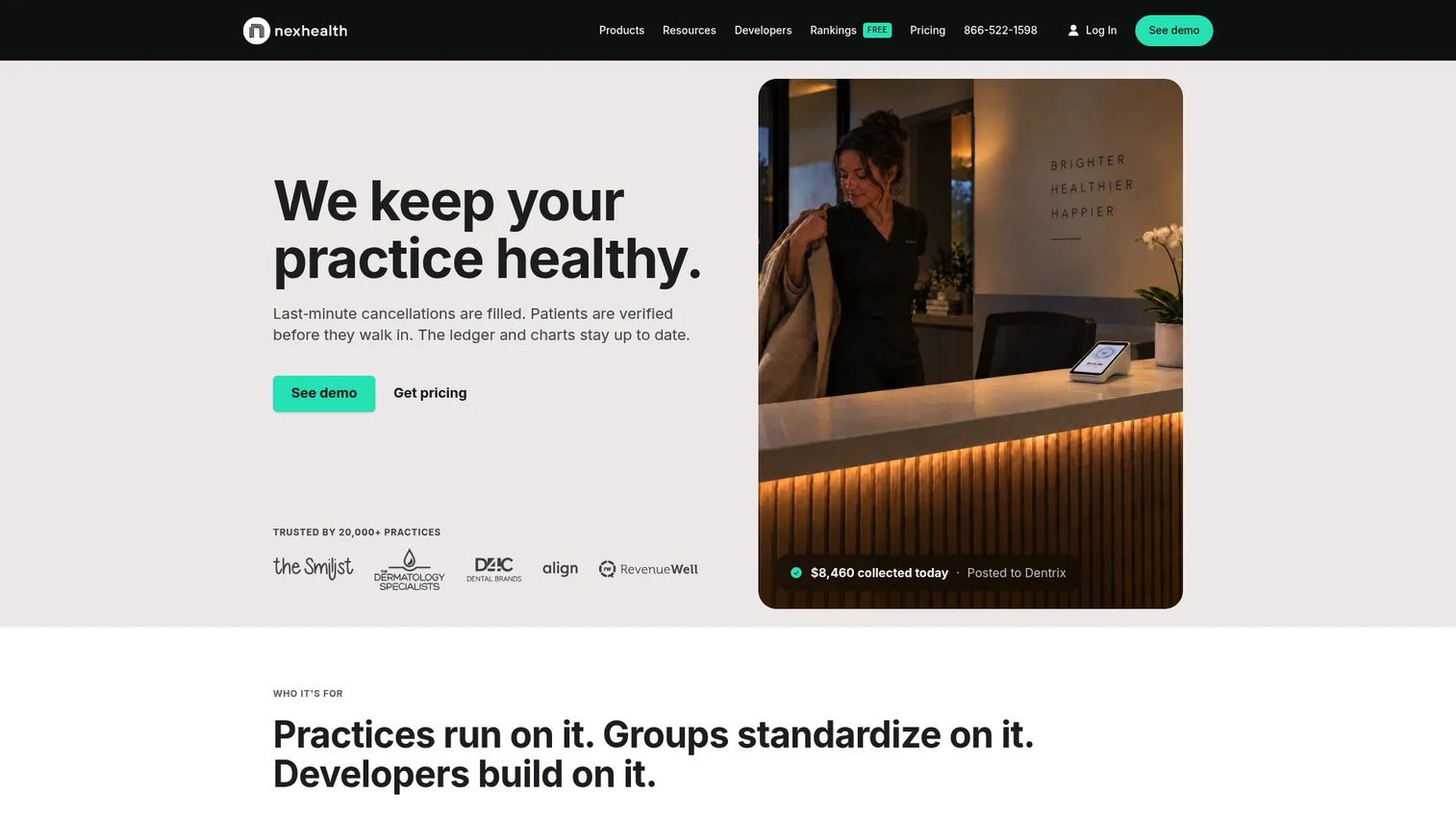
NexHealth is a patient-experience platform for dental and medical practices, covering online booking, waitlist automation, digital forms, insurance verification, patient messaging, recall campaigns, online payments, and practice-system synchronization. Its positioning centers on reducing manual access work and improving the patient-facing experience from booking through billing.
Best for: Dental and medical practices where online scheduling and intake are the primary operational bottlenecks.
Key features
- Online booking and waitlist automation
- Digital forms and insurance verification
- Online and text-based patient payments
- Recall automation and patient messaging
- EHR and practice-management system sync
Why choose NexHealth: NexHealth's strength is reducing manual work in the scheduling and intake pipeline. Practices should verify which EHR and PMS systems are supported and whether month-to-month or annual billing fits their contract model.
NexHealth pricing: Custom pricing. NexHealth offers both month-to-month and annual billing. Contact sales for a quote based on practice size and integrations.
G2 rating: 4.8/5
10. TeleVox
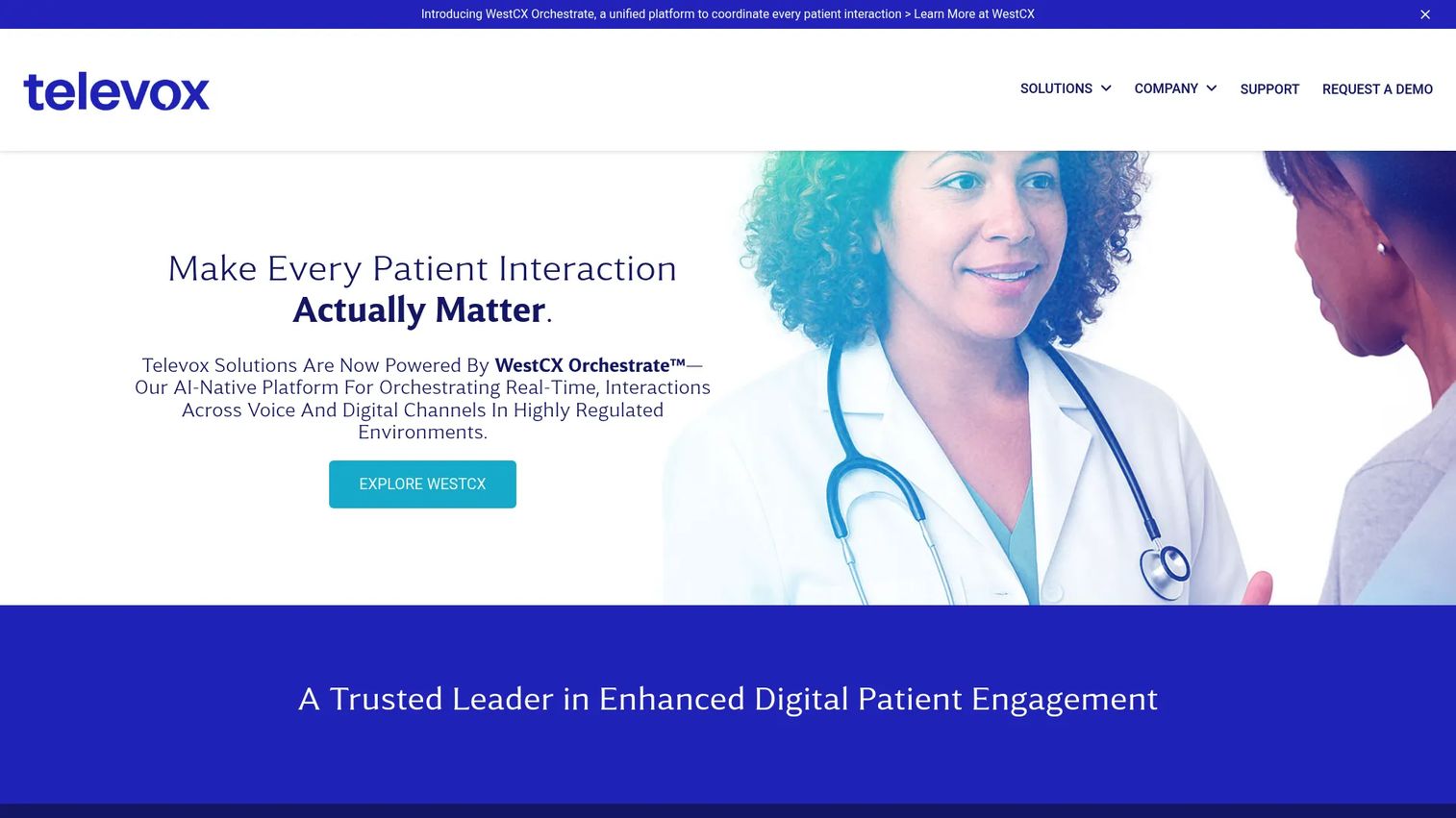
TeleVox is a patient engagement platform built for automated outreach at scale, covering appointment reminders, campaign messaging, population health communication, two-way messaging, and an AI virtual assistant for scheduling, bill pay, and prescription refill requests. It's designed for healthcare organizations managing large patient panels where consistent outreach requires campaign governance rather than case-by-case handling.
Best for: Healthcare organizations needing automated outreach across large patient populations.
Key features
- Appointment reminders and automated appointment management
- Two-way patient messaging and agent chat
- AI virtual assistant for scheduling and billing inquiries
- Patient outreach campaigns and population messaging
- Multichannel engagement across voice, SMS, and web
Why choose TeleVox: The buying case is outreach consistency at volume. Healthcare teams with large patient panels and recurring communication needs should ask about channel volume, patient count per tier, and integration support during the evaluation.
TeleVox pricing: Custom pricing. Buyers should discuss channels, patient volume, modules, and implementation during the sales process.
G2 rating: 3.9/5
11. Artera
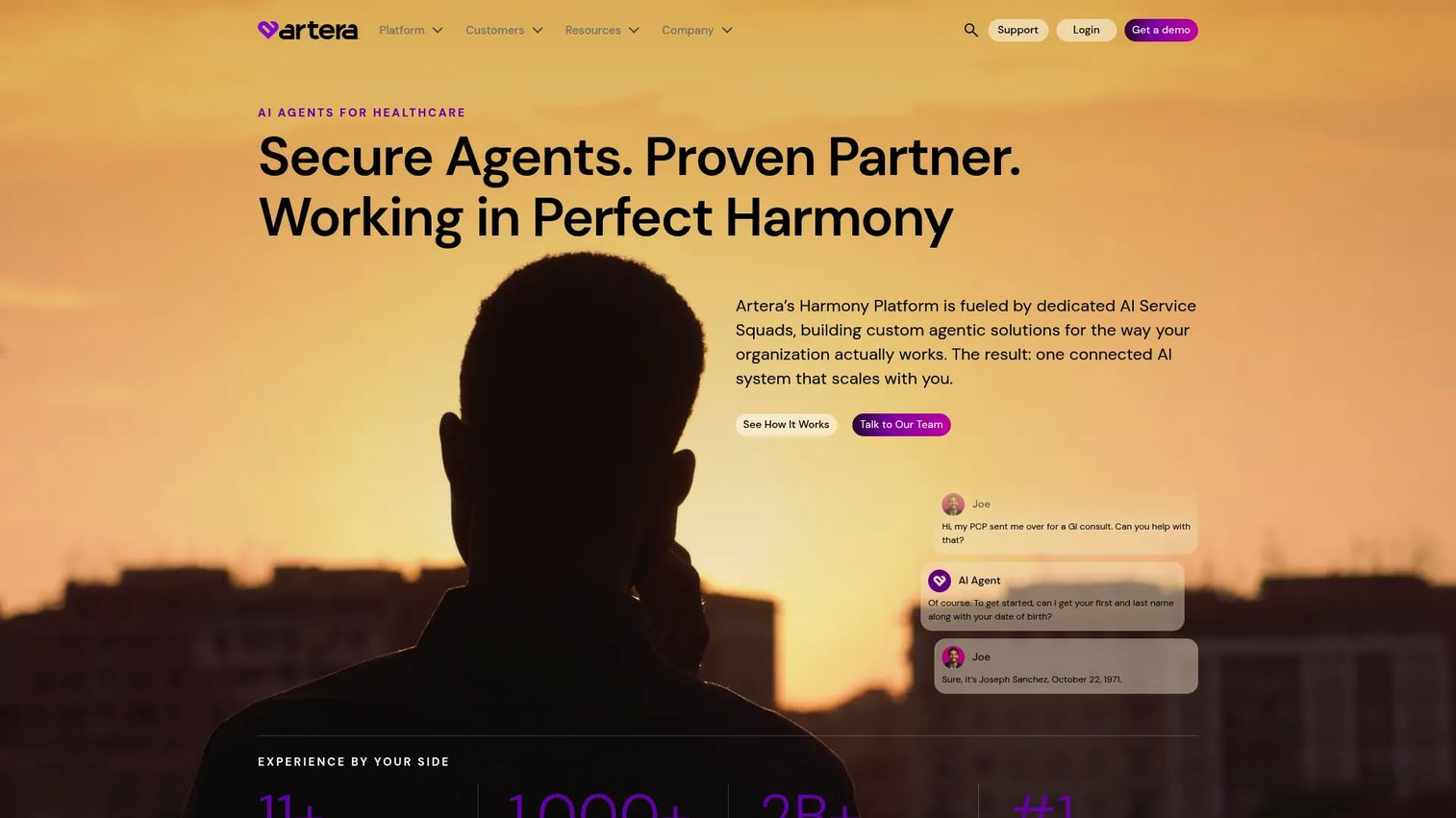
Artera is an agentic healthcare platform covering AI agents, patient scheduling, intake, payments, referrals, care-gap closure, and omnichannel communication across voice, rich text, and email. It describes itself as an agentic healthcare platform, positioning AI agents as the operational layer that coordinates patient communication across the access team. Health systems and larger provider organizations use it when disconnected messaging tools have become a governance problem.
Best for: Health systems and larger provider organizations that need enterprise-grade patient communication with AI-driven workflow automation.
Key features
- AI agents for healthcare communication workflows
- Patient scheduling, intake, and referral coordination
- Omnichannel messaging: Voice, rich text, and email
- Payment collection and care-gap closure
- Enterprise campaign controls and analytics
Why choose Artera: Artera's value proposition centers on communication consistency at scale. Organizations that have outgrown point solutions for messaging should evaluate Artera's governance controls and AI agent workflow depth during the demo.
Artera pricing: Custom pricing. Contact Artera's team for a quote.
G2 rating: 4.5/5
12. Emitrr
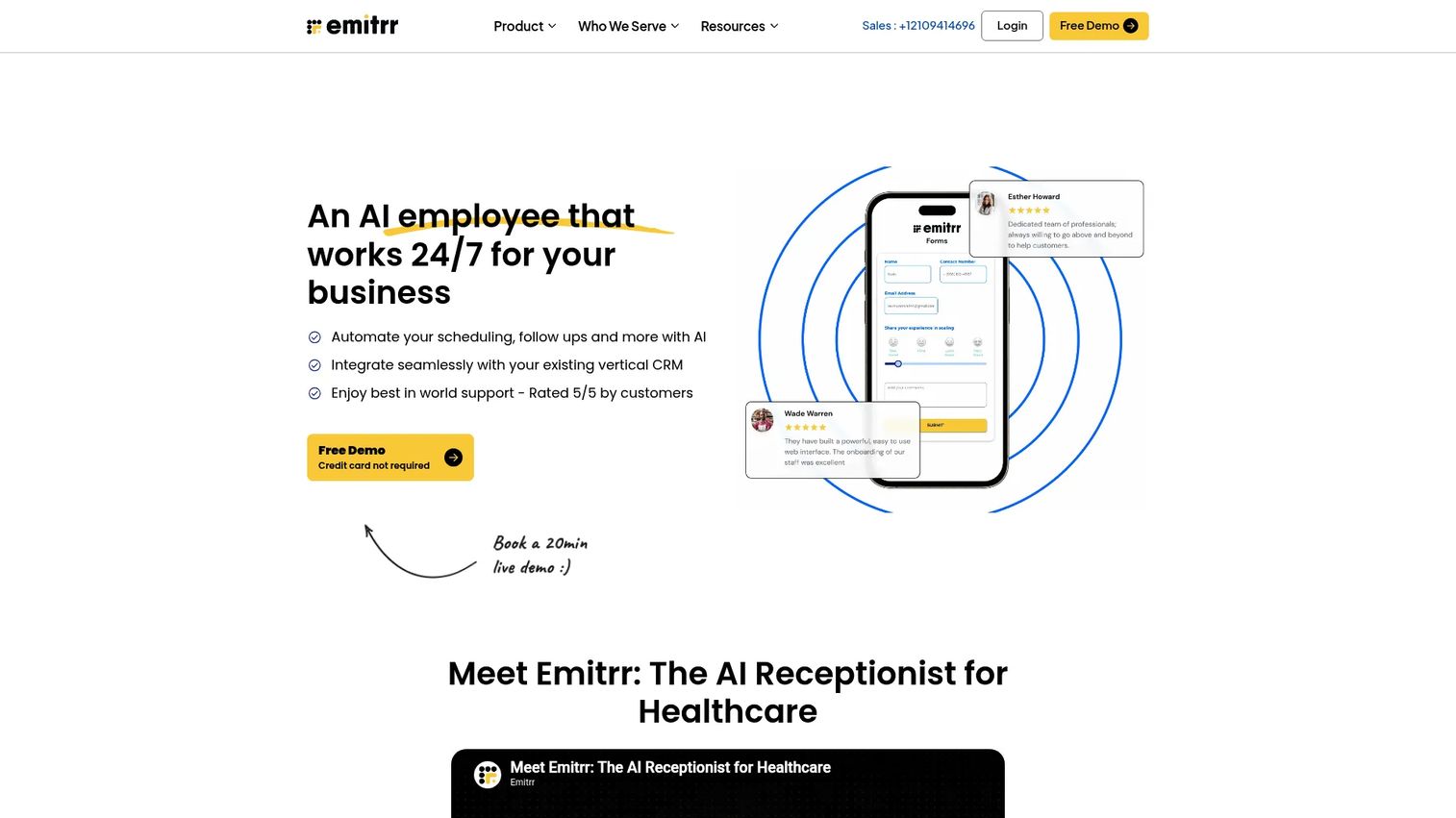
Emitrr is an AI-powered communication and engagement platform for healthcare practices and local businesses, combining AI answering and voice agents, two-way texting, a shared inbox, appointment scheduling, VoIP calling, cloud faxing, review automation, and rule-based workflow automation. It's positioned as an affordable option for smaller practices that need communication automation without enterprise complexity.
Best for: Small practices that need affordable communication automation: Texting, reminders, voice agents, and reviews.
Key features
- AI answering and voice agents
- Two-way texting and shared inbox
- Online appointment scheduling and reminders
- VoIP calling, call recording, and cloud faxing
- Review and feedback automation
Why choose Emitrr: Emitrr covers a wide surface area for smaller teams. Before committing, verify healthcare-specific security controls, BAA availability, and EHR integration depth, as these vary by plan.
Emitrr pricing: Custom pricing. Contact Emitrr for a quote based on practice size, channels, and required automations.
G2 rating: 4.8/5
13. Prosper AI
Prosper AI is a healthcare-focused AI voice agent platform that automates patient-access and revenue-cycle workflows via phone and text. Its agents handle inbound appointment scheduling, rescheduling, and cancellations directly in the EHR, referral fax intake, real-time benefits verification, prior-authorization initiation, claims-status follow-up, and patient billing. The distinction from generic AI platforms is its focus on the full revenue-cycle call workflow, not just front-office scheduling.
Best for: Healthcare organizations evaluating AI-first engagement across patient access, benefits verification, and revenue-cycle phone workflows.
Key features
- 24/7 inbound scheduling and rescheduling directly in the EHR
- Referral fax intake and outreach by phone and text
- Real-time benefits verification and payer calls
- Prior-authorization initiation and claims-status follow-up
- Inbound and outbound billing, payment collection, and billing FAQs
Why choose Prosper AI: The clearest use case is high-volume patient-access and payer call workflows where hiring more staff isn't the right answer. Buyers should ask about EHR write-back behavior, escalation paths, and AI quality monitoring during the demo.
Prosper AI pricing: Usage-based custom pricing. High-volume and partnership terms are available. Contact Prosper AI for details.
G2 rating: 4.7/5
14. Orbita
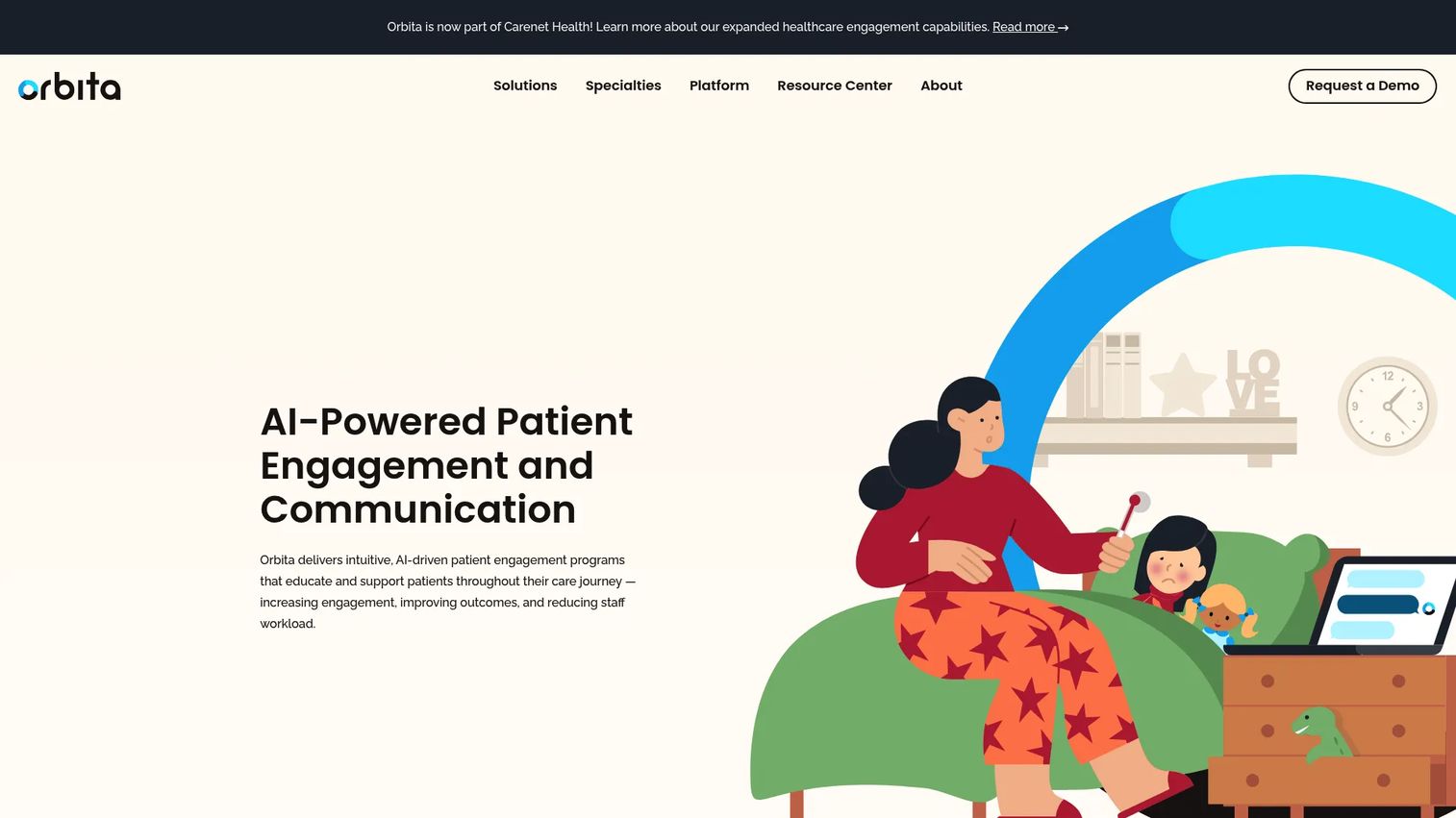
Orbita is a healthcare-focused agentic AI platform, now part of Carenet Health, for deploying conversational chat and voice agents across patient access, outreach, scheduling, and care navigation. It integrates with Epic, Cerner, Salesforce, Genesys, and FHIR or HL7 standards, and supports multilingual engagement across 100+ languages. Its security capabilities align with HIPAA, SOC, ISO, and GDPR requirements, though buyers must verify their own compliance posture independently.
Best for: Healthcare teams that need conversational AI for access, care navigation, and patient self-service across complex journeys.
Key features
- Digital front door and voice agents
- Patient access, outreach, scheduling, and care navigation
- EMR, CRM, call-center, and FHIR or HL7 integrations
- Multilingual support for 100+ languages
- Analytics, reporting, and security controls
Why choose Orbita: Orbita fits organizations that need enterprise conversational AI with deep integration into existing clinical systems. The acquisition by Carenet Health means buyers should confirm current product roadmap and support model directly with the Orbita team.
Orbita pricing: Custom pricing. Cost depends on use cases, channels, integrations, scale, and implementation scope.
G2 rating: 4.2/5
15. Hyro
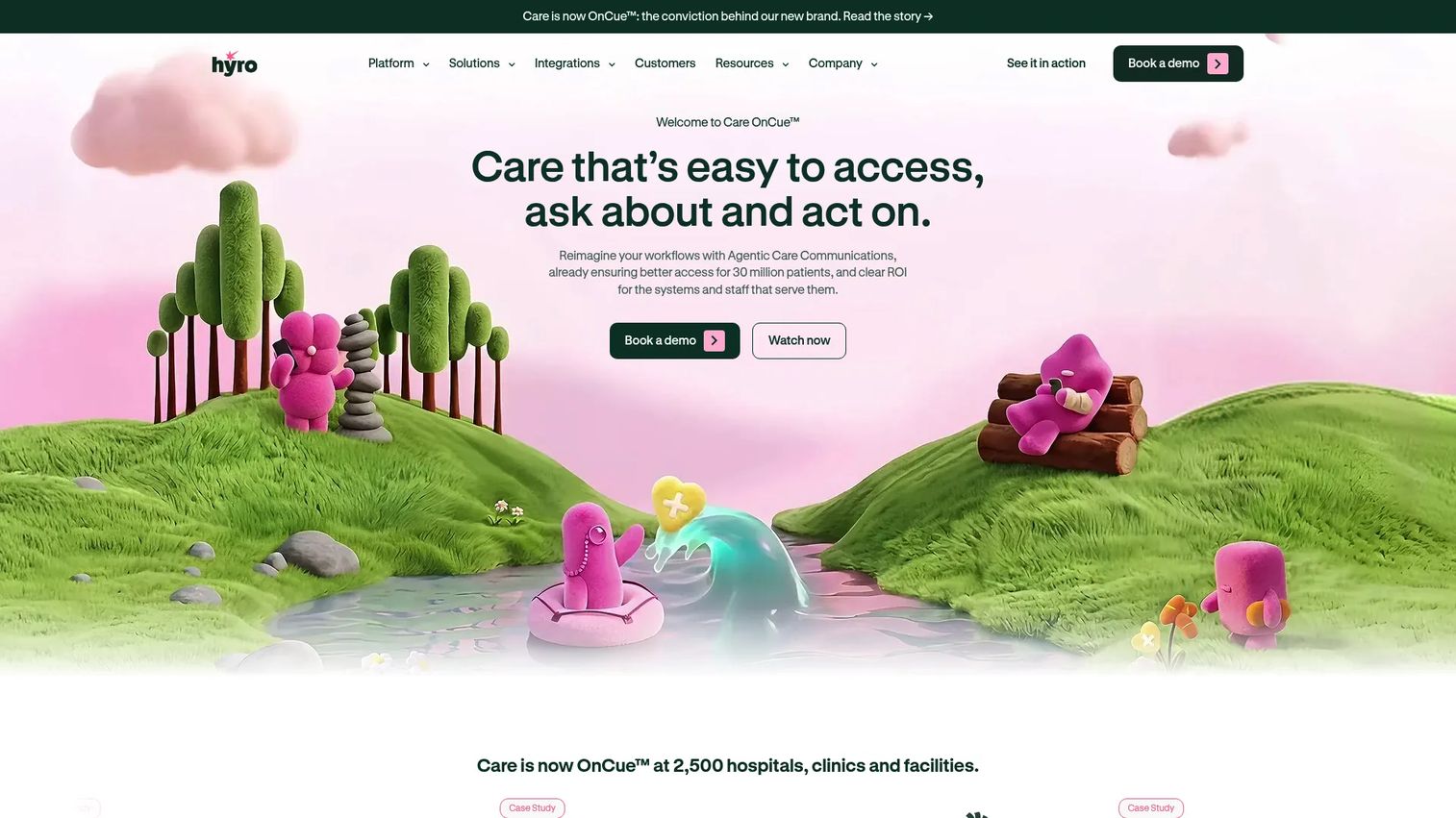
Hyro provides agentic AI communications for healthcare organizations across voice, chat, SMS, and web channels. Its capabilities include appointment scheduling, confirmations, rescheduling, prescription refill requests, knowledge retrieval via RAG and knowledge graphs, human handoff with full conversation context, and analytics with harm detection and hallucination tracking. The 4.9/5 G2 rating (from 20 reviews) reflects strong practitioner satisfaction with its call deflection performance and patient experience quality.
Best for: Healthcare organizations that need AI voice and chat automation for high-volume access workflows with strong quality controls.
Key features
- Omnichannel AI: Voice, chat, and SMS automation
- Appointment scheduling, rescheduling, and reminders
- Prescription refill requests and knowledge retrieval
- Human handoff with full conversation context
- Analytics, harm detection, and hallucination tracking
Why choose Hyro: The buying case centers on containment rate and escalation quality. Organizations with high inbound call volume should ask about integration depth with their scheduling system, escalation SLAs, and how the platform handles edge cases it cannot resolve.
Hyro pricing: Custom pricing. Buyers should discuss call volume, channels, integrations, deployment timeline, and support model during the evaluation.
G2 rating: 4.9/5
Considerations when choosing AI patient engagement software
Workflow fit beats feature count
Map your top three workflows before comparing platforms. A platform that handles scheduling, intake, and recalls well is worth more than one with 20 features you won't deploy. Start with the workflows causing the most friction: Call volume, no-show rate, intake rework, or collections. Build the shortlist from there.
Verify EHR and PMS integration depth
"Integrates with Epic" can mean read-only display, bidirectional data sync, or anything in between. During evaluation, ask specifically what data writes back to the record, what requires custom work, how integration failures are handled, and which version of the EHR API is supported. This is where implementation timelines slip.
Pressure-test the AI governance model
AI agents operating in healthcare environments need clear escalation paths, human review capabilities, audit logs, and clinical safety boundaries. Ask vendors for their BAA terms, data retention policies, prompt or workflow control documentation, and how the platform handles calls it cannot resolve. Never assume HIPAA compliance from a vendor's marketing language. Verify controls directly with your legal and security teams.
Model ROI before implementation begins
Establish a baseline on the metrics that matter: Inbound call volume, abandonment rate, no-show rate, staff hours per appointment, appointment fill rate, and payment collection. Without a baseline, you cannot measure whether the tool earned its place in the stack. Set the measurement framework before go-live, not after.
Check implementation speed and ownership
A strong demo does not mean a fast deployment. Ask who owns workflow configuration after the sale: The vendor's implementation team, your IT staff, or a hybrid. Understand the timeline from contract to first live workflow, what training looks like, and who handles content updates and integration maintenance on an ongoing basis.
Conclusion
AI patient engagement software is not a single category. The right choice depends on your organization's size, the workflows causing the most operational drag, and the systems already in place.
For enterprise health systems, Salesforce, Artera, and Luma Health are the most capable starting points, particularly where patient engagement needs to connect to CRM, care programs, or population health workflows.
Specialty and multi-location practices should evaluate Clearwave, Phreesia, and Luma Health, specifically for front-office automation tied to eligibility, intake, and payment conversion.
Small and midsize practices comparing options on price, adoption speed, and communication depth should look at OhMD, Weave, NexHealth, Solutionreach, and Emitrr.
Teams focused on AI-first communication and voice automation should evaluate Prosper AI, Orbita, and Hyro, with particular attention to call containment quality, EHR write-back behavior, and escalation controls.
Shortlist three platforms based on workflow fit, EHR coverage, and your ability to measure ROI within the first quarter. The teams that move fastest are the ones who define what success looks like before the first vendor demo.
For more on how modern software teams evaluate and demonstrate complex products to buyers and stakeholders, Start your journey with Guideflow today!
FAQs
AI patient engagement software combines automation, AI agents, messaging, scheduling, intake, follow-up, and analytics to help healthcare organizations communicate with patients and coordinate access. It differs from a basic chatbot or messaging app by connecting communication to scheduling systems, clinical records, and operational workflows. The strongest platforms produce measurable outcomes like reduced call volume, lower no-show rates, and improved payment collection.
A patient portal requires the patient to log in and take action. AI patient engagement software pushes communication across channels the patient already uses: SMS, voice, email, and web chat. Many platforms complement existing portals rather than replacing them, using outbound messaging to drive patients into the portal for specific tasks while handling routine inquiries directly.
The core automation workflows cover scheduling, reminders, recalls, waitlists, intake, registration, billing prompts, care program outreach, triage routing, and post-visit follow-up. More advanced platforms handle referral coordination, benefits verification, prior-authorization initiation, and payer call management. The right workflow priority depends on where your staff spends the most time on repeatable, low-complexity tasks.
Vendors may offer HIPAA-supporting controls such as BAAs, encryption, access controls, audit logs, and data retention policies. Whether your deployment meets HIPAA requirements depends on how you configure and use the platform, not just on the vendor's capabilities. Verify your own compliance posture with your legal and security teams before go-live.
The most important questions: Which workflows are supported out of the box? Which EHR and PMS systems have verified integrations? What data writes back to the patient record? How does the AI escalate to a human when it cannot resolve a request? What does the implementation timeline and ownership model look like? Which metrics prove ROI and over what timeframe?
Smaller practices typically prioritize texting, reminders, online scheduling, payment messaging, and low implementation overhead. OhMD offers transparent pricing starting at $300/month. Weave starts at $199/month and combines phones, messaging, and payments. NexHealth and Emitrr are strong options for practices where booking and communication are the main friction points. Phreesia's intake platform is free through spring 2027.
Enterprise buyers need CRM integration, omnichannel governance, care program workflows, security review support, analytics depth, and EHR integration at scale. Salesforce, Luma Health, and Artera are the most complete options. For AI voice and chat automation at high volume, Hyro and Orbita are worth evaluating alongside whichever core engagement platform you select. For more on evaluating complex AI agents in operational contexts, that resource covers the broader category.
AI voice agents answer routine inbound calls, route patients to the right workflow, support appointment scheduling and rescheduling, process prescription refill requests, and reduce hold times without requiring a human agent. The critical evaluation factors are containment rate (the percentage of calls resolved without a human), escalation quality, integration with the scheduling system, and how the agent handles calls it cannot complete. Platforms like Hyro, Prosper AI, and Clearwave each approach this differently, so testing with real call scenarios is worth the time before you sign a contract. For a broader look at AI voice assistants across categories, that guide covers the landscape in more depth.