

You have 40 feature requests, three loud stakeholders, and capacity for maybe six things this quarter. Everyone thinks their idea is the priority. The sales team wants the enterprise integration. Support wants the bug backlog cleared. Your CEO saw a competitor ship something on LinkedIn and now that's urgent too.
So you build the thing the loudest person asked for. Again.
Here's what makes that expensive. Pendo's 2024 Software Benchmarks found that only 6.4% of features drive 80% of clicks. Most of what teams ship barely gets touched. When prioritization runs on opinion instead of evidence, you spend engineering cycles building the 93.6% almost nobody uses.
Product prioritization software exists to fix that. It gives you a repeatable way to score ideas, weigh customer evidence, and connect roadmap decisions to outcomes you actually care about, like activation, retention, and expansion. The global product management software market hit $4.82B in 2025 and is projected to reach $12.34B by 2033, per DataHorizzon Research, which tells you how many teams are moving off spreadsheets.
What's inside
This guide is for product managers, group PMs, and heads of product who need to turn messy input into defensible roadmap choices. Here's how we picked the 10 tools below.
- Scoring flexibility: Support for frameworks like RICE, MoSCoW, Kano, and value vs effort, plus custom weighted scoring
- Feedback aggregation: Pulling requests from customers, sales, and support into one prioritized view
- Roadmap and portfolio visibility: Turning scored ideas into shareable roadmaps
- Execution handoff: Connecting decisions to delivery tools like Jira, Linear, and Azure DevOps
No tool comparisons in this section. Just scope and method. The rankings and framework breakdowns come next.
TL;DR
Short on time? Here are the decision shortcuts.
- Best overall for connected prioritization and roadmapping: airfocus, for teams that want scoring, feedback, and roadmaps in one workflow
- Best for teams already in Jira: Jira Product Discovery, for native handoff to Atlassian delivery
- Best for feedback-driven prioritization: Productboard, for turning customer insights into roadmap decisions
- Best for customer-led teams: Canny, for public boards and closing the feedback loop
- Best for strategy-heavy planning: Aha! Roadmaps, for goals, initiatives, and roadmap depth
- Budget or all-in-one fit: ClickUp if you want prioritization inside a broader work hub, Roadmunk or Craft.io for visual roadmap communication
What is product prioritization software?
Product prioritization software is a tool that helps product teams rank ideas, features, and requests using structured scoring, then turn those decisions into a roadmap the whole company can see.
It does more than sort a backlog. The category connects three things most teams keep in separate places: the evidence for a decision, the decision itself, and the plan to execute it.
Core capabilities usually include:
- Scoring and frameworks: Apply RICE, MoSCoW, Kano, value vs effort, or custom weighted scoring to rank ideas consistently
- Feedback aggregation: Collect requests from customers, sales, and support, then tie them to specific features
- Roadmap visualization: Turn prioritized items into timeline, kanban, or portfolio views
- Collaboration: Give stakeholders a shared source of truth instead of competing spreadsheets
- Execution handoff: Push committed work into delivery tools so nothing gets lost in translation
This is where it differs from generic task management. A project tool tracks what's already been decided. Product prioritization software helps you make the decision in the first place, with the reasoning attached. When someone asks six months later why you built X over Y, the score, the evidence, and the tradeoff are all still there.
Why product prioritization matters
Prioritization is not a philosophical exercise. It is capacity math with real revenue attached. Here are the reasons it earns a dedicated tool.
Limited capacity is the whole problem. You cannot build everything. Every yes is a no to something else. A scoring model forces the tradeoff into the open instead of letting it hide behind whoever argued hardest.
It reduces bias. "I think users want this" is not evidence. When you attach reach, impact, and confidence numbers to an idea, gut feeling has to compete with data. That protects activation and retention metrics from being gambled on a hunch.
It aligns stakeholders. Sales, support, and leadership all pull in different directions. A shared, transparent ranking gives them one place to see why a decision was made, which cuts the recurring "why isn't my feature done yet" conversation.
It keeps the roadmap tied to outcomes. Without a scoring lens, roadmaps drift toward whatever feels new. Tying items to goals like expansion or support deflection keeps the plan pointed at results.
Here's a quick view of what shifts when you move from ad hoc to structured prioritization.
| Dimension | Ad hoc prioritization | Software-backed prioritization |
|---|---|---|
| Decision basis | Loudest voice, recency | Reach, impact, confidence, effort |
| Stakeholder view | Scattered, contested | Single shared ranking |
| Evidence trail | Lost in Slack threads | Attached to each item |
| Outcome link | Vague | Tied to goals and OKRs |
| Revisiting a decision | Restart the debate | Re-check the score |
Core prioritization frameworks
Software is only as good as the method you run through it. Most tools support several frameworks, so knowing when each fits matters more than the tool choice. Here are the ones product teams actually use.
RICE framework
RICE scores each idea on four factors: Reach, Impact, Confidence, and Effort. You calculate it as (Reach × Impact × Confidence) ÷ Effort. Reach is how many users the change touches in a period. Impact is how much it moves your goal. Confidence is how sure you are, expressed as a percentage. Effort is the cost in person-months.
A feature reaching 2,000 users, with an impact of 2, at 80% confidence, costing 4 person-months, scores (2,000 × 2 × 0.8) ÷ 4 = 800. Higher score, higher priority. RICE is best for comparing many ideas on a level field when you have rough data.
MoSCoW method
MoSCoW sorts work into Must have, Should have, Could have, and Won't have. It answers a different question than RICE: not "which scores highest" but "what is non-negotiable for this release." It's best for release planning and scoping, where you need a clear line between commitments and nice-to-haves. It shines when a deadline is fixed and something has to give.
Kano model
The Kano model classifies features by how they affect customer satisfaction: basic expectations, performance features that scale with investment, and delighters that surprise users. A login that works is a basic. Faster load times are performance. An unexpected shortcut is a delighter. Kano is best when you want nuance on customer value, not just raw scoring, and it pairs well with survey data.
Value vs effort matrix
The value vs effort matrix is a 2x2. You plot each idea by expected value and required effort, then chase the high-value, low-effort quadrant first. It's fast, visual, and easy to run in a workshop. It's best for early triage and quick wins. Where it gets thin is precision: two ideas can land in the same box while being very different bets, so it works better as a first pass than a final call.
Opportunity scoring and cost of delay
For teams with stronger data maturity, opportunity scoring ranks features by importance versus current satisfaction, surfacing gaps where customers care but the product underdelivers. Cost of delay assigns a value to shipping sooner, which is useful when timing drives revenue. Both are best for mature teams that already have clean instrumentation and want to sharpen the sequencing of a full backlog.
Here's a quick reference for matching framework to moment.
| Framework | Best for | What it answers |
|---|---|---|
| RICE | Comparing many ideas | Which scores highest on evidence |
| MoSCoW | Release scoping | What is non-negotiable |
| Kano | Customer value nuance | How features affect satisfaction |
| Value vs effort | Quick triage | Where the fast wins are |
| Cost of delay | Timing-sensitive work | What shipping sooner is worth |
When to use product prioritization software
A spreadsheet works fine until it doesn't. Here are the specific moments teams outgrow manual prioritization.
When feedback volume gets messy
Requests arrive from sales calls, support tickets, community forums, and your own head. Once that volume passes what one person can track in a doc, you lose the thread on what customers actually keep asking for. Software aggregates and tags feedback so the same request across ten channels counts as one signal, not ten scattered notes.
When stakeholder alignment is breaking down
If every roadmap review turns into a debate about whose feature matters more, you need a shared source of truth. A transparent ranking that everyone can see, with the scoring logic attached, moves the argument from opinion to evidence. It's cheaper than the recurring meeting where the same case gets re-litigated.
When roadmap decisions must connect to execution
A prioritized list is useless if it dies in a spreadsheet while engineering works from a different backlog. When you need decisions to flow into Jira, Linear, or Azure DevOps without manual copying, dedicated software with two-way sync keeps the roadmap and the delivery board in step.
Comparison table
Here's the shortlist at a glance. Pricing and ratings reflect verified values at the time of writing. Use it to narrow options, then read the sections below for fit.
| # | Product | Best for | Key differentiator | Pricing | G2 rating |
|---|---|---|---|---|---|
| 1 | airfocus | Connected prioritization and roadmapping | Modular scoring plus feedback-to-strategy workflow | From $59/editor/mo | 4.4/5 |
| 2 | Jira Product Discovery | Teams already in Jira | Native handoff to Jira delivery | Free; Standard $10/creator/mo | 4.3/5 |
| 3 | Productboard | Feedback-driven prioritization | Customer insights tied to roadmap | Free; Plus $19/maker/mo | 4.3/5 |
| 4 | Canny | Customer-led teams | Public boards and feedback loop | Free; Pro $79/mo | 4.5/5 |
| 5 | Aha! Roadmaps | Strategy-heavy planning | Goals and initiatives depth | From $59/user/mo | 4.4/5 |
| 6 | ProdPad | Discovery and delivery balance | Ideas, feedback, OKRs in one | Modular, request pricing | 4.2/5 |
| 7 | ProductPlan | Roadmap communication | Unlimited roadmaps and viewers | Custom, billed annually | 4.3/5 |
| 8 | Craft.io | Structured PM workflows | Prioritization plus capacity planning | From $19/editor/mo | 4.5/5 |
| 9 | Roadmunk | Roadmap presentation | Visual roadmaps plus RICE scoring | From $19/mo | 4.0/5 |
| 10 | ClickUp | All-in-one work hub | Prioritization inside broader workspace | Free; Unlimited $7/user/mo | 4.7/5 |
Best 10 product prioritization tools for 2026
Below is each tool in detail: what it does, who it fits, and how it prices. Read the "why choose" note for the tradeoff that matters to your team.
1. airfocus
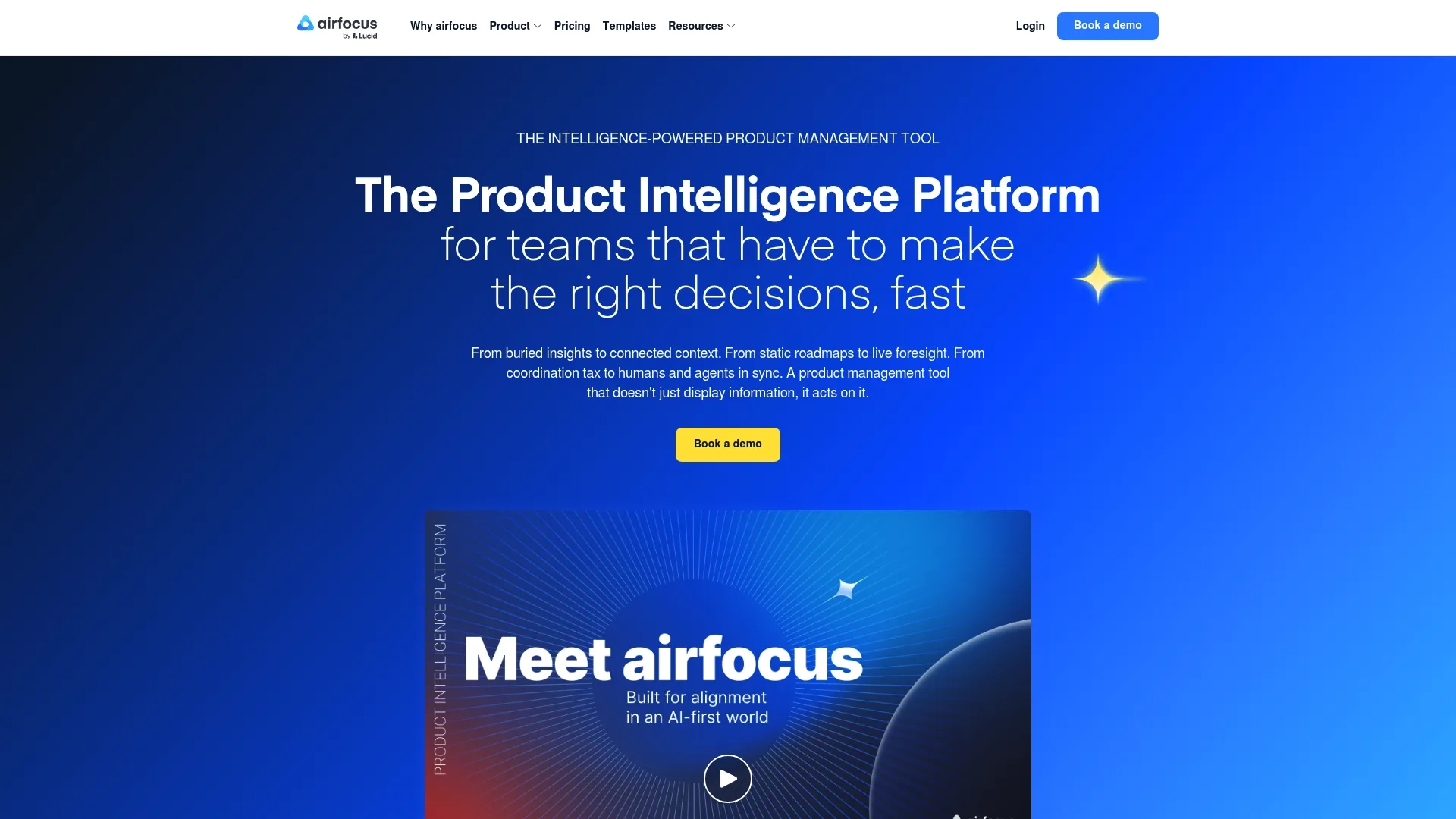
airfocus is an AI-powered product management and roadmapping platform built to connect strategy, prioritization, roadmaps, and delivery. It leans on modular workflows, so you can assemble the pieces your team needs, from evidence-based scoring to portfolio dashboards, without carrying weight you won't use.
Best for: Product teams that want customizable roadmaps, prioritization, and feedback-to-strategy workflows in one place.
Key strengths
- Roadmaps and planning across products
- Feedback and insights management
- Objectives and OKRs tracking
- Portfolio management and dashboards
- MCP server and AI agent capabilities
Why choose airfocus: If your prioritization keeps breaking because scoring lives in one tool and roadmaps in another, airfocus is built to close that gap. The modular structure fits multi-team product organizations that need portfolio-level visibility.
airfocus pricing: Publicly shown plans are Professional and Enterprise, with pricing available on request. A first-party airfocus source lists plans starting at $59 per editor per month. No free tier is offered.
2. Jira Product Discovery

Jira Product Discovery is Atlassian's discovery and roadmapping tool for capturing ideas, prioritizing them, and connecting them straight to delivery in Jira. If your engineers already live in Jira, this removes the copy-paste tax between decision and execution.
Best for: Product teams that want a structured discovery workflow tied directly to Jira delivery.
Key strengths
- Capture opportunities, problems, and requests in one place
- Custom views, fields, and prioritization frameworks
- Built-in scoring for consistent ranking
- Connect discovery work to Jira delivery
- Shareable roadmaps for stakeholders
Why choose Jira Product Discovery: The native link to Jira delivery is the whole point. For Atlassian-centric teams, the handoff from a prioritized idea to a sprint ticket happens without a second system. It's the lowest-friction choice when your delivery already runs on Jira.
Jira Product Discovery pricing: Free forever for up to 3 creators. Standard is $10 per creator per month and Premium is $25 per creator per month. Enterprise requires contacting sales.
3. Productboard
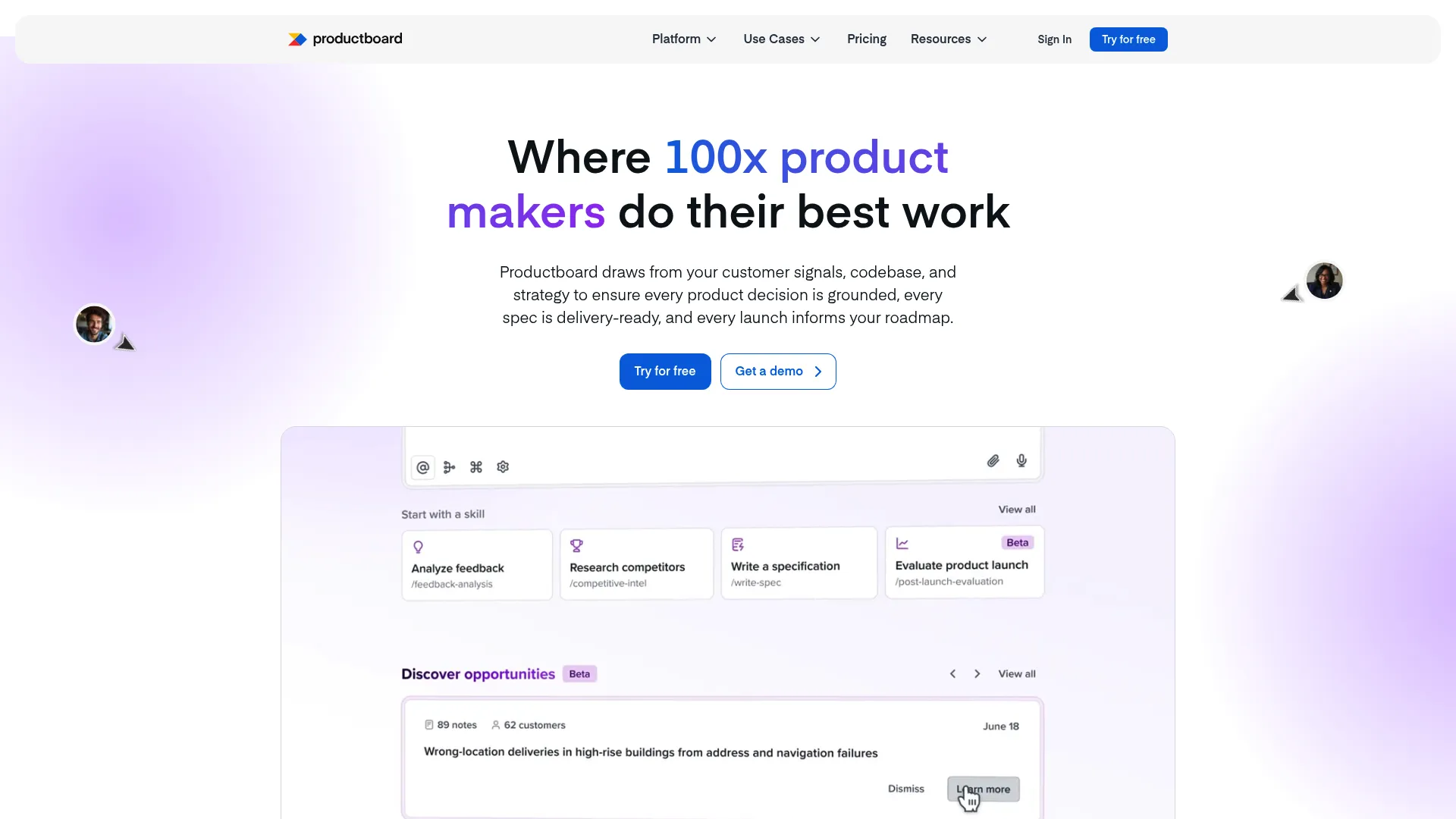
Productboard is an AI-powered product management platform that centers on customer feedback. It collects insights, ties them to features, and turns prioritized decisions into roadmaps, with AI-assisted workflows through its Spark features included on every plan.
Best for: Product teams that need customer feedback, prioritization, and roadmap planning in one workspace.
Key strengths
- Customer feedback collection and insights
- Feature prioritization and roadmapping
- AI-assisted workflows via Spark
- Segmentation to tie feedback to personas
- Execution handoff to Jira, Azure DevOps, and GitHub
Why choose Productboard: If your prioritization should start from what customers say, Productboard is built around that input. The insights-to-roadmap flow keeps the reasoning visible, so a prioritized feature carries its supporting evidence with it.
Productboard pricing: Free plan available. Plus is $19 per maker per month billed annually, Business is $59 per maker per month billed annually, and Enterprise is custom with a 5-maker minimum. Pricing scales by the number of makers.
4. Canny
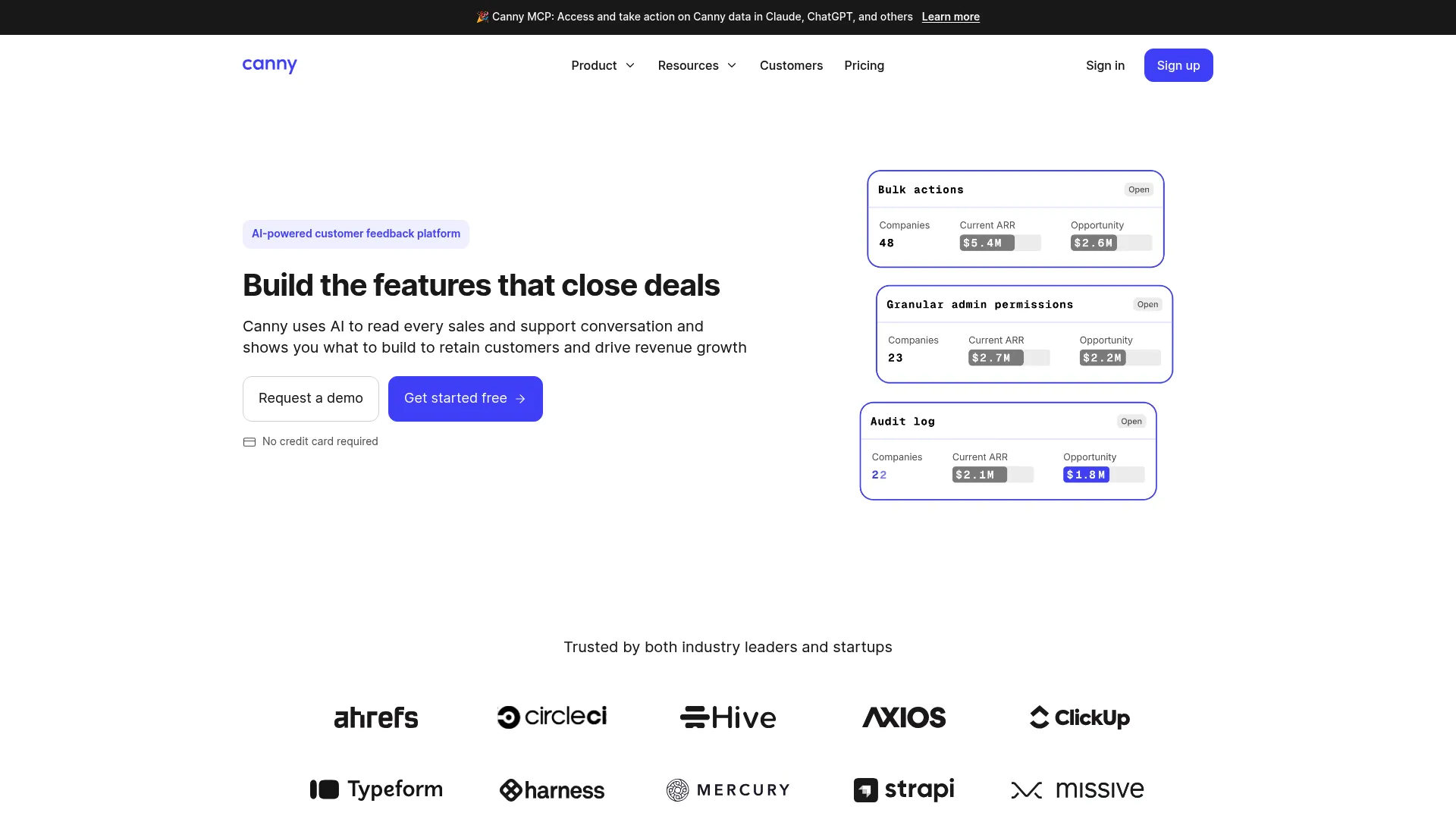
Canny is an AI-native customer intelligence platform for product teams. It collects user feedback, scores and prioritizes requests, and publishes public or private roadmaps, which closes the loop with the customers who asked in the first place.
Best for: Product teams that want to centralize customer feedback, prioritize requests, and publish roadmaps.
Key strengths
- AI feedback capture from sales and support conversations
- Customer feedback analysis and prioritization
- Public and private roadmaps
- Changelog to announce shipped work
- Feedback loop that notifies requesters
Why choose Canny: For customer-led teams, the public board is the differentiator. Customers vote, you prioritize transparently, and they see progress. That visibility reduces the "did you even see my request" support load while keeping prioritization grounded in real demand.
Canny pricing: Free plan at $0 per month. Pro starts at $79 per month billed yearly. Business is custom-priced.
5. Aha! Roadmaps

Aha! Roadmaps is product roadmap software built for strategy, prioritization, delivery, and reporting. It ties work to goals and initiatives, which suits teams that want prioritization to sit inside a broader strategic frame rather than stand alone.
Best for: Product teams that need an end-to-end roadmap and product-planning suite.
Key strengths
- Create visual roadmaps across products
- Link work to strategy and goals
- Crowdsource and prioritize product feedback
- Initiative and goal tracking
- Reporting for stakeholders and leadership
Why choose Aha! Roadmaps: If your prioritization needs to answer to strategy first, Aha! is built for that depth. The goals-and-initiatives structure fits strategy-heavy product teams that want every prioritized item to trace back to a business objective.
Aha! Roadmaps pricing: Premium is $59 per user per month billed annually, or $74 monthly. Enterprise is $99 per user per month annually, or $124 monthly. A 30-day free trial is available, but there is no free tier.
6. ProdPad
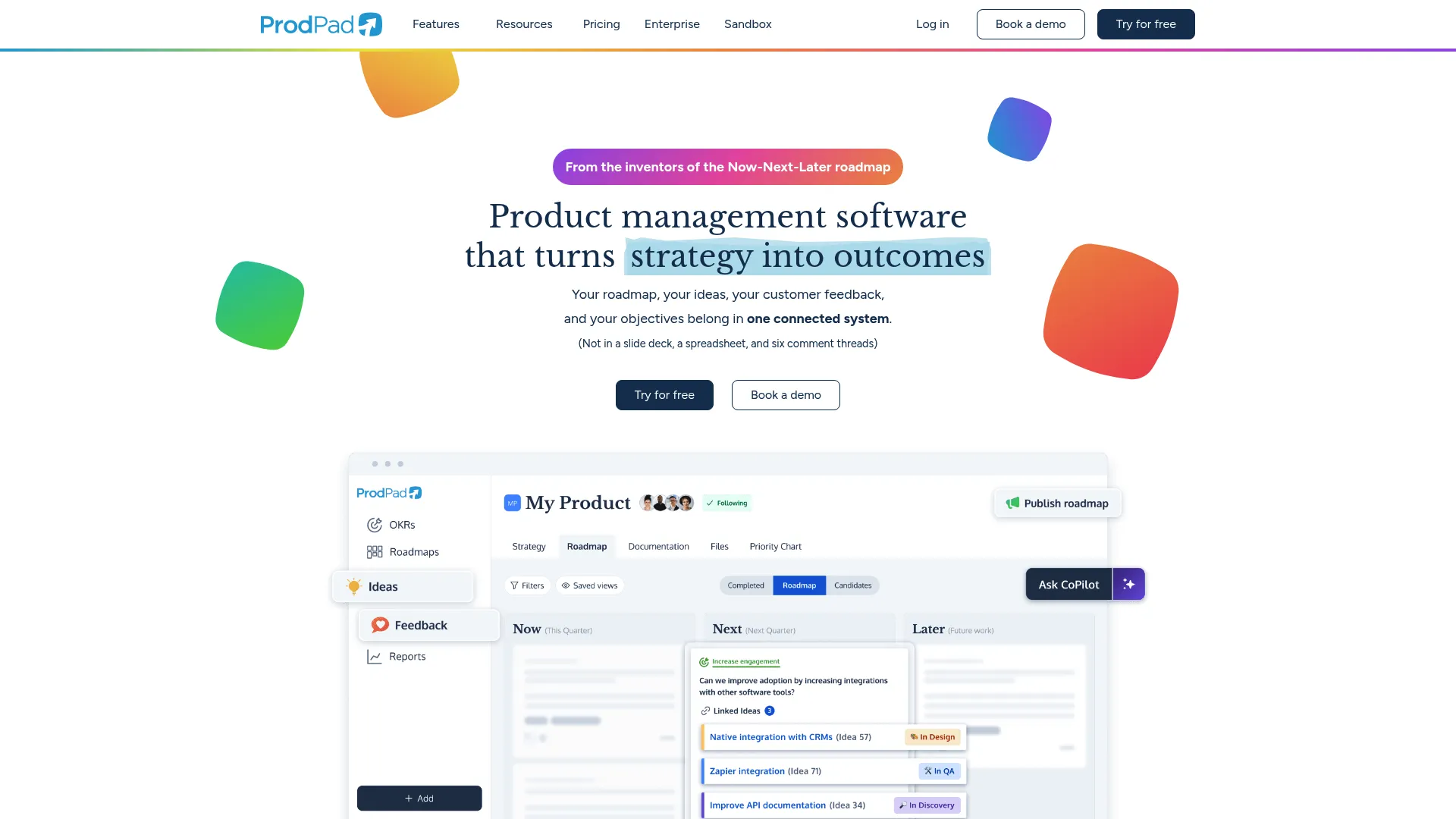
ProdPad is product management software covering ideas, feedback, roadmaps, objectives, and portfolio reporting. It's built to balance discovery and delivery, with a modular structure where you pay for the parts you use.
Best for: Product teams that want one tool for ideas, feedback, roadmaps, and OKRs.
Key strengths
- Idea management and backlog prioritization
- Customer feedback management
- Roadmaps and OKRs/objectives
- Opportunity mapping
- Portfolio reporting
Why choose ProdPad: For teams juggling discovery and delivery, ProdPad keeps ideas, feedback, and prioritization views in one lightweight workflow. The modular pricing suits teams that want to start small and add what they need.
ProdPad pricing: ProdPad uses modular pricing, where you select the parts you need rather than paying a single flat rate. A free trial of at least 7 days is available, contributors and reviewers can be free, and enterprise pricing is available by contacting sales.
7. ProductPlan

ProductPlan is product management software that combines strategic roadmapping with AI-powered customer and market intelligence. It leans on clear roadmap presentation, which makes it strong for communicating decisions to stakeholders who don't live in the tool.
Best for: Product teams that need roadmap prioritization tied to customer signals and stakeholder alignment.
Key strengths
- Unlimited roadmaps and viewers
- Prioritization boards and portfolio views
- AI-moderated research surveys
- Opportunity validation
- Strategic context on each item
Why choose ProductPlan: If the hard part is getting leadership to understand and buy into the roadmap, ProductPlan's presentation and unlimited-viewer model is built for that. Prioritization boards keep evidence attached while the roadmap stays readable for a wide audience.
ProductPlan pricing: ProductPlan offers one plan with all features, all teams, and unlimited viewers included. Pricing is customized based on use case and billed annually, with no public number shown.
8. Craft.io

Craft.io is AI-powered product management software for roadmapping, prioritization, and product strategy. It brings structure to the whole PM workflow, pairing prioritization frameworks with capacity planning so decisions account for what your team can actually deliver.
Best for: Product teams that want an all-in-one roadmap, prioritization, and strategy workspace.
Key strengths
- Product roadmaps and backlog management
- Prioritization frameworks
- Capacity planning
- AI-powered product management workflows
- Cross-functional collaboration
Why choose Craft.io: For structured PM teams, the tie between prioritization and capacity planning is the draw. You are not just ranking ideas, you are ranking them against real delivery capacity, which keeps the roadmap honest.
Craft.io pricing: Starter is $19 per editor per month, Pro is $79 per editor per month, and Enterprise is custom billed annually. A 14-day free trial is available, with no free tier.
9. Roadmunk
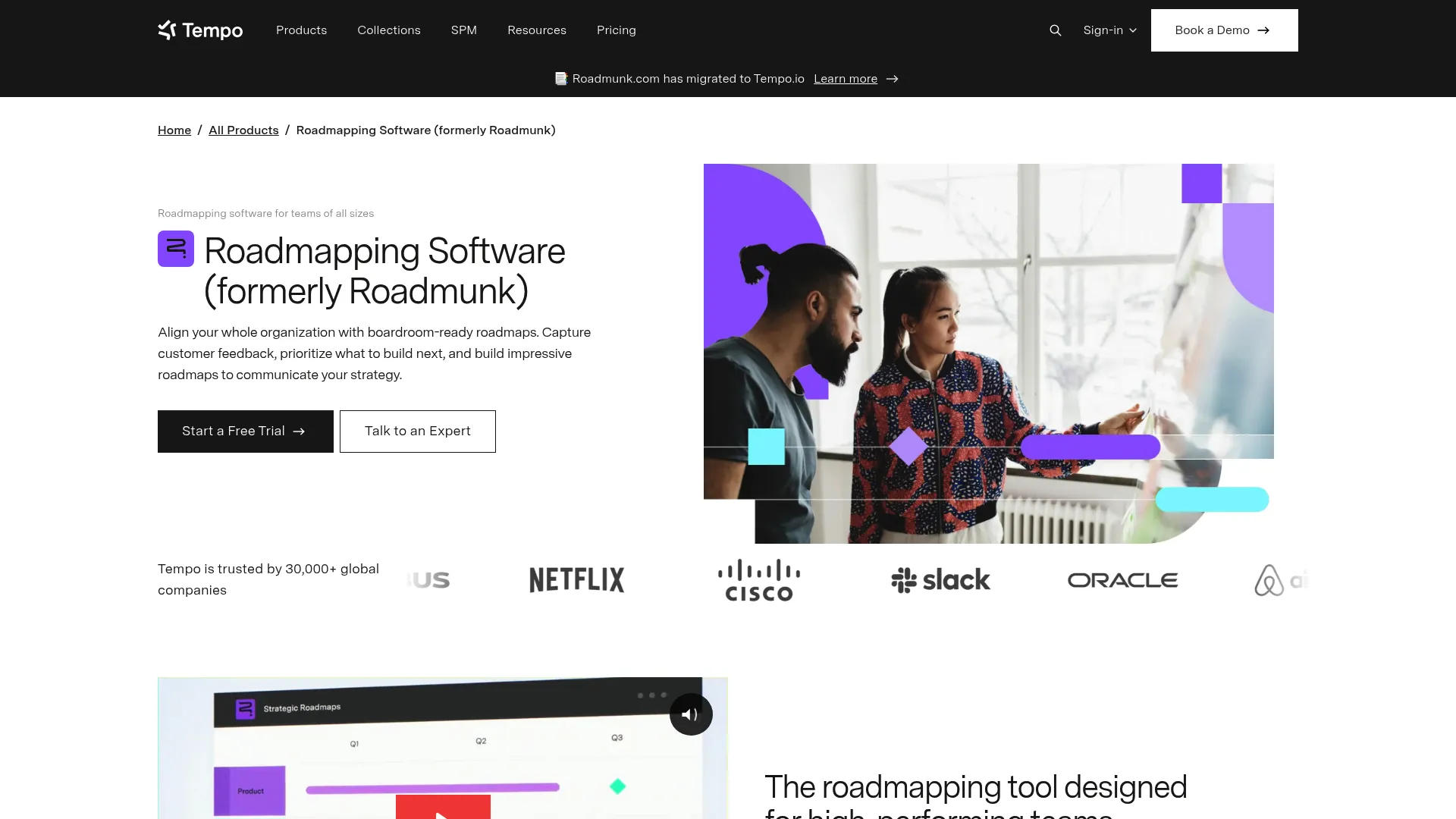
Roadmunk is product roadmapping software for capturing feedback, prioritizing ideas, and publishing roadmaps. Its strength is visualization, with timeline and kanban views plus built-in scoring, so leadership and delivery teams read the same clear picture.
Best for: Teams that need a visual product roadmap plus feedback and prioritization in one tool.
Key strengths
- Feedback inbox and Chrome extension for capturing requests
- Built-in value vs effort and RICE prioritization
- Timeline and kanban roadmap views
- Shareable web exports
- Stakeholder-friendly presentation
Why choose Roadmunk: When the job is aligning leadership and delivery around one visual roadmap, Roadmunk's presentation focus fits. The built-in RICE and value vs effort scoring means prioritization and visualization live in the same place.
Roadmunk pricing: Third-party listings show Starter at $19 per month, Business at $49 per month, and Professional at $99 per month, with Enterprise by contact. A 14-day free trial is available with no credit card required, and there is no free version.
10. ClickUp
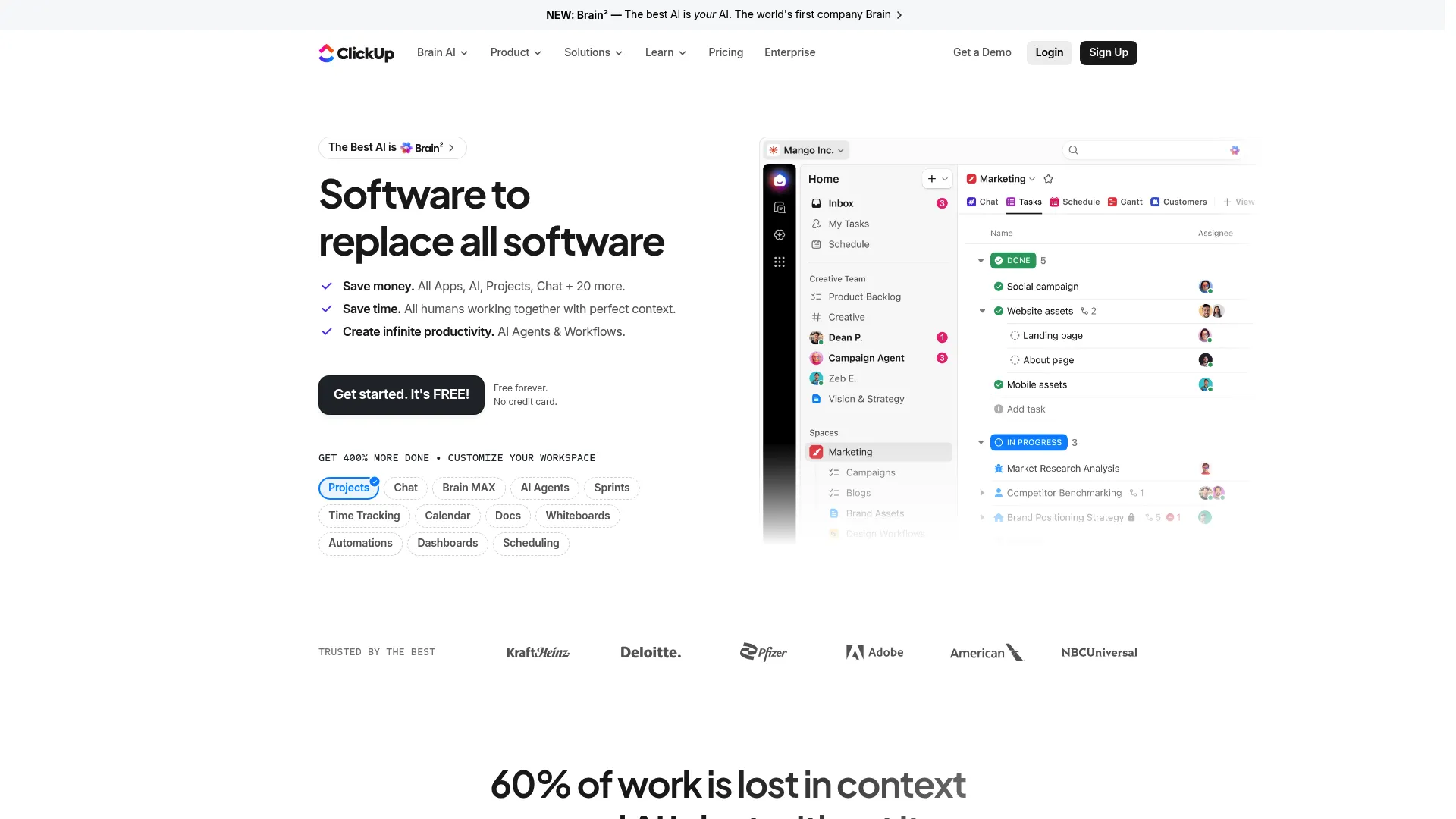
ClickUp is a work management platform covering tasks, docs, chat, goals, time tracking, and AI. It is broader than a dedicated prioritization tool, but teams use its custom fields and views to run prioritization inside the same hub where the rest of the work lives.
Best for: Teams that want an all-in-one work management system with strong customization.
Key strengths
- Task and project management with multiple views
- Docs, wikis, chat, whiteboards, and forms
- Built-in time tracking and dashboards
- Automations and AI
- Custom fields for scoring workflows
Why choose ClickUp: If you'd rather not add a standalone prioritization tool, ClickUp lets you build scoring and roadmap views inside a broader workspace. It's the pick for teams that value one hub over best-in-class prioritization depth.
ClickUp pricing: Free Forever plan available. Unlimited is $7 per user per month, Business is $12 per user per month, both billed yearly. Enterprise is custom pricing via sales.
Considerations
Before you commit, run each shortlisted tool against this checklist. The right choice depends on your operating reality, not on which tool has the longest feature list.
Data inputs and scoring flexibility
Check that the tool supports the frameworks you actually use, whether that's RICE, MoSCoW, Kano, or custom weighted scoring. Confirm you can feed it real data from your feedback channels rather than typing scores by hand. Rigid scoring that fights your method will get abandoned.
Integration depth with execution tools
A prioritized roadmap has to reach engineering. Verify two-way sync with Jira, Linear, or Azure DevOps, not just a one-time export. Shallow integrations create drift, where the roadmap and the delivery board slowly disagree until nobody trusts either.
Roadmap and portfolio visibility
If you run multiple products or teams, portfolio-level views matter. Check whether the tool rolls up individual roadmaps into a view leadership can read without a walkthrough. Presentation quality is not vanity here; it decides whether stakeholders stay aligned.
Collaboration and approvals
Prioritization is a team sport. Look for shared views, commenting, and approval flows so stakeholders can weigh in without derailing the decision. The goal is one source of truth, not a new place for the same debate.
Time to value and maintenance
A tool that takes a quarter to configure and constant upkeep to maintain competes with your actual product work. Weigh setup effort and ongoing maintenance against the opportunity cost. The best tool is the one your team will still be using in six months.
Conclusion
The right product prioritization software depends on where your friction actually lives, not on which tool wins the most feature checkboxes.
- If you want scoring, feedback, and roadmaps connected in one workflow, airfocus is the strongest all-around pick for multi-team product organizations.
- If your engineers already work in Jira, start with Jira Product Discovery so the handoff from decision to delivery is native.
- If your prioritization should start from customer evidence, Productboard and Canny both build the roadmap out of real feedback.
- If strategy has to drive the roadmap, Aha! Roadmaps gives you the goals-and-initiatives depth to trace every item back to an objective.
Pick the framework first, RICE, MoSCoW, Kano, or value vs effort, then choose the tool that runs it well and connects to how your team already ships. The next step is simple: shortlist two tools, run your real backlog through a trial, and see which one your stakeholders actually open.
FAQs
It's a tool that helps product teams rank ideas and features using structured scoring, then turn those decisions into a shared roadmap. Beyond sorting a backlog, it connects the evidence behind a decision, the decision itself, and the plan to execute it. That gives you a defensible answer when someone asks later why you built one thing over another.
There is no single best framework; the right one depends on the question you're answering. Use RICE to compare many ideas on evidence, MoSCoW to scope a release, Kano to weigh customer satisfaction, and value vs effort for quick triage. Most mature teams keep two or three on hand and switch based on the decision in front of them.
They solve different problems, so it's not a straight contest. RICE ranks a large set of ideas by weighing reach, impact, confidence, and effort into a single score. MoSCoW draws a line between what's non-negotiable and what's optional for a specific release. For a fixed-deadline release, MoSCoW is cleaner; for comparing a full backlog, RICE gives you more resolution.
Most dedicated tools offer integrations that sync prioritized items into your delivery tool as tickets or issues. The stronger ones support two-way sync, so status updates flow back into the roadmap without manual copying. Jira Product Discovery has the tightest native link to Jira, while airfocus, Productboard, and others integrate across multiple delivery platforms.
Plenty do, and for small teams or a single quick scoring exercise, a spreadsheet is genuinely fine. The trouble starts when feedback volume grows, stakeholders multiply, and the roadmap needs to sync with delivery. At that point a spreadsheet becomes a source of drift and lost evidence, which is when dedicated software earns its cost.
Start with scoring flexibility, so the tool runs your actual frameworks instead of forcing one. Then check feedback aggregation, roadmap and portfolio visibility, and two-way integration with your execution stack. Finally weigh time to value and maintenance, because a tool that's hard to configure competes with your real product work.
Match the tool to your primary need. Choose airfocus if you want modular, connected prioritization and roadmapping across multiple teams. Choose Productboard if customer feedback should drive prioritization from the start. Choose Jira Product Discovery if your delivery already runs on Jira and native handoff matters most.
Yes, and it's often the biggest reason teams adopt it. A transparent, shared ranking with the scoring logic attached moves roadmap debates from opinion to evidence. When sales, support, and leadership can all see why a decision was made, you spend less time re-litigating the same case in every review.