You can see campaign clicks. You can see signups. The gap is what happens next.
According to Appcues' 2025 benchmark survey, the average product activation rate across SaaS is just 32%. That means most users who sign up never reach the moment that makes them stick. And most marketing teams cannot tell you exactly where the drop happens, which channel created the users who did activate, or which interventions moved the number.
Activation tracking software closes that gap. It measures when a user, campaign, device, or account reaches a defined value milestone, then surfaces progress, stalls, and follow-up triggers. The challenge is that "activation" means different things depending on your business: A product behavior event, an account health milestone, a field campaign execution, or a device first-boot confirmation.
This guide covers 15 tools across all four activation meanings so you can identify the category that matches your problem before comparing logos.
What's inside
This guide is for growth marketers, demand gen leads, and SaaS teams accountable for activation rate, time to value, onboarding conversion, and retention.
Tools were selected based on:
- Coverage across SaaS activation, customer success activation, brand activation, and device activation categories
- Verifiable pricing and G2 ratings from live sources
- Relevance to digital marketers evaluating category fit, not just feature depth
- Representation of the full activation stack: Analytics, onboarding, CS, demo automation, field, and device
TL;DR
- Best for activation experiences: Guideflow is the pick when users or prospects need a guided, interactive product experience to reach their next activation step
- Best for SaaS product analytics: Amplitude for governed event analytics; Mixpanel for fast self-serve funnel analysis
- Best for onboarding and in-app activation: Userpilot connects in-app prompts directly to activation milestones
- Best for customer success activation: Gainsight CS for enterprise account health; Custify for growing SaaS CS teams
- Best for brand activation tracking: AnyRoad, MoZeus, or PINATA depending on whether the job is ROI reporting, data capture, or field execution
- Best for device activation: Atomquark for hardware deployments, license management, and technical telemetry
What is activation tracking software?
Activation tracking software measures when a user, customer, campaign, device, or account reaches a defined value milestone, then reports progress, drop-offs, and follow-up actions in a central dashboard.
The category spans six distinct tool types:
- Product analytics platforms: Event tracking, funnels, behavioral cohorts, retention curves, and experimentation
- Onboarding and adoption platforms: Activation flows, in-app messaging, checklist completion, and feature adoption measurement
- Customer success platforms: Account health scores, time-to-value tracking, renewal risk alerts, and lifecycle playbooks
- Demo automation platforms: Activation education delivered through interactive product experiences across landing pages, emails, and help centers
- Brand activation platforms: Field event execution, campaign ROI reporting, attendee data capture, and experiential measurement
- Device activation platforms: Hardware deployment tracking, license validation, technical telemetry, and first-boot registration
Key activation tracking jobs
Regardless of category, activation tracking software should:
- Define and store activation milestones at the user, account, campaign, or device level
- Capture activation data as events, health scores, task completions, or telemetry reads
- Monitor progress and surface accounts or users that have stalled before reaching value
- Trigger alerts, playbooks, or lifecycle workflows based on activation state changes
- Report activation impact on revenue, retention, campaign ROI, or deployment coverage
What activation tracking is not
Standard web analytics shows acquisition behavior: Source, landing page, bounce rate. Activation tracking starts where acquisition ends. CRM reporting shows pipeline stages and deal status. Activation tracking shows whether the person or account behind the deal actually reached product value or campaign completion.
If your reporting answers "did they sign up?" but not "did they activate?", you need a dedicated activation layer.
When to use activation tracking software
Track activation from signup to first value
Product and growth teams use activation tracking to know exactly how many trial users reached the behavior that predicts conversion, and how long it took. This covers freemium activation events, PQL creation, onboarding completion rates, and time-to-first-value reporting. Without this data, lifecycle campaign decisions rest on guesses about where users actually stall.
Find which campaigns create activated users
Most marketing attribution stops at the lead or the signup. Activation tracking extends the attribution chain to tell you which paid channel, email sequence, or partner program created users who reached a meaningful product milestone. That answer changes budget decisions fast.
Monitor account, event, or device activation at scale
For customer success teams, activation means confirmed product adoption across an account. For field marketing teams, it means verified execution of a physical brand campaign. For enterprise IT and hardware teams, it means device or license confirmation across a deployment fleet. Each context needs a different tool, but the core job is the same: Know what has activated and what has not, in near real time.
Activation tracking software comparison
The table below mixes product categories because search intent around activation tracking is genuinely mixed. Start with the "Best for" column to identify your activation type, then read the item sections for the tools that match.
Pricing and G2 ratings are verified from vendor pricing pages and live G2 listings as of November 2026.
| # | Product | Best for | Key differentiator | Pricing | G2 rating |
|---|---|---|---|---|---|
| 1 | Amplitude | Product analytics and activation cohorts | Governed behavioral analytics with AI | Free; paid plans custom | 4.5/5 |
| 2 | Mixpanel | Self-serve funnel and retention analysis | Fast product analytics without BI overhead | Free; Growth from $0/mo (usage-based) | 4.5/5 |
| 3 | Userpilot | In-app onboarding and feature adoption | Analytics plus in-app activation in one platform | From $299/mo | 4.6/5 |
| 4 | Guideflow | Interactive demos for activation education | Demo automation across landing pages, emails, help centers | Free; Solo from $35/mo (annual) | 5.0/5 |
| 5 | Gainsight CS | Enterprise customer success activation | Account health, playbooks, and renewal risk | Custom pricing | 4.5/5 |
| 6 | Custify | SaaS CS activation monitoring | Customer health and churn risk for growing teams | Custom pricing | 4.7/5 |
| 7 | Heap Illuminate | Retroactive behavioral friction discovery | Autocapture surfaces activation blockers without pre-planning | Free; paid plans custom | Not listed |
| 8 | Quivly AI | AI-assisted time-to-value tracking | AI agents for onboarding, risk, and expansion workflows | From $500/mo | Not listed |
| 9 | AnyRoad | Brand and experiential activation | Experience ROI from booking through post-event analysis | Custom pricing | 4.7/5 |
| 10 | MoZeus | Event activation data capture | Custom experiential tech including AR, gamification, and lead capture | Custom pricing | Not listed |
| 11 | PINATA | IPFS file storage and content delivery | Decentralized storage with dedicated gateway CDN | Free; from $20/mo | 4.4/5 |
| 12 | ActivationMax | Field activation program management | Purpose-built activation execution and reporting | Contact vendor | Not listed |
| 13 | Qualtrics Brand Tracker | Brand health and campaign impact measurement | Continuous brand equity tracking with competitive benchmarks | Custom pricing | 4.4/5 |
| 14 | Resonate | Consumer intelligence for activation strategy | Predictive audience modeling across 15,000+ attributes | Custom pricing | 4.6/5 |
| 15 | Atomquark | Device and license activation tracking | Custom AI and enterprise software for deployment telemetry | SAR 72,000/year (Traffic Mgmt) | Not listed |
Best 15 tools for activation tracking in 2026
1. Amplitude
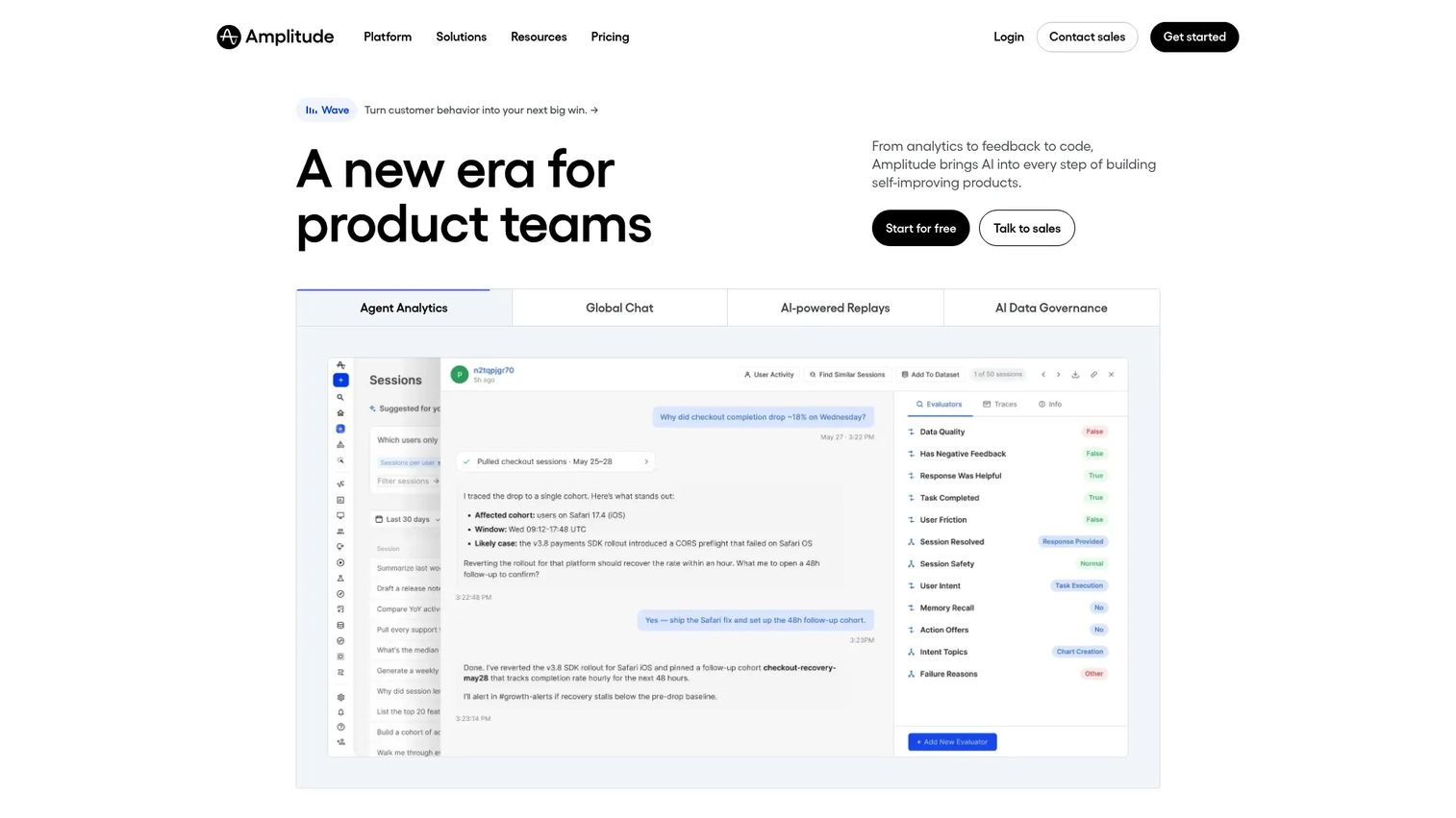
Amplitude is an AI analytics platform that turns user-action data into behavioral insights, retention reporting, and activation cohorts. It is built for product, growth, and marketing teams that need governed definitions of activation events shared across the organization. Amplitude's platform includes product analytics, session replay, feature experimentation, and AI-powered analytics agents in a single environment.
Best for: Growth and product teams that need trusted, consistent activation metrics across marketing, product, and data functions.
Key features
- Event tracking with segmentation and cohorts
- Funnel conversion and retention analysis
- Feature experimentation and flags
- Session replay for individual user sessions
- AI analytics agents and behavioral AI
Why choose Amplitude: Choose Amplitude when leadership needs a single source of truth for activation metrics and your team is ready to invest in clean event taxonomy. The platform's governance tools pay off at scale; a messy tracking plan will still produce messy reports regardless of the tool.
Amplitude pricing: Amplitude includes a free plan covering 2 million events per month. The Plus plan starts with the same event volume; Growth and Enterprise use custom event-based pricing and require a sales conversation.
G2 rating: 4.5/5
2. Mixpanel
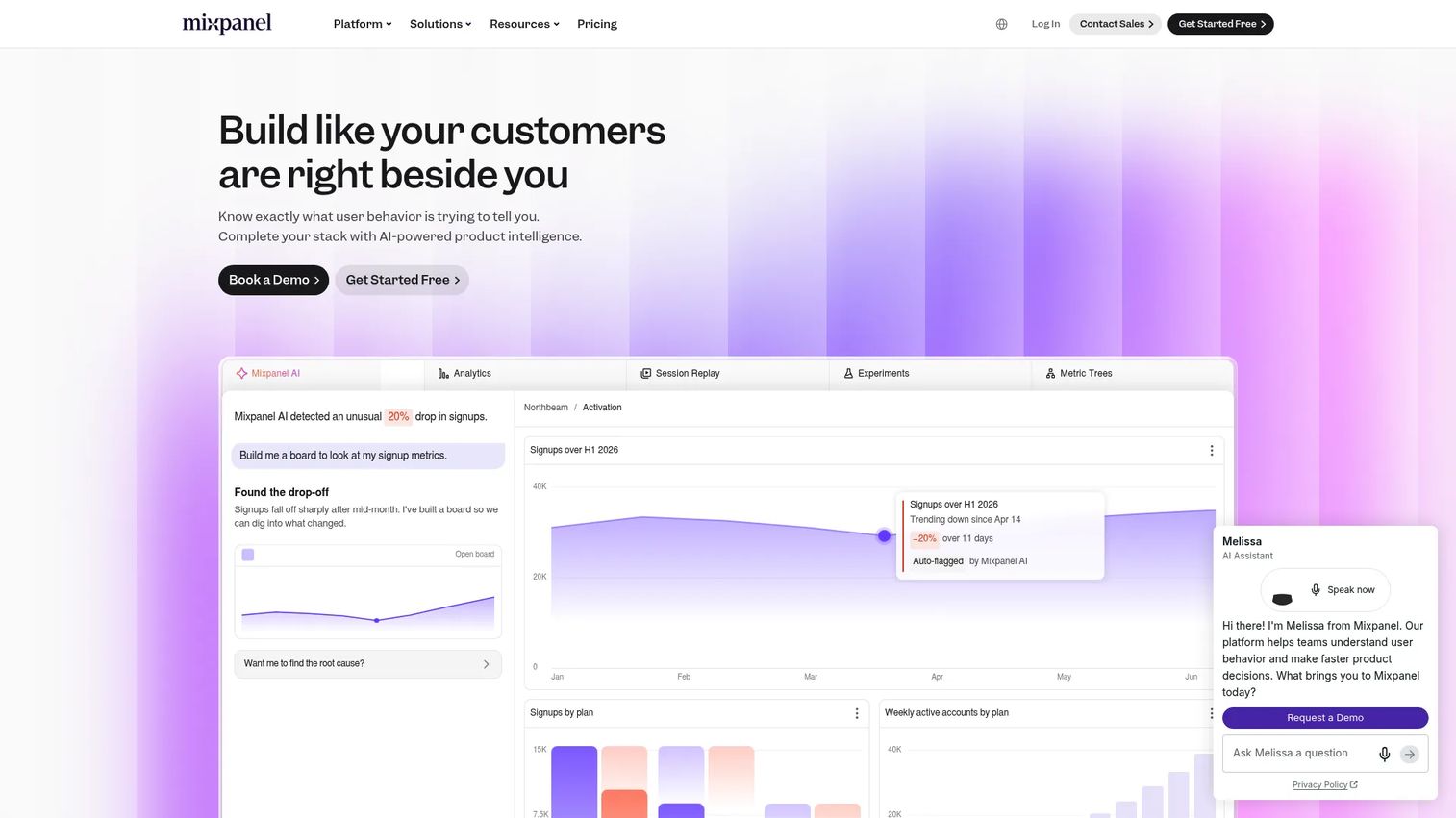
Mixpanel is a product intelligence platform known for its self-serve funnel, cohort, and retention reports. Growth teams use it to analyze where users drop before activation without waiting for a data request. It now includes session replay, heatmaps, feature flags, and conversational AI analytics alongside its core behavioral reporting.
Best for: Growth teams that need quick answers about activation drop-off and want to run their own analysis without routing every question through data engineering.
Key features
- Funnel reports with step-level drop-off
- Retention analysis and behavioral cohorts
- Session replay and heatmaps
- Feature flags and experimentation
- AI and conversational analytics
Why choose Mixpanel: Mixpanel rewards teams that move fast on product questions. The self-serve interface is genuinely usable by non-engineers. The trade-off is that consistent event naming still matters; poorly planned tracking produces the same ambiguous funnel charts in Mixpanel as anywhere else.
Mixpanel pricing: Free forever up to 1 million events per month. The Growth plan starts at $0 per month on a usage-based model, scaling to 20 million events. Enterprise uses custom pricing for larger volumes.
G2 rating: 4.5/5
3. Userpilot
Userpilot is an agentic product adoption platform that combines product analytics, in-app onboarding flows, surveys, session replay, and email engagement in one place. It is particularly useful for teams that want to run activation experiments inside the product without filing a ticket for every change. Its AI agent Lia adds automated analysis and recommendation on top of the behavioral data.
Best for: SaaS product and growth teams that want to connect in-app onboarding prompts, checklists, and guidance directly to activation milestone tracking.
Key features
- In-app onboarding flows and checklists
- Product analytics with event autocapture
- Feature adoption tracking and segmentation
- NPS and in-app surveys
- Behavior-triggered email and mobile engagement
Why choose Userpilot: Choose Userpilot when activation depends on changing what users see and experience inside the product without engineering cycles for each experiment. It fits onboarding and adoption programs more than broad data warehouse analytics or BI reporting.
Userpilot pricing: Starter starts at $299 per month for up to 2,000 monthly active users. Growth starts from $849 per month for up to 100,000 monthly active users. Enterprise pricing requires a custom quote. A 14-day free trial is available.
G2 rating: 4.6/5
4. Guideflow
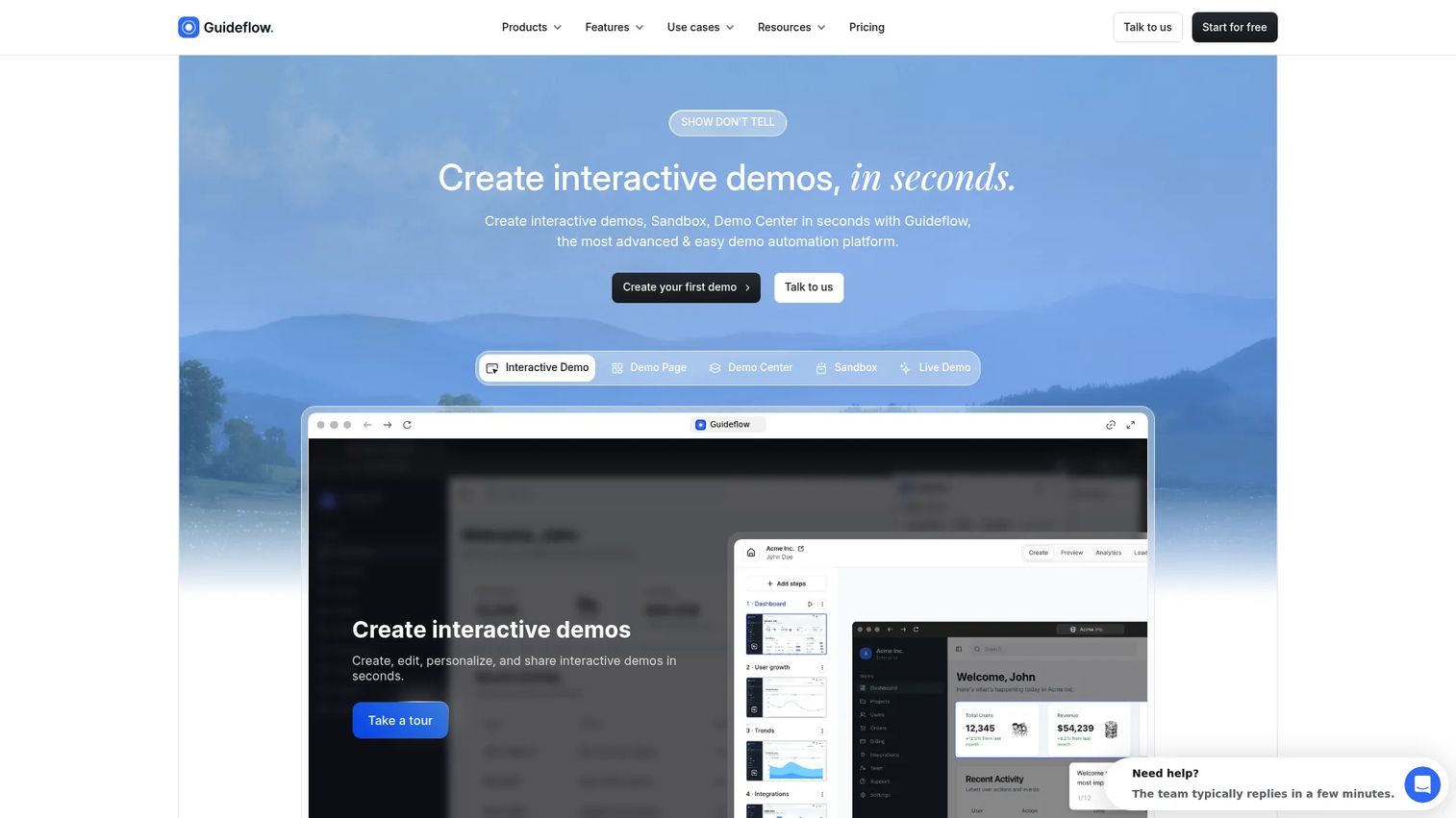
Guideflow is a demo automation platform that helps marketing, sales, CS, and product teams create guided, self-serve interactive demos that show users or prospects exactly how to reach their next activation step. It is not a product analytics platform. Instead, it improves the activation experience itself: Giving people a clickable guided story of the product before they log in, during onboarding, in a support article, or as a sales follow-up.
Teams capture product flows through the browser in a few clicks, then refine them in a no-code editor to add tooltips, CTAs, branching paths, and lead capture forms. The platform supports personalization of text, images, and graphs per viewer, plus AI-generated steps, translations, voiceovers, and avatars. Completed demos can be shared through links, website embeds, emails, or social campaigns.
Guideflow's demo formats cover different activation moments: interactive demos guide users through a specific story, sandboxes let them explore freely, demo centers organize multiple demos by use case or persona, live demos add a human presenter layer, and mobile demos meet users on their device. Analytics track impressions, completion rate, leads collected, and conversion inside the demo experience.
Best for: Marketing, growth, CS, product, and partner teams that need interactive product experiences to help users or prospects understand and reach activation milestones across landing pages, onboarding emails, help centers, and sales follow-ups.
Key features
- Interactive demo creation with no-code editor
- Demo centers for organized self-serve libraries
- Sandboxes for free-form product exploration
- Lead capture forms and viewer identification
- Demo analytics: Impressions, completion, leads, conversion
Why choose Guideflow: Choose Guideflow when the activation problem is "people do not understand the product well enough to take the next step." It is complementary to Amplitude, Mixpanel, and Userpilot. Those tools tell you activation stalled; Guideflow gives you a way to show users what to do next.
Guideflow pricing: Free plan available. Solo is $35 per user per month billed annually ($40 monthly). Growth is $499 per month annually. Advanced is $1,499 per month annually. Enterprise starts from $2,999 per month annually.
G2 rating: 5.0/5
Start your journey with Guideflow today!
5. Gainsight CS
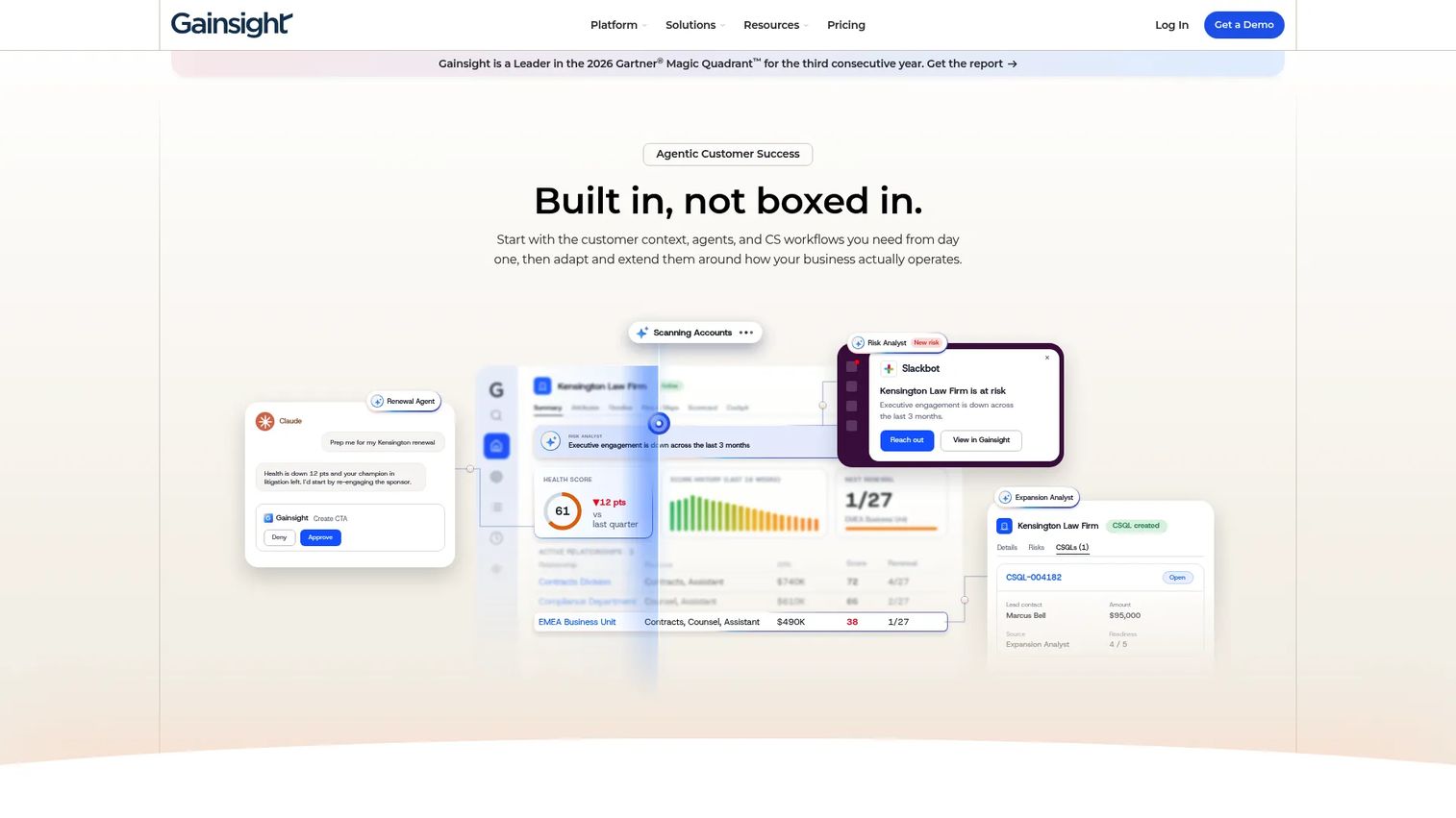
Gainsight CS is a customer success platform for mid-market and enterprise teams managing account-level activation, onboarding progress, adoption health, and renewal risk. It centralizes customer data into a 360-degree view, scores account health across configurable dimensions, and triggers playbooks when accounts fall below threshold. Its AI Copilot adds intelligence across health signals and CS workflows.
Best for: Customer success teams managing complex, multi-stakeholder accounts where activation means confirmed adoption across a buying committee, not a single user event.
Key features
- Customer 360 view with health scorecards
- Success playbooks and journey orchestration
- Account timelines and digital journeys
- Renewal and expansion forecasting
- AI-powered Copilot for CS workflows
Why choose Gainsight CS: Choose Gainsight when activation is an account-level success motion involving onboarding plans, executive business reviews, and renewal conversations. It may exceed the scope of a small marketing team; confirm the platform's fit by scoping seats, modules, implementation effort, and integration requirements during the sales process.
Gainsight CS pricing: Essentials and Enterprise plans are available.
G2 rating: 4.5/5
6. Custify
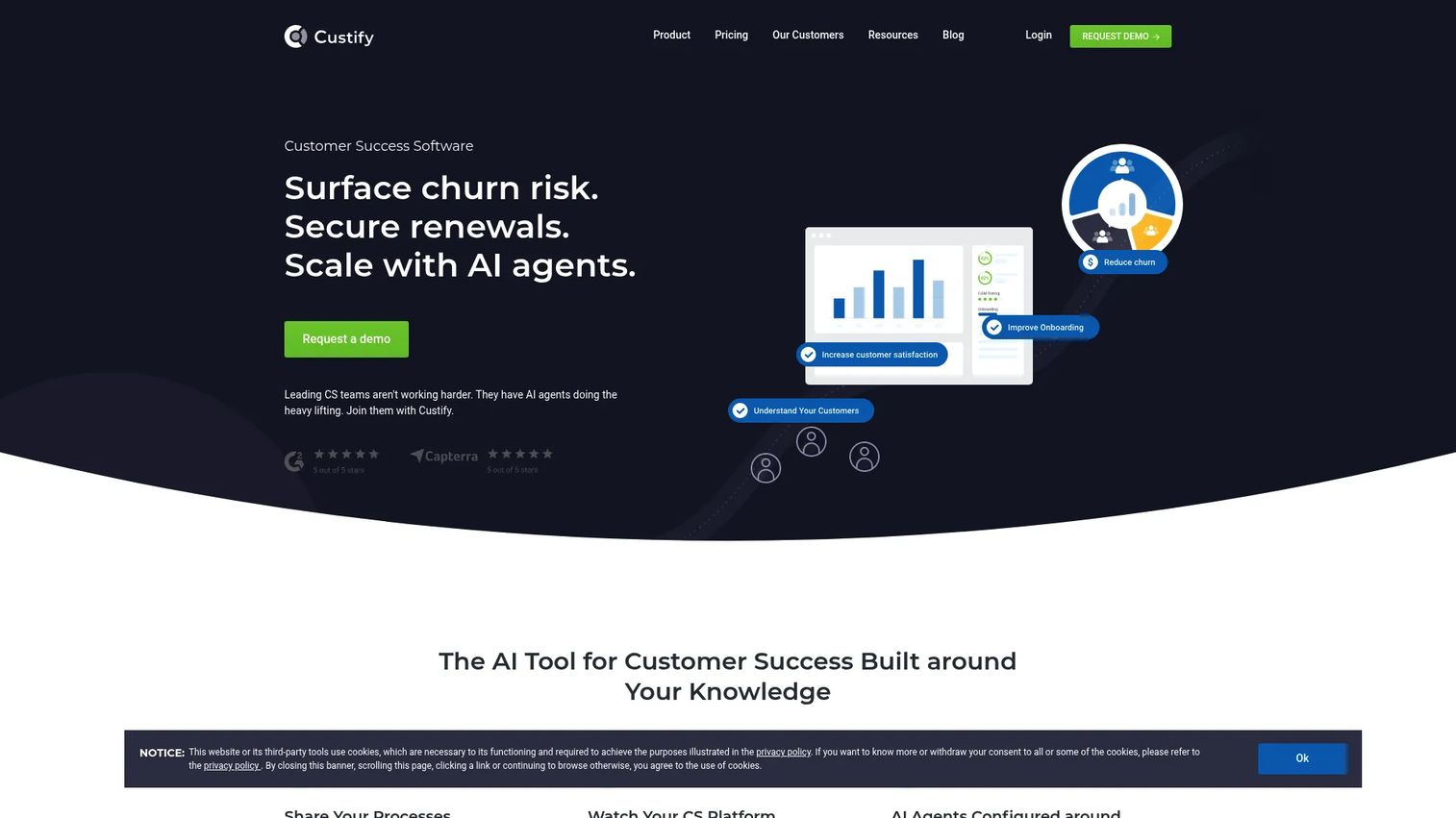
Custify is an AI-first customer success platform for B2B SaaS teams that need centralized customer data, health monitoring, churn risk detection, and workflow automation without enterprise-scale overhead. It covers customer 360 views, health scores, calculated metrics, task automation, surveys, a customer portal, and CustifyAI for intelligent suggestions.
Best for: SaaS customer success teams that need activation monitoring and churn risk detection at a scale between spreadsheet management and full enterprise CS platforms.
Key features
- Customer health scores and churn risk detection
- Onboarding tracking and lifecycle playbooks
- Product usage signals and engagement data
- Automated tasks and CS alerts
- Customer portal and survey tools
Why choose Custify: Choose Custify when activation monitoring sits inside a CS motion rather than a pure product analytics workflow. It is lighter than Gainsight CS for teams that do not need the full enterprise feature set. For deep product-level event analytics, pair it with a dedicated product analytics tool.
Custify pricing: The pricing page directs prospects toward a conversation to scope the right plan. Contact their team directly to get figures for your team size and usage.
G2 rating: 4.7/5
7. Heap Illuminate
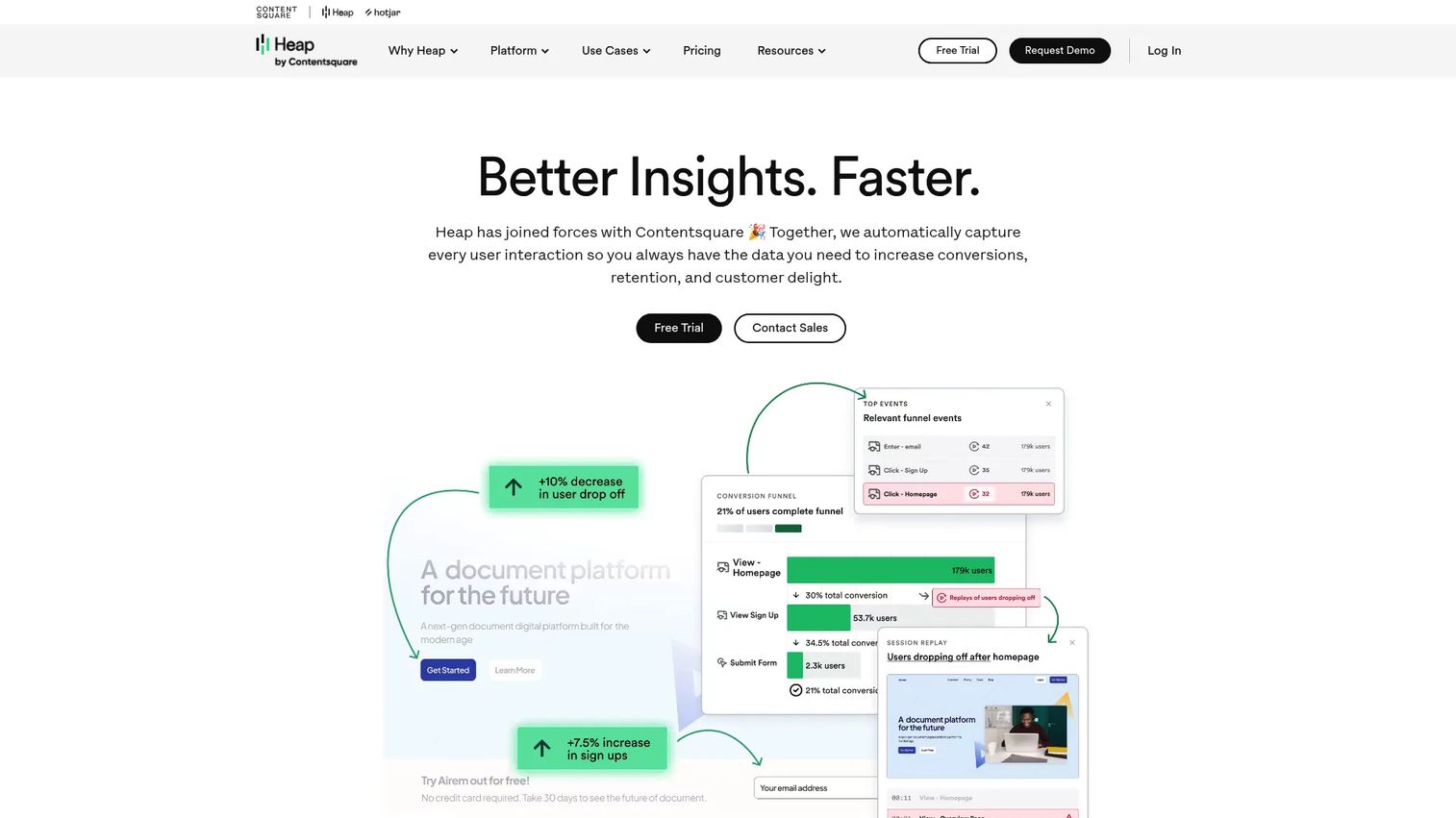
Heap Illuminate is Heap's data-science layer that automatically surfaces hidden friction, conversion drivers, and behavioral patterns from autocaptured user data. Unlike traditional analytics that require pre-planned event schemas, Heap Illuminate can analyze behavior retroactively, which is valuable when teams want to find activation blockers they did not think to instrument upfront.
Best for: Product and growth teams that need to discover activation friction after the fact, without being limited by what they tracked in advance.
Key features
- Autocapture of all user interactions
- Top Events and journey comparison analysis
- Effort analysis and rage-click detection
- Retroactive behavioral segmentation
- Pageview and group suggestions
Why choose Heap Illuminate: Choose Heap when you want to find out what is blocking activation without first knowing the right questions to ask. The autocapture approach reduces the dependency on pre-planned event taxonomy. Governance still matters for turning raw behavioral signals into trusted activation metrics that the broader team will act on.
Heap Illuminate pricing: Heap's Free plan includes core analytics up to 10,000 monthly sessions. Growth, Pro, and Premier plans use custom session-based pricing. Install the free snippet on the Heap pricing page to get a personalized estimate.
8. Quivly AI

Quivly AI deploys AI agents for post-sales teams managing customer onboarding, adoption, expansion, and renewal. It is built specifically around time-to-value and activation milestone tracking for usage-based B2B companies. Agents handle tasks, milestones, risk detection, and expansion signals with human-in-the-loop approvals before actions are taken.
Best for: Customer engineering, field delivery engineering, and CS teams at usage-based B2B companies that want AI-driven activation monitoring without replacing the humans making decisions.
Key features
- AI agents for onboarding, risk, expansion, and renewal
- Milestone and project tracking with health scores
- CRM, Slack, Gmail, and calendar integrations
- MCP server and API access on Growth
- Custom product usage data models on Growth
Why choose Quivly AI: Choose Quivly AI when time-to-value reporting and stuck-account detection are the core problem and the team wants AI to surface the signals rather than writing manual queries. Verify integration depth with your CRM and product analytics stack, and confirm how the AI recommendations are explained before relying on them for renewal conversations.
Quivly AI pricing: Starter is $500 per month for 10 AI agents and up to 50 customer accounts. Growth is $1,000 per month for 25 agents and up to 100 accounts. Enterprise uses custom annual pricing with unlimited accounts. Additional agents cost $50 per agent on Starter and $40 on Growth.
9. AnyRoad
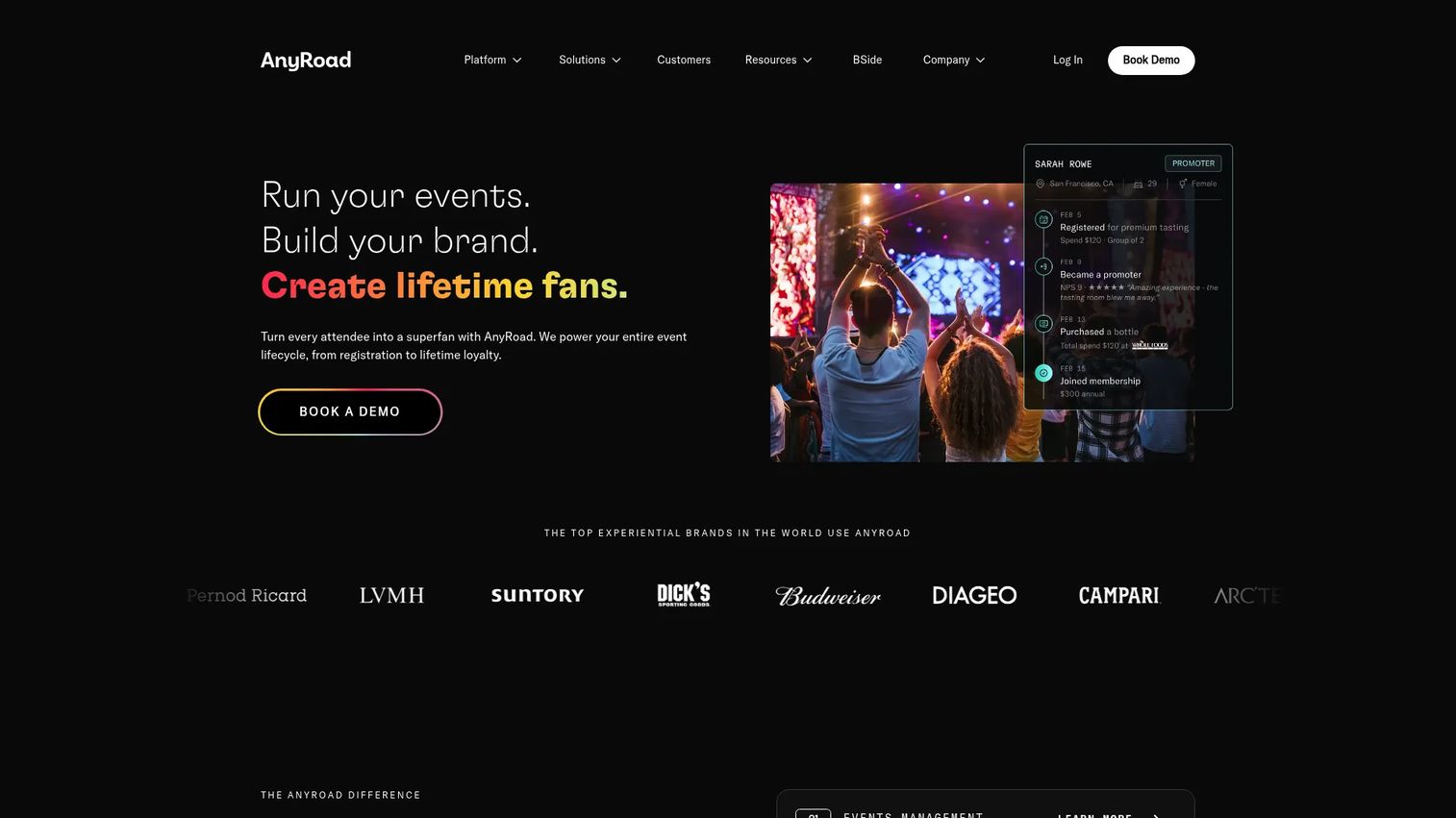
AnyRoad is an experiential marketing platform for enterprise brands running multi-location events, tours, classes, and sampling activations. It covers booking, ticketing, guest data capture, payments, check-in operations, and AI-powered post-event analysis. The platform connects experience data to CRM and marketing automation systems so brand teams can report on activation ROI rather than guessing at it.
Best for: Enterprise field marketing and experiential teams that need to operate large-scale brand activation programs and report their revenue and audience impact in one place.
Key features
- Event booking, ticketing, and capacity management
- Guest data capture and feedback collection
- AI-powered experience analysis and reporting
- Campaign ROI tracking across locations
- Integrations with CRM, marketing, and data platforms
Why choose AnyRoad: Choose AnyRoad when activation means real-world brand experiences with paying or attending guests, and the team needs both operational management and revenue attribution from those events. This is not the right tool for tracking in-product SaaS activation events.
AnyRoad pricing: Custom enterprise pricing based on program scope. Contact AnyRoad to get pricing for your activation volume and integration requirements.
G2 rating: 4.7/5
10. MoZeus
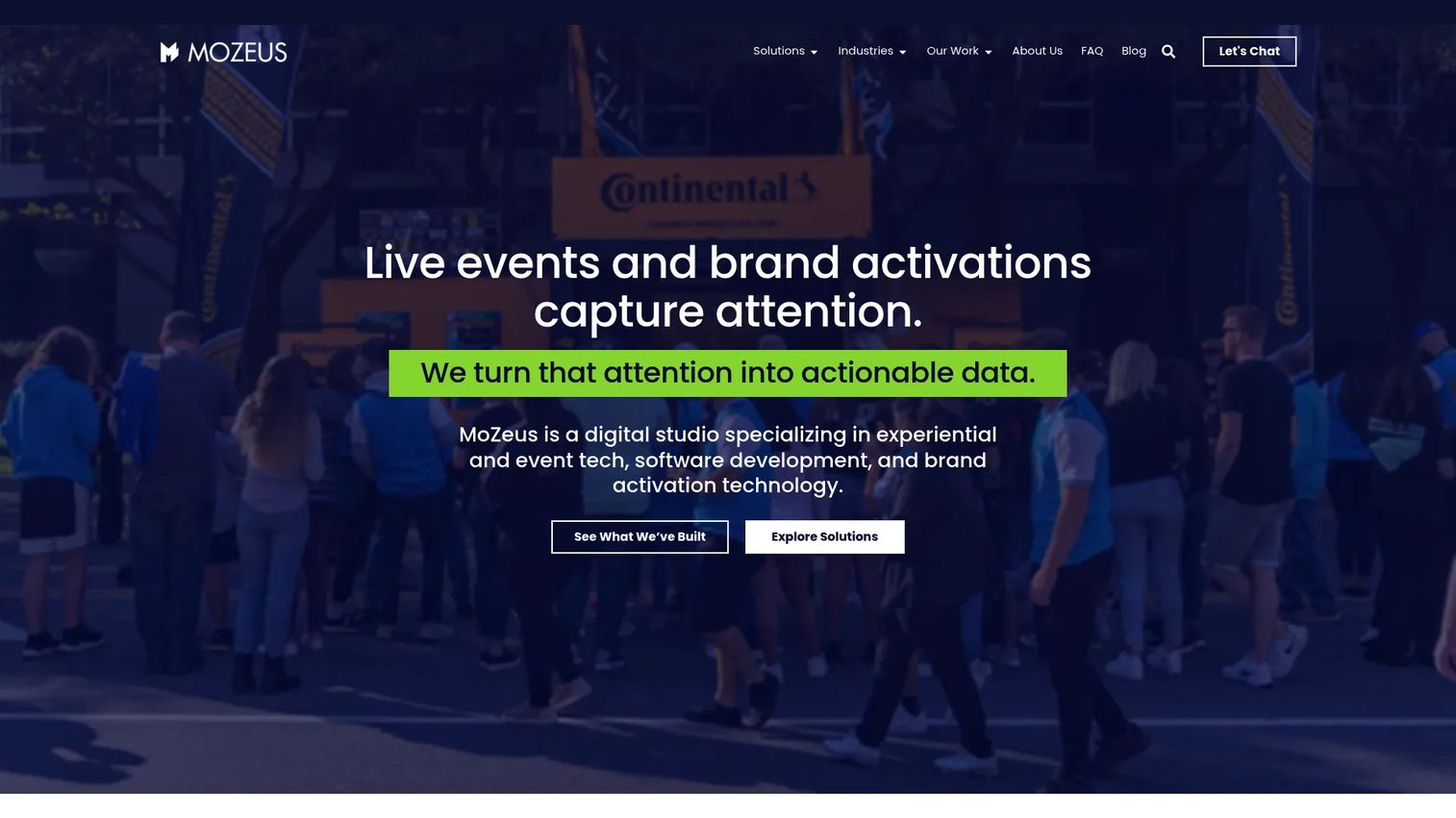
MoZeus is a digital studio that builds experiential and event technology for brands and agencies running measurable live activations. Its capabilities span event registration, badge scanning, secure lead capture, web-based AR, gamification, digital promotions, photo and video marketing, and CRM reporting. MoZeus builds custom technology rather than selling a fixed SaaS platform.
Best for: Enterprise brands and agencies that need purpose-built digital experiences and data capture technology for live brand activations with custom requirements.
Key features
- Event registration, badge scanning, and check-ins
- Secure data capture and lead generation
- Web-based AR and gamification
- Sweepstakes and digital promotions
- Generative AI and photo marketing experiences
Why choose MoZeus: Choose MoZeus when your brand activation requires custom event technology that an off-the-shelf platform cannot handle. The custom-build approach means higher flexibility and higher cost. This is a field marketing tool, not a SaaS onboarding or product analytics platform.
MoZeus pricing: Project pricing is scoped by goals and complexity. Contact MoZeus directly with event scope, timeline, and feature requirements to get a quote.
11. PINATA
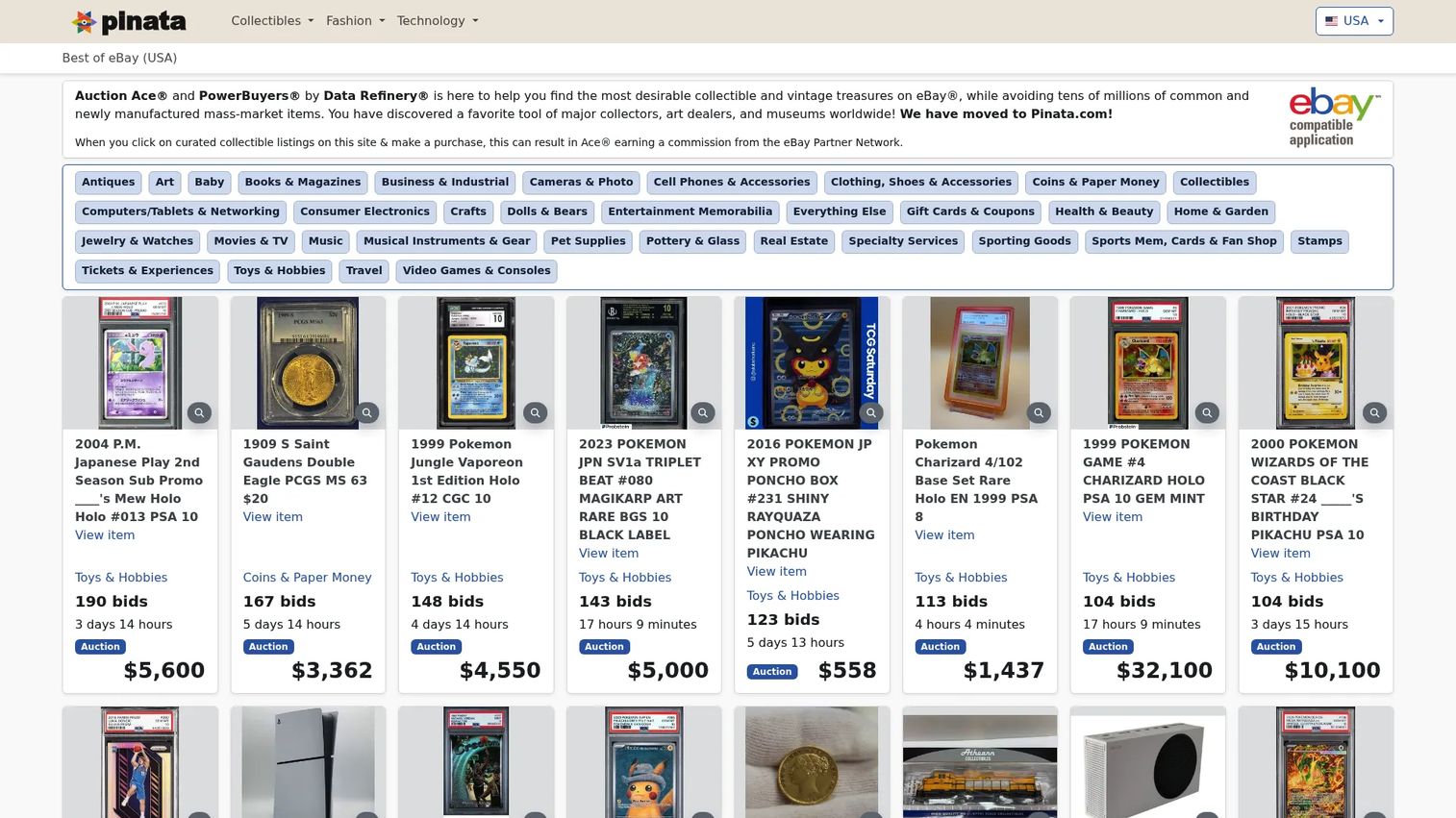
A note on this entry: The domain pinata.com in the brief resolves to an auction discovery site. The verified PINATA product is Pinata Cloud, a web3 infrastructure platform for IPFS file storage, decentralized content delivery, and gateway APIs. It is not a field activation management or SaaS onboarding tool. If your activation tracking search led you here because of the brand name, the product is developer-focused file infrastructure.
Best for: Developers and organizations building IPFS-, NFT-, or media-heavy applications that need scalable decentralized file storage and CDN delivery.
Key features
- IPFS file pinning and storage
- Dedicated gateways with CDN delivery
- File groups, folder uploads, and metadata
- HLS video streaming and image optimization
- Platform API, CLI tooling, and webhooks
Why choose Pinata Cloud: Choose Pinata Cloud when your project requires decentralized file storage on IPFS with reliable gateway delivery, not when you need marketing activation or SaaS onboarding analytics.
Pinata Cloud pricing: Free plan includes 1 GB storage, 500 files, and 10 GB bandwidth. Picnic is $20 per month. Fiesta is $100 per month. Enterprise uses custom pricing.
G2 rating: 4.4/5
12. ActivationMax
ActivationMax appears in activation-related searches as a field activation management platform for brand programs. The official domain timed out during research, so verified feature details, pricing, and ratings could not be confirmed from primary sources. Based on available secondary references, it is associated with activation program execution, field team coordination, and campaign reporting.
Best for: Brand teams that need structured field activation program management and execution tracking, once product details are confirmed directly with the vendor.
Key features
- Activation program planning
- Field execution tracking
- Team coordination tools
- Campaign reporting
- Program documentation
Why choose ActivationMax: If the product matches what secondary sources describe, choose it when your brand activation teams need purpose-built execution and reporting. Contact the vendor directly to verify current feature set, integrations, and pricing before evaluation.
ActivationMax pricing: Reach out to the vendor at activationmax.com for a current quote.
13. Qualtrics Brand Tracker
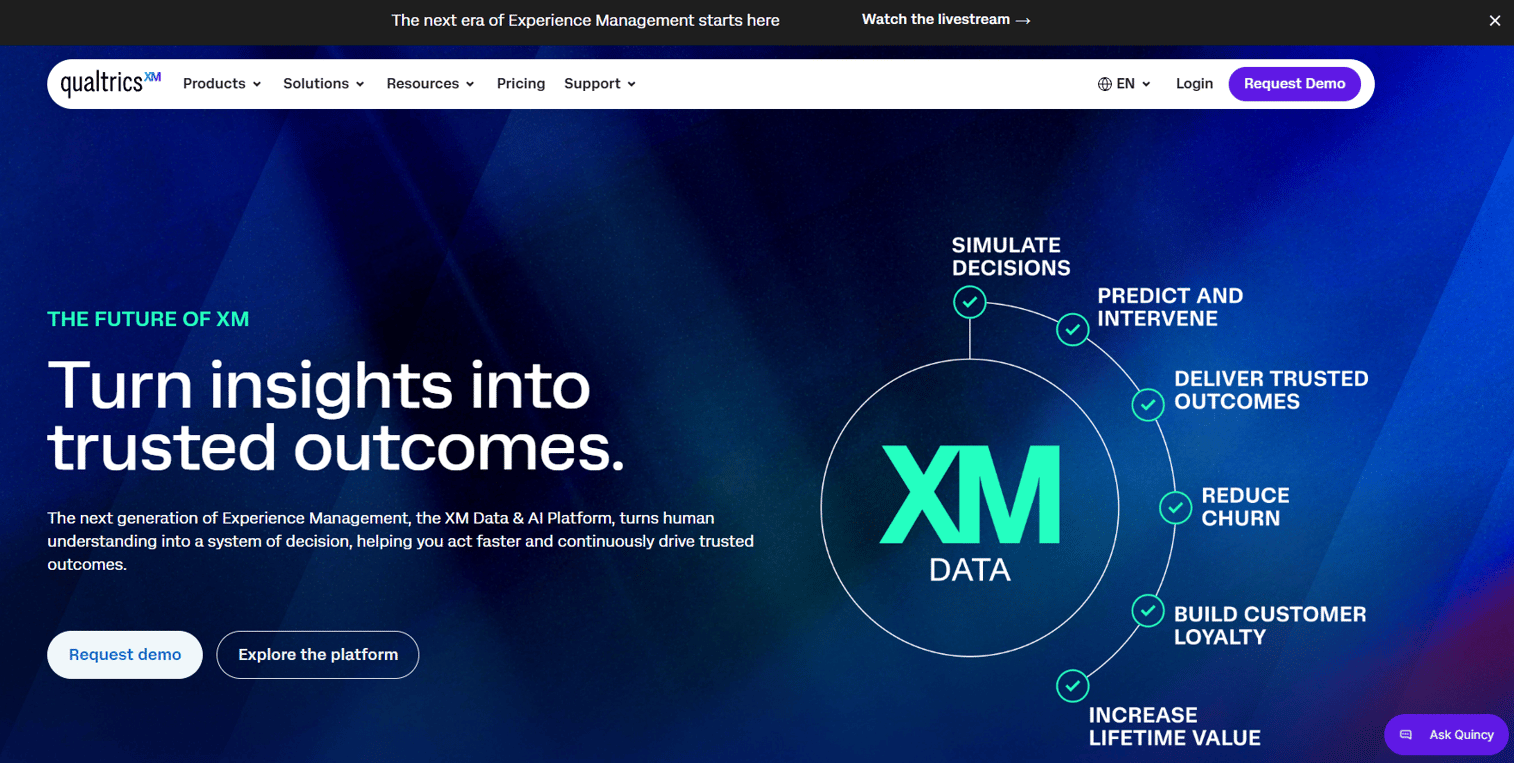
Qualtrics Brand Tracker is an enterprise brand-health research platform for continuously measuring brand awareness, perception, equity, and competitive performance. It uses expert-built surveys, automated workflows, driver analysis, and customizable dashboards to show how activation campaigns move brand metrics over time. It measures brand activation outcomes, not event execution or SaaS onboarding.
Best for: Enterprise marketing and insights teams that need ongoing brand health data to measure the perception impact of activation programs against competitive benchmarks.
Key features
- Brand health tracking across awareness, consideration, and loyalty
- Competitive benchmarking
- Driver analysis linking perceptions to business outcomes
- Prebuilt reports and customizable dashboards
- Campaign pre- and post-measurement comparison
Why choose Qualtrics Brand Tracker: Choose it when activation measurement means understanding whether campaigns are moving audience perception, not whether field tasks were executed or users reached a product milestone. It complements field execution tools rather than replacing them.
Qualtrics Brand Tracker pricing: Brand Tracker is part of the broader Qualtrics platform and is scoped through a custom enterprise conversation. Contact Qualtrics to scope survey volume, users, and modules.
G2 rating: 4.4/5
14. Resonate
Resonate provides predictive consumer intelligence for identifying what motivates audiences to act, respond, or buy. Its platform covers 15,000+ consumer attributes spanning psychographics, media behavior, intent, preferences, and demographics. Teams use Resonate to plan activation campaigns based on what audiences actually care about, then measure response and optimize spend accordingly.
Best for: Brands, agencies, and publishers that need audience intelligence to inform activation campaign strategy and media targeting decisions.
Key features
- 15,000+ consumer attributes across psychographics and behavior
- Audience building and activation across ad channels
- AI-powered predictive modeling through rAI
- Campaign planning with Ignite and Cortex
- Brand affinity and media consumption signals
Why choose Resonate: Choose Resonate when activation performance depends on understanding who you are reaching and what they respond to, not on tracking whether users completed an in-app onboarding flow. It is an audience intelligence tool, not a milestone tracker.
Resonate pricing: Contact their team directly for a quote based on data volume, channel needs, and use case scope.
G2 rating: 4.6/5
15. Atomquark
Atomquark is an AI-driven technology partner offering custom enterprise software, AI services, cybersecurity consulting, and proprietary business tools including workforce management, device tracking, MRO inventory, and traffic management systems. Its activation tracking relevance is in the device and license activation context: Tracking hardware deployments, confirming device registration, and managing telemetry data for enterprise operations.
Best for: Organizations in sectors like transportation, facilities, or enterprise IT that need custom AI or software to track device activation, license management, and operational telemetry.
Key features
- Custom enterprise software for web, mobile, and operations
- AI as a Service including intelligent automation and MLOps
- Device tracking and security tools
- Workforce management systems
- Traffic and transport management platforms
Why choose Atomquark: Choose Atomquark when activation means confirming deployed devices or licenses at the enterprise infrastructure level and you need custom software to match your operational context. This is not relevant for SaaS growth activation tracking or marketing analytics.
Atomquark pricing: Atomquark does not publish a standard pricing page. The verified price is SAR 72,000 per year for the Traffic Management System. Other offerings are priced through custom scoping and sales discussions.
Considerations when choosing activation tracking software
Start with the activation object
Before comparing any tools, name what is being activated: A user reaching a product milestone, an account confirming adoption, a field campaign confirming execution, or a device confirming deployment. The activation object determines the tool category before features become relevant.
Define activation milestones before buying
No software can fix a vague milestone definition. For SaaS teams, identify the specific behavior inside the product that reliably predicts retention or expansion. For brand activation, define what verified execution looks like. For device programs, define the activation states and telemetry fields the system must track. The clearer the milestone, the faster any tool delivers value.
Check implementation effort and data ownership
Growth marketers should ask who owns the tracking implementation, what engineering work is required upfront, and where the data lives after collection. Product analytics platforms typically need instrumentation work. Demo automation tools like Guideflow require only browser capture. CS platforms need CRM or product usage integrations. Confirm the data flow matches your existing stack before purchase.
Evaluate what the tool makes you do next
A dashboard is useful only when it triggers a decision or an action. Before buying, ask what happens when an account stalls, when a user drops off, or when a campaign misses its activation rate. Look for playbooks, alerts, cohort export, CRM sync, and workflow connections that move the signal into the hands of the person who can act on it.
Compare cost at your activation scale
Pricing across this list ranges from free to six-figure annual contracts. The price driver differs by category: Events per month for product analytics, monthly active users for onboarding tools, accounts for CS platforms, program volume for experiential tools, and device count for deployment tracking. Estimate your activation volume in each relevant unit before comparing entry plans.
Conclusion
Activation tracking is not one software category. It is a stack-layer decision that starts with identifying what you are actually trying to activate.
Amplitude and Mixpanel are the strongest picks when activation is a product behavior analytics problem and leadership needs consistent, trusted metrics. Userpilot adds in-app onboarding and adoption experiments on top of the analytics layer. Guideflow fills a different role: When users or prospects need a guided product experience to understand what activation looks like, interactive demos give them that experience across landing pages, emails, help centers, and partner portals. Gainsight CS and Custify handle account-level activation for CS teams managing onboarding, health, and renewal risk.
AnyRoad, MoZeus, ActivationMax, and Qualtrics Brand Tracker serve brand activation programs in different ways: Operational management, data capture, field execution, and outcome measurement respectively. Resonate supports the audience intelligence layer. Atomquark serves device and license activation contexts. PINATA is not a SaaS activation tool and may have appeared in your research due to naming overlap.
Before booking demos, write down your activation object and what counts as a successful activation. Then shortlist two or three tools from the category that matches your definition.
Start your journey with Guideflow today!
FAQs
Activation tracking software measures when a user, customer, campaign, device, or account reaches a defined value milestone, then reports progress, stalls, and follow-up actions. The term covers SaaS product analytics, customer success health monitoring, brand campaign ROI tracking, and device or license deployment confirmation. The right definition depends on your business context.
Product analytics is one type of activation tracking that applies specifically to digital products. It uses event tracking, funnels, and cohorts to show whether users reached behavioral milestones inside the product. Activation tracking is broader: It also covers onboarding milestone completion, account health in a customer success motion, field campaign execution verification, and hardware or license registration for device-led businesses.
The answer depends on the activation layer. Amplitude and Mixpanel are strongest for product-level event analytics and behavioral cohorts. Userpilot covers in-app onboarding flows and feature adoption measurement. Gainsight CS and Custify handle account-level activation and churn risk monitoring. Guideflow improves the activation experience itself by showing users how to reach their next product milestone through interactive demos.
No. Guideflow's analytics cover the demo experience: Impressions, completion rate, leads collected, and conversion inside the demo itself. It does not track in-product behavior across the broader application. Teams that need event-level product analytics, retention curves, or behavioral cohorts should use Amplitude, Mixpanel, or a comparable product analytics platform alongside Guideflow.
Core SaaS activation metrics include activation rate (the percentage of new users who reach the defined activation milestone), time to first value, onboarding completion rate, PQL creation rate, feature adoption by cohort, trial-to-paid conversion, account health score, and retention rate segmented by activation status. According to Appcues' 2025 survey, the average SaaS product activation rate is 32%, which means most companies have meaningful room to improve before looking for new channels.
Growth marketers use activation tracking to extend attribution beyond the click or the signup. The goal is connecting which campaign, channel, or message created users who actually reached a product milestone or account health threshold, not just users who registered. That connection changes CAC calculations, budget decisions, and lifecycle campaign design. Activation data tells you whether the pipeline marketing creates is qualified in a way that revenue reporting alone cannot.
Real-time activation tracking provides live visibility into activation states as they occur rather than through batched reports. For SaaS teams, it can mean immediate alerts when high-value accounts stall in onboarding. For field marketing teams, it means live status of brand activation executions across locations. For enterprise IT teams, it means confirmed device registration within seconds of first boot. The specific meaning depends on the activation object your business cares about.
Start by naming the activation object: A product user, a customer account, a campaign execution, or a device deployment. Then define what counts as a successful activation and who owns the follow-up when activation does not happen. After that, compare tools by category fit, integration with your existing stack, implementation effort, and cost at your expected activation volume. Tools that look similar in a demo often differ significantly on those four dimensions.