You know the moment. A generator throws a fault code mid-charter, and the last service record lives in a paper log somewhere in the engine room, a captain's email thread, and a spreadsheet nobody has opened since the last refit. The part you need is either in stock or it isn't, and nobody can say for certain until someone physically checks a locker.
That is the problem yacht management software exists to solve. The category is growing fast for a reason. The global market was estimated at $923.1 million in 2024 and is expected to reach $1.9 billion by 2030, growing at a 13.1% CAGR, according to Research and Markets (2024). Fleet management applications alone account for 28.5% of revenues, per MarketIntelo (2026). Operators are done running critical assets on memory and message threads.
If you think about this the way a systems buyer does, the question is not "which app has the most features." It is whether the vessel maintenance software you pick creates repeatable operations, gives you clean visibility across one boat or twenty, and stops routine work from turning into downtime. Good yacht maintenance software should shorten the distance between a fault and a fix, keep records audit-ready, and let crew coordinate without living in a chat app.
This guide ranks six platforms on the criteria that actually decide fit: maintenance planning depth, service history, inventory control, documentation, crew collaboration, mobile access, and multi-vessel oversight.
What's inside
This guide covers the best yacht management software for 2026, ranked for practical operations fit rather than marketing claims. We evaluated each platform on maintenance planning and scheduling, service history, inventory management, documentation management, crew collaboration, mobile app access, and yacht fleet management software capabilities.
The list spans tools built for a single owner tracking one boat and platforms built for charter operators running a portfolio of vessels. Where public pricing, ratings, or verified feature sets exist, we included them. Where a vendor keeps figures behind a sales conversation, we said so instead of guessing. The goal is a fast, honest decision, not a feature dump.
TL;DR
- Best overall for all-in-one vessel operations: Seazone, which folds administration, finance, maintenance, fleet, and charter into one platform.
- Best for fleet managers handling multiple vessels: Seahub, built around planned maintenance and multi-user fleet permissions.
- Best for owners who want simple service tracking: YACHTWAVE, with a free Personal Edition covering maintenance logs and tasks.
- Best for captains who need mobile access and task assignment: Quartermaster-style mobile-first tools and Seahub's iOS and Android apps.
- Best for teams prioritizing documentation and records: Seahub, with ISM, documents, warranty, and equipment databases.
- Best for charter or fleet operations needing structured oversight: Floatist and Nauticoncept, both built around turnaround and connected fleet workflows.
What is yacht management software?
Yacht management software is a platform that centralizes maintenance, records, inventory, documents, crew tasks, and compliance for one vessel or an entire fleet, so operators can keep boats service-ready without relying on spreadsheets and paper logs.
At its core, the category handles a repeatable set of operational jobs. Strong marine maintenance software connects these functions so a single fault, task, or document does not get stranded in one person's inbox.
Core capabilities to expect:
- Maintenance planning and scheduling: hour-based and calendar-based service intervals with automatic reminders
- Maintenance logs and service history: a running record of what was done, when, and by whom
- Inventory management: parts, spares, and consumables tracked against usage and reorder points
- Documentation management: manuals, warranties, receipts, certificates, and photos in one searchable place
- Crew collaboration and permissions: task assignment, role-based access, and shared visibility
- Mobile app access and sync: on-deck and offline access that syncs when connection returns
- Multi-vessel management: portfolio-level oversight across a fleet from one dashboard
The better platforms turn these into operational dashboards that show status at a glance, so a manager sees overdue tasks, low stock, and expiring certificates without opening seven tabs. That is the shift from record-keeping to control.
When to use yacht management software
Track maintenance before it becomes downtime
Manual reminders work until they don't. One boat, one engine, one attentive owner, and a calendar might hold. Add a second engine, a watermaker, a genset, and a rotating crew, and the human memory model breaks. A structured yacht maintenance program triggers service by engine hours or calendar date, flags what is overdue, and keeps the next task visible so a missed interval does not become a mid-passage failure.
Centralize service history and records
When a warranty claim, a survey, or a sale depends on proving what was serviced and when, scattered records cost you money. This is the point to move to one source of truth. Digital record keeping puts manuals, receipts, service history, and certificates in one searchable location, so the answer to "when was this last done" takes seconds, not an afternoon of digging.
Coordinate crew across one or more vessels
When more than one person touches maintenance, you need task assignment, permissions, and mobile access so the deckhand, the engineer, and the captain see the same list. Crew collaboration features stop work from falling through the cracks during handovers and let a shore-based manager assign and verify tasks without being aboard.
Manage a growing fleet
The moment ad hoc tools stop scaling is usually the second or third vessel. That is when boat fleet management software earns its place, giving portfolio-level oversight, standardized workflows across boats, and reporting that rolls up so an operator can compare vessels, spot the maintenance-heavy asset, and plan resources without rebuilding a spreadsheet per boat.
Comparison table
Sorted by relevance to yacht management software and fit for multi-vessel operations. Pricing and ratings reflect verified first-party figures where available.
| # | Product | Intent | Key use case | Pricing | G2 rating |
|---|---|---|---|---|---|
| 1 | Seahub | Fleet maintenance and compliance | Planned maintenance, ISM, and fleet oversight for superyachts | Not publicly listed | Not listed |
| 2 | YACHTWAVE | Owner and fleet maintenance | Maintenance logs, checklists, telematics for owners and managers | Free, up to $49/boat per month | Not listed |
| 3 | Floatist | Charter fleet operations | Turnaround workflows, maintenance, and guest check-in | Quote-based | Not listed |
| 4 | Quartermaster | Mobile task and log access | Maintenance logs, inventory, and file storage on mobile | Not publicly listed | Not listed |
| 5 | Nauticoncept | Connected fleet management | Real-time monitoring, maintenance, and remote access | From €199 one-time; NautiFleet from €160/mo | Not listed |
| 6 | Seazone | All-in-one operations | Administration, finance, maintenance, fleet, and charter | Free, Pro €45/mo, Bundle €80/mo | Not listed |
The 6 best yacht management software platforms
1. Seahub
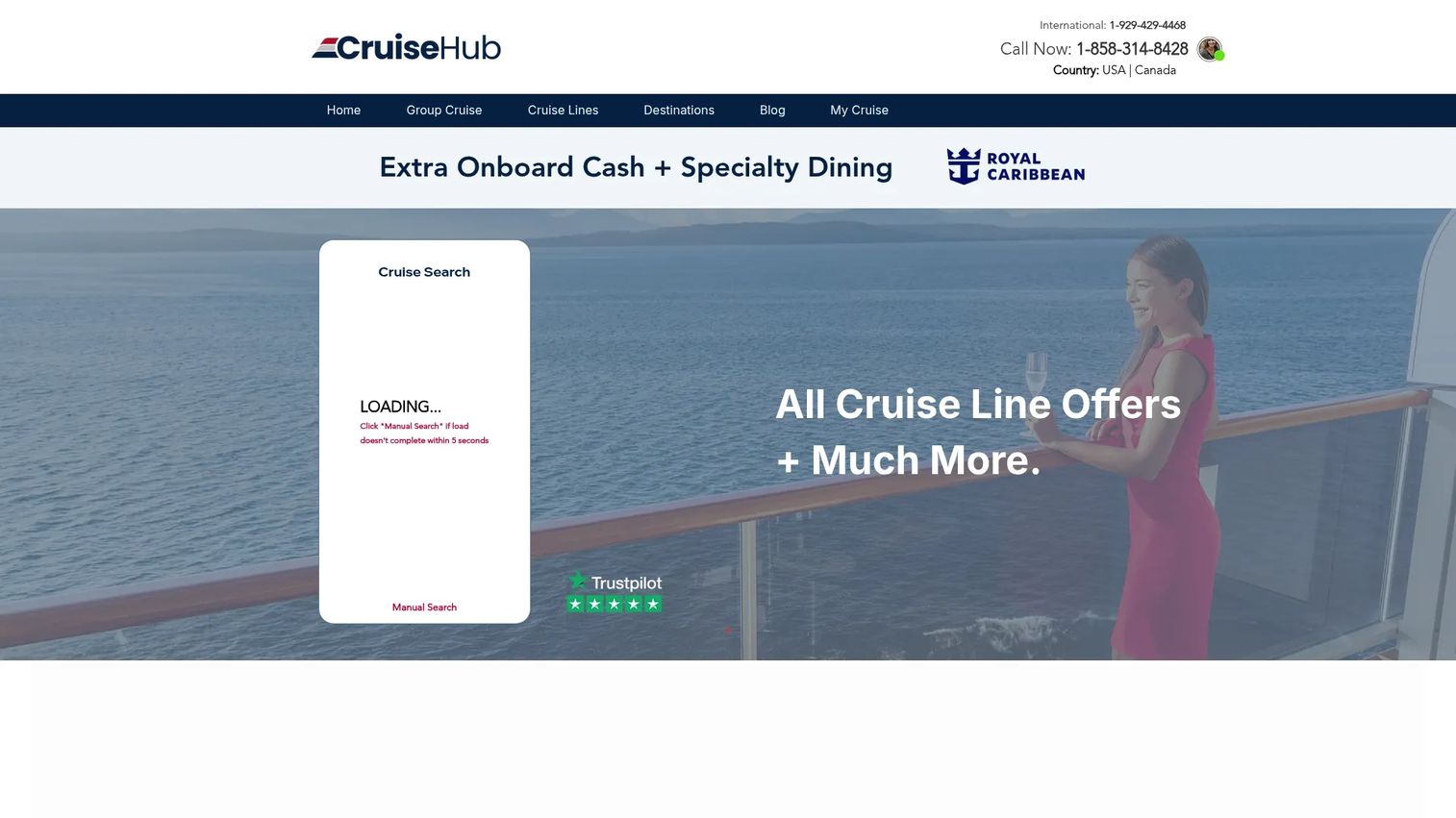
Seahub is cloud-based superyacht maintenance and vessel management software built for operators who need planned maintenance running alongside serious documentation and fleet control. It is the platform to reach for when compliance is not optional and the record has to hold up under scrutiny. The architecture is modular, so you turn on the pieces a given vessel needs rather than forcing every boat into the same template.
Best for: Superyacht operators and fleet managers who need planned maintenance, ISM and SMS workflows, and multi-vessel oversight in one system.
Key strengths
- Planned maintenance and defect log: Service intervals, task scheduling, and a running defect log keep maintenance planning and scheduling ahead of failure rather than reacting to it.
- Documentation and compliance depth: An equipment database plus checklists, inventory, documents, ISM, warranty, and fluid analysis modules make audit-ready record keeping the default state.
- Fleet management and mobile access: Multi-user permissions and iOS and Android apps let a shore team assign work while crew log service history from the engine room.
Seahub earns its ranking because it treats maintenance, documentation, and compliance as one connected system rather than three bolt-ons. For an operator running a fleet where a single missed certificate or lost service record carries real cost, that integration is the point. The project and resource management pieces mean refits and larger jobs live in the same place as routine service, so nothing routes back through one person's memory.
Seahub pricing: Seahub does not publish prices on its first-party site. The platform offers flexible plans (Prime, Select, and Enterprise) sized to fleet and vessel needs, with pricing available through the vendor. Confirm current figures directly with Seahub before committing.
2. YACHTWAVE
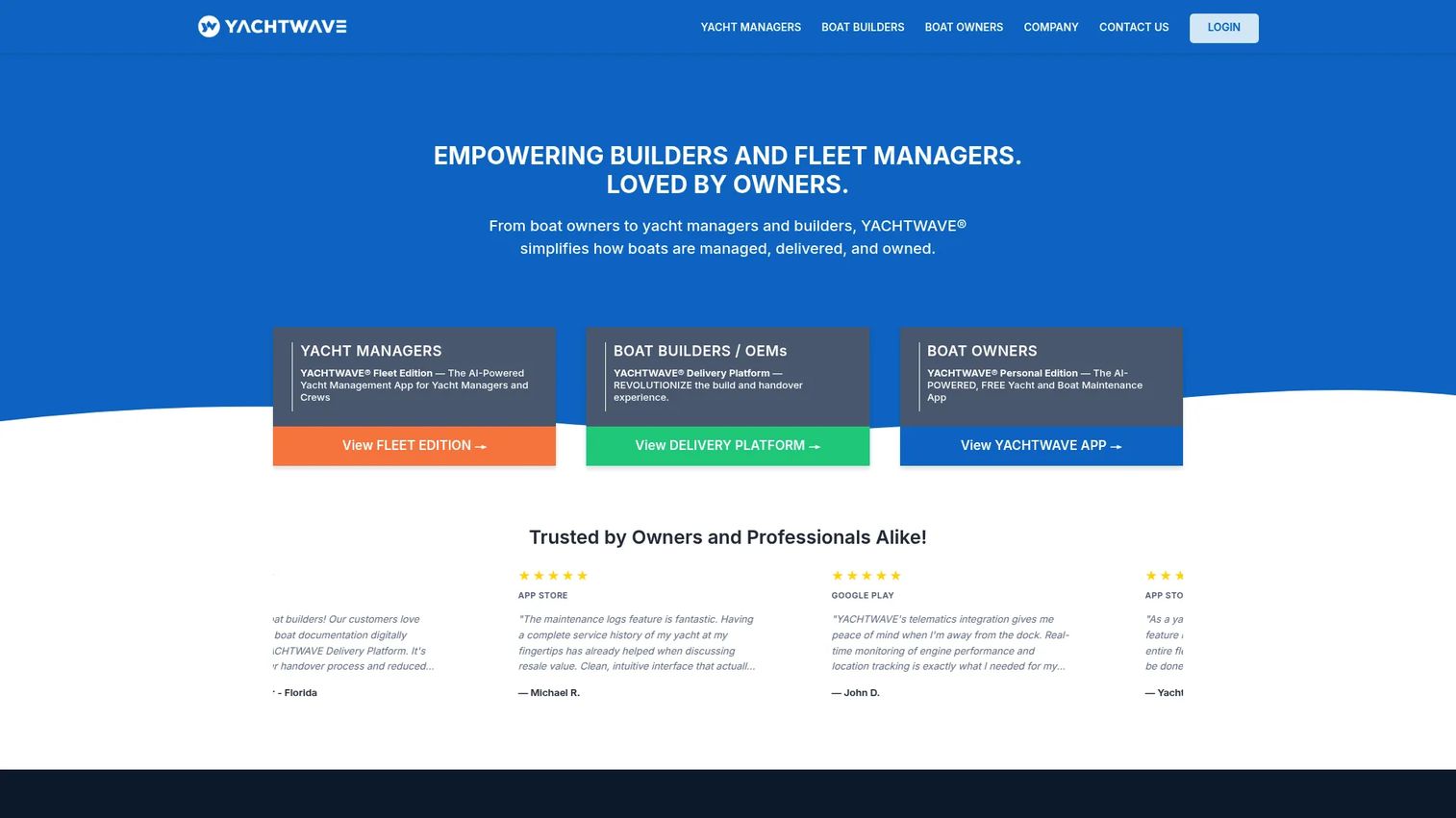
YACHTWAVE is marine technology software built for a spread of users: individual boat owners, yacht managers, builders, and fleet operations. The editions model is the differentiator. A single owner starts free, and a fleet operation scales into paid tiers without switching platforms. That breadth makes it a practical entry point when you are not sure how much boat management software you will need in a year.
Best for: Boat owners and yacht managers who want marine-specific maintenance and fleet management with a free starting point.
Key strengths
- Maintenance logs and tasks: Structured maintenance logs, tasks, and checklists give owners and managers a clean service history without a spreadsheet.
- AI Mechanic and telematics: An AI Mechanic framing plus telematics connects live vessel data to maintenance context, so faults surface with more than a warning light.
- Edition-based scaling: Personal, Personal+, and three fleet editions mean the product serves a lone owner and a multi-vessel operator from the same core.
YACHTWAVE fits teams that want to grow into fleet features rather than commit to them on day one. An owner using the free Personal Edition gets real maintenance tracking, and when the operation adds boats, the Essentials, Pro, and Ultimate Fleet editions layer on the multi-vessel management and pro capabilities. The persona-based design means a builder or OEM sees a different surface than a charter manager, without a separate product.
YACHTWAVE pricing: The Personal Edition is free for up to three boats. Personal+ is $9 per boat per month, Essentials Fleet is $19, Pro Fleet is $39, and Ultimate Fleet is $49 per boat per month, all billed monthly. The free tier makes it easy to trial the workflow before scaling.
3. Floatist
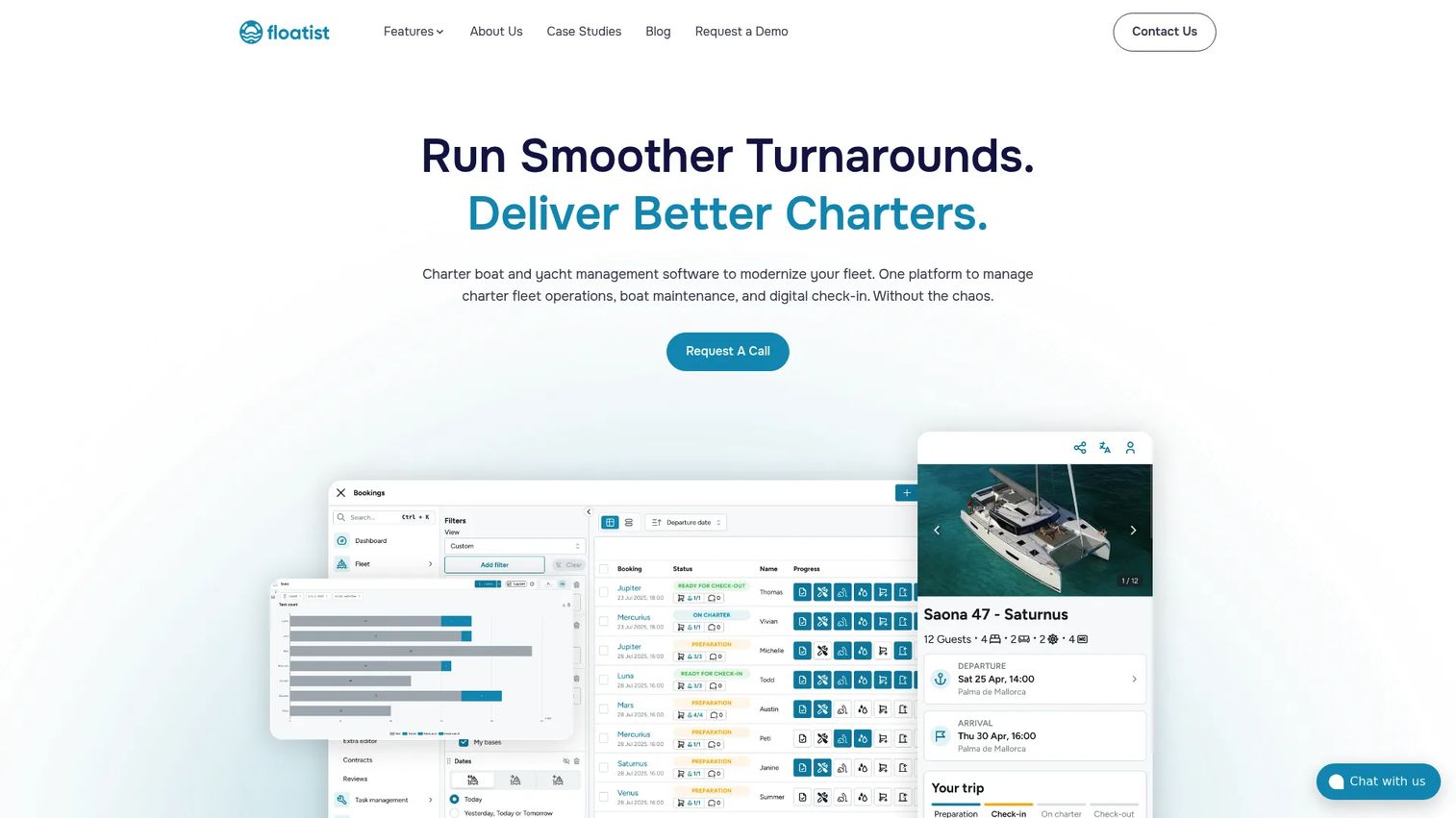
Floatist is yacht charter operations and fleet management software built around the reality of turnaround. Charter operators do not just maintain boats; they hand them to guests, get them back, clean, inspect, and re-let them, often on a tight schedule. Floatist puts that whole cycle, plus maintenance and guest support, into one system so the operational communication does not fragment across email and phone calls.
Best for: Yacht charter operators who need one system for operations, maintenance, and guest check-in.
Key strengths
- Mobile check-in and check-out: Digital turnaround workflows move guest handover off paper and into a repeatable mobile process.
- Task management and boat maintenance: Maintenance tasks live alongside operational tasks, so a defect logged at check-out becomes a scheduled fix, not a forgotten note.
- Guest app with bookings and documents: A guest-facing app handles booking management and documents, reducing the coordination load on shore staff.
Floatist earns its spot as the practical charter-focused option. The operational gain is concrete: fewer dropped handovers, faster turnarounds, and maintenance that gets captured at the exact moment a problem is noticed. For a fleet cycling boats through back-to-back charters, that tight loop between guest return, inspection, and service is where downtime is won or lost.
Floatist pricing: Floatist prices on an annual subscription license that varies by fleet size, boat type, and required features. No public price is listed, so request a quote scoped to your fleet before comparing it against per-boat pricing elsewhere.
4. Quartermaster
Quartermaster is a mobile-first management app that owners and captains reach for when the priority is cross-device access to maintenance logs, inventory, and file storage without being tethered to a desk. The appeal is straightforward: log a task from the deck, check a part on your phone, and store the receipt where the whole team can find it.
Best for: Owners and captains who want maintenance logs, inventory, and documents accessible across phone, tablet, and desktop.
Key strengths
- Cross-device access: Maintenance logs, service history, and inventory sync across mobile and desktop, so the record follows the work.
- File storage and collaboration: Manuals, receipts, and documents live in shared storage, keeping documentation management out of scattered folders.
- Mobile and offline handling: On-deck logging with offline sync means poor marina connectivity does not stall the record.
Quartermaster suits the owner, captain, or small fleet that wants a lightweight yacht maintenance program without the weight of an enterprise compliance suite. It fits owner, captain, and fleet use cases by keeping the essentials, maintenance planning, logs, inventory, and files, close at hand and easy to update in the moment.
Quartermaster pricing: Quartermaster does not publish standard pricing on its first-party site. Confirm current plans and any free option directly with the vendor before you commit, since packaging is not listed publicly.
5. Nauticoncept
Nauticoncept delivers connected digital solutions for boat fleet management, spanning monitoring, maintenance, and access control. It stands out for pairing hardware with software: NMEA 2000 gateways and monitoring devices feed a fleet platform, so the maintenance and operational picture is grounded in real vessel data rather than manual entry alone.
Best for: Marine operators and boat owners who want connected monitoring and fleet workflow tools in one ecosystem.
Key strengths
- Real-time monitoring and alerts: Onboard devices push live vessel data and alerts, so problems surface early.
- Fleet maintenance and operations: The NautiFleet plans handle maintenance and operational management across a fleet.
- Digital check-in and remote access: Digital check-in and check-out plus remote access support structured charter and rental workflows.
Nauticoncept fits a more structured marine workflow where connected hardware and fleet software work together. For charter or fleet operations that want monitoring, maintenance, and access control from one provider, the integrated ecosystem reduces the number of vendors to coordinate. The hardware-plus-subscription model is distinct from the pure-software tools on this list, which is exactly its appeal for connected fleets.
Nauticoncept pricing: Hardware is priced one-time, starting at €199 for an NMEA 2000 gateway, €289 for Nano, €399 for Nautikeys, and €849 for NauticSafe. NautiFleet subscriptions run €160 per month for Care and Charter, and €300 per month for Premium, on a 12-month commitment, excluding taxes.
6. Seazone
Seazone is an all-in-one yacht management and recruitment platform covering administration, finance, maintenance, fleet, and charter operations. It is the broadest tool on this list in scope, aiming to be the single system where an operator runs the business side and the maintenance side without stitching two products together.
Best for: Yacht operators and fleet managers who want administration, finance, maintenance, and charter in one platform.
Key strengths
- Yacht administration and finance: Administration and finance management sit alongside operations, so the commercial and maintenance sides share one system.
- Yacht maintenance and fleet management: Maintenance tracking and fleet and B2B tools give asset oversight across a portfolio.
- Charter and trip management: Charter and trip tools support operators who run boats commercially, with crew collaboration built in.
Seazone earns the all-in-one label because it reaches beyond maintenance into the finance and charter workflows that a commercial operation runs daily. Choose it over a narrower maintenance-only tool when you want fewer systems and are willing to adopt a broader platform. For an operator whose pain is tool sprawl as much as maintenance tracking, that consolidation is the draw.
Seazone pricing: Seazone offers a free Basic plan, a Pro plan at €45 per month, and a Bundle plan at €80 per month. The free tier lets you test the core workflow before moving to paid capabilities, and the pricing page notes a discount and a bank fee for bank transfer payments.
Considerations before you buy
Vessel count and scaling path
Start with how many boats you manage now and how many you expect in two years. A single-owner tool and boat fleet management software solve different problems, and switching platforms mid-growth is painful. Favor a tool whose multi-vessel management scales without forcing a migration.
Maintenance depth versus simplicity
Match the depth of maintenance planning and scheduling to your operation. A heavy compliance suite is overhead for a single weekend boat, while a lightweight log is thin for a superyacht under ISM. Buy the level of marine maintenance software your vessels actually require.
Compliance and documentation needs
If you operate under ISM, SMS, or classification requirements, compliance workflows and documentation management are not optional. Verify the platform supports the certificates, audits, and record retention your flag state and class society expect before you shortlist it.
Mobile access and offline sync
Crew work where connectivity is unreliable. Confirm the mobile app access covers the tasks crew actually perform on deck and that offline sync holds records until connection returns. A tool that only works at the dock office is a tool crew will route around.
Pricing model fit
Per-boat monthly pricing, quote-based licensing, and hardware-plus-subscription models each suit different operations. Compare total cost across your full fleet, not the sticker price of one boat, and factor in setup and any hardware before deciding.
Conclusion
The right yacht fleet management software depends on what your operation is actually solving for. If you need all-in-one vessel operations that reach into finance and charter, Seazone is the broadest pick. For fleet managers who live and die by planned maintenance and compliance, Seahub is built for that scrutiny. Owners who want simple, affordable service tracking should start with YACHTWAVE's free edition, and captains who need mobile-first logging will find Quartermaster fits the deck.
For charter operations, Floatist ties turnaround to maintenance in one loop, while Nauticoncept brings connected monitoring for teams that want vessel data feeding the maintenance picture.
The honest recommendation: choose based on vessel count, crew structure, and reporting needs, not the longest feature list. A single owner does not need an ISM suite, and a fleet operator should not run twenty boats on a personal log. Trial the free tiers where they exist, scope a quote where they don't, and pick the platform that fits the operation you run today and the one you expect in two years.
FAQs
It centralizes maintenance planning, service history, inventory, documents, crew tasks, and compliance for one or more vessels. Instead of tracking service in spreadsheets and paper logs, operators get one source of truth that keeps boats service-ready, records audit-ready, and downtime lower.
Maintenance planning and scheduling, service history, and inventory management are the core three. Beyond those, prioritize documentation management, crew collaboration with permissions, and reliable mobile app access with offline sync, since those decide whether crew actually use the tool day to day.
Yes. Several platforms offer free or low-cost tiers, like YACHTWAVE's free Personal Edition and Seazone's free Basic plan, that give a single owner real maintenance logs, service history, and digital record keeping without the overhead of a fleet suite. It scales up if you add boats later.
It gives captains task assignment, shared visibility, and mobile access so the whole crew works from the same list. A captain can log a defect on deck, assign a fix, and confirm completion, while a shore-based manager sees the same status without being aboard.
Boat maintenance software focuses narrowly on service tasks, logs, and schedules. Yacht management software is broader, adding documentation, inventory, crew collaboration, compliance, and often finance and charter workflows, so it manages the whole operation rather than maintenance alone.
Many do. Seahub offers iOS and Android apps, and mobile-first tools like Quartermaster emphasize cross-device access with offline handling. Because connectivity at sea and in marinas is unreliable, confirm that a platform's offline sync covers the specific tasks your crew perform before committing.
Compare total cost across your full fleet, not one boat's sticker price. Per-boat monthly models like YACHTWAVE, subscription tiers like Seazone, quote-based licensing like Floatist, and hardware-plus-subscription like Nauticoncept each add up differently at scale, so model the real vessel count and factor in setup and hardware.
Yes. Storing service history, manuals, warranties, receipts, and certificates in one searchable place is a core function of the category. Platforms like Seahub build equipment databases and document modules specifically for digital record keeping, so proving what was serviced and when takes seconds rather than an afternoon of digging.