

You do not want another phone system. You want programmable calling that drops into product logic, support flows, or outreach automation without a six-month integration project.
That is the real friction. Most teams pick a voice API on the strength of a landing page, then discover the docs are thin, the webhooks fire inconsistently, or the carrier routing drops calls in the one region their buyers care about. By then, the code is written and the switching cost is brutal.
The market is moving fast. The global voice API market reached $3.2 billion in 2025 and is projected to hit $12.8 billion by 2034 at a 15.4% CAGR, according to MarketIntelo (2026). Cloud-based deployments already account for 68.5% of that revenue, so on-premise telephony is no longer where the momentum sits.
For presales engineers and technical buyers, the stakes are specific. You have to explain voice architecture to a buying committee, defend reliability and security objections, and help someone decide whether a voice API is the right path at all versus SIP trunking. Pick wrong, and technical validation stalls. Pick right, and you ship calling that scales from a pilot to production without a rebuild.
This guide compares seven voice API platforms on the criteria that actually matter during evaluation.
What's inside
This guide is for developers, presales engineers, and technical buyers building a shortlist of voice API software for 2026. We picked platforms based on four things:
- API quality and developer experience: REST design, webhooks, SDKs, and docs
- Call control depth: IVR, recording, transcription, media streams, embedded calling
- Reliability and carrier infrastructure: global reach, failover, number coverage
- Pricing transparency: published per-minute, per-number, and per-feature rates
No banned vendors, no filler. Just seven platforms worth putting on a technical evaluation.
TL;DR
- Best for enterprise scale: Twilio, for the deepest ecosystem, broad Voice API surface, and anti-fraud trust features
- Best for architecture-first buyers: Flowroute, for clean SIP and metered voice infrastructure
- Best for programmable calling inside a UC stack: RingCentral, when you already run their communications platform
- Best for straightforward voice API education: Vonage, for plain-English entry into programmable voice
- Best for high-volume global calling: Sinch, for international reach and omnichannel adjacency
- Best for developer-friendly pay-as-you-go: Plivo, for usage-based pricing and a clean voice API
- Best for network control and telecom-grade routing: Telnyx, for owned infrastructure and routing precision
What is voice api software
Voice API software lets developers programmatically make, receive, route, record, and analyze phone calls through APIs, SDKs, webhooks, and telephony infrastructure, without owning physical carrier hardware.
A programmable voice api exposes calling as code. You send a request to start a call, and the platform handles the carrier connection, media, and events. Webhooks push real-time updates back to your application so you can react to ringing, answers, hangups, and DTMF input.
Core capabilities to expect from a voice call api:
- Call initiation and answering: place and receive calls from your app or backend
- IVR and call routing: build automated menus, capture input, route to the right destination
- Call recording and transcription: store audio, generate transcripts, feed analytics
- Embedded and browser calling: WebRTC voice inside your web or mobile product
- Webhooks and event handling: react to call state changes in real time
- Carrier connectivity and failover: global number coverage with redundant routing
The distinction between a voice api and SIP trunking matters for buyers. SIP trunking connects your existing PBX to the public phone network. A calling api abstracts all of that into HTTP requests and event callbacks, so your developers never touch SIP configuration unless they want to. If you are building calling into an application, a voice api for developers usually wins on speed. If you already run telephony hardware and just need connectivity, SIP trunking can be the simpler path. Several platforms below offer both.
When to use
Add calling to an app or workflow
When you need in-app calling, support callbacks, appointment reminders, or outreach automation, a voice calling api handles the telephony so your team ships the feature. Embedded WebRTC voice lets users call directly from a browser or mobile app without dialing out. This is the most common trigger for voice api integration.
Build IVR and call-routing flows
When callers need automated menus, intelligent routing, or data capture, an ivr api gives you programmable control over the call flow. You define the logic, the platform executes it, and webhooks report what the caller did. This replaces rigid, hardware-bound phone trees with code you can version and test.
Support analytics, recording, and compliance workflows
When teams need call recordings, transcripts, or secure handling for regulated conversations, a phone call api with recording and speech recognition covers it. Media streams push live audio to your systems for real-time transcription or sentiment analysis. This is where voice APIs move beyond connectivity into insight.
Comparison table
Here is the shortlist at a glance. Pricing reflects publicly listed rates verified in July 2026, and G2 ratings reflect each platform's current listing. Twilio leads on ecosystem depth, but the right pick depends on your integration model and reliability needs.
| # | Product | Best for | Key differentiator | Pricing | G2 rating |
|---|---|---|---|---|---|
| 1 | Twilio | Programmable customer communications at scale | Deepest ecosystem, broad Voice API, anti-fraud trust features | Voice from $0.0085/min to receive, $0.014/min to make | 4.1/5 |
| 2 | Flowroute | Architecture-first voice and SIP | Metered SIP and programmable numbers | Inbound from $0.005/min; DID $1.00/number | 3.8/5 |
| 3 | RingCentral | Programmable voice inside a UC stack | Unified messaging, video, and phone with APIs | RingEX from $19.99/user/mo | Not listed |
| 4 | Vonage | Straightforward voice API entry | Business comms plus API-based voice and messaging | Plans from $24.49/extension/mo | 4.3/5 |
| 5 | Sinch | High-volume global omnichannel calling | Voice API plus messaging and verification reach | Engage from $49/mo | 4.4/5 |
| 6 | Plivo | Developer-friendly pay-as-you-go voice | Usage-based pricing, clean voice API | Calls from $0.0010/min; $10 free credits | 4.5/5 |
| 7 | Telnyx | Telecom-grade routing and network control | Owned carrier infrastructure and routing precision | Local numbers from $1/month | 4.7/5 |
Best voice api software for 2026
1. Twilio
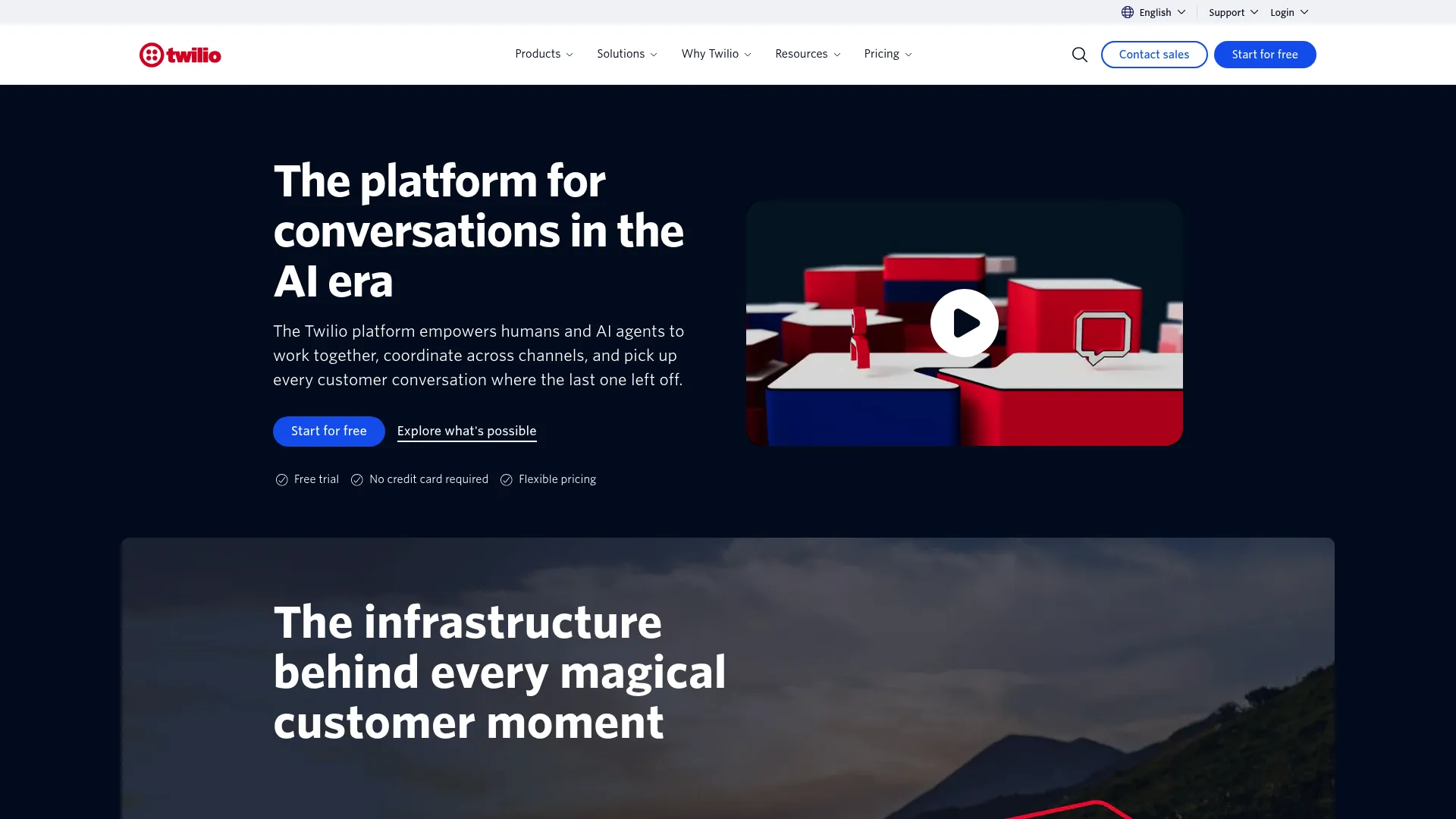
Twilio is the reference point most presales teams reach for first when enterprise reliability and ecosystem depth are the deciding factors. It is a cloud communications platform spanning messaging, voice, email, authentication, and customer data, with a Voice API that covers call control, IVR, recording, and programmable routing. The breadth is the draw: one account can handle SMS, WhatsApp, voice, and customer engagement without stitching vendors together.
For a voice api integration, Twilio gives you granular call control, webhooks for every call event, and SDKs across major languages. Anti-fraud trust features, global carrier coverage, and AI-enabled engagement products round out the platform for teams that need to defend security and reliability to a buying committee.
Best for: Teams building programmable customer communications and engagement workflows that need enterprise-grade scale.
Key strengths
- Broad Voice API for calls, IVR, and recording
- Messaging APIs for SMS, RCS, WhatsApp, MMS
- Customer data products for engagement workflows
Why choose Twilio: When your buyers care about ecosystem depth and you expect to add channels beyond voice, Twilio's breadth reduces future vendor sprawl. It fits teams that want one platform for the full communications surface.
Twilio pricing: Pay-as-you-go with a free trial. Voice APIs cost $0.0085/min to receive and $0.014/min to make a call. SMS runs $0.0083 to send or receive a message. Some products carry monthly or contact-sales pricing.
2. Flowroute
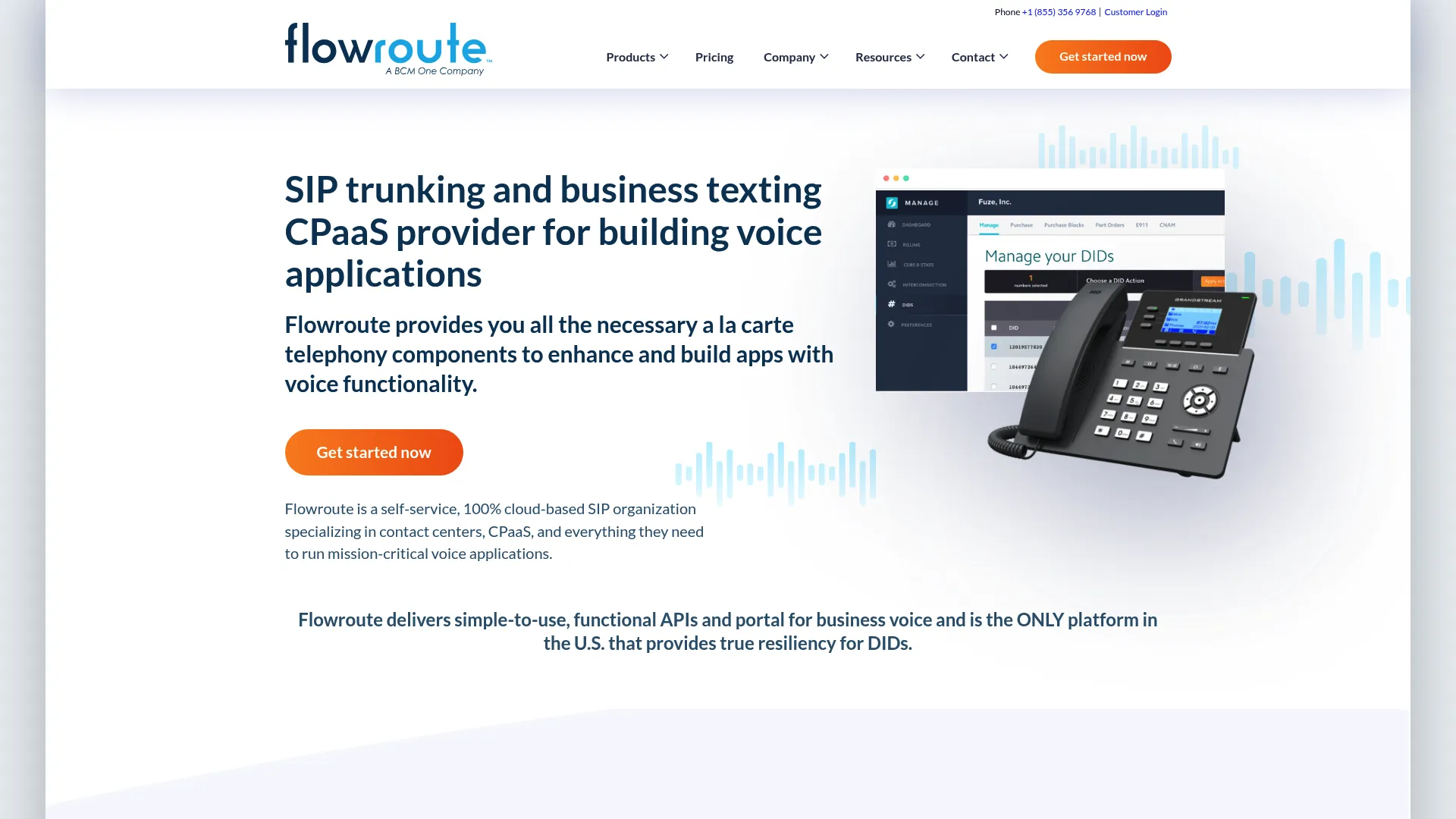
Flowroute is a cloud SIP trunking and CPaaS provider that appeals to technical evaluators who want cleaner infrastructure thinking. If your team is actively weighing voice api vs sip trunking, Flowroute is useful precisely because it speaks both languages: programmable voice and REST-driven number management alongside SIP connectivity.
The platform covers voice SIP, phone numbers, and SMS/MMS with metered, pay-as-you-go pricing. That transparency helps presales teams model costs before committing. For buyers who care about carrier-grade routing and want to reason about their voice architecture rather than accept a black box, Flowroute rewards that mindset.
Best for: Businesses, developers, and resellers needing programmable voice, numbers, and messaging with clean SIP options.
Key strengths
- Voice SIP for carrier-grade connectivity
- Programmable phone numbers via REST
- SMS and MMS messaging
Why choose Flowroute: When you want to understand and control your voice infrastructure instead of abstracting it away entirely, Flowroute fits. It suits architecture-first teams and resellers who value metered pricing.
Flowroute pricing: Pay-as-you-go metered rates with volume discounts. Domestic inbound starts at $0.005/minute, outbound at $0.00833/minute for the US lower 48 and Canada, and DIDs at $1.00 per number monthly. The pricing page also lists SMS, MMS, toll-free, E911, and CNAM charges.
3. RingCentral
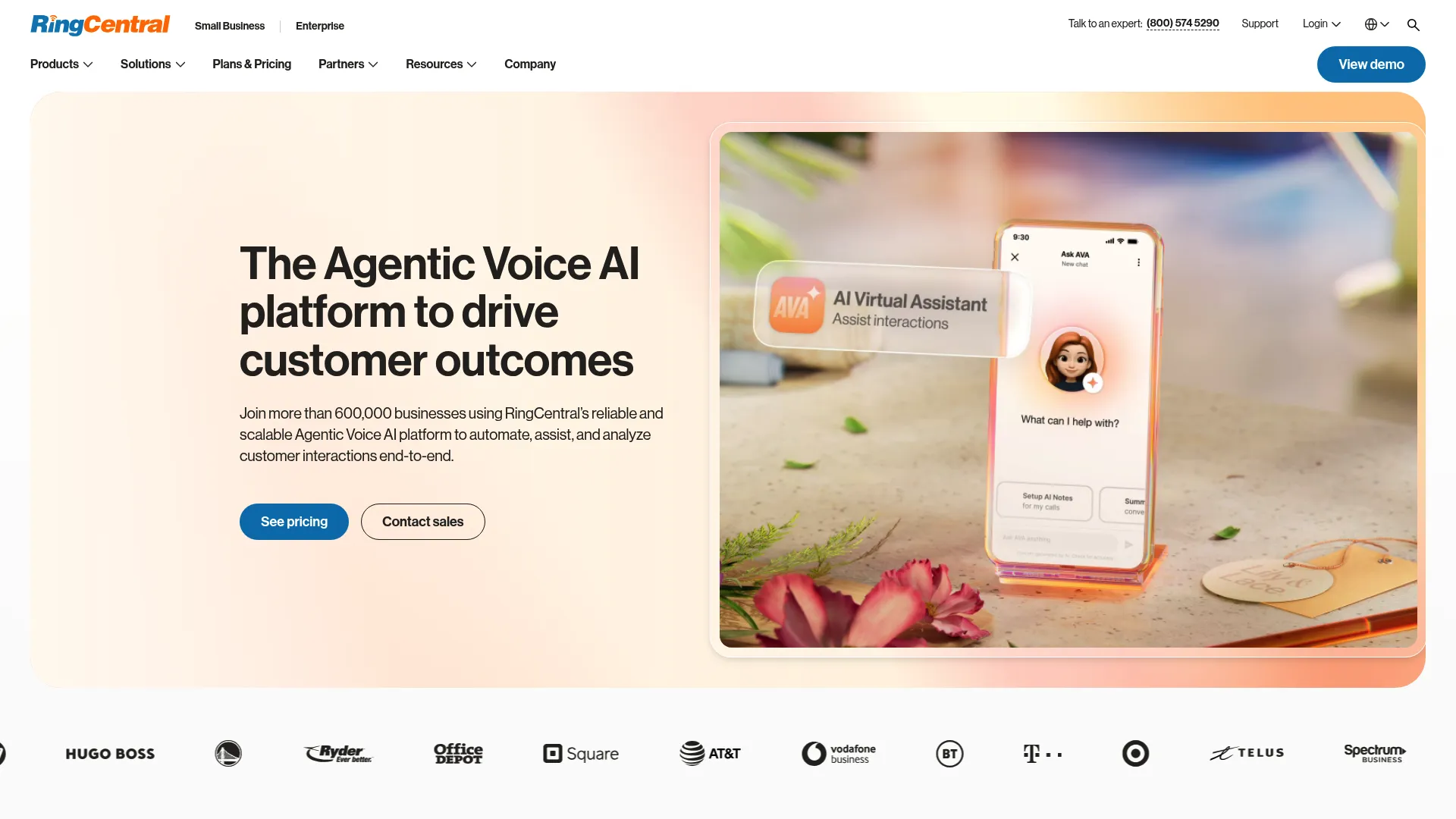
RingCentral makes the most sense when programmable voice needs to live inside a broader communications stack. It is a cloud platform for phone, video, messaging, and contact center, with a Programmable Voice API layered on top of that infrastructure. If your organization already runs RingCentral, adding call control through its API keeps everything on one platform.
The API surface covers programmable calling, call controls, embedded voice, and SDKs, with AI and ML features across the product. For presales teams supporting a buyer who values a single vendor for both unified communications and developer-driven calling, RingCentral removes the need to bolt on a separate CPaaS.
Best for: Businesses that want one cloud communications platform for calling, meetings, and team messaging, plus programmable voice.
Key strengths
- Unified messaging, video, and phone app
- Unlimited US and Canada calling on paid plans
- AI-powered meetings and transcription
Why choose RingCentral: When the buying committee already values RingCentral for unified communications, its Programmable Voice API extends that investment. It fits teams consolidating on one platform rather than assembling best-of-breed pieces.
RingCentral pricing: RingEX plans start at $19.99/user/month (Essentials), then $24.99 (Standard), $44.99 (Premium), and $59.99 (Ultimate), with monthly and annual billing options.
4. Vonage
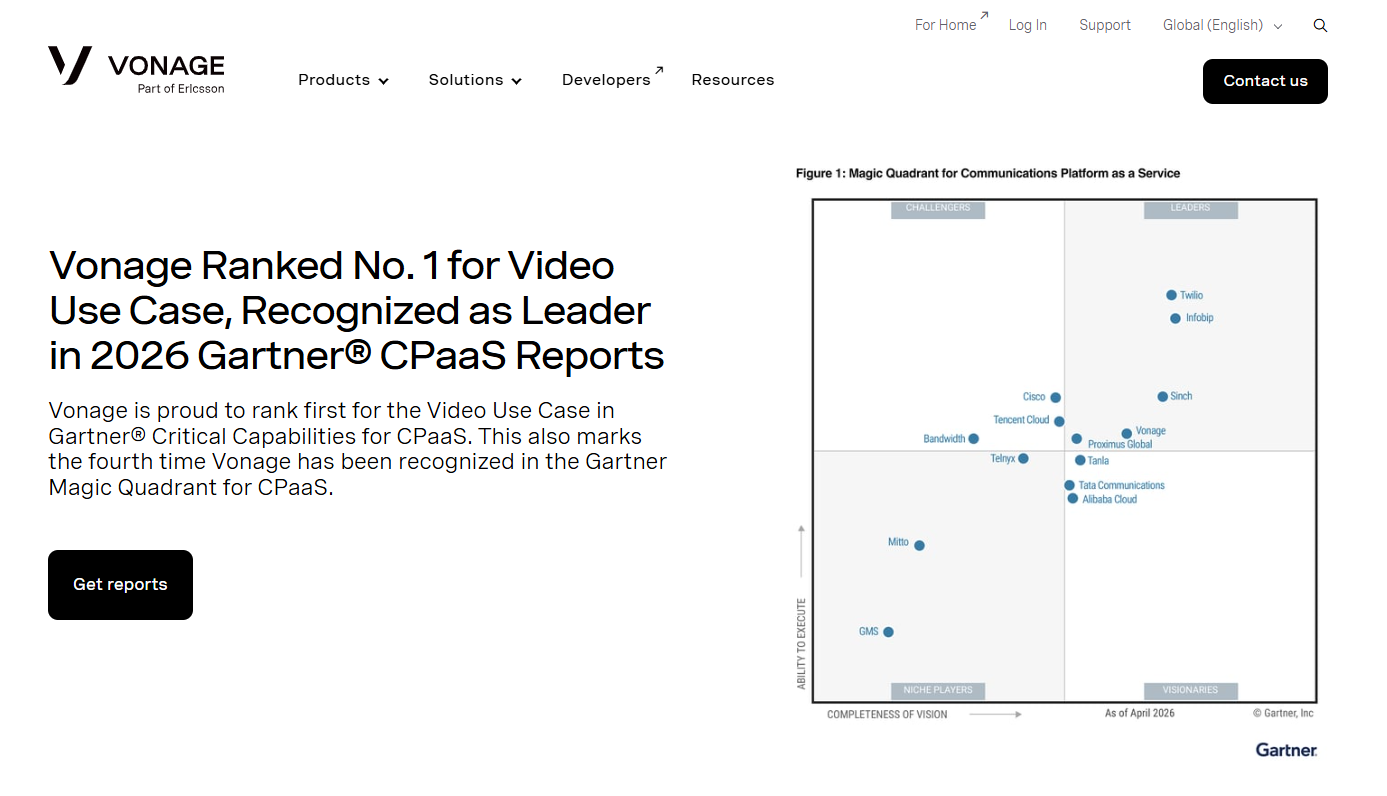
Vonage works well for teams that want a straightforward entry into voice APIs without wading through dense infrastructure documentation first. It is a business communications and API provider covering voice, messaging, video, and contact center, with plain-English framing that helps non-specialist buyers understand the business value quickly.
For a voice api for developers, Vonage offers call automation, virtual assistant capabilities, and API-based voice and messaging alongside its unified communications products. The low-code positioning appeals to teams that want to prototype calling flows fast and expand later. Presales engineers often find Vonage easy to explain to a mixed technical and business audience.
Best for: Businesses needing unified communications or API-based voice and messaging with an approachable on-ramp.
Key strengths
- Cloud-based business phone systems
- API-based voice and messaging
- Video collaboration and team messaging
Why choose Vonage: When you need to get a non-technical buying committee comfortable with voice APIs, Vonage's clear framing and low-code angle help. It fits teams prioritizing a simple entry point over deep infrastructure control.
Vonage pricing: Vonage Business Communications plans start at $24.49 per month/per extension (Mobile), then $34.99 (Premium) and $39.99 (Advanced). Taxes and fees are extra, and some options require contacting sales.
5. Sinch
Sinch is built for teams running high-volume or international voice programs. It is a cloud communications platform spanning messaging, voice, verification, and email, with a Voice API and in-app voice and video SDKs. The global reach and call orchestration make it a natural fit when your calling program spans regions and channels.
For voice api integration at scale, Sinch pairs programmable calling with messaging and verification adjacency, so teams building omnichannel customer communications can consolidate. The enterprise-grade infrastructure suits organizations where reliability across borders is a hard requirement, not a nice-to-have.
Best for: Businesses needing enterprise-grade omnichannel communications and messaging infrastructure at global scale.
Key strengths
- Voice API plus in-app voice and video SDKs
- SMS, MMS, RCS, and WhatsApp messaging
- Verification API and number lookup
Why choose Sinch: When your voice program is global and you want voice, messaging, and verification under one roof, Sinch's reach and omnichannel breadth fit. It suits high-volume, international communication needs.
Sinch pricing: Sinch Engage plans start at $49/mo (Basics), then $99/mo (Conversations), $249/mo (Pro), $450/mo (Pro Plus), and $799/mo (Advanced), with a 14-day free trial. Higher-volume and custom pricing is available beyond 40,000 messages per month.
6. Plivo

Plivo is the pick for teams that want a clean, API-first platform with usage-based pricing. It is a cloud communications platform for voice, SMS, WhatsApp, verify, SIP trunking, and AI voice agents. The voice api sdk coverage and developer experience make it straightforward to build call flows without heavy overhead.
The voice API includes call queueing, conference calling, text-to-speech, DTMF, speech recognition, call recording, voicemail transcription, and custom caller ID. That is a deep feature set for a platform positioned around simplicity and pay-as-you-go economics. For teams that want predictable per-minute costs and a focused developer surface, Plivo delivers.
Best for: Teams building programmable voice and messaging workflows with usage-based pricing.
Key strengths
- Voice API with recording, IVR, and transcription
- SMS platform with delivery reports and opt-out handling
- AI Agent platform with builder and analytics
Why choose Plivo: When you want a developer-friendly voice API with transparent per-minute pricing and no heavy platform commitment, Plivo fits. It suits teams that prize simplicity and cost predictability.
Plivo pricing: Pay-as-you-go with $10 in free credits. Telephony calls start at $0.0010/min, Voice AI Agents at $0.04/min all-inclusive, SMS at $0.0077/message, and WhatsApp at $0.0044/message. An Enterprise plan starts at $1,000 per month.
7. Telnyx
Telnyx is the choice for buyers who care most about network control and telecom-grade routing. It is a cloud communications and connectivity platform for voice, messaging, numbers, wireless, networking, and AI, built on owned carrier infrastructure rather than reselling someone else's. That ownership translates into routing precision and reliability that network-conscious teams value.
For a voice call api backed by real infrastructure, Telnyx pairs its Voice API with global numbers and messaging. Teams evaluating carrier depth, failover behavior, and routing control often shortlist Telnyx specifically because it does not abstract the network away. The trade-off is a platform that rewards technical buyers who want that level of control.
Best for: Teams needing programmable global communications and owned carrier infrastructure.
Key strengths
- Voice API on owned carrier infrastructure
- Messaging API for SMS and MMS
- Global numbers with routing control
Why choose Telnyx: When routing precision, carrier ownership, and network reliability drive the decision, Telnyx fits. It suits technical buyers who want infrastructure-level control over their voice program.
Telnyx pricing: Public pricing for numbers and messaging with pay-as-you-go and volume discounts. Local and toll-free numbers start from $1 per month. 800 TFN numbers run $500 one-time (covering a 12-month term) plus $40 monthly after 12 months, and short codes start at $1,000 per month.
Considerations
Once you have a shortlist, these are the criteria that separate a clean voice api integration from a painful one.
API quality and docs
Evaluate REST design, webhook reliability, SDK coverage, and the quality of quickstarts and code samples. Good voice api webhooks fire predictably and include the payload you need without extra lookups. Read the docs before you commit, and build a small prototype to test how the API behaves under real conditions.
Reliability and carrier infrastructure
Check failover behavior, global number coverage, and incident transparency. Ask whether the provider owns its carrier infrastructure or resells, since that affects routing control and reliability. Look at status pages and historical uptime, not just marketing claims.
Call features and media handling
Compare IVR depth, recording, transcription, media streams, embedded WebRTC calling, and overall call control. If you need real-time audio for speech recognition or sentiment analysis, confirm the platform supports media streams the way your architecture requires. Feature parity varies more than pricing pages suggest.
Pricing and rate transparency
Verify per-minute, per-number, and per-feature costs, plus any add-ons. Voice api pricing is usually usage-based, so model your expected volume against published rates. Watch for charges that only appear at scale, like premium routes or toll-free surcharges.
Support, governance, and scalability
Assess support responsiveness, security posture, and whether the platform scales from pilot to production without a rebuild. For regulated workloads, confirm compliance certifications and data handling. The best platform for a proof of concept is not always the one that holds up at production volume.
Conclusion
The right voice API depends on your integration model and reliability requirements, not on which platform has the loudest landing page.
For enterprise scale and ecosystem depth, Twilio is the default starting point. For architecture-first buyers weighing voice api vs sip trunking, Flowroute rewards infrastructure thinking. RingCentral fits teams already invested in its unified communications stack, and Vonage offers the most approachable entry into programmable voice. For global, high-volume programs, Sinch brings omnichannel reach. Plivo suits developers who want clean, usage-based pricing, and Telnyx wins for teams that need owned carrier infrastructure and routing control.
Narrow your shortlist to two or three platforms, then build a small prototype on each. Test the webhooks, read the docs, and push a realistic call flow through. The provider that survives that hands-on evaluation is the one worth signing.
If your team also needs a fast way to help buyers experience your own product during technical validation, Guideflow lets you build interactive demos and sandboxes that support discovery, proof-of-concept evaluation, onboarding, and enablement without a live environment. Start your journey with Guideflow today!
FAQs
A voice API is software that lets developers make, receive, route, record, and analyze phone calls programmatically through HTTP requests, SDKs, and webhooks. It abstracts carrier infrastructure so you can build calling into an app without managing telephony hardware. Common uses include IVR, call recording, and embedded WebRTC voice.
You send an API request to initiate or control a call, and the platform handles the carrier connection and media. Webhooks then push real-time events back to your application, such as ringing, answered, DTMF input, or hangup. Your code reacts to those events to route calls, capture input, or trigger recordings.
SIP trunking connects an existing PBX or telephony system to the public phone network. A voice API abstracts calling into HTTP requests and event webhooks, so developers never configure SIP directly. If you are building calling into an application, a voice API is usually faster; if you run telephony hardware, SIP trunking can be simpler. Some platforms, like Flowroute and Telnyx, offer both.
Plivo and Telnyx are strong picks for developers who want clean APIs, solid SDK coverage, and transparent usage-based pricing. Twilio remains the broadest choice when you need extensive documentation and a large ecosystem. The best fit depends on your language stack, webhook needs, and whether you want carrier-level control.
Voice API pricing is usually usage-based, charged per minute for calls plus monthly fees for phone numbers. Twilio charges $0.0085/min to receive and $0.014/min to make a call, Plivo starts telephony at $0.0010/min, and Flowroute inbound starts at $0.005/min. Platform plans like RingCentral start at $19.99/user/month. Model your expected call volume against published rates before committing.
Yes. An IVR api lets you build automated menus, capture caller input through DTMF or speech recognition, and route calls based on that input. You define the call flow in code, and webhooks report what the caller did at each step. Twilio, Plivo, Telnyx, and others all support programmable IVR.
Most leading voice APIs support call recording, and many add transcription and speech recognition. Plivo, for example, includes call recording and voicemail transcription in its voice API. Media streams on platforms like Twilio push live audio to your systems for real-time transcription or sentiment analysis. Confirm data handling and compliance for regulated workloads.
Prioritize API quality and documentation, webhook reliability, SDK coverage, and carrier infrastructure. Check whether the provider owns its network or resells, since that affects routing control and reliability. Verify per-minute and per-number pricing against your expected volume, and confirm the platform scales from pilot to production without a rebuild.