The first time your harvest estimate changes, the spreadsheet stops being a plan and becomes a liability. Block notes live on a crew member's phone. Spray records sit in a separate binder. The winemaker has a different yield number than the vineyard manager. And your controller is asking for cost data that doesn't exist yet.
This is the operational reality for most growing wine businesses. Decisions about labor, harvest timing, cellar capacity, and fruit purchasing all interact, but the data feeding those decisions is fragmented across apps, notebooks, and memory. The vineyard management software market was estimated at $314 million in 2025 and is projected to reach $691.2 million by 2034 (Dataintelo, 2026), driven largely by the move away from paper and disconnected spreadsheets.
The harder question is what kind of system your operation actually needs. A field-first vineyard platform, a vineyard-to-cellar operating system, and an enterprise winery suite are three different answers to three different problems. Getting that decision right before you sign a contract matters far more than any individual feature comparison.
This article gives you a clear map of both the category and the shortlist.
What's inside
This guide is for vineyard owners, winery operators, vineyard managers, and winery founders evaluating software for the first time or replacing a system that no longer fits.
- Seven tools covering vineyard-first management, vineyard-to-cellar platforms, and end-to-end winery operations
- Selection criteria: Vineyard and block records, harvest planning, mobile field access, traceability, cost visibility, and integration potential
- Verified pricing and review data, checked against vendor pages and live review listings in October 2026
- Practical guidance on which tool fits estate vineyards, multi-site groups, custom crush operations, and smaller teams
TL;DR
- Best overall for vineyard-to-cellar operations: Vintrace. Connects vineyard blocks, harvest management, production, inventory, and cost workflows in one operating model.
- Best for production, compliance, and COGS depth: InnoVint. Modular packages for winery teams that need block tracking through lot-level costing and TTB reporting.
- Best for small vineyard teams needing field execution: Tend. Transparent pricing, crop planning, tasks, labor tracking, and farm financials in one tool.
- Best for yield management and agronomic decision support: VineInfo. Acreage-based pricing and a vineyard-intelligence focus from pruning through harvest.
- Best for enterprise winery operations: Vintegrate. A wine-specific business suite covering production, finance, DTC, and wholesale in one platform.
- Best for mapping and precision viticulture: ISAGRI. Aerial mapping, crop records, machinery tracking, and grape-to-bottle traceability.
- Best transparent entry pricing across vineyard and winery workflows: Vinsight. Published monthly plans covering vineyard worksheets, production, inventory, and sales.
What is vineyard management software?
Vineyard management software is a system for recording, planning, and analyzing vineyard work by block, variety, season, and crew, often connecting field records to harvest, winery production, compliance management, inventory, and financial reporting.
Core capabilities
Most platforms in this category cover at least a subset of the following:
- Block, varietal, vine age, and field history records
- Work orders, crew assignments, labor, and mobile field updates
- Spray diaries, scouting observations, and application records
- Yield estimates, maturity samples, harvest scheduling, and fruit intake
- Irrigation, soil, weather, or pest-management records where supported
- Traceability and audit records from grape to bottle
- Production, cellar, inventory, and cost links for winery operations
- Reports for management, certifications, internal audits, and finance
The three software models you will encounter
The most useful decision before comparing specific tools is understanding which operating model matches your business. These three categories cover the landscape:
| Model | Best for | Typical strength | Watch for |
|---|---|---|---|
| Vineyard-first software | Growers and estate vineyards | Block records, agronomy, field execution | Whether it connects to winery production and finance |
| Vineyard-to-cellar platform | Wineries with estate or sourced fruit | Harvest through production, inventory, traceability | Whether field workflows are detailed enough for the crew |
| End-to-end winery business suite | Multi-site producers, custom crush, complex sales | Finance, DTC, wholesale, production, centralized data | Implementation scope, governance needs, training time |
Choosing the wrong model creates more work than the tool saves. Map your information flow first, then compare platforms.
When to use vineyard management software
Replace scattered field records before harvest exposes the gaps
Paper notes, disconnected apps, and text messages create a single point of failure at the worst possible time. When two people disagree on the latest block estimate or completed spray application, the problem is not the disagreement. It's that there is no shared record to settle it. A vineyard management system gives the crew one place to close tasks and one place for the manager to see what was done.
Connect vineyard decisions to cellar capacity and fruit intake
Wineries with estate vineyards or grower contracts need a shared view of crop estimates, maturity data, harvest orders, and receiving plans. Without it, the winemaker and vineyard manager are planning independently. A platform that carries yield estimates into harvest intake records eliminates the duplicate entry and the version-control problem that follows.
Build traceability and cost visibility before reporting becomes manual
Linking inputs, operations, lot movements, and costs across the season creates an audit trail that is expensive to reconstruct after the fact. Vineyard management software captures those records as the work happens. This is particularly important for operations that supply grapes to multiple wineries, hold certifications, or need to report on spray applications and material usage.
You are ready for software if:
- Two people cannot agree on current block status or labor allocation
- Your harvest estimate changes and you have no record of why
- Spray records are on paper and audit requests require manual assembly
- Fruit costs are unknown until well after harvest closes
- A new manager or winemaker cannot find historical vineyard data
Vineyard management software comparison
Not all seven tools compete on the same axis. Some are built for field operations. Others focus on winery production and economics. A third group tries to connect every department into one operational record. "Best" means the operating model matches the work your team does every week.
| # | Product | Best for | Key differentiator | Pricing | G2 rating |
|---|---|---|---|---|---|
| 1 | Vintrace | Vineyard-to-cellar winery operations | Block records, harvest, work orders, production, and cost management | Quote-based: Essentials, Professional, Enterprise | Not listed on G2 |
| 2 | InnoVint | Production, compliance, and COGS workflows | Modular Make, Grow, Finance packages with offline mobile access | Quote-based modular packages | 4.3/5 |
| 3 | Tend | Small to mid-size vineyard field operations | Crop planning, tasks, labor, inventory, and farm financials | Free; Pro $20/mo; Ultimate $50/mo; Enterprise from $400/mo | Not listed on G2 |
| 4 | VineInfo | Yield management and vineyard decision support | Block analysis from pruning through harvest with acreage pricing | From $168/acre/year plus setup fee | Not listed on G2 |
| 5 | Vintegrate | Enterprise winery operations and DTC | Wine-specific ERP with production, finance, and DTC modules | Quote-based | Not listed on G2 |
| 6 | ISAGRI | Mapping, crop records, precision viticulture | Aerial mapping, field operations records, traceability | Quote-based | Not listed on G2 |
| 7 | Vinsight | Transparent entry pricing for vineyard and winery workflows | Vineyard worksheets, production, inventory, and sales | From $59/month; 14-day free trial | Not listed on G2 |
Pricing and ratings verified October 2026 from vendor pricing pages and live G2 listings.
Best 7 vineyard management software tools for 2026
1. Vintrace
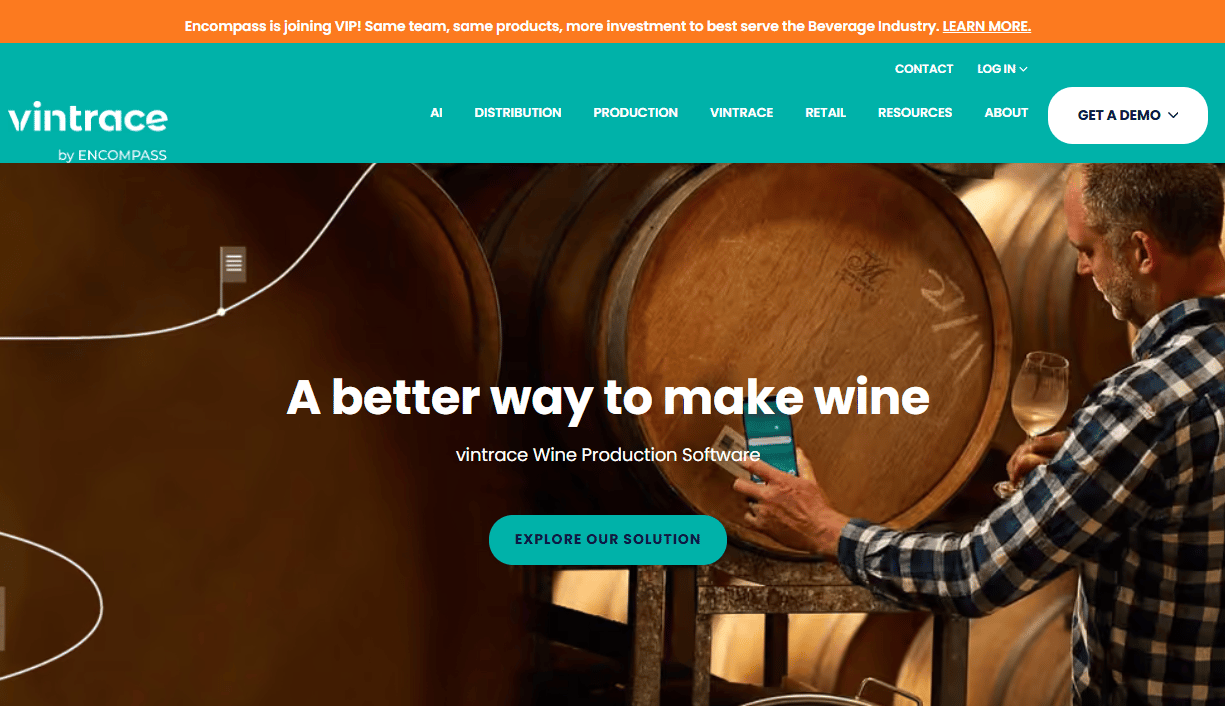
Vintrace is a cloud-based winery operating system built to manage vineyard blocks, fruit bookings, harvest, production, inventory, and cost tracking in one platform. It offers tiered plans covering Winery Essentials, Winery Professional, and Winery Enterprise, with capabilities that scale from smaller estate operations to multi-site producers. The platform supports a mobile app for iOS and Android and includes TTB reporting alongside lab and trial blend management.
Best for: Estate wineries and production teams that need vineyard records connected to winemaking, compliance, and cost workflows.
Key features
- Vineyard and block management with variety and history records
- Fruit bookings and harvest management
- Mobile work orders for iOS and Android
- Winery production tracking with lab module
- Inventory management and cost tracking
Why choose Vintrace: Vintrace earns its place on this shortlist when the vineyard team and cellar team need a shared operational record. It is most compelling when harvest intake, production, inventory, and costing must connect without manual data transfer.
Vintrace pricing: Vintrace sells through inquiry across three plan tiers: Winery Essentials, Winery Professional, and Winery Enterprise. Contact the vendor for current commercial terms and implementation costs. Capterra reviewers report it as a premium-tier investment. Note that Vintrace's official site currently routes through Encompass Technologies pages, so confirm plan details directly with the vendor before committing.
2. InnoVint
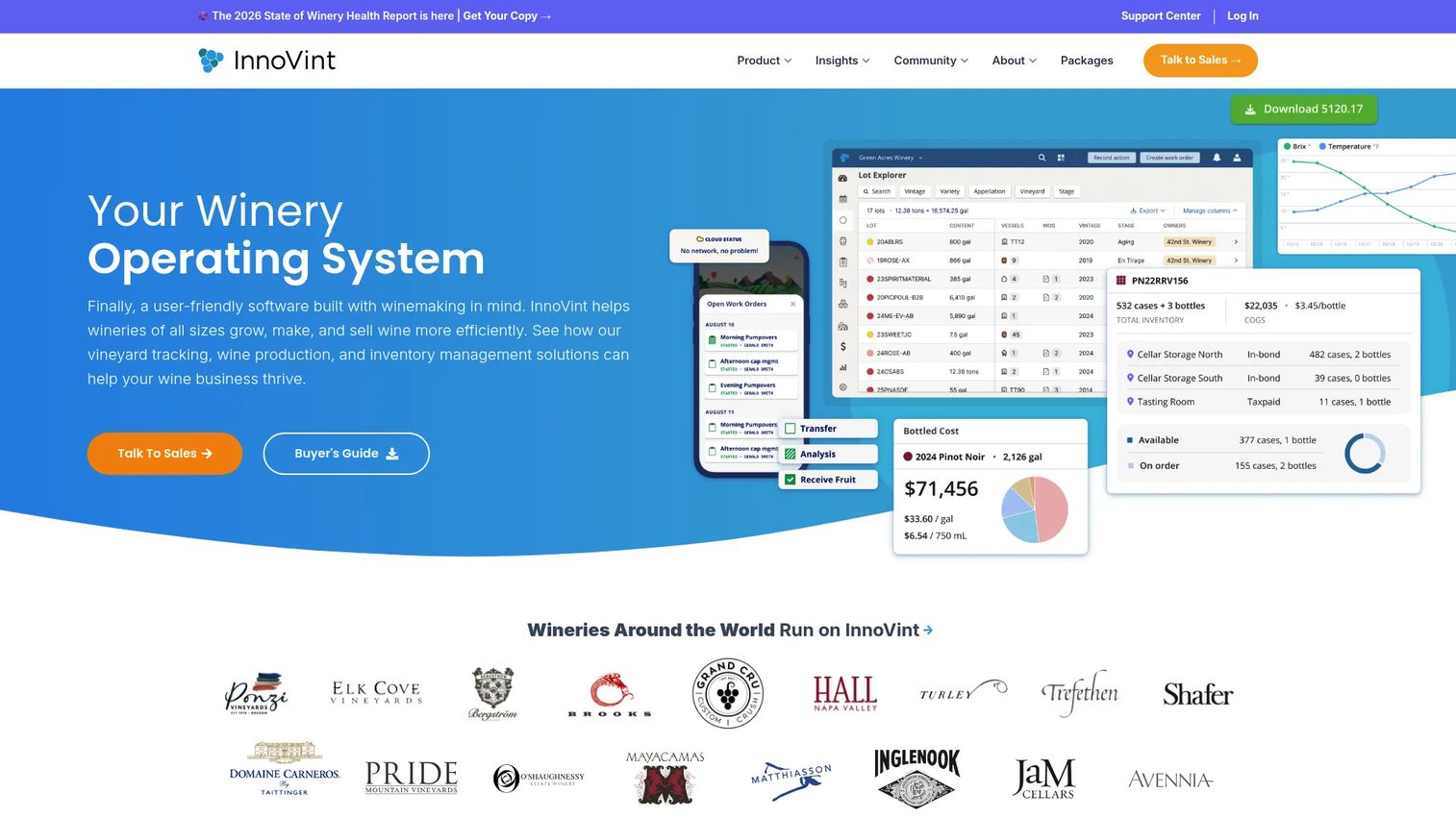
InnoVint is a cloud-based winery operating system that covers vineyard tracking, production, real-time inventory, compliance, and cost accounting. Its modular packaging separates capabilities into Make, Core, Plus, Grow, Finance, and Enterprise tiers, letting teams activate the workflows they actually need. Vineyard block tracking, phenology records, crop estimates, and harvest forecasting sit in the Grow module. Lot-level COGS and costing reports come through the Finance add-on.
Best for: Winery teams that need vineyard data, production records, TTB reporting, offline mobile work, and cost accounting in one connected system.
Key features
- Vineyard and block tracking with phenology records
- Crop estimates and harvest forecasting
- Digital work orders with offline mobile access
- TTB 5120.17 report generation
- Lot-level COGS and costing reports
Why choose InnoVint: The strongest case for InnoVint is the field-to-finance connection. Fruit costs, block costs, lot movements, dry goods, and bottling costs all feed into the same reporting layer. Teams that want reliable COGS on every lot without rebuilding the data from scratch benefit most.
InnoVint pricing: InnoVint packages are priced by quote. The vendor documents Make, Core, Plus, Custom Crush, Grow, Finance, and Enterprise options on its packages page. Buyers should clarify which modules are required and what the onboarding scope includes before comparing total cost. The Grow and Finance modules add meaningfully to the base price.
G2 rating: 4.3/5 based on 2 reviews (G2, October 2026).
3. Tend
Tend is a farm operations platform that covers the full cycle from crop planning through field execution, harvest, inventory, orders, and farm financials. It generates seasonal tasks from crop plans, assigns them to crews, and tracks completion via a mobile app with GPS time clock. Tend's transparent pricing makes it easy to evaluate without entering a sales process, which is a meaningful contrast to most vineyard software vendors.
Best for: Small to mid-size vineyards replacing spreadsheets and disconnected apps with a single field operations system.
Key features
- Crop and production planning with auto-generated seasonal tasks
- Mobile task management with GPS time clock
- Harvest planning and yield curve tracking
- Inventory, orders, sales, and invoicing
- Farm financial reports and profitability tracking
Why choose Tend: Tend fits operations where field execution and operational visibility are the primary problems. If your crew needs to close tasks on a phone and your manager needs a daily view of what happened in the vineyard, Tend delivers that without a lengthy implementation process. It also covers sales and fulfillment for direct produce operations.
Tend pricing: Tend offers a free plan covering core farm planning. Pro costs $20 per month billed annually and adds traceability, inventory, sales, and financials. Ultimate is $50 per month billed annually and includes multi-site management, multiple price lists, and additional integrations. Enterprise starts at $400 per month with dedicated support and advanced governance. Confirm whether complex winery production workflows require an additional tool before selecting Tend as the sole system.
4. VineInfo

VineInfo is a web-based vineyard management and viticultural data application focused on real-time information management from pruning through harvest. It covers farm plans, budgets, activity schedules, work orders, irrigation management, pesticide reporting, fertilizer records, soil amendments, and crop forecasting. The platform serves premium vineyards, wineries purchasing grapes, and growers supplying multiple buyers.
Best for: Vineyard managers who want block-level agronomic records, yield forecasting, and a pricing model that scales with acreage rather than users.
Key features
- Real-time vineyard information by block and variety
- Farm plans, budgets, and activity schedules
- Work orders including irrigation, pesticides, and fertilizer
- Crop planning support and yield forecasting
- Historical vineyard analysis
Why choose VineInfo: VineInfo is the right shortlist candidate when grape quality decisions, yield tracking, and historical block performance are central to how the operation is managed. It works particularly well for growers who supply multiple wineries and need to maintain clean records per relationship. It is a vineyard intelligence tool, not an end-to-end winery ERP.
VineInfo pricing: VineInfo uses acreage-based pricing with a setup fee and annual per-acre service charges. The published schedule starts at $400 setup plus $168 per acre annually for a 20-acre site. Larger operations benefit from lower per-acre rates: 40 acres runs $600 setup plus $108 per acre, 100 acres runs $800 plus $72 per acre, and rates continue to decline at 200, 400, 800, and 1,600 acres. Training is estimated at $75 per hour. Buyers that need deep cellar workflows should validate integration requirements early.
5. Vintegrate
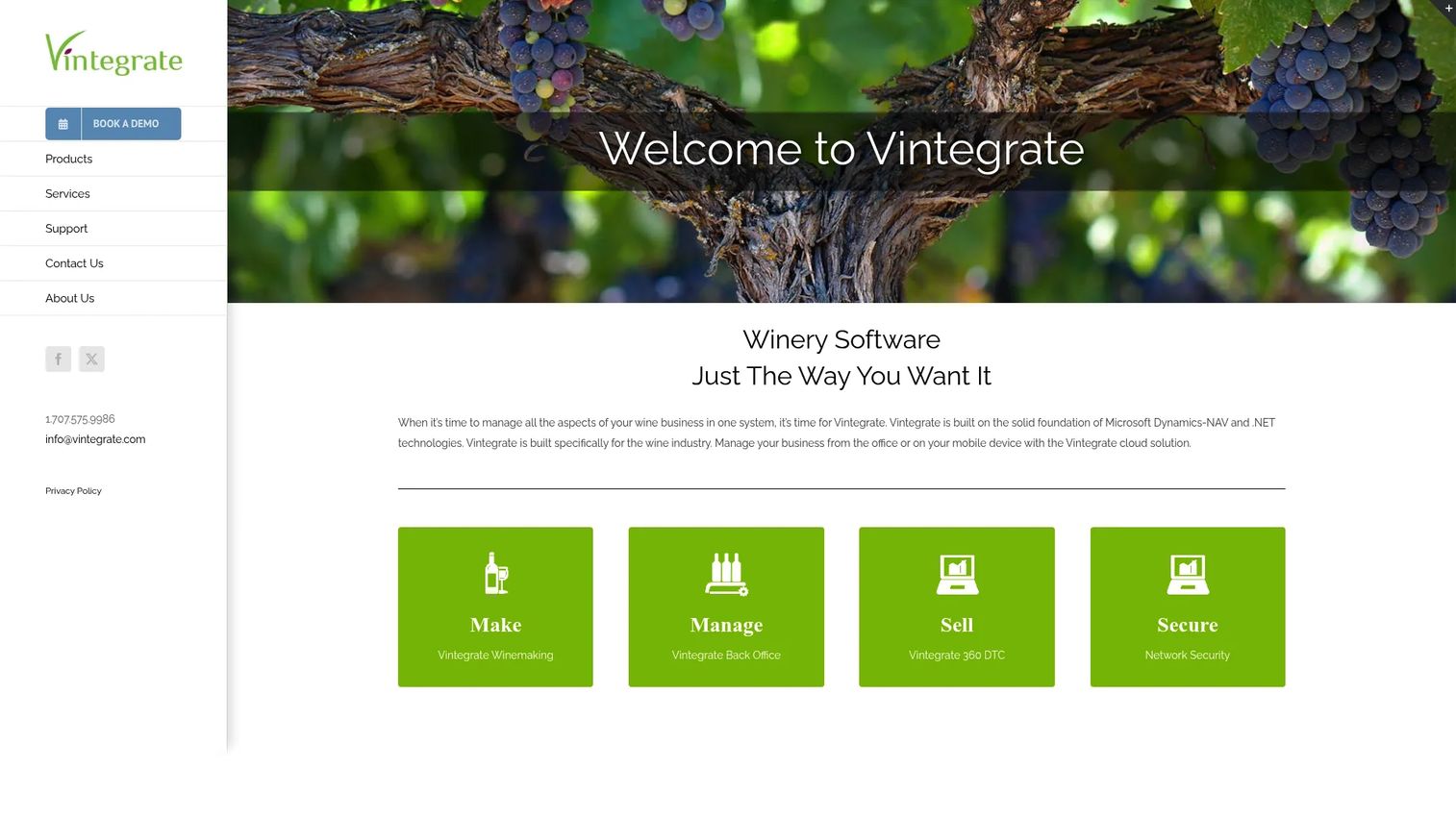
Vintegrate is a wine-specific enterprise suite built on Microsoft Dynamics NAV and .NET, available in cloud or on-premise deployment. It combines winemaking, back-office finance, inventory, compliance, production, and direct-to-consumer operations into a connected platform. Vineyard and harvest tracking sit alongside winemaking work orders, vessel management, laboratory records, purchasing, wholesale sales, and an integrated DTC suite covering POS, wine club, ecommerce, events, and customer profiles.
Best for: Established wineries, custom crush operations, and multi-brand groups that need production, finance, inventory, and DTC in a single connected suite.
Key features
- Winemaking production, cellar, vessel, and harvest management
- Vineyard tracking and dry-goods management
- Finance, inventory, compliance reporting, and business intelligence
- POS, wine club, and ecommerce modules
- Multi-brand and custom crush support
Why choose Vintegrate: Vintegrate earns consideration when the business needs one system across the cellar, warehouse, accounting, wholesale, and direct sales. The ERP foundation means it can replace several point solutions and give finance a reliable source of operational data. The tradeoff is implementation scope: This is not a tool a small team deploys in a week.
Vintegrate pricing: Pricing is quote-based across Essentials, Pro, Elite, and enterprise package discussions. No figures were available on a public pricing page at the time of verification. Confirm deployment model, user licensing, implementation scope, and any DTC transaction-based charges directly with the vendor before comparing total cost against narrower tools.
6. ISAGRI
ISAGRI provides agricultural, livestock, and vineyard management software with a strong emphasis on field mapping, crop recordkeeping, and precision viticulture. For vineyard and winery applications, the platform covers aerial mapping, vineyard localization, crop operation records, machinery and input tracking, gross-margin analysis, fermentation monitoring, blending, and grape-to-bottle traceability. Among surveyed Italian winegrowers, 37.1% intended to adopt satellite-based information services, the highest share among precision-agriculture technologies studied (Precision Agriculture, 2026).
Best for: Vineyard and winery groups that need aerial mapping, field recordkeeping, machinery visibility, and traceability as the operational foundation.
Key features
- Aerial vineyard mapping and localization
- Crop operation records and input tracking
- Machinery management with mobile registration
- Vineyard and winery traceability
- Gross-margin and profitability analysis
Why choose ISAGRI: ISAGRI fits operations where field mapping and precision agricultural records are as important as winery production data. It is a strong candidate for organizations that manage complex agricultural workflows or need to connect detailed field history to wine quality, traceability, and margin reporting.
ISAGRI pricing: Pricing is quote-based. No figures were available at verification. Product availability, language support, and regional configuration may vary by market. U.S. buyers should validate local support coverage and reporting requirements before selecting the platform, as ISAGRI is a global agricultural software group and product delivery may differ by region.
7. Vinsight
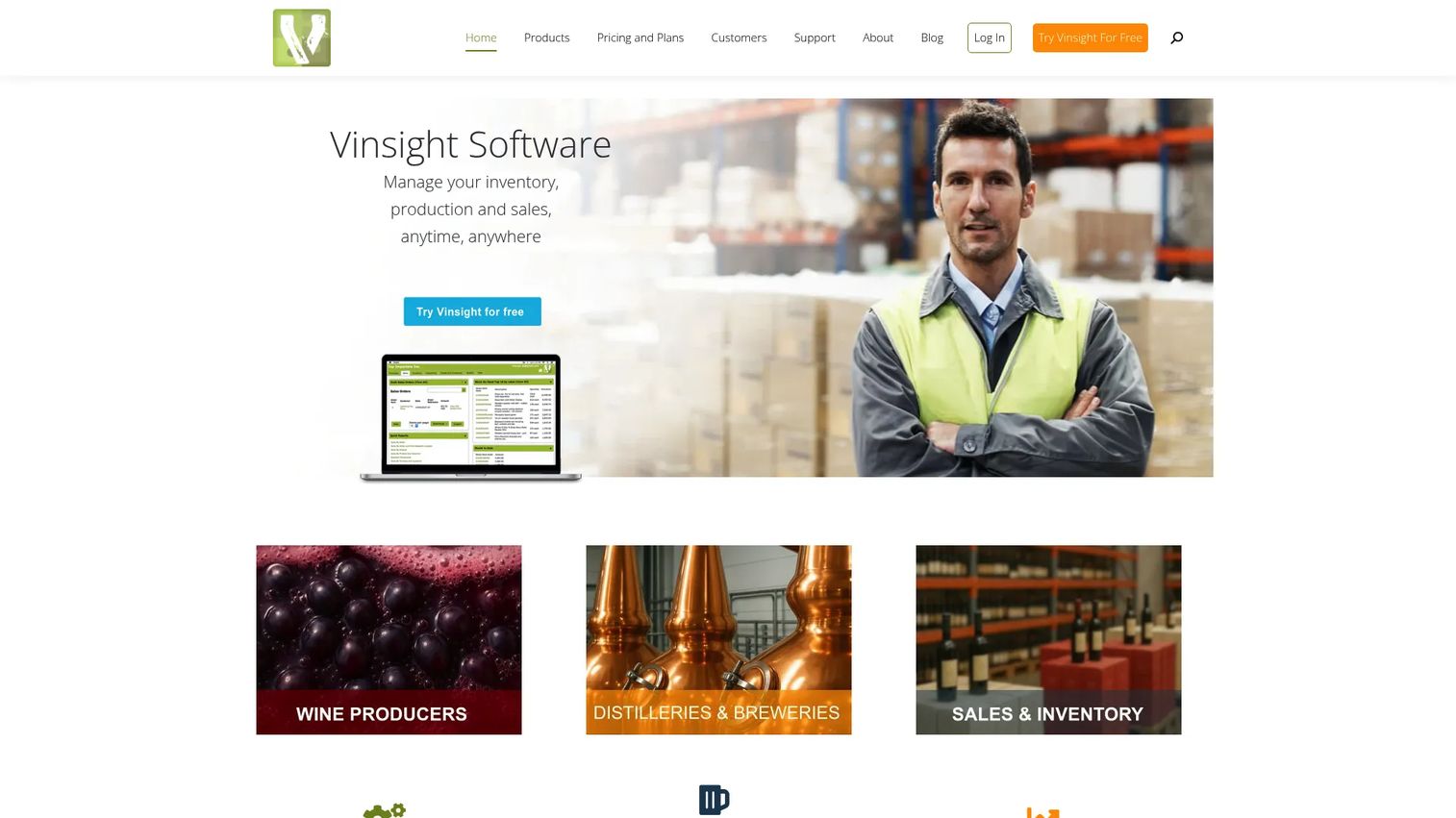
Vinsight is cloud software for beverage and food producers covering vineyard records, winery production, lab data, inventory, sales, and traceability. For vineyard teams, it provides worksheets, spray diaries, maturity records, yield predictions, and block-level data. The production side covers lot movements, vessel records, blending, and bottling. Inventory valuation, sales, purchasing, and Xero accounting integration round out the platform. A 14-day free trial is available.
Best for: Small to mid-size wine businesses that want vineyard, production, inventory, and sales in one tool without entering a custom enterprise sales process.
Key features
- Vineyard worksheets, spray diaries, and maturity records
- Yield predictions and crop tracking
- Winery production records and lot management
- Inventory valuation and sales management
- Xero accounting integration
Why choose Vinsight: Vinsight is the strongest pick for a business that wants to start with a defined monthly cost and a clear trial period rather than a quote-driven process. It covers vineyard records alongside production, stock, and sales, which is enough for many smaller wine businesses. Confirm country-specific tax and excise reporting fit before selecting, as Vinsight's primary market is Australasia.
Vinsight pricing: Starter is $59 per month. Basic is $99 per month. Standard is $177 per month. Premium is $399 per month. A 14-day free trial is available. Note that pricing is displayed in NZD on the vendor site, so verify the current equivalent in your operating currency before budgeting.
Considerations when choosing vineyard management software
Start with the operating model, not the feature list
A vineyard-only operation and an estate winery with a custom crush program are not the same buyer. Before comparing features, map the required information flow: Where does data originate, who needs to act on it, and what reports must come out the other end. That map determines whether you need a field-first tool, a vineyard-to-cellar platform, or a broader suite.
Verify field adoption under real harvest conditions
Ask vendors to show exactly how a crew member closes a task in low-connectivity conditions, how a manager corrects a record, and how quickly updates appear in reports. Mobile access and offline behavior differ significantly between platforms. A demo under ideal conditions does not predict performance during a compressed harvest window.
Trace the data from block to bottle
Request a live demonstration showing how vineyard blocks, fruit intake, production lots, inventory movements, and costs connect through the system. Avoid accepting a general integration claim without seeing the actual data flow. The question is not whether a link exists, but whether the handoff is automatic or requires manual reconciliation.
Separate reporting tools from regulatory obligations
The platform helps maintain records and generate reports. Your operation still owns its regulatory obligations, reporting review, and internal controls. Avoid selecting a platform based on a vendor's compliance claims. Evaluate instead on record completeness, audit history, export formats, and how easily a report can be reviewed before submission.
Price the implementation, not only the subscription
Include data cleanup, configuration, integration work, onboarding, seasonal training, support costs, and any change management effort. A lower monthly subscription can carry a significantly higher total cost if the team cannot maintain the system without outside help. For quote-based platforms, ask specifically for implementation cost estimates alongside subscription figures.
Conclusion
There is no single best vineyard management software without knowing the operating model first. The shortlist reflects three distinct categories:
Vintrace is the strongest candidate for vineyard-to-cellar operations where harvest, production, inventory, and costing must connect. InnoVint fits winery teams that need block tracking, TTB compliance, and lot-level COGS in a modular package. Tend is the practical pick for smaller vineyard teams replacing spreadsheets with field tasks, labor, and farm financials. VineInfo serves operations where yield management and agronomic recordkeeping are the core need. Vintegrate is the right conversation for established wineries and multi-brand groups that need an ERP-grade system across production, finance, and DTC. ISAGRI suits organizations that see aerial mapping and precision crop records as foundational. Vinsight offers the clearest entry path for small to mid-size wine businesses that want published pricing and a free trial.
The best next step is to shortlist two or three platforms based on your operating model, then ask each vendor to demonstrate the same harvest-to-reporting scenario using your actual workflow. The gaps that appear in that exercise will tell you more than any feature comparison grid.
Start your journey with Guideflow today!
FAQs
Small vineyards should prioritize mobile field access, task management, crop records, harvest planning, and pricing that works with seasonal staffing costs. Tend and Vinsight are the strongest starting points for buyers who want visible pricing and a defined trial period. The final choice should reflect whether the operation needs basic field tracking or a connection to winery production and sales.
Some platforms connect vineyard blocks and harvest data to cellar work orders, lot movements, inventory, costs, and compliance reporting. Vintrace and InnoVint are built with that connection as a core capability. Others, like Tend and VineInfo, focus primarily on field operations and may require a separate system for complex cellar work. Confirm how deeply a platform supports production workflows before assuming the vineyard module covers winery operations.
Core capabilities include block and variety records, work orders, mobile field access, spray or application records, crop forecasting, harvest planning, and traceability. Wineries should also evaluate fruit intake records, production lot management, inventory tracking, cost accounting, and finished-goods reporting. Prioritize the features your operation will actually use every week rather than selecting on total feature count.
Pricing varies significantly. Tend publishes plans starting at $20 per month, and Vinsight starts at $59 per month. VineInfo uses acreage-based pricing starting at $168 per acre annually with a setup fee. Vintrace, InnoVint, Vintegrate, and ISAGRI all sell through inquiry and do not display prices on their websites. Always include onboarding, implementation, training, and integration costs in the total when comparing options.
Some platforms support offline mobile workflows, but the specific capability differs by module and device. InnoVint documents offline access for its mobile app. Other platforms may limit offline behavior to viewing rather than editing. Ask vendors to demonstrate the exact field task closure and sync workflow your crew uses in areas with limited connectivity, including how conflicts are handled when the device reconnects.
Most platforms in this category record field activities, spray applications, fruit intake, lot movements, and inventory changes. ISAGRI positions grape-to-bottle traceability as a core capability. Vintrace and InnoVint connect vineyard records through to production and compliance reporting. Buyers should confirm how records are linked, how historical data is audited, and what export formats are available for their own reporting review.
Vineyard management software centers on field blocks, vine health, labor, inputs, yield estimates, and harvest planning. Winery management software adds cellar production, lab work, vessel management, inventory, bottling, costing, sales, and compliance reporting. Some platforms cover both, but the depth varies. Vintrace and InnoVint are examples of vineyard-to-cellar systems. VineInfo and Tend focus primarily on the field side. Understanding which workflows you need to cover determines whether one platform is enough or whether two tools must integrate.
Implementation time depends on the number of blocks, historical records to migrate, active inventory, integrations, user roles, and reporting requirements. A smaller field-focused rollout using Tend or Vinsight can begin within days. Vineyard-to-cellar systems like Vintrace and InnoVint typically require structured data migration, configuration, and phased training across the vineyard and cellar teams. Enterprise platforms like Vintegrate require a project plan with clear process ownership before going live. Budget for seasonal training as well, since harvest conditions will test every workflow the system supports.