Your first payroll problem is paying people correctly. Your second is knowing whether the system will still hold when you add the next five countries.
For most Series B founders, the second problem arrives quietly. Someone hires in Germany. Then Singapore. Then Brazil. Suddenly Finance is reconciling three spreadsheets from three local providers, the Head of People can't answer a board question about total payroll cost by region, and you're the escalation path.
According to PayrollOrg's 2025 global payroll survey, 57% of payroll professionals identified local compliance as their biggest operational challenge. The complexity isn't just about calculations - it's about statutory filings, cutoff management, audit trails, and data that connects to the rest of your operating stack.
The right multi country payroll software reduces that surface area. It should give your new Head of People or VP of Finance infrastructure that holds up under board scrutiny, not just something that works until the next new country hire.
What's inside
This guide compares 15 global payroll software platforms and international payroll providers, evaluated for founders and finance leaders scaling teams across borders.
- Who this is for: Series B SaaS founders, Heads of People, and finance leaders managing international teams
- Selection criteria:
- Country coverage depth (not just country count)
- Compliance handling and statutory update management
- HRIS, ERP, and finance system integrations
- Pricing transparency and implementation fit for 30 to 150 person teams
TL;DR
- Best overall for global hiring and payroll: Deel, for teams that need payroll, EOR, contractors, and HR in one system without stitching together separate tools
- Best for transparent pricing: Remote Global Payroll, at $29 per employee per month with strong owned-entity payroll and EOR coverage
- Best for unified HR, IT, and payroll: Rippling, for founders who want one employee data layer across operations
- Best for enterprise managed payroll: ADP, CloudPay, and Alight Global Payroll, for complex multinational environments with dedicated payroll teams
- Best for European payroll depth: SD Worx, especially if you have collective agreements or country-specific complexity across European markets
- Best for payroll control and visibility: Papaya Global and Payslip, when Finance needs cleaner reconciliation across currencies and providers
The best choice depends on your entity footprint, worker mix, and how mature your HR and finance functions are today.
What is multi country payroll software?
Multi country payroll software helps companies calculate, approve, pay, report, and stay compliant with payroll across employees and contractors in more than one country.
The category spans two distinct delivery models. Global payroll software gives your team the system to run calculations, manage workflows, and generate reports. Global payroll services add operational support: Local execution, statutory filings, and in-country expertise. Many platforms combine both.
A further distinction matters for founders: owned-entity payroll (where your company has a legal entity in the country) differs from EOR payroll, where a third-party employer of record legally employs workers on your behalf. Some vendors do both well; others specialize in one.
Key capabilities to evaluate:
- Country-specific gross-to-net calculations
- Local tax filings and statutory remittances
- Payroll approval workflows and audit logs
- Off-cycle payroll run support
- Multi-currency payments and FX handling
- Contractor onboarding and payments
- Centralized payroll reporting and cost visibility
- HRIS, HCM, ERP, and finance integrations
- EOR, PEO, or contractor-of-record options
Founders should care about this category not because payroll is exciting, but because it's one of those systems that looks operational until it becomes a legal, financial, and cultural problem at once. When payroll data doesn't connect cleanly to your headcount plan and runway model, you lose operating clarity at exactly the moment investors are asking for it.
When to use multi country payroll software
Hire employees before every local entity is mature
A common Series B pattern: You're growing fast in a new market before Finance and HR have built local operations. Multi country payroll software - especially platforms with EOR options - lets you support hiring before full entity setup. The software alone doesn't remove your legal obligations, but it gives your team a structured way to manage pay, benefits, and compliance from day one.
Replace country-by-country payroll vendors
Managing a separate provider in each country creates real friction: Inconsistent payslip formats, missed cutoffs, reconciliation gaps, and board reporting that requires spreadsheet work every quarter. Consolidating onto one global payroll platform matters most once you're operating across four or more countries and payroll variance reviews become a recurring management task.
Give finance and people leaders cleaner operating data
Payroll data should connect to headcount planning, runway, and country-level cost visibility. If your VP of Finance is stitching together answers from multiple systems before every board meeting, the problem isn't the people - it's the infrastructure. The right international payroll software gives leaders a single source of truth for payroll cost by entity, region, and worker type.
Multi country payroll software comparison
The table below is a starting point for building your shortlist. Pricing and ratings reflect publicly available information at the time of writing; verify current figures directly with vendors before procurement decisions.
| # | Product | Best for | Key differentiator | Pricing | G2 rating |
|---|---|---|---|---|---|
| 1 | Deel | Global hiring plus payroll | Payroll, EOR, contractors, and HR in one platform | From $49/contractor/mo; $599/EOR employee/mo | 4.7/5 |
| 2 | Remote Global Payroll | Transparent global payroll pricing | Owned-entity payroll with EOR and contractor services | $29/employee/mo | 4.6/5 |
| 3 | Papaya Global | Payroll payments and workforce visibility | Global payroll, payments, EOR, and contractor management | From $5/contractor/mo; $29/employee/mo (Payroll Plus) | 4.5/5 |
| 4 | ADP | Large multinational payroll operations | Mature global payroll network and managed payroll depth | Custom pricing | 4.7/5 |
| 5 | Rippling | Unified HR, IT, and payroll | One workforce system connecting payroll and operational data | From $8/employee/mo (plus base fee) | 4.8/5 |
| 6 | CloudPay | Enterprise managed global payroll | Payroll processing, treasury, and centralized reporting | Custom pricing | 4.0/5 |
| 7 | Dayforce | Workforce management plus payroll | HCM and payroll in one agentic suite | From $90.72/employee/year (Payroll module) | 4.2/5 |
| 8 | UKG One View | Consolidating multinational payroll data | Payroll aggregation and visibility across existing providers | Custom pricing | N/A |
| 9 | Multiplier | Global employment for lean teams | EOR, contractor, benefits, and payroll support | From $459/person/mo (Core, billed annually) | 4.7/5 |
| 10 | SD Worx | European payroll depth | Payroll, HR, and workforce services across European markets | Custom pricing | 4.0/5 |
| 11 | Safeguard Global Managed Payroll | Managed payroll delivery | End-to-end global payroll operations and compliance support | Custom pricing | 4.4/5 |
| 12 | iiPay Global Payroll Services | Global payroll managed services | Multi-country payroll processing and analytics | Custom pricing | 4.5/5 |
| 13 | Payslip | Payroll control and integration | Payroll automation, vendor management, and reporting | Custom pricing | N/A |
| 14 | TMF Horizon | Entity-heavy global operations | Payroll and HR administration across complex jurisdictions | Custom pricing | 3.5/5 |
| 15 | Alight Global Payroll | Enterprise HR transformation | Global payroll tied to broader HR operations | Custom pricing | 4.0/5 |
Best 15 multi country payroll software for 2026
1. Deel
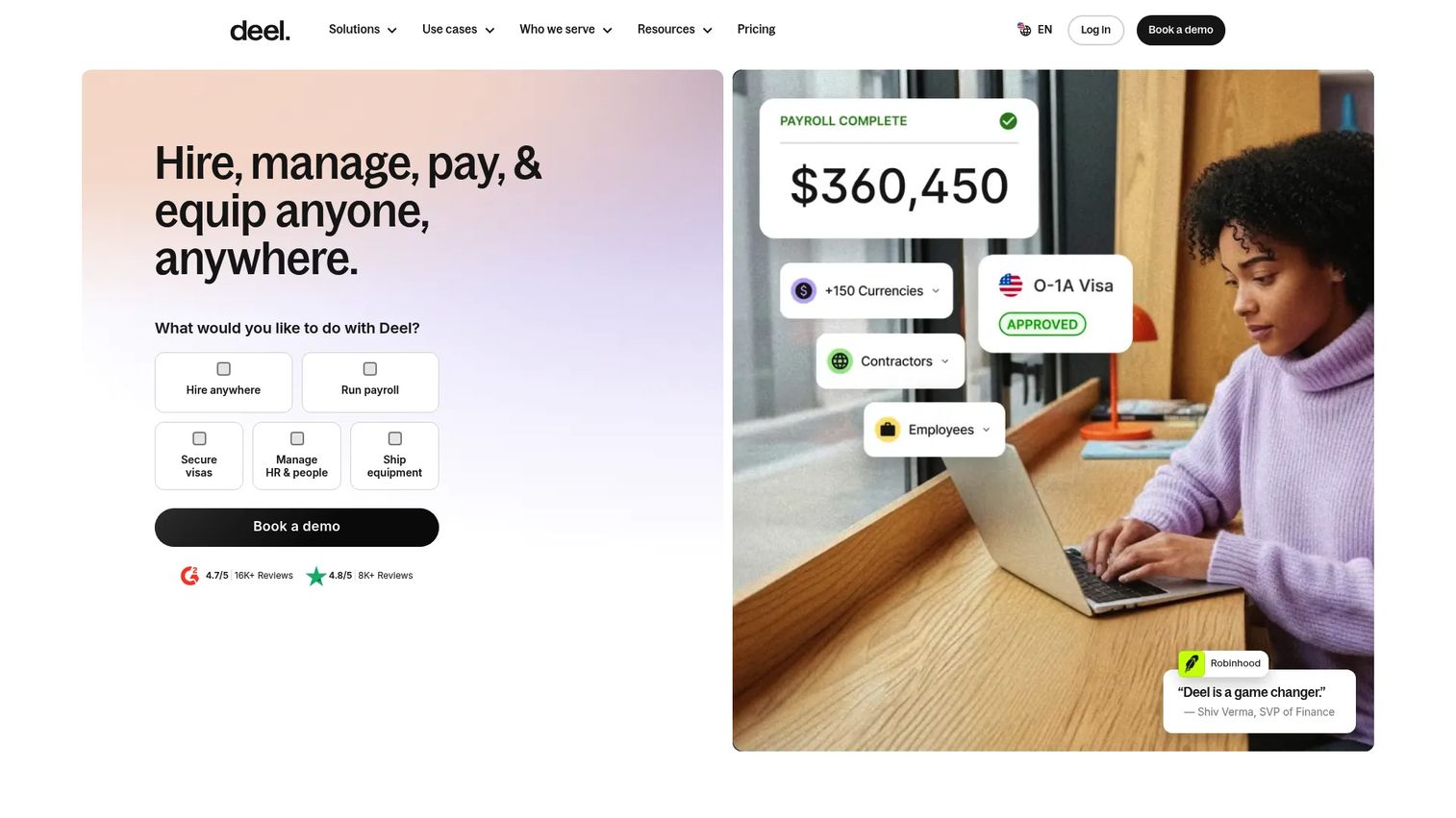
Deel is a global payroll and HR platform built for companies hiring, paying, and managing employees and contractors across borders. It covers EOR employment, contractor management, owned-entity payroll, and HR tools in one system. For a Series B team adding countries faster than the back office can keep up, Deel is often the first shortlist candidate because it removes the need to coordinate separate vendors for different worker types.
Best for: SaaS companies that need payroll, EOR, and contractor payments in one place, without building a global HR operations team first.
Key features
- Global payroll processing across multiple countries
- Employer of Record services for entity-light hiring
- Contractor management, onboarding, and payments
- Benefits administration and global mobility support
- IT and device management for distributed teams
Why choose Deel: Deel is the right call when speed matters and the team includes a mix of full-time employees and contractors across many countries. For a founder, the value is reducing handoff friction between People, Finance, and Legal - one platform owns the worker relationship from hire to pay.
Deel pricing: Contractor management starts at $49 per contractor per month. EOR services run $599 per employee per month. Contractor of Record is $325 per contractor per month, and US PEO is $125 per employee per month. Pricing is month-to-month with no long-term commitment required.
G2 rating: 4.7/5
2. Remote Global Payroll
Remote Global Payroll is a payroll platform for companies running payroll through owned entities in multiple countries. It handles locally calculated gross-to-net processing, statutory filings, automated deductions, and off-cycle payroll runs. Adjacent EOR, contractor, and HRIS services sit alongside the core payroll product, making it a practical option for teams that want pricing clarity before entering a sales cycle.
Best for: Distributed teams that want owned-entity global payroll with transparent per-employee pricing and employment services nearby.
Key features
- Locally calculated gross-to-net payroll
- Automated tax filings and statutory remittances
- Off-cycle payroll runs and local cutoff management
- Audit-ready reporting and payroll logs
- HRIS, ERP, and time-and-attendance integrations
Why choose Remote Global Payroll: Choose Remote when the company wants a provider that handles both owned-entity payroll and entity-light international hiring, without the ambiguity of quote-only pricing. It fits founders who want to know the cost per employee before signing anything.
Remote Global Payroll pricing: Global Payroll starts at $29 per employee per month. The Remote Platform is included with no base fee; additional service fees may apply depending on scope.
G2 rating: 4.6/5
3. Papaya Global
Papaya Global is a global workforce management platform combining payroll processing, EOR services, contractor management, and payment orchestration. It operates across 180+ countries and places particular emphasis on payroll payment visibility and workforce analytics. Finance teams tend to find the reconciliation layer useful when managing payroll across currencies and multiple country entities.
Best for: Companies that need centralized payroll payments, workforce cost reporting, and cross-country reconciliation alongside EOR or contractor coverage.
Key features
- Global payroll management across 180+ countries
- Payroll payment orchestration and tracking
- Contractor onboarding and payments
- AI-powered payroll validation and workforce analytics
- HRIS and ERP integrations via OneData
Why choose Papaya Global: Papaya Global is especially useful when Finance wants clearer reconciliation across countries and currencies, not just payroll calculation. The payment orchestration layer gives controllers a view that most pure-HR platforms don't provide.
Papaya Global pricing: Contractor management starts at $5 per contractor per month. Payroll Plus for owned-entity payroll starts at $29 per employee per month. EOR services start at $499 per employee per month. Contractor of Record is $199 per contractor per month. Workforce OS and Contingent OS use custom pricing.
G2 rating: 4.5/5
4. ADP
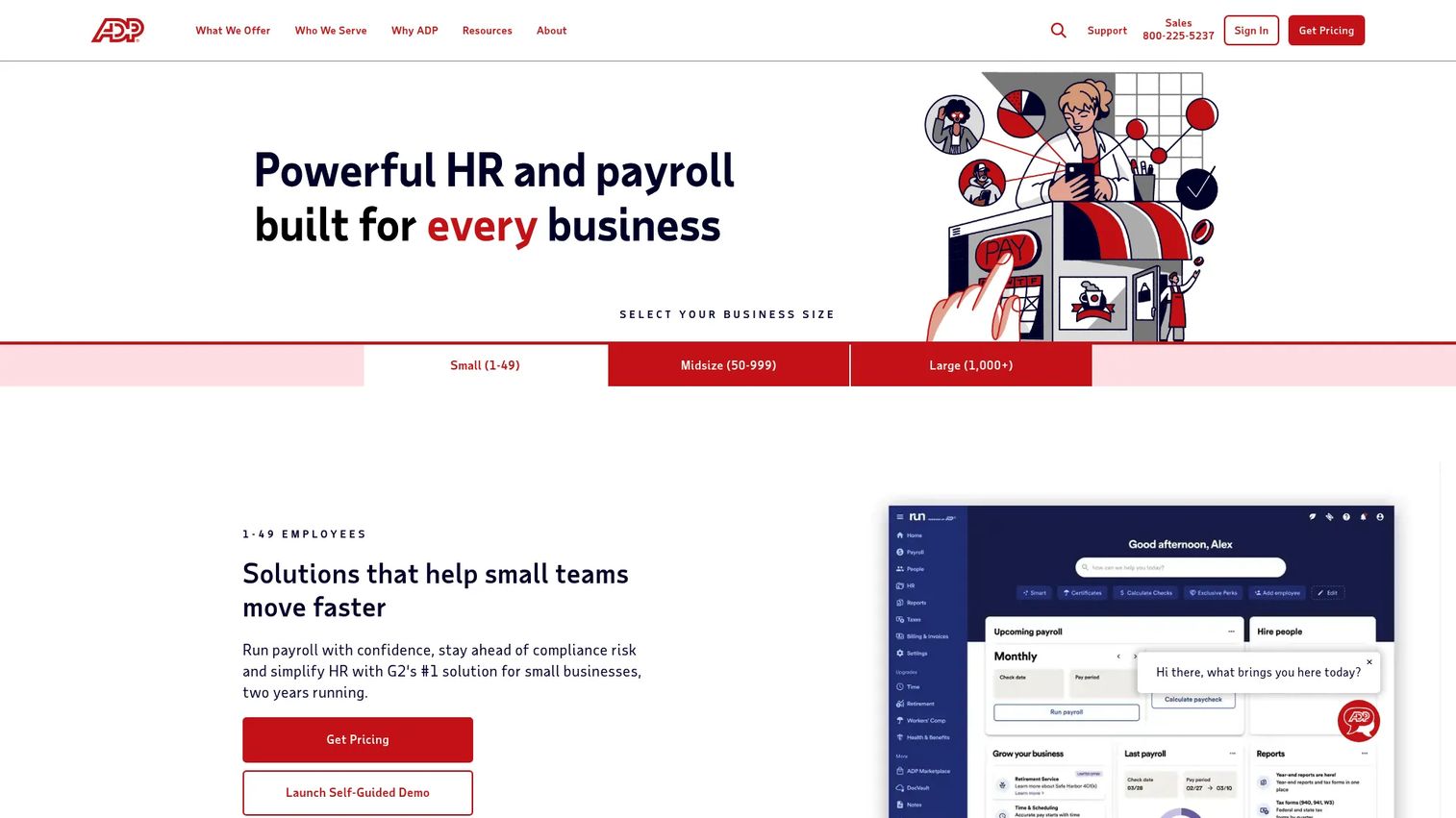
ADP is one of the most established payroll providers in the market, with global payroll, HR, workforce management, and compliance services built for companies ranging from small businesses to large multinationals. Its global network and managed payroll depth make it a frequent choice for finance teams that need proven operational maturity over startup-style speed.
Best for: Larger companies with complex multinational payroll needs and dedicated payroll teams that prioritize provider stability and depth.
Key features
- Global payroll processing and tax administration
- Managed payroll services with local compliance support
- HR and employee self-service capabilities
- Time and attendance management
- Workforce analytics and compliance reporting
Why choose ADP: Choose ADP when payroll risk is too high for a lightweight platform and the company needs an established provider network that can handle enterprise-scale complexity. It suits organizations where the payroll team values operational depth and long-term stability.
ADP pricing: ADP does not publish standard pricing. Cost varies by product line (payroll, HR, HCM), employee count, countries, services, and implementation scope. Contact ADP for a quote.
G2 rating: 4.7/5 (RUN Powered by ADP)
5. Rippling
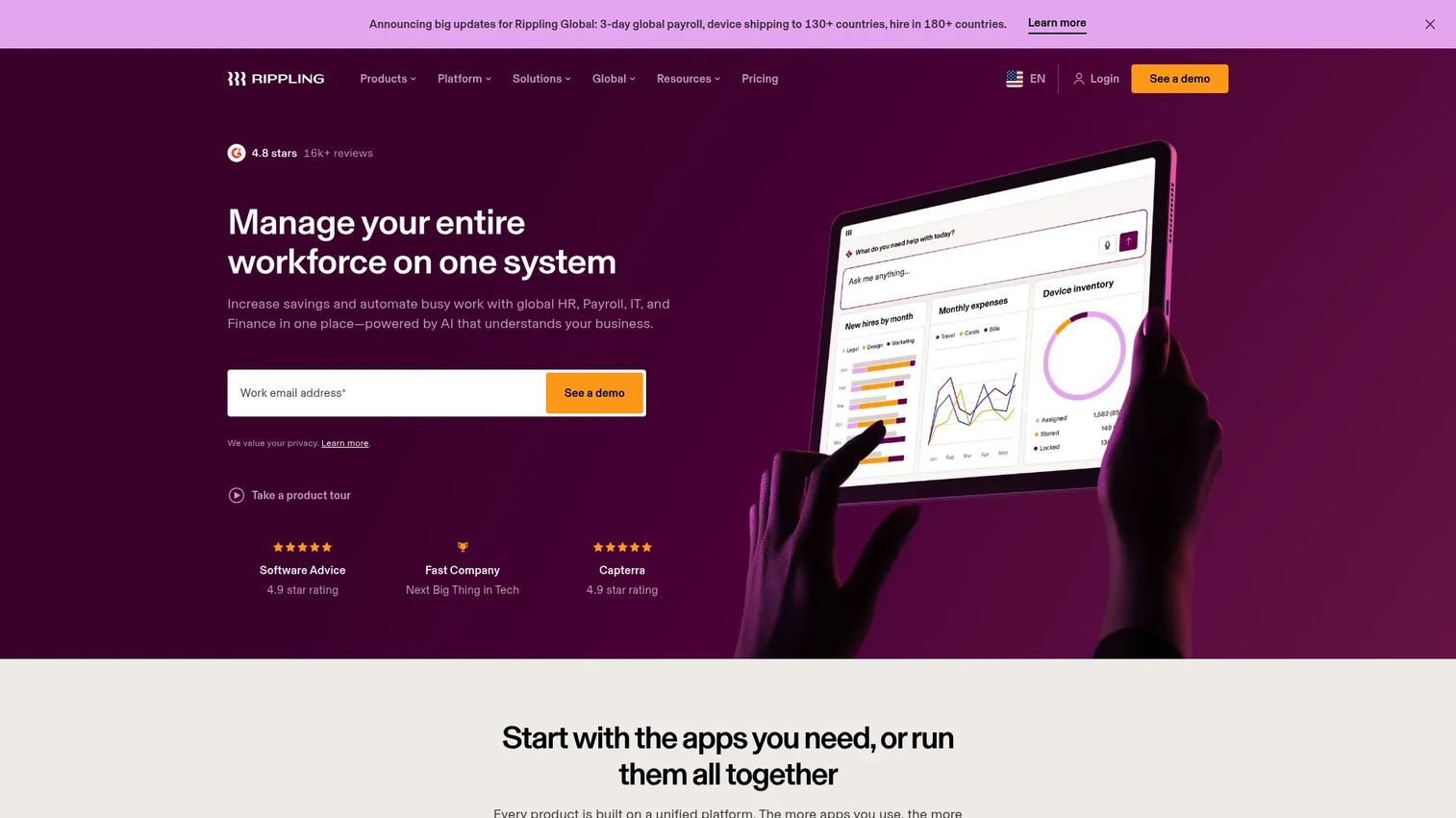
Rippling is a workforce platform that connects HR, payroll, IT, finance, and employee operations in one system. It handles global payroll and EOR alongside identity management, device provisioning, benefits, and workflow automation. For a Series B founder trying to reduce tool sprawl and give a new Head of People or VP of Finance a single employee data layer, Rippling is a strong candidate.
Best for: SaaS companies that want payroll as part of a broader workforce operating system, not a standalone payroll point solution.
Key features
- Global payroll and employer of record services
- HRIS and employee lifecycle management
- IT, device, and identity management
- Benefits administration and time tracking
- Workflow automation with integrations across the operational stack
Why choose Rippling: Choose Rippling when the payroll decision is part of a broader workforce infrastructure decision. It suits founders who want to reduce the number of systems Finance and People have to manage and give new leaders something operational from day one.
Rippling pricing: Plans start at $8 per employee per month plus a monthly base fee. Total cost depends on selected modules and workforce size. Custom quotes are required.
G2 rating: 4.8/5
6. CloudPay
CloudPay provides managed global payroll, payroll payment services, and employee pay-experience tools for multinational companies. It supports processing across multiple currencies and countries, with centralized reporting, treasury services, and analytics that suit enterprise payroll operations. The platform also includes a CloudPay App giving employees access to payslips, pay-on-demand features, and financial wellbeing tools.
Best for: Enterprise teams managing multi-country payroll with dedicated payroll functions that need managed service depth and consolidated payment visibility.
Key features
- Managed global payroll with automation and compliance support
- Global payroll payments across 110+ currencies
- Payroll analytics and centralized reporting
- Treasury services alongside payment execution
- Employee pay experience app with payslips and pay-on-demand
Why choose CloudPay: CloudPay fits companies where payroll spans many entities, approval layers, and payment cycles. It's the right direction when payroll is already a specialized function rather than a task sitting with People Ops.
CloudPay pricing: CloudPay does not display standard pricing. Costs move with country count, employee volume, services, and implementation. Reach out directly for a quote.
G2 rating: 4.0/5
7. Dayforce
Dayforce is an HCM platform that connects HR, payroll, workforce management, time and attendance, talent, and analytics in a single agentic system. Its payroll capabilities are designed to stay in sync with scheduling, time data, and HR records, reducing manual reconciliation for teams where workforce complexity drives payroll variability.
Best for: Mid-market and enterprise organizations that need payroll accuracy driven by real-time workforce data, benefits, and scheduling in one suite.
Key features
- Payroll management with real-time data connections
- Workforce management and scheduling
- Time and attendance tracking
- HR, benefits, and talent management
- AI Assistant and AI Agents for HR workflows
Why choose Dayforce: Dayforce is less of a point payroll tool and more of an HCM decision. Choose it when payroll accuracy depends on scheduling, time data, and HR processes living together - particularly for shift-based or complex workforce models.
Dayforce pricing: Dayforce publishes an MSRP price book. The Payroll module is listed at $90.72 per employee per year. The Core Platform is $171.96 per employee per year. Time and Attendance is $54.84 per employee per year. Additional modules are separately priced.
G2 rating: 4.2/5
8. UKG One View
UKG One View is a global payroll aggregation and visibility solution for multinational organizations that want centralized oversight across existing country-level payroll providers. Rather than replacing local providers, it creates a unified operating layer above them - covering payroll data consolidation, reporting, compliance visibility, and payments across 160+ countries.
Best for: Large multinational companies that have established local payroll providers and need one consolidated view without replacing every country relationship.
Key features
- Unified global payroll data across existing providers
- Payroll processing across 160+ countries
- Payments in 120+ currencies
- Real-time validation and automated oversight
- Multi-language reporting and analytics
Why choose UKG One View: Choose UKG One View when replacing every local provider isn't realistic or desirable. It helps finance and HR leaders build a central operating layer without a full payroll system migration.
UKG One View pricing: UKG does not display standard pricing for One View. Cost depends on country footprint, services, and configuration. Contact UKG for a quote.
G2 rating: No dedicated UKG One View rating available on G2 at time of writing.
9. Multiplier
Multiplier is a global employment platform for hiring, paying, and managing international employees and contractors across 100+ countries. It supports EOR employment, Contractor of Record services, benefits administration, and multi-country payroll without requiring the company to establish local entities. It suits lean teams that need international employment workflows without building a dedicated global HR operations function first.
Best for: Teams scaling international hiring quickly who need EOR, contractor payments, and payroll support without heavy internal infrastructure.
Key features
- Employer of Record services across 100+ countries
- Global payroll with compliant contracts
- Contractor of Record services
- Benefits and insurance administration
- Expense and leave management
Why choose Multiplier: Choose Multiplier when the priority is hiring and paying international workers fast, not running a full enterprise payroll transformation. It fits founders who need practical global employment support at a scale that doesn't yet justify a dedicated global payroll team.
Multiplier pricing: Core EOR plans start at $459 per person per month, billed annually (or $499 per month on a monthly billing cycle). Growth plans are $519 per person per month annually. Enterprise plans use custom pricing.
G2 rating: 4.7/5
10. SD Worx
SD Worx is a payroll and HR services provider with deep European expertise and multi-country payroll capabilities. Its platform covers HR management, payroll processing, and workforce time solutions, with particular strength in markets with complex collective agreements, country-specific labor rules, and regulatory nuance. The mysdworx digital platform serves HR teams, managers, and employees across the organization.
Best for: Companies with significant European payroll complexity, including countries with detailed collective agreements and country-specific regulatory requirements.
Key features
- Multi-country payroll services with European regulatory expertise
- HR management and employee lifecycle support
- Workforce time and attendance solutions
- mysdworx digital platform for HR, managers, and employees
- AI-enabled services and automation across European markets
Why choose SD Worx: SD Worx fits companies where local payroll expertise matters more than a startup-style interface. If European markets are central to your team footprint and you're navigating collective agreements, SD Worx carries the country-level depth that generalist platforms don't always match.
SD Worx pricing: SD Worx does not display pricing. Cost varies by countries, modules, headcount, and service scope. Contact SD Worx for a tailored quote.
G2 rating: 4.0/5
11. Safeguard Global Managed Payroll
Safeguard Global Managed Payroll, delivered through its Global Pay product, provides end-to-end managed payroll operations for companies running payroll across multiple countries. It handles local compliance, statutory filings, payroll calendars, validation workflows, and consolidated reporting. The service model suits organizations that want expert-led payroll operations rather than a software-only platform.
Best for: Organizations that need managed payroll delivery rather than a self-serve platform, particularly when in-house payroll expertise is limited.
Key features
- End-to-end payroll processing with local compliance and filings
- Self-service payroll inputs and built-in validation workflows
- Unified global payroll calendar and checklist
- Consolidated payroll reporting and workforce cost visibility
- Automated country-specific tax rules and payroll regulation updates
Why choose Safeguard Global Managed Payroll: Choose Safeguard Global when payroll operations need external support, not just a dashboard. It fits teams that want coordinated, country-level payroll execution without building an in-house global payroll team.
Safeguard Global Managed Payroll pricing: Safeguard Global does not list standard pricing. Contact the team to discuss scope, countries, and service model - the quote will reflect country footprint and payroll volume.
G2 rating: 4.4/5
12. iiPay Global Payroll Services
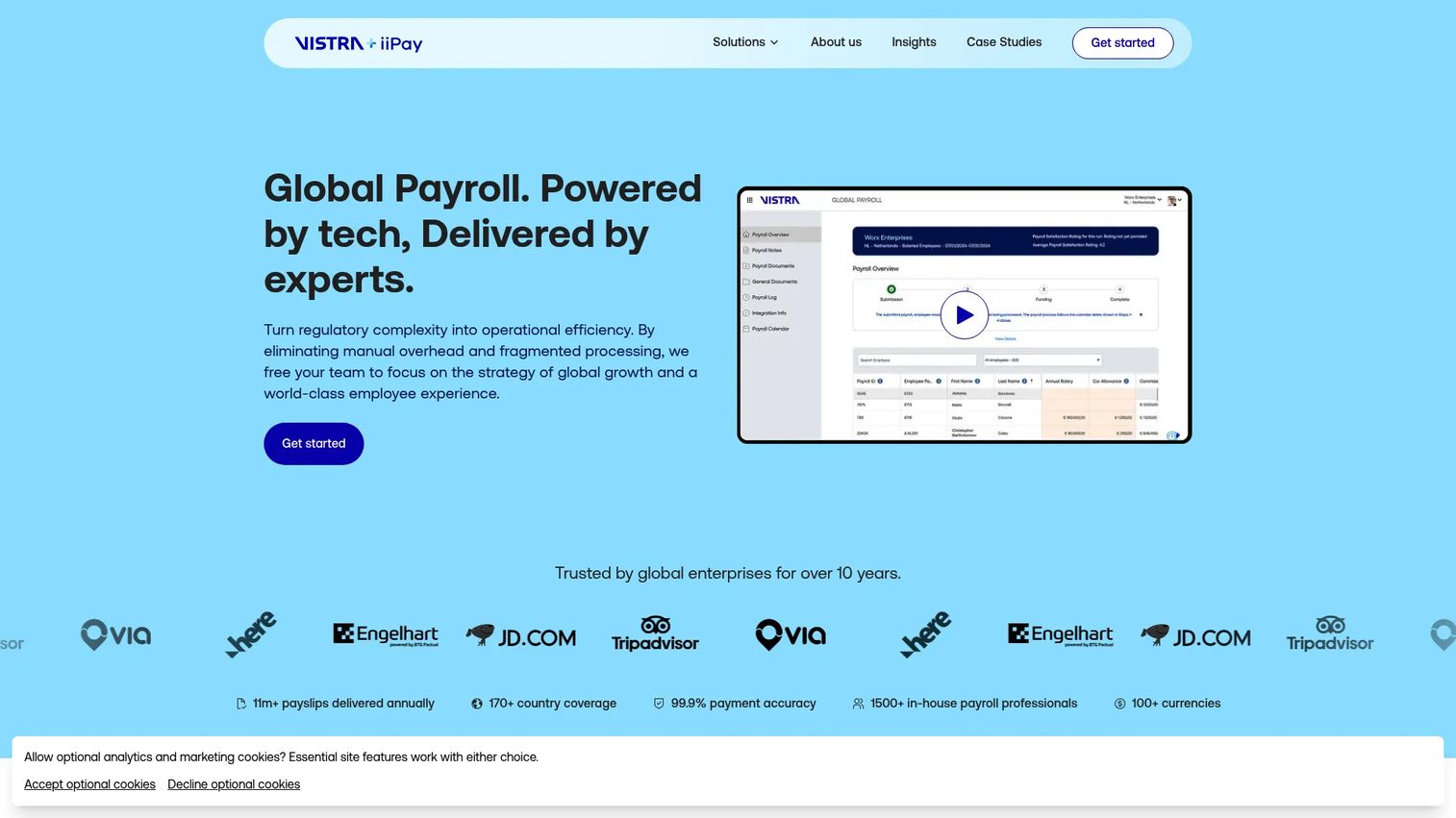
iiPay Global Payroll Services, now delivered as Vistra Global Payroll powered by iiPay following Vistra's 2025 acquisition, provides managed multi-country payroll technology and services. It operates across 170+ countries with centralized payroll analytics, compliance controls, HRIS and ERP integrations, and global payment capabilities in 100+ currencies. The offering suits large enterprises with mature internal payroll functions seeking specialist processing depth.
Best for: Large multinational enterprises that need specialist managed payroll processing, centralized governance, and local compliance expertise across many countries.
Key features
- Global payroll processing across 170+ countries
- Real-time payroll analytics and reporting
- HRIS, ERP, and finance system integrations
- Global payroll payments in 100+ currencies
- Compliance controls, audit trails, and employee self-service
Why choose iiPay Global Payroll Services: Choose iiPay when the company wants a specialist payroll provider rather than a broad HR platform. It suits organizations where payroll operations are mature enough to value depth over generalist HR tooling.
iiPay Global Payroll Services pricing: Pricing is not available. Reach out through the iiPay or Vistra website to discuss your country footprint, employee count, service model, and implementation requirements.
G2 rating: 4.5/5
13. Payslip
Payslip is a global payroll control and automation platform focused on integrations, reporting, and operational control across payroll providers. It automates data input, validation, and variance analysis, and connects with HCM, finance, and existing payroll vendors. It suits teams that already have payroll delivery partners but need better orchestration and reporting across those relationships.
Best for: Multinational companies that need stronger payroll control, integration, and reporting across multiple existing payroll providers.
Key features
- Automated payroll data input, checking, and validation
- Global payroll reporting and variance analysis
- Payroll vendor management and digital calendars
- HCM, finance, and payroll system integrations
- Smart reconciliation and smart alerts
Why choose Payslip: Payslip works when the pain is data control rather than payroll delivery itself. If Finance is spending hours reconciling payroll data from multiple systems before each board cycle, Payslip addresses the orchestration layer that generalist platforms don't always solve.
Payslip pricing: Payslip does not publish a pricing page. Cost moves with the number of integrations, countries, payroll volume, and implementation scope. Contact Payslip for a quote. A free 30-day trial is referenced in their documentation.
G2 rating: No G2 rating available at time of writing.
14. TMF Horizon
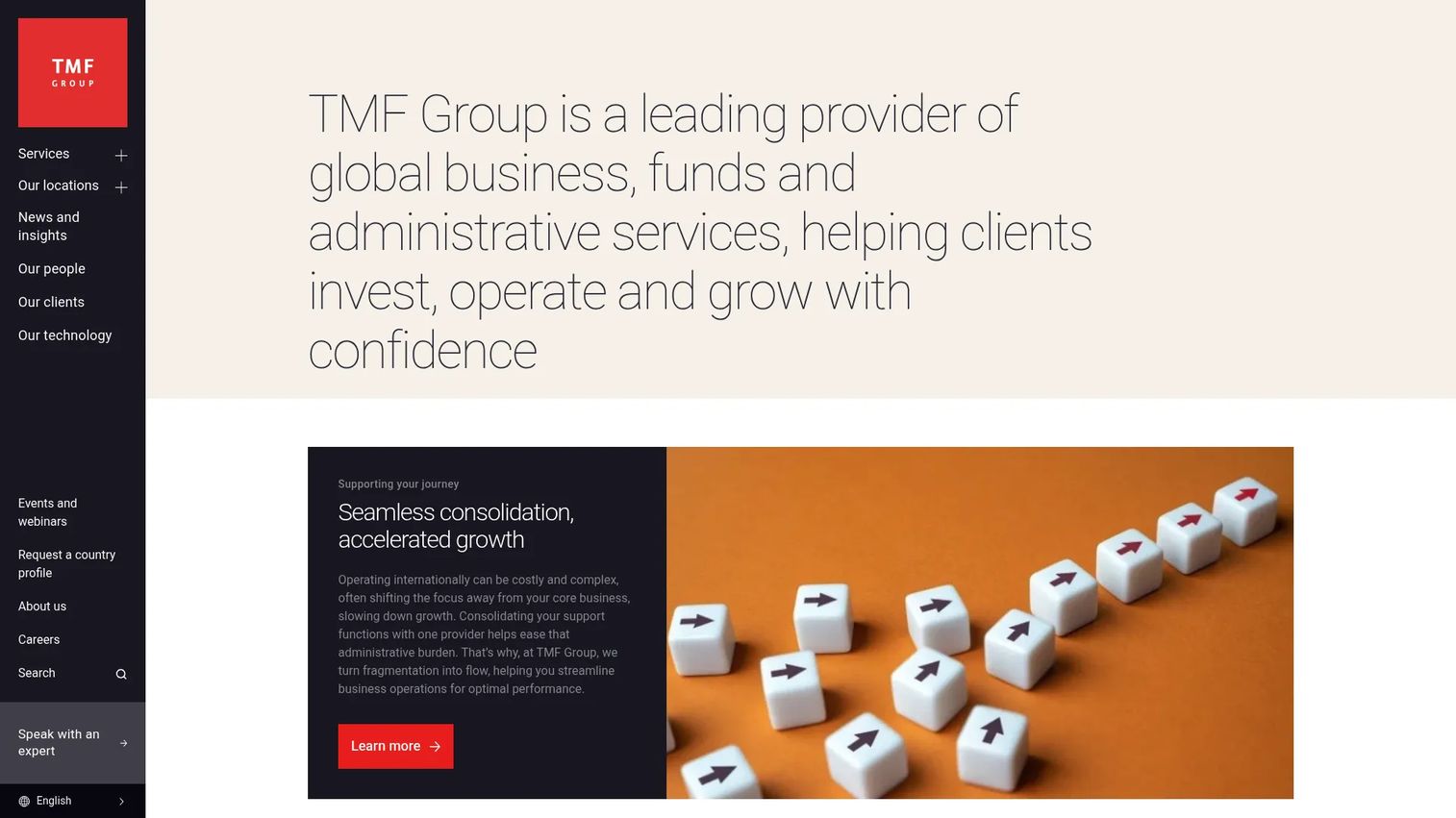
TMF Horizon is part of TMF Group's global business services offering. It provides a unified portal for payroll processing, HR administration, document sharing, compliance workflows, and payroll monitoring. For companies managing entities, statutory requirements, and local administration across many jurisdictions - not just payroll - TMF Horizon connects payroll to the broader operational picture.
Best for: Companies with complex entity structures where payroll is one component of a broader international operations and accounting challenge.
Key features
- Payroll processing and HR administration through a unified portal
- Core module with ticketing, task management, and payroll calendars
- Employee portal for payslips and HR documents
- Exchange workflow for payroll data input and output
- Consolidated payroll reporting and financial forecasting
Why choose TMF Horizon: Choose TMF Horizon when payroll is part of a broader international operations problem. It suits companies managing entities, statutory requirements, and local administration across jurisdictions where TMF Group already has an operational footprint.
TMF Horizon pricing: Standard pricing is not publicly available. The service description references contract-specific add-on fees. Contact TMF Group to discuss jurisdictions, services, entity structure, and payroll scope.
G2 rating: 3.5/5
15. Alight Global Payroll
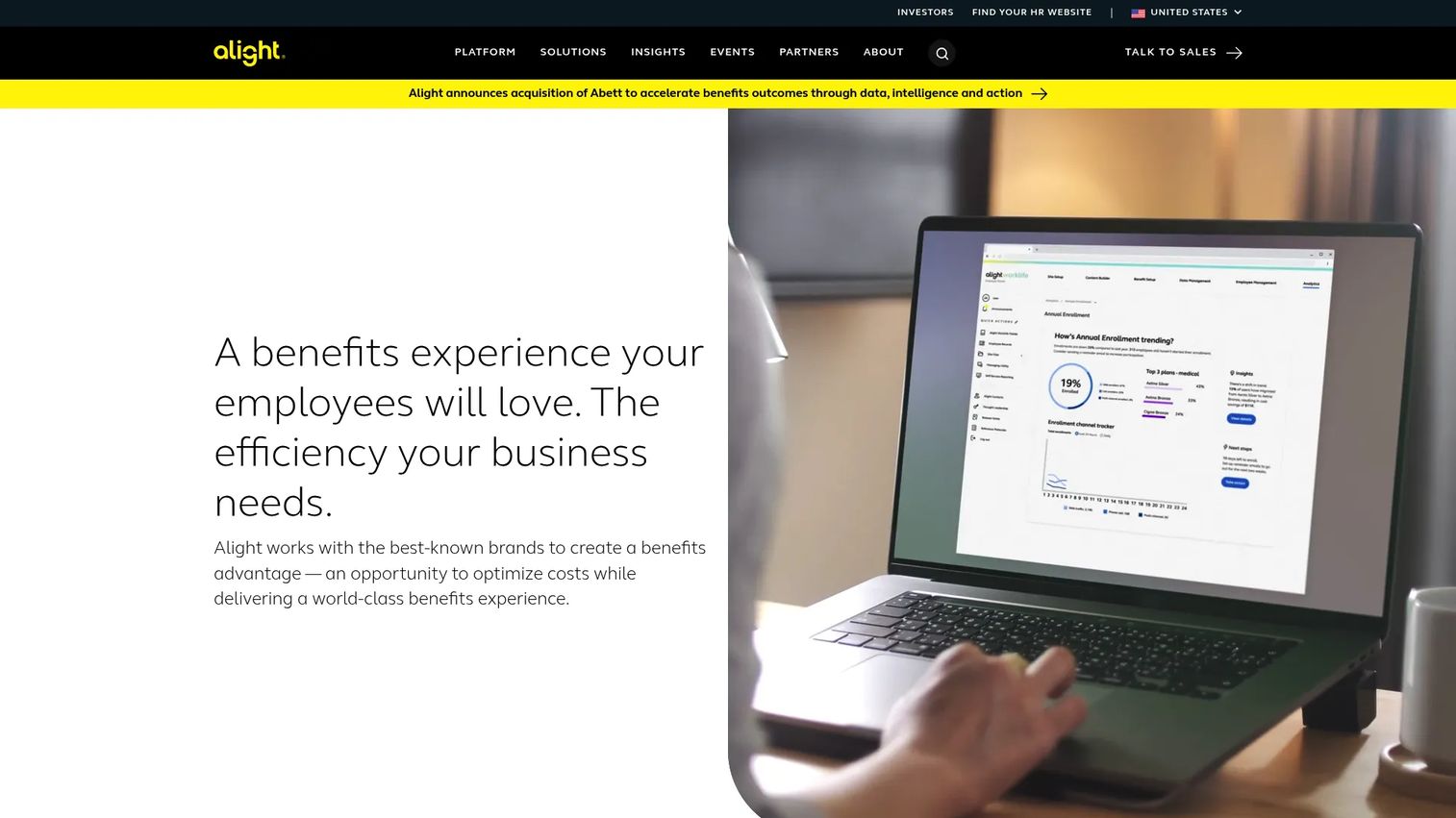
Alight Global Payroll is a global payroll and HR services offering from Alight, covering payroll processing, review, reporting, and analytics across 180+ countries and 25 languages. It is positioned as an enterprise-grade option for large organizations that need payroll connected to broader HR operations and benefit programs, delivered with service depth and program management support.
Best for: Large enterprise organizations that need payroll services tied to broader HR transformation, benefits operations, or global workforce programs.
Key features
- Global payroll coverage across 180+ countries and 25 languages
- Payroll processing, review, reporting, and analytics
- Single, automated payroll and HR experience
- Benefits connections and HR operations support
- Enterprise reporting and compliance capabilities
Why choose Alight Global Payroll: Alight fits when payroll sits inside a broader HR transformation effort rather than a standalone payroll replacement. It suits organizations that need service depth, program management, and enterprise operating support alongside the technology.
Alight Global Payroll pricing: Alight does not publish pricing. Cost depends on employee count, countries, service scope, implementation, and service layers. Contact Alight for a quote.
G2 rating: 4.0/5
Considerations when choosing multi country payroll software
Confirm owned-entity payroll versus EOR coverage
Map your worker types by country before taking any demos. A vendor that excels at EOR employment may handle owned-entity payroll differently, with separate pricing, different SLAs, or limited coverage in some markets. Know whether your workers are employed through your own entities, through a third-party EOR, or as contractors - and confirm each vendor's depth in each model.
Test country depth, not just country count
Country coverage claims can conceal partner dependence, cutoff constraints, and limited local expertise. Ask vendors directly: Who runs payroll in each of your specific markets, who handles statutory changes, and what happens when you need an off-cycle run. A vendor claiming 180 countries may rely on third-party in-country partners for many of them.
Check finance and HR integrations early
Weak integrations create spreadsheet reconciliation work that Finance inherits at the end of every period. Confirm specific integrations with your HRIS, ERP, general ledger, benefits system, and time-tracking tools before shortlisting. Ask what data flows automatically and what requires manual export.
Understand what happens after the contract is signed
For Series B teams, first-quarter value matters more than a polished sales demo. Ask about data migration, parallel payroll runs, local registrations, approval workflow setup, and go-live support. Find out who your implementation contact is and how long comparable companies have taken to process their first payroll.
Know exactly what pricing includes
Separate platform fees, per-employee fees, per-country fees, implementation fees, FX fees, off-cycle payroll fees, and managed service fees. Many vendors lead with a per-employee headline price that excludes implementation and country-specific costs. Get a total cost projection for your actual country footprint before comparing vendors side by side.
Conclusion
The right multi country payroll software depends heavily on where you are in the company's operational arc.
If you're a SaaS team scaling international hiring quickly, Deel, Remote Global Payroll, Rippling, and Multiplier are the natural starting points. They cover EOR, owned-entity payroll, and contractor payments with varying degrees of HR tooling, and they're built for teams that don't yet have a dedicated global payroll function.
If centralized payroll visibility and payment operations are the core problem, Papaya Global, CloudPay, Payslip, and UKG One View address the reporting and orchestration layer that growing Finance teams need.
For enterprise-grade or service-heavy payroll operations, ADP, Dayforce, SD Worx, Safeguard Global Managed Payroll, iiPay, TMF Horizon, and Alight carry the operational depth and managed service capability that complex multinational environments require.
Before booking demos, write down your current countries, worker types, local entities, payroll calendars, HRIS, finance system, and approval owners. The right shortlist will become obvious faster.
Start your journey with Guideflow today!
FAQs
The answer depends on your worker mix, entity footprint, headcount, and the maturity of your HR and finance functions. Deel, Remote Global Payroll, Rippling, and Multiplier suit scaling SaaS teams that need EOR, contractor payments, and payroll in one system. If you're at 200+ employees with dedicated payroll staff, ADP, CloudPay, Alight, or iiPay offer the depth enterprise operations require.
Global payroll software gives your team the system for calculations, workflows, approvals, and reporting. Global payroll services add operational delivery: Local execution, statutory filings, and in-country expertise. Many vendors in this list combine both, though the balance shifts significantly from platform-first options like Rippling to service-led providers like Safeguard Global and iiPay.
Payroll software typically supports employees where your company already has a legal entity. EOR lets you employ workers in countries where no entity exists, because a third-party employer legally employs the worker on your behalf. These are legally distinct structures. Get advice from a tax and employment attorney before choosing an employment model in a new country.
Pricing models vary significantly. Per-employee, per-month pricing is common, ranging from $29 per employee per month for owned-entity payroll platforms up to $599 per EOR employee per month for employment services. Additional costs to factor in include implementation fees, per-country fees, FX or payment fees, off-cycle payroll fees, and managed service layers. Compare total projected cost for your actual country and worker mix, not just the headline per-employee figure.
Ask who owns payroll execution in each of your specific countries, how statutory updates are handled and communicated, which HRIS and ERP integrations exist, how parallel payroll runs work during cutover, what approval workflow configuration is available, and how payroll errors are resolved. Also ask how long implementation took for companies of similar size and country footprint.
Some platforms include full contractor onboarding, invoicing, and payment support. Others focus on employee payroll and treat contractor payments as a separate product or add-on. Verify contractor classification guidance, tax form support, local currency payment methods, and whether the platform distinguishes between independent contractors and those employed through a Contractor of Record structure.
Implementation time depends on country count, data quality, number of entities, integrations, and whether a parallel payroll run is required. A lean team processing payroll in two or three countries may move in four to eight weeks. Enterprise rollouts across many countries with complex integrations commonly take three to six months. Ask vendors for benchmarks from comparable customer implementations, not generic estimates.
The highest-value integrations are with your HRIS or HCM system, your ERP or general ledger, and your finance and budgeting tools. After that, benefits administration, time tracking, and workforce management integrations reduce manual data entry. Weak integration between payroll and your general ledger means Finance inherits reconciliation work every period that payroll software was supposed to eliminate.