You can see your team shipping. Tickets close, pipelines run, deployments happen. But leadership asks whether the work you funded actually moved a business metric, and you have no clean answer.
That gap is what VSM software is built to close. Value stream management software connects strategy to delivery to outcomes, so you can see where work stalls, where investment leaks, and whether shipped features reached real users. According to a 2024 IDC DevOps Tech Buyer Survey, 74.6% of surveyed organizations were already expanding, piloting, or actively using value stream management. The category is no longer niche.
The challenge is that VSM platforms cover very different ground. Some are built around portfolio funding and OKR alignment. Others focus on DORA metrics and CI/CD pipeline intelligence. A few combine both. Picking the wrong one means expensive implementation work and dashboards that sit unused.
This guide cuts through that by mapping 15 tools to the operating model they actually fit.
What's inside
This guide covers 15 value stream management software options for 2026, selected for relevance to software delivery analytics, portfolio alignment, DevOps orchestration, and value stream visibility. Tools were evaluated against four criteria:
- Toolchain integration depth and coverage
- Flow and DORA metric support
- Portfolio or strategy alignment capability
- Fit for product and engineering team operating models
Pricing and G2 ratings reflect verified data at publication time. Cross-check each vendor's pricing page before purchasing.
TL;DR
- Best for enterprise portfolio-to-delivery visibility: Planview Viz connects delivery flow to portfolio-level decision-making
- Best for governed software delivery at scale: OpenText Core Software Delivery Platform covers planning, testing, security, and CI/CD in one SaaS environment
- Best for AI-assisted DevSecOps visibility: Digital.ai DevSecOps spans security-aware delivery intelligence across complex toolchains
- Best for release and pipeline analytics: HCL Accelerate provides a free Community Edition and strong release orchestration
- Best for delivery metrics without an enterprise suite: Plandek starts at $25 per contributor per month with flow analytics and DORA metrics out of the box
- Best for strategy-to-execution alignment: Broadcom ValueOps VSM or ServiceNow Strategic Portfolio Management, depending on whether your priority is agile delivery or enterprise workflow integration
What is value stream management software?
Value stream management software helps teams visualize, measure, and improve how work moves from idea to customer value across product, engineering, DevOps, and portfolio workflows.
The category grows out of value stream mapping, a visual exercise that diagrams how work flows from request to delivery. VSM software turns that static map into ongoing measurement. It pulls data from connected tools, surfaces bottlenecks, and tracks whether delivery improvements translate into business outcomes.
Core capabilities:
- Value stream mapping and visualization: Diagram and track work stages across connected delivery tools
- Flow metrics: Lead time (idea to delivery), cycle time (start to done), throughput, and work in progress (WIP)
- DORA metrics: Deployment frequency, lead time for changes, mean time to restore (MTTR), and change failure rate
- Bottleneck and constraint detection: Identify queue time, blocked handoffs, and delivery risk before commitments slip
- Toolchain integration: Connect planning, code, CI/CD, testing, release, incident, and portfolio tools into one data model
- Portfolio and strategy alignment: Link OKRs, funded initiatives, and roadmap work to delivery outcomes
- Business and customer outcome tracking: Measure whether shipped features produce measurable value realization
- Governance and compliance reporting: Auditability across delivery decisions and process gates
How the category boundaries work:
Value stream mapping is usually a visual workshop exercise. VSM software automates and continuously refreshes that picture. DevOps analytics focuses more narrowly on engineering delivery performance, covering DORA metrics and pipeline health. Strategic portfolio management focuses on funding, prioritization, and investment outcomes. Many enterprise VSM platforms combine categories, so evaluating which layer matters most to your team saves significant selection time.
When to use value stream management software
Find bottlenecks across the software delivery lifecycle
Work hides between planning and delivery. A ticket moves from grooming to development, then sits in code review for three days, then waits a week for release approval. No single tool shows that picture. VSM software connects your planning tool, code repositories, CI/CD system, and incident tracker into one flow view, so you can spot queue buildup before a roadmap commitment slips. For product managers, this reduces the need to run manual status calls just to understand where something is stuck.
Connect strategy, funding, and execution
Leadership wants to know whether the initiative you funded in Q1 shipped, adopted, and moved a metric. VSM software links OKRs, portfolio investments, and roadmap work to delivery data, giving you an answer that does not require a spreadsheet. This matters most when you are accountable for release cadence and need to show that engineering investment connects to customer or business outcomes, not just ticket closure.
Improve delivery predictability with flow and DORA metrics
Flow metrics and DORA metrics measure different parts of the system. Flow metrics show how work moves: How long it takes, how much is in progress, where it accumulates. DORA metrics show delivery performance and reliability: How often you deploy, how long changes take, how fast you recover from incidents, and what percentage of changes cause failures. Business outcome metrics answer the third question: Whether the work mattered. VSM software that tracks all three gives product and engineering leaders a complete picture rather than a partial one.
Value stream management software comparison
The table below maps each tool to its primary fit. Pricing and G2 ratings were verified at publication; confirm current figures directly with each vendor.
| # | Product | Best for | Key differentiator | Pricing | G2 rating |
|---|---|---|---|---|---|
| 1 | Planview Viz | Enterprise value stream visibility | Portfolio-connected flow analytics | Contact sales | Not yet rated |
| 2 | OpenText Core Software Delivery Platform | Governed software delivery at scale | End-to-end SaaS DevOps with AI recommendations | Contact sales | Not yet rated |
| 3 | ValueEdge | Enterprise DevOps and VSM | AI-assisted planning, delivery, and quality insight | Contact sales | Not yet rated |
| 4 | ServiceNow Strategic Portfolio Management | Strategy-to-execution alignment | Portfolio planning inside ServiceNow workflows | Contact sales (SPM Advanced, SPM Prime) | 4.1/5 |
| 5 | Digital.ai DevSecOps | DevSecOps delivery intelligence | Cross-toolchain security-aware delivery analytics | Contact sales | 3.8/5 |
| 6 | HCL Accelerate | Release orchestration and pipeline analytics | Free Community Edition with VSM and release automation | Free tier available | 4.6/5 |
| 7 | Broadcom ValueOps VSM | Enterprise portfolio and agile delivery | Portfolio, agile (Rally), and automation in one suite | Contact sales | 4.5/5 |
| 8 | Opsera | DevOps orchestration and analytics | No-code CI/CD automation with DORA metrics | Contact sales | 4.6/5 |
| 9 | Plandek | Engineering delivery analytics | Flow, productivity, and DORA metrics from $25/contributor/month | From $25/contributor/month | 4.5/5 |
| 10 | CloudBees Platform | Enterprise DevOps workflows | CI/CD, feature flags, release orchestration, and delivery analytics | Contact sales | 4.4/5 |
| 11 | ConnectALL Value Stream Management Platform | Toolchain integration and synchronization | Value stream automation across connected delivery tools | Contact sales | 4.4/5 |
| 12 | Dragonboat | Product portfolio and outcome planning | AI-assisted product operating model with OKR and roadmap alignment | Contact sales | 4.8/5 |
| 13 | IBM UrbanCode Velocity | Deployment and release management | Free Community Edition with pipeline orchestration and VSM | Free tier available | 4.1/5 |
| 14 | Kovair DevOps | ALM and DevOps integration | DORA metrics with broad toolchain and testing connectivity | Contact sales | 4.0/5 |
| 15 | ServiceNow DevOps | DevOps data inside ServiceNow | Automated change management integrated with DevOps toolchains | Contact sales | 4.5/5 |
Best 15 value stream management tools for 2026
The entries below are ordered by relevance to enterprise VSM use cases, starting with portfolio-connected platforms and moving toward specialized delivery analytics. Each entry links to the vendor's website on first mention.
1. Planview Viz
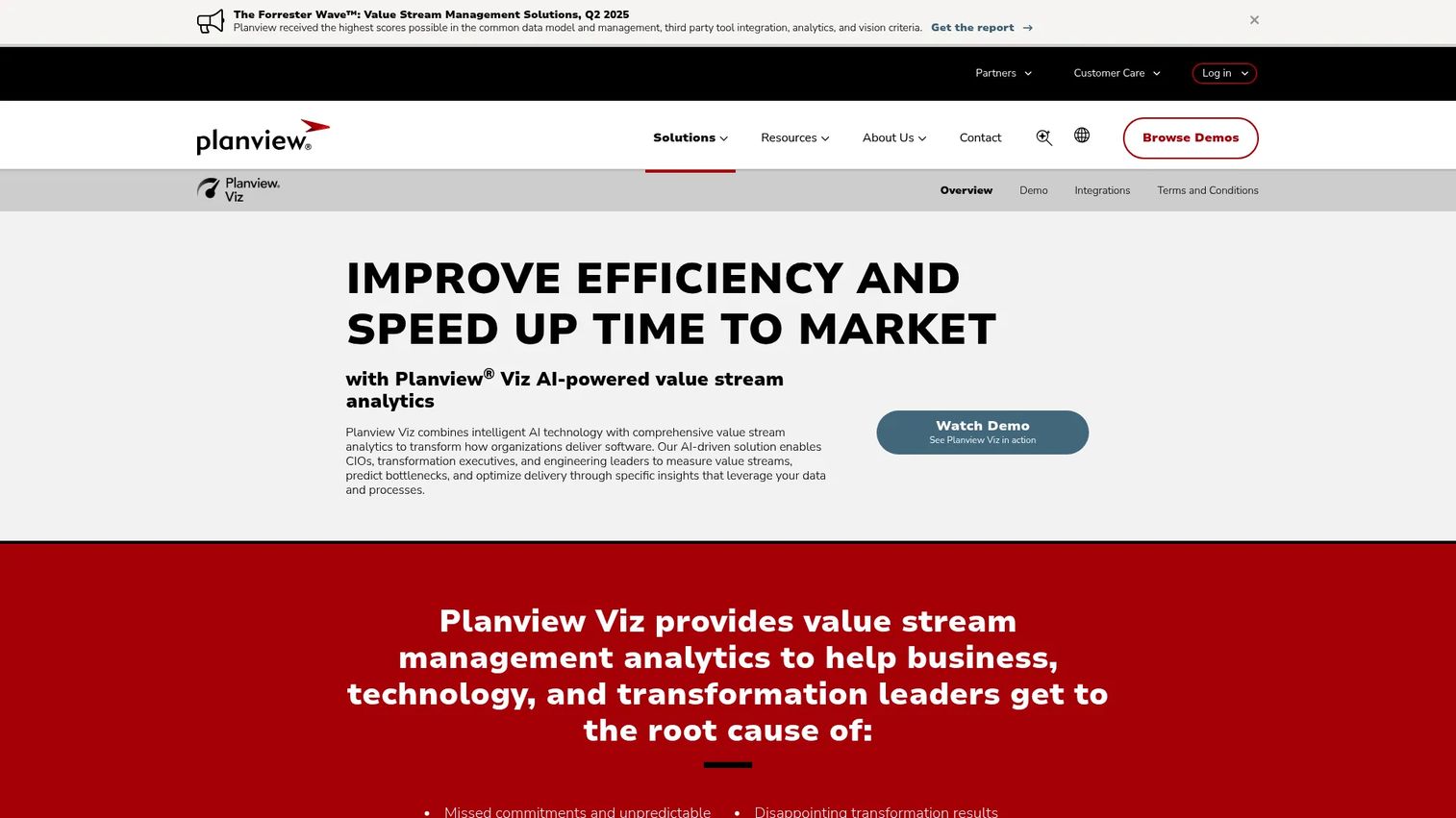
Planview Viz is an AI-powered value stream analytics platform that aggregates data from across the software delivery toolchain to surface flow metrics, bottlenecks, and delivery performance. It connects engineering delivery data to portfolio-level visibility, so technology and transformation leaders can see how work moves from idea to outcome across multiple teams. The platform includes flow modeling, generative AI features, and a secure architecture designed for enterprise scale.
Best for: Enterprise technology and transformation organizations that need portfolio-connected delivery visibility.
Key features
- Flow metrics dashboards: Lead time, cycle time, throughput, WIP
- Portfolio insights: Delivery data connected to portfolio decisions
- Flow modeling: Simulate the effect of process changes
- Bottleneck detection: Identify constraint points across connected tools
- Generative AI: AI-assisted analysis and recommendations
Why choose Planview Viz: Planview Viz earns its place when the primary problem is seeing how delivery performance connects to portfolio investment, not just measuring engineering throughput. PMs evaluating it should ask which planning, CI/CD, and incident tools their teams already use and confirm coverage before committing.
Planview Viz pricing: Contact their sales team for a quote; cost typically depends on modules, user count, and portfolio scale.
2. OpenText Core Software Delivery Platform
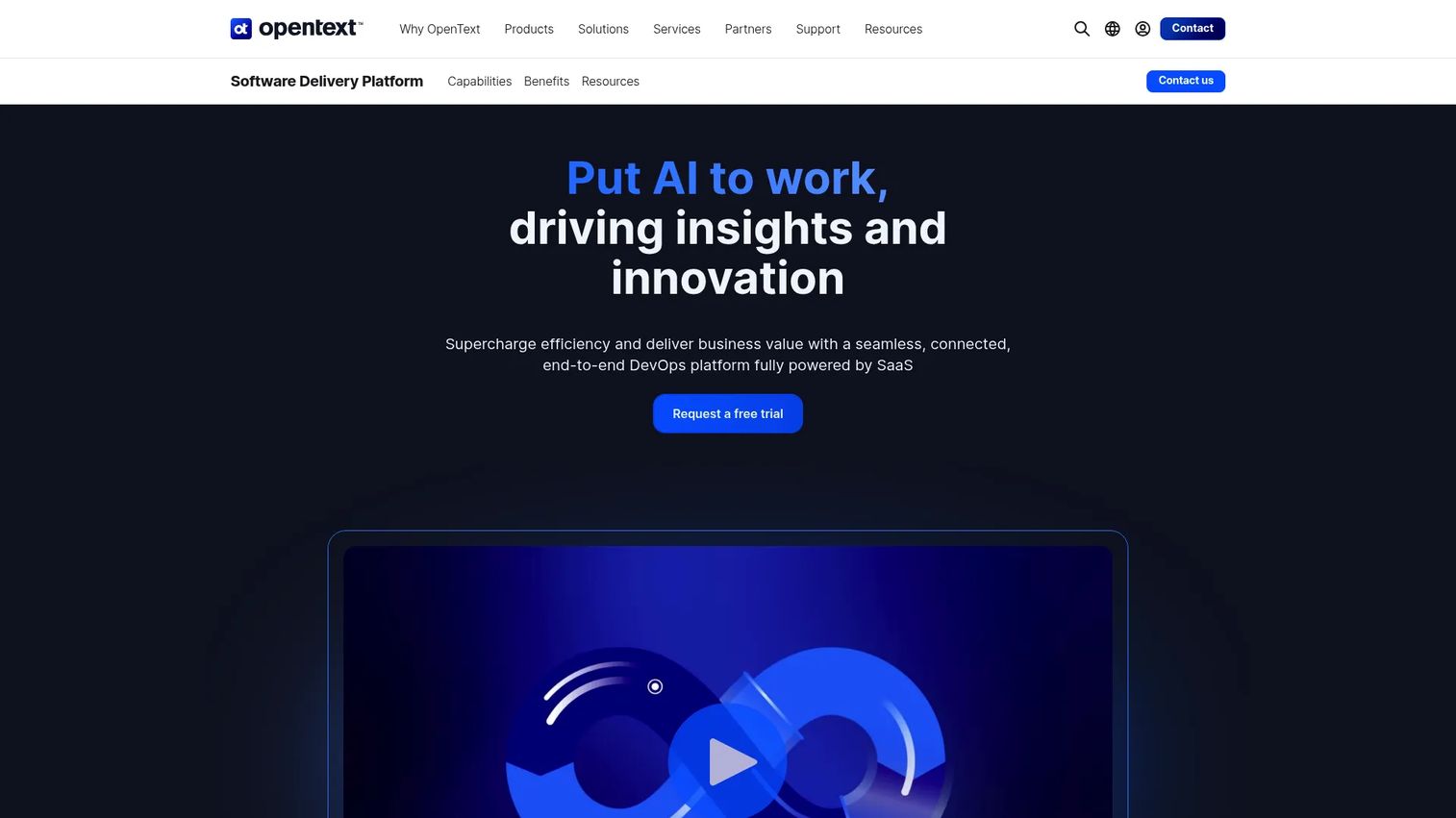
OpenText Core Software Delivery Platform is a SaaS-based, AI-powered DevOps platform covering the full software delivery lifecycle, from planning through testing, security, CI/CD, and release. Its DevOps Aviator feature uses AI to detect issues and surface recommendations inside delivery workflows. The platform offers a 30-day free trial so teams can evaluate before committing.
Best for: Regulated enterprises that need a connected DevOps environment spanning planning, quality management, and delivery governance.
Key features
- End-to-end DevOps integrations with delivery visibility and alerts
- Continuous testing with codeless automation support
- Unified CI/CD with embedded security findings and risk scoring
- AI-powered issue detection through DevOps Aviator
- Release governance and compliance reporting
Why choose OpenText Core Software Delivery Platform: This platform fits product managers operating inside compliance-heavy organizations where delivery must be auditable and quality gates formalized. It suits teams that want planning, testing, and delivery connected in a single environment rather than stitched together from point tools.
OpenText Core Software Delivery Platform pricing: A 30-day free trial is available; contact sales for enterprise pricing, which varies by modules and seat count.
3. ValueEdge
ValueEdge is OpenText's value stream management and DevOps platform, now also marketed under the OpenText Core Software Delivery Platform name. It covers agile planning, DevOps pipeline visibility, quality management, AI-assisted insights, and release tracking across the software delivery lifecycle. With over 100 integrations with commercial and open-source tools, it connects into most existing delivery stacks.
Best for: Enterprise software and IT teams that need agile planning, testing, and DevOps delivery managed in one connected environment.
Key features
- Agile planning and backlog management
- DevOps pipeline visibility and monitoring
- Quality management and test automation
- AI-assisted delivery recommendations
- Release tracking across connected tools
Why choose ValueEdge: Choose ValueEdge when you need a broad enterprise platform rather than a lightweight metrics layer. It suits organizations that want planning, quality, and DevOps delivery aligned under one governance model. Teams should confirm current branding with OpenText, as ValueEdge and Core Software Delivery Platform names are used interchangeably.
ValueEdge pricing: A 30-day free trial is available; teams need a quote from sales, with cost driven by modules, user count, and enterprise deployment scope.
4. ServiceNow Strategic Portfolio Management
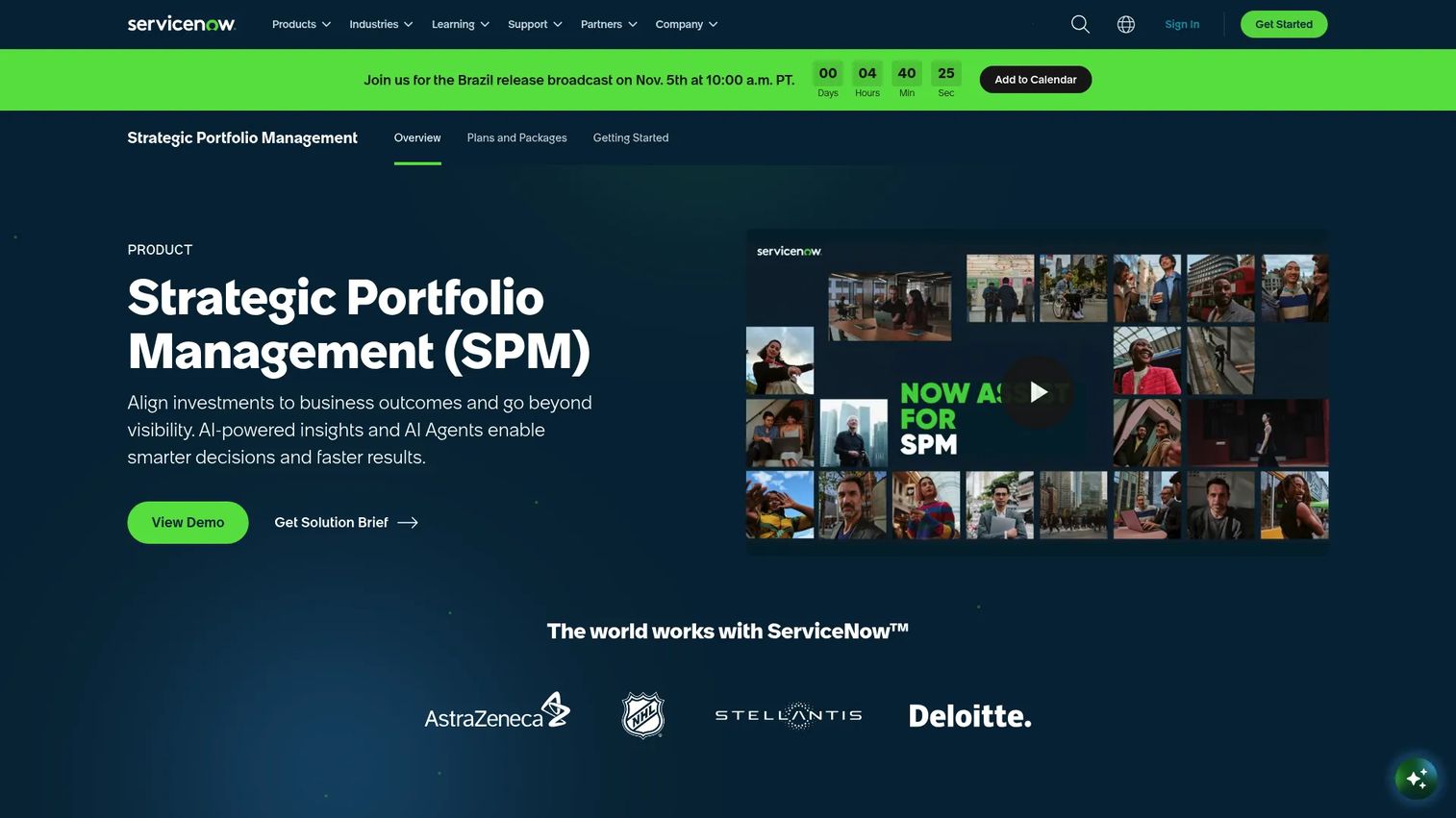
ServiceNow Strategic Portfolio Management connects strategic planning, portfolio roadmaps, investment tracking, and demand management inside the ServiceNow platform. It is built for enterprises that already rely on ServiceNow for operational workflows and want portfolio decisions connected to execution and delivery data. AI-powered features support goal alignment, scenario planning, and resource management.
Best for: Large enterprises already using ServiceNow that need strategy, investments, and delivery execution aligned on one platform.
Key features
- Strategic planning and OKR alignment
- Portfolio and roadmap management with scenario planning
- Investment and financial tracking
- Demand management and resource allocation
- Enterprise workflow integration within ServiceNow
Why choose ServiceNow Strategic Portfolio Management: This tool is a strong fit when leadership wants funded work connected to delivery outcomes inside the same environment used for IT operations. For product managers, it reduces the gap between roadmap decisions and what engineering is actually building. Evaluate it seriously only if ServiceNow is already central to your organization's operations.
ServiceNow Strategic Portfolio Management pricing: Request a custom quote; cost depends on ServiceNow modules, seat roles, and workflow scope.
G2 rating: 4.1/5
5. Digital.ai DevSecOps
Digital.ai DevSecOps is an AI-powered platform that integrates software planning, testing, application security, release orchestration, and deployment automation into a single delivery intelligence layer. It includes application protection features such as code obfuscation, runtime protection, and security gates for SAST, SCA, and DAST. A 30-day free trial is available for the Digital.ai Release SaaS product.
Best for: Enterprise teams that need delivery visibility and security governance across hybrid software delivery environments.
Key features
- Cross-toolchain delivery intelligence across planning, testing, and release
- Release orchestration and deployment automation
- Application protection: Obfuscation, anti-tampering, runtime monitoring
- Security gates integrating SAST, SCA, and DAST findings
- AI-assisted delivery risk tracking
Why choose Digital.ai DevSecOps: This platform suits organizations where VSM and DevSecOps are the same conversation: Regulated industries, government contractors, or teams where security review is embedded in every release. Product managers should evaluate whether security-aware delivery intelligence is what they need or whether a lighter flow analytics tool fits better.
Digital.ai DevSecOps pricing: Contact sales for a quote; cost typically reflects modules, pipelines, integrations, and security requirements.
G2 rating: 3.8/5
6. HCL Accelerate
HCL Accelerate is an enterprise value stream management and release orchestration platform formerly known as HCL DevOps Velocity. It provides value stream visualization, release lifecycle automation, pipeline analytics, bottleneck detection, and custom reporting across DevOps delivery workflows. Its tiered edition model includes a free Community Edition for teams that want to start without an upfront commitment.
Best for: Engineering and DevOps organizations that need release orchestration with built-in VSM analytics and deployment governance.
Key features
- Value stream visualization and mapping
- Release lifecycle automation and orchestration
- Pipeline analytics and deployment insight
- Bottleneck detection across delivery stages
- Custom reports, charts, and DevOps metrics
Why choose HCL Accelerate: HCL Accelerate earns its spot when the primary problem is release readiness and pipeline bottlenecks, not portfolio funding alignment. The free Community Edition (supporting two concurrent sessions) gives product and engineering teams a low-risk way to evaluate whether its VSM and release views solve their specific problem before scaling.
HCL Accelerate pricing: A free Community Edition is available with two concurrent session support. The Standard Edition supports unlimited sessions with 24/7 product support; pricing requires a quote from HCL. A 60-day Standard Edition trial is also available.
G2 rating: 4.6/5
7. Broadcom ValueOps VSM
Broadcom ValueOps VSM is a full enterprise VSM suite connecting strategic portfolio management, agile delivery through Rally, value stream integration via ConnectALL, and outcome intelligence through its Vaia AI engine. It covers funding decisions, agile team execution, automation, and ROI measurement under one platform. The suite is designed for large organizations managing multiple product lines with complex portfolio oversight requirements.
Best for: Large enterprises that need portfolio funding, agile delivery, and automation connected in a single VSM environment.
Key features
- Strategic portfolio management and investment alignment
- Agile enterprise management with Rally
- Value stream integration through ConnectALL
- Real-time enterprise analytics and ROI reporting
- AI-powered guidance through the Vaia engine
Why choose Broadcom ValueOps VSM: This is the right choice when the problem spans portfolio funding, agile delivery governance, and value stream automation simultaneously. It fits complex organizations more than teams looking for a focused delivery metrics dashboard. PMs should evaluate whether they need the full suite or whether a subset of these capabilities from a lighter tool resolves their specific gaps.
Broadcom ValueOps VSM pricing: Contact sales through the ValueOps site; cost reflects suite components, enterprise scale, and deployment model.
G2 rating: 4.5/5
8. Opsera
Opsera is a cloud-native unified DevOps platform combining toolchain automation, declarative no-code CI/CD orchestration, DORA metrics, governance, and AI-driven pipeline analysis through its Hummingbird AI engine. It supports 100+ native integrations and provides persona-based dashboards so engineering leaders, platform teams, and developers each see relevant delivery data. Compliance controls and integrated testing are built into the pipeline layer.
Best for: Enterprise engineering and platform teams that need automated, tool-agnostic CI/CD orchestration with delivery visibility and DORA metrics.
Key features
- No-code CI/CD pipeline builder with drag-and-drop workflows
- Unified DORA metrics, logs, and delivery analytics
- Toolchain automation and self-service provisioning
- Governance, compliance controls, and integrated testing
- Hummingbird AI for pipeline analysis and AI-assisted recommendations
Why choose Opsera: Choose Opsera when the main problem is standardizing and automating DevOps delivery workflows, not just reporting on them. For PMs, fewer hidden handoffs between delivery stages mean clearer release readiness signals. Evaluate whether DORA metrics and pipeline orchestration cover your VSM needs, or whether portfolio alignment requires an additional layer.
Opsera pricing: Opsera prices by user or pipeline count and directs teams to contact sales.
G2 rating: 4.6/5
9. Plandek
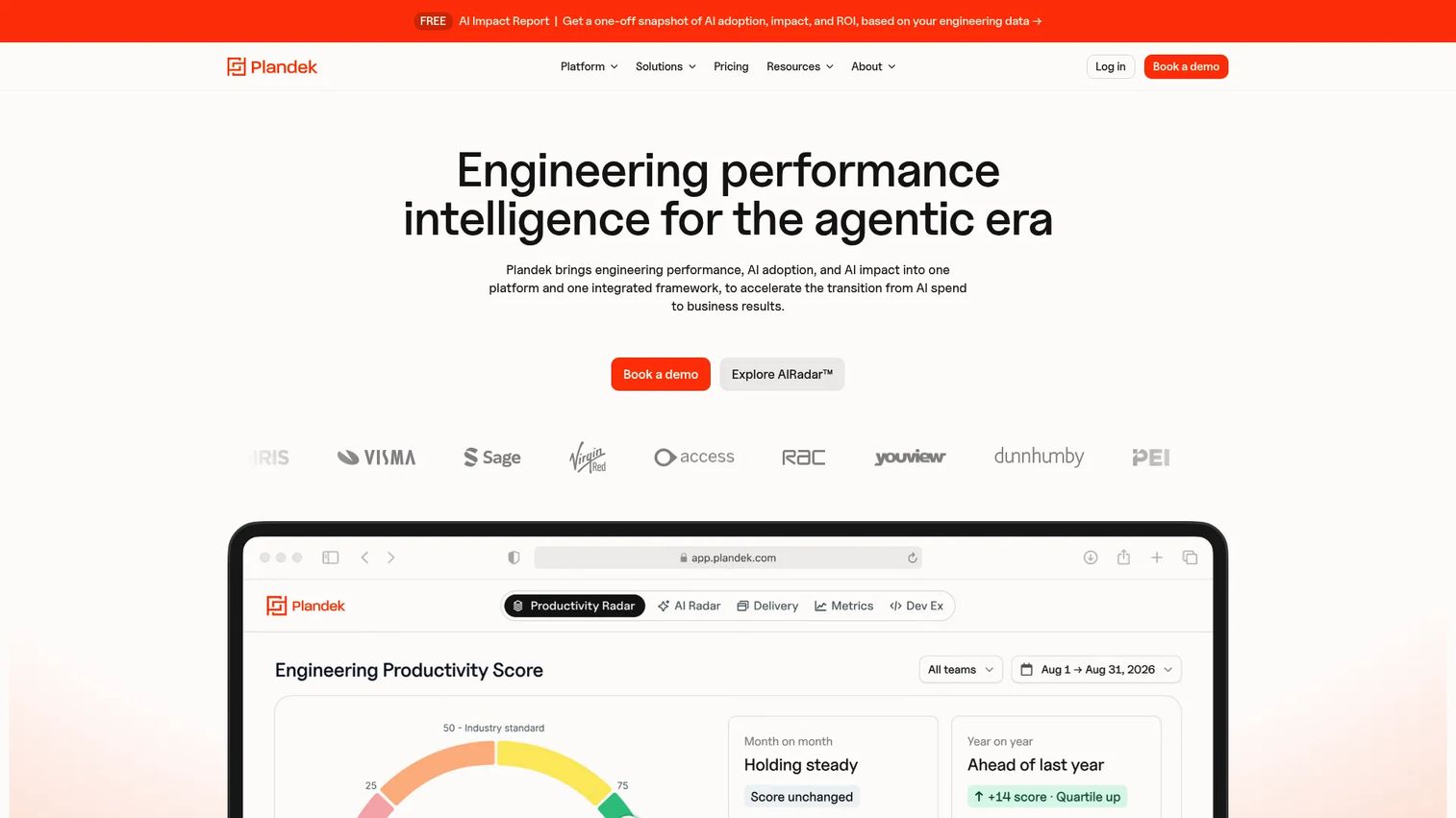
Plandek is an engineering performance intelligence platform for measuring AI impact, delivery performance, productivity, and developer experience. Its ProductivityRadar and DeliveryRadar modules give engineering leaders benchmarked visibility into team health and delivery forecasting. With 500+ configurable metrics, Dekka AI assistance, and integrations across Jira, GitLab, GitHub, Bitbucket, ADO, and CI/CD tools, it covers most engineering stacks without requiring a full enterprise suite.
Best for: Engineering and product organizations that want practical delivery analytics and DORA metrics without implementing an enterprise portfolio platform.
Key features
- ProductivityRadar: Benchmarked engineering productivity metrics
- DeliveryRadar: Delivery forecasting and risk management
- 500+ configurable engineering metrics and custom dashboards
- Developer experience surveys and analytics
- Dekka AI-driven engineering assistant
Why choose Plandek: Plandek is the strongest fit when you need meaningful delivery metrics quickly and your team does not have the appetite for a full enterprise VSM rollout. For product managers, it supports roadmap confidence by showing delivery predictability without requiring extensive implementation effort. It is more focused on engineering intelligence than on portfolio funding alignment.
Plandek pricing: A free AI Impact Report is available as a one-off. The Plandek Platform starts at $25 per contributor per month, with a range of $25 to $55 depending on contract duration and license count.
G2 rating: 4.5/5
10. CloudBees Platform
CloudBees Platform supports enterprise DevOps delivery across CI/CD (GitHub Actions, CloudBees CI, Jenkins), feature management, release orchestration, security and compliance, and delivery analytics. It is designed for heterogeneous engineering environments where multiple CI/CD platforms coexist. Its feature flag and progressive delivery capabilities add a product layer on top of standard DevOps tooling.
Best for: Large enterprises that need governed, scalable software delivery across diverse DevOps toolchains.
Key features
- CI/CD management across GitHub Actions, CloudBees CI, and Jenkins
- Multi-service release orchestration with approvals and rollback
- Feature flags, targeting rules, and progressive delivery
- Application security and vulnerability remediation
- Analytics for delivery, security, and business metrics
Why choose CloudBees Platform: CloudBees fits teams where the core problem is delivery orchestration and governance across multiple CI/CD environments. PMs should distinguish whether the main need is pipeline standardization, feature management, or flow analytics before selecting it; the platform handles all three but it is strongest on the delivery orchestration side.
CloudBees Platform pricing: CloudBees uses custom pricing. Contact sales through their pricing page; cost depends on modules, users, runners, and enterprise support requirements.
G2 rating: 4.4/5
11. ConnectALL Value Stream Management Platform
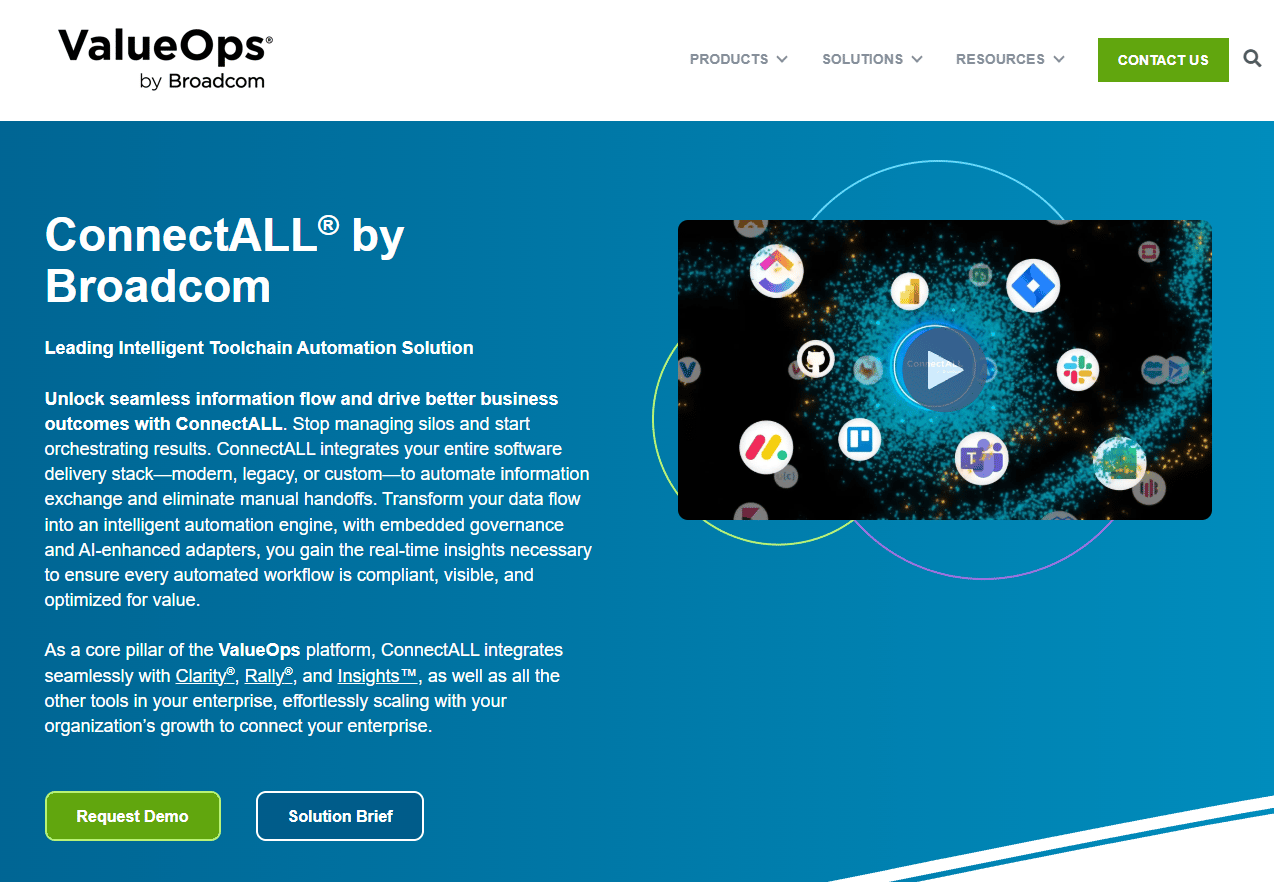
ConnectALL Value Stream Management Platform focuses on value stream management, toolchain integration, and workflow automation across software delivery systems. It provides metrics tracking, workflow orchestration, governance controls, and integration with DevOps tools to give teams a connected view of delivery data without requiring tool replacement. It is now part of the Broadcom ValueOps suite.
Best for: Organizations with fragmented delivery toolchains that need synchronized value stream data without replacing existing tools.
Key features
- Toolchain integration across DevOps and delivery tools
- Value stream automation and workflow orchestration
- Metrics tracking and delivery analytics
- Data synchronization across connected systems
- Governance and compliance controls
Why choose ConnectALL Value Stream Management Platform: ConnectALL earns its place when the hard problem is connecting existing tools rather than replacing them. For PMs, this means fewer manual updates across disconnected planning and delivery systems, with flow data aggregated automatically. Teams that are evaluating ConnectALL as a standalone product should note its integration with the Broadcom ValueOps suite.
ConnectALL Value Stream Management Platform pricing: Contact their team for a quote; cost typically reflects connectors, value streams, users, and automation volume.
G2 rating: 4.4/5
12. Dragonboat
Dragonboat is a product portfolio operating platform connecting strategy, intake, roadmapping, delivery, and outcomes across the product development lifecycle. Its AI-powered prioritization, OKR tracking, scenario planning, and headless API access make it a strong fit for product organizations that need to connect portfolio decisions to measurable results. Read-only users and requestors are free up to 100 seats.
Best for: Product organizations connecting portfolio strategy, roadmap planning, and delivery outcomes in a product operating model.
Key features
- AI-powered prioritization and intake management
- Portfolio roadmapping and scenario planning
- OKR, investment, and outcome tracking
- End-to-end product development lifecycle management
- APIs, MCP, and agent integrations for headless access
Why choose Dragonboat: Dragonboat is closest to VSM on the product portfolio and operating model side, not the CI/CD analytics side. It fits product managers who need to show that funded initiatives moved from strategy to shipped outcome, particularly when reporting to leadership requires more than engineering metrics. Teams that also need DevOps pipeline intelligence will want to pair it with a delivery analytics tool.
Dragonboat pricing: Dragonboat offers Essential and Enterprise plans, both priced by quote. Contact their sales team; cost depends on team size, organizational complexity, and integration requirements.
G2 rating: 4.8/5
13. IBM UrbanCode Velocity
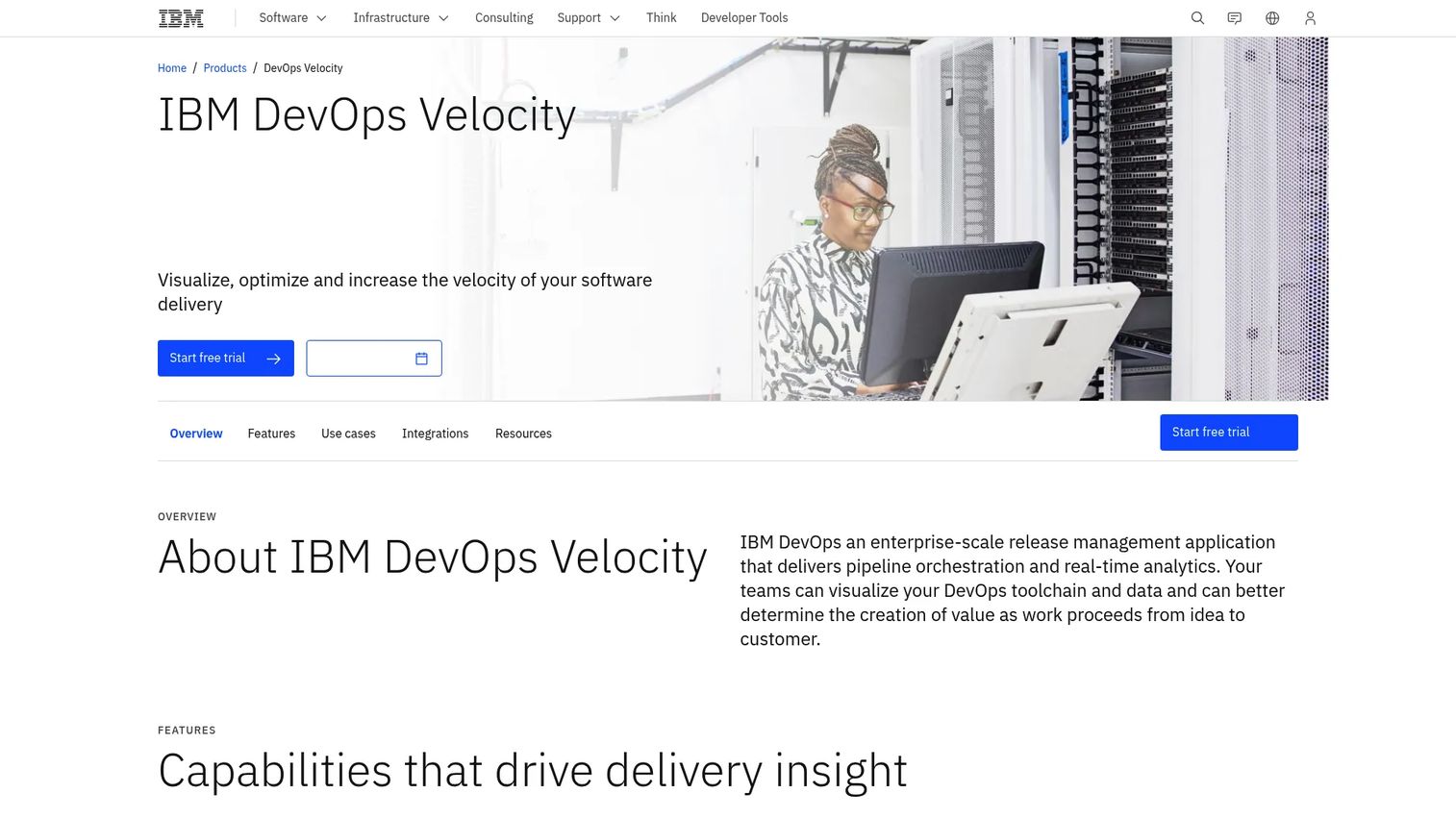
IBM UrbanCode Velocity, now also referenced as IBM DevOps Velocity from version 5.0 onward, is an enterprise release management and DevOps value stream platform. It handles release orchestration workflows, pipeline management, value stream visualization, delivery analytics, and toolchain integrations. A free Community Edition with two concurrent session support gives smaller teams an entry point before committing to the Standard Edition.
Best for: Enterprise DevOps teams managing complex release pipelines, integrations, and delivery governance in IBM-adjacent environments.
Key features
- Automated release orchestration workflows
- Value stream visualization and pipeline management
- Real-time delivery visibility and reporting
- Toolchain integrations across delivery systems
- Advanced analytics and delivery metrics
Why choose IBM UrbanCode Velocity: IBM UrbanCode Velocity fits organizations with complex release pipelines that need governance, audit trails, and delivery analytics in one place. For product managers, it connects release confidence to late-stage delivery risk in ways that simpler ticketing views cannot. Teams that are not already in an IBM infrastructure context should evaluate whether a lighter tool covers the same need at lower implementation cost.
IBM UrbanCode Velocity pricing: A free Community Edition supports two concurrent sessions. The 60-day Standard Edition trial supports full features; Standard Edition paid pricing is not publicly listed and requires a quote from IBM.
G2 rating: 4.1/5
14. Kovair DevOps
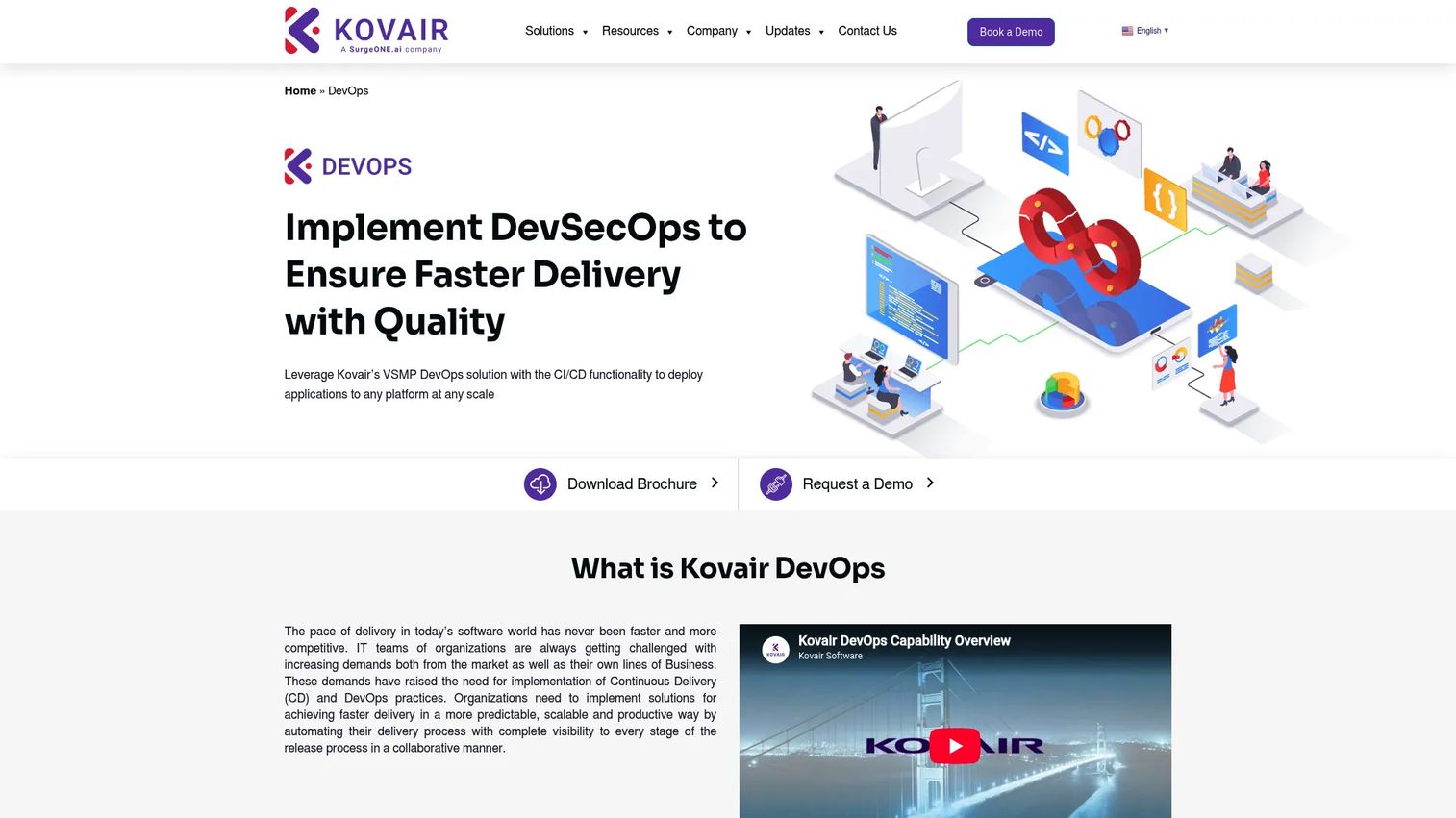
Kovair DevOps is an enterprise DevOps platform for orchestrating software delivery from code through testing and deployment. Its Omnibus integration framework connects ALM systems, DevOps tools, and delivery workflows across both legacy and modern environments. The platform includes DORA metrics, real-time dashboards, pipeline-as-a-code support, and distributed builds with multiple agents.
Best for: Organizations that need to integrate ALM and DevOps toolchains across diverse, often legacy, delivery environments.
Key features
- Task-based release pipelines with parallel and sequential execution
- Continuous build and deployment across on-premises, cloud, and containers
- Continuous testing: Functional, integration, load, API, and security
- Real-time DORA metrics, reports, and dashboards
- Pipeline-as-a-code with distributed builds and multiple agents
Why choose Kovair DevOps: Kovair earns consideration when the challenge is connecting legacy ALM tools to modern DevOps workflows without full replacement. PMs evaluating it should audit connector coverage carefully: The value of an integration platform depends entirely on whether it reaches your specific tools and maps data cleanly across them.
Kovair DevOps pricing: Contact their team for a quote; cost typically depends on connectors, users, support tier, and deployment model.
G2 rating: 4.0/5
15. ServiceNow DevOps
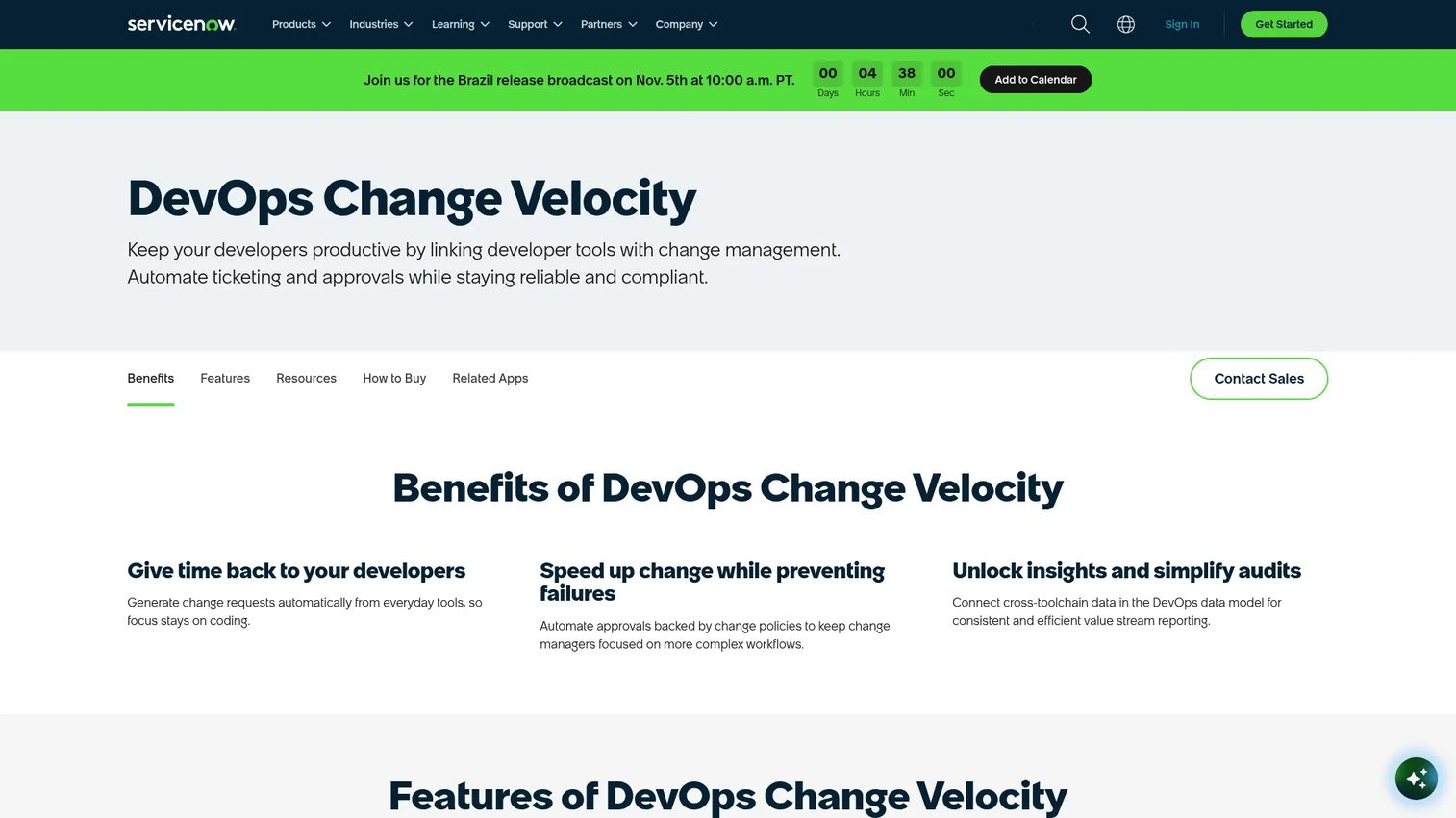
ServiceNow DevOps connects DevOps toolchain data into ServiceNow workflows, automating change request creation and approval, integrating delivery data with IT operations, and providing cross-toolchain visibility for teams already managing change management inside ServiceNow. Its cross-toolchain data model supports value stream reporting and audit trails.
Best for: ServiceNow customers who want DevOps toolchain data connected to change management and IT operations workflows.
Key features
- DevOps integrations across planning, build, testing, and delivery
- Automated change-request creation and approval workflows
- Cross-toolchain data model for value stream reporting
- Toolchain visibility and risk tracking
- ServiceNow workflow integration for change and release
Why choose ServiceNow DevOps: ServiceNow DevOps is the right choice when your organization manages IT change inside ServiceNow and wants delivery data connected to that process automatically. Product managers should evaluate whether they primarily need delivery visibility tied to IT change governance, or a more product-centric VSM layer. The two needs overlap but are not identical.
ServiceNow DevOps pricing: Contact their sales team for a quote; cost depends on ServiceNow modules, user roles, and integration scope.
G2 rating: 4.5/5
Considerations when choosing value stream management software
Start with the decision you need to improve
Before evaluating tools, name the specific decision that currently lacks evidence. Is it release predictability? Portfolio investment returns? Engineering throughput? DORA metric targets? A tool chosen to answer a vague "we need VSM visibility" question rarely gets used. Identify the one or two decisions that need better data, then evaluate platforms against those.
Check your toolchain reality
VSM software depends on what it can connect to. Before shortlisting vendors, map your actual toolchain: Which planning tool, code repositories, CI/CD system, testing platform, incident tool, and portfolio layer your teams use. Confirm each vendor's connector coverage for those specific tools. A platform with 100+ integrations that does not reach your Jira, GitHub Actions, and PagerDuty combination adds no value.
Separate flow metrics from outcome metrics
Flow metrics tell you whether work moves: Lead time, cycle time, WIP, throughput. Outcome metrics tell you whether the work mattered: Adoption rates, revenue impact, NPS change, support ticket reduction. The best VSM setup surfaces both without collapsing them into a single score. Ask each vendor how their platform distinguishes delivery performance from business outcomes.
Evaluate governance and data trust
If teams distrust the data in a dashboard, they stop using it. Ask how each tool handles metric definitions, data normalization across tools, permission controls, and executive reporting. A VSM tool that surfaces different numbers from different views, or whose definitions are opaque, creates more reporting friction than it removes.
Plan for adoption before implementation
VSM software changes how teams operate, not just what they can see. Identify who owns each value stream view, what cadence reviews happen, and what actions follow a bottleneck finding. Tools succeed when they connect to real operating rituals. Without a named owner and a weekly or biweekly review meeting, dashboards become wallpaper.
Conclusion
The 15 tools in this guide cover five distinct operating models for value stream management software. For enterprise portfolio visibility, Planview Viz, Broadcom ValueOps VSM, and ServiceNow Strategic Portfolio Management each connect strategy and delivery in different ways. For governed software delivery, OpenText Core Software Delivery Platform and ValueEdge provide end-to-end SaaS DevOps environments. For DevOps pipeline analytics and release intelligence, HCL Accelerate, CloudBees Platform, IBM UrbanCode Velocity, and ServiceNow DevOps each specialize in different parts of the pipeline. For toolchain integration and automation, ConnectALL, Opsera, and Kovair DevOps reduce manual handoffs across delivery systems. For product and engineering delivery insight without an enterprise rollout, Plandek and Dragonboat are the most accessible starting points.
The practical next step: Identify the delivery decision that currently lacks evidence, map your toolchain, and shortlist two or three vendors whose integration coverage matches what you actually use. Start with one value stream before scaling to a portfolio.
If your team also needs a clearer way to show product value to stakeholders, prospects, or users, interactive product experiences complement delivery metrics by making what you ship visible to the people who need to understand it.
Start your journey with Guideflow today!
FAQs
Value stream management software helps teams visualize, measure, and improve how work moves from idea to customer value across product, engineering, DevOps, and portfolio workflows. It connects data from planning, development, testing, release, and operations tools into a unified view so teams can spot bottlenecks, track delivery performance, and connect shipped work to business outcomes.
Value stream mapping is a visual workshop exercise that diagrams how work flows from request to delivery, usually done as a one-time or periodic exercise. VSM software turns that static map into ongoing automated measurement by pulling data from connected toolchain systems. The software continuously refreshes the picture rather than requiring a manual mapping exercise each quarter.
The most useful metrics fall into three groups. Flow metrics cover lead time, cycle time, work in progress, and throughput; they show how work moves through the delivery system. DORA metrics cover deployment frequency, lead time for changes, mean time to restore (MTTR), and change failure rate; they measure delivery performance and reliability. Business outcome metrics cover adoption rates, revenue impact, and support deflection; they answer whether the delivered work produced meaningful results.
No. DevOps teams are heavy users, but product, portfolio, engineering operations, and transformation leaders all use VSM software for different reasons. Product managers use it to track release predictability and delivery risk. Portfolio leaders use it to connect funded initiatives to delivery and outcome data. Transformation leaders use it to measure whether agile or DevOps adoption is producing measurable flow improvements.
Product managers use VSM software to understand where delivery slows down, which dependencies are blocking roadmap commitments, and whether investment is moving toward customer value or accumulating in queues. It reduces the need to run manual status calls by surfacing delivery risk in a dashboard. It also helps PMs report to leadership with delivery data rather than anecdote.
Project management software tracks tasks, owners, and dates inside a single delivery cycle. VSM software measures how value moves across the entire system, including queues between stages, handoffs across teams, deployment frequency, and whether outcomes matched investment. Project management answers "is this task done?" VSM answers "is the right work moving fast enough and landing correctly?"
Implementation time depends on toolchain complexity, data quality, and how many teams participate. A focused rollout covering one value stream with a small toolchain can produce usable data in weeks. Enterprise rollouts covering multiple product lines and dozens of integrations typically take several months. Starting with one value stream and expanding after the first review cycle is consistently more successful than a full portfolio rollout at once.
Enterprises should evaluate toolchain integration depth for their specific tools, metric definition transparency, executive reporting capabilities, role-based permissions and audit controls, security and compliance certifications, and support for continuous improvement rituals rather than one-time reporting. See also our guide to application release orchestration tools for the CI/CD layer that feeds most VSM platforms.
DORA metrics (deployment frequency, lead time for changes, change failure rate, and MTTR) measure software delivery performance and are a subset of what VSM software tracks. Many VSM platforms expose DORA metrics as a standard dashboard. The distinction is that DORA metrics focus specifically on engineering reliability, while VSM software also covers portfolio alignment, flow across the full delivery lifecycle, and business outcome measurement.
HCL Accelerate and IBM UrbanCode Velocity both offer free Community Editions supporting two concurrent sessions, with paid Standard Editions for unlimited sessions. Plandek offers a free one-off AI Impact Report before requiring a platform subscription starting at $25 per contributor per month. These options let teams validate fit before committing to enterprise pricing conversations. For broader software management context, see our guide to best product management tools.