If you're evaluating Userlane alternatives, the category is wider than it first appears. Userlane is a software adoption platform built around application intelligence and contextual assistance. When reps need process training inside actual tools, that job often calls for something different - an interactive demo platform for step-by-step internal guides, a lightweight onboarding builder, an enterprise digital adoption platform, or an analytics-first product experience tool.
This list covers 15 tools across those categories: Guideflow for interactive internal training, WalkMe and Whatfix as enterprise digital adoption platforms, Userflow and Appcues for product onboarding, Intercom and HelpHero for support-led guidance, Userpilot and Usertour for product growth, Pendo and Gainsight PX for adoption analytics, and Product Fruits, UserGuiding, Usetiful, and Newired rounding out the field. Guideflow is the top pick for sales enablement teams that need interactive internal training without engineering overhead.
TL;DR
- Best for interactive internal training: Guideflow. Record software once, then share step-by-step interactive guides for rep onboarding, SOPs, and CRM process training.
- Best enterprise digital adoption platforms: WalkMe and Whatfix, for large-scale employee software adoption with governance and contextual assistance across multiple applications.
- Best for product onboarding: Appcues, Userflow, Userpilot, Usertour, Product Fruits, UserGuiding, and Usetiful serve customer-facing onboarding teams.
- Best adoption analytics: Pendo (4.4/5 on G2) and Gainsight PX (4.4/5 on G2) for product usage insights and account-level adoption signals.
- Best for support-led onboarding: Intercom and HelpHero when onboarding sits close to help center content and customer messaging.
- The list covers 15 tools across interactive guide platforms, enterprise DAPs, product adoption platforms, and customer messaging tools. Pricing ranges from free tiers to quote-only enterprise contracts.
What's inside
- What Userlane is and when it fits.
- Why teams look for Userlane alternatives (with sourced pain points).
- A 15-tool comparison table with category labels, G2 ratings, free-plan status, and starting prices.
- Ranked cards for all 15 tools, ordered by fit for internal training and software adoption.
- Use-case routing by job: Internal training, enterprise DAP, product onboarding, analytics, support-led guidance.
- FAQs for buyers comparing Userlane alternatives.
What is Userlane?
Userlane is a software adoption platform focused on application intelligence, contextual assistance, and in-app guidance for enterprise applications. It is built for organizations managing software adoption at scale, particularly in regulated industries where measuring adoption health across a portfolio of business applications matters as much as onboarding speed.
Core jobs Userlane is typically evaluated for:
- In-app guidance and contextual assistance within business software.
- Adoption measurement and behavioral analytics across applications.
- Employee software adoption programs in regulated enterprises.
- Contextual support for complex internal workflows.
Userlane's strengths sit in portfolio-level software adoption, not lightweight training guides or product-led onboarding flows. Teams that mainly need rep-facing SOPs or interactive internal training guides often find the category mismatch before they find a pricing problem.
Why teams look for Userlane alternatives
Teams typically compare Userlane alternatives when they need a different fit for training scope, implementation effort, pricing model, or product onboarding workflows.
They need interactive internal training, not a full enterprise DAP
Sales Enablement Managers often need something specific: Step-by-step interactive guides for rep onboarding, CRM process training, and launch enablement. A company-wide digital adoption program is a different buying decision, usually led by IT or HR. When the primary job is keeping reps trained on sales tools, the full DAP architecture adds overhead that the enablement team doesn't need or control.
They want content that stays current without a rebuild
Stale SOPs are a recurring pain. Product updates, RevOps process changes, and CRM reconfigurations make training content obsolete quickly. Teams leaving enterprise DAPs frequently cite maintenance overhead in G2 reviews, specifically the effort required to update guidance content after each software release. Platforms where you can recapture or edit individual steps reduce that cost considerably.
They need different analytics
Userlane's analytics are oriented toward application-level adoption health. Sales enablement teams care about different signals: Did reps complete the training, which steps caused drop-off, and are CRM workflows being executed correctly? Those are behavior-change metrics, not application portfolio metrics.
Implementation and pricing fit
Enterprise DAPs typically involve a sales conversation before you see a price. Product onboarding tools often publish tiered SaaS pricing with free tiers or trials. For enablement teams that need to move fast and show value inside a quarter, the buying cycle for an enterprise DAP is a friction point independent of the platform's capability.
How we picked these Userlane alternatives
Candidates were evaluated on fit for internal training and software adoption, ability to support employee onboarding or in-app guidance, pricing availability, G2 rating and review themes, and suitability for Sales Enablement Managers and RevOps-adjacent teams. Pricing comes from vendor pricing pages where available, and ratings come from G2.
The list spans two distinct categories: Interactive guide platforms (Guideflow) and digital adoption platforms or product onboarding tools (everyone else). That split matters. Choosing a tool in the wrong category for your job produces the same friction Userlane creates for teams whose real need is an interactive internal training platform.
According to Research and Markets (2026), the global digital adoption platforms market was valued at US$792.3 million in 2025 and is projected to reach US$3.5 billion by 2032. The category is growing fast, which means more options at every price point and use case.
Userlane alternatives at a glance
Guideflow leads as the best pick for interactive internal training. The rest of the field splits between enterprise digital adoption platforms, product onboarding tools, and customer messaging platforms. Use the Category column to filter by your actual job.
| Tool | Category | Best for | G2 rating | Free plan | Starting price |
|---|---|---|---|---|---|
| Guideflow | Interactive guide platform | Internal training, employee onboarding, SOPs, sales enablement | 5.0/5 | Yes | $0 (Free); paid from $35/user/month |
| WalkMe | Enterprise digital adoption platform | Large-scale employee software adoption | 4.6/5 | No | Custom quote |
| Whatfix | Enterprise digital adoption platform | Contextual in-app guidance, regulated enterprise training | 4.6/5 | No | Custom quote |
| Userflow | Product onboarding platform | SaaS onboarding flows and product-led teams | 4.8/5 | No | $240/month (annual) |
| Appcues | Product adoption platform | No-code customer onboarding and feature adoption | 4.6/5 | No | $3,600/year |
| Intercom | Customer messaging platform | Support-led onboarding and in-app help | 4.5/5 | No | $19/seat/month (annual) |
| HelpHero | In-app onboarding platform | Affordable help-center connected product guidance | 4.9/5 | No | $55/month |
| Userpilot | Product growth platform | Product adoption analytics and onboarding | 4.6/5 | No | $299/month |
| Usertour | Product onboarding platform | Lightweight onboarding flows and checklists | 4.7 | Yes | $0 (Hobby); paid from $59/month |
| Pendo | Product experience platform | Product analytics and adoption measurement | 4.4/5 | Yes | Free plan available |
| Gainsight PX | Product experience platform | Customer success and product adoption insights | 4.4/5 | No | Custom quote |
| Product Fruits | Product adoption platform | Affordable onboarding and in-app guidance | 4.6/5 | No | $111/month (annual) |
| UserGuiding | User onboarding platform | No-code onboarding checklists and guides | 4.7/5 | No | $249/month |
| Usetiful | Digital adoption platform | In-app guidance; now part of Fullstory | 4.4 | No | Contact Fullstory |
| Newired | Digital adoption platform | Enterprise process guidance and software training | 4.6 | No | Custom quote |
The best Userlane alternatives in 2026
The tools below are ranked by fit for internal training and software adoption use cases. Enterprise DAPs appear early because they overlap most closely with Userlane's category. Product onboarding and analytics tools follow, ordered by relevance for enablement and CS teams.
1. Guideflow (interactive guide platform)
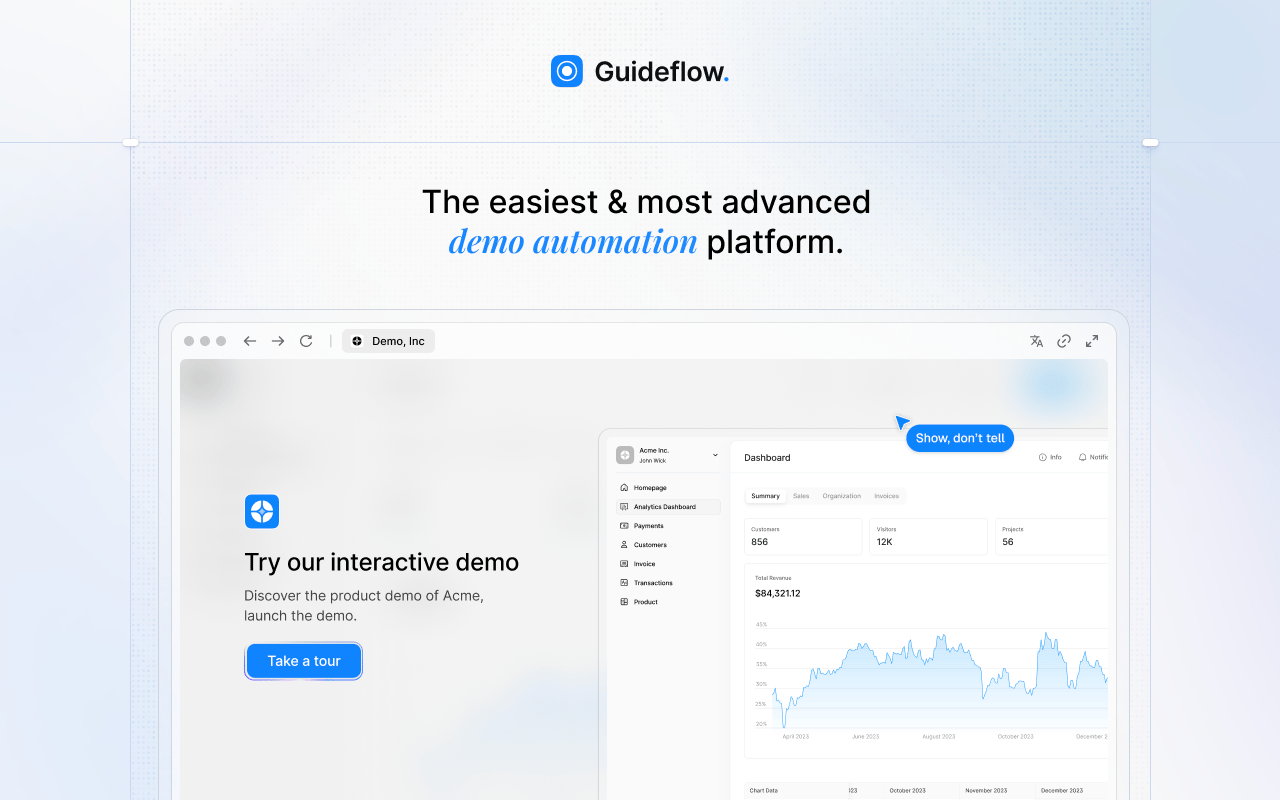
Guideflow is a demo automation platform that sales enablement and training teams use as an interactive guide platform for internal audiences. You capture software flows through the Chrome extension or the native app, and the platform generates step-by-step interactive guides automatically. The result is something reps can click through on their own, at their own pace, without scheduling a live session.
Best for: Sales enablement teams that need interactive internal guides for rep onboarding, SOPs, launch enablement, and CRM process training.
What it is: Guideflow is a demo automation platform supporting interactive demos, demo pages, demo centers, sandboxes, live demos, and mobile demos. Teams use the same platform for internal training guides and for external buyer-facing product experiences, depending on the audience and the job.
Key features:
- Capture via Chrome extension or native app across screenshot, HTML, and video modes
- Editor supporting text, images, graphs, and branching paths
- Step content and CTAs written automatically
- Step-level completion, drop-off, and viewer flow analytics
- Translation into more than 30 languages
- Integrations with HubSpot, Salesforce, Pipedrive, Zoho, and Marketo
Where Guideflow falls short:
- Look elsewhere first if you need a formal LMS with course catalogs, quizzes, certifications, and SCORM management. Guideflow handles step-by-step interactive guides, not structured learning paths with graded assessments.
- Teams whose primary need is a company-wide digital adoption program across dozens of enterprise applications will want to evaluate WalkMe or Whatfix alongside it.
Pricing: Free plan available. Paid plans: Solo at $35 per user per month, Growth at $499 per month, Advanced at $1,499 per month, Enterprise from $2,999 per month. All prices are annual rates.
G2 rating: 5.0/5
How it compares to Userlane: Guideflow fits when the job is interactive internal training and rep-facing guides, not portfolio-level software adoption management. If you need step-by-step onboarding for a CRM rollout or SOP library for new hires, Guideflow covers that job directly. Userlane's application intelligence and contextual assistance layer is built for a broader enterprise adoption program.
2. WalkMe (enterprise digital adoption platform)
WalkMe is one of the most established names in enterprise software adoption. It is built for large organizations that need to guide employees through business applications at scale, and it sits in the same category as Userlane.
Best for: Enterprise organizations rolling out software adoption programs across multiple business applications with governance and analytics requirements.
What it is: WalkMe is a cloud-based digital adoption platform that provides in-app guidance, workflow automation, contextual AI assistance, and behavioral analytics. It supports desktop, web, and mobile applications and is used by enterprise IT, HR, and operations teams.
Key features:
- In-app step-by-step guidance and contextual tooltips
- Workflow automation and smart audience targeting
- Behavioral analytics and enterprise reporting
- AI-powered contextual assistance
- Surveys and feedback collection
Where WalkMe falls short:
- G2 reviewers frequently note a steep implementation and administration learning curve. Getting the platform configured and maintained requires dedicated technical resources.
- Pricing is quote-only with no public tiers, which makes it hard to run a quick budget evaluation without a sales conversation.
Pricing: Custom quote.
G2 rating: 4.6/5
How it compares to Userlane: Both are enterprise DAPs targeting employee software adoption. WalkMe's breadth of automation and AI features may suit teams with complex multi-application environments. The implementation commitment is comparable.
3. Whatfix (enterprise digital adoption platform)
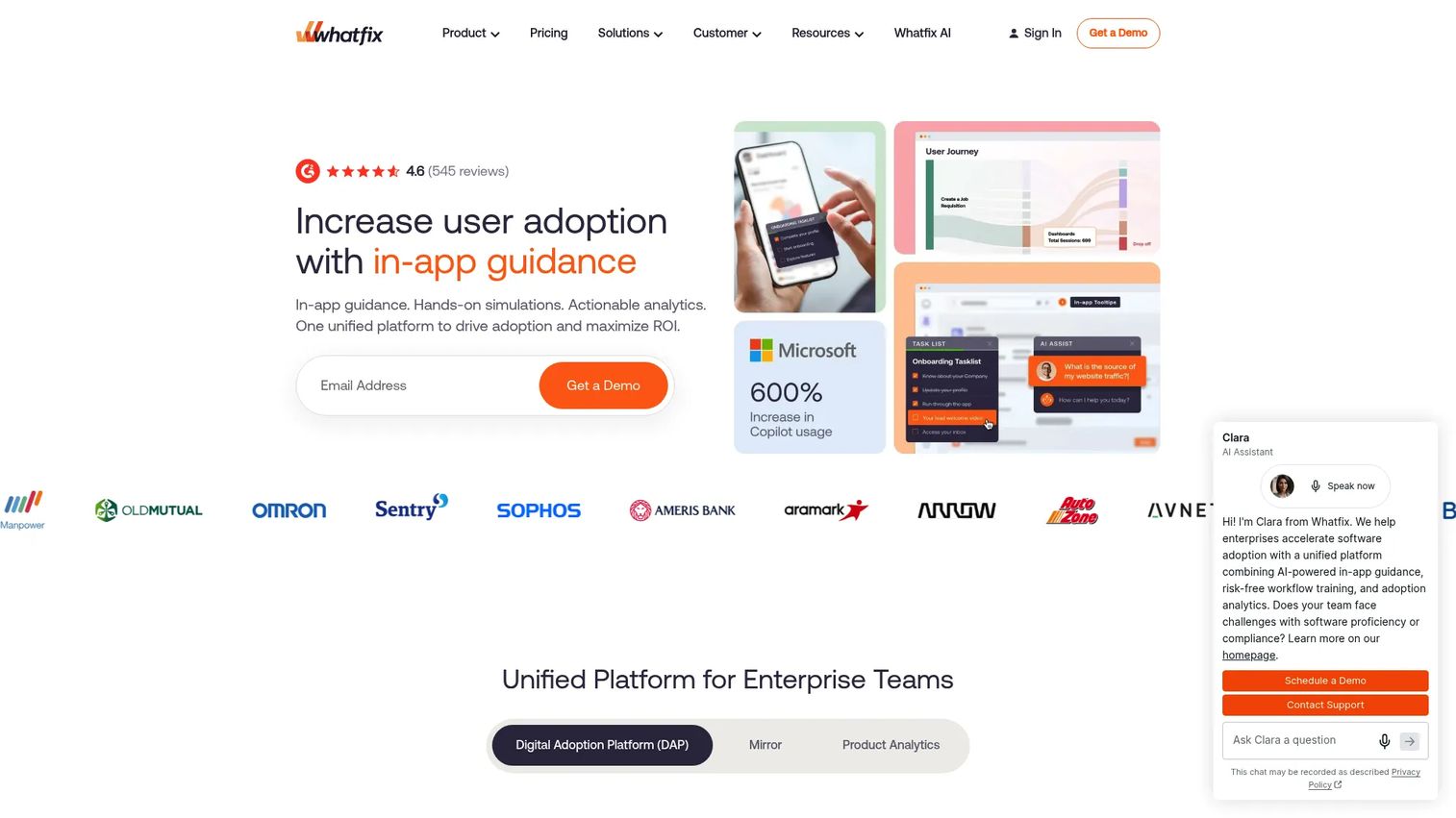
Whatfix positions itself on AI-powered guidance across enterprise applications, with a particular emphasis on content lifecycle management and simulated training environments.
Best for: Enterprise teams that need guided in-app support, governance across internal applications, and AI-assisted content authoring.
What it is: Whatfix is a digital adoption platform for employee onboarding, in-app guidance, task automation, and adoption analytics. It supports a flat per-application fee plus user license model.
Key features:
- In-app guidance and self-help widgets
- AI-powered content authoring and usage analytics
- Application simulations and AI roleplay for training
- Content lifecycle management with versioning
- Surveys and feedback collection
Where Whatfix falls short:
- G2 reviewers note that setup and configuration require significant time investment, particularly when deploying across complex enterprise applications.
- The pricing model (flat per-application fee plus per-user licenses) can become expensive when application scope grows. No public numeric pricing is displayed.
Pricing: Standard, Premium, and Enterprise plans, all custom-quoted. Contact Whatfix for pricing.
G2 rating: 4.6/5
How it compares to Userlane: Whatfix and Userlane share the same category. Whatfix's AI simulation layer gives it a training-depth angle that some enterprises prefer. For teams that care about contextual assistance at the application level, both are worth evaluating.
4. Userflow (product onboarding platform)
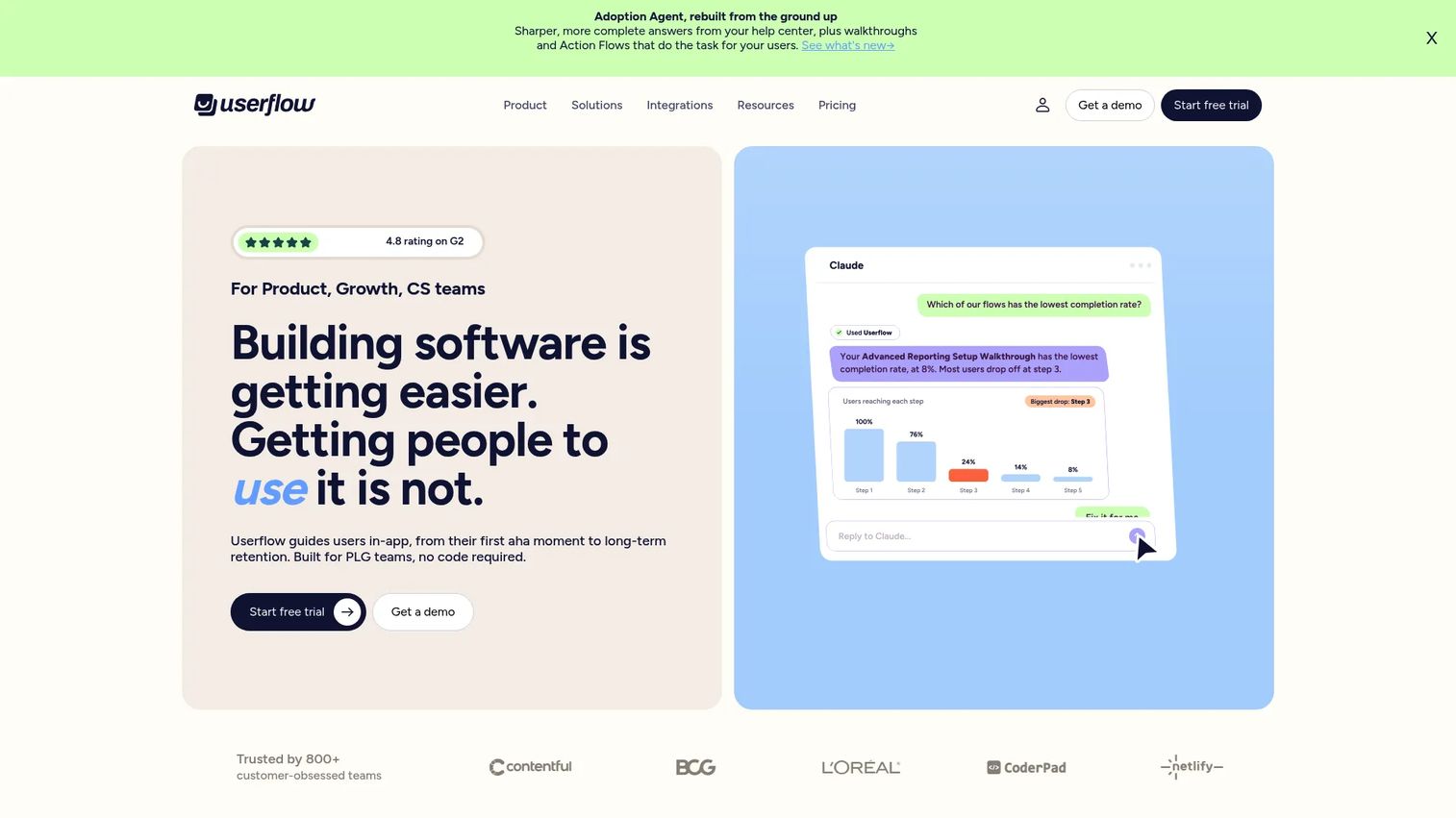
Userflow is an AI-assisted product onboarding platform built for SaaS product and growth teams. It is not an enterprise DAP and does not target internal employee adoption at scale.
Best for: SaaS product teams creating in-app onboarding flows, checklists, and product adoption experiences for external users.
What it is: Userflow is a product onboarding platform with no-code builders for flows, checklists, tooltips, announcements, surveys, and resource centers. It includes AI-assisted flow building, translation, and an Adoption Agent on higher tiers.
Key features:
- No-code flows, checklists, launchers, and tooltips
- AI-assisted flow building, friction detection, and translation
- Behavior-based targeting and segmentation
- Analytics and integrations with CRM and data tools
Where Userflow falls short:
- Userflow's pricing page shows no permanent free tier, only a 14-day trial. Teams on a tight budget may find the $240/month annual entry point high for a product still in early validation.
- Reviewers note that the tool is focused on customer-facing product onboarding, so internal employee training is outside its primary design.
Pricing: Essentials at $240/month (annual), Studio at $400/month (annual), Enterprise custom. No free tier; 14-day free trial available.
G2 rating: 4.8/5
How it compares to Userlane: Userflow targets product-led SaaS onboarding for external users. Userlane targets employee software adoption inside business applications. These are different buyers with different jobs.
5. Appcues (product adoption platform)
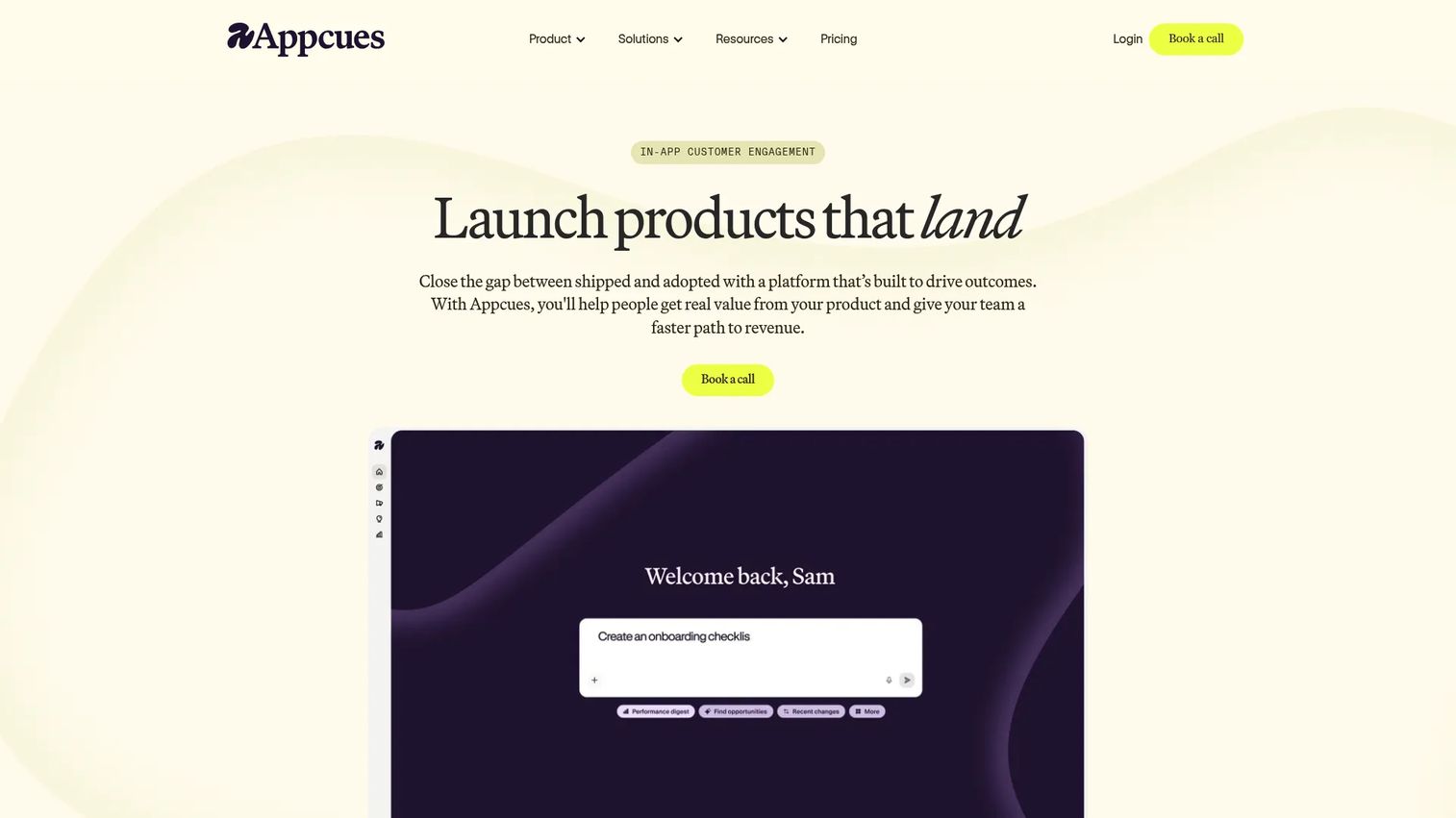
Appcues has been a go-to tool for no-code product onboarding since before the DAP category matured. Its focus is customer-facing onboarding and feature adoption, not internal enterprise software adoption.
Best for: SaaS teams building customer onboarding flows, in-app messages, and feature adoption nudges without engineering support.
What it is: Appcues is a product adoption platform for in-app experiences including flows, checklists, launchpads, banners, NPS surveys, and behavior-based email and push notifications.
Key features:
- No-code flows, checklists, pins, and banners
- Behavior-based audience targeting and segmentation
- AI-assisted experience creation
- Analytics, goal tracking, and reporting
- CRM and support tool integrations
Where Appcues falls short:
- Pricing is annual-only, starting at $3,600/year for the Spark plan (up to 1,000 MAUs), which G2 reviewers note creates friction for small teams evaluating the tool.
- Reviewers mention that advanced customization and deep analytics require the higher Grow tier, pushing total cost above $9,000/year.
Pricing: Spark at $3,600/year (plus a $250 one-time implementation fee), Grow from $9,000/year, Enterprise custom.
G2 rating: 4.6/5
How it compares to Userlane: Appcues fits product teams serving external SaaS customers. Userlane fits enterprises managing internal employee adoption. Sales enablement teams building rep-facing training guides will find neither Appcues nor Userlane the natural fit.
6. Intercom (customer messaging platform)
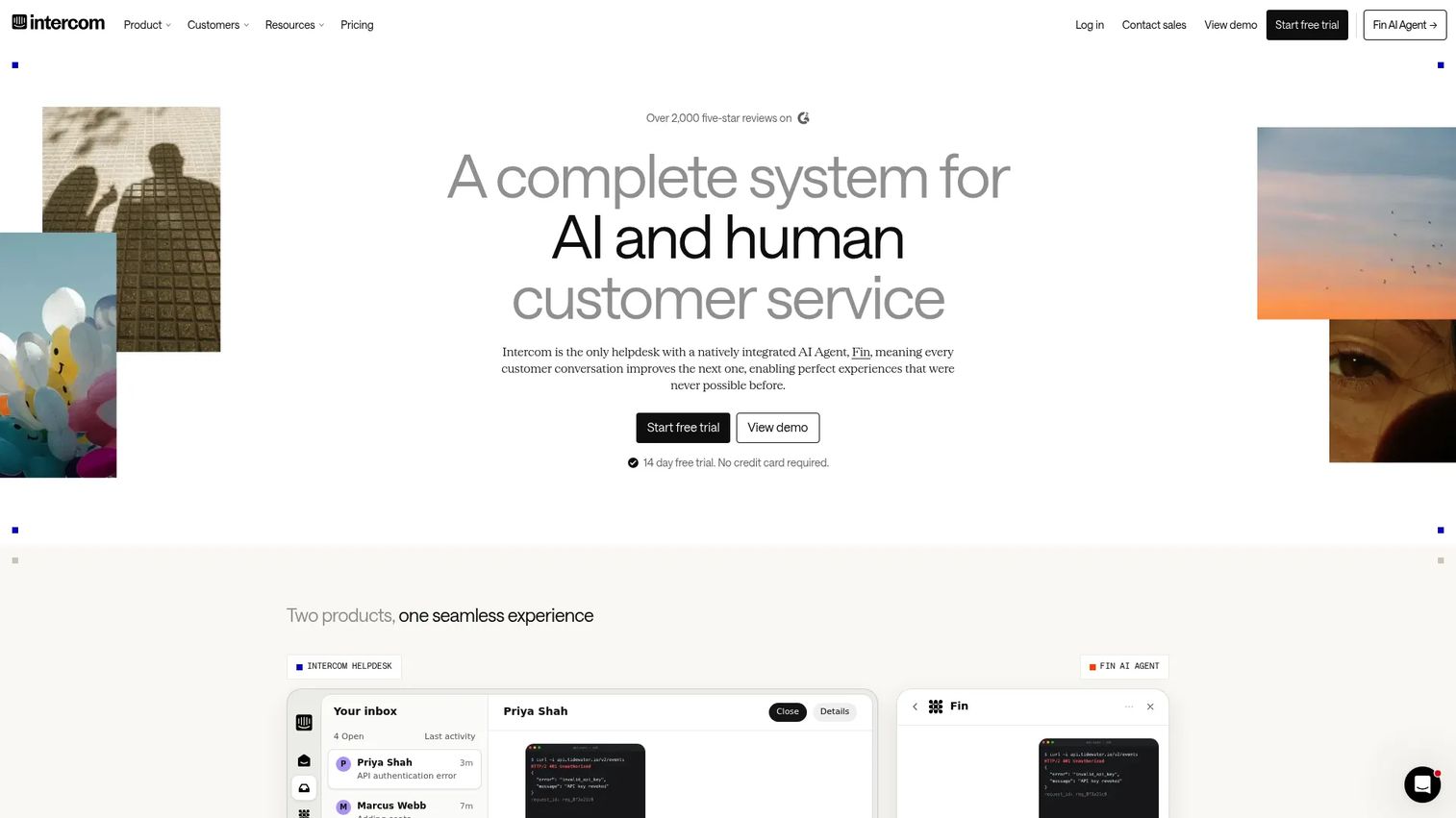
Intercom is a customer service and messaging platform. It earns a place on this list because it supports onboarding-adjacent workflows through its help center, in-app messenger, and AI-powered ticketing, which some teams use for lightweight user education.
Best for: Teams that want onboarding guidance connected to support, chat, help center content, and customer messaging in a single platform.
What it is: Intercom is an AI-powered customer service platform combining an omnichannel inbox, ticket management, a help center, outbound messaging, and an AI agent (Fin). It includes product tour capabilities on some plans.
Key features:
- AI-powered customer service inbox and ticketing
- Help center with self-serve content
- Outbound messaging and in-app banners
- Fin AI Agent for automated responses
- Workflow builder and reporting
Where Intercom falls short:
- Intercom is a customer service platform first, and its onboarding capabilities are secondary to that job. G2 reviewers note that pricing complexity, including per-outcome Fin AI Agent charges on top of per-seat fees, makes total cost hard to predict.
- Teams that need dedicated in-app onboarding flows and checklists often find Intercom's tooling thin compared to purpose-built onboarding platforms.
Pricing: Essential at $19/seat/month (annual), Advanced at $85/seat/month, Expert at $132/seat/month. Fin AI Agent billed at $0.99 per outcome. No free tier; 14-day free trial available.
G2 rating: 4.5/5
How it compares to Userlane: Intercom handles customer support and messaging. Userlane handles internal software adoption. These are genuinely different jobs, and the overlap is thin.
7. HelpHero (in-app onboarding platform)
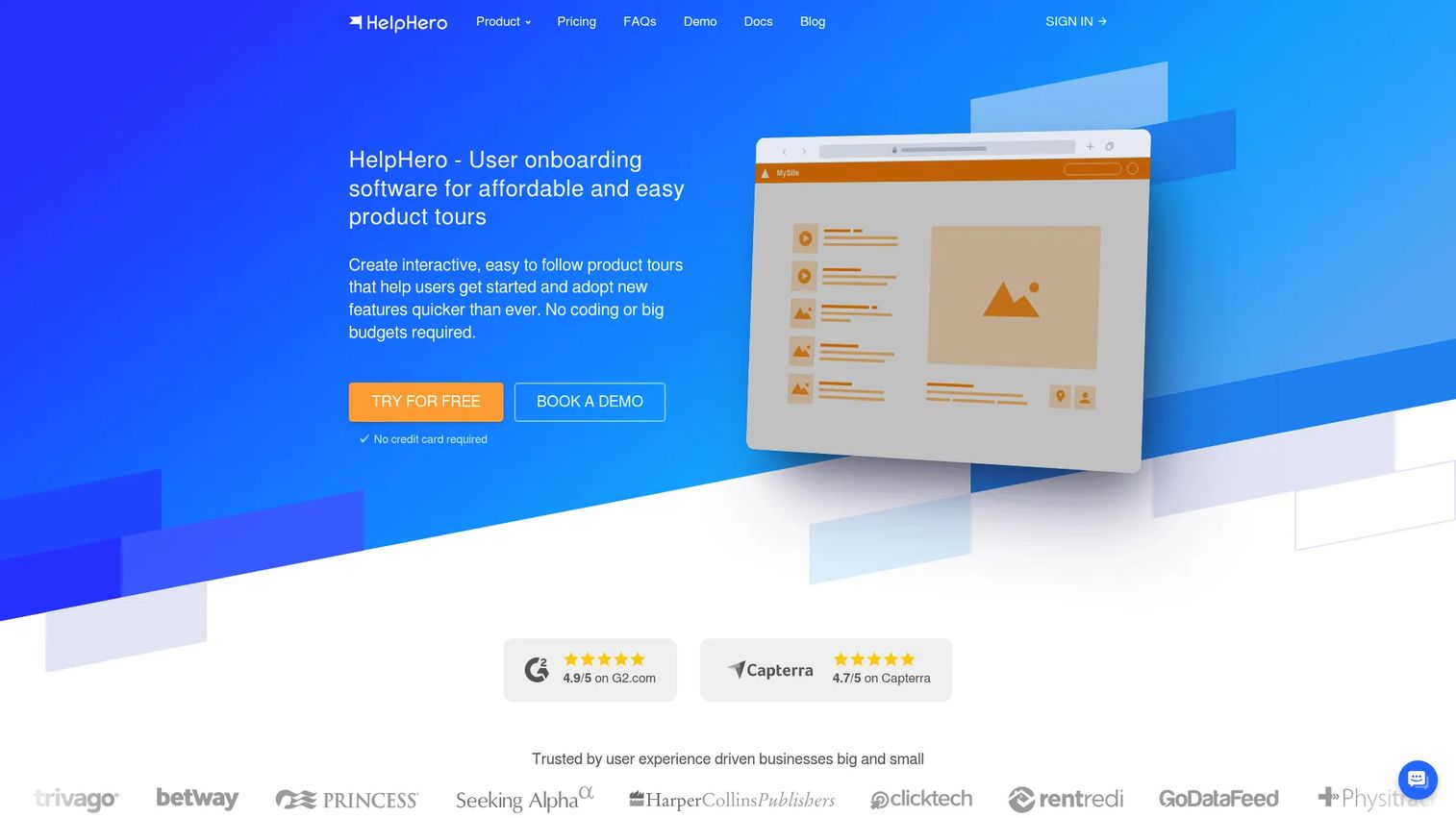
HelpHero targets smaller SaaS teams that need product tours, checklists, and hotspots without a large DAP rollout. Its pricing by monthly active users makes it accessible for teams with modest user bases.
Best for: Smaller SaaS teams that need in-app onboarding and product guidance without enterprise pricing.
What it is: HelpHero is a no-code user onboarding platform for product tours, checklists, hotspots, and analytics. All plans include standard and advanced features; pricing scales by MAU.
Key features:
- No-code product tour creation and customization
- Onboarding checklists and hotspots
- Analytics, drill-down analysis, and A/B testing
Where HelpHero falls short:
- HelpHero's pricing page lists Startup and Enterprise plans as contact-sales only, which limits visibility for teams that need to plan budgets beyond 20,000 MAUs.
- G2 reviewers note that customization options are limited compared to larger platforms, particularly around advanced branching and design control.
Pricing: Starts at $55/month for up to 1,000 MAUs. Scales to $299/month for up to 20,000 MAUs. No free tier; 14-day free trial with no credit card required.
G2 rating: 4.9/5
How it compares to Userlane: HelpHero fits small-to-mid-size product teams building customer onboarding. Userlane fits enterprises managing employee software adoption. The overlap is narrow.
8. Userpilot (product growth platform)
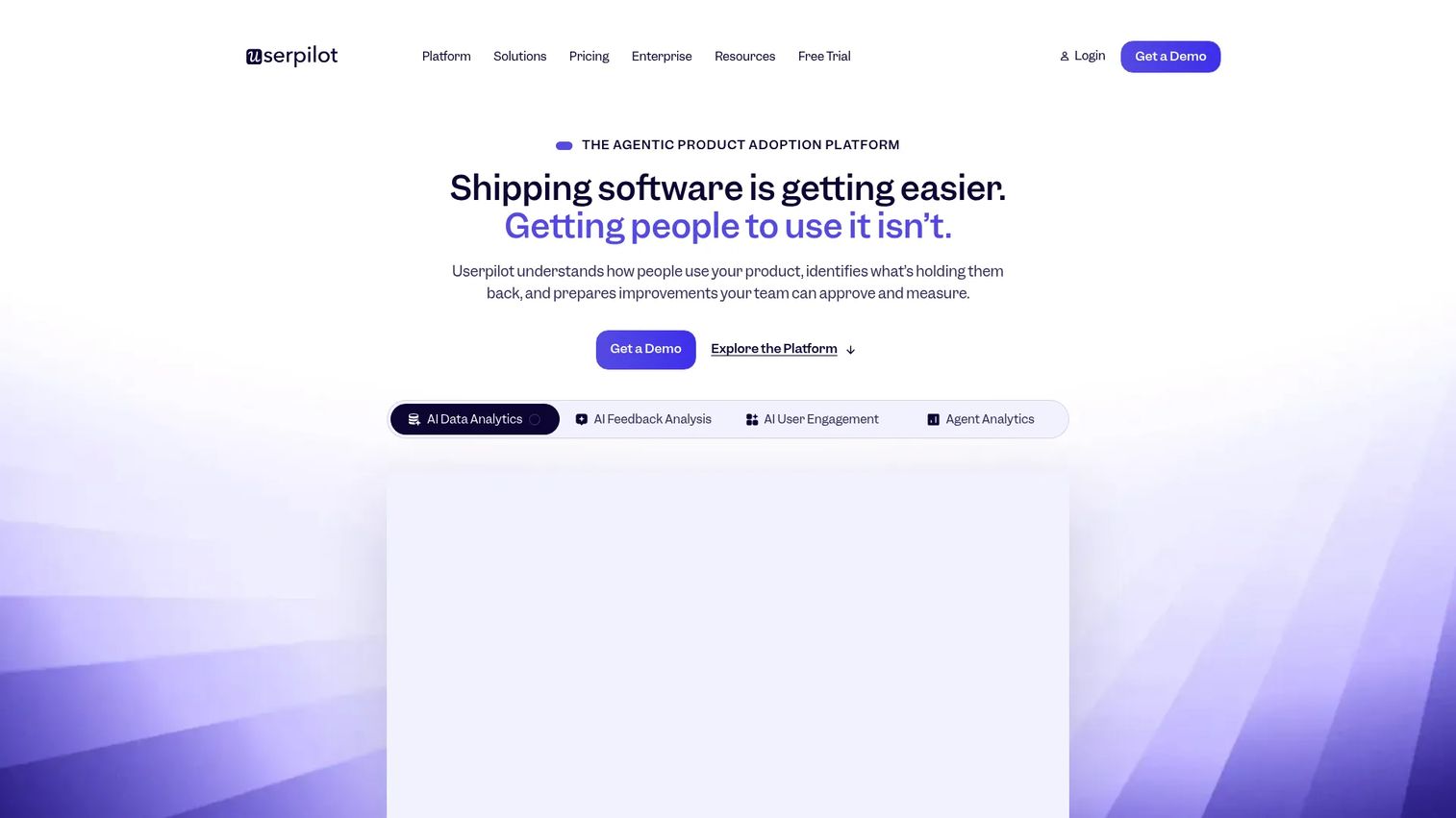
Userpilot combines in-app onboarding with product analytics, making it a stronger fit for teams that need to understand user behavior alongside building onboarding experiences.
Best for: Product teams that need onboarding flows tied directly to usage analytics and feature adoption data.
What it is: Userpilot is a product growth platform covering in-app engagement, product analytics, user feedback, NPS surveys, session replay, and mobile engagement. It targets SaaS product, growth, and customer success teams.
Key features:
- In-app experiences: Flows, tooltips, banners, checklists
- Product analytics with feature tagging and segmentation
- NPS surveys and session replay
- Workflow automation and email
- Mobile engagement on higher tiers
Where Userpilot falls short:
- Userpilot's Starter plan is capped at 2,000 MAUs and $299/month, which G2 reviewers note can feel limiting for growing products where MAU counts jump quickly.
- Some reviewers mention a learning curve around the analytics configuration, particularly feature tagging setup.
Pricing: Starter at $299/month, Growth from $849/month, Enterprise custom. No free tier; 14-day free trial.
G2 rating: 4.6/5
How it compares to Userlane: Userpilot targets product teams tracking customer adoption. Userlane targets employee software adoption programs inside business applications. Sales enablement teams will find Userpilot the better option when they need a product team's analytics angle.
9. Usertour (product onboarding platform)
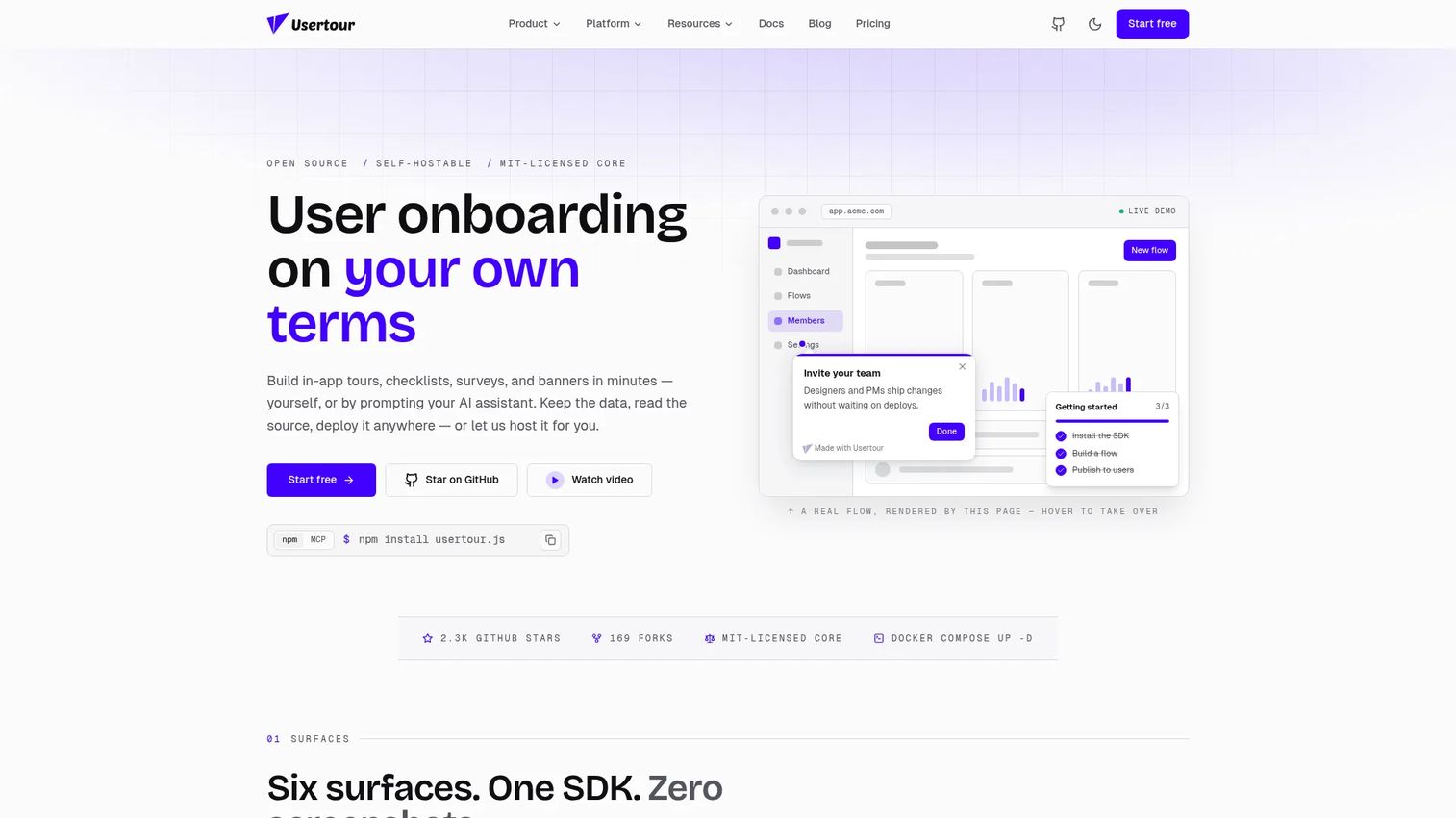
Usertour is an open-source, self-hostable product onboarding platform. Its Hobby free tier and self-hosting option make it appealing for technical teams that want flexibility over vendor lock-in.
Best for: SaaS teams that need no-code onboarding flows, checklists, and launchers, with cloud or self-hosted deployment options.
What it is: Usertour supports product tours, checklists, surveys, NPS, banners, announcements, launchers, and resource centers. Automatic segmented flow triggering and built-in analytics cover the standard onboarding stack.
Key features:
- Product tours, multi-step flows, and checklists
- Surveys, banners, announcements, and resource center
- Segmented flow triggering and completion analytics
- Self-hosted deployment option
Where Usertour falls short:
- Usertour has no G2 reviews at this time, which limits third-party validation for buyers relying on review signals.
- Self-hosting adds infrastructure management overhead that teams without engineering support may want to avoid.
Pricing: Hobby free plan available. Starter at $59/month, Growth at $119/month, Business at $249/month. Annual billing available with two months free.
G2 : 4.7
How it compares to Userlane: Usertour is a product onboarding tool for external SaaS users. Userlane handles enterprise employee adoption. Different categories, different buyers.
10. Pendo (product experience platform)
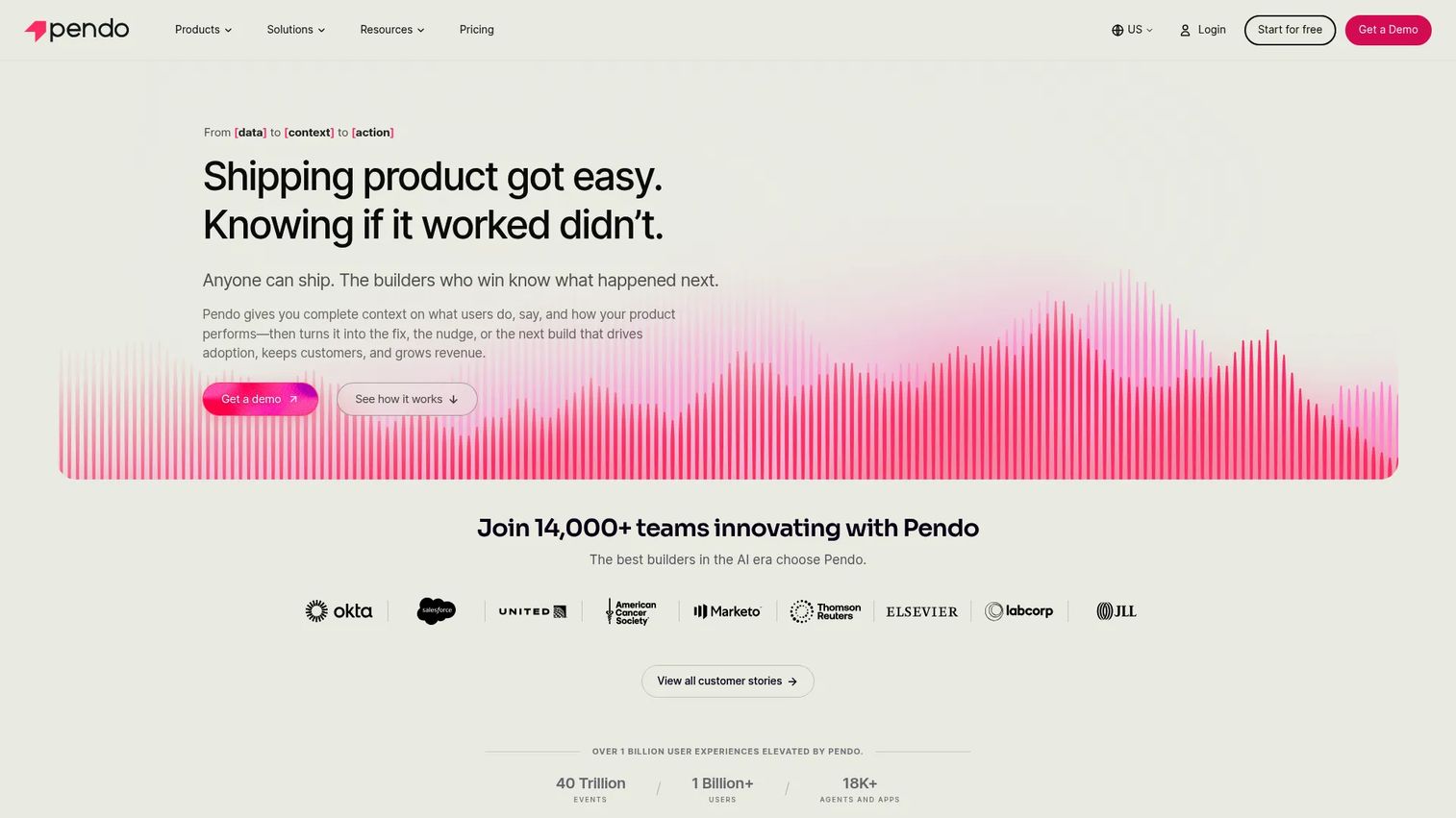
Pendo's strength is the depth of its product analytics. It combines usage data with in-app guidance, which makes it a natural fit for teams that need both measurement and engagement.
Best for: Product and customer success teams that need product usage analytics combined with in-app engagement and feedback tools.
What it is: Pendo is a product experience platform covering product analytics, in-app guides, NPS and other surveys, session replay, feedback collection, and cross-channel journey orchestration.
Key features:
- Product analytics with path, funnel, and cohort analysis
- In-app guides and onboarding checklists
- Session replay and behavioral insights
- NPS, CSAT, and PMF surveys
- Roadmap and feedback management
Where Pendo falls short:
- Pendo's paid plans (Base, Core, Ultimate) require a sales conversation with no public numeric pricing. G2 reviewers note that pricing scales by MAU volume and can become expensive for large products.
- Reviewers mention that the data setup for meaningful analytics, particularly path analysis, requires initial configuration time.
Pricing: Free plan available for up to 500 MAUs. Paid plans (Base, Core, Ultimate) are custom-quoted by MAU volume. Novus beta is available free with no MAU limit during the beta period.
G2 rating: 4.4/5
How it compares to Userlane: Pendo's analytics depth goes beyond Userlane's adoption measurement. For teams where product analytics is the primary job, Pendo is worth comparing directly. Userlane focuses more on contextual assistance inside business applications.
11. Gainsight PX (product experience platform)
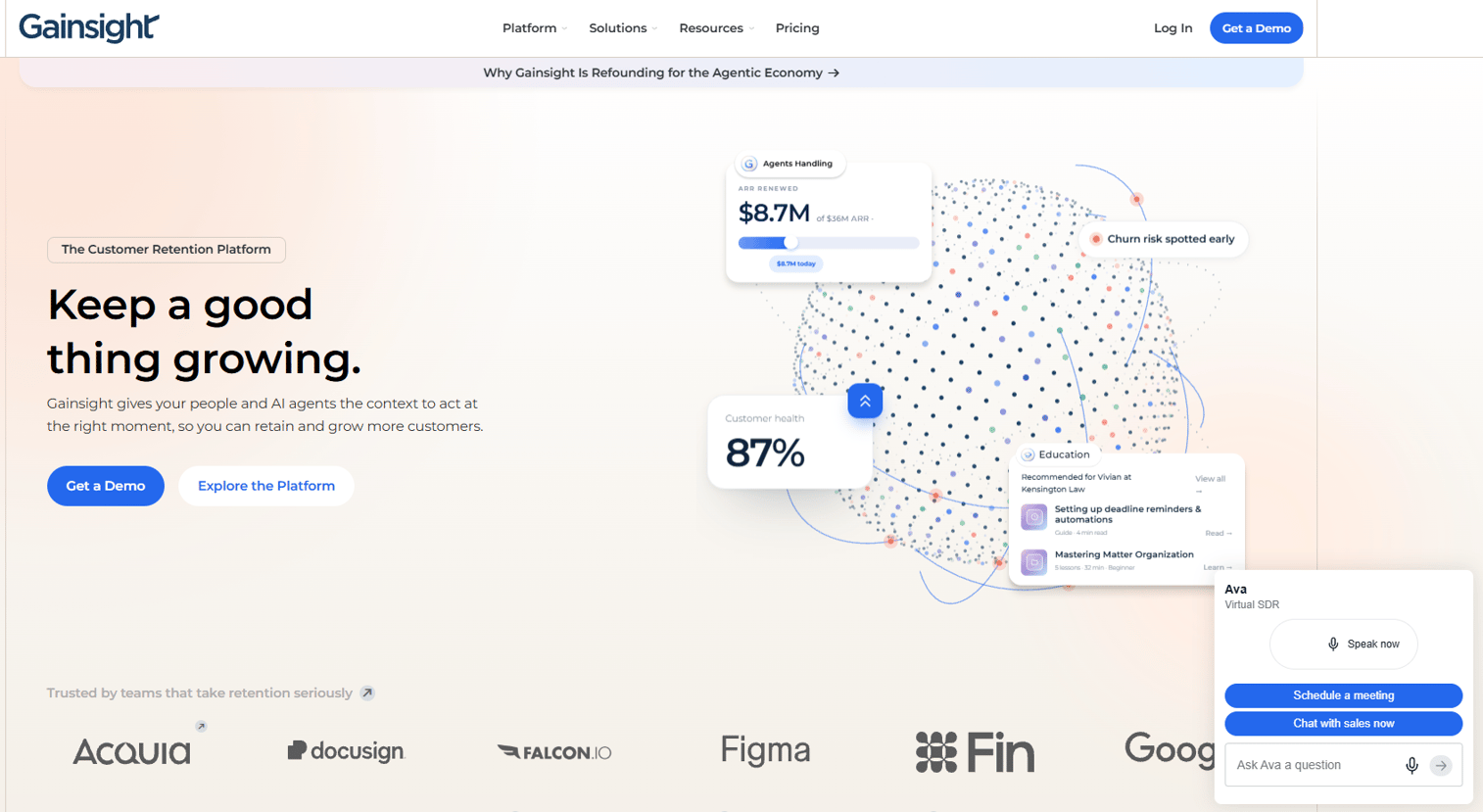
Gainsight PX connects product experience data to customer success workflows. Its account-level analytics make it a strong choice when CS and Product need to work from the same adoption signals.
Best for: Customer success and product teams tracking adoption signals across customer accounts and linking them to CS health scores.
What it is: Gainsight PX is a product experience platform with product analytics, in-app engagement, targeted surveys (CES, CSAT, NPS), and advanced segmentation. It integrates with Gainsight's broader CS platform.
Key features:
- Product analytics with path and funnel analysis
- In-app guides and onboarding checklists
- CES, CSAT, and NPS surveys with account-level targeting
- Advanced behavioral segmentation
- Web, mobile, and desktop product support
Where Gainsight PX falls short:
- PX Essentials and PX Enterprise are both custom-quoted. No public numeric pricing is available.
- G2 reviewers note that setup complexity and the learning curve for analytics configuration can require significant onboarding time before the team sees value.
Pricing: PX Essentials and PX Enterprise tiers, both custom-quoted via Gainsight's pricing page. A free trial is offered.
G2 rating: 4.4/5
How it compares to Userlane: Gainsight PX is focused on customer product adoption analytics and CS account health. Userlane is focused on employee software adoption inside business applications. These serve different buyers.
12. Product Fruits (product adoption platform)
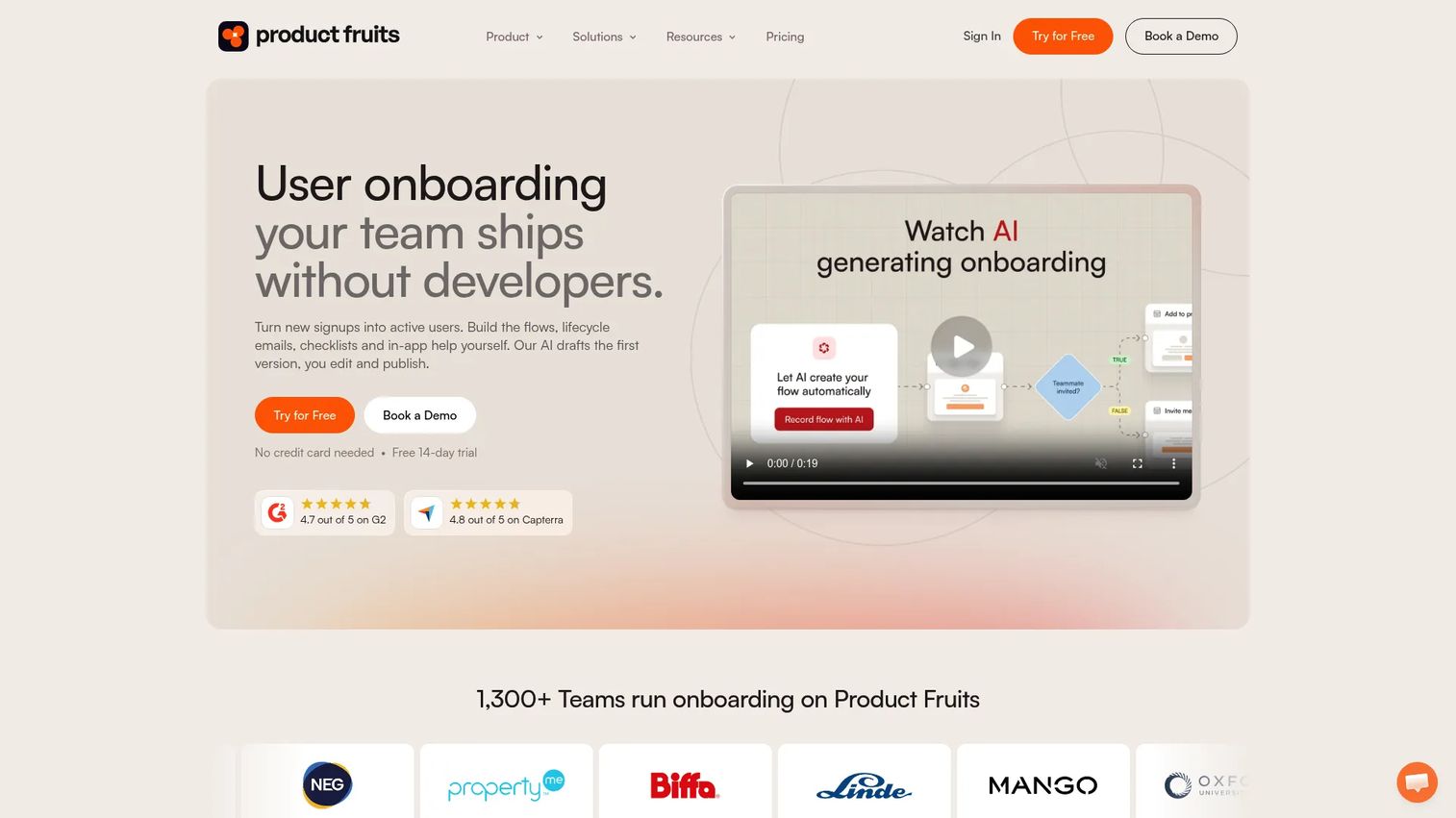
Product Fruits positions itself as an accessible, full-featured onboarding platform at a price point smaller SaaS teams can reach. Its AI-powered onboarding and knowledge base integration stand out at the entry tier.
Best for: SaaS teams that need in-app onboarding tours, checklists, announcements, and feedback on a smaller budget.
What it is: Product Fruits is an AI-powered product adoption platform with flows, tours, hints, tooltips, checklists, knowledge base integration, NPS surveys, feedback widgets, and in-app announcements.
Key features:
- Flows, adaptive onboarding, and guided tours
- Onboarding checklists and in-app announcements
- AI-powered onboarding copilot
- Knowledge base and in-app help
- NPS surveys and custom events
Where Product Fruits falls short:
- The published prices are for 1,500 MAUs. Costs scale upward for larger user bases, and the Custom tier requires a sales conversation.
- G2 reviewers note that advanced analytics and deep customization are thinner compared to platforms like Pendo or Userpilot.
Pricing: Starter at $111/month (annual), Pro at $187/month (annual), Business at $374/month (annual), Custom tier by contract. No free tier; free trial available with no credit card required.
G2 rating: 4.6/5
How it compares to Userlane: Product Fruits covers SaaS product onboarding for external users at accessible pricing. Userlane covers enterprise employee adoption. For product teams watching their budget, Product Fruits is worth evaluating before committing to a DAP.
13. UserGuiding (user onboarding platform)
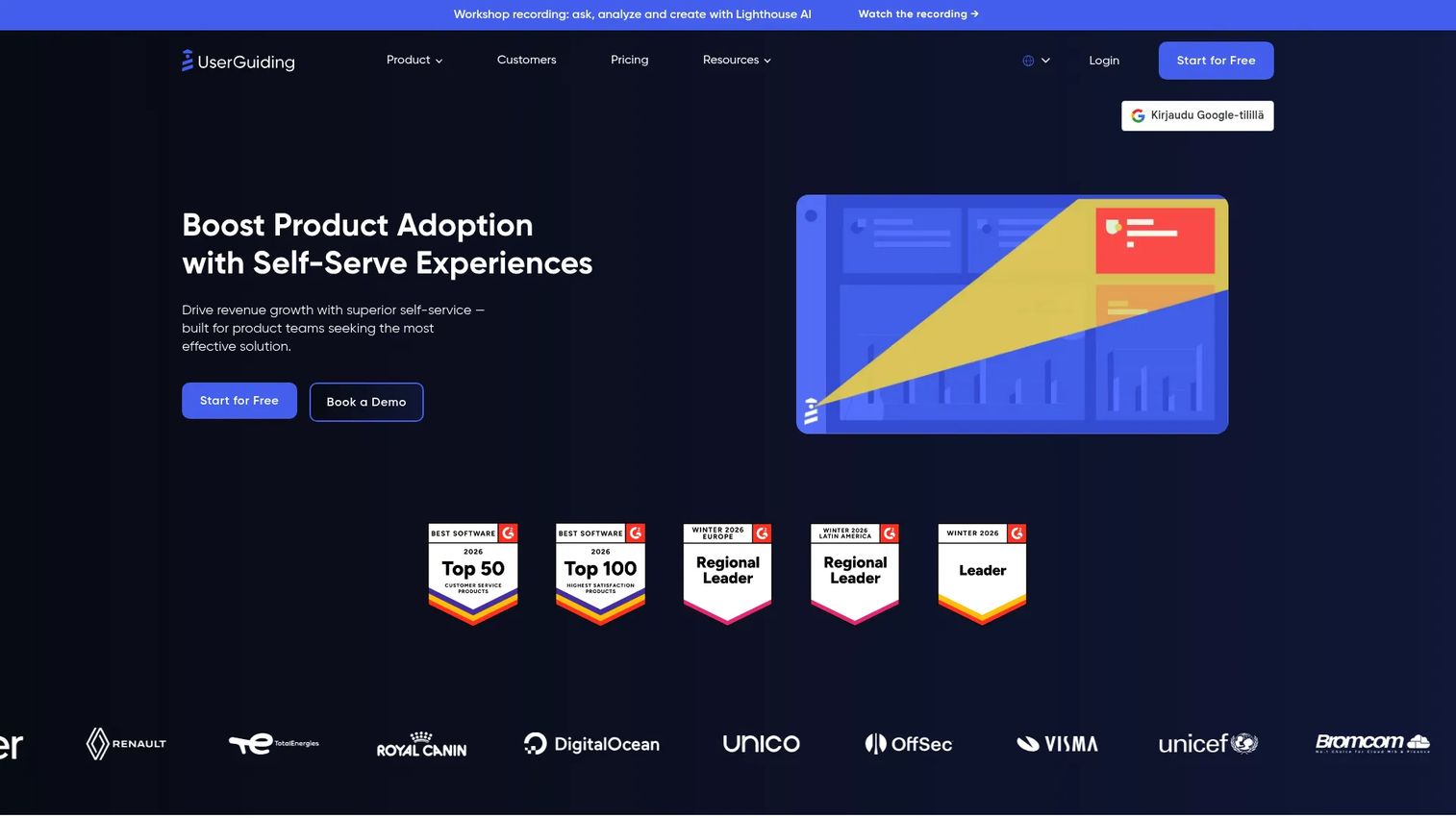
UserGuiding covers the full onboarding stack, including guides, hotspots, checklists, resource centers, session replay, and an AI Assistant, at a price point that scales by MAU.
Best for: Product and customer success teams that need no-code in-app onboarding and self-service experiences without engineering support.
What it is: UserGuiding is a no-code product adoption platform with product tours, interactive guides, checklists, hotspots, tooltips, surveys, knowledge base integration, public roadmaps, and session replay.
Key features:
- Product tours and interactive guides
- Onboarding checklists and hotspots
- In-app surveys, NPS, and session replay
- Knowledge base and resource centers
- AI Assistant for content suggestions
Where UserGuiding falls short:
- Starter pricing starts at $249/month for 2,000 MAUs. Reviewers note that the Growth tier at $499/month is where more advanced analytics and integrations become available, which raises the effective entry cost.
- G2 reviewers mention that design control and advanced customization, particularly for heavily branded experiences, can feel constrained at lower tiers.
Pricing: Starter at $249/month, Growth at $499/month, Enterprise custom. A Support Essentials free option and a 14-day free trial are available.
G2 rating: 4.7/5
How it compares to Userlane: UserGuiding is a product onboarding tool for external SaaS users, not an enterprise employee DAP. The buying context and primary user differ from Userlane's target.
14. Usetiful (digital adoption platform, now part of Fullstory)
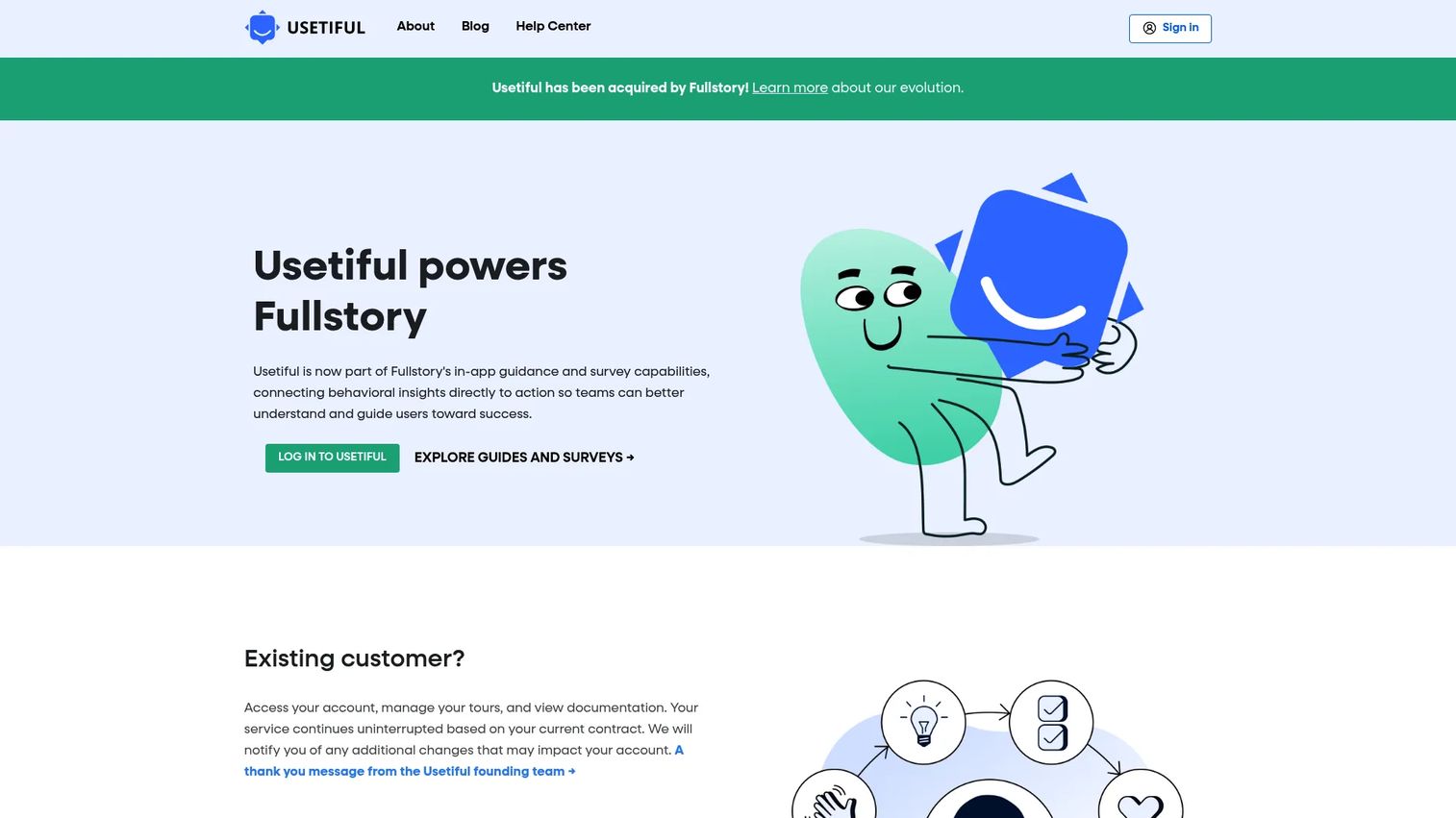
Usetiful was an independent digital adoption and onboarding platform. It has been acquired by Fullstory, and its former pricing page now redirects to an acquisition announcement.
Best for: Teams seeking in-app guidance and survey capabilities connected to behavioral analytics, now within the Fullstory platform.
What it is: Usetiful provided in-app guides, surveys, and personalized user guidance. Following its acquisition by Fullstory, capabilities and packaging have moved under Fullstory's platform.
Key features:
- In-app guidance and product tours
- In-app surveys
- Personalized user guidance
Where Usetiful falls short:
- Usetiful no longer operates as a standalone product. Buyers evaluating it as an independent alternative should contact Fullstory directly for current packaging and pricing.
Pricing: Contact Fullstory. Former Usetiful pricing is no longer available.
G2: 4.4
How it compares to Userlane: Usetiful was a lighter digital adoption tool compared to Userlane's enterprise scope. With the Fullstory acquisition, the buying motion has changed significantly.
15. Newired (digital adoption platform)
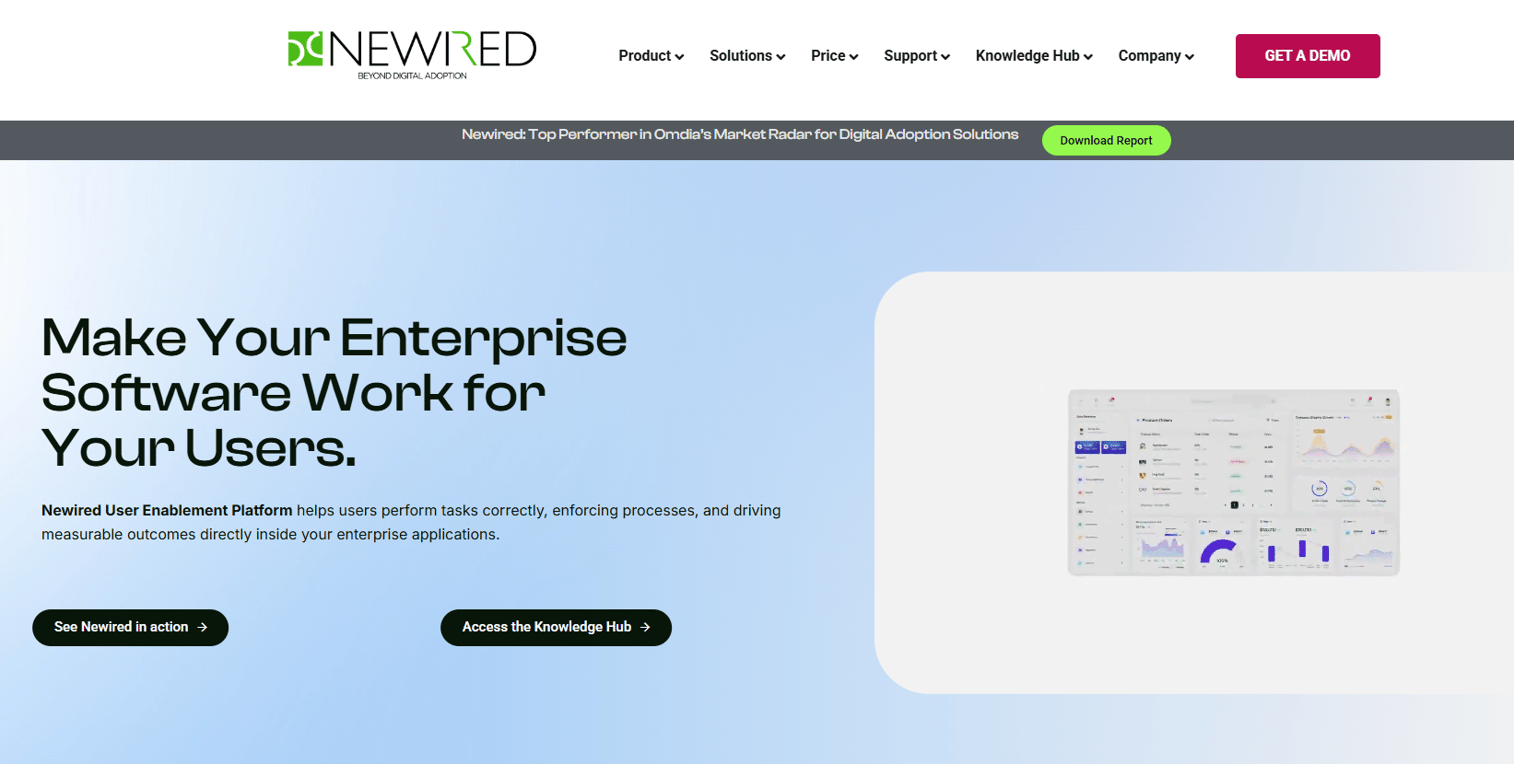
Newired is an enterprise digital adoption platform with a user-token pricing model. It supports unlimited applications and guidance content across all tiers, which makes it appealing for large organizations managing many internal systems.
Best for: Enterprises that need process guidance and in-app training across internal applications, with deployment flexibility including multiple environments.
What it is: Newired is a digital adoption platform providing contextual in-app guidance, process compliance support, AI-assisted content, behavioral analytics, and multi-environment deployment with governance and rollback.
Key features:
- Contextual in-app guidance and guided journeys
- Unlimited applications and guidance content across all tiers
- Multi-environment deployment with versioning and rollback
- Behavioral analytics and usage insights
- AI-driven assistance, chatbot capabilities, knowledge base integration, and automated translations
Where Newired falls short:
- Newired uses a user-token pricing model (Foundation, Scale, Enterprise) with no public numeric prices. The buying process requires a sales conversation.
Pricing: Foundation, Scale, and Enterprise tiers, all custom-quoted based on user token volume. Contact Newired for pricing.
G2: 4.6
How it compares to Userlane: Newired and Userlane share the enterprise DAP category. Newired's unlimited-application policy and token-based pricing may appeal to organizations with large, complex internal software portfolios.
Which Userlane alternative is best for interactive internal training?
Guideflow is the best pick for interactive internal training. Sales enablement teams can record software once through the Chrome extension or native app and produce step-by-step interactive guides that reps complete on their own.
The specific jobs Guideflow covers for enablement teams: CRM hygiene and process training, demo prep guides, product launch enablement, objection handling workflow documentation, and onboarding for new sales hires. Static PDFs require reps to mentally translate instructions into action. An interactive guide runs them through the actual interface, step by step, so the training mirrors the tool they will use on the job.
Which Userlane alternative fits enterprise digital adoption?
WalkMe, Whatfix, and Newired are the strongest fits when the buyer needs a digital adoption platform for broad employee software adoption across internal applications.
Enterprise DAP programs involve IT oversight, multi-application deployment, adoption health reporting, and governance. WalkMe and Whatfix both carry G2 ratings above 4.6/5 and serve organizations managing adoption at portfolio scale. Newired's unlimited-application model and multi-environment deployment may suit enterprises with complex internal infrastructure. Each requires a custom-quote conversation. Interactive guides (Guideflow's category) address a narrower job: Specific training tasks, SOPs, and rep-facing enablement content.
Which Userlane alternative is best for product onboarding?
Appcues, Userflow, Userpilot, Usertour, Product Fruits, UserGuiding, and Usetiful fit product onboarding teams better than enterprise DAP buyers.
These platforms serve product and growth teams building customer-facing onboarding flows, checklists, in-app messages, and feature adoption nudges. If your primary user is a SaaS customer rather than an internal employee, start in this group. Usertour and Product Fruits offer accessible entry pricing; Appcues and Userpilot add more sophisticated analytics at higher tiers.
Which Userlane alternative is best for adoption analytics?
Pendo and Gainsight PX are the strongest options when product usage analytics and account-level adoption signals matter most.
Both platforms combine in-app engagement with meaningful analytics depth. Pendo's free plan covers up to 500 MAUs, which gives product teams room to test before committing. Gainsight PX connects adoption data to CS account health scores, which matters for revenue teams tracking expansion opportunities. RevOps teams that need to show whether enablement content changes rep behavior will find these platforms cover a different signal than training completion.
Which Userlane alternative is best for support-led onboarding?
Intercom and HelpHero make the most sense when onboarding sits close to support, help center content, and customer messaging.
Intercom's AI-powered inbox, help center, and outbound messaging work well for teams where onboarding and customer service share the same workflow. HelpHero is the right call when the team needs in-app product guidance at a price point that scales by MAU without a large enterprise contract. For teams where support deflection and customer education overlap, either tool handles the job Userlane was never built for.
When should you stay with Userlane?
Stay with Userlane if your priority is regulated-industry software adoption, application intelligence, and contextual assistance across a portfolio of internal applications.
Userlane's strengths sit in adoption health measurement across business software, contextual guidance inside applications employees use daily, and enterprise governance for software adoption programs. If your organization manages software adoption across many internal systems, needs compliance-grade reporting, or is running a company-wide change management program, Userlane's category fit is worth keeping. The switch to a different tool only makes sense when a different job has become more important, whether that is interactive internal training, product onboarding, adoption analytics, or support-led education.
Why teams switch from Userlane to Guideflow
Sales enablement teams leave Userlane when their real job is producing training assets reps will use without another live session, not managing an enterprise adoption program.
Guideflow covers four enablement jobs directly. First, rep onboarding: Capture your CRM, sales engagement tool, or demo platform once, then share interactive step-by-step guides that new hires work through at their own pace. Second, SOP documentation: When your RevOps team changes a Salesforce workflow or updates a sales play, recapture the affected steps and push the updated guide without rebuilding from scratch. Third, launch enablement: Product updates and new messaging get packaged into interactive guides that reps explore before the launch call, so the live session becomes coaching rather than a first introduction. Fourth, field readiness: Guides reach reps in the moment they need them, inside email, Slack, or the LMS you already use.
Guideflow supports interactive demos, demo centers, sandboxes, demo pages, live demos, and mobile demos, so the same platform covers internal training and buyer-facing product experiences. Step-level analytics track completion and drop-off, so you can see which training steps reps skip and iterate on the content.
One limitation to keep in view: Guideflow does not replace a formal LMS. If you need graded assessments, SCORM export, certification tracking, or structured course catalogs, keep an LMS alongside it. Guideflow handles the interactive guide layer; the LMS handles the learning management layer.
Start your journey with Guideflow today!
Frequently asked questions: Userlane alternatives
Guideflow is the best pick for internal training. Sales enablement teams can record software once through the Chrome extension or native app and turn it into step-by-step interactive guides for rep onboarding, CRM process training, SOP documentation, and launch enablement. It is an interactive guide platform, not an enterprise digital adoption program.
WalkMe, Whatfix, and Newired are the closest alternatives in the enterprise DAP category. All three support in-app guidance across multiple business applications, adoption analytics, and enterprise governance. All three use custom-quote pricing. WalkMe and Whatfix both carry 4.6/5 ratings on G2.
A digital adoption platform deploys inside live business applications and guides employees through workflows in real time. It typically requires integration with the applications it supports and is designed for portfolio-level adoption programs. An interactive guide platform captures software flows and turns them into clickable, step-by-step experiences that users work through independently, without the guide being embedded in the live application. The interactive guide fits training, onboarding, SOPs, and enablement content; the DAP fits ongoing in-app guidance at scale across enterprise systems.
Appcues, Userflow, Userpilot, Usertour, Product Fruits, and UserGuiding all fit SaaS product onboarding. These tools help product teams build customer-facing flows, checklists, in-app messages, and feature adoption nudges. Usertour has a free Hobby plan. Product Fruits starts at $111/month (annual). Appcues starts at $3,600/year. The right pick depends on MAU volume, analytics depth, and budget.
Guideflow is the strongest fit for sales enablement teams. The specific jobs it covers are rep ramp, CRM and tool adoption, SOP documentation, and launch enablement. Step-level analytics show which training steps reps skip, so enablement managers can measure completion and iterate on content. It does not require IT involvement or an enterprise adoption program rollout.
Pricing across this category varies widely. Enterprise DAPs (WalkMe, Whatfix, Newired) are all custom-quoted. Product onboarding tools range from free tiers (Usertour, Pendo) to $3,600/year (Appcues). Guideflow has a free plan, with paid plans starting at $35/user/month. The right comparison is by category: A product onboarding tool at $299/month and an enterprise DAP at a custom enterprise contract are not competing on the same purchase decision.
Many teams pair interactive guides, onboarding tools, or DAPs with an existing LMS or enablement platform. The LMS handles formal learning paths, certifications, and graded assessments. An interactive guide platform like Guideflow handles step-by-step software training for specific workflows and processes. The two layers are complementary: The LMS manages structured learning; the interactive guide handles task-specific execution training in the moment reps need it.
Choose a DAP (WalkMe, Whatfix, Newired) when the job is enterprise employee software adoption across a portfolio of internal applications with governance and compliance reporting. Choose a product onboarding tool (Appcues, Userflow, Userpilot, etc.) when the job is customer-facing onboarding for a SaaS product. Choose an interactive guide platform (Guideflow) when the job is internal training, SOPs, rep onboarding, and enablement content that needs to show software processes step by step, without embedding guidance inside the live application.