The load was delivered, but the invoice packet is missing a signed document. Fuel receipts sit elsewhere. Driver deductions live in another system. Nobody sees the true cost per mile until cash gets tight.
These gaps matter at scale. The American Trucking Associations reported in 2026 that U.S. trucking generated $936.4 billion in revenue during 2025. Weak finance processes put a meaningful share of that revenue at risk through billing delays, settlement errors, and poor margin visibility.
The right trucking accounting software connects operational activity with financial control. It should help you bill faster, prepare IFTA reports, reconcile expenses, and identify unprofitable work before month end.
What’s inside
This guide compares truck accounting software for owner operators, growing fleets, established carriers, and multi entity transportation businesses.
We assessed each product using criteria that affect day to day finance control:
- Trucking fit: Support for freight billing, mileage, and settlements
- Financial depth: Reporting, reconciliation, cash visibility, and controls
- Operational fit: Connections with dispatch, TMS, payroll, and fuel data
- Cost visibility: Clear pricing or a direct quote process
- Scalability: Suitability for current fleet size and future growth
TL;DR
- Best trucking native pick: TruckingOffice combines invoicing, IFTA reporting, dispatch, expenses, and driver management
- Best general accounting pick: QuickBooks Online offers familiar bookkeeping and accountant collaboration
- Best dispatch connected pick: TruckLogics ties accounting to loads, payments, settlements, and tax reporting
- Best for growing carriers: Sage Intacct supports multi entity finance and stronger reporting controls
- Best operational pick: Truckstop TMS connects load management with documents, invoices, and IFTA estimates
- Best cost discipline: Compare tools using billing speed, settlement accuracy, load profitability, and cost per mile
What is trucking accounting software?
Trucking accounting software is bookkeeping and financial management software built for freight invoicing, fuel expenses, driver settlements, IFTA reporting, equipment costs, and per mile profitability.
Generic accounting systems record transactions and produce standard financial statements. Trucking company accounting also needs operational context. A fuel purchase belongs to a truck, while revenue comes from a specific load or customer. Driver advances and deductions affect settlement accuracy.
This context lets carriers answer practical questions:
- Which trucks generate acceptable margins?
- Which customers delay payment?
- Are specific lanes profitable after fuel and driver costs?
- Does invoiced revenue reconcile with completed loads?
Some systems combine dispatch, billing, accounting, and compliance workflows. Others handle the general ledger while relying on separate operational software. Neither model fits every carrier.
Owner operators usually need straightforward trucking bookkeeping software with invoicing, expense tracking, and tax records. Larger fleets may require stronger controls, consolidated reporting, and integrations with operational systems.
Core capabilities to look for
- Freight billing: Invoices linked to loads and supporting documents
- IFTA reporting: Mileage and fuel information organized by jurisdiction
- Driver settlements: Advances, deductions, reimbursements, and pay calculations
- Expense capture: Fuel, repairs, insurance, and equipment costs
- Profitability reporting: Cost per mile and revenue per mile
- Operational connections: TMS, dispatch, payroll, and fleet data
- Financial reporting: Cash flow, profit and loss, and balance sheets
The right accounting software for trucking companies makes finance repeatable. It reduces reliance on the owner remembering which receipt, deduction, or accessorial charge belongs to each load.
When to use trucking accounting software
Replace spreadsheets before billing errors compound
Spreadsheets become fragile as you add trucks, drivers, reimbursements, and factoring requirements. A missing document or accessorial charge can delay freight billing and cash collection.
Move to dedicated software when office staff must rekey load data across several files. The system should create a repeatable path from completed load to collected invoice.
Track cost per mile before rates move against you
Monthly financial statements can arrive too late for daily pricing decisions. Carriers need current visibility into revenue per mile and operating costs.
Use trucking accounting software when you need profitability by truck, load, customer, or lane. That detail helps operators identify work that produces revenue without enough margin.
Keep IFTA and settlement data audit ready
Mileage, fuel purchases, advances, and driver deductions often originate in separate workflows. Reconstructing them later creates avoidable risk.
A suitable system keeps supporting data organized throughout the quarter. It also gives drivers and finance staff a clearer settlement record.
Trucking accounting software comparison
This comparison covers nine accounting software options for carriers, from simple bookkeeping products to integrated trucking systems.
Start with the workflow creating the most financial friction. Choose trucking native software when dispatch, IFTA, or driver settlements drive the problem. A general ledger may fit when standard bookkeeping and accountant access matter most.
| # | Product | Best for | Key differentiator | Pricing | G2 rating |
|---|---|---|---|---|---|
| 1 | TruckingOffice | Owner operators and small fleets | Trucking native dispatch, invoicing, IFTA, and expense management | From $25/month | N/A |
| 2 | QuickBooks Online | General bookkeeping and accountant access | Broad accounting functions and familiar financial workflows | Free plan, paid plans from $38/month | 4.0/5 |
| 3 | TruckLogics | Small and midsize fleets | Dispatch, accounting, IFTA, and fleet management | From $35.96/month, billed yearly | N/A |
| 4 | Sage Intacct | Growing and multi entity carriers | Financial controls, automation, and consolidated reporting | Custom pricing | 4.3/5 |
| 5 | Truckstop TMS | Carriers connecting loads with billing | Load, document, invoice, and IFTA workflows | Included tier, Basic costs $60/month | 4.0/5 overall |
| 6 | Q7 | Buyers prepared for vendor discovery | Product details require direct confirmation | Custom pricing | N/A |
| 7 | Rigbooks | Owner operators tracking profitability | Trucking bookkeeping with cost visibility | From $19/month | 3.0/5 |
| 8 | Axon | Fleets integrating operations and finance | Dispatch, billing, settlements, and accounting data | Custom pricing | 3.7/5 |
| 9 | Zoho Books | Small carriers needing general accounting | Low cost accounting with automation and reporting | Free plan, paid plans from $15/month annually | 4.4/5 |
Best 9 tools for trucking accounting software
1. TruckingOffice
TruckingOffice combines dispatching, invoicing, IFTA reporting, expenses, maintenance, mileage, and driver management. Its trucking native design fits operators who want financial records connected to load activity.
The software calculates miles and fuel gallons by state for IFTA reporting. Invoice tracking and overdue alerts help office teams follow completed loads through payment.
Best for: Owner operators and small fleets that need trucking specific finance workflows without a large accounting stack.
Key features
- Freight invoicing and payment tracking
- IFTA calculations by state
- Dispatch and load management
- Driver reports and settlements
- Maintenance and expense records
Why choose TruckingOffice: Choose it when duplicate entry between dispatch, invoices, and tax records causes delays. The system also supports document storage for shipment records.
Basic plans fit full truckload operations. Pro adds support for less than truckload workflows, including related dispatch and load planning.
TruckingOffice pricing
Basic Owner/Operator costs $25/month. Pro Owner/Operator costs $35/month, and every plan includes a 30 day trial.
Basic Fleet costs $90/month. Pro Fleet costs $130/month.
2. QuickBooks Online

QuickBooks Online is cloud accounting software for income, expenses, invoices, payments, financial reports, and bank transactions. It suits carriers that prioritize standard bookkeeping and accountant collaboration.
The system also supports transaction categorization, budgeting, inventory, and project profitability. Its familiar accounting structure can reduce handoff friction between internal staff and external bookkeepers.
Best for: Trucking businesses that want general bookkeeping with established accountant workflows.
Key features
- Automated bank transaction feeds
- Customer invoicing and online payments
- Income and expense tracking
- Financial statements and budgets
- Accountant access and app connections
Why choose QuickBooks Online: Choose it when your accountant already works inside QuickBooks and trucking operations live elsewhere. Pair it with separate software when dispatch or IFTA drives your workflow.
Its project profitability tools can support internal analysis. However, carriers should map each load, truck, or customer consistently before expecting useful margin reports.
QuickBooks Online pricing
A Free plan costs $0. Simple Start costs $38/month, while Advanced costs $340/month.
Promotional prices may reduce paid plan costs by 50% for three months.
G2 rating
4.0/5.
3. TruckLogics
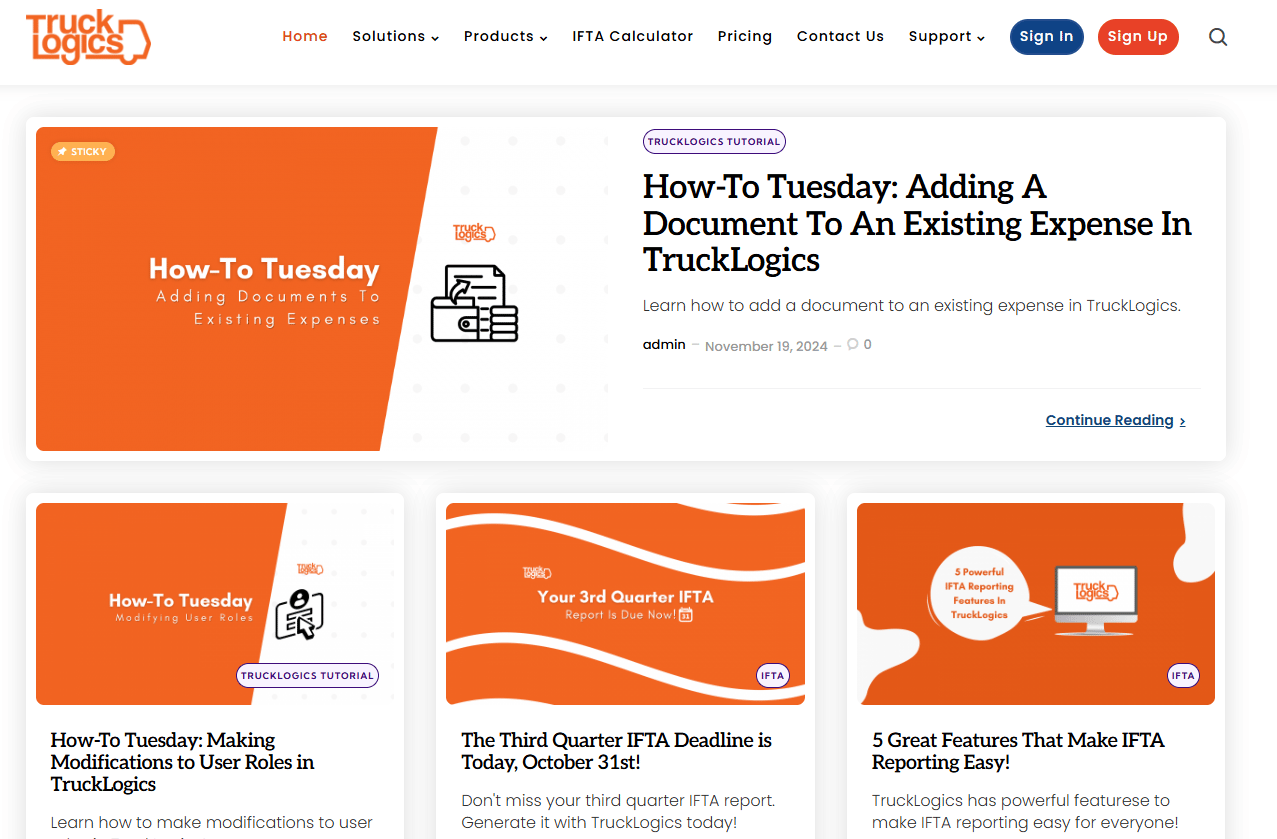
TruckLogics combines dispatch, accounting, IFTA reporting, maintenance, driver records, load management, and business reporting. It serves owner operators, fleets, brokers, leased operators, and trucking service providers.
Accounting functions cover invoices, payments, income, and expenses. IFTA workflows can import ELD and fuel information, reducing manual collection across operational systems.
Best for: Small and midsize fleets that want accounting connected to dispatch and compliance workflows.
Key features
- Load and dispatch management
- Invoices and payment tracking
- Income and expense records
- IFTA reporting and imports
- Driver and truck management
Why choose TruckLogics: Choose it when the finance problem starts with disconnected load data. Its integrations include fleet tracking, fuel, load, accounting, and mileage services.
The mobile app also supports field access. Before buying, confirm which integration will serve as the source for mileage, fuel purchases, and settlement information.
TruckLogics pricing
Owner Operator costs $35.96/month when billed yearly. Small Fleet costs $71.96/month on annual billing.
Mid Size Fleet costs $179.96/month. Large Fleet costs $224.96/month, while Enterprise uses custom pricing.
4. Sage Intacct

Sage Intacct provides cloud financial management for growing and multi entity organizations. Its verified capabilities include accounts payable automation, receivables, dashboards, dimensions, and consolidated accounting.
This is a finance led option rather than a trucking operations system. Transportation companies can use dimensions to organize reporting around their internal financial model.
Best for: Growing carriers and multi entity transportation businesses that need stronger financial controls.
Key features
- Multi entity financial management
- Accounts payable automation
- Accounts receivable workflows
- Financial dashboards and dimensions
- Intelligent general ledger
Why choose Sage Intacct: Choose it when the business has outgrown owner operator bookkeeping. It fits finance teams handling consolidation, stronger close controls, and reporting for lenders or leadership.
The buying process should include an integration map. Confirm how the system receives load, fuel, settlement, payroll, and TMS data before approving the migration.
Sage Intacct pricing
Custom pricing. Sage prices the software by industry, organization size, and selected modules.
G2 rating
4.3/5.
5. Truckstop TMS
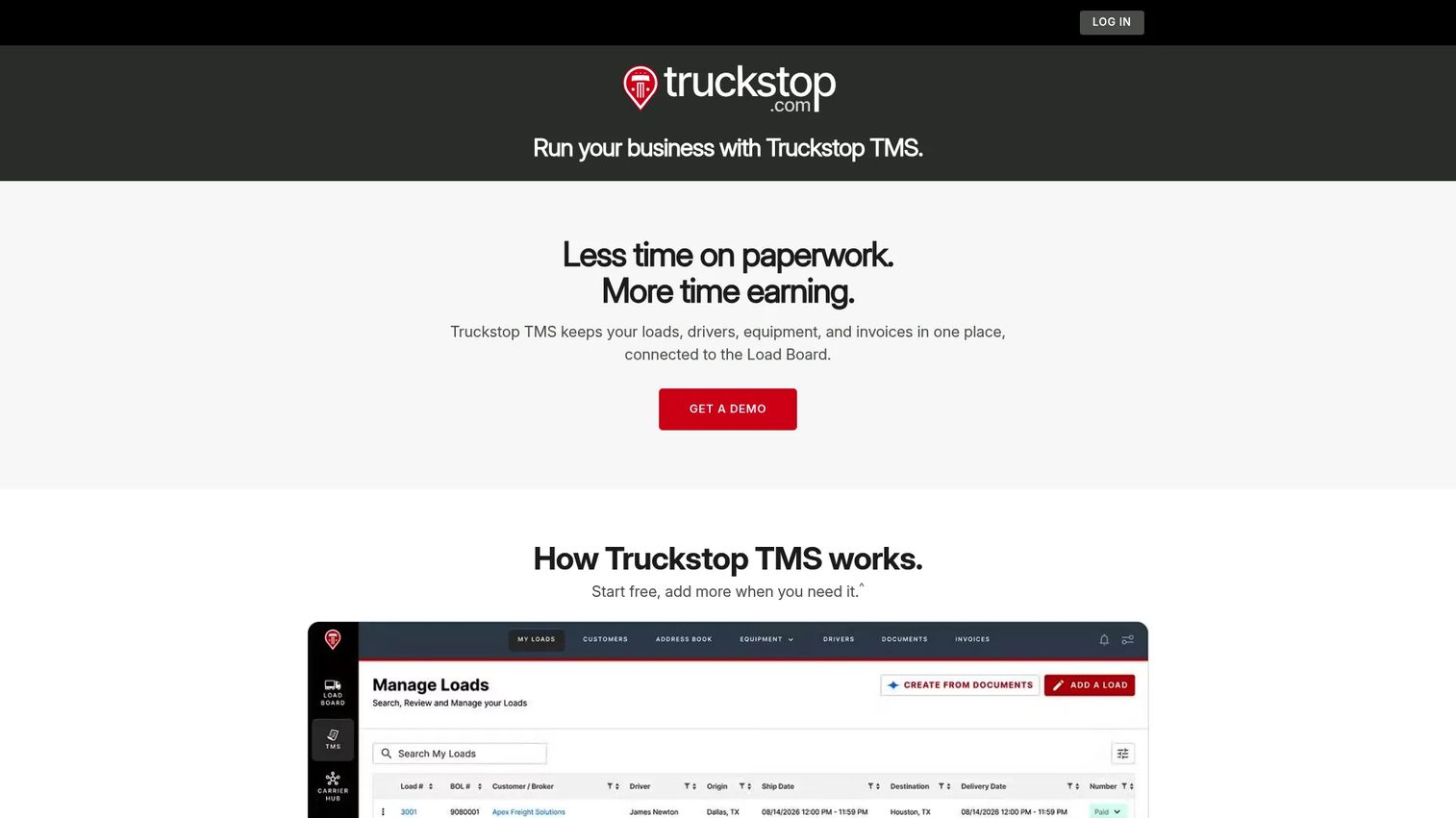
Truckstop TMS helps carriers manage loads, drivers, equipment, documents, and invoices. It connects these workflows with the Truckstop Load Board.
The free tier supports up to 10 active loads. Basic adds IFTA mileage and fuel estimates, accounting connectivity, branded invoices, and integrated invoicing.
Best for: Small and midsize carriers that want load management connected to billing and documentation.
Key features
- Load and driver management
- Equipment and document records
- Invoice creation and tracking
- IFTA mileage and fuel estimates
- QuickBooks Online connection
Why choose Truckstop TMS: Choose it when billing problems originate upstream in dispatch. Complete load records can help office staff create invoices with fewer manual handoffs.
The accounting connection makes it useful for carriers keeping their general ledger elsewhere. Buyers should still test how documents move from completed load to invoice packet.
Truckstop TMS pricing
TMS Free is included with a Load Board subscription and supports 10 active loads. TMS Basic costs $60/month per company.
G2 rating
4.0/5 for Truckstop.com overall. The available rating covers the broader vendor profile.
6. Q7

Q7 requires direct vendor discovery before buyers can compare it responsibly. Its official homepage did not expose enough verifiable product, plan, or rating detail for a feature level assessment.
Treat the sales conversation as a structured requirements review. Bring a sample invoice packet, settlement, and IFTA workflow. Ask the vendor to complete each process using your expected data.
Best for: Carriers willing to run detailed vendor discovery before shortlisting the system.
Key features
- Product scope: Confirm with Q7
- Accounting workflow: Request a live demonstration
- Integration coverage: Review against your current stack
- Reporting depth: Test with carrier data
- Migration support: Document before signing
Why choose Q7: Keep it on the shortlist only after confirming the operational and financial workflows you require. Avoid making a decision from category positioning alone.
The evaluation should cover invoice packets, driver pay, mileage data, and period close. Ask which functions are native and which require additional modules or third party software.
Require clear ownership for migration. The vendor should explain how opening balances, customers, drivers, equipment, and historical transactions enter the system.
Q7 pricing
Custom pricing. Contact Q7 for a quote.
7. Rigbooks
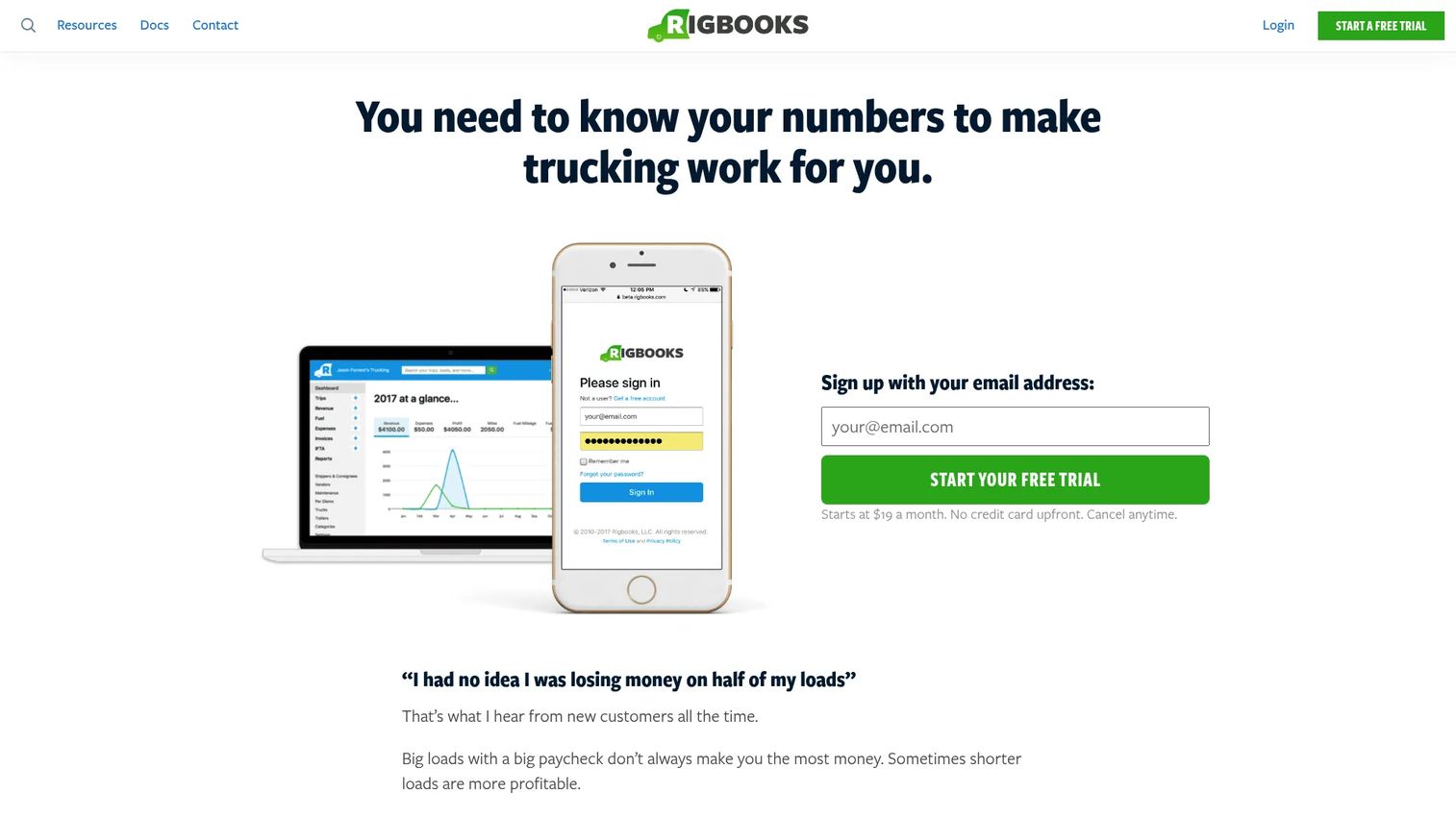
Rigbooks is web based bookkeeping software designed for trucking businesses. It tracks revenue, expenses, fuel mileage, equipment, maintenance, loads, and trips.
The product also provides profit and loss reports, expense reports, and IFTA information. Its focused scope suits smaller operators that want clearer finances without adopting a broader finance system.
Best for: Owner operators and small fleets needing straightforward bookkeeping and profitability tracking.
Key features
- Detailed load and trip records
- Revenue and expense tracking
- Fuel mileage and IFTA reports
- Equipment and maintenance records
- Profit and loss reporting
Why choose Rigbooks: Choose it when clarity matters more than complex financial administration. The plan structure maps to leased owner operators, independent operators, and small fleets.
It can help a carrier organize the inputs behind cost per mile. Larger businesses should confirm whether its controls and reporting structure match their close process.
Rigbooks pricing
Basic Entry costs $19/month. Leased O/O costs $29/month, while Independent O/O costs $49/month.
Small Fleet costs $149/month. A 30 day trial is available.
G2 rating
3.0/5.
8. Axon
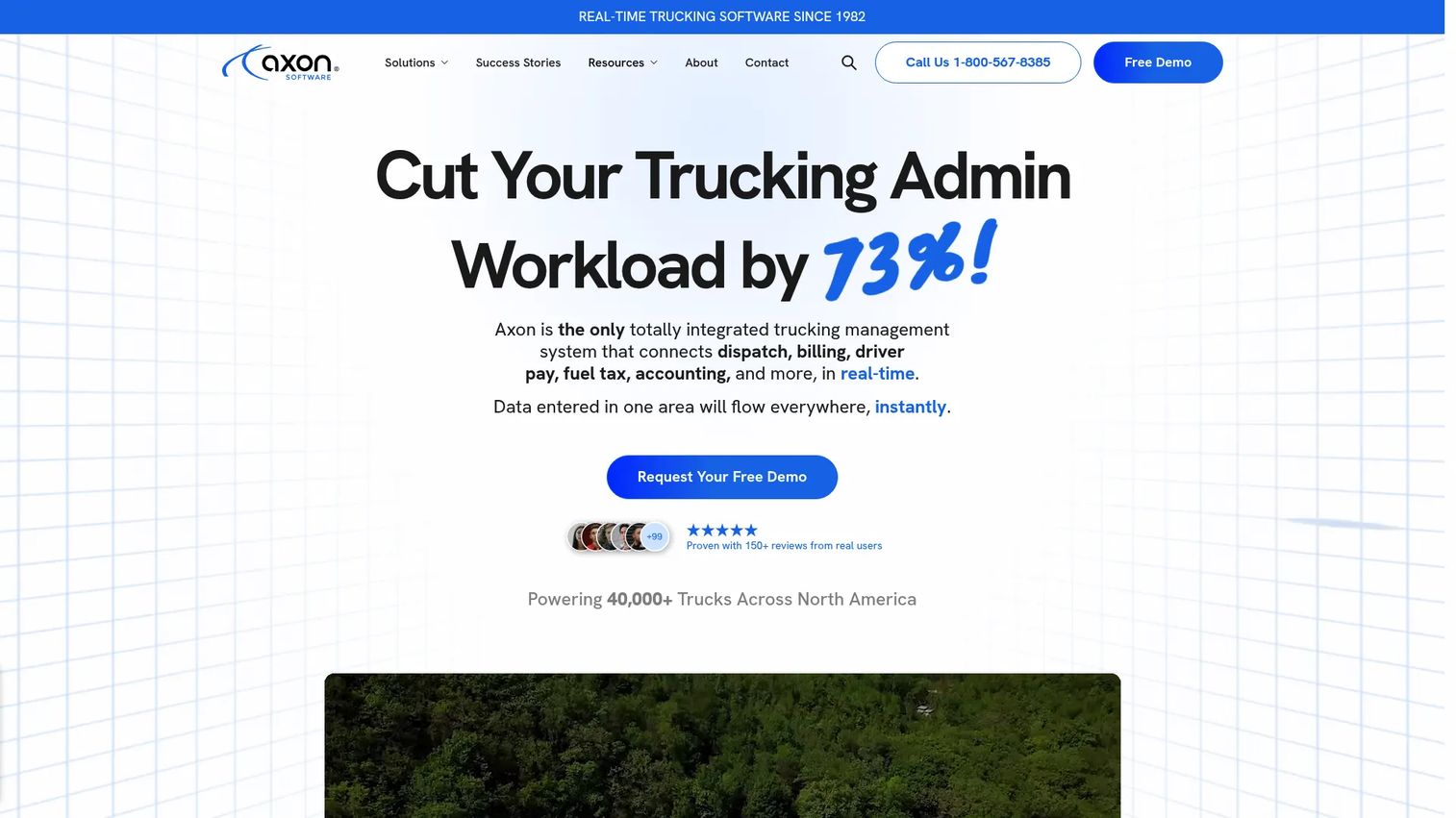
Axon connects trucking operations with finance through dispatch, billing, payables, receivables, and driver settlements. It also covers fuel tax, payroll, safety, compliance, and fleet information.
The system provides current visibility into loads, trucks, drivers, and trailers. Driver communication supports order details, documents, signatures, and photos.
Best for: Trucking companies that need integrated operations, accounting, payroll, and compliance workflows.
Key features
- Dispatch and equipment visibility
- Billing and receivables
- Driver settlements and payroll
- Fuel tax and IFTA reporting
- Safety and compliance management
Why choose Axon: Choose it when duplicated data creates billing lag, payroll issues, or reporting gaps. A connected operating system becomes more valuable as manual handoffs multiply.
During evaluation, test the full path from dispatch through driver pay and customer billing. That workflow reveals whether the system can replace existing tools or adds another layer.
Axon pricing
Custom pricing. Contact Axon for a quote.
G2 rating
3.7/5.
9. Zoho Books
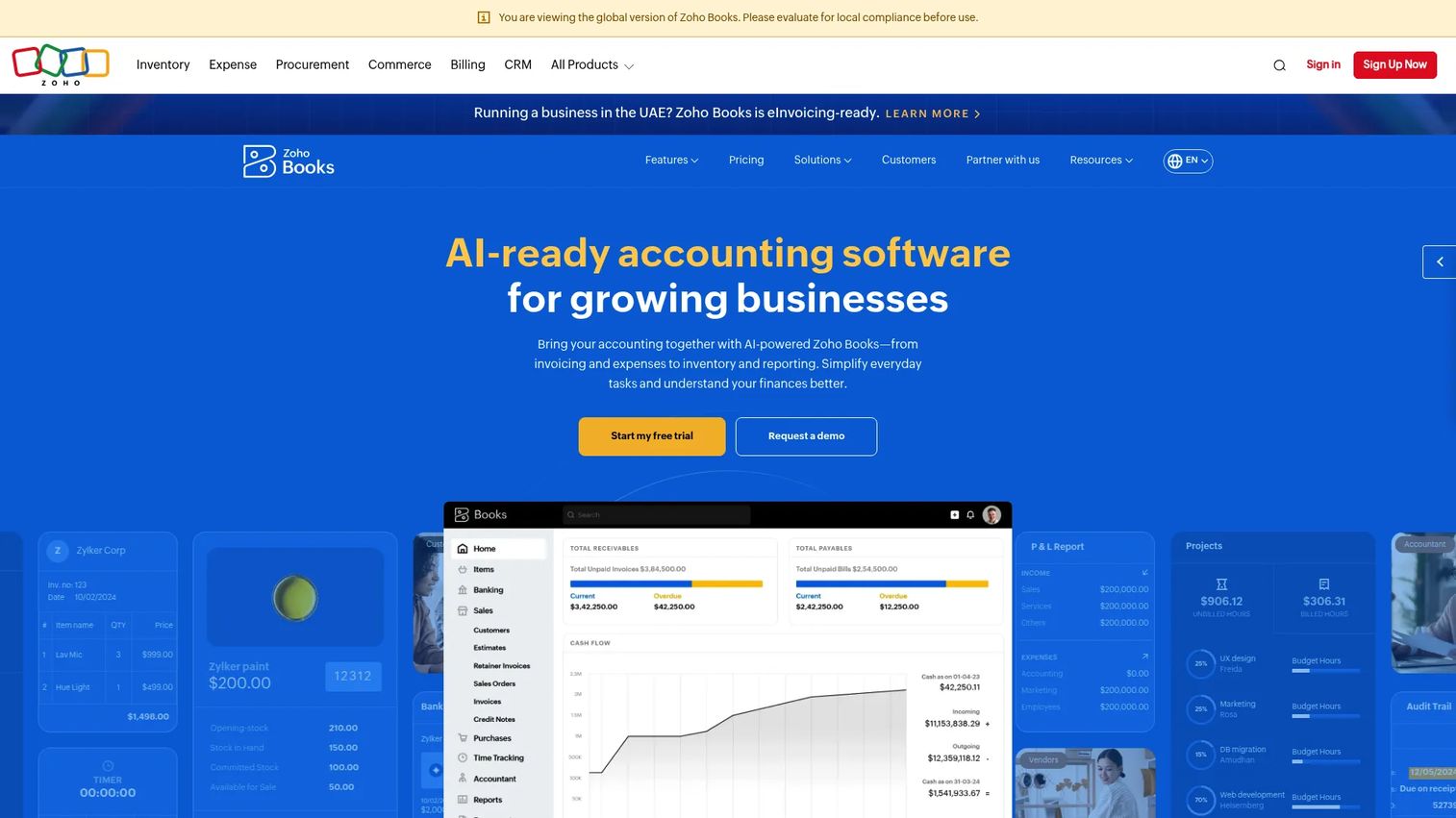
Zoho Books is cloud accounting software for invoicing, expenses, bank reconciliation, inventory, and financial reporting. It also supports project budgeting, profitability tracking, and multi currency transactions.
This is a general accounting product. Small carriers can use it for financial records while managing dispatch and trucking tax workflows elsewhere.
Best for: Small trucking businesses that want affordable cloud accounting and already use Zoho products.
Key features
- Customer invoicing and expenses
- Banking and reconciliation
- Financial and scheduled reports
- Project budgeting and profitability
- Workflow automation
Why choose Zoho Books: Choose it when cost control and standard accounting take priority. Its organization based pricing avoids a separate charge for every accounting user on the entry plans.
Carriers with complex settlements or IFTA workflows should include their operational software in the design. Decide which system owns mileage, fuel, load, and payment data.
Zoho Books pricing
The Free plan costs $0. Standard costs $20 per organization monthly or $15 with annual billing.
Paid plans extend to Ultimate at $275 monthly or $240 with annual billing.
G2 rating
4.4/5.
Considerations when choosing trucking accounting software
Match the tool to your fleet size
A single truck operation needs different controls from a 200 truck carrier. Owner operators may prioritize invoicing, expenses, and tax records.
Growing fleets need settlement controls and reliable operational connections. Multi entity companies should also test consolidation, permissions, and close management.
Verify IFTA and mileage workflows
Confirm whether the software creates IFTA reports or prepares data for another system. Ask where mileage and fuel purchase information originates.
Check IRP reporting separately when it matters. Similar source data does not guarantee the same report coverage.
Check settlement and payroll fit
Review advances, deductions, reimbursements, contractor payments, and payroll connections. Run a sample driver settlement before buying.
Settlement errors affect trust as well as finance. The best workflow gives drivers a clear record while preserving an audit trail.
Inspect invoice packet workflows
Test how the system handles rate confirmations, signed bills of lading, delivery documents, receipts, and accessorial charges.
Factoring may add further documentation requirements. Measure the time from delivered load to complete invoice packet.
Test profitability reporting before buying
Ask the vendor to produce cost per mile and revenue per mile from sample data. Then request profitability by load, truck, customer, or lane.
A report that needs spreadsheet reconstruction will not remove owner dependency. The system should produce numbers your controller can defend.
Conclusion
TruckingOffice is a practical starting point for owner operators and smaller fleets needing trucking native workflows. QuickBooks Online fits businesses prioritizing familiar accounting and accountant access.
TruckLogics connects finance with dispatch and IFTA. Sage Intacct addresses stronger controls for growing or multi entity organizations.
Truckstop TMS links load operations with invoices and documents. Axon takes a broader approach across finance and fleet operations, while Rigbooks keeps trucking bookkeeping focused.
Zoho Books offers a lower cost general accounting route. Q7 requires deeper vendor discovery before it can be compared on verified capabilities.
Shortlist two tools that fit your fleet size and operating model. Then run four tests:
- Create a complete invoice packet
- Produce an IFTA report
- Calculate a driver settlement
- Show cost per mile by truck
The tool should earn its place within the first quarter through cleaner cash visibility and fewer manual reconciliations.
Show complex software workflows clearly
If your team sells trucking or finance software, a clickable product experience can show invoicing, settlements, or IFTA workflows before a sales call.
Interactive demos also support landing pages, sales follow ups, partner enablement, and customer education.
Start your journey with Guideflow today!
FAQs
The best choice depends on where your finance process breaks. TruckingOffice fits fleets needing trucking native invoicing, IFTA, dispatch, and expense management.
TruckLogics suits dispatch connected workflows, while Rigbooks focuses on bookkeeping and profitability. QuickBooks Online fits businesses prioritizing standard accounting and accountant access.
Yes. QuickBooks Online can manage income, expenses, invoices, bank transactions, and financial reports for a trucking business.
It remains general accounting software. Carriers may pair it with separate systems for dispatch, IFTA, driver settlements, mileage, or load management.
Look for freight invoicing, expense tracking, fuel records, IFTA reporting, and driver settlement support. Payroll connections and financial statements also matter as the fleet grows.
Strong accounting software for carriers should report cost per mile. More advanced systems can also show profitability by truck, customer, load, or lane.
IFTA reporting organizes fuel purchases and miles traveled by jurisdiction. Carriers use that information when preparing fuel tax returns.
Verify whether the software produces the report directly or exports the underlying data. Also confirm which source provides mileage and fuel transactions.
Cost per mile divides applicable operating costs by miles driven. Those costs can include fuel, maintenance, insurance, driver pay, and equipment expenses.
The calculation becomes more useful when software separates results by truck, route, load, lane, or customer. Consistent transaction coding determines report quality.
It can be worthwhile when invoicing, tax records, and IFTA reporting consume regular administrative time. Better records also make profitability easier to evaluate.
A simple operation may begin with general bookkeeping. Trucking bookkeeping software becomes more useful once mileage, fuel, and load details outgrow that setup.
Accounting software manages financial records, invoices, payments, expenses, taxes, and reports. A transportation management system manages loads, dispatch, equipment, documents, and operational activity.
Some trucking products combine both areas. Others connect a TMS with a separate general ledger.
Entry plans in this comparison start at $19/month, while several products offer free tiers. Larger financial and operational systems use custom pricing.
Compare total cost across users, trucks, integrations, onboarding, payroll, and support. A low subscription cost can lose its advantage when staff rebuild reports manually.