If you're evaluating Thought Industries alternatives, you're probably wrestling with one of a few familiar problems: The pricing is hard to compare, the implementation is heavier than expected, or your team needs customers to actually practice product workflows rather than just complete a course module.
The best Thought Industries alternative depends on the job. Skilljar and Intellum fit enterprise SaaS customer education, Docebo and Absorb LMS cover broader enterprise learning, and Guideflow fits hands-on product lessons where customers need to click through a workflow rather than watch a video or read a help article. The list below spans customer education platforms, enterprise LMS tools, course commerce platforms, and one demo automation option for product practice. Twelve tools serve formal academy and LMS needs. Guideflow serves a different job entirely and is included here because CS teams increasingly need both.
No single platform wins every use case. The goal of this guide is to help you match the right category to your actual problem.
TL;DR
- Best for enterprise SaaS customer education: Skilljar, with strong academy portals, certifications, and Salesforce integration
- Best for multi-audience enterprise learning: Intellum, covering customers, partners, and employees from one platform
- Best for broad enterprise LMS needs: Docebo or Absorb LMS, both rated 4.6/5 or higher on G2
- Best for hands-on product lessons: Guideflow, a demo automation platform where customers click through real product workflows; it has no enrolment, no certificates, and no completion records
- Best for monetized course businesses: LearnWorlds, with public pricing starting at $44/month billed annually
- Best for fast launch with published pricing: TalentLMS, with plans from $119/month billed annually and a free tier for up to 5 users
- Price reality: Most enterprise LMS tools use quote-based pricing. Drivers include learner volume, portal count, admin seats, and integration requirements. Compare those factors before shortlisting.
What's inside
- What Thought Industries is and who it serves
- Why teams look for alternatives
- A 13-tool comparison table with category labels
- Full card reviews for all 13 tools
- Use-case routing by job to be done
- When to stay with Thought Industries
- FAQs for CS and customer education buyers
What is Thought Industries?
Thought Industries is a customer education and extended-enterprise learning platform. Teams use it to build branded academies, structure learning paths, run certification programs, train external partners, and monetize education content. It is built for organizations that treat customer education as a formal program rather than a loose collection of help articles.
Who Thought Industries is built for
It serves customer education leaders, partner enablement teams, and organizations running structured external training across multiple audiences. The platform suits teams that need branded learning portals, course sequencing, learner management, and reporting tied to business outcomes. Enterprise SaaS companies with mature CS programs, compliance-sensitive industries, and businesses that sell education as a product are common buyers.
Where Thought Industries may feel heavy
G2 reviewers frequently note that implementation requires significant internal effort: Content migration, SSO setup, CRM integration, portal configuration, and admin training all take time. Pricing is quote-based, which makes early-stage budget comparison difficult. Teams that need a quick launch or a lighter academic footprint often find the platform's depth more than they need. Some reviewers describe the admin interface as complex for smaller teams without dedicated learning operations staff.
Why teams look for Thought Industries alternatives
Teams usually compare Thought Industries alternatives when they need a clearer pricing model, a faster path to launch, a different learner experience, or a way to teach product workflows that an LMS doesn't cover well.
Pricing is hard to compare
Thought Industries doesn't publish pricing, so early-stage budget conversations require a full sales process. Enterprise LMS buyers should factor in implementation services, active learner limits, portal count, admin seats, integrations, support tier, and content migration. G2 reviewers mention that the total cost of ownership can surprise teams that budget based on license fees alone.
Implementation can become the hidden project
Migrating courses, converting SCORM and xAPI assets, setting up SSO, connecting a CRM, configuring multi-portal branding, and training internal admins can stretch a launch from weeks to months. For CS teams already stretched thin, that overhead competes directly with the work of actually educating customers. G2 reviewers across the customer education LMS category consistently flag implementation effort as the top reason for switching.
Customers need to practice, not just complete a course
LMS platforms track enrolment, course progress, assessment scores, certificates, and completion records. What they don't track is whether a customer can complete a workflow inside the product. If a user finishes a lesson on "how to set up an integration" but can't do it in the actual interface, the training didn't land. Interactive demos fill that gap by letting customers click through the real product flow as part of onboarding, a CS follow-up, or a help article. That's a different job than what an LMS does, and it's worth separating the two decisions.
Analytics need to prove CS impact
An LMS measures enrolment, completion, and assessment scores. Those are useful, but CS leaders increasingly need to connect training engagement to activation rates, support ticket volume, renewal signals, and product adoption. Tools differ significantly on this axis. Some offer rich reporting dashboards; others give you export-only data. Plan for the reporting you need before choosing.
How we picked these Thought Industries alternatives
Each tool was evaluated on its fit for customer education, customer training, partner training, or product onboarding workflows. Pricing language comes from each vendor's official pricing page. G2 ratings come from G2's current listings. The list includes both LMS-category tools and Guideflow as a demo automation option, with each labeled so readers can tell a formal academy platform from a product-practice layer. Tools without a confirmable G2 rating or any public pricing signal were excluded.
Thought Industries alternatives at a glance
Guideflow is the top pick for hands-on product lessons. For structured academies and formal LMS needs, Skilljar and Intellum lead for SaaS customer education. The table spans customer education platforms, enterprise LMS tools, course commerce platforms, and one demo automation tool.
| # | Tool | Category | Best for | G2 rating | Free plan | Starting price |
|---|---|---|---|---|---|---|
| 1 | Guideflow | Demo automation | Hands-on product lessons inside onboarding and customer education | 5.0 | Yes | Free; Solo from $35/user/month (annual) |
| 2 | Skilljar | Customer education LMS | Enterprise SaaS customer and partner academies | 4.6 | No | Vendor does not publish pricing, request quote |
| 3 | Intellum | Extended-enterprise learning | Multi-audience education across customers, partners, and employees | 4.3 | No | Vendor does not publish pricing, request quote |
| 4 | Docebo | Enterprise LMS | Enterprise learning across internal and external audiences | 4.3 | No | Vendor does not publish pricing, request quote |
| 5 | Absorb LMS | Enterprise LMS | Polished enterprise learner experience and external training | 4.6 | No | Vendor does not publish pricing, request quote |
| 6 | LearnUpon | Customer and employee LMS | Training customers, partners, and employees from one platform | 4.5 | No | Vendor does not publish pricing, request quote |
| 7 | TalentLMS | SMB and mid-market LMS | Fast launch and budget-sensitive customer training | 4.6 | Yes (up to 5 users) | From $119/month (annual, 1 to 40 users) |
| 8 | Thinkific Plus | Monetized course platform | Selling customer education and training programs at scale | 4.4 | No | Vendor does not publish pricing, request quote |
| 9 | WorkRamp | Customer education and revenue enablement | Customer education connected with sales and revenue enablement | 4.4 | No | Vendor does not publish pricing, request quote |
| 10 | Litmos | Enterprise LMS | Compliance-heavy and structured training programs | 4.3 | No | From $8,000/year (Foundation plan) |
| 11 | LearnWorlds | Course platform and academy builder | Monetized academies with course authoring | 4.7 | No | From $44/month (annual) |
| 12 | Continu | Learning platform | Customer, partner, and employee training consolidated | 4.6 | No | Vendor does not publish pricing, request quote |
| 13 | ClassroomIO | Lightweight academy platform | Lightweight customer academy or cohort-based learning | 4.0 | Yes (up to 20 students) | From $35/month |
The best Thought Industries alternatives in 2026
1. Guideflow (demo automation platform)
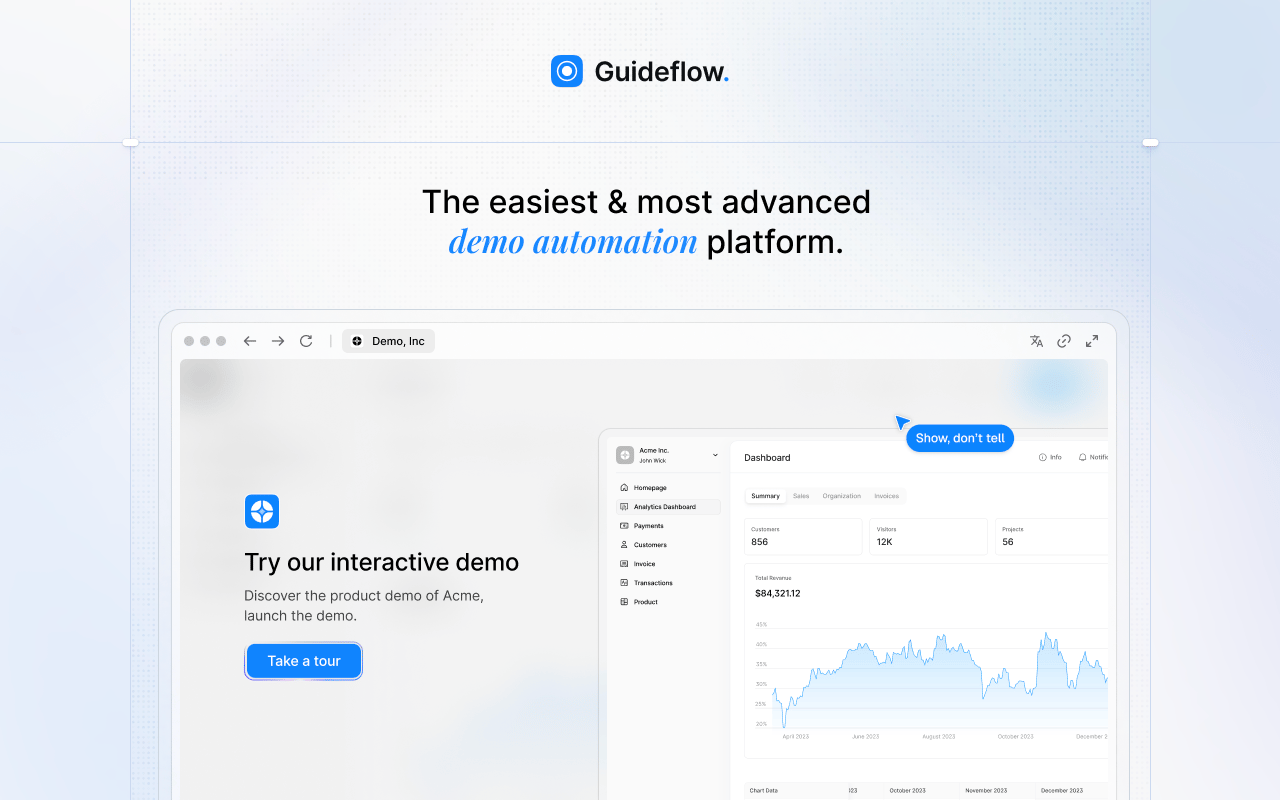
Guideflow is a demo automation platform that lets Customer Success teams create interactive demos, demo pages, demo centers, sandboxes, live demos, and mobile demos, so customers practice the actual product workflow instead of reading about it.
CS teams use Guideflow when users need to see and practice a workflow without booking a training call. The interactive demo sits inside an onboarding email, a help article, a CS follow-up, or a feature announcement. The customer clicks through the real product flow, and the team measures step-level completion, drop-off, and viewer flow through Guideflow's analytics.
Best for: SaaS CS teams that need hands-on product lessons, feature adoption content, and self-serve onboarding practice.
What it is: Guideflow is a demo automation platform. Teams capture product flows and publish them as interactive demos across six formats: Interactive demos, demo pages, demo centers, sandboxes, live demos, and mobile demos. Capture runs through the Chrome extension or the native app. Step content and CTAs are written automatically.
Key features:
- Interactive demos, demo pages, demo centers, sandboxes, live demos, and mobile demos
- Step-level completion tracking, drop-off analysis, and viewer flow reporting
- Company-level visitor identification
- Translation into more than 30 languages
- AI voiceover
- Integrations with HubSpot, Salesforce, Pipedrive, Zoho, and Marketo
Where Guideflow falls short:
- Guideflow is purpose-built for buyer-facing and customer-facing product experiences, so teams that need enrolment, certificates, assessments, or completion records should keep an LMS alongside it
- The platform rewards a structured demo workflow; teams looking for ad hoc, one-off recordings may find a recording tool enough at first
Pricing: A free plan exists. Solo is $35 per user per month (annual). Growth is $499 per month. Advanced is $1,499 per month. Enterprise starts from $2,999 per month and adds SSO, advanced governance, and enterprise security.
G2 rating: 5.0
How it compares to Thought Industries: Guideflow doesn't replace Thought Industries as an academy. It replaces static lesson modules when the job is product practice. Customers click through the workflow; the team sees where they drop off and what they complete.
2. Skilljar (customer education LMS)
Skilljar is one of the closest like-for-like alternatives for SaaS customer education. It was built for teams running formal customer academies and partner training programs, and it covers the full range: Branded portals, certifications, learning paths, and CRM integrations.
Best for: Enterprise SaaS companies running formal customer academies and partner certification programs.
What it is: Skilljar is a customer education LMS focused on external training. It supports branded academy sites, certificate issuance, single sign-on for learners, training monetization with payments and subscriptions, and deep integrations with Salesforce, Gainsight, Zoom, Webex, GoTo, and Zendesk. It sits squarely in the customer education LMS category.
Key features:
- Customizable branded academy portals
- Certifications and learning paths
- Training monetization with payments and subscriptions
- SSO for learners
- Salesforce, Gainsight, and Zendesk integrations
Where Skilljar falls short:
- Pricing consists of an annual subscription plus an active-user fee, and G2 reviewers note the total cost can be difficult to predict before a detailed sales conversation
- Implementation requires planning, admin resources, and content migration time, particularly for teams moving from an existing academy
- Some reviewers report that advanced analytics and reporting require higher-tier packages
Pricing: Skilljar offers Essentials, Professional, and Enterprise plans, each priced on an annual subscription plus an active-user fee. The vendor does not publish dollar amounts; request a quote from the sales team.
G2 rating: 4.6
How it compares to Thought Industries: Skilljar is a strong like-for-like swap for SaaS customer education. Teams that primarily need a customer academy and partner training program will find the core fit close. It is less suited to organizations that need employee training or broad internal learning alongside external programs.
3. Intellum (extended-enterprise learning platform)
Intellum fits teams with more than one training audience. If the education program spans customers, partners, and employees, Intellum's multi-tenant architecture handles all three from one platform, with separate portals and governance per audience.
Best for: Enterprise teams running education programs across multiple distinct audiences.
What it is: Intellum is an AI-powered enterprise learning platform. It supports multi-tenant learning portals, certifications, assessments, social learning, gamification, and analytics. The Evolve authoring tool lets teams build courses with branching logic, quizzes, and custom themes. Integrations span SSO, HRIS, CRM, payment systems, BI tools, and AI platforms.
Key features:
- Multi-tenant portals for customers, partners, and employees
- Evolve course authoring with branching logic and collaboration
- Certifications, assessments, gamification, and analytics
- Integrations with SSO, HRIS, CRM, and payment tools
- AI-powered learner, creator, and manager agents
Where Intellum falls short:
- The Intellum Platform is custom-quoted and requires a full sales process before budget comparison is possible
- Smaller customer education teams often find the platform's breadth more than they need if they only run customer-facing programs
- G2 reviewers note that implementation requires dedicated internal ownership to manage portal configuration and audience segmentation
Pricing: Intellum Platform pricing is custom. The Evolve authoring tool publishes separate pricing (Personal at $49/user/month billed annually, Team at $65/user/month billed annually, Enterprise custom), but those are not the core platform rates. Request a quote for the full platform.
G2 rating: 4.3
How it compares to Thought Industries: Intellum is the stronger choice when the education function spans more than a single customer academy. For organizations where Thought Industries feels narrow across multiple audience types, Intellum's multi-tenant model handles the complexity.
4. Docebo (enterprise LMS)
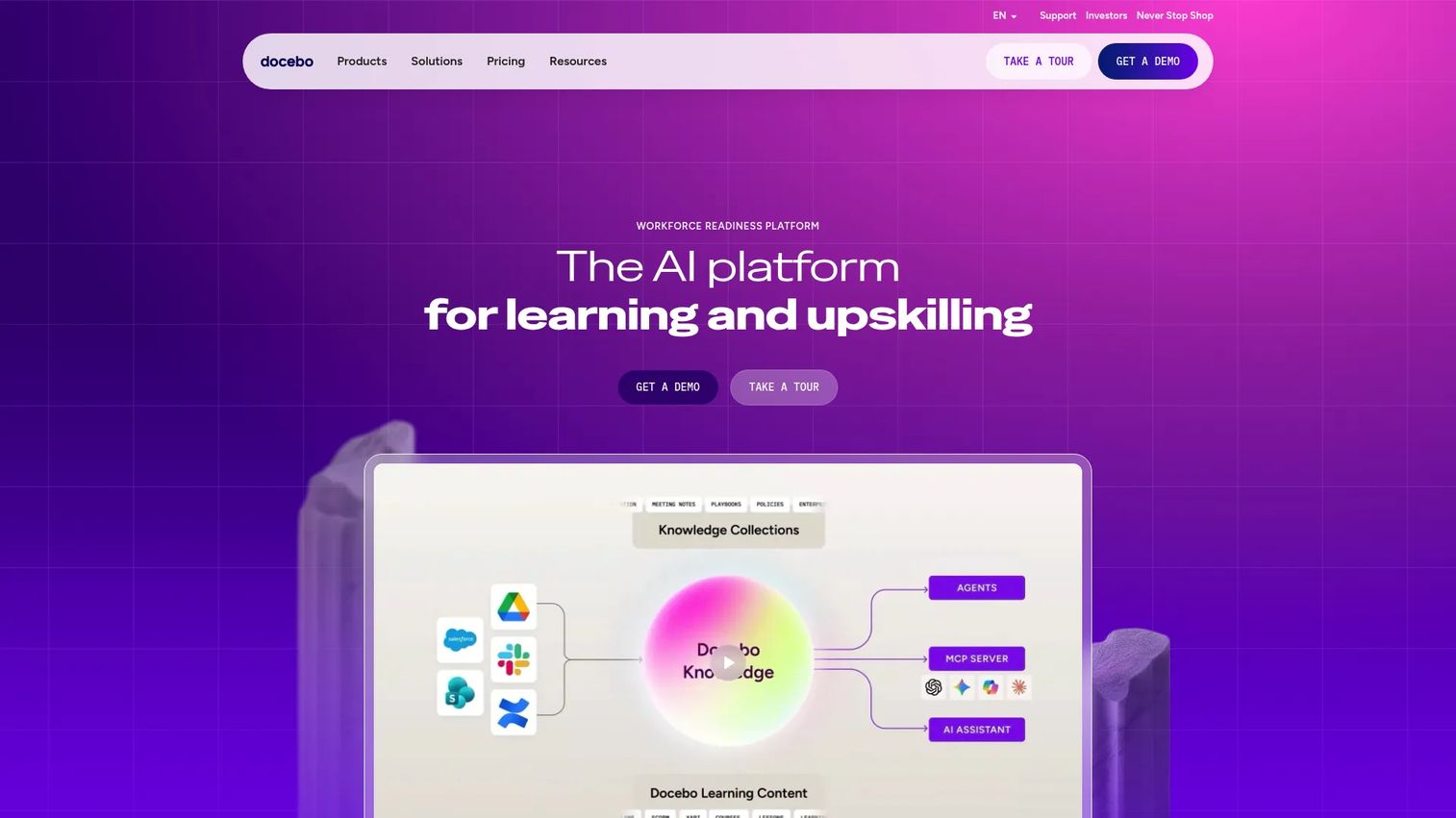
Docebo is an enterprise LMS with a broader scope than most customer education platforms. It suits teams where customer education sits inside a wider learning strategy that also includes employee development, compliance, and partner enablement.
Best for: Enterprise learning teams that need to manage customer, partner, and employee training from a single platform.
What it is: Docebo is an AI-powered learning platform for delivering learning at enterprise scale. It supports extended enterprise portals, certification and compliance tracking, skills intelligence, learning automation, and workflow integrations. AI features include content creation assistance, search, and personalized recommendations. Available add-ons include Advanced Analytics, E-Commerce, Extended Enterprise, and Communities.
Key features:
- Enterprise learning management and delivery
- AI-powered content creation, search, and learning recommendations
- Certification and compliance tracking
- Live, on-demand, mobile, and social learning
- Workflow automation and integrations
Where Docebo falls short:
- G2 reviewers note that Docebo's implementation footprint is large, and teams without dedicated learning operations staff report longer time to launch
- Pricing requires a full sales engagement, and add-ons can materially increase the total cost
- Teams that only need a customer education academy may find the platform broader than their actual requirements
Pricing: Docebo offers Elevate and Enterprise plans, both custom-priced.
G2 rating: 4.3
How it compares to Thought Industries: Docebo is a better fit when customer education is one component of a larger enterprise learning strategy. For teams whose primary need is an external customer academy, Skilljar or Intellum may map more directly to the job.
5. Absorb LMS (enterprise LMS)
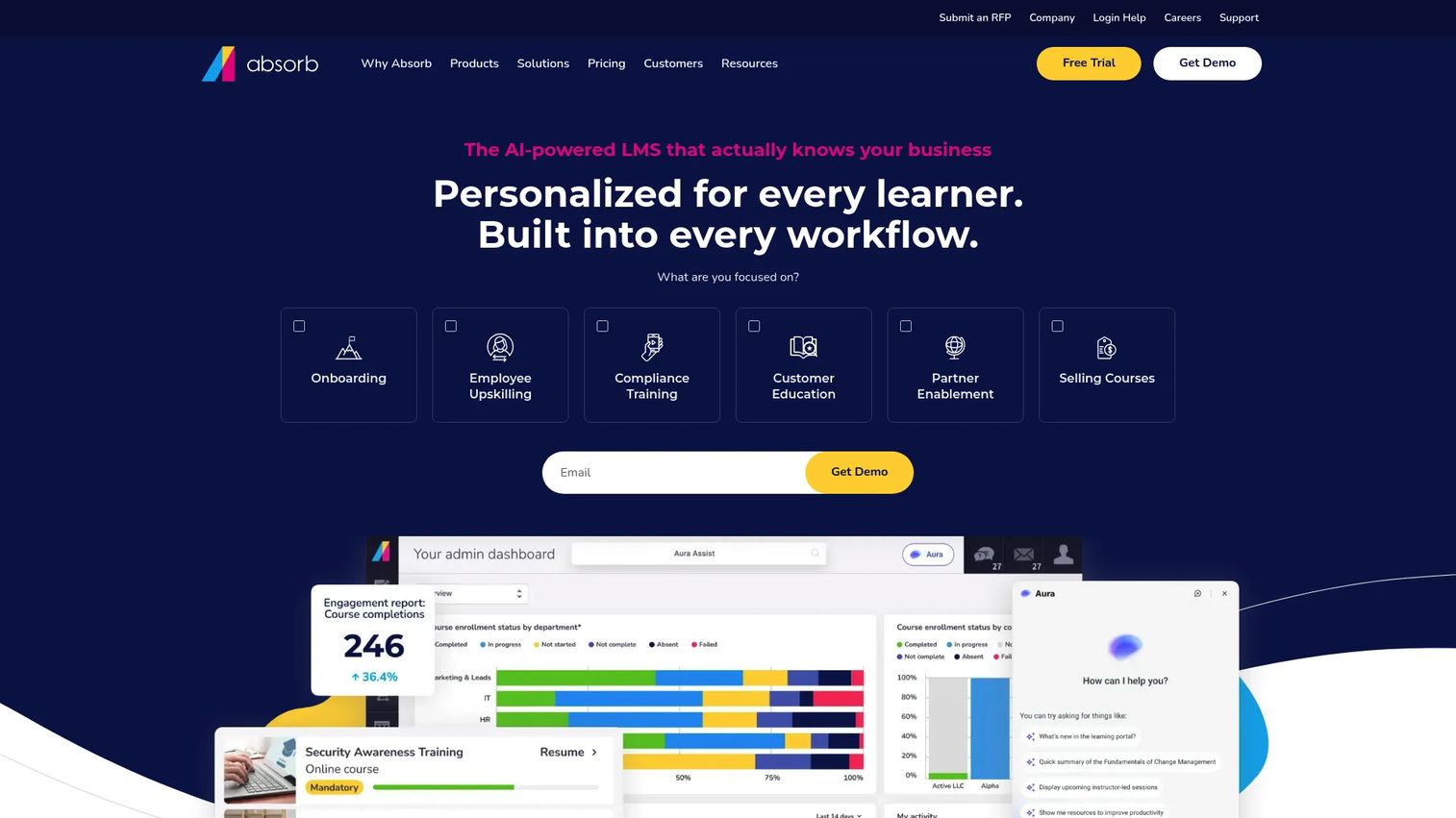
Absorb LMS competes on learner experience and mature enterprise administration. It's a strong option for teams that care about the quality of the learner-facing interface and need robust external training portals.
Best for: Enterprise organizations that prioritize a polished learner experience alongside strong LMS administration.
What it is: Absorb LMS is an AI-powered learning management system covering employee, customer, partner, compliance, and onboarding training. Key capabilities include role-, department-, and skill-gap-based learning assignment, PCI-compliant e-commerce for selling courses, AI course generation with Absorb Create (including quizzes, videos, translations, and voice-overs), and integrations with ADP, Workday, Salesforce, and 40+ other systems.
Key features:
- Personalized learning assignment by role, department, goal, and skill gap
- AI course generation with Absorb Create
- PCI-compliant e-commerce for course selling
- Custom performance reporting for compliance and engagement
- 40+ integrations including ADP, Workday, and Salesforce
Where Absorb LMS falls short:
- Pricing is not publicly displayed; the official pricing page requires learner-count and contact information before providing numbers
- G2 reviewers report that advanced configuration can require significant planning, particularly for complex role-based assignments
- Some reviewers note that the admin learning curve is steeper than expected for teams new to enterprise LMS platforms
Pricing: Submit learner count and contact details through the official pricing page to receive a quote.
G2 rating: 4.6
How it compares to Thought Industries: Absorb LMS is a strong alternative when learner experience and enterprise administration maturity are the primary buying factors. Teams that need a polished, scalable LMS with deep integrations will find the capability overlap substantial.
6. LearnUpon (customer and employee LMS)
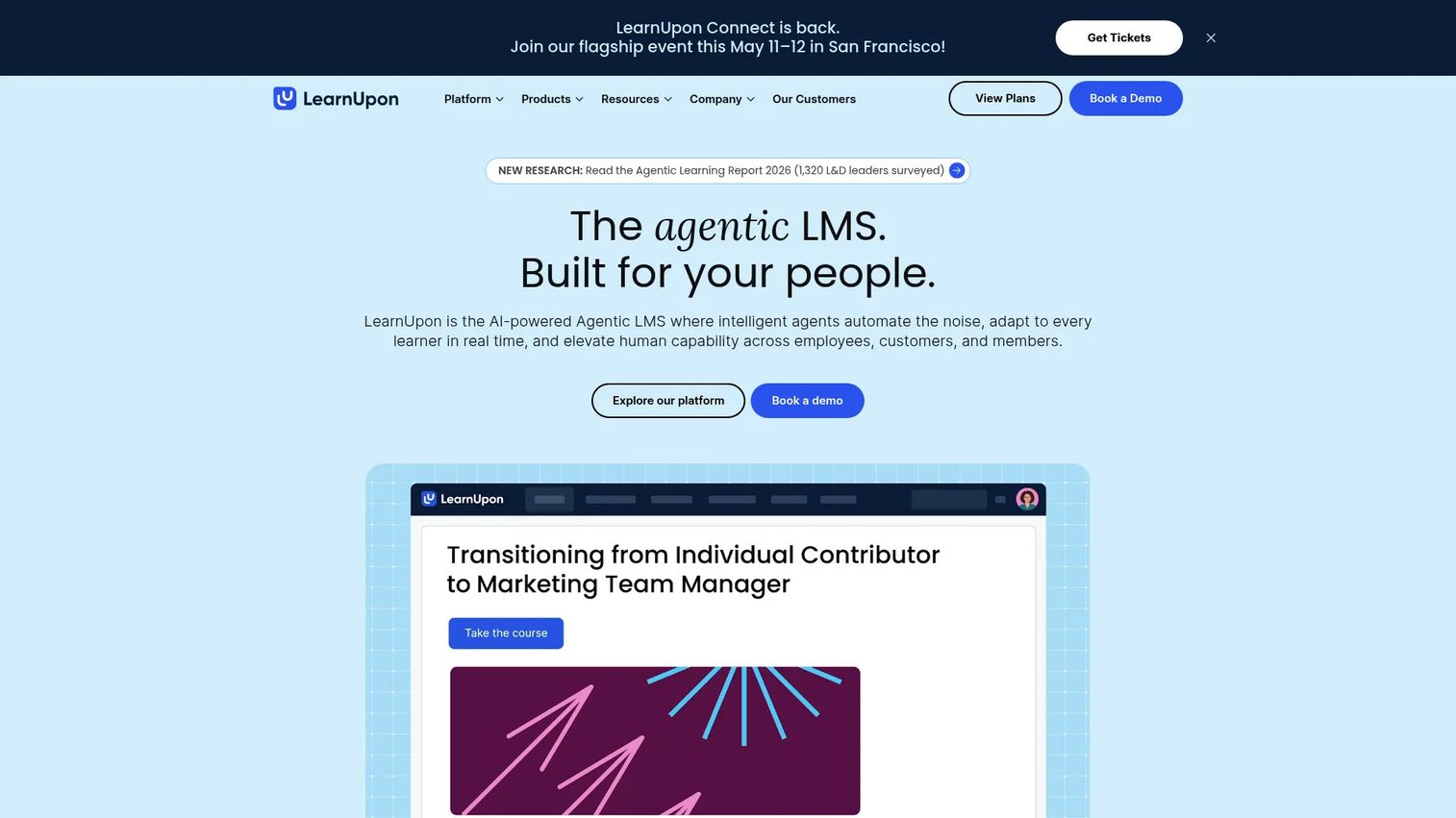
LearnUpon is a practical multi-audience LMS for teams that need to train customers, partners, and employees without building a highly custom academy operation. It is a mid-market alternative to both Thought Industries and broader enterprise LMS platforms.
Best for: Teams that need a single LMS covering customers, partners, and employees with a manageable implementation lift.
What it is: LearnUpon is an AI-driven learning management platform supporting multi-portal training, learning journeys with branching logic, assessments, certifications, skills development, eCommerce, and reporting. Live learning and webinar integrations extend instructor-led training capability. Portals can be scoped to separate audiences with distinct branding.
Key features:
- Multi-portal training for separate audiences
- AI-powered course authoring with Create+
- Learning journeys with branching logic
- Assessments, certifications, and eCommerce
- Reporting and analytics
Where LearnUpon falls short:
- The official pricing page shows user minimums (100 for employees, 300 for customer education, 150 for associations) but no public dollar amounts, requiring a sales conversation before budget comparison
- G2 reviewers note that advanced enterprise customization and white-label requirements are available but may require higher packages
- Some users describe reporting configuration as requiring more setup than expected for complex multi-audience programs
Pricing: LearnUpon offers separate products for employees, customer education, and associations, each with stated user minimums. The vendor does not publish pricing; request a quote.
G2 rating: 4.5
How it compares to Thought Industries: LearnUpon is a stronger fit for teams that want a practical multi-audience LMS rather than a deeply specialized customer education platform. The implementation is generally reported as more manageable, though it still requires planning.
7. TalentLMS (SMB and mid-market LMS)
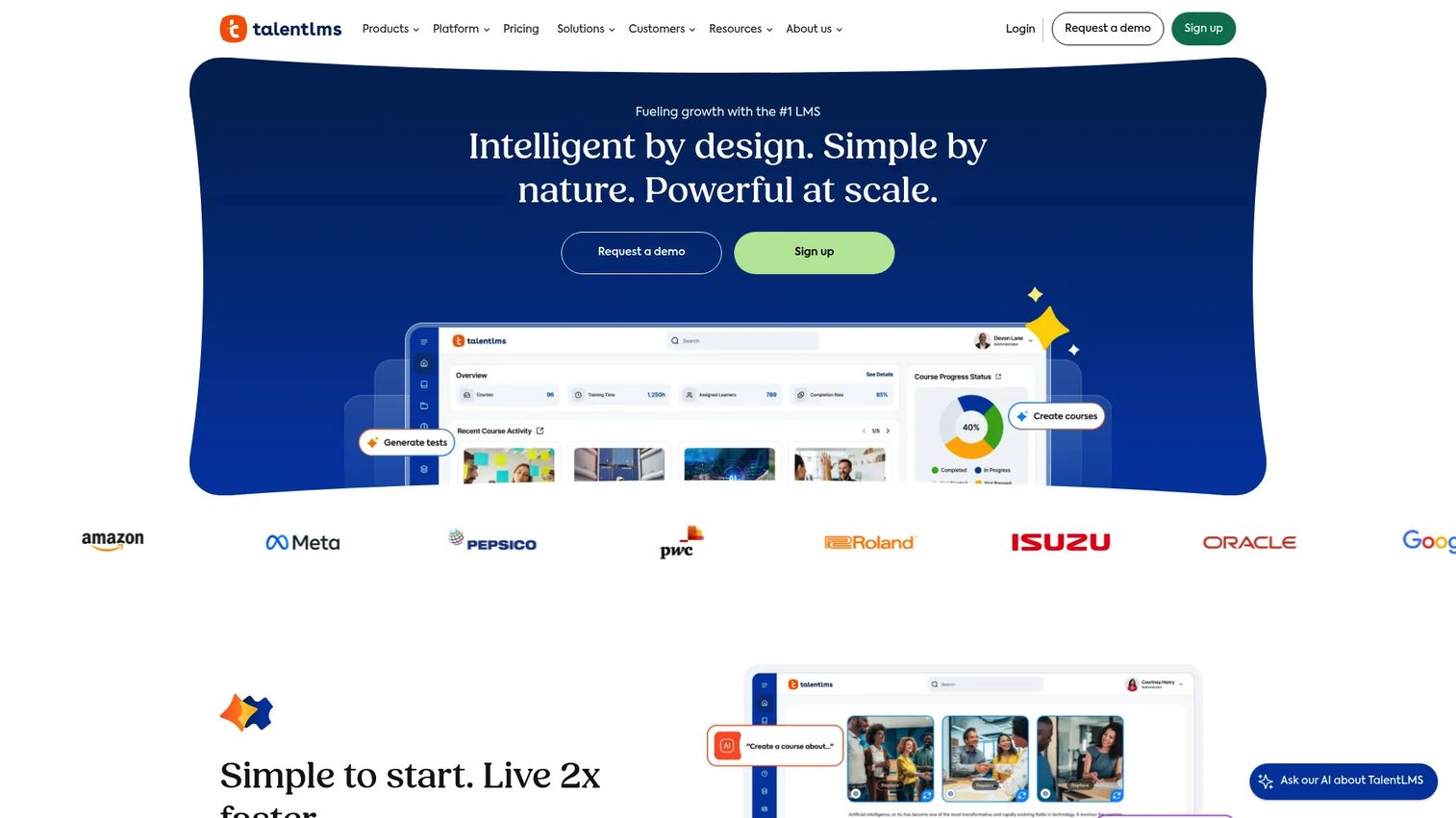
TalentLMS is the most accessible entry point in this list for teams that want to launch training fast without enterprise LMS overhead. It publishes pricing, offers a free tier, and supports standard LMS workflows without requiring a lengthy sales process.
Best for: Budget-sensitive teams that need a working customer training program quickly.
What it is: TalentLMS is a cloud-based LMS for employee, partner, and customer training. Core capabilities include AI-powered course creation, learning paths, quizzes, assessments, SCORM and xAPI support, custom branding, and SSO. A free plan is available indefinitely for up to 5 active users and 10 active courses.
Key features:
- AI-powered course and content creation
- SCORM, xAPI, and cmi5 support
- Learning paths, quizzes, and assessments
- Custom branding and SSO
- Public pricing with a free tier
Where TalentLMS falls short:
- G2 reviewers note that multi-audience academy governance and complex portal configurations may push programs beyond what the mid-market plans handle well
- Customization options are lighter than enterprise LMS tools; teams with demanding branding or reporting requirements often upgrade quickly
- Enterprise plan pricing is quote-based, so the published tiers only cover up to around 100 users on the Pro plan
Pricing: A free plan covers up to 5 users and 10 courses. Core starts at $119/month billed annually for 1 to 40 users. Pro starts at $449/month billed annually for 1 to 100 users. Enterprise pricing requires a quote.
G2 rating: 4.6
How it compares to Thought Industries: TalentLMS is better for straightforward programs and fast launches. Teams with complex external training operations, multi-portal governance, or large learner volumes will likely outgrow it.
8. Thinkific Plus (monetized course platform)
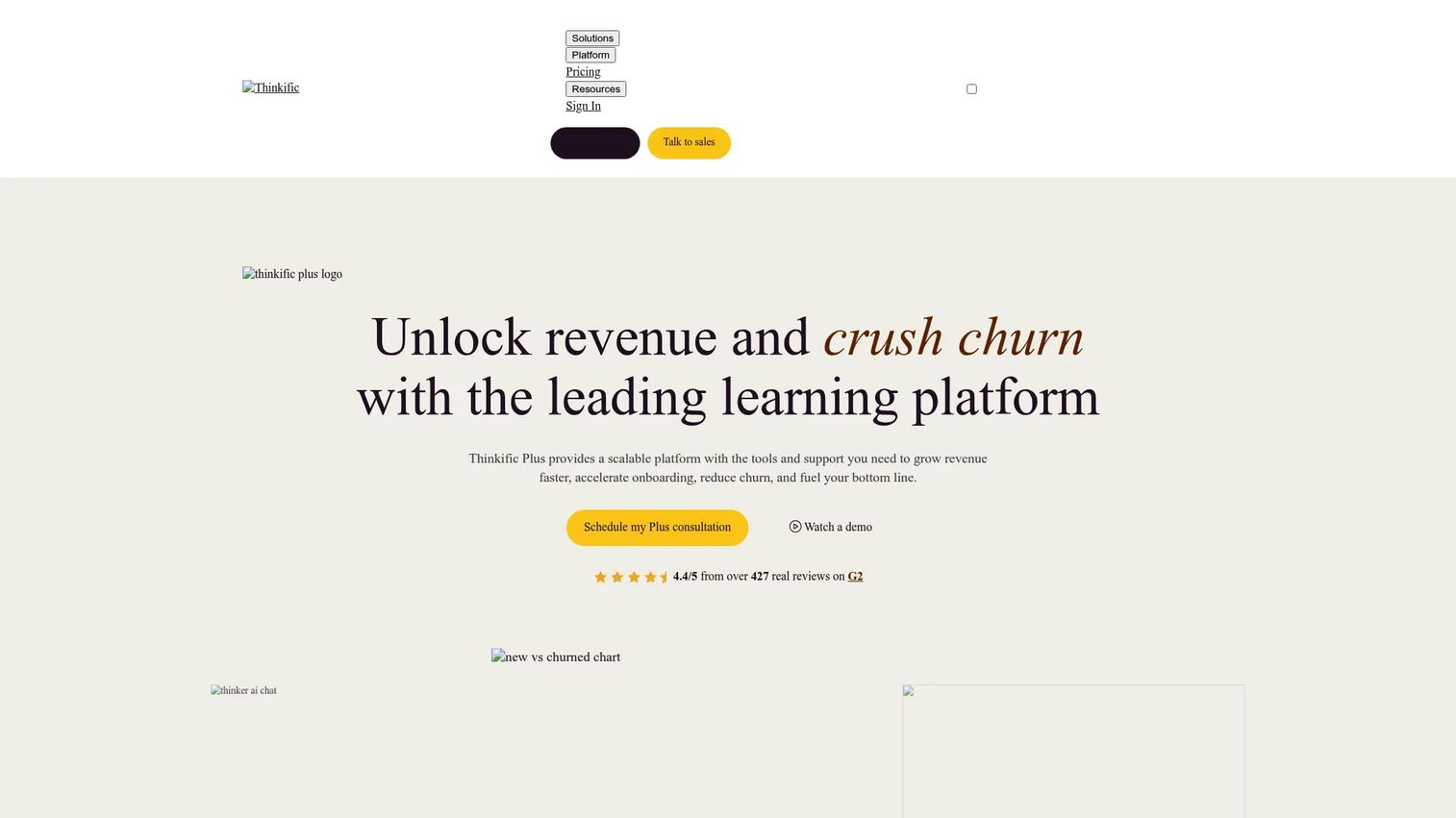
Thinkific Plus fits organizations that treat education as a revenue product. If the academy sells courses, subscriptions, or memberships, Thinkific Plus handles the commerce layer alongside course delivery.
Best for: Organizations building monetized customer academies or selling education programs at scale.
What it is: Thinkific Plus is an enterprise tier of the Thinkific platform. It adds SSO, SCORM support, learning paths, CRM integrations with HubSpot and Salesforce, custom roles and admin seats, custom analytics dashboards, and a Plus Portal for managing multiple branded sites. Dedicated customer success support is included. It is not a traditional extended-enterprise LMS; it is a course commerce platform with enterprise-level controls.
Key features:
- SSO and SCORM support
- Learning paths and community features
- HubSpot and Salesforce integrations
- Plus Portal for multi-site management
- Custom analytics dashboards
Where Thinkific Plus falls short:
- Thinkific Plus is not built for complex enterprise governance such as deep role-based learner management or compliance recordkeeping at scale
- Pricing is custom and not published; teams expecting a quick budget comparison will need to go through a sales conversation
Pricing: Thinkific Plus pricing is custom.
G2 rating: 4.4
How it compares to Thought Industries: Thinkific Plus is a stronger fit when training is a revenue product. For compliance-heavy programs, complex external learner management, or formal certification at enterprise scale, a dedicated LMS is likely a better match.
9. WorkRamp (customer education and revenue enablement)
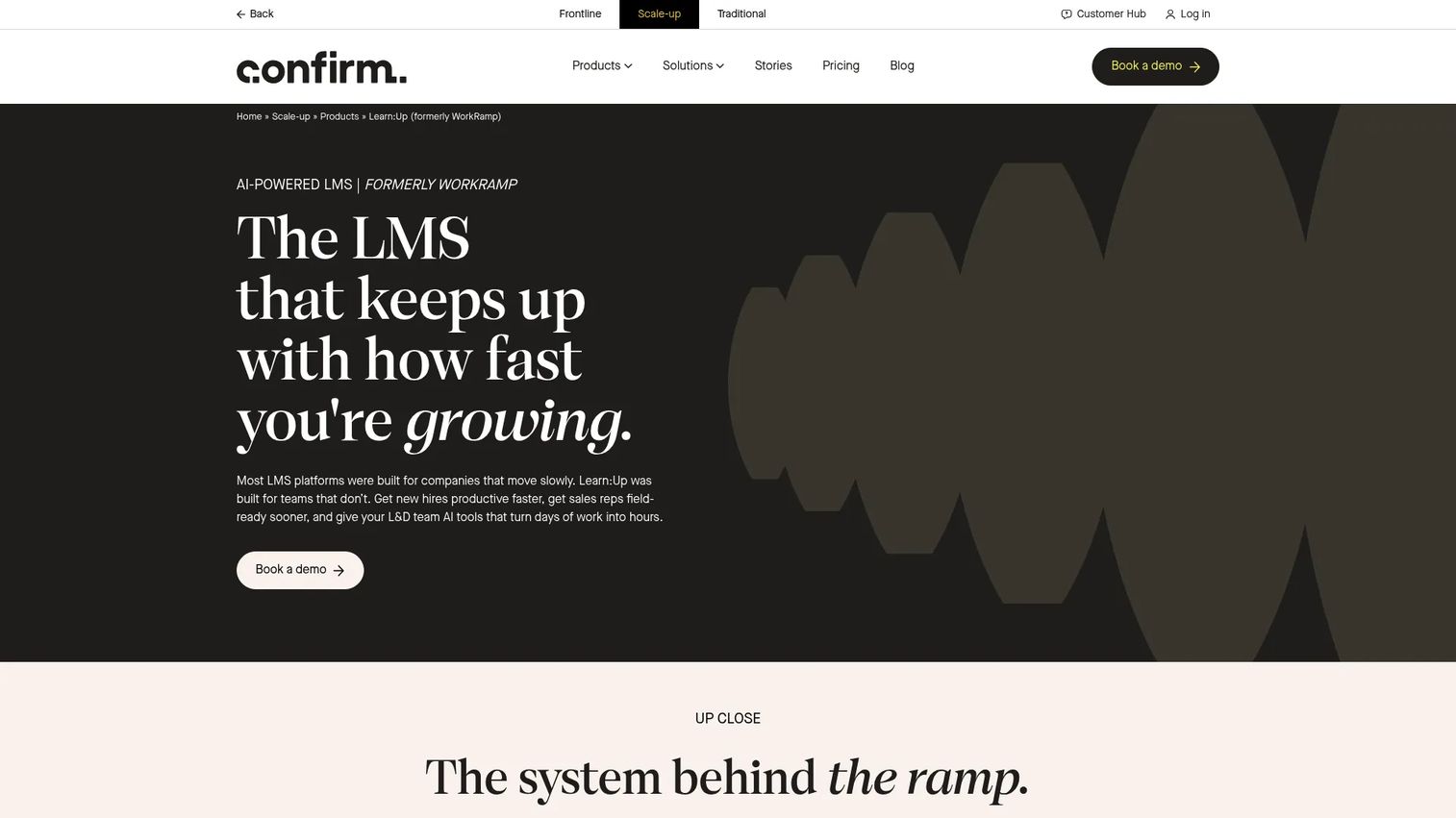
WorkRamp connects customer education with revenue enablement. It serves teams that want to run customer training alongside sales and employee onboarding from a single platform, particularly when CS and enablement share ownership of the learning stack.
Best for: Companies where customer education and revenue enablement are managed by the same team or budget.
What it is: WorkRamp (now presented as Learn:Up by Confirm) is an AI-first LMS for employee onboarding, enablement, customer education, and partner training. Capabilities include AI simulations and role plays, personalized learning formats, AI-assisted content creation, analytics and reporting, and integrations with HRIS, HCM, SSO, scheduling, and API tools.
Key features:
- AI simulations and role plays
- Personalized learning formats
- AI-assisted content creation
- Analytics and reporting
- HRIS, HCM, and SSO integrations
Where WorkRamp falls short:
- G2 reviewers note that pricing requires a sales conversation; Professional and Enterprise packages are listed publicly, but no dollar amounts are displayed
- Teams whose only need is a customer academy may find the platform's enablement breadth adds complexity without proportional value
- The product's recent rebrand to Learn:Up means teams should confirm current product naming and feature scope directly with the vendor
Pricing: Request a quote from the vendor.
G2 rating: 4.4
How it compares to Thought Industries: WorkRamp is a stronger fit when customer education is part of a broader enablement motion that also covers sales and employee training. For teams whose sole need is an external customer academy, it may be more platform than the job requires.
10. Litmos (enterprise LMS)
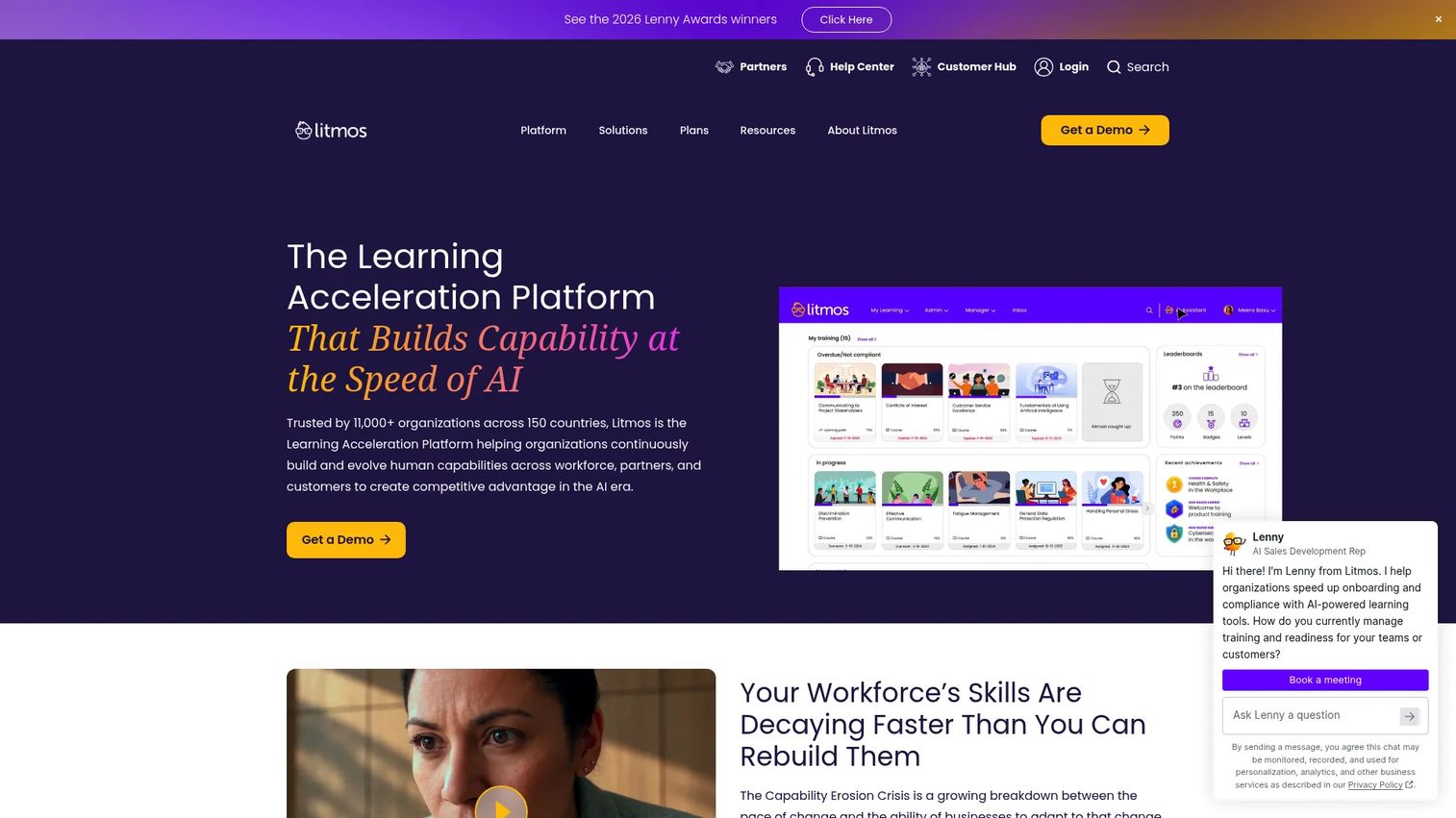
Litmos is a mature enterprise LMS with published starting prices, which is unusual in this category. It serves compliance-heavy programs and structured training operations across employees, customers, and partners.
Best for: Teams running compliance-oriented training programs that need structured assignments, records, and governance.
What it is: Litmos is a learning acceleration platform covering learning paths, instructor-led and virtual instructor-led training, 360-degree video, SCORM, xAPI, and AICC content support, compliance management, AI-assisted content management, and reporting. The Foundation plan covers essential learning tools; Platinum adds advanced compliance and engagement features; Platinum AI adds embedded AI capabilities.
Key features:
- SCORM, xAPI, and AICC content import
- Compliance management and tracking
- AI-assisted content management and video tagging
- Learning paths and instructor-led training
- Reporting and dashboards
Where Litmos falls short:
- G2 reviewers note that Litmos is less specialized for SaaS customer academies than tools built specifically for external customer education
- The UI has mixed reviews, with some users reporting that the admin experience feels dated relative to newer LMS platforms
- Platinum AI pricing requires a sales conversation, while Foundation and Platinum have published starting prices
Pricing: Foundation starts at $8,000/year. Platinum starts at $15,000/year. Platinum AI pricing requires a quote.
G2 rating: 4.3
How it compares to Thought Industries: Litmos is a better fit for compliance-heavy and structured training programs. Teams whose primary need is a SaaS customer education academy with a modern learner experience may find other tools in this list a closer match.
11. LearnWorlds (course platform and academy builder)
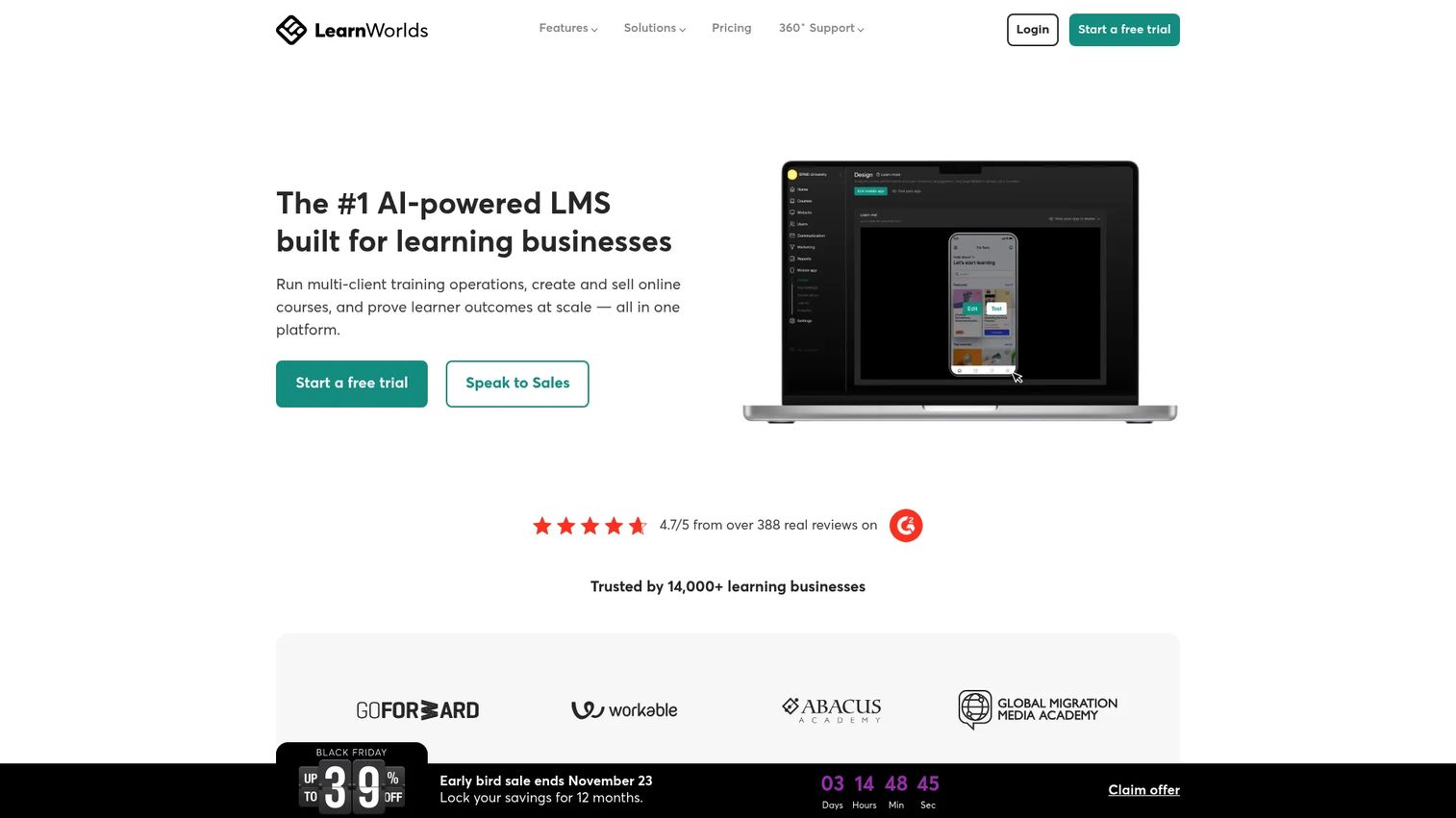
LearnWorlds combines course authoring, branded academy sites, and course commerce in one platform with published pricing. For teams building monetized academies or education-led customer programs without a full enterprise LMS rollout, it offers a strong starting point.
Best for: Teams building monetized courses, branded academies, or lightweight education-led customer programs.
What it is: LearnWorlds is an AI-powered LMS for creating, selling, and delivering online courses and training programs. It supports interactive video, SCORM and HTML5, assessments and certifications, community and social network features, course bundle and membership selling, white-label websites, and branded mobile apps. Analytics and reporting are included across plans.
Key features:
- AI course and website builder
- Interactive video and SCORM support
- Assessments and certifications
- Course, bundle, membership, and subscription selling
- White-label websites and analytics
Where LearnWorlds falls short:
- LearnWorlds is not built for complex enterprise customer education with deep role-based learner management or multi-portal governance at scale
- G2 reviewers note that advanced branding and admin needs may require the Learning Center or higher plan, which increases cost significantly over the entry-level Starter plan
- Integration depth for enterprise CRM and analytics stacks may need review before committing
Pricing: Starter is $44/month billed annually (or $49/month). Pro Trainer is $79/month billed annually. Learning Center is $194.35/month billed annually. Learning Center and Mobile Apps is $364.78/month billed annually. Corporate pricing is custom. Note: Starter includes a $5 per-enrolment fee; higher plans do not.
G2 rating: 4.7
How it compares to Thought Industries: LearnWorlds is a stronger fit for course commerce and lighter academies. Teams that need complex external enterprise learning, deep compliance recordkeeping, or large-scale certification programs will want a dedicated enterprise LMS instead.
12. Continu (learning platform)
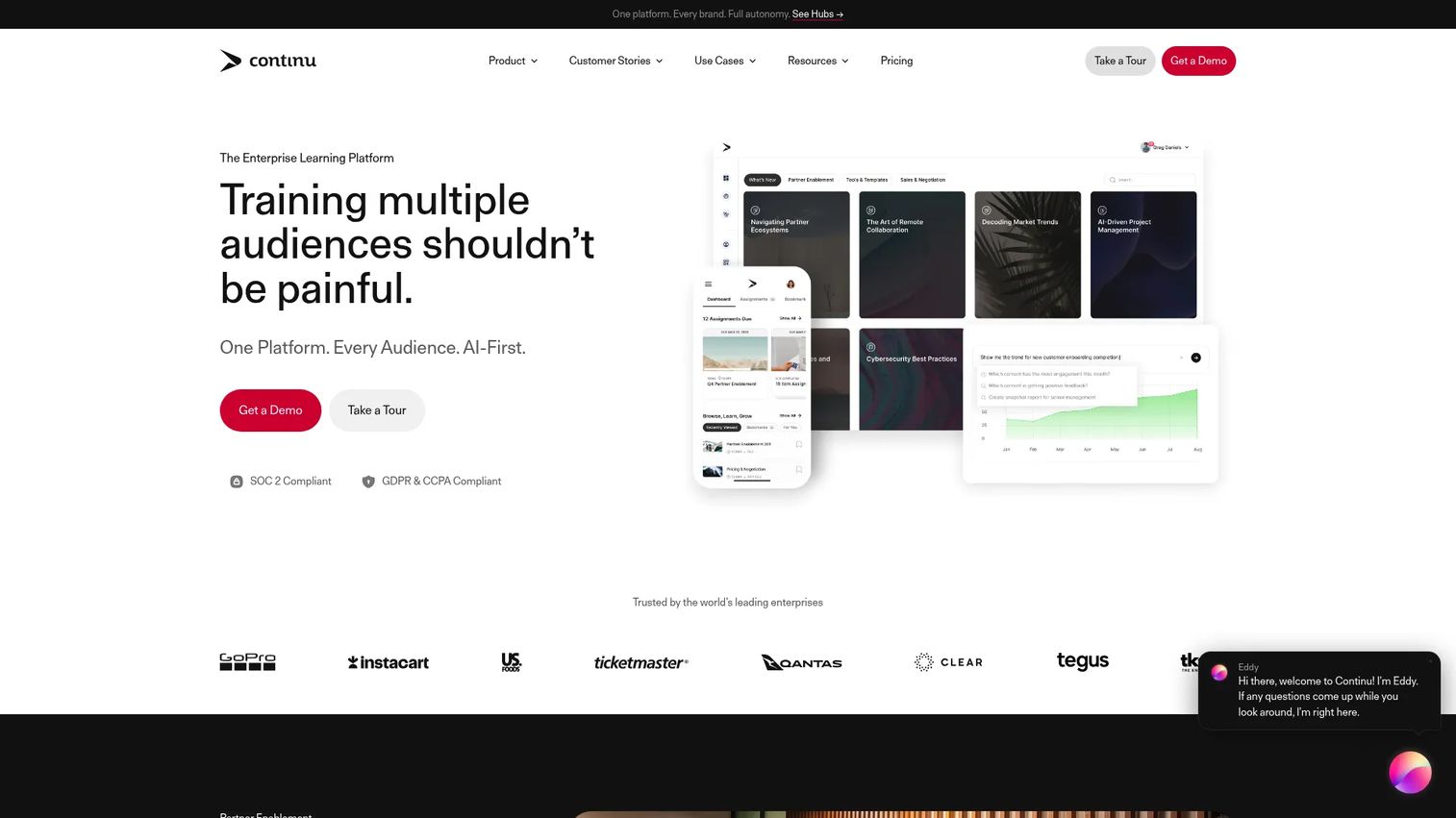
Continu fits teams consolidating customer, partner, and employee training under one platform. It is positioned as an enablement-oriented learning platform rather than a pure customer education tool.
Best for: Teams consolidating customer, partner, and internal training into a single platform.
What it is: Continu is an AI-powered enterprise learning and enablement platform. Core capabilities include content authoring and SCORM support, learning tracks, journeys, assignments, workshops, and assessments. The platform adds an AI learning agent, AI-powered insights, automated workflows, and branded external learning portals. Plans scale by monthly active user count: Growth (under 1,000), Professional (1,000 to 5,000), and Enterprise (5,000+).
Key features:
- Content authoring and SCORM support
- Learning tracks, journeys, and workshops
- AI learning agent and AI-powered insights
- Automated workflows
- Branded external learning portals
Where Continu falls short:
- G2 reviewers note that fit depends heavily on whether the buyer wants a consolidated enablement platform or a specialized customer academy; teams with the latter need may find other tools in this list more directly targeted
- Implementation effort scales with the number of audiences and integrations required
Pricing: Growth, Professional, and Enterprise plans are priced by monthly active users. The vendor does not publish dollar amounts; request a quote.
G2 rating: 4.6
How it compares to Thought Industries: Continu is a stronger choice when the goal is consolidating multiple learning audiences into one platform. For teams that only need a customer education academy, more specialized tools may be a more direct fit.
13. ClassroomIO (lightweight academy platform)
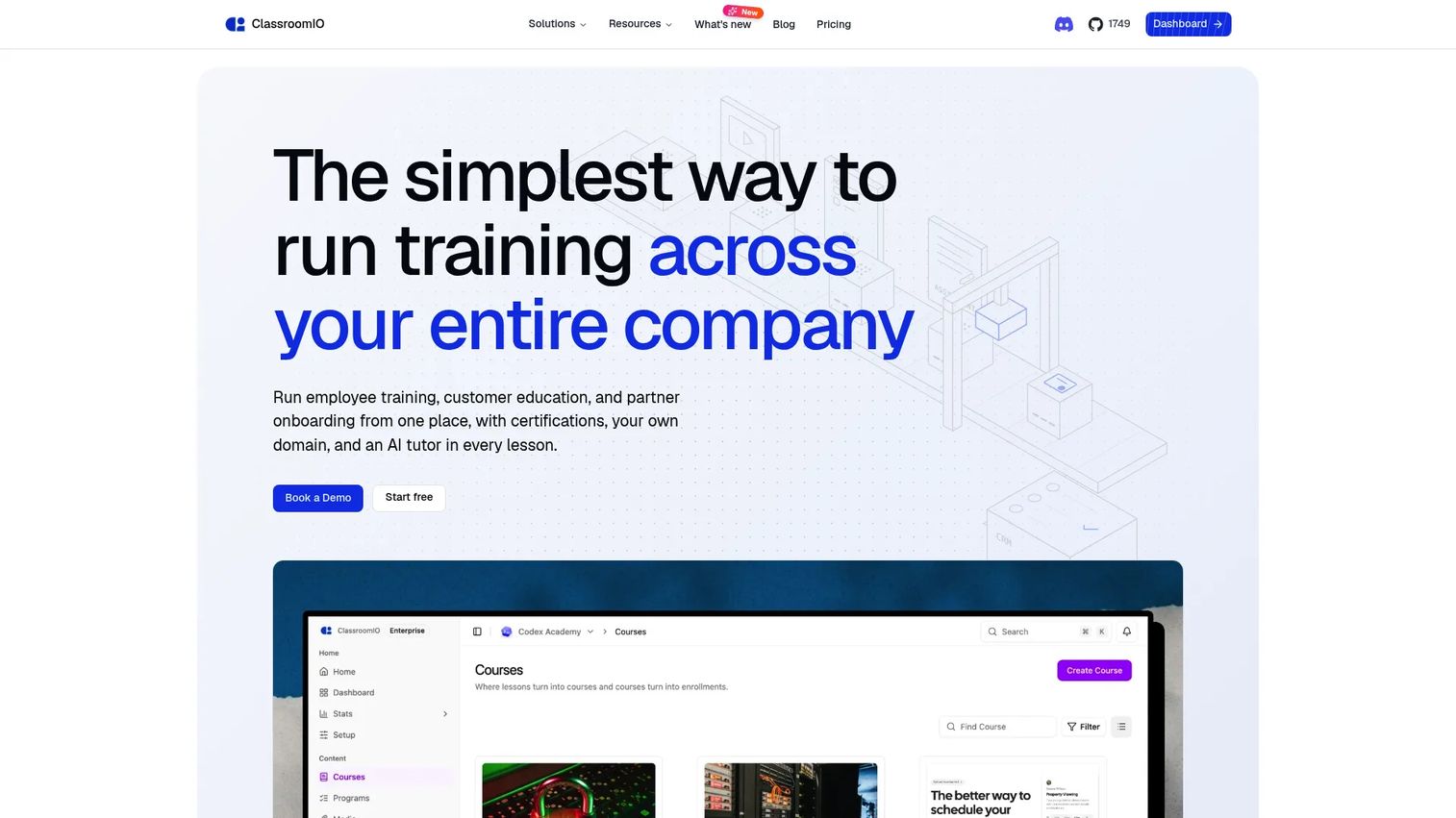
ClassroomIO is an open-source LMS with published pricing and a free tier, making it one of the most transparent options in this list. It suits lean teams that want a working academy without navigating a lengthy enterprise sales process.
Best for: Lean teams that need a lightweight customer academy or cohort-based learning program with visible pricing.
What it is: ClassroomIO is an open-source LMS for customer, partner, and employee training. It supports AI-assisted course authoring with templates, quizzes, and review approval, branded academies with custom domains, embeddable courses, an AI teaching assistant, REST API, webhooks, and an MCP server. Multi-academy workspaces support separate training programs for different audiences.
Key features:
- AI-assisted course authoring with templates and quizzes
- Branded academies with custom domains
- Embeddable courses
- REST API, webhooks, and MCP server
- Multi-academy workspaces
Where ClassroomIO falls short:
- Enterprise governance features (SSO, unlimited students, unlimited API requests) are limited to the Enterprise plan, which requires a quote
- Integration depth for mature CS stacks with complex CRM and analytics requirements needs review before committing
Pricing: Basic is free for up to 20 students. Early Adopters is $35/month for up to 10,000 students, adding video uploads, certificates, custom branding, custom domains, and API access. Enterprise pricing requires a quote.
G2 rating: 4.0
How it compares to Thought Industries: ClassroomIO is better for lighter, price-conscious academy programs. Teams running complex external enterprise training or multi-audience certification programs at scale will want an enterprise LMS with more governance depth.
Which Thought Industries alternative is best for enterprise customer education?
Skilljar for SaaS-focused academies, Intellum for multi-audience programs. Skilljar is built specifically for external customer and partner education in SaaS contexts, with strong certifications, branded portals, and Salesforce integration. Intellum covers more audience types and suits organizations where customer education is one of several external training programs. Both are enterprise-grade and require a quote-based sales conversation.
What should SaaS teams use for hands-on product lessons?
Guideflow. When customers need to click through a real product workflow rather than read a lesson or watch a recording, Guideflow's interactive demos deliver that experience. CS teams embed them in onboarding emails, help articles, CS follow-ups, and release notes. The platform measures step-level completion and viewer drop-off, so teams can see exactly where customers stop engaging. Use an LMS alongside Guideflow when the program also needs enrolment, certificates, and formal completion records.
Which option works best for monetized courses?
LearnWorlds or Thinkific Plus, depending on scale and pricing transparency. LearnWorlds publishes pricing starting at $44/month billed annually and covers course commerce, certifications, and branded academies. Thinkific Plus handles larger-scale course businesses with multi-site management and enterprise integrations, but pricing is custom. Both support payments and course storefronts; the right choice depends on learner volume and how much customization the commerce layer requires.
Which alternatives are strongest for partner training?
Skilljar, Intellum, Docebo, and Continu each handle partner programs well. Partner programs typically need multi-portal governance, certifications, reporting, and CRM visibility. Skilljar and Intellum are the most customer-education-native of the four. Docebo and Continu add breadth when partner training sits alongside employee learning. The right choice depends on whether partners need formal certification, hands-on product practice, or broad enablement content.
Which Thought Industries alternative is easiest to budget for?
TalentLMS, LearnWorlds, and ClassroomIO publish pricing. TalentLMS starts at $119/month for up to 40 users and includes a free tier. LearnWorlds starts at $44/month billed annually. ClassroomIO offers a free tier up to 20 students and an Early Adopters plan at $35/month. Most enterprise LMS vendors in this list use quote-based pricing, which means the sales process is part of the evaluation. Enterprise buyers comparing Docebo, Absorb LMS, Intellum, and LearnUpon should factor in implementation services, learner volume, portal count, and integration requirements when requesting quotes.
Which alternative is best for compliance-heavy training?
Litmos, Docebo, or Absorb LMS. All three support SCORM, xAPI, structured assignments, compliance reporting, and certificate management. Litmos publishes starting prices, which simplifies early budget comparison. Guideflow should not be positioned for compliance recordkeeping: It tracks step-level engagement and viewer flow, not formal completion records or certificates.
When should you stay with Thought Industries?
Stay with Thought Industries if the academy is already running, internal stakeholders are trained, and the platform supports your required learner records, certifications, and reporting.
Three scenarios where switching makes less sense: The migration cost (content conversion, SCORM assets, learner data, integrations, branding) outweighs the operational gain; the internal team is already proficient with the admin tools; the integrations with CRM and analytics are working and would need to be rebuilt on a new platform. If the pain is content quality or learner engagement rather than platform capability, an alternative platform won't solve it. Fix the content first.
Why teams switch from Thought Industries to Guideflow
Teams that add Guideflow aren't replacing their academy. They're filling the gap between finishing a lesson and completing the workflow inside the product.
A customer success team typically reaches for Guideflow when they realize that video-based training isn't translating to product adoption. Users complete the course but then can't do the thing the course explained. Guideflow's interactive demos, demo pages, demo centers, sandboxes, live demos, and mobile demos let customers click through the actual product flow, in a browser, without a login or a live call. The CS team embeds the experience in an onboarding sequence, a help article, or a feature launch email.
The measurement difference matters for CS teams trying to prove impact. An LMS reports course completion. Guideflow reports step-level engagement, where viewers drop off, and which steps drive completion. Those signals connect training to adoption behavior in a way that course completion rates alone don't.
Guideflow connects to HubSpot, Salesforce, Pipedrive, Zoho, and Marketo, so engagement data flows into the CRM stack that CS teams already use for health scoring. More than 500,000 guideflows have been created across teams using the platform for customer onboarding, support deflection, feature adoption, and partner enablement.
Keep the LMS for enrolment, certificates, and formal learning records. Add Guideflow when the lesson needs to become a practice experience.
Start your journey with Guideflow today!
Frequently asked questions: Thought Industries alternatives
There is no single best alternative. Skilljar fits SaaS customer education programs with partner academies and certifications. Intellum fits multi-audience enterprise learning. Docebo and Absorb LMS cover broader enterprise LMS needs. Guideflow is the right choice when the job is hands-on product practice rather than formal academy administration.
TalentLMS offers a free tier for up to 5 active users and 10 courses. ClassroomIO offers a free tier for up to 20 students. Guideflow has a free plan. No enterprise LMS alternative in this list offers a meaningful free tier for large-scale customer education programs.
The cheapest option changes with learner count, portal requirements, and integration needs. TalentLMS publishes the most accessible starting price at $119/month for up to 40 users. LearnWorlds starts at $44/month billed annually. ClassroomIO's Early Adopters plan is $35/month. Enterprise platforms require a quote that incorporates learner volume, support tier, and add-ons.
No, Guideflow is not a full LMS replacement. It has no enrolment, no certificates, and no formal completion records. It can replace static or video-based course modules when the goal is product workflow practice. Many CS teams use Guideflow alongside an LMS: The LMS handles academy administration, and Guideflow handles the product experience layer.
LearnUpon, WorkRamp, and TalentLMS all handle structured onboarding courses well. Guideflow is better for embedded product practice and adoption moments, particularly when the goal is reducing "how do I?" tickets by letting customers click through the workflow themselves. For programs where onboarding success is measured by time-to-value and support deflection, combining an LMS with Guideflow's interactive demos addresses both sides of that equation.
Most enterprise LMS tools use quote-based pricing. Cost drivers include active learner volume, number of portals, admin seats, integration requirements, support tier, implementation services, and content migration. TalentLMS, LearnWorlds, ClassroomIO, and Litmos (Foundation and Platinum tiers) publish starting prices. All others in this list require a sales conversation before dollar figures are available.
Migration timelines depend on course volume, SCORM and xAPI content, learner records, certificates, integrations, and branding. Content export is only the first step. Learner data, historical completion records, SSO setup, CRM reconnection, and admin training all add time. Auditing courses, learner records, integrations, and reporting requirements before choosing a new platform will reduce surprises during the transition. Teams migrating from large, mature academies should plan for several months of parallel operation rather than a clean cutover.