
Your claims teams know the money is sitting there. A liable third party. A missed offset. A coverage detail buried in an adjuster's diary from four months ago. But the file already closed, the recovery window is narrowing, and nobody has the hours to reread thousands of notes to find it.
That gap is expensive. U.S. insurers face roughly $15 billion in annual missed subrogation opportunities, according to a 2024 analysis from Evolve Capital citing NASP and Deloitte data. A separate 2024 buyer guide from Finantrix found that 87% of carriers recover under 65% of actionable claims, mostly because the process is manual and fragmented. The recovery exists. The capacity to chase it does not.
Manual review does not scale with file volume. Every new claim adds pages of unstructured notes, journals, and diaries that a human has to read, interpret, and act on before a statute or a closed file kills the opportunity. Subrogation software changes the math. It reads the file for you, flags the recoverable dollars, routes the work, and shows you where recovery is leaking, so throughput and visibility stop depending on how many hours your team can grind.
What's inside
This guide compares the best subrogation software for insurance carriers, health plans, TPAs, and self-insured groups that need to detect recovery opportunities, automate claims workflows, and improve yield without turning recovery into a manual review project. It covers pure software platforms, AI detection engines, and hybrid tech-plus-service providers.
We selected and ordered vendors on four criteria that matter most to recovery operations:
- AI-driven detection across structured and unstructured claims data
- Workflow automation from opportunity scoring through demand and recovery
- Compliance and jurisdiction handling with audit trails and defensibility
- Analytics, reporting, and benchmarking that show recovery performance over time
Tools that improve recovery outcomes with the least manual load rank highest.
TL;DR
- Best overall for end-to-end recovery automation: Avalon Subrogation, with SubroAI claims interrogation plus a back-office service layer.
- Best for outbound detection and claims workflow automation: CCC Intelligent Solutions, built for high-volume auto carriers.
- Best for healthcare and benefits-adjacent recovery: Intellivo, with third-party liability detection and no member abrasion.
- Best for AI-native claims decisioning: Shift Technology, for insurers who want subrogation inside a broader claims AI platform.
- Best for embedded lifecycle analytics: EXL, for larger teams that want decision support across the recovery process.
- Best for payment integrity and post-payment recovery: Claritev, for health plan claims accuracy and recovery.
What is subrogation software?
Subrogation software is a class of insurance recovery software that helps insurers and claims teams identify, prioritize, and recover recoverable claim dollars from liable third parties. It reads claim files, flags subrogation potential, automates the recovery workflow, and tracks results, so recovery stops depending on manual file review.
The core capability set spans detection, automation, and measurement:
- AI-driven opportunity detection that scores files for recovery potential, sometimes from first notice of loss (FNOL) onward
- Structured and unstructured claims data ingestion, pulling from claim records, forms, and free-text sources
- Claim file interrogation of notes, journals, and diaries to surface facts a human reviewer would need hours to find
- Workflow automation from evaluation through demand letter automation and recovery pursuit
- Compliance and jurisdiction rules handling, with audit trails for legal defensibility
- Reporting, analytics, and benchmarking to track recovery rate, cycle time, and conversion from identified to recovered dollars
- Hybrid tech and human service delivery, where a platform pairs with a specialist recovery team
Why it matters now
File volume keeps rising while staffing stays flat. The global subrogation software market was valued at $2.8 billion in 2025 and is forecast to reach $5.6 billion by 2034 at an 8.7% CAGR, per Market Intelo. Cloud-based deployments already account for 56.2% of that market and are the fastest-growing segment. The pressure is simple: more files, the same headcount, and a recovery pool most carriers only partially capture. Software is how teams close that gap without hiring their way out.
When to use subrogation software
Improve recovery on closed and open files
Recovery does not stop when a file closes. A closed-file audit rechecks paid or closed claims for missed third-party liability, coverage offsets, and recovery facts that slipped past the first review. Use software here when you suspect yield is leaking after the fact and you need a systematic way to interrogate historical files at scale rather than sampling by hand.
Reduce manual review load
When adjusters and recovery specialists spend hours reading notes, journals, and supporting documents to decide whether a file has subrogation potential, that time is capacity you are not spending on recovery itself. Subrogation automation shifts the reading to the system, which frees your team for negotiation and pursuit and drives real cycle time reduction across the queue.
Standardize recovery decisions across jurisdictions
State rules, carrier policies, and compliance constraints make manual recovery decisions inconsistent, and inconsistency is a defensibility risk. Use software when you need repeatable workflows that apply compliance and jurisdiction rules the same way every time, with an audit trail that holds up if a decision is challenged.
Comparison table
The table below sorts vendors by relevance to core subrogation software use cases. Pricing across this category is almost entirely quote-based, since these are enterprise recovery platforms and services rather than seat-priced SaaS.
| # | Product | Intent | Key use case | Pricing | G2 rating |
|---|---|---|---|---|---|
| 1 | Avalon Subrogation | End-to-end recovery | SubroAI file interrogation plus back-office recovery services | Custom | Not rated |
| 2 | CCC Intelligent Solutions | Detection and workflow | Outbound subrogation and auto claims workflow automation | Custom | 4.7/5 |
| 3 | Intellivo | Healthcare recovery | Third-party liability detection for health plans and TPAs | Contingency-based | Not rated |
| 4 | Terra | Claims management | Workers' comp and commercial P&C claims and compliance | Custom | Not rated |
| 5 | Machinify | Payment integrity | AI healthcare payment integrity and recovery | Custom | Not rated |
| 6 | Claritev | Payment integrity | Post-payment recovery and claims accuracy for payers | Custom | Not rated |
| 7 | EXL | Lifecycle analytics | Embedded decision support across the recovery process | Custom | 4.4/5 |
| 8 | WNS | Subrogation as a service | AI opportunity identification plus service execution | Custom | Not rated |
| 9 | Shift Technology | Claims AI | Subrogation detection inside claims decisioning | Custom | 4.0/5 |
The pattern is clear: the market splits between AI detection engines, workflow automation platforms, and hybrid service providers. Most buyers end up choosing based on their file mix, jurisdiction needs, and whether they want software they run themselves or a team that runs recovery for them.
1. Avalon Subrogation
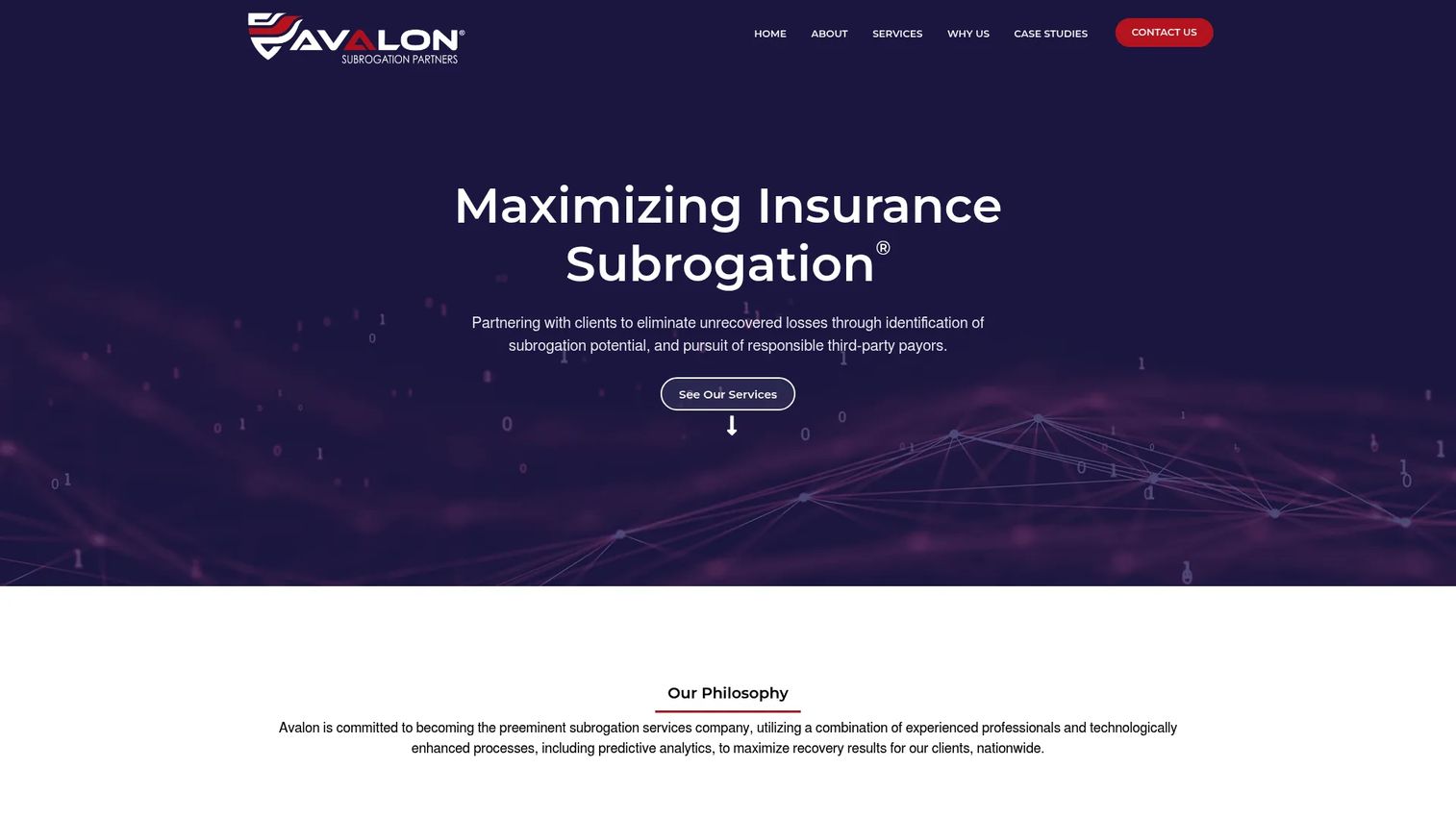
Avalon Subrogation pairs a proprietary AI engine with a full recovery service layer, which is what puts it at the top of this list for teams that want detection and execution in one place. Its SubroAI engine interrogates claims, notes, journals, and diaries to surface recovery facts, while the RECOVERit service handles the pursuit. It serves carriers, MGAs, claims organizations, and large employers.
The differentiator is the tech-and-touch model. You get AI-driven claim file interrogation to find the opportunities, plus a back-office team to work the recoveries, so you are not staffing a full recovery operation internally. Avalon also offers a no-cost closed file review, which is a low-risk way to see how much yield your historical files are still holding.
Best for: Insurance organizations that want AI detection and outsourced recovery execution from a single provider.
Key strengths
- SubroAI file interrogation: Reads notes, journals, and diaries to surface recovery facts a manual review would miss.
- RECOVERit recovery services: Back-office team pursues recoveries so you avoid building internal capacity.
- No-cost closed file review: Audits historical files for missed opportunity at no upfront charge.
Why choose Avalon Subrogation: If your team knows recovery is leaking but cannot commit headcount to chase it, Avalon's hybrid model does the reading and the pursuing. The free closed-file review and free training lower the risk of a first engagement, which matters when you are proving ROI before committing.
Avalon Subrogation pricing: No public pricing is listed; Avalon directs prospects to contact the company for a custom quote. The closed file review and subrogation training are offered at no cost.
2. CCC Intelligent Solutions
CCC Intelligent Solutions is a SaaS platform for auto claims and collision repair workflows, and its outbound subrogation capability is built for the volume and speed that high-throughput auto carriers need. It connects estimating, parts, payments, and workflow so subrogation detection lives inside the same system that already runs the claim.
For subrogation specifically, CCC leans on early opportunity scoring, demand package generation, and performance dashboards. Because it sits inside a broader auto claims ecosystem, detection can happen early in the claim lifecycle rather than as a separate downstream review, which supports both cycle time reduction and capacity optimization.
Best for: Large auto carriers that want subrogation detection embedded in their existing claims and repair workflow.
Key strengths
- Early opportunity scoring: Flags subrogation potential early in the claim lifecycle, not after closure.
- Demand package generation: Automates the assembly of recovery documentation and demands.
- Performance dashboards: Tracks recovery, capacity, and cycle time across the workflow.
Why choose CCC Intelligent Solutions: If you already run auto claims at scale, CCC keeps subrogation inside the workflow you use daily rather than bolting on a separate tool. The breadth across estimating, parts, and payments means detection and recovery share the same data spine.
CCC Intelligent Solutions pricing: No public pricing is listed; CCC uses a contact-sales model. It holds a 4.7/5 rating on G2.
3. Intellivo
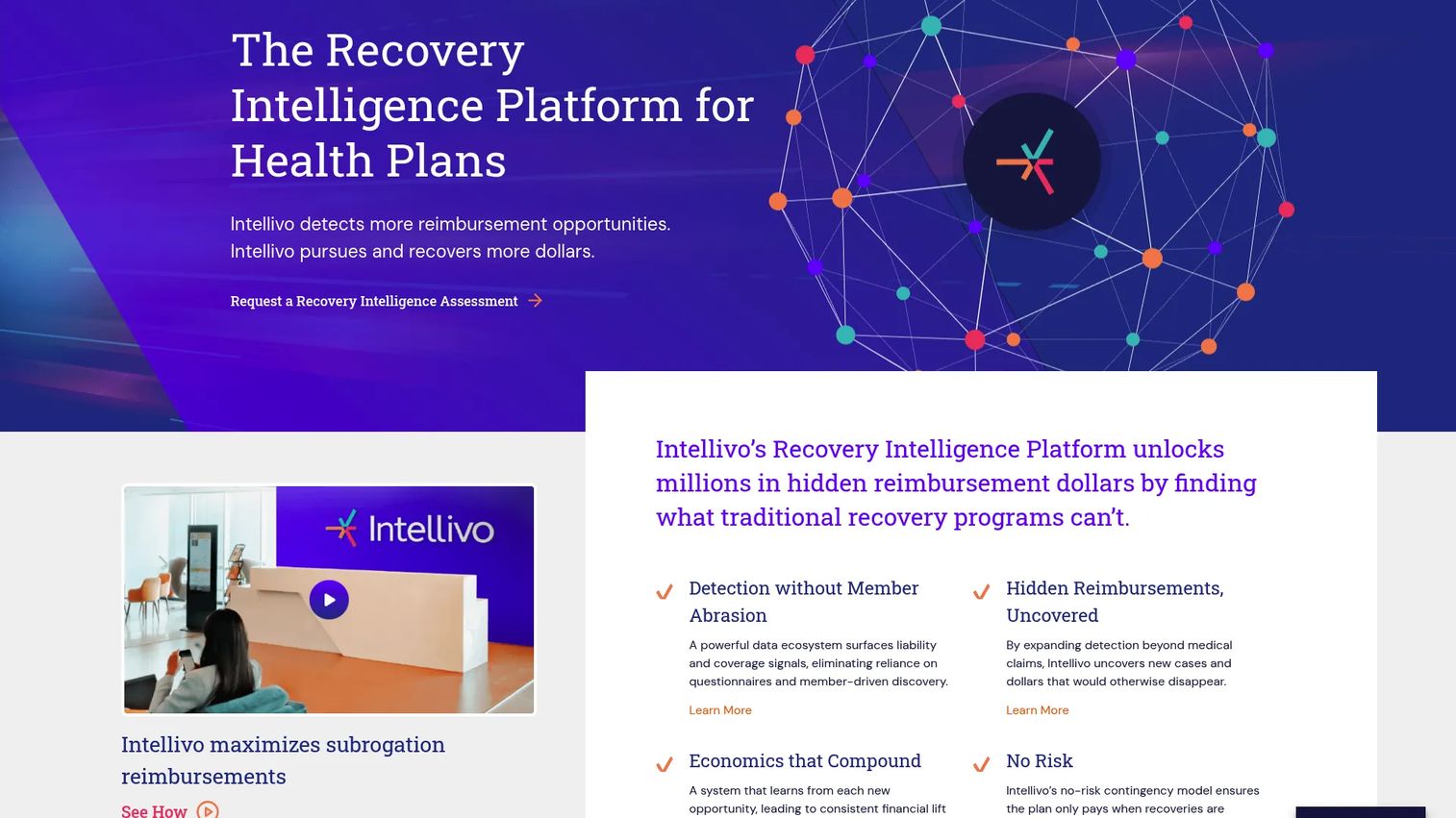
Intellivo is a recovery intelligence platform built for health plans, TPAs, and payers, using external liability and coverage data to detect reimbursement opportunities. It runs an end-to-end recovery workflow from identification through pursuit, negotiation, and recovery, which makes it a strong fit for benefits-adjacent medical claims recovery.
What sets Intellivo apart in the healthcare context is its no-member-contact approach. Recovery happens without member abrasion, which matters for self-funded employer plans and TPAs where member experience is a live concern. The platform handles detection and the recovery workflow, so payers do not have to run pursuit themselves.
Best for: Health plans, TPAs, and self-funded employer plans that need outsourced subrogation recovery with minimal member disruption.
Key strengths
- Third-party liability detection: Uses external liability and coverage data to find reimbursement opportunities.
- End-to-end recovery workflow: Runs identification through pursuit, negotiation, and recovery.
- No member abrasion: Recovers without member contact, protecting member experience.
Why choose Intellivo: For payers, member experience is often the reason recovery gets left on the table. Intellivo's no-contact model removes that objection, and its contingency pricing means you pay against recovered dollars rather than upfront.
Intellivo pricing: Intellivo uses a contingency-based model with no setup fees, no activation charges, and no upfront costs. No public numeric price is disclosed.
4. Terra
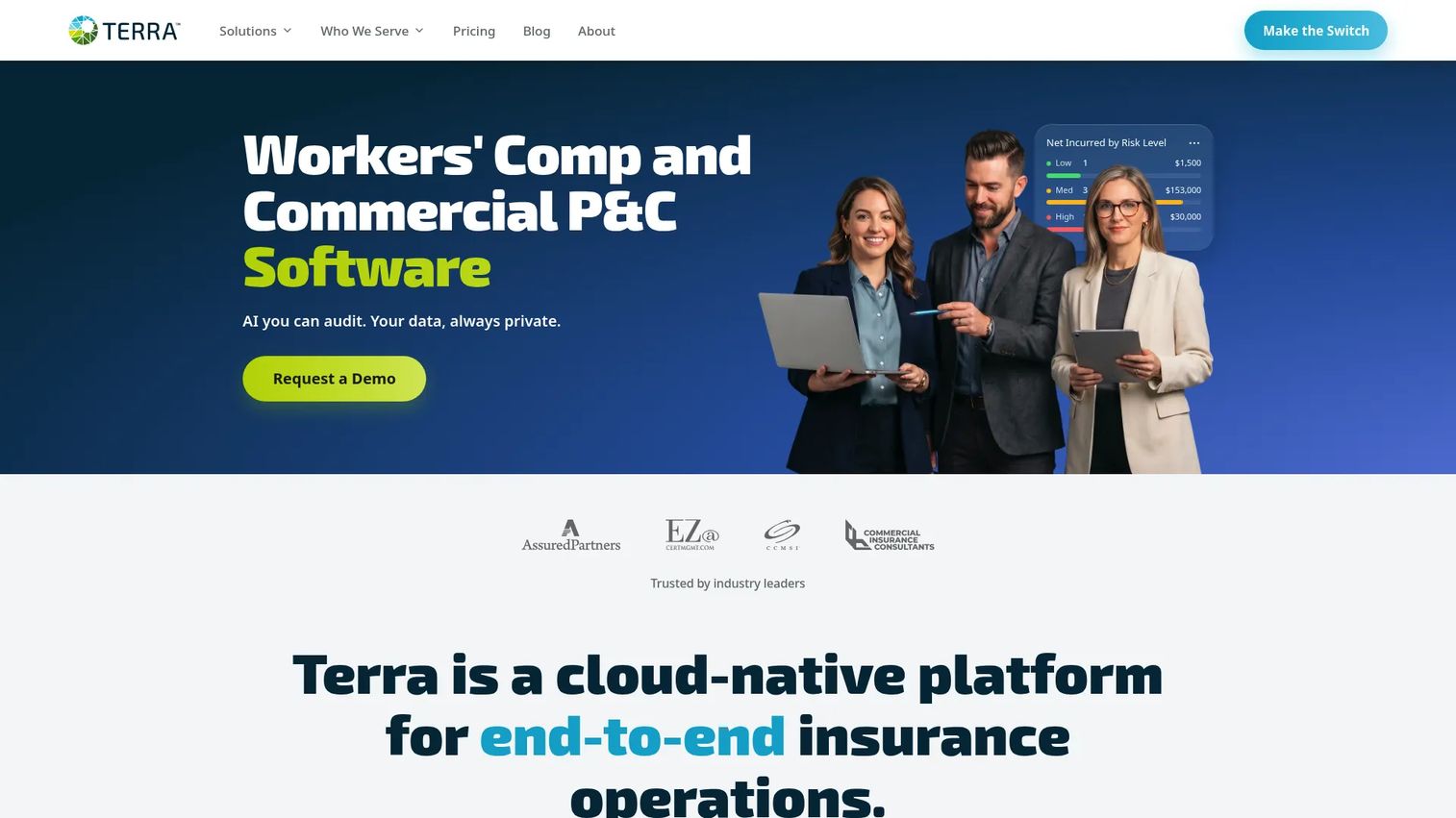
Terra is cloud-native insurance software for workers' compensation and commercial P&C claims and policy management. It is not a pure subrogation tool, but its claims management foundation gives teams a practical baseline for handling workers compensation subrogation within a broader operations platform.
Terra's strengths are claims management, policy administration, and compliance tracking. For subrogation, the value is having recovery workflow, document management, and compliance handling inside the same system that runs the claim, which keeps jurisdiction rules and audit trails connected to the underlying file.
Best for: TPAs, carriers, and self-insured groups that want a claims management lens on subrogation for workers' comp and commercial P&C.
Key strengths
- Claims management: Runs the full claim lifecycle with recovery workflow attached.
- Policy administration: Connects policy data to claims and recovery decisions.
- Compliance tracking: Applies jurisdiction and regulatory rules with audit visibility.
Why choose Terra: If your priority is a modern claims and policy platform where subrogation is one capability among many, Terra fits. It is the right pick when you want recovery managed inside claims operations rather than as a standalone detection engine.
Terra pricing: Pricing is custom and usage-based, with no setup fees and no long-term contracts. Terra directs prospects to contact for a custom quote.
5. Machinify
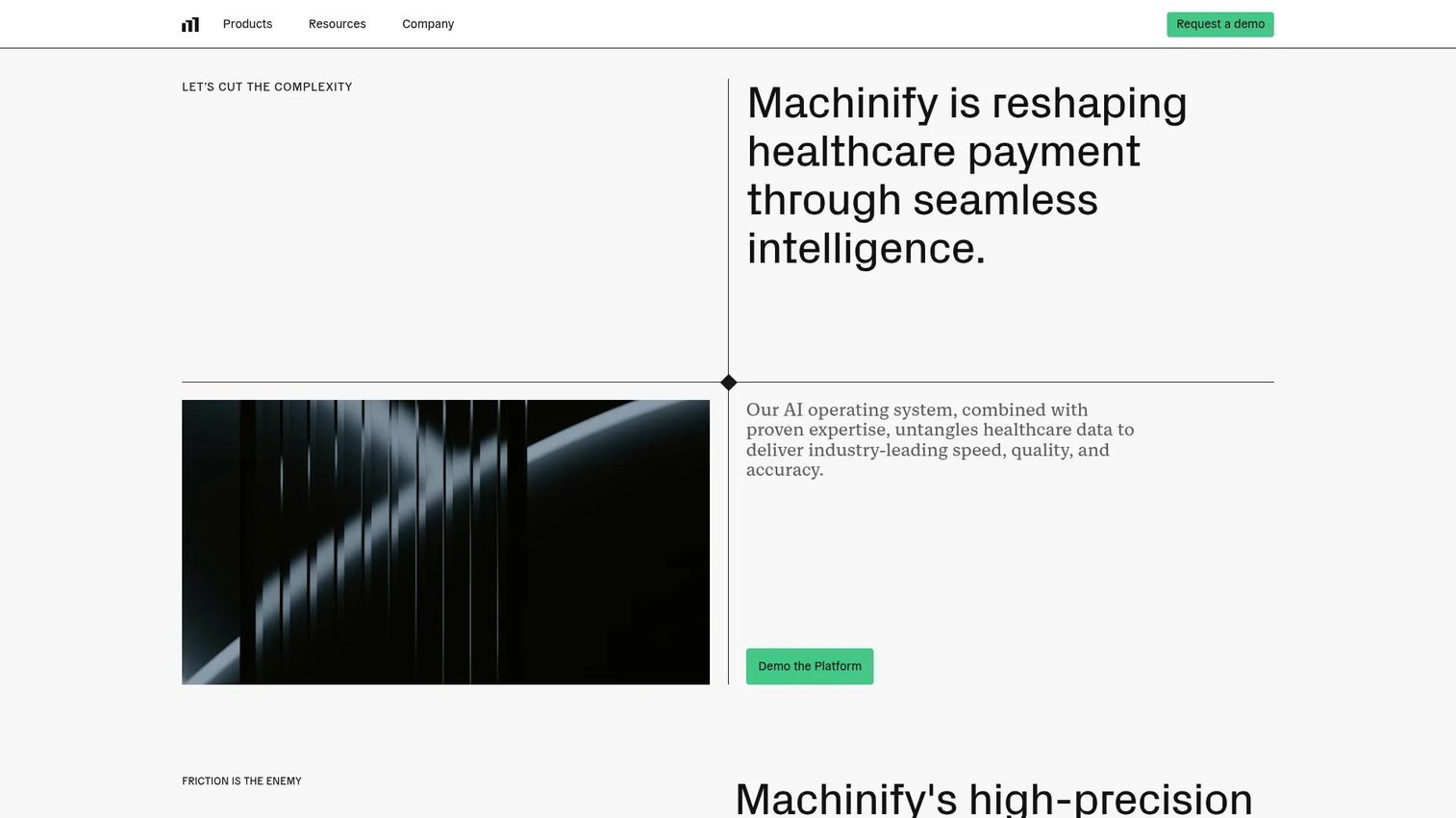
Machinify is an AI-powered healthcare payment integrity platform for payers, spanning claims editing and repricing, coordination of benefits and recovery, and subrogation and pharmacy payment integrity. It sits in the payment integrity category, where subrogation and recovery are part of a broader accuracy mission.
For teams focused on medical claims recovery, Machinify combines AI-driven detection with recovery execution across the payment integrity workflow. The subrogation capability is one piece of a wider system aimed at making sure claims are paid correctly and recoverable dollars are pursued.
Best for: Health plans and payers that want subrogation inside a broader AI payment integrity system.
Key strengths
- Claims editing and repricing: Catches payment errors before and after adjudication.
- Coordination of benefits and recovery: Identifies and recovers dollars owed by other payers.
- Subrogation and pharmacy payment integrity: Extends recovery across subrogation and pharmacy claims.
Why choose Machinify: Choose Machinify when subrogation is one part of a larger payment integrity mandate rather than a standalone job. Its AI-driven detection and recovery capabilities fit payers who want accuracy and recovery managed together.
Machinify pricing: No public pricing is listed on the Machinify site. Prospects contact the company directly.
6. Claritev
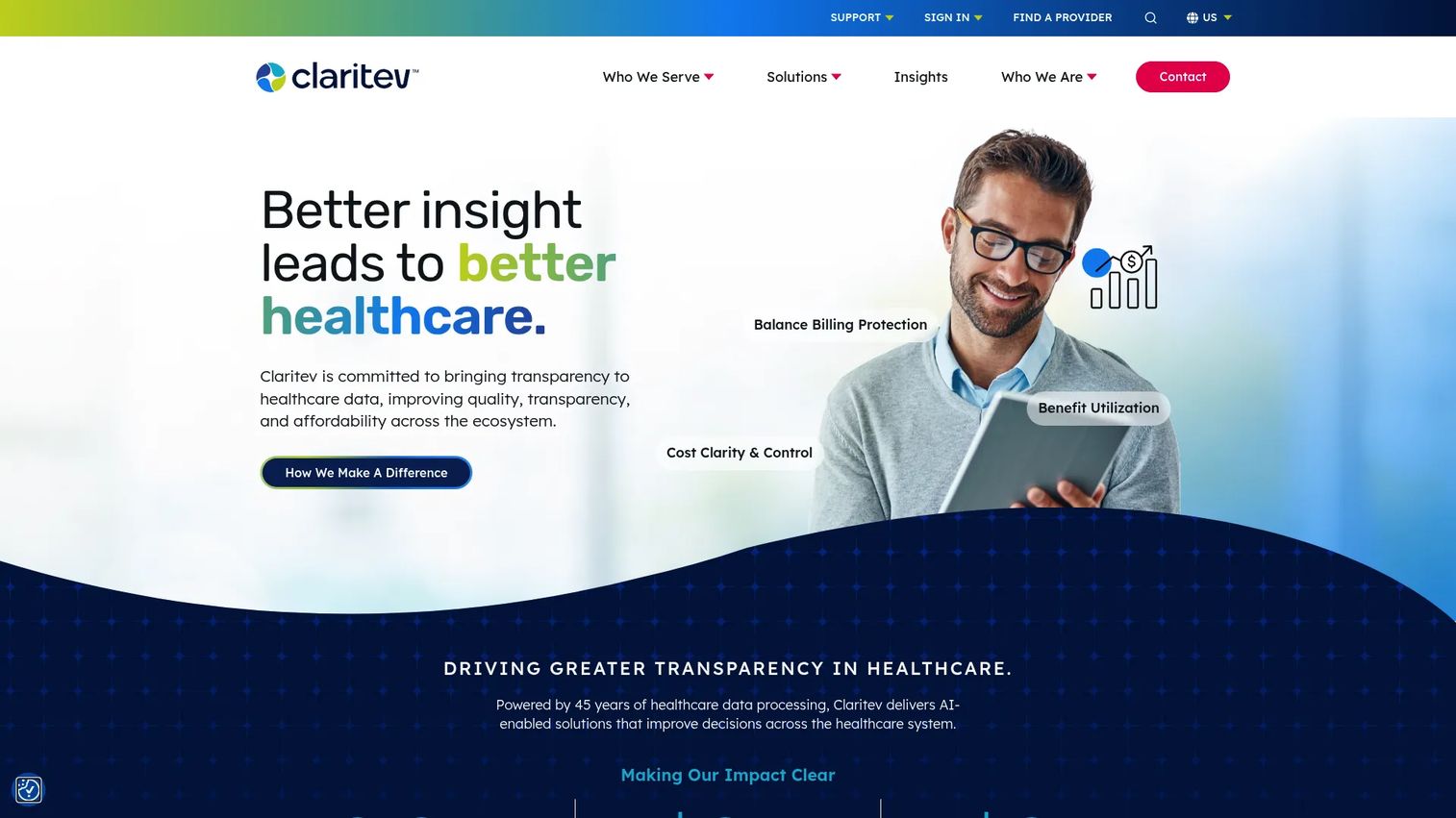
Claritev is a healthcare technology and data company focused on transparency, affordability, and payment integrity for health plans and related stakeholders. Its post-payment recovery and claims intelligence capabilities make it a fit for payers running healthcare claims recovery at scale.
Claritev pairs advanced analytics and machine learning with specialist teams across claims intelligence, cost control, and payment and revenue integrity. For subrogation and recovery, the analytics depth is the draw: identifying where recovery exists and applying it consistently across a large claims book.
Best for: Health plans, employers, and providers that need analytics-led payment integrity and post-payment recovery.
Key strengths
- Claims intelligence and cost control: Surfaces recovery and cost-saving opportunities across claims.
- Data and analytics solutions: Applies machine learning to detect recoverable dollars.
- Payment and revenue integrity: Combines analytics with specialists for recovery execution.
Why choose Claritev: If your recovery challenge is analytics depth across a large healthcare claims book, Claritev's data-and-specialist model fits. It suits payers who want machine learning surfacing opportunities and specialists working them.
Claritev pricing: No public pricing is listed; Claritev directs prospects to contact sales.
7. EXL

EXL is a global data and AI company providing analytics, digital operations, and industry-specific services, with a Subrosource offering aimed at insurance subrogation. Its strength is embedding lifecycle analytics and decision support throughout the recovery process rather than treating detection as a single step.
For larger recovery teams, EXL's value is analytics that run across the workflow, from opportunity identification through arbitration and vendor management. That embedded decision support helps standardize recovery decisions and keeps analytics visible at every stage rather than only at the end.
Best for: Larger insurance teams that want analytics and decision support embedded across the full recovery lifecycle.
Key strengths
- Lifecycle analytics: Applies analytics from opportunity identification through recovery.
- Automated arbitration support: Streamlines arbitration decisions within the workflow.
- Vendor management: Coordinates external recovery vendors alongside internal work.
Why choose EXL: EXL fits teams that treat recovery as a data problem across the whole lifecycle, not just a detection step. Its analytics-and-services model suits larger operations that want decision support embedded throughout. EXL holds a 4.4/5 rating on G2.
EXL pricing: No public pricing is listed; EXL uses a contact-based, custom pricing model.
8. WNS

WNS is a digital-led business transformation and services company that delivers subrogation as a service, combining AI and machine learning opportunity identification with a service execution layer. Its model fits teams whose real buying trigger is a hybrid operations partner rather than a piece of software to run themselves.
WNS layers AI-based detection on top of analytics, a partner ecosystem, and back-office service execution. For subrogation, that means opportunity identification and the operational capacity to pursue recoveries, delivered as a managed operation rather than a self-serve platform.
Best for: Enterprises that want subrogation delivered as a managed operation with AI detection and service execution.
Key strengths
- AI/ML opportunity identification: Detects subrogation potential across large claims volumes.
- Analytics and reporting: Tracks recovery performance and benchmarking across the operation.
- Service execution layer: Provides the back-office capacity to work recoveries.
Why choose WNS: WNS fits when the buying trigger is capacity, not just detection. If you want a partner to run the recovery operation end to end with AI doing the identification, the managed-service model is the draw.
WNS pricing: No public pricing is listed; WNS uses a contact-sales model for its services.
9. Shift Technology
Shift Technology is an AI platform for insurers spanning claims, fraud, underwriting, subrogation, and payment integrity. Its subrogation detection lives inside a broader claims decisioning platform, which makes it a strong fit for insurers who want recovery identified as part of a wider AI claims workflow.
Shift's approach centers on AI agents for coverage and liability assessment, fraud and risk, and payment integrity. For subrogation, that means quick opportunity identification that plugs into the same decisioning layer handling other claims outcomes, so recovery is not a siloed process.
Best for: Larger insurers who want subrogation detection as part of an AI claims decisioning platform they may already use.
Key strengths
- Coverage and liability agents: Assess policy coverage and liability to surface recovery potential.
- Fraud and risk detection: Runs detection, case assignment, and investigations alongside subrogation.
- Payment integrity tools: Detect claims anomalies and savings within the same platform.
Why choose Shift Technology: Shift fits insurers who want subrogation inside a claims AI platform rather than as a standalone recovery tool. If you are already evaluating AI claims decisioning, adding subrogation detection to the same system keeps recovery connected to your wider claims workflow. Shift holds a 4.0/5 rating on G2.
Considerations before you buy
The right subrogation software depends less on feature lists and more on how it fits your file mix, jurisdictions, and service expectations. Use this checklist to shortlist.
Detection accuracy across your data
Test how the platform reads your actual files, especially unstructured claims data like notes, journals, and diaries. Detection that only works on clean structured fields will miss the recovery facts buried in free text. Ask for a proof of concept on your own historical files.
Workflow automation depth
Look at what happens after detection. Does the platform automate demand letter generation, route work, and track pursuit, or does it just flag opportunities and hand them back? The gap between identified and recovered dollars is where automation earns its keep.
Compliance and jurisdiction handling
Confirm the platform applies compliance and jurisdiction rules consistently and produces an audit trail. Legal defensibility matters when a recovery decision is challenged, and inconsistent manual overrides undermine it.
Analytics and benchmarking
Evaluate whether the reporting shows recovery rate, cycle time, and conversion from identified to recovered dollars over time. Analytics that let you benchmark performance are how you prove ROI and find where yield is leaking.
Software versus hybrid service model
Decide whether you want software you run or a partner that runs recovery for you. A hybrid tech and human service model suits teams without recovery headcount; a pure platform suits teams with capacity that need better detection and workflow.
Conclusion
The best subrogation software for your team comes down to one question: do you need detection, workflow automation, analytics, or a hybrid service model? Avalon Subrogation leads for teams that want AI file interrogation plus outsourced recovery in one place. CCC Intelligent Solutions fits high-volume auto carriers wanting detection inside their existing claims workflow. Intellivo and Claritev serve healthcare and benefits-adjacent recovery, EXL and WNS bring embedded analytics and service execution, and Shift Technology suits insurers standardizing on a claims AI platform.
Whatever your file mix, the business case is the same: better recovery maximization, faster cycle times, and more predictable capacity, driven by recovery rate improvement and operational efficiency rather than more headcount. Shortlist two or three vendors that match your file mix, jurisdiction needs, and service expectations, then run a proof of concept on your own closed files. The recovery is already sitting in your data. The right platform is the one that gets the most of it out.
FAQs
Subrogation software is insurance recovery software that helps carriers and claims teams identify, prioritize, and recover claim dollars owed by liable third parties. It reads claim files, flags subrogation potential, automates the recovery workflow from evaluation through demand and pursuit, and tracks results so recovery stops depending on manual file review.
AI reads claim files, including unstructured notes, journals, and diaries, to detect recovery facts a human reviewer would need hours to find. It scores files for recovery potential, sometimes from FNOL onward, and prioritizes the highest-value opportunities so recovery teams spend their time on pursuit rather than reading.
Subrogation software reviews both structured claims data, like claim records and coded fields, and unstructured claims data, like adjuster notes, journals, and diaries. Many platforms also pull in third-party liability data and external coverage information to detect and confirm recovery opportunities.
Yes. A closed-file audit rechecks paid or closed claims for missed third-party liability and recovery facts the first review overlooked. Software can interrogate large volumes of historical files systematically, surfacing missed opportunity that manual sampling would never reach before recovery windows close.
Buyers should confirm the platform applies compliance and jurisdiction rules consistently across every file, produces a complete audit trail, and supports legal defensibility if a recovery decision is challenged. Consistent rule application matters more than manual overrides, which introduce inconsistency and weaken defensibility.
Pure software gives your team detection, workflow automation, and analytics to run recovery internally. A hybrid tech and human service model pairs the platform with a back-office team that works the recoveries for you. The right choice depends on whether you have internal recovery capacity or want a partner to provide it.
Teams measure ROI through recovered dollars, cycle time reduction, capacity freed for higher-value work, and the conversion rate from identified opportunities to recovered dollars. The last metric is the sharpest signal, since detection only pays off when flagged opportunities turn into actual recoveries.
Start with file ingestion and detection accuracy on your own historical files, since a platform that reads clean fields but misses free-text notes will leave recovery on the table. Then evaluate workflow automation depth, from demand letter automation through pursuit tracking, and the depth of reporting and benchmarking.