You bought the platform to fix content chaos. Reps are still asking in Slack where the latest deck lives. A product launch drops, and two weeks later most of the team is running the wrong talk track. Leadership wants to know what changed in rep behavior, and you have numbers on uploads, not outcomes.
Teams comparing Seismic alternatives in 2026 are dealing with one of these situations: Pricing clarity, implementation effort, adoption drag, or a narrower enablement job that a full enterprise suite makes heavier than it needs to be. The sales enablement platform market is growing fast, projected to reach $12.35 billion by 2031 (Mordor Intelligence, 2026), and the category now includes focused tools for every job in the enablement stack.
This list covers 12 Seismic alternatives across six categories: Guideflow for interactive internal training, Mindtickle and Allego for readiness and learning, Showpad and SalesHood for content and training, Dock and GetAccept for digital sales rooms, Spekit and Guru for in-workflow knowledge, Content Camel and Paperflite for lightweight content enablement, and Bigtincan for enterprise coverage. For enablement teams that need reps to learn software workflows by doing, Guideflow is the top pick.
TL;DR
- Best for interactive internal training and SOPs: Guideflow records software once and turns it into step-by-step interactive demos employees complete on their own. Free plan available; paid plans from $35/user/month (annual).
- Best for structured readiness and certification: Mindtickle, with a 4.7/5 G2 rating, is the strongest fit when skills measurement, AI role play, and manager coaching are the core of the program.
- Best for video learning and coaching: Allego combines learning, conversation intelligence, and digital sales rooms in a revenue enablement platform rated 4.6/5 on G2.
- Best for governed sales content: Showpad and SalesHood serve teams that need content libraries, training, and buyer engagement in one environment.
- Best for buyer-facing deal rooms: Dock (free plan available, Standard from $350/month) and GetAccept (from $25/user/month) are purpose-built for mutual plans, proposals, and stakeholder tracking.
- Best for in-workflow knowledge: Spekit delivers contextual guidance inside reps' daily tools; Guru provides governed, cited answers across workplace apps.
- This list spans full revenue enablement platforms and specialist tools. The category label next to each tool matters as much as the rank.
What's inside
- What Seismic is and what it covers
- Why enablement teams look for alternatives
- A side-by-side table of all 12 tools
- Ranked cards for each alternative
- Use-case routing by job: Training, content, readiness, deal rooms, and knowledge
- FAQs on pricing, fit, and how to choose
What is Seismic?
Seismic is a revenue enablement platform that covers sales content management, learning and readiness, buyer engagement, digital sales rooms, analytics, and CRM integrations. It serves enterprise and mid-market revenue teams that want to manage the full enablement lifecycle from one system: Organizing and distributing assets, running training programs, tracking content usage, and understanding what buyers engage with.
Seismic's strengths are breadth and integration depth. Its content governance, learning paths, and analytics connect to Salesforce, Microsoft 365, and other enterprise systems. For organizations with large sales teams, complex content libraries, and a dedicated enablement operations function, it delivers broad coverage.
The right alternative depends on whether you need to replace that full platform or solve a narrower job. A team rebuilding rep ramp from scratch has different needs than one that mainly wants interactive guides for software training or a lightweight content hub.
Why teams look for Seismic alternatives
Teams usually look for Seismic alternatives when implementation effort, pricing opacity, or a narrower enablement job makes a broad platform feel heavier than the problem requires.
Pricing and contract complexity
Seismic prices by quote, with costs driven by seat count, modules, integrations, and implementation. G2 reviewers frequently flag that total contract value is hard to forecast before a sales conversation. Teams without a dedicated enablement ops function or IT support often find the procurement process longer than expected. For growing teams trying to plan annual tool spend, that opacity creates friction.
Implementation and admin load
Content migration, CRM integration, governance setup, and rep adoption all require time and ownership. Seismic implementations typically involve a formal project plan. For teams without dedicated admin support, that lift can delay time-to-value by months. G2 reviewers note that the initial configuration effort is significant and that keeping content governance structures current takes ongoing work.
Rep adoption and content findability
Reps will use a tool that meets them where they work or ignore one that adds steps to their existing flow. G2 reviewers report that Seismic's search results can surface outdated content when governance is not actively maintained. If reps cannot quickly find the right asset for the stage and persona they are working, adoption stalls regardless of how good the library is.
The need for interactive software training
Many enablement jobs require reps to learn product flows, internal CRM steps, SOPs, and launch updates by practicing the workflow rather than reading about it. Static PDFs and recorded videos get skipped or go stale. Interactive step-by-step guides let reps click through the actual process and complete it on their own time. Seismic alternatives pages rarely cover this gap. It is where Guideflow fits, not as a full replacement, but as the interactive training layer that most enablement stacks are missing.
How we picked these Seismic alternatives
Each tool on this list has genuine capability overlap with one or more Seismic use cases: Internal training, content management, sales readiness, coaching, buyer engagement, or in-workflow knowledge. Pricing comes from each vendor's official pricing page. Ratings come from G2. Category labels follow each tool's primary job, not its broadest marketing description.
The sales enablement market now includes both full revenue enablement suites and focused specialist tools. Knowing which category a tool belongs to is as important as knowing its rating. This list covers both, labeled throughout so you can tell a Seismic swap from a specialist complement.
Seismic alternatives at a glance
The table below is a routing tool, not the full decision. Use it to map each option to your primary enablement job, then read the ranked cards for depth on fit and pricing.
| Tool | Category | Best for | G2 rating | Free plan | Starting price |
|---|---|---|---|---|---|
| Guideflow | Interactive guide platform | Internal training, onboarding, SOPs, interactive product education | 5.0/5 | Yes | $0 (free); $35/user/month (annual) |
| Mindtickle | Revenue readiness platform | Structured readiness, certification, coaching | 4.7/5 | No public info | Custom pricing |
| Allego | Revenue enablement platform | Learning, video coaching, conversation intelligence, content | 4.6/5 | No public info | Custom pricing |
| Showpad | Sales enablement platform | Governed content enablement and field selling | 4.6/5 | No public info | Custom pricing |
| SalesHood | Sales training and enablement | Training, coaching, and team learning | 4.6/5 | No public info | Custom pricing |
| Dock | Digital sales room platform | Buyer-facing sales rooms and mutual plans | 4.6/5 | Yes | $0 (free); $350/month (Standard) |
| Spekit | In-workflow enablement platform | Just-in-time enablement inside rep workflows | 4.6/5 | No public info | Custom pricing |
| Guru | Knowledge management platform | Trusted internal knowledge and answer governance | 4.7/5 | No public info | Custom pricing |
| GetAccept | Digital sales room and e-sign | Buyer engagement, proposals, mutual plans, signatures | 4.6/5 | No (14-day trial) | $25/user/month |
| Content Camel | Content management platform | Governed asset management for growing teams | 4.0/5 | Yes | €19.99/user/month (Team) |
| Paperflite | Content experience platform | Content sharing, tracking, and buyer engagement | 4.7/5 | No public info | $27.50/user/month (annual, min 5 users) |
| Bigtincan | Enterprise sales enablement | Enterprise content, coaching, and field enablement | 4.3/5 | No public info | Custom pricing |
The best Seismic alternatives in 2026
The tools below are ranked by fit for a Sales Enablement Manager comparing Seismic alternatives. Guideflow leads because interactive internal training and SOP creation is the highest-value gap in most enablement stacks. Full-suite platforms and specialist tools appear together, labeled by category.
1. Guideflow (interactive guide platform)
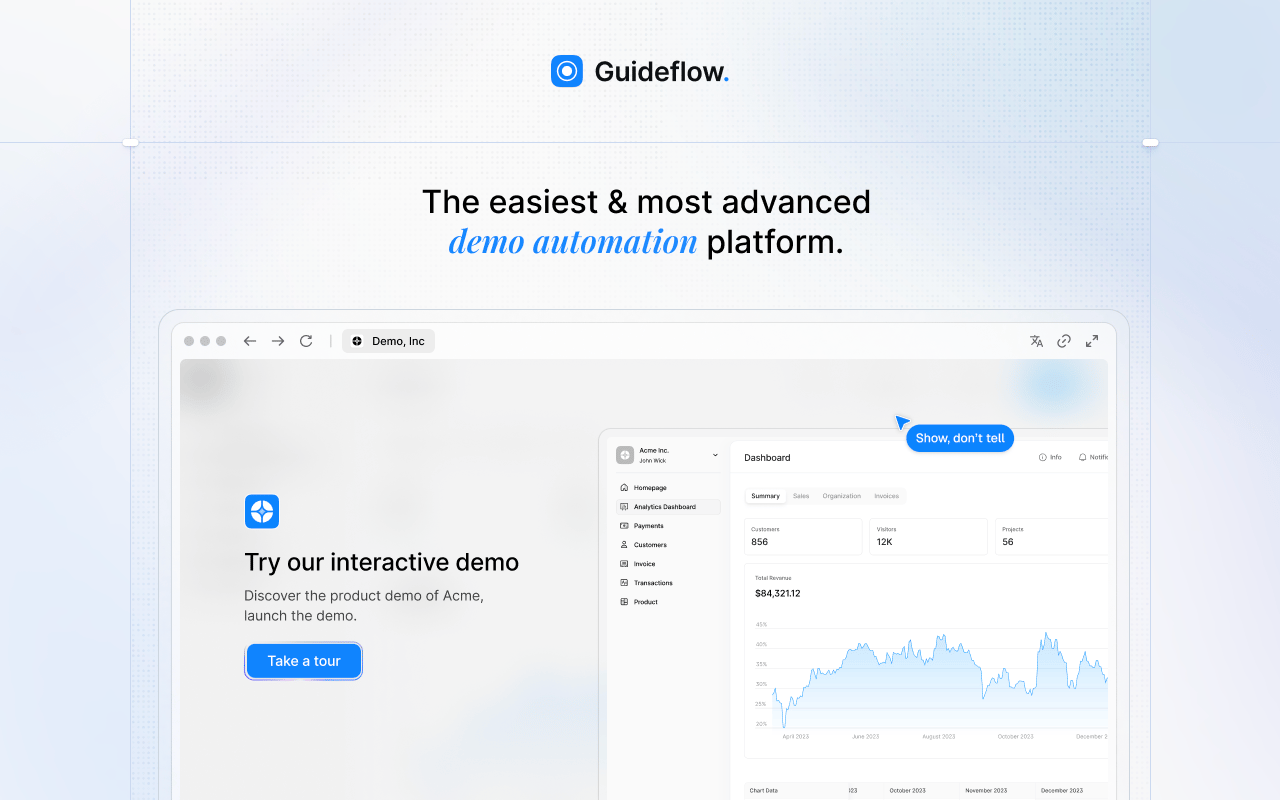
Guideflow is a demo automation platform that lets enablement teams record their software once and distribute interactive step-by-step demos for employee onboarding, internal training, SOPs, product launches, and buyer education. Reps click through the actual workflow instead of reading a document or watching a recording that gets ignored.
Best for: Sales enablement teams that need reps to learn internal systems, product flows, SOPs, and launch narratives through clickable guidance they can complete without a live session.
What it is: Guideflow captures software through the Chrome extension or the native app, then turns that capture into an interactive demo with automated step content. The editor supports text, images, graphs, and branching. Demos can be shared via public link or embedded in an LMS, knowledge base, email, or any web property. Analytics track step-level completion, drop-off, and viewer flow. CRM records are created when a viewer identifies through an in-demo form or a personalized link.
Key features:
- Capture through the Chrome extension or native app (screenshot, HTML, and video modes)
- Automated step content and CTAs
- Editor supports text, images, graphs, and branching
- Translation into more than 30 languages
- Step-level completion, drop-off, and viewer flow analytics
- Integrations with HubSpot, Salesforce, Pipedrive, Zoho, and Marketo
Where Guideflow falls short:
- Look elsewhere if your primary need is a formal LMS with graded assessments, learning paths, and HR administration.
- Look elsewhere if you need a complete sales content repository with complex governance as the central system of record.
Pricing: Free plan at $0. Solo at $35/user/month (annual). Growth at $499/month (annual). Advanced at $1,499/month (annual). Enterprise from $2,999/month, with SSO, advanced governance, and enterprise security.
G2 rating: 5.0/5
How it compares to Seismic: Guideflow covers the interactive internal training job that Seismic does not prioritize. It is not a full sales enablement suite. It is the right choice when the failing workflow is reps learning product changes, CRM steps, or SOPs through static assets that nobody reads.
2. Mindtickle (revenue readiness platform)
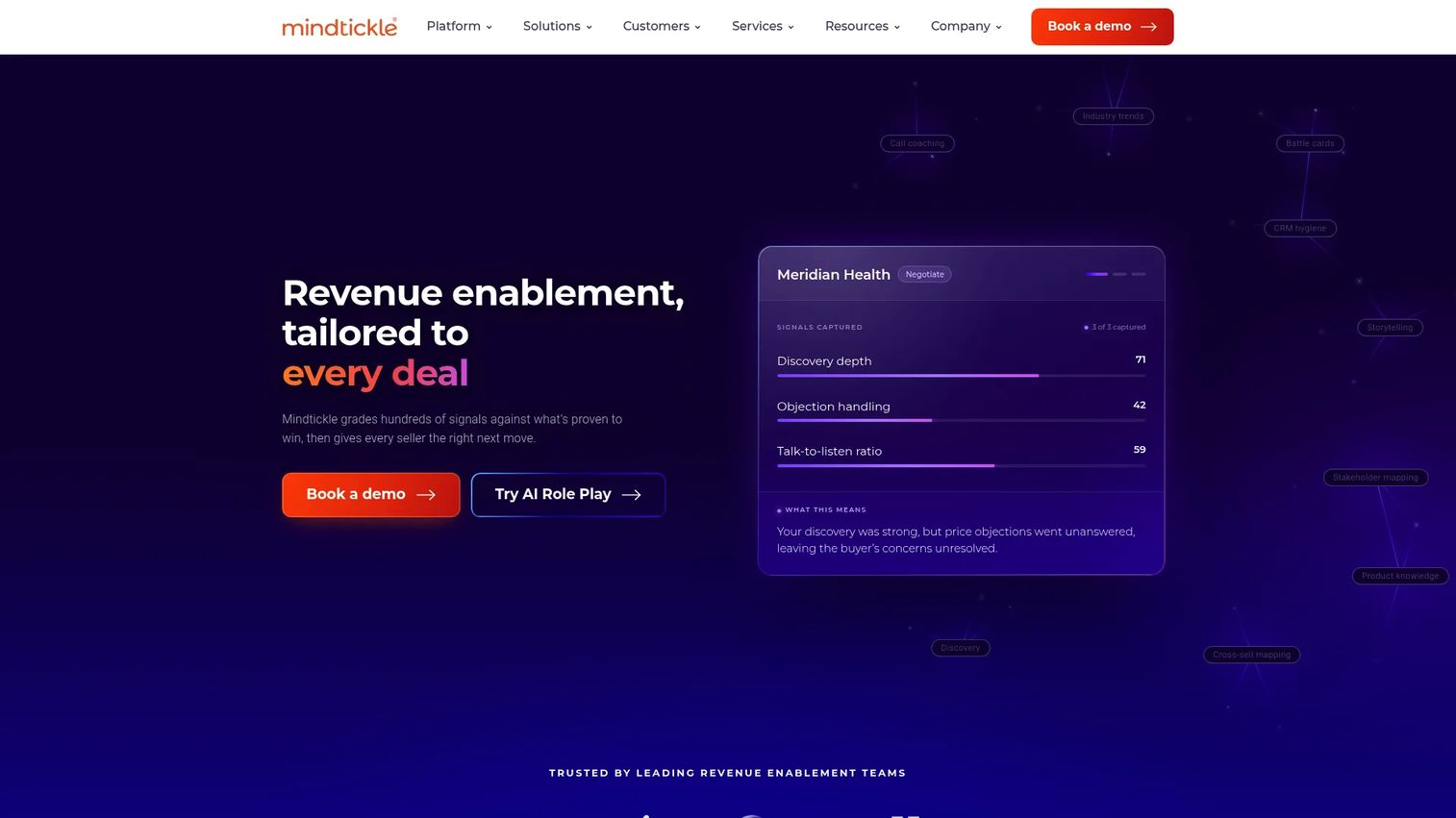
Mindtickle is one of the more complete readiness-first alternatives on this list. Its center of gravity is sales capability development: Onboarding paths, skill measurement, AI role play, and manager coaching workflows that connect training completion to pipeline outcomes.
Best for: Mid-market and enterprise teams where the core enablement problem is rep readiness, certification, and manager coaching, not content distribution alone.
What it is: Mindtickle is a revenue enablement platform covering training, coaching, readiness analytics, digital sales rooms, conversation intelligence, and content management. Its Readiness Index gives leaders a view of which reps are prepared and which are not, tied to actual deal performance.
Key features:
- Sales onboarding paths and certification workflows
- AI role play and skills measurement
- Coaching analytics and manager coaching workflows
- Asset Hub for content management
- Digital sales rooms
- AI Copilot assistant
Where Mindtickle falls short:
- G2 reviewers note that the depth of configuration required to maintain structured readiness programs places a significant admin burden on small enablement teams.
- Teams seeking a lightweight content hub report that Mindtickle's readiness-first architecture adds complexity they do not need at their stage.
- Pricing requires contacting sales, and buyers should ask specifically about learner seats, manager seats, coaching modules, AI role play, and implementation costs before budgeting.
Pricing: Custom pricing. Mindtickle offers LMS, Readiness, Enable, and Transform packages. Contact Mindtickle for a quote based on seat count, modules, and contract length.
G2 rating: 4.7/5
How it compares to Seismic: Mindtickle is a strong alternative when the core problem is behavior change and rep readiness, not primarily content storage. Teams replacing Seismic's learning and coaching modules will find Mindtickle's depth a close fit.
3. Allego (revenue enablement platform)
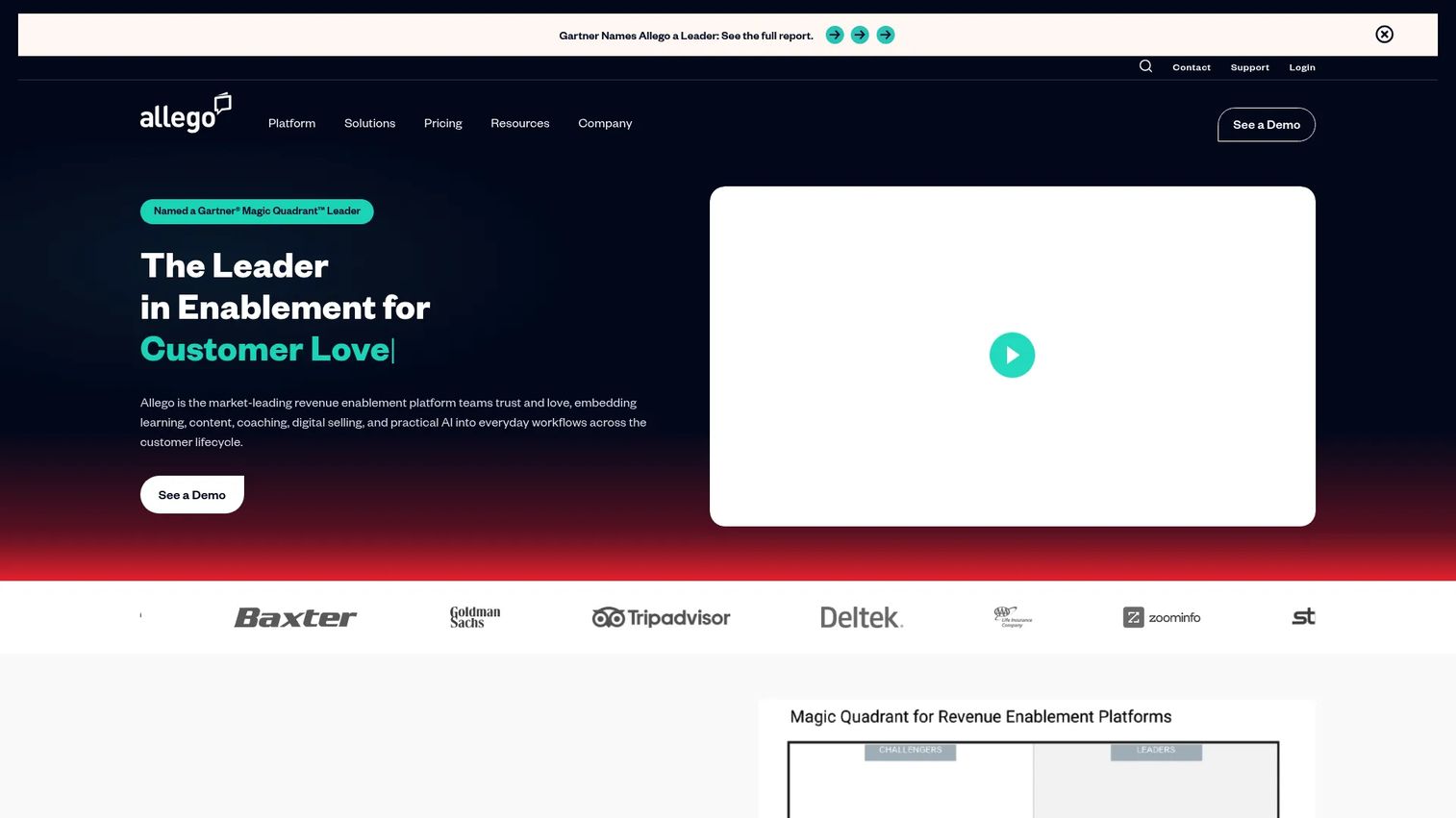
Allego combines learning, coaching, content management, conversation intelligence, and digital sales rooms in one platform. Its video-first approach to learning differentiates it from text-heavy LMS tools, and its conversation intelligence adds a feedback loop from actual calls back into training.
Best for: Revenue enablement teams that want sales learning, video coaching, recorded call analysis, and content management in a single environment.
What it is: Allego is a revenue enablement platform built around modern learning and video coaching. Users practice skills through video submissions and AI role play. Managers review calls via conversation intelligence. Content management and digital sales rooms round out the buyer engagement side. Allego is sold per user per month, billed annually upfront, with typical contracts running three years.
Key features:
- Video-based learning and onboarding
- AI role play and coaching
- Conversation intelligence and call analysis
- Content management with AI-powered search
- Digital sales rooms
- Mobile applications for field teams
Where Allego falls short:
- G2 reviewers report that Allego's content governance controls are less mature than those in dedicated content management platforms, which matters for teams that need strict version control and expiration workflows.
- Buyers should evaluate the package structure carefully. Learning, content, coaching, and conversation intelligence are sold as separate modules, so total cost can rise quickly when combining them.
- Multi-year annual-upfront billing with minimum three-year contract terms is a commitment that smaller teams should model before signing.
Pricing: Custom pricing, billed annually upfront per user per month. Standard contract is three years; one-year and two-year options are available. Contact Allego for module-specific pricing.
G2 rating: 4.6/5
How it compares to Seismic: Allego is a natural fit when the enablement program is built around learning, coaching, and conversation review. Teams replacing Seismic's learning module while keeping a separate content system often consider Allego as the readiness layer.
4. Showpad (sales enablement platform)
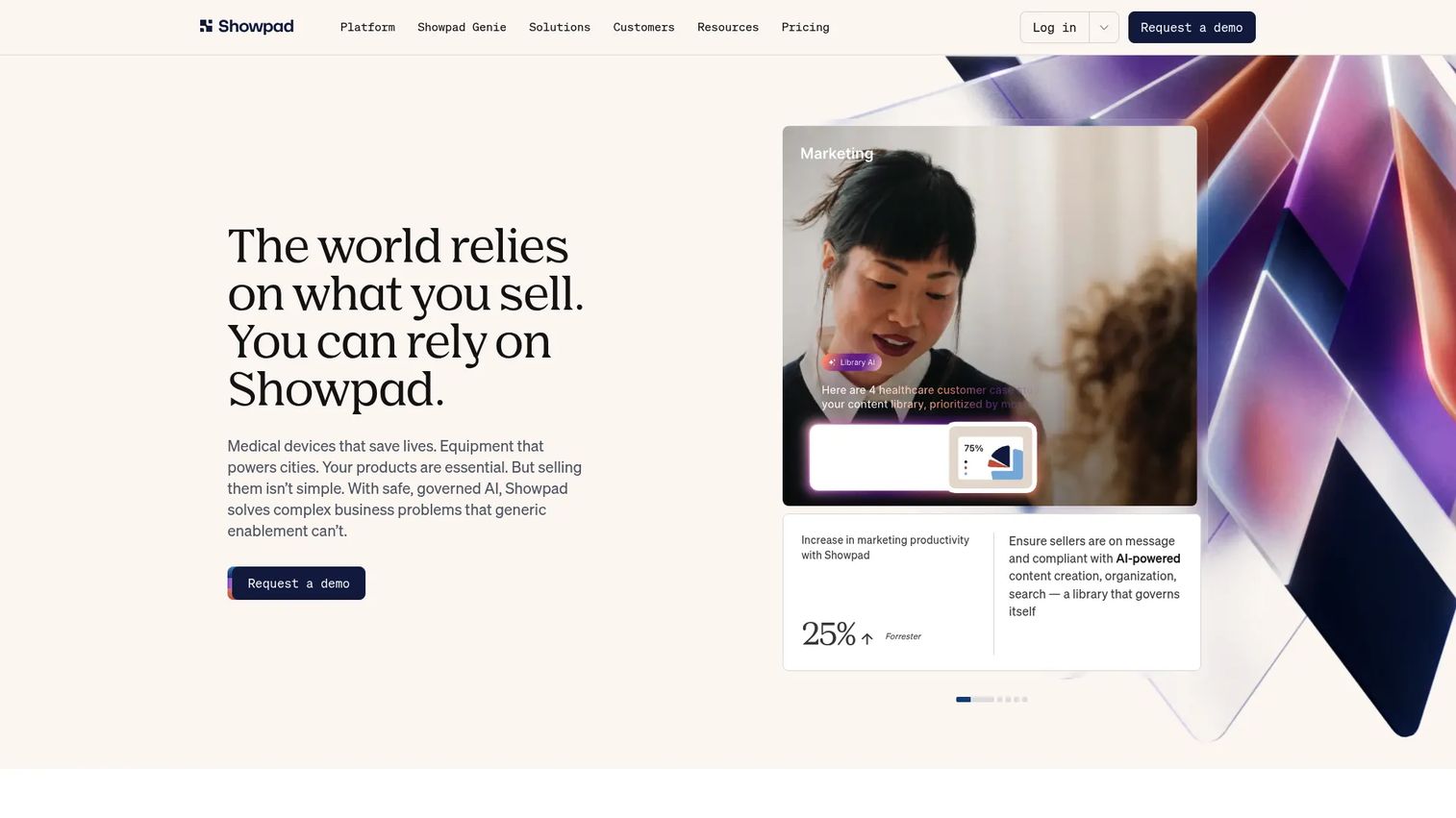
Showpad is one of the closest category-level alternatives to Seismic. It covers sales content governance, rep access, buyer sharing spaces, training, and analytics in one platform. Its AI-native positioning means content recommendations and answer generation are built into the rep workflow.
Best for: Revenue teams that need a governed sales content platform with strong buyer engagement capabilities and AI-assisted content delivery for field selling.
What it is: Showpad is an AI-native revenue effectiveness platform for content management, seller readiness, buyer engagement (Shared Spaces), and analytics. It integrates with CRM systems and offers Professional, Advanced, and Expert package tiers, all quote-based.
Key features:
- Content library with governance controls
- Shared Spaces for buyer engagement
- Seller content recommendations via AI
- Training, courses, and AI role play
- Content analytics and usage insights
- Conversation intelligence
Where Showpad falls short:
- G2 reviewers flag a learning curve in Showpad's admin configuration, particularly for teams setting up content governance structures for the first time.
- Buyers focused primarily on rep readiness and certification should compare Showpad's training depth against readiness-first platforms before deciding.
- All plans are quote-based, and cost drivers include user count, content modules, analytics depth, and integrations.
Pricing: Custom pricing across Professional, Advanced, and Expert tiers. Contact Showpad for a quote.
G2 rating: 4.6/5
How it compares to Seismic: Showpad is the closest full-suite alternative for teams whose primary Seismic use case is governed content management and field-selling support. Teams that run Seismic primarily as a content system will find Showpad the most direct comparison.
5. SalesHood (sales training and enablement platform)
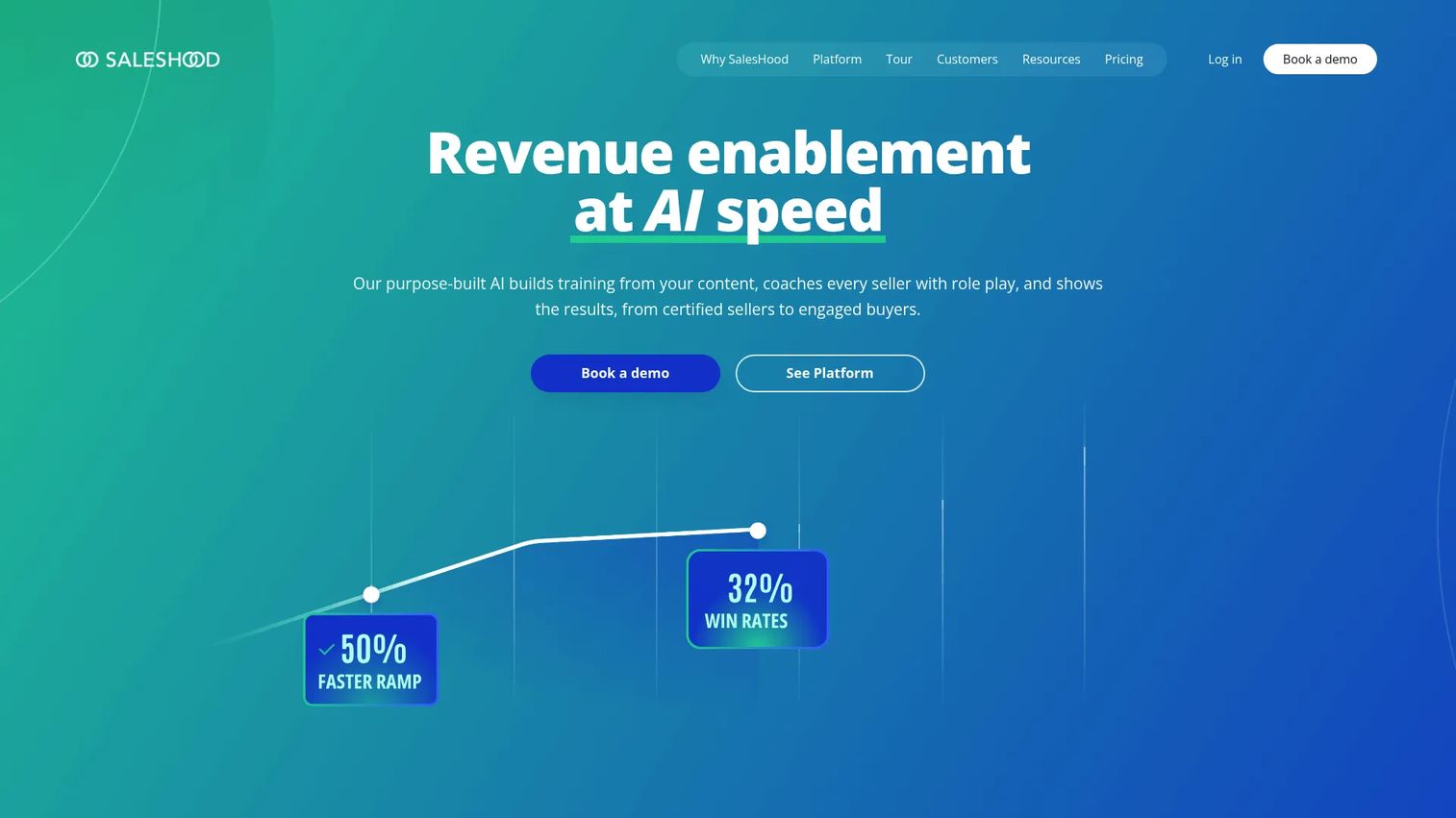
SalesHood positions itself as an agentic AI sales enablement platform. Its focus is tighter than Seismic's: Training, coaching, content sharing, and guided selling, without the enterprise content governance infrastructure that makes Seismic implementations so involved.
Best for: Enablement teams that want sales training, coaching, content, and buyer engagement without committing to a heavy enterprise rollout.
What it is: SalesHood combines centralized content management, training and onboarding paths, AI coaching, digital sales rooms, and guided selling into Essential, Pro, and Unlimited editions. Its AI features cover answers, content writing, and practice scenarios. CRM integrations connect rep activity to pipeline outcomes.
Key features:
- Sales onboarding and training paths
- AI coaching and pitch practice
- Content sharing and AI search
- Digital sales rooms and mutual action plans
- Guided selling workflows
- Performance insights and reporting
Where SalesHood falls short:
- G2 reviewers note that content governance and repository depth are lighter than enterprise-grade platforms, which may not meet the needs of teams with complex content hierarchies.
- Enterprise buyers should validate SSO, permissions depth, and security requirements before committing.
- Teams fully replacing a Seismic deployment should map which existing workflows SalesHood covers and which will need a separate tool.
Pricing: Custom pricing across Essential, Pro, and Unlimited editions. Contact SalesHood for a quote.
G2 rating: 4.6/5
How it compares to Seismic: SalesHood works when the enablement priority is training, coaching, and guided selling rather than a broad enterprise content infrastructure project. For teams where Seismic's implementation was the core pain, SalesHood is a faster path to running a structured program.
6. Dock (digital sales room platform)
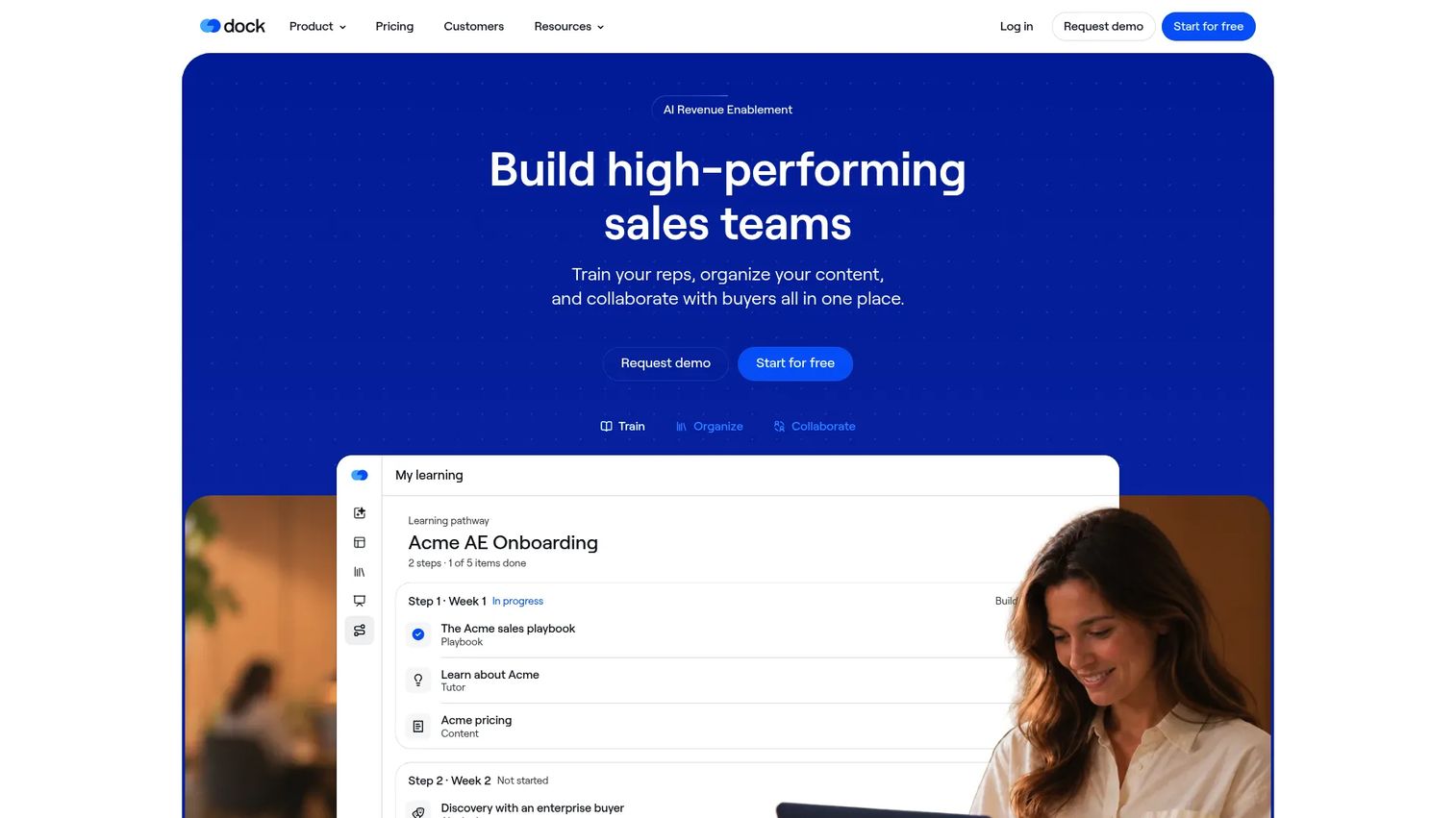
Dock takes a different angle than most tools on this list. Its primary job is the buyer-facing workspace: A shared space where the sales team and the buying committee organize resources, track mutual actions, and move a deal forward without the usual chaos of email threads and stale attachments.
Best for: Revenue teams that need buyer collaboration spaces for follow-up, mutual action plans, stakeholder alignment, and deal execution.
What it is: Dock is an AI revenue enablement platform for customer workspaces across sales, onboarding, and renewals. It includes a content library, learning tools (playbooks and courses), AI agents for training and answering questions, and sales order forms with e-signatures. It is not a full enablement suite; its strength is the buyer experience layer.
Key features:
- Customer workspaces for sales, onboarding, and renewals
- Mutual action plans and stakeholder tracking
- Revenue content library
- Learning tools including playbooks and courses
- Sales order forms with pricing quotes and e-signatures
- Salesforce and HubSpot integrations
Where Dock falls short:
- Dock is not a replacement for a sales readiness platform. Teams still need a separate training, coaching, and certification system.
- Content governance depth should be evaluated carefully if Dock is replacing a repository rather than complementing one.
- G2 reviewers note that some advanced analytics and CRM sync features are gated to higher-tier plans.
Pricing: Free plan at $0 (forever). Standard at $350/month (includes 5 users, additional seats at $50/month each). Premium at $1,000/month billed annually (includes 10 users). Enterprise: Custom annual contract.
G2 rating: 4.6/5
How it compares to Seismic: Dock is a specialist alternative for buyer engagement and deal rooms, not a full Seismic replacement. Teams replacing only Seismic's buyer engagement module, or adding deal room capability to a leaner stack, will find Dock purpose-built for that job.
7. Spekit (in-workflow enablement platform)
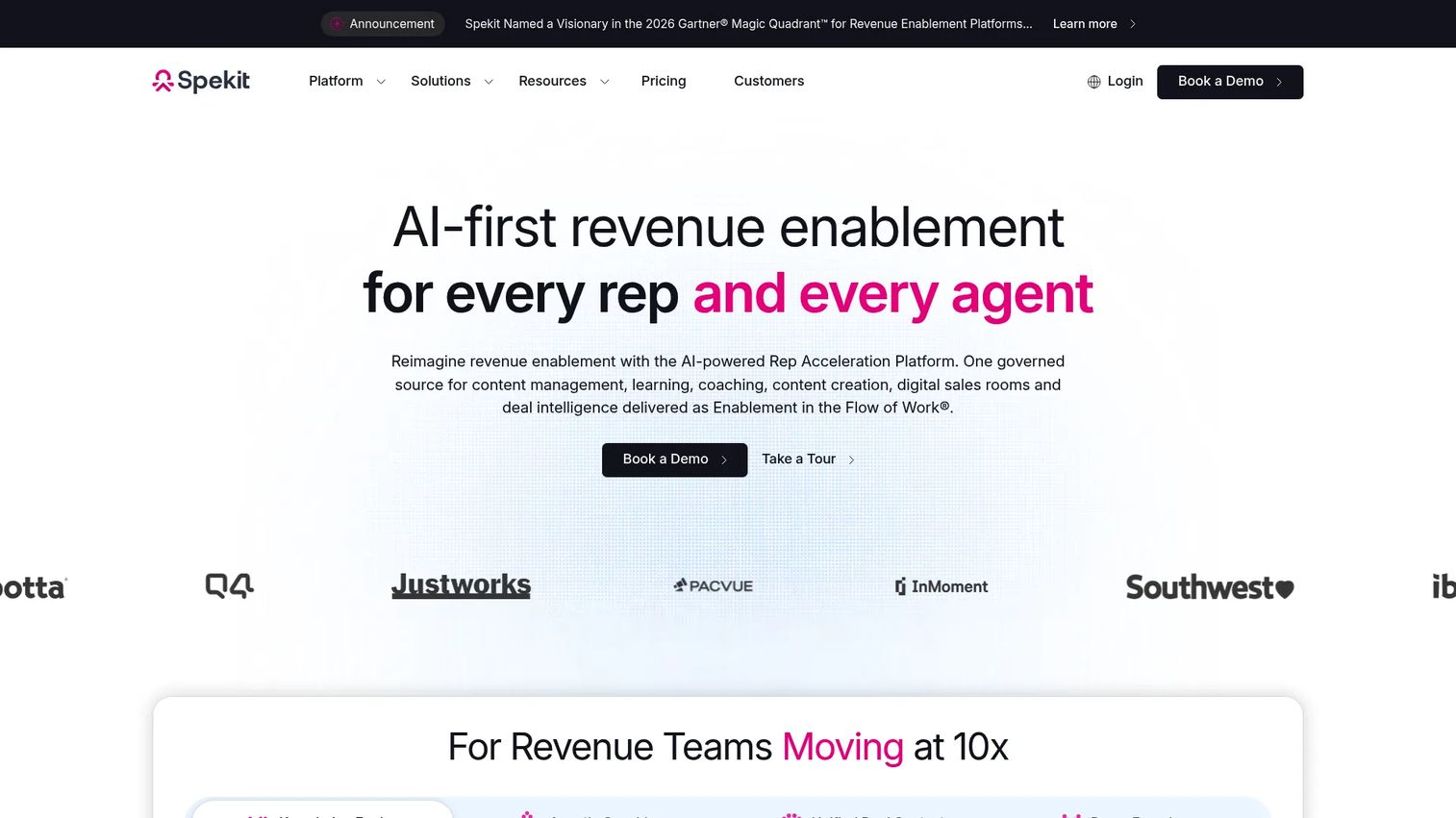
Spekit solves the adoption problem from a different angle than content repositories do. Its premise is that reps are most likely to use enablement content when it surfaces inside the tools they already work in, not when they have to navigate a separate platform.
Best for: Mid-market and enterprise revenue teams where the core problem is rep adoption of process, content, and guidance inside CRM and browser-based tools.
What it is: Spekit is an AI-powered revenue enablement platform that embeds content, coaching, and guidance inside Salesforce, Gmail, Outlook, Gong, LinkedIn, and browser-based tools. Its AI Sidekick surfaces contextual answers and recommendations in real time. It includes governed content management, dynamic learning paths, AI role play, and AI deal rooms with buyer engagement tracking.
Key features:
- AI Sidekick for contextual answers and recommendations inside daily tools
- Governed content management with version history, ownership, and content health controls
- Dynamic learning paths and AI knowledge checks
- AI role play for practice and certification
- AI deal rooms with buyer engagement tracking
- Embedded enablement across Salesforce, Gmail, Outlook, Gong, and LinkedIn
Where Spekit falls short:
- Spekit's pricing page does not display public figures. Teams should run a full pricing conversation before budgeting.
- G2 reviewers note that deep readiness, formal certification programs, and coaching workflows may need a dedicated platform alongside Spekit.
- Teams looking for a central content repository with broad governance controls should validate whether Spekit's content management depth meets their requirements.
Pricing: Custom pricing. Contact Spekit for a quote based on seat count, integrations, and feature requirements.
G2 rating: 4.6/5
How it compares to Seismic: Spekit is the right pick when the problem is rep adoption inside the flow of work. For teams where Seismic content exists but reps cannot find or use it at the right moment, Spekit's in-workflow delivery changes the equation.
8. Guru (knowledge management platform)
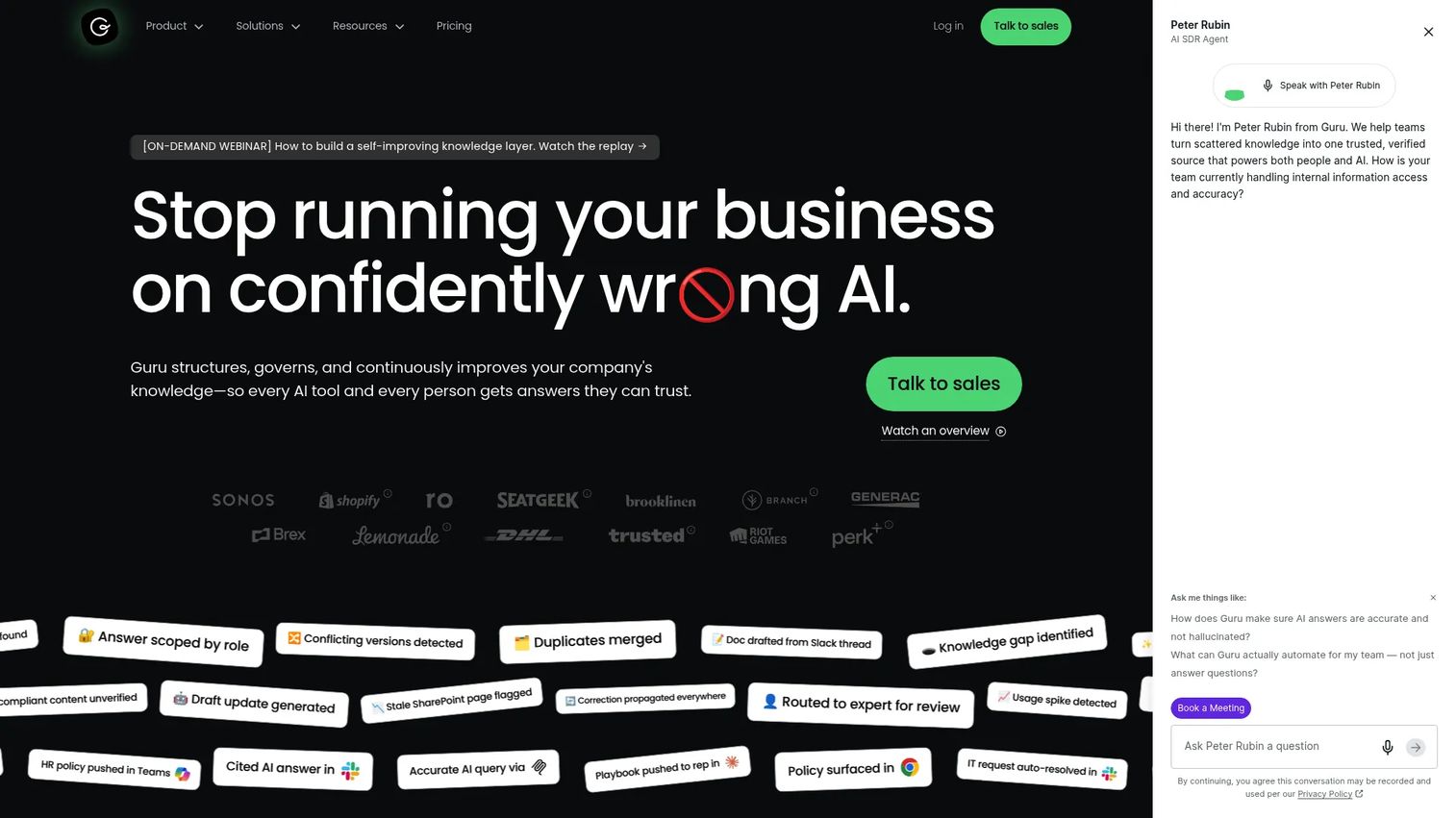
Guru is built around a problem that shows up constantly in enablement: Reps ask the same question in Slack that was answered in a document last month. Guru's answer is to build a governed knowledge layer that delivers cited, verified answers wherever the team already works.
Best for: Sales enablement teams where the primary pain is reps not finding accurate answers quickly, and where knowledge accuracy and governance are as important as the content itself.
What it is: Guru is an AI knowledge platform that organizes, verifies, and delivers cited answers across Slack, Microsoft Teams, the browser extension, and a web app. Its automated verification workflows assign ownership to knowledge cards and prompt review on a cadence. AI answers surface with source citations and permission context.
Key features:
- Verified knowledge cards with ownership and review workflows
- AI answers with source citations and permission context
- Universal delivery through Slack, Teams, browser extension, and web app
- Automated knowledge verification and maintenance
Where Guru falls short:
- Guru is not a sales readiness platform. It does not replace structured coaching, certification, or formal learning programs.
- G2 reviewers note that onboarding and content migration require dedicated time to set up the verification and ownership workflows effectively.
- Teams that need interactive software training alongside knowledge management will need a complementary tool.
Pricing: Custom pricing. Guru prices by organization based on scale and AI maturity. Contact Guru for a quote.
G2 rating: 4.7/5
How it compares to Seismic: Guru fits when Seismic feels too heavy and the core problem is internal knowledge accuracy and rep self-service. It is a narrower tool, purpose-built for the "where does the right answer live" problem.
9. GetAccept (digital sales room and e-sign platform)
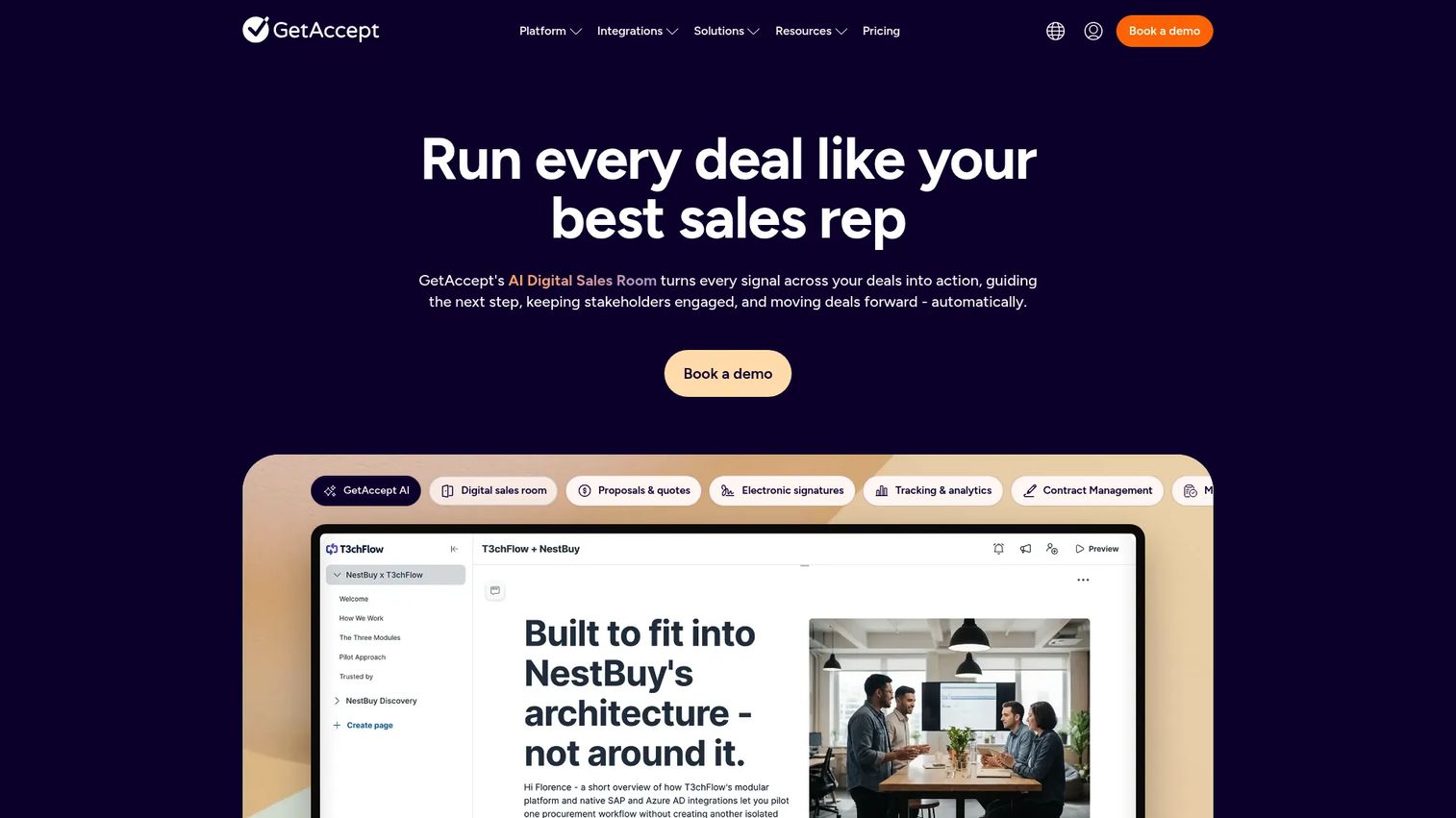
GetAccept covers the late-stage buyer engagement workflow from proposal through signature. For teams whose Seismic pain was specifically in the deal execution layer, GetAccept addresses the whole arc from sharing a proposal to collecting a contract signature.
Best for: Revenue teams managing proposals, digital sales rooms, contract collaboration, e-signatures, and mutual action plans as part of the deal execution flow.
What it is: GetAccept is an AI-native digital sales room platform combining proposals, unlimited electronic signatures, contract management, buyer collaboration, and sales content. It tracks buyer engagement at the document and content level and integrates with CRM systems.
Key features:
- Digital sales rooms with mutual action plans
- Unlimited electronic signatures
- Contract management and proposal workflows
- AI Editor and Smart Content
- Meeting summarizer
- CRM integrations and document tracking
Where GetAccept falls short:
- GetAccept is not a rep training platform. Teams focused on internal readiness need a dedicated learning or interactive guide tool alongside it.
- G2 reviewers note occasional friction in the mobile signing experience for buyers on certain devices.
- Teams replacing Seismic's full content governance need to plan for a separate content management layer.
Pricing: eSign plan at $25/user/month (monthly or annual, 12-month agreement). Professional at $49/user/month (annual, minimum 5 users). Enterprise: Custom pricing.
G2 rating: 4.6/5
How it compares to Seismic: GetAccept is strongest when the Seismic replacement need is specifically the buyer engagement and deal execution layer. It pairs well with a separate content and training platform rather than replacing everything.
10. Content Camel (content management platform)
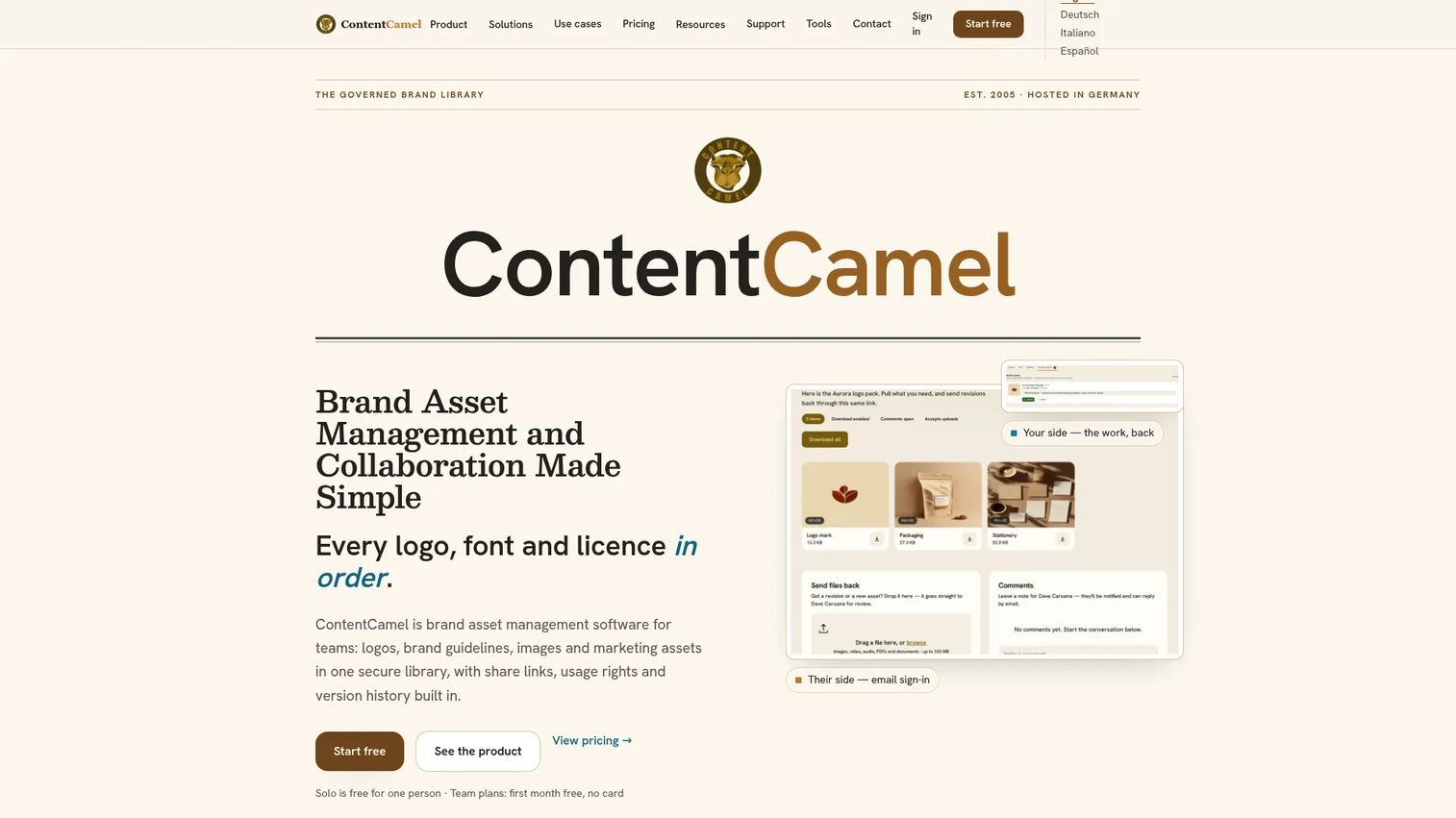
Content Camel sits at the lightweight end of the content management spectrum. For growing teams that need a governed asset library with search, usage-rights controls, and two-way sharing, without the rollout weight of an enterprise suite, it covers the basics without the overhead.
Best for: Growing teams that need governed brand and sales asset management, controlled external sharing, and usage-rights controls without an enterprise rollout.
What it is: Content Camel is a governed content management platform for centralizing brand assets, managing versions, controlling usage rights, and sharing projects through two-way links. Its Team plan supports full-text search, metadata filters, browser previews, and a quarantined review queue for returned work.
Key features:
- Governed asset library with full-text search, metadata filters, and browser previews
- Brand kits with logos, colors, fonts, and versioning controls
- Two-way project links with download, upload, and comment permissions
Where Content Camel falls short:
- Content Camel's G2 rating is based on limited reviews, so the sample is too thin to draw strong trend conclusions.
- Teams needing formal readiness, coaching, and certification will need a dedicated training tool.
- Enterprise buyers with complex permission hierarchies and CRM integration requirements should validate integration depth before committing.
Pricing: Solo plan free for one person. Team at €19.99/user/month (monthly billing, first month free). Company: Custom pricing. Note that pricing is published in euros.
G2 rating: 4.0/5
How it compares to Seismic: Content Camel fits when the enablement priority is organized, governed assets for a growing team, without the rollout complexity of an enterprise platform. It is a lightweight alternative for teams that mainly want to stop losing files in shared drives.
11. Paperflite (content experience platform)
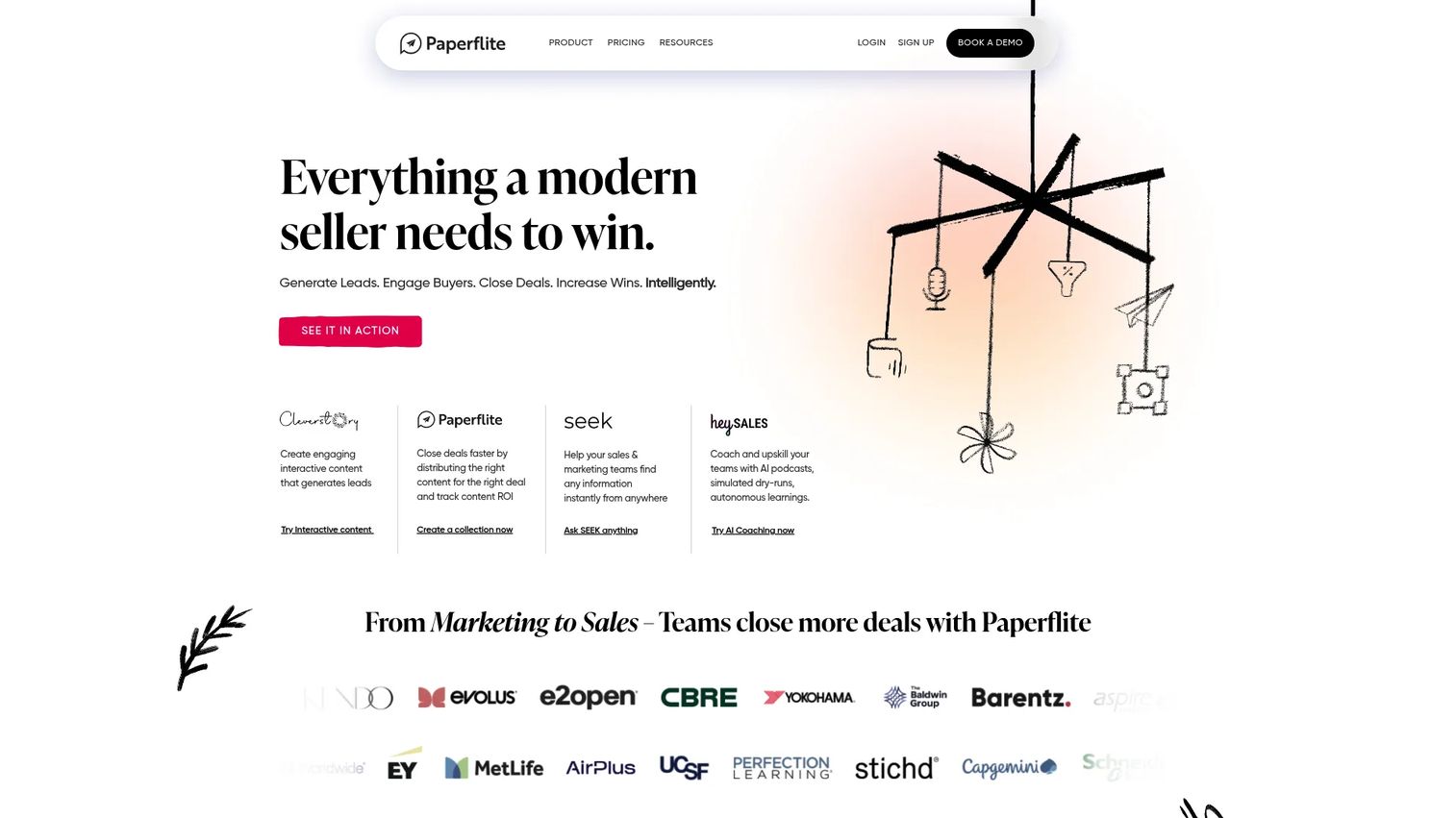
Paperflite focuses on the buyer-facing content experience: Packaging sales assets into personalized microsites and tracking how buyers actually engage with them. Where most content platforms track uploads and rep access, Paperflite tracks what buyers click, read, and return to.
Best for: B2B revenue teams that want to package, share, and track buyer content experiences, with AI-powered content discovery and analytics on asset performance.
What it is: Paperflite is an AI-native revenue enablement platform for content management, personalized buyer microsites, engagement analytics, and sales coaching. Its entry plan starts at $27.50/user/month (annual, minimum 5 users) and includes content hubs, AI content discovery, and asset analytics.
Key features:
- AI-powered content discovery and recommendations
- Personalized content microsites and buyer experiences
- Content engagement, performance, and ROI analytics
- Digital deal rooms (available on higher tiers)
- CRM integrations and secure distribution
Where Paperflite falls short:
- Paperflite's pricing requires a minimum of 5 users on paid plans, which affects smaller enablement teams.
- G2 reviewers note that internal training and rep readiness use cases are not Paperflite's primary strength; it is built for buyer-facing content experiences.
- Version control and content governance depth should be evaluated if Paperflite is replacing a full content management system.
Pricing: "I Got Wings" plan at $27.50/user/month (annual, minimum 5 users). "I Believe I Can Fly" at $47.50/user/month. "Touch The Sky" at $57/user/month. Enterprise: Custom quote.
G2 rating: 4.7/5
How it compares to Seismic: Paperflite is the right choice when the job is buyer-facing content experience and engagement tracking. Teams replacing Seismic's buyer engagement features, rather than its full training and governance infrastructure, will find Paperflite purpose-fit for that work.
12. Bigtincan (enterprise sales enablement platform)
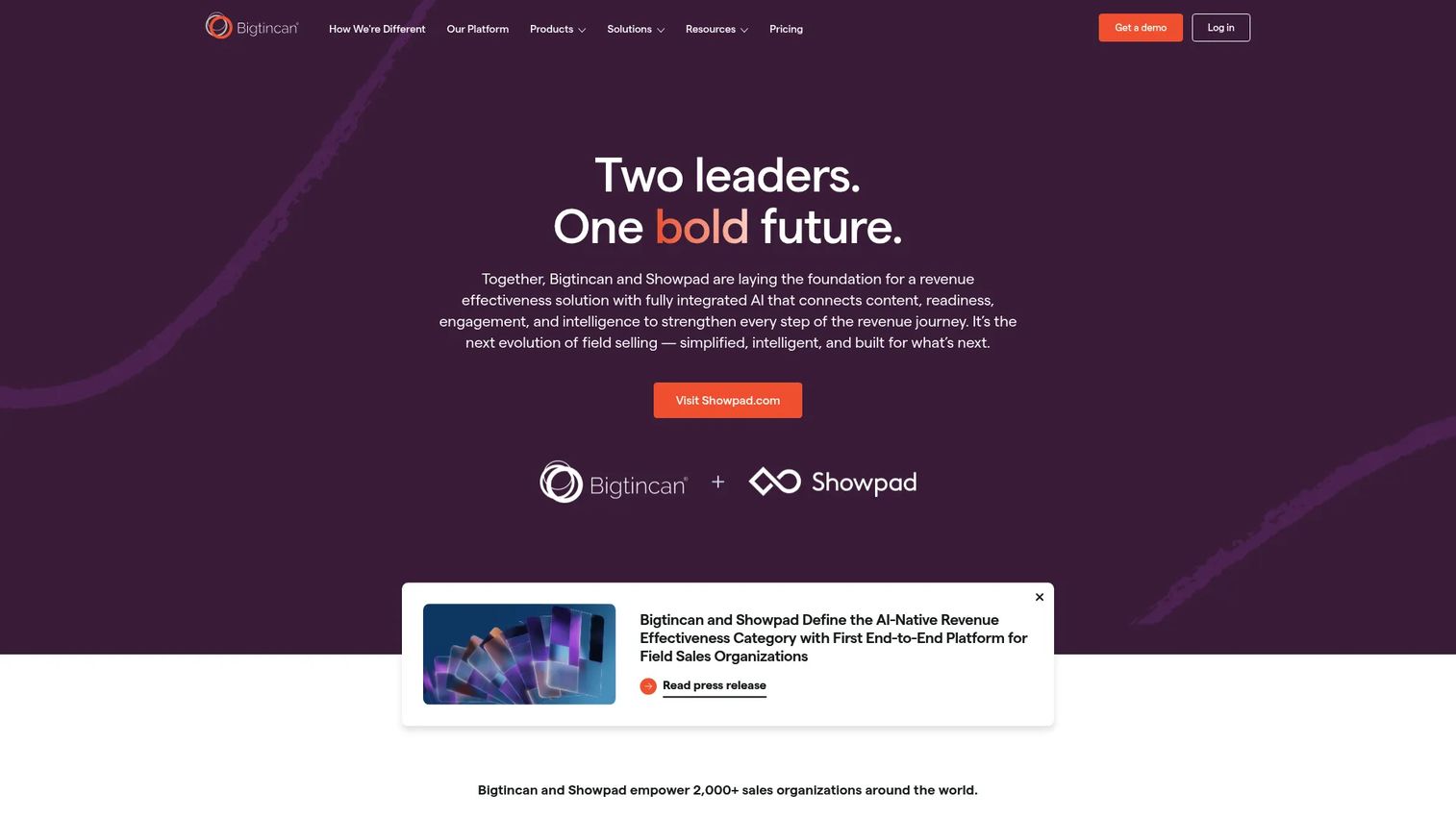
Bigtincan covers enterprise sales enablement with a broad platform that includes training, coaching, content management, digital sales rooms, conversation intelligence, and field selling support. It is built for larger revenue organizations with complex content needs and distributed teams.
Best for: Enterprise revenue organizations that need broad enablement coverage across content management, learning, coaching, buyer engagement, and analytics in a single platform.
What it is: Bigtincan is an AI-enabled revenue enablement platform for training, coaching, content management, digital sales rooms, conversation intelligence, and sales productivity. Its Essential and Elite platform editions are both quote-based. It is used by large sales organizations, including those with significant field selling requirements.
Key features:
- AI-powered training, coaching, and role play
- Content management, personalization, and version control
- Digital sales rooms and buyer engagement tracking
- MeetingsAI and conversation intelligence
- Analytics dashboards and CRM integrations
- Relationship intelligence
Where Bigtincan falls short:
- Bigtincan does not publish pricing, and G2 reviewers report that implementation and configuration require significant internal resource investment.
- Smaller teams should evaluate whether Bigtincan's breadth is matched by their available admin capacity.
- Buyers seeking quick interactive SOP or software training creation will find Bigtincan's architecture oriented toward content distribution rather than guided software learning.
Pricing: Essential and Elite editions. Contact Bigtincan for a quote based on team size, modules, and contract terms.
G2 rating: 4.3/5
How it compares to Seismic: Bigtincan is one of the closer full-suite alternatives for enterprise buyers evaluating Seismic. Teams that need enterprise-grade field selling support and broad enablement coverage alongside a comparable implementation profile should put it on the evaluation list.
Which Seismic alternative works best for interactive internal training?
Guideflow is the strongest choice for teams that need reps to learn software workflows, CRM steps, and SOPs through clickable guidance.
Guideflow records software once and distributes interactive demos employees complete at their own pace, covering employee onboarding, product training, CRM process training, launch enablement, and internal tool adoption. Teams needing formal LMS administration with graded assessments and HR learning records should pair Guideflow with a dedicated LMS. For the interactive software training job alone, it covers the gap that most enablement stacks leave open.
What tool fits best for structured sales readiness?
Mindtickle is the strongest fit when readiness, certification, skills measurement, and manager coaching are the program's core.
Mindtickle's Readiness Index links training completion to rep performance data, which gives enablement leaders the measurement layer that most tools lack. SalesHood is a lighter alternative when the same training and coaching goals apply but the team does not need enterprise-scale certification infrastructure.
Which alternative handles sales content management best?
Showpad is the closest fit for governed sales content management, with Paperflite and Content Camel covering lighter content enablement.
Showpad's content library, governance controls, and AI-powered content recommendations serve teams that need strong asset governance and content usage analytics. For teams that mainly need to organize and track buyer-facing content without full governance infrastructure, Paperflite covers buyer engagement analytics well. Content Camel fits growing teams that need basic asset organization and controlled sharing without an enterprise rollout.
Which Seismic alternative wins on buyer engagement?
Dock and GetAccept are the purpose-built picks for digital sales rooms, mutual plans, and stakeholder tracking.
Dock serves the full buyer collaboration arc from first follow-up through customer onboarding and renewal. GetAccept focuses on the late-stage deal execution workflow: Proposals, e-signatures, contract management, and engagement tracking. Both integrate with CRM. Teams comparing them should map which part of the buyer journey is the actual gap.
Where do Spekit and Guru fit in the stack?
Spekit and Guru are stronger fits when reps need answers and guidance inside the tools they already use.
Spekit delivers contextual content, coaching, and answers embedded inside Salesforce, Gmail, Gong, and LinkedIn. Guru governs internal knowledge and surfaces cited answers wherever the team works, primarily through Slack, Teams, and a browser extension. Both address rep adoption from a different angle than a central content platform does.
When should you stay with Seismic?
Seismic makes sense when your implementation is already mature and your team is using it. If reps consistently find the right content, your governance structures are actively maintained, and CRM and analytics integrations are running cleanly, the switching cost of migrating a working system outweighs the benefit. Seismic's breadth is an advantage for large revenue organizations that need a single system for content, learning, coaching, and buyer engagement with one governance model across all of them. If those conditions apply and leadership has the admin capacity to sustain the platform, staying is the lower-risk path.
Why teams switch from Seismic to Guideflow
The core reason is a specific job that Seismic does not prioritize: Getting reps to learn product flows, internal tools, CRM steps, and SOPs through interactive practice rather than passive content.
Reps learn by clicking through the actual workflow, not by reading a document. Guideflow lets enablement teams build that experience from a capture of the real software interface, using the Chrome extension or native app. The editor supports text, images, graphs, and branching, with automated step content. Translation into more than 30 languages means a single guide can reach distributed or international teams.
Analytics track step-level completion, drop-off, and viewer flow, so enablement teams can see which steps get skipped and where reps stop. CRM records are created when a viewer identifies through an in-demo form or a personalized link, connecting training completion to pipeline data in HubSpot, Salesforce, Pipedrive, Zoho, or Marketo.
Guides can be embedded in a knowledge base, shared by public link, included in onboarding emails, or added to any web property. The same interactive demo that trains a rep on a new product workflow can serve as buyer education without rebuilding it. See the full Guideflow pricing and integrations pages for current plan details.
One limitation to keep in view: Guideflow is not a formal LMS and does not replace a sales content repository with complex governance. It is the interactive training layer that most enablement stacks are missing.
Start your journey with Guideflow today!
Frequently asked questions: Seismic alternatives
The right answer depends on the job. Guideflow is the top pick for interactive internal training and SOPs. Mindtickle leads for structured readiness and certification. Showpad is the closest fit for governed sales content management. Dock and GetAccept address buyer engagement and deal rooms. The category label next to each tool in the comparison table is the fastest way to route.
The most common drivers are pricing opacity, implementation complexity, and rep adoption problems. Seismic prices by quote, and buyers often find it difficult to forecast total contract cost before a sales conversation. Implementation requires a formal project plan and ongoing admin ownership. Some teams are also looking for a narrower specialist tool that solves one enablement job without the rollout weight of a full platform.
Guideflow has a free plan. Dock also offers a free plan. Most full-suite revenue enablement platforms (Mindtickle, Allego, Showpad, SalesHood, Spekit, Guru, Bigtincan) do not publish public pricing or free tier details. GetAccept offers a 14-day free trial without a permanent free tier.
Guideflow is the top pick for interactive step-by-step software training, where reps click through real workflows instead of reading docs or watching recordings. Mindtickle and SalesHood are stronger fits for formal training programs with structured learning paths, certification, and graded assessments. The difference is interactive workflow training versus LMS-style program administration.
Showpad is the closest fit for governed sales content with strong CRM integration and buyer engagement. Content Camel works for growing teams that need organized, controlled asset libraries without an enterprise rollout. Paperflite covers buyer-facing content experiences and engagement analytics. Guru is the right choice when the problem is specifically internal knowledge accuracy and rep self-service.
Dock and GetAccept are the primary recommendations. Dock covers the full buyer collaboration arc, including post-sale onboarding and renewal workspaces. GetAccept focuses on the deal execution workflow from proposal through e-signature. Allego and Showpad also include buyer engagement features that may overlap with deal room requirements, so verify which capabilities are included at each package tier.
Yes. Many enablement teams run Seismic for enterprise content governance and pair it with a specialist tool for a specific job. Guideflow for interactive training guides, Dock or GetAccept for buyer-facing deal rooms, and Spekit for in-workflow rep guidance are all practical complements to an existing Seismic deployment. The trigger for adding a specialist tool is usually a workflow that the primary platform does not cover well.
Start with the failing workflow. Map it to one of these categories: Interactive training, content governance, rep readiness, coaching, buyer engagement, or in-workflow knowledge. Run a pilot with 30 to 50 priority assets or 3 to 5 reps before committing. Measure adoption, step-level completion for training tools, content usage for content platforms, and stage conversion where the tool is meant to have pipeline impact. The platforms that change rep behavior are the ones that meet reps where they already work and make the right action the low-effort one.