You spent two hours resetting the demo environment. The prospect asked for a recording. Then three stakeholders who missed the call sent the same questions the following week.
That is the core presales tax: Repetitive live demos, fragile environments, and buyers who forget what they saw the moment the call ends. According to TrustRadius (2024), 71% of buyers who used product demos said demos were the most influential resource they consulted during a purchase. Yet 67% of B2B buyers prefer a rep-free buying experience, per Gartner (2025). Those two facts point in the same direction: Buyers want product proof, but they want it on their own terms.
Sales demo automation software exists to close that gap. It helps revenue teams create, personalize, share, and measure interactive demos without rebuilding each experience from scratch, so presales capacity goes toward high-value technical conversations instead of repetitive first-look calls.
What's inside
This guide compares 15 sales demo automation software tools for 2026, written for presales, sales, RevOps, PMM, and enablement teams.
- Who it is for: Sales Engineers, Solutions Consultants, Presales Managers, AEs, and revenue ops teams
- How tools were chosen: Sales demo fit, repeatability, analytics depth, CRM and stack integrations
- What to compare: Demo format coverage, personalization, governance, buyer-intent signals
- What you'll verify before buying: Pricing, G2 rating, security controls, implementation effort
- What's covered: Interactive demos, sandbox environments, demo analytics, enablement workflows, CRM-native options, and ABM-adjacent tools
TL;DR
- Best overall for sales demo automation: Guideflow covers interactive demos, sandboxes, demo centers, live demos, and mobile demos, with personalization and engagement analytics built in
- Best for enterprise demo governance: Demoboost, for teams that need governed demo libraries and AI-assisted personalization across many reps and regions
- Best for live demo data personalization: Saleo, for sellers who need account-specific data inside a native product environment during live calls
- Best CRM-native pick: HubSpot or Salesforce, depending on which CRM already anchors your revenue stack
- Best for sales enablement context: Seismic, when demo assets need to live inside a broader content and readiness program
- Best for revenue intelligence: Clari, when demo signals need to connect to pipeline inspection and forecast conversations
What is sales demo automation software?
Sales demo automation software helps revenue teams create, personalize, share, and measure product demos without rebuilding each experience from scratch.
The category covers several distinct demo formats, each suited to a different sales moment:
- Interactive demos: Guided, clickable product stories a buyer navigates at their own pace
- Sandboxes: Explorable product environments for hands-on technical validation and free-form exploration
- Demo centers: Branded hubs that organize multiple demos by persona, use case, or funnel stage
- Live demo support: Tools that structure and personalize presenter-led product walkthroughs
- Video demos: Recorded walkthroughs for async education and quick explanations
- CRM-connected engagement data: Buyer-intent signals that sync into the sales workflow
Key capabilities to look for
- No-code demo capture and editing
- Account-level personalization by industry, role, or opportunity
- Reusable demo libraries with version control
- Shareable links, website embeds, and social distribution
- Demo Center for buying-committee sharing
- Analytics for views, completion, drop-offs, revisits, and stakeholder activity
- CRM and Slack integrations for follow-up workflows
- Access controls, role-based permissions, and SSO
- AI-assisted step generation, translation, and narration
What separates sales demo automation from generic demo content
A video recording or a one-off slide deck is not demo automation. The category's value comes from repeatability: Standardize the product story, personalize it per deal, support async buying committees, and surface buyer-intent signals that help presales prioritize follow-up. That is where the operational lift actually shows up.
When to use sales demo automation software
Qualify buyers before a live SE call
Automated demos help buyers evaluate the product before presales invests time in deep discovery or technical validation. When an inbound request comes in, sending a guided product experience first filters unqualified interest before an SE calendar slot gets blocked. Engagement data from that first view tells you who is ready for a real conversation.
Give champions a demo they can share internally
After a live call, the champion needs to sell internally. A guided or explorable demo they can forward to security, finance, or executive stakeholders, complete with the product story intact, removes the information loss that happens between your call and their internal meeting. A Demo Center makes it easy to send one branded destination instead of a pile of attachments.
Support technical validation without rebuilding demos
Presales teams answer the same "show me how this works" questions across dozens of deals. Reusable sandbox environments, personalized product experiences, and demo libraries let you answer those questions without resetting an environment for each prospect. Live demos remain the right tool for discovery, objection handling, and complex stakeholder discussions. Automation handles the repeatable layer around them.
Sales demo automation software comparison
The table below covers all 15 tools in this guide. Guideflow leads as the most complete demo automation platform for presales and revenue teams. The other tools are sorted by their fit for sales demo workflows.
Pricing and G2 ratings reflect verified sources as of November 2026.
| # | Product | Best for | Key differentiator | Pricing | G2 rating |
|---|---|---|---|---|---|
| 1 | Guideflow | Full sales demo automation | Interactive demos, sandboxes, demo centers, live demos, mobile demos | Free; paid from $35/mo | N/A |
| 2 | Demoboost | Enterprise demo governance | Governed demo libraries with AI personalization | From $375/mo (billed annually) | 4.8/5 |
| 3 | Saleo | Live demo data personalization | Account-specific data injection in native product | Custom pricing | 4.9/5 |
| 4 | RELAYTO AI | Interactive sales content | AI-powered content-to-interactive-experience conversion | From $750/mo (billed annually) | 4.7/5 |
| 5 | ReachSuite | REACH regulatory compliance | Compliance and consortium collaboration | Custom pricing | N/A |
| 6 | HubSpot | CRM-native sales workflows | Demo activity tied to CRM and marketing automation | Free; paid from $7/seat/mo | 4.4/5 |
| 7 | Loom | Async video walkthroughs | Fast screen-and-camera recording with viewer insights | Free; Business from $18/user/mo | 4.7/5 |
| 8 | Seismic | Sales enablement programs | Demo assets inside governed enablement content workflows | Custom pricing | 4.7/5 |
| 9 | Clari | Revenue forecasting and pipeline | Deal risk and pipeline inspection with revenue intelligence | Custom pricing | 4.6/5 |
| 10 | Salesforce | Enterprise CRM-led sales | Opportunity tracking, CRM automation, and AppExchange | From $25/user/mo | 4.4/5 |
| 11 | 6sense | ABM and intent-led selling | Predictive account intent for demo prioritization | Custom pricing | 4.1/5 |
| 12 | Demandbase | Enterprise ABM programs | Account-based engagement and GTM orchestration | Custom pricing | 4.4/5 |
| 13 | GUIDEcx | Post-sale onboarding handoff | Client onboarding project management after close | Custom pricing | 4.6/5 |
| 14 | Spryker | Complex B2B commerce demos | Composable commerce platform for enterprise evaluation | Custom pricing | 4.4/5 |
| 15 | Komo | Interactive engagement campaigns | Gamified microsites for buyer qualification and engagement | Custom pricing | 4.7/5 |
Best 15 sales demo automation software for 2026
1. Guideflow
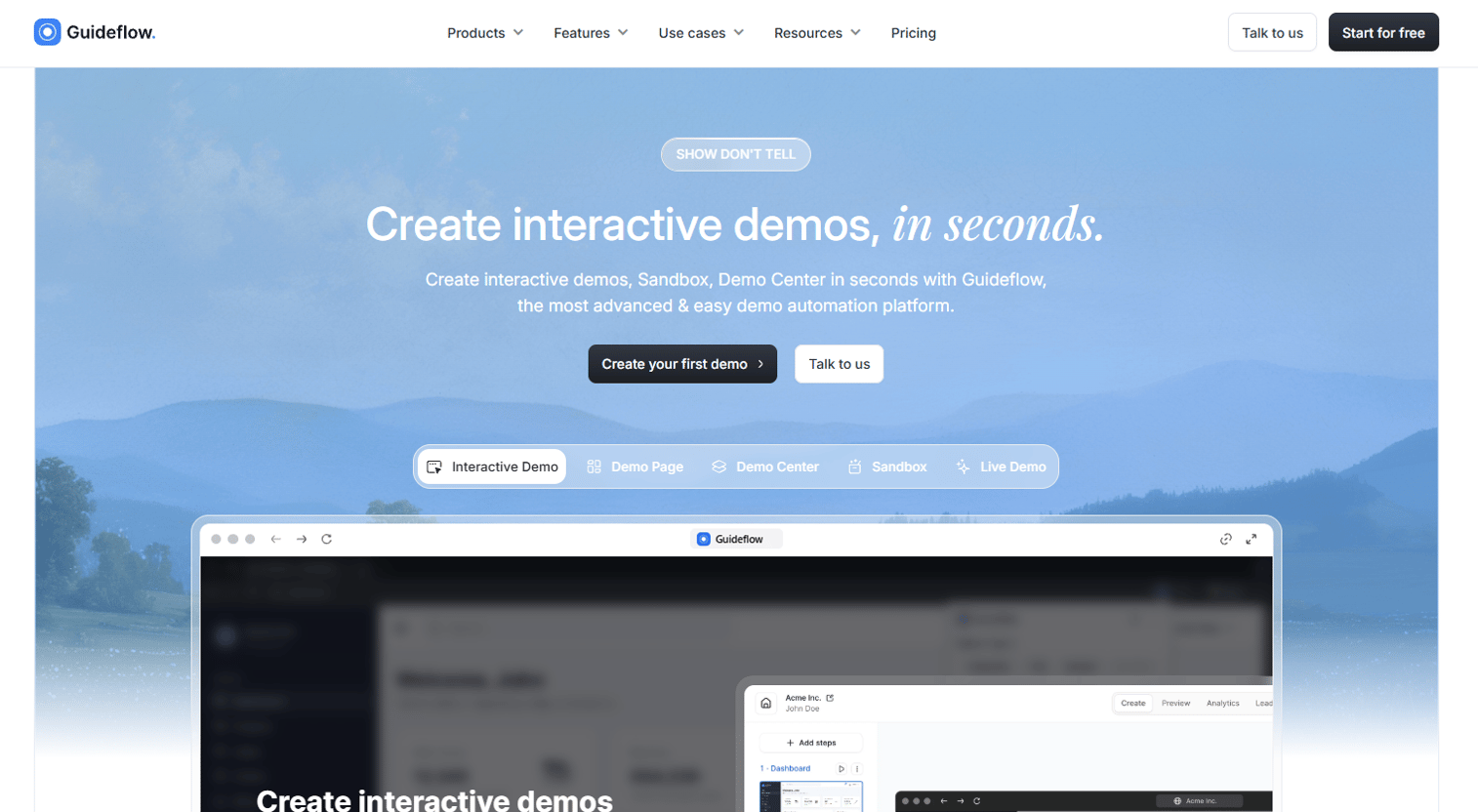
Guideflow is a demo automation platform built for revenue teams that need to create, personalize, share, and measure product experiences fast. It covers five demo formats: Interactive Demo, Sandbox, Demo Center, Live Demo, and Mobile Demo, so presales, sales, marketing, and customer success teams work from a shared library instead of rebuilding assets for every deal. You capture product flows directly from your browser, edit with a no-code builder, and share by link, embed, email, or social in minutes.
Best for: Presales and revenue teams that need one platform for guided product stories, explorable sandbox environments, champion-ready demo centers, live call support, and mobile-optimized product experiences.
Key features
- No-code browser-based demo capture
- Guided interactive demos and explorable sandboxes
- Branded demo centers for buying-committee sharing
- Account-level personalization with editable text, images, and graphs
- AI step generation, voiceover, and translation
- Engagement analytics: Impressions, completion, leads, drop-offs
- CRM, Slack, and marketing automation integrations
- Access controls, private links, and domain restrictions
Why choose Guideflow: For presales teams, Guideflow reduces repetitive demo work without reducing quality. Guided demos filter unqualified prospects before an SE gets involved, and sandbox environments give technical buyers hands-on validation without requiring a live environment reset. After a call, champions can share a personalized demo center with the full buying committee.
Guideflow pricing: Free plan available. Paid plans start at $35/user/month (billed annually) for the Solo tier, with Growth at $499/month and Advanced at $1,499/month. Enterprise pricing is available on request.
G2 rating: Check the Guideflow G2 listing directly.
Start your journey with Guideflow today!
2. Demoboost
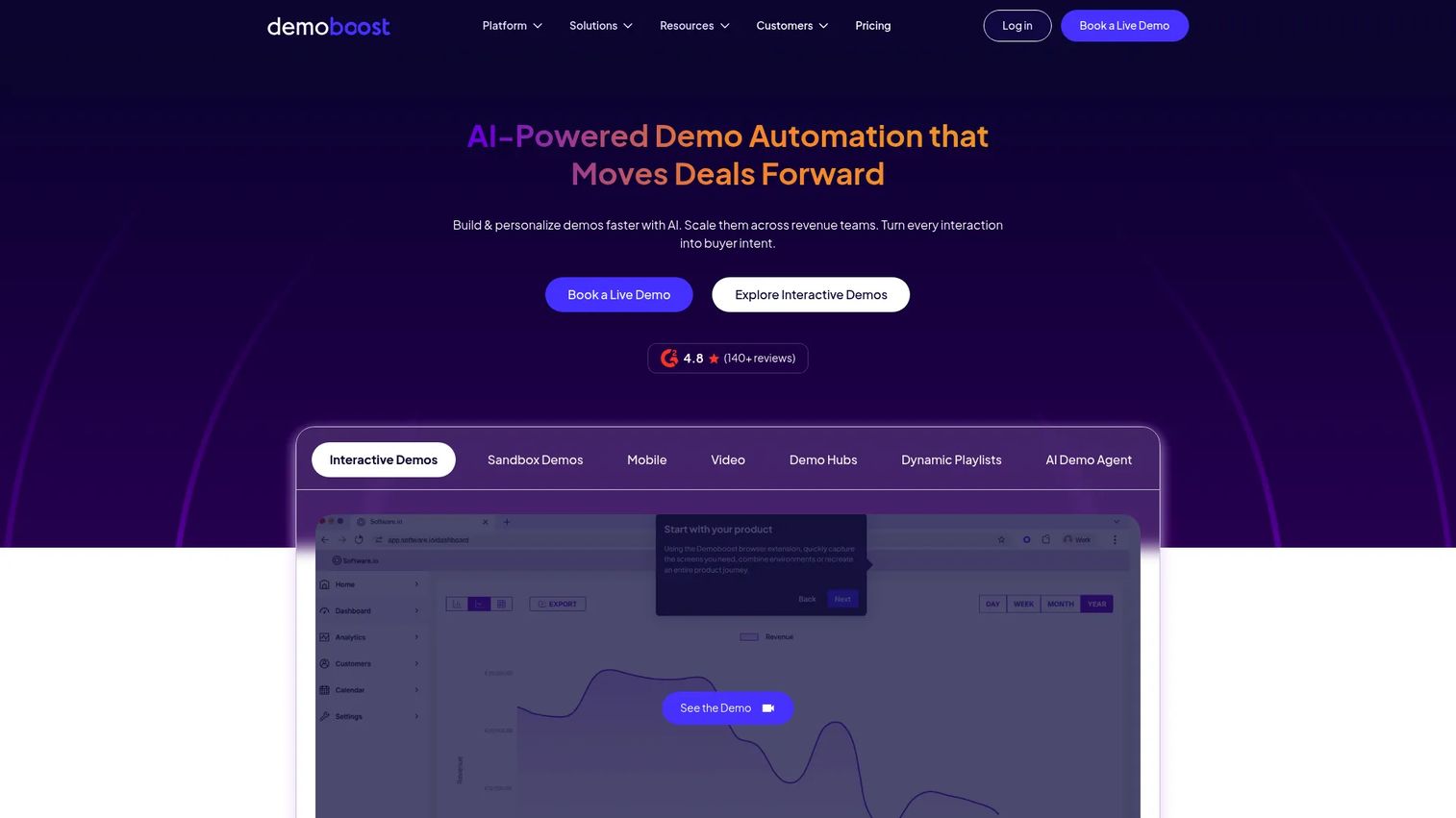
Demoboost is an interactive demo platform built for enterprise revenue teams that need governed, reusable demo assets across many reps, regions, and product lines. It supports HTML, screenshot, video, mobile, sandbox, and overlay demo formats, with AI-powered personalization, narration, and translation built into the editor. Demo engagement analytics and buyer-intent signals connect to CRM workflows and digital sales rooms.
Best for: Enterprise sales and presales teams managing large demo libraries that require centralized governance, AI-assisted personalization, and consistent quality across a distributed team.
Key features
- Interactive demos: HTML, screenshot, video, mobile, sandbox, overlay formats
- AI personalization, narration, and translation
- Digital sales rooms and demo playlists
- Buyer engagement analytics and intent signals
- Native CRM integrations and webhooks
- Enterprise SSO and access controls
Why choose Demoboost: Demoboost fits teams where demo operations are mature enough to need centralized control. The governed library structure prevents reps from going off-script, and the AI tools reduce the time it takes to personalize assets for each deal.
Demoboost pricing: Plans start at $375/month (Start Up), with Essentials at $600/month, Growth at $1,200/month, and Enterprise at custom pricing. All tiers are billed annually. No self-serve free tier.
G2 rating: 4.8/5
3. Saleo
Saleo is a live demo experience platform that helps software companies create personalized, data-complete demonstrations inside their native SaaS product. Rather than building a separate demo environment, Saleo injects AI-modeled data into your existing product, so sellers show account-specific names, metrics, and workflows during live calls without touching production data. The platform includes demo libraries with folder management, sharing controls, and an AI Demo Agent for autonomous multilingual demos.
Best for: Mid-market and enterprise sales teams that need live demos to reflect the prospect's actual world, with account-specific data visible in the native product interface.
Key features
- AI-powered demo data modeling and injection
- Personalization of text, images, tables, graphs, and metrics
- Live demos inside the native product environment
- Demo library with folders, duplication, and permissions
- AI Demo Agent for autonomous, multilingual demos
- SSO and role-based access control
Why choose Saleo: Saleo excels when the interface is strongest if it reflects the prospect's industry, company name, or key metrics. It is particularly useful for live-call storytelling where generic sample data would undermine credibility.
Saleo pricing: Custom pricing. Contact Saleo for a quote. G2 reviewers report enterprise-level packaging.
G2 rating: 4.9/5
4. RELAYTO AI
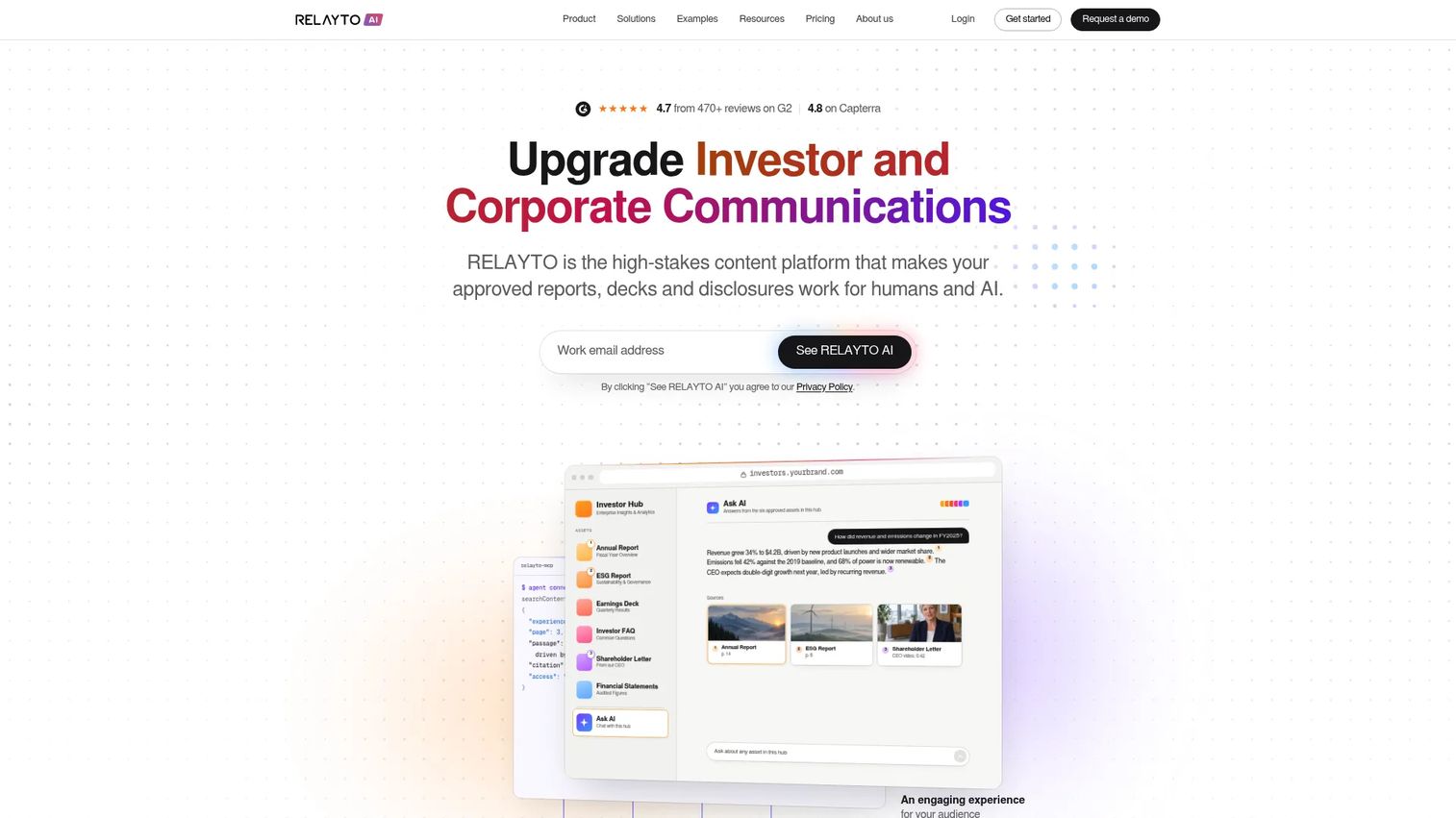
RELAYTO AI transforms static content, PDFs, presentations, and reports, into interactive, secure digital experiences using AI. Sales teams use it to build digital sales rooms, content hubs, and product storytelling microsites that track engagement at the visitor level. The platform adds animations, responsive layouts, AI-powered content chat, and analytics covering visits, interactions, and traffic sources.
Best for: Businesses and regulated teams that need branded, interactive content experiences where the "demo" is part of a broader interactive sales package rather than a standalone product walkthrough.
Key features
- AI Experience Builder converts static files into interactive microsites
- AI Content Chat with source-grounded answers from uploaded documents
- Content hubs for digital sales rooms and client portals
- Engagement analytics: Visits, interactions, traffic sources, devices
- Advanced security and audience access controls
Why choose RELAYTO AI: RELAYTO AI works well when the demo need sits inside a broader set of sales materials. If your buyers consume a mix of decks, one-pagers, and product stories, RELAYTO AI makes the whole package interactive rather than isolating the demo as a separate asset.
RELAYTO AI pricing: Team plan starts at $750/month (billed annually). Business plan is $2,500/month (billed annually). Enterprise pricing is custom. No free tier was confirmed.
G2 rating: 4.7/5
5. ReachSuite
ReachSuite is a software platform built for REACH regulatory compliance, substance registration, and SIEF collaboration. The platform helps businesses manufacturing or importing regulated substances manage compliance workflows, coordinate across legal entities and consortium members, and track substances, raw materials, and articles.
Best for: Organizations in chemicals, manufacturing, or regulated industries that need to manage REACH compliance, consortium collaboration, and substance registration workflows.
Key features
- REACH compliance management and substance registration
- Collaboration across sites, legal entities, and SIEF members
- Management of substances, raw materials, articles, and mixtures
- Multi-stakeholder coordination for consortium activities
Why choose ReachSuite: ReachSuite belongs in this list for teams in regulated industries where the product being demoed involves REACH-governed materials or workflows. It is a compliance platform, not a general-purpose demo automation tool.
ReachSuite pricing: Custom pricing. Contact ReachSuite directly for plan details.
6. HubSpot
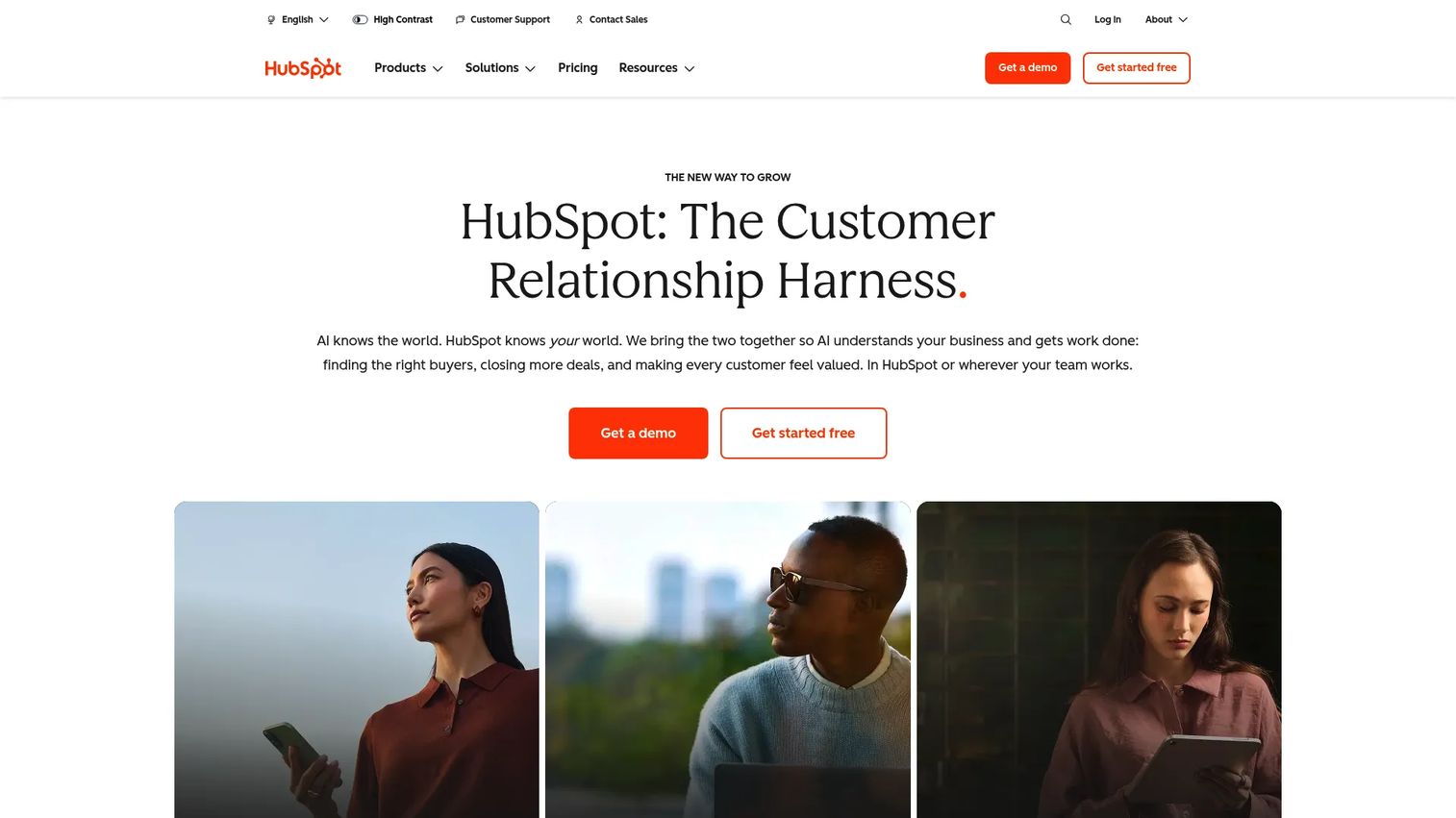
HubSpot is an all-in-one customer platform covering marketing, sales, customer service, and CRM. For revenue teams, its value in a demo automation stack comes from tying demo activity to CRM records, follow-up sequences, deal stages, and marketing automation. HubSpot does not create interactive product demos by itself, but it is where demo engagement data lands and drives next actions.
Best for: Revenue teams already running sales, marketing, and CRM workflows inside HubSpot who want demo engagement to trigger follow-up sequences and pipeline updates automatically.
Key features
- CRM contact and deal records
- Email sequences and sales automation
- Meeting scheduling and routing
- Landing pages and forms
- Marketing workflow automation
- Integrations with leading demo tools
Why choose HubSpot: HubSpot is not a pure demo automation platform. It earns a place in this list as the CRM layer where demo signals, from tools like Guideflow, flow into nurture, scoring, and rep follow-up workflows for teams already on the HubSpot stack.
HubSpot pricing: Free tier available. Marketing Hub Starter starts at $7/seat/month. Professional is $800/month. Enterprise is $3,600/month. One-time onboarding fees apply to Professional and Enterprise.
G2 rating: 4.4/5
7. Loom
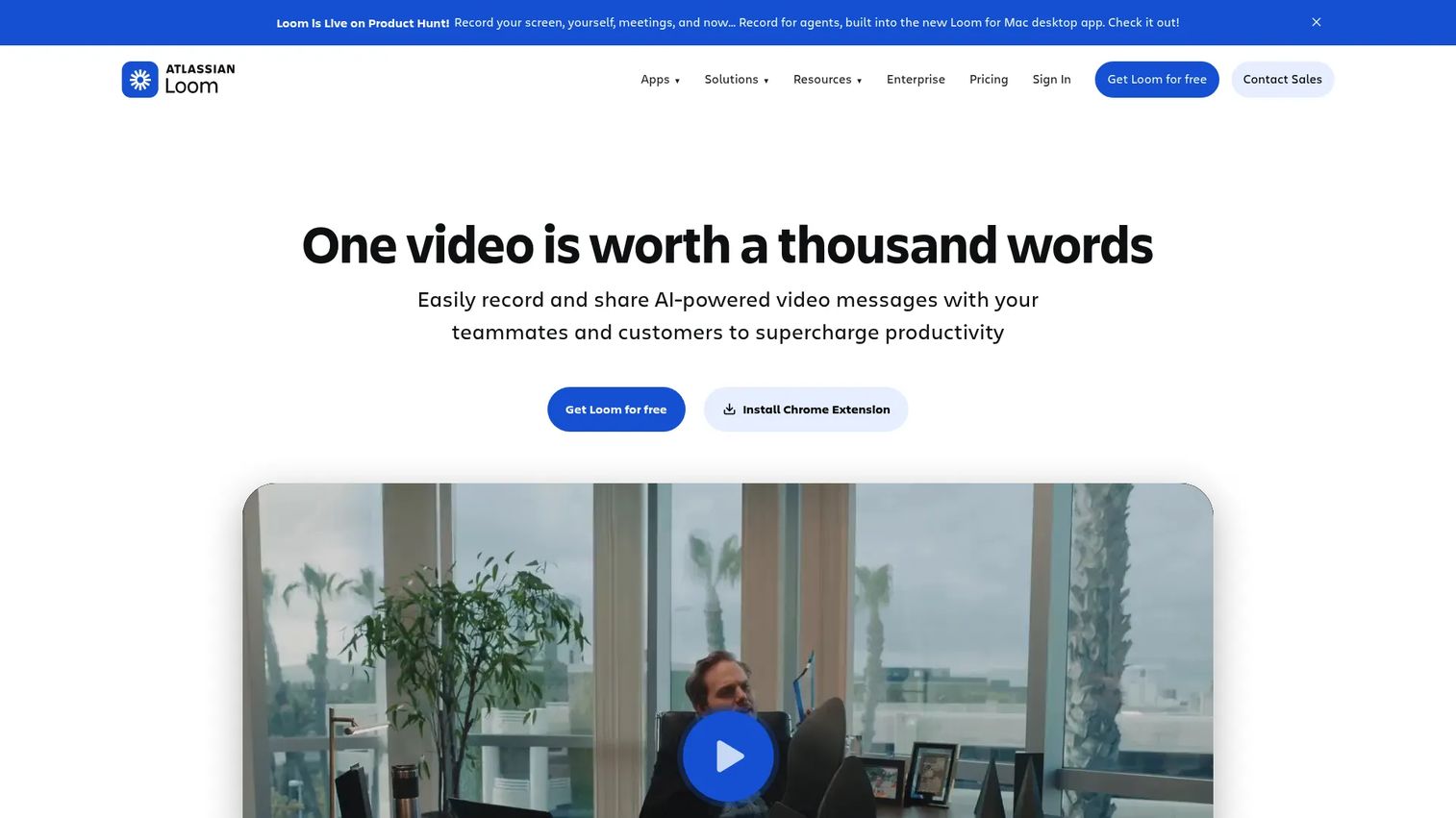
Loom is an AI-powered video messaging and screen-recording platform for communicating with teammates and customers. Sales teams use it to record quick product walkthroughs, follow-up explanations, and personalized outreach videos. Viewers receive a shareable link and Loom tracks completion, comments, and call-to-action clicks.
Best for: Sales reps and SEs who need to record a narrated product walkthrough or personal follow-up quickly, without building a full interactive demo.
Key features
- Screen and camera recording
- Video editing: Trimming, stitching, text overlays, and arrows
- Transcriptions in 50+ languages
- Viewer completion and engagement insights
- AI summaries, chapters, and meeting recaps
Why choose Loom: Loom fits when the job is a narrated explanation, a personal message, or an internal team walkthrough. It is a different tool from interactive demo automation: Viewers watch a linear video rather than explore a clickable product experience. Many presales teams use both, with Loom for quick follow-ups and a platform like Guideflow for self-serve product proof.
Loom pricing: Free Starter plan available. Business plan is $18/user/month. Business + AI is $24/user/month. Enterprise pricing requires contacting sales.
G2 rating: 4.7/5
8. Seismic
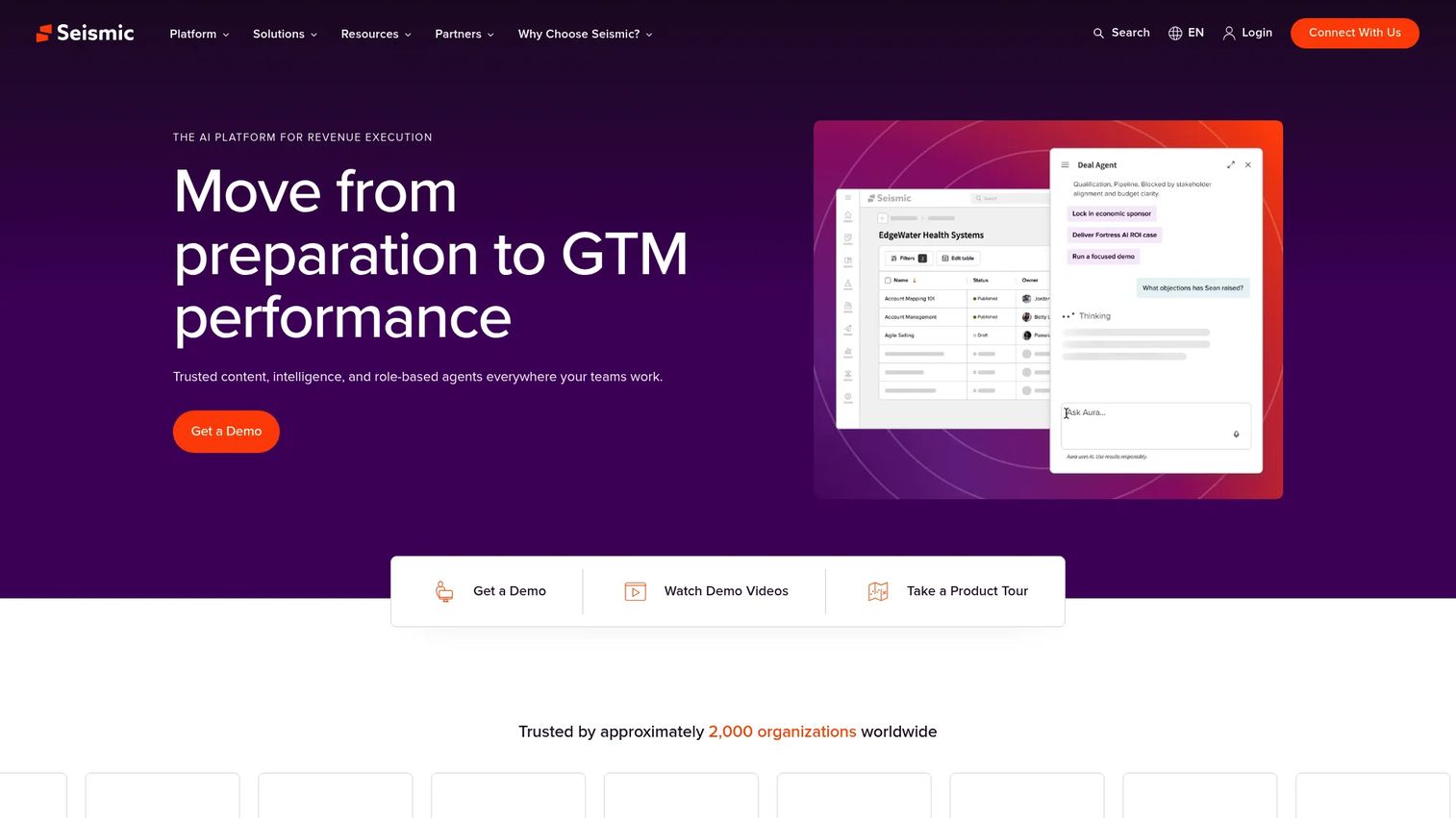
Seismic is an AI-powered revenue enablement platform that provides content management, learning and coaching, meeting intelligence, digital sales rooms, and analytics for go-to-market teams. Sales and presales teams use it to organize demo assets alongside playbooks, training, and buyer-facing materials in a governed content library.
Best for: Large enterprise enablement teams that need demo assets organized within a broader sales content and readiness program, with analytics on content usage by rep, deal stage, and region.
Key features
- Sales content library and asset management
- Enablement playbooks and learning workflows
- Meeting intelligence and coaching tools
- Digital sales rooms
- Content usage analytics and CRM integrations
Why choose Seismic: Seismic is the right choice when demo automation is part of a larger enablement initiative. It is not built for creating interactive product demos, but it is a strong home for demo assets once they exist, especially when sales managers need visibility into which assets reps actually use.
Seismic pricing: Custom pricing. Contact Seismic for a quote.
G2 rating: 4.7/5
9. Clari
Clari is an AI-powered Revenue Orchestration Platform that unifies revenue data, pipeline management, forecasting, sales engagement, conversation intelligence, and customer retention workflows. It is not a demo builder, but it belongs in this list because demo engagement signals, routed from tools in your stack, can inform Clari's pipeline and deal risk analysis.
Best for: Enterprise revenue teams that want demo engagement to contribute to pipeline inspection, forecast calls, and deal risk conversations, integrated with CRM and revenue data.
Key features
- Pipeline and opportunity management
- Sales forecasting and revenue insights
- AI revenue agents
- Sales engagement and prospecting
- Conversation intelligence and coaching
- Customer retention and expansion workflows
Why choose Clari: Clari makes sense when your team has demo engagement data flowing into CRM and you want that signal to surface in forecast reviews and deal risk discussions. It is a revenue intelligence layer, not a standalone demo platform.
Clari pricing: Custom pricing. Clari states pricing is tailored to each use case. Contact Clari for a quote.
G2 rating: 4.6/5
10. Salesforce
Salesforce is an AI-powered CRM platform connecting sales, service, marketing, commerce, analytics, and workflow automation. For demo automation, Salesforce serves as the system of record where demo engagement data, synced from dedicated demo tools, connects to opportunity records, deal stage progression, and follow-up automation.
Best for: Enterprise sales teams that need demo activity tracked against CRM records, opportunity stages, and revenue reporting, with AppExchange access to extend functionality.
Key features
- Lead, account, contact, and opportunity management
- Sales automation and lead routing
- Agentforce AI agents
- CRM dashboards and reporting
- AppExchange ecosystem for integrations
- Enterprise permissions and security
Why choose Salesforce: Like HubSpot, Salesforce is not a demo creation platform. It earns its place here as the CRM backbone that most enterprise revenue teams already use, and where demo engagement data ultimately needs to land to drive rep follow-up and pipeline reporting.
Salesforce pricing: Sales Cloud starts at $25/user/month (Starter Suite). Pro Suite is $100/user/month. Core is $195/user/month. Advanced is $395/user/month. Max is $550/user/month. All paid plans are billed annually.
G2 rating: 4.4/5
11. 6sense
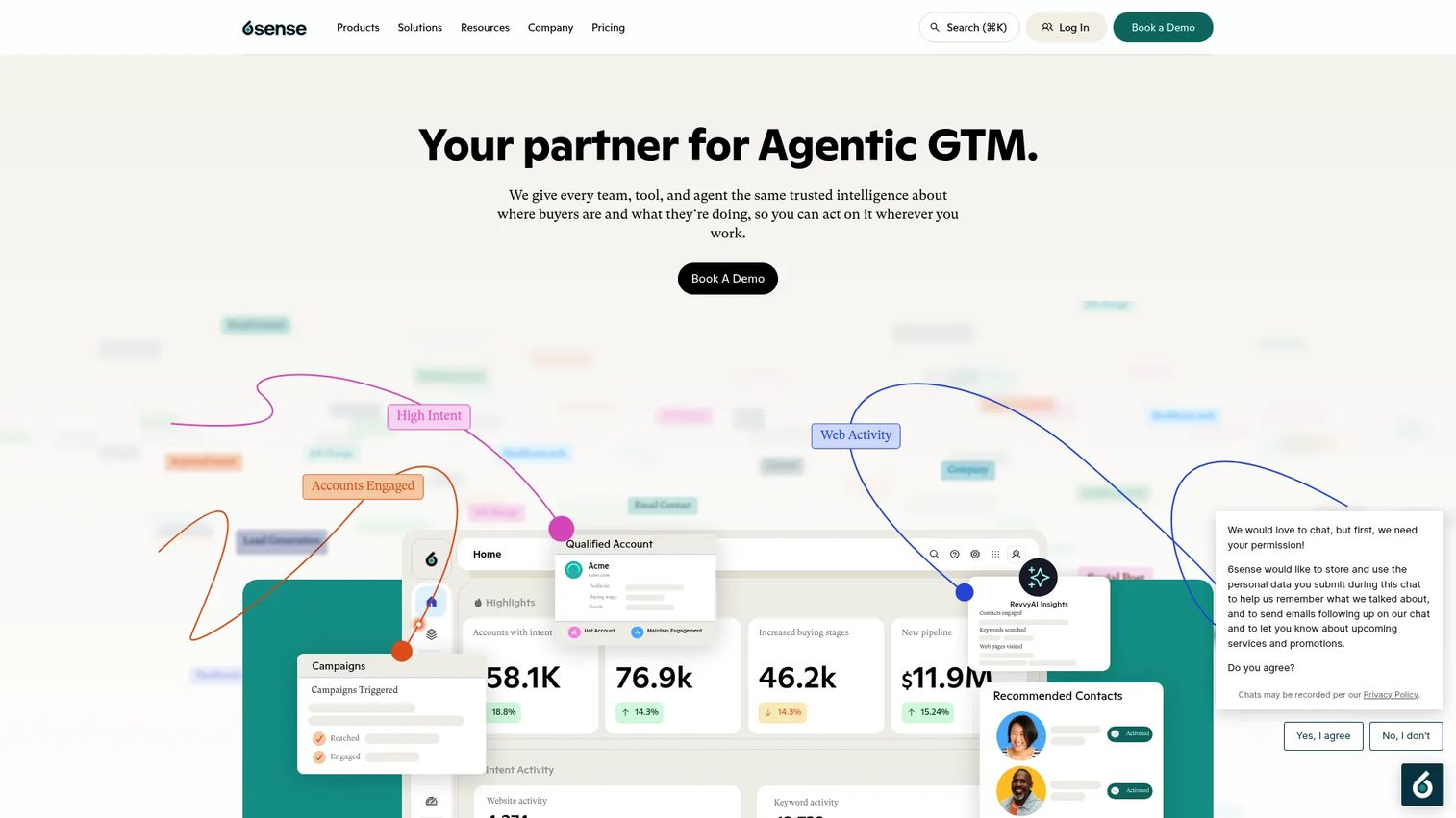
6sense is a B2B go-to-market platform that uses buyer signals, data, and predictive intelligence to help revenue teams identify and engage accounts likely to buy. Its value in a demo automation workflow is prioritization: Knowing which accounts are showing intent helps presales and sales decide where to send demos and when to follow up.
Best for: ABM and intent-led sales teams that want predictive account scoring to determine which accounts should receive demos, targeted outreach, or accelerated presales engagement.
Key features
- Account intent data and predictive scoring
- Dynamic audience segments by fit, intent, and buying stage
- Sales intelligence with prioritization alerts
- Account-based advertising across multiple channels
- Revvy AI for account research and next-step recommendations
- Native CRM integrations and MCP server
Why choose 6sense: 6sense does not create demos. It tells you which accounts are most likely to convert based on behavioral signals, so your demo creation and outreach effort goes to the right targets.
6sense pricing: Custom pricing across Revenue Marketing, Sales Intelligence, and 6sense Intelligence plans. Contact 6sense for a quote.
G2 rating: 4.1/5
12. Demandbase
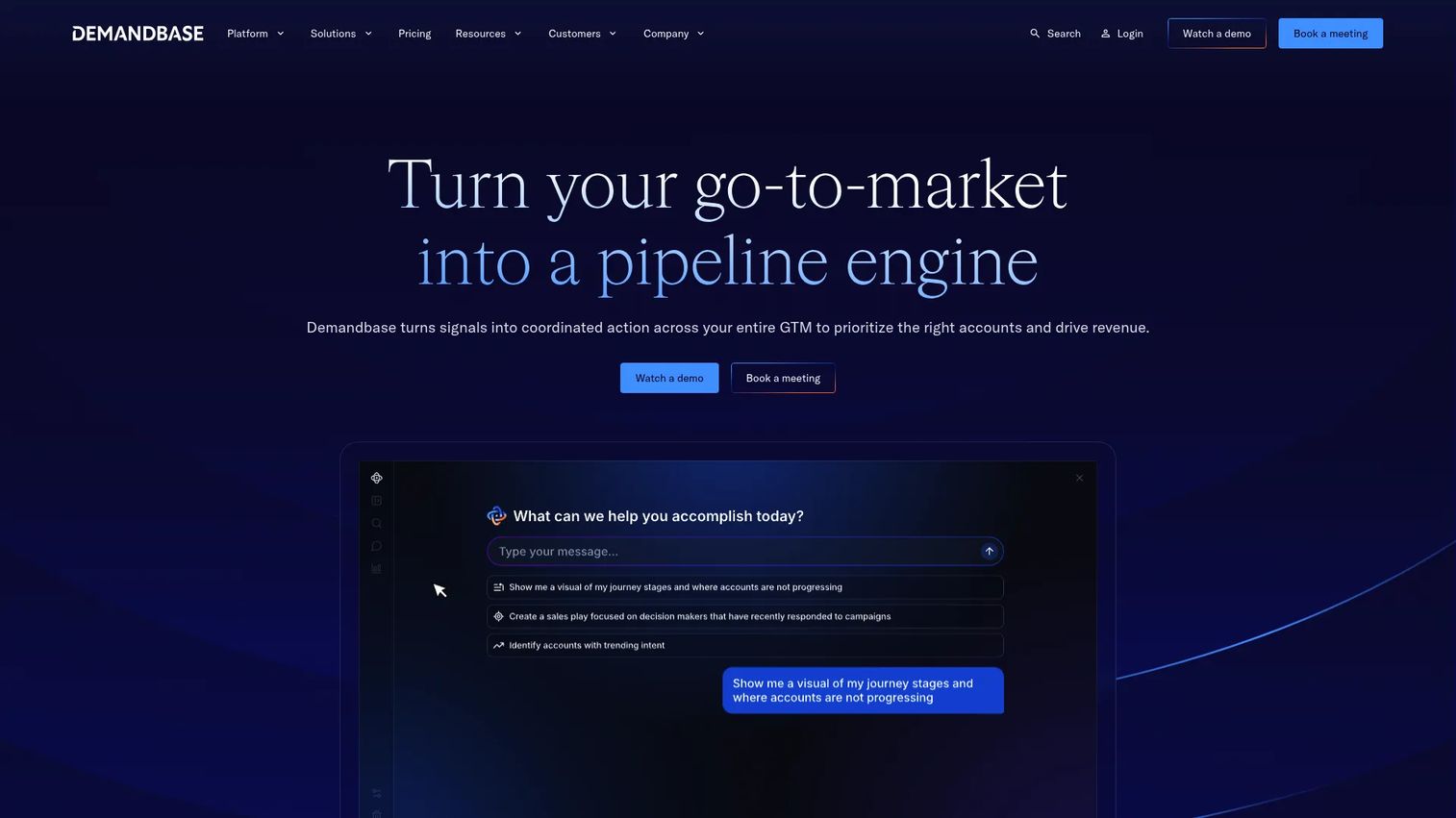
Demandbase is an AI-powered B2B go-to-market platform that unifies sales, marketing, advertising, data, and account intelligence. For demo automation contexts, it surfaces the account-level engagement and intent data that helps GTM teams decide which accounts should receive demos, personalized outreach, or accelerated sales motion.
Best for: Enterprise GTM teams running account-based programs who want account intent and engagement orchestration to inform demo targeting and follow-up prioritization.
Key features
- Account intelligence and intent signals
- Buying-group identification and sales prioritization
- Account-based advertising and audience activation
- Website personalization and form enrichment
- GTM orchestration and pipeline measurement
Why choose Demandbase: Demandbase fits before and around the demo. It identifies which accounts are showing buying signals and helps coordinate marketing and sales outreach, so demos reach accounts that are ready for them.
Demandbase pricing: Custom pricing. Demandbase uses a platform fee plus a per-user fee for Sales and Marketing, with Advertising and Data available separately. Contact Demandbase for a quote.
G2 rating: 4.4/5
13. GUIDEcx
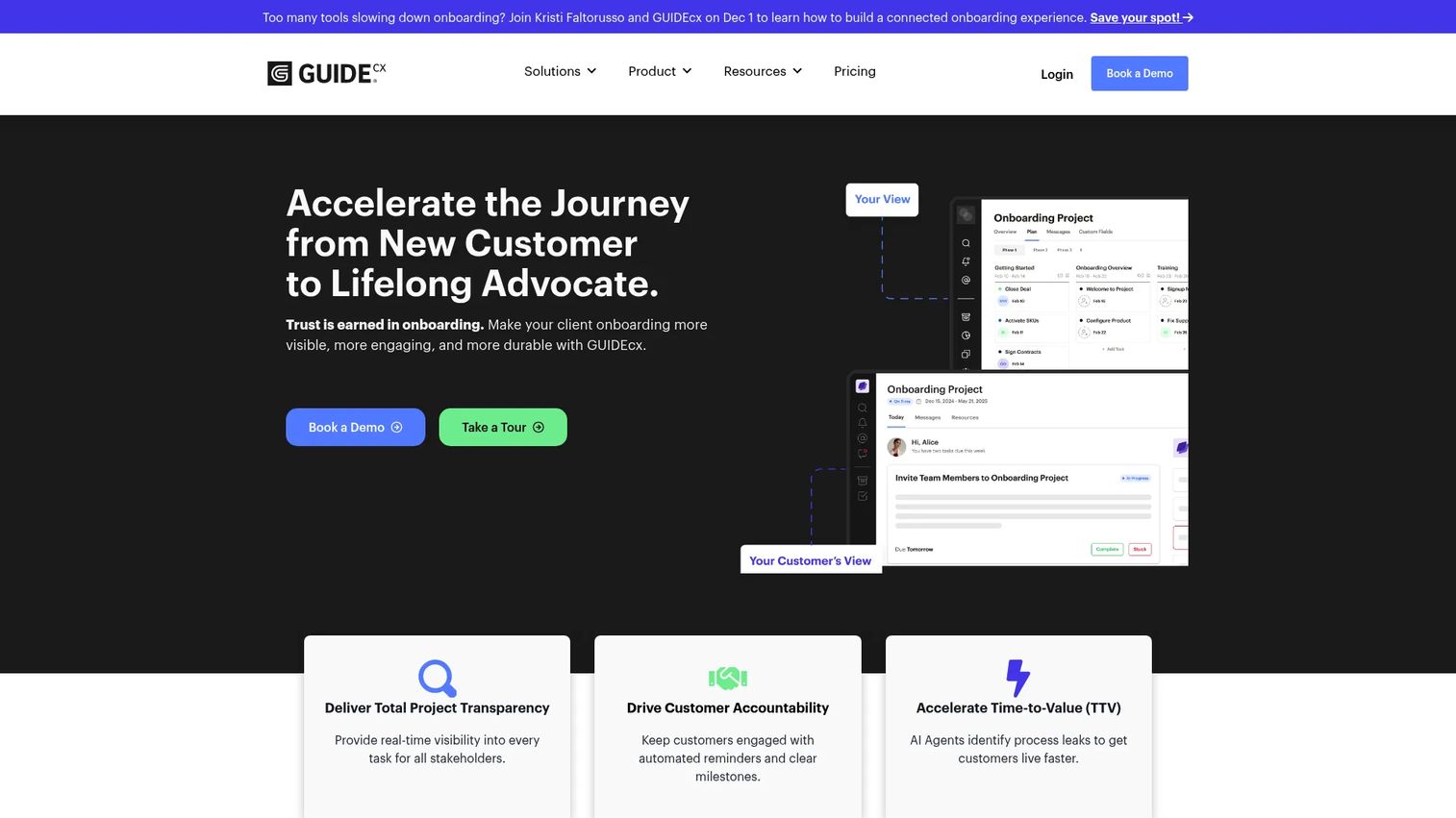
GUIDEcx is a customer onboarding and project management platform for coordinating internal teams, customers, and partners through implementation projects. It enters the demo automation conversation because sales demos make commitments, and GUIDEcx is where those commitments become visible onboarding tasks after the deal closes.
Best for: Teams managing repeatable customer onboarding and implementation projects, particularly where the transition from sales demo promises to delivery milestones needs clear structure and stakeholder visibility.
Key features
- Customer onboarding portal and project plans
- Task and email automation
- Gantt, list, and board project views
- Automated reminders and SMS notifications
- Advanced reporting, CSAT, and resource management
- Integrations and iPaaS connectivity
Why choose GUIDEcx: GUIDEcx is a post-sale platform, not a demo creation tool. It belongs in this list for presales teams whose deals involve complex implementation scopes, where the gap between what was demoed and what gets delivered is a known risk. Onboarding project visibility starts at close.
GUIDEcx pricing: Custom pricing across Starter, Premium, and Advanced plans. All include unlimited projects and customers. Contact GUIDEcx for a quote.
G2 rating: 4.6/5
14. Spryker
Spryker is a composable, headless, API-first cloud commerce platform for enterprise B2B, B2C, D2C, marketplace, and unified-commerce use cases. It appears here as a platform where demo quality matters for enterprise sales, particularly for solutions engineers demonstrating complex B2B commerce workflows to enterprise buyers during technical evaluations.
Best for: Commerce teams selling a complex B2B or marketplace platform to enterprise buyers, where the product evaluation involves demonstrating modular architecture, pricing rules, and multi-channel workflows.
Key features
- Composable modular architecture with API-first integrations
- B2B commerce: Customer-specific pricing, approval workflows, and account catalogs
- Marketplace management for merchants and order fulfillment
- Multi-language, multi-currency, and multi-region support
- Product, catalog, order, and back-office management
Why choose Spryker: Spryker belongs here as a commerce platform where the demo itself is technically complex, not as a broad demo automation vendor. SEs selling Spryker or competing against it need a strong product storytelling strategy for enterprise evaluations.
Spryker pricing: Custom pricing. Contact Spryker for a quote.
G2 rating: 4.4/5
15. Komo
Komo is an AI-powered engagement platform for creating interactive content, collecting customer data, automating journeys, and driving loyalty. Marketing and sales teams use it to build branded engagement hubs, quizzes, competitions, and microsites that capture buyer interest and qualify intent before a sales demo is scheduled.
Best for: Marketing and revenue teams that want interactive, gamified experiences to capture and qualify buyer interest at the top of the funnel, before formal demo requests come in.
Key features
- No-code branded engagement hubs and microsites
- Interactive gamification: Quizzes, polls, competitions, and instant wins
- Customer intelligence through data capture, segmentation, and analytics
- Workflow automation, email and SMS communications
- APIs, webhooks, and SDKs for integration
Why choose Komo: Komo is a broader engagement platform, not a specialized sales demo automation tool. It is useful for campaigns that qualify interest before a demo, particularly for marketing teams running product launches, events, or interactive outbound sequences.
Komo pricing: Custom pricing across Core, Core Plus, Core Enterprise, and Engage plans. Contact Komo for a quote.
G2 rating: 4.7/5
Considerations when choosing sales demo automation software
Match the demo format to the deal stage
Guided interactive demos work well for inbound qualification and champion sharing, where controlling the product story matters. Sandbox environments excel when a technical buyer wants to validate specific workflows without a live environment. Live demos remain the right format for discovery, objection handling, and complex stakeholder discussions. Know which moment you are solving for before choosing a platform.
Check who controls personalization
Presales teams need governance so reps cannot expose sensitive data or break the product story. Sales teams need speed to personalize for the next call without filing a request. The right platform gives both: A no-code editor that reps control within defined guardrails, with account-specific variables for data, text, and visuals.
Verify what analytics show at the stakeholder level
Generic "engagement analytics" is not enough. Presales needs to know which stakeholders viewed a demo, how far they got, where they dropped off, whether they shared it internally, and whether they came back. Those signals drive follow-up prioritization and forecast accuracy. Confirm the analytics show company-level and individual-level activity, not just aggregate views.
Review CRM and revenue workflow fit
Demo engagement data only matters if it reaches the team where they work. For most revenue orgs, that means Salesforce, HubSpot, Slack, or a marketing automation platform. Confirm the demo tool syncs buyer engagement into those systems automatically, not via manual export.
Pressure-test security and access controls
Presales often works with sensitive product screens, mock data, and enterprise buyers under NDA. Evaluate SSO, role-based permissions, private link controls, domain restrictions, and audit trails before committing. Data handling and sharing governance become table stakes in enterprise deals where security review is part of the buying process.
Conclusion
For presales and revenue teams, the tool that covers the widest range of demo moments without requiring a separate platform for each is Guideflow. It handles the full arc: Interactive demos for qualification, sandbox environments for technical validation, demo centers for buying-committee sharing, live demo support for structured calls, and mobile demos for field scenarios. Personalization, analytics, and CRM integrations are built in.
If your organization runs a large, distributed demo program with complex governance requirements, Demoboost adds structured library management and enterprise controls. For teams where live demo data credibility is the differentiator, Saleo's native product data injection stands out.
CRM-native teams will find that HubSpot or Salesforce handle demo engagement tracking within the stacks they already run, while Seismic fits when demo assets need to live alongside a broader enablement program. Clari and the ABM platforms, 6sense and Demandbase, work best as intelligence and prioritization layers that feed into demo strategy rather than replacing it.
Choose the tool that fits the moment you are actually trying to solve for.
Start your journey with Guideflow today!
FAQs
Sales demo automation software helps revenue teams create, personalize, share, and measure product demos without rebuilding each experience from scratch. It covers interactive demos, sandbox environments, demo centers, video walkthroughs, and engagement analytics that connect to CRM and sales workflows.
Product demo software is the broader category covering any tool that helps teams show a product. Sales demo automation focuses specifically on revenue workflows: Qualification, champion sharing, stakeholder follow-up, CRM sync, and buyer-intent tracking. The automation part refers to repeatability, using reusable assets and engagement signals, rather than rebuilding each demo manually.
Not fully. Automated demos reduce the volume of repetitive first-look calls and support buyer-led evaluation, but live demos remain the right format for technical discovery, complex objection handling, and multi-stakeholder discussions where real-time conversation matters. The two formats work best as complements: Automation handles the repeatable layer, live demos handle the high-value conversations.
Interactive demos perform best when the team wants to guide a specific product story, control the narrative, and walk buyers through a curated path. Sandboxes excel when buyers want to explore freely, validate specific workflows, and test the product on their own terms without a guided path. Both formats serve different presales moments and are frequently used in sequence across a deal cycle.
Look for views, completion rate, click behavior, drop-off points, revisits, internal shares, lead capture, account-level engagement, and CRM or Slack alerts. Stakeholder-level visibility is particularly important for presales, where knowing which members of the buying committee engaged with which parts of a demo informs follow-up strategy and forecast confidence.
Reps include a short product experience in outreach sequences to give prospects something tangible before a call. Engagement data from that first view, who clicked, how far they went, whether they shared it, helps prioritize follow-up on accounts showing real intent. After calls, personalized demo leave-behinds let champions sell internally without scheduling another SE session.
Verify SSO support, role-based permissions, private and domain-restricted link controls, data masking for sensitive product screens, and CRM integrations. Also check procurement requirements, contract terms, and whether the vendor has SOC 2 or equivalent certifications, since those will come up in your buyer's security review if you are selling into enterprise accounts yourself.
Pricing varies by seat count, demo volume, analytics depth, security requirements, and enterprise support tier. Tools like Guideflow offer a free plan with paid tiers starting at $35/user/month. Platforms targeting enterprise governance or live data personalization, such as Demoboost and Saleo, start at higher thresholds and require annual contracts. CRM and ABM platforms in this list price by custom quote. The table in this article reflects verified pricing as of November 2026.