Three refs cancel the night before a full slate of games. One never opens email. Two are double-booked across sports because your roster lives in a spreadsheet. You spend Saturday morning texting replacements instead of watching a single game.
That is the assignor's real job: not scheduling, but chasing. Every late availability change, every silent official, every payment question turns into a manual thread. Email and spreadsheets do not push a notification, do not track who accepted, and do not tell you who got paid.
The category exists because the volume broke the manual method. The global sports scheduling software market reached USD 152.8 million in 2025 and is projected to hit USD 168.3 million in 2026, growing at a 6.8% CAGR through 2034, according to Intel Market Research (2026). Officials increasingly work from a phone, payments run through direct deposit, and one roster often covers several sports at once.
This guide treats referee scheduling software as an operations system, not a calendar. It compares seven tools on the workflow factors that actually decide whether your Saturday gets easier.
What's inside
This guide is for assignors, league administrators, and sports org operators who are done managing officials in spreadsheets and email. Here is how the seven tools were chosen and compared.
- Scheduling depth: assign rules, availability handling, conflict detection, multi-assignor collaboration
- Communication: accept and decline flows, reminders, push notifications
- Mobile experience: how officials view and respond to assignments on a phone
- Payments and tax workflows: direct deposit, payout tracking, W-9 and 1099 support
- Multi-sport fit: shared official pools across baseball, soccer, basketball, and more
Every entry ranks on workflow fit for a real assignor, not a feature checklist.
TL;DR
- Best for all-in-one scheduling plus payments: Assignr
- Best for operational breadth and group-based pricing: HorizonWebRef
- Best for straightforward referee schedule management: RefereeSchedule.com
- Best for K-12 athletic department operations: Arbiter
- Best for assigning plus integrated payout tracking: RefInsight
- Best for broader youth sports and league management: Demosphere
- Best for a compliance-focused officiating niche: ZebraWeb
Read the comparison table if you want the shortlist in 30 seconds. Read the item sections if you want to know which one survives your Saturday.
What is referee scheduling software
Referee scheduling software is a tool that helps assignors schedule referees and umpires, manage availability, communicate assignment changes, and track officials' payments in one system. It replaces the spreadsheet-and-email workflow that breaks down once game volume climbs.
Basic scheduling and a full assigning workflow are not the same thing. A calendar shows games. An assigning system matches the right official to the right game, enforces rules, and closes the loop when plans change.
Common capabilities include:
- Game and assignment management: import schedules, assign officials, detect conflicts
- Availability management: officials mark when they can and cannot work
- Communication tools: accept and decline flows, reminders, mass messaging
- Mobile access: view and respond to assignments from a phone
- Payments and tax workflows: direct deposit, payout tracking, W-9 and 1099 generation
- Multi-sport support: shared rosters across sports and seasons
The difference between a light referee scheduler and a full assigning platform shows up on the worst days. Anyone can build a schedule when nothing changes. The value is in what happens when three officials pull out at once, and the system reassigns, notifies, and records the change without you touching a phone.
When to use referee scheduling software
Manage last-minute assignment changes
An official cancels at 9pm for a 9am game. In a spreadsheet, you now own a manual search: who is free, who is qualified, who will answer a text tonight. Nothing pushes the request out, and nothing confirms it came through.
A ref scheduler flips that. The system surfaces available and eligible officials, sends the request, and captures the accept or decline. You stop being the notification layer. This is where email and spreadsheets consistently fall apart, because neither tracks state or nudges anyone.
Coordinate multi-sport officials
One official often works baseball in spring, soccer in fall, and basketball in winter. Many assignors manage a shared pool across sports, and a single person can be double-booked across two leagues in the same weekend without anyone noticing.
Cross-sport visibility solves this. When every assignment for every sport lives in one place, the system catches the conflict before it becomes a no-show. Referee and umpire scheduling in one tool also means one availability calendar per person, not one per sport.
Reduce payment and admin overhead
Paying officials is a finance workflow, not a convenience feature. Direct deposit removes the check run. Payout tracking tells you who has been paid and who is owed. W-9 collection and 1099 generation turn tax season from a scramble into an export.
For a league admin, this is where the software earns its keep. The hours spent reconciling game counts, mileage, and payments shrink when the same system that assigns the game also records what the official earned.
Comparison table
Seven tools, ranked by relevance to a working assignor. Pricing and ratings reflect values verified on each vendor's site in August 2026. Where a public G2 rating was not available, the column is left blank rather than guessed.
| # | Product | Best for | Key differentiator | Pricing | G2 rating |
|---|---|---|---|---|---|
| 1 | Assignr | Assigning plus communication and payments | Direct deposit with W-9 and 1099 support | From $240/year | 4.6/5 |
| 2 | HorizonWebRef | Operational breadth for officiating groups | Group-size pricing with per-user licenses | From $4.00/user license | - |
| 3 | RefereeSchedule.com | Straightforward referee scheduling | Unlimited assignors and refs on every plan | From $75/year | - |
| 4 | Arbiter | K-12 athletic department operations | Registration, scheduling, and compliance in one | Custom pricing | 2.8/5 |
| 5 | RefInsight | Assigning with integrated payouts | Drag-and-drop assigning plus payment tracking | From $50/month | - |
| 6 | Demosphere | Youth sports and league management | Broad club and league operations | Custom pricing | - |
| 7 | ZebraWeb | Compliance-focused officiating | Eligibility and compliance tracking | Custom pricing | - |
Best referee scheduling software for 2026
1. Assignr

Assignr is cloud-based referee and official scheduling software that pulls assigning, communication, and payments into one system. It handles game and referee scheduling with availability calendars, then layers on unlimited assignments and messaging so you stop coordinating officials by hand. The payments side is where it separates from lighter schedulers: direct deposit plus W-9 and 1099 support means the tool that assigns the game also pays the official.
For an assignor juggling a full slate, that consolidation matters. Availability lives in one place, changes push out automatically, and payroll stops being a separate spreadsheet at season's end.
Best for: Sports leagues and associations that need referee assignment, communication, and payroll in one place.
Key strengths
- Unlimited assignments and communication tools
- Game and referee scheduling with availability calendars
- Direct deposit plus W-9 and 1099 payment support
Why choose Assignr: Choose Assignr if you want assigning and payments handled by the same system rather than stitched together. It fits leagues that treat officials' pay as a real finance workflow, not an afterthought.
Assignr pricing: Public annual plans are Recreational at $240/year, League at $360/year, and Elite at $480/year, with Enterprise available on request. A 14-day free trial is available. No free tier.
Assignr holds a 4.6 out of 5 rating.
2. HorizonWebRef
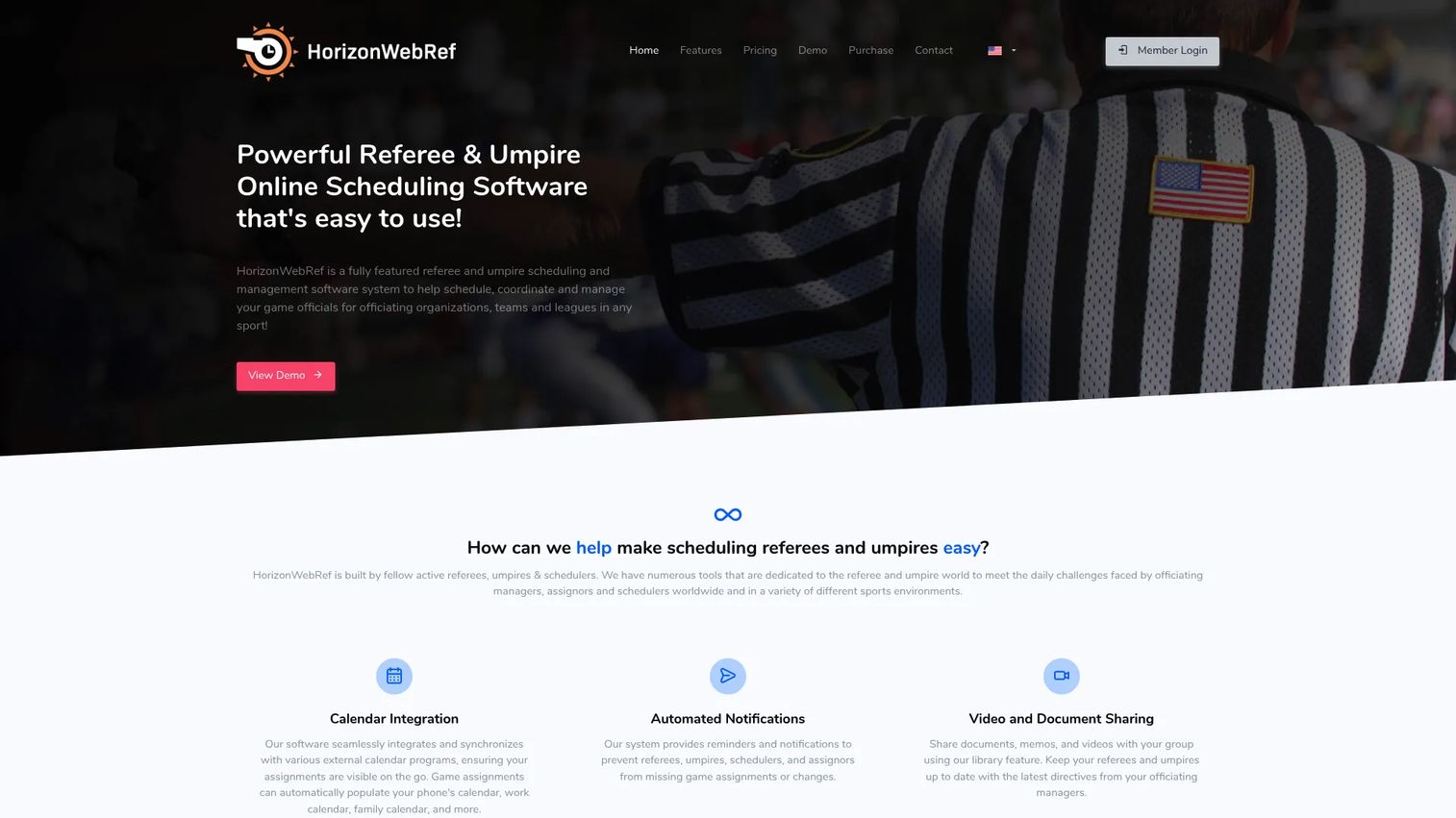
HorizonWebRef is referee and umpire scheduling and management software built for officiating organizations, teams, and leagues. It leans into operational breadth: calendar integration keeps assignments in sync with personal calendars, automated notifications push changes to officials, and video and document sharing supports evaluations and training material.
The pricing model is the tell. HorizonWebRef sells by group size with included user licenses, so larger and more operationally complex groups can scale seats without jumping to an entirely different product tier.
Best for: Sports officiating groups that need scheduling, assignment, and communication with room to grow.
Key strengths
- Calendar integration
- Automated notifications
- Video and document sharing
Why choose HorizonWebRef: Choose HorizonWebRef if your group is large enough that per-user pricing beats a flat plan, and if document and video sharing for evaluations matters to your program.
HorizonWebRef pricing: Annual plans are sold in group sizes with included user licenses. Per-user rates run from $8.05 for the Mini Group down to $4.00 per user license for the Large Group, with add-on licenses at the same rate. No free tier.
3. RefereeSchedule.com
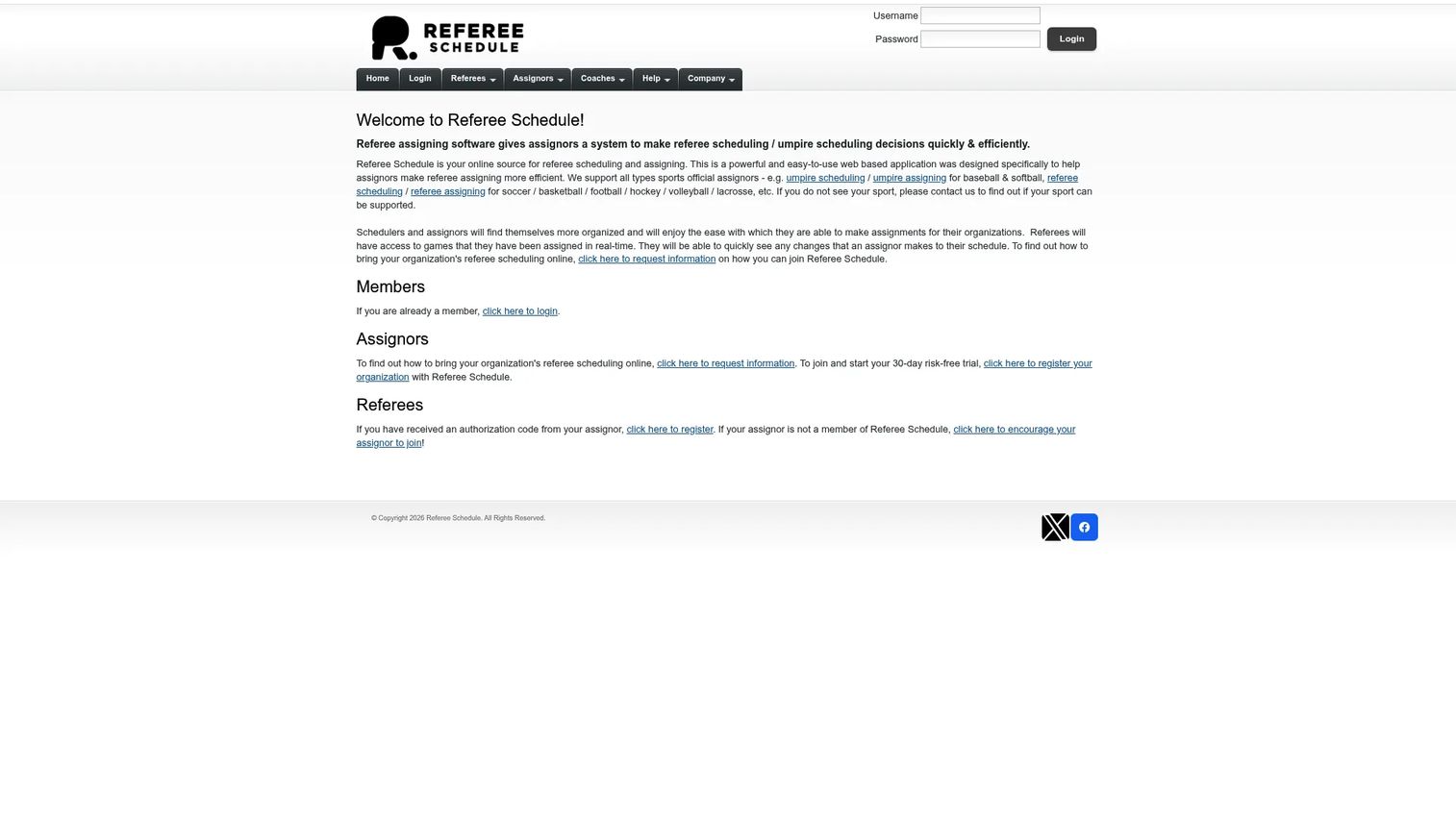
RefereeSchedule.com is web-based referee scheduling and assigning software aimed at assignors who want to get up and running fast. It covers organization management, game management and import, and three assignment workflows: manual, automated, and self-assignment. That last one matters when you want officials to claim open games instead of waiting on you.
The plan structure is refreshingly simple. Every tier includes unlimited assignors, referees, and coaches, so you pay for game volume rather than headcount.
Best for: Sports assignors who want simple, fast referee scheduling and assignment management.
Key strengths
- Organization management
- Game management and import
- Manual, automated, and self-assignment workflows
Why choose RefereeSchedule.com: Choose it if you want low-friction adoption and predictable pricing tied to games, not people. The self-assignment option is useful for pools where officials prefer to pick up their own games.
RefereeSchedule.com pricing: Bronze is $75/year for up to 250 games, Silver is $125/year for up to 500 games, and Gold is $175/year for unlimited games. All plans include unlimited assignors, referees, and coaches plus a 30-day risk-free trial. Communication credits are sold separately. No free tier.
4. Arbiter

Arbiter (ArbiterSports) is a K-12 athletics and activities management platform that reaches well beyond referee assigning. It handles online registration for sports and programs, injury management and health tracking, and broader athletic administration and compliance workflows. Officiating is one workflow inside a larger operations system.
That breadth defines who it fits. If you run an athletic department where assigning refs is one task among registration, eligibility, and payments, the all-in-one scope is the draw rather than the officiating depth alone.
Best for: K-12 schools and athletic departments managing sports registration and operations.
Key strengths
- Online registration for sports, programs, and activities
- Injury management and health tracking
- All-in-one athletic administration and compliance workflows
Why choose Arbiter: Choose Arbiter when officiating is part of a wider school operations picture, not the whole job. Standalone assignors will find lighter tools a closer fit, but a district managing many programs benefits from the consolidation.
Arbiter pricing: Arbiter offers all-inclusive annual subscription plans for K-12 schools. Plan on a sales conversation to size your program.
Arbiter holds a 2.8 out of 5 rating on G2.
5. RefInsight

RefInsight is a sports officiating management platform that pairs assigning with payments, communication, and training. The assigning experience is drag-and-drop, integrated payments handle payout tracking, and officials management covers profiles, certifications, pools, and geo-mapping. That geo-mapping is practical: it helps you assign officials who are actually close to the venue.
The platform reads as a middle ground between a light scheduler and a full athletic department suite. You get real assigning depth plus payment tracking without buying a broad operations system you do not need.
Best for: Sports associations and leagues that need officiating assignment and payment management together.
Key strengths
- Drag-and-drop game assigning
- Integrated payments and payout tracking
- Officials management with profiles, certifications, pools, and geo-mapping
Why choose RefInsight: Choose RefInsight if certification tracking and geo-based assigning matter, and if you want payouts recorded in the same tool that assigns games. Its tiered structure scales from a single association up to larger multi-group operations.
RefInsight pricing: Public annual subscription tiers run from Small at $50/month up through Medium at $91/month, Large at $174/month, Extra Large at $338/month, Enterprise at $635/month, and Association at $1,261/month. Onboarding and payment platform fees apply. No free tier.
6. Demosphere

Demosphere is youth sports management software for clubs, leagues, and associations. Its scope covers registration, scheduling, and roster management, positioning it as broader operations software rather than a narrow assigning tool. For organizations that need scheduling as one piece of a wider club platform, that breadth is the point.
Treat Demosphere as a fit for youth sports operators who want registration and league management alongside scheduling, rather than a dedicated referee assigner. Note that its site now routes to OTTO SPORT AI, so confirm the current product scope and roadmap directly with the vendor before committing.
Best for: Youth sports organizations needing club and league operations software.
Key strengths
- Registration
- Scheduling
- Roster management
Why choose Demosphere: Choose Demosphere if you manage a youth sports club or league where scheduling sits inside a larger operations need that includes registration and rosters. Verify the current offering directly given the recent brand change.
Demosphere pricing: Request a demo and pricing from the vendor, and confirm product scope given the recent rebrand.
7. ZebraWeb
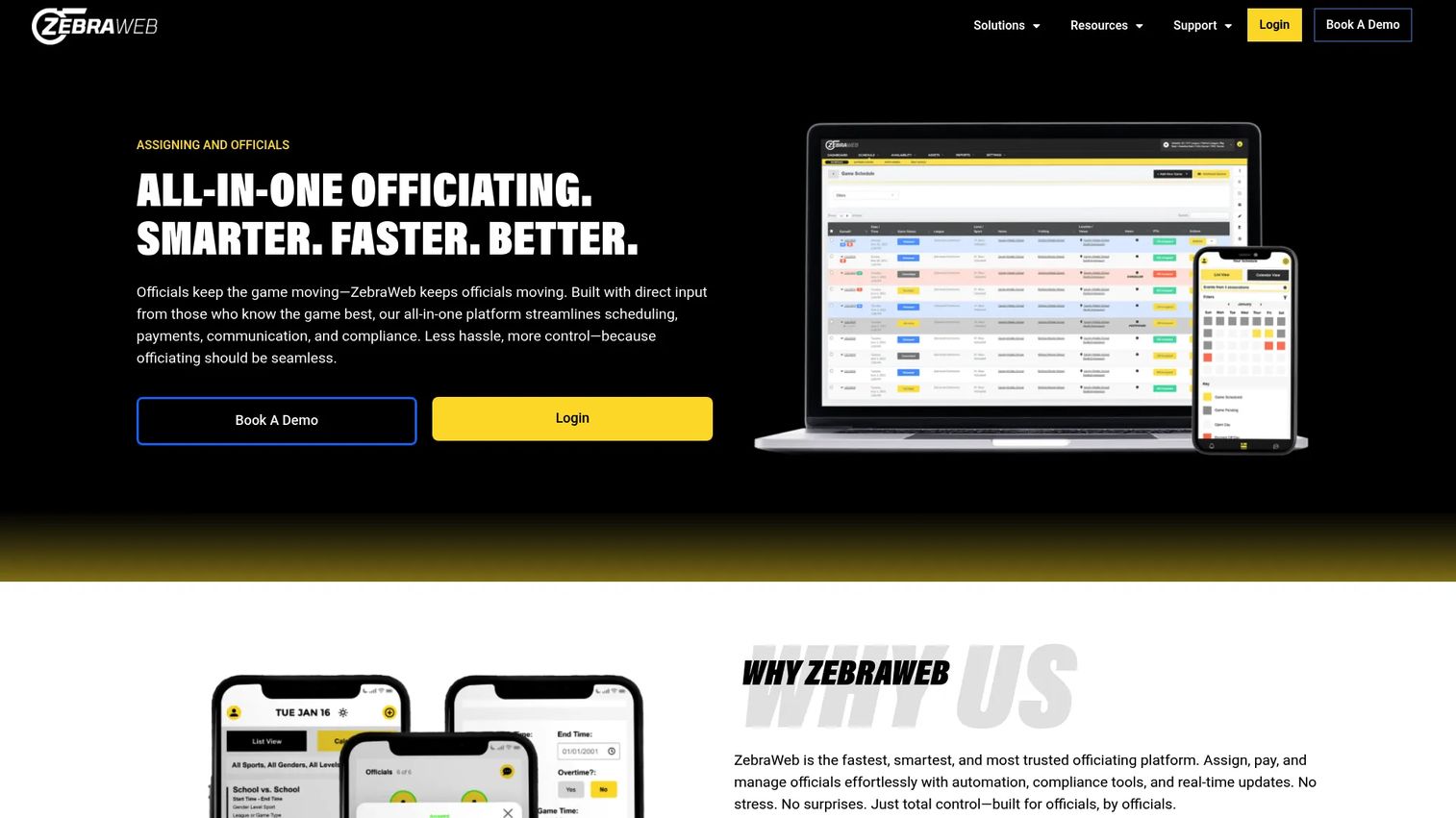
ZebraWeb is sports officiating software covering assigning, scheduling, payments, communication, and compliance. Its differentiator leans into eligibility and compliance tracking, alongside AI-powered assigning and scheduling and digital payments. That compliance angle matters for organizations where officials must meet certification or eligibility requirements before they can work a game.
It rounds out this list for assignors who want a compliance-aware officiating tool. If eligibility rules drive who can be assigned, a system that enforces them at assignment time saves a manual check every week.
Best for: Assignors, officials, and sports organizations managing officiating workflows with compliance requirements.
Key strengths
- AI-powered assigning and scheduling
- Eligibility and compliance tracking
- Digital payments and communication
Why choose ZebraWeb: Choose ZebraWeb if eligibility and compliance tracking are non-negotiable for your program, and if you want assigning, payments, and communication in one officiating-focused tool.
ZebraWeb pricing: Contact the vendor for a quote sized to your organization.
Considerations
Before you commit, pressure-test each tool against the days that actually break your workflow. Here is the buyer's checklist.
Scheduling depth
Look past the calendar view. Check how the tool handles assign rules, availability, and conflict detection when plans change. Can multiple assignors collaborate without stepping on each other? Does it flag a double-booking across sports before it becomes a no-show? Depth shows up on the chaotic days, not the calm ones.
Mobile experience
Officials live on their phones. Test whether they can view assignments, mark availability, and accept or decline from a mobile app or mobile web without friction. If responding takes more than a few taps, adoption drops and your no-show rate climbs.
Payments and tax workflows
Direct deposit, payout tracking, W-9 collection, and 1099 generation turn a season-end scramble into an export. Confirm which tools handle payments natively versus which leave you reconciling in a separate spreadsheet. This is a finance win, not a nice-to-have.
Communication speed
Push notifications, accept and decline flows, and automated reminders are what reduce no-shows. Evaluate how fast a change reaches an official and whether the system records their response. Silence in email becomes a confirmed status in a good scheduler.
Multi-sport fit
If your official pool covers several sports, broad sport support and one shared availability calendar per person prevent the double-bookings that spreadsheets miss. Confirm the tool treats officials as people who work across sports, not as separate rosters per league.
Conclusion
The right pick comes down to your workflow, not a feature count.
If you want assigning and payments in one system, Assignr is the cleanest fit, with direct deposit and 1099 support built in. If your group is large enough that per-user pricing beats a flat plan, HorizonWebRef scales by group size. If you want simple, fast referee scheduling with predictable game-based pricing, RefereeSchedule.com gets you running quickly.
For a K-12 athletic department where assigning is one task among many, Arbiter's all-in-one scope fits. For assigning plus integrated payout tracking with certification support, RefInsight lands in the middle. Demosphere suits youth sports operators who need broad club management, and ZebraWeb fits programs where eligibility and compliance drive assignments.
Start a free trial where one exists, run a real weekend through it, and watch what happens when an official cancels. That is the test that matters.
Start your journey with Guideflow today!
FAQs
Scheduling builds the game calendar. Assigning matches the right official to each game, enforces rules, and manages accept or decline responses. Most modern tools do both, but a light scheduler stops at the calendar while a full assigning platform handles the loop when plans change.
Yes. Most of these platforms handle referee and umpire scheduling in the same system, since the workflow is identical: availability, assignment, communication, and payment. Tools like Assignr, HorizonWebRef, and RefInsight support officials across multiple sports, so umpires and referees share one roster.
Yes, on most tools. Assignr and HorizonWebRef both push assignments to officials with accept and decline flows and automated notifications. Mobile response is a core buying factor, because officials who can confirm from a phone in a few taps produce fewer no-shows than an email chain does.
Assignr supports direct deposit along with W-9 and 1099 generation. RefInsight includes integrated payments and payout tracking, and ZebraWeb lists digital payments. If tax workflows drive your decision, confirm each vendor's current 1099 support directly, since payment features change between plan tiers.
A good ref scheduler surfaces available and eligible officials, pushes the request out, and records who accepts. That removes the manual late-night text search. The system tracks the state of every request, so you always know which games still need coverage without reconstructing it yourself.
Look for a shared official pool with one availability calendar per person, cross-sport conflict detection, and support for the specific sports you run. The goal is to catch a double-booking across baseball and soccer before it becomes a missing official on game day.
Often yes, because pricing scales down. RefereeSchedule.com starts at $75/year for up to 250 games, and Assignr starts at $240/year. For a small league, the time saved on manual assignment and payment tracking usually outweighs the subscription cost within a season.
Match the pricing model to your size. Some tools price by game volume, like RefereeSchedule.com, some by user license and group size, like HorizonWebRef, and some by tiered monthly subscription, like RefInsight. Others use custom pricing, so request a quote and compare total cost against your season's game count and roster size.