Every request arrives as the most important thing on your list. Engineering wants to finish the migration. Sales needs the integration. Leadership just heard about a competitor feature and moved everything else aside.
The real problem isn't the volume of requests. It's that without a shared scoring model, every decision gets relitigated from scratch. The PM becomes a referee, not a strategist. Decisions that should take an afternoon turn into weeks of committee debate.
The global project portfolio management software market was valued at approximately $5.3 billion in 2024 and is projected to reach $10.8 billion by 2031, according to multiple industry research reports published in 2025 and 2026. That growth reflects a real signal: Teams are replacing gut-feel prioritization with structured, defensible scoring systems.
The right project prioritization software doesn't just sort your backlog. It gives you a scoring framework the whole team can stand behind, surfaces trade-offs under capacity constraints, and keeps stakeholder alignment intact when strategy shifts. This guide covers the seven tools that do that job best.
What's inside
This guide is for product managers, heads of product, and cross-functional leads who need to replace argument cycles with repeatable decisions.
How items were chosen:
- Scoring depth: Does the tool support criteria-based scoring, weighted rubrics, or AHP-style methodology, not just drag-and-drop reordering?
- Explainability: Can you show leadership how a decision was made and why it changed?
- Workflow fit: Does it connect to where the team already works (Jira, roadmap tools, CRM)?
- Reprioritization speed: How fast can you rerank when funding or capacity changes?
TL;DR
- Best for defensible portfolio decisions: TransparentChoice handles criteria-based scoring with full decision rationale built in
- Best for daily task focus: Priority Matrix uses the Eisenhower quadrant system with strong Microsoft 365 fit
- Best for structured intake: KPI Fire suits ops and continuous improvement teams scoring ideas against effort and impact
- Best for roadmap-heavy product orgs: Aha! connects strategy, scoring, and roadmapping in one system
- Best for signal-driven backlog: Productboard turns customer feedback directly into a ranked, scored priority list
- Best for configurable scoring: airfocus lets you build the rubric your team actually needs, not a preset one
- Best for mid-sized product teams: Craft.io offers OKR-linked prioritization without a heavy implementation lift
What is project prioritization software?
Project prioritization software is a category of tools that helps teams score, rank, and compare competing initiatives based on explicit criteria, so decisions become repeatable and defensible rather than driven by whoever speaks loudest.
These tools exist because backlogs are not queues, they're portfolios. Every item competes for finite capacity, and without a scoring framework, the portfolio drifts toward whoever has the most political capital at any given moment.
Key capabilities to look for:
- Scoring frameworks: Weighted criteria models, rubric-based scoring, or AHP-style pairwise comparison
- Matrix views: Effort vs. impact quadrants, urgency/importance grids, or custom two-axis displays
- Portfolio ranking: Side-by-side comparison across multiple initiatives with a single normalized score
- Stakeholder alignment: Shared scoring sessions, role-based input, and comment threads tied to specific decisions
- Scenario comparison: What-if modeling when capacity or strategic priorities shift
- Reporting and auditability: Decision history, score change logs, and exportable rationale for leadership reviews
The distinction between project prioritization software and general project management tools matters here. A project management tool helps you track what you're building. A prioritization tool helps you decide what to build first. Many teams use both in sequence: Score in the prioritization tool, execute in the task tracker.
Portfolio prioritization specifically refers to comparing investment decisions across a set of projects or product initiatives, not just reordering a sprint. That's the layer this category addresses, and where it earns its keep in organizations with more ideas than capacity.
When to use project prioritization software
When requests outpace capacity
Every quarter starts the same way: More ideas than engineering cycles to deliver them. A shared scoring model turns the conversation from "why isn't my project at the top?" to "here's how this project scores against the criteria we all agreed on." That shift from opinion to instrumentation is where these tools pay off most quickly.
When leadership needs a defensible trade-off
Funding changes. A competitor ships a feature. An acquisition resets the roadmap. At those moments, leadership doesn't want a gut feeling, they want to see the decision rationale. Prioritization software that logs scoring history lets you show not just what you're building, but why that changed, and what the opportunity cost of each shift is.
When product and engineering need a common language
PMs score by business impact. Engineers think in terms of complexity and technical debt. Without a shared rubric, every planning session becomes a translation exercise. Tools with criteria-based scoring force both sides to work from the same inputs, which reduces rework cycles and makes the eventual roadmap easier for the whole team to commit to.
Project prioritization software comparison
Use this table to scan fit by use case before diving into the individual sections. Pricing reflects verified figures from each vendor's official pricing page as of August 2026. G2 ratings are pulled from each tool's current listing.
| # | Product | Best for | Key differentiator | Pricing | G2 rating |
|---|---|---|---|---|---|
| 1 | TransparentChoice | PMO and strategy teams needing defensible portfolio decisions | AHP-based criteria scoring with full decision rationale | Custom pricing | 4.5/5 |
| 2 | Priority Matrix | Teams wanting a visual urgency/importance system in Microsoft 365 | Eisenhower quadrant model with Teams and Outlook integration | Free; paid from $12/month | 4.7/5 |
| 3 | KPI Fire | Ops and continuous improvement teams scoring ideas against strategy | Effort vs. impact scoring linked to goals and KPIs | Custom pricing | 4.5/5 |
| 4 | Aha! | Product orgs managing strategy, scoring, and roadmapping together | Full product management suite with roadmap-linked prioritization | From $59/user/month | 4.5/5 |
| 5 | Productboard | Product teams driving prioritization from customer feedback | Feedback aggregation tied directly to scoring and roadmap | Free; paid from $59 maker/month | 4.3/5 |
| 6 | airfocus | Teams that need a configurable scoring model, not a preset one | Modular prioritization with custom rubrics and OKR alignment | Custom pricing | 4.4/5 |
| 7 | Craft.io | Mid-sized product teams wanting structured planning without overhead | OKR and initiative management with built-in prioritization | From $19/editor/month (annual) | 4.5/5 |
Best 7 project prioritization software for 2026
1. TransparentChoice
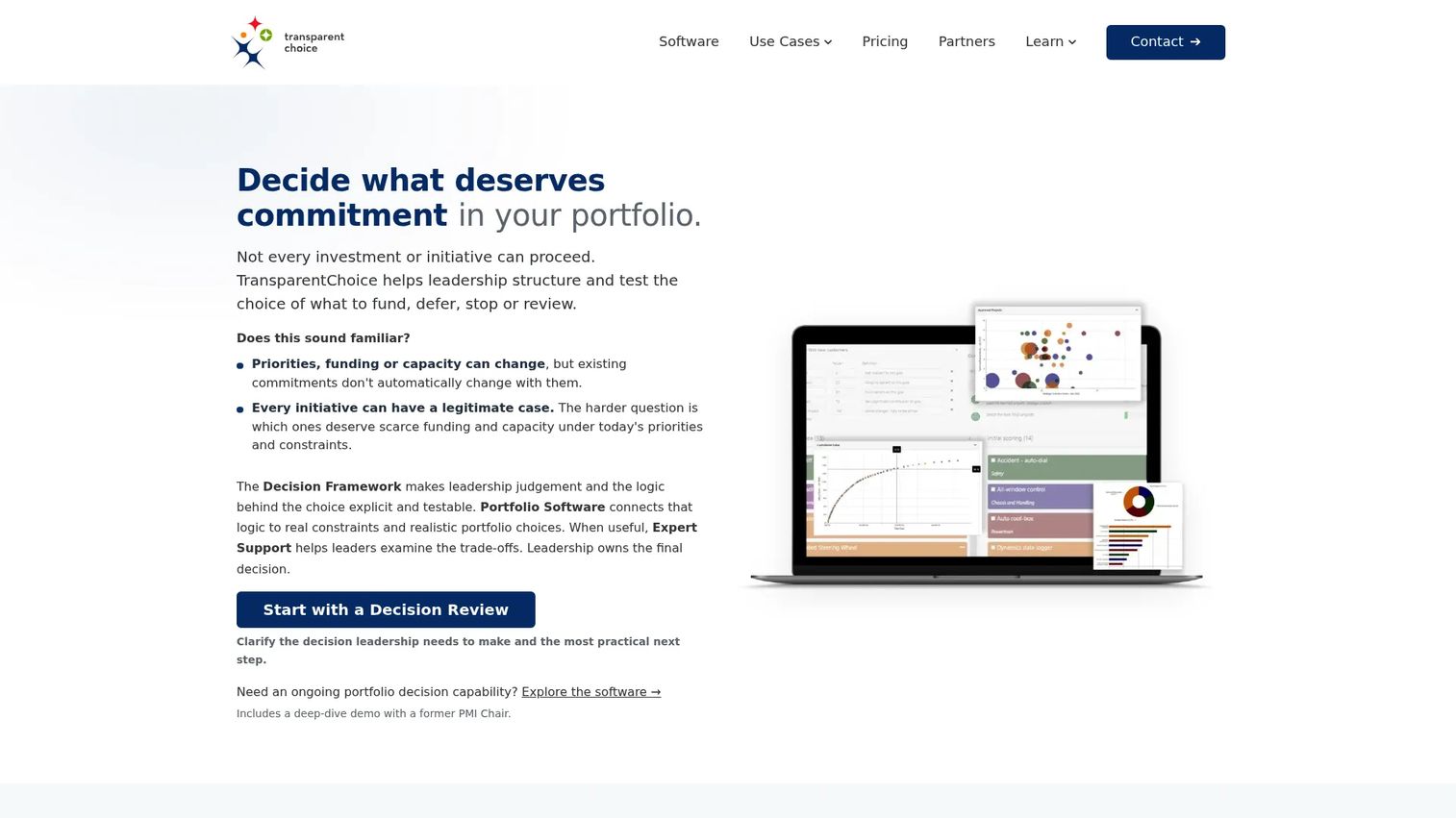
TransparentChoice is a portfolio prioritization and strategic planning platform built for PMOs and leadership teams that need to make multi-million-dollar investment decisions with full traceability. Its core methodology draws on the Analytic Hierarchy Process (AHP), a pairwise comparison technique that forces stakeholders to explicitly weigh criteria against each other rather than assign arbitrary scores. The result is a ranked portfolio with a defensible rationale attached to every decision.
Best for: PMO and strategy teams that need to show the board exactly how investment decisions were made, and why they changed when conditions shifted.
Key strengths
- AHP-based scoring: Pairwise comparison eliminates score inflation and anchoring bias
- Portfolio planning: Compare and rank initiatives across the full investment portfolio
- Capacity planning: Model resource constraints alongside priority scores
- Demand management: Structured intake captures new requests before they bypass the scoring process
- Decision rationale: Full audit trail of how scores were assigned and by whom
Why choose TransparentChoice: If your organization is spending serious time relitigating priorities in leadership reviews, this tool addresses that at the root. The AHP methodology doesn't just rank projects, it makes the weighting logic visible so stakeholders can challenge criteria instead of scores. That's a different and more productive argument to have.
TransparentChoice pricing: Pricing is customized to portfolio size, complexity, hosting requirements, and support level. Contact TransparentChoice directly for a quote. A free trial is available.
G2 rating: 4.5/5
2. Priority Matrix
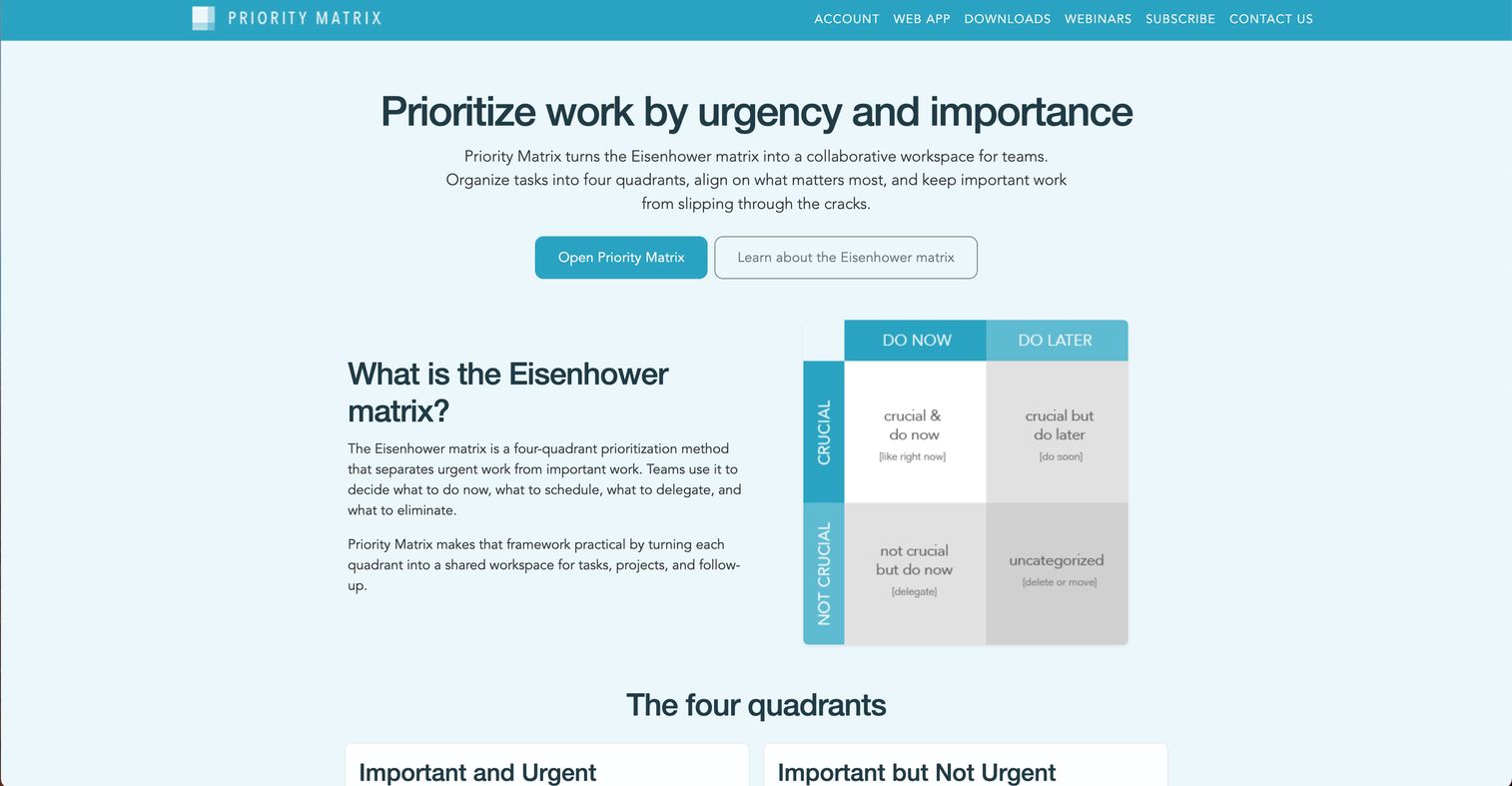
Priority Matrix is a collaborative workspace built around the Eisenhower matrix, the four-quadrant system that separates urgent-and-important work from everything else. It's designed for teams that want a practical visual system to stop firefighting and start focusing on what actually moves the needle. The platform integrates deeply with Microsoft 365, including Outlook, Teams, and SharePoint, which makes adoption easier for organizations already running on that stack.
Best for: Teams managing daily work prioritization across Microsoft 365 who want a shared visual system without a heavy setup cost.
Key strengths
- Four-quadrant prioritization: Urgent/important matrix with drag-and-drop assignment
- Microsoft 365 integration: Native Outlook and Teams plugins for task capture and tracking
- Shared team matrices: Collaborative views with templates and role-based access
- Cross-device access: Works on desktop, mobile, and tablet
Why choose Priority Matrix: This tool works best when the team needs operational clarity, not portfolio governance. If your PM challenge is focus and execution rather than scoring 50 competing initiatives, the quadrant model gives a shared reference point that everyone can update in real time.
Priority Matrix pricing: A free tier is available, limited to 5 teammates, 5 projects, and 250 total items. The Pro plan is $12/month per user billed annually. The Business plan is $24/month per user billed annually.
G2 rating: 4.7/5
3. KPI Fire
KPI Fire is a strategy execution and continuous improvement platform that links goals, metrics, and projects in a single system. It's built for organizations running Lean, Agile, or Six Sigma processes that need to score ideas against strategic objectives and business impact, not just gut instinct. The effort vs. impact matrix thinking at its core helps operations and product teams move from a pile of improvement ideas to a ranked, scored action list.
Best for: Operations managers and continuous improvement teams who need to connect individual project scores directly to strategic KPIs and goals.
Key strengths
- Goals linked to metrics and projects: Scores roll up to business outcomes, not just task completion
- Continuous improvement intake: Structured idea submission with scoring before ideas reach the backlog
- Dashboards and huddleboards: Real-time reporting on project progress against goals
- Lean/Agile/Six Sigma compatibility: Built to fit existing process improvement disciplines
Why choose KPI Fire: If your team uses Lean or continuous improvement methodology and wants prioritization that connects to measurable strategy execution, KPI Fire fits that workflow better than a generic product roadmap tool. The intake funnel forces ideas through scoring criteria before they consume planning bandwidth.
KPI Fire pricing: Pricing is not listed on the vendor site. Contact KPI Fire directly to request a quote.
G2 rating: 4.5/5
4. Aha!
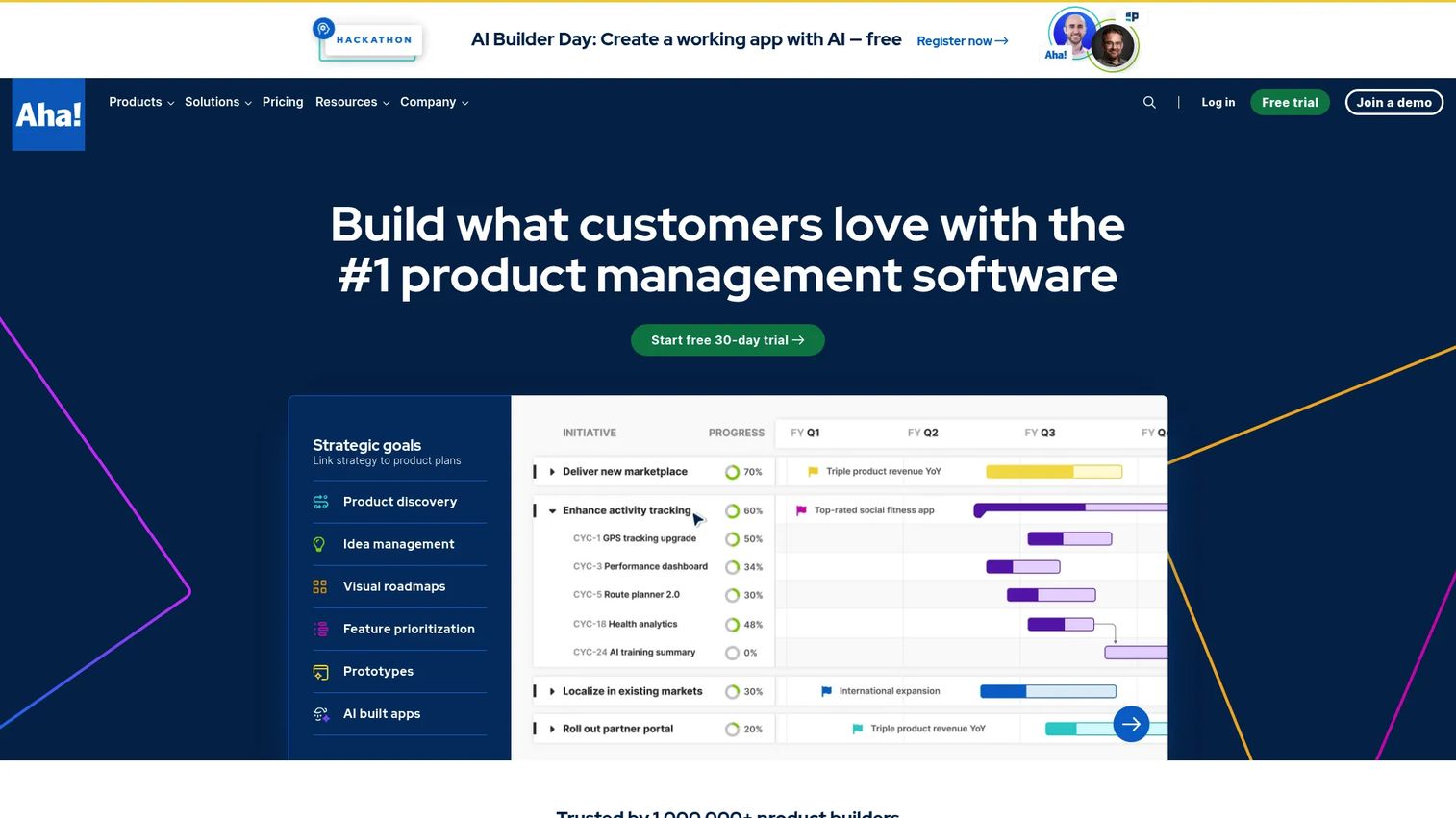
Aha! is a full product management suite covering strategy, roadmaps, ideas, and cross-functional planning. For teams doing ongoing roadmap prioritization rather than one-off portfolio scoring, it provides a connected workflow from strategic goal-setting down to feature-level decisions. The ideas portal aggregates input from customers and internal stakeholders, which feeds directly into the scoring and prioritization layer.
Best for: Product organizations managing a full planning cycle, from strategy definition through roadmap publication, who want scoring embedded in the workflow rather than as a separate step.
Key strengths
- Roadmap and strategy hierarchy: Links goals, initiatives, and features in a single system
- Ideas management portal: Customer and internal feedback feeds the prioritization layer
- Scoring and ranking: Configurable score cards with weighted criteria
- Whiteboards and planning views: Visual planning surfaces for cross-functional sessions
- AI-assisted planning: Automated suggestions and content generation for product workflows
Why choose Aha!: Aha! suits product teams that need more than a scoring tool. If your PM workflow spans strategy, roadmapping, stakeholder communication, and backlog management, consolidating into Aha! reduces the overhead of moving data between systems. The trade-off is cost: Per-user pricing adds up quickly for larger orgs.
Aha! pricing: Plans start at $59 per user per month (Premium, billed annually). The Enterprise plan is $99 per user per month, and Enterprise+ is $149 per user per month, both billed annually. No free tier is available, but a free trial is offered.
G2 rating: 4.5/5
5. Productboard
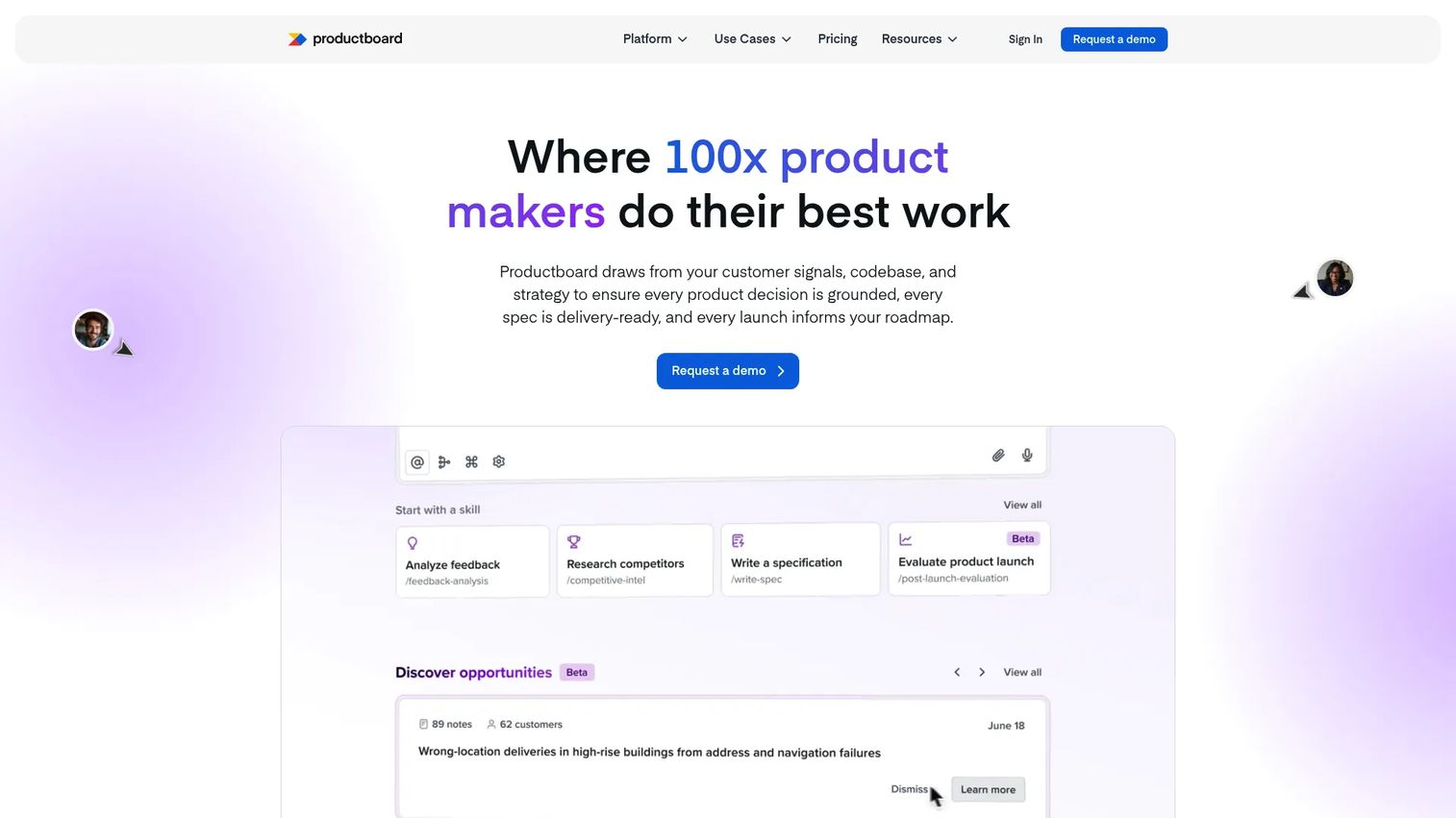
Productboard is an AI-powered product management platform that turns raw customer and stakeholder feedback into a prioritized, scored backlog. The core workflow pulls signals from support tickets, sales conversations, NPS responses, and direct research, then connects those signals to features in the roadmap. That feedback-to-priority loop is what differentiates Productboard from tools that ask you to score manually without connecting scoring criteria to real demand.
Best for: Product teams that need their prioritization to reflect customer and sales signal, not just internal opinion.
Key strengths
- Centralized feedback repository: Aggregates input from Intercom, Zendesk, Salesforce, and other sources
- Impact scoring: Scores features by customer demand, business value, and effort
- Stakeholder collaboration: Separate views for product, engineering, leadership, and sales
- Roadmap publishing: Shareable roadmaps with segment-specific visibility controls
Why choose Productboard: If stakeholder alignment is breaking down because product decisions feel disconnected from what customers are actually asking for, Productboard closes that gap. The feedback aggregation layer means your scoring isn't arbitrary; it's traceable back to real demand signals. That makes it easier to defend prioritization decisions to sales teams asking "why isn't my deal-blocker at the top?"
Productboard pricing: A free plan is available. The Plus plan starts at $59 per maker per month, billed annually. Business and Enterprise plans are available at custom pricing. A 14-day free trial on the Business plan is offered.
G2 rating: 4.3/5
6. Airfocus
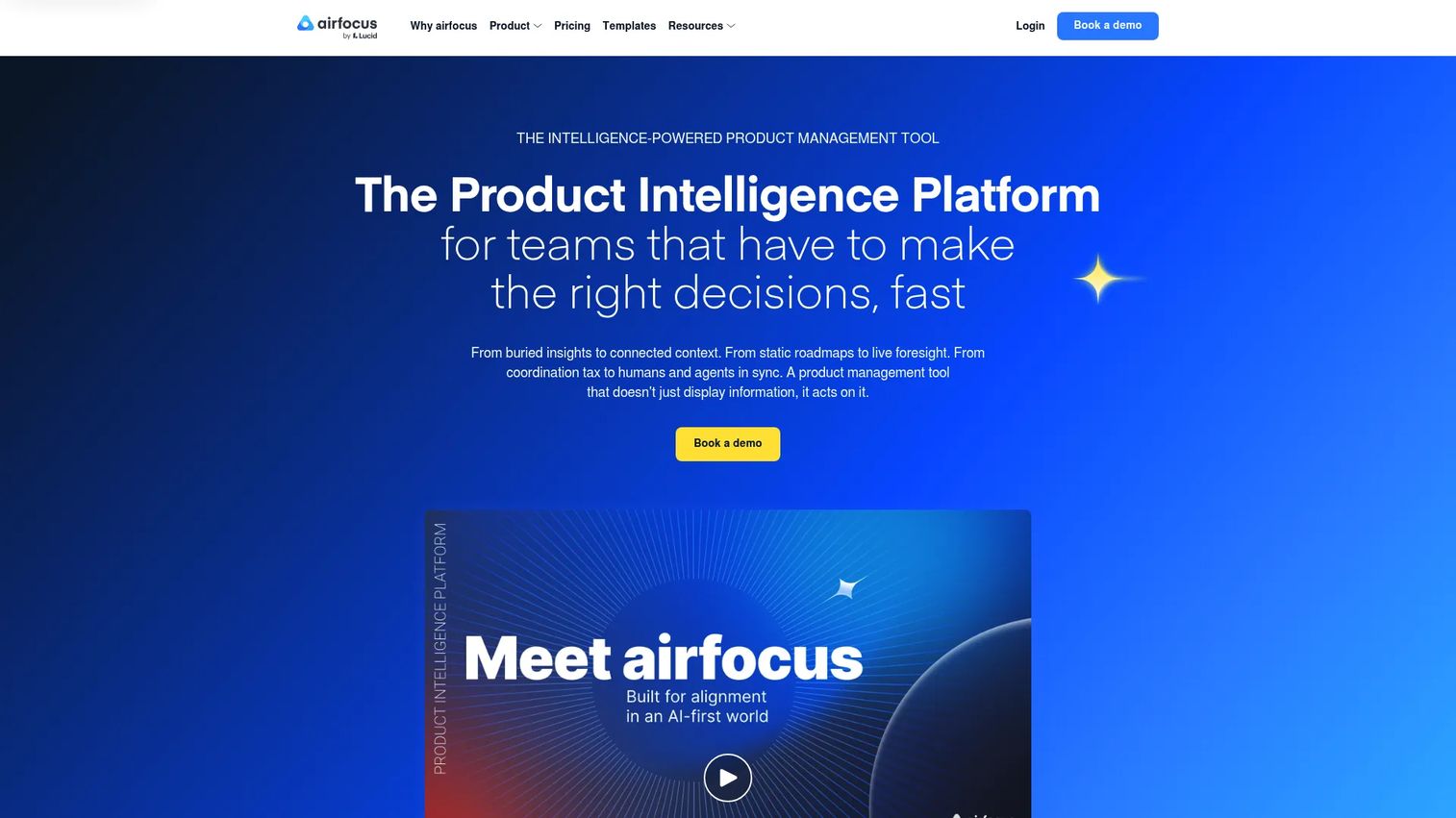
Airfocus is a modular product management and roadmapping platform that lets teams configure their own scoring model rather than inheriting a fixed one. If your org uses OKRs, the tool connects prioritization scores directly to objectives. If you prefer a custom rubric with specific criteria for your industry or product type, the flexible scoring layer accommodates that without requiring a workaround. Portfolio views let you compare initiatives across products or teams with a shared scoring baseline.
Best for: Product teams with specific scoring requirements, multiple products, or a need to align prioritization to an existing OKR framework.
Key strengths
- Configurable scoring models: Build any rubric, weighted criteria set, or scoring formula the team needs
- OKR and portfolio alignment: Connect individual item scores to objectives across the portfolio
- Feedback and insights management: Centralized feedback collection linked to prioritization
- Multiple roadmap views: List, matrix, timeline, and custom visualizations
Why choose airfocus: The appeal is flexibility without complexity. Most prioritization tools force you into their framework. airfocus starts from the other direction: Define your criteria, set your weights, and build the model that fits your planning process. That's valuable when your org has tried preset frameworks and found them too generic for the actual decisions you face.
airfocus pricing: airfocus offers Professional and Enterprise plans, both priced on request. No free trial is available. Contact airfocus directly for current pricing.
G2 rating: 4.4/5
7. Craft.io
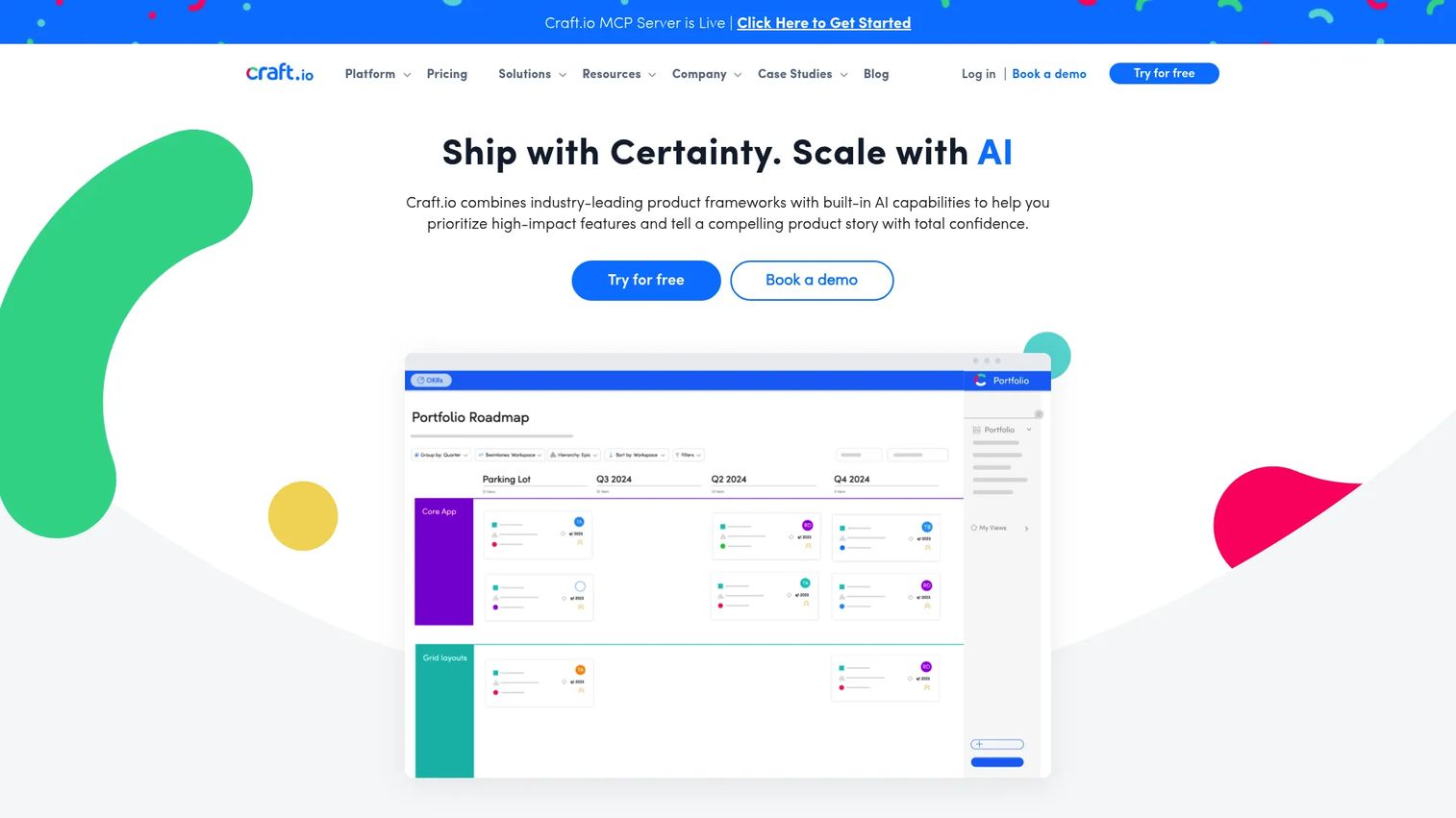
Craft.io is an AI-powered product management platform covering strategy, backlog structuring, prioritization, roadmapping, and OKR tracking. It's designed to give mid-sized product teams a structured operating environment without the setup investment of enterprise platforms. The prioritization layer links directly to OKRs and portfolio-level initiatives, so teams can see how individual features roll up to strategic goals without building that connection manually.
Best for: Product teams of 5 to 50 people who want structured roadmap prioritization with OKR alignment and don't need the full overhead of an enterprise product management system.
Key strengths
- OKR and initiative management: Features and epics link upward to organizational goals
- AI-powered product management: Automated suggestions, content generation, and planning assistance
- Roadmap and backlog views: Multiple visual formats for planning and stakeholder communication
- 14-day free trial on Pro plan: Full feature access before committing
Why choose Craft.io: For growing product teams that have outgrown a spreadsheet but aren't ready to implement a full enterprise platform, Craft.io hits a practical middle ground. The annual billing discount makes the Starter plan accessible at $19 per editor per month. The Pro plan at $79 per editor per month (annually) unlocks advanced prioritization, portfolio management, and the full AI feature set.
Craft.io pricing: The Starter plan is $24 per editor per month (monthly billing) or $19 per editor per month billed annually. The Pro plan is $99 per editor per month (monthly) or $79 per editor per month billed annually. Enterprise is billed annually at custom pricing. A 14-day free trial is available, covering the full Pro plan.
G2 rating: 4.5/5
Considerations
Before selecting a project prioritization tool, work through these four checkpoints. They'll save you a painful switch six months in.
Define your scoring model before evaluating tools
The tool can't fix a team that hasn't agreed on what good looks like. Before you compare platforms, decide which criteria matter most: Impact on retention, engineering effort, strategic alignment, revenue potential. Different tools reward different scoring approaches, and choosing the methodology first makes the shortlist obvious.
Check how the tool handles stakeholder alignment
Some tools let anyone score. Others require a facilitator to run scoring sessions. Ask specifically: Who can add criteria? Who can change a score after it's submitted? Can leadership see the rationale without editing the underlying data? Visibility and auditability matter as much as the scoring mechanics themselves.
Verify integration with your actual workflow
Abstract integration lists don't tell you much. Test specifically whether the tool connects to Jira for backlog sync, your CRM for customer signal, and your analytics stack for usage data. If the prioritization tool lives in a silo, it won't get used after the first quarter.
Confirm it supports reprioritization when strategy changes
This is the most underrated buying criterion. Ask how quickly you can rerun scores with new criteria weights. Ask what happens to historical scores when you change a rubric. The best tools make it easy to show "here's what changed and why" rather than forcing you to start from zero.
Look for ROI reporting, not just task tracking
The end goal isn't a sorted backlog, it's better outcomes. Look for tools that let you connect scored initiatives to actual delivery results over time: Which prioritized items shipped, which metrics moved, which bets paid off. That connection between prioritization decisions and measurable ROI is what justifies the tool to leadership.
Conclusion
The seven tools in this guide cover the full range of project prioritization needs, from daily task focus to portfolio governance at the PMO level.
For teams that need the most defensible decision rationale, TransparentChoice's AHP-based methodology is hard to beat. For product orgs building a full planning system, Aha! and Productboard connect prioritization to strategy and customer signal respectively. airfocus suits teams that want to configure their own rubric rather than inherit a preset one. Craft.io is the practical choice for mid-sized product teams who want structure without a heavy implementation cycle. Priority Matrix solves a different, more operational problem: Keeping daily work focused in a Microsoft environment. KPI Fire fits operations and continuous improvement teams that need scoring tied directly to strategic KPIs.
The right starting point is the same regardless of which tool you choose: Agree on the scoring criteria first, then select the platform that supports them. A great tool with the wrong criteria model won't fix prioritization. A simple tool with the right criteria model often will.
For teams that also need to communicate product value to prospects and customers after decisions are made, Guideflow helps you turn product workflows into interactive demos that share the story behind what you built and why it matters.
Start your journey with Guideflow today!
FAQs
The best choice depends on whether you need portfolio governance, roadmap-linked scoring, or feedback-driven backlog management. TransparentChoice is strongest for defensible portfolio decisions with full decision rationale. Aha! fits product teams managing strategy through delivery in one system. For teams that want customer signal to drive the ranking, Productboard handles that workflow directly.
A project prioritization matrix is a scoring grid that plots initiatives against two or more criteria, typically effort vs. impact or urgency vs. importance. The resulting quadrant positions help teams quickly identify high-return, low-effort work versus projects that consume resources without proportional return. Tools like Priority Matrix use the Eisenhower version; others like KPI Fire apply the effort vs. impact framing to continuous improvement pipelines.
Cross-team prioritization works best when all teams use the same scoring criteria and weight them consistently. The practical steps: Agree on four to six criteria (strategic alignment, customer impact, effort, risk, revenue potential), assign weights to each, have each team score their initiatives independently, then aggregate scores in a shared portfolio view. Portfolio prioritization tools like TransparentChoice and airfocus are built specifically for this process at scale.
Spreadsheets work fine when the team is small, the criteria are stable, and scoring happens infrequently. They break down when multiple stakeholders are scoring simultaneously, when criteria weights change, or when you need to show leadership a traceable decision history. The real gap is auditability: A spreadsheet can't easily show you why a score changed between quarters, which is exactly the question leadership asks when strategy shifts.
Objective scoring starts with criteria that are defined before any specific project is evaluated. Criteria like "number of customers affected" or "estimated engineering days" are measurable. Criteria like "strategic importance" need an explicit definition before they can be scored consistently. Rubric-based scoring assigns a 1-to-5 scale with anchored descriptions at each level, so two different people scoring the same project will arrive at the same number. AHP-style pairwise comparison goes further by forcing scorers to compare criteria against each other, not just rate them in isolation.
At minimum: Weighted scoring with customizable criteria, a portfolio view that ranks items by total score, collaboration features so multiple stakeholders can score asynchronously, and an audit trail that shows score history over time. More advanced requirements include scenario comparison (what if we weight effort higher?), integration with the task management or roadmap tool where work is actually tracked, and reporting that connects scored priorities to delivered outcomes.
The most effective justification is a documented scoring model that leadership helped define. When executives participate in setting criteria weights, the ranked output carries their fingerprints. Beyond that, showing the opportunity cost of alternative choices, what doesn't get built if this does, makes trade-offs concrete. Tools that log scoring history let you answer "why did this move up?" with data rather than a narrative, which is the difference between a decision that sticks and one that gets relitigated at the next leadership review.