You picked a design. You loaded it into a storefront. Then an order came in, and you realized the mockup tool, the fulfillment partner, the order router, and the shipping notification all lived in four different places. None of them talked to each other. You spent your afternoon copying SKUs between tabs instead of testing a new product line.
That is the real friction with print on demand. The model itself is clean: a customer buys, the item gets printed, the supplier ships it, and you never touch inventory. The problem is the stack. Most sellers stitch together a storefront, a mockup generator, a supplier network, and an order management layer, then babysit the handoffs between them. The right print on demand software collapses that into one workflow.
The category is growing fast enough that the tooling is finally catching up. The global print on demand software market was valued at USD 4.21 billion in 2024 and is projected to reach USD 16.42 billion by 2035, a 13.18% CAGR, according to Market Research Future (2025). The broader print on demand market hit USD 10.8 billion in 2025 per Grand View Research, with the software platform segment alone holding 69.6% of global revenue. Translation: more buyers are choosing software-first, and the platforms are competing on automation, not just catalog size.
This guide compares the best print on demand software by the things a marketer actually cares about: workflow fit, integration quality, catalog depth, storefront control, and pricing clarity. If you are evaluating what to consolidate or which platform earns a place in your stack, this is the shortlist. For broader stack decisions around data and attribution, our guide to the best customer data platform pairs well with the picks below.
What's inside
This guide covers eight print on demand companies spanning three jobs: full POD platforms that handle design through fulfillment, web-to-print storefront software for branded selling, and print fulfillment software built for operations at scale. We selected each tool on four criteria that matter most when you are choosing software, not just a supplier: automation depth, catalog breadth, integration quality with platforms like Shopify and Etsy, and pricing transparency.
You will get a comparison table near the top, a tool-by-tool breakdown with verified pricing notes, and a short buying checklist at the end. The list is useful whether you are a new seller launching without inventory, a scaling brand replacing manual order workflows, or a team comparing print on demand services by where production happens.
TL;DR
- Best overall for most sellers: Printify, for the deepest supplier network, free-to-start pricing, and low-friction setup across marketplaces.
- Best for branded storefronts: PrintNow, for web-to-print storefronts, dynamic pricing, and multi-vendor order management.
- Best for beginner-friendly fulfillment: Printful, for dependable automated fulfillment and broad ecommerce integration.
- Best for global fulfillment: Gelato, for local production across 32 countries and faster regional delivery.
- Best for premium branded print: MOO, for high-quality business cards and marketing collateral.
- Best for enterprise distribution: Mimeo, for secure content distribution and large-scale print workflows.
What is print on demand software?
Print on demand software is a platform that creates a custom product, sends the order to a print supplier after a sale, and ships it directly to the buyer, so the seller never holds inventory.
That single capability changes the economics. Instead of buying 500 t-shirts and hoping they sell, you list a design, and a unit gets produced only when someone pays for it. The software sits between your storefront and the printer, automating the part that used to require a warehouse.
The core capabilities you should expect from a print on demand platform:
- Web-to-print storefronts: Branded shops where customers design or personalize products before checkout.
- Order management and fulfillment automation: Automatic routing of paid orders to the right supplier and production facility.
- Integrations and APIs: Connections to Shopify, Etsy, WooCommerce, Amazon, and custom builds through a print on demand API.
- Product personalization and mockups: Mockup generators and design tools that turn artwork into sellable product images.
- Catalog and supplier network scale: The range of blank products and the geographic spread of production partners.
- Profitability and margin visibility: Pricing rules, sample orders, and a profit calculator to sanity-check margins before scaling.
How does this differ from traditional ecommerce? Inventory-based retail forces you to forecast demand, buy stock, and eat the cost of anything that does not sell. POD flips it. Production happens after the sale, so your risk is design and marketing, not unsold cartons in a storage unit. The tradeoff is per-unit cost, which is why margin visibility matters so much.
When to use print on demand software
Launch a custom product business without inventory
POD removes the biggest barrier to selling physical products: upfront capital. You can list a catalog of designs, drive traffic, and only pay production costs once orders come in. This is the right model when you want to test designs before committing to stock. Run a small batch of listings, watch which ones convert, and double down on winners without ever touching a warehouse.
Automate fulfillment across channels
If orders arrive from Shopify, an Etsy shop, a marketplace listing, and a custom storefront all at once, manual routing breaks fast. Print fulfillment software connects those channels and pushes each paid order to the correct supplier without a human touchpoint. This is where automated fulfillment earns its keep: fewer copy-paste errors, faster dispatch, and a clean audit trail when something needs tracking.
Build a branded storefront or product experience
Plugging into a marketplace is fine for reach, but it puts your brand inside someone else's checkout. When brand control and conversion matter more than borrowed traffic, storefront software lets you own the buying experience end to end. Web-to-print platforms add live product personalization, so customers customize before they pay, which lifts both order value and perceived quality.
Add a simple profitability model
Before you scale spend, get the unit economics straight. Order a sample to confirm print quality, set pricing rules that protect your margin after product cost and shipping, and run the numbers through a profit calculator. POD margins are thinner than bulk wholesale, so a tool that surfaces real per-order profit keeps you from scaling a product that loses money on every sale.
Comparison table
The list below is ordered by fit for the broadest set of sellers first, then by pricing clarity, then by verified ratings. Full POD platforms that cover design through fulfillment lead, followed by storefront-first and enterprise-leaning options. Use the table to shortlist, then read the sections for the detail that matters to your channel mix.
| # | Product | Intent | Key use case | Pricing | G2 rating |
|---|---|---|---|---|---|
| 1 | Printify | Full POD platform | Sell custom products across marketplaces with no inventory | Free; Premium from $39/mo; Enterprise custom | 4.6/5 |
| 2 | PrintNow | Web-to-print storefront | Branded storefronts with dynamic pricing and order management | From $495/mo; 14-day trial | Not listed |
| 3 | Printful | POD fulfillment | Automated fulfillment with broad ecommerce integration | Free; Growth $24.99/mo; Enterprise custom | 4.5/5 |
| 4 | Gooten | POD fulfillment | API-driven fulfillment for ecommerce brands | No membership fees; pricing in Admin | 4.3/5 |
| 5 | Gelato | Global POD platform | Local production across 32 countries | Free; Gelato+ from $19.99/mo; Platinum custom | 4.8/5 |
| 6 | MOO | Premium print | Premium business cards and branded collateral | Products from $23; plans from $99/yr | 4.7/5 |
| 7 | Vistaprint | Small-business print | Marketing materials, apparel, signage, packaging | Website plans listed at $0 | 4.2/5 |
| 8 | Mimeo | Enterprise distribution | Secure on-demand print and content distribution | Custom pricing | 4.5/5 |
1. Printify
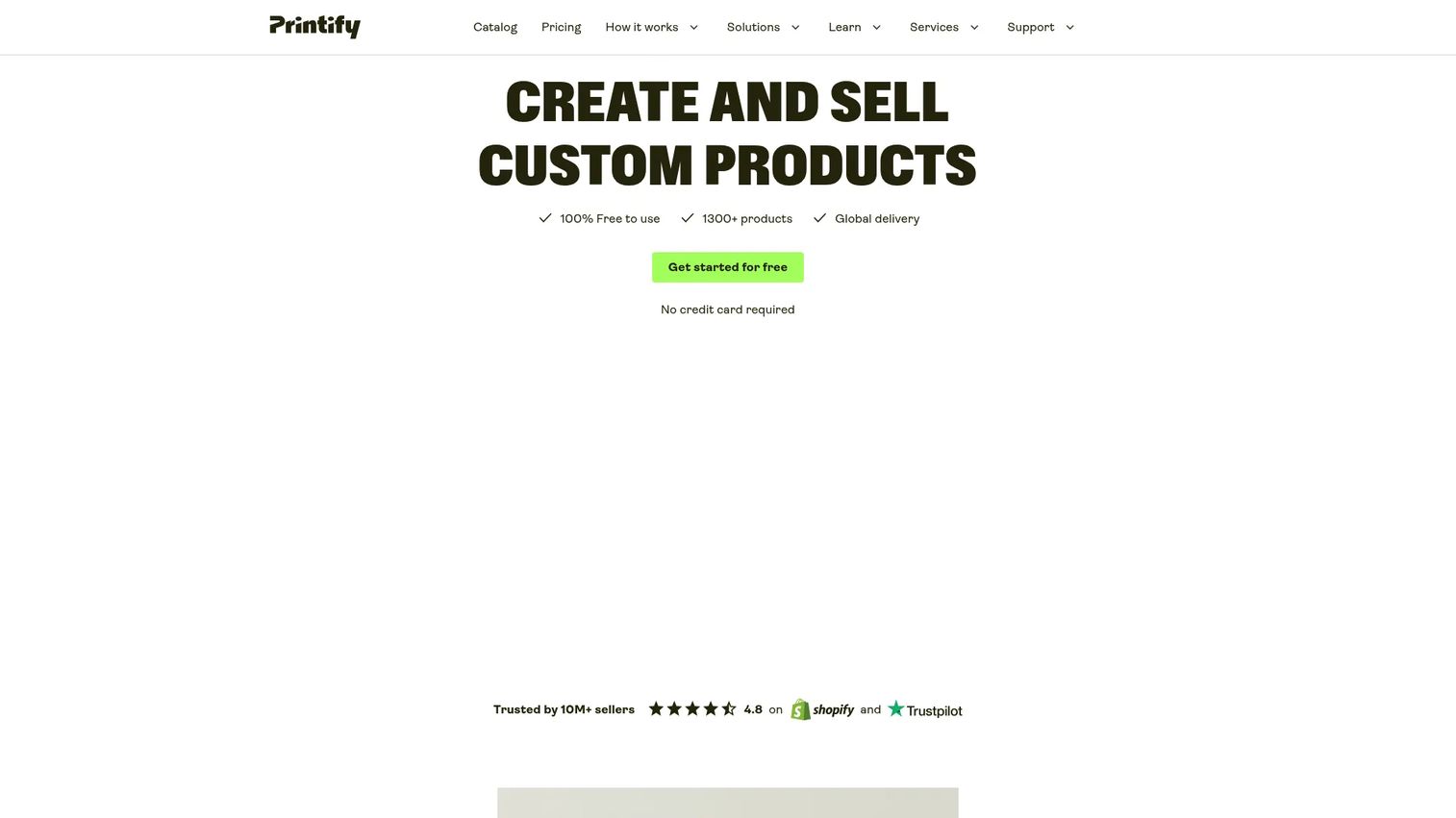
Printify is the broadest entry point into print on demand, built for merchants who want to launch a store without upfront inventory and without locking into a single supplier. Its model is a marketplace of print providers, so you choose where each product gets made based on price, location, and quality. That flexibility is why it works for everyone from a first-time Etsy seller to a brand running thousands of orders a month.
The Product Creator and mockup generator turn artwork into sellable listings in minutes, and the supplier network gives you real choice on cost and production geography. Order management runs through Printify Connect, and integrations cover Shopify, Etsy, eBay, and more, so you can sell wherever your audience already shops.
Best for: Merchants who want to launch a print-on-demand store with no upfront inventory.
Key strengths
- Supplier network choice: Pick the print provider per product based on cost, location, and quality.
- Product Creator and mockups: Generate sellable listings and product images from your artwork fast.
- Marketplace integrations: Connect Shopify, Etsy, eBay, and more from one dashboard.
Why choose Printify: If you value variety and low-friction setup over a single locked relationship, Printify gives you the widest catalog and the most production flexibility. The free plan lets you validate designs before paying anything, which fits the test-then-scale approach most new sellers should take.
Printify pricing: The Free plan starts at $0/month and covers core selling. Premium starts from $39/month and adds product discounts and higher limits. Enterprise pricing is custom and handled through sales. Printify holds a 4.6/5 rating on G2.
2. PrintNow
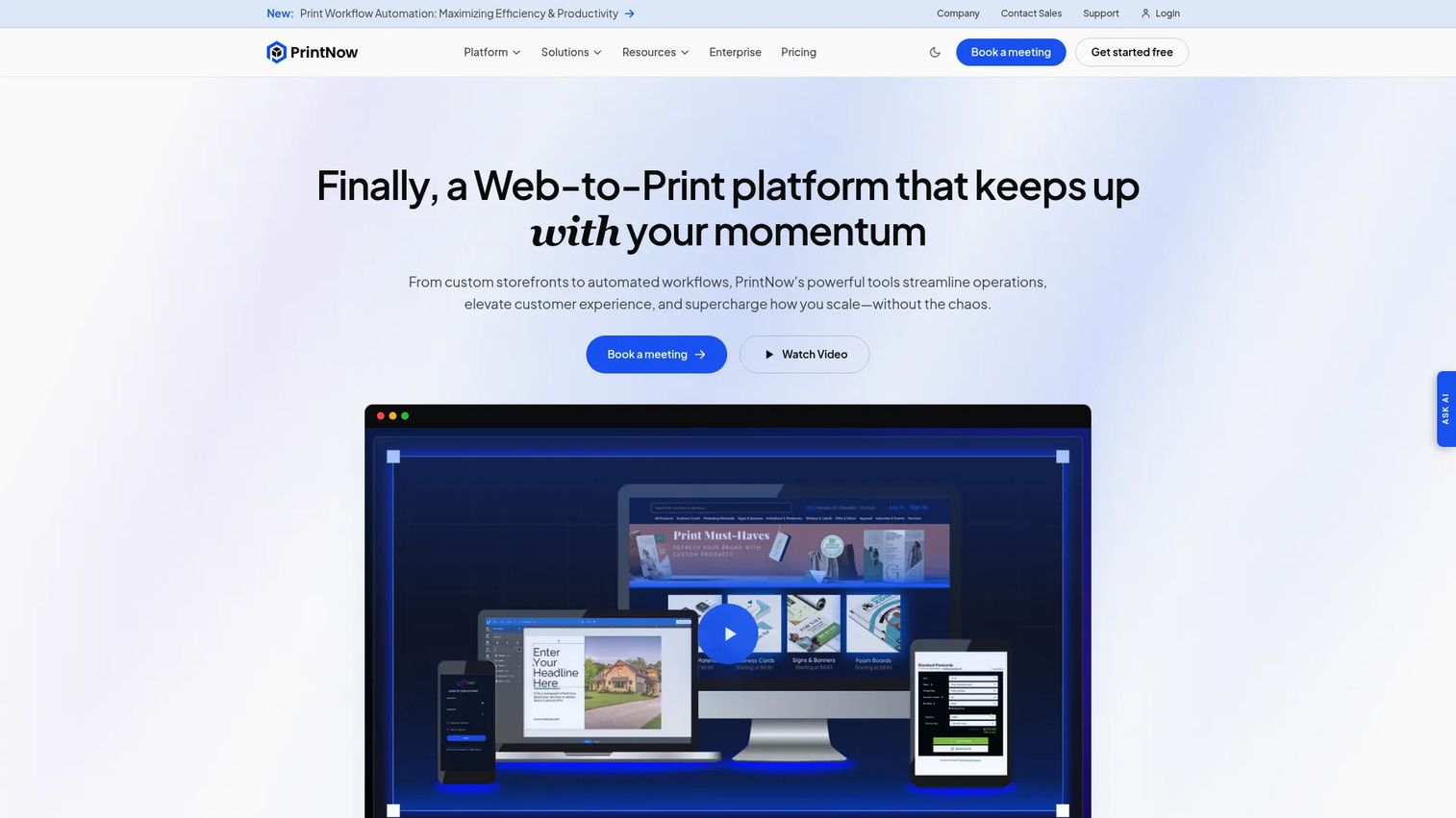
PrintNow is web-to-print software built for print businesses that want to own a branded storefront rather than only plug into a marketplace. It is the option for companies running their own print operation, promotional product programs, or B2B ordering portals where the buying experience itself is part of the product.
The platform pairs Print Store storefronts with a Print Editor for online customization, so customers configure and proof their orders before checkout. The Unified Admin centralizes orders, pricing, content, and users in one place, and dynamic pricing lets you set rules that adjust by quantity, product, or customer. That multi-vendor workflow management is what separates a true web-to-print platform from a simple fulfillment connector.
Best for: Print providers needing a web-to-print platform with storefronts, pricing, and order management.
Key strengths
- Print Store storefronts: Launch branded shops you fully control end to end.
- Print Editor customization: Let customers personalize and proof products before they pay.
- Unified Admin: Manage orders, pricing, content, and users from one console.
Why choose PrintNow: Choose PrintNow when brand control and storefront customization matter more than borrowed marketplace traffic. It fits enterprise and promotional printing workflows where pricing logic and multi-vendor order management need to live in one system rather than spread across tools.
PrintNow pricing: The Starter plan is $495 per month and Growth is $995 per month, with Enterprise available as custom pricing. Quarterly and yearly billing are offered, and yearly billing saves 20%. A 14-day free trial is available. A G2 rating for PrintNow was not listed at the time of writing.
3. Printful
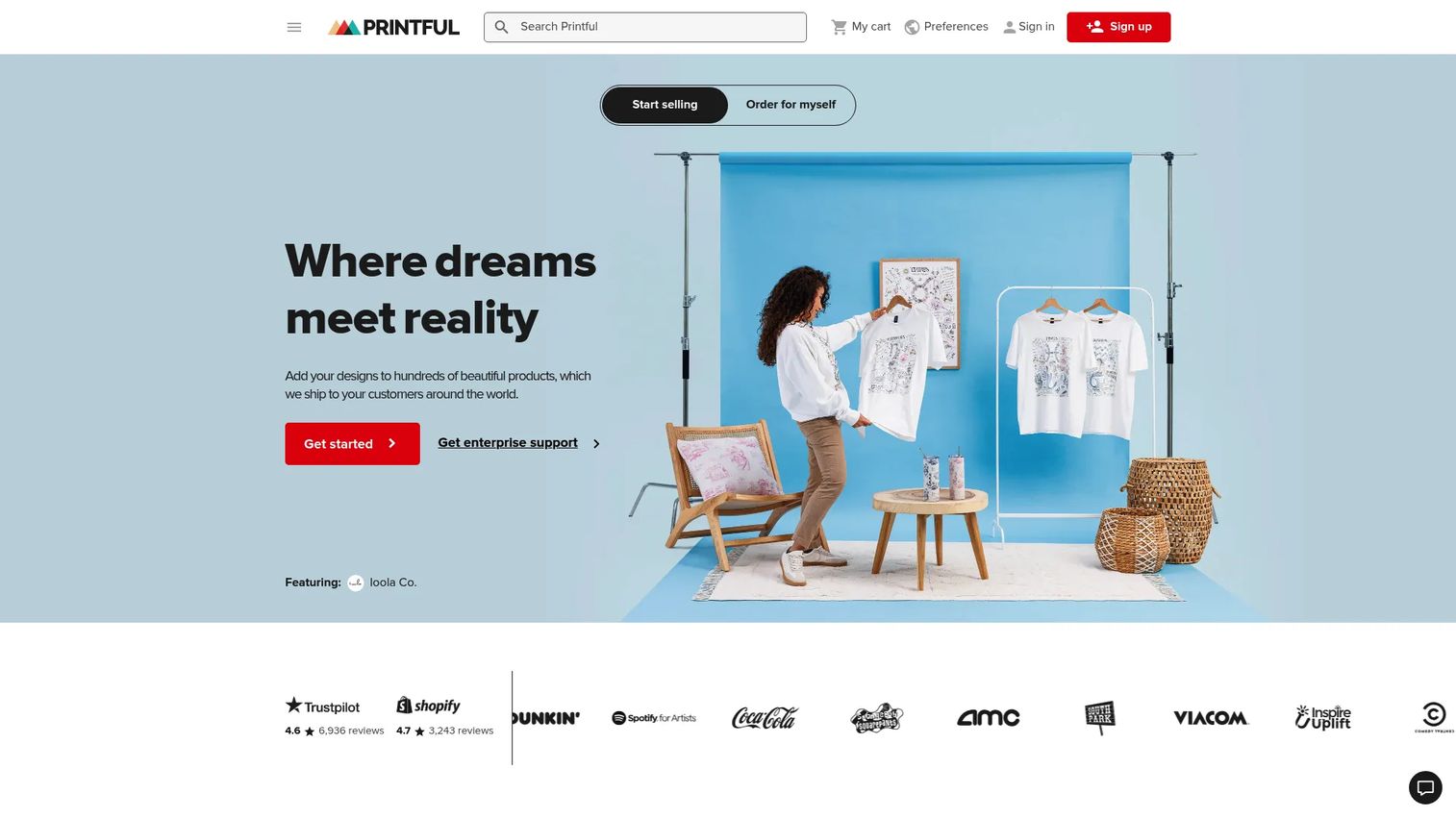
Printful is a mainstream POD fulfillment platform for teams that want a dependable all-around partner with strong ecommerce integration and broad category coverage. It handles the production-to-doorstep half of the workflow so you can focus on design and demand, not logistics.
Automatic order fulfillment routes each sale to production and ships it to the customer without manual steps. The Design Maker and mockup generator handle the creative side, turning artwork into product images and listings. Integrations span major ecommerce platforms and marketplaces, which makes Printful a clean fit if you are running a Shopify or WooCommerce store and want fulfillment to run quietly in the background.
Best for: Merchants who want print-on-demand fulfillment without managing inventory.
Key strengths
- Automatic order fulfillment: Orders route to production and ship without manual handling.
- Design Maker and mockups: Build product images and listings from your designs.
- Ecommerce integrations: Connect to major platforms and marketplaces out of the box.
Why choose Printful: Printful suits sellers who prioritize reliability and a smooth integration over the widest possible supplier choice. If you want one fulfillment partner that handles the operational load and plays nicely with your existing storefront, it is a safe, well-reviewed pick.
Printful pricing: Printful Free starts at $0.00/month and includes core selling and fulfillment tools. Printful Growth is $24.99/month and adds product discounts and extra perks. Enterprise uses custom pricing. Printful holds a 4.5/5 rating on G2.
4. Gooten
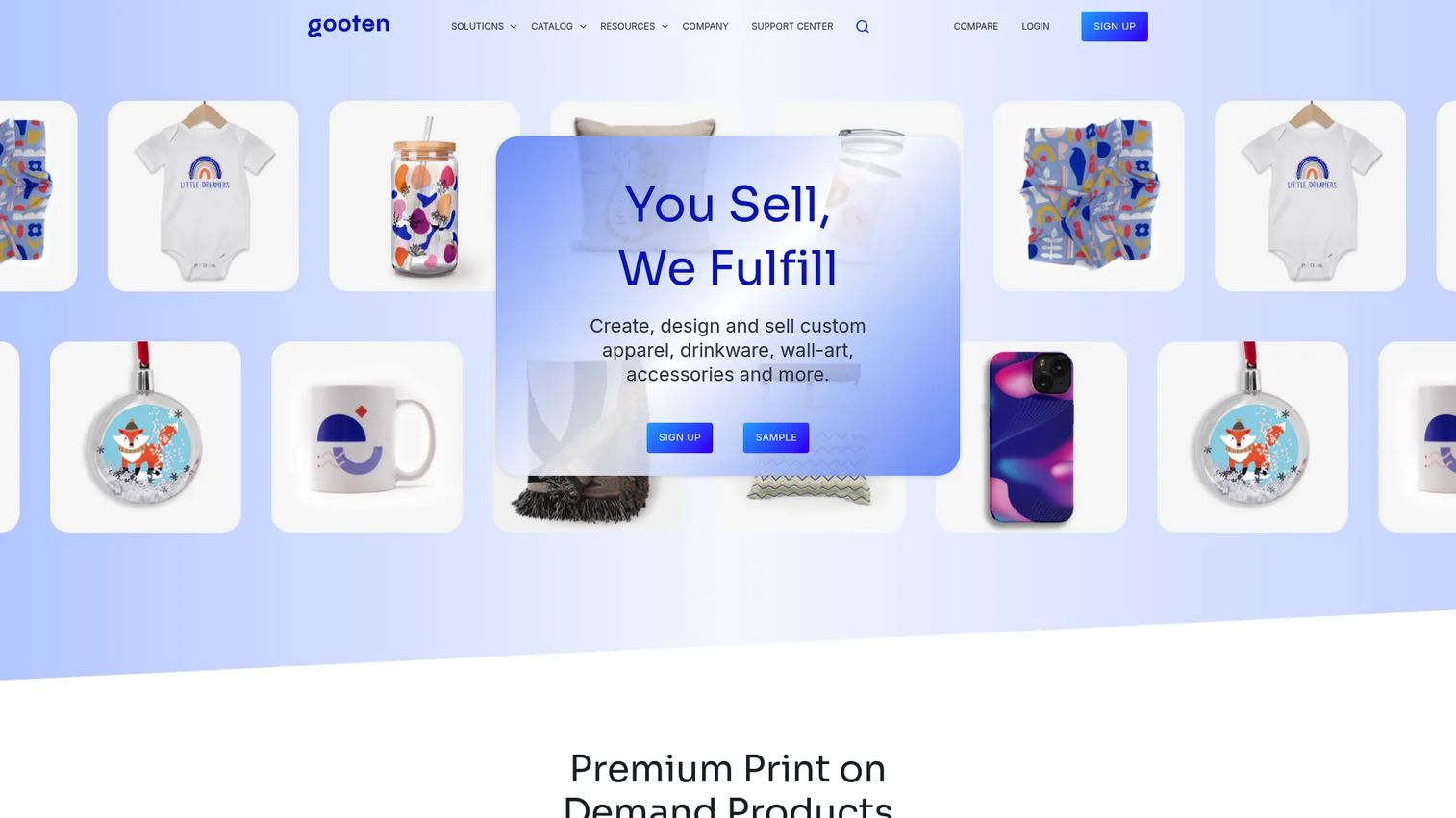
Gooten is a fulfillment-first platform built for ecommerce brands that care about operations, routing, and scale more than a flashy front end. It leans toward sellers with multiple SKUs and growing order volume who need fulfillment to be reliable and programmable rather than hand-managed.
Automated order fulfillment and custom API integrations are the core draw, letting technical teams wire Gooten directly into their store or middleware. The catalog spans more than 500 print-on-demand products, and the platform positions itself around transparent costs with no membership or hidden fees. For teams comparing fulfillment partners by automation depth and API flexibility, Gooten is a serious contender against the larger brand-first platforms.
Best for: Merchants needing print-on-demand fulfillment with ecommerce and API integrations.
Key strengths
- Automated order fulfillment: Paid orders route to production without manual touchpoints.
- Custom API integrations: Wire fulfillment directly into your store or middleware.
- 500+ products: A broad catalog to build varied product lines.
Why choose Gooten: Gooten fits teams that treat fulfillment as infrastructure and want API-level control over routing. If your store has complex SKU logic or you are building a custom workflow, its developer-friendly approach is the differentiator.
Gooten pricing: Gooten states there are no membership or hidden fees. Product and shipping pricing is viewed inside the Gooten Admin rather than posted publicly on the website. Gooten holds a 4.3/5 rating on G2.
5. Gelato
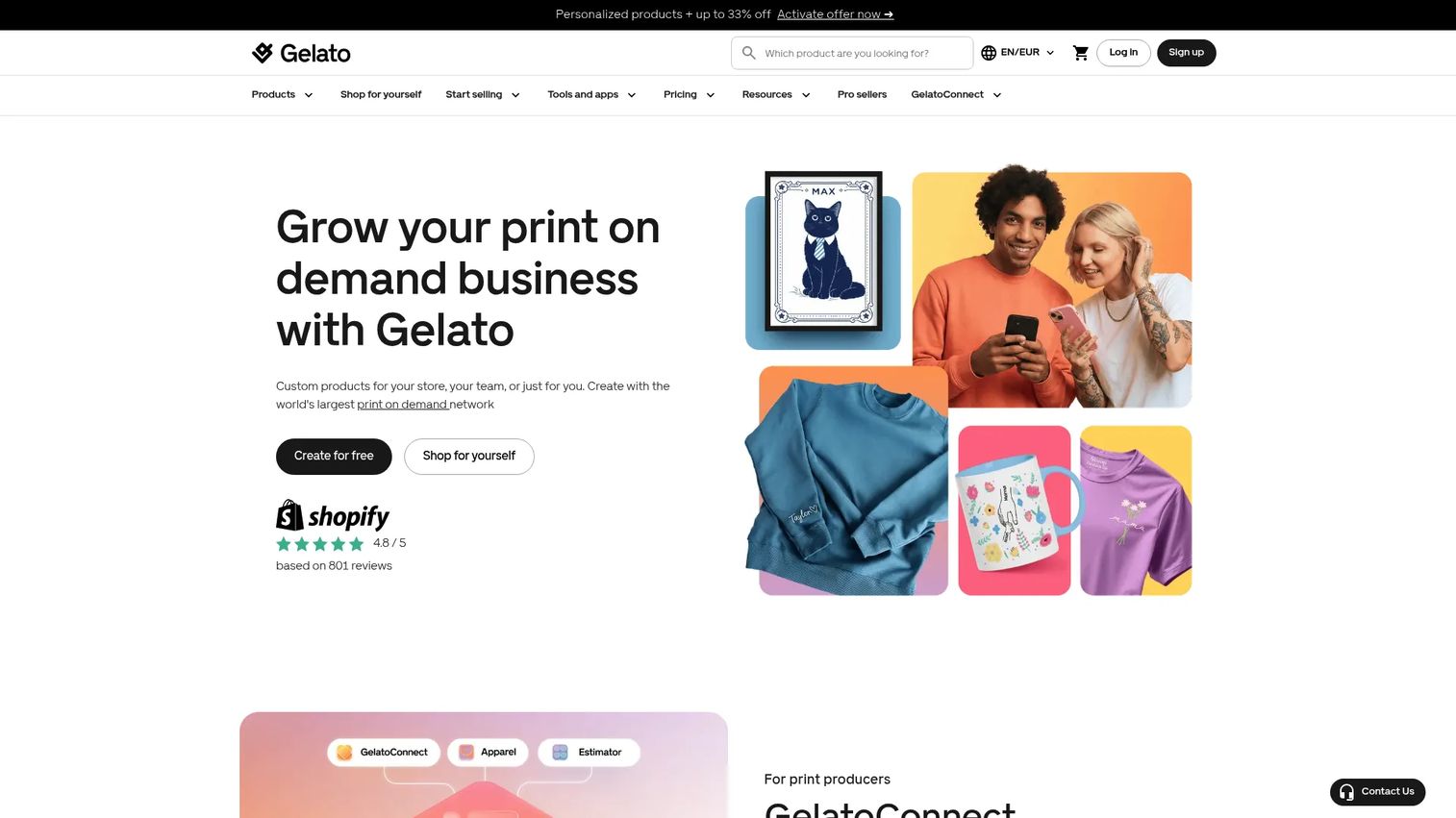
Gelato is a global print on demand platform built around local production, with a network spanning 32 countries. The pitch is geographic: by printing close to the customer, you cut shipping time and distance, which matters when speed and delivery experience are part of how you compete. This is what sets it apart from US-centric tools.
Sign-up is free with no minimums or prepayments, and the platform pays as you sell. Integrations cover Shopify, Etsy, an API, and other ecommerce platforms, and the toolkit includes AI features and premium mockups. For sellers shipping internationally or expanding into new regions, local production routing is the feature that justifies a closer look.
Best for: Ecommerce brands that want print-on-demand fulfillment with local production.
Key strengths
- Local production network: Print across 32 countries to shorten delivery distance.
- Broad integrations: Connect Shopify, Etsy, API, and more ecommerce platforms.
- AI tools and premium mockups: Speed up product creation with built-in design tools.
Why choose Gelato: Choose Gelato when geography is a competitive lever, whether that means faster delivery for international customers or reducing cross-border shipping costs. Its free, pay-as-you-sell model also lowers the barrier to testing a global product line.
Gelato pricing: The Free plan is $0 forever with pay-as-you-sell fulfillment. Gelato+ is $29.99/month billed monthly or $19.99/month billed annually and adds up to 33% product discounts plus extra tools. Platinum uses custom pricing. Gelato holds a 4.8/5 rating on G2.
6. MOO
MOO sits at the premium end of the print spectrum, specializing in custom business cards and branded marketing collateral. It is less about an open product catalog and more about print quality and brand presentation, which makes it a strong fit for marketers, agencies, and teams producing premium merch and physical brand assets.
Custom business cards come in multiple sizes and papers with double-sided full-color printing included, and the business plans add preferential pricing and account support. For a marketer who needs polished physical touchpoints, event collateral, or premium leave-behinds rather than a t-shirt dropshipping operation, MOO covers a different but adjacent need.
Best for: Businesses needing premium custom print products and business-card-centric branding materials.
Key strengths
- Custom business cards: Multiple sizes and paper stocks with full-color printing.
- Premium print quality: Double-sided full-color printing included as standard.
- Business plans: Preferential pricing and account support for teams.
Why choose MOO: Choose MOO when print quality and brand feel are the priority over catalog breadth. It is the option for agencies and brand teams who treat physical print as part of the brand experience, not a commodity product line.
MOO pricing: Product pricing starts at $23.00 for 50 business cards. Business plans are billed annually: Business Boost at $99 a year, Advanced at $299 a year, and Enterprise at $699 a year. There is no free tier. MOO holds a 4.7/5 rating on G2.
7. Vistaprint
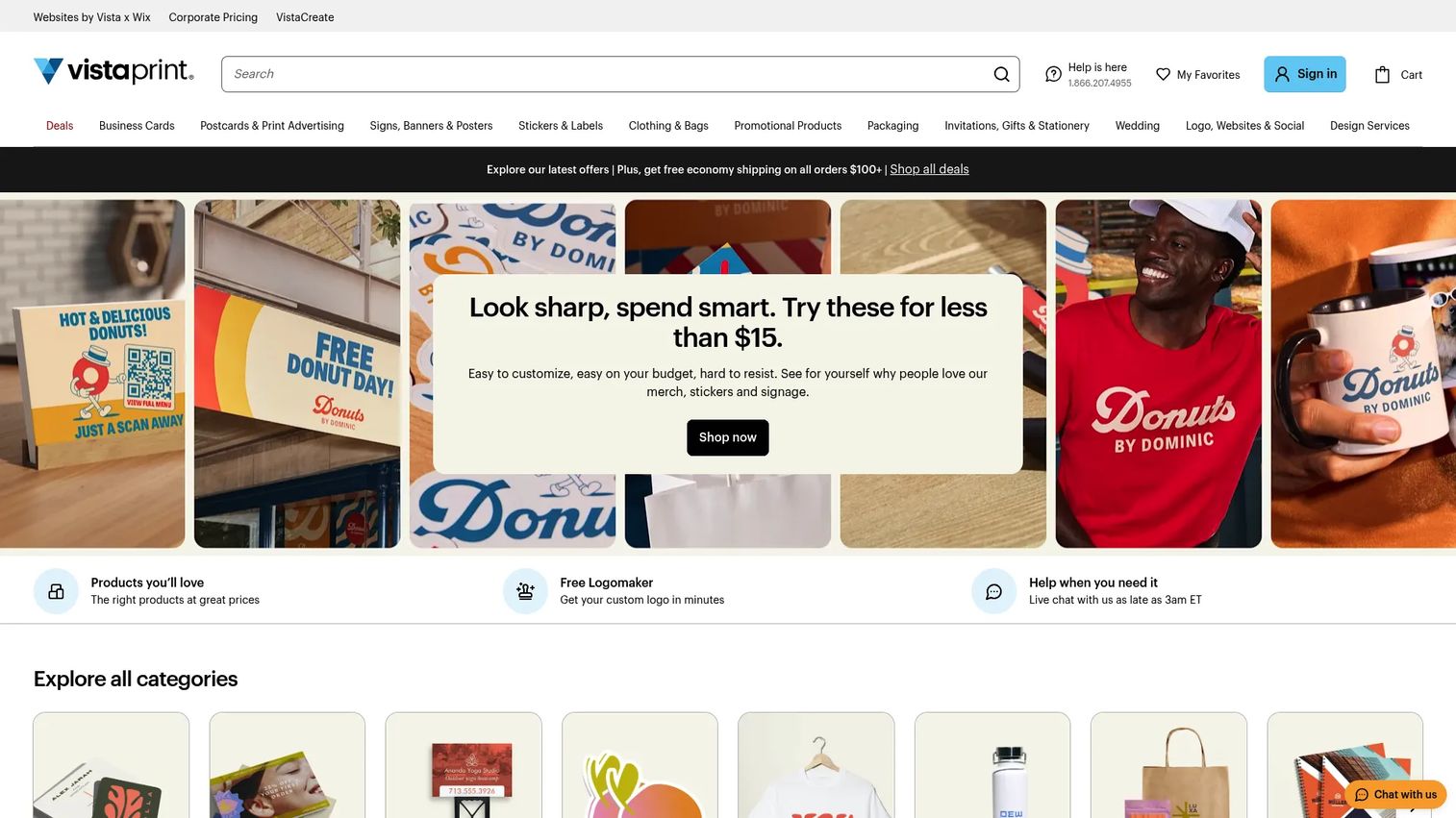
Vistaprint is a high-recognition print and design partner for small businesses, covering custom marketing materials, apparel, signage, packaging, and online design tools. Its appeal is familiarity and breadth: buyers who want one recognizable name for a wide range of branded print products gravitate here.
Customizable templates and easy upload options lower the design barrier, design support is available for buyers who want help, and the product assortment stretches across print, apparel, signage, packaging, and gifts. For a small business that wants marketing collateral and merchandise from a single trusted source rather than a developer-grade POD API, Vistaprint is an accessible choice.
Best for: Small businesses needing custom printed marketing materials and simple design support.
Key strengths
- Customizable templates: Start from templates or upload your own artwork easily.
- Design support: Get help when you need a hand with customization.
- Broad product assortment: Print, apparel, signage, packaging, and gifts in one place.
Why choose Vistaprint: Choose Vistaprint when you want a familiar, wide-ranging print partner for small-business marketing assets and merchandise. It trades developer-grade flexibility for accessibility and a recognizable brand, which fits buyers who value simplicity.
Vistaprint pricing: Vistaprint's website builder plans, Light, Core, Business, and Business Elite, are each displayed at $0 with first-year discount pricing and a 14-day money-back guarantee. Broader print catalog pricing varies by product. Vistaprint holds a 4.2/5 rating on G2.
8. Mimeo
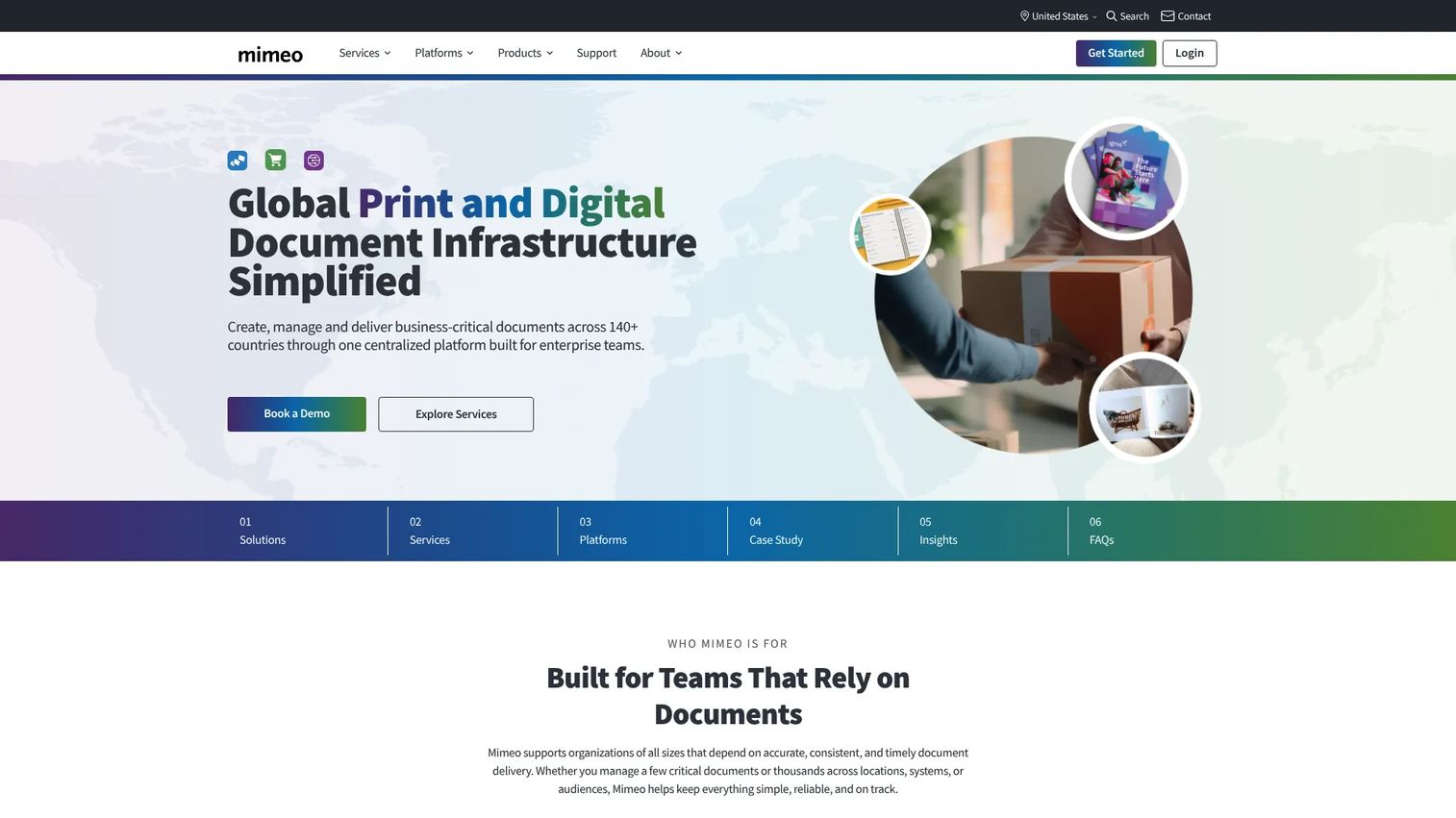
Mimeo is an enterprise-leaning B2B print, fulfillment, and digital content distribution platform. It fits organizations that need on-demand print and secure document distribution at scale, which is a different job than custom merch dropshipping. Think training materials, controlled document distribution, and large-volume print runs with governance.
The platform pairs on-demand print with an online document builder and real-time proofing, adds global delivery tracking with no order minimums, and layers in digital content distribution with permissions and LMS or API integration. That permission and distribution control is exactly why enterprise teams pick Mimeo over pure merch tools.
Best for: Businesses that need on-demand print and secure document distribution at scale.
Key strengths
- On-demand print with proofing: Online document builder and real-time proofing.
- Global delivery and no minimums: Track delivery worldwide without order minimums.
- Secure content distribution: Permissions plus LMS and API integration.
Why choose Mimeo: Choose Mimeo when the job is enterprise print distribution with governance, not selling custom products to consumers. It fits operations and enablement teams that distribute controlled content and need permission-level control over who sees and prints what.
Mimeo pricing: Public pricing is not posted on the Mimeo site, which directs prospects to request a guided tour or personalized pricing. Pricing is customized or project-specific. Mimeo holds a 4.5/5 rating on G2.
Conclusion
The right print on demand software depends on which half of the workflow is your bottleneck. If you need the broadest catalog and the most supplier flexibility to launch fast, Printify is the best overall pick for most sellers, and its free plan lets you validate before you spend. If you are building a branded storefront where the buying experience is the product, PrintNow gives you web-to-print control, dynamic pricing, and unified order management.
For global reach, Gelato's local production across 32 countries shortens delivery and cuts cross-border friction, which is the clearest fit when geography is a competitive lever. For enterprise content distribution with governance and permissions, Mimeo handles secure, large-scale print workflows that pure merch tools are not built for.
Choose based on three things: catalog breadth, automation depth, and how much storefront control you need. A new seller testing designs and a brand replacing manual order routing should not land on the same tool. Start with the job your current stack does worst, match it to the pick above, and run a sample order before you scale.
FAQs
Print on demand software is a platform that produces a custom product only after a customer buys it, then ships it directly to them, so you never hold inventory. Production happens post-sale, which removes the upfront cost and waste of stocking products in advance. The software automates the link between your storefront and the print supplier.
Yes, because it lets you test product ideas with almost no upfront capital. You list designs, drive traffic, and only pay production costs when orders come in. The two things beginners should watch are margins, which are thinner than wholesale, and shipping times, which vary by supplier and production location. Order a sample first.
The features that matter most are branded storefronts or web-to-print software, integrations with platforms like Shopify and Etsy, catalog and supplier depth, mockup and product personalization software, fulfillment automation, and pricing transparency. Weight them by your bottleneck: a new seller needs catalog and mockups, while a scaling brand needs automation and clean print order management.
Most charge you the product base cost plus shipping, and you set the retail price above that, keeping the difference as margin. Some also offer subscription tiers that lower per-unit costs in exchange for a monthly fee. Because POD margins are thin, running the numbers through a profit calculator before scaling keeps you from selling products that lose money on every order.
POD software focuses on ecommerce fulfillment: producing and shipping custom products after a sale, often across marketplaces. Web-to-print software emphasizes the storefront and customization workflow, letting customers design, configure, and proof products before checkout in a branded environment. Many sellers use a POD platform for fulfillment and web-to-print for the buying experience, and some tools blend both.
For branded storefronts, PrintNow is the strongest pick because it is purpose-built web-to-print software with Print Store storefronts, dynamic pricing, and unified order management. It suits companies that want to own the buying experience and run multi-vendor or promotional printing workflows rather than only plugging into a marketplace where the brand sits inside someone else's checkout.
Yes. Most major print on demand companies integrate directly with Shopify and Etsy, and many also support WooCommerce, Amazon, eBay, and custom builds through an API. These integrations let paid orders route automatically to the right supplier without manual entry, which is the core of automated fulfillment across channels. Confirm the specific connectors before committing, since coverage varies by platform.