Your team approved a subcontractor last quarter. The project started. Then you discovered an expired certificate of insurance, an unresolved OSHA recordable, and a balance sheet that could not absorb a payment delay.
The cost was not the paperwork. The cost was finding out after you had already committed.
Contractor prequalification is a risk-control workflow, not an administrative formality. According to the U.S. Bureau of Labor Statistics, construction accounts for roughly 20% of all U.S. worker fatalities annually, a number that tracks directly to how carefully contractors are screened before they set foot on site. Beyond safety, contractor default risk creates financial exposure that surfaces in claims, delays, and subcontractor replacement costs that rarely appear in a project budget.
The problem most organizations face is not a lack of awareness. It is a process that lives in spreadsheets, shared inboxes, and reminder emails, with no single place where approval status, insurance currency, safety history, and financial standing are visible at once.
This guide covers 15 prequalification software tools and helps you match the right one to the most expensive risk your current process fails to catch.
What's inside
This guide is built for founders, COOs, VP Operations, and procurement leaders evaluating contractor prequalification infrastructure for construction, manufacturing, facilities, or field-service vendor networks. Tools were assessed on four criteria:
- Risk depth: Does the platform evaluate financial health, safety performance, insurance, and capacity, or only collect documents?
- Workflow fit: Does it replace spreadsheets and inbox approvals, and can a non-founder team member own it?
- Integration: Does it connect to the construction, ERP, or project systems where contractor records and bids already live?
- Pricing transparency: What does the operating model actually cost, including implementation, contractor fees, and renewal management?
TL;DR
- Best for construction workflow integration: Procore, for teams already running bidding, project management, and documents in one platform
- Best for deep subcontractor financial and risk review: PreQual by Vertikal RMS or COMPASS by Bespoke Metrics, for firms that need analyst-supported financial assessment
- Best for safety and compliance program governance: Highwire or Avetta, for organizations where contractor safety exposure is the primary risk driver
- Best for insurance and credential tracking: Jones (getjones.com) or Contractor Compliance, for teams replacing inbox-based certificate chasing
- Best for growing operations teams: Mitti by SafetyCulture or Constrafor, for teams that need a practical contractor workflow without deploying a full enterprise construction suite
What is contractor prequalification software?
Contractor prequalification software is a system that collects, verifies, scores, and stores contractor or subcontractor data before approving them for bidding, site access, or project work.
The software evaluates evidence across several categories:
- Financial stability, bonding capacity, and creditworthiness
- Safety performance, incident history, and qualification certifications
- Insurance certificates, policy limits, and coverage types
- Licenses, credentials, and compliance documents
- Past project experience, references, litigation history, and current capacity
- Diversity, workforce, and supplier requirements where applicable
The four common software categories
Understanding which category fits your operating model is more important than comparing feature lists.
| Category | Primary job | Best fit | What it does not replace |
|---|---|---|---|
| Construction-suite prequalification | Connect qualification to bidding and project records | Firms standardized on a construction platform | Deep third-party financial underwriting |
| Risk assessment platform | Evaluate financial, safety, capacity, and default risk | Large contractors and high-risk subcontractor networks | Everyday site or project management |
| Compliance and credential tracking | Track COIs, licenses, certifications, and renewals | Teams with heavy insurance and onboarding work | Full project-capacity review |
| Contractor workflow platform | Automate invites, forms, review tasks, and approvals | Growing operations teams | Specialist financial analyst review |
Key features to look for
- Configurable qualification questionnaires
- Contractor self-service document upload
- Automated expiration and renewal alerts
- Review queues and approval controls
- Risk scoring and audit trails
- Construction ERP and bidding-system integrations
- Portfolio reporting across contractors and projects
When to use contractor prequalification software
Approve subcontractors before bid invitations go out
A centralized qualification workflow prevents teams from inviting unvetted vendors into active bids. Approval status, trade coverage, and insurance controls become searchable before the invitation goes out, not after the contract is signed. This is where the approval workflow software category earns its keep in construction operations.
Replace spreadsheet-based insurance and credential reviews
If compliance documentation is scattered across folders, inboxes, and shared drives, your team is not managing risk, it is managing email. Automated reminders, document expiration tracking, and searchable contractor profiles make the difference between catching a lapse before mobilization and discovering it after an incident.
Standardize risk decisions across projects and regions
Companies where every region or project team evaluates contractors differently cannot produce consistent risk decisions. Scoring, role-based approvals, and executive visibility into exceptions are the controls that make contractor programs auditable and board-ready. This is particularly important for any organization preparing for a fundraise, an acquisition, or an insurance renewal conversation.
Contractor prequalification software comparison
The table below is a shortlisting tool. Use it to narrow your options, then run a live security, integration, and workflow review with each finalist. Prices and ratings reflect verified research conducted in October 2026 and should be confirmed against live vendor pages before purchase.
| # | Product | Best for | Key differentiator | Pricing | G2 rating |
|---|---|---|---|---|---|
| 1 | Procore | Construction teams using an integrated project platform | Prequalification connected to bidding and project records | Custom quote | 4.6/5 |
| 2 | Highwire | Contractors needing detailed risk and safety visibility | Financial, safety, and capacity risk assessment | Custom quote | 4.6/5 |
| 3 | PreQual by Vertikal RMS | Firms needing analyst-led subcontractor financial review | Expert financial qualification with configurable workflows | Custom quote | Not listed |
| 4 | COMPASS by Bespoke Metrics | GCs managing subcontractor default exposure | Q Score risk assessment with standardized 1Form | Custom quote | 5.0/5 |
| 5 | Autodesk TradeTapp | Autodesk Construction Cloud users | Prequalification tied to Autodesk preconstruction workflows | Custom quote | Not listed |
| 6 | VelocityEHS Contractor Safety | EHS-led organizations | AI-assisted COI review and safety qualification | Custom quote | 4.4/5 |
| 7 | Oracle Textura | Enterprise owners and contractors with payment controls | Qualification tied to construction payment workflows | 0.22% of contract value | Not listed |
| 8 | Constrafor | GCs connecting compliance, contracts, and payment | Subcontractor onboarding, compliance, and Early Pay financing | Free/$1,750/mo | Not listed |
| 9 | Jones | Teams prioritizing insurance compliance | COI collection, verification, and compliance automation | Custom quote | 4.9/5 |
| 10 | Mitti by SafetyCulture | Operations teams standardizing contractor workflows | Mobile-first onboarding and compliance management | Free/$24/seat/mo | Not listed |
| 11 | Avetta | Enterprises with broad contractor and supplier networks | Contractor management across safety, compliance, and risk | Custom quote | 3.7/5 |
| 12 | Contractor Compliance | Teams focused on document and credential control | Free hiring-organization tier with tiered contractor plans | Free/$349/yr | Not listed |
| 13 | Safety Plus | HSE equipment and safety services providers | Safety product supply and field inspection services | Custom quote | Not listed |
| 14 | GoContractor | Construction firms managing site access and worker onboarding | Digital onboarding, training, and site access workflows | Custom quote | 4.8/5 |
| 15 | ISNetworld | Large organizations with complex compliance requirements | Established contractor management network | Custom quote | 3.4/5 |
Best 15 contractor prequalification software tools for 2026
1. Procore
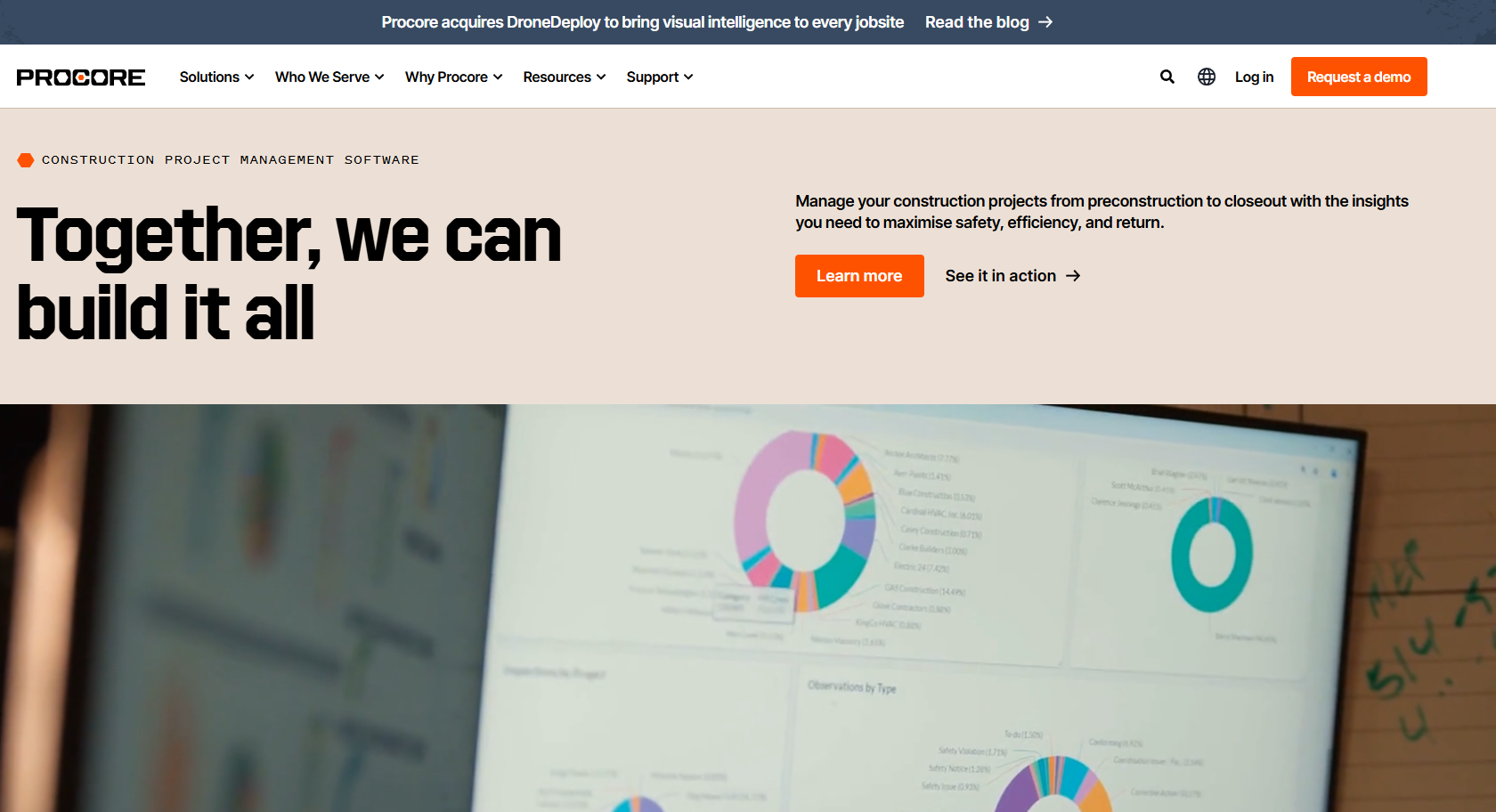
Procore is a cloud-based construction management platform that connects project stakeholders, workflows, data, and resources across the full project lifecycle. Its prequalification module sits inside a broader operating system that includes bid management, project financials, document control, and quality and safety management. For construction teams that already run their preconstruction and project workflows inside Procore, adding contractor qualification keeps all contractor records in one place rather than forcing a switch between systems.
Best for: General contractors and owners that already manage bidding, project management, and documents inside a single construction platform.
Key features
- Custom contractor qualification forms and record history
- Review, approval, and denial workflows with controlled access
- Connection to bidding, project directory, and reporting workflows
- Real-time field and office visibility across projects
- Financial management including invoicing and budget tracking
Why choose Procore: Strong fit when prequalification must live inside a wider construction operating system. Teams that need independent, analyst-led subcontractor financial assessment should evaluate specialist platforms alongside it.
Procore pricing: Procore prices by Annual Construction Volume with annual contracts, unlimited users, and unlimited data. You request a custom quote based on which products your team needs. Field Productivity is priced by FTE separately.
G2 rating: 4.6/5
2. Highwire
Highwire is a contractor risk management platform that combines prequalification assessments with field applications for inspections, incidents, and ongoing risk monitoring. Unlike platforms focused on document collection, Highwire evaluates contractors across company capability, financial health, safety performance, and insurance before they are approved. A Procore integration and browser-based companion tool extend its reach into existing construction workflows.
Best for: Owners, general contractors, and facilities teams that need to evaluate contractor financial risk, safety exposure, and capacity before inviting firms into bids or projects.
Key features
- Contractor prequalification covering financial, safety, and insurance dimensions
- Field inspections and safety observation management
- Incident management and real-time risk monitoring
- Procore integration and browser-based Highwire Companion
- Contractor subscription fees tiered by employee headcount
Why choose Highwire: Appropriate when contractor default, safety exposure, and capacity are all material business risks. Evaluate whether the analyst involvement, data sources, and integration requirements fit your operating model during a pilot.
Highwire pricing: Assessment packages are priced based on contractor headcount; the hiring organization pays a platform fee and contractors pay a subscription fee tied to their employee count. Request a quote from Highwire directly.
G2 rating: 4.6/5
3. PreQual by Vertikal RMS
PreQual by Vertikal RMS combines configurable prequalification workflows with optional expert financial analysis. The platform supports custom forms, risk-focused scorecards, and automated creditworthiness tracking. Where the financial review goes deeper than a standard form submission, PreQual offers Full, Self, and Hybrid service levels, with Full including professional analyst review of financial statements.
Best for: General contractors and risk teams that need more than current insurance and uploaded documents, particularly firms managing subcontractor default insurance or high-value project portfolios.
Key features
- Custom forms and configurable risk-focused scorecards
- Financial statement review by expert analysts (Full service level)
- Automated creditworthiness and financial-exposure tracking
- ERP, accounting, and project-management system integration
- Web-based third-party information database with unlimited storage
Why choose PreQual by Vertikal RMS: Strong candidate when your risk committee requires financial analysis depth that automated scoring alone cannot provide. Verify the service level model, onboarding requirements, and integration scope during evaluation.
PreQual by Vertikal RMS pricing: Vertikal RMS offers Full, Self, and Hybrid service levels. Pricing is not listed on the website and requires a direct conversation with the Vertikal team.
4. COMPASS by Bespoke Metrics
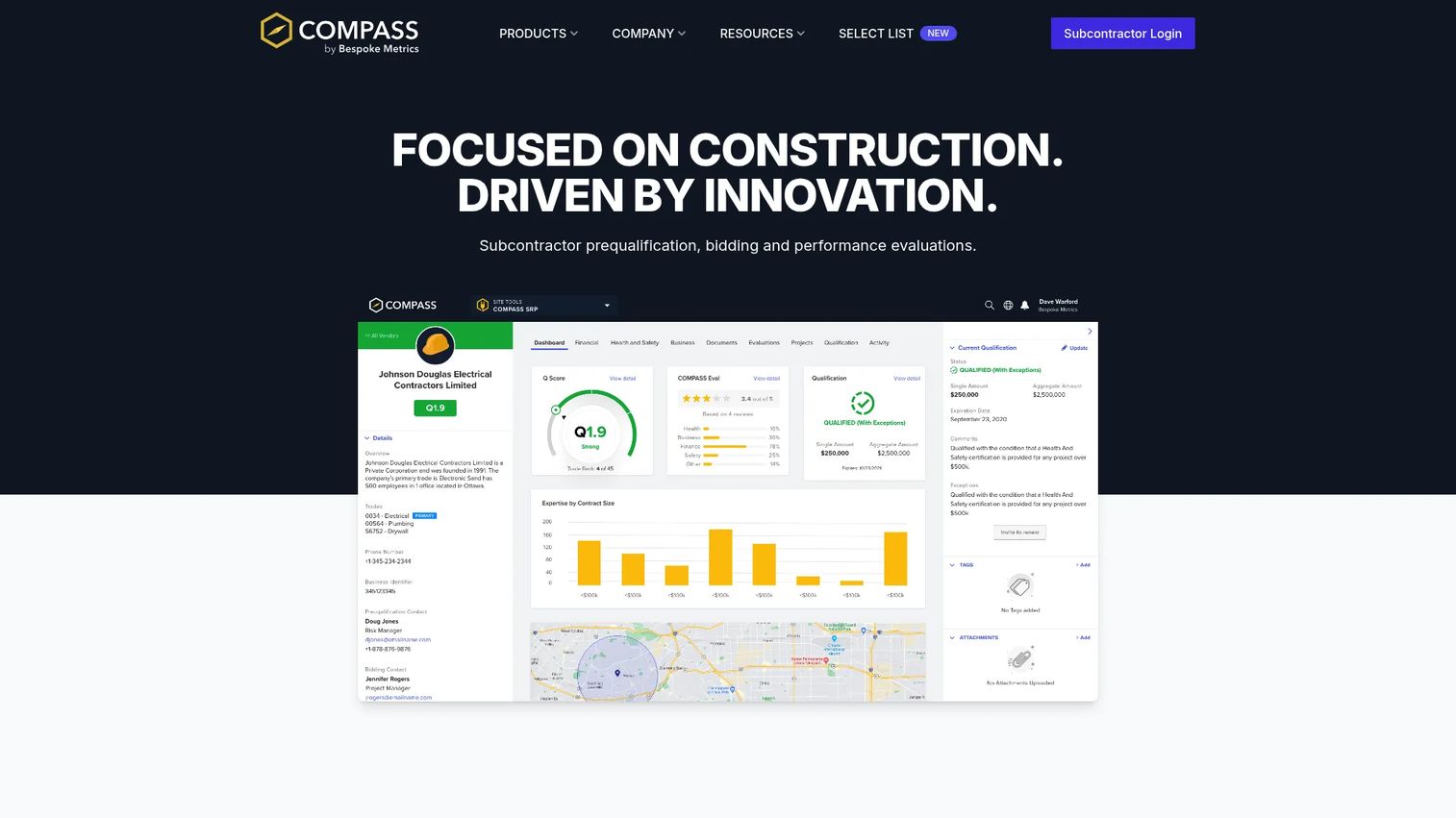
COMPASS by Bespoke Metrics is a construction prequalification, bidding, and performance-evaluation platform built around a standardized subcontractor qualification form called the COMPASS 1Form. Its Q Score provides a construction credit and risk assessment based on business, financial, and health-and-safety data. The platform integrates with Procore and supports secure data sharing with authorization controls, so subcontractors can share their qualification data across multiple general contractors.
Best for: General contractors managing subcontractor default exposure across a large trade base who need consistent financial and capacity intelligence rather than a different evaluation standard on every project.
Key features
- Standardized subcontractor qualification through the COMPASS 1Form
- Q Score construction credit and risk assessment
- Subcontractor bidding and performance evaluations
- Secure data sharing and authorization controls
- Procore and third-party integrations
Why choose COMPASS by Bespoke Metrics: Best when you need a repeatable financial-risk standard that does not shift by region or project team. Confirm whether financial assessment depth, broader compliance coverage, or platform integration is the primary driver before engaging.
COMPASS by Bespoke Metrics pricing: Pricing was not publicly listed on the Bespoke Metrics website at time of research. Contact the team directly for current figures.
G2 rating: 5.0/5
5. Autodesk TradeTapp
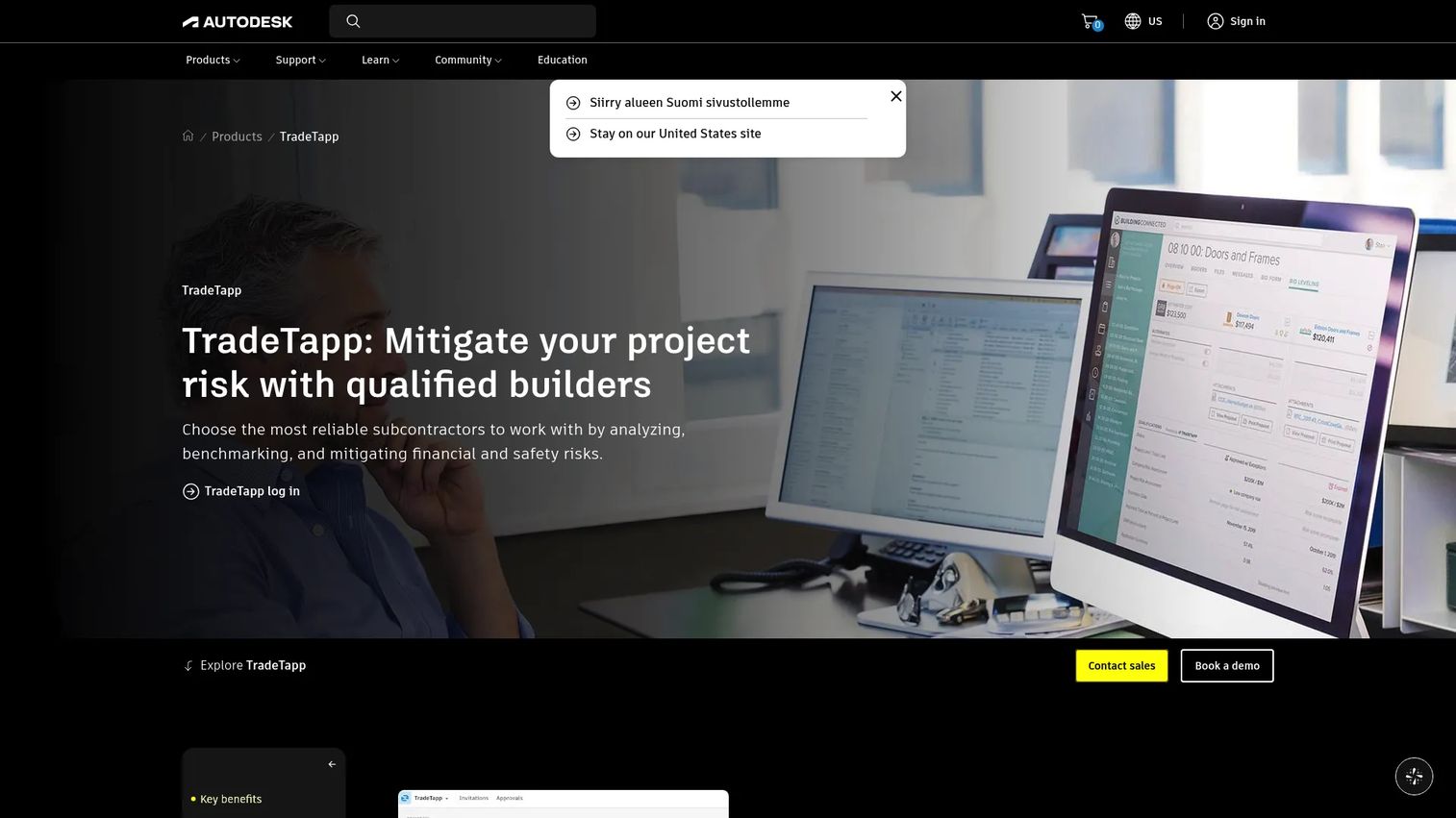
Autodesk TradeTapp is a subcontractor prequalification and risk-management tool built into the Autodesk Construction Cloud. It analyzes financial risk, safety performance, and project history to support subcontractor selection decisions. Custom questionnaires, approval workflows, financial-ratio calculations, and automated renewal requests are included, along with integrations to BuildingConnected Pro and Forma Build for teams already working in the Autodesk ecosystem.
Best for: Preconstruction and procurement teams that use Autodesk Construction Cloud as their system of record and want qualification data to flow into subcontractor selection without a separate platform.
Key features
- Custom questionnaires with financial-ratio calculations and approval workflows
- Project-specific risk assessments with mitigation recommendations
- BuildingConnected Pro and Forma Build integrations
- Automated invitations, follow-ups, and renewal requests
- ERP and accounting-system integrations for backlog data
Why choose Autodesk TradeTapp: A sensible shortlisting choice when Autodesk is already the preconstruction system of record. Confirm implementation scope, data migration requirements, and integration depth during evaluation, particularly if your team also uses financial tools outside the Autodesk suite.
Autodesk TradeTapp pricing: TradeTapp is part of the Autodesk Construction Cloud and requires a custom quote. Contact Autodesk or an authorized reseller for current pricing.
6. VelocityEHS Contractor Safety
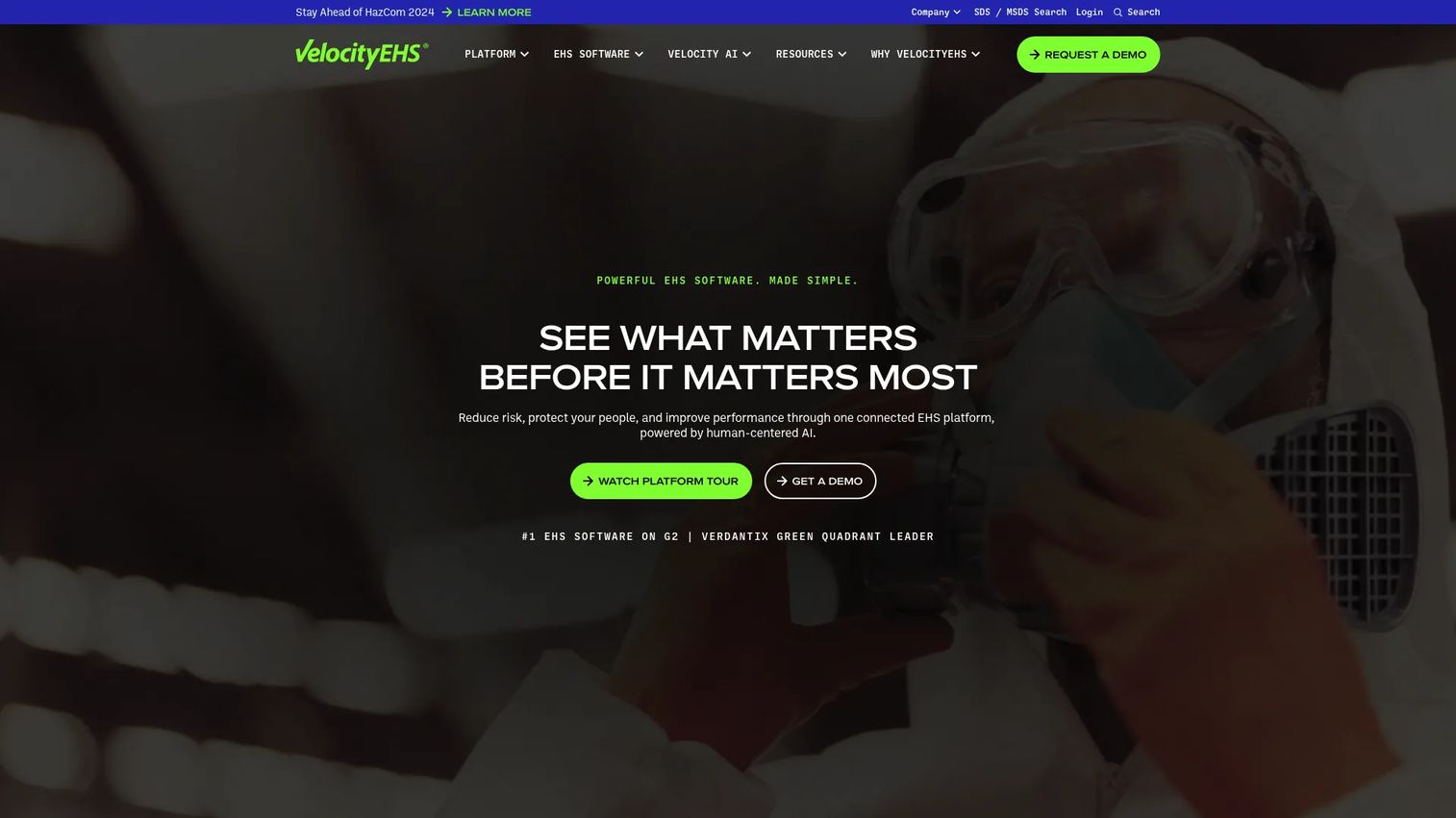
VelocityEHS Contractor Safety handles contractor qualification management with AI-driven review of certificates of insurance, OSHA logs, and safety records. The platform monitors compliance in real time, sends expiration alerts, and gives contractors a self-service portal for uploading documents, completing training, and submitting qualification questionnaires. Multilingual induction support and centralized contractor, subcontractor, visitor, and permit visibility make it a practical choice for multi-facility operations.
Best for: EHS-led organizations and industrial or manufacturing sites where contractor safety governance is the primary purchase driver and qualification must connect to a broader environmental, health, and safety program.
Key features
- AI-driven review of COIs, OSHA logs, and safety records
- Real-time compliance tracking with expiration alerts
- Contractor self-service portal for documents and training
- Multilingual induction and orientation support
- Centralized contractor, visitor, and permit visibility
Why choose VelocityEHS Contractor Safety: Best when contractor qualification is part of a larger EHS investment rather than a standalone construction-workflow need. Teams that also need deep financial subcontractor review should evaluate a specialist risk platform alongside it.
VelocityEHS Contractor Safety pricing: VelocityEHS does not publish a standard pricing page for the Contractor Safety module. Contact the team for a quote based on contractor volume and facility count.
G2 rating: 4.4/5
7. Oracle Textura
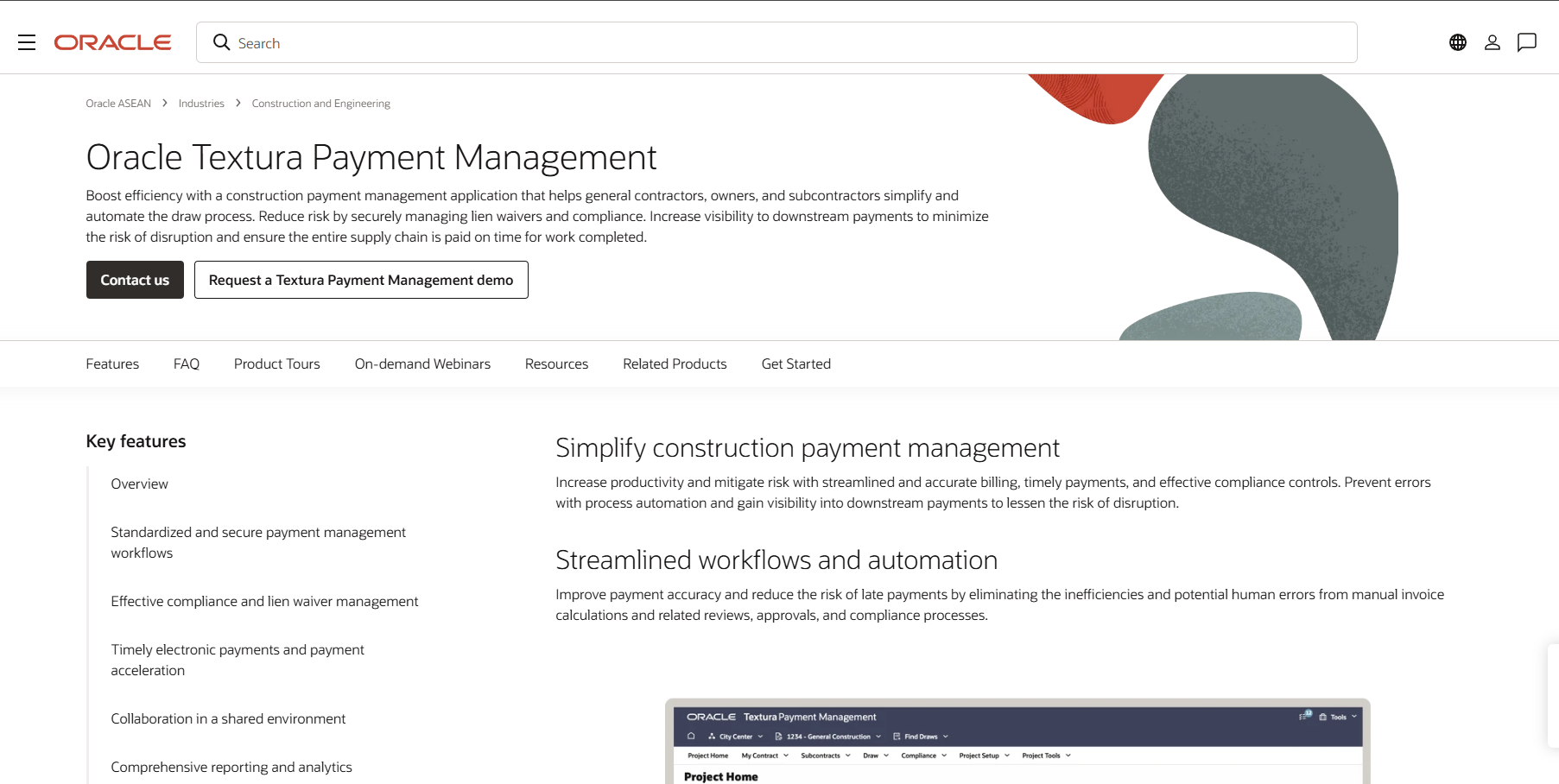
Oracle Textura is a cloud-based construction payment management platform that automates invoicing, compliance, lien waiver management, and disbursements across owners, general contractors, and subcontractors. Its contractor workflows sit inside Oracle's construction and enterprise ecosystem, making it most relevant for organizations where payment controls and procurement are already governed through Oracle infrastructure.
Best for: Enterprise owners and general contractors where payment operations, compliance, and contractor approval are formally connected and must integrate with Oracle construction and financial systems.
Key features
- Construction payment workflows and invoicing
- Compliance and lien waiver management with automated payment holds
- Electronic payments and optional payment acceleration
- Collaboration, reporting, and accounting-system integrations
Why choose Oracle Textura: Strongest fit when payment controls and contractor approval are inseparable processes within an existing Oracle environment. Confirm which prequalification capabilities are included in your specific Oracle configuration before assuming full scope.
Oracle Textura pricing: Oracle Textura uses a consumption-based model. Subcontractor contract fees are 0.22% of contract value with a maximum of $5,000 for qualifying projects. Lower-tier subcontractors pay a flat $100 per contract. Enterprise terms may vary.
8. Constrafor
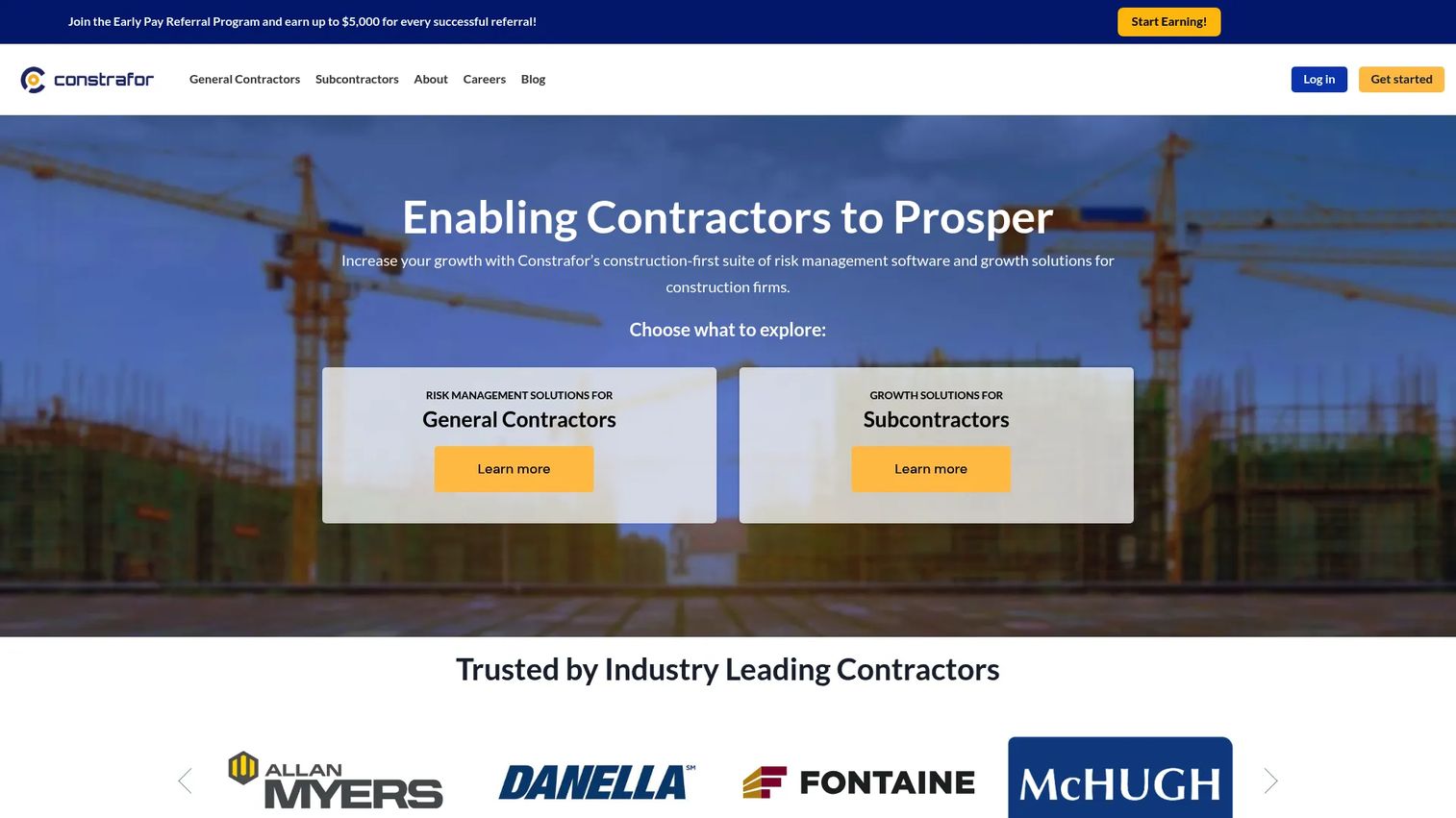
Constrafor provides construction-focused procurement, compliance, contract, invoice, payment, and subcontractor financing workflows. Its subcontractor management offering covers qualification, COI tracking, contract e-signature, invoice processing, and an Early Pay Program that lets subcontractors access early payment for a weekly fee. The Blue tier has a $0 monthly subscription, making it one of the few platforms where a general contractor can get started before committing to a paid plan.
Best for: General contractors looking to reduce fragmentation between compliance administration and payment operations, particularly those working with subcontractors that face cash-flow constraints between payment cycles.
Key features
- Subcontractor prequalification and procurement workflows
- COI and insurance compliance management
- Contract management and e-signature
- Invoice management and payment processing
- Early Pay invoice financing for subcontractors
Why choose Constrafor: Consider it when payment administration and subcontractor compliance are both friction points. If formal financial underwriting is a requirement, validate the risk-assessment depth during evaluation.
Constrafor pricing: The Blue tier starts at $0/month. The Gold tier is $1,750/month or $16,800/year. The Platinum tier is $3,500/month or $33,600/year. Early Pay fees vary by tier (0.4% per week on Blue, lower on paid tiers).
9. Jones
Jones (available at getjones.com) is an insurance compliance platform focused on certificate of insurance collection, verification, and contractor compliance automation. It reduces the manual work of chasing certificates by handling document requests, verifying coverage against requirements, and sending automated renewal reminders. Teams in construction, property management, and facilities management use it when expired or missing certificates are the primary operational failure point.
Best for: Teams where COI collection and verification consume significant staff time and where insurance compliance is the dominant contractor risk rather than financial capacity or safety performance.
Key features
- Certificate of insurance collection and verification
- Automated compliance reminders and renewal tracking
- Vendor onboarding workflows
- Document verification controls
- Contractor compliance reporting
Why choose Jones: Strong candidate when certificate chasing and coverage gaps are the main operational headache. Pair it with a deeper financial-risk process if contractor default assessment is also part of your evaluation requirements.
Jones pricing: Pricing is quote-based and was not publicly listed at time of research. G2 reviewers rate the product at 4.9/5, which reflects strong user satisfaction with the compliance automation workflow.
G2 rating: 4.9/5
10. Mitti by SafetyCulture
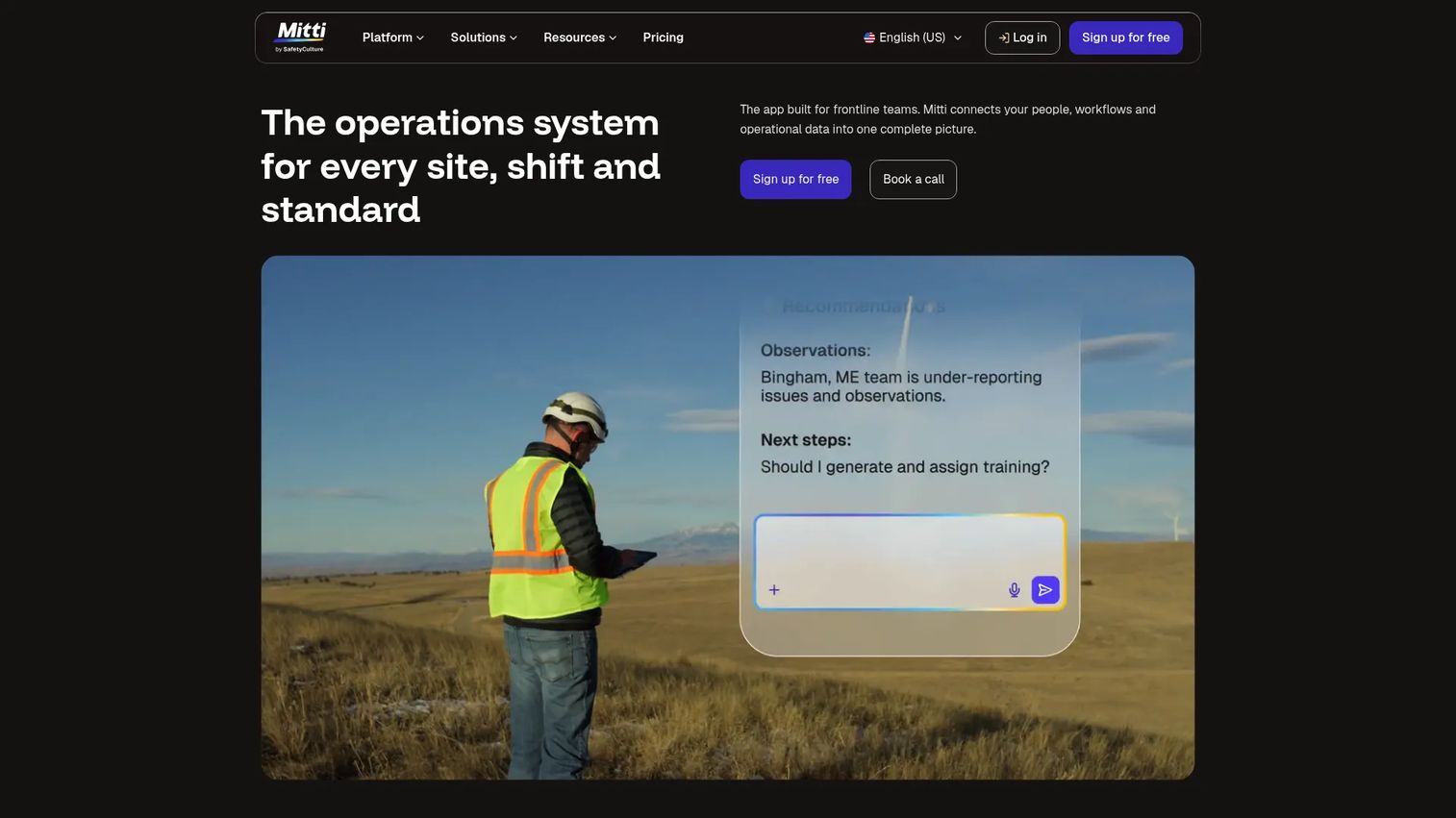
Mitti by SafetyCulture sits within SafetyCulture's broader frontline operations platform, which covers inspections, checklists, tasks, training, asset management, and workplace communications. The contractor-facing capabilities cover onboarding workflows, compliance document tracking, and certification management, all on a mobile-first platform built for field teams. A free tier makes it accessible for operations teams that want to standardize contractor onboarding without a large upfront commitment.
Best for: Operations teams that need a usable field workflow for contractor compliance and where safety programs, site operations, and contractor onboarding overlap within one platform.
Key features
- Digitized inspections, checklists, and contractor onboarding
- Mobile-first compliance management with task and issue tracking
- Training and certification record management
- AI-assisted course creation for mobile learning
- Reporting, analytics, and workplace communications
Why choose Mitti by SafetyCulture: A practical option when your team needs an operational platform that works on mobile and covers both daily safety activity and contractor onboarding. It is not a substitute for specialist financial due diligence or deep subcontractor risk assessment.
Mitti by SafetyCulture pricing: SafetyCulture's Free tier is $0/seat/month. The Premium tier is $24/seat/month billed monthly, with a Lite seat available at $5/seat/month when billed annually. Enterprise plans are custom-quoted.
11. Avetta
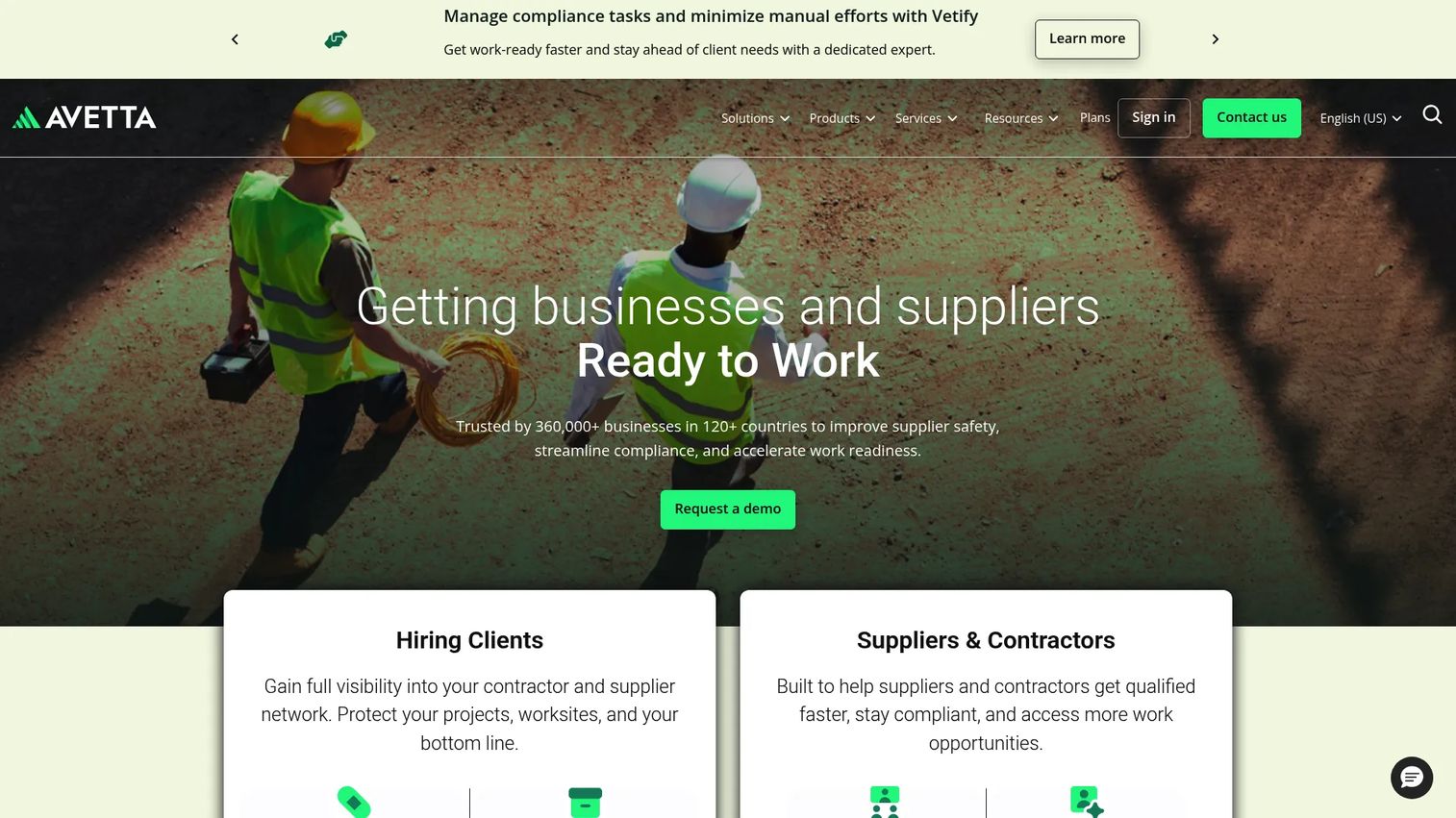
Avetta is a contractor and supplier risk-management platform covering prequalification, compliance document management, worker readiness, safety qualification, and supply-chain visibility. It is used by large enterprises managing contractor networks across multiple sites, business units, and supplier categories. Avetta offers Directory access and customized Client-Connected Plans, with pricing set through direct sales conversations.
Best for: Large enterprises with broad contractor and supplier networks that need consistent governance across safety, compliance, and supplier risk, with multi-site program reporting.
Key features
- Supplier and contractor prequalification
- Compliance task and document management
- Worker qualifications, training, and site-access management
- Risk and performance monitoring across contractor networks
- Enterprise reporting and analytics
Why choose Avetta: Strong candidate for organizations that need contractor governance at scale across many sites or business units. Factor in implementation depth, supplier adoption requirements, and change management when building your business case.
Avetta pricing: Avetta does not publish numeric pricing. Directory and Client-Connected plans are available; contact Avetta directly for a quote based on contractor volume and program scope.
G2 rating: 3.7/5
12. Contractor Compliance
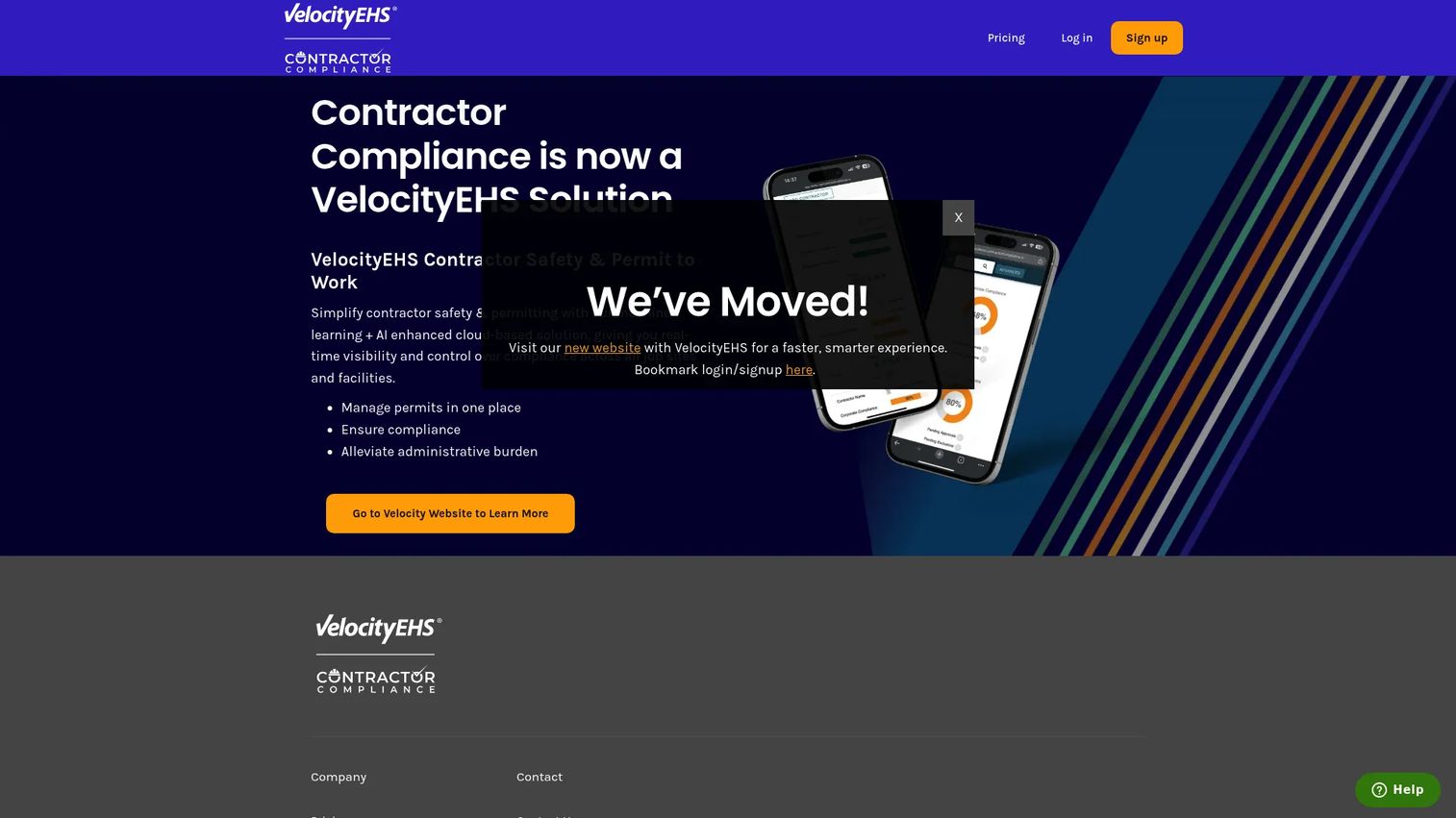
Contractor Compliance is a cloud-based contractor management platform now operating as a VelocityEHS solution. It handles contractor qualification forms, document collection, credential tracking, permit management, and automated notifications for expiring requirements. Hiring organizations access the platform at no annual cost, with contractor-side plans priced by the number of contractor companies using the platform.
Best for: Organizations that need to make compliance ownership visible and repeatable without deploying a full construction-suite platform, particularly where the current process runs through email and shared folders.
Key features
- Centralized contractor compliance management and onboarding
- Real-time compliance visibility and dashboards
- Automated notifications for expiring documents
- Permit management and document tracking
- Approval workflow controls
Why choose Contractor Compliance: Good fit when the primary goal is removing inbox-driven compliance checks and giving a non-founder team member clear ownership of contractor records. Confirm whether financial-risk depth is required alongside compliance tracking.
Contractor Compliance pricing: The Enterprise (hiring organization) plan is free at $0/year. Contractor-side plans start at $349/year (Essential), $799/year (Growth), $1,299/year (Premium), and $1,999/year (Commercial), billed annually.
13. Safety Plus

Safety Plus is an HSE supplier and services provider focused on safety equipment, wearables, gas detection, emergency and first-aid products, and related inspection and calibration services. Its offering spans head, eye, hearing, respiratory, and fall protection product categories, along with gas-detector calibration, breathing-apparatus service, and respiratory fit testing. Safety Plus operates primarily in oil and gas, construction, power, and firefighting sectors.
Best for: Organizations in safety-sensitive industries that need a supply partner for personal protective equipment, gas detection, and field safety services rather than a software-based contractor prequalification workflow.
Key features
- PPE across head, eye, hearing, respiratory, and fall protection
- Gas detection, emergency and first-aid, and lockout/tagout products
- Gas-detector calibration and breathing-apparatus service
- Fall-protection inspection and respiratory fit testing
- Torque-wrench calibration services
Why choose Safety Plus: Choose Safety Plus for HSE equipment and field safety services, not as a software platform for contractor prequalification or compliance tracking. If your requirement is a software-based contractor management workflow, evaluate the other platforms in this list.
Safety Plus pricing: Safety Plus operates as an equipment and services provider. Product and service pricing is not listed on the website. Contact the team directly for a quote.
14. GoContractor
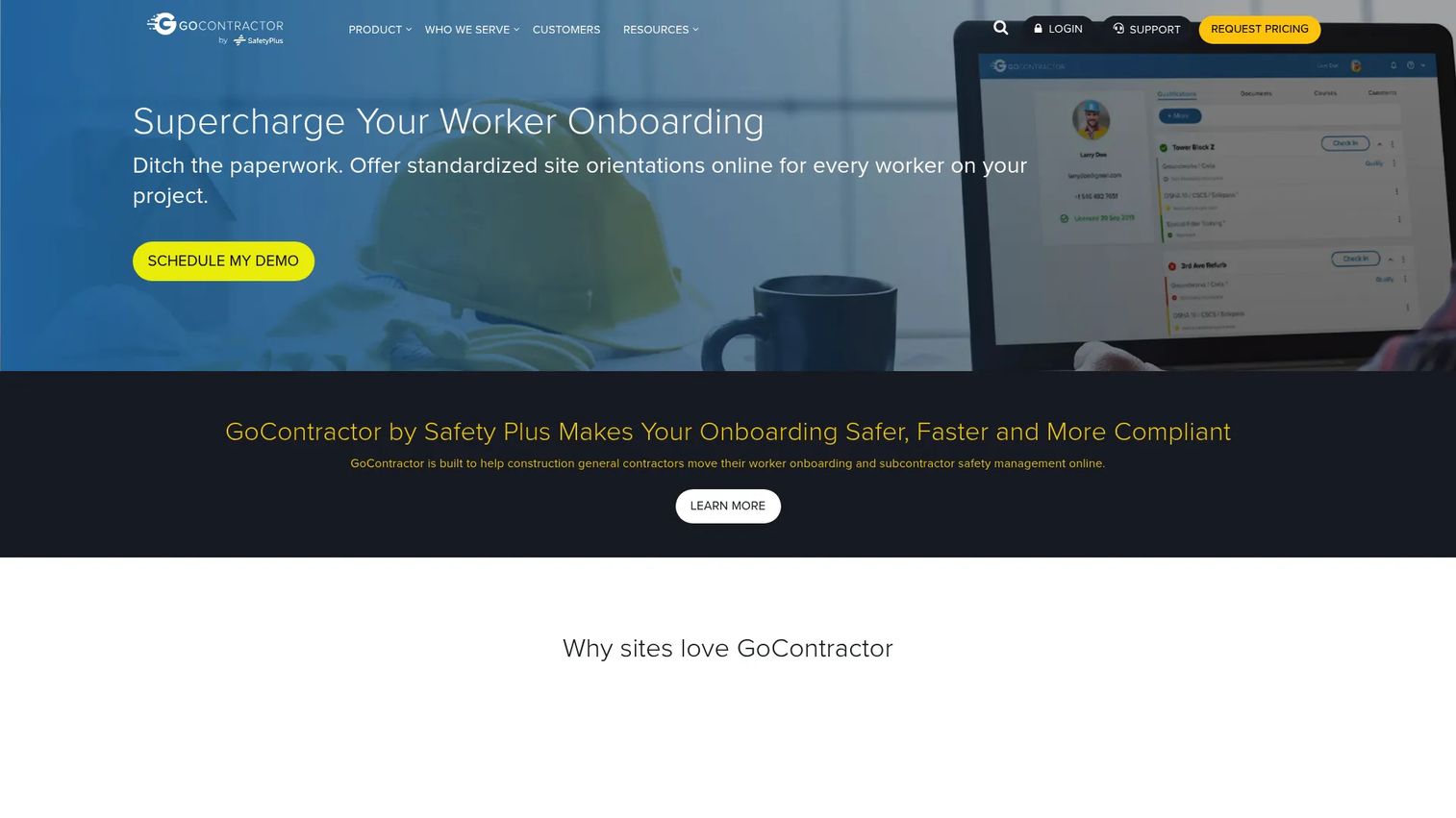
GoContractor is a construction contractor-management platform for online worker onboarding, safety training, document collection, qualification tracking, and site access control. Contractors and workers complete registration, role-specific orientations, and training online before arriving on site. QR-code credential verification enables in-field spot checks, and integrations with access-control and project-management systems extend the platform into the site environment.
Best for: Construction general contractors managing high contractor turnover, site access controls, and safety orientation requirements where the bottleneck happens at mobilization rather than at financial-risk review.
Key features
- Online worker and subcontractor registration with document collection
- Role-, project-, and language-specific orientations and training
- Central worker qualification database with expiration alerts
- Worker check-in/check-out and QR-code credential verification
- Integrations with access-control and project-management systems
Why choose GoContractor: Useful when the friction point is site readiness, training completion, and worker access rather than subcontractor financial assessment. Pair with a risk assessment platform if capacity and default exposure are also in scope.
GoContractor pricing: GoContractor uses custom pricing based on contractor volume and project scope. Request a quote through the purchase page.
G2 rating: 4.8/5
15. ISNetworld
ISNetworld is an established contractor and supplier information-management network used by large enterprises for qualification, compliance, safety, and risk monitoring. The platform collects health, safety, environmental, quality, insurance, cybersecurity, and sustainability data from contractors and suppliers. Worker-level training and qualifications, analytics, benchmarking, and the Empower mobile app for worker readiness extend the program beyond document collection.
Best for: Large, mature organizations with established contractor programs that need a common compliance process across many contractors, sites, and supplier categories, with formal third-party risk governance.
Key features
- Contractor prequalification and ongoing compliance monitoring
- Health, safety, environmental, quality, and insurance management
- Worker-level training and qualifications tracking
- Analytics, benchmarking, and Empower mobile app
- Multi-site program support across global regions
Why choose ISNetworld: Strong fit when a common contractor compliance standard across a large, distributed network is the priority. Evaluate supplier participation requirements, program design expectations, and the change-management burden for smaller trade partners during procurement.
ISNetworld pricing: ISNetworld uses an all-inclusive annual subscription plus a one-time setup fee. Contractor and supplier fees vary by workforce size and country; Hiring Client fees vary by global region. Contact ISNetworld for current figures.
G2 rating: 3.4/5
Considerations when choosing contractor prequalification software
Match the tool to the risk you are actually managing
A platform that collects documents well may not provide the financial or project-risk analysis needed for major subcontract awards. Map your most expensive contractor risk first: Insurance gaps, safety incidents, financial instability, or capacity constraints each point to a different platform category.
Confirm the source of truth for contractor data
Assess whether the platform becomes the contractor master record or syncs with an existing construction, ERP, or vendor-management system. Require clarity on data ownership, duplicate records, and who updates contractor information when it changes. Fragmented records create the same approval delays the software is supposed to eliminate.
Test the contractor experience before committing
Contractors must complete forms, upload documents, respond to renewal requests, and sometimes pay a participation fee. Run the invitation and onboarding flow with two or three actual trade partners before committing to a platform-wide rollout. Friction in the contractor experience creates exactly the incomplete records that a prequalification program is designed to prevent.
Price the operating model, not only the software license
Look beyond the platform fee. Account for implementation services, contractor or supplier fees, analyst review costs, integration work, internal administration time, and renewal management. Several platforms in this list price at the hiring-organization level but charge contractors separately, which affects adoption and total cost.
Set first-quarter success metrics before launch
Measure outcomes against a baseline from your prior process. Track approval-cycle time, percentage of compliant active contractors, insurance or credential gaps caught before mobilization, review hours per contractor, and the number of approval exceptions. These numbers tell you whether the platform earned its place in the approval workflow software stack.
Conclusion
Contractor prequalification software is a control system for risk, speed, and auditability. The category ranges from document-compliance trackers to analyst-supported financial underwriting platforms, and the right fit depends on the most expensive risk your current process fails to catch.
For construction teams running an integrated project platform, start with Procore or Autodesk TradeTapp. For financial and default risk depth, evaluate PreQual by Vertikal RMS or COMPASS by Bespoke Metrics. If safety and compliance governance is the primary driver, Highwire or Avetta covers the broadest scope. For insurance and credential tracking without a full construction-suite commitment, Jones or Contractor Compliance replaces inbox approvals with a repeatable process. For growing operations teams that need contractor onboarding and field readiness, GoContractor or Mitti by SafetyCulture deliver without the enterprise implementation overhead.
A practical next step: Identify the three risks your current process manages worst, then run the same real contractor record through each shortlisted platform during evaluation. The platform that surfaces the right risk signals fastest, with the least manual intervention, is the one your team will actually use.
FAQs about contractor prequalification software
Prequalification evaluates whether a contractor should be approved for a project or bid opportunity, typically covering financial stability, safety history, capacity, and insurance before the relationship begins. Compliance software often focuses on keeping required documents, certificates, and credentials current after approval. Some platforms cover both functions, but the depth of each varies significantly across the market.
A complete form covers company details, trade coverage, project history, financial information, current insurance, safety metrics, licenses, certifications, references, litigation disclosures, and current capacity. Match the depth of the form to the risk level of the project rather than collecting every possible document by default. A $5 million specialty trade award justifies more financial scrutiny than a routine maintenance contractor.
Software makes risk signals visible earlier and standardizes review decisions, which helps teams catch financial instability, thin backlog, or lapsed insurance before commitment. It does not guarantee contractor performance and does not eliminate the need for commercial judgment, project oversight, and contract controls alongside the qualification process.
Yes, particularly when a small team spends significant time chasing certificates, reconstructing contractor history, or reviewing forms that live in different inboxes. Smaller firms should prioritize simple onboarding, pricing that fits contractor volume, and integrations that eliminate duplicate data entry. Platforms like Contractor Compliance offer a free tier for hiring organizations that reduces the cost barrier.
The right integration set depends on where contractor records, bids, purchase orders, and payment data currently live. Common integration needs include construction management platforms, bidding systems, ERP and accounting tools, EHS platforms, document storage, and identity or access systems. Confirm that the integrations are live and maintained rather than listed without documentation.
A focused document-compliance rollout with a clean contractor list can move in four to eight weeks. A cross-region risk program with financial reviews and ERP integration typically takes three to six months. The variables are contractor-record cleanup, form design, approval workflow configuration, the number of subcontractors being onboarded, and how much the new workflow diverges from existing processes. Set a realistic scope before signing a contract.
Some programs are owner-funded, some are contractor-funded, and some use a shared-cost model. Evaluate the total cost against the adoption risk, particularly for smaller trade partners who may resist a paid participation requirement. A contractor-funded model can reduce your platform cost but may also limit the pool of qualified firms willing to participate, which is a risk worth modeling before committing.
Track approval-cycle time, administrative review hours, document-compliance rates, contractor exceptions requiring manual escalation, and risk issues discovered before project start. Compare results against a baseline from the prior process. For a founder or COO framing this for a board conversation, the clearest metric is the number of insurance gaps or safety issues caught before mobilization versus after, because post-commitment discovery is where the real cost lives.