You collected another season of yield data. Machine logs, soil samples, drone flights, satellite passes, scouting notes. Now it sits in five different formats across three tools, and nobody can turn it into a prescription before planting starts.
That gap between data collection and decision is where most farm software stalls. Not the sensors. Not the imagery. The workflow that connects a field observation to a variable rate map to a machine that actually executes it.
The market keeps growing because that gap is expensive. Global precision agriculture software is projected to grow from about USD 5.82 billion in 2026 to USD 12.29 billion by 2035, an 8.6% CAGR, according to MarketGrowthReports (2026). More than 72% of large-scale farms globally now use at least one precision agriculture software module for crop monitoring, yield mapping, or field analytics, per the same report. In the U.S., more than 79% of farms larger than 500 acres deploy precision agriculture software for planting optimization and yield forecasting.
Adoption at that scale means the question is no longer whether to use software. It is which platform matches how your operation actually moves data from field to decision to equipment. That is a systems question, not a feature checklist. The right tool depends on whether you lead with imagery, prescriptions, equipment integrations, or cross-season reporting.
What's inside
This guide is for product-minded farm operators, agronomists, and ag-tech teams evaluating precision farming software as a workflow decision, not a feature dump. We selected eight platforms based on four criteria that matter when you are stitching a farm stack together: mapping and analytics depth, scouting and prescription workflows, equipment and data interoperability, and how well each tool scales across fields, teams, and seasons. Each section covers what the tool does best, who it fits, verified pricing where public, and the workflow maturity it suits. No single tool wins every category, so we frame each by the problem it solves.
TL;DR
- Best for drone and satellite crop analytics: Agremo turns aerial imagery into stand counts, health maps, and prescription layers.
- Best for mapping and agronomic decision support: GeoPard covers planning, prescribing, scouting, and ROI analysis in one workflow.
- Best for local-first data management: Ag Leader SMS keeps yield and field data organized on the desktop with broad file compatibility.
- Best for equipment-linked operations: John Deere Operations Center syncs machine and field data at no cost to create an account.
- Best for broad digital farming adoption: Climate FieldView pairs field health snapshots with prescription creation and a free Basic tier.
- Best for below-ground insight: CropX combines soil sensors with agronomic recommendations for irrigation and nutrition.
What is precision agriculture software?
Precision agriculture software is a class of platforms that collects field, machine, imagery, and yield data, then turns it into maps, prescriptions, and analytics that guide farm decisions at the sub-field level. Instead of treating a field as one uniform block, it manages variability across zones so inputs like seed, fertilizer, and water match what each part of the field actually needs.
A precision agriculture platform typically spans several connected capabilities. Understanding these helps you evaluate where a tool is strong and where you may need to combine it with another.
- Field mapping and geospatial farm data: Boundary creation, zone management, topography, and multi-layer map comparison built on geospatial data.
- Crop monitoring software: Satellite and drone imagery, vegetation indices, plant health tracking, and stand counts for remote scouting.
- Field scouting software: Mobile observation logging, issue flagging, and location-tagged notes that feed back into the map.
- Variable rate application and prescription maps: Zone-based scripts for seeding, fertilizer, and spraying that export to compatible equipment.
- Yield analytics software: Harvest data cleaning, yield mapping, and multi-season reporting to measure what actually worked.
- Equipment integrations and interoperability: Connections to machinery, monitors, and other platforms so data flows without manual re-entry.
- Farm management software: Work orders, records, personnel, and finance tracking that tie agronomy to operations.
The strongest platforms connect these so a scouting note informs a prescription, the prescription reaches the machine, and the resulting yield data closes the loop for next season.
When to use precision agriculture software
Different operations reach for these tools at different points. Match the trigger to your situation before comparing features.
Turn imagery into field decisions
If you fly drones or pull satellite passes and struggle to translate pixels into action, crop monitoring software earns its place first. Tools built around imagery convert vegetation indices and stand counts into health maps and prescription layers, so remote scouting drives real interventions instead of a folder of pretty pictures.
Build and execute prescriptions
When you are ready to vary inputs by zone, prescription-focused platforms matter most. Variable rate application depends on clean zones, agronomic logic, and export formats your equipment reads. This is where mapping depth and equipment integrations decide whether a prescription ever reaches the planter.
Close the loop with yield analytics
If you already collect harvest data but cannot compare seasons or prove what worked, yield analytics software is the priority. Multi-season reporting and clean yield maps turn raw monitor logs into decisions about seed, inputs, and field investment. This is the workflow maturity stage where reporting depth separates platforms.
Comparison table
Here is how the eight platforms compare across intent, key use case, pricing, and rating. Use it to shortlist two or three, then read the full sections for workflow fit.
| # | Product | Intent | Key use case | Pricing | G2 rating |
|---|---|---|---|---|---|
| 1 | Agremo | Imagery analytics | Drone and satellite crop monitoring, prescription maps | Free trial; PRO $1,950/year | Not enough reviews |
| 2 | GeoPard | Mapping and decision support | Zone creation, VRA maps, agronomic analytics | Free 30-day trial; from $20/month | 4.0/5 |
| 3 | Ag Leader SMS | Local data management | Desktop yield data organization, prescriptions | Not publicly listed | Not listed |
| 4 | John Deere Operations Center | Equipment-linked ops | Machine and field data sync, work planning | Free account | Not listed |
| 5 | Climate FieldView | Digital farming | Field health, prescriptions, data visualization | Basic $0/year; Plus $649/year | 4.5/5 |
| 6 | FJDynamics FMS | Farm workflow management | Task planning, prescription maps, operations | From €269/year | Not listed |
| 7 | Trimble Ag Software | Mixed-fleet operations | Field records, prescriptions, fleet sync | Not publicly listed | Not listed |
| 8 | CropX | Soil and agronomy | Sensor-based irrigation and nutrition insights | Quote-based | Not enough reviews |
1. Agremo
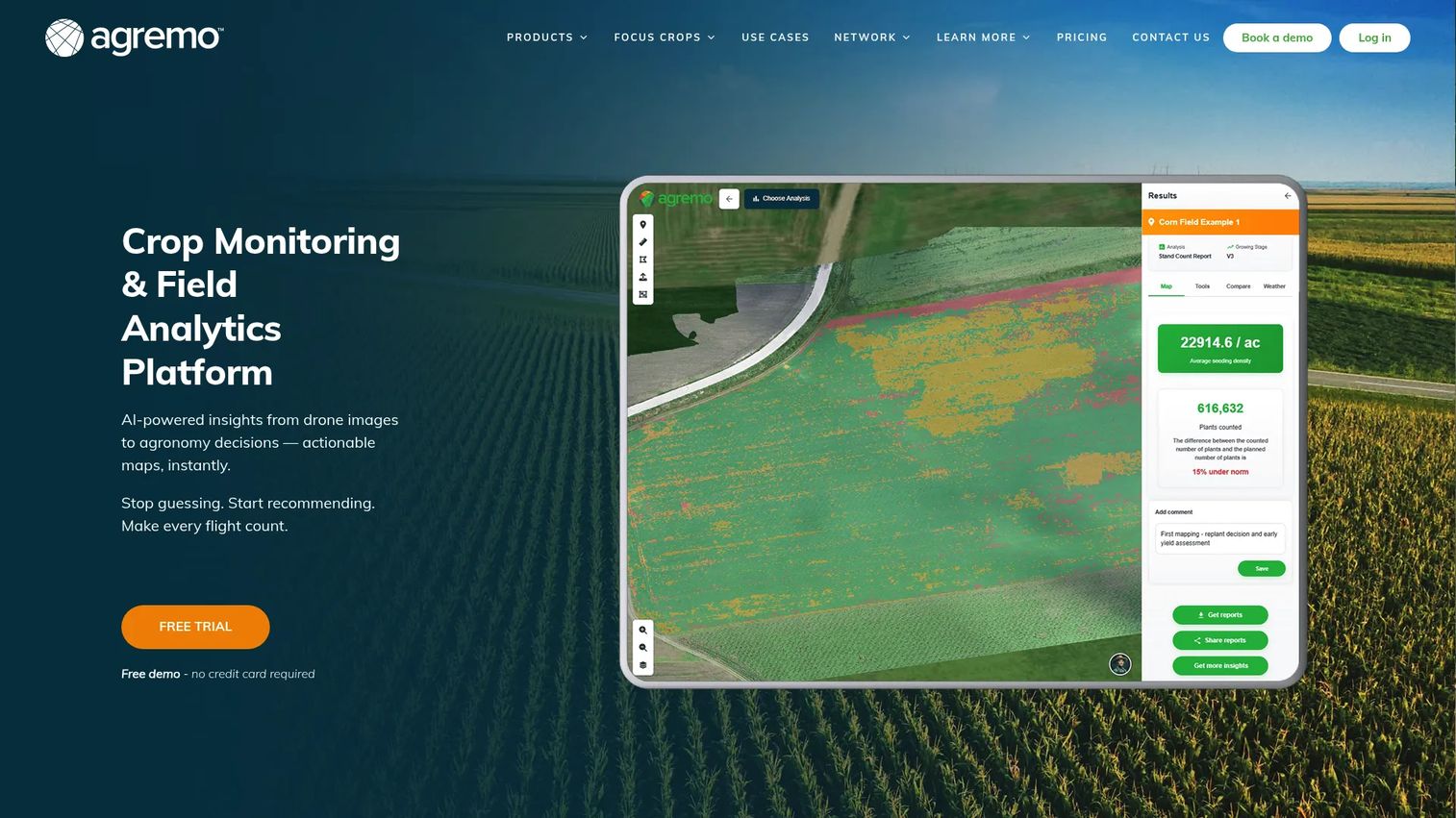
Agremo is cloud-based precision agriculture software built around drone and satellite imagery. It turns aerial captures into crop analyses, health maps, and prescription layers, so teams that already fly fields can convert imagery into decisions. If your workflow starts with a drone or a satellite pass rather than a machine log, Agremo is where that data becomes actionable.
The platform handles image stitching, a range of crop analyses, reporting, and prescription map generation in one place. Its AI stand count and plant health monitoring reduce the manual work of counting plants or eyeballing vegetation indices across large fields. Map comparison and zone management let you track how a field changes across flights and seasons, which supports both remote scouting and variable-rate planning.
Best for: Agricultural teams and agronomists who need drone or satellite crop analytics feeding into prescription maps.
Key strengths
- Imagery-driven crop monitoring: Stitching, analyses, and reporting turn raw aerial captures into field-level insight.
- AI stand count and health monitoring: Automated plant counting and vegetation indices cut manual scouting time.
- Zone and map comparison tools: Track change over time and build variable-rate and spraying layers.
Why choose Agremo: If imagery is the center of your operation, Agremo specializes in the part where most tools are thin: turning captures into stand counts, health maps, and spray or seed prescriptions. It fits teams whose scouting is increasingly remote and who want repeatable analytics rather than one-off image reviews.
Agremo pricing: Agremo offers a free Trial, then a PRO plan at $1,950/year and a 3-Year Plan at $3,900, per its pricing page. Specialized plans include Starter at $1,950/year, Field Trials Pro at $3,450/year, and Forestry at $2/acre, with an Enterprise tier available by quote.
2. GeoPard
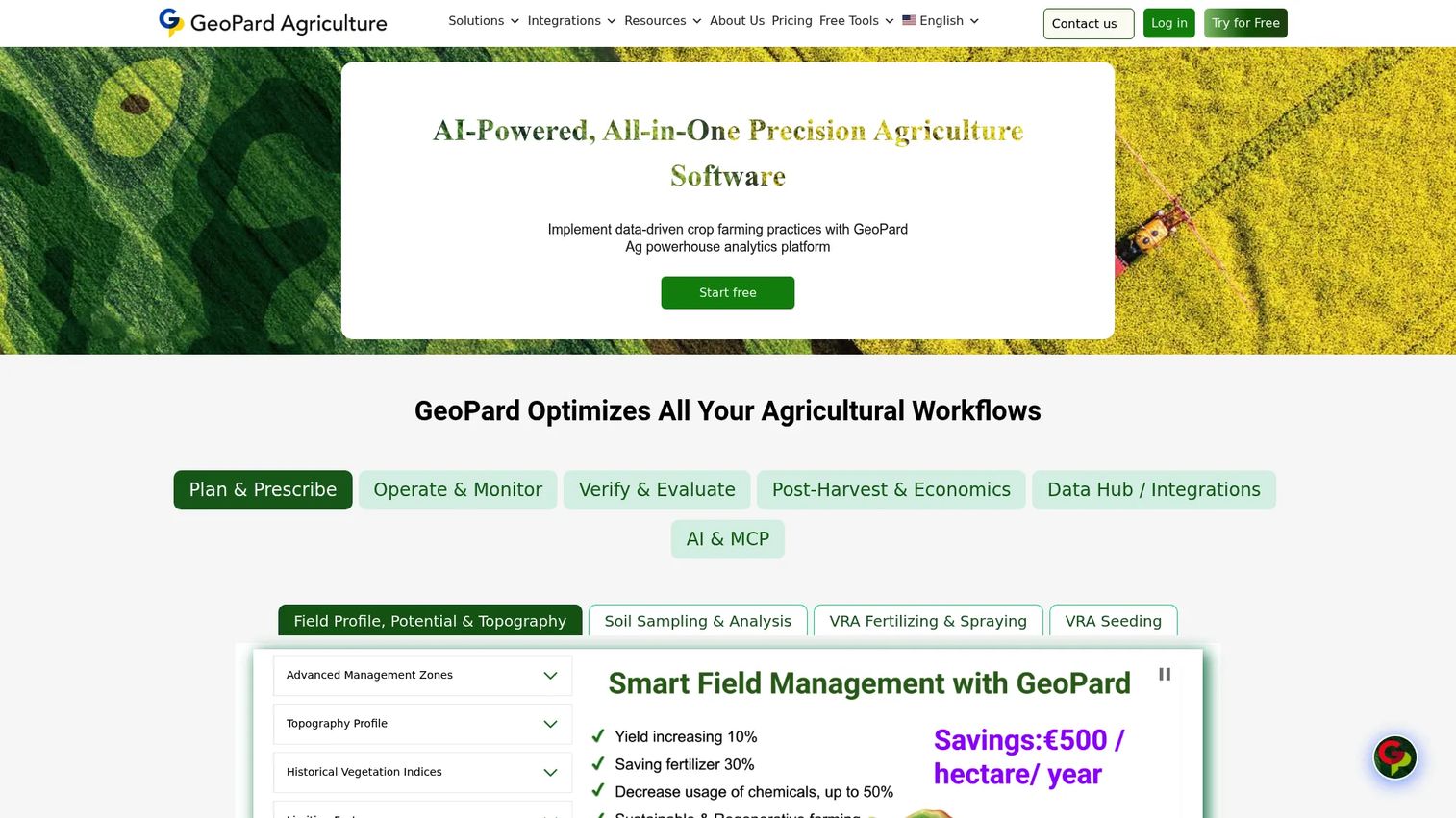
GeoPard is AI-powered precision agriculture software that spans planning, prescribing, scouting, trials, and post-harvest ROI analysis. It is built around a full workflow rather than a single step, which makes it a strong fit for agribusinesses that want mapping, prescriptions, and analytics living in one system. GeoPard rated 4.0 out of 5 on G2 from users who value its analytics depth.
The platform generates field potential and topography maps, then layers variable rate application maps and multi-layer analytics on top. Its data import and export supports agronomic sources including John Deere, which matters when you are pulling machine and monitor data into a shared workspace. Profit and ROI mapping close the loop by showing which zones and decisions actually paid off, useful for teams that treat each season as an experiment worth measuring.
Best for: Agribusinesses and advisors needing mapping, zone creation, and field analytics across the full crop cycle.
Key strengths
- Full-cycle workflow coverage: Planning, prescribing, scouting, and verification in one platform.
- VRA and multi-layer analytics: Variable rate maps built on topography, potential, and agronomic layers.
- Broad data interoperability: Import and export across agronomic sources, including John Deere data.
Why choose GeoPard: GeoPard suits teams that want geospatial farm data, prescriptions, and profit analysis connected rather than scattered across tools. Its ROI mapping is a differentiator for operations that measure the return on every variable-rate decision.
GeoPard pricing: GeoPard offers a 30-day free trial, pay-as-you-go monthly pricing starting at $20/month, and an annual subscription starting at $200/year, per its pricing page. An Enterprise plan is available with custom pricing.
3. Ag Leader SMS
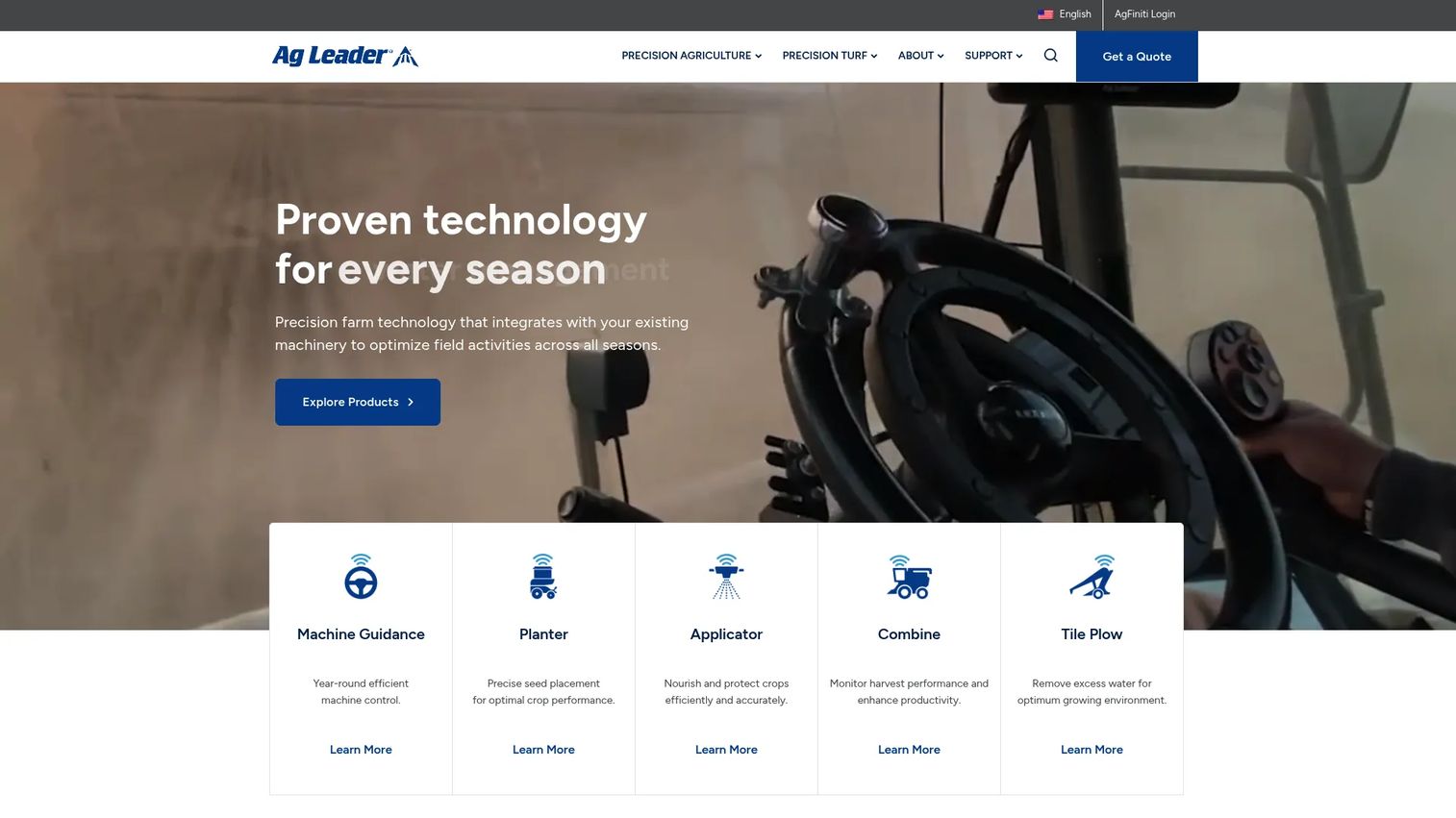
Ag Leader SMS is spatial data management software for precision agriculture, built as a desktop, local-first tool. It appeals to operations that want to own their data on their own machine rather than route everything through the cloud. SMS imports most precision ag file types, which makes it a practical hub for farms running mixed equipment and monitors.
The software organizes data by farm, field, year, and operation, giving you a clean structure for multi-season yield data and records. It handles field and guidance line management, and its advanced tier supports variable rate prescriptions and deeper analysis. For teams that value offline access and local backups over constant connectivity, SMS keeps the full data set under your control.
Best for: Precision ag teams that want to manage and analyze field and yield data in one desktop tool with broad file compatibility.
Key strengths
- Broad file import: Reads most precision ag file types across brands and monitors.
- Structured data organization: Farm, field, year, and operation hierarchy for multi-season records.
- Prescriptions and advanced analysis: Variable rate prescriptions and deeper analytics in the advanced tier.
Why choose Ag Leader SMS: SMS fits operations that prioritize data ownership and offline workflows. If you want a local system of record that reads nearly any file type and structures years of yield data cleanly, it earns its place as the desktop hub of the stack.
Ag Leader SMS pricing: Ag Leader documents SMS Basic and SMS Advanced licenses, plus Advanced modules available on annual subscriptions, but no public price is listed on the pages reviewed. A demo period is available before purchase.
4. John Deere Operations Center
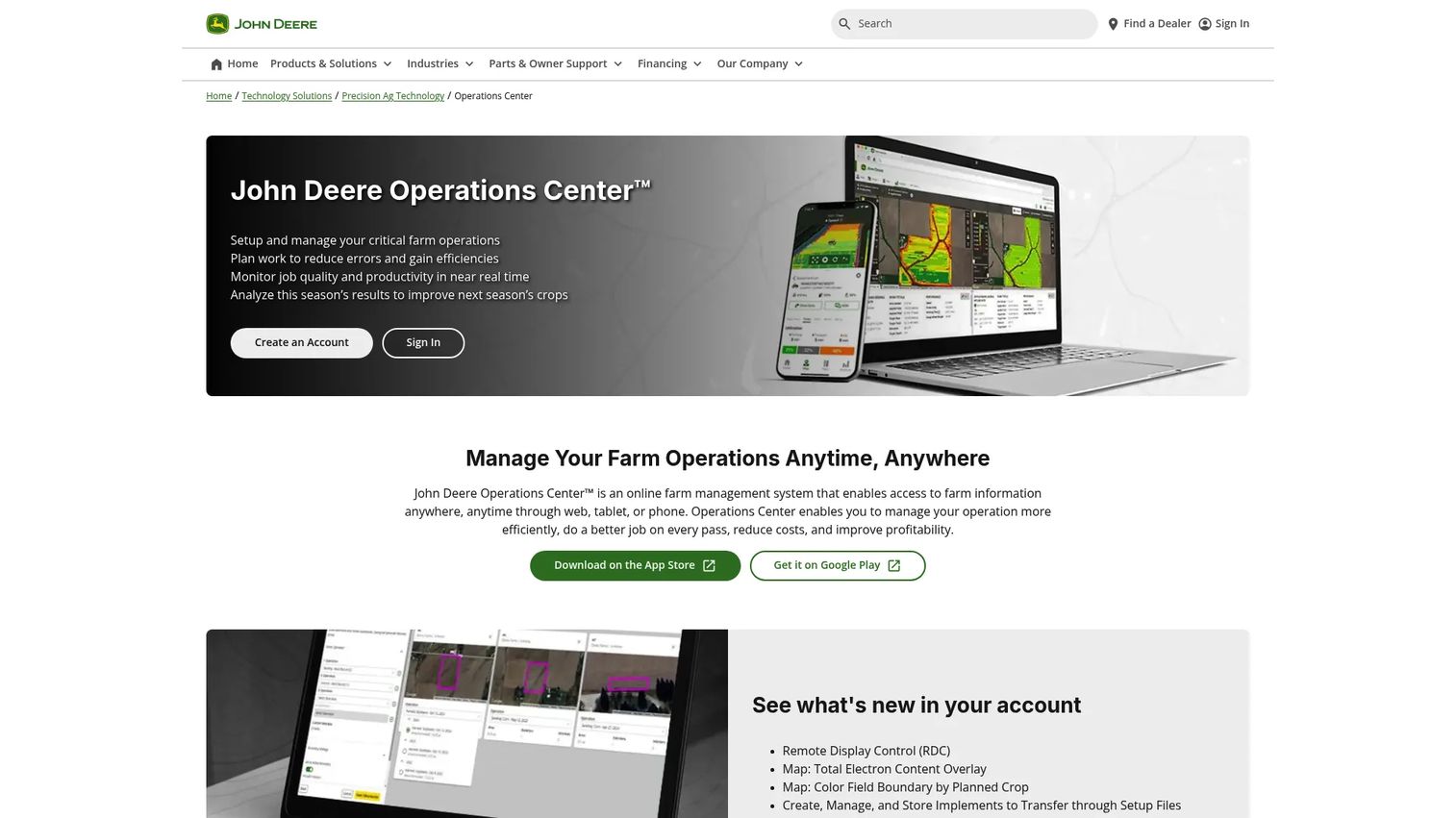
John Deere Operations Center is a free cloud-based farm management system for monitoring, organizing, analyzing, and sharing farm data. Its center of gravity is equipment connectivity: if you run John Deere machines, field data syncs into a shared workspace with minimal manual entry. That machine-linked agronomy is the reason it anchors many farm stacks.
The platform lets you manage fields, equipment, work plans, and field operations from web or mobile. It tracks machine location, status, and performance in near real time, which supports both logistics and agronomic record-keeping. Because it is free to create and use, it lowers the barrier to centralizing data, then connects outward to a broad ecosystem of compatible tools and partners for prescriptions and analytics.
Best for: Farm operations teams that want a free central hub for ag data and machine monitoring across web and mobile.
Key strengths
- Equipment connectivity: Near real-time machine location, status, and performance tracking.
- Cloud workflow management: Fields, equipment, work plans, and operations in one workspace.
- Broad ecosystem integrations: Connects to compatible partner tools for prescriptions and analytics.
Why choose John Deere Operations Center: For equipment-centric operations, Operations Center removes friction from getting machine and field data into one place. Its interoperability and no-cost account make it a natural backbone that other precision ag tools plug into.
John Deere Operations Center pricing: There is no cost to create an Operations Center account, and no payment is required to use it, per John Deere's FAQ. Connected hardware, subscriptions, and partner tools may carry their own costs.
5. Climate FieldView
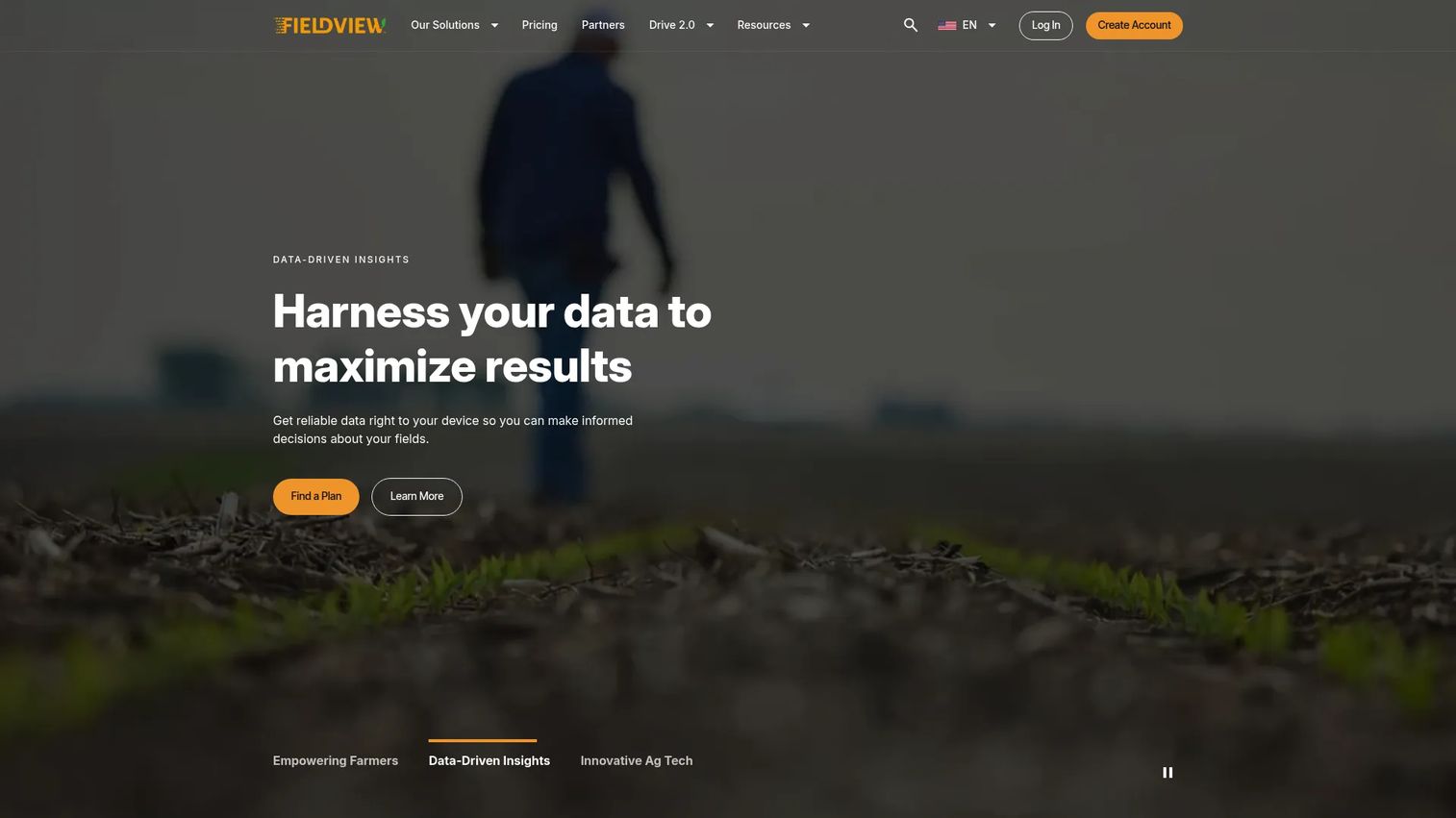
Climate FieldView is digital farming software for collecting, visualizing, and analyzing field data. It has broad adoption and pairs field health snapshots with yield analytics, weather insights, and secure data ownership. For operations that want cloud-based agronomy visibility across many fields, FieldView is a common starting point. It holds a 4.5 out of 5 rating on G2.
The platform collects and visualizes field data, then supports prescription creation and scripting so you can move from insight to variable-rate action. Scouting, imagery, and weather tools round out the field-level picture, and data sync keeps records consistent across devices. Its free Basic tier makes it easy to start visualizing data before committing, while the Plus tier adds capabilities for teams ready to scale.
Best for: Farm operations wanting an all-in-one digital farming platform for field visualization and prescriptions.
Key strengths
- Field data visualization: Collect and visualize imagery, yield, and field health in one view.
- Prescription creation and scripting: Build variable-rate scripts from field insight.
- Scouting, imagery, and weather: Integrated tools for a complete field-level picture.
Why choose Climate FieldView: FieldView suits teams that want broad, accessible digital farming with a low barrier to entry. Its free Basic tier and strong data visualization make it a practical foundation for real-time insights, with prescriptions layered on as the operation matures.
Climate FieldView pricing: Two public plans are listed: Basic starts at $0/year and Plus starts at $649/year, per Climate's pricing page. The free Basic tier lets you start collecting and visualizing data before upgrading.
6. FJDynamics FMS
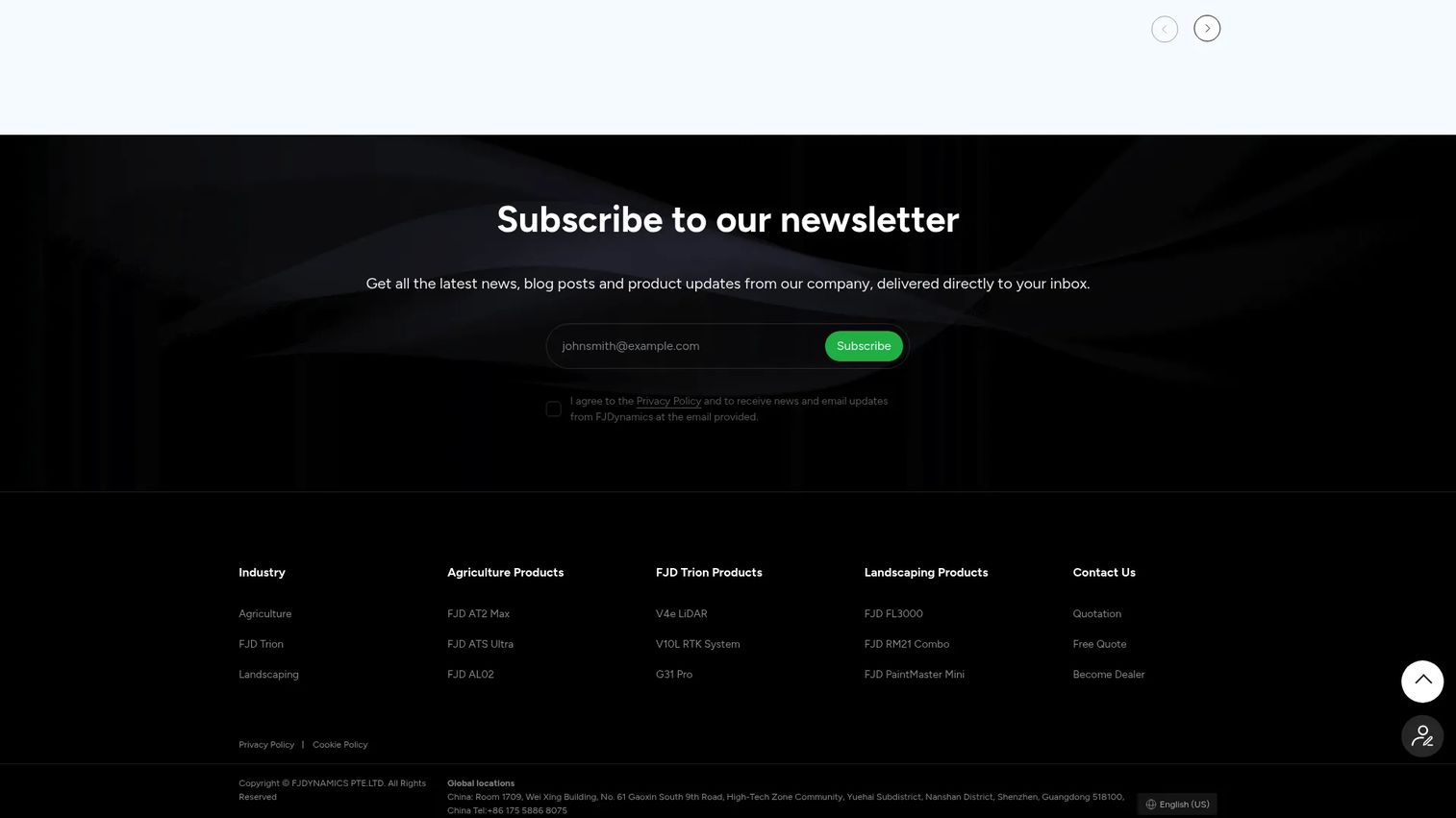
FJDynamics FMS is farm management software covering precision agriculture planning, execution, monitoring, and reporting. It leans toward all-in-one farm workflow management, tying agronomy to the operational side of running a farm. For operators who want prescriptions, task planning, and business records in one system, FJDynamics offers broad coverage.
The platform manages equipment, fields, materials, personnel, and finance, which extends it beyond agronomy into operations. Its intelligent task planning and route optimization support real-time operational decisions, useful for teams coordinating machines and labor across many fields. On the precision side, it builds prescription maps including soil, yield, and satellite image prescriptions, with import and export to move data in and out.
Best for: Farm operators needing centralized digital planning and prescription workflows alongside operations management.
Key strengths
- Full farm management: Equipment, fields, materials, personnel, and finance in one system.
- Intelligent task planning: Route optimization and task tracking for field operations.
- Multiple prescription types: Soil, yield, and satellite image prescriptions with import and export.
Why choose FJDynamics FMS: FJDynamics fits operations that want agronomy and business management under one roof rather than in separate tools. Its prescription range and task planning suit teams coordinating both fieldwork and operational logistics.
FJDynamics FMS pricing: A first-party store listing shows an FMS Pro activation license at €269/year, with an ADV variant also available for one year. Some products may require contacting sales, but FMS Pro pricing is publicly visible.
7. Trimble Ag Software
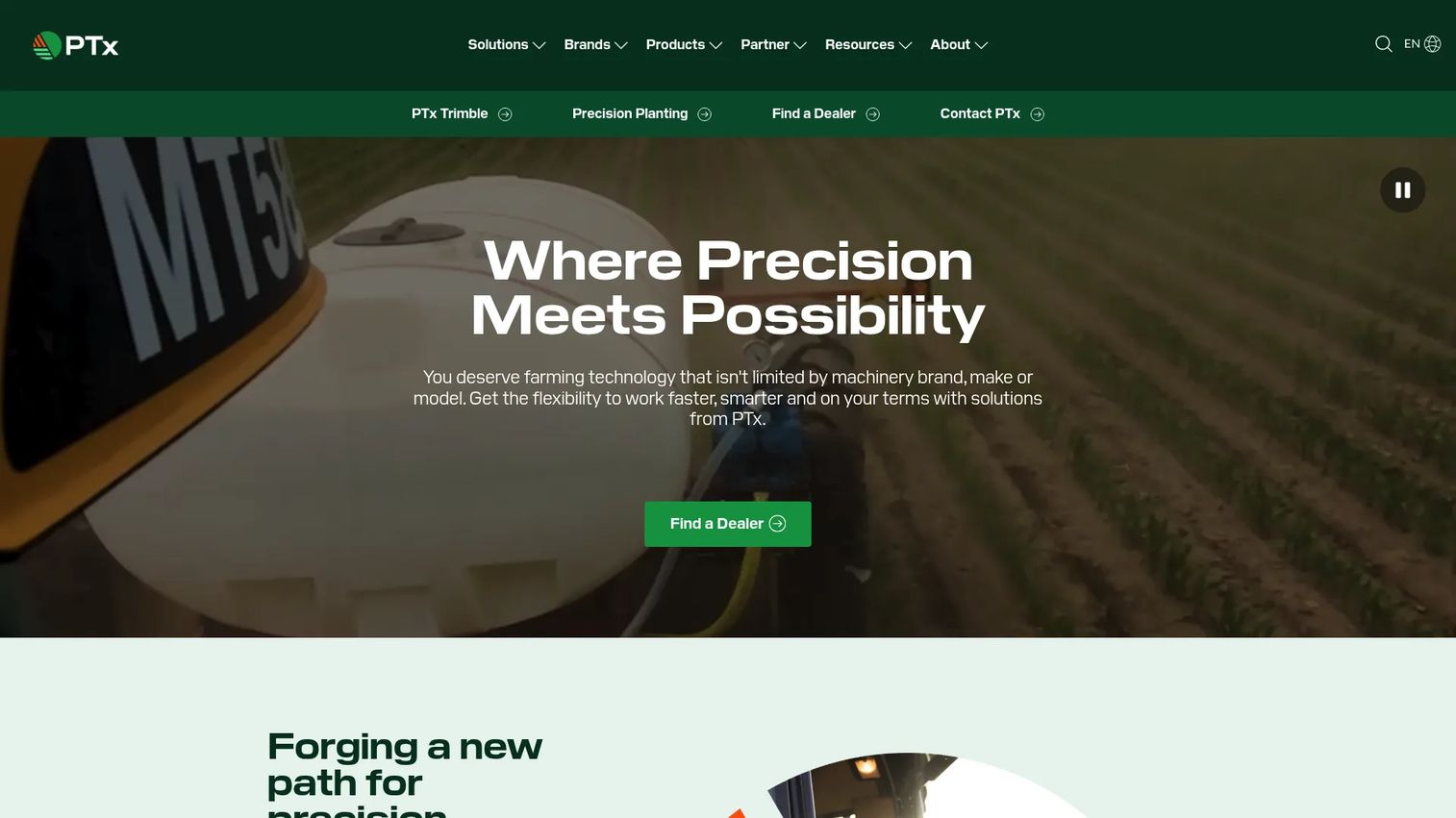
Trimble Ag Software is farm operations management software for farmers and advisors, now presented under PTx Trimble's digital farming solutions. It centers on field-level decision support and equipment alignment, which makes it a strong fit for mixed-fleet farms that need agronomic records and machine data in one place.
The platform manages farm operations across web, mobile, and desktop, so records stay consistent whether you are in the office or the cab. Work orders and task tracking keep field operations organized, while prescriptions, field records, and fleet and data synchronization tie agronomy to equipment. For operations running equipment from multiple brands, Trimble's positioning around interoperability is the draw.
Best for: Mixed-fleet farms that need centralized field operations and agronomic record-keeping across devices.
Key strengths
- Cross-device operations: Manage farm operations across web, mobile, and desktop.
- Work orders and task tracking: Keep field operations and labor organized.
- Prescriptions and fleet sync: Field records and data synchronization across mixed equipment.
Why choose Trimble Ag Software: Trimble suits farms and advisors managing varied equipment who want records, prescriptions, and fleet data aligned. Its cross-device access supports teams that split work between the field and the office.
Trimble Ag Software pricing: The original Trimble Ag Software domain redirects to PTx Trimble pages, and no public pricing was verified on the brand site during review. Contact the vendor for current plan and licensing details.
8. CropX
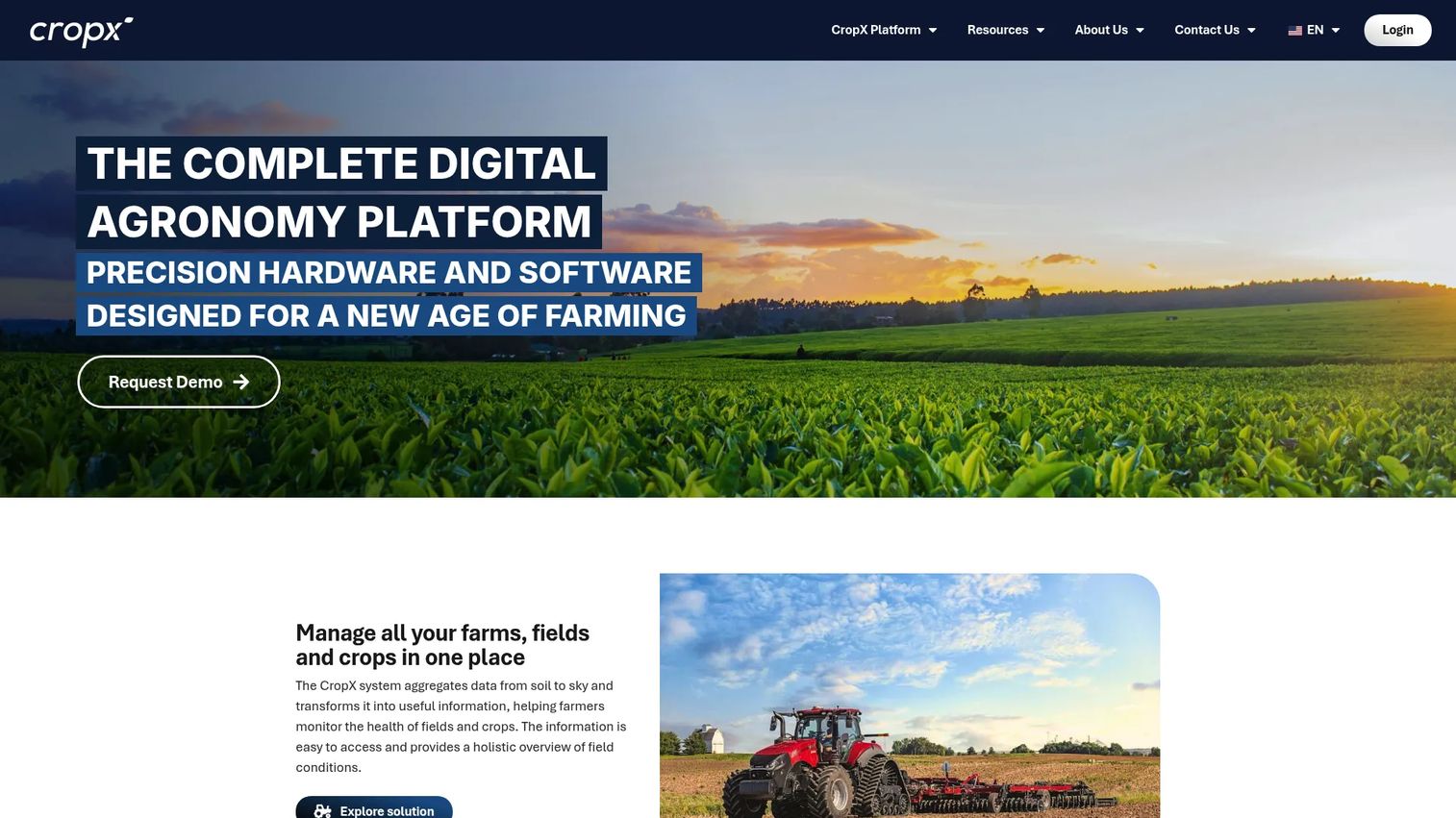
CropX is a digital agronomy and farm management platform that combines soil sensors, software, and analytics. Where most tools work from imagery or machine logs, CropX adds below-ground data, giving irrigation and nutrition decisions a foundation in actual soil conditions. For operations where water and inputs are the biggest levers, that soil layer is the differentiator.
The platform manages field data across crop, soil, weather, and vegetation health, then feeds it into irrigation planning, disease control, nutrition monitoring, and effluent irrigation tools. Sensor-based recommendations translate readings into agronomic action rather than raw numbers. Hardware and software integrations, including farm machinery data import, connect CropX to the wider stack so soil insight informs the rest of the workflow.
Best for: Farmers, agronomic advisors, dealers, and agribusinesses managing irrigation and field operations at scale.
Key strengths
- Below-ground soil data: Sensor readings ground irrigation and nutrition decisions in real conditions.
- Agronomic recommendations: Disease control, nutrition monitoring, and irrigation planning from field data.
- Hardware and software integration: Machinery data import connects soil insight to the broader stack.
Why choose CropX: CropX fits operations where irrigation and nutrition drive yield, and where soil-level data is worth the sensor investment. Its combination of hardware and agronomic software suits teams optimizing productivity below the surface, not just from the air.
CropX pricing: CropX does not list a public price on its own site; subscriptions are sold via quote and support rather than a public price list. Contact CropX for a quote based on acreage and sensor needs.
Considerations before you choose
Shortlisting is easier when you evaluate against how your operation actually works. Here is a buyer's checklist for precision farming software.
Data maturity and workflow stage
Match the tool to where you are. If you are still centralizing data, a hub like Operations Center or SMS comes first. If you are building prescriptions or measuring ROI, GeoPard or FieldView fit better. Buying analytics depth you cannot yet feed is wasted spend.
Interoperability and equipment integrations
Check which machines, monitors, and platforms each tool reads and writes. Interoperability decides whether a prescription reaches the planter and whether yield data flows back without manual re-entry. Confirm support for John Deere, mixed fleets, and your specific monitors before committing.
Data export formats and ownership
Verify the data export formats and who owns the data. Local-first tools like SMS keep records on your machine; cloud platforms centralize them. Either way, confirm you can export in formats your other tools accept, so you are never locked into one system.
Reporting depth and multi-season analytics
If proving what worked matters, prioritize multi-season reporting and yield analytics. Profit and ROI mapping, like GeoPard's, turns each season into a measurable experiment. Thin reporting means you repeat the same guesses year over year.
Total cost across the stack
Free accounts and low entry prices rarely tell the whole story. Factor in hardware, sensors, connected subscriptions, and partner tools. A no-cost hub still carries downstream costs once you add prescriptions, imagery, or soil sensors.
Conclusion
The right precision agriculture software depends on which part of the field-to-decision workflow you need to solve first. If imagery drives your scouting, Agremo turns drone and satellite captures into prescriptions. For full-cycle mapping, prescriptions, and ROI analysis, GeoPard connects the whole loop. Ag Leader SMS suits teams that want local-first data ownership, while John Deere Operations Center anchors equipment-centric operations at no cost to start.
For broad digital farming with a low barrier to entry, Climate FieldView pairs visualization with prescriptions. FJDynamics FMS ties agronomy to farm operations, Trimble Ag Software fits mixed-fleet record-keeping, and CropX brings soil-level data to irrigation and nutrition decisions.
Start by naming your bottleneck: data centralization, prescriptions, yield analytics, or equipment sync. Then shortlist two tools that match that stage and your existing equipment, run their free trials or demos, and confirm the data flows in and out cleanly before you scale across the operation.
FAQs
Precision agriculture software collects field, machine, imagery, and yield data, then converts it into maps, prescriptions, and analytics for sub-field decisions. It manages variability across zones so inputs like seed, fertilizer, and water match what each part of a field needs, rather than treating the field as one uniform block.
For imagery-driven crop monitoring, Agremo specializes in turning drone and satellite captures into stand counts, health maps, and prescription layers. Climate FieldView and GeoPard also offer strong scouting and imagery tools if you want monitoring connected to prescriptions and analytics in the same platform.
GeoPard, Climate FieldView, FJDynamics FMS, Ag Leader SMS, and Agremo all support variable rate application through prescription maps. The key differences are the agronomic layers each uses to build zones and the export formats they produce, so confirm the tool writes prescriptions your equipment can read.
Yes. John Deere Operations Center is built around John Deere equipment connectivity, and GeoPard supports import and export of John Deere data. Many platforms connect to the John Deere ecosystem, but always confirm the specific data types and formats before assuming a clean two-way sync.
Prioritize data maturity fit, interoperability with your equipment, clean data export formats, and reporting depth. Field scouting software and yield analytics software are most valuable when observations feed prescriptions and prescriptions feed back into multi-season reporting, closing the loop rather than sitting in silos.
It depends on your workflow. Cloud platforms like Climate FieldView and John Deere Operations Center centralize data and sync across devices. Desktop, local-first tools like Ag Leader SMS give you offline access and data ownership on your own machine. Many operations use both, with a desktop system of record and cloud tools for field sync.
Look for broad import and export covering common precision ag file types from major monitors and machinery brands. Ag Leader SMS is known for reading most file types, and interoperability across formats prevents lock-in. Confirm the platform exports prescriptions and yield data in formats your equipment and other tools accept.
Yield analytics software cleans raw harvest monitor data, builds yield maps, and enables multi-season reporting so you can compare what worked across years. Platforms like GeoPard add profit and ROI mapping, turning each season into a measurable experiment that informs seed, input, and field investment decisions.