You quoted the job Friday afternoon. You lost it Monday morning. Not on price, on speed. The competitor got their number to the owner while you were still tracing fixtures in a spreadsheet.
That is the real cost of manual estimating. Not the hour lost per bid, though that adds up. The deals that never close because the estimate arrived late, or the margin that quietly disappears because someone forgot to price the labor on 40 feet of copper. The U.S. plumbing estimating software market hit roughly USD 350 million in 2023 and is expected to grow near 8% annually through 2028, according to a 2023 LinkedIn market analysis. Contractors are not buying software because it is trendy. They are buying it because manual takeoff does not scale past a certain job volume.
Here is the pattern most owners miss. The problem is rarely the estimator. It is the process. A skilled estimator on a spreadsheet still miscounts fittings, still forgets to update supply house pricing, still spends three hours on a takeoff that software finishes in forty minutes. Commercial firms figured this out first, roughly 70% of commercial plumbing estimates now run through software versus about 40% in residential, per a 2024 adoption study. The gap is closing fast.
So the question is not whether you need estimating software for plumbers. It is which plumbing estimating programs fit your workflow, your team size, and the way you actually bid work.
What's inside
This guide compares seven plumbing estimating tools for contractors who need faster takeoffs, cleaner pricing, real labor support, and quotes they can send the same day. We selected tools based on plumbing-specific workflow depth, the quality of the material and pricing database, integrations with tools like QuickBooks and Excel, mobile and field support, and fit by contractor size. Some are built for deep commercial takeoff. Some are built for a solo plumber quoting from a truck. We flag which is which, and we map each tool to a real bidding scenario instead of dumping feature lists.
TL;DR
- Best overall for detailed plumbing takeoff and estimating: PlanSwift, strong on-screen takeoff with custom assemblies and Excel export.
- Best for commercial and mechanical plumbing depth: FastPIPE, built for pipe, fittings, and complex jobs.
- Best for cloud collaboration across takeoff teams: STACK, real-time markups and shared access.
- Best plumbing estimating app for field quoting: ThermoGrid, mobile estimating with dispatch and invoicing.
- Best for pricing databases and labor benchmarks: McCormick Estimating, trade-specific databases with supplier pricing.
- Best for AI-assisted multi-unit counting: PataBid Quantify, cloud takeoff with Rapid Count.
- Best plumbing quote software for solo contractors: TurboBid Estimating, fast bids and simple pricing.
What is plumbing estimating software?
Plumbing estimating software is a tool that turns construction plans into priced, labor-loaded plumbing bids by combining digital takeoff, material counting, labor calculation, and quote generation in one workflow. Instead of measuring pipe runs by hand and typing quantities into a spreadsheet, you import the plans and trace the work on screen.
The core workflow is consistent across most plumbing bidding software: import the plans, trace piping and count fixtures, calculate material quantities, apply labor units, assemble reusable assemblies, and export a quote. The best plumbing takeoff software collapses that whole sequence into a single pass, so the number that lands on the owner's desk is both faster and more defensible.
Core capabilities to expect from any plumbing estimate software:
- Digital blueprint takeoff: trace piping, count fixtures, and measure runs directly on imported plans, including on-screen takeoff for linear and count work.
- Material quantity calculation: roll up pipe, fittings, valves, and fixtures into accurate counts without manual tallying.
- Labor pricing and assembly reuse: apply labor units to each item and save custom assemblies so repeat work does not get re-estimated from scratch.
- Quote and bid generation: produce a clean, itemized quote or proposal ready to send.
- Integrations: connect to Excel for export, QuickBooks for accounting, and field tools for on-site quoting.
That last capability separates plumber estimating software that lives on one desktop from a system that scales across a growing team. When pricing, assemblies, and labor benchmarks are shared, every estimator bids the same way.
When to use plumbing estimating software
Not every contractor needs the same tool at the same moment. Three situations tend to trigger the switch.
Speed up manual bid creation
Spreadsheets work fine for a two-fixture bathroom remodel. They break down the moment jobs get larger or more repetitive. Every commercial takeoff you do by hand is a chance to miscount, and every miscount is either a lost bid or lost margin. Plumbing pricing software cuts a multi-hour takeoff down to a fraction of the time and keeps the math consistent. If your estimator is spending nights and weekends on bids, the tool pays for itself in reclaimed hours alone.
Standardize estimating across a growing team
When you have one estimator, the process lives in their head. When you have three, it lives nowhere unless you build it. Shared assemblies, standardized labor benchmarks, and a common pricing database mean any estimator produces a bid that looks and prices like every other bid. That consistency is what lets an owner hand off estimating without re-checking every number, the exact repeatability problem that keeps founders and operators stuck in the work.
Quote from the field
Sometimes the value is not deep desktop takeoff. It is standing in a customer's basement and handing them a price before you leave. Service and residential plumbing teams live in this moment. A plumbing estimating app with mobile estimating, on-site pricing, and instant invoicing closes work faster than any office-bound tool, because the quote never waits for someone to get back to a desk.
Comparison table
Here is how the seven best plumbing estimating software tools stack up on intent, differentiation, pricing, and rating. Pricing and ratings are drawn from each vendor's public pages and third-party review sites as of mid-2026. Confirm current figures before you buy, since vendors adjust tiers often.
| # | Product | Intent | Key differentiation | Pricing | G2 rating |
|---|---|---|---|---|---|
| 1 | PlanSwift | Desktop takeoff and estimating | On-screen digital takeoff with custom assemblies and Excel export | From $1,749/year | 4.3/5 |
| 2 | FastPIPE | Commercial and mechanical plumbing | Deep pipe, fitting, and valve takeoff with labor benchmarks | From $4,995 one-time or $250/mo lease | Not listed on G2 |
| 3 | STACK | Cloud collaboration and takeoff | Real-time markups and shared cloud access | Free tier; from $249/user/mo | 4.4/5 |
| 4 | ThermoGrid | Field estimating and dispatch | Mobile quoting with scheduling, invoicing, and inventory | From $25/user/mo | Not listed on G2 |
| 5 | McCormick Estimating | Pricing databases and labor | Trade-specific databases with real-time supplier pricing | Demo-based pricing | Not listed on G2 |
| 6 | PataBid Quantify | AI-assisted cloud takeoff | Rapid Count AI for multi-unit drawing counts | From $2,460/year | Not listed on G2 |
| 7 | TurboBid Estimating | Fast bids for solo contractors | Simple pricing sources and quick quote creation | From $135/mo or $1,395 one-time | 2.8/5 |
1. PlanSwift
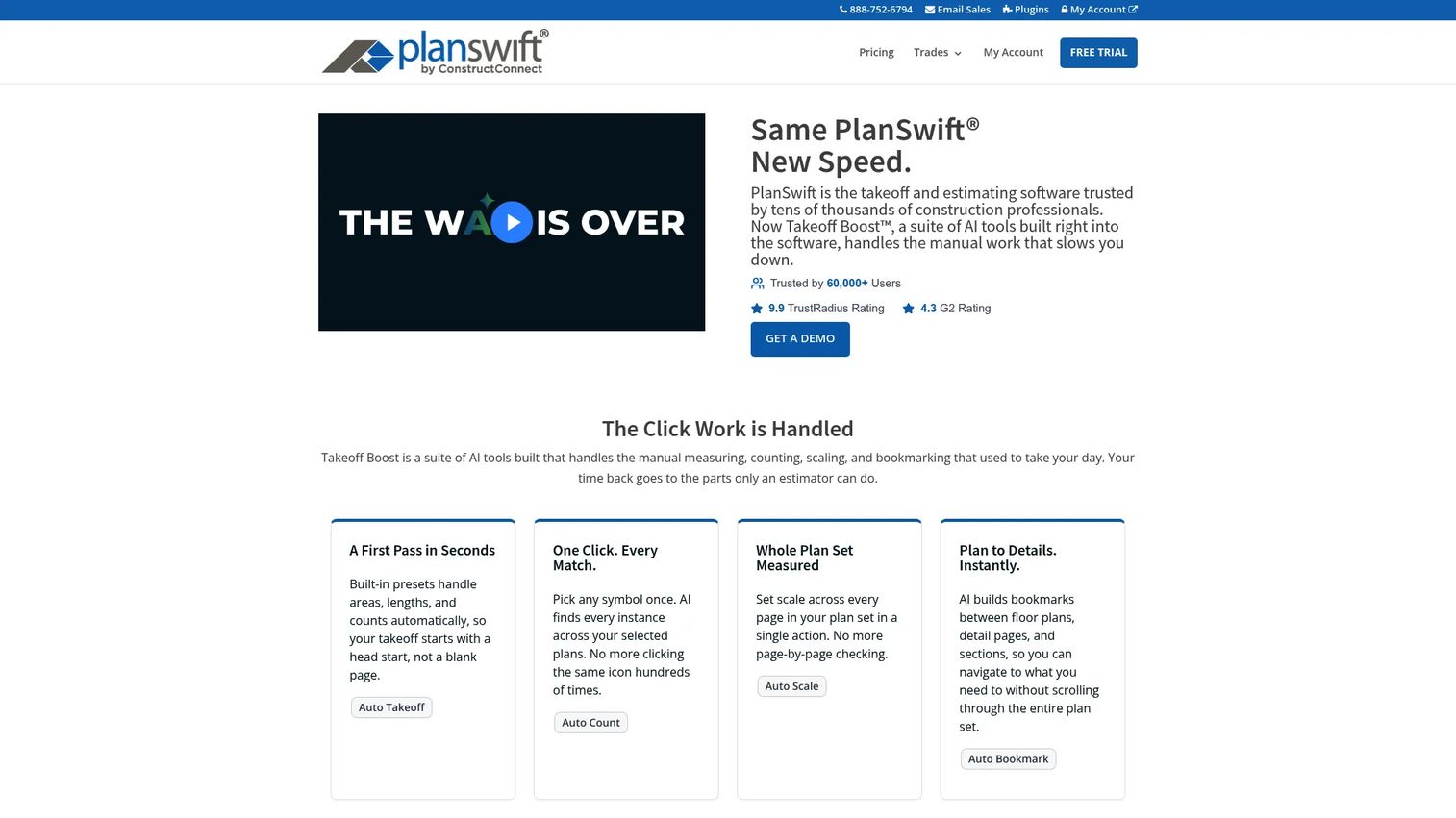
PlanSwift is a desktop takeoff and estimating tool built for contractors and estimators who want to trace work directly on digital blueprints. You import plans, measure area, linear, segment, and count items on screen, then roll everything into a priced estimate. For plumbing work, that means tracing pipe runs, counting fixtures, and building the quantities without a manual tally. Its digital takeoff engine is the reason it shows up on nearly every plumbing estimate software shortlist.
Best for: Estimators who want detailed desktop on-screen takeoff with reusable assemblies and clean exports.
Key strengths
- Digital takeoff tools: Measure area, linear, segment, and count work directly on imported plans, the core of any plumbing takeoff software.
- Custom assemblies and Excel export: Build reusable plumbing assemblies once, then export priced estimates straight to Excel for further work.
- AI-assisted Takeoff Boost: Auto takeoff, auto count, auto scale, and auto bookmark features speed up repetitive counting on large drawing sets.
Why choose PlanSwift: If your estimating happens at a desk and you want granular control over every measurement, PlanSwift gives you that depth without locking you into a single trade template. The custom assemblies matter most for plumbing crews that bid similar work repeatedly, since you stop re-estimating the same rough-in every time. It fits growing teams that need a repeatable takeoff process, not a one-off tool.
PlanSwift pricing: PlanSwift's public pricing page lists a Professional Subscription at $1,749.00 per year, billed annually. That annual subscription includes support, software updates, and two hours of training. There is no free tier, though a trial is available through the vendor's site. Pricing has appeared inconsistent across PlanSwift's own pages, so confirm the current figure before purchase.
2. FastPIPE
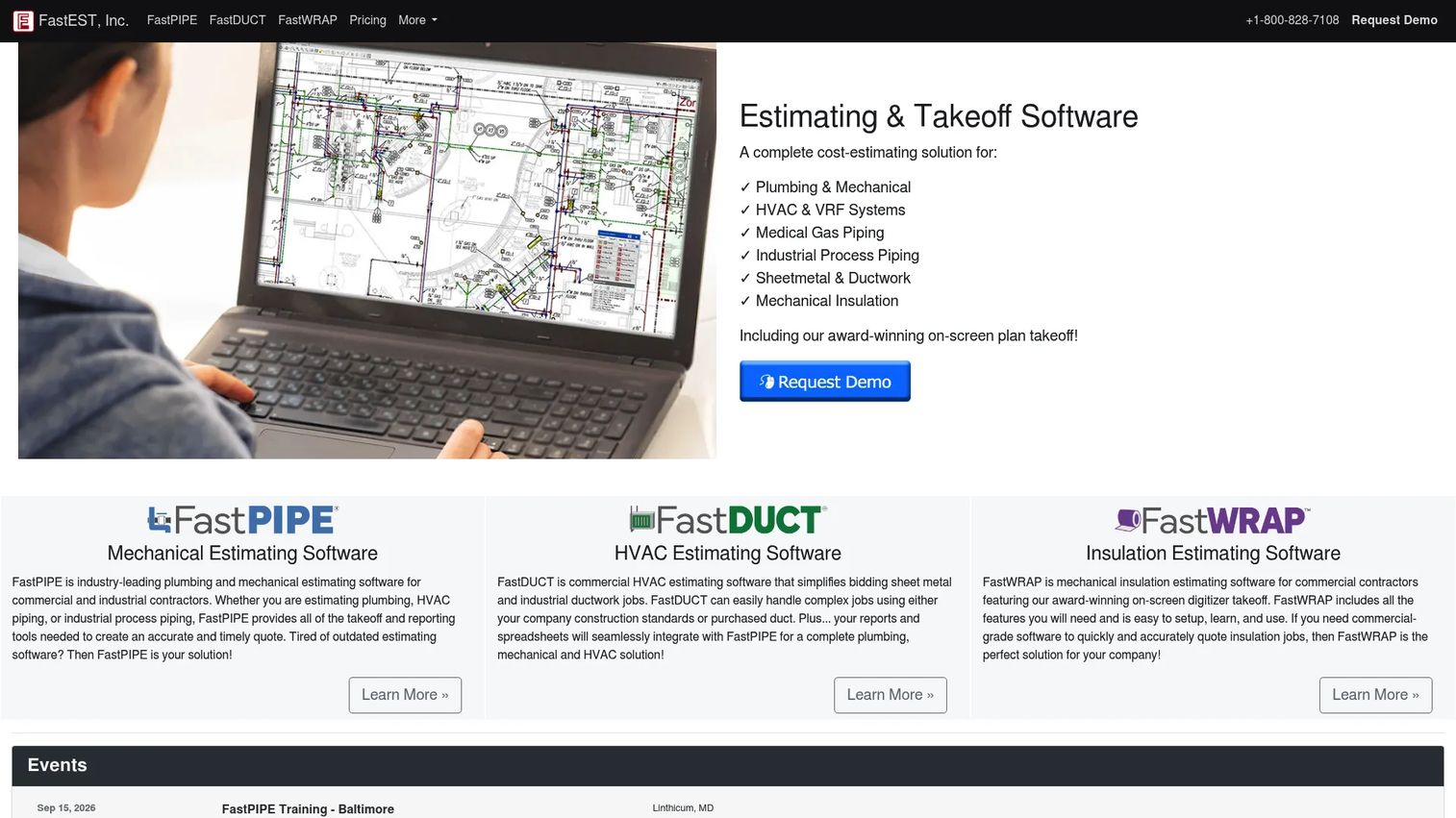
FastPIPE is mechanical and plumbing estimating software built for contractors who bid complex pipe work. Where a general takeoff tool treats pipe as a line, FastPIPE treats it as pipe, fittings, valves, and assemblies with the labor detail that commercial and industrial jobs demand. That trade-specific depth is why commercial plumbing estimating software buyers keep it on their list.
Best for: Mechanical, plumbing, and HVAC contractors bidding commercial or industrial jobs where labor precision matters.
Key strengths
- On-screen takeoff for pipe systems: Trace pipe, fittings, valves, and assemblies with the detail complex jobs require, not a generic linear measure.
- Pricing snapshots and print hotkeys: Capture pricing states and speed up repetitive estimating actions with keyboard shortcuts.
- Job export and Procore format: Export jobs, import work, and push report plans in a Procore-compatible format for downstream workflows.
Why choose FastPIPE: Commercial contractors evaluate FastPIPE when the labor calculation has to be right, because a fitting-level miss on a large job compounds fast. The custom assemblies and trade-specific data let you estimate a mechanical room the way you actually build it. It is the tool for teams whose bids live or die on labor accuracy rather than speed alone.
FastPIPE pricing: FastPIPE lists purchase, lease, and maintenance options on its public pricing page. A first application is $4,995 as a one-time purchase, with additional applications at $2,495 each. Lease pricing starts at $250 per month for a first application and $105 per month for additional ones. Annual maintenance runs $1,250 for the first application. Enterprise shared-session licensing requires contacting the company. Capterra shows a 4.7/5 rating across 129 reviews, though no G2 rating was verified.
3. STACK
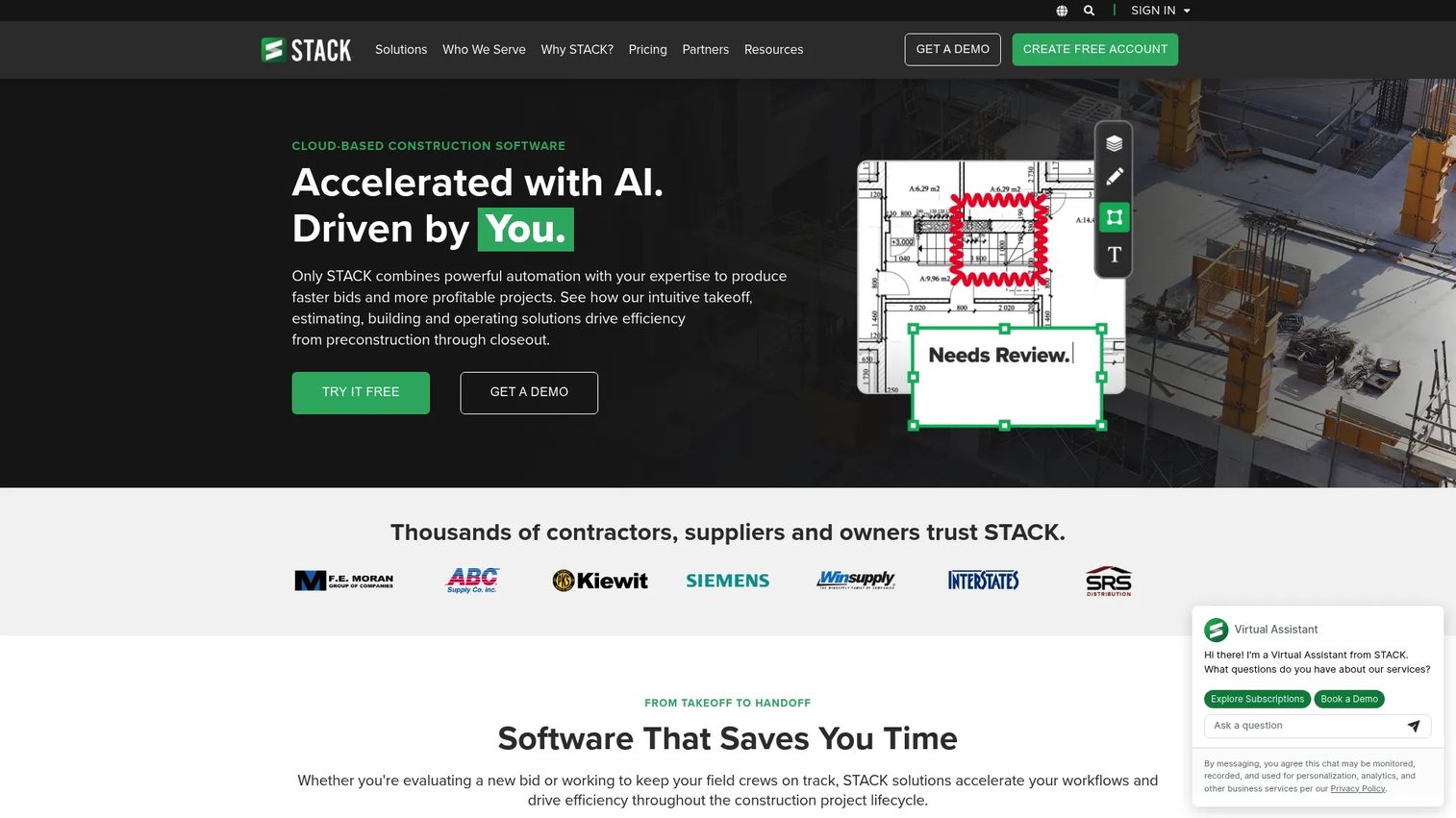
STACK is cloud-based construction software for takeoff, estimating, and project collaboration. Because it runs in the browser, multiple estimators can work the same plans, mark them up in real time, and share access without emailing files back and forth. For plumbing teams that split takeoff across people or locations, that shared workspace is the draw.
Best for: Construction and plumbing teams that need takeoff, estimating, and field collaboration in one cloud system.
Key strengths
- Takeoff and estimating: Perform on-screen takeoff and build estimates in the cloud, accessible from any machine.
- Field collaboration and project management: Coordinate takeoff, documents, and workflows across office and field teams.
- Real-time document and markup tools: Mark up plans and manage workflows live, so no one waits on the latest file version.
Why choose STACK: If your bottleneck is collaboration rather than takeoff depth, STACK solves the version-control mess that comes with passing plans around. It suits broader construction teams that still need solid plumbing estimating workflows but want everyone working from one live source. The free tier also makes it a low-risk way to test cloud takeoff before committing.
STACK pricing: STACK publishes pricing across two product lines. On Takeoff & Estimate, a Free tier is available, Premium is $249 per user per month billed annually, and Pro is $299 per user per month billed annually. Its Build & Operate line lists Essential at $599 per user per year, Pro at $699 per user per year, and an Enterprise tier priced on request. Build & Operate also includes a free 30-day trial. STACK Construction Technologies holds a 4.4/5 rating on G2.
4. ThermoGrid

ThermoGrid is contractor dispatching software for HVAC, plumbing, and electrical businesses, and it earns its place here for field quoting rather than deep office takeoff. This is the plumbing estimating app for teams that need an estimate, an invoice, and a scheduled job from the truck. Mobile estimating sits inside a full field service platform, so the quote flows straight into dispatch and billing.
Best for: HVAC, plumbing, and electrical service teams that estimate and quote on site.
Key strengths
- Scheduling and smart dispatching: Estimate and schedule work in one system, so quotes turn into booked jobs without a handoff.
- Estimates, invoicing, and payments: Build a field quote, convert it to an invoice, and take payment on the spot.
- VoIP, inventory, and geolocation: Manage inventory, calls, timesheets, and technician location alongside estimating.
Why choose ThermoGrid: Residential and service plumbing teams do not lose bids to slow desktop takeoff. They lose them to slow follow-up. ThermoGrid's mobile estimating and field quoting close that gap by pricing work while the technician is still on site. If your revenue comes from service calls rather than plan-based commercial bids, this is the fit.
ThermoGrid pricing: ThermoGrid publishes four tiers on its pricing page. Level 1 is $25 per month for one user, Level 2 is $99 per month for five users, Level 3 is $349 per month for ten users, and Level 4 is $759 per month for twenty users. Some features carry additional per-user fees. No G2 rating was verified during this review.
5. McCormick Estimating
McCormick Estimating is estimating and takeoff software for electrical, plumbing, and mechanical contractors, built around a deep pricing and labor reference layer. For plumbing bids, the appeal is the trade-specific database paired with real-time supplier pricing, so your material costs reflect what the supply house charges today, not last quarter.
Best for: MEP contractors who want specialty-trade estimating databases and takeoff in one system.
Key strengths
- Built-in digital takeoff: Trace and count work on plans without a separate takeoff tool.
- Trade-specific estimating databases: Estimate plumbing work against a database built for the trade, not a generic parts list.
- Real-time supplier pricing: Pull current material pricing so bids reflect actual supply house costs and protect margin.
Why choose McCormick Estimating: Contractors who bid on thin margins live and die by pricing accuracy. McCormick's real-time supplier pricing and labor estimating standards give you a reference layer that keeps every bid grounded in current costs. It fits MEP shops that want the pricing database to do the heavy lifting, with labor calculation and assemblies built on top.
McCormick Estimating pricing: McCormick does not publish pricing on its public pages and instead routes buyers to request a demo, so no starting price is available. A Capterra listing shows a 4.6/5 rating, though no G2 rating was verified. Expect a sales conversation to get a quote tailored to your trade and team size.
6. PataBid Quantify
PataBid Quantify is cloud-based AI estimating software for MEP contractors, combining digital takeoff, pricing, and proposal tools in one system. Its standout is Rapid Count, an AI-assisted feature that counts repeated items across drawing sets, which cuts the tedious multi-unit counting that eats time on larger plans. For plumbing estimators facing dense fixture and fitting counts, that automation is the hook.
Best for: MEP contractors who want cloud estimating with AI counting and supplier pricing integrations.
Key strengths
- Digital takeoff and estimating in one system: Run takeoff and pricing in a single cloud workflow, no desktop install required.
- 60,000+ item database with real-time pricing: Price bids against a large item database with live supplier pricing integrations.
- Rapid Count AI and proposal module: Speed up multi-unit counting with AI, then generate a comprehensive proposal from the same system.
Why choose PataBid Quantify: If your takeoffs involve repetitive counting across many pages, Rapid Count reduces the manual work that slows large bids. The cloud-only workflow means labor calculation, custom assemblies, and proposals all live in one place, accessible anywhere. It fits estimators who bid larger drawing sets and want AI to handle the counting grind.
PataBid Quantify pricing: PataBid lists a yearly license at $2,460 on its Quantify page. The site describes pricing as competitive and encourages booking a demo for details. There is no free tier. A Capterra listing is available for reviews, though no G2 rating was verified during this review.
7. TurboBid Estimating
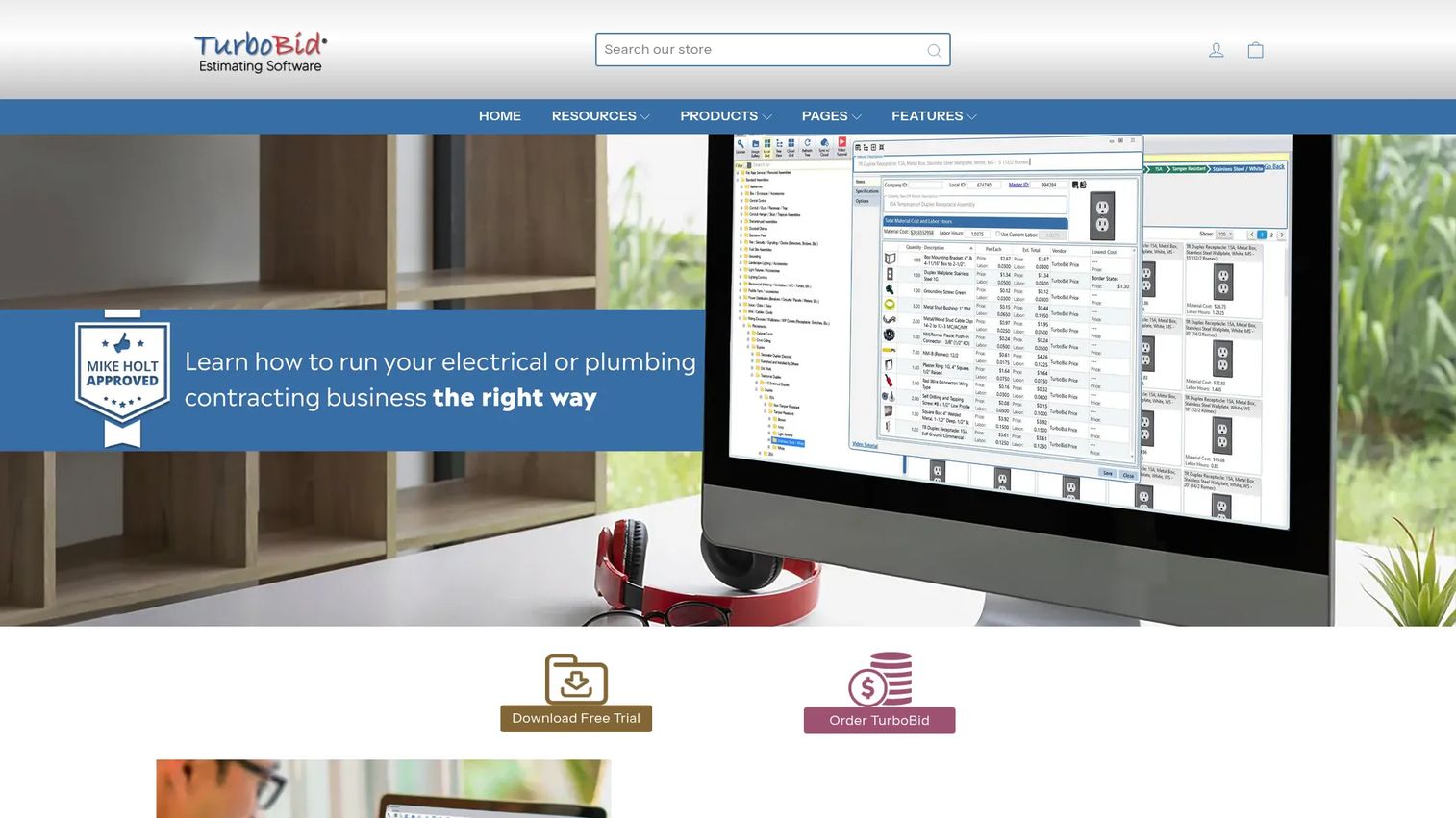
TurboBid Estimating is estimating and bid pricing software for contractors, with electrical roots and related plumbing estimating products. It leans toward speed and simplicity, which makes it a fit for solo proprietors and smaller shops that want a quick, defensible bid without a steep setup. On-screen takeoff and flexible price sources keep the workflow light.
Best for: Solo contractors and small shops that want fast quote creation and a simpler estimating system.
Key strengths
- On-screen takeoff: Measure and count work directly on plans without a separate tool.
- Flexible price sources: Choose between List Price, TurboBid Price, and vendor pricing to control how bids are costed.
- Flat rate pricing and reports: Build flat-rate quotes and generate reports for fast, clean bid delivery.
Why choose TurboBid Estimating: A one-person shop does not need enterprise takeoff depth. It needs to send an accurate bid fast and move on. TurboBid's simpler system and flexible pricing sources fit that reality, with custom assemblies available for repeat work. It works best for users who value speed and a low learning curve over deep commercial features.
TurboBid Estimating pricing: TurboBid offers a monthly subscription at $135, a four-payment option totaling $399, and a one-time purchase at $1,395. The monthly plan also carries a mandatory one-time setup fee not included in the listed price. There is no free tier. TurboBid holds a 2.8/5 rating on G2, so weigh reviews carefully against your own trial.
Considerations before you buy
Picking the right plumbing bidding software is less about the longest feature list and more about matching the tool to how you actually bid. Run any shortlist through these criteria.
Plumbing workflow depth
Does the tool handle pipe, fittings, valves, and fixtures the way you estimate them, or does it treat everything as a generic line? Trade-specific depth matters most on commercial and mechanical jobs where a fitting-level miss compounds across the bid.
Pricing and material database quality
Stale pricing quietly erodes margin. Look for real-time supplier pricing or an item database you can keep current, so your material costs reflect today's supply house numbers rather than last quarter's.
Labor calculation and assemblies
Labor is where most bids get won or lost. Confirm the tool applies labor units cleanly and lets you save custom assemblies, so repeat work is not re-estimated from scratch every time.
Integrations and exports
Check for QuickBooks integration for accounting and Excel export for downstream work. If the estimate cannot flow into the rest of your systems, you are just moving data by hand somewhere else.
Desktop versus mobile fit
Decide whether you need deep desktop takeoff, cloud collaboration across a team, or a plumbing estimating app for field quoting. The right answer depends on whether your revenue comes from plan-based commercial bids or on-site service calls.
Conclusion
The best plumbing estimating software depends entirely on how your team bids work. For detailed desktop on-screen takeoff with reusable assemblies and Excel export, PlanSwift is the strongest all-around pick. For commercial and mechanical jobs where labor precision decides the margin, FastPIPE has the trade-specific depth. STACK wins for cloud collaboration across takeoff teams, while ThermoGrid is the plumbing quoting software of choice for field and service crews that estimate on site.
If your bids hinge on pricing accuracy, McCormick Estimating's supplier-priced databases earn a look. PataBid Quantify's Rapid Count AI reduces the counting grind on large drawing sets, and TurboBid Estimating keeps things fast and simple for solo contractors.
The practical move is not to read another comparison. It is to pull one real job you recently bid, run it through one or two of these plumbing estimating programs, and see which one gets you an accurate number faster. Test against your own work, not a demo dataset, and the right tool becomes obvious.
FAQs
Plumbing estimating software is a tool that turns construction plans into priced, labor-loaded bids by combining digital takeoff, material counting, labor calculation, and quote generation in one workflow. Instead of measuring pipe by hand and typing quantities into a spreadsheet, you trace the work on screen and let the system roll up quantities, apply labor, and produce a quote. It replaces the slow, error-prone parts of manual estimating for both residential and commercial plumbing work.
The features that matter most are digital takeoff, a quality material and pricing database, clean labor calculation, reusable custom assemblies, and integrations with tools like QuickBooks and Excel. Trade-specific depth for pipe, fittings, and valves matters more on commercial jobs, while speed and mobile quoting matter more for service work. Prioritize the capability that fixes your biggest current bottleneck first.
Not exactly. Plumbing takeoff software focuses on measuring and counting work from plans, tracing pipe runs and counting fixtures. Estimating software takes those quantities and adds pricing, labor units, and quote generation. Most modern tools combine both, so the takeoff feeds directly into a priced bid, but some products lean harder toward one side than the other.
For commercial and mechanical plumbing, FastPIPE and McCormick Estimating tend to fit best because both handle deep pipe, fitting, and valve takeoff with strong labor benchmarks. Commercial plumbing estimating software has to get labor calculation right, since a fitting-level miss compounds across a large job. PlanSwift also works well for commercial estimators who want granular on-screen takeoff control.
Many plumbing estimating tools offer QuickBooks integration or at least Excel export that maps cleanly into accounting workflows. Before buying, confirm the specific integration on the vendor's page, since depth varies. A clean connection between your estimate and your books means you are not re-entering job costs by hand after the bid is won.
Yes. Tools like ThermoGrid are built around mobile estimating and field quoting, letting a technician price work, generate an invoice, and schedule the job from the truck. Field-focused plumbing pricing software matters most for residential and service teams whose revenue depends on fast on-site follow-up rather than plan-based commercial bids.
Plumbing contractors price labor by applying labor units to each item and assembly, where a labor unit represents the estimated time to install a given component. Tools like FastPIPE, McCormick Estimating, and PataBid Quantify carry trade-specific labor benchmarks so estimators do not guess. Reusable custom assemblies bundle labor with materials, so repeat work carries consistent labor pricing every time.
A small plumbing business should look first for speed, a low learning curve, and pricing that fits a lean budget. Plumber estimating software like TurboBid Estimating or a field-focused tool like ThermoGrid gets you to an accurate bid fast without enterprise complexity. Start with the tool that removes your single biggest time sink, then add depth as the team grows.