Picking a PHP framework takes about ten minutes. Living with that choice for three years takes considerably longer.
PHP remains one of the most widely deployed server-side languages on the web: According to W3Techs (2026), it powers 69.1% of websites with a known server-side programming language. That ubiquity means the framework decision affects millions of applications, and the stakes for presales and solutions teams are real. When a buyer asks how the product handles authentication, scales under load, or passes a security review, the framework underneath is often part of the answer.
The problem is not finding a PHP framework. The problem is choosing the right one for a specific project type, team skill set, and maintenance horizon, then being able to defend that choice during technical validation.
This guide covers 12 frameworks organized by project fit, architecture, and long-term maintainability, so you can match the framework to the application rather than chase the most popular option.
What's inside
This guide is for developers, engineering managers, and presales teams evaluating PHP web application frameworks for production builds in 2026.
Frameworks were selected based on:
- Project fit: Full-stack apps, APIs, CMS projects, and microservices each have different requirements
- Architecture: MVC, middleware-first, extension-based, and API-first approaches covered
- Maintainability: Long-term support, hiring pool, documentation quality, and upgrade path
- Ecosystem maturity: Package availability, community size, and integration depth
G2 ratings are included where a verified listing exists. Most frameworks are open source with no paid license, so pricing reflects hosting and ecosystem context rather than subscription tiers.
TL;DR
- Best overall for fast product development: Laravel, with the largest ecosystem and most learning resources among PHP frameworks
- Best for enterprise architecture: Symfony, preferred by 23% of PHP developers according to JetBrains (2025)
- Best lightweight option: CodeIgniter 4, for teams that want structure without a heavy footprint
- Best for APIs: API Platform for structured API products, Slim Framework for minimal services
- Best for convention-driven teams: CakePHP, for CRUD-heavy business applications
- Best for enterprise CMS projects: TYPO3, for content-heavy sites with complex governance needs
What are PHP frameworks?
PHP frameworks are reusable application structures, libraries, and conventions that help developers build PHP web applications faster and more consistently. A framework provides the skeleton so teams can focus on business logic rather than rebuilding routing, authentication, and database access from scratch on every project.
Most PHP frameworks handle a common set of concerns:
- Routing and request handling: Mapping URLs to controllers or handlers
- Controllers and middleware: Processing requests and applying cross-cutting logic
- Templating: Rendering HTML or API responses
- ORM or database abstraction: Querying databases without raw SQL everywhere
- Validation: Checking inputs before they reach business logic
- Authentication support: Managing sessions, tokens, and access control
- Dependency injection: Wiring components together cleanly
- Testing support: Running unit and integration tests
- CLI tooling: Running migrations, generating boilerplate, and running jobs
- Package management: Installing third-party libraries through Composer
Types of PHP frameworks
- Full-stack frameworks: Laravel, Symfony, CakePHP, Yii 3
- Lightweight frameworks: CodeIgniter 4, Slim Framework, FlightPHP
- Middleware-first frameworks: Mezzio, Laminas
- API-first frameworks: API Platform
- CMS and content platforms: TYPO3
Key features to compare
When evaluating frameworks for a specific project, check:
- Security defaults (CSRF protection, input validation, output escaping)
- Database and ORM support
- Package ecosystem depth
- Long-term support and release cadence
- Hosting and deployment fit
- Documentation quality and community size
When to use PHP frameworks
Build web applications faster
Frameworks remove repetitive setup work like routing, database access, folder structure, and session management. Teams building multi-developer applications get the biggest return because a shared structure reduces onboarding time and prevents divergent patterns from accumulating across the codebase.
Standardize technical validation
For presales and solutions engineers, a known PHP web development framework makes architecture discussions more predictable. Buyers can inspect dependencies, assess package maturity, review the update history, and evaluate security posture without treating the application as a black box. That visibility shortens security reviews and RFP responses.
Support long-term maintainability
Framework choice directly affects onboarding speed, refactoring cost, version upgrade paths, and future integrations. For SaaS products, portals, and enterprise applications with multi-year lifespans, choosing a framework with strong long-term support and a deep hiring pool is as important as any initial speed advantage.
PHP frameworks comparison
Most PHP frameworks carry no paid license. The meaningful cost is developer time, hosting, commercial support, and long-term maintenance. G2 ratings are included where verified listings exist.
| # | Product | Best for | Key differentiator | Pricing | G2 rating |
|---|---|---|---|---|---|
| 1 | Laravel | Fast full-stack web apps | Large ecosystem and developer-friendly tooling | Open source (Cloud from $5/mo) | 4.7/5 |
| 2 | Symfony | Enterprise applications | Reusable components and long-term architecture | Open source | 4.3/5 |
| 3 | CodeIgniter 4 | Lightweight PHP apps | Small footprint and straightforward setup | Open source | 4.4/5 |
| 4 | Yii 3 | Performance-conscious apps | Component-based architecture | Open source | 4.2/5 |
| 5 | CakePHP | Convention-driven development | Scaffolding and structured MVC conventions | Open source | 3.9/5 |
| 6 | Laminas | Enterprise modular applications | PHP-FIG standards and enterprise continuity | Open source | 4.2/5 |
| 7 | Mezzio | Middleware-based APIs | PSR-15 middleware architecture | Open source | N/A |
| 8 | Slim Framework | Minimal APIs and microservices | Routing-focused microframework design | Open source | 4.2/5 |
| 9 | Phalcon | Performance-sensitive applications | Extension-based framework architecture | Open source | 4.4/5 |
| 10 | FlightPHP | Tiny APIs and prototypes | Minimal routing and low framework overhead | Open source | N/A |
| 11 | API Platform | API-first PHP projects | API generation built around Symfony | Open source | N/A |
| 12 | TYPO3 | Enterprise CMS projects | Mature content management and governance | Open source | 3.9/5 |
Best 12 PHP frameworks for web development in 2026
1. Laravel
Laravel is a full-stack PHP web application framework built around MVC architecture. It ships with Eloquent ORM, Blade templating, the Artisan CLI, and a built-in queue and job system, giving teams most of what they need for SaaS products, dashboards, marketplaces, and ecommerce backends. According to JetBrains' State of PHP (2025), 64% of surveyed PHP developers use Laravel, making it the most widely adopted PHP framework by a significant margin.
Best for: Teams that want a batteries-included PHP web app framework with a large hiring pool and extensive documentation.
Key features
- MVC application structure with Eloquent ORM
- Blade templating with component support
- Artisan CLI for code generation and task management
- Built-in queue, job, and event system
- Dependency injection container
Why choose Laravel: It covers the broadest set of use cases out of the box, and the hiring pool makes it easier to onboard new developers quickly. Teams that need strict architectural control or prefer assembling components independently may find Symfony a stronger fit.
Laravel pricing: The Laravel framework itself is open source and free. Laravel Cloud, a managed hosting platform, starts at $5 per month plus usage on the Starter tier, with Growth at $20/month plus usage, Business at $200/month plus usage, and Enterprise at custom pricing.
G2 rating: 4.7/5
2. Symfony
Symfony is a set of reusable PHP packages and a full-stack PHP web development framework for building complex, long-lived applications. Its component architecture means teams can adopt individual Symfony packages without using the full framework, a pattern that makes it foundational infrastructure for much of the PHP ecosystem, including Laravel itself. JetBrains (2025) reported 23% of PHP developers using Symfony, reflecting its strength among teams building modular enterprise systems.
Best for: Engineering teams building large applications where architecture discipline, reusable components, and long maintenance horizons are non-negotiable.
Key features
- Reusable Symfony Components for routing, DI, console, and more
- Twig templating with inheritance and macros
- Doctrine database integration
- Symfony Console for CLI commands
- Long-term support releases with multi-year coverage
Why choose Symfony: Choose it when you need granular control over application architecture and plan to support the application for years. Laravel is faster to scaffold; Symfony gives senior teams more flexibility when the scaffold would get in the way.
Symfony pricing: Symfony core and all official packages are free and open source. SymfonyCloud and SymfonyInsight are separate optional services with their own pricing, not included in the framework itself.
G2 rating: 4.3/5
3. CodeIgniter 4
CodeIgniter 4 is a lightweight, fast, and flexible PHP full-stack web application framework designed to minimize overhead while providing enough structure for most business applications. It follows MVC conventions without enforcing strict application architecture on teams, which makes it a practical fit for agencies, small internal tools, and REST APIs that do not need a heavy dependency tree.
Best for: Teams that want a structured PHP website framework without pulling in a large set of opinionated defaults.
Key features
- MVC architecture with simple configuration
- Query Builder and database abstraction layer
- Built-in security helpers (CSRF, XSS filtering, output escaping)
- RESTful routing and response handling
- Email, file handling, and session management included
Why choose CodeIgniter 4: It works well when developer familiarity matters more than ecosystem depth. The smaller footprint also reduces attack surface, which can simplify early security review conversations with buyers. For teams that anticipate scaling into complex enterprise patterns, starting with Laravel or Symfony will save a migration later.
CodeIgniter 4 pricing: CodeIgniter 4 is open source with no paid tiers. The cost of running it is hosting, developer time, and any third-party packages the team adds.
G2 rating: 4.4/5
4. Yii 3
Yii 3 is the successor to Yii 2, rebuilt around a component-based architecture with PSR standards compliance and support for PHP 8.2 through 8.5. Each Yii 3 package can be used independently, and the framework supports worker-mode deployment with RoadRunner, Swoole, and FrankenPHP, giving teams options for higher-throughput PHP runtimes without switching languages.
Best for: Developers and teams building modern PHP applications with a component-first design approach and an interest in high-throughput deployment options.
Key features
- Independently usable component packages via Composer
- Dependency injection container with automatic wiring
- Active Record, Query Builder, and migrations for multiple database engines
- Built-in RBAC, JWT authentication, and CSRF protection
- Worker-mode support for RoadRunner and Swoole
Why choose Yii 3: It suits teams that want modular design and are comfortable evaluating package maturity independently. Teams migrating from Yii 2 should budget evaluation time, as the component ecosystem is still maturing relative to Laravel's breadth.
Yii 3 pricing: Yii 3 is open source and distributed through Composer at no cost. Budget includes hosting, any commercial support arrangements, and developer time for ecosystem evaluation.
G2 rating: 4.2/5
5. CakePHP
CakePHP is an MIT-licensed PHP MVC framework built around convention over configuration. Its Bake code generator can scaffold models, controllers, and views from a database schema, which accelerates early development for CRUD-heavy business applications. CakePHP's built-in ORM, validation, authentication plugins, and security helpers provide a consistent pattern that teams with strong existing CakePHP experience can ship quickly.
Best for: PHP developers and teams that prioritize consistent conventions and want to reduce the number of structural decisions made per sprint.
Key features
- Convention-driven MVC with Bake code generation
- CakePHP ORM with associations and behavior system
- Built-in validation, authentication, and security tools
- Plugin architecture for extending core functionality
- Strong backward compatibility across major versions
Why choose CakePHP: It performs best when consistency is more valuable than flexibility. Teams building repeatable business applications, internal portals, or admin tools with predictable data structures get the most out of its conventions. Projects requiring extensive customization of the ORM or routing layer may find Laravel's approach more adaptable.
CakePHP pricing: CakePHP is free and open source under the MIT license. Costs are driven by hosting, developer salaries, and any agency or support arrangements the team arranges separately.
G2 rating: 3.9/5
6. Laminas
Laminas is the successor to Zend Framework, maintained by the Linux Foundation. It provides enterprise-grade PHP components aligned with PHP-FIG standards (PSR-7, PSR-11, PSR-15), including Mezzio for middleware applications and Laminas API Tools for building REST APIs. Organizations that built on Zend Framework have a documented migration path to Laminas, making continuity a core part of the product story.
Best for: Developers and enterprises running or modernizing Zend Framework-era PHP applications, or teams building modular PHP services with strict standards alignment.
Key features
- Enterprise-ready PHP components installable individually
- PSR-7 and PSR-15 support through Mezzio
- Laminas API Tools for REST API development
- Dependency injection, event dispatching, and input validation
- Supported by the Linux Foundation with clear governance
Why choose Laminas: It makes the most sense when an organization needs standards compliance, long-term governance, and a continuity path from Zend Framework. Teams starting fresh on a new project without a Zend Framework legacy will often reach for Laravel or Symfony first.
Laminas pricing: The Laminas project is free and open source, supported through sponsorships and donations. Commercial support or migration assistance is available from third-party providers at separately arranged rates.
G2 rating: 4.2/5
7. Mezzio
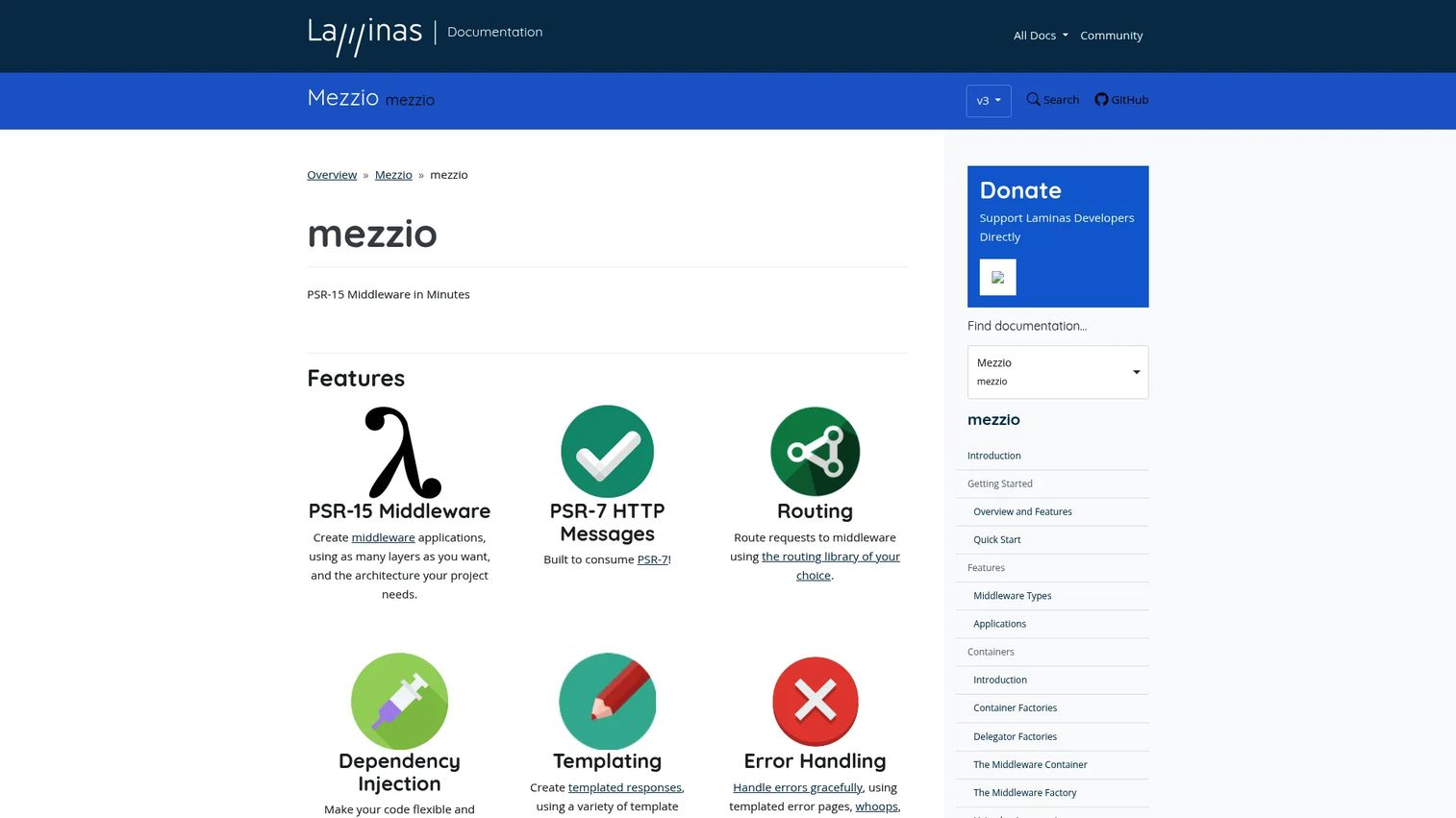
Mezzio is a minimalist PSR-15 middleware framework for PHP, part of the Laminas project. It composes applications from a pipeline of PSR-15 middleware handlers, giving teams explicit control over request processing without the abstractions of a full-stack framework. Router implementations are selectable (FastRoute, Laminas Router, Aura.Router), and templating is optional with support for Plates, Twig, and laminas-view.
Best for: PHP developers building APIs, web applications, or single-page application backends where composable middleware pipelines are preferable to full-stack conventions.
Key features
- PSR-15 middleware pipeline as the primary application model
- Selectable router implementations
- PSR-11 dependency injection container support
- Optional templating with Plates, Twig, or laminas-view
- Nested middleware for modular application composition
Why choose Mezzio: It fits teams that want explicit HTTP handling and composability over convention-driven scaffolding. For projects where the HTTP pipeline itself is the main concern, Mezzio gives more direct control than Laravel or Symfony while still providing structure. Teams building larger content-driven applications will find a full-stack framework more productive.
Mezzio pricing: Mezzio is open source and free. It installs via Composer as part of the Laminas ecosystem. Costs are developer time and hosting.
8. Slim Framework
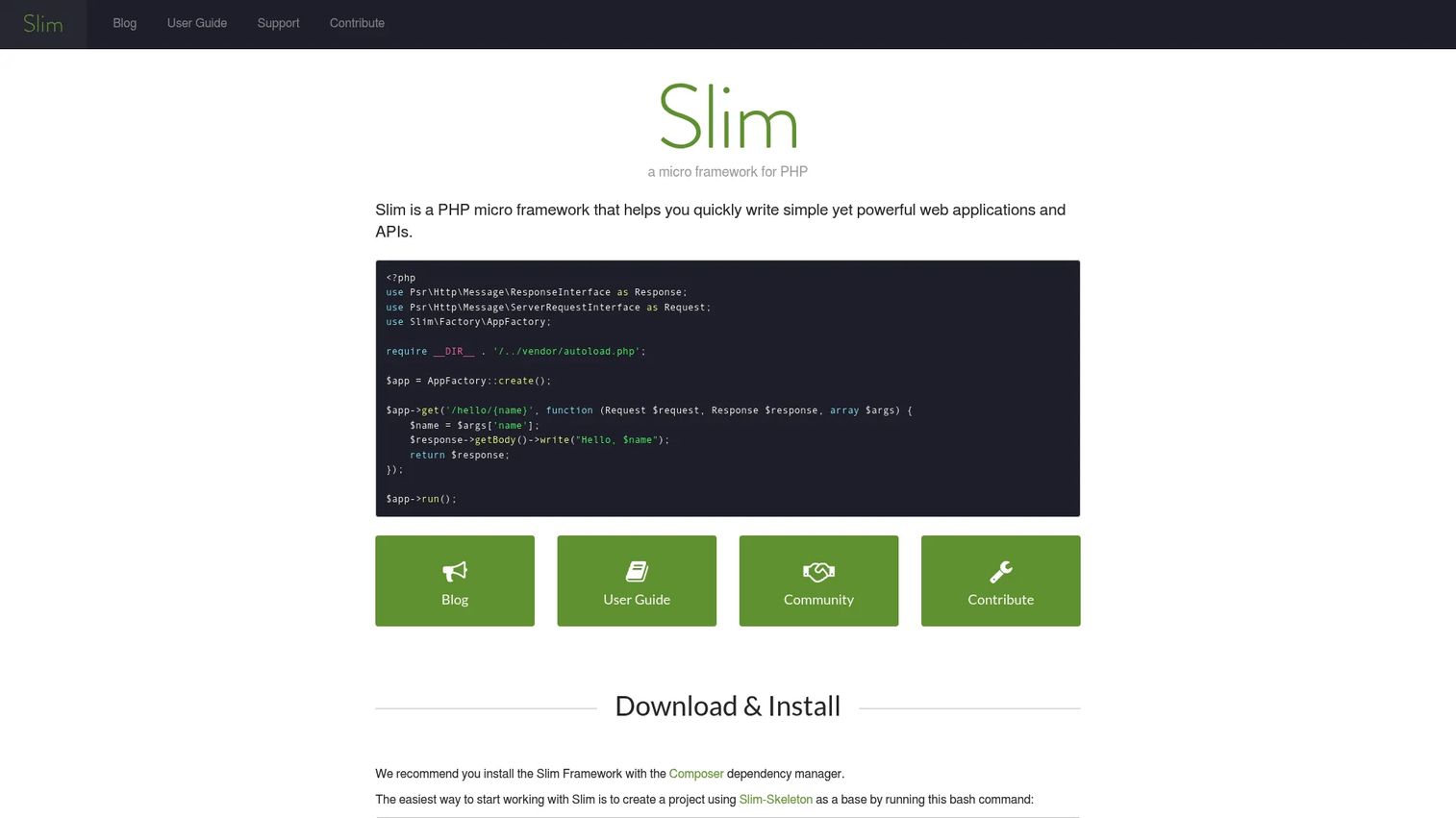
Slim Framework is a PHP microframework for quickly building web applications and APIs. It handles routing with parameter extraction, runs a concentric middleware stack, and supports PSR-7 HTTP messages and PSR-11 dependency injection containers. What Slim does not do is tell you how to structure your application beyond the HTTP layer, which is the point for teams building narrow services.
Best for: Developers building small PHP APIs, microservices, webhooks, or focused backend services where a full-stack framework would add more structure than the project requires.
Key features
- HTTP routing with named routes and parameter matching
- Concentric middleware architecture
- PSR-7 HTTP message interfaces
- PSR-11 dependency injection container compatibility
- Small core with optional add-on packages
Why choose Slim Framework: It keeps the surface area small, which reduces security review complexity and makes the application easier to reason about in early buyer conversations. For teams building an API Platform with documentation generation, schema validation, or GraphQL, API Platform will cover more ground without additional assembly.
Slim Framework pricing: Slim is open source and free. Hosting and any surrounding packages determine the operating cost.
G2 rating: 4.2/5
9. Phalcon
Phalcon is an open-source, full-stack PHP framework delivered as a compiled C extension under the BSD-3-Clause license. Its extension-based architecture means the framework code runs closer to the PHP engine than PHP-written frameworks, which can reduce per-request overhead for workloads that are sensitive to that. Phalcon supports MVC, dependency injection, an ORM with PHQL, the Volt templating engine, and micro-application mode for REST APIs.
Best for: Development teams that prioritize runtime performance and can manage the operational requirement of installing and maintaining a PHP C extension on their hosting environment.
Key features
- C extension architecture with MVC and multi-module support
- Dependency injection container
- Phalcon ORM with PHQL query language
- Volt templating engine compiled to plain PHP
- Micro/REST application mode for minimal API surfaces
Why choose Phalcon: The performance angle is worth evaluating when throughput is a genuine bottleneck, but check hosting compatibility early. Shared hosting and many managed platforms do not support custom PHP extensions, which narrows deployment options. Teams evaluating Phalcon for buyer POCs should confirm server requirements before the POC begins.
Phalcon pricing: Phalcon is open source under the BSD-3-Clause license at no cost. Budget includes hosting that supports the C extension, server setup, and developer time for environment configuration.
G2 rating: 4.4/5
10. FlightPHP
FlightPHP is an extensible PHP microframework for building web applications and APIs. It handles routing, middleware, dependency injection, HTML templates, security basics, and JSON responses, with recent additions including AI coding-assistant integration for autocomplete support. FlightPHP is intentionally small, making it a faster starting point than a full-stack framework for narrow, well-scoped jobs.
Best for: Developers who need a minimal PHP framework for quick prototypes, simple REST routes, or internal tools where a full-stack setup would add overhead without corresponding value.
Key features
- Simple routing with parameter support
- Middleware pipeline
- Dependency injection container
- Built-in JSON response handling
- Security helpers and HTML template support
Why choose FlightPHP: It removes the framework decision from small projects so the team can focus on the service logic. For applications that will grow into multi-team products with long maintenance cycles, starting with Laravel or Symfony avoids a rewrite later. FlightPHP is a practical fit for prototypes, internal utilities, and focused microservices.
FlightPHP pricing: FlightPHP is open source and free. Costs come from hosting and any added packages.
11. API Platform
API Platform is an open-source PHP API framework built around the Symfony ecosystem that generates REST and GraphQL APIs from PHP data models. It produces OpenAPI documentation, Swagger UI, and GraphiQL automatically, and supports JSON-LD, Hydra, JSON:API, and Mercure for real-time updates. Teams building developer-facing API products or structured backend platforms get documentation and schema handling without writing it separately.
Best for: Teams building API-first PHP applications where standards compliance, automatic documentation, and structured schema management are part of the product requirements.
Key features
- REST and GraphQL API generation from PHP models
- Automatic OpenAPI, Swagger UI, and GraphiQL documentation
- JSON-LD, Hydra, and JSON:API hypermedia support
- Pagination, filtering, and authentication/authorization rules built in
- Mercure integration for real-time server-sent events
Why choose API Platform: When the API is the product or the primary integration surface, API Platform removes the work of wiring documentation, schema validation, and content negotiation manually. For simple APIs that do not need that structure, Slim Framework gets the job done with less setup. API Platform builds on Symfony, so teams should budget for the Symfony learning curve if they do not already have it.
API Platform pricing: API Platform is free software. Commercial support, training, and professional services are available separately from the project's maintainers. Costs are hosting, developer time, and any consulting arrangements.
12. TYPO3
TYPO3 is an open-source enterprise content management system built with PHP. It manages multilingual sites, complex editorial workflows, multi-site instances, and large extension ecosystems from a single installation. TYPO3 belongs on this list because searches for PHP frameworks regularly include PHP-based platforms for content-heavy projects, and TYPO3 is the strongest open-source CMS option for organizations with enterprise governance requirements.
Best for: Organizations building large content-managed websites with complex editorial governance, multilingual requirements, or multi-site management needs.
Key features
- Multilingual content and site management
- Role-based access control with granular permissions
- XML sitemaps, hreflang, canonical URLs, and social metadata for SEO
- Extension ecosystem for adding functionality
- Forms, workflows, and media management built in
Why choose TYPO3: It fits content-heavy applications where governance, permissions, and editorial workflow matter more than application flexibility. It is not a general-purpose web application framework. Teams building SaaS products, custom APIs, or dynamic business applications should evaluate Laravel, Symfony, or another framework on this list instead.
TYPO3 pricing: TYPO3 CMS is open source and free to download and use. Costs come from implementation, hosting, extensions, and agency support arrangements, which vary by project scope.
G2 rating: 3.9/5
Considerations when choosing a PHP framework
Match the framework to the application type
Separate the project category before comparing frameworks. SaaS applications, REST APIs, enterprise CMS sites, internal admin tools, and microservices each have different requirements. A framework can be well-maintained and widely adopted while still being wrong for the specific job. Laravel is an excellent choice for a SaaS dashboard and a poor default for a content-governance platform.
Check security defaults and update cadence
Look at CSRF protection, input validation, output escaping, authentication support, and how quickly the framework publishes security patches. For presales teams, this directly affects buyer security review. Organizations with formal procurement processes will ask about dependency vulnerability disclosure and long-term support commitments. Symfony and Laravel both have active security teams and documented vulnerability response policies.
Evaluate maintainability before performance
Raw throughput matters in some architectures, but maintainability usually determines total cost over the application's lifetime. Check documentation quality, upgrade path between major versions, test coverage tooling, and the available hiring pool in your geography. A framework with a thin developer community adds long-term risk that no performance gain offsets.
Review ecosystem and package depth
Composer packages, official plugins, and community integrations determine how much the team builds versus assembles. Laravel's ecosystem is the broadest, with first-party packages for queues, payments, authentication, and deployment. Frameworks like FlightPHP or Mezzio have smaller package ecosystems, which is appropriate for narrow services but a gap for complex business applications.
Confirm hosting and deployment requirements
Standard PHP frameworks run on most shared hosting, containers, and cloud platforms. Phalcon is an exception because it requires a compiled C extension, which is not supported on many managed hosting environments. Check extension support, queue worker compatibility, cron job support, and caching options before finalizing a framework choice for production deployment.
Conclusion
The PHP frameworks landscape in 2026 gives teams precise tools for specific jobs rather than one option that fits everything.
Laravel is the best starting point for most full-stack product builds. Symfony is the stronger choice when architectural discipline and long-term component reuse matter. CodeIgniter 4 fits lightweight applications without a heavy dependency tree. For API work, API Platform handles structured API products with automatic documentation, while Slim Framework covers focused services with minimal overhead. Mezzio fits teams that prefer explicit middleware pipelines over framework conventions. CakePHP reduces structural decisions for convention-driven teams. TYPO3 belongs on content-heavy enterprise websites, not general-purpose application builds. Phalcon, Yii 3, and FlightPHP each serve specific technical fits worth evaluating when the project requirements point that way.
Choose based on application lifespan, security requirements, developer skill availability, and the validation conversations you will need to support. A defensible framework decision is one where the reasoning holds up in a security review, an RFP response, or a three-year maintenance review.
If your product is built on any of these frameworks and you need buyers to understand it before a call, Start your journey with Guideflow today!
FAQs
Laravel is the best default for most full-stack web applications, used by 64% of surveyed PHP developers according to JetBrains (2025). Symfony is the stronger choice for complex, long-lived enterprise applications where component control matters more than scaffolding speed. Slim Framework or API Platform are better fits for API-first projects depending on how much structure the API surface requires.
Laravel and CodeIgniter 4 are both accessible starting points, but for different reasons. Laravel has a larger community, more tutorials, and more first-party documentation, which makes it easier to find answers quickly. CodeIgniter 4 has a smaller footprint and simpler folder structure, which reduces the number of abstractions a new developer needs to understand before shipping their first route.
Symfony fits custom enterprise web applications where modular architecture and long-term support are requirements. Laminas fits enterprise teams maintaining or modernizing Zend Framework-era PHP systems, with a documented migration path and Linux Foundation governance. TYPO3 is the right choice for enterprise content management specifically, not for general enterprise application development.
API Platform is the strongest option when the API needs automatic documentation, schema validation, and standards compliance built in. Slim Framework handles minimal APIs and microservices with less overhead and a smaller footprint. Mezzio fits teams that want explicit PSR-15 middleware pipelines for API request handling. The right choice depends on how much structure and documentation the API surface requires.
Neither is universally better. Laravel is generally faster for product development because of its scaffolding, first-party packages, and developer tooling. Symfony gives senior teams more architectural control and is the stronger foundation for complex, modular, long-lived applications. Many Laravel packages are built on Symfony components, so the two work complementarily in practice rather than as strict alternatives.
PHP frameworks remain actively used and well-maintained across content platforms, SaaS products, ecommerce backends, internal tools, and API services. PHP's 69.1% share of websites with a known server-side language (W3Techs, 2026) reflects its continued deployment at scale. Frameworks improve on raw PHP by providing security defaults, organized structure, and package ecosystems that accelerate production development.
Framework choice affects how easily a buyer can inspect the application's security posture, integration options, and maintenance plan. During technical validation, presales teams should ask about the framework's update cadence, long-term support commitments, package dependency count, and any hosting requirements that could create friction during POC scoping. A well-known framework with active security disclosures is easier to pass through procurement than a custom or obscure stack.
All 12 frameworks covered in this guide are open source with no paid software license. The cost of running a PHP application is hosting, developer time, commercial support (when contracted separately), and long-term maintenance. Laravel Cloud offers optional managed hosting starting at $5 per month plus usage. SymfonyCloud and SymfonyInsight are separate paid services that complement the Symfony framework but are not required to use it.