You can get a prototype into a pilot with shared folders and a determined quality lead. That approach breaks down the moment you face a formal submission, an external audit, or a supply chain that spans multiple contract manufacturers.
The decision to adopt a medical quality management system is not about document storage. It is about whether evidence stays connected as the company grows, whether a corrective action links back to the design record that triggered it, and whether your quality team can answer an auditor's question in minutes rather than days.
The stakes sharpened in 2026. FDA's Quality Management System Regulation became effective on February 2, 2026, harmonizing U.S. device quality requirements more closely with ISO 13485:2016. That shift changes what your QMS needs to support, not just store. The healthcare quality management software market reflects that urgency: Grand View Research valued it at $1.30 billion in 2025 and projects 14.5% CAGR growth through 2033.
Treat all regulatory references in this guide as operational context, not legal advice. Work with qualified regulatory and legal advisers for company-specific requirements.
What's inside
This guide covers eight medical quality management systems evaluated for 2026. It is written for founders and operations leaders at medical device, digital health, diagnostics, and regulated health technology companies, whether you are preparing a first submission or scaling across multiple product lines.
Tools were selected based on:
- Medical device and life sciences relevance
- Breadth of quality lifecycle coverage (documents, CAPA, audits, design controls, supplier quality)
- Scalability from lean teams to enterprise operations
- Deployment model and available pricing information
- G2 rating based on current verified listings
TL;DR
- Best overall for medical device teams: Greenlight Guru, a purpose-built medtech eQMS with packages starting at $12,000 per year
- Best for lean regulated teams: Qualio, for companies formalizing quality operations in a cloud-first system before a major submission or audit
- Best for enterprise life sciences: MasterControl, for broad quality and manufacturing workflows at scale
- Best for Salesforce-centered operations: ComplianceQuest, when Salesforce already anchors your operating stack
- Best for connected PLM and quality: Arena PLM & QMS, when design changes and quality records must stay linked
What are medical quality management systems?
A medical quality management system is the documented set of processes, records, controls, and responsibilities that a medical device organization uses to ensure products are designed, manufactured, monitored, and improved under controlled conditions.
Medical QMS versus eQMS software
A QMS is the operating system of your quality processes and evidence. An eQMS is the software used to manage, automate, connect, and retrieve that evidence electronically. Software does not replace procedures, quality ownership, training, management review, or regulatory judgment. It makes those things faster to execute and easier to prove.
Core processes a medical device eQMS should support
- Document control and controlled approvals
- Training and competency records
- CAPA and nonconformance workflows
- Change control and impact assessment
- Internal audits and audit evidence
- Supplier qualification and performance oversight
- Complaint handling and post-market signals
- Design controls, risk records, and traceability
- Electronic signatures, audit trails, and access controls
Regulations that shape the buying decision
| Regulation or standard | What it governs |
|---|---|
| ISO 13485:2016 | Medical device quality management systems globally |
| FDA QMSR (effective February 2, 2026) | U.S. device quality requirements, now harmonized with ISO 13485 |
| 21 CFR Part 820 | Predecessor U.S. device quality regulation, now updated by QMSR |
| 21 CFR Part 11 | Electronic records and electronic signatures in FDA-regulated contexts |
| EU MDR | Medical device market access and post-market requirements in Europe |
| ISO 14971 | Risk management for medical devices |
| IEC 62304 | Software lifecycle requirements for medical device software |
Applicability depends on your product type, target markets, classification, and regulatory strategy. This table is educational context, not compliance guidance.
When to use medical quality management software
Move beyond shared drives before your first formal submission
When controlled document approvals start cycling through email, when training records live in a spreadsheet no one owns, and when audit preparation means manually assembling evidence, a QMS earns its place. Early-stage medical device and digital health teams often cross this threshold before their first FDA submission or notified-body audit.
Connect quality events before they become remediation work
A CAPA that does not link to the complaint that opened it, or a supplier change that has no impact assessment on record, creates audit exposure. Medical device audit management software helps teams trace quality events across CAPA, nonconformances, supplier records, and changes before gaps surface during an inspection.
Standardize quality across product lines, sites, or external partners
Multi-site manufacturers, companies managing contract manufacturers, and teams expanding into international markets need common workflows, access controls, and evidence retrieval. When a quality event at one site needs to inform a corrective action that applies globally, disconnected tools make that expensive.
Medical quality management systems comparison
The strongest fit depends on company stage, product type, and whether you need a purpose-built medtech eQMS, a configurable enterprise quality platform, or an integrated PLM and quality environment. Evaluate total first-year cost across licensing, implementation, validation support, integrations, and internal process work, not license price alone.
| # | Product | Best for | Key differentiator | Pricing | G2 rating |
|---|---|---|---|---|---|
| 1 | Greenlight Guru | Medical device teams needing a purpose-built eQMS | Connected quality, design, risk, and regulatory workflows for medtech | From $12,000/year | 4.4/5 |
| 2 | Qualio | Lean to mid-market regulated teams formalizing quality | Structured cloud QMS with Foundation, Growth, and Scale plans | Quote based | 4.4/5 |
| 3 | MasterControl | Large life sciences and manufacturing organizations | Broad quality and manufacturing suite for regulated operations | Quote based | 4.4/5 |
| 4 | ComplianceQuest | Salesforce-centered quality and enterprise operations | Salesforce-native QMS with configurable workflows | Quote based | 4.3/5 |
| 5 | Veeva Vault QMS | Enterprises wanting a unified Vault quality environment | Quality events, CAPA, audits, complaints, and supplier quality | Quote based | 4.1/5 |
| 6 | ETQ Reliance | Configurable enterprise quality with supply-chain depth | Large application library and codeless workflow configuration | Quote based | 4.3/5 |
| 7 | Dot Compliance | Life sciences teams on a Salesforce-native cloud QMS | Salesforce-based platform with AI assistant | Quote based | 4.0/5 |
| 8 | Arena PLM & QMS | Product organizations needing linked PLM and QMS | Unified product lifecycle and quality records | Quote based | 4.2/5 |
Best 8 medical quality management systems for 2026
Each platform below solves the core medical device QMS job differently. The right choice turns on whether your company needs a medtech-specific system, configurable enterprise workflows, or tightly connected product lifecycle and quality data.
1. Greenlight Guru
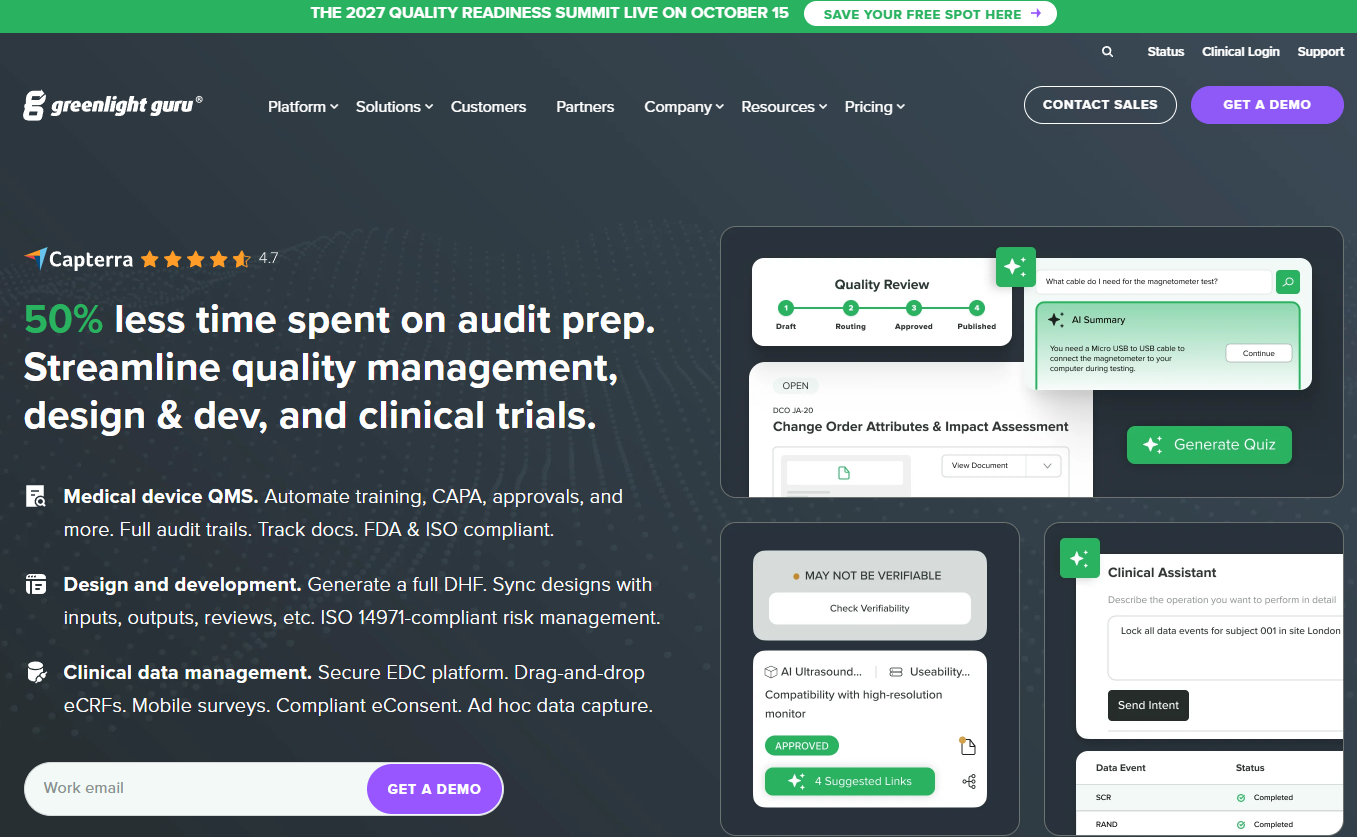
Greenlight Guru is an AI-powered quality management, product development, and clinical data platform built specifically for medical device companies. It connects quality management, design controls, risk records, and regulatory workflows in one environment, from early-stage teams through global operations. The platform is explicitly positioned for medtech, which means it ships with medical-device vocabulary, templates, and validation documentation rather than requiring a general QMS to be configured for device-specific use.
Best for: Founders and quality leaders who want a medical device-specific system rather than a configurable general QMS.
Key features
- Document and change management with controlled approvals
- Design controls, requirements, and risk management with full traceability
- CAPA, audit management, and quality event workflows
- Supplier quality management and oversight
- AI-powered search, summaries, and training analytics
Why choose Greenlight Guru: Choose this when your quality lead needs medtech-specific templates and a system that already understands the device lifecycle, rather than building that context into a general platform. The implementation commitment is real for a smaller team, but the alternative is bolting together generic tools that create traceability gaps under audit.
Greenlight Guru pricing: eQMS and quality and product development packages start at $12,000 per year, billed annually. Implementation and clinical study-build services are quoted separately and include planning, migration, template setup, and team training.
G2 rating: 4.4/5
2. Qualio
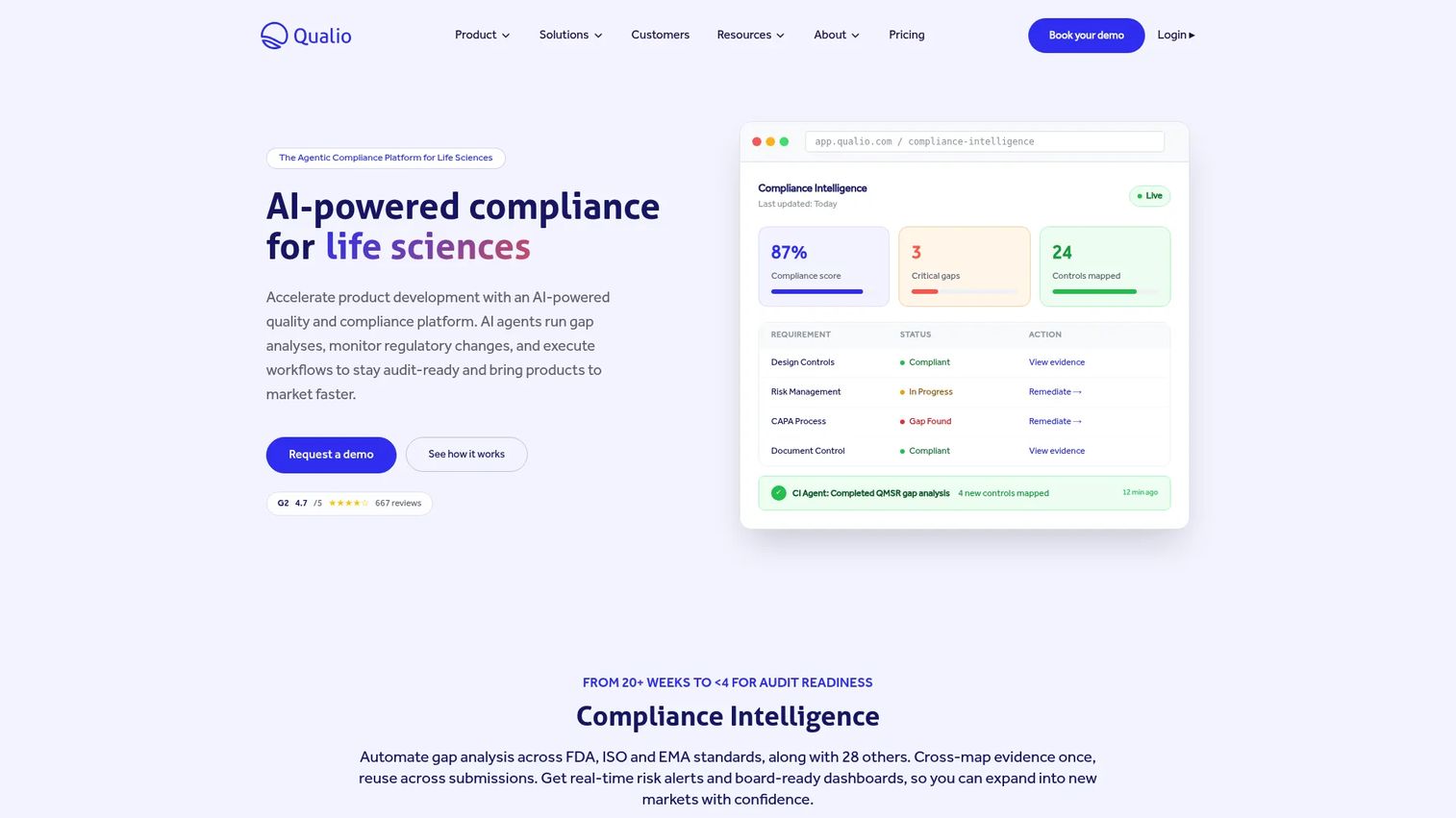
Qualio is an AI-powered quality management and compliance platform for life sciences companies. It positions itself as a structured cloud QMS that helps lean to mid-market teams formalize controlled quality processes while keeping the system approachable for organizations that do not yet have a large quality department. Qualio publicly offers Foundation, Growth, and Scale editions, each covering progressively broader quality frameworks and multi-market requirements.
Best for: Teams moving from manual document and training processes toward a cloud QMS before their first major submission, audit, or international expansion.
Key features
- Controlled document management and version control
- Training assignments, assessments, and competency records
- CAPA and nonconformance workflows
- Audit and supplier management
- Design controls, risk records, and compliance intelligence
Why choose Qualio: It fits a growing company that needs a structured operating model without immediately deploying a large enterprise stack. The QMSR-aligned positioning is vendor framing, not a compliance guarantee, but the platform is designed with ISO 13485 and life sciences workflows as the default context rather than an afterthought.
Qualio pricing: Qualio uses quote-based pricing across Foundation, Growth, and Scale editions. All plans include an implementation fee. Contact Qualio's sales team for current figures across editions.
G2 rating: 4.4/5
3. MasterControl
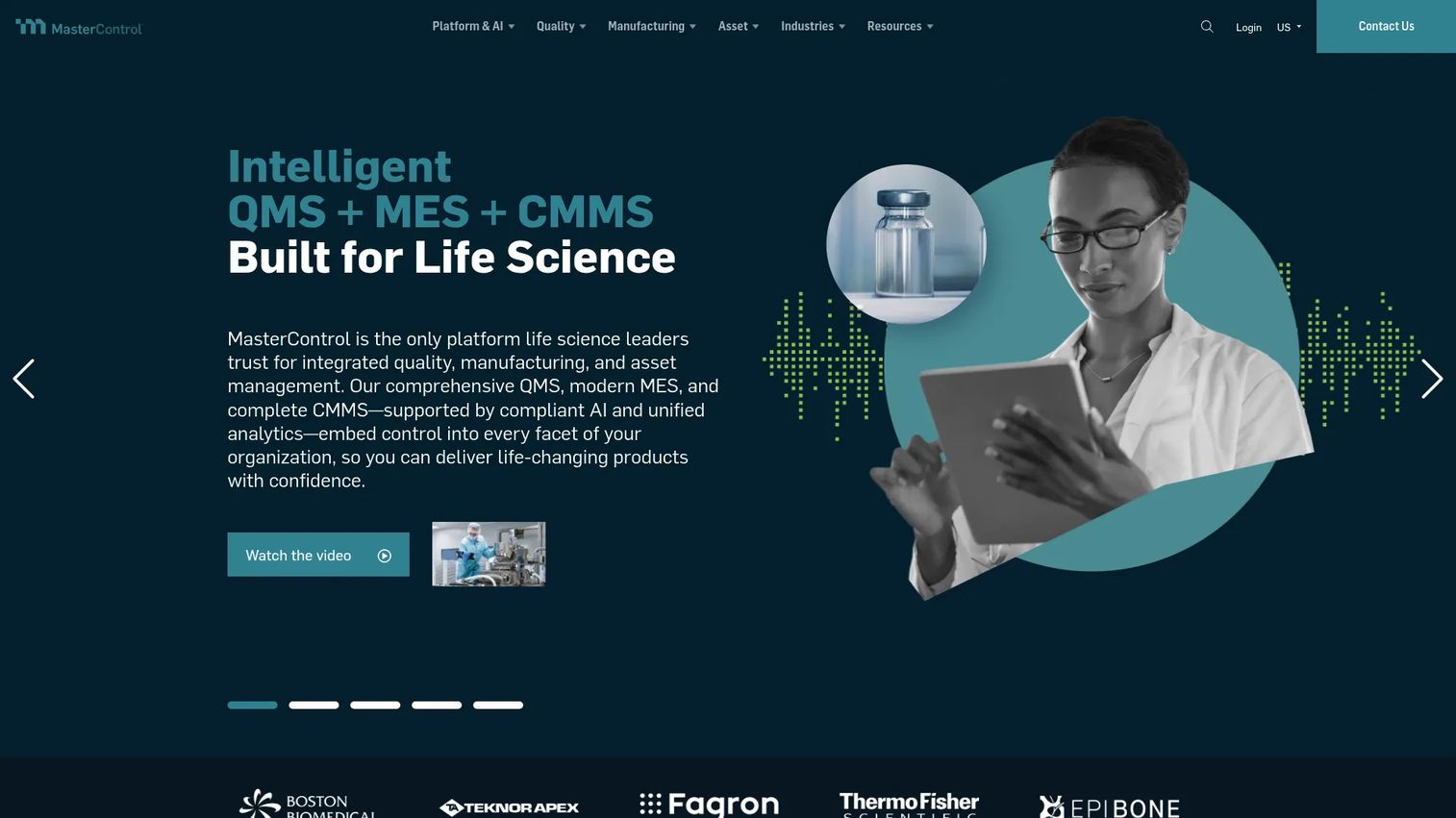
MasterControl provides cloud-based quality, manufacturing, and asset management software for regulated life sciences organizations. It is one of the more established names in the category, with coverage spanning document control, training, quality events, audits, risk, change control, supplier management, and manufacturing process management. The platform offers pre-configured packages for startup-stage through enterprise customers, though all pricing goes through a tailored sales process.
Best for: Established medical device manufacturers and life sciences companies with complex operations, mature quality teams, or broader manufacturing requirements.
Key features
- Enterprise document control and approval workflows
- Audit management and inspection readiness tools
- CAPA and quality event management
- Manufacturing process management capabilities
- Validation and compliance resources
Why choose MasterControl: Strong candidate when your organization needs a broad, mature quality platform that spans product development and manufacturing. That breadth brings a more involved evaluation and implementation project than a focused medtech eQMS, so size the commitment honestly before signing.
MasterControl pricing: MasterControl sells through a tailored quote process. Before comparing cost, request a line-item view covering modules, validation support, implementation services, user licensing, and contract structure.
G2 rating: 4.4/5
4. ComplianceQuest
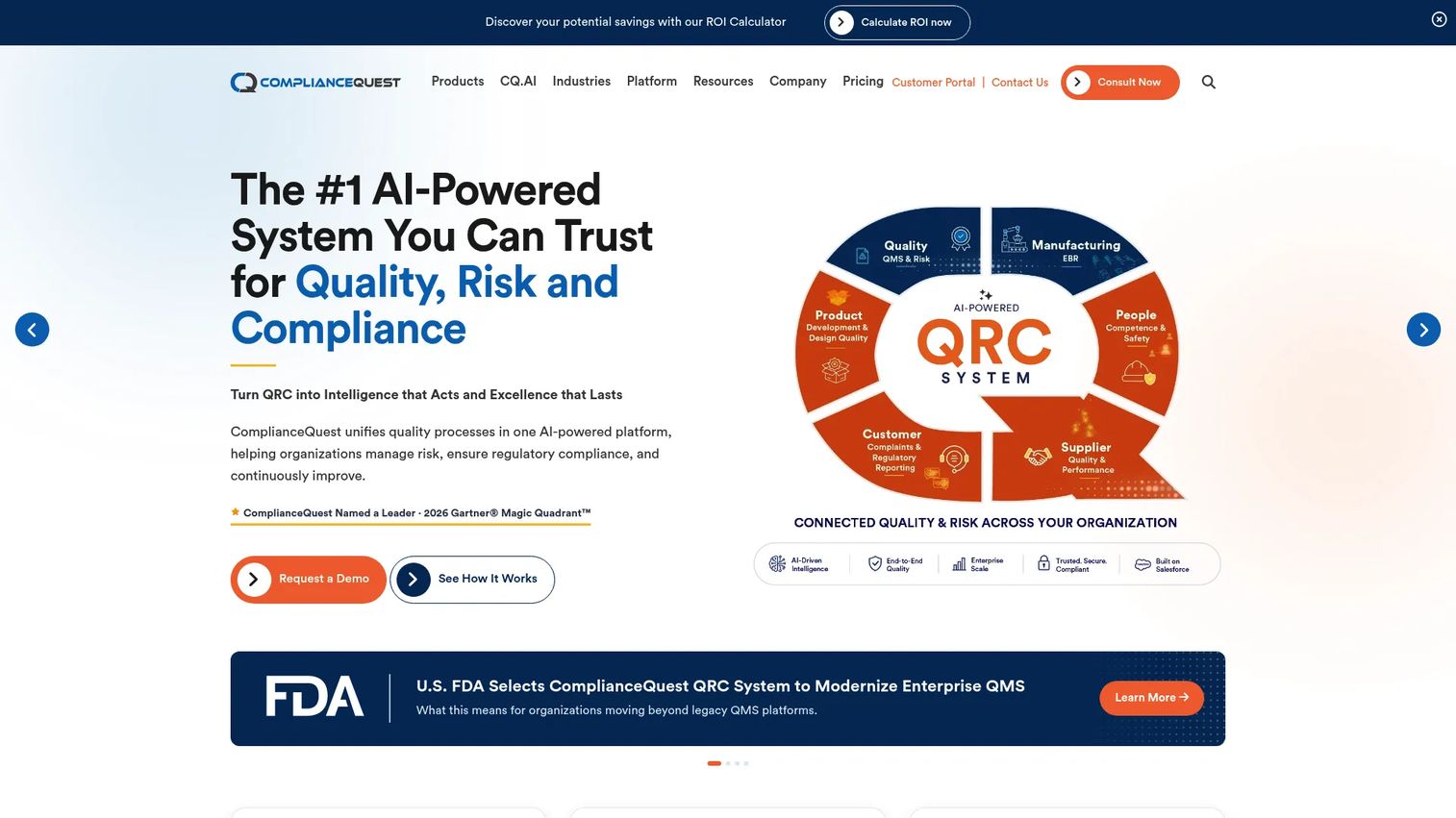
ComplianceQuest is an AI-powered quality, risk, and compliance platform built natively on Salesforce. It covers CAPA, audits, complaints, nonconformance, risk, change, document, and training management, alongside product lifecycle management, environmental health and safety, supplier management, and electronic batch records. The Salesforce-native architecture means quality data can connect directly to sales, service, and operational records in the same platform your GTM team already uses.
Best for: Mid-market and enterprise medical device organizations that already operate heavily in Salesforce and need configurable quality workflows with cross-functional data connectivity.
Key features
- Salesforce-native architecture with CRM data integration
- CAPA and nonconformance management
- Document, training, and change control
- Audit and supplier management
- Connected PLM and QHSE workflows
Why choose ComplianceQuest: The configurability and shared data model are compelling for companies with complex cross-functional systems. Tightly govern the configuration scope before implementation begins. An overextended configuration project is one of the most common sources of delayed go-live on this type of platform.
ComplianceQuest pricing: Pricing is quote based and varies with user count, modules, validation requirements, integrations, and rollout scope. Contact ComplianceQuest for a current estimate tied to your specific configuration.
G2 rating: 4.3/5
5. Veeva Vault QMS
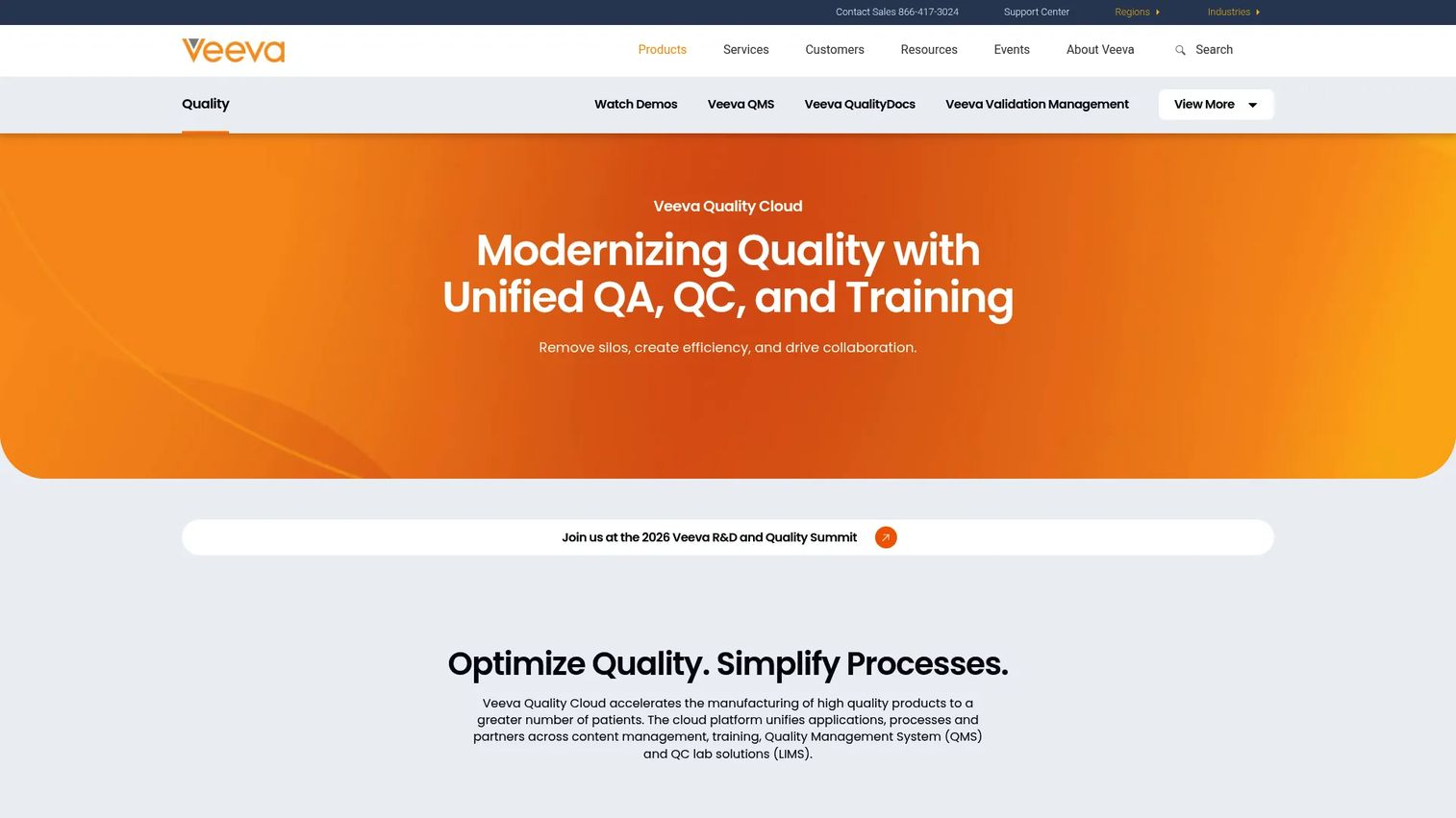
Veeva Vault QMS is a cloud-based quality management system for life sciences and medical device organizations. It covers complaints, deviations, audits, quality risk management, supplier quality management, and change control, with configurable forms and automated workflows. The platform is part of Veeva's broader Vault suite, which means organizations already using Vault for regulatory, clinical, or commercial processes can work within a connected environment.
Best for: Larger regulated organizations that want a unified Vault quality environment and may already use other Vault applications for regulatory or commercial functions.
Key features
- Quality event management and deviation tracking
- CAPA and change control workflows
- Complaint handling and post-market signal management
- Audit management with supplier visibility
- Reports, dashboards, and mobile access
Why choose Veeva Vault QMS: The suite-level approach and enterprise fit are the primary arguments. Most relevant when quality operations span multiple functions, geographies, or adjacent Vault systems. For a company that does not yet use Veeva elsewhere, evaluate whether the full Vault commitment fits your current operating model.
Veeva Vault QMS pricing: Veeva uses quote-based enterprise pricing. Obtain details on modules, environments, validation support, data migration, and contract commitments during vendor evaluation.
G2 rating: 4.1/5
6. ETQ Reliance
ETQ Reliance (now marketed as Octave Reliance on the current ETQ site) is a cloud-native electronic QMS for enterprise quality and compliance management. It offers a broad application library covering document control, CAPA, audit, training, supplier quality, and change management, with codeless workflow, form, and rules configuration. Advanced analytics with real-time KPIs and AI-driven insights are included as part of the platform.
Best for: Medical device manufacturers that need configurable enterprise quality workflows, deeper supply-chain quality management, and analytics across a larger quality program.
Key features
- Document control, CAPA, audit, and training management applications
- Codeless workflow and form configuration
- Supplier quality workflows and nonconformance management
- Advanced analytics with real-time KPIs and predictive insights
- Validation support options for regulated environments
Why choose ETQ Reliance: ETQ fits organizations that need to model their own quality processes and scale across sites, teams, or suppliers. Configuration flexibility raises the importance of implementation governance, so confirm internal capacity to own that work before signing.
ETQ Reliance pricing: ETQ uses sales-led, quote-based pricing. Request a line-item view of required applications, user types, validation packages, implementation services, and expansion costs before comparing against other platforms.
G2 rating: 4.3/5
7. Dot Compliance
Dot Compliance is an AI-powered, Salesforce-native electronic quality management system for pharmaceutical, biotechnology, and medical device organizations. The platform covers document management, training, CAPA, change management, quality event management, audit management, supplier quality management, and risk management. It also includes Dottie, an AI assistant designed to support quality workflows within the platform.
Best for: Medical device teams looking for a cloud QMS with life sciences orientation, Salesforce-native architecture, and a clear focus on validation, regulatory workflows, and quality process controls.
Key features
- Document management and controlled approvals
- Electronic records, audit trails, and 21 CFR Part 11 support
- CAPA and quality event management
- Audit and supplier quality workflows
- Dottie AI assistant for quality process support
Why choose Dot Compliance: Worth evaluating when you want validation and regulated-workflow support with a Salesforce-native architecture, without immediately committing to the broadest enterprise suite. Verify the exact functional coverage needed for your product lifecycle and global regulatory footprint during the demo process.
Dot Compliance pricing: Dot Compliance uses quote-based pricing. The evaluation should cover licensing, onboarding, validation, integration work, and anticipated scale across users and modules.
G2 rating: 4.0/5
8. Arena PLM & QMS
Arena PLM & QMS is a cloud-native platform that combines product lifecycle management and quality management in a single environment. It connects BOM and product record management, engineering change management with automated approvals, document and revision control, and closed-loop quality management including CAPAs, nonconformance reports, and complaints. Requirements, project, training, supplier, analytics, and compliance management round out the application set.
Best for: Hardware, diagnostics, connected-device, and medical device organizations where design changes, BOMs, supplier collaboration, and quality records must stay tightly linked.
Key features
- Integrated PLM and QMS records in one environment
- Engineering change management with automated approvals
- Closed-loop quality management: CAPA, NCMR, complaints
- Supplier collaboration and revision control
- Requirements, training, and compliance management
Why choose Arena PLM & QMS: Arena is most compelling when the quality risk lives in product change complexity and supplier collaboration rather than controlled documents alone. This is a different buying decision from choosing a document-control-focused eQMS. Arena publicly lists a free 10-day trial; paid plans require a quote.
Arena PLM & QMS pricing: All paid plans (Launch, QMS, and Enterprise QMS) are priced through Arena's sales team. A 10-day free trial is available. Request clarity on PLM seats, quality modules, supplier access, implementation services, and contract terms.
G2 rating: 4.2/5
Considerations when choosing a medical quality management system
Match the system to your regulatory and product scope
A software as a medical device company, a diagnostics company, and a multi-site device manufacturer typically need different modules and depth. Map the eQMS requirements to your product lifecycle, target markets, and evidence obligations before evaluating features. An early-stage IVD startup and an established Class III device manufacturer are making different purchases.
Price the implementation, not just the license
The purchase includes migration, controlled document setup, process design, validation evidence, integrations, training, and internal change management. Request a first-year total cost estimate that covers all of those components, not a license price alone. The lowest annual subscription can carry the highest first-year cost when implementation scope is underestimated.
Test traceability across a real change scenario
During vendor demos, ask them to walk through a live scenario: Update a controlled procedure, assign linked training, record a risk or design impact, route approvals, and then retrieve the audit trail. Show related CAPA or supplier records where applicable. How quickly and cleanly that scenario runs tells you more than a feature comparison slide.
Verify data integrity, access controls, and validation support
Ask specifically about audit trails, electronic signatures, permissions by role, data export options, disaster recovery, and how the vendor supports the company's own system validation approach. 21 CFR Part 11 compliance requirements for electronic records and signatures apply in many FDA-regulated contexts, and the answers here will surface differences that a standard demo does not cover.
Choose for the operating model you will have in two years
Consider future product lines, manufacturing sites, external suppliers, international markets, and buyer due-diligence requirements. Do not overbuy for infrastructure you will not use in 18 months, and do not choose a system that forces a painful migration at the first sign of real scale.
Conclusion
The medical quality management systems in this guide solve similar problems with meaningfully different approaches.
Greenlight Guru is the strongest choice for medical device teams that want a purpose-built eQMS with medtech templates, design controls, and connected quality workflows from day one. Qualio fits regulated teams formalizing quality operations with a cloud-first system before a first major submission. MasterControl and ETQ Reliance work best for larger operations that need configurable enterprise quality programs with manufacturing depth. ComplianceQuest and Dot Compliance suit organizations where Salesforce already anchors the operating model. Veeva Vault QMS belongs in the conversation when your company is building toward a broader Vault environment. Arena PLM & QMS stands apart when product change complexity and supplier collaboration drive the quality risk.
The best medical quality management system for your company is the one your quality team can run every day, your product team can work alongside, and your organization can defend when an auditor, strategic partner, or board member asks for evidence.
Start your journey with Guideflow today!
FAQs about medical quality management systems
A medical device quality management system is the documented set of processes, responsibilities, and records used to control product quality, safety, and compliance through the device lifecycle. It covers everything from design controls and supplier oversight to post-market surveillance and corrective actions. eQMS software helps manage that system electronically, but it does not replace quality ownership, procedural design, or regulatory judgment.
A QMS is the broader management system encompassing people, procedures, and responsibilities. An eQMS is the digital platform used to manage documents, approvals, training records, quality events, audit trails, and reporting. Most regulated medical device companies need both: The system as a set of controlled procedures and the software to execute and evidence those procedures.
Core capabilities include document control, training management, CAPA, change management, audit management, supplier quality oversight, complaint handling, risk management, and design controls. Electronic signatures, audit trails, and access controls are required in most FDA-regulated contexts under 21 CFR Part 11. The exact feature set depends on product type, target markets, and the company's specific quality processes.
ISO 13485:2016 is the most widely used medical device quality standard globally, and many international markets and notified bodies require it. In the U.S., FDA's QMSR (effective February 2, 2026) incorporates ISO 13485 by reference, bringing U.S. requirements closer to the international standard. Whether it applies to your company depends on your product classification, target markets, customer requirements, and regulatory strategy. Work with qualified regulatory advisers for company-specific guidance.
FDA's Quality Management System Regulation became effective on February 2, 2026, replacing 21 CFR Part 820 as the primary U.S. device quality regulation. QMSR harmonizes U.S. requirements more closely with ISO 13485:2016, which means companies previously compliant with Part 820 need to assess their procedures, evidence practices, supplier controls, audit activities, and QMS software support against the updated requirements. Work with your quality and regulatory teams to evaluate the gap for your specific operations.
Pricing varies widely. Purpose-built platforms like Greenlight Guru publish starting points at $12,000 per year for eQMS packages, billed annually. Most enterprise platforms use sales-led, quote-based pricing with no public figures. First-year cost for any platform should account for licensing, implementation, validation support, training, data migration, integrations, and internal process work. Comparing license prices alone typically underestimates the real cost of switching.
Common triggers include: Formal design controls are underway, an external audit or submission is on the horizon, controlled documents exceed what a shared drive can reliably version, more than one product line or site is in scope, supplier oversight has become a recurring effort, CAPAs are recurring without resolution tracking, or manually assembling evidence for a regulatory interaction is costing more time than the software would.
No. Software organizes workflows and stores evidence. Quality consultants, regulatory specialists, and legal advisers provide judgment, interpretation, procedural design, and company-specific guidance that software cannot replace. A well-implemented eQMS makes those advisers more productive by giving them clean data and accessible records, but it does not substitute for their expertise.