Your organic report shows traffic and rankings. Leadership asks whether AI answers recommend your company. The dashboard doesn’t answer that question.
LLM SEO checking tools help close that reporting gap. But buying another subscription only makes sense if it changes your content priorities or replaces manual analysis.
The shift in discovery is measurable. Fractl research reported by Search Engine Land in 2026 found that 70% of U.S. consumers use AI for search more than a year earlier. That finding describes consumer behavior, not the share of your pipeline influenced by AI.
For marketers, the practical challenge is separating visibility from business impact. A brand mention, a cited page, and a converted visitor represent different outcomes.
The best LLM SEO checker for your team should measure the missing part of that journey. Start with the decision you need to make, then assess what your existing stack already covers.
What’s inside
This comparison covers 17 products associated with LLM SEO checking, including dedicated platforms and supporting analytics tools.
- Audience: Growth marketers and SEO teams evaluating spend, plus agencies building recurring client reports.
- Selection criteria: Answer monitoring, source analysis, technical diagnostics, and reporting usefulness.
- Evidence base: Vendor product and pricing information, with G2 research dated November 24, 2026.
- Important distinctions: Eldil AI and Visus currently serve different categories. Their entries explain why they shouldn’t enter an LLM SEO shortlist.
Use the category distinctions to evaluate the best LLM SEO checking software for your workflow. A broad feature list matters less than whether the tool helps your team act.
TL;DR
- Best starting shortlist for dedicated tracking: AIclicks and Peec AI combine recurring monitoring with analysis for marketing teams.
- Best for broader enterprise evaluation: Profound connects answer visibility with prompt research and AI traffic attribution.
- Best for agency reporting: LLMrefs offers exports and unlimited projects. Compare its workflow with AIclicks before committing.
- Best for stack consolidation: Semrush One, Surfer, and SE Ranking combine established SEO work with AI visibility capabilities.
- Best supporting measurement tools: Google Search Console and Google Analytics establish search performance and conversion baselines.
- Best for manual investigation: ChatGPT and Perplexity help inspect answers directly. The best LLM SEO checkers add repeatable measurement beyond individual tests.
What is llm seo checking software?
LLM SEO checking software measures how brands and pages appear in AI answers, or diagnoses the website factors supporting that visibility.
The category includes dedicated LLM visibility tools and supporting SEO platforms. Some monitor generated responses; others help improve content or measure visits afterward.
These jobs overlap, but they answer different questions.
Core capabilities
- AI visibility tracking: Measures brand mentions and competitor presence across monitored answer engines.
- Prompt monitoring: Repeats selected buyer questions to reveal changes over time.
- AI citation tracking: Identifies the source URLs used in generated answers.
- Technical diagnostics: Examines accessibility and page structure, alongside issues affecting content interpretation.
- Content improvement: Helps teams address topic gaps and present useful answers clearly.
- Referral measurement: Connects identifiable AI traffic with website behavior and conversion events.
A mention indicates that a brand appeared. A citation identifies a source supporting an answer. Neither, by itself, proves a visit or commercial outcome.
For example, an LLM SEO analysis tool might show competitors appearing for a procurement question. Source analysis then helps you investigate what supports those recommendations. Your content team can decide whether the opportunity belongs on your website or in an external publication.
How LLM SEO differs from traditional SEO
| Traditional SEO | LLM SEO checking |
|---|---|
| Tracks search result positions | Tracks presence within generated answers |
| Uses keywords and landing pages | Uses prompts, topics, and named entities |
| Measures search impressions and clicks | Measures mentions, citations, and answer position |
| Diagnoses indexing and website health | Adds answer monitoring and source analysis |
Keep both disciplines in the same operating plan. Technical accessibility remains relevant, while recurring LLM SEO tracking tools add evidence about generated responses.
Generative engine optimization, also called GEO, concerns improving visibility in these experiences. AI answer engine optimization describes a closely related goal.
Treat any visibility score as a vendor-defined measurement. Ask which prompts it includes and how the calculation handles repeated answers. Before comparing LLM SEO analysis tools, establish the question set you want measured.
When to use llm seo checking tools
Track brand visibility in AI answers
Use recurring monitoring when leadership needs evidence beyond screenshots from individual searches. Build a stable prompt set around buying decisions your audience makes.
Separate branded questions from category discovery. Otherwise, prompts containing your company name can distort your interpretation of recommendation visibility.
Find citation gaps before assigning content work
Investigate sources when competitors appear in answers that overlook your brand. Review the cited pages and identify which claims they support.
Turn that evidence into a content brief or outreach decision. Avoid assigning another article before understanding whether the answer relies on vendor pages or independent sources.
Audit pages for AI-search readiness
Run technical checks when important pages have access problems or unclear content structure. Review crawlability and rendering alongside the information a buyer needs.
Combine this work with your existing SEO audit process. A schema recommendation should lead to an accurate implementation, while a content recommendation should improve the page’s usefulness.
Llm seo checking tools comparison
The best LLM SEO checker depends on whether you need monitoring, diagnosis, content work, or attribution.
The table separates dedicated LLM SEO analysis software from supporting products. Eldil AI and Visus remain visible as category mismatches, rather than receiving unsupported SEO capabilities.
Prices below preserve the vendor’s billing basis and currency. Annual rates represent monthly equivalents under an annual commitment. G2 scores describe the listed product; Semrush’s rating covers the broader platform.
Pricing and review information reflects research dated November 24, 2026. “N/A” means a usable rating or category-specific price wasn’t established. It does not imply poor quality.
| # | Product | Best for | Key differentiator | Pricing | G2 rating |
|---|---|---|---|---|---|
| 1 | AIclicks | Dedicated AI visibility workflows | Monitoring plus content and outreach recommendations | From $59/month | 4.9/5 |
| 2 | Profound | Enterprise evaluation | Answer analytics, crawler monitoring, and AI traffic attribution | From $99/month, billed yearly | 4.5/5 |
| 3 | Cognizo | Monitoring with content production | Prompt analysis and automated publishing | From $499/month | 4.8/5 |
| 4 | Eldil AI | Print-media services, not LLM SEO | Current offering concerns books and digitization | N/A for LLM SEO | N/A |
| 5 | Rank Prompt | Prompt tracking and outreach | Monitoring across nine AI engines | Free; paid from $470/year | 5.0/5 |
| 6 | Peec AI | Marketing analytics | Brand perception and AI shopping analysis | From $95/month | 4.7/5 |
| 7 | Semrush One | SEO stack consolidation | Combined SEO and AI Visibility toolkits | From $165.17/month, billed annually | 4.4/5, Semrush |
| 8 | LLMrefs | Agency reporting | Unlimited projects and team members | $79/month | N/A |
| 9 | Visus | Internal knowledge assistants, not LLM SEO | Answers grounded in uploaded documents | Free; paid from $20/member/month | Unrated |
| 10 | SEO Site Checkup | Technical audits with AI visibility | Website diagnostics and monitoring | $39/month or $29/month annually | 3.6/5 |
| 11 | Google Search Console | Organic search baseline | Google search and indexing diagnostics | Free | 4.7/5 |
| 12 | Google Analytics | Referral and conversion measurement | Acquisition reporting and funnel analysis | Free; Analytics 360 custom pricing | 4.5/5 |
| 13 | Surfer | Content and AI visibility | Optimization alongside answer tracking | From €49/month, billed yearly | 4.6/5 |
| 14 | SE Ranking | Integrated SEO operations | Research, audits, reporting, and AI visibility | $129/month or $103.20/month annually | 4.8/5 |
| 15 | Scrunch AI | Brand and AI-agent experiences | Citation intelligence and Agent Pages | From $250/month | 4.6/5 |
| 16 | ChatGPT | Qualitative answer testing | Direct prompt experimentation | Free; Plus $20/month | 4.6/5 |
| 17 | Perplexity | Citation-led investigation | Answers linked to supporting sources | Free; Pro $17/month annually | N/A |
Best 17 tools for llm seo checking
1. AIclicks
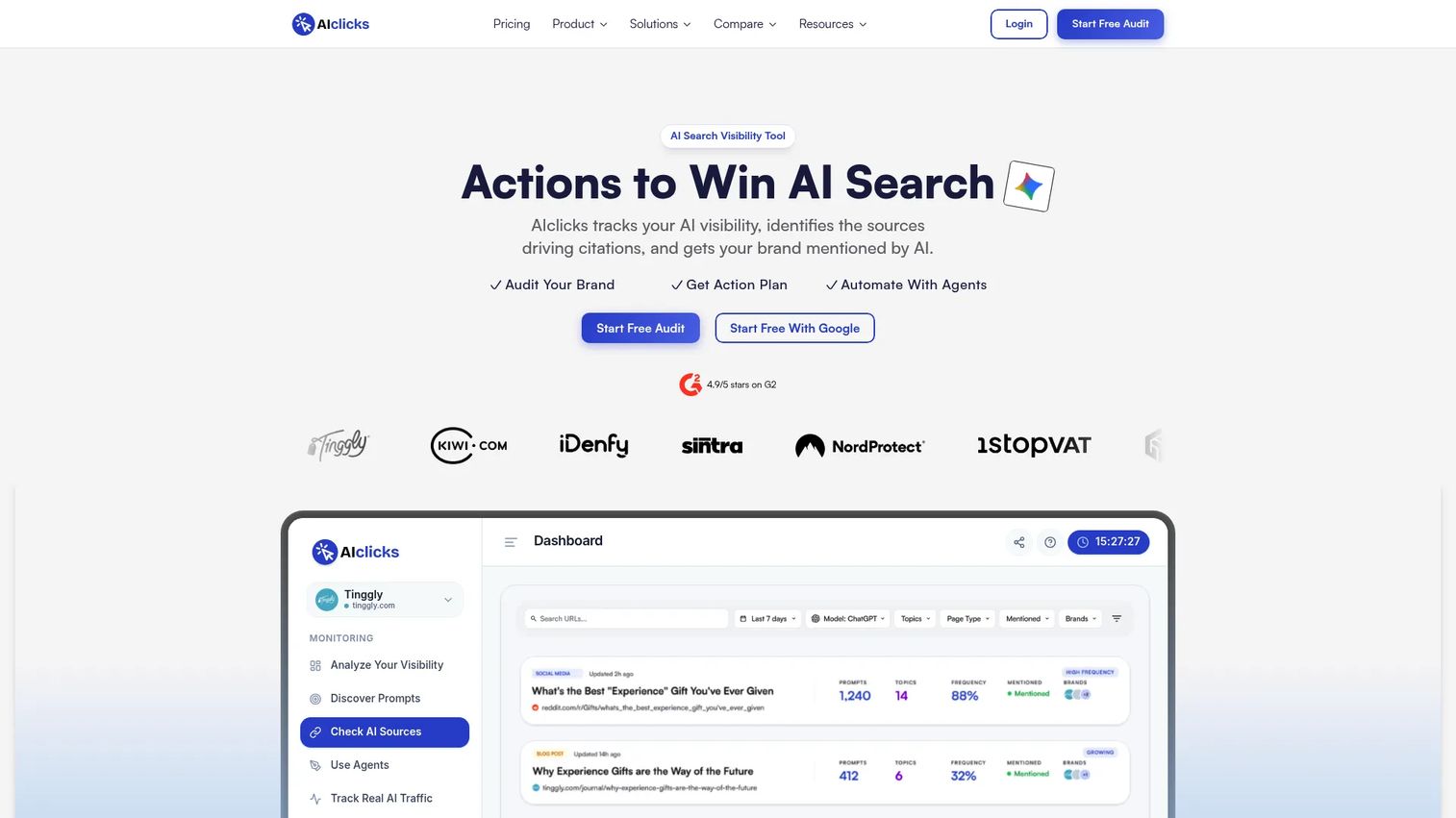
AIclicks combines AI-search monitoring with recommendations for content and outreach. Its analysis covers brand mentions and citation sources, with competitor benchmarking across AI platforms. Google Analytics and CMS integrations connect the findings with adjacent marketing workflows.
Best for: Growth teams building a repeatable process around AI visibility rather than collecting occasional answer screenshots.
Key features
- Daily prompt and visibility monitoring
- Citation-source coverage analysis
- Competitor benchmarking
- AI-assisted content and outreach recommendations
- API, MCP, and CMS integrations
Why choose AIclicks: Choose it when the same team owns diagnosis and the next content action. Its workflow spans measurement and recommendations without requiring a separate research process for every finding.
During evaluation, bring a buying-intent prompt and inspect the underlying sources. Ask whether the suggested action gives your content owner enough context to work independently.
Budget against prompt coverage as well as model access. Starter includes 30 tracked prompts and three models; Pro expands those allowances to 150 prompts and four models.
AIclicks pricing: Starter costs $59/month, Pro $189/month, and Business $499/month. All plans include a three-day trial; Enterprise uses custom pricing.
G2 rating: 4.9/5.
2. Profound
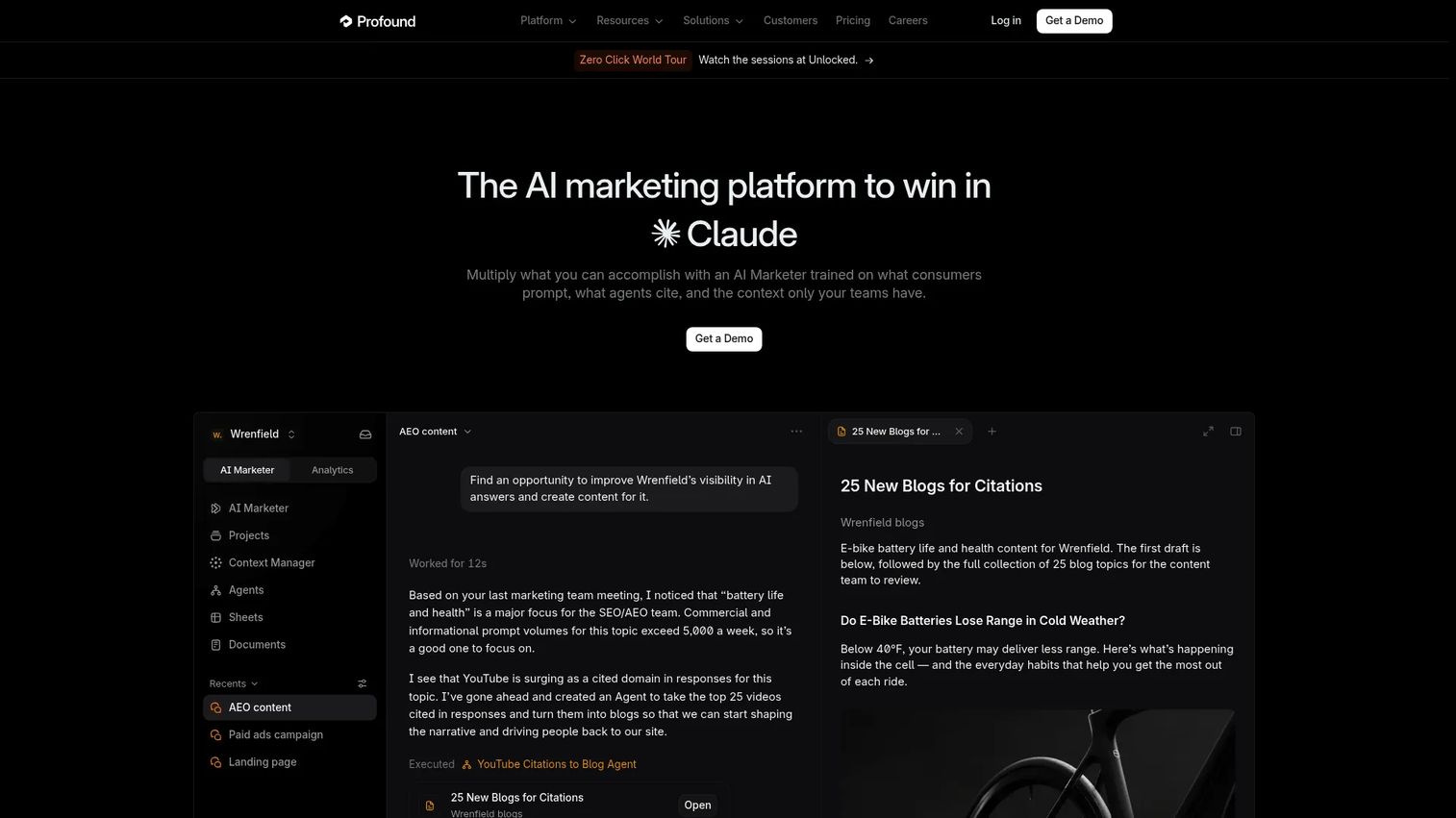
Profound combines answer-engine analytics with prompt research and content gap analysis. It also monitors AI crawlers and supports AI traffic attribution. ChatGPT Shopping tracking extends its coverage into product discovery.
Best for: Larger marketing organizations evaluating AI visibility alongside content investment and brand perception.
Key features
- Answer visibility and sentiment analysis
- Competitive citation research
- Prompt volume research
- AI crawler monitoring
- ChatGPT Shopping visibility tracking
Why choose Profound: It suits organizations asking several related questions about AI discovery, including how answers describe the brand and which topics deserve investment. Small teams should identify which modules they will use before buying a broader workflow.
For a practical evaluation, ask different stakeholders to review the same category. A content lead should identify a publishing opportunity, while a brand manager should assess answer accuracy.
Its pricing page presents different plan configurations. Match the proposed subscription with the specific modules in your evaluation rather than assuming every listed capability accompanies the entry plan.
Profound pricing: Starter is $99/month and Growth $399/month, billed yearly. A seven-day trial is available; Enterprise uses custom pricing.
G2 rating: 4.5/5.
3. Cognizo
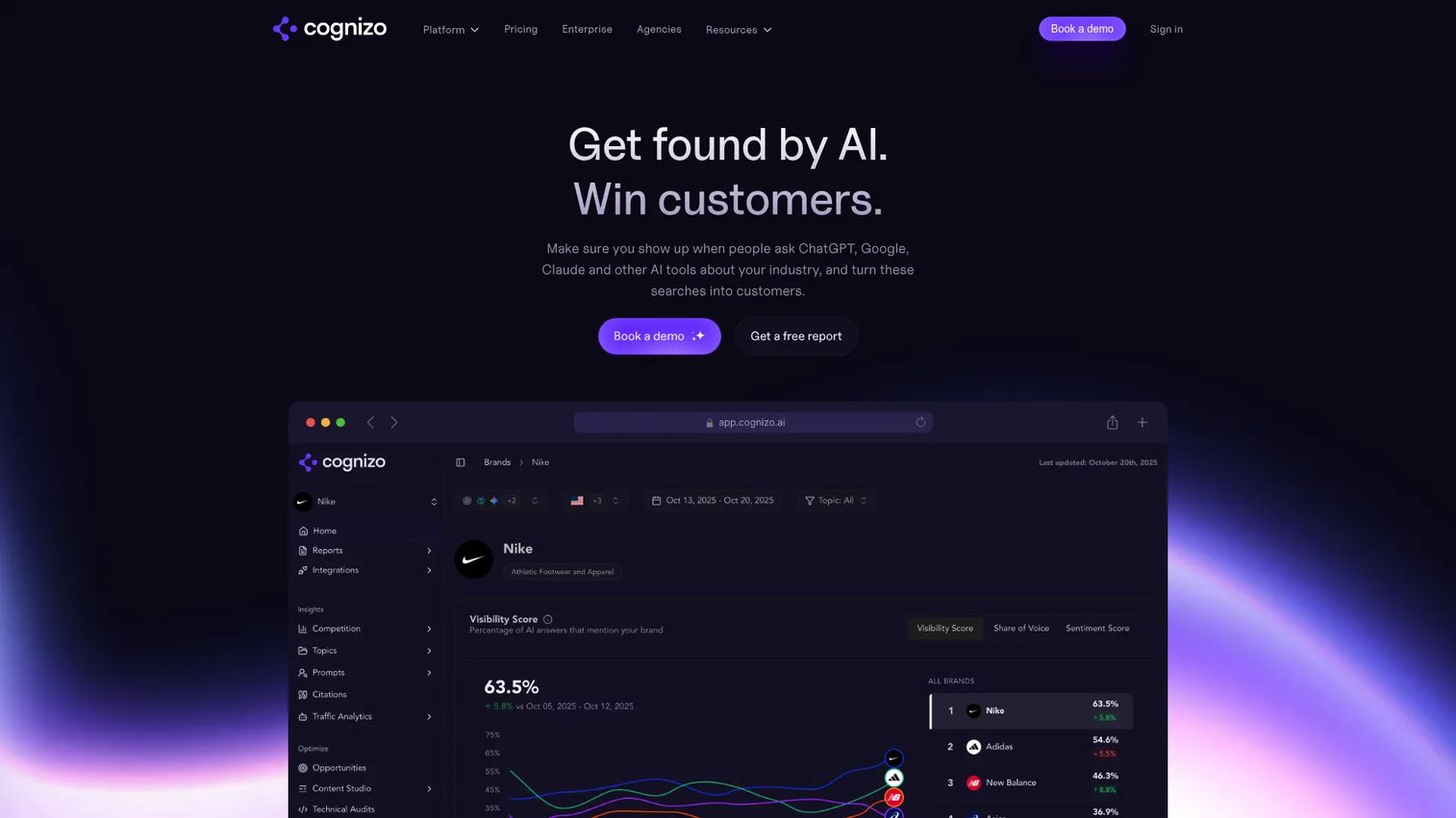
Cognizo connects answer-engine monitoring with content generation and publishing. It examines sources and sentiment alongside visibility trends. Technical audits supply prioritized actions for the website.
Best for: SEO teams that want an LLM SEO analysis tool connected to ongoing content production.
Key features
- AI visibility and share-of-voice tracking
- Prompt research and competitive gaps
- Citation and sentiment analysis
- Content generation and auto-publishing
- Prioritized technical audits
Why choose Cognizo: Its fit is strongest when monitoring findings need to feed an existing publishing program. Compare the cost against both your research workload and content production budget.
The Growth package includes eight AI-optimized articles per month and 150 tracked prompts. Pro increases those allowances to 20 articles and 350 prompts.
That packaging makes editorial capacity part of the buying decision. If your team lacks an owner for reviewing generated drafts, establish that responsibility before adopting automated publishing.
Ask for a complete example connecting a detected gap to a proposed article. Evaluate factual accuracy and the amount of editing your team would still perform.
Cognizo pricing: Growth costs $499/month and Pro $999/month. Managed uses custom pricing.
G2 rating: 4.8/5.
4. Eldil AI
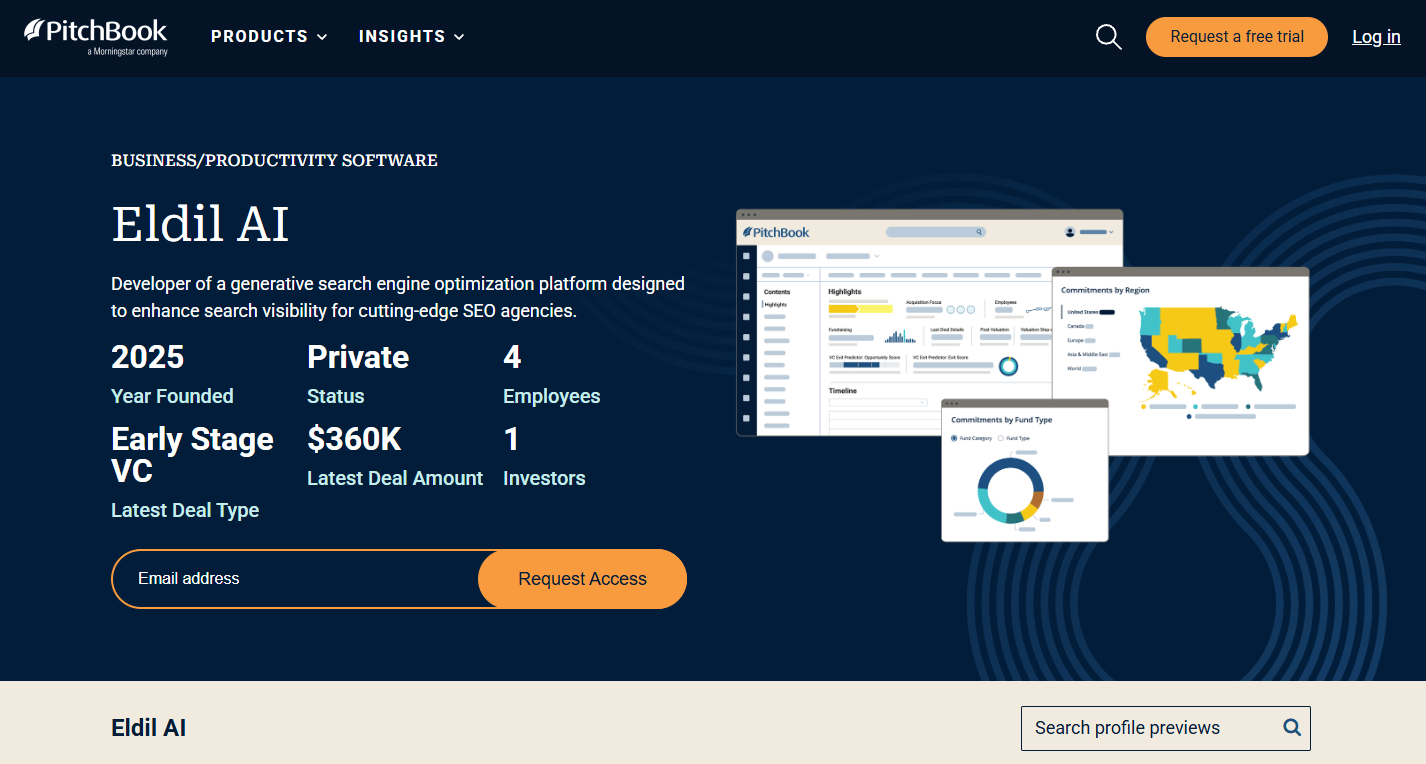
Eldil AI currently describes a print-media business that sources hard-to-find material and handles book digitization. This is different from technical AI-readiness software. Its current offering does not support recommending it for LLM SEO checking.
Best for: Organizations seeking print-media sourcing or book preservation services.
Key features
- Hard-to-find print-media sourcing
- Print-media cataloging
- Book preservation and digitization
Why choose Eldil AI: Choose it only for the documented print-media services. For AI visibility monitoring or website diagnostics, evaluate the relevant products elsewhere in this comparison.
This distinction matters when researching emerging software categories. A product name in an older comparison does not establish what the current website sells.
Before allocating procurement time, verify that the service addresses your intended workflow. For this entry, the current category is enough to rule it out of an SEO software purchase.
Eldil AI pricing: No LLM SEO subscription applies to the current offering.
5. Rank Prompt
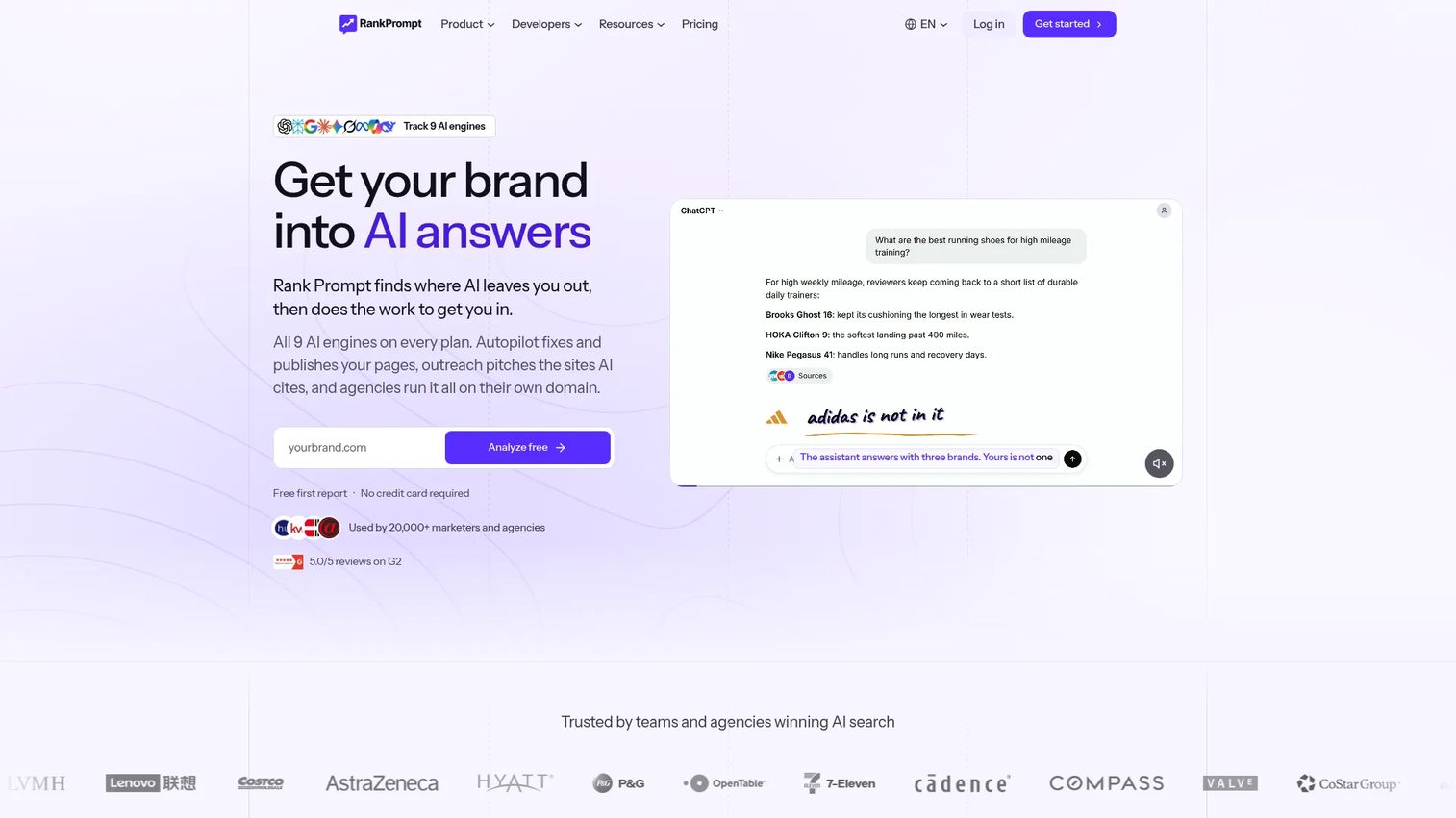
Rank Prompt adapts ranking analysis to AI answers, with monitoring across nine AI engines. Beyond tracking, it offers content publishing and citation outreach. GEO and technical SEO audits add a diagnostic workflow.
Best for: SEO teams that want familiar ranking reports alongside actions addressing citation opportunities.
Key features
- AI rank and mention tracking
- Citation and source monitoring
- Autopilot content generation and publishing
- GEO and technical SEO audits
- Citation outreach and scheduled reporting
Why choose Rank Prompt: It fits marketers who want to move from an answer-position report into outreach or content work. Evaluate both workflows instead of judging the product solely by its ranking charts.
The free plan includes 10 credits and one brand. Paid subscriptions use credit allowances, making consumption an important part of your cost model.
During a trial, run the same representative task repeatedly and record its credit cost. Compare the resulting monthly estimate with your reporting cadence.
Avoid treating prompt position as identical to a traditional search ranking. Keep the generated answer available for interpretation.
Rank Prompt pricing: A free plan is available; Starter costs $470/year, displayed as approximately $39/month. Paid plans include a seven-day trial.
G2 rating: 5.0/5.
6. Peec AI
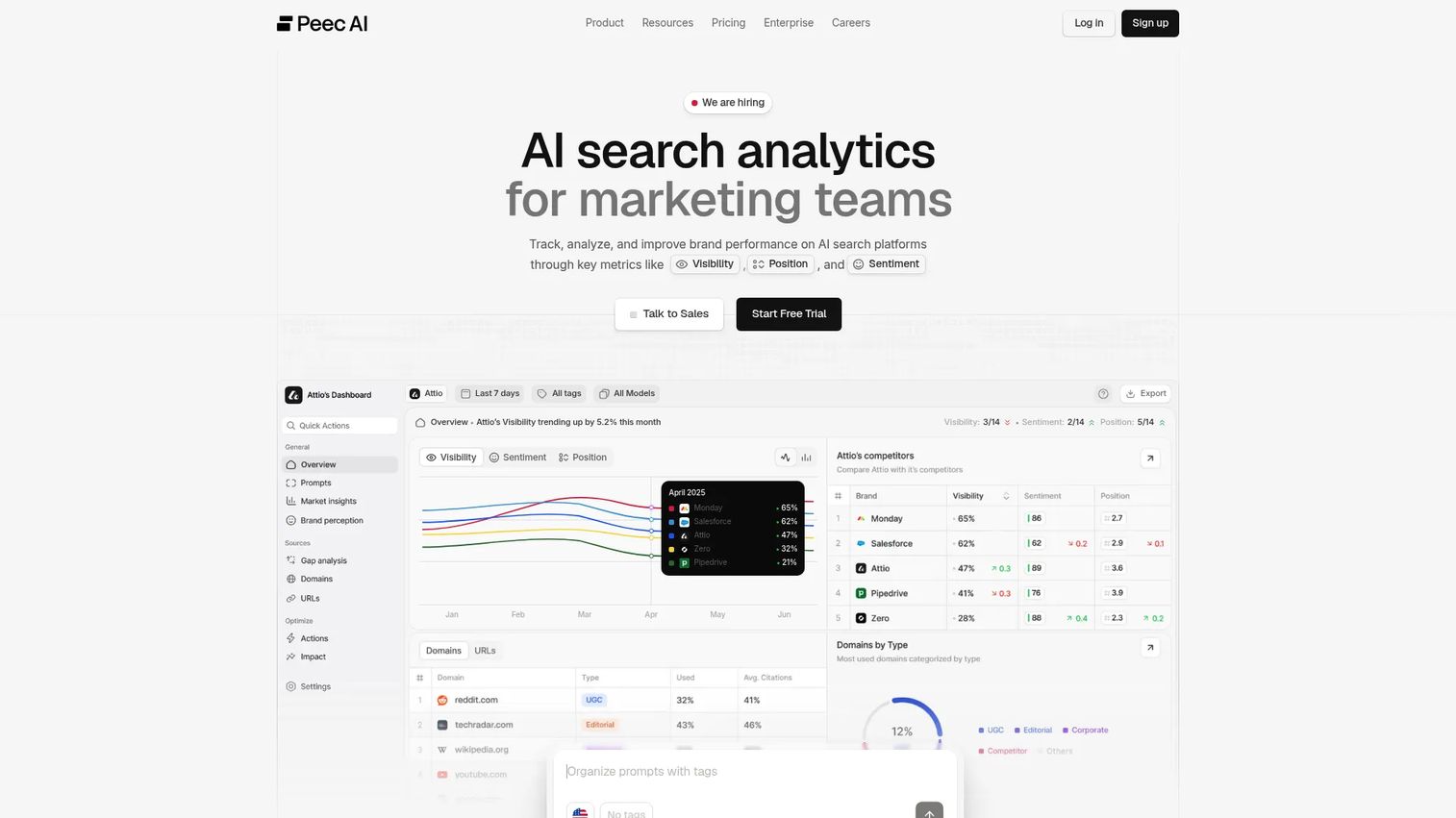
Peec AI tracks brand performance across AI models and competitors. Its scope includes brand perception and fact-checking, plus AI shopping analysis at SKU level. Referral analytics and agent crawlability checks connect visibility with website activity.
Best for: Marketing teams that need recurring visibility reporting with context about how their brand is represented.
Key features
- Model and competitor visibility tracking
- Brand sentiment and fact-checking
- AI shopping and SKU analytics
- Agent crawlability and referral analysis
- Recommendations and reporting integrations
Why choose Peec AI: Consider it when your reporting needs extend beyond whether a name appears. Product-level analysis is particularly relevant when buyers compare specific items.
Evaluate the geographic coverage your campaigns require. Prompt, country, model, and project allowances increase across its plans.
For an international program, test the same buyer question in the markets you serve. Ask how reports distinguish regional differences from changes in the underlying prompt set.
Enterprise adds API access and SSO, alongside custom tracking and dedicated support. Those capabilities deserve separate consideration during procurement.
Peec AI pricing: Starter costs $95/month, Pro $245/month, and Advanced $495/month. Enterprise uses custom annual pricing.
G2 rating: 4.7/5.
7. Semrush One
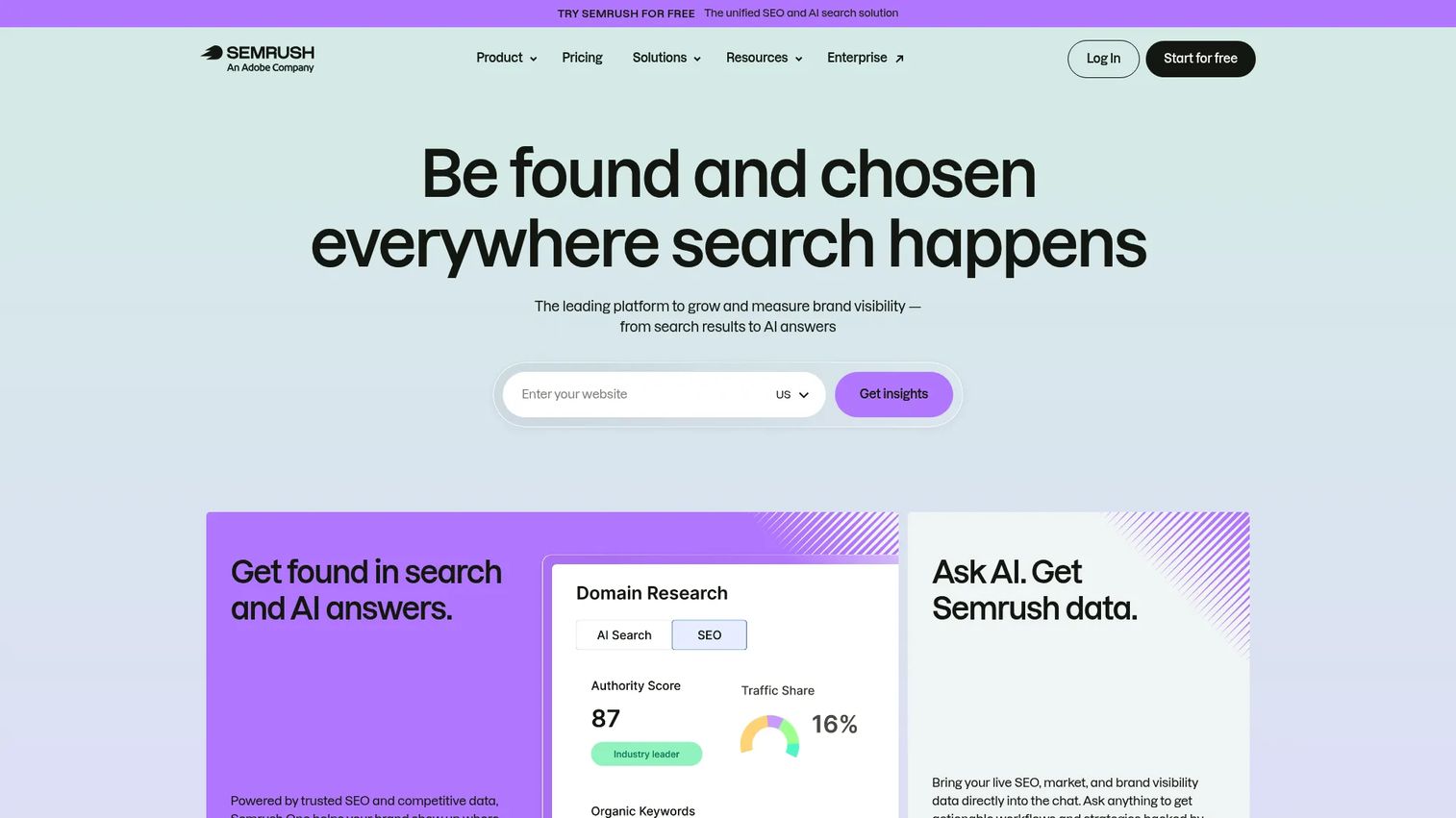
Semrush One combines the SEO and AI Visibility toolkits. It brings website auditing together with research across keywords and prompts. Supported AI surfaces include Google AI Overviews, AI Mode, ChatGPT, Gemini, and Perplexity.
Best for: Teams assessing whether AI visibility work can fit inside their existing SEO subscription.
Key features
- Unified SEO and AI visibility tracking
- Keyword and prompt research
- Website and AI-readiness audits
- Backlink and competitive analysis
- AI-assisted recommendations
Why choose Semrush One: Start here if your team already relies on Semrush for search operations. Consolidation has value when it removes duplicate research and reporting work.
Compare the bundle against your present contract before assuming it replaces every subscription. Map your recurring tasks to the included toolkit allowances.
A useful trial should cover an established SEO report and a new AI visibility question. Ask the person preparing monthly reporting to assess whether the combined workflow reduces reconciliation work.
The G2 score below belongs to Semrush generally, rather than this particular bundle.
Semrush One pricing: Starter costs $199/month or $165.17/month billed annually. New users can access a seven-day trial.
G2 rating: 4.4/5
8. LLMrefs
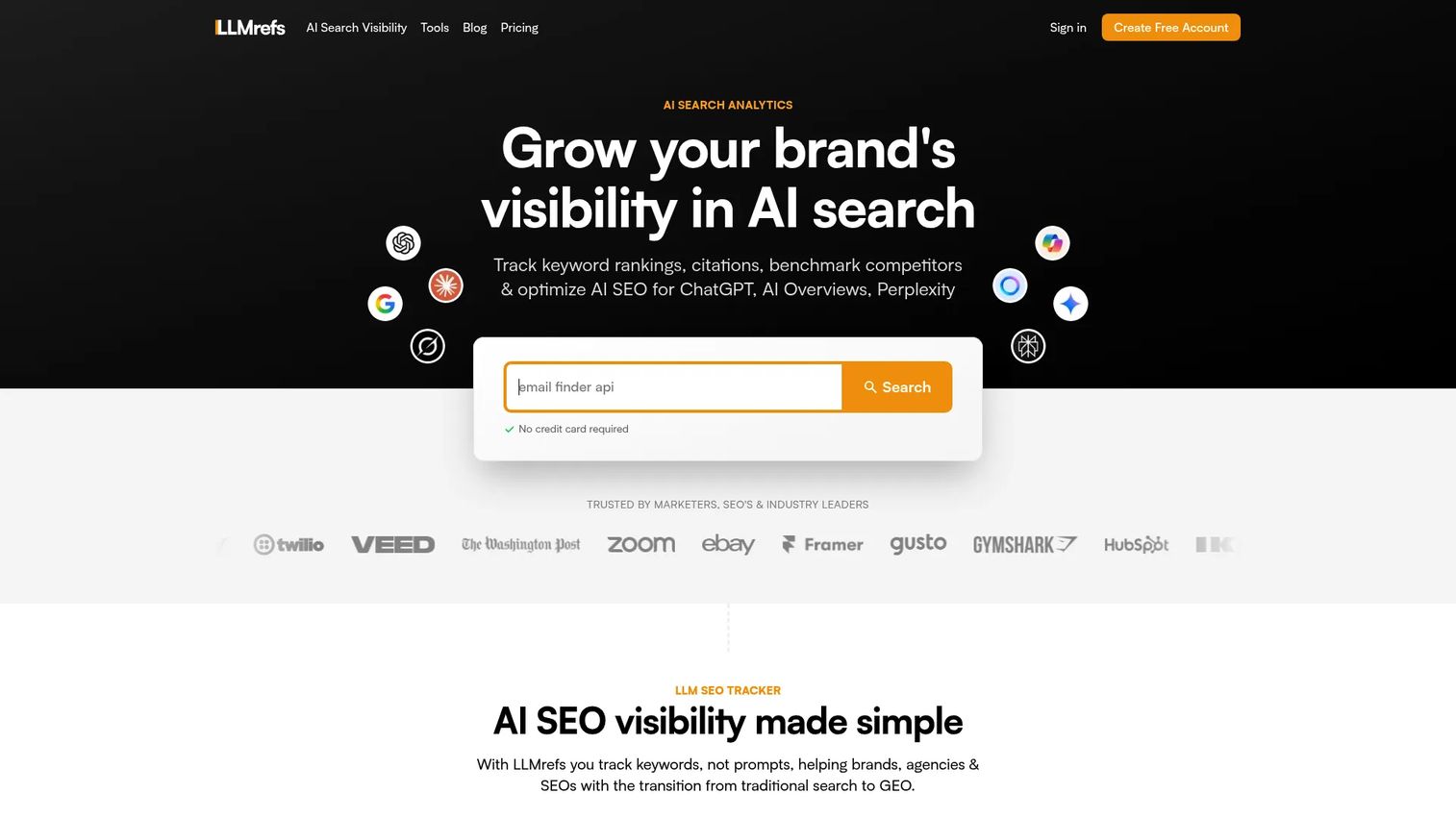
LLMrefs tracks brand rankings and citations across generative AI search engines. Its reporting includes share of voice and position metrics, with geographic and language targeting. CSV exports and API access support reporting outside the product.
Best for: Agencies and in-house SEO teams managing recurring reports across multiple projects.
Key features
- AI keyword and visibility tracking
- Citation and source URL analysis
- Competitor position benchmarking
- Geographic and language targeting
- CSV export and API access
Why choose LLMrefs: Its unlimited projects and team members suit collaborative reporting. Evaluate whether its prompt allowance matches the combined coverage required across your accounts.
The listed plan includes 500 tracked prompts and weekly visibility reports. Those details make it worth testing with a representative client portfolio rather than one small project.
Ask your reporting owner to export results and build the client-facing summary. The useful test is whether the data answers a commercial question without extensive spreadsheet cleanup.
Treat estimated opportunity and measured performance as separate reporting concepts. Keep client-facing explanations clear about what was observed.
LLMrefs pricing: The All in One plan costs $79/month and includes a seven-day trial.
9. Visus
Visus is a configurable AI assistant trained on company documents and knowledge bases. Users upload material and ask natural-language questions about it. Its current product belongs to internal knowledge management rather than public AI-search visibility tracking.
Best for: Teams that want conversational access to workplace documents.
Key features
- Document uploads and knowledge-base training
- Natural-language questions and follow-ups
- Configurable response sensitivity
- Workplace knowledge integrations
- Permission enforcement and encryption
Why choose Visus: Evaluate it for internal information retrieval. It should not replace a tool measuring how external answer engines describe your brand.
This is an important distinction for marketers consolidating software. An assistant can help employees find approved information without measuring whether public AI systems cite your website.
Assess the intended audience for the answers before comparing vendors. Internal employees querying uploaded documents represent a different workflow from prospects researching your category.
Its G2 listing has no reviews, so a displayed zero average should not be interpreted as a customer satisfaction score.
Visus pricing: A free plan is available; Standard costs $20/member/month and Business $50/member/month.
10. SEO Site Checkup
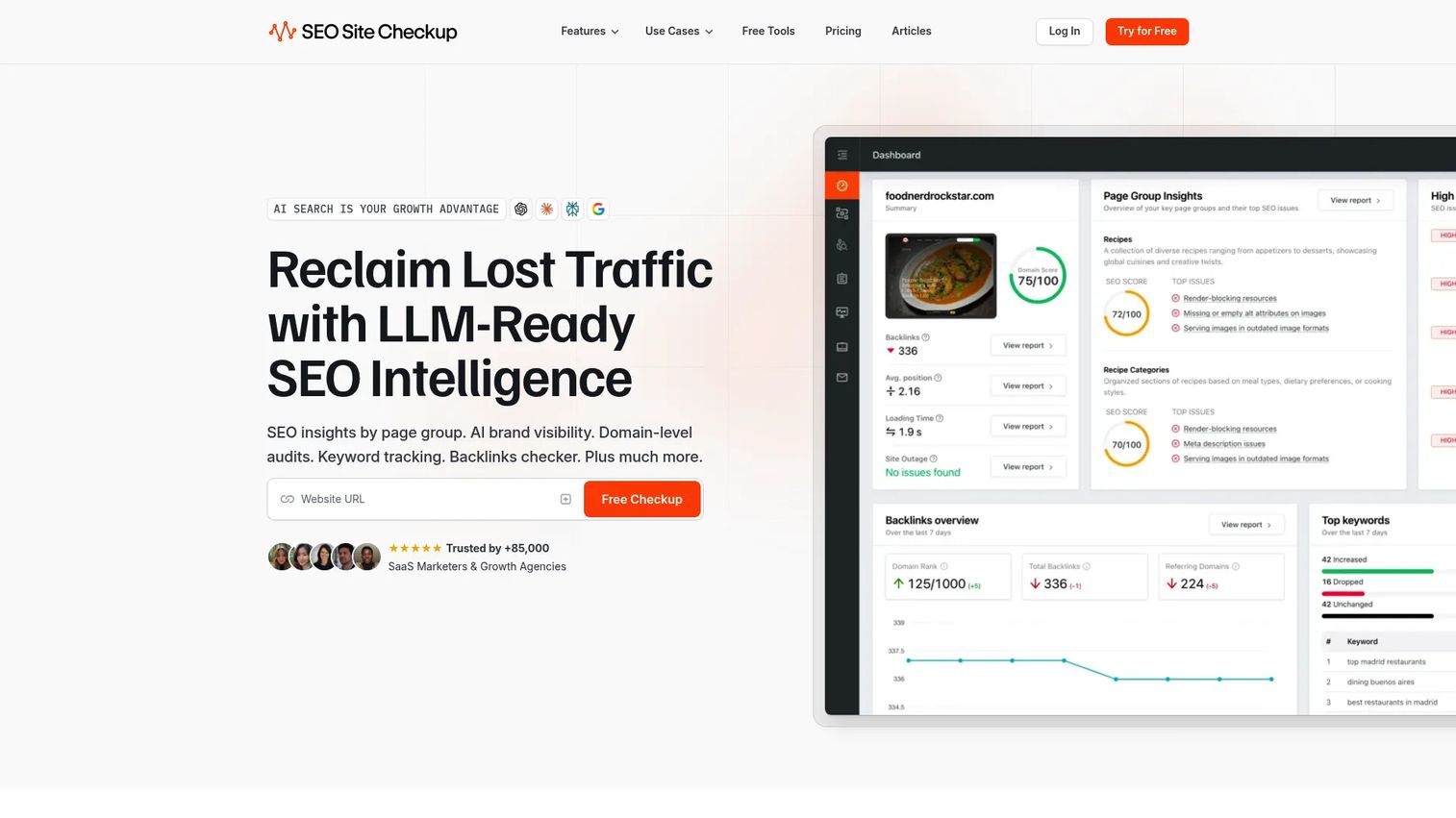
SEO Site Checkup combines technical website audits with LLM visibility and AI content analysis. It also covers keyword positions and backlinks. Uptime and speed monitoring make it relevant to ongoing website operations.
Best for: Marketers who need technical diagnostics alongside AI-search analysis.
Key features
- Technical SEO audits
- LLM visibility and content analysis
- Keyword tracking and competitor comparisons
- Uptime and speed monitoring
- White-label reports
Why choose SEO Site Checkup: It fits teams whose immediate priority is identifying website issues and assigning fixes. Agency reporting also makes it worth evaluating for recurring client audits.
Use a commercially important landing page during the trial. Ask whether each flagged issue has a clear owner and a practical resolution.
An audit score should lead to a prioritized backlog. Separate issues blocking access from improvements that require editorial judgment.
This approach keeps technical work connected to campaign goals. It also gives you a way to evaluate whether the product replaces an existing audit subscription.
SEO Site Checkup pricing: Basic costs $39/month or $29/month billed yearly. A seven-day trial is available.
G2 rating: 3.6/5.
11. Google Search Console
Google Search Console measures Google Search performance and helps diagnose indexing issues. URL Inspection supports investigation at page level. Security and manual action reports identify additional problems requiring attention.
Best for: SEO teams establishing a search baseline before interpreting AI visibility changes.
Key features
- Search traffic and performance reports
- Indexing and crawl diagnostics
- URL Inspection
- Security and manual action reports
- Core Web Vitals monitoring
Why choose Google Search Console: Use it to understand the search foundations of a page before assigning an AI-specific explanation. Its role complements dedicated LLM visibility trackers.
For instance, investigate indexing when a priority page loses organic exposure. Comparing that evidence with answer-monitoring results helps prevent an incorrect diagnosis.
Keep the question boundaries clear. Search Console reports on Google Search; it is not a cross-engine prompt monitoring platform.
Build page groups around your commercial priorities and review them consistently. That baseline provides context when an AI citation report suggests changes to the same content.
Google Search Console pricing: Free.
G2 rating: 4.7/5.
12. Google Analytics
Google Analytics measures website and app behavior through acquisition reports and custom explorations. It provides the conversion layer for identifiable visits from AI platforms. Connections with Search Console and BigQuery support broader analysis.
Best for: Growth marketers connecting measurable AI referrals with landing-page outcomes.
Key features
- Acquisition and engagement reporting
- Conversion and monetization analysis
- Custom explorations and funnels
- Cross-platform attribution
- Search Console and BigQuery integrations
Why choose Google Analytics: It helps establish whether referred visitors take valuable actions after arriving. Use it alongside visibility reporting rather than treating sessions as a complete measure of AI influence.
GA4 referral tracking starts with source classification and reliable conversion events. Audit those definitions before presenting an AI channel contribution to leadership.
A useful report separates landing-page engagement from qualified inquiries. Keep downstream revenue claims tied to the systems recording those outcomes.
Visitors who never click through will not appear in website behavior reports. Explain that measurement boundary when comparing traffic with observed brand mentions.
Google Analytics pricing: Standard Google Analytics is free. Analytics 360 uses custom pricing through sales partners.
G2 rating: 4.5/5.
13. Surfer
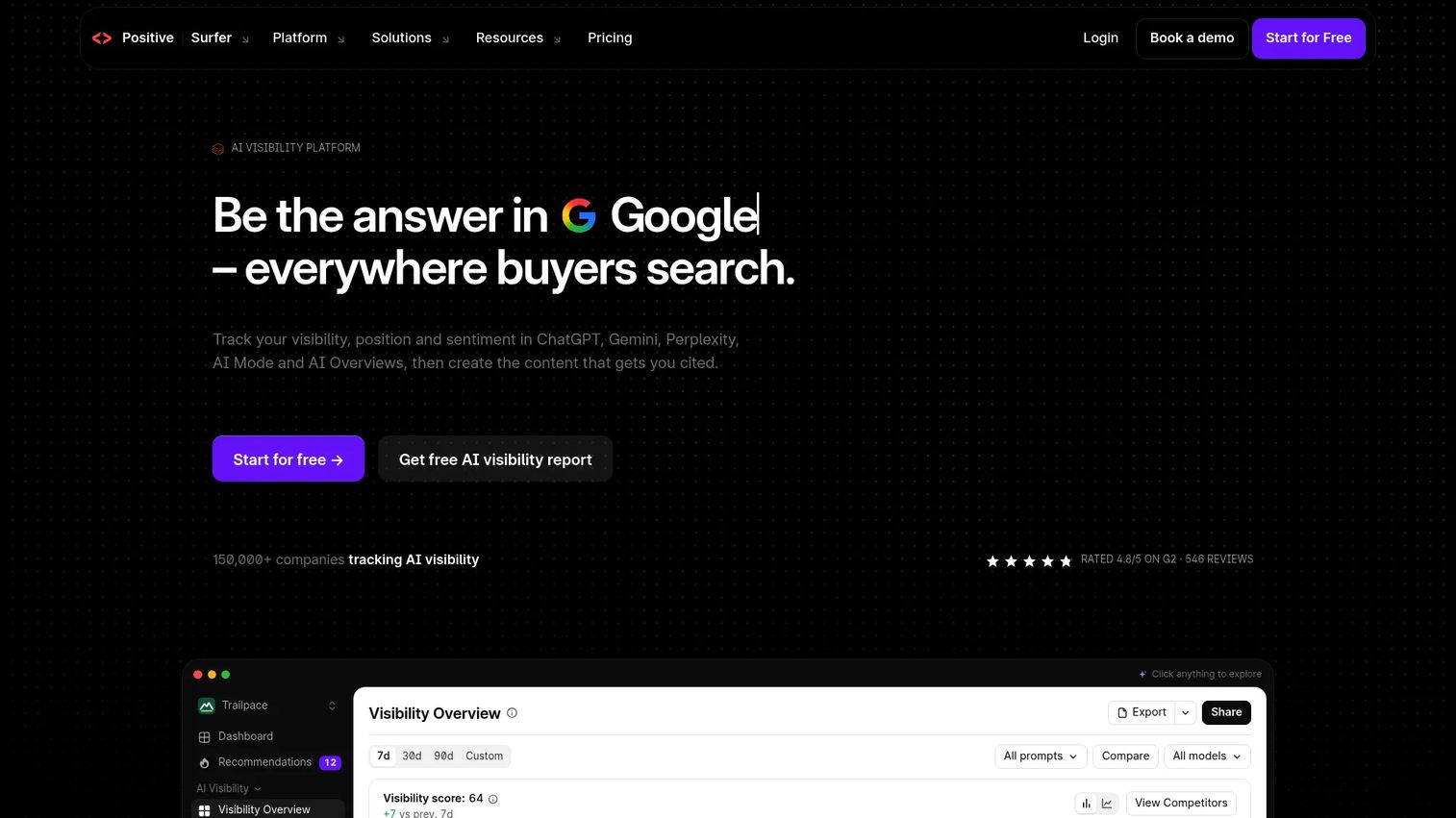
Surfer combines content optimization with AI-search visibility tracking. Its current scope extends beyond a content editor into answer analytics. Coverage includes ChatGPT, Gemini, Perplexity, Google AI Mode, and AI Overviews.
Best for: Content teams that want to connect publishing decisions with search and AI-answer performance.
Key features
- AI visibility tracking
- AI-assisted content creation
- Content optimization
- SEO audits and SERP analysis
- Rank-drop alerts
Why choose Surfer: Consider it when your team already owns a substantial content improvement program. Assess whether its analytics can direct that work without adding another disconnected reporting process.
Take an existing commercial article into the evaluation. Review whether the recommended changes improve the buyer’s understanding, rather than merely increasing a content score.
Its packaging distinguishes content-oriented access from AI Search Analytics. Compare the relevant plan with your intended workflow instead of using the lowest price as the entire budget.
For a content lead, the key question is whether findings change the next editorial assignment.
Surfer pricing: Discovery starts at €49/month and AI Search Analytics at €82/month, billed yearly. A trial option is available.
G2 rating: 4.6/5.
14. SE Ranking
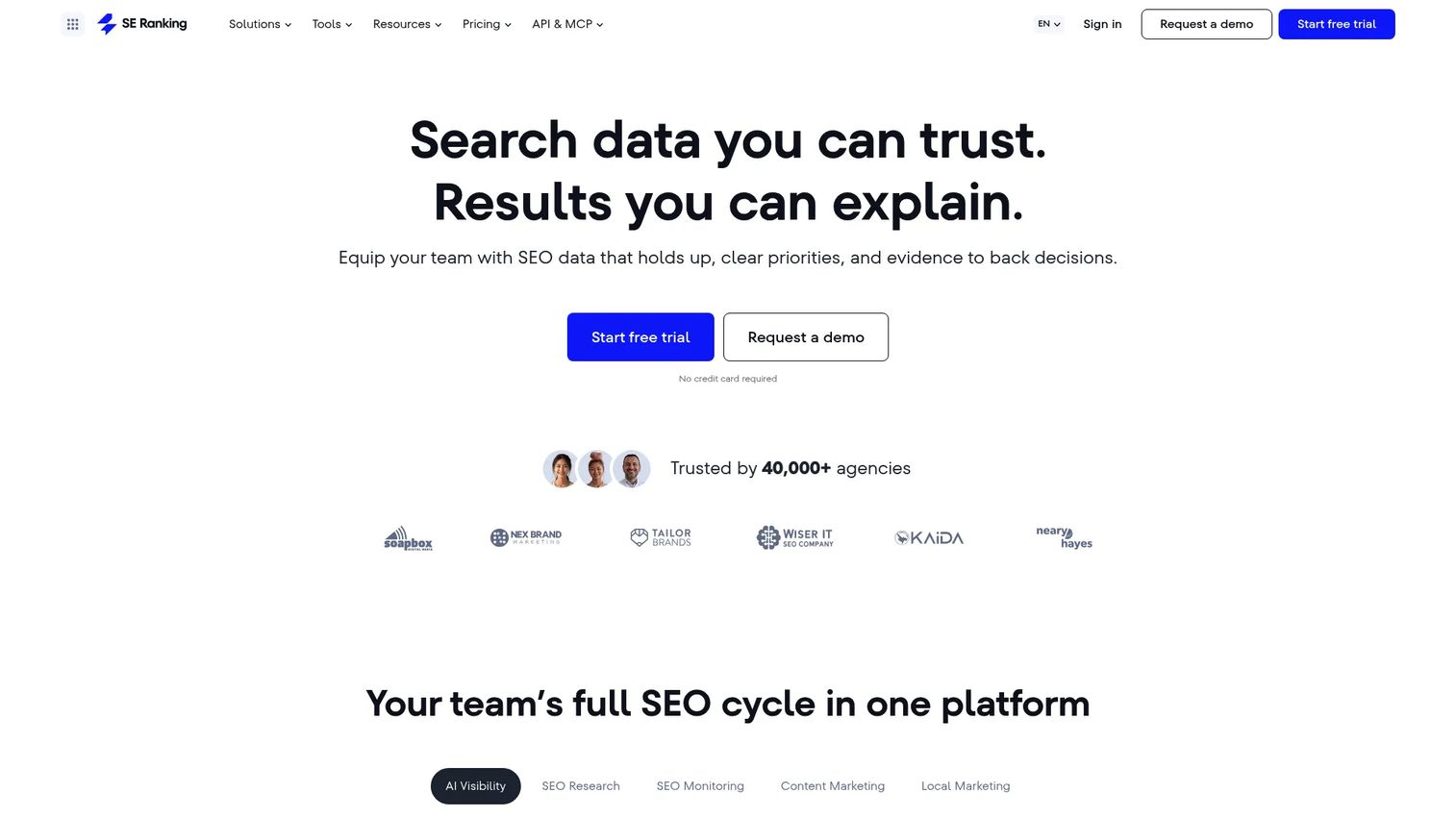
SE Ranking combines search tracking with audits and competitive research. It also includes content tools, agency reporting, and AI visibility tracking. This breadth makes it relevant to teams reviewing overlapping SEO subscriptions.
Best for: Agencies and in-house marketers looking to consolidate routine SEO operations.
Key features
- Search rank and AI visibility tracking
- Keyword and competitive research
- Website and on-page audits
- Backlink research and monitoring
- Content tools and report building
Why choose SE Ranking: Evaluate it when consolidation matters as much as a specialized AI dashboard. Compare included AI tracking coverage against the depth required by your prompt-monitoring program.
Bring your current reporting template into the trial. Recreate the outputs stakeholders already use before considering additional metrics.
Agencies should also test the handoff from analyst to account manager. A report that requires extensive explanation can create work even when its underlying data is useful.
The purchase decision should reflect which subscriptions and manual tasks it replaces. Keep that comparison separate from the appeal of newly added capabilities.
SE Ranking pricing: Core costs $129/month or $103.20/month billed annually. A 14-day trial is available.
G2 rating: 4.8/5.
15. Scrunch AI
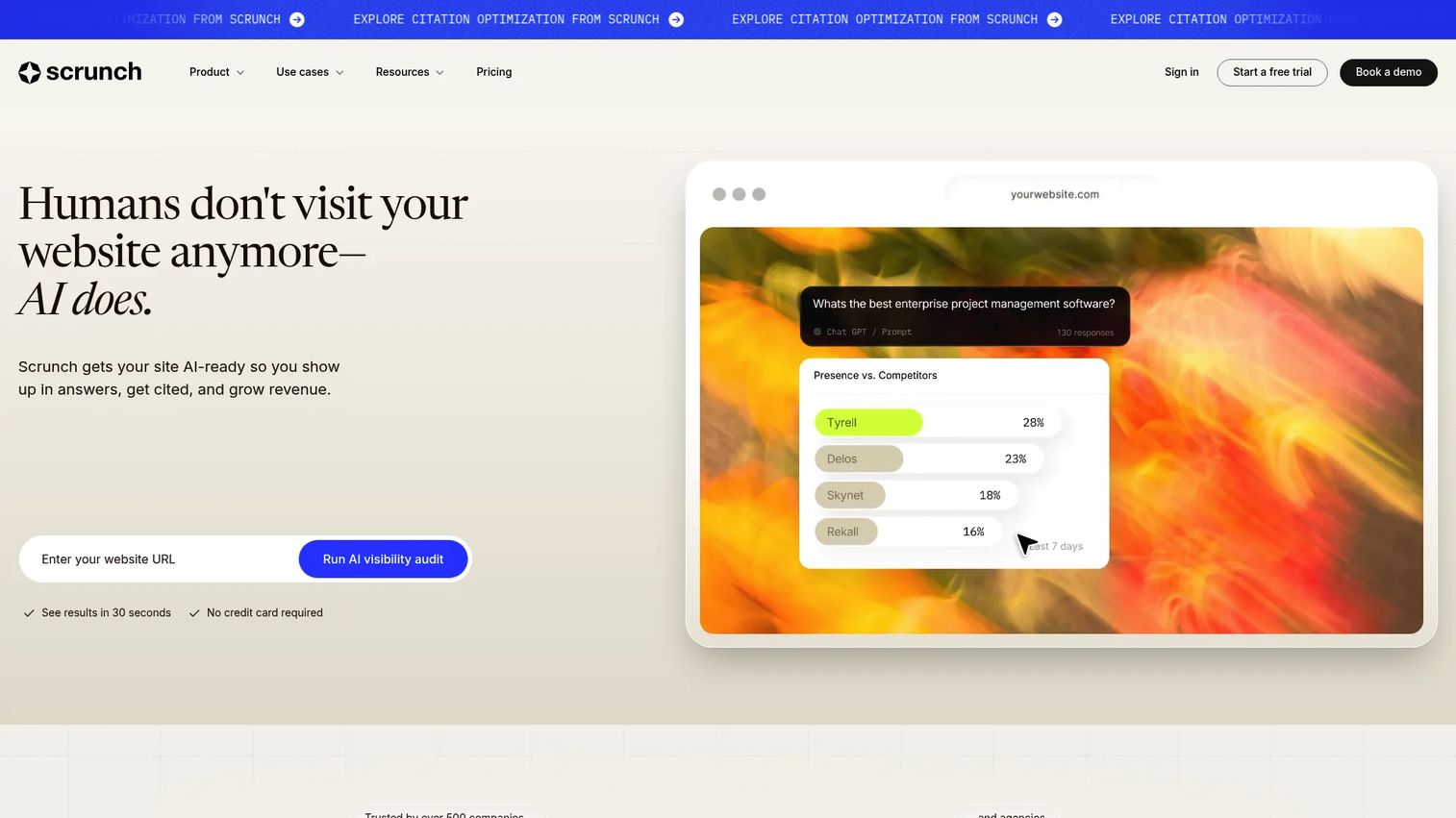
Scrunch AI combines search monitoring with citation intelligence and AI-agent traffic analytics. Page optimization and content generation provide an action layer. Its Agent Pages capability addresses content delivery for AI systems.
Best for: Brands evaluating both their presence in AI answers and how AI agents encounter their website.
Key features
- AI-search monitoring and citation tracking
- Visibility recommendations
- Agent Pages
- AI-agent traffic analytics
- Page optimization and content generation
Why choose Scrunch AI: Its scope suits teams connecting visibility findings with website changes. Include the web owner in evaluation, particularly when considering agent-focused delivery.
Core includes one brand and five seats, with allowances for monitored responses and page work. Enterprise expands capacity and adds API access plus SSO.
Ask the vendor to demonstrate a full sequence from finding to implementation. Your evaluator should understand which changes marketing can own and which require another team.
Set a success measure before testing optimization features. Improved reporting quality and changes to qualified referral traffic are different evaluation outcomes.
Scrunch AI pricing: Core costs $250/month and includes a seven-day trial. Enterprise uses custom annual pricing.
G2 rating: 4.6/5.
16. ChatGPT
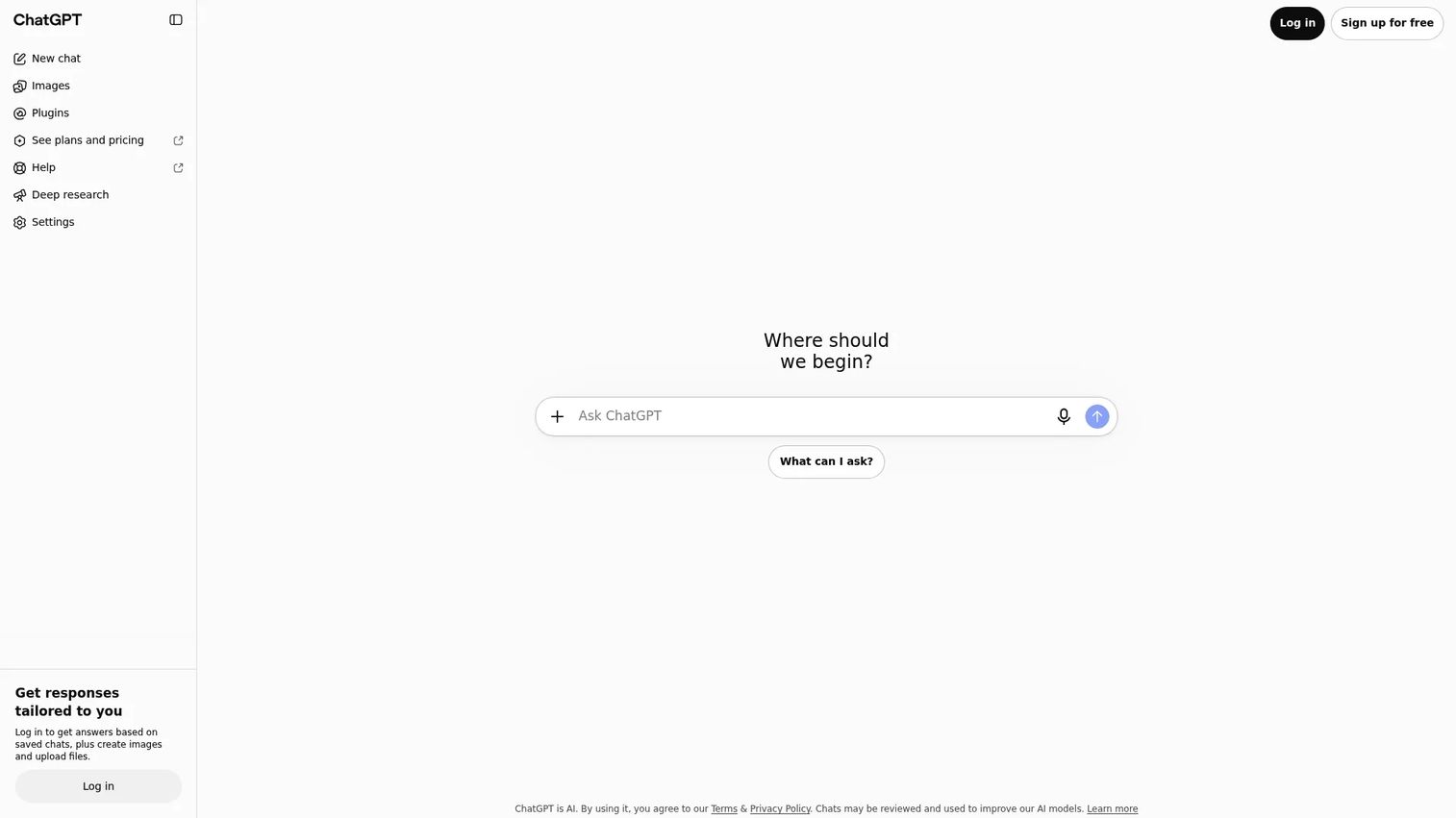
ChatGPT provides a direct environment for testing how buyer questions receive answers. Web search and research capabilities support qualitative investigation. It also helps teams inspect how their category is explained.
Best for: Marketers developing a prompt set before adopting recurring ChatGPT visibility tracking.
Key features
- Conversational prompt testing
- Web search and deep research
- Follow-up questions
- File uploads and analysis
- Writing and summarization
Why choose ChatGPT: Use it to understand answer framing and identify questions worth monitoring. A manual conversation should remain an observation rather than a market-wide visibility score.
Start with the wording customers use during research. Save the question and response, including the available source links.
Avoid repeatedly adjusting a prompt until your brand appears, then presenting that answer as representative. Such testing answers a different question from unprompted category discovery.
For ongoing reporting, preserve a stable question set and compare observations over time. A dedicated tracker provides the recurring workflow that manual investigation does not establish by itself.
ChatGPT pricing: A free plan is available; Plus costs $20/month.
G2 rating: 4.6/5.
17. Perplexity
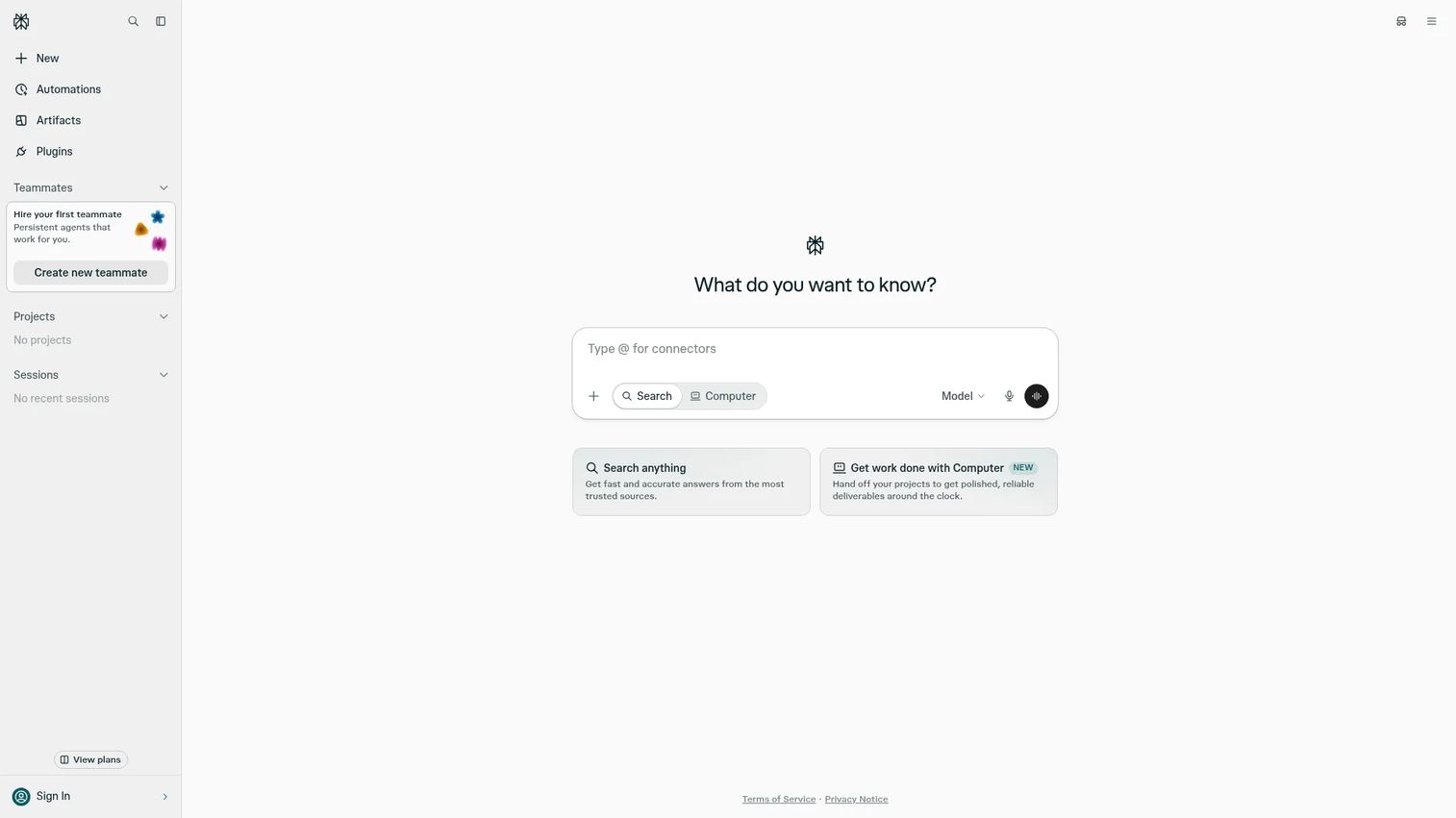
Perplexity produces web-researched answers with linked citations. That makes it useful for examining which pages support category recommendations. Follow-up questions help investigate the wording and evidence behind an answer.
Best for: Marketers researching citation patterns before commissioning content or outreach.
Key features
- Cited web answers
- Source URL inspection
- Follow-up research
- File uploads and analysis
- Model selection
Why choose Perplexity: It gives researchers a direct route from an answer to its supporting material. Use it to investigate source quality before turning a citation gap into a content assignment.
Read the cited page rather than relying only on the summary. Note which claim it supports and whether your company could contribute relevant evidence.
For Perplexity SEO tracking, preserve the original question and distinguish fresh tests from follow-up conversations. The surrounding context matters when interpreting the response.
Manual research is useful for diagnosis. Recurring cross-engine reporting still calls for a measurement workflow with consistent inputs.
Perplexity pricing: A free plan is available; Pro costs $17/month and Max $167/month, billed annually.
Considerations when choosing llm seo checking tools
Separate monitoring from fixing
Choose the missing workflow before comparing subscriptions. LLM SEO optimization tools should turn findings into assigned work, while monitoring platforms should provide evidence you can inspect.
Ask who will own the next action. A dashboard without an operational owner rarely justifies another recurring expense.
Check answer-engine coverage
Request the exact engines, locations, and models included in your proposed plan. Google AI Overviews tracking and ChatGPT visibility tracking address different surfaces.
Test coverage against your buyers’ research habits. More monitored platforms do not automatically make the reporting more useful.
Look for citation and source data
Prioritize access to underlying answers and cited URLs. An aggregate score without supporting evidence gives your content team little to investigate.
Include technical accessibility and accurate structured data in your review. Treat schema for AI search as a technical assessment, not a guaranteed recommendation mechanism.
Connect visibility to analytics
Maintain separate reporting for observed mentions and attributable website outcomes. AI referral traffic requires a click; answer exposure does not.
Evaluate whether exports fit your existing reporting workflow. The best LLM SEO checking software should reduce manual reconciliation rather than create another monthly spreadsheet.
Match pricing to reporting needs
Calculate costs using your intended prompt set and reporting cadence. Account for client projects and regional coverage where relevant.
Pilot one question cluster before expanding. Judge LLM SEO software by decisions improved and tasks replaced, not the number of charts available.
Conclusion
Choose LLM SEO checking tools around the work your team needs to complete.
For dedicated monitoring, start by comparing AIclicks with Peec AI. Add Profound when your evaluation includes broader brand analysis and AI traffic attribution. LLMrefs deserves attention when recurring agency reporting is the priority.
For consolidation, inspect the AI capabilities already available through Semrush One, Surfer, or SE Ranking. SEO Site Checkup offers another path when technical audits drive the immediate workload.
Keep Google Search Console and Google Analytics in the measurement plan. They answer different questions from visibility platforms, and those distinctions protect the credibility of your reporting.
Begin with manual research in ChatGPT and Perplexity, then select a recurring tracker if the process earns ongoing attention. Leave Eldil AI and Visus out of the SEO shortlist because their current products serve other jobs.
The next step is a focused pilot. Define a commercial question, assign an owner, and agree on the decision the results should change. Buy additional LLM SEO tools only when that workflow demonstrates value.
FAQs
LLM SEO checking tools measure AI-answer visibility or help diagnose the content and technical factors supporting it. Dedicated platforms track prompts and citations, while supporting products measure website performance or improve pages. Choose an LLM SEO checking tool according to the question your current reporting cannot answer.
Run buyer questions directly and record the responses, including cited sources and the date of each test. Keep location and conversation context consistent where possible, and separate branded prompts from category discovery questions. Add an LLM SEO tracking tool when repeating these checks manually becomes impractical or stakeholders require historical reporting.
Traditional SEO evaluates search-result performance and the website factors affecting it. LLM SEO examines how generated answers represent your company and which sources support those responses. The workflows should inform each other, especially when the same commercial pages contribute to organic search and AI-generated answers.
No LLM SEO checker can guarantee that an answer engine will recommend your company. Responses can change with the prompt, available sources, model behavior, and user context. Evaluate software on its ability to document observations and support useful action, rather than promises of permanent placement in generated answers.
Track brand presence and competitor share of voice, with access to answer text and citation URLs. Group prompts by commercial intent so category discovery doesn’t get mixed with questions already naming your company. Report identifiable AI referrals and conversions separately, then explain how those outcomes relate to the visibility observations.
Free access can support an initial LLM SEO check and help you decide whether a recurring workflow is worthwhile. It is enough when your task is occasional investigation and you can maintain the records manually. Compare paid allowances when you need repeated monitoring across client accounts or consistent reporting over time.
Set a weekly or monthly review cadence according to how frequently the results can change your decisions. Revisit priority prompts after a major launch or a substantial content update. Preserve the baseline question set while adding new tests separately, so changes in coverage do not get mistaken for changes in performance.
LLMrefs is worth evaluating for its project model and export capabilities, while AIclicks connects monitoring with action recommendations. Semrush One suits agencies consolidating SEO work; Profound merits evaluation for broader client requirements. Test permissions and reporting handoffs against a representative account before standardizing any platform across your portfolio.