You sent the hold notice. Three people never acknowledged it. One left the company last week. The data they touched lives across email, Teams channels, shared drives, and a handful of cloud apps that legal hasn't fully mapped yet.
That's where litigation risk actually lives. Not in the decision to issue a hold, but in everything that happens after: Tracking who received it, confirming who acknowledged it, preserving the right data at the right sources, and logging every action in a record that can survive scrutiny. According to a 2024 Everlaw and ACC survey, 51% of U.S. in-house legal teams still manage litigation holds by email. Another 35% track them on spreadsheets.
Those methods don't scale past a handful of matters. A growing company approaching enterprise deals, a financing event, or its first significant dispute needs a repeatable process, not a shared inbox and a prayer. Legal hold management software replaces that improvised workflow with something defensible, auditable, and owned by someone other than the founder.
This guide helps you choose the right tool.
What's inside
This guide covers 11 legal hold platforms evaluated for corporate legal teams and legal operations leaders at growing SaaS companies.
- Who it's for: Founders, GCs, legal ops leads, and IT leaders choosing a defensible preservation process
- How tools were chosen: Coverage of hold lifecycle, custodian management, data-source integrations, and eDiscovery fit
- Selection criteria: Notice and acknowledgment workflows, in-place preservation, audit trail depth, and implementation reality
- Scope note: The list includes dedicated legal hold products and broader eDiscovery platforms with legal hold capability, so you can match platform scope to your actual matter volume
TL;DR
- Best for complex enterprise hold programs: Exterro Legal Hold, for deep workflow automation and employee change monitoring
- Best for legal ops teams in a Microsoft environment: Mitratech LegalHold, for matter-linked holds and Microsoft 365 preservation
- Best for legal hold connected to end-to-end eDiscovery: Casepoint or Everlaw, depending on how much review work needs to live in the same platform
- Best for existing Relativity users: Relativity Legal Hold, for hold workflows that connect directly into your eDiscovery lifecycle
- Best for data-heavy or governance-oriented programs: OpenText Core Legal Hold, IBM StoredIQ Suite, or Arctera eDiscovery Platform
- Best starting point for founders: Map your data sources, custodians, and ownership model before selecting any platform. Buying an enterprise suite before you can define the workflow creates cost without control
What is legal hold software?
Legal hold software is a system that helps organizations issue, track, enforce, document, and release preservation notices when litigation, investigations, audits, or regulatory matters require relevant information to be retained.
The category addresses a specific operational gap: Most companies know they have preservation obligations, but lack a repeatable, auditable process for fulfilling them. Manual coordination through email exposes organizations to spoliation risk when notices go unacknowledged, employees depart, or data changes without a record of what was preserved.
What legal hold software manages
A legal hold platform handles the full preservation lifecycle:
- Matter intake and hold creation: Triggering a hold from a case or matter record
- Custodian identification: Building and segmenting the list of people with relevant data
- Notice delivery: Sending hold notices through tracked channels
- Acknowledgments and questionnaires: Collecting responses and follow-up information from custodians
- Reminders and escalation: Automatically following up on non-responses and escalating to managers
- In-place preservation: Instructing or activating preservation at the data source
- Audit logging: Recording every action across issuance, acknowledgments, exceptions, and release
- Release documentation: Formally closing holds with a record of what was preserved and when
Key capabilities to look for
When evaluating legal hold tools, prioritize these:
- Notice templates with approval workflows
- Custodian directories with HR data synchronization
- Automated reminders and manager-level escalation paths
- Coverage for email, collaboration tools, file storage, and cloud data
- Preservation status tracking by custodian and data source
- Defensible audit records with timestamped event history
- Matter and eDiscovery integrations
- Role-based access and authentication controls
Legal hold software versus eDiscovery software
These categories overlap but serve different core jobs. A legal hold platform manages preservation obligations: Notices, acknowledgments, custodian tracking, and audit records. An eDiscovery platform may add collection, processing, review, production, and investigation workflows. Some platforms do both. The right choice depends on whether your team needs a focused hold workflow or a connected investigation stack. A growing company with occasional matters may not need the full suite yet.
When to use legal hold software
Issue holds across a distributed team
Spreadsheets and email templates stop working when matters multiply, custodians are spread across departments, and more than one person owns legal processes. A platform creates a repeatable workflow: The same notice goes to the right people, reminders run automatically, and acknowledgments are logged without manual tracking.
Preserve data across collaboration and cloud systems
Email is one source. Teams conversations, Slack channels, shared drives, cloud storage, and private channels may all be in scope for a given matter. Legal hold and eDiscovery workflows that cover only email create gaps exactly where modern communication happens. The right tool helps legal and IT document what was preserved and flag what still needs attention.
Prepare for enterprise scrutiny and due diligence
A company approaching larger enterprise customers, a financing event, or formal regulatory attention needs documented processes, not ad hoc coordination. Legal hold automation matters when a defensible operating record is more valuable than the hold notice itself. The system proves what happened, not just that something happened.
Legal hold software comparison
The table below gives you a first-pass shortlist. Pricing across this category is largely quote-based, so contact each vendor directly for current figures. All ratings were verified from vendor G2 listings in 2026.
| # | Product | Best for | Key differentiator | Pricing | G2 rating |
|---|---|---|---|---|---|
| 1 | Exterro Legal Hold | Enterprise hold programs with high custodian volume | Workflow automation and employee change monitoring | Contact for quote | 4.4/5 |
| 2 | Mitratech LegalHold | Legal ops teams using matter management and Microsoft 365 | Matter-linked holds with Microsoft ecosystem preservation | Contact for quote | Not listed |
| 3 | Casepoint | Unified legal hold and eDiscovery in one platform | End-to-end from preservation through production | Contact for quote | 4.7/5 |
| 4 | Everlaw | Litigation teams needing hold plus review | Cloud eDiscovery with legal hold and case collaboration | Volume-based | 4.7/5 |
| 5 | Relativity Legal Hold | Existing Relativity eDiscovery customers | Hold workflow integrated into Relativity lifecycle | Contact for quote | 4.6/5 |
| 6 | OpenText Core Legal Hold | Enterprise preservation programs | Configurable hold workflows with flat-fee subscription | Contact for quote | Not listed |
| 7 | Arctera eDiscovery Platform | Broad data governance and eDiscovery programs | End-to-end EDRM with iterative search and tagging | Contact for quote | 4.5/5 |
| 8 | Hanzo Illuminate | Teams preserving collaboration and web content | In-place preservation across Slack, Teams, and web | Contact for quote | Not listed |
| 9 | Nuix Neo | Investigation-heavy legal and compliance teams | Unstructured data intelligence across 1,000+ file types | Contact for quote | 3.5/5 |
| 10 | IBM StoredIQ Suite | Large enterprises with distributed unstructured data | In-place analysis and governance across enterprise sources | Contact for quote | Not listed |
| 11 | ZDiscovery | Corporate legal teams managing routine eDiscovery in-house | Annual-subscription hold, preserve, collect, and review modules | Annual subscription | Not listed |
Pricing and ratings verified in 2026 from vendor pricing pages and current G2 listings. Quote-based products are marked accordingly.
Best 11 legal hold software tools for 2026
1. Exterro Legal Hold
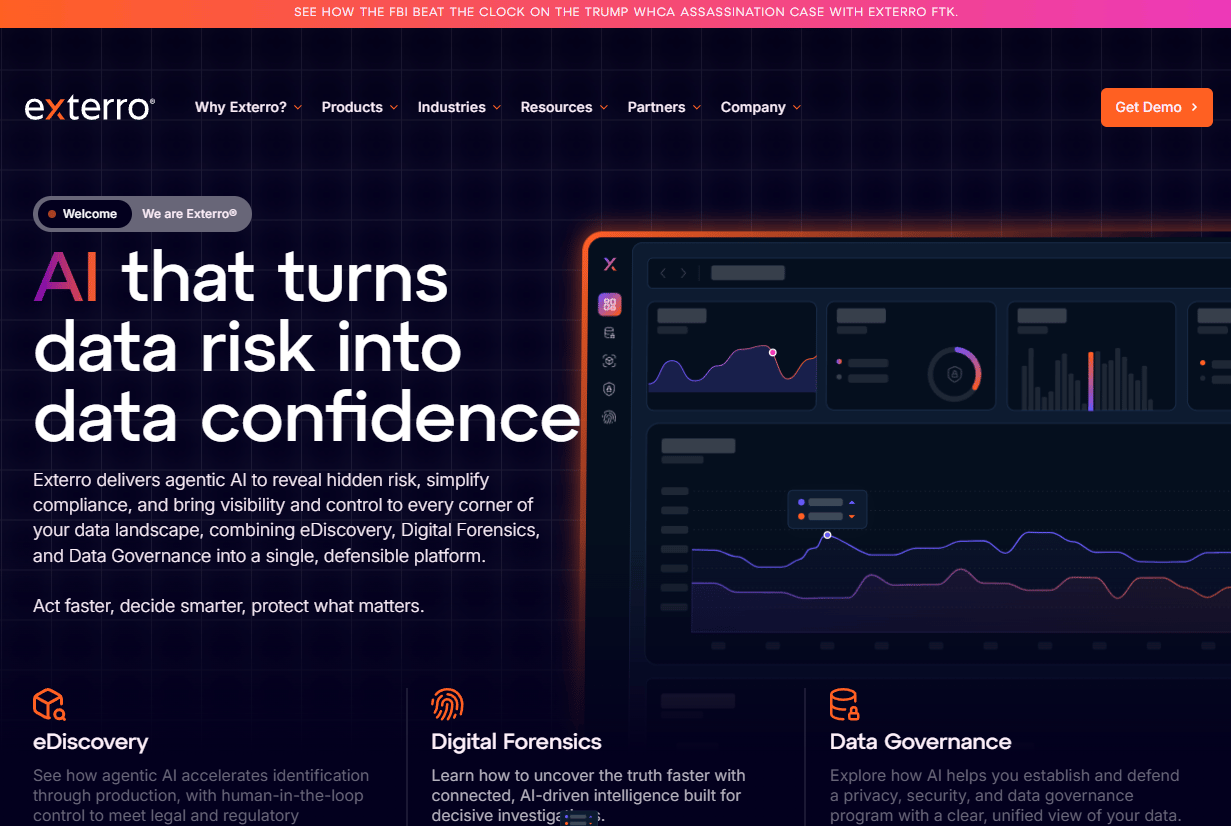
Exterro is an enterprise legal hold and data-preservation platform built for the full hold lifecycle. It covers hold creation, custodian notices, acknowledgments, questionnaires, reminders, in-place preservation, and audit reporting. The platform connects to more than 190 native enterprise data sources and includes employee change monitoring, which flags departures or role transfers that could create preservation gaps.
Best for: Large legal departments and legal operations teams managing high-volume, complex matters across multiple data sources.
Key features
- Automated hold notifications, reminders, and escalation workflows
- In-place preservation of custodial and non-custodial data
- Configurable custodian questionnaires and interviews
- 190+ native enterprise data-source connectors
- Audit trails, dashboards, and hold reporting
Why choose Exterro: It fits buyers who need deep workflow automation and want legal hold connected to broader data risk operations. Plan for implementation ownership and confirm reporting usability during the evaluation. This is a "buy for the team you're becoming" decision, best suited when legal operations and IT can jointly own the system.
Exterro pricing: Exterro uses a quote-based model. Contact sales directly for current packaging and pricing. No free tier is available.
Exterro holds a 4.4/5 rating on G2, based on the Exterro Data Risk Management Platform listing, which covers legal hold functionality.
2. Mitratech LegalHold
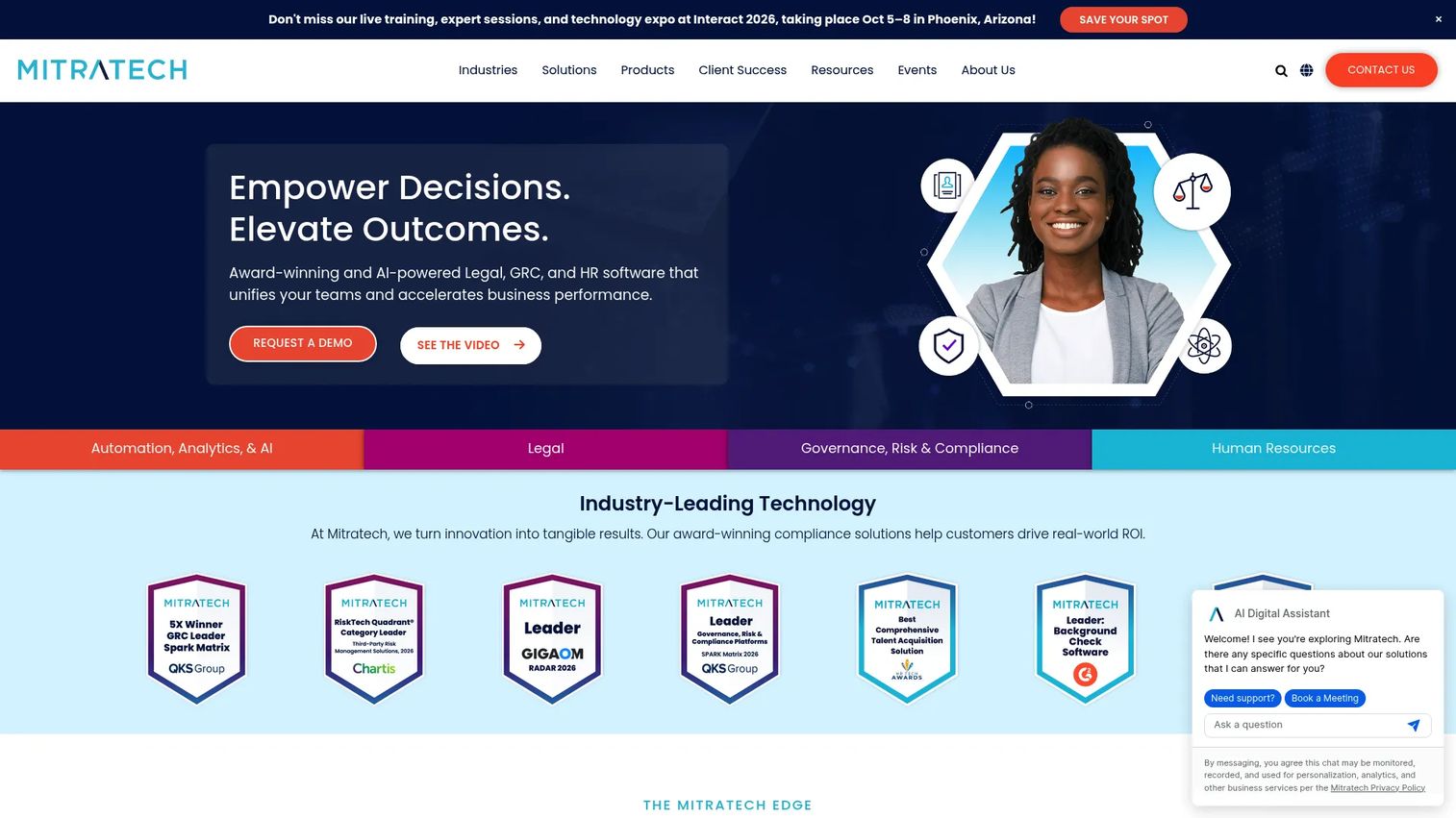
Mitratech LegalHold is a SaaS legal hold management platform built around automated notices, custodian tracking, and Microsoft 365 preservation. Holds connect directly to matters in TeamConnect, giving legal operations teams a single record across the hold lifecycle and broader legal work. The platform also includes a Manager Portal that gives compliance visibility to department managers without requiring them to navigate the full legal system.
Best for: Corporate legal and compliance teams that want legal holds integrated with matter management and Microsoft 365 environments.
Key features
- Hold notice authoring, delivery, reminders, and escalation tracking
- Microsoft 365, OneDrive, Teams, SharePoint, and Purview preservation
- TeamConnect integration for matter-linked holds
- Manager Portal for staff compliance visibility
- Nine standard reports plus a custom report designer
Why choose Mitratech LegalHold: This is the right fit when legal holds need to operate inside a larger legal operations stack and when Microsoft ecosystem coverage is a primary requirement. A small legal team running only occasional holds may find it broader than needed.
Mitratech LegalHold pricing: Mitratech does not post pricing. Reach out to their sales team for current module and subscription details. Contract terms are quote-based..
3. Casepoint
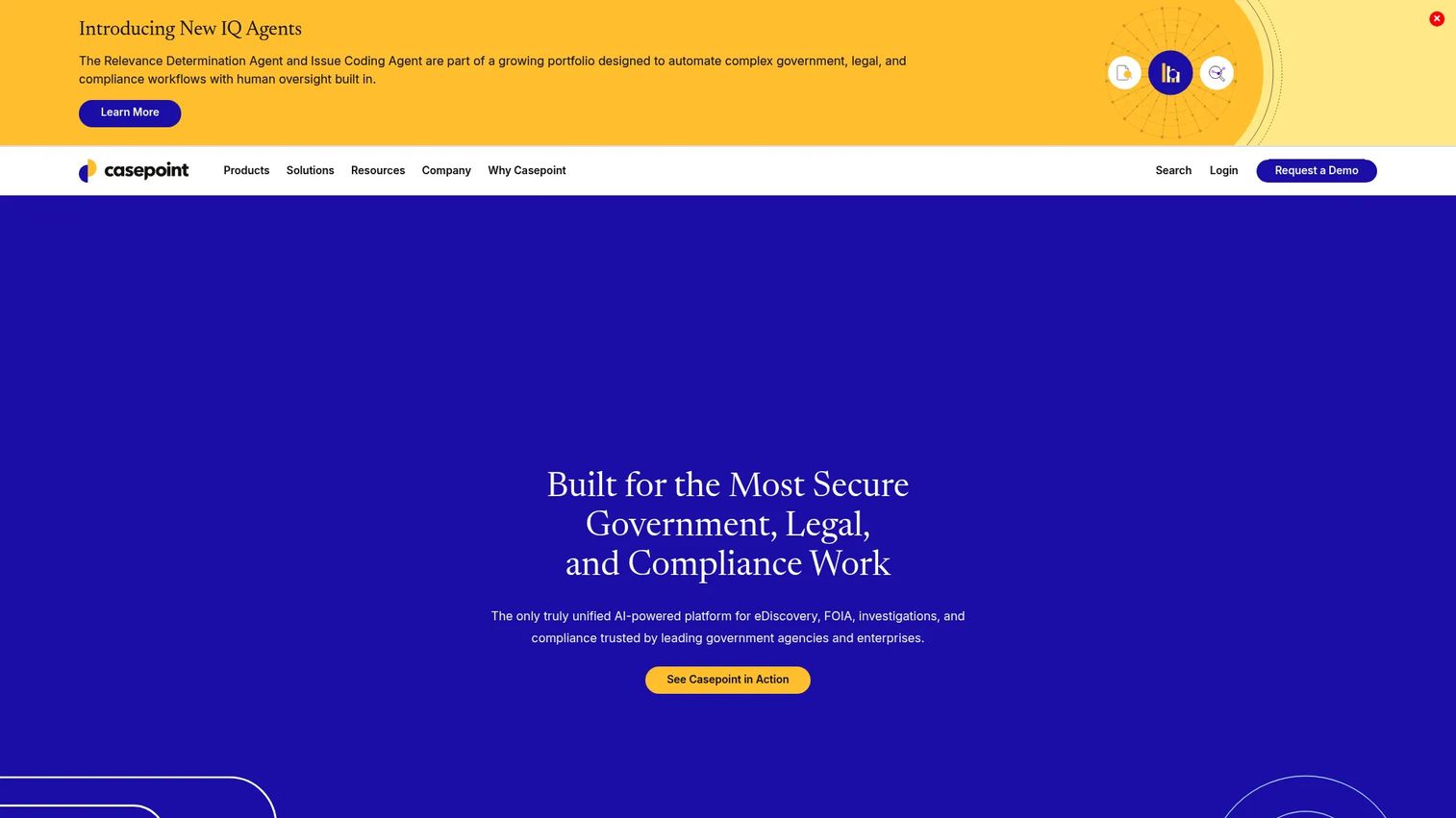
Casepoint is an AI-powered platform that covers legal hold, preservation, collection, processing, review, analytics, and production in a single environment. It supports government agencies, enterprises, and compliance teams managing complex investigations, FOIA requests, and regulatory matters alongside routine litigation. Custodian questionnaires, automated notices, and cloud data connectors come standard.
Best for: Organizations that want legal hold workflows connected tightly to downstream eDiscovery, review, and production work.
Key features
- Hold creation, approvals, and custodian questionnaires
- Automated reminders and escalation workflows
- Cloud data collection connectors
- AI-powered analytics including predictive coding and machine learning
- End-to-end eDiscovery from preservation through production
Why choose Casepoint: It reduces handoffs between hold management and review, which matters when the legal team handles matters end to end. Verify connector coverage against your actual SaaS stack before committing. If the company expects regulatory requests or data-intensive disputes to grow, this platform scales with that.
Casepoint pricing: Tailored pricing based on applications and use cases. Casepoint states customers pay only for what they use. Contact their team for a current quote.
Casepoint holds a 4.7/5 rating on G2.
4. Everlaw
Everlaw is a cloud litigation and investigations platform that positions legal holds as the first step in a connected evidentiary process. Custodian identification, hold notices, preservation documentation, and compliance tracking connect directly into collaborative document review and case preparation tools like Storybuilder. Subscriptions include unlimited user licenses and processing, with usage-based charges on hosted data volume.
Best for: Litigation and investigations teams that want one environment for legal holds, review, analysis, and case preparation.
Key features
- Custodian identification and hold notice workflows
- Preservation documentation and compliance tracking
- AI-powered document coding and natural-language Q&A
- Collaborative document review and case analytics
- Storybuilder for deposition and trial preparation
Why choose Everlaw: It fits teams where review, analysis, and outside-counsel collaboration carry as much weight as hold administration. Confirm whether the hold workflow has the notice templates, HR integrations, escalation logic, and reporting depth your program requires. Worth evaluating when you expect the organization to need more than preservation.
Everlaw pricing: Pricing is volume-based, tied to hosted data. Subscriptions include unlimited users, processing, and core platform features. Contact Everlaw for current rates. Additional AI feature charges may apply.
Everlaw holds a 4.7/5 rating on G2.
5. Relativity Legal Hold

Relativity Legal Hold manages hold creation, custodian notices, questionnaires, reminders, dashboards, and audit trails, with preserved data transferring directly to RelativityOne for review. Integrations cover Microsoft 365, Google Vault, and Slack. For organizations already running eDiscovery in Relativity, the hold workflow becomes a natural extension of the existing environment rather than a separate system.
Best for: Legal departments and service providers that already standardize on Relativity for eDiscovery work.
Key features
- Hold notices, templates, and distribution workflows
- Custodian questionnaires and acknowledgment tracking
- Automated reminder schedules with escalation
- Centralized dashboards and audit trail reporting
- Direct data transfer to RelativityOne for review
Why choose Relativity Legal Hold: The value proposition is clearest when you're already in the Relativity ecosystem. For a company without an existing Relativity footprint, compare total stack cost and implementation scope against dedicated legal hold tools before committing.
Relativity Legal Hold pricing: Relativity does not post pricing. Contact their team to understand whether Legal Hold is sold as part of a broader platform package or consumption model.
Relativity holds a 4.6/5 rating on G2 across its platform.
6. OpenText Core Legal Hold
OpenText Core Legal Hold is a cloud-based platform that centralizes and automates legal hold workflows for enterprise legal, compliance, HR, and IT teams. It covers automated notifications, custodian questionnaires, audit trails, dashboards, and policy-based process controls. OpenText describes the offering as a flat-fee subscription, though pricing figures are not posted publicly. The platform fits organizations managing large data volumes under formal preservation policies.
Best for: Enterprises with high data volumes, formal preservation policies, or an existing OpenText information-management environment.
Key features
- Configurable hold workflows with policy-based controls
- Automated custodian notice tracking and reminders
- Custodian questionnaires and profile management
- Centralized audit trails and dashboards
- Enterprise information governance alignment
Why choose OpenText Core Legal Hold: It fits data-heavy organizations that need governance-level controls around preservation. Validate usability for daily legal operations during the evaluation, not just technical depth. This is generally a later-stage choice for companies where legal, security, and records management are operating under shared governance.
OpenText Core Legal Hold pricing: OpenText uses a flat-fee subscription model but does not display pricing. Reach out to their sales team for a current quote.
7. Arctera eDiscovery Platform
Arctera eDiscovery (also listed on G2 as Arctera Insight eDiscovery) is a cloud-based platform that covers the full electronic discovery reference model from identification through presentation. Its strengths lie in advanced iterative search, collaborative case-based workflows, and targeted collection by keywords, custodians, dates, and classification criteria. It suits organizations where legal hold sits inside a broader data governance and eDiscovery program rather than operating as a standalone function.
Best for: Enterprise legal, compliance, and investigation teams managing end-to-end eDiscovery alongside preservation programs.
Key features
- Advanced phrase, Boolean, proximity, and wildcard search
- Collaborative case workflows with reviewer permissions
- Filtering and targeted collection by custodian and classification
- Review capabilities including tagging and redaction
- Export with metadata, audit logs, and chain-of-custody documentation
Why choose Arctera: Include it on the shortlist when legal hold cannot be separated from broader data-governance decisions. For a smaller legal team looking only for a focused notice-and-acknowledgment workflow, the platform scope may exceed current needs.
Arctera eDiscovery Platform pricing: Arctera does not post pricing. Contact their sales team for current packaging and commercial terms.
Arctera holds a 4.5/5 rating on G2.
8. Hanzo Illuminate
Hanzo Illuminate is an eDiscovery and investigations platform focused on collaboration data and dynamic web content. It provides in-place preservation across Slack, Microsoft Teams, Google Workspace, Jira, and Confluence, with dynamic user-channel-custodian mapping and AI-driven relevance analysis. Where most legal hold platforms center on email and file shares, Hanzo builds around the modern collaboration stack.
Best for: Legal and compliance teams whose evidence lives primarily in Slack, Teams, and web applications rather than traditional email environments.
Key features
- In-place preservation across collaboration platforms
- Dynamic mapping of users, channels, custodians, and conversations
- AI-driven Spotlight intelligence for contextual relevance analysis
- Defensible collection and export with metadata and audit trails
- Legal hold management capabilities
Why choose Hanzo Illuminate: It belongs on the shortlist when standard email and file-share coverage doesn't address the full preservation problem. Validate exact connector coverage, export formats, chain-of-custody documentation, and hold notice capabilities during evaluation. Relevant when core evidence may live in product systems, digital communications, or distributed content channels.
Hanzo Illuminate pricing: Hanzo does not post pricing. Contact their team for a current quote and to confirm available service tiers.
9. Nuix Neo
Nuix Neo is an unstructured data intelligence platform for processing, analyzing, and extracting insights from complex enterprise data. It handles more than 1,000 file types at the binary level and includes semantic search across languages, images, and multimedia, AI-assisted review, and audio and video transcription. Its fit for legal hold depends on whether preservation must connect to forensic investigation or large-scale data analysis.
Best for: Investigation-heavy teams that need to understand complex, large-volume data before or alongside downstream eDiscovery review.
Key features
- Semantic search across languages, images, and multimedia
- AI Review with relevancy scoring and preliminary coding
- Processing of 1,000+ file types at the binary level
- Audio and video transcription with multilingual support
- Automated ingestion, classification, redaction, and orchestration
Why choose Nuix Neo: It suits organizations where investigations, forensic context, and large data volumes drive the purchase. For a company seeking a focused legal hold notice and acknowledgment product, this platform is broader than required. Consider it when the hold process must connect to internal investigations or high-stakes regulatory response.
Nuix Neo pricing: Nuix uses a sales-led commercial model. Contact their team for current terms.
Nuix holds a 3.5/5 rating on G2 based on Nuix Discover listings.
10. IBM StoredIQ Suite
IBM StoredIQ Suite provides scalable in-place analysis and governance of unstructured data across distributed enterprise repositories. Capabilities cover advanced search, indexing, classification, data assessment, eDiscovery export, records retention, and compliance workflows. Its relevance to legal hold sits at the intersection of preservation support and enterprise information governance, making it a consideration when legal hold is one part of a larger data management initiative.
Best for: Large enterprises evaluating legal hold alongside data discovery, records governance, and broader enterprise information management needs.
Key features
- In-place discovery, analysis, and management of unstructured data
- Advanced search, indexing, and classification workflows
- Records retention, compliance, and storage optimization
- eDiscovery and discovery export workflows
- Enterprise repository visibility across distributed sources
Why choose IBM StoredIQ Suite: It may fit buyers with extensive legacy repositories or existing IBM relationships. This is not the default choice for a scaling SaaS company needing a focused, fast-to-administer legal hold workflow. Include it as a comparison point when records management and preservation are being evaluated together.
IBM StoredIQ Suite pricing: IBM does not post public pricing for StoredIQ. Contact IBM sales for current availability, implementation model, and commercial terms.
11. ZDiscovery
ZDiscovery is a cloud-based eDiscovery platform built specifically for corporate legal teams managing litigation response in-house. The product is offered in modular annual subscriptions: A Hold and Preserve plan, and a Hold, Preserve, Collect, and Review plan. Microsoft 365, Google Vault, and Slack preservation integrations are built in, and Nuix-powered processing handles collection, deduplication, search, review, redaction, and production.
Best for: Corporate legal teams handling routine litigation and eDiscovery in-house without an external service provider.
Key features
- Legal hold creation, custodian tracking, reminders, and audit trails
- In-place preservation for Microsoft 365, Google Vault, and Slack
- Nuix-powered processing, search, review, and redaction
- Bates numbering and document production workflows
- Modular annual-subscription plans
Why choose ZDiscovery: The modular structure lets a corporate legal team start with hold and preservation and add collection and review when volume justifies it. This is worth considering when internal teams need to own eDiscovery operations without building a complex platform or engaging a managed service for every matter.
ZDiscovery pricing: ZDiscovery offers annual subscription plans. Pricing is not posted publicly. Contact their sales team for current rates by module.
Considerations when choosing legal hold software
Map data sources before comparing feature lists
Before booking a demo, list where potentially relevant data lives: Microsoft 365, Google Workspace, Slack, Teams, shared drives, source code repositories, and employee devices. A platform with strong notice workflows but weak support for your critical data sources creates a manual gap exactly where you need documentation. Connector coverage should match your actual data map, not a generic enterprise list.
Define who owns legal hold administration
Clarify the division of work between legal, IT, HR, and security before selecting a platform. The best software will still produce inconsistent results if no one owns custodian updates, escalation review, data-source changes, and release approvals. A clear ownership model is a prerequisite, not a post-purchase problem.
Test the audit record, not only the dashboard
Ask vendors to walk through the event history for a completed hold. The record should show notice delivery, acknowledgments, reminders, questionnaire responses, preservation actions, exceptions, escalations, and release activity with timestamps. A dashboard that summarizes outcomes is not the same as a log that can survive legal scrutiny.
Check the employee-change workflow
Employee departures, department transfers, and manager changes are among the most common sources of preservation gaps. Evaluate whether the platform receives HR data, flags relevant changes, reroutes notices to new managers, and documents follow-up. This is a specific technical question to ask during evaluation, not a generic feature.
Separate hold needs from full eDiscovery needs
A dedicated legal hold system may be the cleanest choice for an early legal operations program with moderate matter volume. A broader eDiscovery platform makes sense when preservation, collection, review, and production must operate in a shared workflow. Buying the full suite before the workflow is defined adds cost without adding control.
Conclusion
Legal hold software fails when it stops being used. The most common reason it stops being used is that it was built for a workflow the team didn't actually own. Before evaluating platforms, define who manages custodians, who handles escalations, and who closes holds when matters resolve.
For compliance management at enterprise scale, Exterro and Mitratech LegalHold are strong starting points. Exterro handles complex, high-volume programs with deep automation. Mitratech suits legal ops teams already working inside Microsoft environments and matter management systems.
Casepoint, Everlaw, and Relativity Legal Hold deserve close review when eDiscovery workflows are central to the decision. Each connects preservation to review in a different way. OpenText, Arctera, and IBM StoredIQ fit organizations evaluating hold alongside broader information governance. Hanzo Illuminate belongs on the shortlist when collaboration data is the primary preservation challenge. ZDiscovery is worth considering for corporate legal teams that want to handle routine matters in-house under a modular subscription model.
The wrong system creates more handoffs. The right one gives legal and IT a process they can run without escalating every exception to the executive team.
Start your journey with Guideflow today!
FAQs
Legal hold software manages preservation obligations: Issuing notices, tracking acknowledgments, managing custodians, instructing data preservation, and maintaining an audit record. eDiscovery software may add collection, processing, review, production, and investigation workflows. Some platforms combine both categories in a single environment. The right choice depends on how much of the eDiscovery lifecycle your team needs to manage in one system.
At minimum: Notice templates with delivery tracking, custodian directories with HR integration, automated reminders and escalation paths, in-place preservation instructions, and a timestamped audit log covering every action from issuance through release. Beyond that, look for coverage of your specific data sources, questionnaire functionality, and reporting that produces a defensible record, not just a summary count.
Many enterprise platforms support Microsoft ecosystem data, but coverage varies. Private channels, shared channels, OneDrive files, SharePoint sites, and Purview configurations each have different preservation requirements and connector approaches. Verify what your tenant configuration supports and test the specific data types that matter for your matters before committing to a platform.
It creates a documented workflow: Notice delivery is tracked, acknowledgments are recorded, reminders run automatically, non-compliance escalates to managers, and every preservation action generates a log entry. That log is what demonstrates due diligence if a hold is challenged. Using software instead of email eliminates the "we sent something" problem and replaces it with a verifiable record. This is not legal advice; consult counsel on your specific obligations.
A startup without defined legal processes, mapped data sources, or recurring matter volume probably doesn't need an enterprise platform yet. The trigger is when manual coordination stops producing a reliable record. For a Series B company approaching enterprise customers, a financing event, or a first significant dispute, a documented and repeatable process has real value before the first matter tests it. See also audit management software for related compliance tooling.
In-place preservation keeps data where it resides rather than immediately copying and collecting it elsewhere. The data stays in Microsoft 365, Google Workspace, or whichever system holds it, but it's protected from deletion or modification during the hold period. The legal and technical implications depend on the data system, the platform's connector model, and whether the preservation instruction is monitored and logged. Some platforms confirm preservation status; others only instruct it.
Most enterprise vendors in this category use quote-based pricing. Cost drivers typically include the number of custodians, matter volume, data-source connectors, eDiscovery modules, implementation requirements, and contract length. ZDiscovery is one of the few platforms offering modular annual subscriptions without a full quote process for every tier. When comparing options, include total implementation and administration cost, not subscription price alone. For broader context on compliance automation software costs, the same principle applies.
A narrow notice-management rollout can be operational in weeks. A full preservation program with HR feed integration, data-source connectors, matter workflow configuration, and role-based permissions takes longer. The primary time drivers are custodian directory quality, data map completeness, and how clearly internal ownership is defined before implementation begins. Teams that arrive with a documented workflow implement faster than teams that define it during setup.