Supply chain says one number. Finance says another. Sales has a third, and it lives in a spreadsheet nobody trusts.
That gap is where plans go to die. When demand shifts, each team reruns its own math, and by the time everyone agrees, the window to act has closed. The global integrated business planning software market sat between $4.3B and $4.8B in 2025 and is forecast to roughly double by 2034, growing at 7.4% to 11.2% CAGR, according to Intel Market Research and MarketIntelo. Companies are spending because the manual reconciliation tax is real.
Integrated business planning software is a decision system, not another dashboard. It forces demand planning, supply planning, financial planning, and scenario analysis onto one model, so a single change ripples through every function at once. That is the whole point. You stop arguing about whose number is right and start deciding what to do next.
What's inside
This guide is for teams comparing IBP platforms to replace fragmented planning across forecasting, scenario planning, financial alignment, and supply planning. We selected tools by looking at what actually matters when you have to defend the choice internally.
Selection criteria:
- Breadth of IBP capabilities: demand, supply, inventory, and S&OP in one model
- Financial and supply chain alignment: plans that tie to revenue, margin, and budget
- Scenario planning depth: how fast you can run what-if analysis
- Collaboration and analytics: versioning, governance, and performance monitoring
- Enterprise readiness: integrations, security, and scale
TL;DR
- Best overall for enterprise IBP: SAP Integrated Business Planning, for mature supply chain planning at scale.
- Best for AI-driven planning and unified data models: o9 Solutions.
- Best for finance-led planning teams: OneStream.
- Best for ERP-centric teams: NetSuite.
- Best for broader enterprise planning and what-if analysis: Anaplan.
- Best for supply chain control and rapid decision cycles: Oracle Fusion Cloud Supply Chain Planning.
- Best for real-time response planning: Kinaxis RapidResponse.
What is integrated business planning software
Integrated business planning software is a platform that unifies demand planning, supply planning, financial planning, and scenario analysis into a single model so teams plan against one shared version of the truth.
It connects the pieces that usually live apart. A demand forecast feeds a supply plan. The supply plan feeds an inventory position. The inventory position feeds a financial projection. Change one input, and every downstream number updates. That is what separates IBP from a stack of disconnected point tools.
Core capabilities:
- Demand forecasting: statistical baselines, demand sensing, and forecast accuracy tracking
- Supply planning: constrained planning, replenishment, and capacity checks
- Scenario planning: what-if analysis across demand, supply, and margin shocks
- Financial alignment: plans mapped to revenue, cost, and budget
- Performance monitoring: KPIs, versioning, and plan-versus-actual tracking
- Cross-functional collaboration: shared cadence across finance, supply chain, and sales
Large enterprises drove over 70% of IBP software spend in 2025, and cloud deployments made up about 62% of revenue, per MarketIntelo. The category has moved decisively to the cloud.
How IBP differs from S&OP
Sales and operations planning (S&OP) is the monthly operational rhythm that balances demand and supply. IBP is broader. It pulls finance into the same cadence, extends the horizon, and treats the plan as a company-wide decision, not a supply chain meeting.
The distinction matters when you buy. If you only need to balance demand and supply, an S&OP-focused tool may cover it. If finance and operations keep disagreeing on the number, you need IBP.
| Approach | Primary scope | Who owns it | Horizon |
|---|---|---|---|
| IBP | Demand, supply, and financials on one plan | Cross-functional, often finance and operations | 18 to 36 months |
| S&OP | Balancing demand and supply | Supply chain and operations | 3 to 18 months |
| FP&A | Budgets, forecasts, and financial reporting | Finance | Fiscal year and beyond |
| Supply chain point solutions | A single function like demand or inventory | Supply chain specialists | Function-specific |
When to use
Align finance and operations around one plan
When your forecast lives in three places and none of them agree, you have a reconciliation problem, not a data problem. IBP puts demand planning, supply planning, and financial planning on a shared cadence. Every team plans against the same numbers, so the monthly debate shifts from "whose figure is right" to "what do we do about it."
Run scenario planning faster than spreadsheets allow
Spreadsheets break the moment you need to model a demand spike, a supplier outage, and a margin hit at the same time. IBP platforms let you run what-if analysis across all three in minutes. You test the shock, see the downstream effect on inventory and revenue, and decide before the disruption forces your hand.
Improve inventory and service-level decisions
Stock levels and replenishment only work when the forecast is good and every function feeds in. IBP ties inventory optimization to demand quality and cross-functional input. You hold less safety stock where confidence is high, and protect service levels where it is not.
Comparison table
Sorted by relevance to enterprise IBP. Pricing reflects publicly available figures at writing time; several vendors scope pricing per customer.
| # | Product | Best for | Key differentiator | Pricing | G2 rating |
|---|---|---|---|---|---|
| 1 | SAP Integrated Business Planning | Mature supply chain planning at scale | Demand, supply, inventory, and S&OP on SAP HANA | Custom | 4.3/5 |
| 2 | o9 Solutions | AI-led enterprise planning | Enterprise Knowledge Graph and Digital Brain | Custom | 4.2/5 |
| 3 | OneStream | Finance-driven IBP and xP&A | Unified EPM across close, planning, and reporting | Custom | 4.6/5 |
| 4 | NetSuite | ERP-centered planning teams | Planning inside a cloud ERP suite | Custom | 4.1/5 |
| 5 | Anaplan | Flexible enterprise planning models | Connected planning across every function | Custom | 4.6/5 |
| 6 | Oracle Fusion Cloud Supply Chain Planning | Oracle-centric supply chain planning | Modular demand, supply, and S&OP services | From $625/mo per module | 4.0/5 |
| 7 | Kinaxis RapidResponse | Real-time response planning | Concurrent planning and rapid scenarios | Custom | Not listed |
Best integrated business planning software for 2026
1. SAP Integrated Business Planning
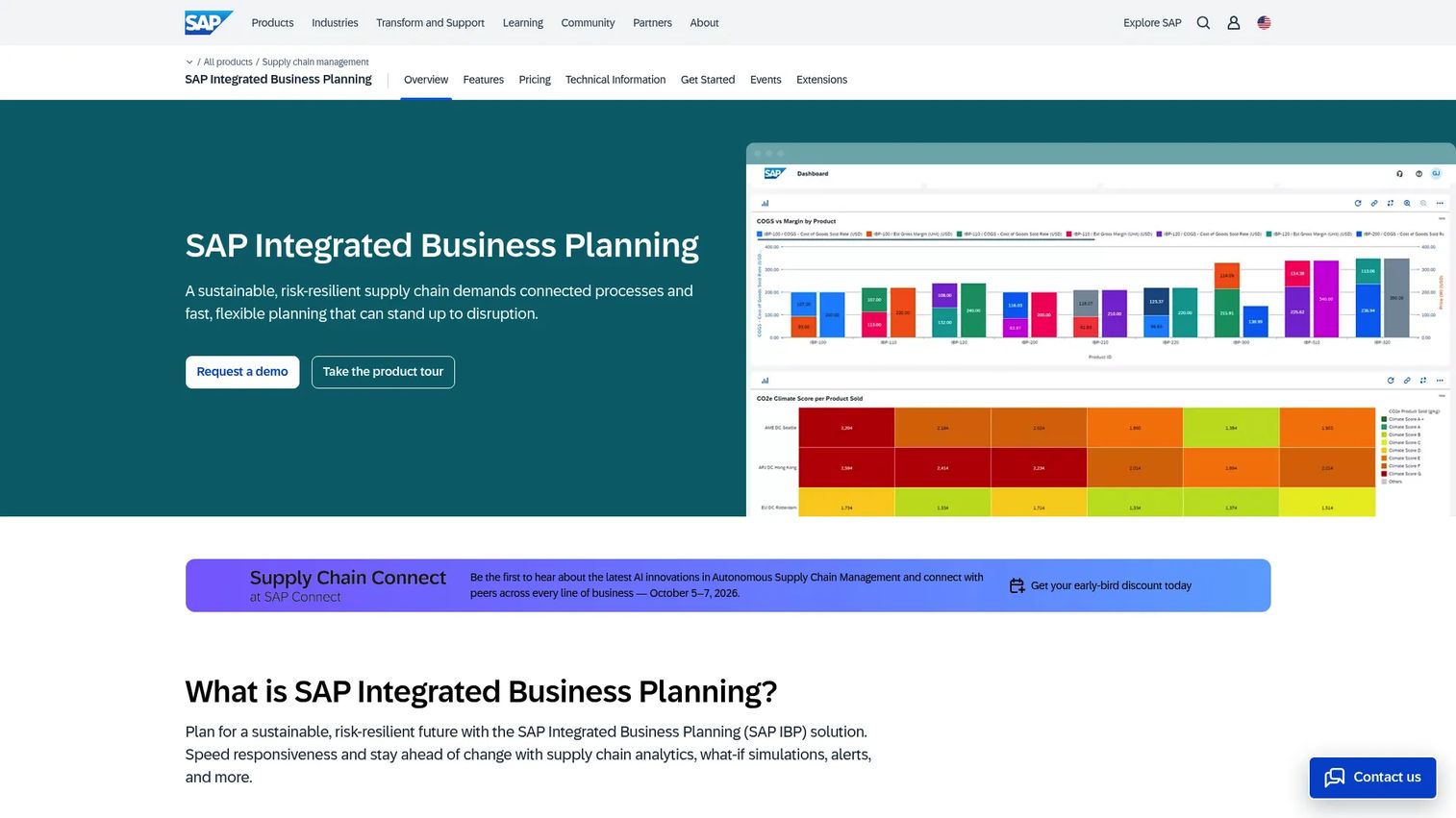
SAP Integrated Business Planning is a cloud-based supply chain planning platform built on SAP HANA. It covers demand, supply, inventory, and S&OP in one model, with real-time scenario simulation. For enterprises already running SAP, it slots into broader supply chain workflows without bolting on a separate planning layer.
Best for: Enterprises needing integrated supply chain planning across demand, supply, inventory, and S&OP.
Key strengths
- Sales and operations planning
- Forecasting and demand management
- Inventory planning and optimization
Why choose SAP Integrated Business Planning: If your supply chain is already deep in the SAP world, SAP IBP removes the integration headache and gives you HANA-speed scenario simulation across the full plan.
SAP Integrated Business Planning pricing: SAP describes flat fee pricing for the starter edition and additional environments on its pricing page, but no public numeric price is listed. Expect a custom quote scoped to your deployment.
2. o9 Solutions
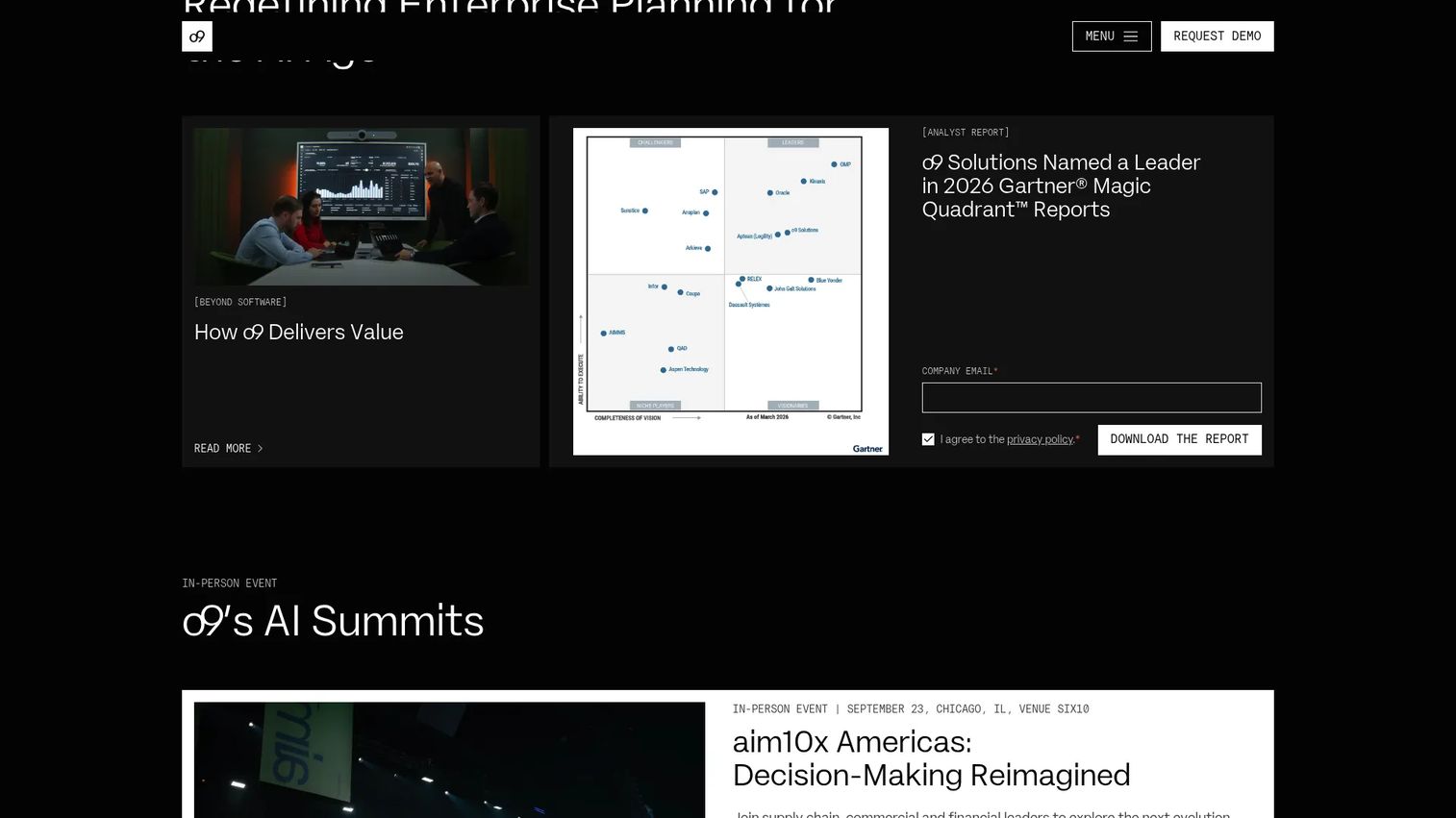
o9 Solutions is an enterprise AI platform for integrated planning and decision-making. Its Digital Brain and Enterprise Knowledge Graph unify data across supply, commercial, and financial planning, so scenario simulation runs on one connected model. Teams that want AI at the center of planning, not bolted on the side, tend to land here.
Best for: Large enterprises needing integrated supply chain, commercial, and financial planning.
Key strengths
- Digital Brain platform for end-to-end planning
- Enterprise Knowledge Graph-based data and model layer
- AI/ML, scenario simulation, and connected planning
Why choose o9 Solutions: Choose o9 when a unified data model and AI-driven scenario speed matter more than fitting into a single ERP vendor's stack.
o9 Solutions pricing: o9 does not publish list pricing. Pricing is scoped per customer through a demo and sales conversation.
3. OneStream
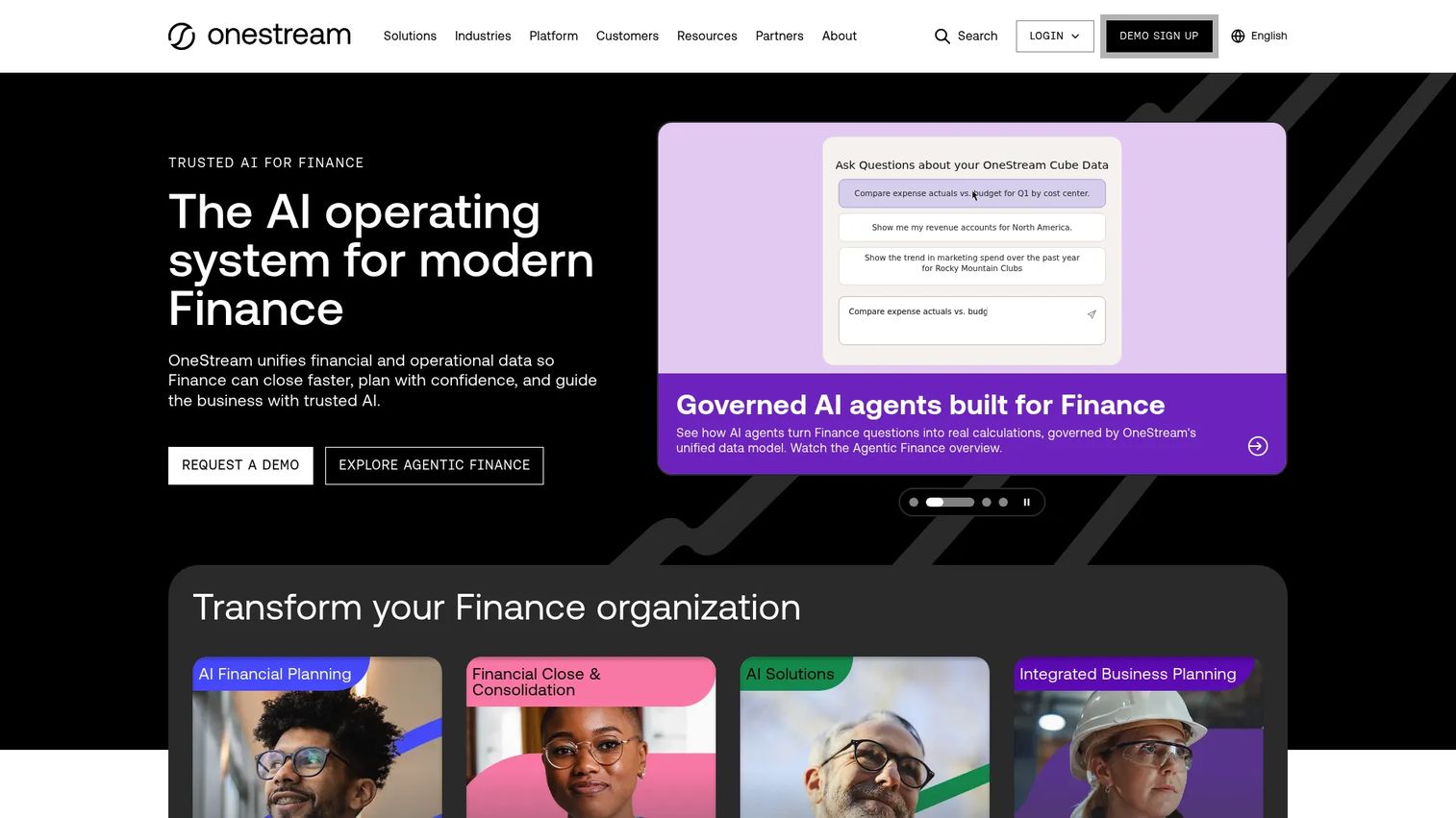
OneStream is a unified EPM platform for finance teams, covering close, consolidation, planning, reporting, analytics, and AI in one system. When FP&A leads the planning motion, OneStream ties financial and operational plans together with governance and audit trails built in. It is the strongest fit for teams where the number that matters is a financial one.
Best for: Mid-market to enterprise finance teams needing a unified EPM platform.
Key strengths
- Financial close and consolidations
- Planning, forecasting, and reporting
- Built-in data integration, data quality, and audit trails
Why choose OneStream: Choose OneStream when finance owns the planning cadence and you need consolidation, xP&A, and governance in one place rather than stitched across tools.
OneStream pricing: OneStream does not publish a public numeric price. Its documentation points to per-user pricing, scoped through a sales conversation.
4. NetSuite
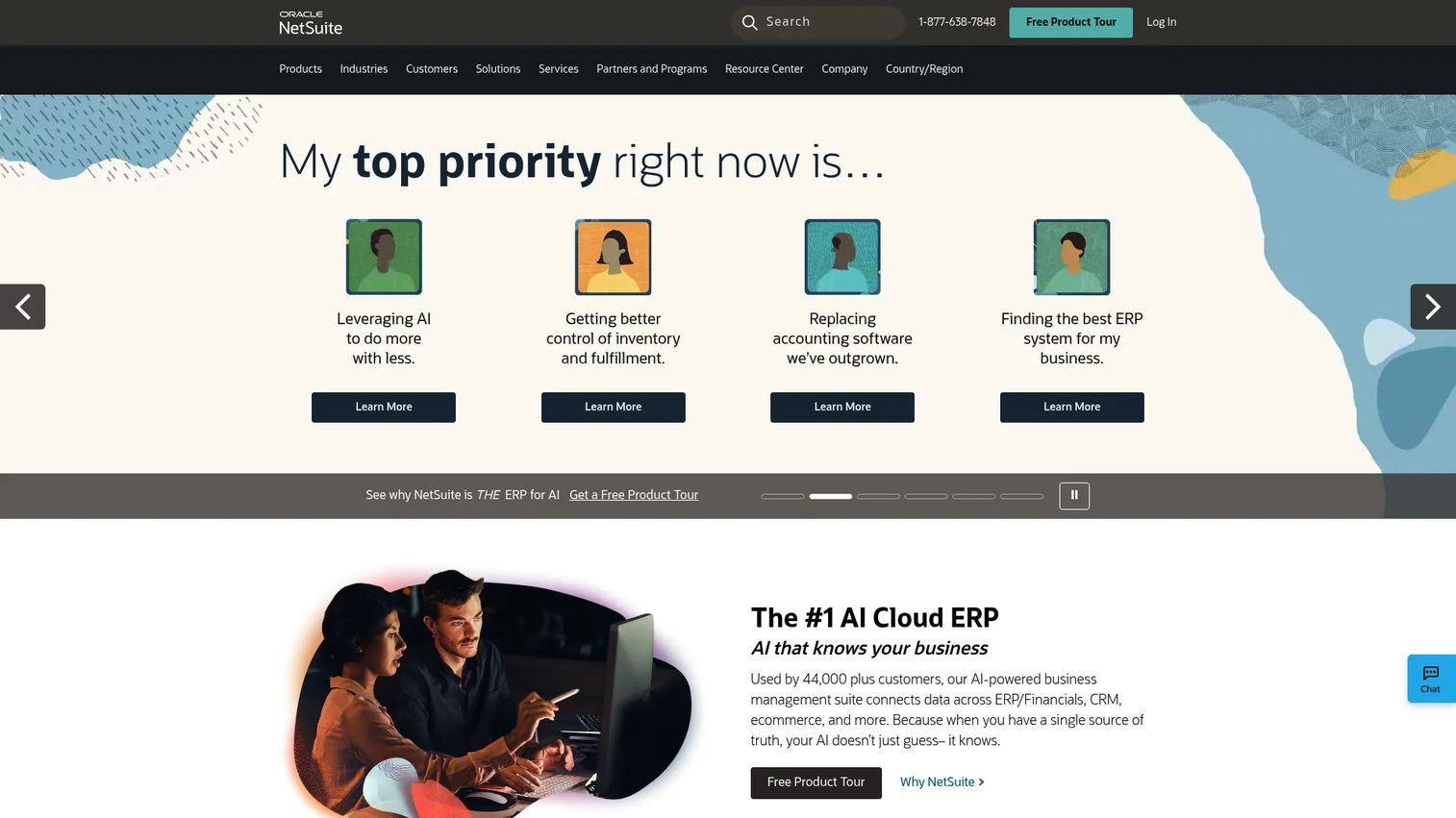
NetSuite is Oracle's cloud ERP and business management suite spanning finance, CRM, ecommerce, and operations. Planning, budgeting, and forecasting run inside the same suite that handles the rest of the business, which keeps operational and financial data aligned without a separate integration project. It fits smaller enterprises and mid-market teams that want planning close to their system of record.
Best for: Mid-market and enterprise companies needing an integrated cloud ERP suite.
Key strengths
- Cloud financials and ERP
- CRM and ecommerce
- Multi-subsidiary, multi-currency management
Why choose NetSuite: Choose NetSuite when you want planning, budgeting, and forecasting to live inside your ERP rather than in a standalone platform. The adjacent ERP market hit $92.6B in 2025 and is projected to top $106B in 2026, per Quantumrun, and NetSuite sits squarely in that cloud shift.
NetSuite pricing: NetSuite does not publish public pricing. Plans are quoted per customer through Oracle's sales team.
5. Anaplan
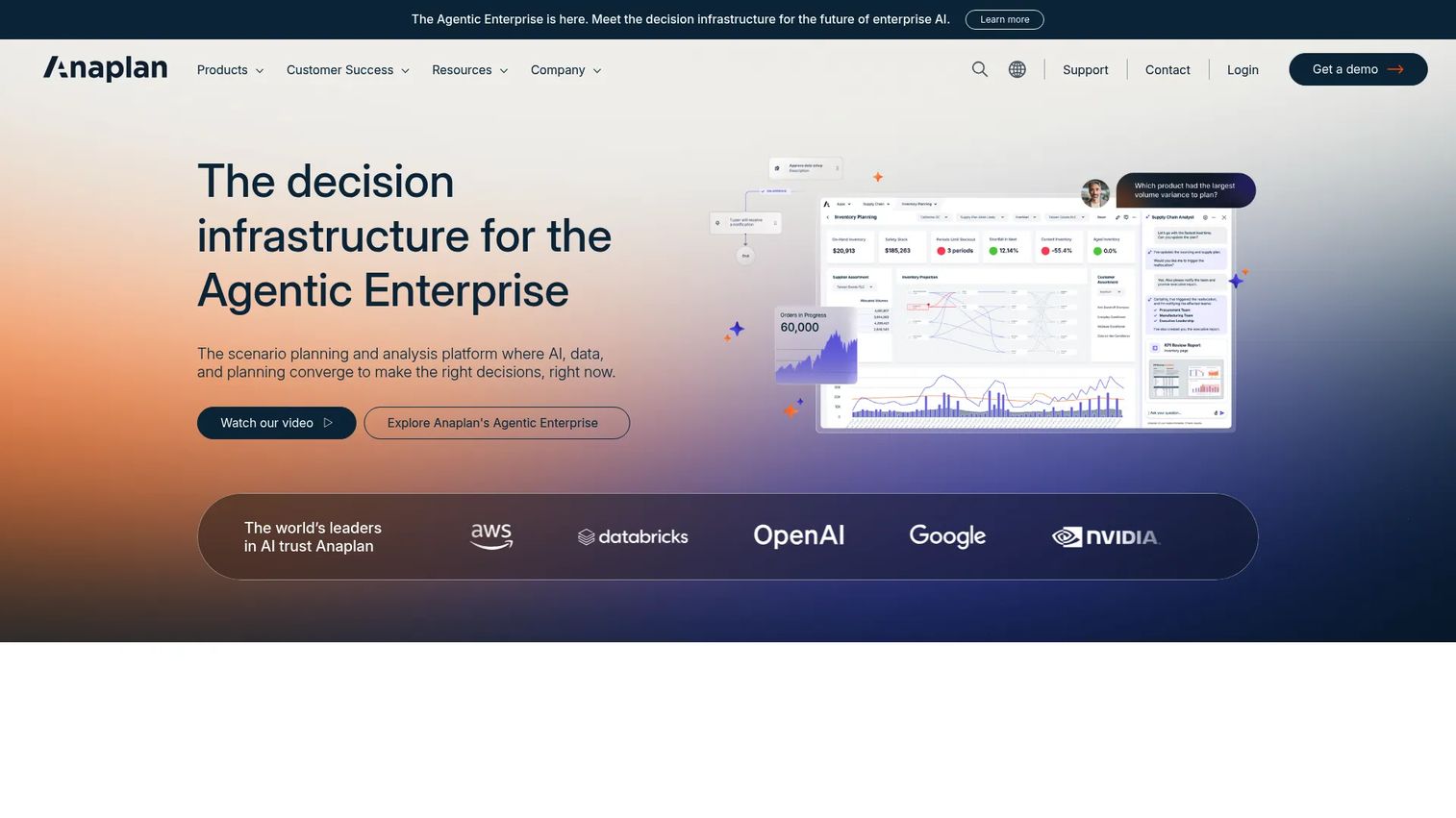
Anaplan is an AI-driven scenario planning and analysis platform for enterprise decision-making. Its connected planning model spans finance, supply chain, sales, and workforce, so you can build flexible models across functions without being locked to one domain. Teams that need to model almost anything, and change the model as the business changes, choose Anaplan for that adaptability.
Best for: Large organizations needing connected enterprise planning across finance, supply chain, sales, and workforce.
Key strengths
- AI-driven scenario planning and analysis
- Deterministic calculations with probabilistic AI
- Connected data orchestration and role-based agents
Why choose Anaplan: Choose Anaplan when flexibility across many planning use cases matters more than a prebuilt supply chain template. It rewards teams willing to build and maintain their own models.
Anaplan pricing: Anaplan does not expose public pricing on its site. Pricing is scoped per customer through sales.
6. Oracle Fusion Cloud Supply Chain Planning
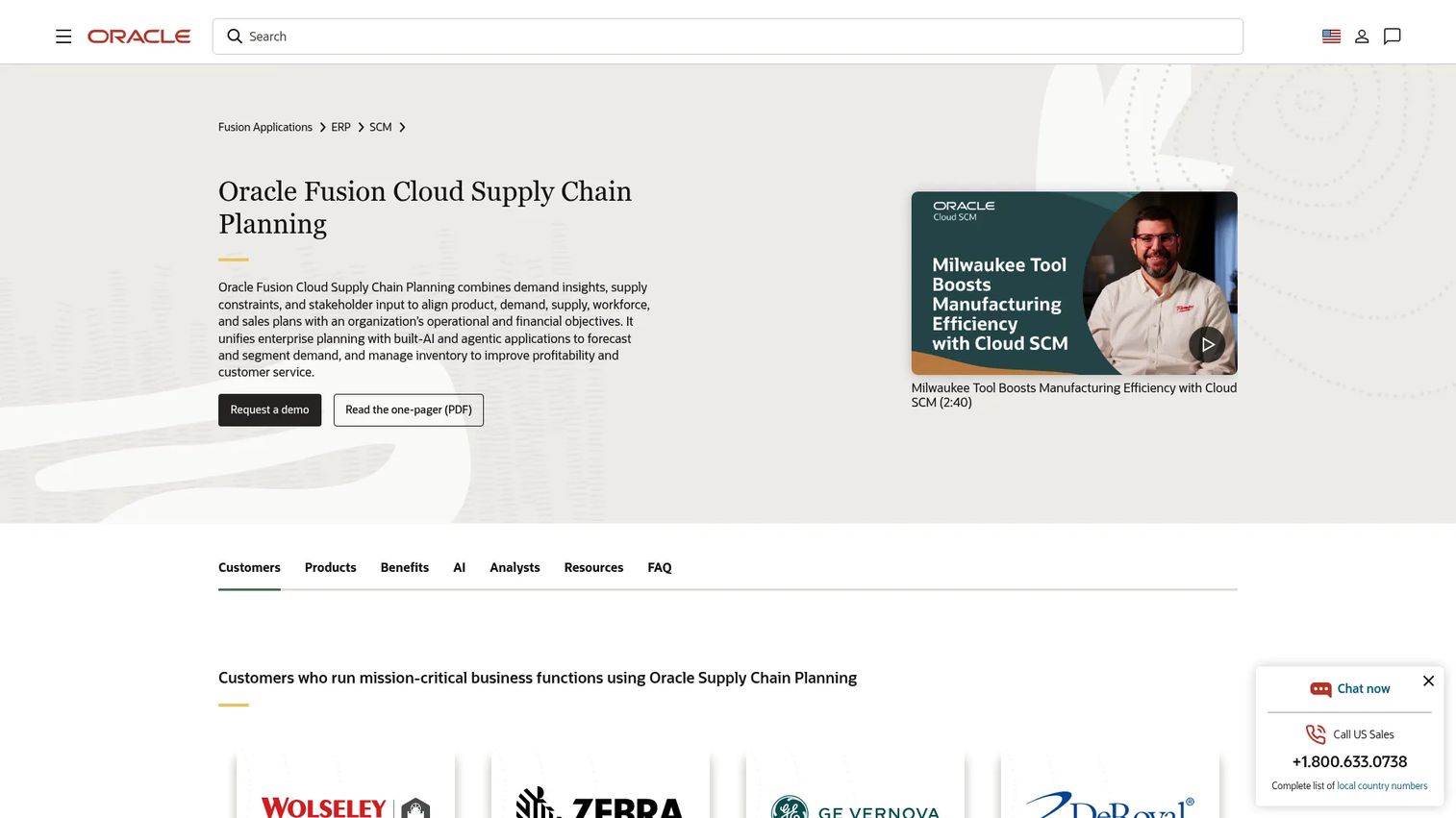
Oracle Fusion Cloud Supply Chain Planning is Oracle's cloud suite for demand, supply, S&OP, collaboration, backlog, and production planning. Sold as modular services, it lets you buy the planning capabilities you need and tie them tightly to Oracle's operational systems. For Oracle-centric environments, that connection between planning and execution is the draw.
Best for: Large enterprises needing integrated, AI-assisted supply chain planning across demand and supply.
Key strengths
- Demand Management and forecasting
- Supply Planning with constrained planning and production scheduling
- Sales and Operations Planning and Supply Chain Collaboration
Why choose Oracle Fusion Cloud Supply Chain Planning: Choose Oracle when you run Oracle operational systems and want planning modules that connect directly to execution. The modular pricing also lets you start with one capability and expand.
Oracle Fusion Cloud Supply Chain Planning pricing: Oracle's published price list shows monthly subscription pricing per module. Sales and Operations Planning and Supply Chain Collaboration start at $625.00/month each, while Supply Planning and Demand Management are listed at $1,250.00/month each.
7. Kinaxis RapidResponse
Kinaxis RapidResponse is a cloud-based supply chain planning and orchestration platform built for end-to-end visibility and rapid decisions. Its concurrent planning approach lets demand, supply, and inventory update together, so you can run scenarios and respond to disruptions in minutes rather than days. Kinaxis now markets this capability under the Maestro name, extending the RapidResponse foundation.
Best for: Large enterprises needing concurrent supply chain planning and orchestration.
Key strengths
- End-to-end supply chain visibility
- Concurrent planning and scenario modeling
- Control tower, demand, supply, and inventory planning
Why choose Kinaxis RapidResponse: Choose Kinaxis when decision speed is the priority. Concurrent planning shines for teams that face frequent disruptions and need to reprioritize the plan fast.
Kinaxis RapidResponse pricing: Kinaxis does not publish public pricing. Pricing is scoped per customer through an information request.
Considerations
How strong is the demand and supply planning layer?
Look for demand sensing, forecast accuracy tracking, inventory optimization, and constrained replenishment. The planning layer is the engine, so a weak forecast here undermines every downstream decision. Ask vendors to show accuracy metrics on your own data patterns, not a canned demo.
How well does finance connect to operational planning?
Check whether the platform maps plans to revenue, margin, and budget outcomes. IBP earns its name when a supply decision immediately shows its financial effect. If finance still exports to a spreadsheet to see the P&L impact, the integration is not there yet.
Can teams run scenarios fast enough to matter?
Evaluate simulation speed, what-if modeling depth, and how easily non-technical users run scenarios. A scenario that takes a day to model is a scenario nobody runs. Speed is what turns planning from a monthly ritual into a live decision system.
Does it support cross-functional governance?
Confirm versioning, approvals, a single source of truth, and role-based access. When finance, supply chain, and sales all touch the plan, governance keeps it trustworthy. Without version control, you are back to arguing about whose spreadsheet is current.
Will it integrate cleanly with your current stack?
Examine ERP, CRM, BI, and supply chain integrations. By 2025, 70.4% of ERP deployments were cloud-based, per Quantumrun, so cloud connectivity is now table stakes. Map your systems of record before you shortlist, and confirm each vendor supports them natively.
Conclusion
The right integrated business planning software depends on where your friction lives.
- SAP Integrated Business Planning for deep supply chain planning at enterprise scale
- o9 Solutions for AI and a unified data model
- OneStream for finance-led planning and xP&A
- NetSuite for planning inside a cloud ERP
- Anaplan for flexible modeling across functions
- Oracle Fusion Cloud Supply Chain Planning for operational supply chain planning
- Kinaxis RapidResponse for real-time response
Start by naming the disagreement you keep having. If finance and supply chain never align on the number, weigh SAP, o9, or OneStream. If your bottleneck is scenario speed, look hard at Kinaxis and Anaplan. If your planning should live next to your ERP, NetSuite or Oracle fit best.
Then run a scoped proof of concept on your own data. A vendor demo proves the tool works. A test on your numbers proves it works for you. Shortlist two, model one real disruption in each, and pick the one that gets your teams to a decision fastest.
FAQs
Integrated business planning software unifies demand planning, supply planning, financial planning, and scenario analysis into one model. It connects functions that usually plan separately, so a change in demand automatically updates supply, inventory, and financial projections. The goal is one shared plan instead of competing spreadsheets.
S&OP is the monthly operational rhythm that balances demand and supply, owned mostly by supply chain. IBP is broader: it pulls finance into the same cadence, extends the horizon to 18 to 36 months, and treats the plan as a company-wide decision. Put simply, IBP is S&OP plus financial alignment across a longer horizon.
Supply chain, finance, sales, and operations teams all use it, usually together. Demand planners own the forecast, supply planners balance capacity, and FP&A ties plans to the P&L. Large enterprises drove over 70% of IBP spend in 2025, but mid-market companies increasingly adopt it as cloud options lower the barrier.
Look for demand forecasting, supply planning, scenario and what-if analysis, financial alignment, performance monitoring, and cross-functional collaboration. Strong versioning and role-based governance matter just as much, because multiple teams edit the same plan. Clean integrations with your ERP, CRM, and BI stack round out the essentials.
No, though large enterprises still dominate spend. Cloud-based IBP made up about 62% of the market in 2025, and cloud deployment has lowered the cost and setup barrier for mid-market teams. Smaller organizations often start with ERP-embedded planning, then move to a dedicated IBP platform as complexity grows.
It combines statistical baselines with demand sensing and cross-functional input, so forecasts reflect signals sales and operations see on the ground. Because the forecast connects to supply and finance, forecast accuracy gets tracked against real outcomes and refined over time. That feedback loop is hard to sustain in disconnected spreadsheets.
Yes. IBP ties inventory optimization to forecast quality and supply constraints, so you hold safety stock where demand is uncertain and trim it where confidence is high. Because inventory decisions connect to service levels and cost, you can balance working capital against service targets in the same plan.
For serious planning, yes. Spreadsheets break when scenario planning, forecasting, and inventory decisions need to move together, and they offer no version control across teams. IBP platforms centralize the model, track changes, and update every function at once. Many teams keep spreadsheets for ad hoc analysis but move the core plan into an IBP system.