A customer request lands in your backlog. Sales forwards another opportunity. Leadership wants a new initiative evaluated before the next planning meeting.
Each suggestion deserves consideration. Your team still needs a defensible way to decide which opportunities justify engineering time.
Innovation management software gives that decision process structure. It connects incoming ideas with evaluation criteria, accountable owners, investment decisions, and measurable outcomes. A spreadsheet can hold suggestions, but maintaining those relationships becomes its own operational job.
The category also reaches beyond new product development. OECD research published in 2026 reports business-process innovation across 38% of enterprises, compared with 26% for product innovation. Your intake process may need to accommodate operational improvements alongside roadmap opportunities.
For product managers, the useful question is specific. Can the system explain why an initiative advanced, what evidence supported it, and whether the result justified the investment?
Start there. A polished submission form means little if the decision trail disappears before work reaches the roadmap.
What’s inside
- Who this guide serves: Product managers, innovation program owners, strategy leaders, and operators choosing software for internal idea-to-impact workflows.
- What it compares: Seventeen named products, covering employee participation, portfolio governance, technology scouting, and external challenges.
- Selection criteria: Category fit, evaluation depth, execution visibility, and adoption within existing workflows.
- Evidence base: Vendor product information, pricing sources, and G2 ratings collected on November 24, 2026. This is a research-based comparison, not hands-on testing.
- Important buying context: Some entries have changed branding or ownership. Medallia Ideas’ maintenance status also affects its suitability for new purchases.
TL;DR
- Best for enterprise innovation portfolios: HYPE Innovation combines phase-gate governance with initiative oversight and business-impact tracking.
- Best for mature corporate programs: Brightidea supports configurable processes across innovation challenges, experimentation, and departmental programs.
- Best for employee idea crowdsourcing: IdeaScale emphasizes community participation and collaborative evaluation. Treat voting as an input to prioritization, not the final decision.
- Best for portfolio-connected decisions: Planview IdeaPlace connects ideation with Planview’s planning and delivery products.
- Best for structured employee intake: Ideawake combines submission forms with custom scorecards. For smaller visual programs, consider Viima, now presented as HYPE Boards.
- Best for Microsoft-centered teams: edison365 connects innovation with business cases and project delivery. Evaluate its operational fit alongside your existing reporting practices.
What is innovation management software?
Innovation management software helps organizations collect and evaluate ideas, prioritize investment, coordinate implementation, and measure outcomes across the innovation lifecycle.
An innovation management platform creates a decision process around opportunities. Submissions enter through campaigns or ongoing intake. Reviewers assess evidence, assign ownership, and determine whether an idea should advance.
That makes the distinction from idea management software important. An idea management system typically emphasizes collection and collaborative evaluation. Broader innovation lifecycle management adds governance around funded initiatives and their eventual results.
For product teams, this separates discovery inputs from delivery commitments. A suggestion can remain visible without becoming a promised feature.
Core capabilities to evaluate
- Idea intake: Capture suggestions from employees, customers, partners, and research.
- Challenge campaigns: Invite contributions around a defined problem or strategic priority.
- Idea scoring: Compare customer impact against feasibility, risk, and investment.
- Stage-gate workflows: Require evidence and approval before advancing an initiative.
- Validation: Record experiments and learning before larger commitments.
- Innovation portfolio management: Review competing initiatives across business units.
- Impact reporting: Connect investment with operational or commercial outcomes.
- Governance: Control access and preserve decision history.
- Open innovation: Coordinate external contributors and challenge programs.
Not every product covers this entire range. Some specialize in crowdsourcing ideas. Others emphasize technology scouting software capabilities or enterprise portfolio oversight.
Choose the approach that matches where your process begins. Employee suggestions require different participation mechanics from startup discovery. Both need evaluation, but the evidence and handoffs differ.
The same distinction applies to reporting. Participation dashboards answer whether people contribute. Investment reporting should help leaders understand what received funding and what happened afterward.
For product innovation management, connect these records to a measurable hypothesis. An onboarding proposal might target activation or time to first value. A cost-reduction initiative needs a different baseline.
Project management software becomes relevant once work is approved. Innovation management tools help establish which work deserves approval and preserve the reasoning behind that choice.
When to use innovation management software
Centralize idea intake across teams
Use a dedicated system when customer requests and employee suggestions arrive through disconnected channels. Assign responsibility for triage before inviting more submissions.
An employee innovation platform should make contribution practical while keeping status visible. Ask vendors to show how contributors learn whether their idea advanced or needs more evidence.
Score and prioritize ideas before they hit the roadmap
Introduce structured evaluation when stakeholder pressure routinely outruns discovery. Compare strategic fit with customer impact, implementation effort, and uncertainty.
Test your scoring model with an onboarding improvement and a new product opportunity. Useful ideation software should accommodate different evidence requirements without forcing every proposal through identical approvals.
Prove innovation impact after launch
Connect your innovation pipeline to outcomes when leadership asks what funded initiatives delivered. Define the expected benefit before implementation begins.
Stage-gate workflows should preserve those assumptions as projects progress. After release, compare the result with the original hypothesis and record what the team learned.
For a product manager, that could mean improved activation rather than submission volume. For operations, it might mean a documented reduction in handling time.
Innovation management software comparison
Use this table to narrow the field by operating model. The order follows category relevance, while the “Best for” column identifies different buying situations.
Prices use the vendor’s stated billing unit. A monthly workspace subscription and an annual per-seat license are different commitments. Review included users and support charges before comparing totals.
G2 scores provide context rather than a substitute for workflow evaluation. “N/A” means this comparison has no confirmed aggregate rating to report.
Product status also matters. The list includes names buyers still encounter during research, including renamed products and platforms now within another vendor’s portfolio.
| # | Product | Best for | Key differentiator | Pricing | G2 rating |
|---|---|---|---|---|---|
| 1 | HYPE Innovation | Enterprise initiative portfolios | Phase-gate governance and impact tracking | From €15,000/year | 4.8/5 |
| 2 | Brightidea | Corporate innovation programs | Configurable programs and experimentation | Custom pricing | 4.3/5 |
| 3 | IdeaScale | Community idea crowdsourcing | Participation and collaborative evaluation | Custom pricing | 4.5/5 |
| 4 | Planview IdeaPlace | Portfolio-connected innovation | Connections to Planview delivery products | Custom pricing | 4.5/5 |
| 5 | Ideawake | Employee innovation programs | Custom scorecards and outcome analytics | Business from $300/month | 4.6/5 |
| 6 | Wazoku | Challenge-driven innovation | Communities and challenge workflows | Custom pricing | 4.4/5 |
| 7 | Sideways 6 | Employee participation in existing channels | Microsoft Teams and intranet delivery | Free Lite; paid Lite $3/user/month | 4.4/5 |
| 8 | Medallia Ideas | Existing organizational ideation programs | Challenge collaboration; maintenance mode | Custom pricing | 3.9/5 |
| 9 | Ideanote | Automated idea workflows | AI-assisted evaluation and routing | $899/month for 100 seats | 4.7/5 |
| 10 | edison365 | Microsoft-centered delivery workflows | Business cases connected to projects | Custom pricing | 4.6/5 |
| 11 | Traction Platform | Technology and startup evaluation | Scouting through pilot management | $4,000/seat/year | N/A |
| 12 | ITONICS | Foresight-led innovation | Trend radars linked to portfolios | Custom pricing | 4.4/5 |
| 13 | Qmarkets | Multiple enterprise innovation programs | Modules for scouting, improvement, and portfolios | Custom pricing | 4.5/5 |
| 14 | Agorize | External innovation challenges | Participant sourcing and proposal evaluation | Custom pricing | 4.4/5 |
| 15 | Viima | Visual idea management | Now HYPE Boards; configurable board views | Basic $79/month, billed annually | 4.8/5 |
| 16 | InnovationCast | Structured innovation pipelines | Challenges connected to portfolio monitoring | Standard from $2,999/month | N/A |
| 17 | Planbox | Existing customers evaluating their transition | Now part of HYPE Innovation | Contact HYPE for a quote | N/A |
Pricing and ratings reflect the supplied vendor and G2 research dated November 24, 2026.
17 best tools for innovation management
1. HYPE Innovation
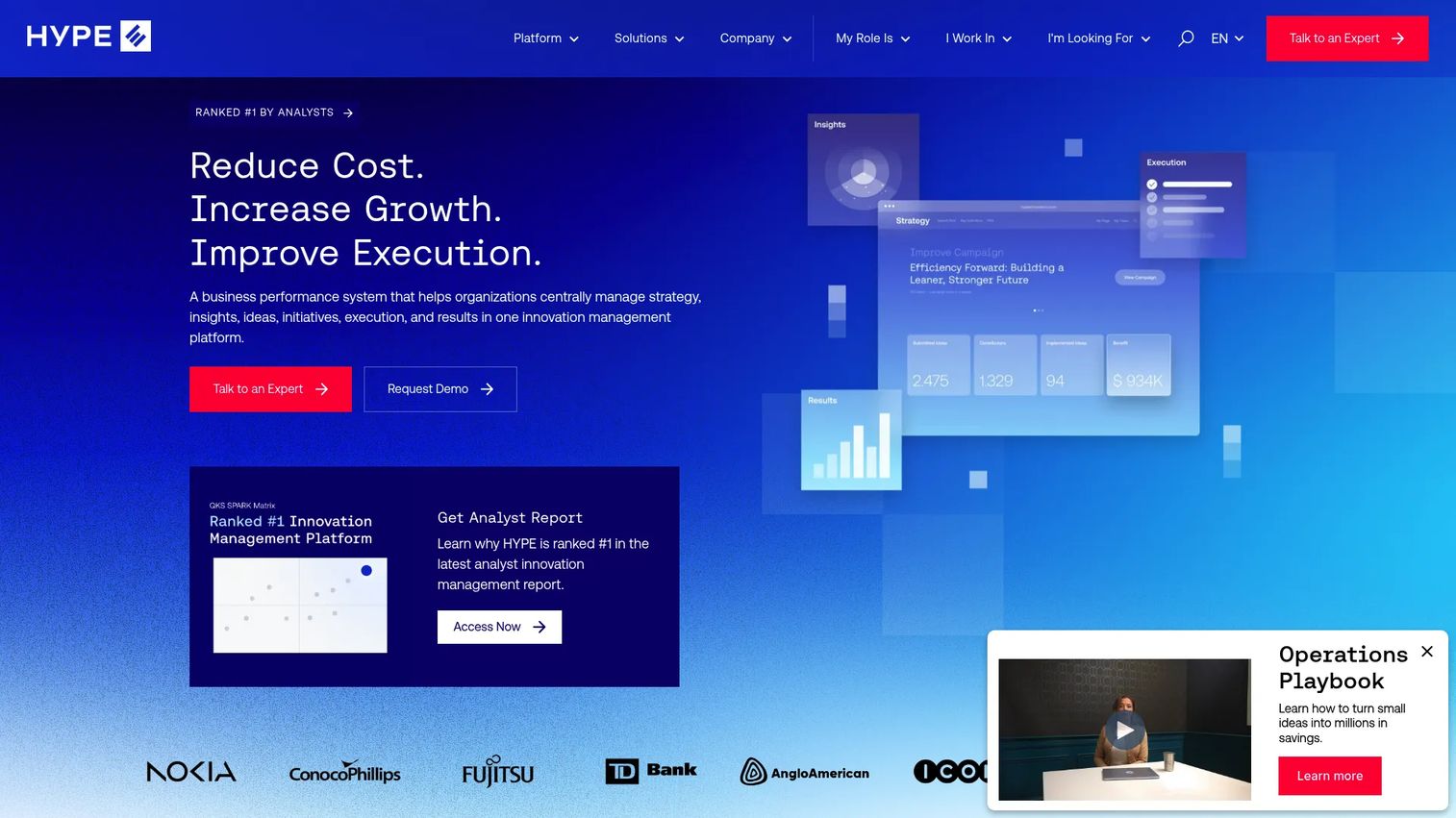
HYPE Innovation covers enterprise innovation from opportunity capture through execution and business-impact measurement. Its scope includes technology signals and partner opportunities alongside internal suggestions. Product leaders can evaluate initiatives within a broader investment portfolio.
Best for: Large organizations coordinating innovation programs across business units with shared governance requirements.
Key features
- Configurable workflows and phase-gate governance
- Innovation portfolio management
- AI-supported evaluation and similarity detection
- Progress, risk, KPI, and impact tracking
- Microsoft Teams, Power BI, and Tableau integrations
Why choose HYPE Innovation: Choose it when cross-program oversight matters more than launching an isolated suggestion campaign. Its breadth fits teams that need traceable investment decisions.
For evaluation, bring a proposal that requires input from multiple departments. Ask the vendor to follow it from initial assessment through approval and outcome reporting.
Pay particular attention to ownership transfers. A product manager should be able to distinguish the person developing evidence from the person approving investment.
Also test the reporting audience. Executives need portfolio-level visibility, while program owners need enough detail to identify stalled work.
HYPE Innovation pricing: Enterprise subscriptions start at €15,000 per year.
G2 rating
2. Brightidea

Brightidea supports enterprise programs for capturing ideas and developing them into implemented initiatives. Its documented coverage includes hackathons, innovation labs, and experimentation. Configurable workflows make it relevant to organizations running different program types across departments.
Best for: Established corporate innovation teams standardizing repeatable programs rather than introducing a single intake board.
Key features
- Idea capture and management
- Configurable innovation workflows
- Programs and challenge management
- Innovation labs and experimentation
- Microsoft Teams, Jira, Slack, and Asana integrations
Why choose Brightidea: It suits organizations that want a common operational foundation for distinct innovation activities. Evaluate how much administration your chosen program structure requires.
A useful buying exercise is to compare an employee challenge with an experimentation program. Ask which settings are reusable and which require separate configuration.
Then follow an approved opportunity into the delivery workflow. Your product team needs clarity on where discovery ends and project ownership begins.
Integration testing should include a practical handoff, such as moving approved work into Jira. Check what context accompanies that transfer rather than accepting a connector logo as proof.
Brightidea pricing: Custom pricing through sales.
G2 rating
3. IdeaScale
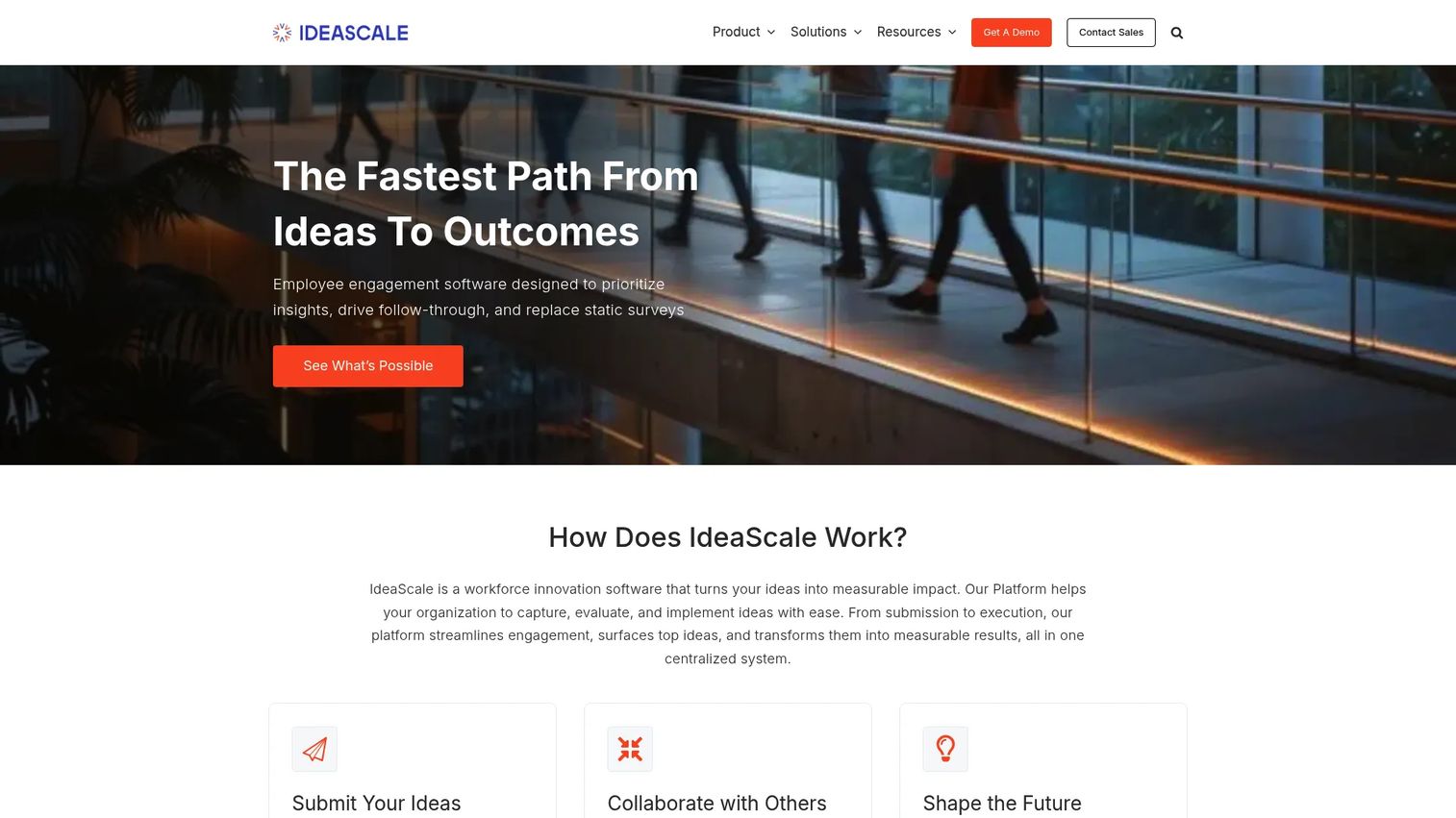
IdeaScale centers innovation programs on idea collection and community collaboration. Participants submit suggestions and contribute through voting or comments. Configurable campaigns and workflows support structured evaluation across organizational communities.
Best for: Organizations seeking broad participation from employees or external contributors within a managed idea program.
Key features
- Idea submission and collection
- Voting and commenting
- Community collaboration
- Customizable campaigns and workflows
- Reporting and analytics
Why choose IdeaScale: It fits programs where participation is central to discovering opportunities. Product managers should assess how community input feeds expert evaluation and investment decisions.
Popularity and customer value can point in different directions. During evaluation, use an example with many votes but limited strategic relevance.
Ask reviewers to explain how they would preserve that feedback while declining the proposal. The resulting record should help contributors understand the decision.
Also test an opportunity with a smaller audience and stronger commercial evidence. Your process should give niche customer needs a fair hearing.
For organizations inviting external participation, review how access boundaries work before opening a campaign. Decide which discussions belong in the shared community.
IdeaScale pricing: Custom subscriptions are available through sales.
G2 rating
4. Planview IdeaPlace
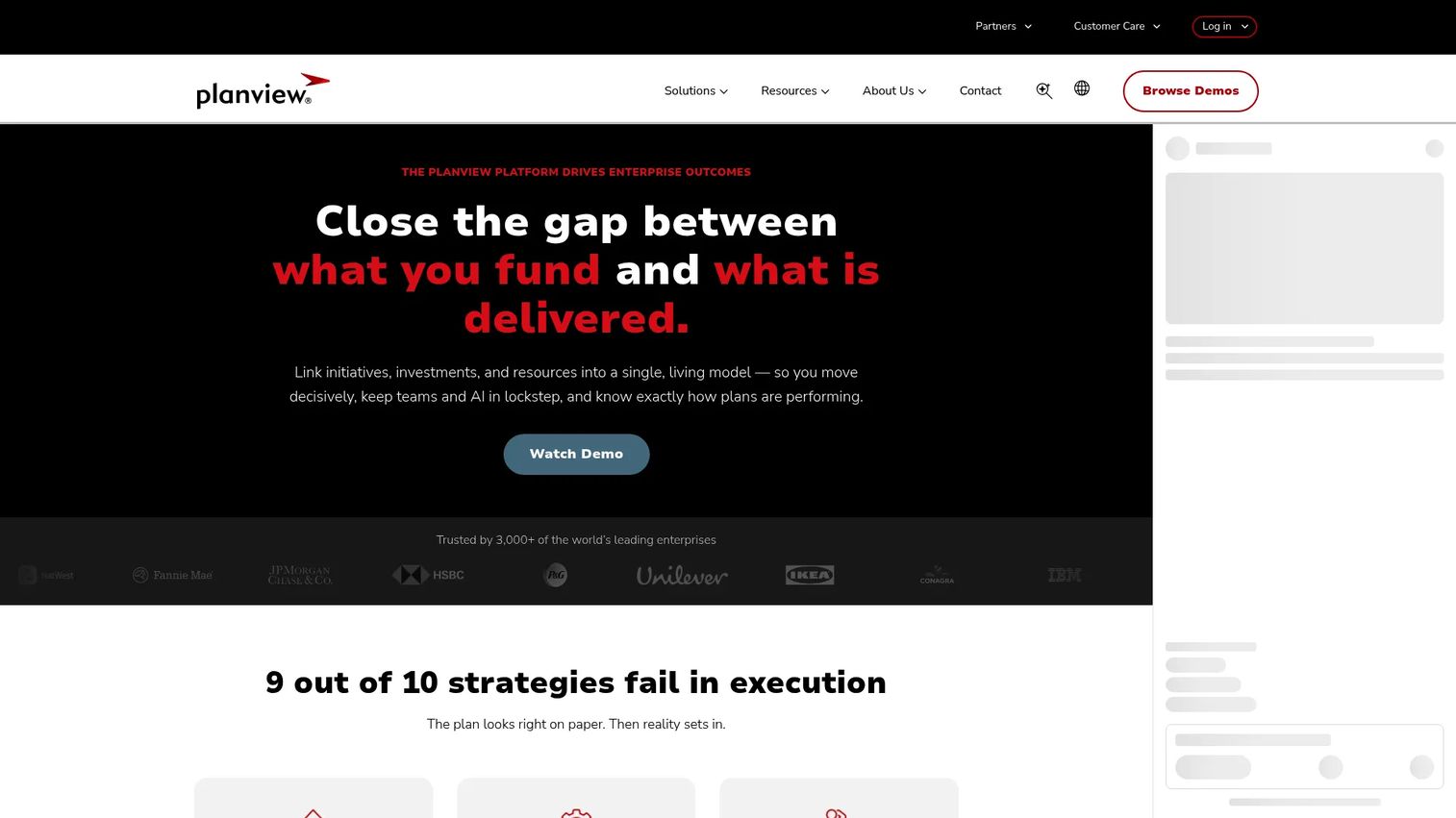
Planview IdeaPlace connects idea capture and evaluation with the broader Planview planning environment. It supports multiple assessment methods, including pairwise ranking and expert reviews. Documented integrations include Planview Portfolios, AdaptiveWork, and ProjectPlace.
Best for: Product and portfolio teams that need innovation inputs connected to investment planning and delivery.
Key features
- Challenge templates and configurable intake forms
- Crowd voting and pairwise ranking
- Expert reviews and prediction methods
- Natural-language idea consolidation
- Embedded Microsoft Power BI dashboards
Why choose Planview IdeaPlace: Choose it when the connection between opportunity selection and portfolio execution drives the purchase. Existing Planview usage makes that evaluation especially relevant.
Bring your portfolio owner into the buying process. A strong intake experience will not resolve disagreements about funding authority or planning cadence.
Test whether the evaluation record remains understandable after an opportunity advances. Reviewers should be able to locate the evidence behind its original score.
The different assessment methods deserve attention. Ask the vendor to apply pairwise ranking and expert review to the same sample proposals.
Compare the resulting decisions with your current prioritization approach. The goal is a clearer investment discussion, not another scoring exercise.
Planview IdeaPlace pricing: Custom pricing.
G2 rating
5. Ideawake
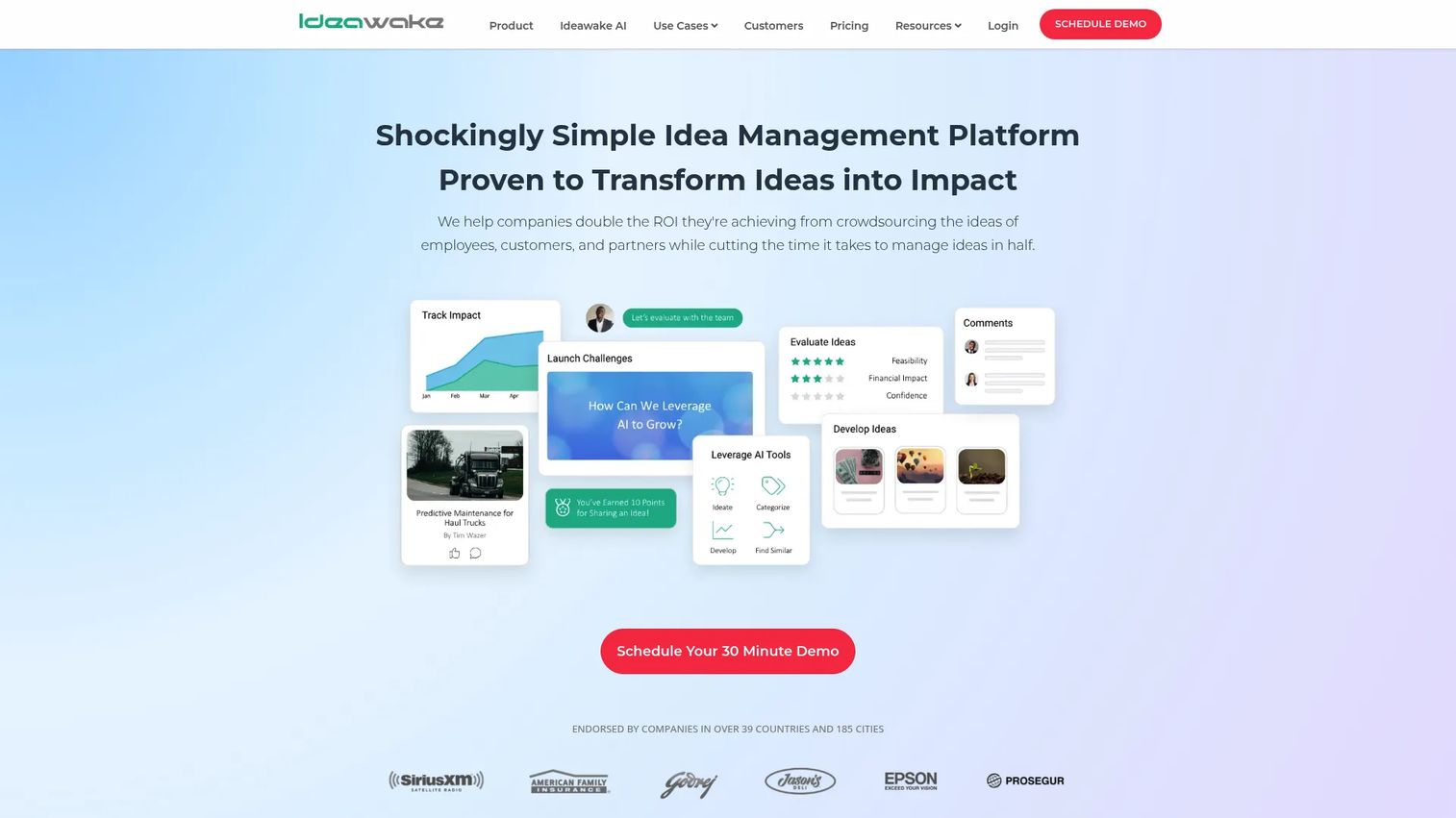
Ideawake combines idea submission with structured evaluation and implementation tracking. Its custom scorecards make it relevant to teams replacing informal review habits. Outcome analytics extend the conversation beyond employee participation.
Best for: Organizations establishing an employee innovation process with explicit evaluation criteria and measurable benefits.
Key features
- Customizable submission forms
- Comments, mentions, notifications, and voting
- Custom scorecards
- Configurable stages and workflows
- ROI and engagement analytics
Why choose Ideawake: It offers a clear fit for teams that need consistent assessment alongside participation. Include success and support charges in your commercial comparison.
Start your evaluation with a scorecard your reviewers already understand. For example, compare an onboarding improvement against a request serving a small enterprise segment.
Ask each stakeholder to score independently before discussing differences. This reveals whether your criteria are specific enough to produce useful decisions.
Also decide who owns benefit measurement after implementation. A dashboard needs an accountable person supplying the outcome, particularly when the result comes from product analytics.
Avoid measuring the program only by submissions. Review completion and evidence quality deserve equal attention.
Ideawake pricing: Business costs $300 to $2,250/month; Flex costs $500/month. Separate support packages start at $250/month.
G2 rating
6. Wazoku
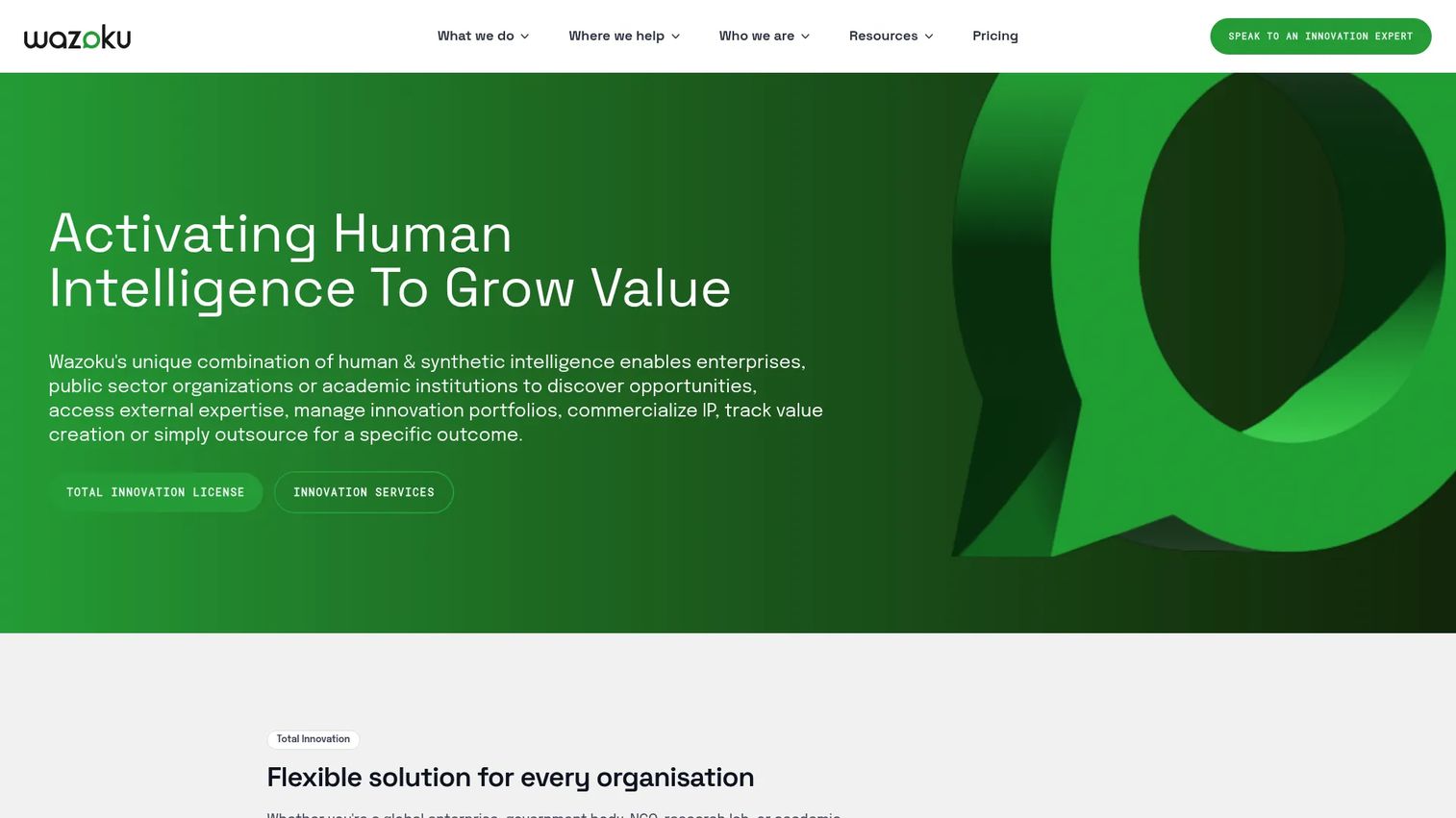
Wazoku organizes innovation around challenges and collaborative communities. Its platform includes portfolio management and AI assistance alongside program analytics. This makes it relevant when teams want contributions focused on defined problems.
Best for: Enterprise organizations running challenge-driven innovation across distributed groups of contributors.
Key features
- Challenge workflows
- Idea and co-creation communities
- Challenge Driven Innovation
- Analytics and benchmarking
- AI Copilot and portfolio management
Why choose Wazoku: Choose it when a well-framed challenge is your primary intake mechanism. Evaluate the community experience together with the process for selecting contributions.
Before reviewing the platform, write a challenge brief with a clear constraint. A product team might seek ways to improve activation without increasing implementation work.
Include the evidence reviewers will need and the outcome the sponsor will fund. Those details help you judge whether the workflow supports your operating model.
Test how promising ideas move beyond the campaign. Assign responsibility for validation before selecting a winner.
For purchasing, review the administrator-seat model and optional add-ons. Separate platform access from any additional requirements your program introduces.
Wazoku pricing: Custom pricing, with monthly or annual billing options.
G2 rating
7. Sideways 6
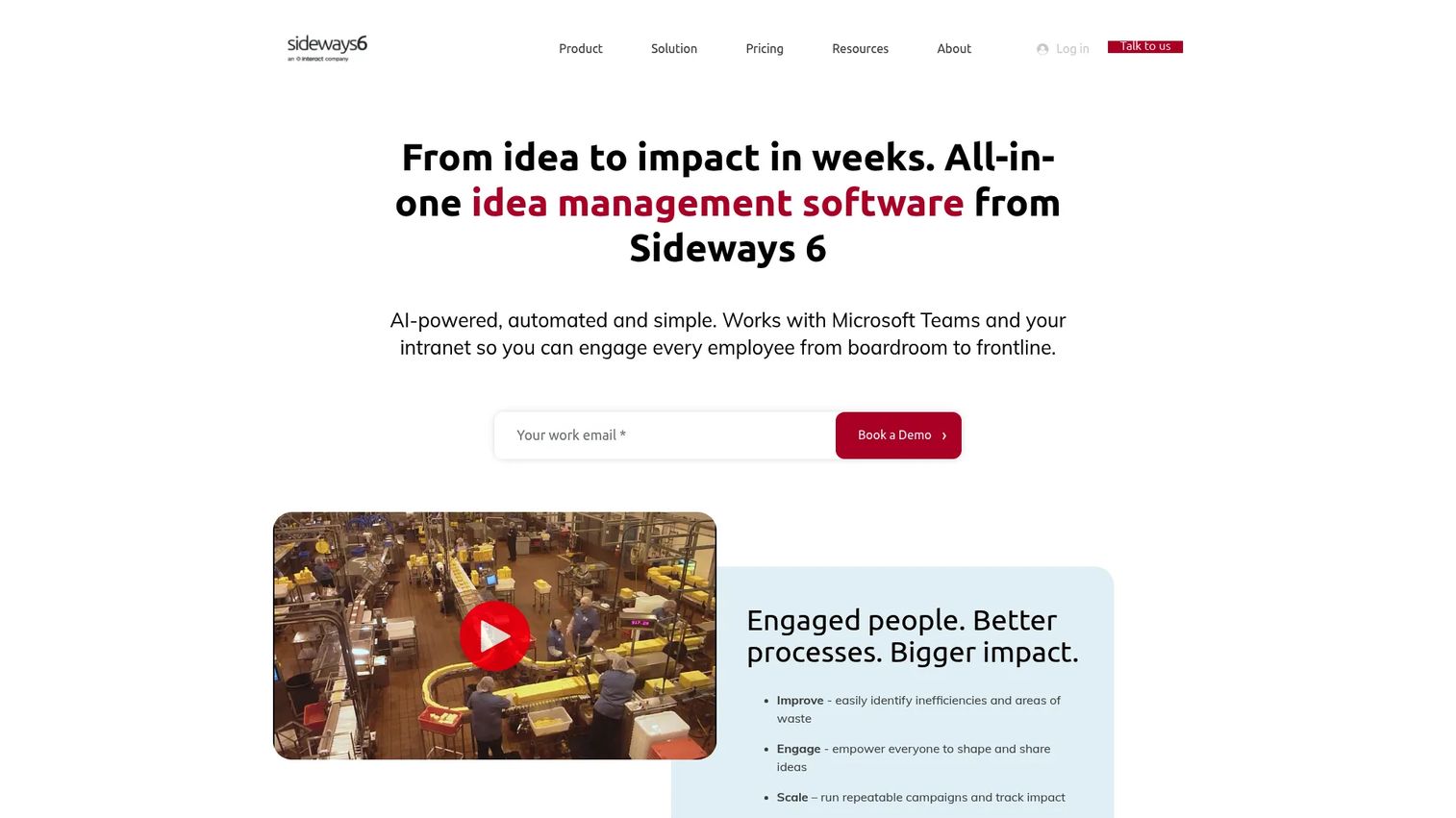
Sideways 6 brings employee idea management into Microsoft Teams and intranets. Its approach addresses participation through channels employees already use. Behind that collection layer, it provides prioritization and pipeline management.
Best for: Organizations whose main adoption challenge is getting employees to contribute through familiar workplace channels.
Key features
- Microsoft Teams and intranet integration
- AI-assisted prioritization and duplicate detection
- Employee campaigns and collaboration
- Workflow automation
- Analytics and impact tracking
Why choose Sideways 6: It fits organizations that want idea submission close to everyday work. Judge the review process as carefully as the employee-facing experience.
Run a pilot with contributors who do not normally join innovation programs. Their experience will reveal whether your campaign wording invites useful suggestions.
Next, inspect the administrator’s queue. Convenient submission can increase the amount of material reviewers must process.
Test duplicate handling with several versions of the same problem. Preserve the underlying signal while avoiding separate evaluations of near-identical requests.
Finally, agree on a feedback cadence. Participation is easier to sustain when contributors can see what happened after submission.
Sideways 6 pricing: Lite is free for up to 10 users and costs $3/user/month for 11 to 500 users. Enterprise uses custom pricing.
G2 rating
8. Medallia Ideas
Medallia Ideas supports organizational challenges where participants submit and evaluate proposals together. Moderator workflows manage progression and status. Its documentation states that the product entered maintenance mode in March 2026, with no planned feature enhancements.
Best for: Existing customers assessing continuity and the future of their current ideation program.
Key features
- Challenges and idea submission
- Voting, ratings, and collaboration
- Moderator workflows and status management
- Slack, Microsoft Teams, and Jira integrations
- Reports and embedded surveys
Why choose Medallia Ideas: Existing deployments warrant an operational review before any change. New buyers should resolve product availability and long-term support expectations before evaluating a rollout.
For current users, inventory the workflows your team depends on. Include reporting obligations and the records needed to explain past decisions.
Then ask how those requirements will be supported throughout your intended contract period. Separate current functionality from future development expectations.
If you are considering migration, examine data exports early. Preserve submission history and evaluation context rather than moving only the surviving ideas.
The relevant decision is continuity of your innovation process. Avoid expanding a deployment before understanding the product’s direction.
Medallia Ideas pricing: Contact Medallia for an Ideas-specific quote; its pricing page covers broader enterprise packaging.
G2 rating
9. Ideanote
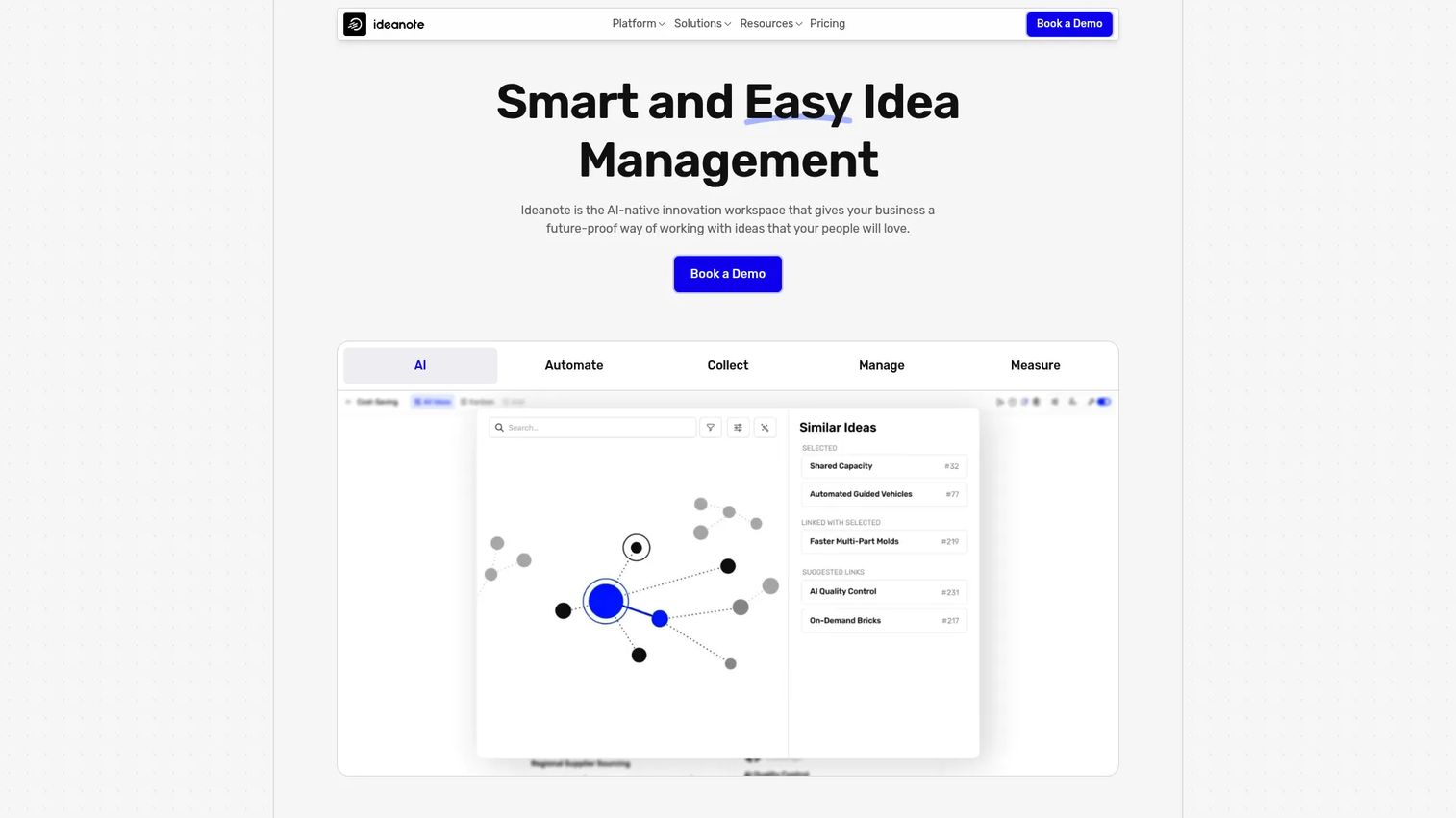
Ideanote combines configurable idea collections with workflow automation and AI-assisted evaluation. Its current offering includes conditional submission fields and pipeline management. Assess it as an innovation workspace rather than assuming it is only a basic suggestion board.
Best for: Organizations seeking automated routing and structured evaluation across a shared idea process.
Key features
- AI scoring, merging, tagging, and summarization
- No-code routing and notification workflows
- Conditional submission fields and anonymous intake
- Kanban pipelines with custom phases
- ROI tracking and shareable reports
Why choose Ideanote: It fits teams that want to reduce manual administration around incoming ideas. The commercial evaluation should reflect its current seat configuration.
Use a sample intake queue with incomplete submissions and overlapping proposals. Inspect the automation rules before judging the final board.
For AI-assisted scoring, compare the output with an experienced reviewer’s assessment. Ask how the team will handle disagreement and retain human decision ownership.
Also evaluate whether conditional fields improve evidence quality. A feature request and a process improvement should not necessarily require the same submission details.
Connect reporting to your intended outcome. Product teams should distinguish program activity from improvements in activation or retention.
Ideanote pricing: The single plan costs $899/month for 100 seats. A free start and trial workspace are offered.
G2 rating
10. edison365
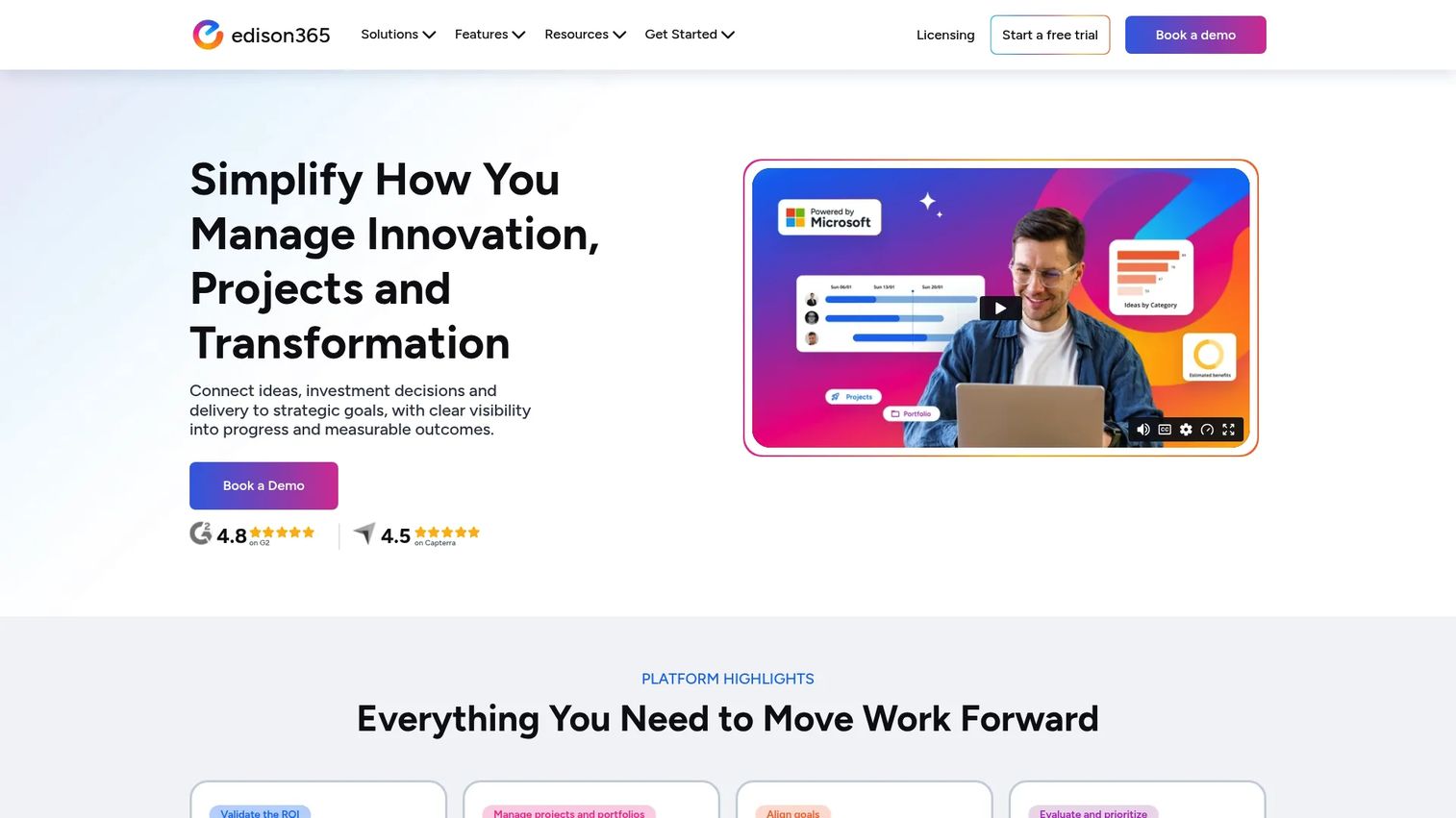
edison365 connects innovation management with business cases and project delivery. Its scope includes planning and resource management, extending beyond idea collection. That combination suits organizations evaluating innovation alongside delivery capacity.
Best for: Microsoft-centered organizations that want approved opportunities connected to business cases and portfolio execution.
Key features
- Configurable workflows and templates
- Business case and project management
- Gantt charts and resource planning
- Reports and dashboards
- Triage and gamification
Why choose edison365: Choose it when the operational gap sits between selecting an idea and resourcing its delivery. Include portfolio administrators in the evaluation.
A useful test starts with a promising proposal that lacks an implementation plan. Follow how the business case becomes sufficiently detailed for an investment decision.
Then inspect the resource assumptions. Product managers need to understand whether the initiative competes with committed roadmap work.
Ask your existing delivery team where responsibilities would move. Introducing another project record without deciding ownership can create duplicate administration.
For reporting, define which system will hold the authoritative benefit calculation. Keep that decision explicit before configuring dashboards.
edison365 pricing: Custom pricing across Base, Standard, Professional, and Premium. Standard and Professional offer trials; free read-only access is available.
G2 rating
11. Traction Platform
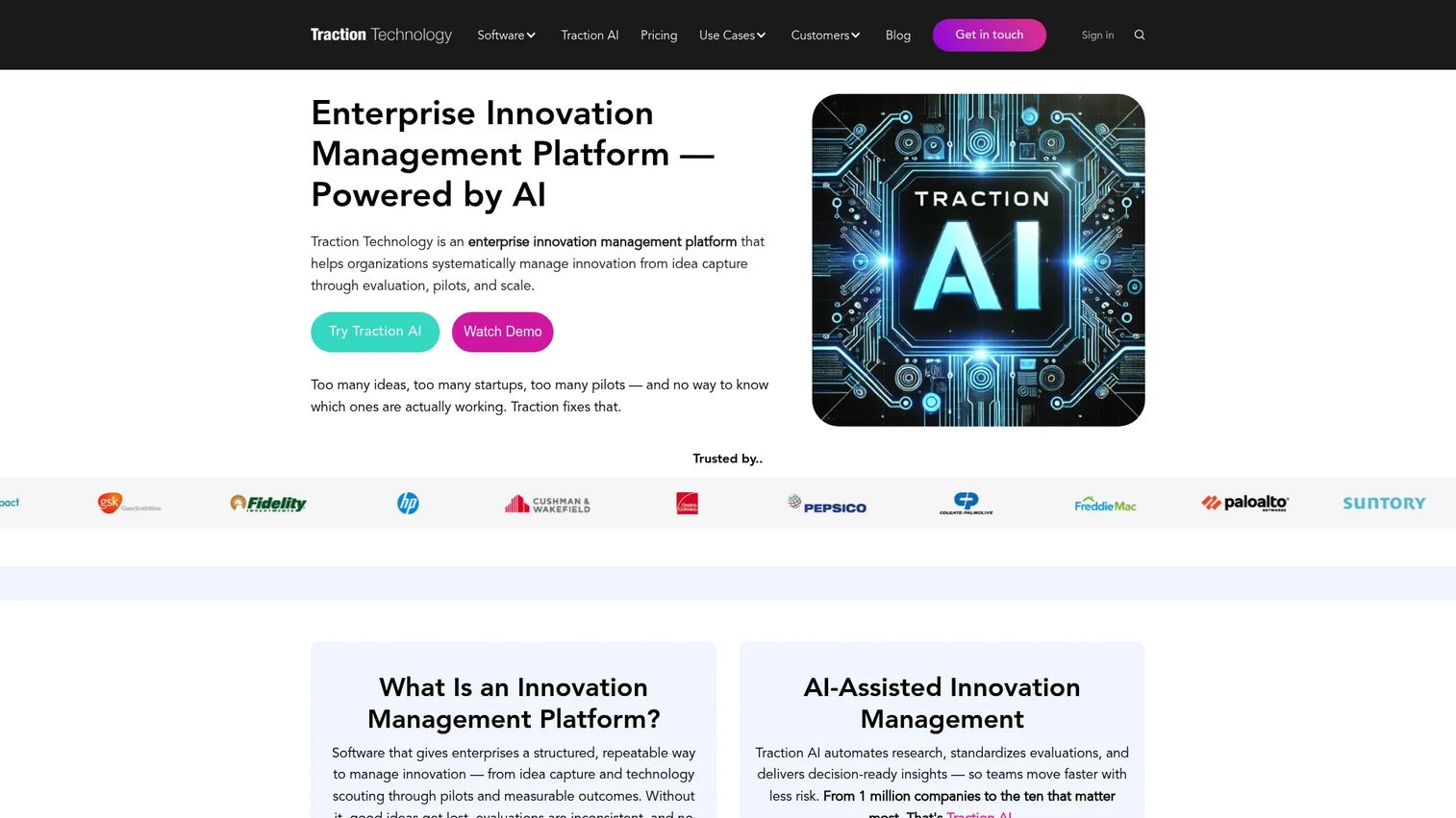
Traction Platform covers technology discovery through vendor evaluation and pilot management. It also supports internal campaigns and open innovation challenges. The external evaluation workflow makes it relevant to product teams assessing partnership or technology opportunities.
Best for: Enterprise innovation teams comparing startups and vendors before committing to pilots or partnerships.
Key features
- Technology scouting and evaluations
- Startup and vendor management
- RFI management
- Pilot tracking and ROI visibility
- AI innovation agents
Why choose Traction Platform: It suits a buying process that begins with external technology discovery. Evaluate the evidence handoff from scouting to technical assessment.
Bring a build-versus-buy question to the session. Define the product requirement before exploring a vendor shortlist.
Ask how your team would compare candidates and preserve the reasons for rejecting alternatives. Procurement and technical reviewers should understand the same evaluation record.
Pilot success criteria deserve particular attention. Record the expected operational benefit alongside the test conditions before launching a trial.
Also identify who needs editing access versus visibility. That distinction matters when comparing a per-seat license with broader workspace subscriptions.
Traction Platform pricing: Standard costs $4,000 per seat annually, including all AI capabilities and unlimited view-only users.
12. ITONICS
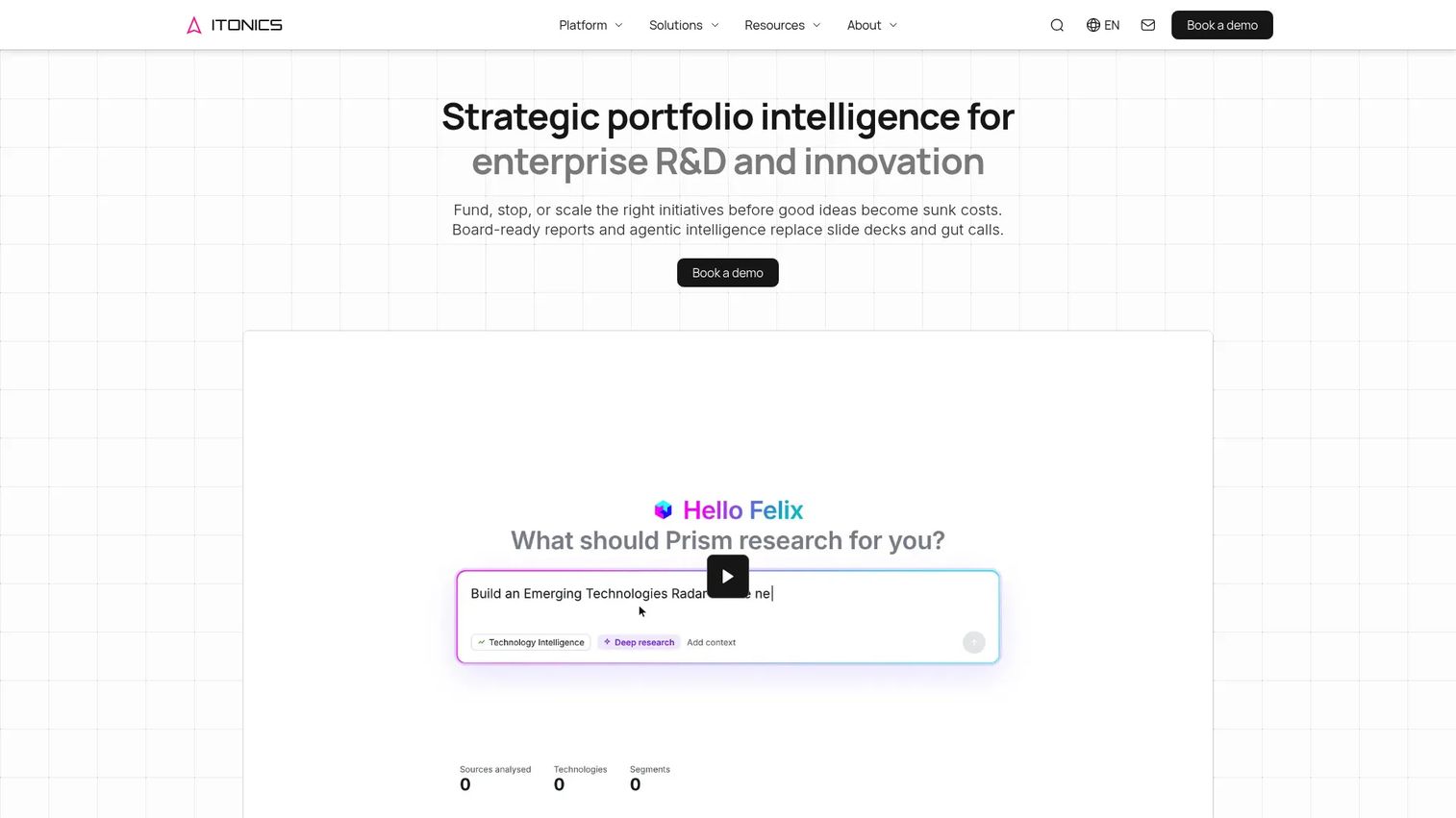
ITONICS connects foresight with idea management and innovation portfolios. Its trend and technology radars help teams organize external signals. Workflow stages and audit trails support progression from opportunity discovery toward execution.
Best for: Strategy, R&D, and product organizations using emerging trends to inform longer-range investment decisions.
Key features
- Trend and technology radars
- Idea campaigns and evaluations
- Portfolio views and roadmaps
- Stage gates, handovers, and audit trails
- AI-assisted innovation intelligence
Why choose ITONICS: It fits teams that need a traceable connection between market signals and funded initiatives. Evaluate the decision process behind the visualization.
A radar is useful when it changes what your team investigates. Bring a technology trend and ask how it becomes a specific opportunity hypothesis.
Then follow that hypothesis into evaluation. Product managers should be able to distinguish evidence of market change from assumptions about customer demand.
Test how a roadmap decision connects back to its supporting material. This matters when leadership revisits an investment after conditions change.
Assign ownership for signal review as well. Foresight content needs a refresh cadence to remain relevant to planning.
ITONICS pricing: Core, Pro, and Enterprise use custom pricing.
G2 rating
13. Qmarkets
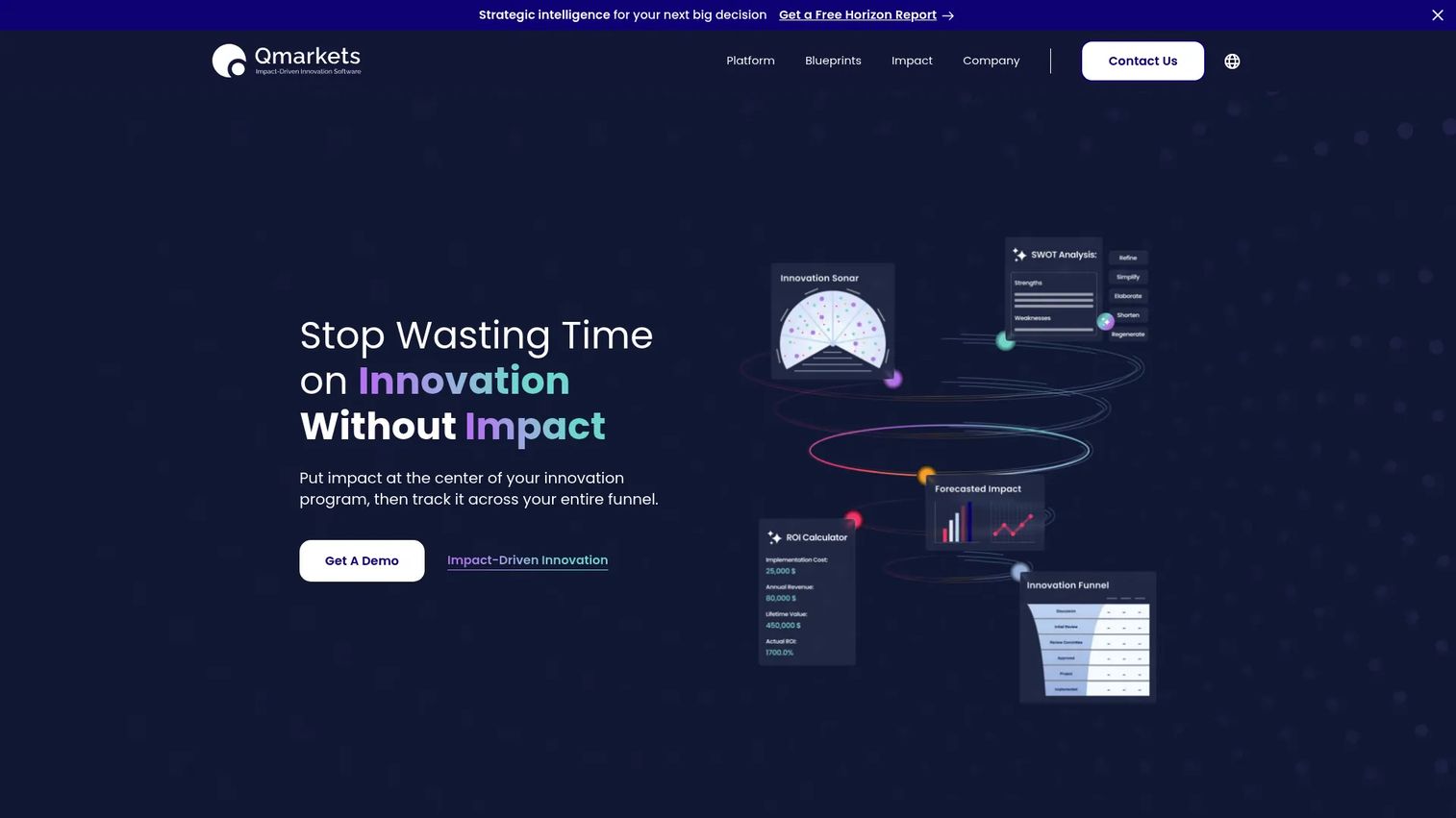
Qmarkets offers modules spanning employee ideas, continuous improvement, strategic foresight, and technology scouting. Its portfolio offering connects these activities with initiative oversight. This breadth fits organizations operating several innovation motions under shared leadership.
Best for: Large enterprises that need distinct program types with coordinated governance and impact reporting.
Key features
- Idea challenges and evaluation workflows
- Continuous improvement programs
- Horizon strategic foresight
- Q-scout technology and startup tracking
- Q-impact innovation portfolio management
Why choose Qmarkets: Choose it when multiple innovation functions need a coordinated operating model. Identify the modules required for your initial program before comparing commercial proposals.
Start with the organizational boundary. Determine whether product innovation and operational improvement share reviewers or require separate decision rights.
During evaluation, ask how leadership compares outcomes across those programs. Cost savings and new-product learning require different measures.
Its packaging also warrants attention. Core supports up to 1,000 users, while Enterprise adds capabilities across administration and collaboration.
Avoid selecting modules solely because another department may eventually use them. Establish the initial workflow and sponsor first, then evaluate expansion against a defined use case.
Qmarkets pricing: Core and Enterprise use custom pricing.
G2 rating
14. Agorize
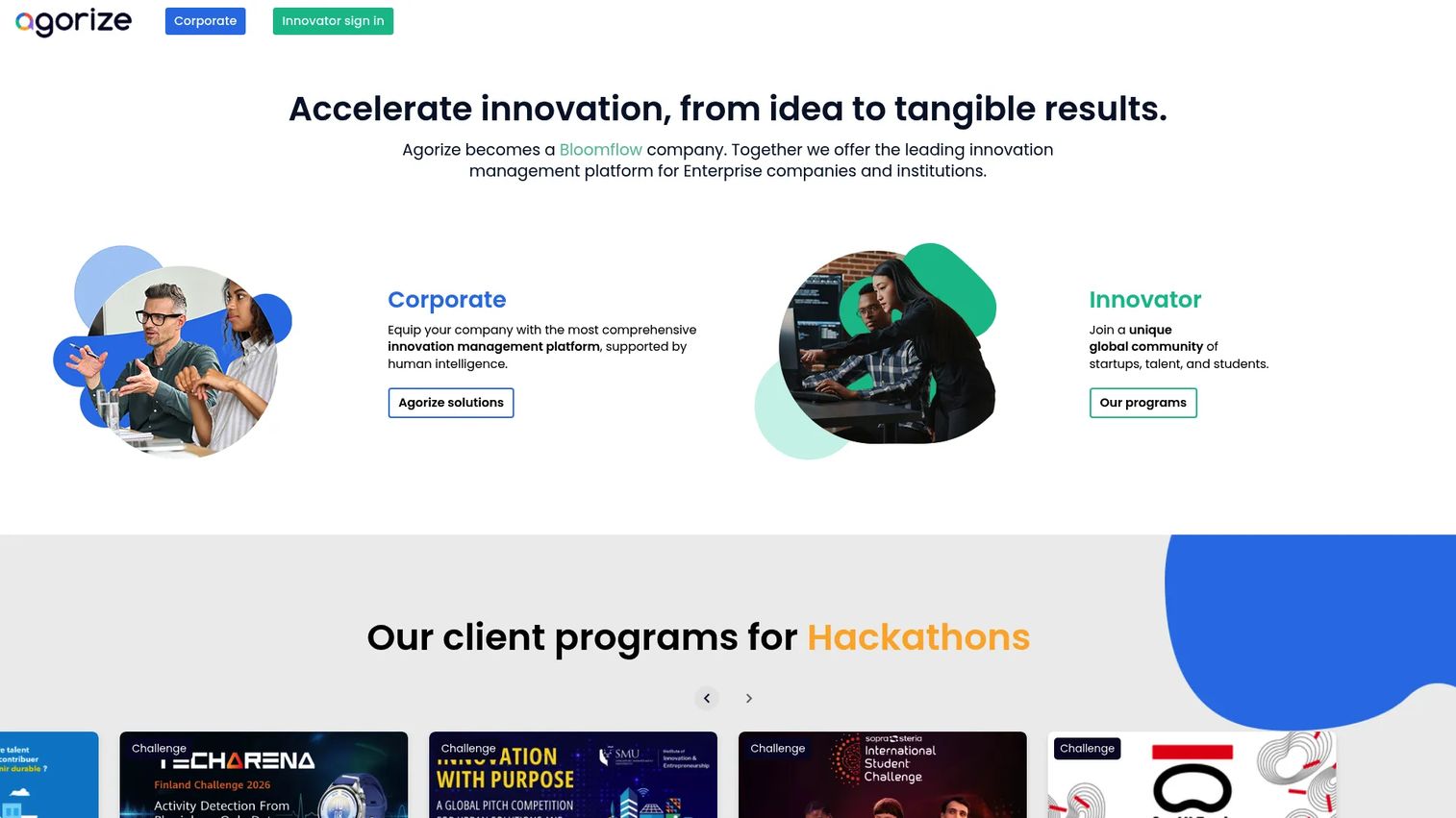
Agorize supports innovation programs that source and assess ideas, startups, or talent. Branded challenges and participant engagement are central to its offering. Evaluation workflows help organizers move submissions through selection stages.
Best for: Organizations running external challenges, startup engagement programs, or talent-focused innovation initiatives.
Key features
- Branded challenges and program platforms
- Startup, student, and talent scouting
- AI proposal screening and matching
- Criteria-based evaluation and voting
- Analytics, exports, and API integrations
Why choose Agorize: It fits teams whose immediate job is attracting and evaluating external contributions. Prioritize participant experience and judging operations during your assessment.
Write the challenge around a specific business problem. Product teams should explain the required evidence without prematurely prescribing the answer.
Then test the reviewer workflow with submissions of uneven quality. Ask how judges apply criteria consistently and record their reasoning.
The post-selection handoff matters just as much. Decide who owns technical assessment and commercial discussions before announcing a winning proposal.
Review data ownership and participant permissions with the appropriate internal teams. External programs require explicit boundaries around what contributors share.
Agorize pricing: Custom pricing. Its German pricing page offers an IDEA BOX trial for up to 20 participants and one administrator.
G2 rating
15. Viima
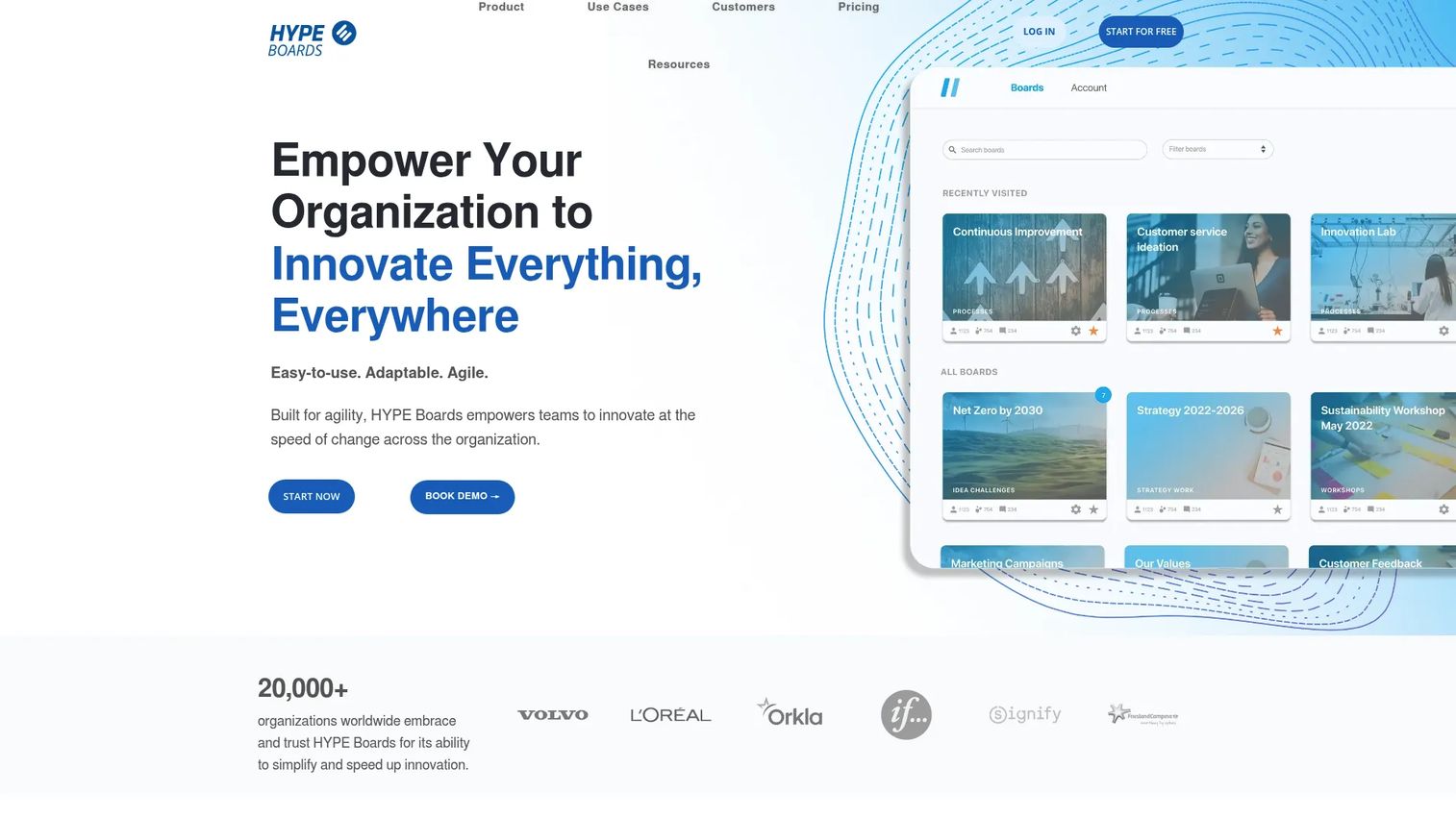
Viima is now presented as HYPE Boards. The product combines idea collection and evaluation with configurable innovation processes. Its visual views offer different ways to inspect suggestions and their progress.
Best for: Teams that want a visual idea management system with a defined starting configuration.
Key features
- Customizable processes and board templates
- Idea commenting, liking, and evaluation
- Kanban, list, and bubble views
- Workflow automation and gamification
- Microsoft Teams, Jira, and intranet integrations
Why choose Viima: It fits teams seeking visible participation and progression within a board-based process. Review current HYPE Boards packaging rather than relying on older Viima comparisons.
Use your pilot to test whether the chosen visual layout improves review discussions. A clear board should help people identify pending decisions and understand ownership.
Separate contribution access from administration requirements. Basic includes 10 users and two boards; broader participation changes the commercial evaluation.
Also agree on what each status means. A label such as “in progress” should distinguish evidence gathering from funded delivery.
The vendor’s current branding matters during procurement. Ensure the contract and implementation materials refer to the product you evaluated.
Viima pricing: Basic costs $79/month and Pro $499/month, billed annually. A limited free version and 14-day Pro trial are available.
G2 rating
16. InnovationCast
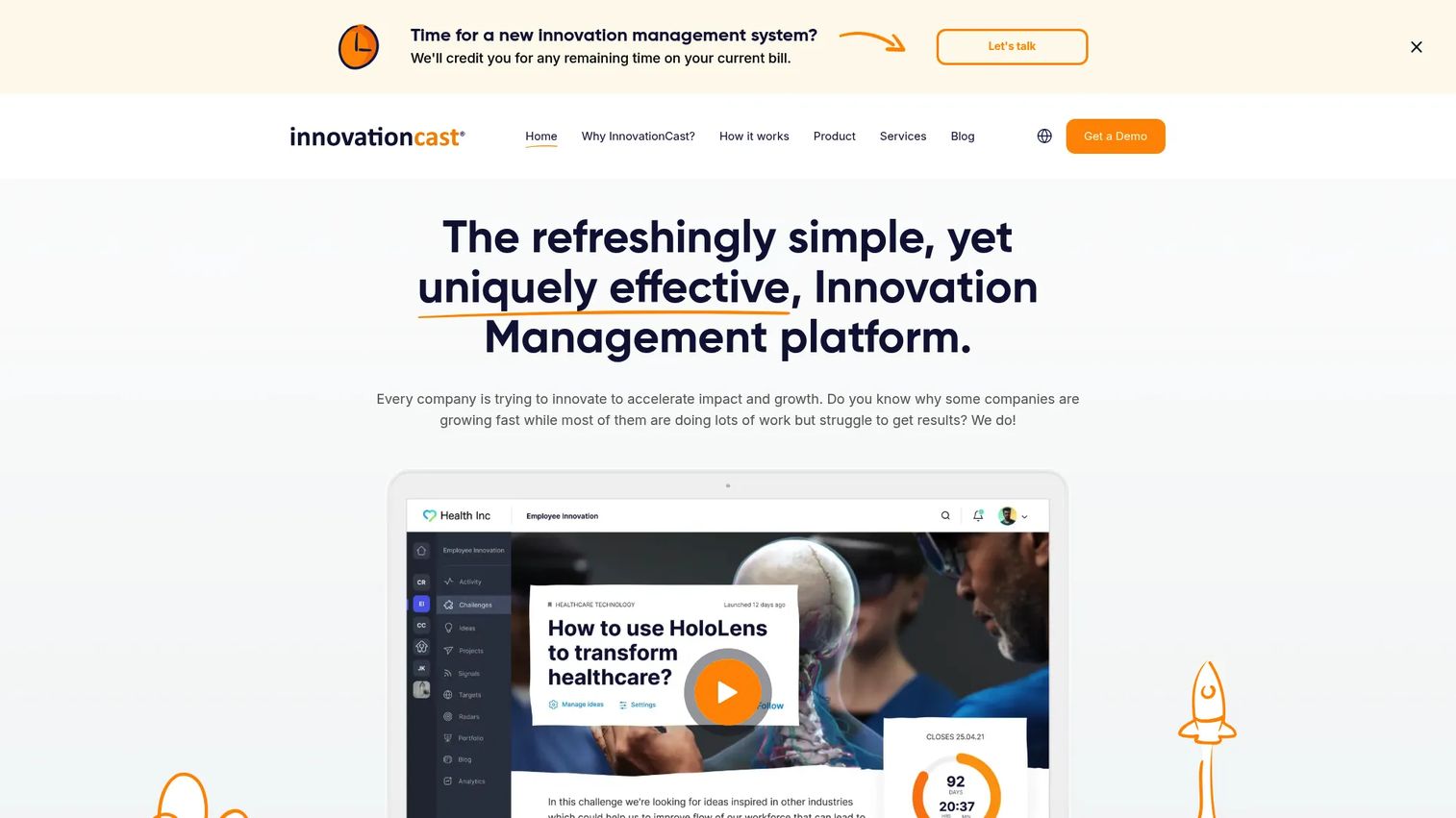
InnovationCast supports collaborative innovation through challenges and configurable evaluation workflows. Its positioning follows ideas from discovery toward incubation and acceleration. Analytics and portfolio monitoring provide visibility across the resulting pipeline.
Best for: Mid-market and enterprise organizations formalizing innovation programs across defined communities.
Key features
- Innovation challenges and crowdsourcing
- Configurable evaluation workflows
- Idea selection processes
- Innovation analytics
- Portfolio monitoring
Why choose InnovationCast: It suits teams that need structured progression across a managed participant community. Compare administrative requirements alongside the subscription price.
Its packaging distinguishes members from administrators. Standard includes unlimited members, one community, and two administrators.
That structure makes governance design important before purchase. Determine whether business units require separate communities or can share a review process.
Ask the vendor to demonstrate an idea returning for more evidence after evaluation. Product discovery is iterative, and your operating process should accommodate learning.
Also test the portfolio view with initiatives at different maturity levels. Leadership needs to distinguish early hypotheses from work with an approved investment case.
InnovationCast pricing: Standard starts at $2,999/month; Plus at $4,199/month; Enterprise at $7,199/month.
17. Planbox
Planbox is now part of HYPE Innovation, and its website redirects there. Its documented capabilities include idea evaluation and project tracking. For buyers encountering older references, the current evaluation should focus on the transition to HYPE’s offering.
Best for: Existing Planbox customers assessing continuity and their path toward HYPE Innovate.
Key features
- Idea collection
- Idea evaluation
- Project tracking
- Innovation Graph
- Similarity search
Why choose Planbox: Existing users should evaluate the transition against their current operating requirements. New buyers should establish the current product and contract path with HYPE.
Begin by documenting the workflows your organization relies on today. Identify any historical scoring records that must remain accessible.
Then compare those requirements with the proposed destination. Ask how administrators will manage the transition without interrupting active reviews.
Commercial ownership also needs clarity. Determine which vendor agreement governs the service and what implementation work accompanies a change.
Treat Planbox and HYPE as connected entries during procurement. They should not automatically count as independent vendor options on your final shortlist.
For product leaders, preserving decision history deserves as much attention as moving active submissions.
Planbox pricing: Contact HYPE for a quote covering the current offering and transition.
Considerations when choosing innovation management software
Match the tool to your operating model
Start with the work your team must perform. Employee suggestions, external challenges, technology scouting, and product investment planning require different participation mechanics.
Choose for the first funded program, not every possible future use.
Inspect the path from intake to decision
Ask vendors to process a duplicate request and a proposal with weak evidence. Review ownership assignments and approval records.
An effective idea management system should make your reasoning understandable to someone who missed the meeting.
Evaluate innovation reporting before buying
Request a report that separates participation from outcomes. Include stage conversion, funded work, realized benefits, and experiments that changed direction.
For innovation ROI tracking, define who supplies the baseline and who validates the result.
Test integrations and identity management
List the required connections explicitly, such as Jira, Microsoft Teams, or your BI platform. Ask vendors to demonstrate the exact handoff.
Review SSO and permissions separately from connector availability. A supported integration does not establish whether its data behavior fits your process.
Budget for participation and maintenance
Assign a program owner and a review cadence before rollout. Design campaigns around problems people can influence, then explain decisions to contributors.
Include administrator time and implementation work in the business case. Software will not replace the people responsible for evaluation.
Choose the platform that improves your next investment decision
The best innovation management software matches how your organization turns uncertainty into funded work.
HYPE Innovation and Brightidea belong on the shortlist for mature enterprise programs. IdeaScale and Ideawake address participation and structured idea evaluation.
Planview IdeaPlace deserves attention when portfolio connectivity drives the decision. Microsoft-centered organizations should assess edison365’s connection between business cases and delivery.
Traction Platform and ITONICS fit different external-discovery workflows. Agorize is relevant when challenge execution and participant engagement take priority.
For a visual starting point, evaluate Viima’s current HYPE Boards offering. Compare Ideanote through its present automation capabilities and packaging rather than older lightweight positioning.
Shortlist three candidates within your operating model. Give each vendor the same proposal and ask them to show the decision trail.
Include one rejected idea in that exercise. Your team needs a clear explanation of why work stopped, not only a polished path to approval.
Start by mapping your current idea flow from intake to decision. Then choose software that closes the biggest gap in that workflow.
FAQs
Innovation management software organizes opportunities from initial submission through evaluation and investment decisions to implementation and impact measurement. It gives teams a shared process for assigning ownership and documenting why work advances. Product managers can use it to preserve discovery evidence before an initiative becomes a roadmap commitment. The appropriate platform depends on whether your program begins with employee ideas, customer needs, technology research, or external challenges.
Idea management software primarily supports collecting suggestions and evaluating contributions through discussion, voting, or scoring. Innovation management usually extends into validation and implementation, with portfolio governance and business-outcome reporting. Product names overlap, so compare the workflow rather than relying on the category label. Ask a vendor to follow an approved idea into funded execution and show how the original hypothesis remains attached.
Product managers use these platforms to organize opportunities and support prioritization discussions with evidence. Innovation program owners manage campaigns, while strategy and R&D teams connect external signals with potential investments. Operations leaders may focus on continuous improvement and measurable cost reductions. Establish decision rights before rollout, especially when contributors, reviewers, budget owners, and delivery teams belong to different departments.
Prioritize structured intake and configurable evaluation, then inspect stage gates, portfolio visibility, permissions, and reporting. Choose additional capabilities according to your program, such as external participant management or technology scouting. Ask the vendor to demonstrate exceptions, including duplicate suggestions and ideas returned for further evidence. Those cases reveal whether the process supports daily administration rather than only the ideal path shown in a sales presentation.
It helps product teams distinguish raw requests from opportunities with enough evidence to justify discovery or delivery investment. A shared evaluation record supports stakeholder alignment and makes opportunity cost explicit. After launch, connect the initiative with the metric it intended to change, such as activation or retention. Keep product analytics responsible for observed behavior while using the innovation record to preserve the hypothesis and decision history.
Project tools can be sufficient when intake is modest and your team already has a clear evaluation process. A dedicated innovation platform becomes worth assessing when campaigns or cross-program governance require workflows your delivery system does not provide. Compare the additional administration required to configure your current tool against introducing another application. Keep responsibility for the authoritative idea record and approved project record explicit.
Pricing models include per-user subscriptions, workspace packages, annual enterprise agreements, and separately priced support. Compare equivalent configurations rather than treating a starting price as the full cost of your program. Ask for the required editor seats and participant access, plus implementation, integration, and support charges. Include internal administration in the business case, particularly when your program requires frequent campaign changes or several approval groups.
Enterprise teams should choose according to governance requirements and the work their program coordinates. HYPE Innovation, Brightidea, Planview IdeaPlace, and Qmarkets offer different approaches to broad organizational programs. Evaluate ITONICS for foresight-led decisions and edison365 when business cases and project delivery drive the requirement. Require each shortlisted vendor to demonstrate your approval process and reporting obligations using the same sample initiative.