Finance has one version of the budget. HR has another count of headcount. Student services tracks enrollment in a third system. Leadership gets reports two weeks after the numbers moved.
This is the operational reality inside most schools, districts, colleges, and universities today. The education ERP market now sits at $24.24 billion and is projected to reach $46.58 billion by 2030, according to Mordor Intelligence (2025). That growth reflects how many institutions are finally replacing fragmented back-office systems with something that runs from shared data.
Choosing the wrong platform is expensive in ways that compound: Staff who never adopt the system, integrations that fail, compliance gaps during audits, and a migration that takes two years when leadership expected six months. The right education ERP software determines whether finance, HR, student services, and leadership work from the same data or stay in separate spreadsheets indefinitely.
This guide maps 15 platforms across K-12 and higher education, with honest guidance on fit, pricing, and implementation reality.
What's inside
This guide covers 15 education ERP software tools reviewed for 2026, covering K-12 districts, colleges, universities, and nonprofit education institutions.
- Who it's for: CFOs, COOs, CIOs, and operations leaders at schools and higher-ed institutions, plus founders and operators building or selling into the education sector
- How tools were chosen: Competitor overlap, education category fit, functional scope, and verifiable pricing or G2 data
- Selection criteria:
- Functional coverage across finance, HR, payroll, procurement, or student administration
- Education-specific design or strong education market presence
- Verifiable G2 or Capterra ratings where available
- Clear fit routing by institution type (K-12, higher-ed, nonprofit, or small school)
TL;DR
- Best for higher-ed suites: Jenzabar One, Ellucian, and Anthology fit institutions that need student lifecycle depth alongside finance and HR
- Best for finance-led modernization: Workday, Oracle Fusion Cloud ERP, and Unit4 suit institutions replacing fragmented finance and HR systems
- Best for large global institutions: SAP S/4HANA Cloud and Microsoft Dynamics 365 fit complex ERP environments with strong IT teams
- Best for K-12 districts: Tyler Enterprise ERP fits school district finance, HR, payroll, and state reporting; Classe365 suits smaller schools wanting an all-in-one management platform
- Best for student administration modernization: Thesis and Tribal SITS:Vision fit institutions where the central pain is replacing a legacy student system
- Best for nonprofit finance: Blackbaud Financial Edge NXT fits schools where fund accounting, grants, and restricted gifts drive reporting complexity
What is education ERP software?
Education ERP software is an integrated system that helps schools, districts, colleges, and universities manage core operations, including finance, HR, payroll, procurement, student administration, billing, reporting, and compliance, from shared institutional data.
Generic corporate ERP was not designed for how education institutions actually run. Academic calendars, tuition cycles, grant-funded budgets, teacher certifications, substitute tracking, state compliance reporting, and accreditation requirements all need purpose-built logic that general finance software handles poorly or not at all.
Education ERP versus SIS, CRM, LMS, and BI
Understanding system boundaries saves significant buying regret:
| System | Main job | Typical owner | Where it overlaps with ERP |
|---|---|---|---|
| ERP | Finance, HR, payroll, procurement, compliance | CFO, COO, CIO | The core; some vendors extend into student data |
| SIS | Student records, enrollment, grades, academic lifecycle | Registrar, academic affairs | Student billing and financial aid often sits here |
| CRM | Prospect and alumni engagement, admissions marketing | Enrollment management, advancement | Shared enrollment data with ERP and SIS |
| LMS | Course delivery, assignments, grades | Academic technology, faculty | Grade and completion data may flow to SIS or ERP |
| BI or analytics platform | Dashboards, reporting, decision support | Institutional research, leadership | Pulls from ERP, SIS, and LMS to surface cross-functional insight |
Several vendors on this list blur these lines by design. Ellucian, Anthology, and Jenzabar One each span SIS and ERP functions. Classe365 combines SIS, LMS, and CRM-style admissions tools. Knowing what your institution needs to consolidate versus what it needs to integrate separately is the most important scoping decision before any vendor conversation.
Core education ERP features
A full education ERP suite typically covers:
- Finance, budgeting, grants, and fund accounting
- HR, payroll, benefits, pensions, contracts, and certifications
- Procurement, vendor management, and purchase approval workflows
- Student records, billing, scheduling, and academic administration
- Reporting, dashboards, audit trails, and compliance
- Integrations with LMS, CRM, SIS, identity management, and finance tools
- Security, role-based permissions, and data governance
- Workflow automation and approval routing
No single platform on this list covers every capability at equal depth. The match between your institution's primary pain and a platform's strongest module matters more than the feature count.
When to use education ERP software
Replace fragmented finance and HR workflows
Spreadsheets, legacy payroll, disconnected procurement, and separate HR tools stop working when the institution grows past the point where one person can manually reconcile them. The trigger is usually a board-level request for clean institutional metrics that nobody can produce quickly. ERP replaces the reconciliation work with a shared data layer.
Connect student, staff, and financial data
Enrollment changes affect staffing plans. Staffing plans affect budgets. Budgets affect what programs can run. When these data streams live in separate systems, every planning cycle requires manual joins that introduce errors and delay decisions. ERP creates the connection so finance, HR, and student services work from one version of institutional reality.
Standardize operations across campuses or districts
Multi-campus universities and school districts face a specific coordination problem: Each site may run its own procurement, payroll rules, and approval chains. ERP enforces consistent workflow across sites while giving central leadership consolidated reporting. Cloud deployment, now representing 63.85% of the education ERP market (Mordor Intelligence, 2025), makes this standardization easier to maintain without a large on-premise IT footprint at every location.
Education ERP software comparison
The table below maps all 15 tools by institution fit, key differentiator, pricing, and G2 rating. Use it as a first pass to narrow your shortlist before reading the full tool entries.
| # | Product | Best for | Key differentiator | Pricing | G2 rating |
|---|---|---|---|---|---|
| 1 | Jenzabar One | Higher-ed institutions wanting an education-native suite | Student, finance, HR, and advancement modules built for colleges | Custom pricing | 3.9/5 |
| 2 | Unit4 | Education and nonprofit finance teams | People-centered ERP with finance, HR, planning, and procurement | Custom pricing | 4.1/5 |
| 3 | Microsoft Dynamics 365 | Institutions with Microsoft-heavy IT environments | Flexible ERP and CRM stack with broad integration options | From $65/user/month | N/A |
| 4 | Workday | Large institutions modernizing finance and HR | Cloud-native finance, HCM, and adaptive planning | Custom pricing | 4.2/5 |
| 5 | Oracle Fusion Cloud ERP | Large universities with complex finance teams | Enterprise finance, procurement, project accounting, and risk controls | From $625/month | N/A |
| 6 | Ellucian | Colleges and universities needing deep student administration | Higher-ed platform spanning student, finance, HR, and analytics | Custom pricing | 3.4/5 |
| 7 | SAP S/4HANA Cloud | Large global education institutions | Enterprise-grade finance, procurement, assets, and analytics | Custom pricing | 4.4/5 |
| 8 | TechnologyOne OneEducation | Institutions prioritizing SaaS student and enterprise workflows | Education-specific SaaS for student and enterprise processes | Custom pricing | N/A |
| 9 | Anthology | Higher-ed teams combining student and administrative systems | Student lifecycle platform with finance and HCM options | Custom pricing | N/A |
| 10 | Tribal SITS:Vision | UK and international higher-ed student administration | Mature student records platform for complex academic operations | Custom pricing | 3.9/5 |
| 11 | Thesis | Higher education teams modernizing student systems | Cloud student management focused on academic administration | Custom pricing | N/A |
| 12 | Oracle NetSuite | Smaller private institutions and education businesses | Cloud ERP for finance, procurement, projects, and reporting | Custom pricing | 4.0/5 |
| 13 | Blackbaud Financial Edge NXT | Nonprofit and advancement-heavy institutions | Fund accounting and nonprofit finance depth | Custom pricing | 4.1/5 |
| 14 | Tyler Enterprise ERP | K-12 school districts and public education agencies | District finance, HR, payroll, procurement, and reporting | Custom pricing | 4.8/5 |
| 15 | Classe365 | Small to midsize schools needing ERP plus student administration | School management suite with admissions, academics, billing, and CRM | From $100/month | 4.3/5 |
Best 15 education ERP software tools for 2026
1. Jenzabar One
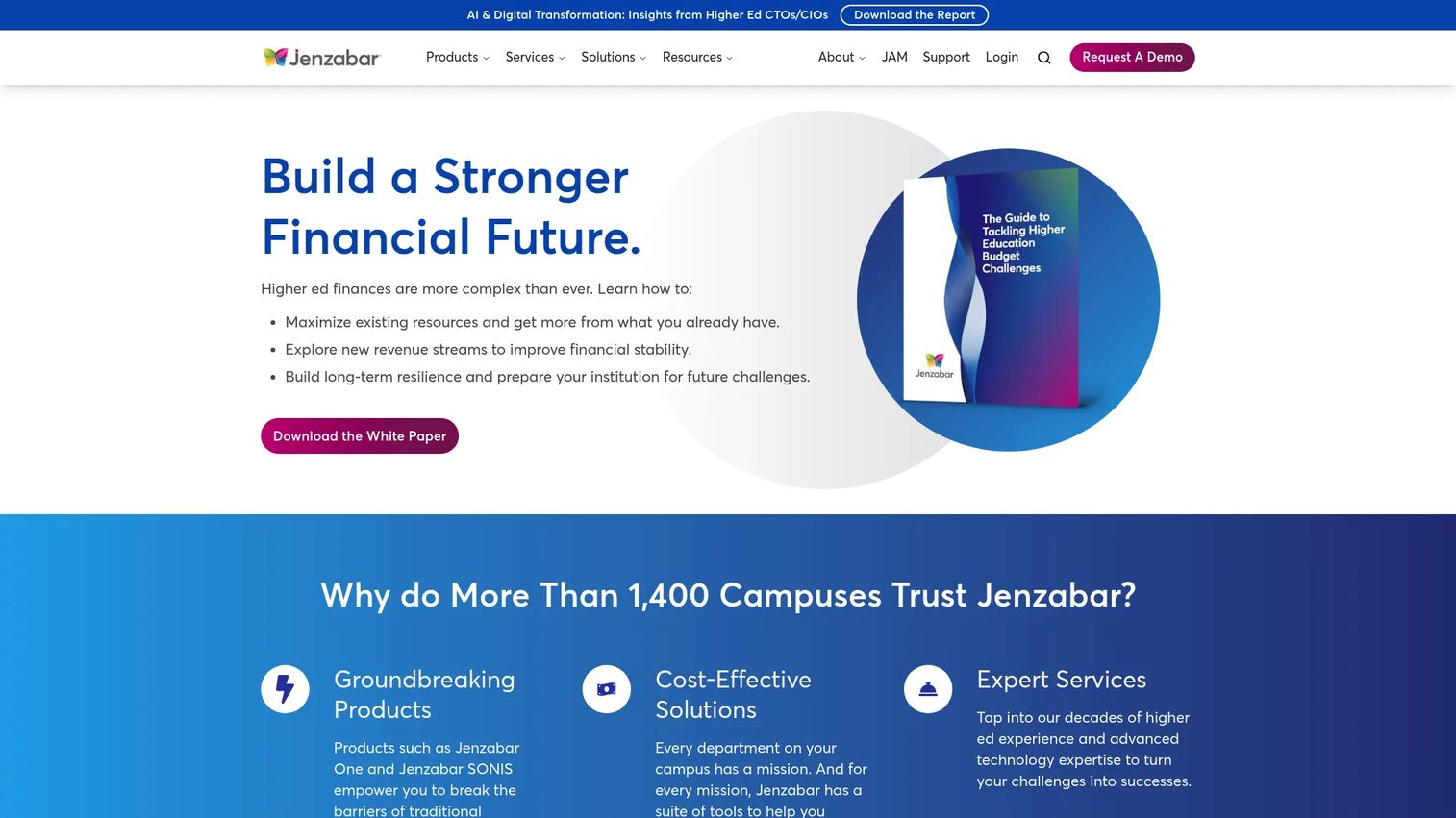
Jenzabar One is a unified cloud ERP and student information platform built exclusively for higher education. It consolidates student engagement, finance, financial aid, HR, advancement, analytics, and eLearning modules in one environment. The platform targets colleges and universities that want education-specific workflows rather than a generic enterprise ERP configured to fit academic operations.
Best for: Colleges and universities that want an integrated higher-ed ERP without assembling a broad enterprise stack.
Key features
- Student recruitment, retention, advising, and engagement tools
- Finance, financial aid, and accounting workflows
- HR and payroll modules
- Advancement and alumni engagement tools
- Analytics and reporting dashboards
Why choose Jenzabar One: This is a fit when the institution wants a vendor that speaks higher-ed natively. Jenzabar has decades in the sector, which shows in module design. If your team has struggled with generic ERP configuration, this reduces that burden.
Jenzabar One pricing: Jenzabar requires a sales conversation for pricing. Quotes vary by modules selected, institution size, and implementation scope. Plan for a multi-year contract and factor in implementation services as a separate line.
G2 rating: 3.9/5
2. Unit4
Unit4 provides cloud enterprise software for finance, HR, procurement, project accounting, and planning, with strong positioning in education, public sector, and nonprofits. Its people-centered design philosophy shapes how it handles project budgets, resource planning, payroll, and talent management. For institutions where staff planning and financial controls intersect daily, Unit4 covers both sides without requiring a separate HR system.
Best for: Education finance teams that need ERP depth across finance, people planning, grants, and procurement without losing operational context.
Key features
- Financial management and accounting
- Project budgeting, billing, and resource planning
- HR, payroll, and talent management
- Procurement and source-to-contract workflows
- AI-powered automation and virtual assistant capabilities
Why choose Unit4: Strong fit when the institution's ERP pain is at the finance and operations layer rather than student administration. It suits education organizations that look more like service businesses than traditional universities, including professional education providers and research-heavy institutions.
Unit4 pricing: Pricing is subscription-based and paid annually. The price driver is employee count or a comparable usage metric. Expect a sales-led quote process rather than a posted price list.
G2 rating: 4.1/5
3. Microsoft Dynamics 365
Microsoft Dynamics 365 is a suite of AI-powered CRM and ERP business applications covering finance, supply chain, HR, sales, service, and commerce. For education institutions already running on Microsoft 365, Azure, and Power Platform, Dynamics 365 offers a natural extension into ERP and finance operations. Education-specific configuration typically comes through Microsoft partners rather than out-of-the-box templates.
Best for: Institutions already standardized on Microsoft infrastructure and willing to invest in partner-led configuration.
Key features
- Finance and operations management
- Power BI reporting and analytics
- Power Platform low-code extensibility
- Microsoft 365 and Azure integration
- Large global partner implementation network
Why choose Microsoft Dynamics 365: The fit is strongest when IT already runs Microsoft infrastructure and leadership wants a single vendor relationship across productivity and business operations. Configuration depth requires a capable implementation partner; factor that into the total cost.
Microsoft Dynamics 365 pricing: Dynamics 365 Finance starts at $210 per user per month, billed annually. Dynamics 365 Sales Professional starts at $65 per user per month. Education deployments typically combine multiple Dynamics 365 applications, so total license cost depends on which modules the institution activates.
4. Workday
Workday is a cloud-native platform for financial management, human capital management, payroll, planning, and spend management. It is widely used by large universities and education systems replacing legacy finance and HR platforms. IDC's 2025 Industry AI and Cloud Path Survey found that 30 to 50 percent of higher-education institutions had already moved ERP and HR systems to the cloud, with another 50 percent planning to within 18 months. Workday serves a significant share of that migration activity.
Best for: Large institutions replacing legacy finance and HR systems that need a cloud-native operating layer with executive-ready analytics.
Key features
- Financial management and accounting
- Human capital management and talent management
- Adaptive planning and forecasting
- Spend management and procurement
- Embedded analytics and dashboards
Why choose Workday: The case for Workday is executive visibility and HCM depth. If the institution's board needs clean institutional metrics and the finance-HR data gap is driving blind spots, Workday removes that gap. Implementation is a serious undertaking; the payoff lands 12 to 18 months post-go-live.
Workday pricing: Workday uses subscription pricing tied to employee count and product modules. Sales-led pricing applies across all institutional deployments. Budget for implementation services in addition to the license.
G2 rating: 4.2/5
5. Oracle Fusion Cloud ERP
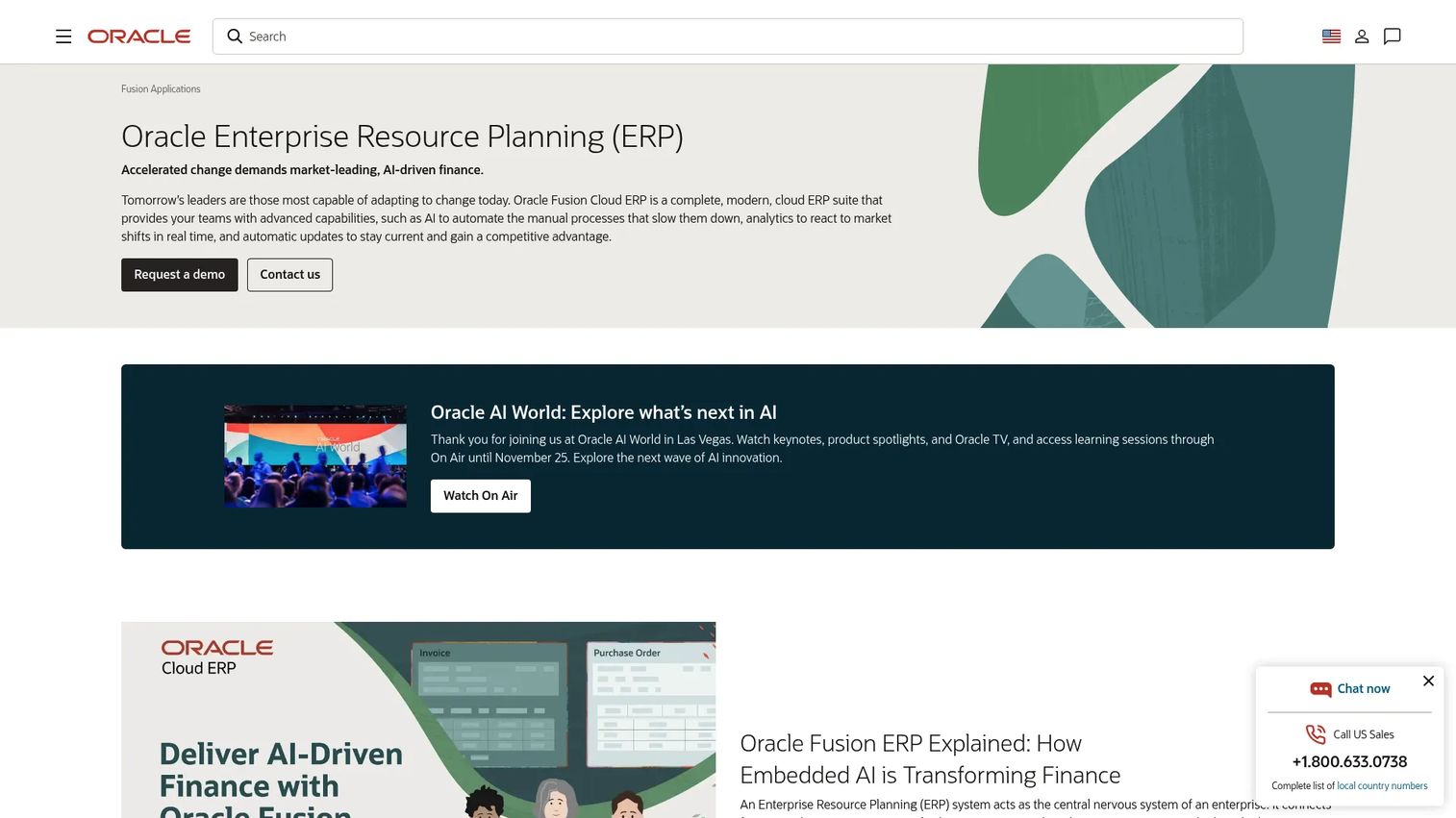
Oracle Fusion Cloud ERP is an enterprise-grade cloud ERP covering general ledger, procurement, project financial management, risk management, and enterprise performance management. It suits large universities with complex chart-of-accounts structures, grants, multi-unit budgeting, and procurement compliance requirements. Automatic updates and embedded AI reduce the maintenance overhead that plagued older Oracle on-premise deployments.
Best for: Large education institutions with complex finance governance, procurement, planning, and risk requirements across many organizational units.
Key features
- General ledger and accounting
- Procurement, contracts, and sourcing
- Project financial management and grant accounting
- Risk management and compliance controls
- Enterprise performance management and reporting
Why choose Oracle Fusion Cloud ERP: Choose this when ERP must handle a complex chart of accounts, restricted grants, procurement policy enforcement, and reporting across dozens of departments or campuses. It is not the right starting point for a 300-student institution.
Oracle Fusion Cloud ERP pricing: Oracle publishes component-based subscription pricing. The ERP service runs at $625 per hosted named user per month with a minimum of 10 users, billed on a standard three-year subscription term. Self-service users are priced separately at $20 per user per month with a minimum of 100 users.
6. Ellucian
Ellucian is one of the most established higher education technology providers, offering AI-powered SaaS products spanning student information systems (Banner and Colleague are flagship product lines), human capital management, finance, analytics, and campus operations. The platform covers student recruitment, admissions, financial aid, advising, degree audit, and student success alongside the administrative and financial layer. Ellucian's depth comes from decades of iteration inside higher-ed environments.
Best for: Colleges and universities that need end-to-end higher-ed administration coverage from a vendor with deep sector experience.
Key features
- Student lifecycle management from admissions through graduation
- Finance, budgeting, and accounting
- HR, payroll, and human capital management
- Data analytics and institutional reporting
- AI-powered workflows and low-code integrations
Why choose Ellucian: Strong fit when the institution needs a vendor that has seen its specific administrative challenges before. Ellucian's implementation ecosystem is large, which means available partners, but it also means implementation quality varies significantly by partner. Ask for references from institutions your size.
Ellucian pricing: Subscription-based pricing with AI included in the core subscription. Quotes depend on products selected, institution size, and implementation scope. Expect a multi-year contract.
G2 rating: 3.4/5
7. SAP S/4HANA Cloud
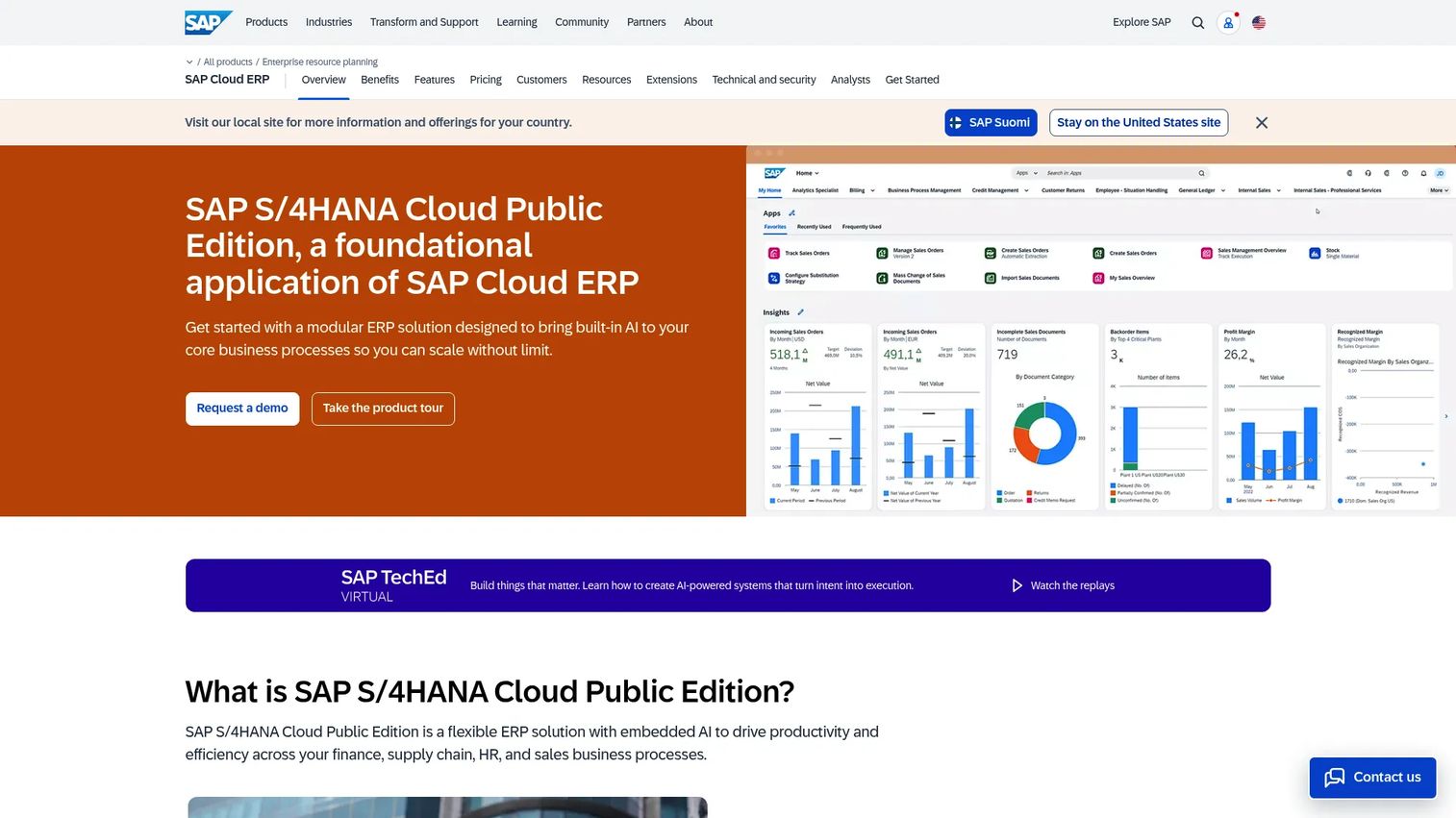
SAP S/4HANA Cloud is an enterprise resource planning platform with embedded AI, real-time analytics, and preconfigured industry best-practice processes. It covers finance, procurement, asset management, supply chain, HR, sales, and manufacturing. For large global education organizations, research universities, and institutions with operating complexity that rivals mid-market corporations, SAP delivers enterprise process discipline and integration breadth.
Best for: Large universities, global education organizations, and institutions with enterprise-scale finance and operations complexity.
Key features
- Financial management and reporting
- Procurement and sourcing
- Asset management and tracking
- Embedded AI and machine learning
- Integration via SAP Business Technology Platform
Why choose SAP S/4HANA Cloud: This is the right choice when institutional complexity requires enterprise-grade controls and your IT team has the capability to operate a SAP environment. It is not a tool for under-resourced IT teams. The configuration depth is an asset when used well and a liability when it is not.
SAP S/4HANA Cloud pricing: SAP directs buyers to request a quote.
G2 rating: 4.4/5
8. TechnologyOne OneEducation
TechnologyOne OneEducation is an integrated SaaS ERP platform designed specifically for higher education and vocational education institutions. It covers the full student lifecycle from enrollment to graduation, alongside financial management, operational processes, and administrative functions. The platform provides personalized dashboards, self-service capabilities for students and staff, and real-time data access across devices. TechnologyOne has strong market presence in Australia, New Zealand, and the UK.
Best for: Higher education and vocational education institutions wanting a purpose-built SaaS ERP that covers student management and enterprise administration together.
Key features
- End-to-end student lifecycle management
- Integrated finance and enterprise operations
- Student portals for wellbeing, financial, and academic services
- Real-time data access across devices
- Automated and streamlined administrative workflows
Why choose TechnologyOne OneEducation: When student operations and institutional administration must modernize at the same time, this avoids the integration project that comes with choosing a student system and an ERP separately. Education-native design means less configuration work than a generic ERP requires.
TechnologyOne OneEducation pricing: Pricing is sales-led and varies by institution size and modules. Contact TechnologyOne directly for a quote.
9. Anthology
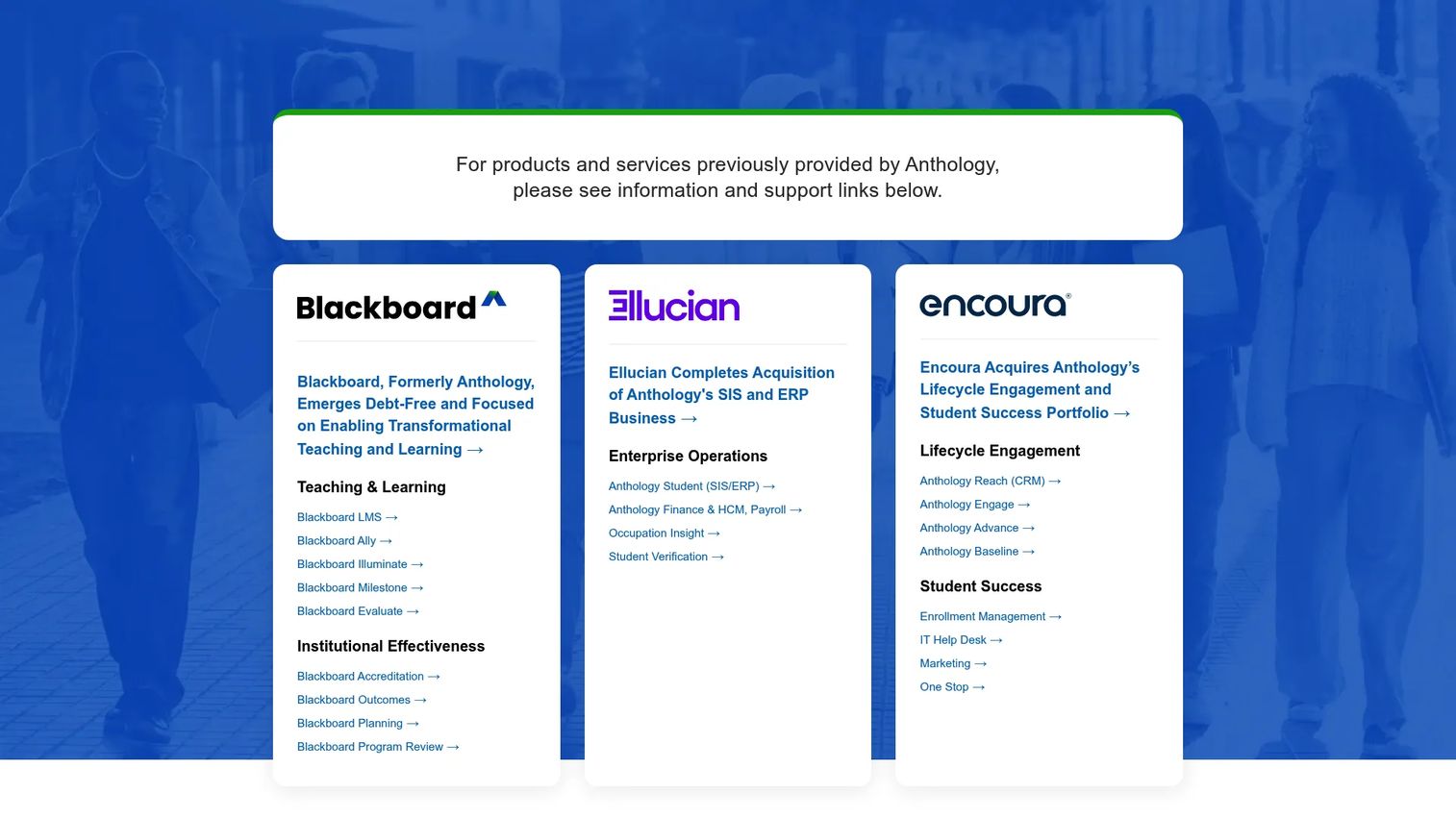
Anthology provides higher education technology spanning student information systems, finance, human capital management, payroll, learning management, CRM, enrollment management, and student success tools. Buyers should note that Anthology's portfolio has connections with Blackboard, Ellucian, and Encoura following industry consolidation. Confirm current product availability and roadmap directly with Anthology when evaluating specific modules.
Best for: Higher-ed institutions evaluating student lifecycle and administrative systems together and needing broad platform coverage.
Key features
- Student information and lifecycle tools
- Finance and accounting options
- HCM and payroll system options
- Institutional analytics and reporting
- Student engagement and success modules
Why choose Anthology: Useful when a higher-ed institution wants connected student and administrative workflows under a single vendor relationship. Confirm which specific products are actively developed and supported given recent portfolio evolution in the sector.
Anthology pricing: Custom pricing applies. Expect a sales-led quote process based on products selected and institution size.
10. Tribal SITS:Vision

Tribal SITS:Vision is a mature student information system managing the full higher-education student lifecycle, from recruitment and admissions through retention, finance, outcomes, and graduation. It is ERP-adjacent rather than a full finance and HR ERP in isolation, making it most relevant when student administration is the primary operational pain. It integrates with finance, HR, payment, statutory, and compliance systems to cover the broader institutional picture.
Best for: Universities and higher-education providers that prioritize student records, academic operations, and lifecycle processes over finance-first ERP consolidation.
Key features
- Student recruitment and admissions management
- Student self-service via the e:Vision web portal
- Student finance, bursary, and scholarship management
- Progression, assessment, and outcomes management
- Integrations with finance, HR, and compliance systems
Why choose Tribal SITS:Vision: Strong fit when the institution's core pain is student administration complexity rather than finance system fragmentation. It is a well-established platform in UK and international higher education with deep regulatory and accreditation familiarity.
Tribal SITS:Vision pricing: Tribal directs prospective customers to book a demo and receive a tailored quote.
G2 rating: 3.9/5
11. Thesis
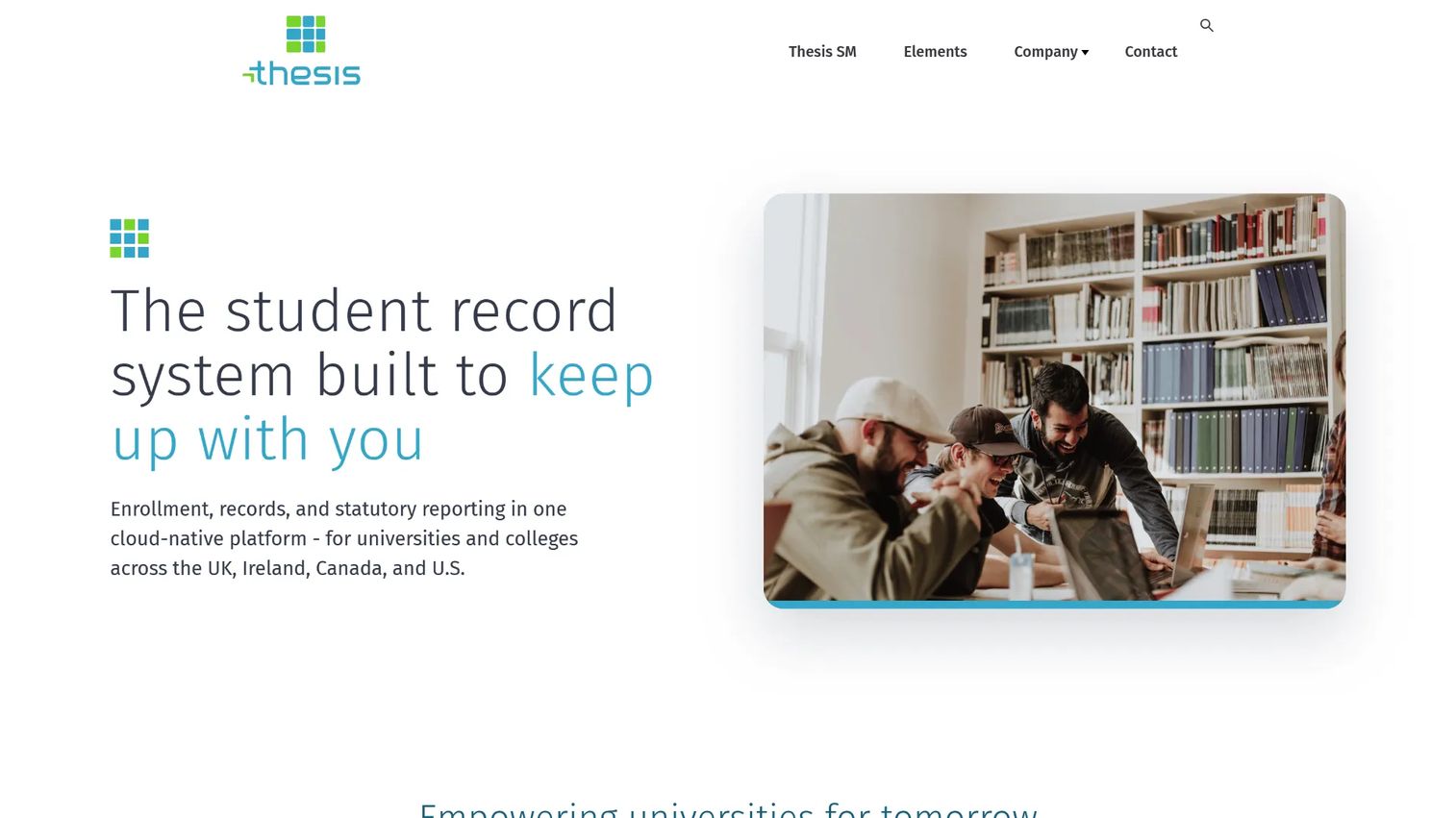
Thesis provides cloud-based student information systems for higher-education institutions. It covers admissions, student lifecycle management, billing, financial aid, curriculum management, and real-time analytics via Power BI dashboards. Thesis suits institutions replacing aging on-premise student systems where the primary goal is a modern cloud architecture rather than a full finance and HR ERP consolidation.
Best for: Small to midsize higher-education teams replacing legacy student administration systems with a cloud-native alternative.
Key features
- Admissions and student lifecycle management
- Billing and financial aid management
- Curriculum management and academic operations
- Real-time Power BI dashboards and analytics
- Cloud deployment model
Why choose Thesis: When legacy SIS replacement is the priority and the institution does not need to consolidate finance and HR at the same time, Thesis offers a focused, modern student management approach without the scope and cost of a full ERP project.
Thesis pricing: Contact Thesis directly for a quote tied to your institution's size and module requirements.
12. Oracle NetSuite
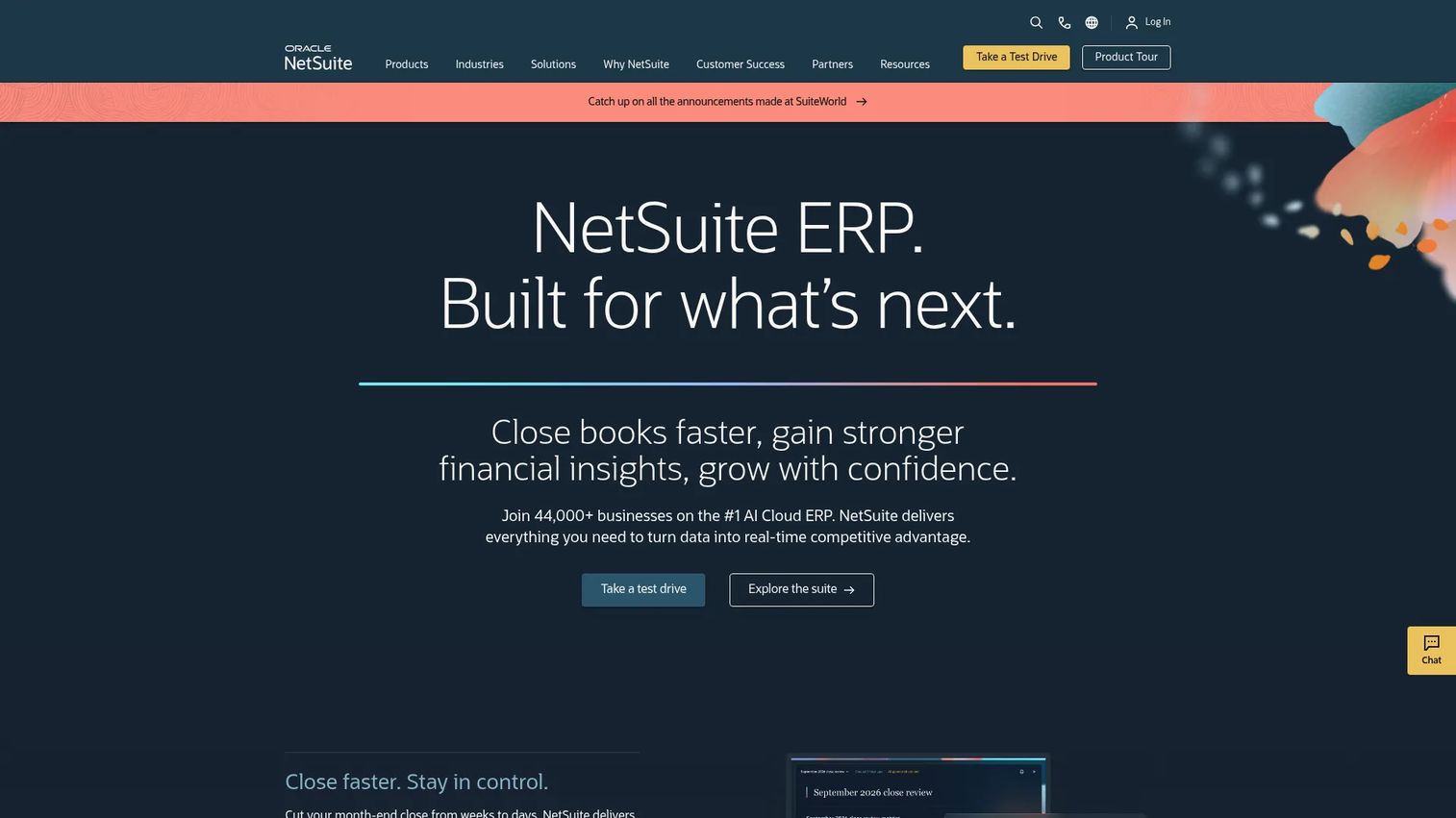
Oracle NetSuite is an AI-powered cloud ERP covering financial management, inventory, procurement, project accounting, CRM, and reporting. For education, it fits private institutions, training organizations, and education businesses that need solid finance and operations management without a large campus ERP. Student-specific administration typically requires integrations rather than native NetSuite modules.
Best for: Private education organizations, training companies, and nonprofit education operators that need cloud finance and operations management rather than a campus-wide ERP suite.
Key features
- Cloud financial management and accounting
- Procurement and vendor management
- Project accounting and billing
- SuiteAnalytics reporting and dashboards
- CRM and sales automation for education businesses
Why choose Oracle NetSuite: Fits when the institution or education business looks more like a service company than a traditional university. If finance, revenue, and project tracking are the core needs and student records are managed elsewhere, NetSuite delivers without the overhead of a full campus ERP.
Oracle NetSuite pricing: Annual licensing combines a core platform fee, optional modules, and per-user charges, plus a one-time implementation fee. Oracle directs prospects to contact NetSuite for a quote tied to their specific configuration.
G2 rating: 4.0/5
13. Blackbaud Financial Edge NXT
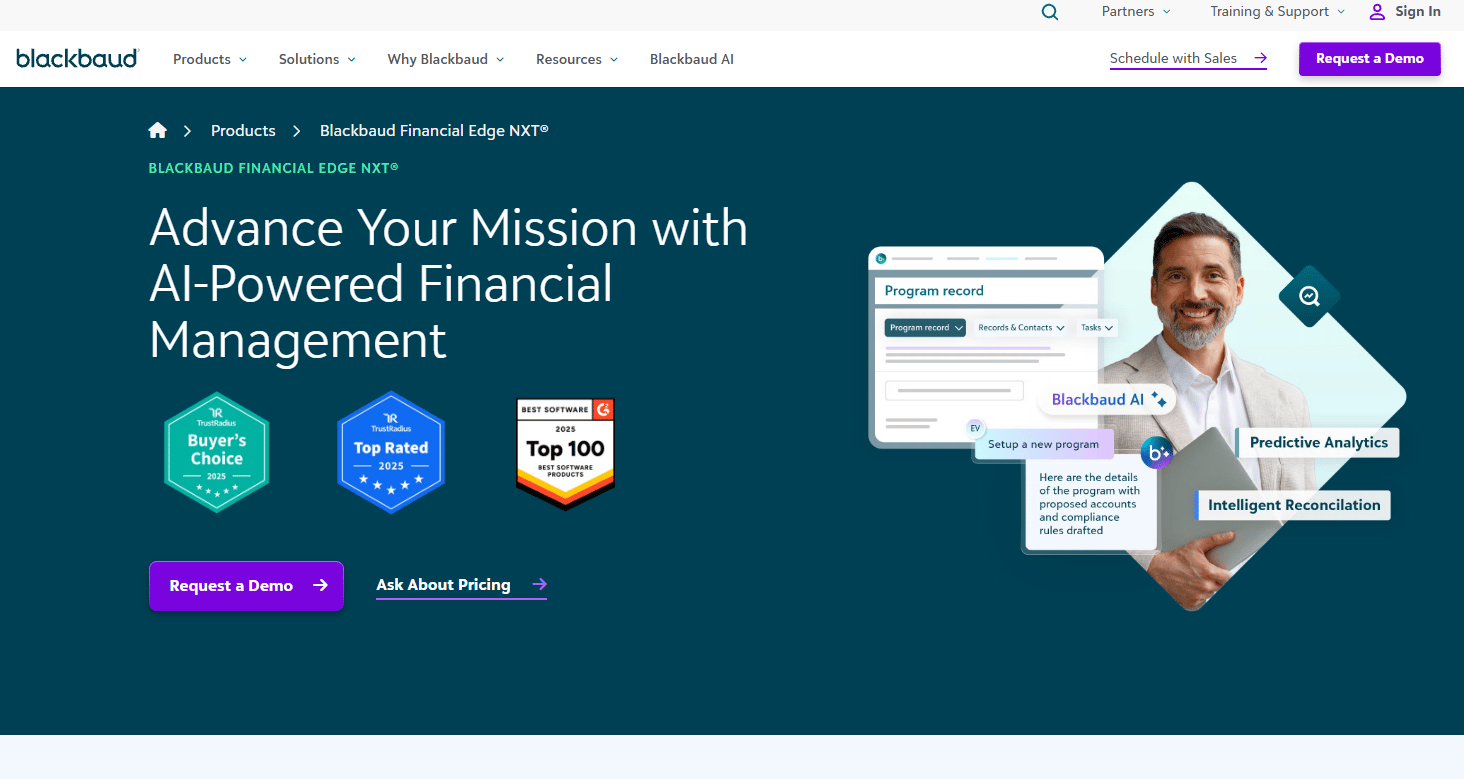
Blackbaud Financial Edge NXT is an AI-powered, cloud-based fund accounting platform designed for nonprofits and social-impact organizations, including independent schools, community colleges, and advancement-heavy universities. It covers fund accounting, grant management, budget tracking, accounts payable, invoicing, and financial reporting with AI-assisted reconciliation and document intelligence.
Best for: Nonprofit schools and institutions where fund accounting, grants, restricted gifts, and advancement finance are the central financial complexity.
Key features
- Fund accounting with restricted-fund, grant, and endowment tracking
- AI-powered reconciliation and compliance controls
- Accounts payable, invoicing, and payment workflows
- Budget tracking and financial reporting dashboards
- Integrations with Blackbaud products and external tools
Why choose Blackbaud Financial Edge NXT: This is the right tool when the institution's finance pain lives in funds, grants, and board-level restricted reporting rather than general ERP consolidation. It is not a student ERP, but it is the strongest fund accounting option on this list for mission-driven education organizations.
Blackbaud Financial Edge NXT pricing: Pricing is tailored to each organization. Blackbaud requires a personalized quote.
G2 rating: 4.1/5
14. Tyler Enterprise ERP
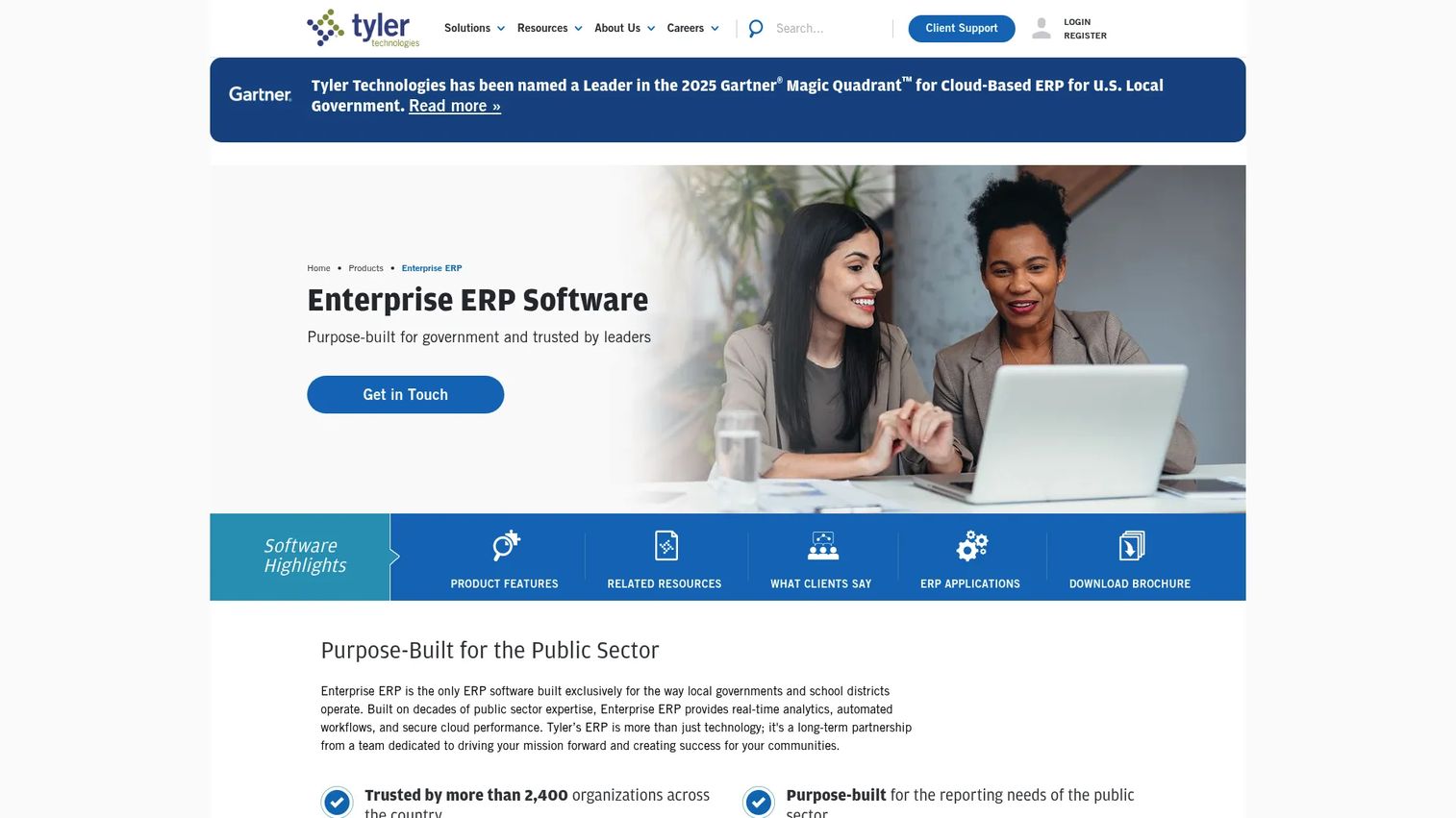
Tyler Enterprise ERP is a cloud-based ERP built exclusively for local governments and school districts. For K-12, it covers financial management, HR, payroll, procurement, revenue management, and real-time reporting dashboards. Public-sector accounting standards, fund accounting requirements, and state compliance reporting are built in rather than configured as afterthoughts.
Best for: K-12 school districts and public education agencies that need a purpose-built district finance, HR, payroll, and reporting platform.
Key features
- School and district financial management
- HR and payroll management
- Procurement and purchasing workflows
- Budget controls and monitoring
- Real-time dashboards and analytics
Why choose Tyler Enterprise ERP: The fit is narrow and strong. If you run a K-12 district with public-sector accounting requirements, state reporting obligations, and teacher-specific payroll complexity, Tyler was built for exactly this. If you run a private school or a university, look elsewhere.
Tyler Enterprise ERP pricing: Pricing requires a sales conversation and varies by district size and modules. Contact Tyler directly for a quote.
G2 rating: 4.8/5
15. Classe365
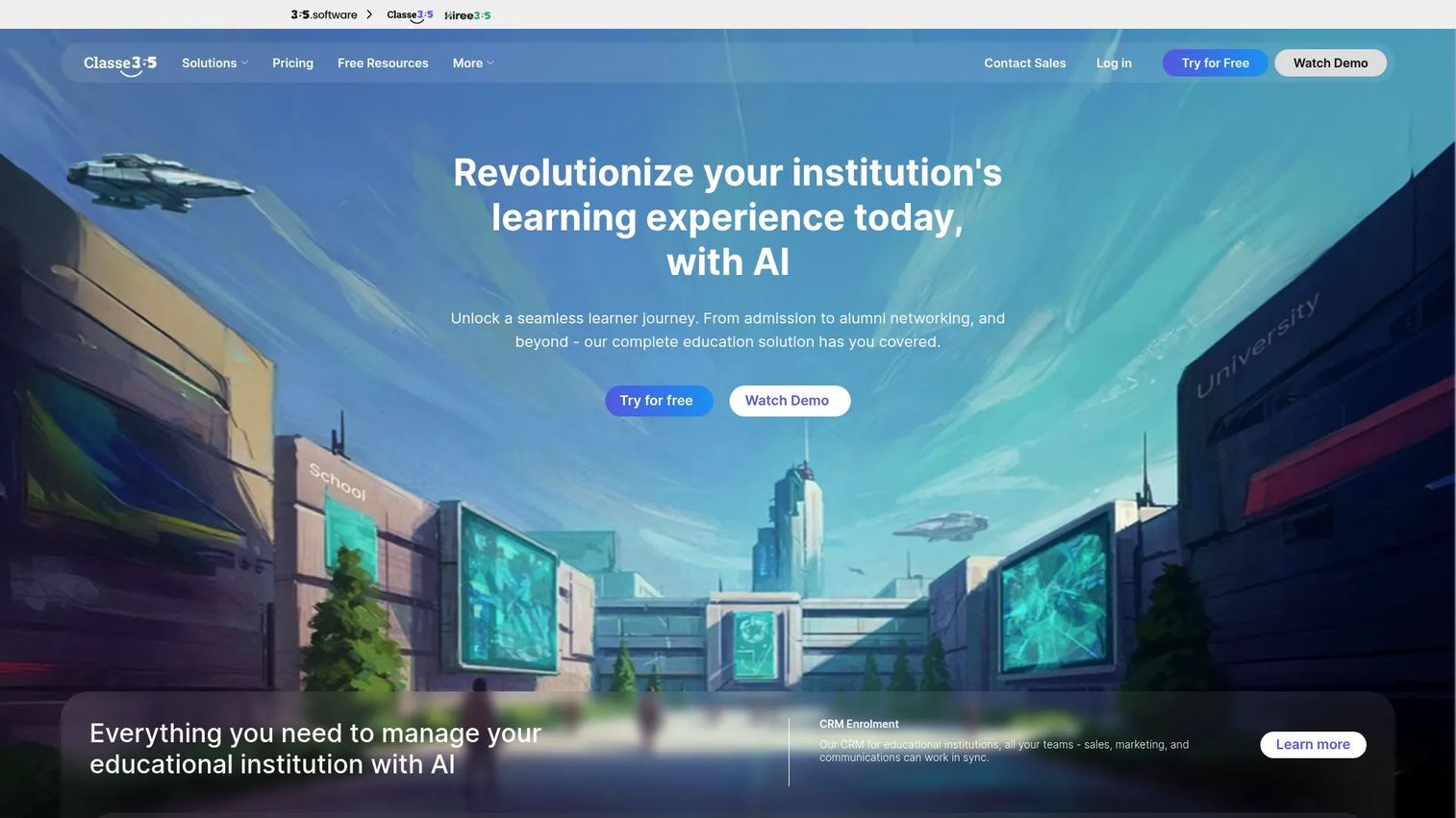
Classe365 is a school management and education operations platform combining a student information system, learning management, admissions, CRM, fees and billing, scheduling, attendance, and alumni tools. It suits small to midsize schools that need a broad operations suite without the implementation complexity of enterprise ERP. The pricing model is transparent and scales with active student count.
Best for: Small to midsize schools that want student administration, billing, admissions, and learning management in one manageable system.
Key features
- Student information system with student and parent portals
- Admissions and CRM management
- Fees, invoicing, and accounting
- Class scheduling, attendance, and grading
- Learning management with assessments and curriculum tools
Why choose Classe365: This is the most accessible entry point on the list, both in price and in implementation scope. It fits schools that need broad operational coverage but cannot justify a multi-year ERP project. The tradeoff is depth: District-level fund accounting or complex grant management will require a more specialized platform.
Classe365 pricing: The Core Module starts at $100 per month for up to 100 students, billed monthly. Pricing scales with active student count: $250 per month for 101 to 250 students, $500 per month for 251 to 500 students, $750 per month for 501 to 750 students, and $1,000 per month for 751 to 1,000 students. Add-on modules are $75 per month each. Annual billing carries a 10% discount. Enterprise Pro pricing requires a sales conversation.
G2 rating: 4.3/5
Considerations when choosing education ERP software
Institution type and operating model
K-12 districts, higher education institutions, private schools, and nonprofit education organizations face fundamentally different operational requirements. A district finance system built for public-sector fund accounting serves a completely different need than a research university's grants and multi-campus procurement platform. Map your institution type first. The operating model determines which platforms are even in scope.
Functional coverage versus integration strategy
Decide whether the institution needs a full ERP suite, a finance-first system alongside a separate SIS, or a student-first platform that integrates with an existing finance tool. Buying a platform that covers everything at medium depth sometimes costs more than combining two strong specialist tools. Ask vendors to demonstrate how their system handles your three highest-priority workflows before evaluating feature lists.
Implementation capacity
This is the buying criterion most institutions underweight. Data migration, integrations with existing systems, staff training, process redesign, and governance setup all consume time and budget well beyond the license cost. IDC found that institutions moving ERP to the cloud typically require sustained project investment across 12 to 24 months. Ask vendors for implementation timelines from institutions your size, not their fastest or most resourced case.
Security and compliance
Role-based permissions, audit trails, data residency, FERPA compliance, and identity management requirements vary by institution type and geography. Cloud ERP often reduces on-premise infrastructure risk, but data ownership terms, breach notification obligations, and integration security need explicit review. Do not treat security as an IT decision separate from the ERP selection.
Total cost of ownership
License fees are rarely the largest cost. Add implementation services, configuration, data migration, integrations, training, ongoing support, and future module expansion to the calculation. For enterprise platforms like SAP, Oracle, and Workday, services costs commonly exceed license costs in year one. For smaller platforms like Classe365, the ratio reverses. Build a three-year cost model before comparing vendors by subscription price alone.
Conclusion
The right education ERP comes down to institution fit, not feature count.
For higher-ed institutions that need student lifecycle depth alongside finance and HR, start with Jenzabar One, Ellucian, or Anthology. For finance-led modernization at scale, Workday, Oracle Fusion Cloud ERP, Unit4, and SAP S/4HANA Cloud are the main contenders. K-12 districts with public-sector accounting requirements have a clear match in Tyler Enterprise ERP. Smaller schools wanting broad operational coverage without a heavy ERP project should evaluate Classe365. Institutions where the primary pain is student administration modernization fit Thesis or Tribal SITS:Vision. When fund accounting and grants drive reporting complexity at a nonprofit school or college, Blackbaud Financial Edge NXT is the strongest option on this list.
Before you schedule vendor demos, map your three primary operational pain points, your current systems and data owners, your compliance requirements, and your realistic implementation capacity. Then build a shortlist of three to five platforms matched to your institution type, not to what ranked highest on a generic feature comparison.
Ask every shortlisted vendor for implementation references from institutions that match your size and type. That conversation will tell you more than any demo.
Start your journey with Guideflow today!
FAQs
Education ERP software is an integrated platform that helps schools, districts, colleges, and universities manage finance, HR, payroll, procurement, student administration, billing, reporting, and compliance from a shared institutional data layer. It replaces fragmented back-office systems with one operational source of truth that finance, academic affairs, and leadership can all access.
Generic ERP systems were built for manufacturing, distribution, or professional services businesses. Education institutions operate on academic calendars, manage tuition and financial aid, comply with state and accreditation reporting requirements, run grant-funded budgets, handle teacher certifications and contracts, and track substitutes and stipends. These workflows require purpose-built logic that generic ERP handles poorly or only after heavy configuration. Education ERP vendors either build these requirements in from the start or have deep education-specific configuration frameworks.
An ERP covers institutional operations broadly, including finance, HR, payroll, procurement, and compliance. A student information system manages the academic lifecycle: Student records, enrollment, grades, scheduling, and academic administration. Some vendors, including Ellucian, Anthology, and Jenzabar One, combine both in one platform. Others separate them and require integration between the two. When evaluating, clarify whether the vendor's strength is ERP, SIS, or a genuine combination of both.
Prioritize finance and fund accounting, HR and payroll that handles education-specific staffing patterns, procurement with appropriate approval workflows, compliance and reporting for your regulatory obligations, and integrations with your existing LMS, SIS, and CRM. Weight implementation support as heavily as feature depth. A platform with 90% of the features you need and an experienced implementation partner often outperforms a full-featured system with no education-specific implementation expertise.
Cloud ERP reduces on-premise infrastructure burden, makes updates automatic, and supports access from multiple locations. Cloud deployments accounted for 63.85% of education ERP market share in 2024, according to Mordor Intelligence. The case for cloud is strong for most institutions. The evaluation still requires examining data residency terms, security controls, integration options, and what happens during downtime. Some institutions, particularly those with specific regulatory or data sovereignty requirements, may face constraints that influence deployment choice.
Pricing varies by institution size, modules activated, number of users, implementation scope, integrations, and support tier. Most enterprise education ERP vendors do not post prices publicly and require a sales quote. Classe365 is the exception on this list, with a published starting price of $100 per month for up to 100 students. For enterprise platforms, total first-year cost including implementation commonly runs from hundreds of thousands to several million dollars for large institutions. Build a three-year total cost model, not a license comparison.
Implementation timelines range from a few months for a focused student management platform at a small school to multi-year programs for a large university replacing finance, HR, and student systems simultaneously. Scope, data migration complexity, integrations required, and change management capacity are the main drivers of timeline. Smaller school systems deploying a platform like Classe365 may go live in weeks. A research university deploying Workday or Oracle Fusion Cloud ERP across multiple campuses typically plans for 18 to 36 months.
K-12 buyers should prioritize district finance with public-sector fund accounting, HR and payroll that handles teacher contracts, certifications, substitutes, and stipends, procurement with district-level approval chains, and state compliance reporting. Tyler Enterprise ERP was designed for exactly this environment and covers those requirements natively. For smaller private K-12 schools that do not need public-sector fund accounting, Classe365 offers a more accessible starting point with student administration, fees, admissions, and learning management included. The right answer depends on whether the institution is a public district or a private school, as these have different operational and regulatory requirements.