for nonprofits in 2026](https://cdn.guideflow.com/cdn-cgi/image/width=2144,quality=80,format=auto,onerror=redirect/uploads/screenshot_c18aa0e1_png_450a31acf3.png)
A donor gives twice, changes their email, and joins a campaign. Yet the team still can’t answer a basic question: Which outreach drove the gift?
This happens when donation records sit across spreadsheets, payment processors, email platforms, and staff inboxes. Receipts take longer. Recurring gifts become harder to monitor. Board reports require another round of manual cleanup.
The stakes are growing. Online giving increased about 11% year over year in 2025, according to the Blackbaud Institute. Meanwhile, Omatic reported in 2025 that 90% of surveyed nonprofits use at least three systems beyond their primary CRM.
Donation management software can consolidate that operational data. The right choice depends on donation volume, team capacity, reporting requirements, and the CRM depth your staff can maintain.
What’s inside
This guide compares 17 donor software options for nonprofits. Each product was assessed against practical fundraising workflows, including:
- Donor records and gift tracking
- Recurring giving and receipt creation
- Campaign attribution and fundraising reports
- CRM depth and broader nonprofit fit
- Pricing, migration risk, and operational overhead
The shortlist covers lightweight tools for small organizations, digital fundraising platforms, and deeper donor management systems. Use it to narrow your options before running the same workflow in each trial.
TL;DR
- Best overall for donation management: Funraise connects donor records, online giving, events, communications, and reporting
- Best free or low friction start: Givebutter combines fundraising pages with donor management and supporter engagement
- Best for donor retention: Bloomerang emphasizes relationship history, engagement, and retention insights
- Best for donation forms and recurring giving: Donorbox suits broad online fundraising, while Fundraise UP focuses on checkout performance
- Best for established nonprofit CRMs: DonorPerfect, Neon ONE, Virtuous, and Bonterra provide greater operational depth
- Best for major gifts: Kindsight combines donor intelligence with advancement and prospect research tools
What is donation management software?
Donation management software is a system nonprofits use to collect, record, receipt, track, and report donations while connecting each gift to a donor record.
The category overlaps with several adjacent systems. Understanding those boundaries helps you avoid buying more software than your team can maintain.
Donation management software focuses on gift collection and administration. Common functions include donation forms, payment processing, recurring giving, acknowledgments, and campaign tracking.
Donor management software adds relationship context. It records donor profiles, communication history, notes, giving patterns, household relationships, and retention signals.
Nonprofit CRM software covers a broader constituent database. Depending on the product, it may include fundraising activity, volunteers, memberships, events, grants, and organization wide reporting.
Donor engagement software supports stewardship and outreach. It often includes segmentation, personalized communication, automated journeys, and retention workflows.
Most modern platforms combine several of these categories. A tool marketed as CRM donor management software may also process gifts. An online donation platform may include lightweight donor records without replacing a full fundraising database.
Key capabilities include:
- Donor profiles and giving history
- Donation forms and payment processing
- Recurring gift management
- Receipts and acknowledgments
- Campaign attribution
- Donor lists and segmentation
- Reporting dashboards
- CRM and accounting connections
- Data imports and duplicate management
- Permissions and audit trails
Start with the workflow your team needs to improve. A polished form won’t fix incomplete donor history. Likewise, a powerful donor database CRM won’t earn its cost if nobody maintains the records.
The strongest donor management systems connect gift capture with financial administration and relationship history. That link reduces reporting lag and gives leadership cleaner data for fundraising decisions.
When to use donation management software
Track donors and gifts in one place
Move beyond spreadsheets when duplicate records start appearing across payment exports, email lists, and campaign files. Donor tracking software should connect each online or offline gift to the correct supporter.
This becomes especially important when several staff members update the nonprofit donor database. Shared records reduce dependency on one person’s spreadsheet logic.
Automate receipts and recurring giving
Manual receipts create delays and increase administrative work. Recurring donation software can record repeat gifts, issue acknowledgments, and maintain an ongoing history for each supporter.
Test how the system handles payment changes and failed transactions. Also check whether donors can update their own details.
Report fundraising performance without spreadsheet cleanup
Donation tracking software should help leadership review campaign performance, donor retention, and monthly fundraising without rebuilding the numbers.
The right platform should also support finance reconciliation. If board reporting still requires several exports and manual joins, the system hasn’t fixed the core problem.
Donation management software comparison
Use this table as a first pass. Your final choice should reflect how the organization handles online gifts, offline payments, receipts, recurring donors, and campaign reporting.
Pricing comes from each vendor’s pricing information. G2 ratings use the current figures supplied in the research for this guide. “N/A” means a suitable rating was unavailable rather than estimated.
| # | Product | Best for | Key differentiator | Pricing | G2 rating |
|---|---|---|---|---|---|
| 1 | Funraise | Connected fundraising operations | CRM, campaigns, events, and communications | Free plan, premium plans by quote | 4.4/5 |
| 2 | Givebutter | Quick campaign setup | Free core fundraising and engagement tools | Free, Plus from $29/month | 4.7/5 |
| 3 | Bloomerang | Donor retention | Engagement and relationship insights | CRM from $125/month annually | N/A |
| 4 | Donorbox | Online giving and recurring donations | Forms, memberships, crowdfunding, and kiosks | Free, Pro $150/month | 4.6/5 |
| 5 | Classy | Digital fundraising campaigns | Peer fundraising, events, and campaign pages | Essentials has no subscription fee, custom plans available | 4.4/5 |
| 6 | DonorPerfect | Fundraising administration | Mature CRM, receipts, reports, and automation | From $119/month | 4.4/5 |
| 7 | Neon ONE | Broader nonprofit operations | Donors, memberships, events, and volunteers | From $99/month | 4.2/5 |
| 8 | Virtuous | Automated donor engagement | Responsive fundraising and journey automation | Custom pricing | 4.3/5 |
| 9 | Bonterra | Larger social impact organizations | Broad fundraising and program software portfolio | Custom pricing | 4.5/5 |
| 10 | Fundraise UP | Donation checkout conversion | Personalized asks and donor self service | $0 upfront, transaction pricing | 4.8/5 |
| 11 | Paymattic | WordPress donation forms | Payment and donation plugin for WordPress | Free, Pro from $95/year | N/A |
| 12 | Springly | Small nonprofit administration | Fundraising, accounting, memberships, and events | Contact Springly for a quote | 4.2/5 |
| 13 | DonorKite | Moving beyond spreadsheets | Straightforward gifts, receipts, and reporting | $29/month or $299/year | N/A |
| 14 | CharityEngine | Connected fundraising operations | CRM, marketing, advocacy, and payments | Custom pricing | 4.3/5 |
| 15 | iDonate | Digital giving experiences | Web giving, text giving, events, and testing | Custom pricing | 4.4/5 |
| 16 | OneCause | Events and auctions | Event fundraising with online campaigns | From $200 | N/A |
| 17 | Kindsight | Major gifts and advancement | Donor intelligence and prospect research | Engage from $545/year | 4.6/5 |
Best 17 tools for donation management software
1. Funraise
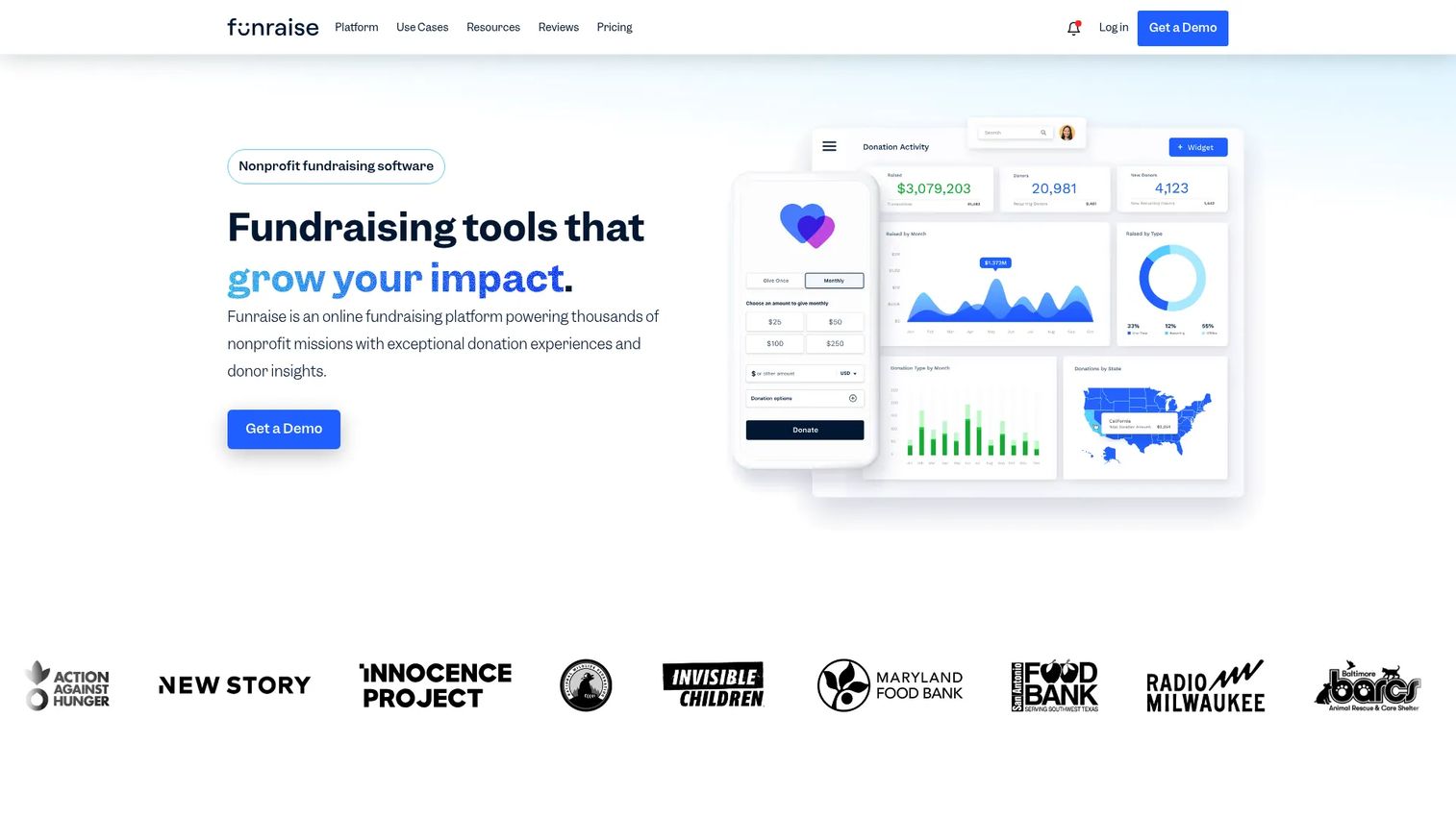
Funraise combines online fundraising with donor management, events, communications, and reporting. Its connected workflow helps growing organizations reduce tool sprawl between donation capture and fundraising administration.
Best for: Growing nonprofits that want campaigns and CRM style donor records in one system.
Key features
- Donation forms and pages
- Recurring giving
- Donor management
- Events and ticketing
- Fundraising dashboards
Why choose Funraise: Choose it when campaign activity, donor history, and reporting need to share the same data. Its broader feature set suits teams replacing several disconnected fundraising tools.
Funraise pricing: The Free plan costs $0 monthly and carries a 5% platform fee. Premium plans use custom pricing and charge platform fees from 0% to 3%.
G2 rating: 4.4/5
2. Givebutter
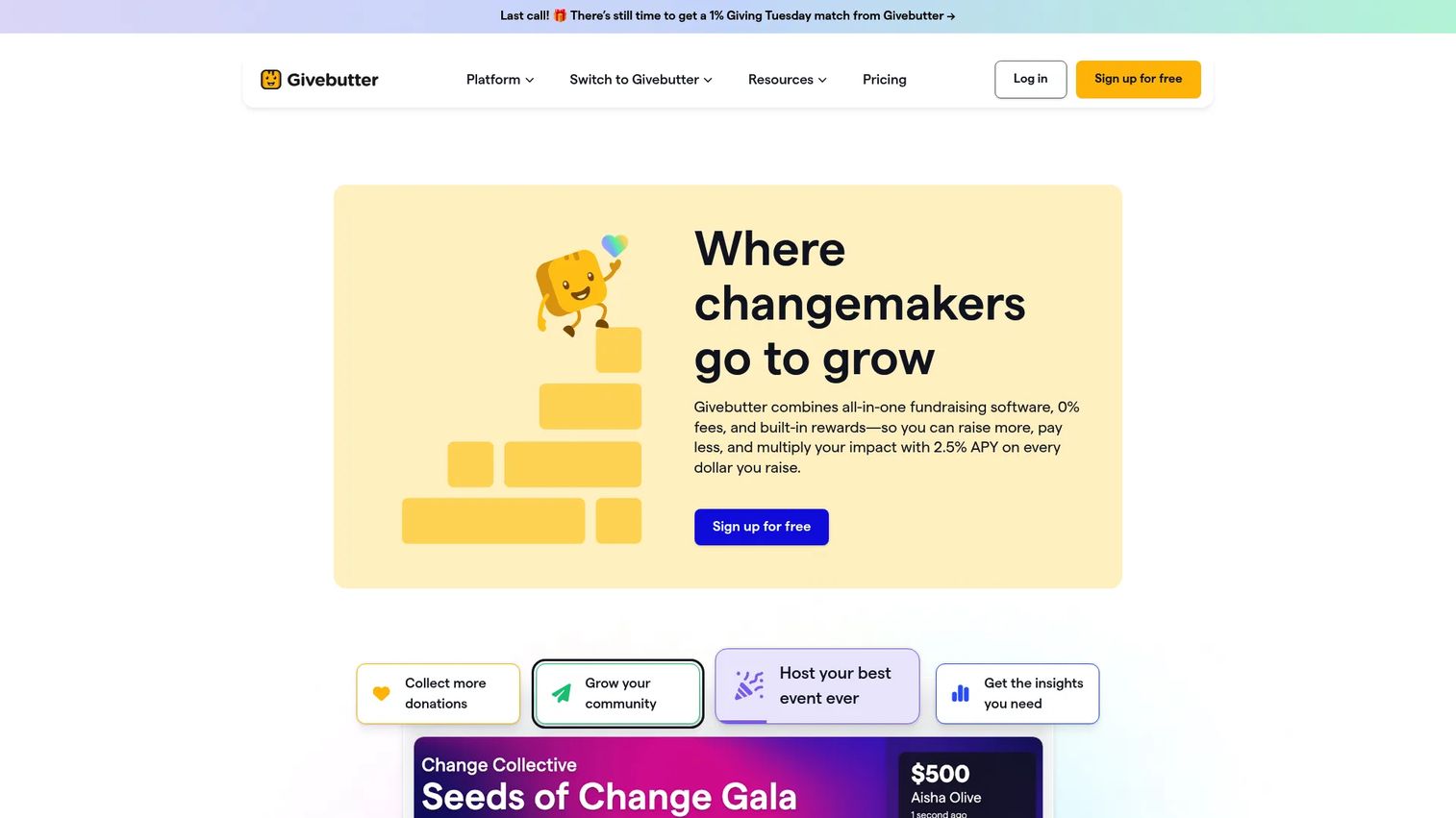
Givebutter combines donation forms, fundraising pages, events, donor records, and supporter communications. It gives small teams a practical starting point without requiring a heavy implementation.
Best for: Small and midsize nonprofits that want quick campaign setup with donor tracking.
Key features
- Donation forms
- Fundraising pages
- Donor CRM
- Email and SMS
- Events and auctions
Why choose Givebutter: It fits teams that need to launch campaigns quickly and manage supporter engagement. Organizations with complex development operations may need deeper CRM controls.
Givebutter pricing: Core fundraising tools are free with optional donor tips. Givebutter Plus starts at $29 monthly for up to 250 contacts.
G2 rating: 4.7/5
3. Bloomerang
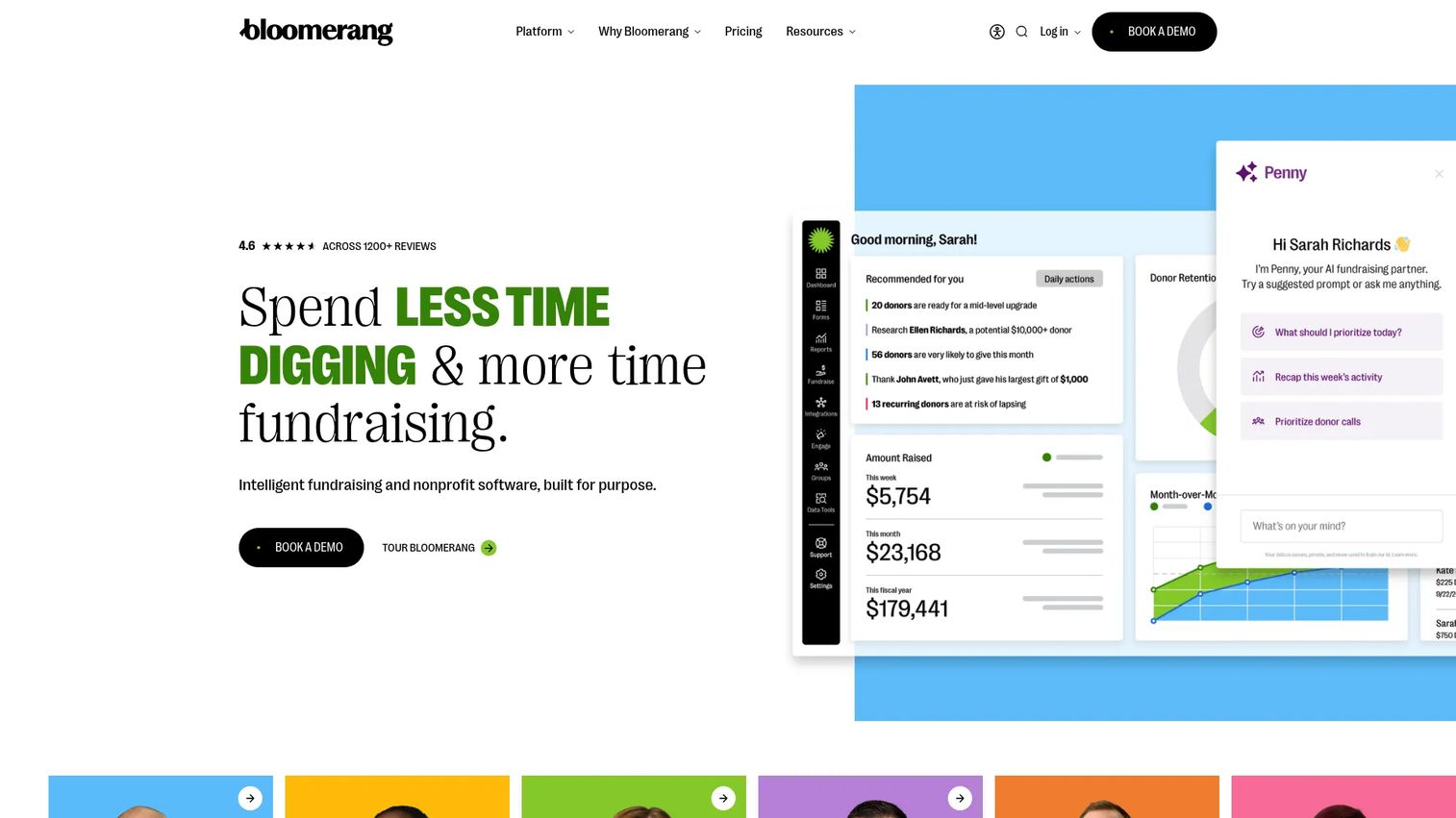
Bloomerang combines donor management with fundraising, volunteer coordination, marketing automation, and reporting. Its positioning centers on donor engagement and relationship visibility.
Best for: Nonprofits focused on donor retention and relationship based fundraising.
Key features
- Constituent management
- Retention insights
- Online fundraising
- Volunteer management
- Reporting dashboards
Why choose Bloomerang: Fundraisers can review supporter relationships alongside transaction history. This context helps teams plan stewardship around engagement rather than isolated gifts.
Bloomerang pricing: CRM starts at $125 monthly when billed annually. The Giving Platform costs $242 monthly under annual billing.
4. Donorbox
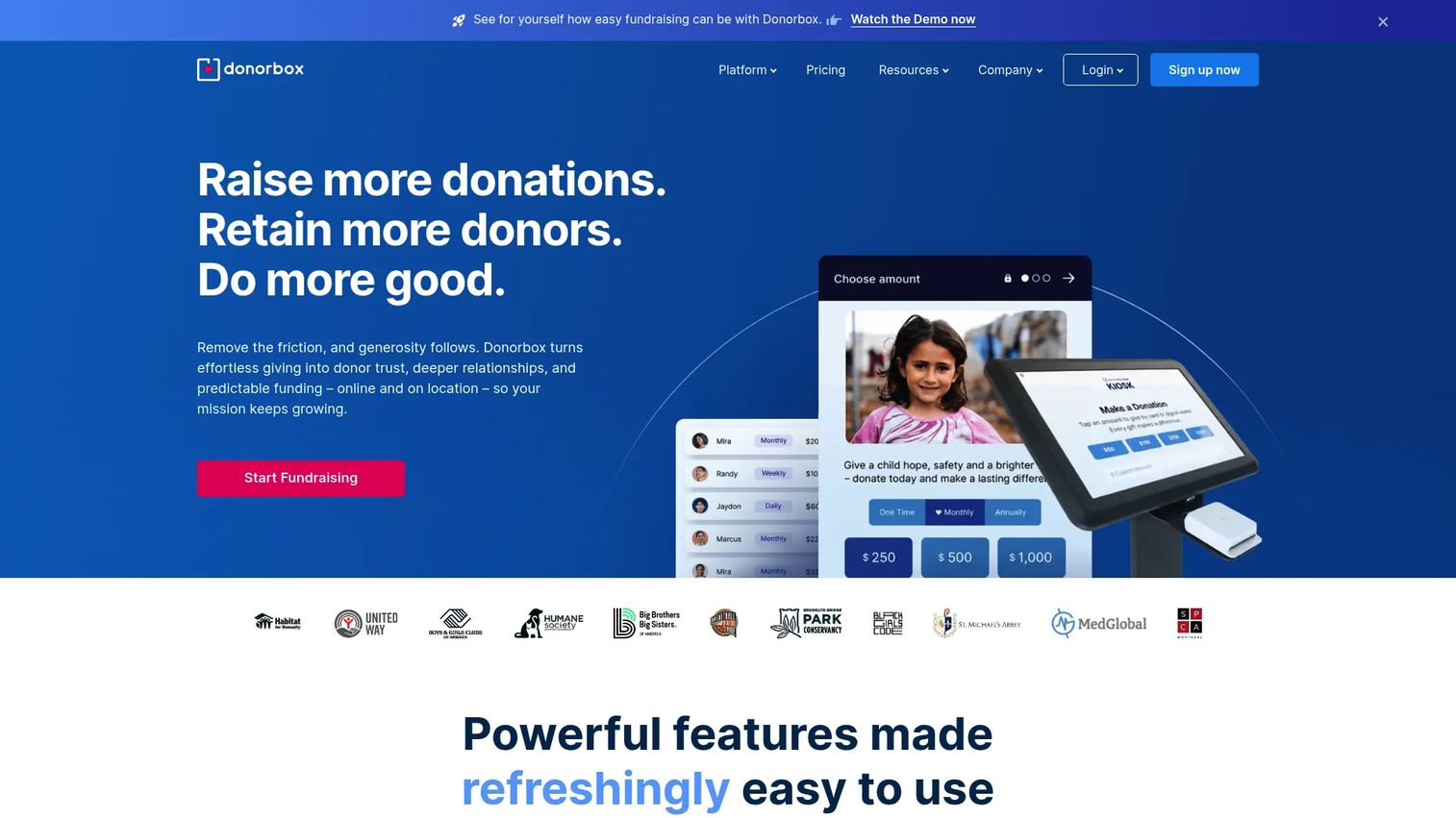
Donorbox is an online donation platform with forms, hosted pages, recurring gifts, memberships, events, and donor records. It also supports crowdfunding and in person giving.
Best for: Nonprofits prioritizing donation forms and recurring giving.
Key features
- Hosted donation pages
- Recurring donations
- Donor management CRM
- Memberships and events
- Giving kiosks
Why choose Donorbox: Pick it when online donation capture matters more than a deep constituent CRM. Its feature set supports several fundraising formats without requiring a broad administrative platform.
Donorbox pricing: Standard has no monthly fee and charges platform fees from 2.95% to 3.95%. Pro costs $150 monthly with lower platform fees.
G2 rating: 4.6/5
5. Classy
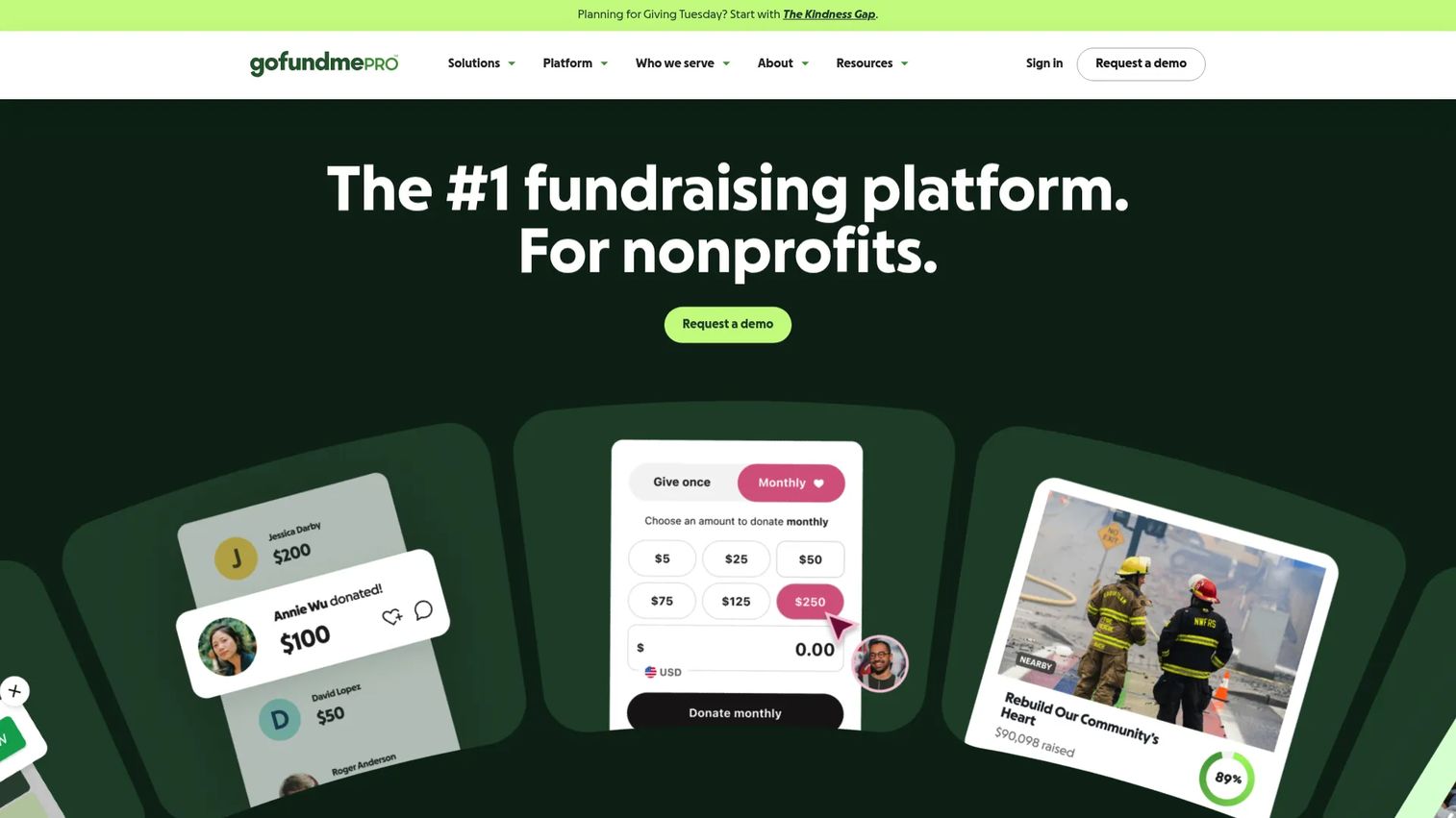
Classy, now GoFundMe Pro, supports online donations, peer fundraising, events, and recurring giving. It suits nonprofits running coordinated digital campaigns across several fundraising formats.
Best for: Nonprofits managing peer fundraising and larger digital campaigns.
Key features
- Campaign pages
- Peer fundraising
- Recurring giving
- Event registration
- Marketing analytics
Why choose Classy: Its campaign tools fit organizations that care about the supporter facing fundraising experience. Evaluate separate CRM requirements if your team needs deeper donor database workflows.
Classy pricing: Essentials has no subscription or setup fee. Larger nonprofits receive custom pricing through sales.
G2 rating: 4.4/5
6. DonorPerfect
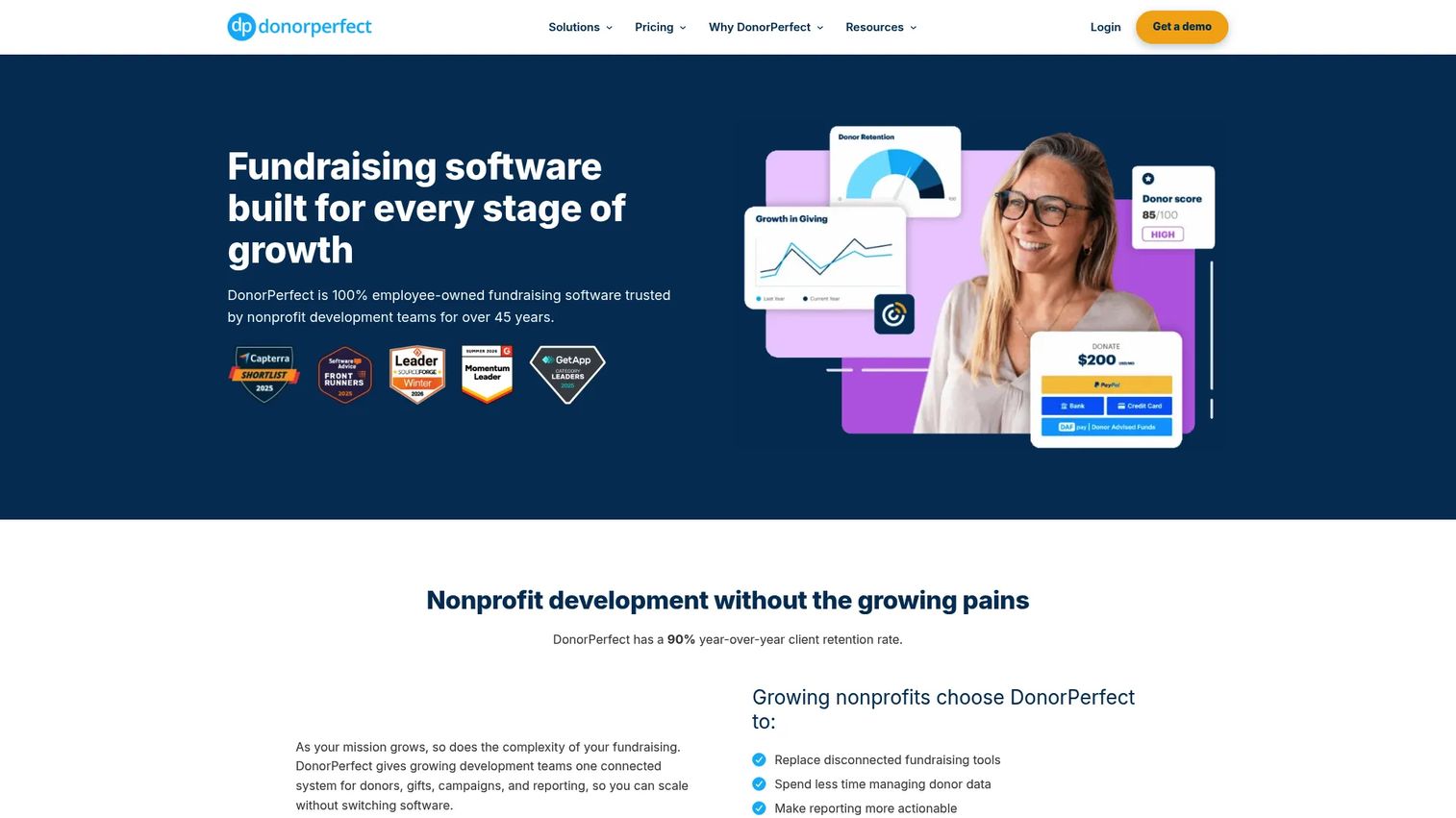
DonorPerfect is established nonprofit donor management software for gifts, campaigns, communications, and reporting. It covers the administrative work that lighter donation form products often leave elsewhere.
Best for: Nonprofits seeking a mature fundraising CRM with operational depth.
Key features
- Custom donor profiles
- Gift processing
- Donation receipts
- Reporting dashboards
- Monthly giving automation
Why choose DonorPerfect: It fits teams moving from basic forms into structured fundraising administration. Scheduled reports and acknowledgment workflows support repeatable processes.
DonorPerfect pricing: Core starts at $119 monthly. Final cost changes with the plan, donor record count, and selected add ons.
G2 rating: 4.4/5
7. Neon ONE
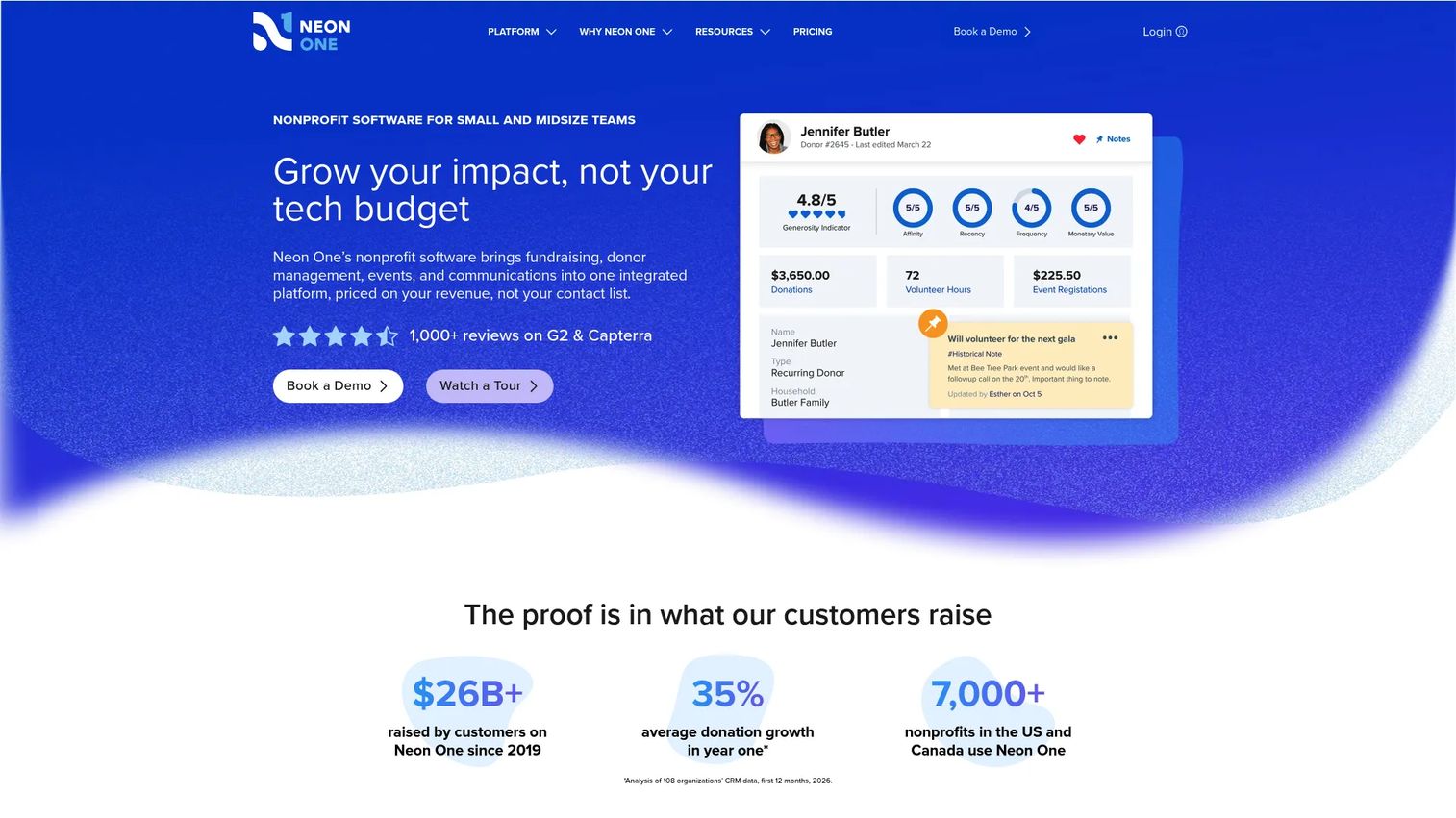
Neon ONE combines donor management with online giving, events, memberships, communications, and volunteer operations. Its CRM supports unlimited records and users within its revenue based pricing model.
Best for: Small and midsize nonprofits managing several constituent programs.
Key features
- Donor CRM
- Online giving
- Event management
- Membership management
- Automated workflows
Why choose Neon ONE: Consider it when fundraising connects with memberships, volunteers, or ticketed events. A donation only team may not need its wider operational scope.
Neon ONE pricing: Neon CRM starts at $99 monthly. Memberships and Volunteers each add 10% of the CRM subscription fee.
G2 rating: 4.2/5
8. Virtuous
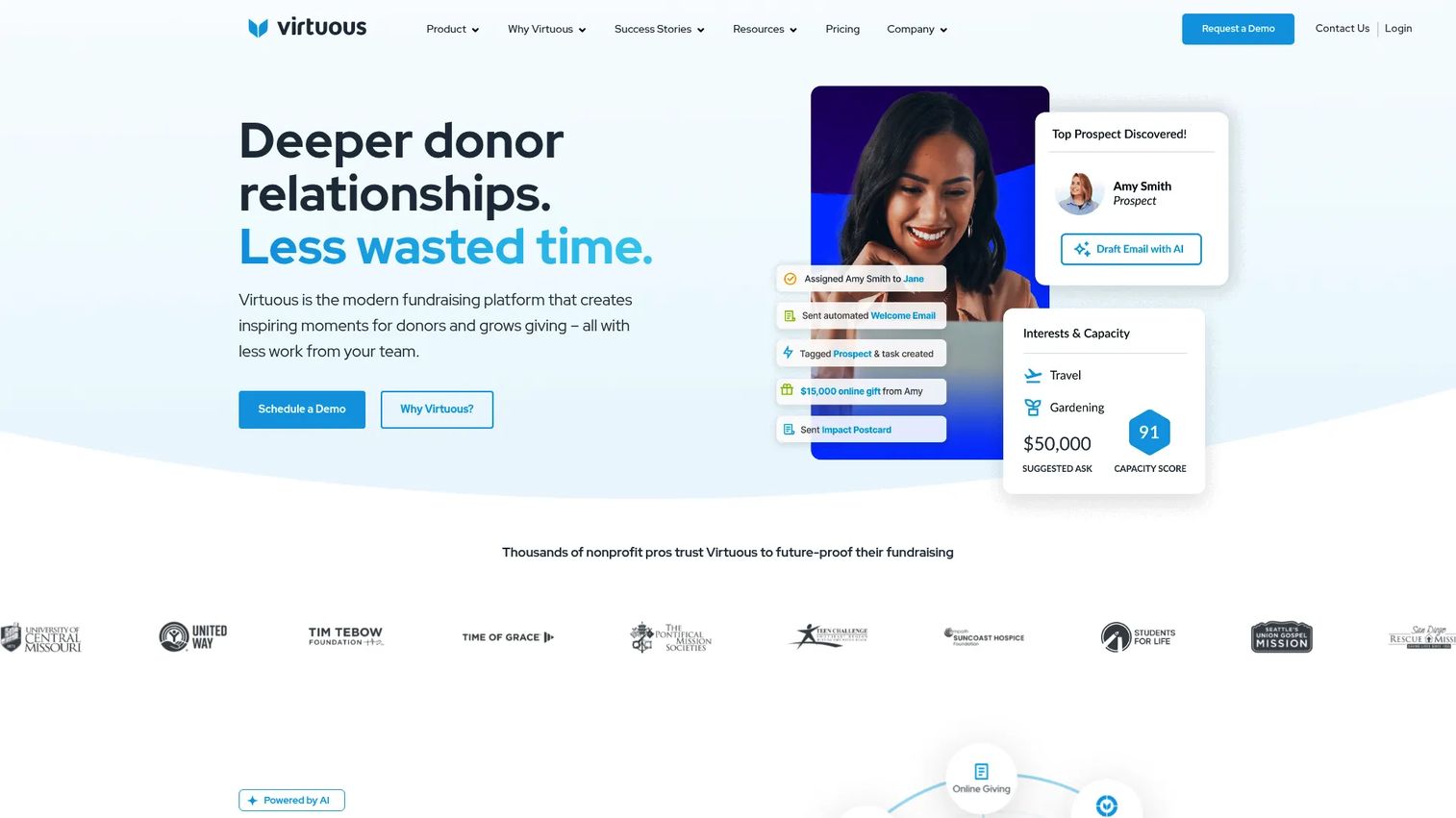
Virtuous combines donor CRM capabilities with fundraising, automation, communications, and analytics. It focuses on responsive fundraising informed by supporter behavior.
Best for: Nonprofits connecting CRM data with automated donor engagement.
Key features
- Donor management
- Journey automation
- Donor segmentation
- Online fundraising
- Reporting and analytics
Why choose Virtuous: It suits development teams ready to move beyond reactive gift tracking. Automated journeys help turn database signals into timely stewardship activity.
Virtuous pricing: Custom pricing applies to Platform and Enterprise plans. Platform serves organizations raising up to $5 million annually.
G2 rating: 4.3/5
9. Bonterra
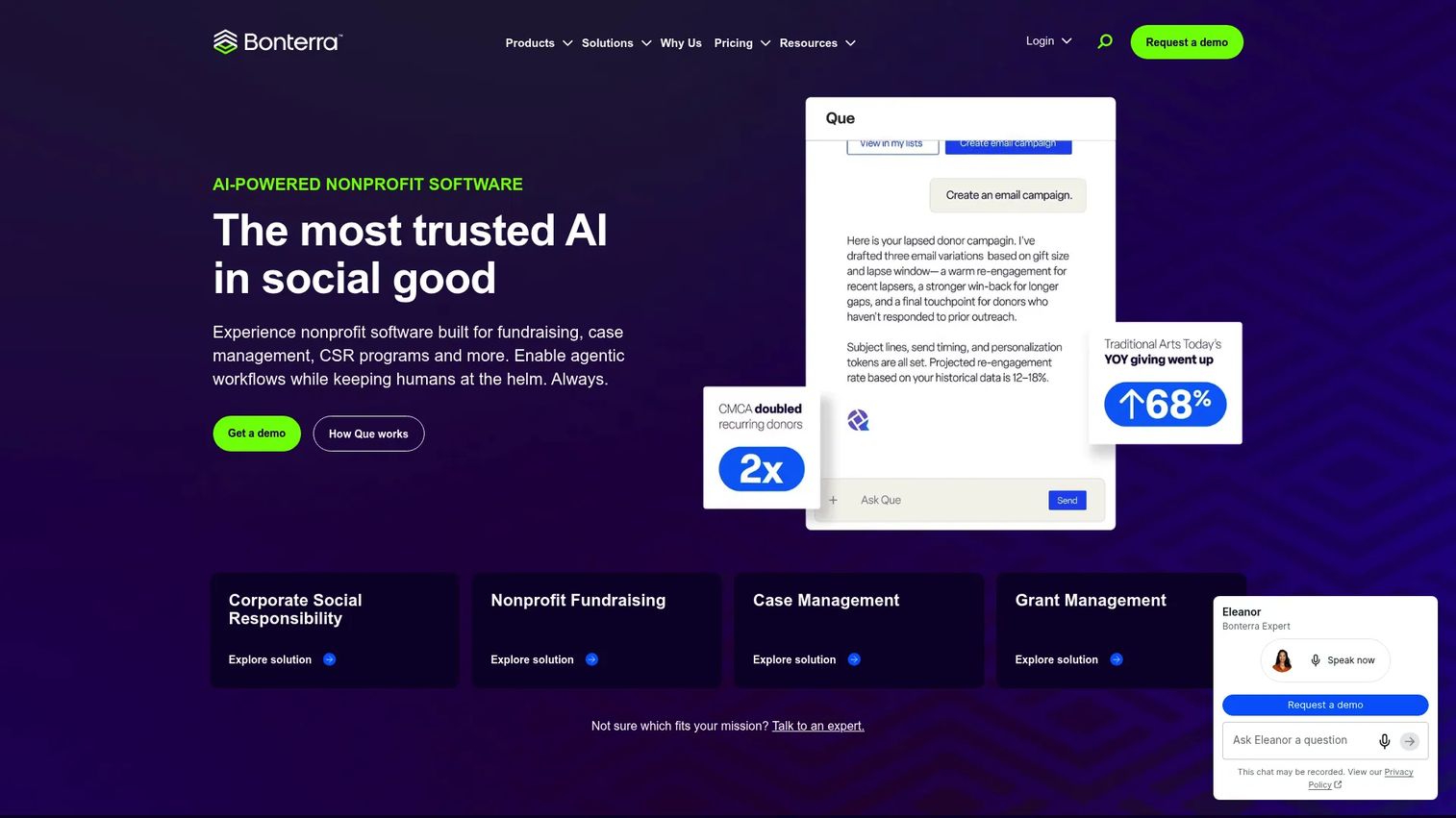
Bonterra offers fundraising, donor management, grant administration, case management, and corporate giving products. Buyers should identify the specific product line before comparing features.
Best for: Larger nonprofits and social impact organizations needing broad operational coverage.
Key features
- Fundraising CRM
- Donor engagement
- Grant management
- Case management
- Volunteer coordination
Why choose Bonterra: Its portfolio fits organizations that need more than donation tracking. Define the systems you want to consolidate before requesting a proposal.
Bonterra pricing: Bonterra prices by selected product, organization size, and included features. Contact the company for a quote.
G2 rating: 4.5/5
10. Fundraise UP
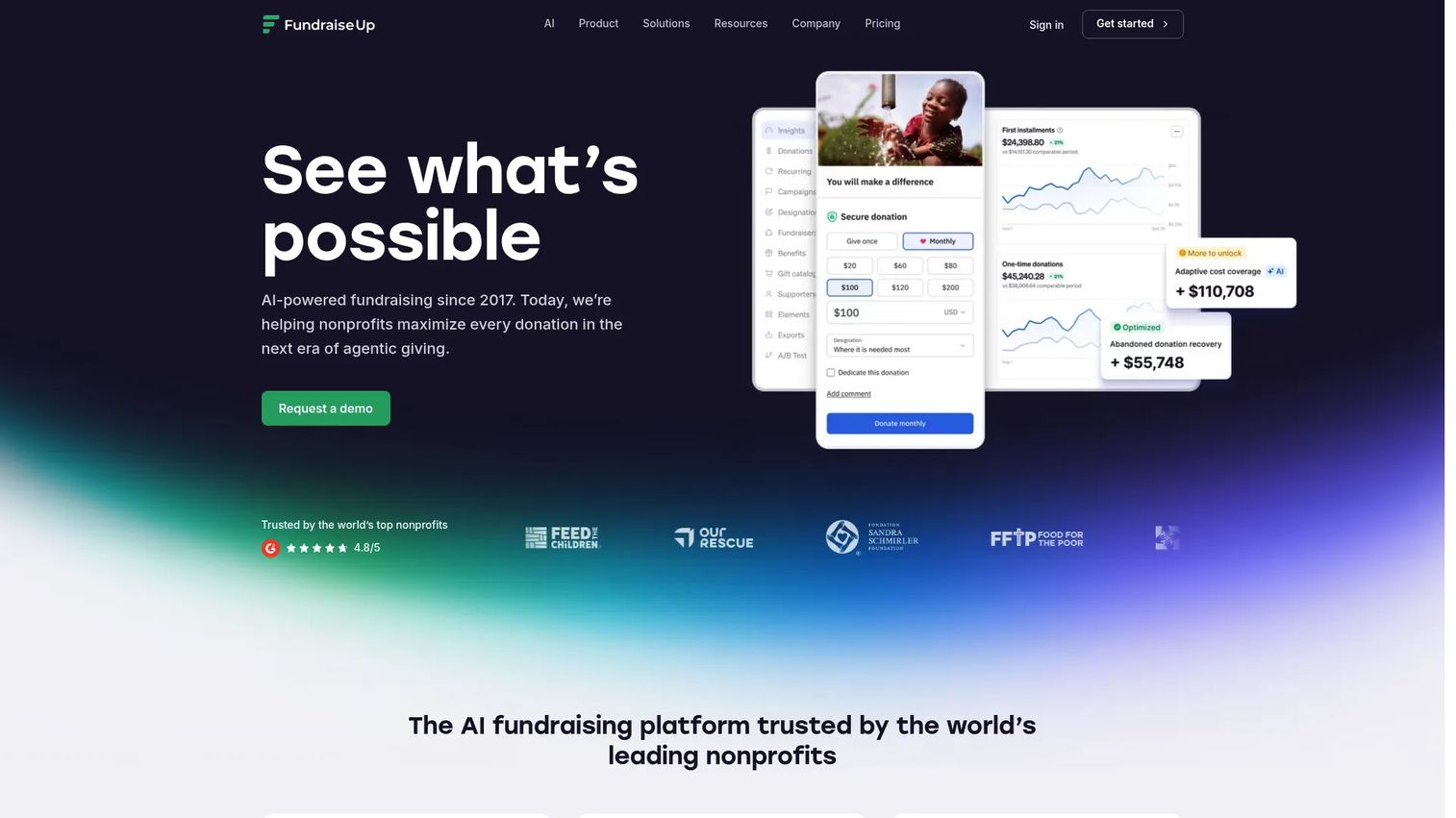
Fundraise UP focuses on digital donation checkout, recurring giving, donor self service, and payment choice. It commonly complements an existing CRM rather than replacing every donor workflow.
Best for: Nonprofits optimizing online donation conversion.
Key features
- Hosted donation checkout
- Recurring giving prompts
- Donor self service
- Multiple payment methods
- CRM integrations
Why choose Fundraise UP: Choose it when checkout performance is the fundraising bottleneck. Teams still need to map donor data and offline gifts into their core database.
Fundraise UP pricing: There are no setup or subscription fees. Transaction pricing applies, with an average effective platform cost near 1% after donor fee coverage.
G2 rating: 4.8/5
11. Paymattic
Paymattic is a WordPress plugin for donation forms, payment collection, subscriptions, and donor dashboards. It keeps donation capture inside an existing WordPress site.
Best for: WordPress based nonprofits that need forms without a full nonprofit CRM.
Key features
- WordPress donation forms
- Recurring payments
- Donor dashboards
- Payment integrations
- Coupons and analytics
Why choose Paymattic: It gives website teams direct control over donation forms. Organizations needing householding, major gift workflows, or broad constituent records should pair it with another system.
Paymattic pricing: A free plugin is available. Pro starts at $95 yearly, while lifetime licenses start at $279.
12. Springly
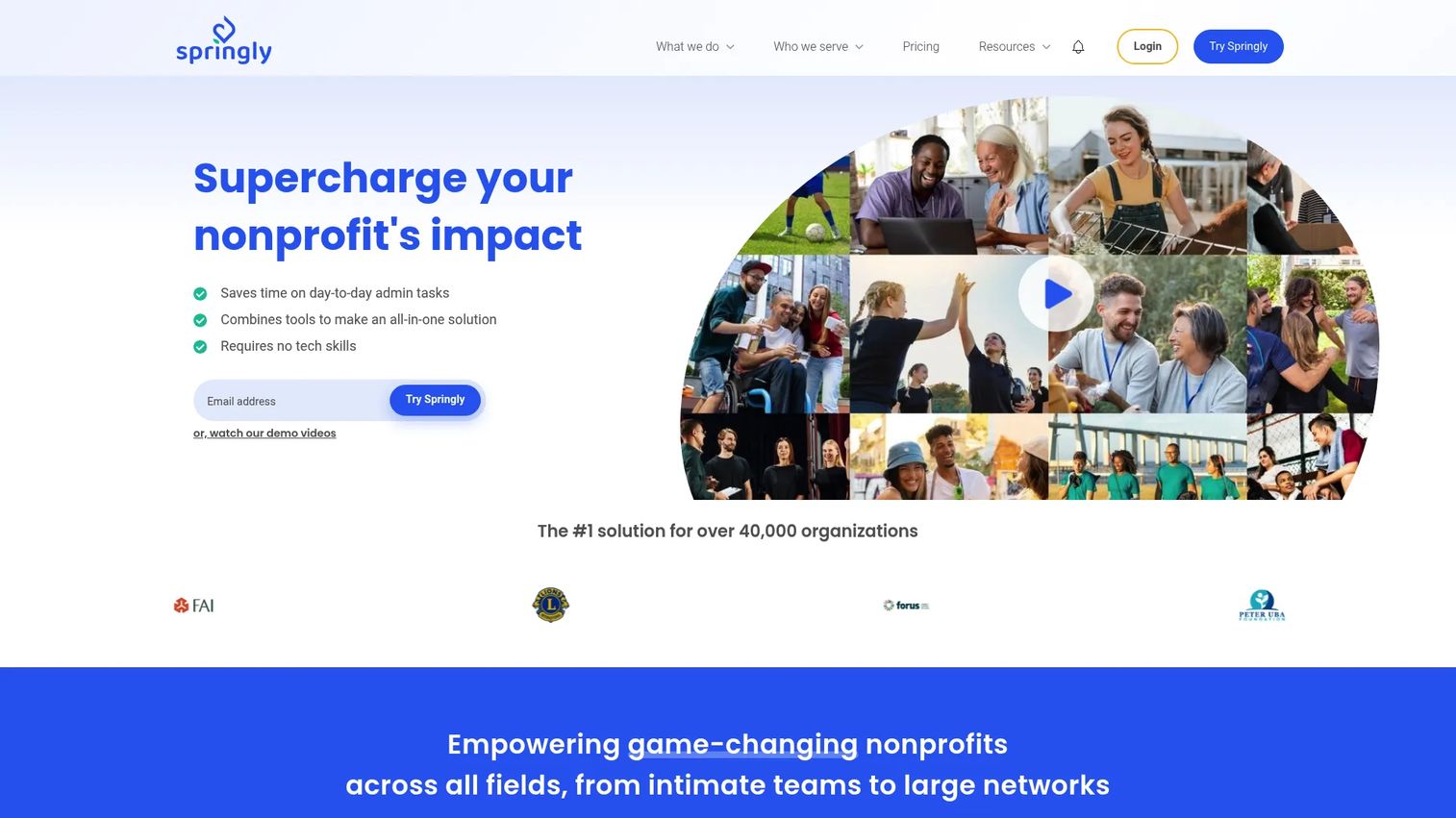
Springly combines donor management with memberships, accounting, communications, events, and website tools. Its broad scope suits small organizations that would otherwise manage several separate products.
Best for: Small nonprofits seeking donation tools and daily administration in one system.
Key features
- Donor records
- Online donations
- Membership management
- Nonprofit accounting
- Event management
Why choose Springly: Springly fits teams that value broad coverage over deep fundraising specialization. Map the accounting handoff before moving financial records.
Springly pricing: Contact Springly for a quote. The vendor offers a free start and support.
G2 rating: 4.2/5
13. DonorKite
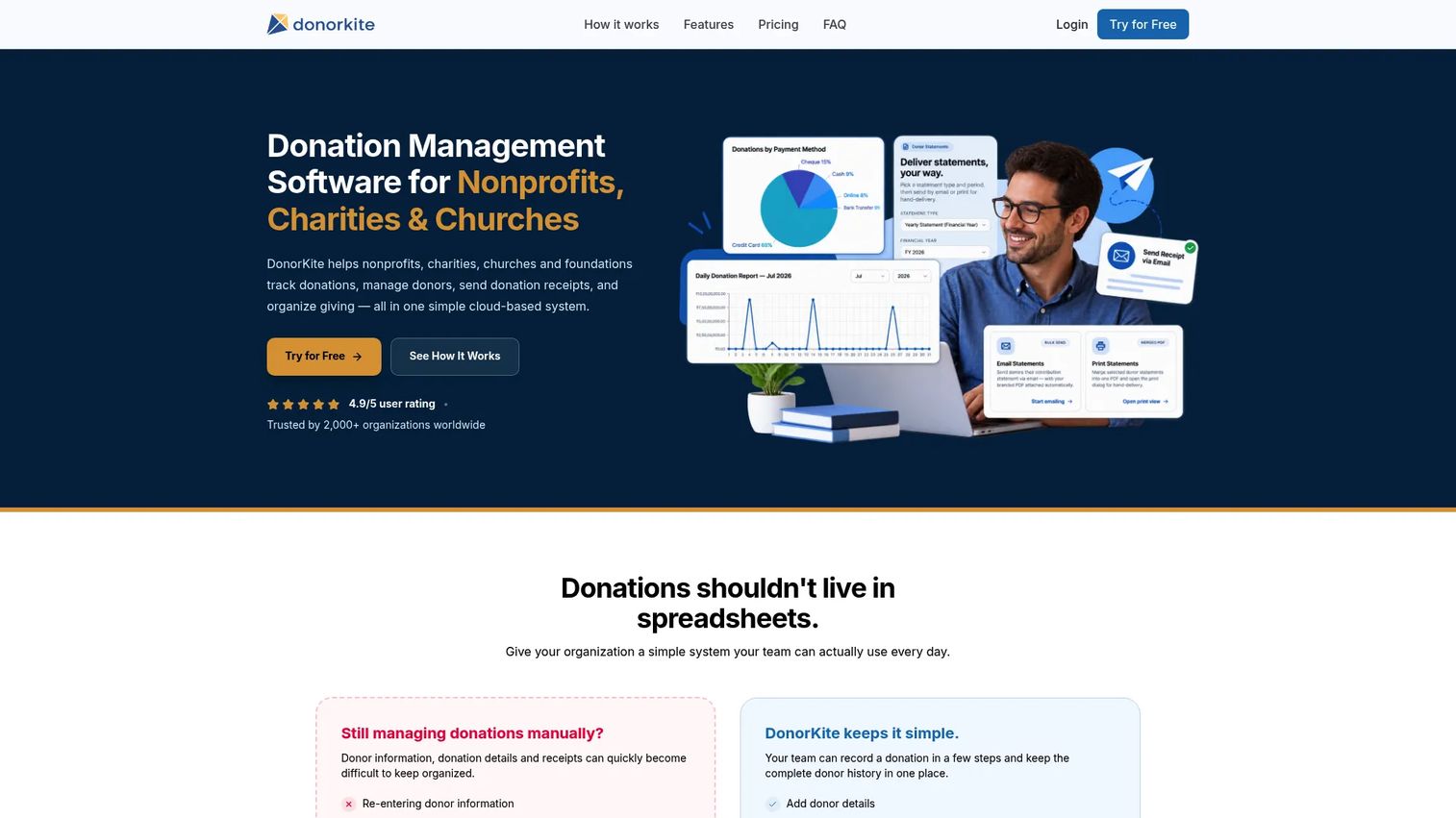
DonorKite provides straightforward donor records, donation entry, email receipts, statements, and reports. It targets smaller organizations replacing spreadsheets with dedicated gift tracking software.
Best for: Small nonprofits that need clear donor and donation administration.
Key features
- Donor records
- Gift tracking
- Email receipts
- Donation statements
- Funds and campaigns
Why choose DonorKite: Choose it when staff need clarity rather than a broad nonprofit CRM. Its focused workflow reduces the learning surface for occasional users.
DonorKite pricing: The monthly plan costs $29. Annual pricing is $299 and includes priority email support.
14. CharityEngine
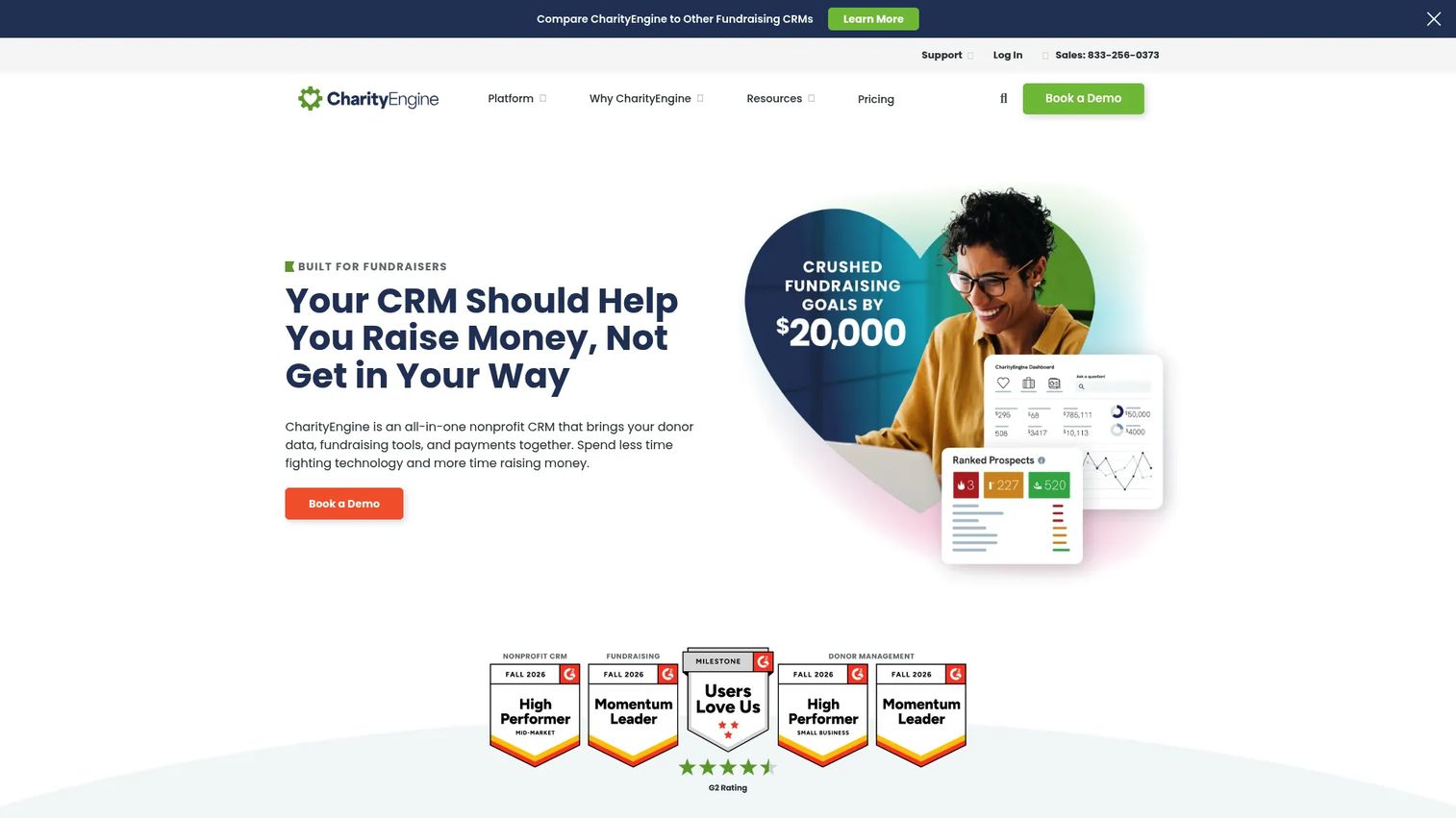
CharityEngine combines nonprofit CRM capabilities with fundraising, payments, communications, events, and advocacy. It brings donor activity and campaign execution into a connected system.
Best for: Midsize and larger nonprofits with complex fundraising operations.
Key features
- Donor CRM
- Donation forms
- Email workflows
- Advocacy tools
- Custom dashboards
Why choose CharityEngine: It fits organizations managing donations alongside events and advocacy programs. Implementation needs more planning than a focused donation form tool.
CharityEngine pricing: Custom pricing applies across its fundraising, digital giving, engagement, and enterprise CRM packages.
G2 rating: 4.3/5
15. iDonate
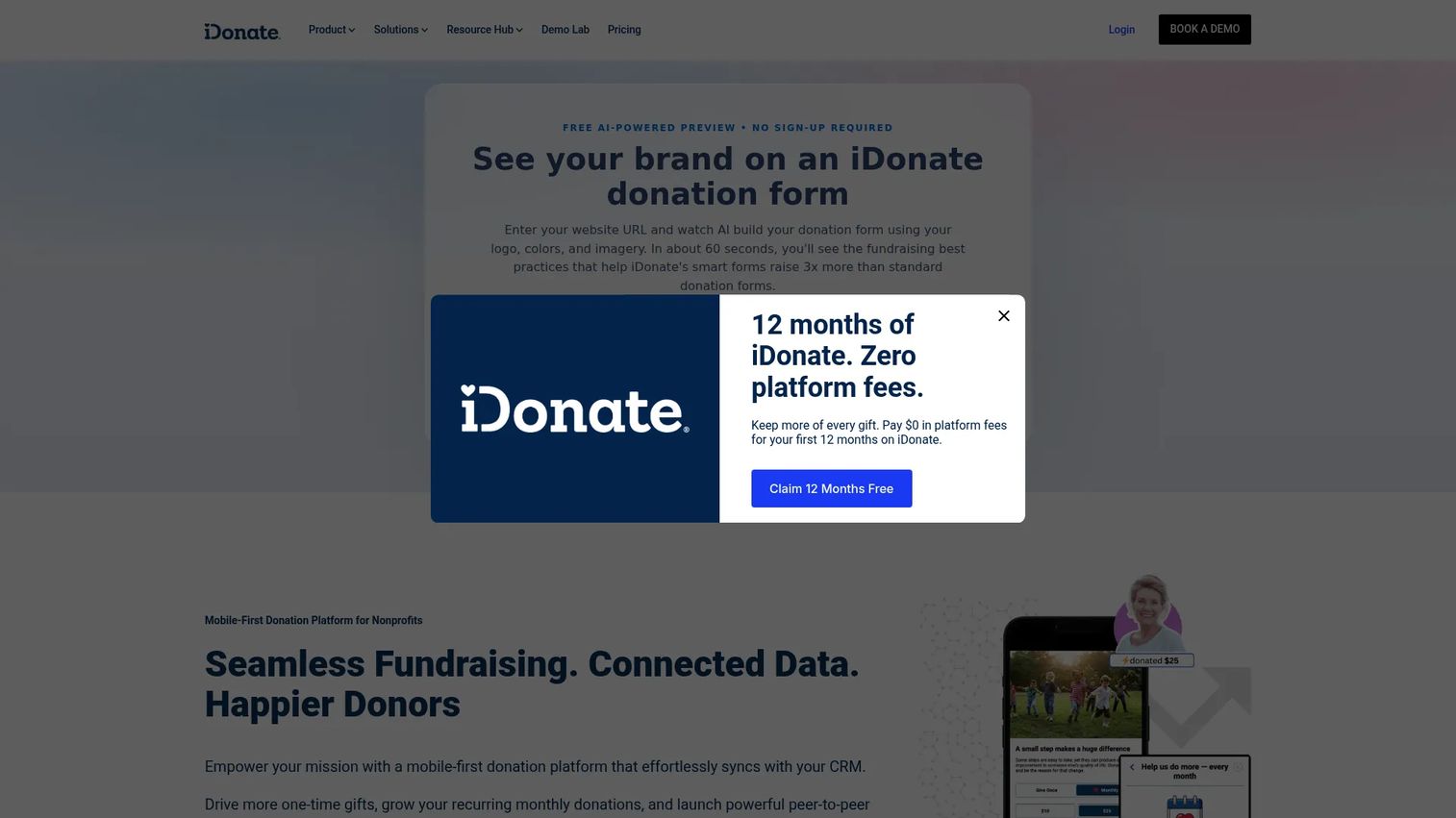
iDonate provides online giving forms, text giving, peer fundraising, events, and noncash gift processing. Built in testing tools support teams refining their digital donation experience.
Best for: Nonprofits modernizing online and mobile giving.
Key features
- Embedded giving forms
- Text giving
- Peer fundraising
- Event pages
- Built in testing
Why choose iDonate: It works well when donor conversion and payment choice matter. Confirm how its records connect with your nonprofit fundraising CRM.
iDonate pricing: Custom pricing combines a subscription fee, platform fee, and transaction fee. Packages include Starter, Core, Professional, and Distributed.
G2 rating: 4.4/5
16. OneCause
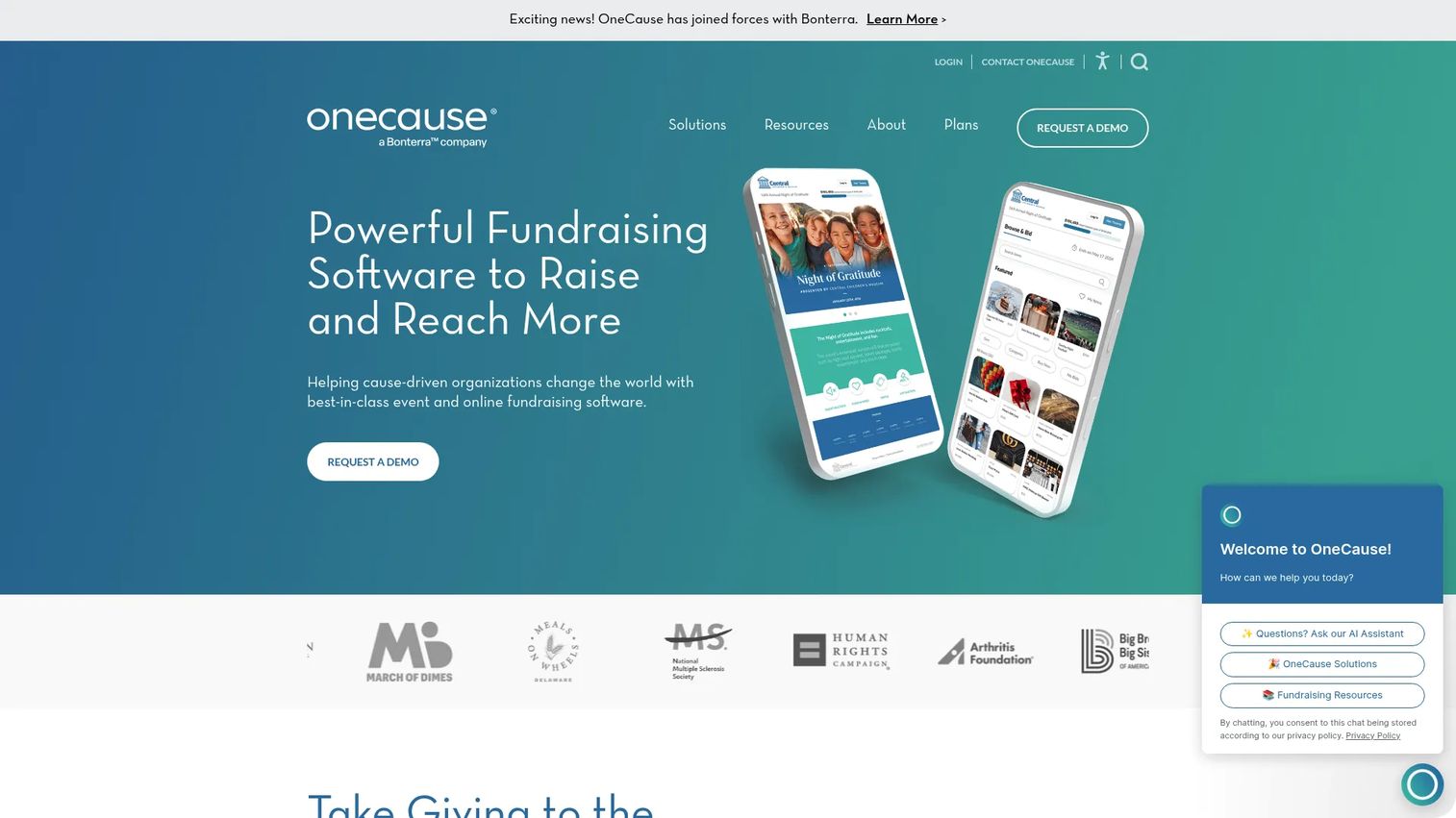
OneCause provides fundraising software for events, auctions, online giving, peer campaigns, and text giving. Its strength lies in connecting donation activity with event execution.
Best for: Nonprofits where events and auctions generate significant donation volume.
Key features
- Event fundraising
- Charity auctions
- Peer fundraising
- Online giving
- Text giving
Why choose OneCause: Choose it when ticketing, tables, auctions, and campaign reporting belong in the same workflow. Donation only organizations may prefer a narrower database.
OneCause pricing: Pay as you go plans start at $200. The Professional Auction and Event package costs $2,995 annually.
17. Kindsight
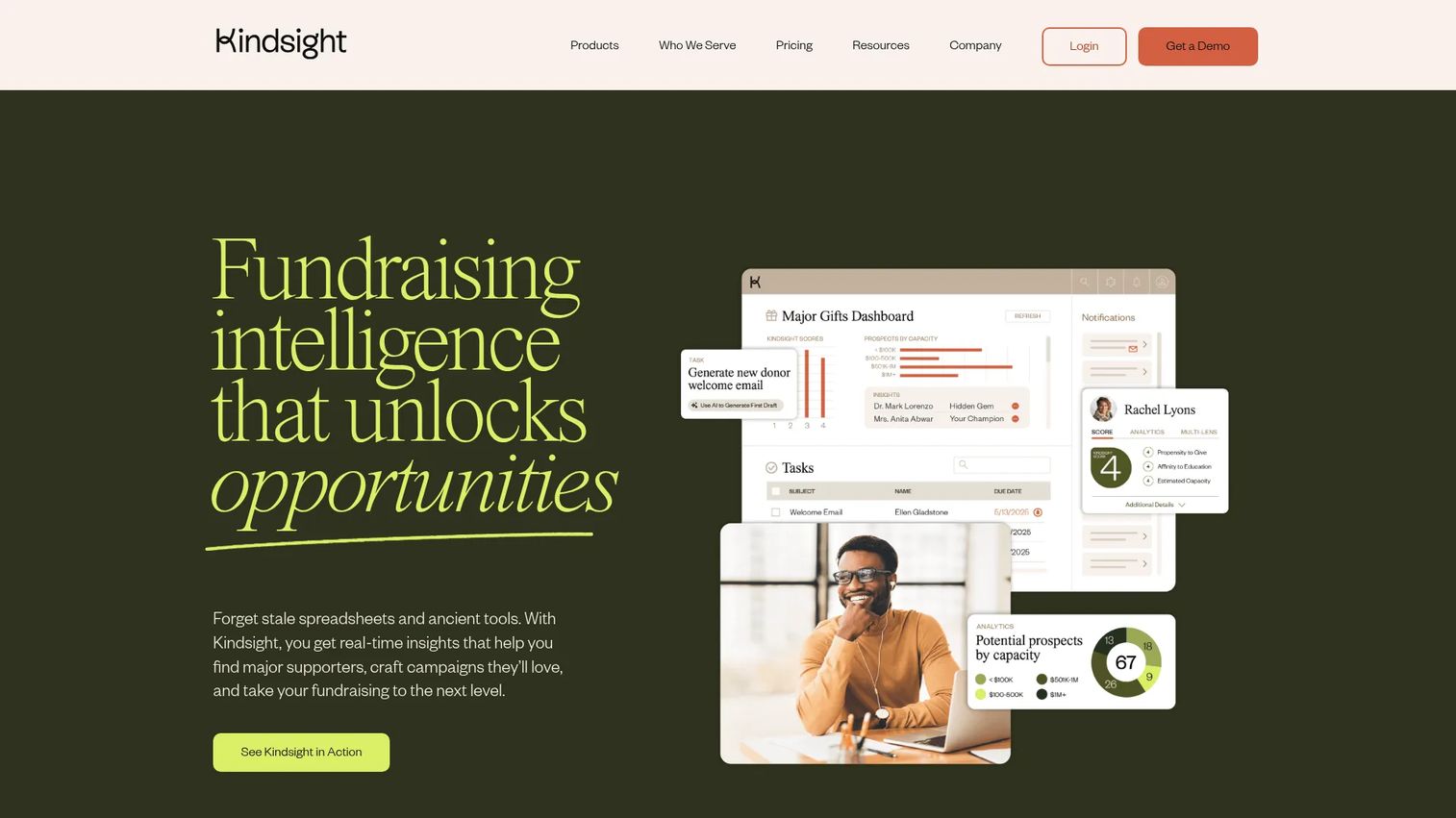
Kindsight combines donor intelligence, prospect research, fundraising CRM tools, and engagement capabilities. It serves nonprofit, education, and healthcare advancement teams.
Best for: Development teams focused on major gifts and prospect prioritization.
Key features
- Prospect research
- Donor intelligence
- Fundraising CRM
- Predictive scoring
- Advancement reporting
Why choose Kindsight: It suits teams deciding which high value donors to prioritize. The product portfolio goes beyond basic donation forms into advancement intelligence.
Kindsight pricing: Engage starts at $545 yearly. Kindsight also lists an iWave Starter offering from $4,500.
G2 rating: 4.6/5
Considerations when choosing donation management software
Start with the donation workflow, not the feature list
Map how your nonprofit receives, records, receipts, and reports each gift. Include online donations, checks, pledges, event revenue, and recurring payments.
Then test whether the product handles that path without duplicate entry. Don’t buy CRM depth your team won’t maintain.
Check how donor records handle duplicates and history
Review duplicate detection, household relationships, interactions, pledges, and offline gifts. Ask who will own donor data hygiene after implementation.
Reporting quality follows record quality. A dashboard can’t repair inconsistent campaign tags or duplicate supporters.
Verify receipts, finance exports, and accounting handoff
Donation receipt software should fit your acknowledgment process and financial controls. Test receipt edits, reissues, and year end statements.
Next, export a month of gifts for finance. Check whether fund codes and fees appear in usable fields.
Test campaign attribution before migration
Create a campaign and process a sample gift. Tag its source, generate a report, and see whether the result answers the board’s question.
Run this test before signing a contract. Campaign attribution for donations often breaks at data entry, not inside the final dashboard.
Price the system against staff time
Compare subscription costs with hours spent cleaning duplicates, sending receipts, and building reports. Add payment fees, implementation, migration, support, and extra user seats.
A cheaper platform can cost more if staff rebuild its missing workflows every month.
Conclusion
The best donation management software matches the fundraising operation you run today and the one you can maintain next year.
Funraise and Givebutter suit organizations seeking broad fundraising workflows with quick campaign setup. Bloomerang, DonorPerfect, Neon ONE, Virtuous, and Bonterra offer more CRM depth.
Donorbox and Fundraise UP deserve attention when donation forms or recurring giving drive the decision. Classy, OneCause, and iDonate fit campaign or event led fundraising.
Kindsight serves major gift teams that need donor intelligence. Paymattic, Springly, and DonorKite offer simpler routes for smaller organizations.
Shortlist three platforms. Then run the same workflow in each:
- Import sample donor records
- Enter online and offline gifts
- Create and resend a receipt
- Process a recurring donation
- Generate a campaign report
- Export transactions for finance
The best product is the one that produces trustworthy records without making one employee its permanent administrator.
FAQs
Donation management software helps nonprofits collect, record, receipt, track, and report gifts. It usually connects every transaction with a donor record and campaign source.
Depending on the platform, it may also include recurring giving, payment processing, segmentation, and finance exports.
Donation management software focuses on gifts and transaction workflows. It covers payment collection, recurring donations, receipts, and campaign reporting.
Donor management software focuses on supporter relationships and history. Many nonprofit donor management software products combine both functions within one database.
Givebutter and Donorbox offer accessible starting points for online fundraising. Springly provides broader nonprofit administration, while DonorKite focuses on straightforward donor and gift tracking.
Paymattic fits organizations that collect donations through WordPress. Test receipt creation and board reporting before choosing donor management software for small nonprofits.
Move when duplicate records appear, receipts are delayed, or recurring gifts become difficult to monitor. Multiple staff members editing separate files is another clear trigger.
Fundraising database software also becomes useful when board reporting takes hours or campaign attribution remains unclear.
Donorbox, Fundraise UP, Funraise, Givebutter, and iDonate are options to evaluate for recurring giving. Each approaches donation capture and supporter management differently.
Compare payment methods, failed payment recovery, donor self service, and CRM synchronization. Those details matter more than the presence of a recurring gift checkbox.
Pricing models include free plans with platform fees, monthly subscriptions, contact based charges, and custom enterprise agreements. Transaction fees can materially change the total cost.
Calculate payment processing, user seats, migration, support, and contact limits. Include the staff time required to maintain the system.
Strong donor tracking software should include profiles, giving history, household relationships, segmentation, notes, and receipt records. Campaign source tracking and accessible reports are equally important.
Check how the system handles duplicates and offline donations. Reporting remains unreliable when the underlying donor records are incomplete.
Run the same workflow in every trial. Import donors, enter online and offline gifts, issue a receipt, create a segment, and build a campaign report.
Finish by exporting data for finance. This test exposes workflow gaps before migration costs make switching harder.