Orders live in one system. Inventory lives in another. Route updates live in a driver's head, scribbled on a clipboard, or buried in a text thread. When leadership asks a simple question, "how much did we actually deliver this week?", someone spends two hours reconciling three spreadsheets to answer it.
That gap is exactly what distribution management software exists to close. A distributor management system centralizes inventory, order processing, delivery execution, reporting, and distributor collaboration inside one workflow, so the data flows instead of getting reassembled by hand every Friday.
The market reflects the pressure. The distributor management system market reached $3.8 billion globally in 2025 and is projected to hit $9.1 billion by 2034 at a 10.2% CAGR, according to Dataintelo (2025). The software component alone held 64.3% of that market in 2025, and reporting and analytics applications are forecast to grow fastest at 13.4% CAGR. Operators are not buying software for its own sake. They are buying visibility they can act on without adding headcount.
For a founder or operator, the calculus is simple. Fragmented workflows quietly tax every function: sales enters orders twice, ops guesses at stock, finance closes the month late. The right distributor software collapses that drag into a single source of truth. This guide breaks down eight options so you can match a tool to your actual workflow instead of the loudest sales pitch.
What's inside
We chose these eight platforms based on six criteria that decide whether distribution software solutions actually reduce operational load: inventory control, order management, route and delivery support, reporting depth, integration fit with your existing stack, and field usability for teams working off a phone.
This guide is written for distributors, wholesalers, manufacturers running their own distribution networks, and operators who need cleaner execution data without stitching together five dashboards. Each entry states who it fits, what it does well, verified pricing where public, and its current G2 rating. Where a vendor keeps pricing behind a sales call, we say so plainly instead of guessing.
TL;DR
- Best overall for a modern, full-stack DMS: SimplyDepo, built for CPG field sales, routing, and retail execution in one system.
- Best for enterprise route-to-market and analytics: Botree AI, for FMCG operators needing DMS, sales force automation, and AI dashboards.
- Best for lightweight wholesale order management: B2B Wave, a self-serve ordering portal with customer-specific pricing.
- Best for ERP-centric operators: NetSuite, when distribution workflows should live inside a unified ERP spine.
- Best flexible cloud ERP: Acumatica Cloud ERP, with consumption-based licensing and unlimited users.
- Best for multi-channel commerce and manufacturing distribution: Agiliron for omnichannel operators, SYSPRO and Tecsys for complex back-office and supply chain workflows.
Background: what is distributor management software?
Distributor management software is a system that centralizes inventory, order processing, delivery execution, reporting, and partner collaboration for businesses that move products through distribution networks.
In plain English, a distributor management system software platform pulls the scattered pieces of a distribution business into one operational layer. Instead of running orders in email, stock in a spreadsheet, and routes on paper, everything updates in one place. The category covers a few core jobs:
- Centralized inventory and order management: Track stock across locations and warehouses, capture orders once, and push them straight to fulfillment without re-keying.
- Real-time workflow visibility: See order status, stock levels, and delivery progress as they happen, not after the fact.
- Field and delivery coordination: Give drivers and field sales teams mobile access for order capture, delivery confirmation, and reconciliation on-site.
- Reporting and KPI tracking: Turn raw operational data into KPI reporting that leadership can read without asking ops to build a custom report every week.
- Integration with ERP, CRM, and accounting systems: Connect the distribution management solution to the systems that already run your finance, sales, and back office so data stays consistent.
The through-line is control. A good distribution business management software platform reduces manual entry, shrinks the reconciliation lag, and gives operators one version of the truth to run the week on.
When to use distribution management software
Not every distribution business needs the same system on day one. Here is how to pattern-match your situation to the category.
Centralize inventory and orders
Use software for distributors when order intake, stock visibility, and fulfillment are scattered across too many spreadsheets or disconnected apps. If two people can look at "current inventory" and get two different numbers, that is the signal. Centralizing order management removes the double entry and the guesswork that comes with it.
Improve route and delivery execution
Use a distributor management system when drivers or field teams need mobile access, delivery confirmation, and reconciliation in the field. Route planning that lives in a dispatcher's head does not scale past a handful of trucks. Offline mobile access matters here too, because delivery zones rarely have reliable signal.
Replace manual reporting
Use distribution software when leadership needs cleaner KPI visibility without ops building reports by hand every week. When the answer to "how did we do?" takes hours to assemble, the reporting layer is the bottleneck, not the people. A system with built-in analytics turns that into a dashboard anyone can open.
Comparison table
The table below ranks the eight platforms by fit with the core keyword, then by breadth of distribution functionality. Pricing and G2 ratings reflect verified values as of mid-2026. Where a vendor does not publish pricing, we mark it as custom.
| # | Product | Intent | Key differentiation | Pricing | G2 rating |
|---|---|---|---|---|---|
| 1 | SimplyDepo | Real-time distribution control | CPG field sales, routing, and retail execution in one system | From $89/rep/mo | 4.7/5 |
| 2 | Botree AI | Enterprise route-to-market | DMS, SFA, and AI-powered sales analytics | Custom | 3.3/5 |
| 3 | B2B Wave | Wholesale order portal | Self-serve B2B ordering with customer-specific pricing | From £135/mo | 4.9/5 |
| 4 | NetSuite | ERP-led distribution operations | Distribution inside a unified cloud ERP | Custom | 4.1/5 |
| 5 | Acumatica Cloud ERP | Flexible cloud ERP | Consumption-based licensing, unlimited users | Custom | 4.4/5 |
| 6 | Agiliron | Multi-channel commerce | Retail, wholesale, POS, and eCommerce in one platform | From $99/mo | 4.2/5 |
| 7 | Tecsys | Supply chain complexity | Configurable enterprise supply chain platform | Custom | Not listed |
| 8 | SYSPRO | Manufacturing distribution | Industry-specific ERP for makers and distributors | Custom | 4.1/5 |
1. SimplyDepo
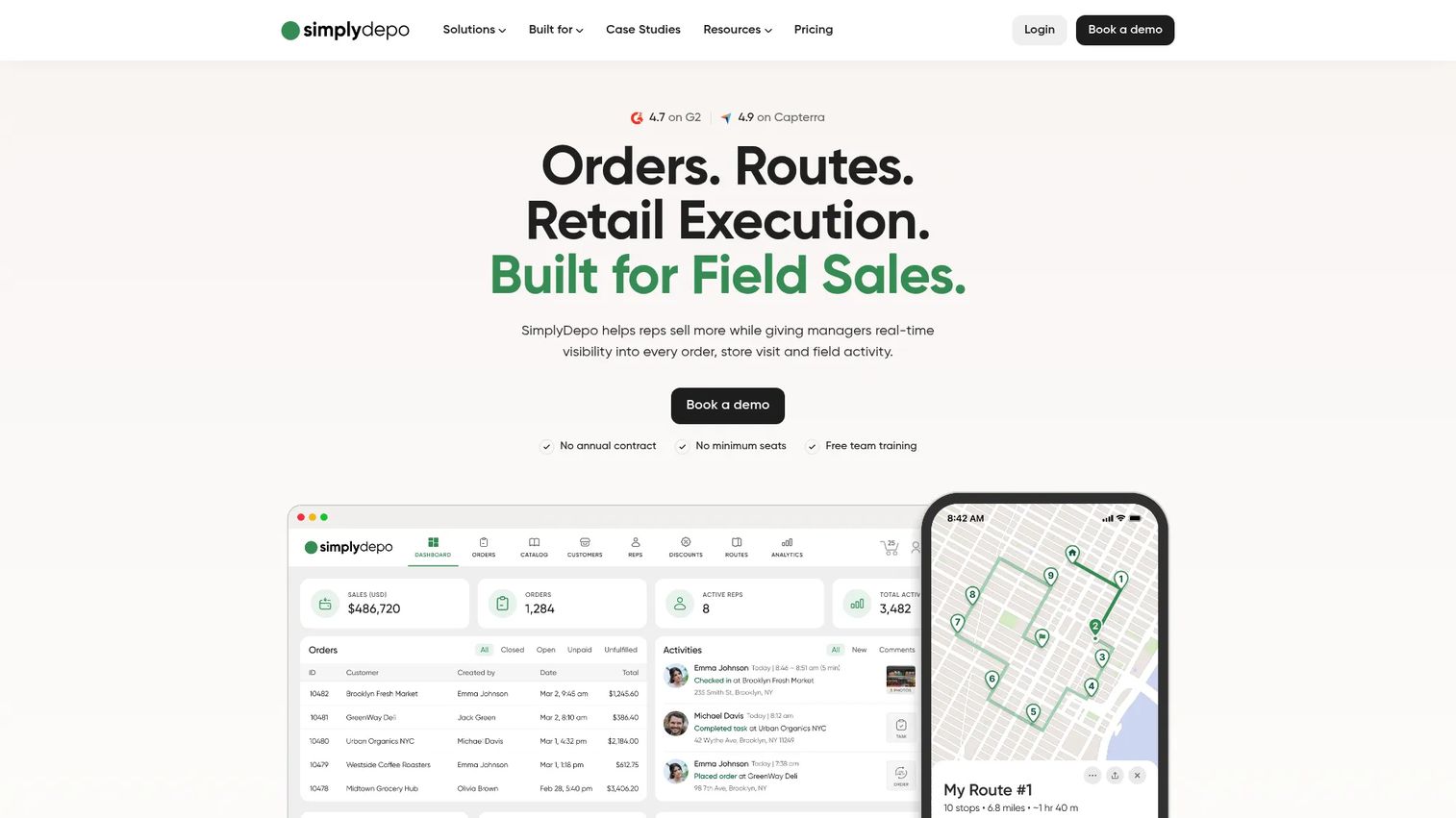
SimplyDepo is a modern distributor management system built for CPG brands, distributors, and field teams that need one platform for the whole distribution motion. It combines a CRM for customer management, B2B order management with invoicing and returns, and route intelligence with visit scheduling and photo proof of delivery. Instead of running field sales on one app and back-office fulfillment on another, operators get a single system that connects the rep in the field to the warehouse and the finance team.
That consolidation is where it earns its place. Field sales reps capture orders on their phone, dispatchers plan routes with scheduling and visit tracking, and leadership sees the resulting KPI reporting without asking anyone to build it. For a distribution business tired of reconciling three tools, that is the whole pitch.
Best for: CPG brands and distributors that need field sales, routing, and retail execution running in one system.
Key strengths
- CRM and account history: Every rep sees the full customer record, order history, and pricing before they walk in the door.
- B2B order management: Orders, invoicing, and returns run in one flow, so nothing gets re-keyed between systems.
- Route intelligence: Visit scheduling, route planning, and photo proof of delivery give ops real-time visibility into what happened in the field.
Why choose SimplyDepo: If your bottleneck is the gap between field execution and back-office data, SimplyDepo closes it directly. It is purpose-built for CPG and distribution field motions rather than adapted from a generic ERP, which shows in how quickly reps and dispatchers adopt it. Teams that live on mobile and need offline-friendly order capture will feel at home fast.
SimplyDepo pricing: Public pricing shows a Starter plan at $89 per rep per month, a Growth plan at $79 per rep per month for six reps, and a Scale plan at $69 per rep per month at sixteen reps. A Simply Intelligence add-on runs $19 per rep per month. A 30-day free trial is available, and the platform holds a 4.7/5 rating on G2.
2. Botree AI (Botree Software)
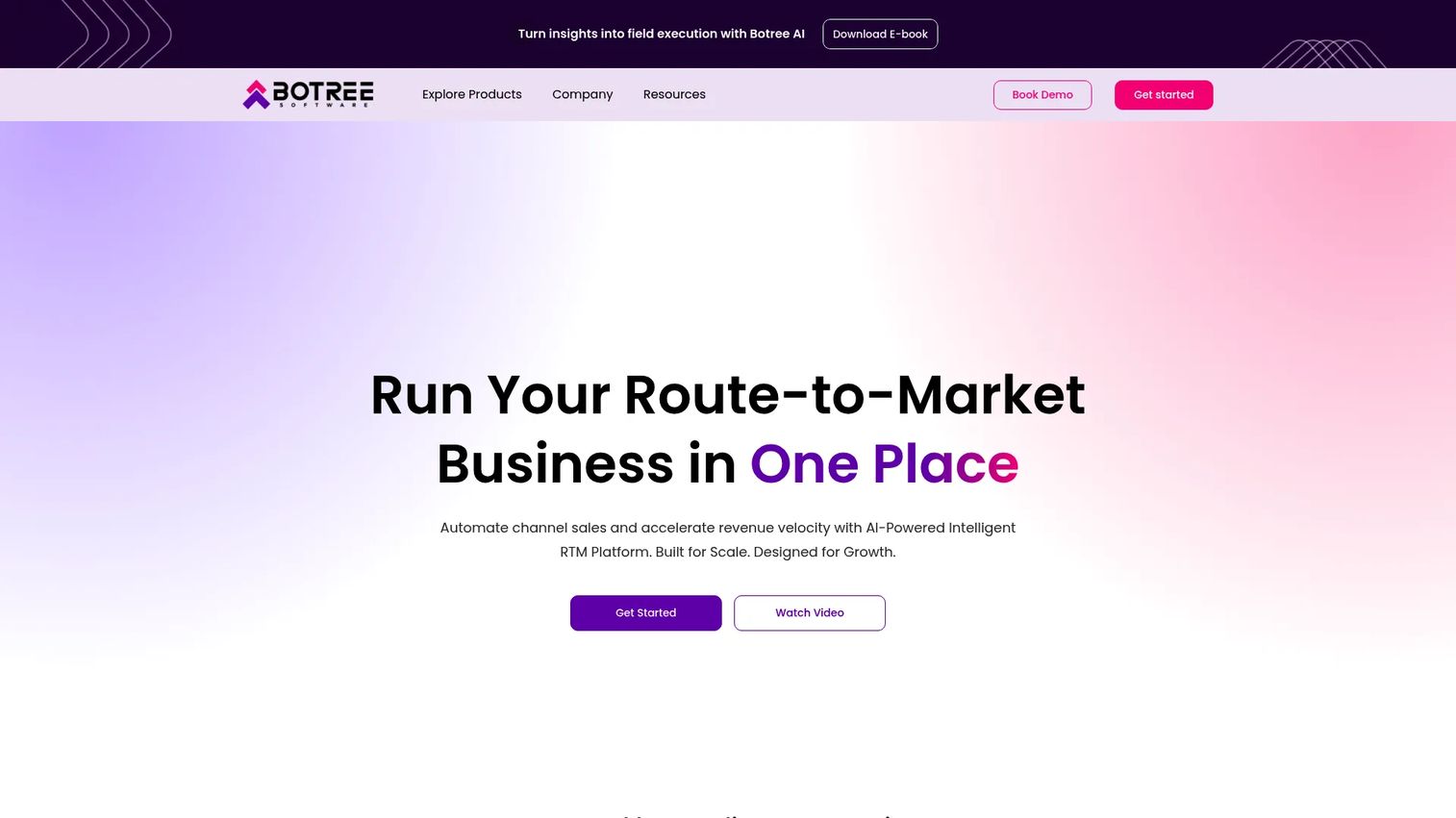
Botree AI is an AI-powered route-to-market platform that combines distributor management, sales force automation, and sales analytics for FMCG and CPG operators. It is built for the more complex end of distribution, where a brand sells through a layered network of distributors and retailers and needs governance, scheme management, and analytics across all of it. The distributor management system software handles the operational core while the SFA layer keeps field reps productive.
Where it fits is enterprise-scale route-to-market. If you manage hundreds of distributors, run trade schemes and claims, and need AI-driven dashboards to spot where sell-through is slipping, Botree is designed for that environment rather than a single-warehouse operation.
Best for: FMCG and CPG companies that need route-to-market, DMS, SFA, and analytics in one governed platform.
Key strengths
- Distributor management: Manages inventory, orders, and distributor relationships across a multi-tier network.
- Sales force automation: Keeps field reps productive with order capture, visit planning, and retailer coverage.
- AI-powered analytics: Dashboards surface sell-through, coverage, and performance signals across the distribution network.
Why choose Botree AI: Choose Botree when your distribution environment is genuinely complex, with schemes, claims, and multi-tier distributor relationships that a lighter tool cannot govern. The analytics layer is the differentiator for operators who need to read the whole network at once, not just one warehouse. It suits FMCG brands that treat route-to-market as a core competency.
Botree AI pricing: Botree does not publish public pricing; the platform is quote-based, and the site routes evaluators to a demo booking. The closest verified rating for the Botree family is 3.3/5 on G2. Ask for a scoped quote tied to your distributor count and module needs during evaluation.
3. B2B Wave
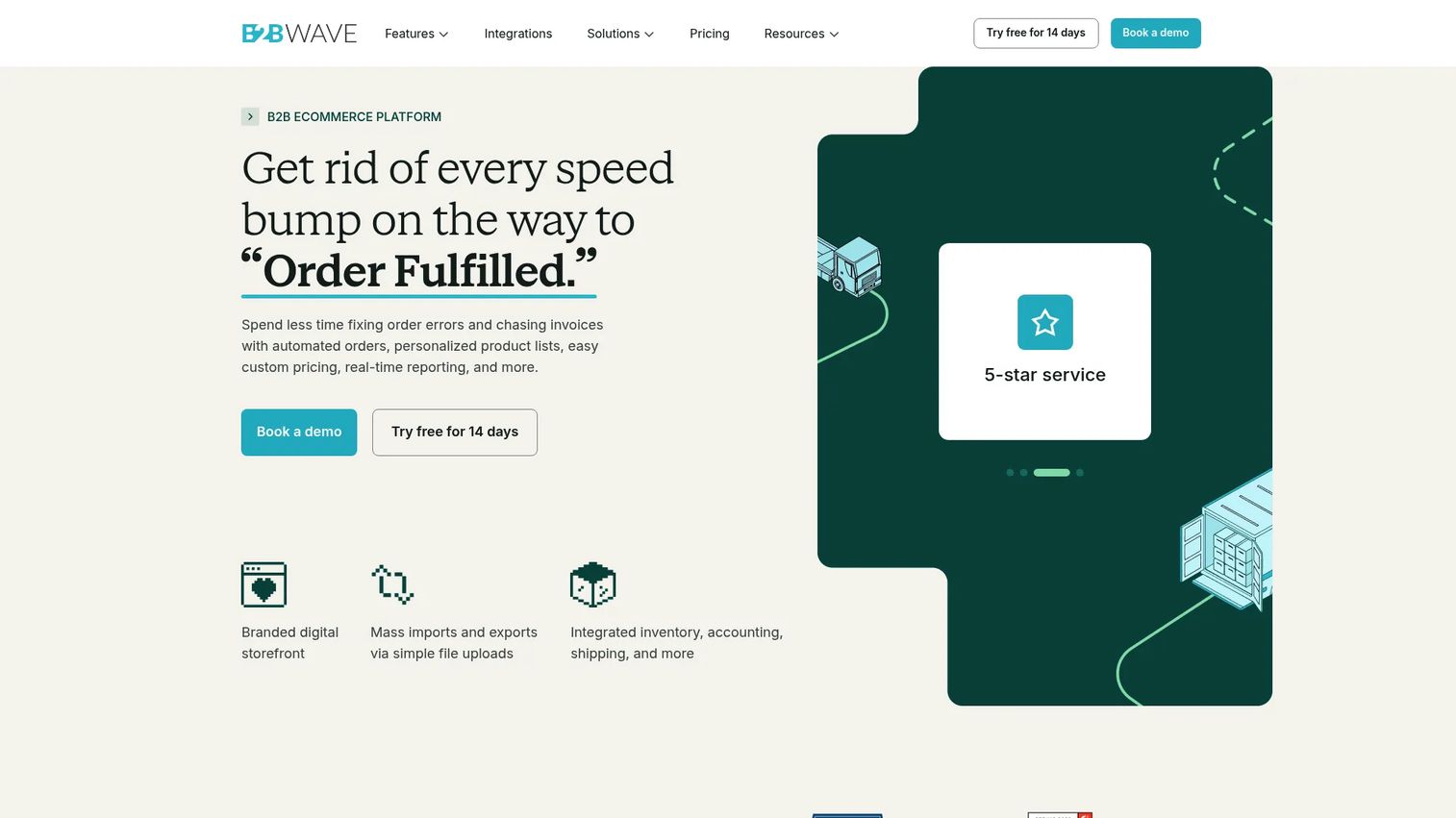
B2B Wave is a B2B eCommerce platform focused on wholesale ordering, pricing, and order management. It gives distributors and wholesalers a branded self-service store where customers place orders directly, complete with customer-specific price lists and pricing overrides. For operators whose main friction is manual order entry from phone and email, this is the lightweight distribution software solution that removes it.
It is deliberately simpler than a full ERP, and that is the appeal. Small to mid-market distributors get wholesale ordering, PDF catalogs, quotes, and a mobile app without a heavy implementation. Buyers self-serve, orders land clean, and the team stops transcribing.
Best for: Wholesale and B2B businesses that need a self-service ordering portal with customer-specific pricing.
Key strengths
- Wholesale storefront: A branded, customer-facing store where buyers place their own orders around the clock.
- Customer-specific pricing: Per-customer price lists and overrides handle the reality of wholesale pricing tiers.
- Orders, quotes, and catalogs: Order management, quoting, PDF catalogs, and a mobile app cover the full ordering workflow.
Why choose B2B Wave: Choose B2B Wave when your priority is speed and simplicity over a sprawling ERP. It shines for distributors who want to move buyers to self-serve ordering quickly and cut the manual entry that eats sales-team time. It is the right call when you need clean order management fast, not a multi-quarter deployment.
B2B Wave pricing: Public pricing lists Pro and Scale plans at £135 GBP per month each, both marked 50% off for the first three months, with an Enterprise tier available on request. There is no free tier, but a 14-day free trial is offered. B2B Wave holds a strong 4.9/5 rating on Capterra.
4. NetSuite
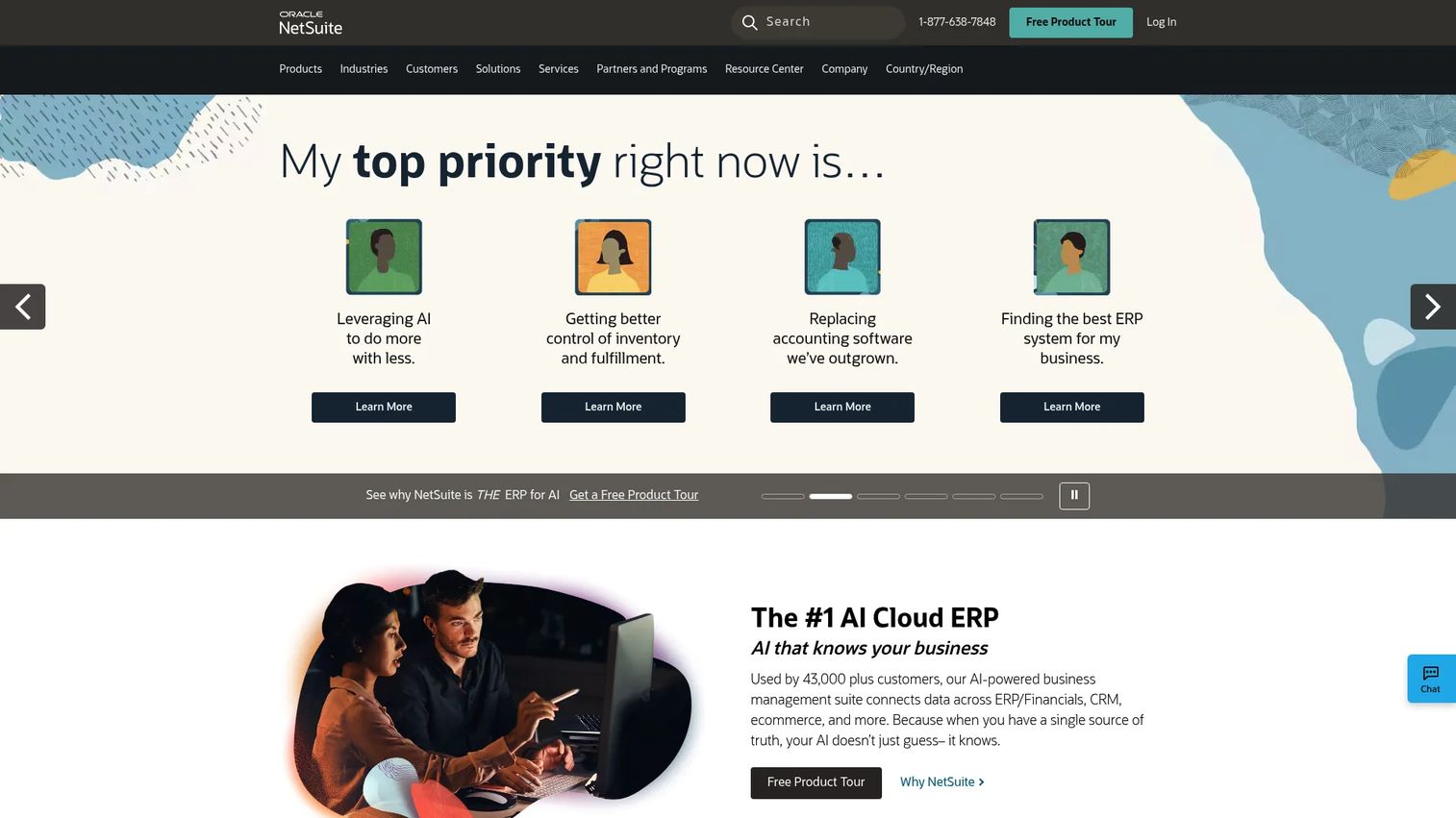
NetSuite is a cloud ERP that runs finance, operations, and commerce on one platform, with distribution living inside that larger spine. For operators who want inventory, order management, and financial visibility consolidated rather than bolted together, NetSuite puts distribution workflows in the same system as the general ledger. That means fewer integrations to maintain and one dataset feeding both operations and finance.
It fits mid-market to enterprise companies that have outgrown point tools and want systems consolidation. If your reporting problem is really a "too many disconnected systems" problem, an ERP-led approach addresses the root cause.
Best for: Mid-market to enterprise companies that want distribution inside a unified ERP platform.
Key strengths
- Cloud ERP and financials: Global financials and distribution operations run on one dataset, closing the ops-to-finance gap.
- SuiteBilling: Subscription and billing models handle complex revenue and pricing arrangements.
- SuiteCloud platform: Customization and APIs let you tailor workflows and connect the rest of your stack.
Why choose NetSuite: Choose NetSuite when consolidation is the goal and distribution is one part of a broader operational picture. It earns its place for companies that want ERP integration handled natively rather than through middleware. The trade-off versus a purpose-built DMS is scope: you get depth across the business, best suited to teams ready to run more of the company in one platform.
NetSuite pricing: NetSuite does not publish public pricing; deals are quoted based on modules, users, and deployment scope. Plan for an implementation partner and a defined onboarding timeline. NetSuite holds a 4.1/5 rating on G2.
5. Acumatica Cloud ERP
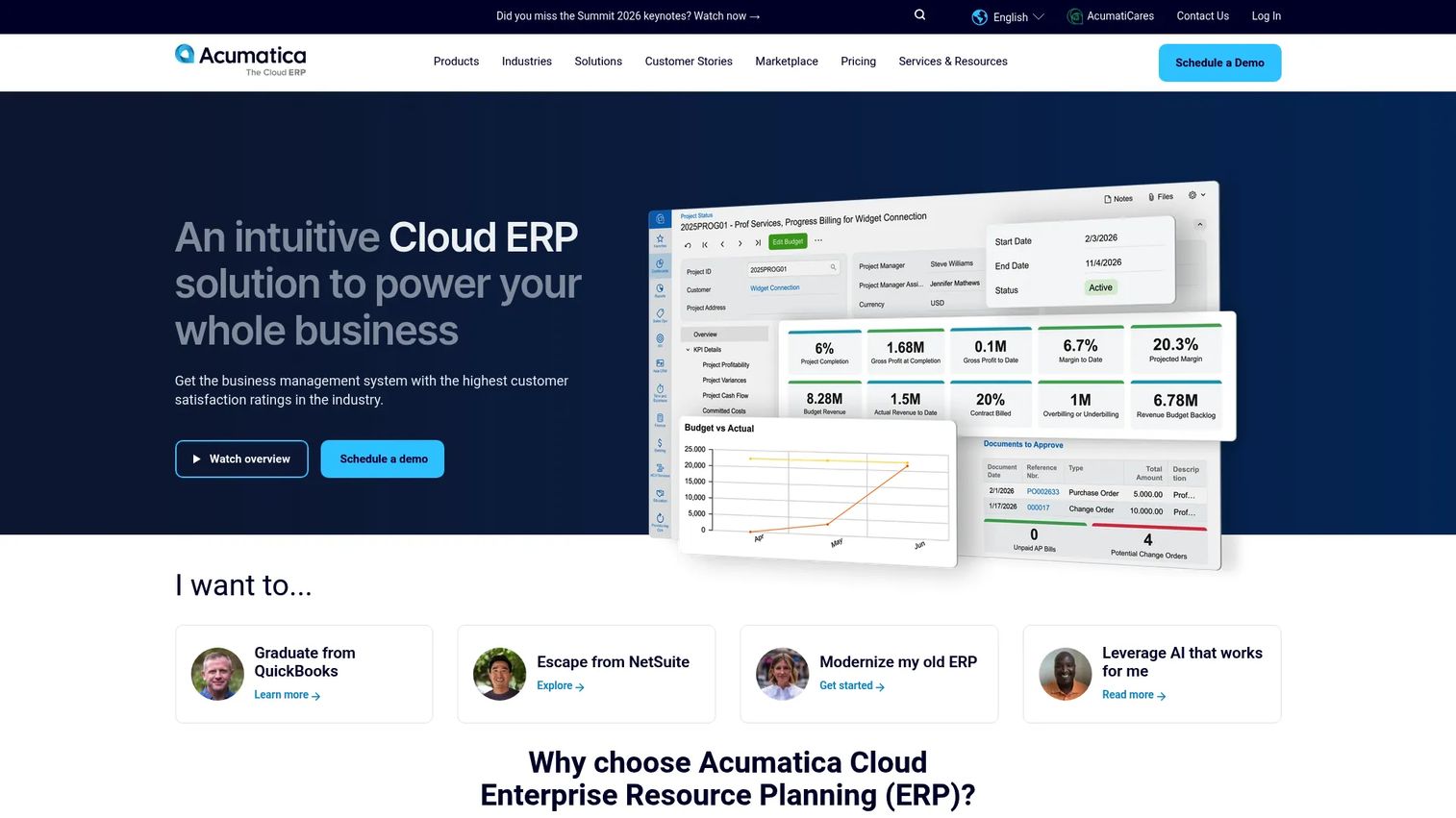
Acumatica Cloud ERP is a cloud ERP built for mid-sized businesses, with a distinctive consumption-based licensing model and unlimited users. For distribution operators, that means you can put every warehouse worker, field rep, and finance user on the system without per-seat costs multiplying. It layers inventory, fulfillment, reporting, dashboards, and mobile apps on a flexible platform you can shape to your workflow.
The modular fit is the draw. Distribution businesses that want broader operational planning, not just order and inventory management, can add modules as they grow. It suits teams that expect their process to evolve and do not want licensing to punish adding users.
Best for: Mid-market companies that need a scalable cloud ERP without per-user licensing.
Key strengths
- Unlimited users: Consumption-based pricing means you add people without adding seat costs.
- Flexible ERP modules: Inventory, fulfillment, workflows, document management, and reporting adapt to your operation.
- Platform features: Dashboards, mobile apps, and configurable workflows support real-time visibility across the business.
Why choose Acumatica: Choose Acumatica when headcount is growing and you do not want licensing to penalize putting the whole team on the system. Its modular design lets distribution operators start with inventory and order management, then expand into broader planning. It fits companies that value flexibility and want ERP integration without a rigid seat model.
Acumatica pricing: Acumatica uses customized, consumption-based pricing tailored by applications, resource usage, and deployment preference rather than a public list price. Request a scoped quote based on your module and usage needs. Acumatica holds a 4.4/5 rating on G2.
6. Agiliron
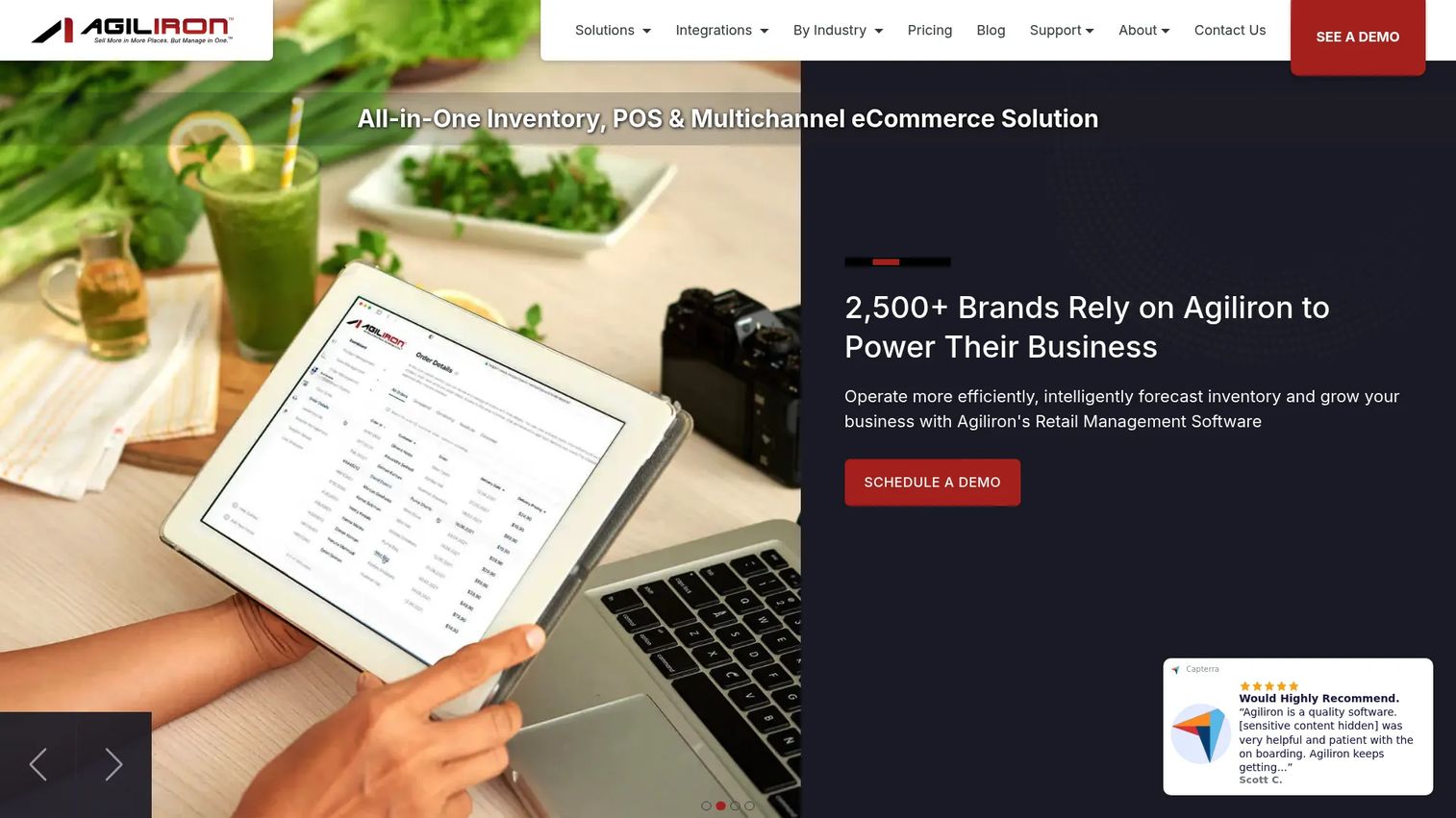
Agiliron is a multi-channel commerce platform for retailers, wholesalers, and distributors managing orders across many channels at once. It brings point of sale, inventory management, a warehouse management app, order management, B2B and B2C eCommerce, marketplace integration, CRM, and business intelligence into one system. For operators selling through several channels, it centralizes inventory visibility and order routing so stock and orders stay consistent everywhere.
Where it fits is omnichannel distribution. If you sell wholesale, run retail, and list on marketplaces, Agiliron keeps one inventory truth across all of it and routes orders to the right fulfillment path.
Best for: Retailers, wholesalers, and distributors that need one platform for sales channels, inventory, and POS.
Key strengths
- Multi-channel commerce: Retail, wholesale, B2B, B2C, and marketplace orders run through one system.
- Inventory and warehouse: Central inventory management plus a warehouse app keeps stock accurate across channels.
- Order routing and BI: Order management with routing and built-in business intelligence supports operational control and reporting.
Why choose Agiliron: Choose Agiliron when your distribution runs across multiple sales channels and inventory drift is the core pain. It earns its place for operators who need omnichannel order routing without a custom-built integration layer. It fits businesses that want commerce and distribution operations in one place.
Agiliron pricing: Public pricing lists three editions billed monthly: Premier at $99 per month, Enterprise at $199 per month, and Global Enterprise at $299 per month. A 30-day free trial is available with no credit card required. Agiliron holds a 4.2/5 rating on G2.
7. Tecsys
Tecsys provides cloud-based supply chain software for healthcare, distribution, retail, and complex fulfillment operations. It is built for the demanding end of distribution, where inventory visibility, order orchestration, and warehouse workflows get genuinely complicated. The platform pairs an end-to-end supply chain foundation with low-code adaptability and AI-driven supply chain intelligence, so larger operators can configure it to their reality rather than force-fitting a rigid tool.
Where it fits is scale and complexity. Organizations running multi-site fulfillment, healthcare distribution, or intricate warehouse operations get a configurable platform designed for that difficulty, not a lightweight order tool stretched past its limits.
Best for: Organizations that need a configurable enterprise supply chain platform for complex fulfillment.
Key strengths
- End-to-end supply chain: One platform covers inventory, orchestration, and fulfillment across the operation.
- Low-code adaptability: The Itopia layer lets teams configure workflows without heavy custom development.
- AI supply chain intelligence: TecsysIQ surfaces insights across the supply chain for better operational decisions.
Why choose Tecsys: Choose Tecsys when your logistics and warehouse workflows are complex enough that a general DMS would strain. It fits operators in healthcare distribution and multi-site fulfillment who need configurability and orchestration depth. It is the right call when supply chain complexity, not order entry, is your defining challenge.
Tecsys pricing: Tecsys does not publish public pricing on its site; engagements are scoped to the operation's size and complexity. Plan for a consultative sales process and a defined implementation. Ratings were not listed on a primary rating source at the time of writing.
8. SYSPRO
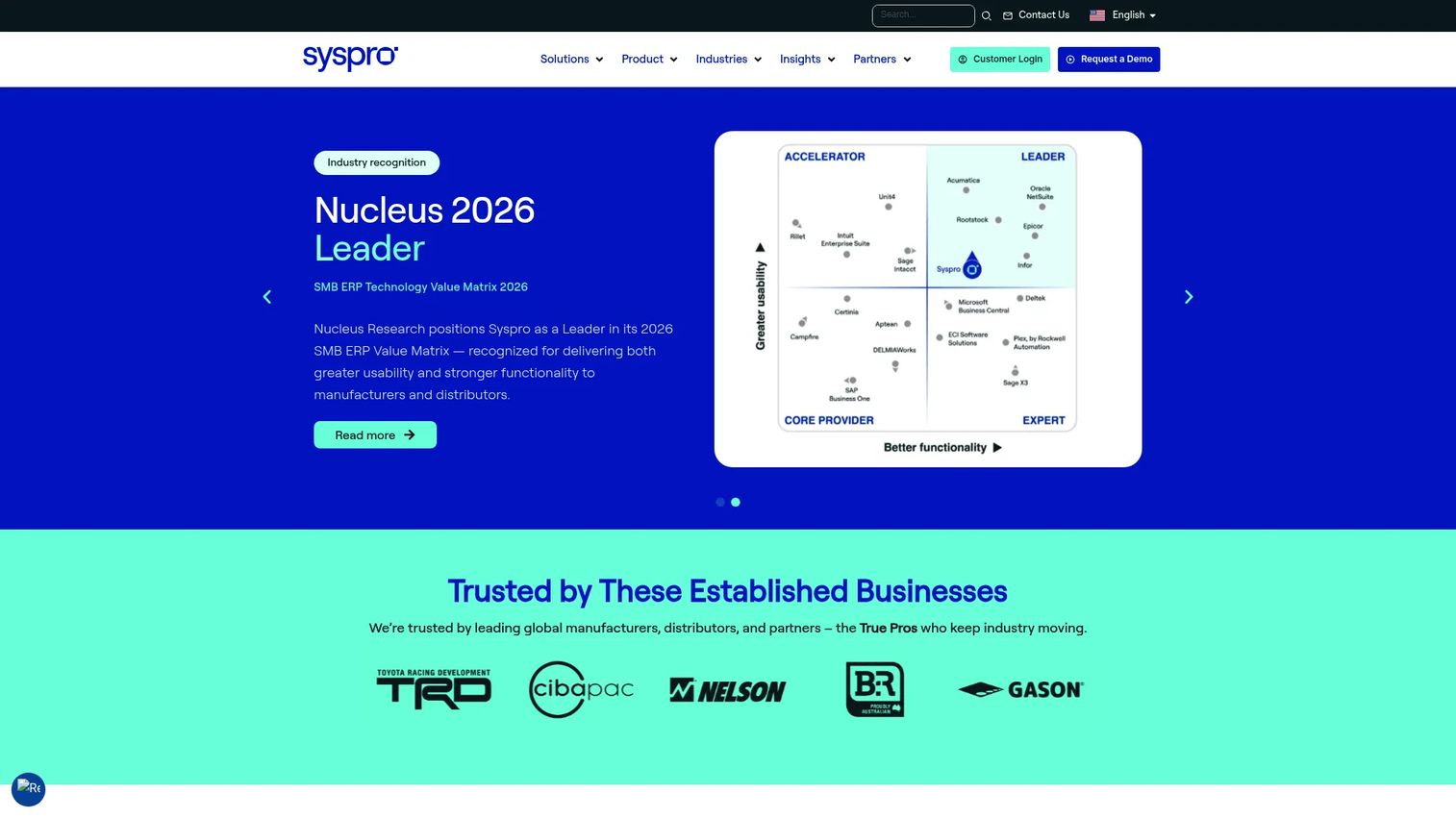
SYSPRO is an industry-specific ERP for manufacturers and distributors that need strong operational control and inventory management alongside production-adjacent workflows. It is designed for businesses where distribution sits close to manufacturing, so pricing engines for sales and purchasing, inventory management, and embedded analytics all live in one system. For mid-sized makers who also distribute, that overlap is the point.
Where it fits is complex operational environments. If your business runs production and distribution together and needs tight control over both, SYSPRO's manufacturing-and-distribution focus is more targeted than a generic ERP.
Best for: Mid-sized manufacturers and distributors that need industry-specific ERP.
Key strengths
- Manufacturing and distribution ERP: One system covers production-adjacent workflows and distribution operations.
- Pricing engines: Sales and purchase pricing engines handle complex, tiered pricing across the operation.
- Embedded analytics: Business intelligence and embedded analytics support KPI reporting without external tools.
Why choose SYSPRO: Choose SYSPRO when manufacturing and distribution are tightly linked and you need ERP-grade control over both. It earns its place for mid-sized operators who want industry-specific depth rather than a horizontal platform. It fits companies whose distribution challenge is inseparable from their production workflow.
SYSPRO pricing: SYSPRO does not display a public numeric price; pricing depends on organization size, users, modules, customization, and deployment. The vendor describes it as cost-competitive and quotes per engagement. SYSPRO holds a 4.1/5 rating on G2.
Considerations before you buy
The best distribution management software is the one that fits your actual workflow, not the one with the longest feature list. Run every shortlisted vendor through these criteria before you commit.
Field and offline usability
If your team works off phones in delivery zones with spotty signal, offline mobile access is non-negotiable. Test order capture and delivery confirmation on a real device, not a demo screen. A system that stalls without a connection creates more manual reconciliation than it removes.
Reporting and KPI depth
Ask to see the exact reports leadership will read every week. Reporting and analytics is the fastest-growing part of this market for a reason: operators want KPI reporting that updates itself. If ops still has to export and rebuild in a spreadsheet, the reporting layer is not doing its job.
Integration fit with your stack
Confirm how the platform handles ERP integration, plus CRM and accounting connections. Ask which systems it connects to natively versus through middleware. Fragmented data is usually the root problem, so integration depth decides whether the tool actually consolidates or just adds another silo.
Implementation speed and stack fit
Get a straight answer on time-to-first-value. A lightweight portal can go live in weeks; a full ERP is a multi-quarter project. Match the timeline to your urgency and your team's capacity to absorb change.
Total cost relative to your stage
Look past the sticker price to seat models, implementation fees, and add-ons. A per-rep tool and a consumption-based ERP scale very differently as you grow. Model the cost at your projected headcount, not today's.
Conclusion
The eight platforms here map cleanly to different distribution realities. For modern operational control across field sales, routing, and retail execution, SimplyDepo leads the list. For enterprise route-to-market with schemes and AI analytics, Botree AI fits complex FMCG networks. When you want distribution inside a consolidated system, NetSuite and Acumatica Cloud ERP deliver ERP-centered operations, with Acumatica's unlimited-user model appealing to growing teams. For lightweight wholesale order management, B2B Wave gets buyers self-serving fast. And for larger distribution complexity, Agiliron handles multi-channel commerce while Tecsys and SYSPRO cover supply chain and manufacturing-adjacent workflows.
The practical move before you compare vendors: write down your three must-have workflows first. Whether that is offline order capture, real-time inventory visibility, or clean KPI reporting, define what the software must do before you sit through a single demo. That list will disqualify half the market faster than any feature comparison, and it keeps the evaluation anchored to the operational drag you are actually trying to remove.
FAQs
Distribution management software centralizes inventory, order processing, delivery execution, reporting, and distributor collaboration in one workflow. It replaces the patchwork of spreadsheets, email orders, and paper routes that quietly taxes distribution businesses. The goal is one source of truth that ops, sales, and finance can all run on.
At minimum, look for inventory management, order management, route and delivery support, KPI reporting, and integration with your ERP, CRM, and accounting systems. Field and offline mobile access matters if your team works in the field. The right mix depends on whether your bottleneck is order entry, delivery execution, or reporting.
A distributor management system focuses on distribution execution: orders, inventory, routes, and field workflows. An ERP is a broader spine that runs finance, operations, and often manufacturing, with distribution as one module. Purpose-built DMS tools tend to fit field motions faster; ERPs like NetSuite and Acumatica win when consolidation across the whole business is the priority.
If drivers or field sales reps place orders and confirm deliveries on-site, yes. Delivery zones often have weak signal, so offline mobile access prevents data loss and manual re-entry later. Test it on a real device before buying, because a mobile experience that fails without connection creates the exact reconciliation work you are trying to eliminate.
Look for visit scheduling, route optimization, delivery confirmation, and proof of delivery like photos or signatures. Reconciliation in the field matters as much as planning, because that is where delivered-versus-ordered gaps surface. SimplyDepo's route intelligence is a good reference point for what strong field execution looks like.
Choose a full distributor management system when you need inventory, routing, delivery, and reporting together. Choose lighter wholesale order software like B2B Wave when your main friction is manual order entry and you want buyers to self-serve fast. If your problem is ordering, do not buy an ERP to solve it.
Yes, and it is often the biggest single win. Reporting and analytics is the fastest-growing part of the distributor management system market at 13.4% CAGR, per Dataintelo (2025). A good platform turns raw operational data into KPI reporting leadership can open on demand, instead of ops rebuilding spreadsheets every week.
ERP integration, accounting, and CRM connections matter most, because they keep operational and financial data consistent. Confirm which integrations are native versus middleware-dependent before you commit. Fragmented data is usually the underlying problem, so integration depth decides whether a distribution management solution truly consolidates or just adds another disconnected system.