Your care team is chasing follow-ups across three systems. Patient risk data lives in one place, care plans in another, and billing evidence somewhere else entirely. Nobody has a clean view of who is slipping through the cracks.
That fragmentation is the real problem chronic care teams face. It is not a lack of effort. It is that the work spans too many disconnected tools, and the handoffs between them leak.
Disease management software exists to pull that work into one operational layer: risk tracking, care coordination, patient engagement, and reporting in a system your team actually runs the day in. The global disease management software market was valued at USD 4.21 billion in 2024 and is projected to reach USD 9.12 billion by 2033, a 9.1% CAGR from 2026 to 2033, according to Verified Market Reports (2025). That growth reflects a simple pressure: chronic conditions keep rising, and manual coordination does not scale with them.
This guide compares seven disease management platforms for provider organizations weighing their options in 2026. No fluff, no inflated claims. Just how each tool actually fits chronic care operations.
What's inside
This guide is for providers, care coordination teams, and health systems comparing chronic disease management software. We reviewed each platform against the criteria that decide whether a tool survives contact with real chronic care operations.
We selected and evaluated platforms based on:
- EHR integration and interoperability fit
- Care coordination and patient engagement depth
- Analytics, predictive insight, and reporting
- Billing, documentation, and operational usability
Tools range from analytics-heavy population health platforms to managed care coordination services. The right pick depends on whether you need software, service, or both.
TL;DR
- Best for analytics-driven population management: Arcadia, built for health systems already thinking in cohorts, risk, and care gaps.
- Best for EHR-native workflow integration: Canvas Medical, with FHIR-native architecture and developer extensibility.
- Best for turnkey RPM and CCM services: 1bios and HealthSnap, where enrollment and monitoring run as a managed model.
- Best for outsourced or hybrid care coordination: ChartSpan and Signallamp Health, software plus operational support.
- Best for billing and documentation-first CCM: TimeDoc Health, built around reimbursement, tracking, and administrative efficiency.
What is disease management software
Disease management software is a category of healthcare technology that helps provider organizations monitor chronic conditions, coordinate care teams, track patient engagement, and support long-term chronic care management across large patient populations.
It sits on top of your clinical systems and turns scattered patient data into a coordinated workflow. Where an EHR records what happened, disease management software helps your team decide what happens next: who to reach, when to follow up, and where care gaps are opening.
Core capabilities usually include:
- Risk stratification: ranking patients by clinical and social risk so teams focus effort where it matters
- Care plan coordination: assigning, tracking, and routing tasks across nurses, coordinators, and clinicians
- Patient engagement: outreach, reminders, and self-management support that drive patient adherence
- EHR integration: connecting cleanly to existing clinical records and workflows
- Reporting and predictive analytics: surfacing trends, gaps, and cohorts before they become escalations
- Billing and documentation support: capturing the evidence needed for chronic care reimbursement
The strongest platforms also handle multimorbidity support, since most chronic patients carry more than one condition. Population health management sits alongside this, giving leaders a view across the whole patient panel rather than one patient at a time.
When to use disease management software
Manage chronic populations at scale
When your panel grows past what spreadsheets and manual review can handle, you need patient stratification and a patient registry that surface risk automatically. Disease management software lets teams monitor large cohorts, flag rising-risk patients, and prioritize care gap closure without reviewing every chart by hand. This is where population health management earns its keep.
Coordinate multi-team follow-up
Chronic care rarely runs through one person. Nurses, coordinators, clinicians, and administrators all touch the same patient. Care coordination software keeps handoffs from dropping by routing tasks, tracking who owns what, and making follow-up logic explicit. Everyone works from the same care plan instead of separate notes.
Improve engagement and adherence
Patients disengage between visits. That is when conditions drift. Patient engagement software supports reminders, structured outreach, remote patient monitoring, and consistent follow-up so patients stay connected to their care plan. Telehealth integration extends that reach for check-ins that do not require an in-person visit.
Comparison table
The shortlist below is sorted by relevance to provider needs and operational fit. It spans analytics-led platforms, EHR-native systems, and managed care coordination services, so you can match the tool to how your team actually works. Pricing across this category is often custom and quoted per organization, so treat the pricing column as a starting orientation, not a final quote.
| # | Product | Best for | Key differentiator | Pricing | G2 rating |
|---|---|---|---|---|---|
| 1 | Arcadia | Analytics-led population health | Healthcare data lakehouse with point-of-care insights | Custom, via sales | 5.0/5 |
| 2 | 1bios | Turnkey RPM and CCM services | Fully managed enrollment and clinical workflows | PPPM or revenue share | Not available |
| 3 | Canvas Medical | EHR-native chronic care workflows | FHIR-native EMR with developer extensibility | From $4,000/month | Not available |
| 4 | HealthSnap | Combined RPM and CCM programs | Integrated remote monitoring and care management | Custom, via sales | Not available |
| 5 | ChartSpan | Managed Medicare care management | Full-service CCM and Annual Wellness Visit support | Custom, via sales | Not available |
| 6 | Signallamp Health | Outsourced CCM inside your EHR | Nurses work directly in the practice's EHR | $0 out of pocket | Not available |
| 7 | TimeDoc Health | Billing and documentation-first CCM | EHR-integrated care management with flexible service models | Software, hybrid, or full service | Not available |
Best disease management software for chronic care teams
1. Arcadia
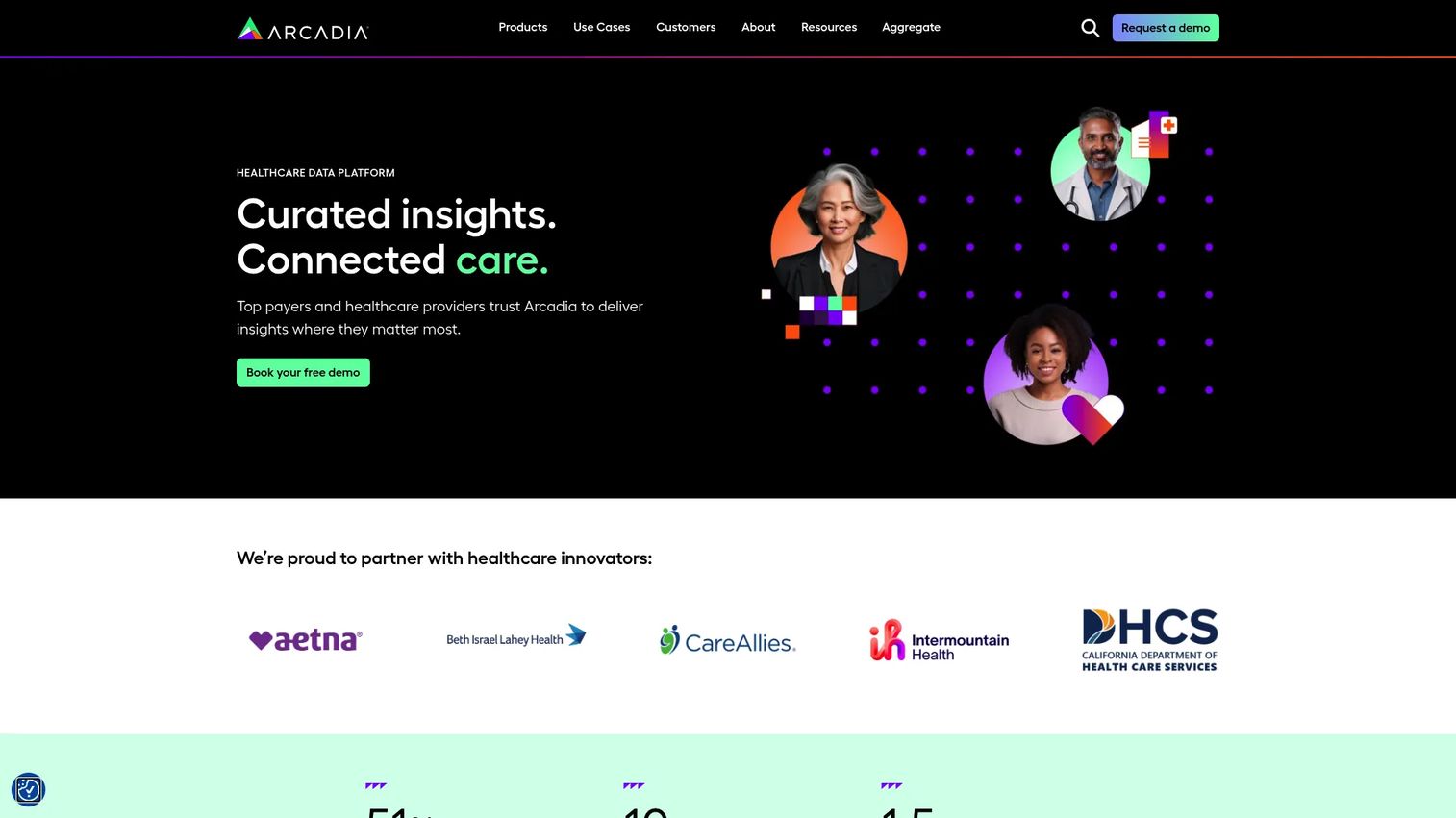
Arcadia is a healthcare data and analytics platform built for payers, providers, ACOs, and government organizations. It pulls clinical and claims data into a data lakehouse, then turns that into analytics, dashboards, and point-of-care insights. For chronic care teams, that means population-level visibility instead of chart-by-chart guesswork.
Arcadia is the analytics-heavy option on this list. It suits larger provider organizations that already think in terms of cohorts, risk, and care gaps, and need the data infrastructure to back that thinking.
Best for: Healthcare organizations that need population health and value-based care analytics at scale.
Key strengths
- Healthcare data lakehouse that unifies clinical and claims data
- Analytics and dashboards for population health management
- Point-of-care insights delivered inside care management workflows
- Patient stratification and risk adjustment support
- Engagement workflows tied to underlying data
Why choose Arcadia: Arcadia stands out when the buyer needs population-level insight, not just task tracking. If your chronic care strategy depends on identifying rising-risk cohorts and closing care gaps across a large panel, the data layer is the point. Smaller practices looking for a simple CCM workflow will find it heavier than they need.
Pricing: Arcadia does not publish public pricing. Cost is quoted through its sales process, so plan to scope a demo and a custom quote based on your organization's data and program scale.
2. 1bios
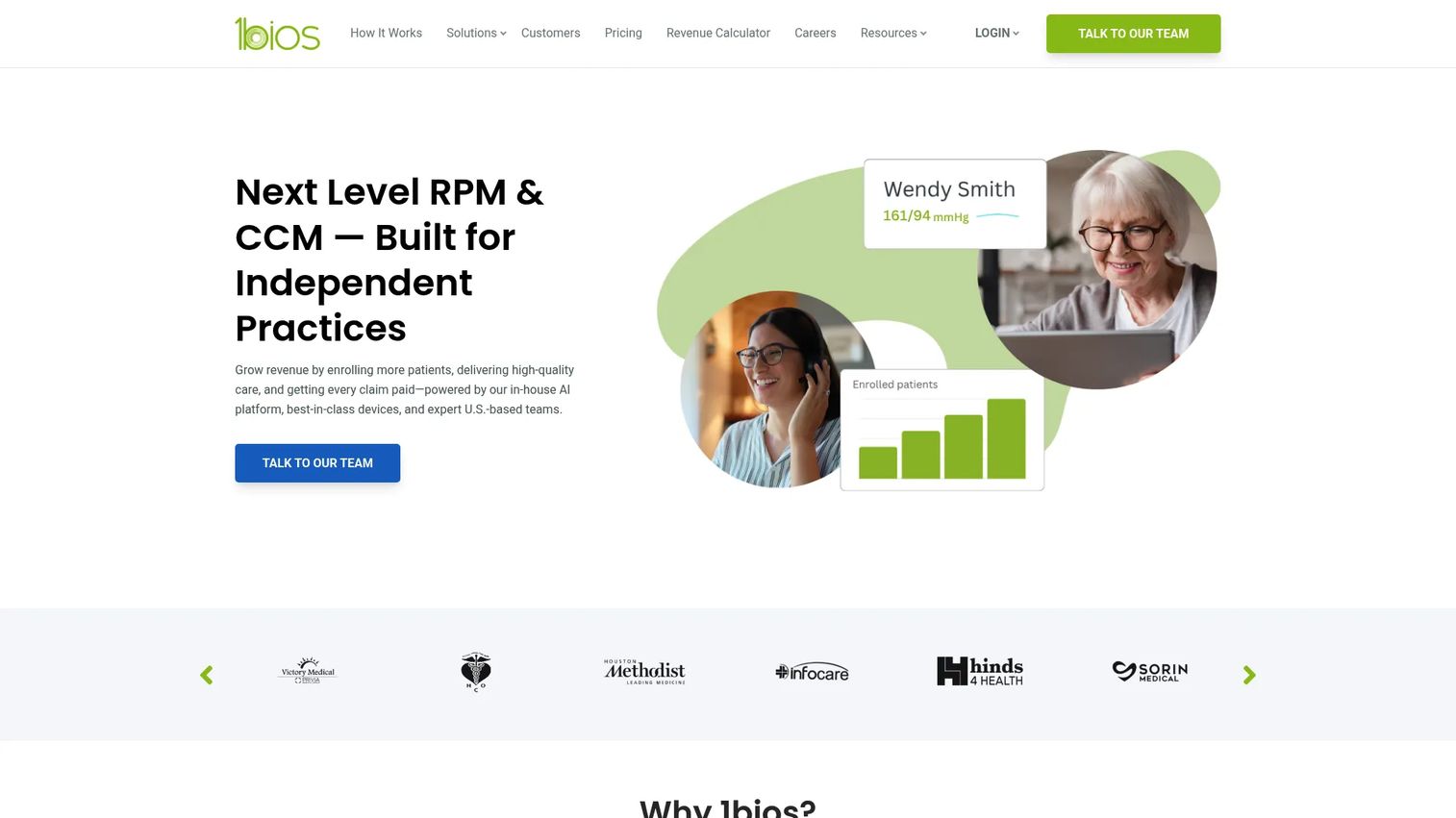
1bios delivers fully managed RPM, CCM, PCM, RTM, and APCM services for independent practices. Instead of asking your staff to build and run a chronic care program internally, 1bios handles patient enrollment, clinical workflows, and device logistics as a service. It leans on AI-powered clinical workflows to keep the operational load manageable.
The appeal is practical. Independent practices rarely have spare staff to stand up remote patient monitoring and care coordination from scratch. 1bios runs that machinery for you.
Best for: Independent medical practices seeking a turnkey RPM and CCM partner.
Key strengths
- Full patient enrollment services handled for you
- AI-powered clinical workflows across RPM, CCM, PCM, RTM, and APCM
- Managed device logistics and support
- Care coordination without building internal infrastructure
- Billing and documentation aligned to reimbursable programs
Why choose 1bios: Choose 1bios when you want the outcomes of a chronic care program without hiring and managing the team to run it. It fits practices that would rather partner than build. Organizations that want deep in-house control over every workflow may prefer a platform they configure themselves.
Pricing: 1bios offers per-patient-per-month (PPPM) or revenue-share pricing, with no setup fees, no minimums, and no long-term contracts. A software-only VAR model is also available. Exact numeric pricing is quoted directly rather than listed publicly.
3. Canvas Medical
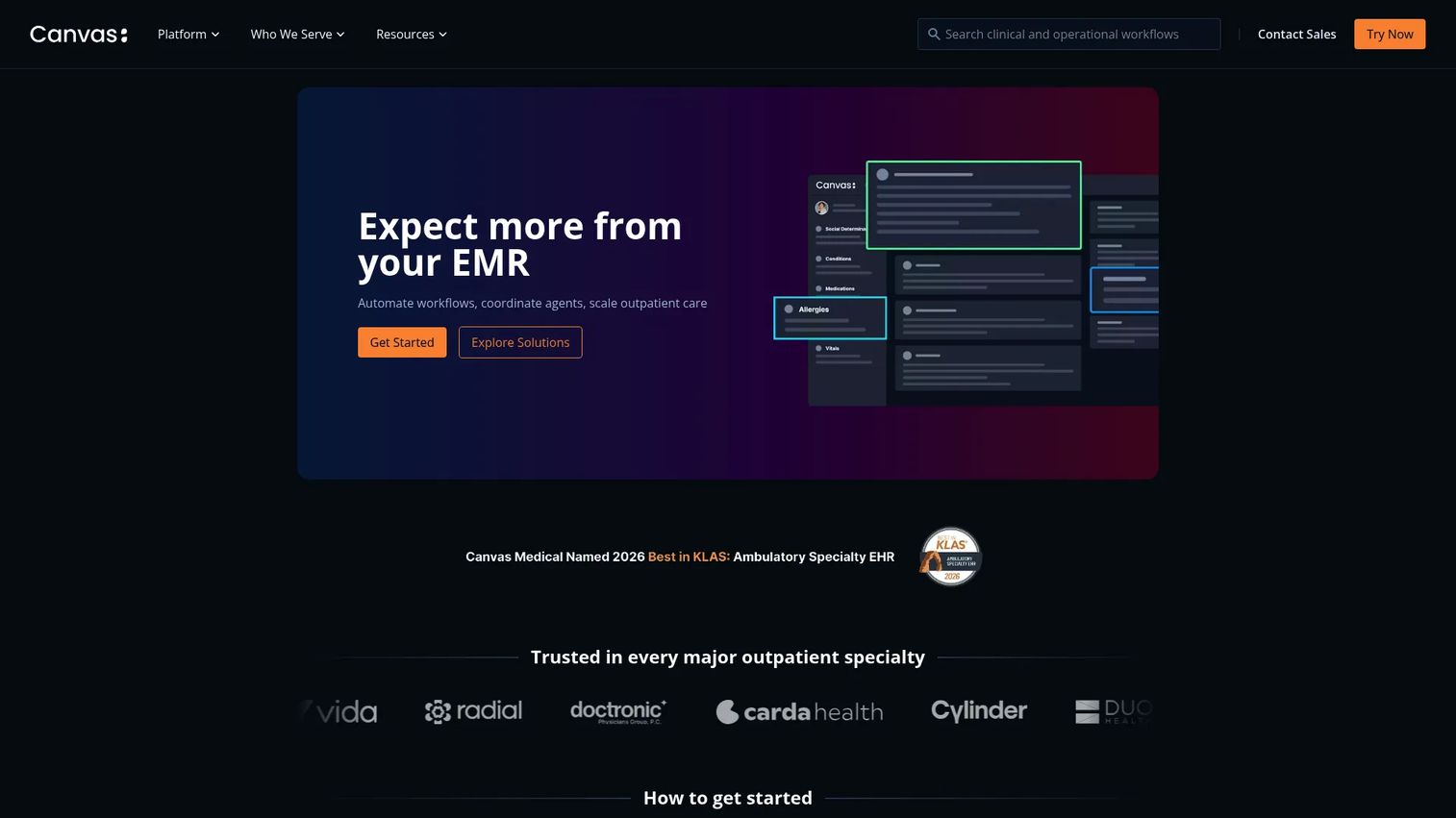
Canvas Medical is an EMR platform built for modern care delivery, with workflow automation and developer extensibility at its core. Rather than bolting chronic care management onto a separate tool, Canvas lets teams build condition-specific protocols directly inside the clinical workflow. Its FHIR API and plugin architecture make it the developer-friendly option here.
This is the choice for teams that want chronic care management embedded in the record itself, not managed in a parallel system. Digital health builders especially benefit from the extensibility.
Best for: Clinics and digital health teams that want a customizable EMR with deep workflow control.
Key strengths
- Builder and Enterprise plans with unlimited users and API calls
- FHIR API with 41 supported resources and 21 with write support
- Plugins, agents, and embeddable applications for workflow customization
- Custom care protocols built into the EMR
- Interoperability designed for connected care delivery
Why choose Canvas Medical: Canvas fits teams that treat their EMR as a platform to build on, not just a system of record. If you have developer capacity and want chronic care workflows native to the chart, the extensibility pays off. Teams looking for an outsourced service rather than a build surface will look elsewhere on this list.
Pricing: Canvas Medical starts at $4,000/month for the Builder plan, which includes the first 1,000 monthly active patients. The Enterprise plan includes the first 3,000 active patients and is quoted through sales. Pricing scales with monthly active patients. There is no free tier.
4. HealthSnap
HealthSnap is a virtual care management platform that combines remote patient monitoring and chronic care management in one operating model. It layers AI-guided care coordination and workflow automation on top of monitoring data, then feeds population analytics back to providers. When RPM is central to your disease management program, HealthSnap connects it into clinical operations.
The differentiator is integration. Rather than running RPM and CCM as separate efforts, HealthSnap treats them as one continuous workflow with shared data.
Best for: Teams that need remote patient monitoring plus care management in a single platform.
Key strengths
- Integrated RPM and CCM in one system
- AI-guided care coordination and workflow automation
- Patented Eligibility Report for program qualification
- Population analytics for provider decision-making
- Provider dashboards and care coordination support
Why choose HealthSnap: HealthSnap is strong when remote monitoring is the backbone of your chronic care program and needs to tie back into clinical operations. If device data and care management should live in one place, the integration matters. Teams without an RPM component may not need its full scope.
Pricing: HealthSnap does not display public pricing. Cost is scoped through its sales process, so expect a custom quote based on program size and services.
5. ChartSpan
ChartSpan provides managed care management services and software for Medicare-focused practices. It covers chronic care management, Annual Wellness Visit software, and remote patient monitoring enrollment, plus quality improvement support. For provider organizations that want a partner to run the program rather than software to operate, ChartSpan is built around the managed-service model.
The pitch is software plus operational support. ChartSpan handles patient outreach and enrollment so your staff can stay focused on clinical work.
Best for: Healthcare organizations that want a managed partner for Medicare care management programs.
Key strengths
- Chronic Care Management (CCM) as a managed service
- Annual Wellness Visit (AWV) software
- Remote Patient Monitoring (RPM) enrollment
- Patient outreach and engagement handled by ChartSpan
- Billing support aligned to Medicare programs
Why choose ChartSpan: ChartSpan is best when you want software and operational support together, not software alone. It fits Medicare-heavy practices that would rather outsource the day-to-day program mechanics. Teams that want to own and configure every workflow internally will prefer a platform-first option.
Pricing: ChartSpan does not publish a numeric price. Pricing is custom and varies by organization, and Medicare reimbursements vary by state and practice type. Contact ChartSpan for a scoped quote.
6. Signallamp Health
Signallamp Health delivers chronic care management and remote patient monitoring services for healthcare organizations. Its defining feature is that Signallamp nurses work directly inside the practice's own EHR, so the care coordination happens where the clinical record already lives. That keeps follow-up and documentation from splintering across systems.
This model helps teams operationalize chronic care without overwhelming existing staff. The nurses extend your team rather than adding another platform to log into.
Best for: Healthcare groups seeking outsourced CCM and RPM services without upfront implementation cost.
Key strengths
- Remote chronic care management delivered as a service
- Remote patient monitoring support
- Nurses operate directly in the practice's EHR
- Care plan follow-up handled by dedicated staff
- Reporting on chronic care program execution
Why choose Signallamp Health: Signallamp works well for teams that need help executing chronic care programs without straining internal staff. Because nurses work inside your EHR, there is no parallel system to maintain. Organizations that want a self-operated software platform rather than an embedded service team will look at other options here.
Pricing: Signallamp Health states $0 out-of-pocket costs and shares in the revenue generated from services. No public tiered pricing is listed, so specifics come through a direct conversation.
7. TimeDoc Health
TimeDoc Health provides healthcare technology and services for chronic care management, remote patient monitoring, and behavioral health monitoring. Its EHR-integrated care management workflow is built with billing and documentation front of mind, which suits provider groups that treat reimbursement and administrative efficiency as core requirements, not afterthoughts.
TimeDoc offers flexible engagement models, so teams can pick how much they run themselves versus hand off. That flexibility is the differentiator for practices at different staffing levels.
Best for: Healthcare organizations that want virtual care management with chronic care, RPM, and care coordination support.
Key strengths
- EHR-integrated care management workflow
- Chronic care management with structured documentation
- Remote patient monitoring
- Behavioral health monitoring
- Billing and compliance support built into the workflow
Why choose TimeDoc Health: TimeDoc fits teams that care about reimbursement, tracking, and administrative efficiency as much as patient follow-up. The flexible service models let you match the engagement to your staffing. Practices that only want raw analytics without the care management services layer may find it broader than needed.
Pricing: TimeDoc Health offers three models: Software Only, Hybrid, and Full Service. The pricing page shows symbolic markers ($, $$, $$$) rather than numeric prices, and lists the implementation fee as free. There is no free tier, and exact pricing comes through a quote.
Considerations
Before you shortlist a disease management platform, run each option against the criteria that actually determine fit. These are the questions that surface problems after signature, not before.
EHR and interoperability
Confirm which systems must connect cleanly and how. Look for real EHR integration, not just data export. Ask whether the platform supports FHIR and other interoperability standards, and whether care data flows both directions. A tool that only reads from your EHR forces double documentation.
Care coordination depth
Evaluate how the platform handles task routing, handoffs, and follow-up logic. Can it assign work across nurses, coordinators, and clinicians without dropping ownership? Care coordination software is only useful if it makes the next action obvious to the right person.
Billing and documentation
Chronic care reimbursement depends on documented time and activity. Check whether the platform captures the billing and documentation evidence you need for CCM, RPM, and related programs. Reimbursement support is often the difference between a program that pays for itself and one that drains staff time.
Patient engagement and adherence
Look at how the tool drives outreach, reminders, and self-management support. Patient engagement software should reach patients between visits and log the touches. Weak engagement means poor patient adherence, which undermines the whole program.
Analytics and reporting
Judge whether the platform gives actionable insight or just dashboards. Good predictive analytics flags rising-risk patients and open care gaps before they escalate. If the reporting cannot drive a next action, it is decoration.
Conclusion
Disease management software succeeds or fails on operational fit, not feature counts. The right pick depends on how your team is built and what you need it to carry.
- Analytics-first teams should start with Arcadia for population-level insight and patient stratification.
- EMR-native teams should look closely at Canvas Medical for chronic care workflows built into the record.
- Operational CCM teams should compare 1bios, ChartSpan, Signallamp Health, and TimeDoc Health, where managed services and billing support carry the load.
- RPM-heavy teams should evaluate HealthSnap for integrated remote monitoring and care management.
The practical next step is simple. Book demos with your top two or three, then verify integration fit against your actual EHR. Compare billing and workflow support side by side, and ask each vendor how their model handles multimorbidity and value-based care reporting. The platform that fits your workflow will beat the one with the longest feature list every time.
FAQs
Disease management software is healthcare technology that helps provider organizations monitor chronic conditions, coordinate care teams, and support long-term chronic care management across patient populations. It combines risk stratification, care coordination, patient engagement, and reporting so teams can manage large panels without losing track of individual patients.
The features that decide fit are analytics and predictive analytics for risk and care gaps, care coordination for task routing and handoffs, patient engagement for outreach and adherence, and interoperability for clean EHR integration. Billing and documentation support matters too, since chronic care reimbursement depends on captured evidence.
Strong platforms integrate through standards like FHIR and support two-way data flow, so care data written in the platform reflects back in the EHR and vice versa. The goal is one source of truth, not double documentation. Before buying, confirm exactly which EHRs the vendor supports and how deep the integration runs.
The terms overlap heavily and are often used interchangeably. Chronic care management software usually refers to programs tied to specific reimbursable services like Medicare CCM, focused on enrollment, time tracking, and billing. Disease management software is the broader category, spanning population health, risk stratification, and multimorbidity support across whole panels, with chronic care management as one part.
Providers track engagement rates, care gap closure, follow-up completion, and patient adherence, alongside operational outcomes like staff time saved and documented billable activity. The strongest programs also watch population-level trends, such as rising-risk cohorts and readmission patterns, to catch problems before they escalate.
Yes. Value-based care depends on the population insight and reporting these platforms provide. Risk stratification, care gap closure, and predictive analytics let teams manage outcomes across a panel rather than reacting patient by patient, which is exactly what value-based care contracts reward.
Yes, and for many buyers it is a primary reason to purchase. Platforms built for CCM and RPM capture the time, activity, and documentation needed to bill reimbursable programs correctly. That billing and documentation support often determines whether a chronic care program pays for itself or costs staff hours it never recovers.
Look at EHR integration depth, care coordination logic, billing and documentation support, patient engagement, and analytics that drive action rather than just display data. Run demos against your real workflows, confirm interoperability with your existing systems, and ask each vendor how their model handles multimorbidity and value-based care reporting.