Databricks projects rarely fail because teams lack ambition. They fail because migration, governance, pipelines, AI workloads and cost controls collide at once, and the wrong consulting partner makes every collision worse.
The global data and analytics services market reached $118 billion in 2025, according to DataIntelo, which means there's no shortage of vendors claiming Databricks expertise. What's harder to find is a partner whose depth matches your specific project stage: Assessment, lakehouse migration, Unity Catalog governance, MLflow-based model workflows or FinOps-style cost control after go-live.
For presales and sales engineering teams, this evaluation matters beyond vendor selection. When prospects ask whether your platform can integrate with Databricks, migrate into a lakehouse, or prove AI readiness, the consulting partner sitting behind that implementation directly affects technical validation risk. A weak governance story stalls security review. A brittle migration plan delays POC sign-off. A partner without managed-services depth creates post-launch ownership gaps that surface during renewal conversations.
This guide compares 10 Databricks consulting services and partner-discovery options so you can build a shortlist that matches the technical risk you need to reduce, not just the logo on the proposal.
What's inside
This guide covers 10 Databricks consulting services and partner-discovery paths evaluated for data, analytics, AI and technical GTM teams.
Items were chosen based on four criteria:
- Databricks specialization: Direct service coverage of Databricks products, not just general cloud consulting
- Migration and implementation depth: Evidence of lakehouse architecture, pipeline development and data migration experience
- Governance and security coverage: Unity Catalog, access controls, lineage and audit support
- AI and managed services: MLflow, MLOps, generative AI delivery and post-launch support options
Pricing, G2 ratings and service claims should be verified against live sources before finalizing any shortlist.
TL;DR
- Best official partner discovery path: Databricks Partner Directory, for teams that want to search the broadest verified pool of consulting and technology partners
- Best for Microsoft-centered Databricks projects: Collectiv, for Azure, Microsoft Fabric and Power BI-heavy programs; Visioning Program starts at $25,000
- Best for custom data engineering and AI delivery: Chetu, for teams that need broad implementation depth across Apache Spark, Delta Live Tables and MLflow
- Best for certified cloud-agnostic consulting: Cyntexa, for projects spanning AWS, Azure and Google Cloud deployment
- Best for Databricks migration cost and performance work: Ask every shortlisted partner separately about cluster policies, job scheduling and spend monitoring before you sign
What is Databricks consulting services?
Databricks consulting services help organizations design, implement, migrate, govern, optimize and operate Databricks-based data and AI platforms.
A consulting engagement typically starts with an assessment of the existing stack: Data warehouses, legacy ETL pipelines, data lakes or fragmented cloud storage. From there, the partner designs a lakehouse architecture on Delta Lake, builds ETL and ELT pipelines, and migrates data from Snowflake, Hadoop, or similar systems into the unified environment.
Governance work covers Unity Catalog setup, data lineage tracking, role-based access controls, PII handling and auditability. Analytics work spans Databricks SQL, dashboard development and BI continuity after migration. AI and ML services include MLflow, MLOps workflows, model serving and generative AI use cases built on Mosaic AI or similar frameworks. Post-launch, many partners offer managed Databricks services covering cluster tuning, job optimization and cost observability.
Common capabilities include:
- Lakehouse architecture design on Delta Lake
- Pipeline development and orchestration (batch, streaming, real-time)
- Data migration from warehouses, data lakes and legacy systems
- Unity Catalog governance, lineage and access control
- Databricks SQL analytics and BI continuity
- AI, MLflow and MLOps implementation
- Performance tuning and Databricks cost optimization
- Managed services and post-launch support
Services are priced by quote because scope drives cost. The main drivers are data volume, pipeline count, cloud environment (Databricks on AWS, Azure or Google Cloud), migration complexity and the support model after go-live. Treat any flat-rate estimate from a partner you haven't scoped with as a yellow flag.
For presales teams, the governance and AI sections matter most: Unity Catalog consulting and lineage documentation directly address the access-control and auditability questions that slow enterprise security reviews.
When to use Databricks consulting services
Migrate without breaking reporting
Teams moving from Snowflake, Hadoop or legacy data warehouses into Databricks need dependency mapping before a single pipeline moves. Schema assessment, pipeline refactoring, reconciliation testing and BI continuity planning are non-negotiable. A partner that skips reconciliation creates data-quality gaps that surface in production, usually during a demo or QBR.
Build governed analytics and AI
When security reviewers want to see how data access, lineage and model workflows are controlled, Unity Catalog consulting becomes the validation proof point. This is where presales gets pulled in: A prospect asking about data governance expects a concrete answer about catalog design, access policies and audit trails, not a whitepaper.
Reduce Databricks cost and performance drag
Cluster sprawl, slow notebooks and inefficient Spark jobs create friction that compounds as usage scales. FinOps-style governance, cluster policies, job scheduling and spend monitoring belong in the original SOW, not in an emergency optimization sprint six months after go-live.
Databricks consulting services comparison
The table below is a shortlist to accelerate evaluation, not a replacement for a formal RFP. Pricing values reflect verified sources; G2 ratings are from live listings at time of writing. For providers where no relevant G2 profile exists, N/A is noted.
| # | Product | Best for | Key differentiator | Pricing | G2 rating |
|---|---|---|---|---|---|
| 1 | Databricks Partner Directory | Official partner discovery | Searchable directory across consulting and technology partners | Free to browse | 4.6/5 |
| 2 | Collectiv | Microsoft-centered lakehouse projects | Databricks consulting tied to Azure, Microsoft Fabric and Power BI | From $25,000 | 4.8/5 |
| 3 | Chetu | Custom data engineering and AI development | Broad implementation across Spark, Delta Live Tables, MLflow and managed services | Custom pricing | 4.2/5 |
| 4 | Cyntexa | Certified cloud-agnostic Databricks consulting | Multi-cloud delivery across AWS, Azure and Google Cloud | Custom pricing | N/A |
| 5 | 10Pearls | Enterprise data and AI modernization | AI-native engineering with data architecture and MLOps depth | Custom pricing | N/A |
| 6 | 11:59 | AI and cloud-managed programs | AWS cloud modernization and AI adoption for government and enterprise | Custom pricing | N/A |
| 7 | 27Global | Cloud and software engineering support | Data engineering, AI and cloud modernization consulting | Custom pricing | N/A |
| 8 | 3Cloud | Azure-first data and AI teams | Microsoft Azure consulting with generative AI, MLOps and managed services | Custom pricing | 3.5/5 |
| 9 | 4 Mile Analytics | Analytics engineering and BI modernization | Data analytics, engineering and governance consulting | Custom pricing | N/A |
| 10 | 540.co, LLC | Cloud-native and public-sector modernization | Federal-grade DevSecOps, cloud data delivery and agile engineering | Custom pricing | N/A |
Best 10 Databricks consulting services for 2026
1. Databricks Partner Directory
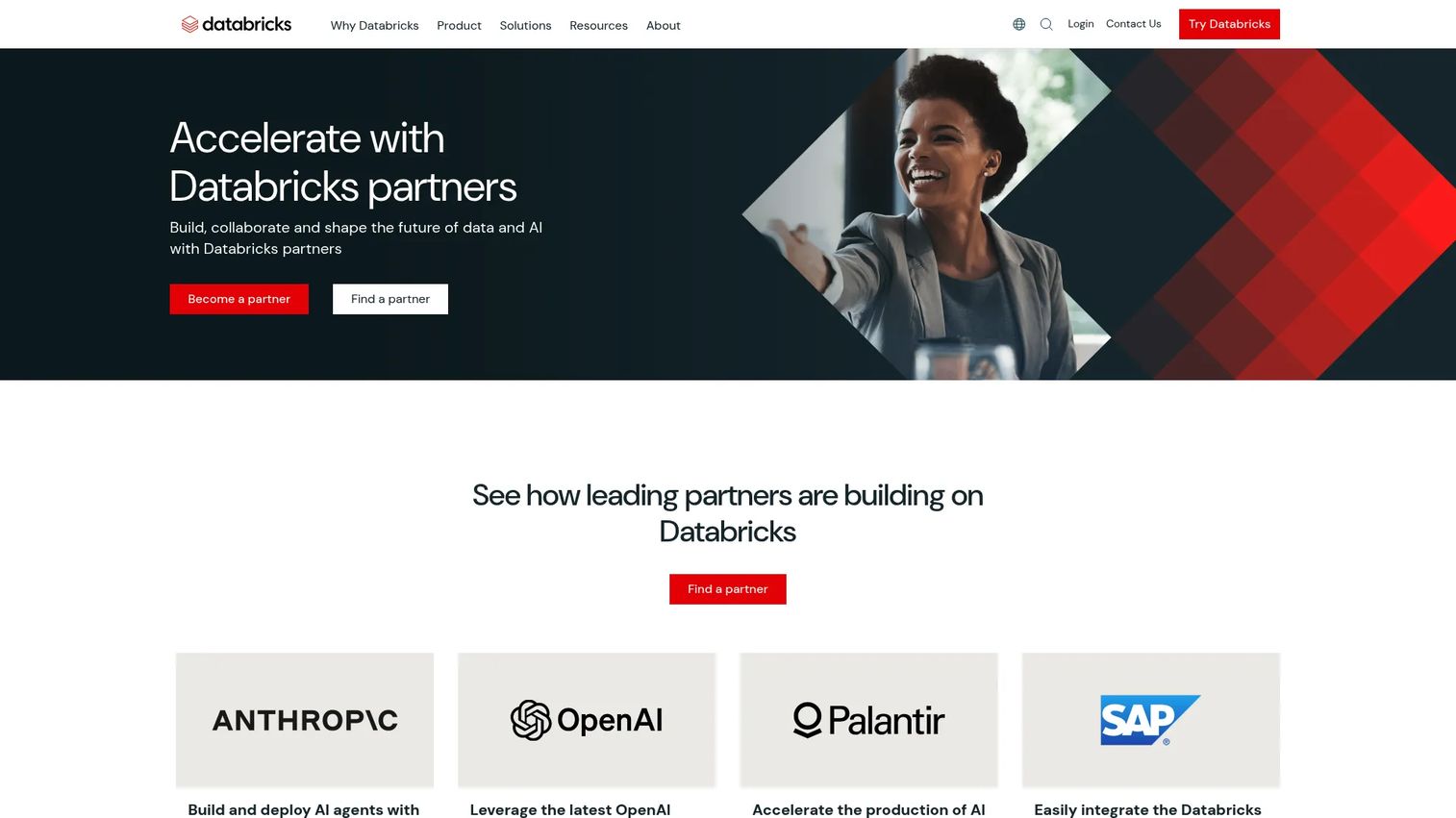
The Databricks Partner Directory is the official starting point for finding Databricks consulting partners. It lets buyers search across partner types, geographies and capabilities rather than relying on cold outreach or vendor referrals. For presales teams, the directory is a validation tool: When a prospect asks whether your platform has certified implementation partners or regional delivery options, this is where you direct them.
The directory is not a consulting firm. It surfaces the ecosystem so buyers can identify candidates, then apply their own diligence.
Best for: Teams that want the broadest verified pool of Databricks partners before narrowing to a shortlist.
Key features
- Official partner search with capability and geography filters
- Category browsing across data, AI and technology partners
- A to Z partner directory
- Partner program and portal context
- Broad coverage of Databricks consulting and technology partners
Why choose the Databricks Partner Directory: Choose this first when you need breadth, not a single vendor pitch. The directory surfaces the full range of certified partners, including region-specific options that cold searches miss. After pulling a candidate list, still run diligence on certifications, industry experience, delivery model and current availability before engaging.
Databricks Partner Directory pricing: Free to browse. Consulting pricing comes from the selected partner, so budget planning starts after you've identified candidates and scoped with them directly.
G2 rating: 4.6/5, based on the broader Databricks Data and AI Platform listing.
2. Collectiv
Collectiv is a data and AI consulting firm with a strong Microsoft ecosystem focus. It covers Microsoft Fabric, Power BI, Databricks and Azure, which makes it a natural fit when Databricks sits inside a broader Microsoft data stack rather than as a standalone platform. For Microsoft-first buyers in technical validation, Collectiv's coverage reduces integration risk across BI, cloud and data layers.
Its work spans data strategy, architecture, AI implementation and managed services, with specific offerings around Copilot and planning and forecasting work.
Best for: Microsoft-heavy teams modernizing analytics on Databricks, particularly where Power BI or Microsoft Fabric are already in the stack.
Key features
- Microsoft Fabric, Power BI, Databricks and Azure implementation
- Data strategy, architecture and stack design
- AI strategy including Copilot consulting
- Managed services and cloud licensing support
- Planning, forecasting and Power BI migration
Why choose Collectiv: Choose Collectiv when Databricks is part of a broader Azure modernization program and BI continuity matters as much as pipeline development. Confirm team availability, Databricks-specific certifications and industry experience before committing, since the Microsoft-first positioning means depth varies by workload type.
Collectiv pricing: The Visioning Program starts at $25,000. Broader implementation scopes are priced by engagement. G2 also references Power BI Implementation starting at $15,000 and training programs starting at $10,000, though these are G2-sourced ranges rather than figures on Collectiv's own site.
G2 rating: 4.8/5 on G2.
3. Chetu
Chetu is a custom software development and digital transformation firm with broad data engineering and AI delivery capability. Its Databricks-related work spans Apache Spark development, Delta Live Tables, MLflow and MLOps, generative AI and managed Databricks services. For presales teams supporting deals where technical validation spans custom integrations, app development and data workflow modernization, Chetu's breadth covers territory that specialist firms often don't.
The trade-off is that breadth requires tight SOW discipline. Without a narrow statement of work, broad service providers tend to scope wider than the project actually needs.
Best for: Teams that need custom data engineering, AI implementation and integration support across a complex stack.
Key features
- Apache Spark and Delta Live Tables development
- MLflow, MLOps and model serving
- Generative AI development and integration
- Managed Databricks services
- Enterprise application integration
Why choose Chetu: Choose Chetu for build capacity that spans data engineering, AI and custom software development. Narrow the statement of work before engagement, and ask for case studies that match your migration scope and industry.
Chetu pricing: Pricing is scoped by engagement and reflects engineering hours, integration complexity and support coverage. Contact Chetu directly for a project estimate.
G2 rating: 4.2/5 on G2.
4. Cyntexa
Cyntexa is an IT consulting and digital transformation partner with certified Databricks consulting coverage across AWS, Azure and Google Cloud. Its Databricks work covers implementation, migration, data engineering, machine learning and analytics, plus governance work including Unity Catalog. For enterprise buyers evaluating cloud-agnostic delivery, Cyntexa's multi-cloud positioning reduces lock-in risk and simplifies procurement framing.
Its broader practice covers Salesforce and ServiceNow alongside Databricks, so the engagement model matters: Confirm that the Databricks team is distinct from the CRM practice.
Best for: Enterprise teams that want certified, cloud-agnostic Databricks consulting with governance depth.
Key features
- Certified Databricks consulting across AWS, Azure and Google Cloud
- Unity Catalog governance and lakehouse implementation
- Data engineering, migration and pipeline development
- Machine learning and analytics delivery
- Post-launch support and optimization
Why choose Cyntexa: Choose Cyntexa when the project spans platform design, migration, governance and ongoing support, and when cloud neutrality matters for procurement. Ask for consultant credentials, delivery location and recent Databricks-specific project examples before signing.
Cyntexa pricing: Engagement pricing is customized by project scope. Ask about project-based, hourly or dedicated-consultant options when scoping.
5. 10Pearls
10Pearls is an AI-native software development and digital technology services company. Its capabilities span generative AI development, AI agent delivery, RAG and knowledge integration, MLOps, data engineering and custom product engineering. For enterprise buyers where Databricks is one component of a larger digital transformation, 10Pearls provides scaled delivery capacity that specialist data firms often can't match in headcount or timeline.
The tradeoff: Confirm current Databricks-specific credentials and project examples before engagement, since AI-native positioning doesn't automatically imply Databricks platform depth.
Best for: Enterprises that want data modernization and AI delivery inside a broader digital engineering program.
Key features
- Generative AI and AI agent development
- RAG and knowledge integration
- MLOps and scalable model deployment
- Data engineering and cloud architecture
- Custom software and product engineering
Why choose 10Pearls: Choose 10Pearls when Databricks is one part of a larger transformation and you need a partner with broad AI and engineering capacity. Ask for separate estimates across assessment, build and ongoing support phases.
10Pearls pricing: Pricing is customized by project scope, team size and engagement model. No numeric rates are shown on the site. Contact 10Pearls directly for a scoped estimate.
6. 11:59
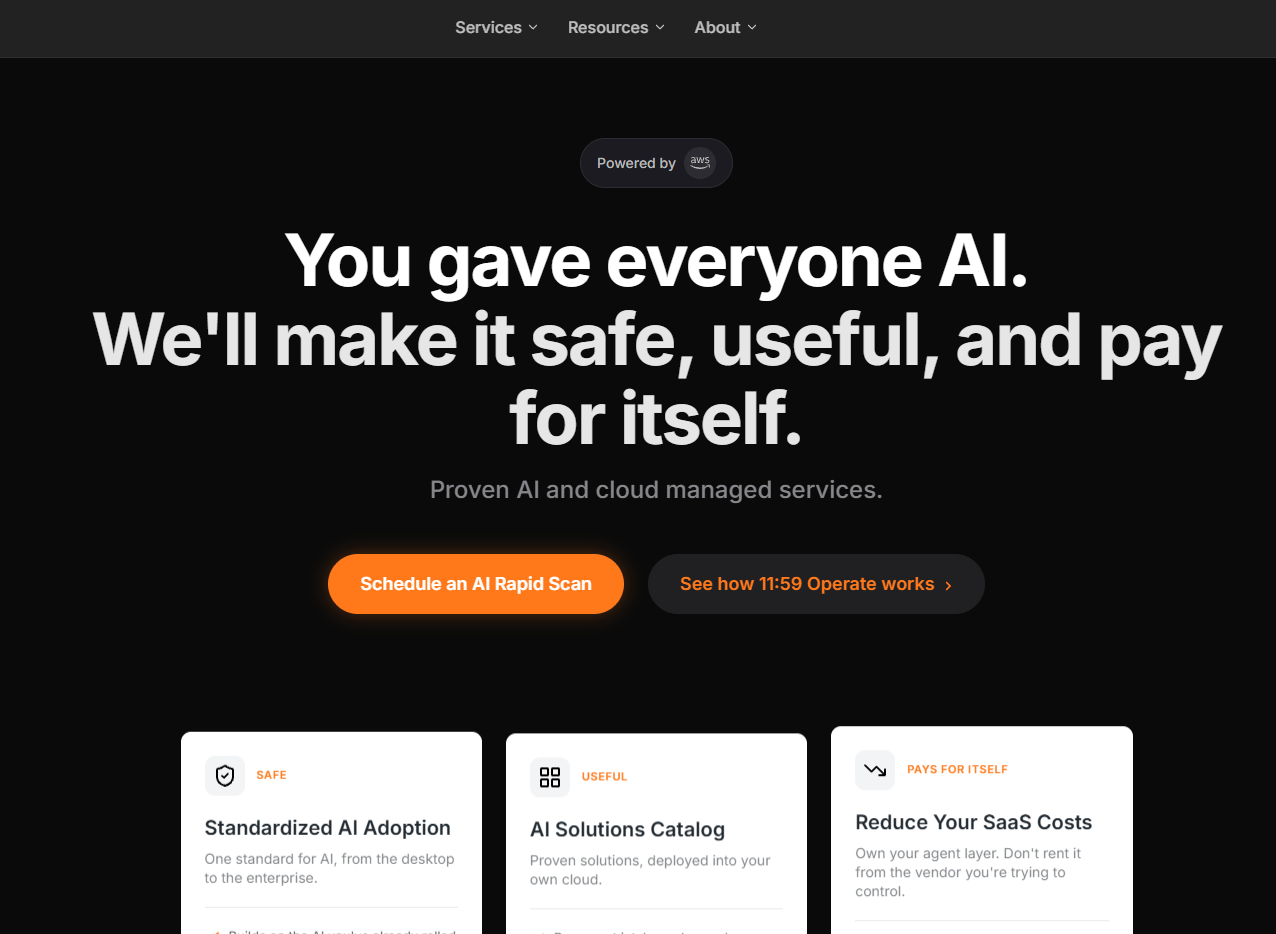
11:59 is an AI and cloud managed-services firm focused on standardized AI adoption, AWS cloud modernization and ongoing AI operations. Its documented capabilities cover AI solutions for document intake, public-records workflows, knowledge search and database migration, alongside AWS cloud foundations, rapid migration and managed AI operations with defined SLAs.
For presales teams supporting deals where the buyer is a government department or a growth organization running on AWS, 11:59's structured delivery model addresses the compliance-aware, documentation-heavy procurement processes common in those segments.
Best for: Teams evaluating enterprise data transformation and AI adoption, particularly AWS-centric and government-adjacent programs.
Key features
- Standardized AI adoption and governance frameworks
- AWS cloud foundations and rapid migration
- AI solutions for document intake, knowledge search and ERP workflows
- Managed AI operations with monitoring and SLAs
- Database migration planning and execution
Why choose 11:59: Choose 11:59 when the project needs structured AI strategy and cloud foundation work before Databricks buildout. Verify current Databricks-specific experience directly, as the firm's documented focus centers on AI and AWS managed services.
11:59 pricing: Services are scoped and quoted before work begins. Ask for a discovery-led estimate tied to platform scope, delivery team size and SLA requirements. No rates are shown publicly.
7. 27Global
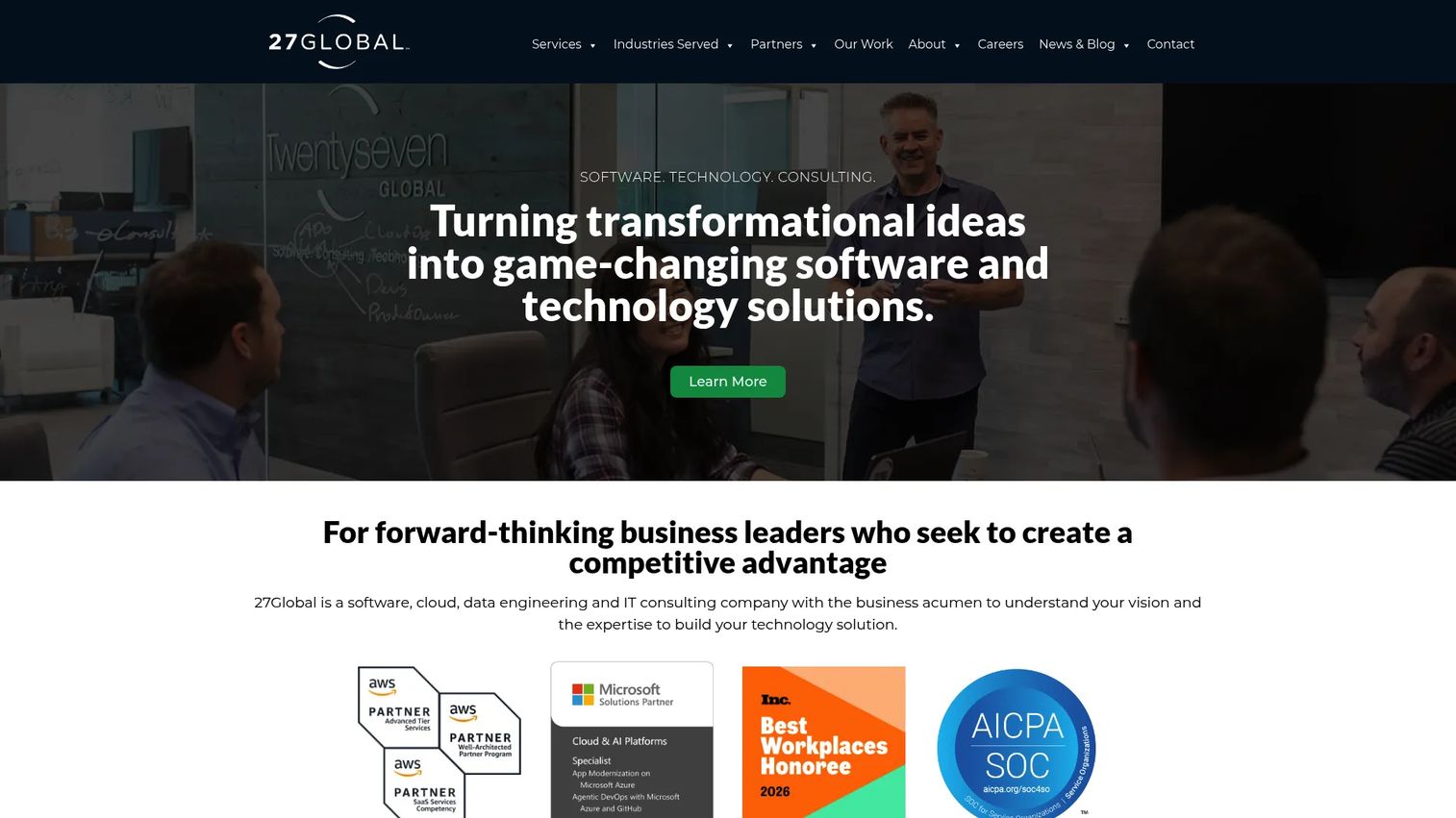
27Global is a software, cloud, data engineering and IT consulting company. Its capabilities span custom software development, cloud engineering, data engineering and analytics, AI and agentic solutions, and systems integration. For presales teams where a Databricks project connects to broader application or cloud architecture work, 27Global's cross-disciplinary delivery reduces the number of vendors the buyer needs to coordinate.
Verify Databricks certifications, cloud specialization and recent project examples before including 27Global in a formal evaluation, since the services portfolio is broad.
Best for: Teams pairing Databricks with cloud-native software engineering or systems integration work.
Key features
- Cloud engineering and security
- Data engineering and analytics
- AI and agentic solution development
- Custom software development
- Systems integration and technology consulting
Why choose 27Global: Choose 27Global when the Databricks project connects to broader application or cloud architecture decisions. Ask for a scoped delivery plan with milestones and staffing assumptions, and confirm Databricks-specific credentials before engagement.
27Global pricing: Ask for a scoped delivery plan that separates data engineering, cloud work and integration phases.
8. 3Cloud
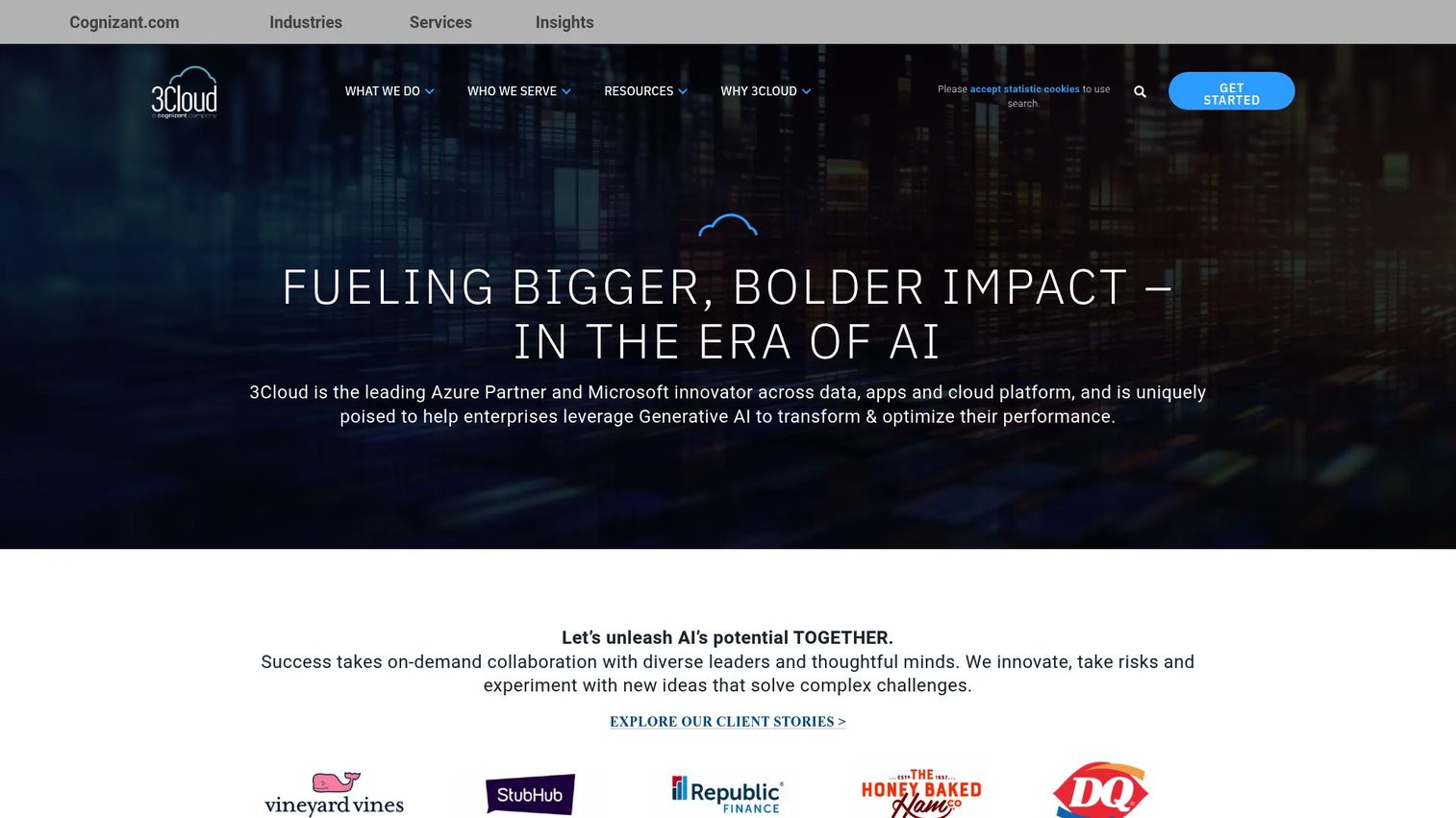
3Cloud is a Microsoft Azure consulting partner with dedicated practices across data and AI, app innovation and cloud platform services. Its capabilities include generative AI, machine learning, MLOps, cloud-native development, infrastructure migration and managed services. For Azure-first buyers, 3Cloud's MILO AI-augmented delivery methodology and managed platform services reduce delivery risk on complex cloud modernization programs.
Verify whether Databricks delivery sits within 3Cloud's data and AI practice or is handled as a subcomponent of Azure modernization work.
Best for: Azure-first data and analytics teams where Databricks is part of a broader Microsoft cloud program.
Key features
- Azure data and AI services including generative AI and MLOps
- App modernization and cloud-native development
- Cloud strategy, infrastructure migration and managed services
- MILO AI-augmented delivery methodology
- Managed platform, data and AI services
Why choose 3Cloud: Choose 3Cloud when Microsoft cloud fit matters as much as Databricks expertise, and when managed services continuity after migration is a priority. Ask specifically about Databricks delivery depth within the data and AI practice.
3Cloud pricing: Request separate estimates for Azure architecture, Databricks migration and managed services when scoping.
G2 rating: 3.5/5 on G2, based on one review.
9. 4 Mile Analytics
4 Mile Analytics is a data consultancy focused on analytics engineering, data governance and BI modernization. Its documented capabilities span data analytics, data engineering and data governance. For buyers where Databricks project success depends on trusted business reporting and stakeholder adoption of governed datasets, 4 Mile's analytics-first orientation addresses the last-mile problem that platform-focused partners often underinvest in.
Verify Databricks-specific experience directly, as the firm's core positioning centers on analytics consulting rather than platform engineering.
Best for: Teams that need analytics engineering and BI modernization support alongside Databricks data platform work.
Key features
- Analytics engineering and data modeling
- BI modernization and dashboard enablement
- Data governance and lineage
- Cloud data consulting
- Data platform advisory
Why choose 4 Mile Analytics: Choose 4 Mile Analytics when Databricks project success hinges on governed datasets and business-user adoption, not just pipeline delivery. Ask whether the engagement covers Databricks SQL, dashboard continuity and stakeholder training alongside engineering.
4 Mile Analytics pricing: Pricing is engagement-based. Ask whether the project is priced on a fixed-scope, retainer or team-augmentation model before scoping.
10. 540.co, LLC
540.co, LLC helps federal mission teams build scalable, secure technology systems from complex data and operational requirements. Its capabilities span cloud engineering, DevSecOps, agile delivery, API development, AI and data analysis. For presales teams supporting deals in federal civilian, defense or national-security segments, 540.co's compliance-aware delivery posture addresses the procurement, security and documentation requirements that commercial-first partners often struggle to satisfy.
Verify Databricks-specific credentials and delivery team composition directly, since the firm's primary positioning centers on government-grade cloud and software delivery.
Best for: Teams evaluating cloud-native modernization for public-sector or compliance-heavy programs where data platform work intersects with federal delivery requirements.
Key features
- Cloud-native engineering and DevSecOps
- Data analysis and platform integration
- Agile delivery and API development and design
- AI development and integration
- Tech strategy and secure systems delivery
Why choose 540.co, LLC: Choose 540.co when the project requires cloud engineering discipline, compliance posture and federal delivery experience alongside data modernization. Ask for contracting model, security requirements and Databricks-specific project examples before including in a formal shortlist.
540.co, LLC pricing: Services are priced by project scope and contracting model. Ask about delivery-team assumptions and security clearance requirements when requesting a quote.
Considerations when choosing Databricks consulting services
Match the partner to the project stage
A partner with strong architecture credentials is not automatically the right partner for production engineering or FinOps optimization. Separate the engagement by stage: Assessment and design, migration and build, optimization and managed support. Ask each shortlisted partner for case studies that match your current stage specifically.
Verify Databricks product depth
Partner directory presence does not confirm that every Databricks product is covered. Ask explicitly about Unity Catalog consulting, Delta Lake implementation, Databricks SQL, MLflow, Delta Live Tables and Lakeflow where relevant. A partner who can't describe their Unity Catalog governance methodology in a scoping call is not ready for enterprise validation.
Ask how they handle governance
Access controls, lineage documentation, catalog design, PII handling and audit support are the specific governance elements that stall security review in enterprise deals. For Databricks consultants, ask how they design Unity Catalog hierarchies, manage role-based access and produce lineage documentation for compliance teams. Governance gaps during a POC create post-launch ownership disputes.
Separate migration cost from operating cost
A scoped migration can still produce an expensive platform if cluster policies, job scheduling and spend monitoring are left out of the original SOW. Ask every partner how they approach Databricks cost optimization during and after migration, and whether that work is included or priced separately.
Demand proof of handoff
Databricks implementation does not end at go-live. Ask for runbooks, monitoring configuration, training plans and post-launch support SLAs before signing. Confirm who owns incident response, cluster maintenance and optimization reviews after the engagement closes. Without this, platform ownership gaps surface during the first production incident.
Conclusion
The right Databricks consulting partner depends less on the logo and more on matching the partner's depth to the specific risk you're trying to reduce.
Start with the Databricks Partner Directory for breadth, then narrow based on project stage, cloud environment and governance requirements. For Microsoft-centered programs, Collectiv's Power BI and Azure integration depth makes it a strong candidate. For custom data engineering and AI delivery at scale, Chetu's broad implementation capability addresses complex multi-system builds. For certified, cloud-agnostic delivery across AWS, Azure and Google Cloud, Cyntexa's multi-cloud positioning reduces lock-in risk during procurement.
Regardless of which partner you shortlist, validate fit through a scoped discovery call, current Databricks certifications, recent project examples that match your migration type, and a written delivery plan with milestone-based pricing and a separate operating-cost estimate.
For presales teams supporting Databricks-adjacent deals, the evaluation criteria above map directly to the technical objections security reviewers, data platform leads and enterprise architects raise during validation. Build your internal briefing around migration risk, governance diligence and post-launch ownership before the prospect asks.
Start your journey with Guideflow today!
FAQs
A Databricks consultant helps organizations design, implement, migrate, govern and optimize their Databricks-based data and AI platforms. Depending on specialization, work covers lakehouse architecture, ETL and ELT pipeline development, Unity Catalog governance, Databricks SQL analytics, MLflow-based model workflows and post-launch managed services. Some consultants focus specifically on AI and MLOps, while others specialize in migration from Snowflake, Hadoop or legacy warehouses.
Typical services cover assessment and architecture planning, lakehouse design on Delta Lake, data pipeline development, Databricks migration from existing warehouses and lakes, Unity Catalog setup, Databricks SQL and BI analytics, AI and MLflow implementation, and managed services after go-live. Scope depends on the existing stack, the target operating model and how much post-launch support the engagement includes.
Match the partner to your project stage first: Assessment, migration, build, optimization or managed support. Then verify cloud environment fit (Databricks on AWS, Azure or Google Cloud), industry experience, and governance credentials around Unity Catalog and lineage. Ask for recent case studies that match your migration type, Databricks product certifications, and a written delivery plan before engaging.
Yes, if they have migration experience that covers your source system. The work typically includes schema assessment, data mapping, pipeline conversion, reconciliation testing and BI continuity planning. Ask specifically about rollback planning and how the partner handles data-quality validation between source and target, since reconciliation gaps are the most common post-migration issue.
A focused assessment may take two to six weeks. An enterprise migration with governance, pipeline conversion and BI continuity typically runs three to nine months or longer. The main timeline drivers are data volume, pipeline count, governance requirements, integration complexity and change management scope. Treat any firm timeline estimate provided before a scoping call as a placeholder.
Databricks consulting is almost always priced by quote because scope drives cost. The main variables are assessment depth, migration complexity, pipeline count, cloud environment, AI scope and the managed services model after go-live. Ask for milestone-based pricing with a separate operating-cost estimate so you can compare total cost of ownership, not just the initial project fee.
Yes, when the partner includes workload tuning and governance as part of the engagement scope. Cluster policies, job optimization, storage tier selection and spend monitoring directly affect monthly compute costs. Cost optimization should appear in the original SOW, not as a follow-on engagement after runaway spend has already occurred.
Many do, but support models vary significantly. Ask about managed services scope, SLA response times, monitoring configuration, incident response ownership and optimization review cadence before signing. Confirm that the post-launch team overlaps with the implementation team, since handoffs to separate support staff after go-live are a common source of institutional knowledge loss.