Your activation dashboard says 42%. The warehouse model says 36%. Finance uses another definition in the board deck. Nobody can explain which metric is canonical.
Data catalog software gives teams a searchable record of definitions, owners, lineage, classifications, and quality signals. Product managers can find trusted data without waiting for someone to untangle the stack.
The need is growing. Precisely reported in 2025 that 71% of surveyed organizations had a data governance program, up from 60% in 2023. Yet governance alone doesn't make data discoverable.
The practical question is which catalog fits your stack, operating model, and governance maturity.
What’s inside
This guide covers 15 data catalog tools for product teams, data leaders, analysts, stewards, and governance teams.
We selected the platforms based on:
- Metadata discovery across warehouses, BI tools, pipelines, and business systems
- Data lineage that supports impact analysis before instrumentation changes
- Governance features for ownership, policies, certification, and access context
- Adoption by technical teams and everyday data consumers
- Verified vendor pricing structures and current G2 ratings
The comparison includes enterprise suites, cloud native catalogs, privacy focused platforms, and open source data catalog tools.
TL;DR
- Best enterprise data catalog: Alation combines governed discovery, lineage, quality monitoring, and business context
- Best active metadata platform: Atlan connects metadata work across modern data stacks
- Best for governance programs: Collibra supports formal stewardship, policy controls, privacy, and traceability
- Best cloud native picks: Microsoft Purview, Databricks Unity Catalog, and Snowflake Horizon fit their respective environments
- Best open source options: OpenMetadata and DataHub give engineering teams extensibility and infrastructure control
What is data catalog software?
Data catalog software is a searchable metadata system that helps teams find, understand, trust, and govern data assets across warehouses, lakes, BI tools, pipelines, and business systems.
A catalog acts as a metadata repository, but useful platforms do more than list tables. They connect technical structures to business definitions, accountable owners, downstream dependencies, and trust signals.
Modern data catalog platforms commonly include these capabilities:
- Metadata harvesting: Pulls schemas, owners, tags, descriptions, and usage data from connected systems
- Search and discovery: Finds assets by domain, keyword, owner, freshness, or certification
- Data lineage: Maps where information originated and which downstream assets use it
- Business glossary: Defines metrics, entities, events, and domain language
- Ownership and stewardship: Assigns responsibility for assets and definitions
- Governance context: Surfaces policies, classifications, approval paths, and access rules
- Trust signals: Shows quality scores, freshness, usage history, and certification
- AI assisted discovery: Generates descriptions and supports natural language dataset search
An automated data catalog reduces manual documentation work by collecting metadata from connected systems. Automation still needs human ownership. A generated description cannot settle a disputed activation definition without a responsible decision maker.
For product managers, the value is practical. You can identify the canonical activation event, find the owner of churn logic, and assess whether a dashboard supports roadmap decisions.
A catalog also reduces Slack archaeology. Instead of asking which table feeds an experiment, you can inspect its definition, owner, lineage, and quality context before drawing conclusions.
When to use data catalog software
Make metrics discoverable across teams
Use data catalog software when product, growth, finance, and data teams apply different definitions to the same KPI.
A catalog connects each metric to its definition, source tables, dashboards, lineage, and owner. Product managers can resolve an activation rate dispute before it affects prioritization or launch reporting.
Trace launch impact before changing instrumentation
Use data lineage when event updates or schema changes can affect reports downstream.
Before renaming an onboarding event, inspect which models, experiments, and dashboards rely on it. This impact analysis reduces broken reporting after a release and protects the team’s analysis window.
Govern self-service data access
Use a catalog when more employees need self-service data while privacy and security requirements are increasing.
Classification, stewardship, and access context help users find certified datasets without bypassing policy. Product teams get trusted answers without asking data engineering to validate every table manually.
Data catalog software comparison
The table below is a focused shortlist rather than a complete directory. These best data catalog platforms cover enterprise governance, cloud environments, open source deployments, privacy programs, and analyst focused discovery.
Pricing reflects vendor information available in November 2026. Several enterprise data catalog vendors use custom pricing because connector counts, metadata volume, modules, and users affect the contract.
| # | Product | Best for | Key differentiator | Pricing | G2 rating |
|---|---|---|---|---|---|
| 1 | Alation | Enterprise discovery and stewardship | Governed catalog with quality, lineage, and AI governance | Custom pricing | 4.4/5 |
| 2 | Atlan | Modern data and AI teams | Active metadata across daily data workflows | Custom pricing | 4.5/5 |
| 3 | Collibra | Enterprise governance programs | Formal stewardship, policy, privacy, and workflow controls | Custom pricing | 4.2/5 |
| 4 | Informatica | Broad enterprise data management | Cataloging within a wider data management platform | Custom pricing | 4.2/5 |
| 5 | Microsoft Purview | Microsoft centered environments | Integrated security, governance, compliance, and risk controls | From $12/user/month yearly | 4.3/5 |
| 6 | Databricks Unity Catalog | Lakehouse governance | Native control for Databricks data and AI assets | Included with eligible tiers | 4.6/5 |
| 7 | Snowflake Horizon | Snowflake centered teams | Native governance and discovery across Snowflake assets | Custom pricing | 4.6/5 |
| 8 | OpenMetadata | Open source cataloging | Extensible metadata platform with 130+ connectors | Free, open source | 4.5/5 |
| 9 | DataHub | Programmable metadata infrastructure | Event driven metadata graph and APIs | Free Core, Cloud custom | 4.4/5 |
| 10 | DataGalaxy | Business friendly governance | Shared glossary, lineage, and collaborative context | Custom pricing | 4.8/5 |
| 11 | Select Star | Analytics discovery | Automated lineage and popularity context | Custom pricing | Not available |
| 12 | Ataccama | Data quality and governance | Cataloging connected to quality and master data | Custom pricing | 4.2/5 |
| 13 | data.world | Semantic discovery | Knowledge graph architecture and collaborative cataloging | Custom pricing | 4.2/5 |
| 14 | BigID | Sensitive data intelligence | Classification across privacy and security workflows | Custom pricing | 4.3/5 |
| 15 | OvalEdge | Broad midmarket governance | Catalog, lineage, quality, and access governance | Custom pricing | 5.0/5 |
Best 15 tools for data catalog software
1. Alation

Alation provides enterprise data discovery, governance, lineage, quality monitoring, and AI governance. Its catalog combines technical metadata with business context and governed data products.
The platform supports more than 120 connectors and open standards. This breadth suits organizations where metadata spans many domains and platform owners.
Best for: Large enterprises needing governed data discovery with strong stewardship and adoption across business teams.
Key features
- Enterprise data catalog and discovery
- Column level data lineage
- Automated data quality monitoring
- Governed data products and marketplace
- AI governance and policy workflows
Why choose Alation: Choose it when adoption matters as much as metadata coverage. Search, quality context, and governance help users assess assets before using them.
For PMs, that means less time comparing conflicting dashboards. Ownership and lineage also make metric disputes easier to route to the right team.
Its broad scope suits mature programs with dedicated stewards. Smaller organizations should first decide whether they can sustain formal ownership and governance routines.
Alation pricing: Custom pricing. Costs use shared Alation Consumption Units across AI capabilities, and buyers request an estimate.
G2 rating: 4.4/5
2. Atlan
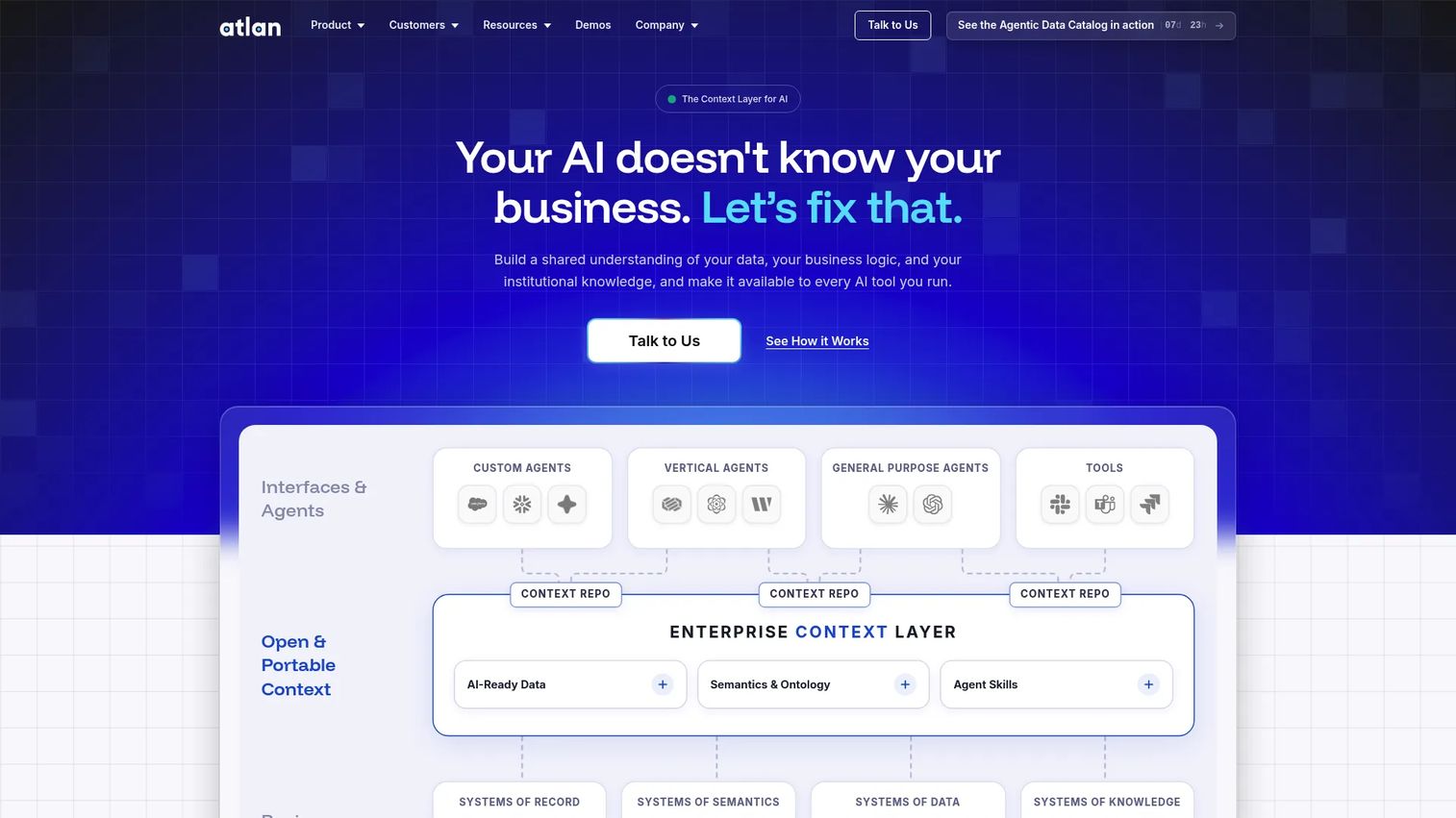
Atlan is an enterprise context layer for connecting metadata, business knowledge, lineage, and AI tools. It emphasizes active metadata inside everyday data workflows.
Its data graph connects warehouse assets with BI content and broader analytics context. Conversational AI and machine readable metadata also support teams preparing governed context for AI applications.
Best for: Modern data teams that want collaborative metadata management across connected analytics systems.
Key features
- Enterprise metadata graph
- Data search and discovery
- Automated data lineage
- Context enrichment agents
- Data quality capabilities
Why choose Atlan: Choose Atlan when the catalog must participate in daily work rather than sit as a separate reference site. Its context layer supports collaboration between producers and consumers.
Product managers benefit from clearer ownership and faster dataset discovery. The catalog can also reduce repeated questions about metric meaning and downstream use.
Pricing reflects both platform access and usage. Teams should model asset growth before comparing contracts because metadata volume can increase with new instrumentation.
Atlan pricing: Custom pricing. Edition, cataloged assets, seats, Flexi Credits, and paid add-ons influence the quote.
G2 rating: 4.5/5
3. Collibra
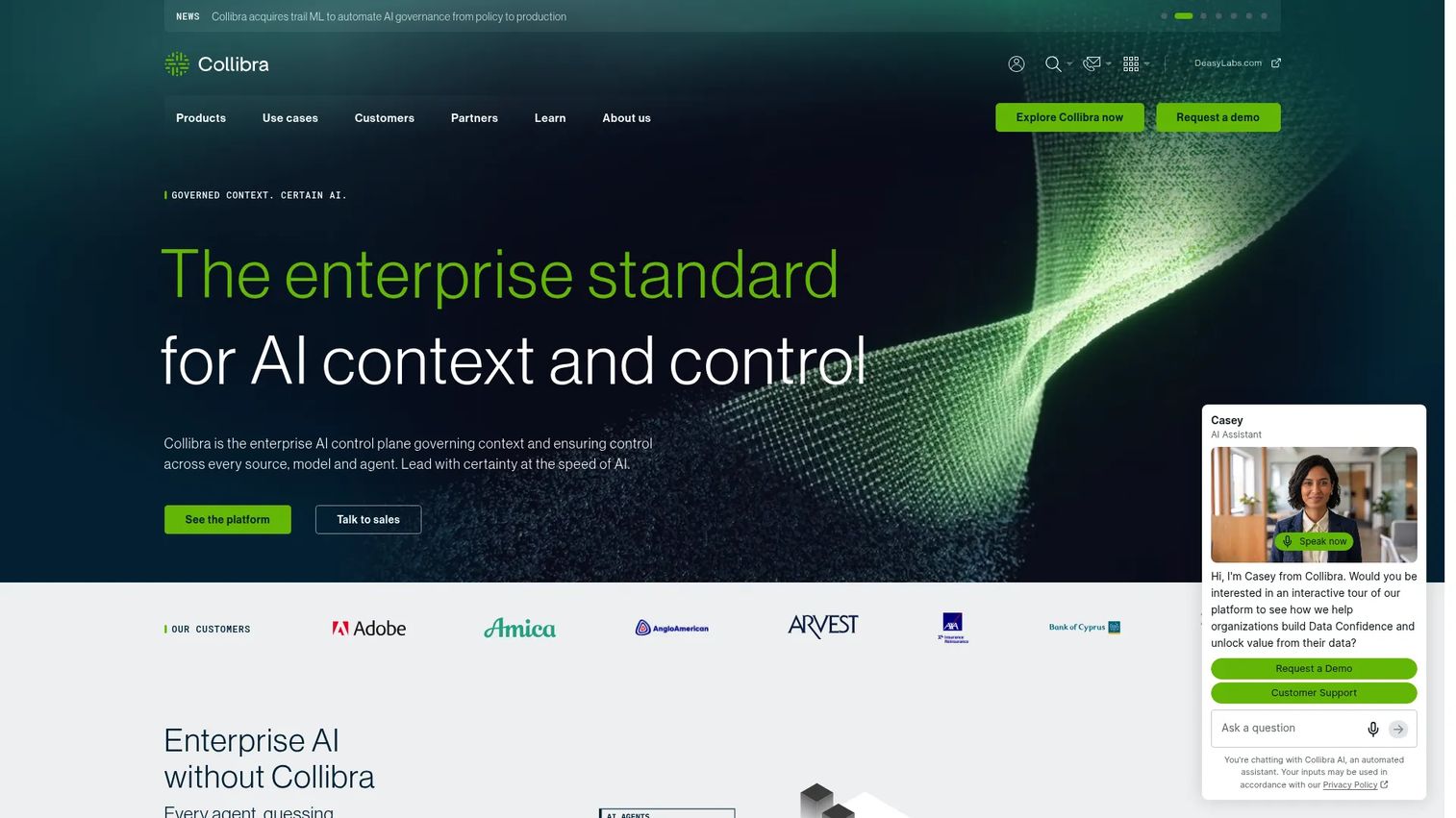
Collibra provides enterprise data and AI governance across complex data environments. It combines cataloging with stewardship, privacy, quality, policy management, and traceability.
The platform fits organizations that already treat data ownership as an operating responsibility. Business glossaries and formal workflows help teams manage definitions across domains.
Best for: Large organizations building formal data governance programs with accountable owners and approval processes.
Key features
- Automated metadata classification
- Business glossary controls
- Stewardship and policy workflows
- Data lineage and traceability
- Data quality and observability
Why choose Collibra: Choose it when governance maturity drives the project. Formal workflows support organizations that need review history and clear accountability.
For product teams, the benefit appears when customer data, billing information, or behavioral events require careful handling. PMs can identify classifications and owners before requesting access.
Collibra’s breadth fits enterprise programs with dedicated governance resources. Buyers should define the first domains before rollout because a large taxonomy can slow initial adoption.
Collibra pricing: Custom pricing. Licensing is contract based, with catalog, governance, lineage, privacy, and other capabilities determined through the agreement.
G2 rating: 4.2/5
4. Informatica
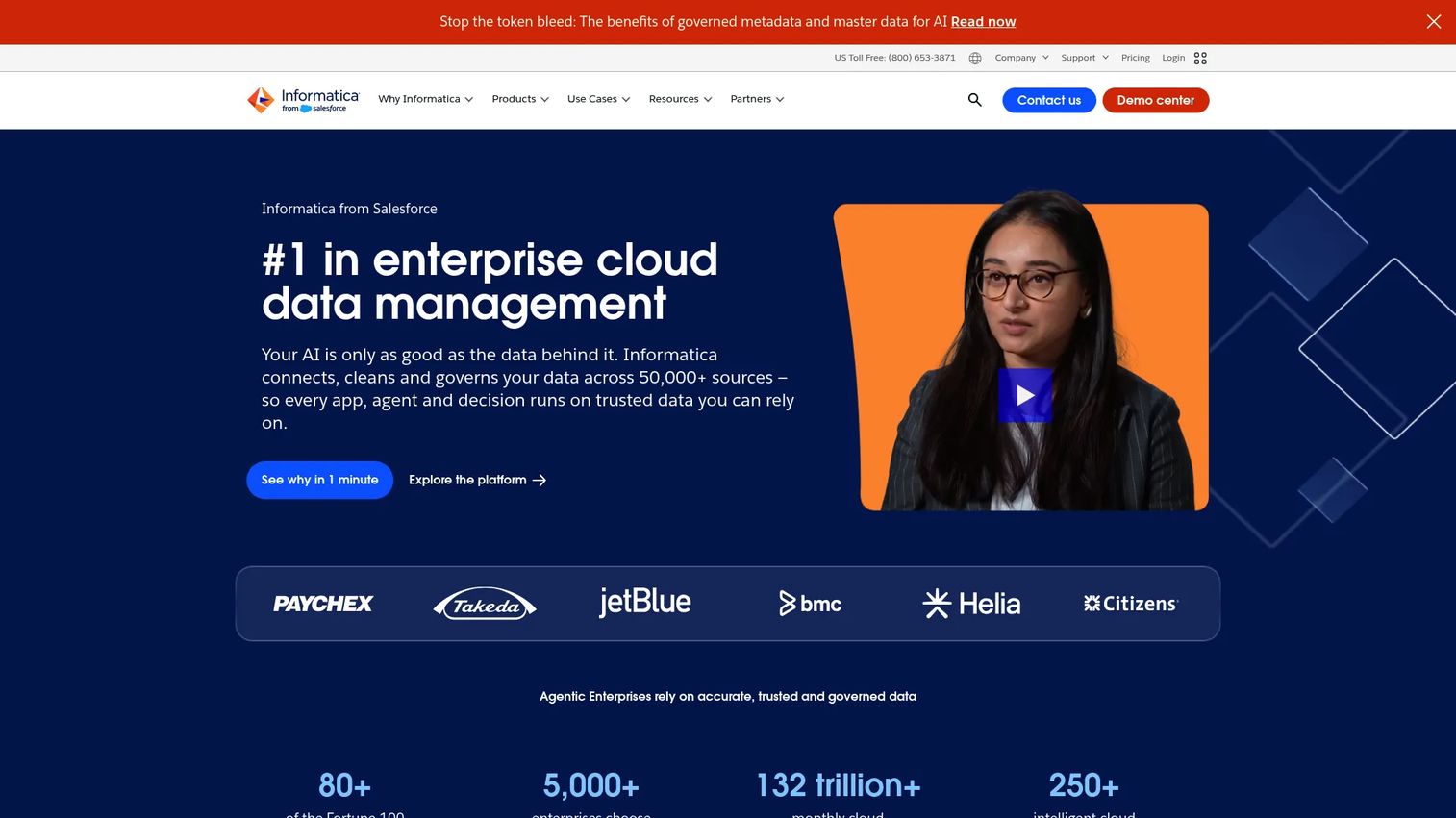
Informatica provides enterprise data integration, cataloging, governance, quality, and master data management. Its catalog sits inside a broader platform for hybrid and multicloud data estates.
This breadth makes Informatica relevant when metadata management is one part of a larger data modernization program. Teams can connect catalog context with quality and integration work.
Best for: Large enterprises standardizing cataloging within a broader data management platform.
Key features
- Enterprise metadata scanning
- AI assisted metadata enrichment
- Integrated data quality
- Lineage and impact analysis
- Governance and privacy controls
Why choose Informatica: Choose it when the catalog must connect with data integration or master data initiatives. Consolidating related work can simplify ownership across enterprise programs.
A PM may encounter Informatica through certified datasets rather than direct administration. The value lies in seeing quality context and lineage before using a metric for prioritization.
The platform covers more than cataloging. Buyers should separate essential capabilities from adjacent modules to keep evaluation criteria focused.
Informatica pricing: Custom pricing. Informatica uses consumption and volume models based on processing units, while master data costs can use domain records.
G2 rating: 4.2/5
5. Microsoft Purview
Microsoft Purview is a product family covering data security, governance, compliance, risk management, audit, and information protection. It fits organizations already operating within Microsoft environments.
Purview connects policy and classification work with Microsoft services. However, its family structure means buyers must identify the exact catalog and governance capabilities required.
Best for: Organizations using Microsoft data and productivity services that want integrated governance and security controls.
Key features
- Data loss prevention controls
- Information protection
- Audit and eDiscovery
- Data lifecycle management
- Compliance and risk management
Why choose Microsoft Purview: Choose it when Microsoft already anchors your environment and procurement model. Existing identity and licensing relationships can simplify evaluation.
Product teams benefit when reports and governed information share consistent classifications. Buyers should map each requirement to a specific Purview component before comparing cost.
The G2 rating below covers Microsoft Purview Audit rather than the entire product family. Treat it as component feedback, not a single score for every capability.
Microsoft Purview pricing: Microsoft Purview Suite starts at $12 per user monthly, paid yearly. A Business Premium add-on starts at $10 per user monthly.
G2 rating: 4.3/5 for Microsoft Purview Audit
6. Databricks Unity Catalog
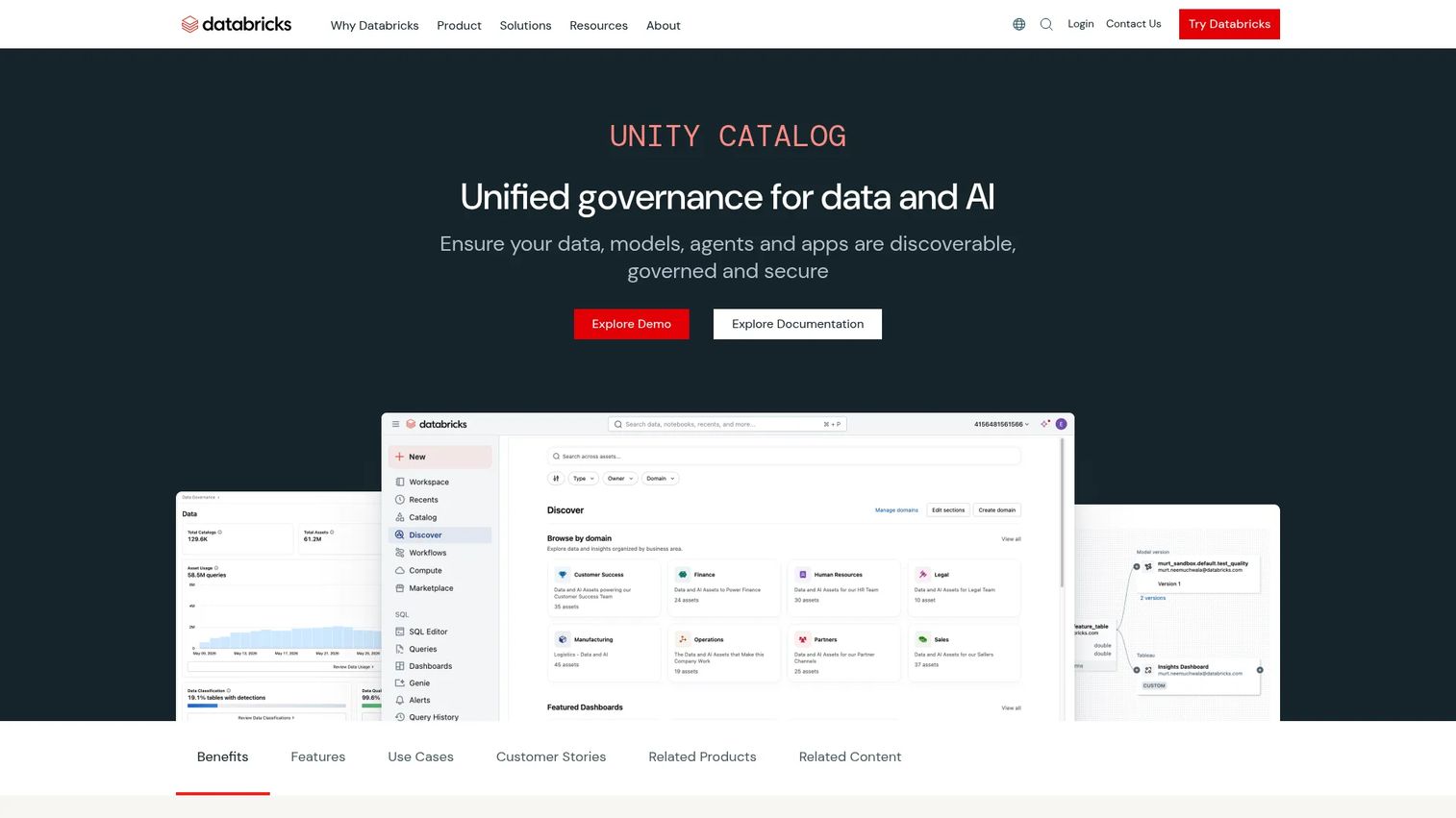
Databricks Unity Catalog provides centralized governance for data, applications, and AI assets across Databricks environments. It covers discovery, security, sharing, auditing, and lineage.
Its native position matters. Teams can govern tables, models, notebooks, and related assets without introducing a separate control plane for core lakehouse work.
Best for: Organizations running analytics and AI workloads primarily on Databricks.
Key features
- Fine grained access controls
- Automated column level lineage
- Data and AI asset discovery
- Cross workspace governance
- Governed asset sharing
Why choose Databricks Unity Catalog: Choose it when Databricks is central to your architecture. Native governance can reduce context switching for engineers and analysts.
PMs gain clearer visibility into which assets support product analytics or experimentation. However, vendor neutral discovery may require additional evaluation when important metadata lives beyond the Databricks environment.
The available G2 rating applies to Databricks overall. It should be read as broader platform sentiment rather than a Unity Catalog only score.
Databricks Unity Catalog pricing: No separate license is required. Unity Catalog is included with Databricks Premium and Enterprise tiers, while usage follows platform consumption.
G2 rating: 4.6/5 for Databricks
7. Snowflake Horizon
Snowflake Horizon is Snowflake’s governance and interoperability layer for data and AI assets. It covers discovery, classification, policy management, observability context, and lineage.
Horizon supports Snowflake data alongside external catalogs and Apache Iceberg assets. Search can span data, dashboards, notebooks, agents, and connected BI metadata.
Best for: Snowflake centered organizations seeking native cataloging and governance across their data estate.
Key features
- Interoperable metadata catalog
- Sensitive data classification
- Column level lineage
- Semantic search and context
- Quality monitoring
Why choose Snowflake Horizon: Choose it when trusted data already concentrates in Snowflake. Native policy and discovery features keep governance close to the warehouse.
For PMs, this can connect dashboard context with underlying assets and lineage. Teams with diverse platforms should still test how much external metadata becomes discoverable.
Its available G2 rating represents Snowflake overall. Buyers should combine that score with product specific testing during their evaluation.
Snowflake Horizon pricing: Custom pricing. Horizon specific plan prices are not separated from Snowflake’s wider edition and consumption model.
G2 rating: 4.6/5 for Snowflake
8. OpenMetadata
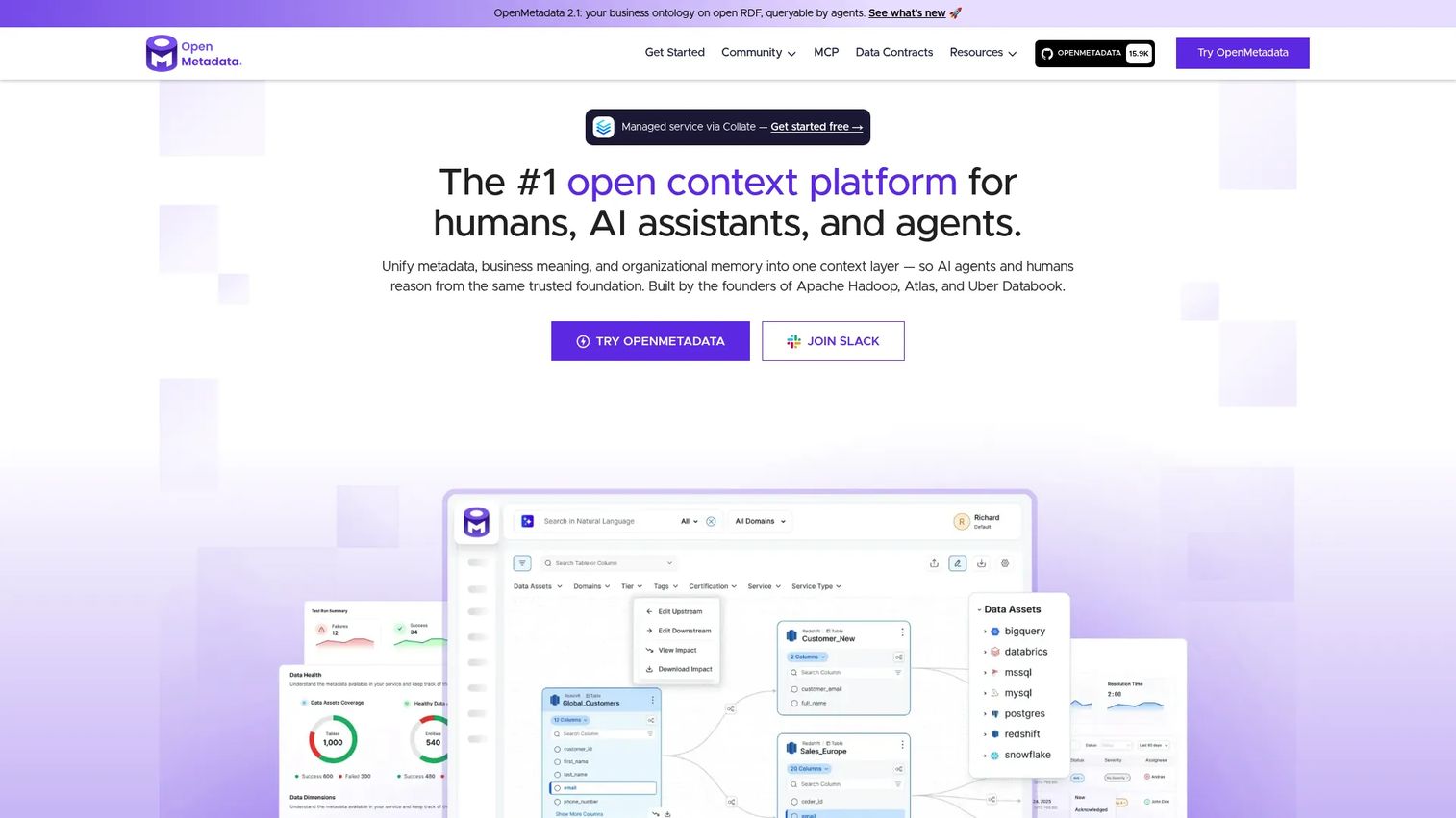
OpenMetadata is an open source metadata platform for discovery, governance, lineage, quality, observability, and semantic context. It supports more than 130 connectors.
The platform covers tables, dashboards, pipelines, topics, and services. Its native context features also support data teams preparing metadata for AI agents.
Best for: Engineering led teams that want open source control with broad catalog capabilities.
Key features
- Open source metadata platform
- Data discovery across asset types
- Lineage and impact analysis
- Quality and profiling context
- Governance and collaboration
Why choose OpenMetadata: Choose it when extensibility and infrastructure ownership are priorities. Teams can inspect the codebase and adapt integrations around internal systems.
Open source does not mean zero operating cost. Engineering time, hosting, upgrades, connector maintenance, and support still affect total ownership.
PMs benefit when the implementation produces a stable search layer for metrics and dashboards. Adoption still requires definitions and accountable owners outside the engineering team.
OpenMetadata pricing: The open source edition is free. Managed commercial pricing was not established from the supplied OpenMetadata pricing information.
G2 rating: 4.5/5
9. DataHub
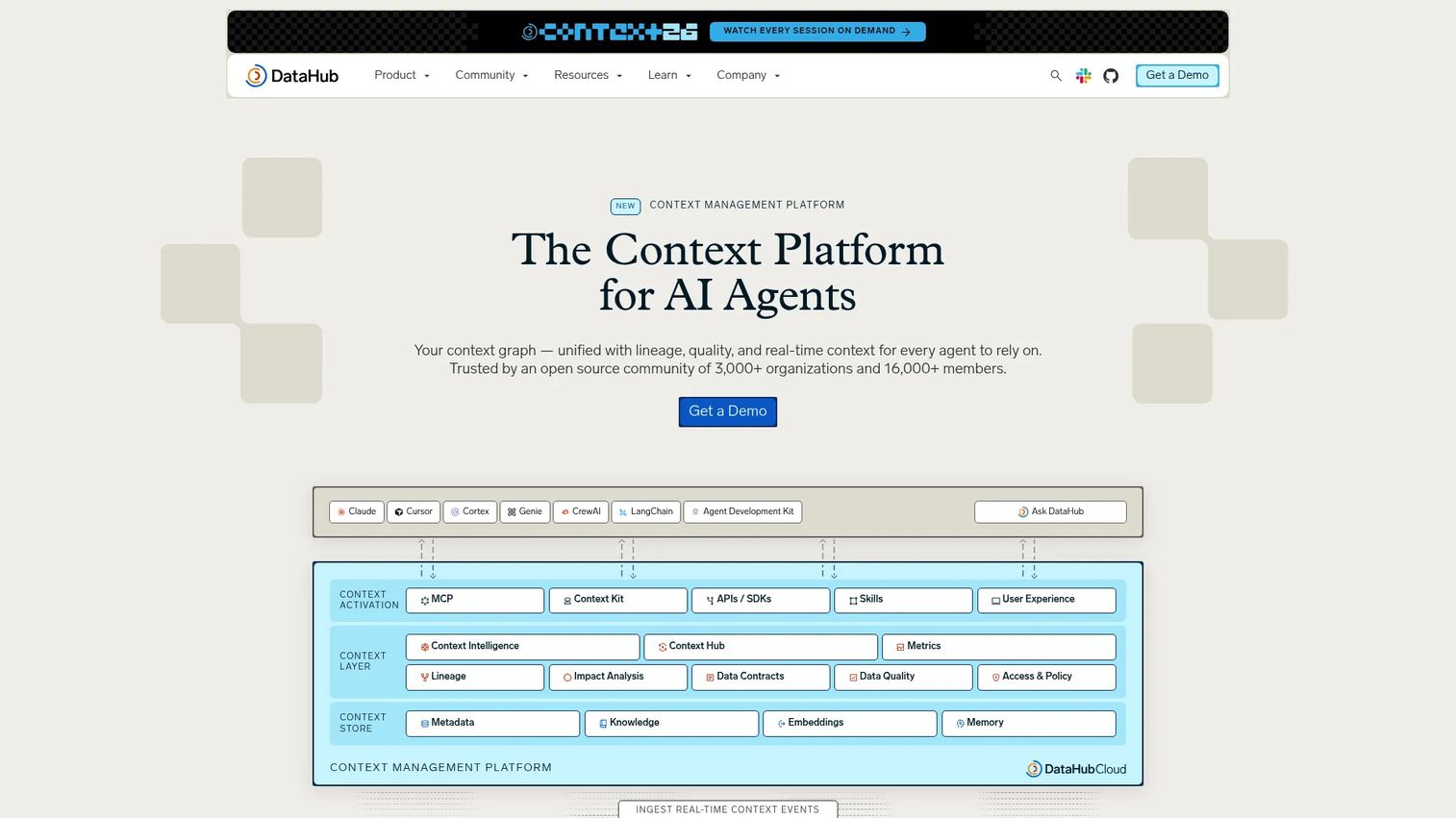
DataHub is a metadata and context management platform for discovery, governance, observability, lineage, and AI readiness. Its architecture centers on a metadata graph and APIs.
The platform supports impact analysis, access policies, quality context, and machine readable metadata. DataHub Core provides the open source foundation, while DataHub Cloud offers a managed service.
Best for: Data platform teams that want programmable metadata infrastructure and event driven updates.
Key features
- Metadata graph architecture
- Event driven metadata updates
- Lineage and impact analysis
- Governance and access policies
- APIs and MCP integrations
Why choose DataHub: Choose it when engineering control matters and metadata must support internal applications. Its graph structure fits teams building data products or automated workflows.
The tradeoff sits in operational ownership. Self-hosting requires engineering capacity, while the managed option changes the cost model.
Product managers will see the most value after domains and ownership are established. A technically rich catalog still needs clear definitions for activation and retention metrics.
DataHub pricing: DataHub Core is free and self-hosted. DataHub Cloud uses custom pricing based on data volume, users, and required capabilities.
G2 rating: 4.4/5
10. DataGalaxy
DataGalaxy provides collaborative data governance with cataloging, lineage, business context, and glossary management. It aims to make metadata useful for technical and business teams.
Its trust indicators and ownership context help users interpret assets before use. AI assisted descriptions can reduce some manual documentation work.
Best for: Organizations that need business users to adopt the catalog alongside data specialists.
Key features
- Business glossary management
- Column level data lineage
- Ownership and trust indicators
- AI assisted documentation
- Campaign based governance workflows
Why choose DataGalaxy: Choose it when shared language is the main obstacle. A business friendly glossary helps PMs and analysts settle definitions before reviewing dashboards.
The platform also supports collaborative documentation and access control management. These capabilities suit teams that want governance embedded in recurring campaigns.
Plan selection should reflect both catalog depth and portfolio management needs. Buyers should compare connector coverage before choosing a tier.
DataGalaxy pricing: Custom pricing. Catalog plans include Starter, Professional, and Enterprise, while portfolio plans include Start and Scale.
G2 rating: 4.8/5
11. Select Star
Select Star is a data catalog and governance platform for discovery, documentation, lineage, and access context. It emphasizes automated metadata across modern analytics environments.
Popularity signals help users identify heavily used assets. Cross-platform lineage connects warehouse structures with downstream BI context.
Best for: Analytics teams that need faster discovery across warehouse tables and business intelligence assets.
Key features
- Automated data catalog
- Cross platform column lineage
- Popularity and usage metrics
- Business glossary and dictionary
- Role based access controls
Why choose Select Star: Choose it when analyst productivity is the main goal. Usage context helps teams identify established assets instead of rebuilding familiar analyses.
For PMs, popularity and ownership signals can narrow the search for a trusted dashboard. Lineage adds context before changing instrumentation or metric logic.
Select Star also offers AI assisted questions and documentation. Teams should test whether generated context matches their internal language before relying on it.
Select Star pricing: Custom pricing. A verified starting amount or named tier structure was unavailable in the supplied research.
G2 rating: Not available
12. Ataccama
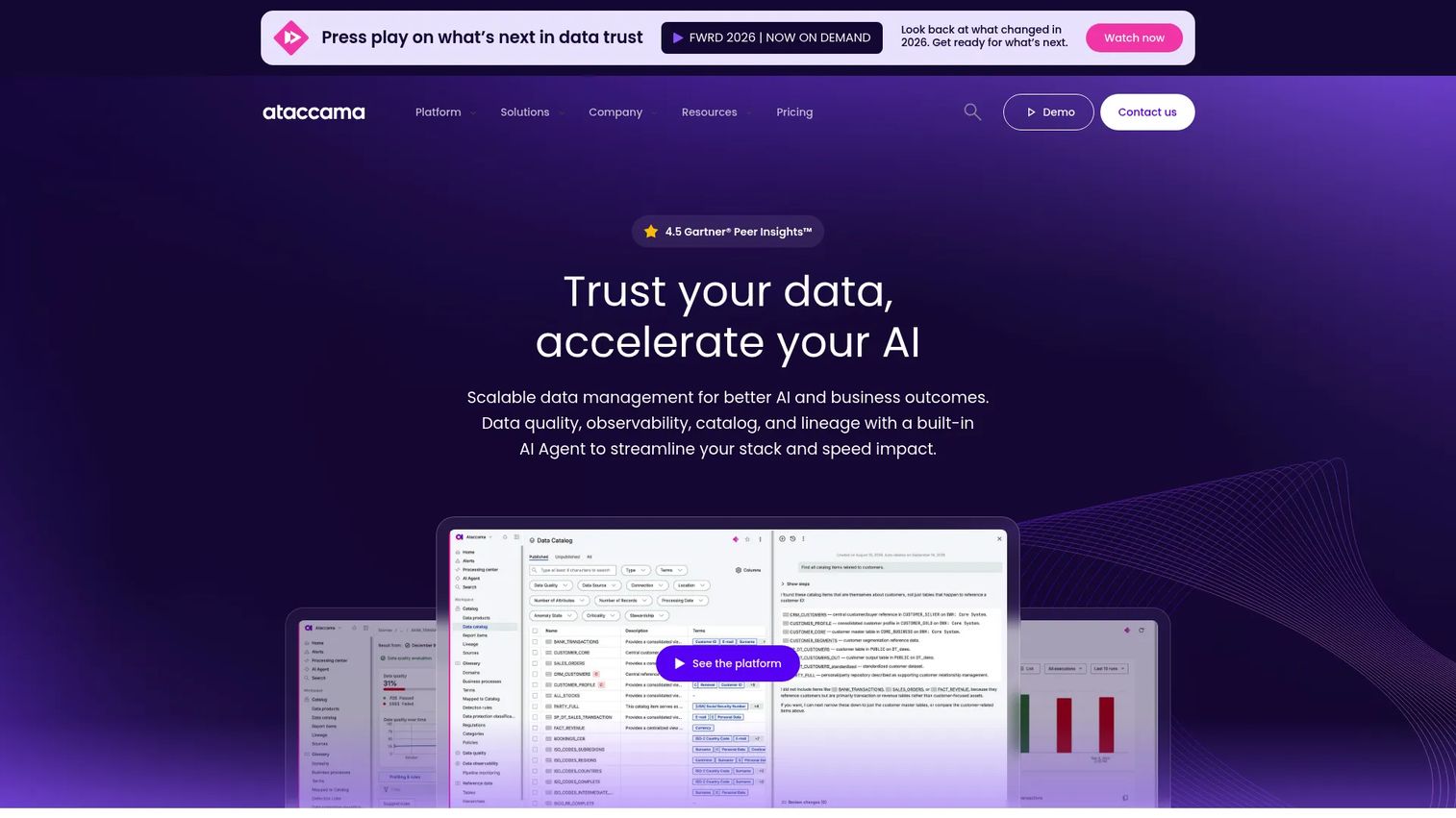
Ataccama combines data quality, observability, cataloging, governance, lineage, and master data management. Its catalog forms part of a broader data trust platform.
This approach suits organizations where poor quality creates more risk than missing documentation alone. Quality monitoring and catalog context reinforce each other.
Best for: Enterprises connecting data discovery with quality management and master data programs.
Key features
- Data quality management
- Knowledge catalog and glossary
- Data observability
- Master data management
- AI assisted workflows
Why choose Ataccama: Choose it when trust problems involve inaccurate or stale data. A definition is more useful when users can also inspect freshness and quality.
Product managers can use this context before accepting experiment results or launch analysis. Data teams retain responsibility for configuring checks that reflect business expectations.
The broad platform may exceed the needs of teams seeking lightweight dataset search. Start evaluation with a specific trust problem and required source systems.
Ataccama pricing: Custom pricing. Licensing covers selected capabilities and deployment requirements through a sales agreement.
G2 rating: 4.2/5
13. data.world
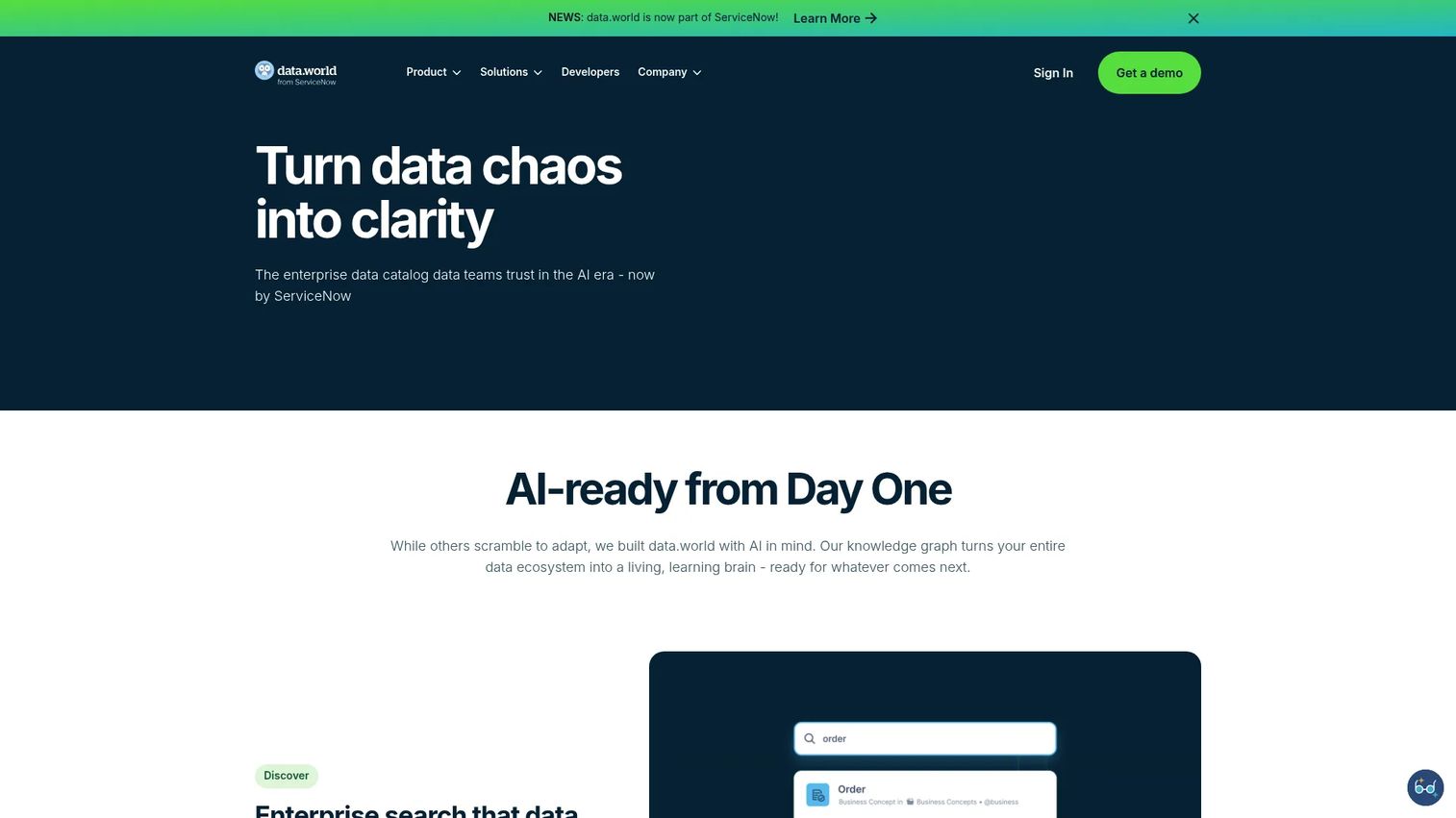
data.world provides an enterprise data catalog built on knowledge graph architecture. It supports semantic discovery, governance workflows, lineage, metadata management, and DataOps collaboration.
The knowledge graph connects assets with definitions and business concepts. This structure helps users explore relationships that keyword search may miss.
Best for: Enterprise teams seeking semantic context and collaborative data discovery.
Key features
- Knowledge graph architecture
- AI assisted data discovery
- Governance workflow automation
- Data lineage and metadata
- APIs and webhooks
Why choose data.world: Choose it when relationships between definitions and assets drive discovery. Semantic context can make a large catalog easier to navigate.
For PMs, this supports questions that span metrics, datasets, and operational concepts. Teams should validate whether the modeled relationships match their domain structure.
Each plan includes ten users, with additional users charged separately. This seat structure matters when broad business adoption is a project goal.
data.world pricing: Custom pricing. Plans include Essentials, Standard, Enterprise, and Enterprise+.
G2 rating: 4.2/5
14. BigID
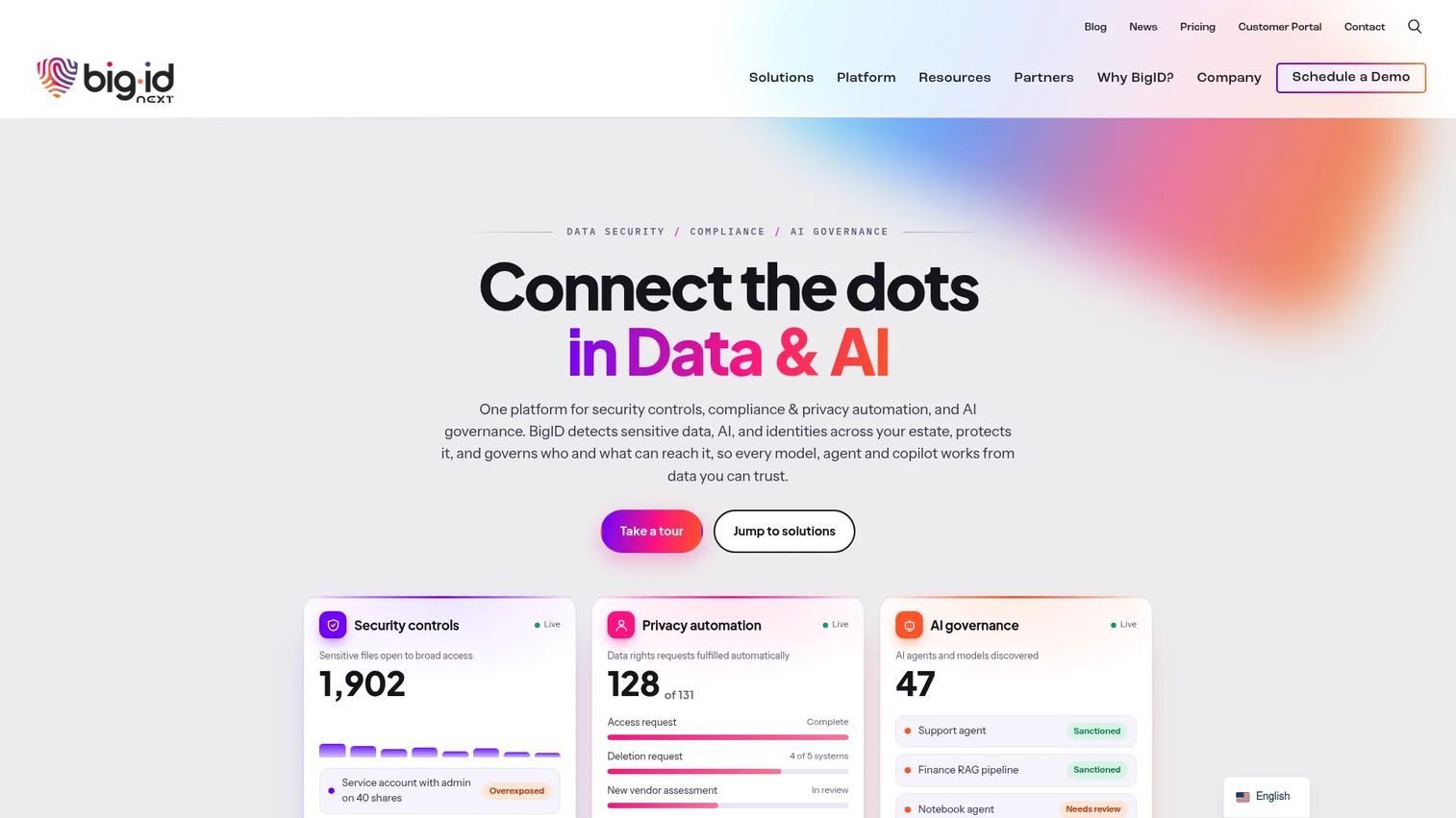
BigID focuses on data discovery, classification, security, privacy, governance, and AI governance. It scans structured and unstructured information across varied environments.
Its catalog value centers on understanding sensitive data and risk context. Classification supports security teams while helping governance leaders locate regulated information.
Best for: Enterprises that need sensitive data discovery across security, privacy, and governance programs.
Key features
- Sensitive data discovery
- Automated data classification
- Access and activity intelligence
- Privacy workflow automation
- AI security and governance
Why choose BigID: Choose it when cataloging overlaps with privacy or security. The platform is designed to reveal where sensitive information lives and how it is accessed.
PMs working with behavioral, billing, or support data can use classifications to understand handling constraints. Lightweight analytics discovery is not the central buying reason.
A free trial is available. Buyers should define source count and deployment preferences before requesting a quote.
BigID pricing: Custom pricing. Data sources, applications, connectors, deployment type, and support services affect the quote.
G2 rating: 4.3/5
15. OvalEdge
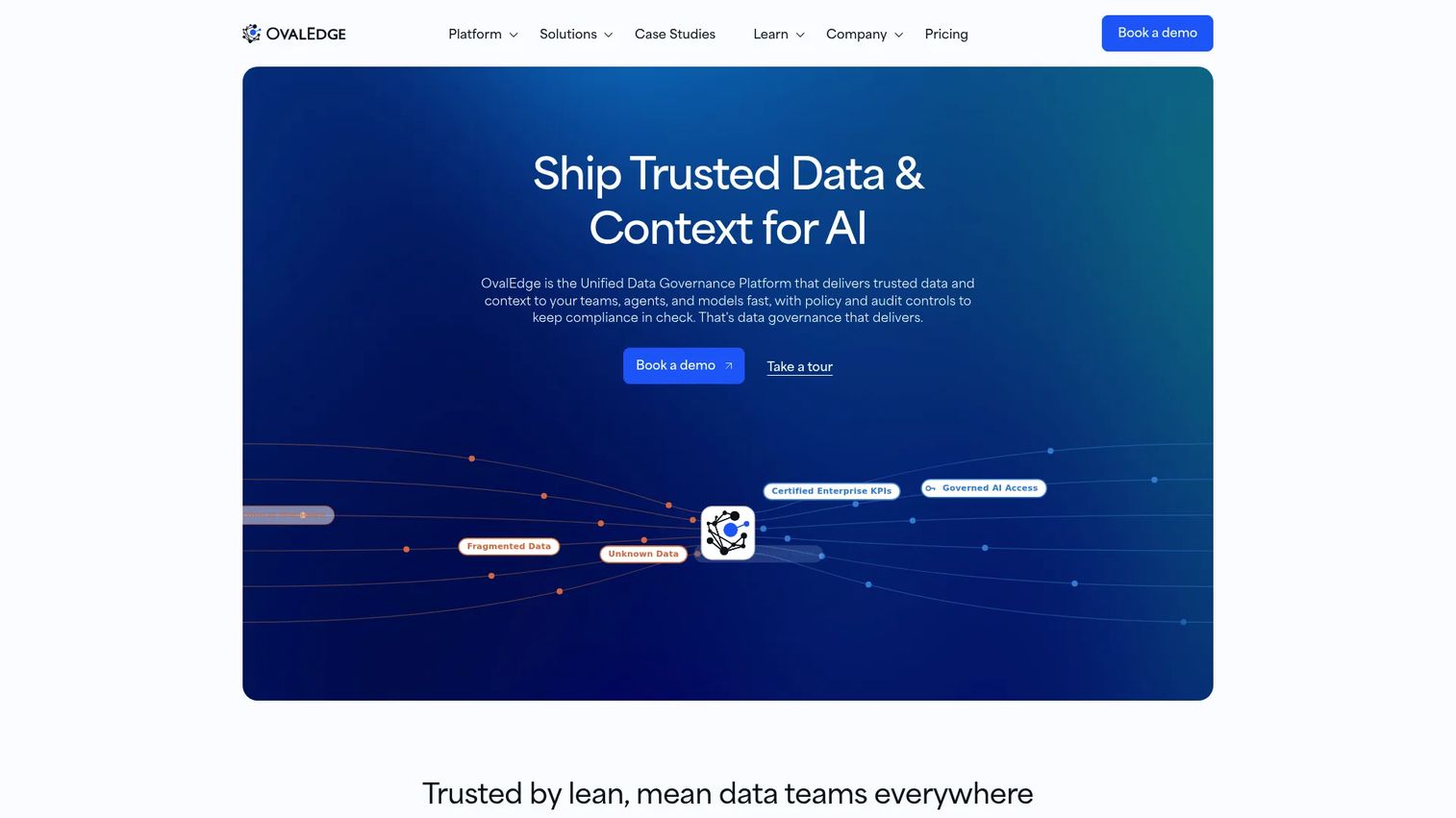
OvalEdge combines cataloging, metadata management, lineage, classification, quality monitoring, and access governance. It supports more than 150 native connectors.
The platform covers discovery alongside business glossary and stewardship workflows. This breadth suits organizations moving beyond spreadsheet based metadata management.
Best for: Midmarket and enterprise teams seeking broad governance without choosing the largest enterprise suites.
Key features
- Metadata search and discovery
- Automated data lineage
- Business glossary workflows
- Data quality monitoring
- Access governance controls
Why choose OvalEdge: Choose it when you need catalog, governance, and quality functions within one platform. Its connector breadth supports mixed data environments.
For PMs, the combination links business terms with technical assets and owners. Impact analysis also helps teams assess downstream reporting before changing events.
The G2 score comes from one review in the supplied research. Treat it as a limited signal and place more weight on a proof of concept.
OvalEdge pricing: Custom pricing. Connected systems, enabled connector capabilities, and author users determine the license.
G2 rating: 5.0/5
Considerations when choosing data catalog software
Metadata coverage
List every system that carries product data or business context. Include your warehouse, lakehouse, BI platform, transformation layer, notebooks, and operational applications.
For PMs, coverage should connect a dashboard to its source, definition, and owner. A catalog with weak connector support creates another partial view.
Lineage depth
Ask whether lineage works at table, column, dashboard, and pipeline levels. The right depth depends on how your team changes instrumentation.
A PM updating an event needs downstream impact analysis. High level lineage may not reveal which dashboard field uses the changed column.
Business glossary adoption
A business glossary needs owners, approvals, history, and links to technical assets. Without those controls, it becomes another stale wiki.
Start with disputed metrics such as activation or churn. Solving visible disagreements creates a reason for teams to return.
Governance and access workflows
Evaluate classifications, stewardship, approval paths, and access context. Product data can include customer behavior or billing details that require controlled handling.
The catalog should help users locate trusted data without bypassing policy. Test this workflow with a common product analytics request.
Maintenance effort
Every catalog decays without accountable ownership. Check how the platform detects stale metadata and highlights unused assets.
Automation can draft descriptions or identify gaps. Domain experts still need to approve definitions and resolve conflicts during the release cadence.
Conclusion
The right data catalog software reflects your stack and operating model.
Alation, Atlan, Collibra, and Informatica fit enterprise programs with broad metadata management requirements. Each supports a different balance of discovery and formal governance.
Microsoft Purview suits Microsoft centered environments. Databricks Unity Catalog and Snowflake Horizon make sense when their respective platforms anchor the data estate.
OpenMetadata and DataHub give engineering teams open source control. They also introduce hosting and maintenance responsibilities that should enter the business case.
The remaining platforms address more specific priorities. Those include business adoption, privacy classification, semantic discovery, data quality, or midmarket governance.
Shortlist three products. Then run the same evaluation workflow in each: Find a trusted activation metric, inspect its lineage, identify its owner, and request access.
If your team also explains complex product workflows to customers or internal users, interactive product experiences serve that separate job. Data catalogs organize trusted data. Interactive demos support landing pages, sales follow-ups, onboarding, customer education, and internal training.
Start your journey with Guideflow today!
FAQs
Data catalog software helps teams discover, understand, govern, and trust data assets. It connects metadata with search, lineage, ownership, glossary definitions, classifications, and quality signals.
A product manager might use it to find the canonical activation dataset. They can then inspect its owner and downstream dashboard usage before making a decision.
A data catalog focuses on discovering and understanding data assets. A data governance platform manages policies, stewardship, approvals, accountability, and privacy processes.
Many enterprise tools combine both jobs. Your evaluation should separate discovery requirements from governance workflows because they involve different users.
Prioritize metadata harvesting, search, lineage, ownership, glossary management, access context, quality signals, and relevant integrations.
The feature list matters less than coverage and adoption. A sophisticated catalog cannot support self-service data if users cannot find their dashboards or trust the definitions.
Enterprise teams commonly evaluate Alation, Atlan, Collibra, Informatica, and Microsoft Purview. The right choice depends on governance maturity and the existing data stack.
Alation emphasizes governed discovery. Collibra fits formal governance programs, while Informatica connects cataloging with broader enterprise data management.
OpenMetadata and DataHub are strong open source data catalog tools. Both support discovery, lineage, governance context, and extensibility.
OpenMetadata provides broad catalog capabilities with more than 130 connectors. DataHub suits engineering teams seeking a metadata graph and event driven architecture.
A catalog helps users find data and understand its meaning, ownership, and lineage. A data quality tool tests whether records meet defined expectations.
Some platforms combine both. Quality results become trust signals inside the catalog, while the catalog helps users find the affected assets.
Product managers benefit when decisions rely on shared metrics, experiments, behavioral events, and cross-functional reporting. They usually consume the catalog rather than administer it.
A good implementation reduces time spent finding owners or reconciling definitions. It also supports impact analysis before instrumentation changes.
Data catalog tools give users searchable metadata, definitions, owners, lineage, and trust indicators. These signals help users evaluate an asset without waiting for a data engineer.
Self-service still needs access controls and clear stewardship. The catalog should expose the request path when a certified dataset requires approval.
Start with high-value domains and disputed metrics. Connect source systems, assign owners, certify useful assets, and review definitions during analytics planning.
Treat stewardship as recurring operational work. Tie catalog updates to releases, schema changes, and instrumentation reviews rather than a separate documentation project.
Use a workflow tied to an upcoming release. Pick an event or field that will change, then inspect every downstream model and dashboard the platform identifies.
Check whether lineage reaches the column and BI layers. Product teams need enough depth to predict reporting impact before shipping.