A lens goes out on a Thursday shoot and comes back Monday with a scratched element nobody logged. A second client books the same cinema body for the same weekend because two coordinators were working off two different spreadsheets. An invoice ships without the late-return fee because the contract lived in an email thread. If you run a camera rental operation, none of this is hypothetical. It is a normal week.
The stakes are not small, either. The global camera rental service market was valued at USD 3.8 billion in 2025 and is projected to reach USD 6.9 billion by 2034, growing at a 6.9% CAGR, according to Dataintelo (2025). The film and video equipment rental market alone sat at USD 26.91 billion in 2025 per 360iResearch (2026). That is a lot of high-value, serialized gear moving through booking, dispatch, and billing every day, and every manual handoff is a place where money leaks.
The fix is not more spreadsheets or a bigger whiteboard. It is software built for the specific reality of renting cameras: real-time availability, serialized asset management, quote and contract workflows, and condition tracking that holds up when a client disputes a scratch. Cloud-based rental software captured 72.6% of worldwide rental software revenue in 2025, per PW Consulting (2025), which tells you where operators are already voting with their budgets. The question is not whether to move off spreadsheets. It is which platform matches the workflow you actually need to fix first.
What's inside
This guide compares four camera rental software tools for teams managing serialized assets, reservations, quotes, contracts, and billing. It is written for operators in film, production, broadcast, and AV rental, not for buyers who want a generic feature checklist. We chose the four tools on practical fit against the jobs that break most often in a rental business.
We evaluated each on four criteria: inventory control and serialized asset tracking, booking and reservation depth, scanning or tracking capability, and how well the platform fits camera, film, production, and AV workflows end to end. Pricing and ratings are drawn from each vendor's own materials where available.
TL;DR
- Best overall for broad rental management: EZRentOut covers centralized inventory, a customer-facing webstore, scanning, payments, and mobile operations in one system, which makes it the safest all-around pick for camera and AV teams.
- Best for barcode, RFID, and QC-heavy workflows: IntelliEvent is built for operational discipline, with inventory control, availability calendars, warehouse management, and labor scheduling for production-grade teams.
- Best for multi-brand, real-time booking, and try-before-you-buy: Circulio runs multi-site, multi-brand webstores with live availability, virtual kits, and unified product and asset management from one platform.
- Best for cutting double-bookings and damage disputes: Rentablez focuses on real-time booking, condition and maintenance workflows, invoicing, and mobile operations with offline sync, at accessible entry pricing.
What is camera rental software?
Camera rental software is a purpose-built platform that manages the full lifecycle of renting camera, lens, and production gear, from real-time availability and reservation management through quotes, contracts, invoicing, and asset return. Unlike generic inventory tools, it treats every body, lens, and accessory as a serialized asset that has to be checked out, tracked, and checked back in.
The category breaks into a handful of core capabilities. Different tools emphasize different parts of this workflow, which is exactly why a comparison beats a feature dump.
- Real-time inventory and serialized asset management: every item tracked by serial number with real-time availability so two coordinators never book the same body twice.
- Booking and reservation management: holds, confirmations, and rental scheduling across dates, locations, and clients.
- Quotes, contracts, invoicing, and payments: moving an inquiry to a signed contract to a paid invoice without losing context.
- Scanning, RFID integration, and QC workflows: barcode scanning and RFID integration for fast check-in and check-out, plus condition tracking at each handoff.
- Kits, bundles, and multi-location control: kit building so a full camera package books as one unit, across multi-location rental operations.
- Customer portals, webstores, or self-serve booking: a webstore or self-serve booking flow so clients can check real-time availability and reserve without a phone call.
Camera equipment rental software and camera and lens rental software are the same category described from different angles. Some vendors lean toward front-end conversion and webstore booking; others lean toward back-office control, serialized asset management, and QC. The right choice depends on which end of that spectrum hurts more in your operation.
When to use camera rental software
Manage a rental business with serialized gear
The moment your inventory becomes individually valuable and individually trackable, spreadsheets stop working. A cinema body, a set of primes, and a follow focus each need their own serial, condition history, and utilization record. Camera rental management software checks each item out against a specific booking and back in against a specific return, which kills availability errors and the manual reconciliation that eats your Monday mornings. When a client asks whether a particular serial was available on a date, you answer in seconds instead of scrolling a shared sheet.
Replace spreadsheets and disconnected booking workflows
The trigger is usually a near-miss or an actual miss: a double-booking that cost you a client, or a rental that shipped without a contract. When bookings live in a calendar, quotes live in email, and inventory lives in a spreadsheet, every handoff between booking, dispatch, and billing is a chance to drop something. Consolidating these into one system gives you operational speed and fewer handoff mistakes, which matters more the faster you turn gear.
Improve quote-to-cash flow for camera and production rentals
High-value gear and repeat clients make quote-to-cash the workflow worth protecting. Software carries context from inquiry to reservation to contract to invoice, so the late-return fee, the insurance requirement, and the kit discount all survive the trip. For a team handling recurring production clients, that continuity is the difference between predictable revenue and chasing details after the shoot wraps.
Comparison table
Scan the Intent column to find the workflow you most need to fix, then read that row's key use case and pricing before you shortlist.
| # | Product | Intent | Key use case | Pricing | G2 rating |
|---|---|---|---|---|---|
| 1 | EZRentOut | Broad rental management | Centralized inventory, webstore, scanning, and billing for camera and AV teams | From $79/month | 4.5/5 |
| 2 | IntelliEvent | Inventory and QC control | Inventory, availability calendars, warehouse and labor scheduling for production teams | Contact sales | Not listed |
| 3 | Circulio | Multi-brand real-time booking | Multi-site, multi-brand webstores with live availability and virtual kits | Contact sales | Not listed |
| 4 | Rentablez | Damage prevention and booking | Real-time booking, condition and maintenance workflows, mobile operations | From $29/month | Not listed |
Best camera rental software tools for 2026
1. EZRentOut
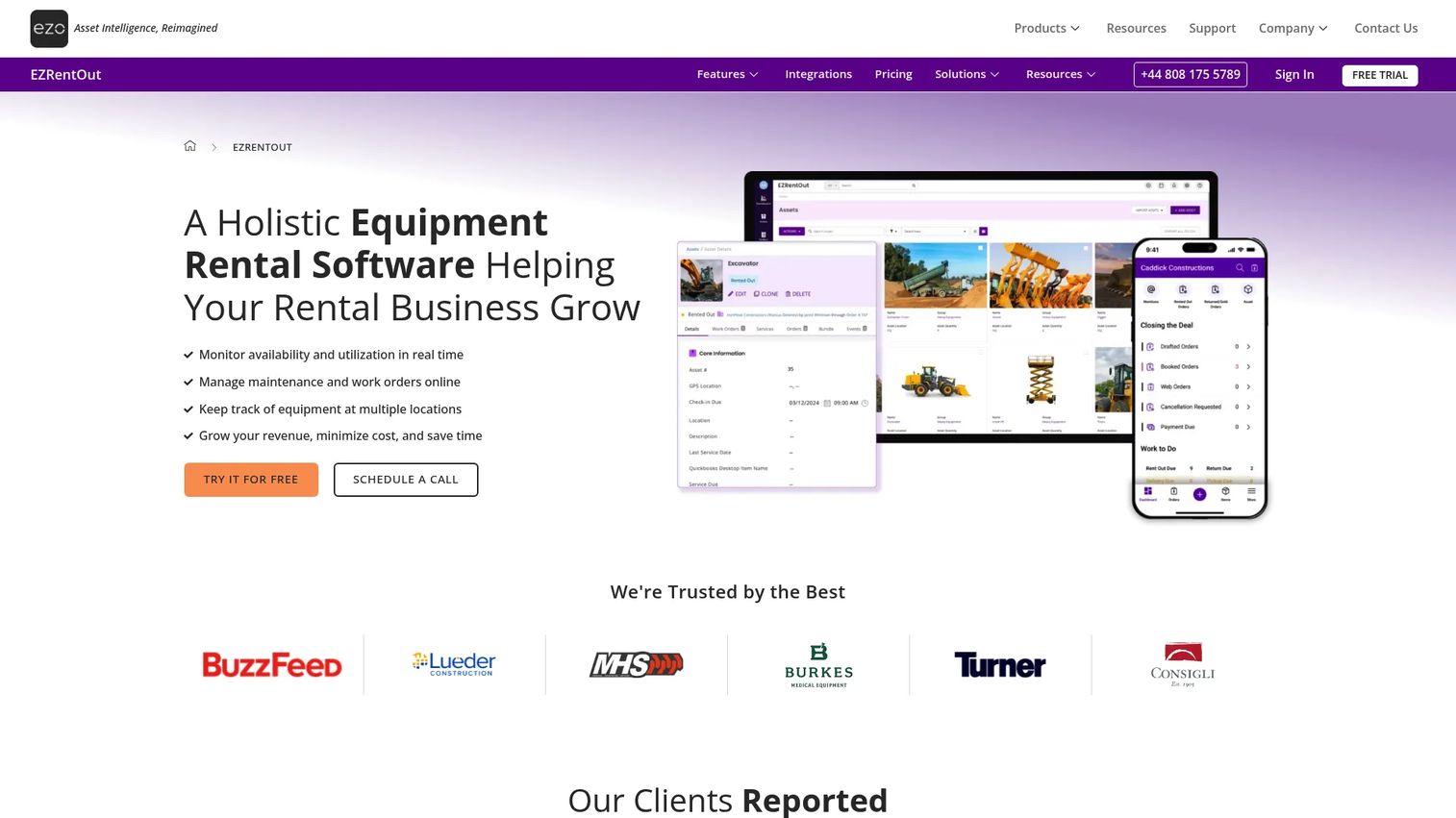
EZRentOut is cloud-based equipment rental management software for bookings, inventory, billing, and reporting. For camera and AV teams, it functions as an all-in-one rental system: centralized inventory and asset management, a customer-facing webstore for self-serve booking, a mobile app with barcode and QR scanning, and billing built in. If your problem is that too many pieces of the workflow live in too many tools, this is the platform that pulls them into one place.
Best for: Operators who want a single system covering reservations, equipment tracking, and customer or order management without stitching together separate tools.
Key strengths
- Bookings and reservations: manage holds, confirmations, and rental scheduling with real-time availability so double-bookings stop happening.
- Asset and inventory management: track serialized gear, utilization, and condition across a full catalog of camera bodies, lenses, and accessories.
- Mobile app with barcode and QR scanning: run check-in and check-out from the warehouse floor or a shoot location, which speeds up field operations.
Why choose EZRentOut: It is the broadest of the four for teams whose pain is fragmentation rather than a single specialized gap. The customer-facing webstore matters if you want clients booking gear themselves, and the mobile scanning app matters if your team spends more time in the warehouse than at a desk. It is a strong default when you are not sure which workflow to prioritize because it covers most of them competently.
EZRentOut pricing: Plans are billed monthly and start with the Essential tier at $79 USD per month. Growth runs $149 USD per month and Premium is $299 USD per month, with an Enterprise tier available at custom pricing through sales. There is no free tier, but a free trial is offered so you can test booking and asset workflows before committing. Pricing is verified from EZRentOut's own pricing page as of July 2026.
2. IntelliEvent
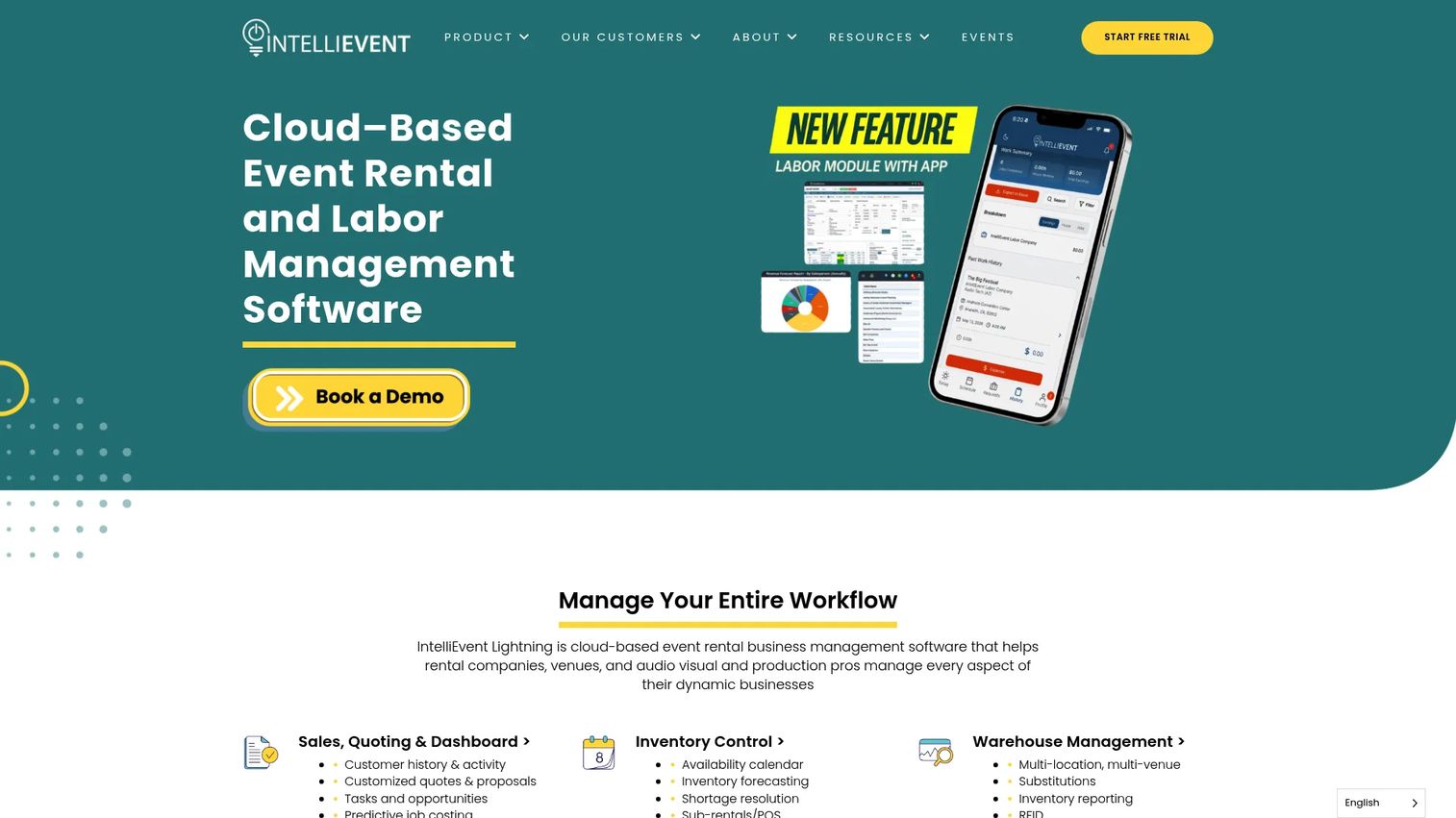
IntelliEvent is cloud-based event rental and labor management software for rental companies, venues, and AV or production teams. It is the option to look at when operational discipline is the priority: inventory control tied to an availability calendar, warehouse management, and labor scheduling in one platform. For camera, broadcast, and production rental businesses that care about condition history, asset life, and getting the right crew on the right job, it fits the way these teams actually run.
Best for: Production and broadcast rental teams that need serious inventory control, QC discipline, and multi-location equipment coordination.
Key strengths
- Sales, quoting, and dashboards: move quotes through to booking while keeping visibility on pipeline and utilization from a single dashboard.
- Inventory control and availability calendar: see real-time availability across serialized gear so scheduling stays accurate as bookings stack up.
- Warehouse management and labor scheduling: coordinate gear prep and crew assignment together, which matters when a rental includes people, not just equipment.
Why choose IntelliEvent: Consider a multi-location production house running gear across several venues. IntelliEvent's availability calendar and warehouse management keep every serialized asset accounted for as it moves between sites, and the labor scheduling layer means the operations manager coordinates gear and crew in one system instead of two. That combination is where it stands apart for teams whose rentals are as much about logistics and people as about the camera itself.
IntelliEvent pricing: IntelliEvent does not publish public pricing on its site. The company directs prospective buyers to contact sales for a quote, which is common for platforms sold to larger, operations-heavy rental businesses. If you are evaluating it, budget time for a scoping call to map your inventory volume and location count before you get a number.
3. Circulio
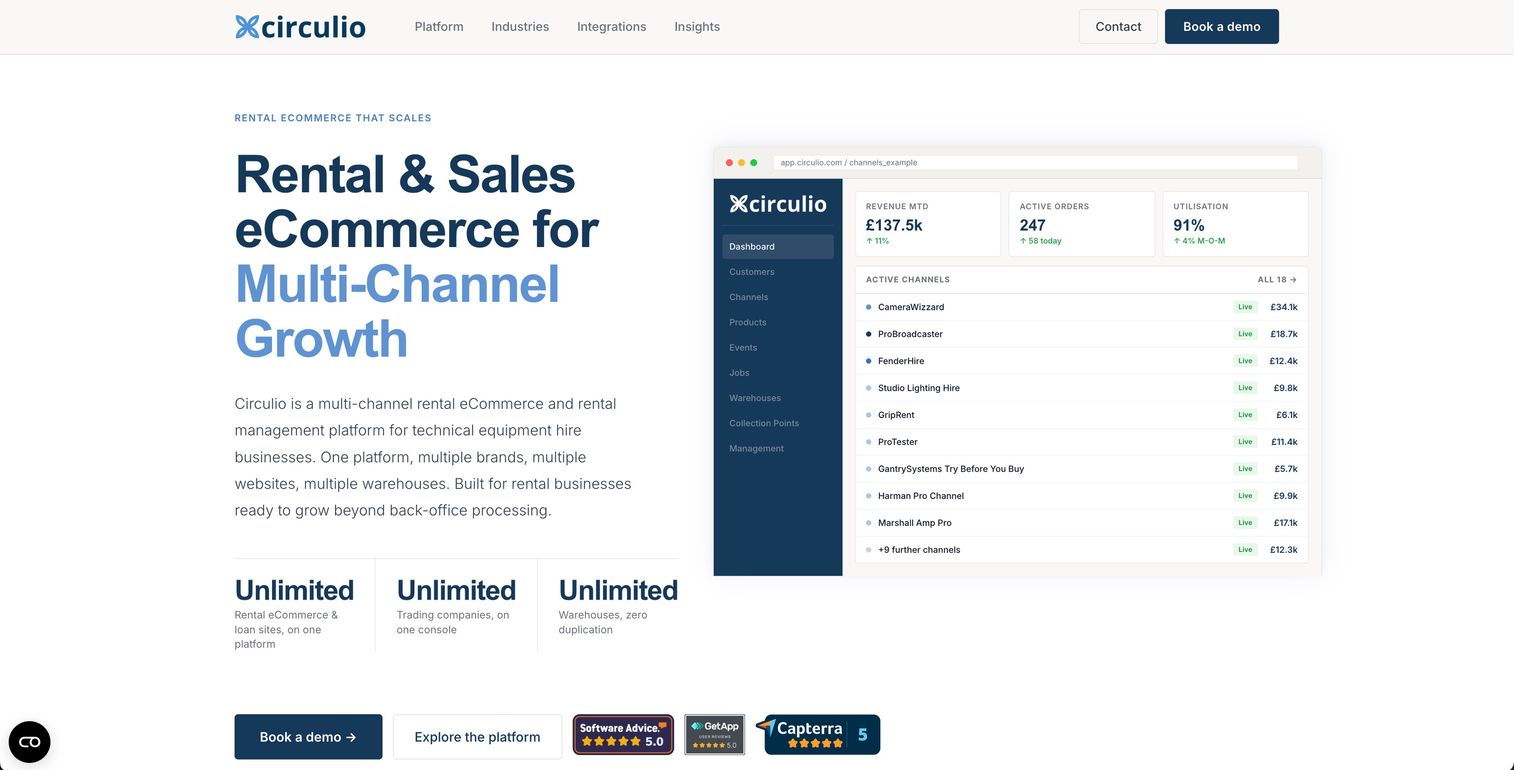
Circulio is a multi-channel rental eCommerce and rental management platform for technical equipment hire businesses. It is the most sophisticated of the four for front-end booking and multi-brand operations: real-time online booking with live availability and automated confirmation, multi-site and multi-brand websites from one platform, and unified product and asset management with PIM, DAM, and virtual kits. For camera and lens rental businesses running both consumer-facing and trade-facing motions, that channel separation is the headline feature.
Best for: Rental operators who need multi-channel eCommerce, multi-brand webstores, and real-time booking managed from a single back end.
Key strengths
- Real-time online booking: live availability and automated confirmation so clients reserve serialized gear without a manual back-and-forth.
- Multi-site, multi-brand websites: run separate branded storefronts from one platform, which suits operators serving distinct audiences or partner programs.
- Unified product and asset management: PIM and DAM plus virtual kits so a full camera package books as one unit with accurate imagery and specs.
Why choose Circulio: If you sell to both walk-up consumers and trade or production clients, running each through its own branded webstore while managing one shared inventory is the exact problem Circulio is built for. Virtual kits handle kit building cleanly, so a body, lens set, and support package reserve together. It is also the stronger fit if you run manufacturer loan programs or try-before-you-buy motions where booking rules differ by channel.
Circulio pricing: Circulio does not display public pricing on its first-party site, instead pointing prospects to contact or demo prompts. If multi-brand webstores and channel separation are core to your operation, a scoping conversation is worth it to map storefront count and integration needs to a quote.
4. Rentablez
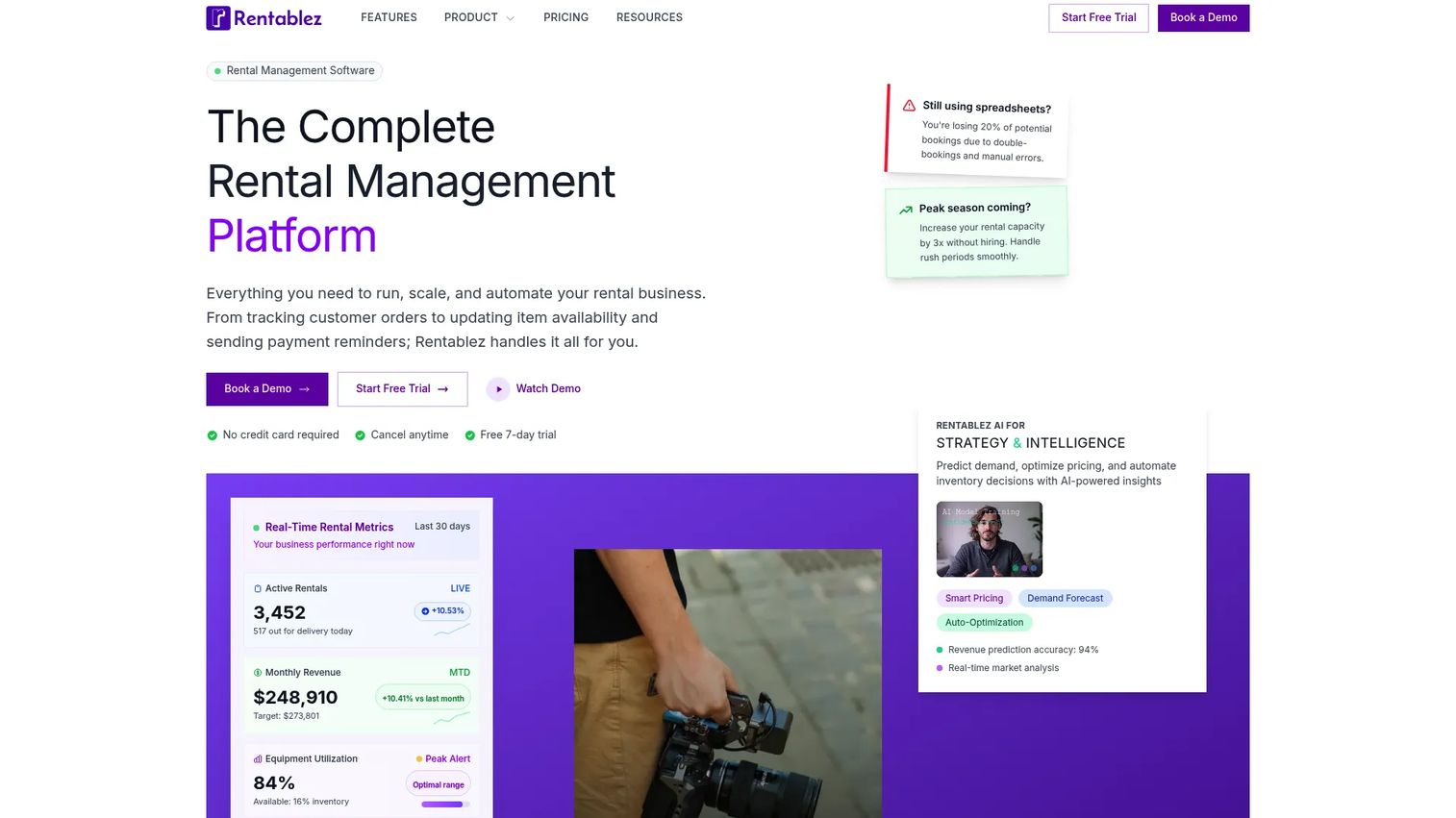
Rentablez is rental management software for equipment, vehicle, and asset rental businesses, with a clear operational focus on booking accuracy and gear protection. For camera rental teams, the value proposition is concrete: cut double-bookings, protect high-value gear with condition tracking, and reduce damage disputes with timestamped records. It pairs real-time inventory and booking management with invoicing, payments, and maintenance workflows, plus a mobile app that syncs offline.
Best for: Teams focused on reducing double-bookings and damage disputes while running professional booking and billing flows at an accessible price.
Key strengths
- Real-time inventory and booking management: live availability and double-booking prevention so the same serial never goes to two clients on the same date.
- Mobile app for iOS and Android with offline sync: run check-in and check-out in the field even without signal, then sync when you reconnect.
- Analytics, invoicing, payments, and maintenance workflows: track asset utilization, bill accurately, and schedule maintenance before condition becomes a dispute.
Why choose Rentablez: It replaces the manual condition-report-and-photo routine that most small rental teams still run through phones and email. Timestamped condition records and utilization metrics turn a "he said, she said" damage argument into a documented one, which protects revenue directly. The tiered pricing also makes it the most approachable entry point for a smaller operation that wants professional booking flows without a large upfront commitment.
Rentablez pricing: Plans are billed monthly and start with the Starter tier at $29 per month, Growth at $69 per month, and Professional at $149 per month, with a Custom tier available through sales. Prices are shown in USD and exclusive of GST. There is no free tier, but a 30-day free trial lets you test booking and condition workflows first. Pricing is verified from Rentablez's own pricing page as of July 2026.
Considerations before you buy
Before you commit, run each shortlisted tool against the workflow you most need to fix. These are the criteria that separate a good fit from an expensive mistake.
Serialized asset accuracy
Every camera, lens, and accessory should live in the system as its own serialized record with condition history and utilization. Test whether the tool tracks by serial number, not just by SKU. If it only counts quantities, it will not stop the double-booking of a specific body, and that is the whole point.
Booking and reservation depth
Look at how the platform handles holds, confirmations, kit building, and real-time availability across multiple locations. Book a fake rental end to end during your trial. If the reservation flow feels clumsy in testing, it will be worse under a busy week.
Scanning and field operations
If your team works from a warehouse floor or on location, barcode scanning, RFID integration, and a reliable mobile app matter more than any dashboard. Check whether check-in and check-out work on a phone, and whether the app handles field operations without a constant connection.
Quote and contract workflows
Trace an inquiry through to a paid invoice. Confirm the tool carries quote and contract workflows, e-signature, deposits, and late fees without losing context between steps. Broken quote-to-cash flow is where high-value rentals quietly lose margin.
Pricing fit for your stage
Match the pricing model to your revenue, not your ambition. A smaller operation is better served by an accessible entry tier it fully uses than an enterprise platform it half-adopts. Weigh what each tool replaces in your current stack against what it costs.
Conclusion
The right camera rental software depends less on the brand and more on the workflow you most need to fix. If your problem is fragmentation across booking, inventory, and billing, EZRentOut gives you the broadest all-in-one coverage. If it is operational discipline, QC, and coordinating gear with crew across locations, IntelliEvent is built for that reality. If you run multiple brands or channels with real-time booking, Circulio's multi-site eCommerce is the strongest fit. And if double-bookings and damage disputes are eating your margin, Rentablez targets exactly that at an accessible price.
The next step is not to sign a contract. Shortlist two tools, run a real rental through each during the trial, and test the three workflows that break most often in your operation: booking and real-time availability, serialized check-in and check-out, and quote-to-cash. Whichever platform holds up under your actual week is the one worth committing to.
FAQs
Camera rental software is a platform that manages the full rental lifecycle for camera, lens, and production gear, from real-time availability and reservation management to quotes, contracts, invoicing, and asset return. It treats every item as a serialized asset that gets checked out and back in, which prevents double-bookings and manual reconciliation. It is the operational backbone that replaces spreadsheets, email quotes, and shared calendars.
Prioritize serialized asset management, real-time availability, and booking depth, because those stop double-bookings and availability errors. After that, weigh quote and contract workflows, invoicing and billing, and scanning for fast check-in and check-out. Which features matter most depends on whether your pain is front-end booking or back-office control.
It ties every reservation to a specific serialized asset and updates real-time availability the instant a booking is confirmed. When one coordinator reserves a specific cinema body for a date, that serial shows as unavailable to everyone else immediately. That single source of truth is what a spreadsheet and a shared calendar cannot reliably provide.
Yes. Most camera rental software supports barcode scanning through a mobile app for check-in and check-out, and several platforms also offer RFID integration for faster bulk processing. EZRentOut and Rentablez both include mobile scanning apps, and IntelliEvent is built around inventory control workflows. Scanning is what makes field operations fast and accurate.
Yes, quote and contract workflows plus invoicing and billing are core to the category. The value is continuity: an inquiry becomes a quote, then a signed contract, then a paid invoice, without losing deposits, late fees, or kit discounts along the way. Protecting this quote-to-cash flow is where high-value rentals keep their margin.
They overlap heavily. AV rental software is broader, covering audio, lighting, staging, and event gear, while camera rental software emphasizes serialized bodies, lenses, and production accessories with condition tracking. Several platforms, including EZRentOut and IntelliEvent, serve both camera and AV rental teams from the same system, so the distinction is often about emphasis rather than a hard line.
Any operation renting individually valuable, serialized gear benefits most: film and video production rental houses, broadcast equipment rental, camera and lens shops, and AV rental teams. The trigger is usually outgrowing spreadsheets after a double-booking, a lost item, or a damage dispute that manual records could not resolve. If your gear is high-value and moves fast, purpose-built software pays for itself in prevented losses.