Your VP Sales wants product presentations to be consistent. Engineering offers to build something internally. And you’re still joining the important deals, because nobody tells the product story quite like you do.
Build vs buy demo automation is where all three of those pressures land in one budget conversation. Finance sees a subscription next to engineering time. Product sees another roadmap commitment. What you need is a GTM system that runs without you in it.
At Series B, demo automation deserves the same scrutiny as any other piece of infrastructure. Who owns it after launch? What product work gets pushed back? Can the commercial team change something without opening an engineering ticket?
The answer starts with which work you actually want to own. Proprietary evaluation logic can justify building. Repeatable product storytelling is a different problem, and that’s where buying deserves a serious look.
So treat demo software build or buy as a question about where your people go, not a prototype against a subscription invoice. Compare the maintained system, including the humans and the dependencies that keep it alive.
What’s inside
Everything here is aimed at a decision your product and revenue leaders can actually act on:
- What an internal demo environment needs after its first working version.
- What buying changes about ownership.
- A comparison of control, security, cost, and day-to-day operations.
- When to build, when to buy, and when to do both.
- A decision scorecard and a 12-month cost model.
- A proof-of-value plan with separate build and buy tracks.
- Where Guideflow fits on the buy side.
- The metrics that tie this to engineering capacity and revenue.
TL;DR
- Build when the technical layer is strategic. Proprietary simulation or evaluation logic can earn dedicated engineering ownership.
- Buy when repeatable GTM is the point. Give commercial teams a supported way to make and distribute product experiences.
- Cost the maintained system, not the prototype. Release updates, internal support, security work, and instrumentation all belong in the number.
- Keep opportunity cost on the table. Name the product work that an internal build would push out.
- Consider a hybrid. Keep the product-specific infrastructure, buy the content and distribution layer.
- Decide on evidence. Run one production change through both options and look at what happened downstream before you commit.
What it means to build demo automation in-house
Building means your team develops and runs the system that creates, delivers, and measures product demos. That can include custom environments, reusable content, access management, and integrations.
An internal demo environment usually starts with a staged app and some representative data. Making it dependable enough for daily commercial use is where the work shows up:
- Demo accounts with the right permissions.
- Data generation and reset scripts.
- Variants for different evaluation scenarios.
- Instrumentation tied to opportunity records.
- Release testing and internal documentation.
- Someone to call when it behaves oddly.
Scope follows the evaluation requirement. A captured interface and a working backend tenant do different jobs, so write down exactly what buyers have to validate.
Take an infrastructure company selling complex authorization software. Its buyers need to make permission changes against a proprietary policy engine. An internal environment could expose that behavior with representative accounts.
That investment needs an engineering owner and a presales partner. Between them, they decide which scenarios are supported and how changes reach the field.
What you get is architectural control. Your team decides which backend behavior exists and how the environment connects to everything else. What comes with it is responsibility for keeping that running.
So give a sales engineering demo environment an internal product charter: who it’s for, what service level it promises, and who funds it. Write down which requests it covers and which ones get looked at separately.
Keep build to learn and build to run apart in your head. A prototype proves an idea works. A maintained service has to keep working after the person who wrote it moves teams.
Before you accept a short delivery estimate, ask one question: who owns the next product release that changes this environment?
What it means to buy demo automation software
Buying means you adopt a platform for producing and delivering demos instead of building that layer yourself.
You still own the product narrative and whether the content is accurate. The vendor supplies the software your team works in. Make that split explicit in procurement, because it tends to get assumed.
1. Guideflow as the buy-side implementation path
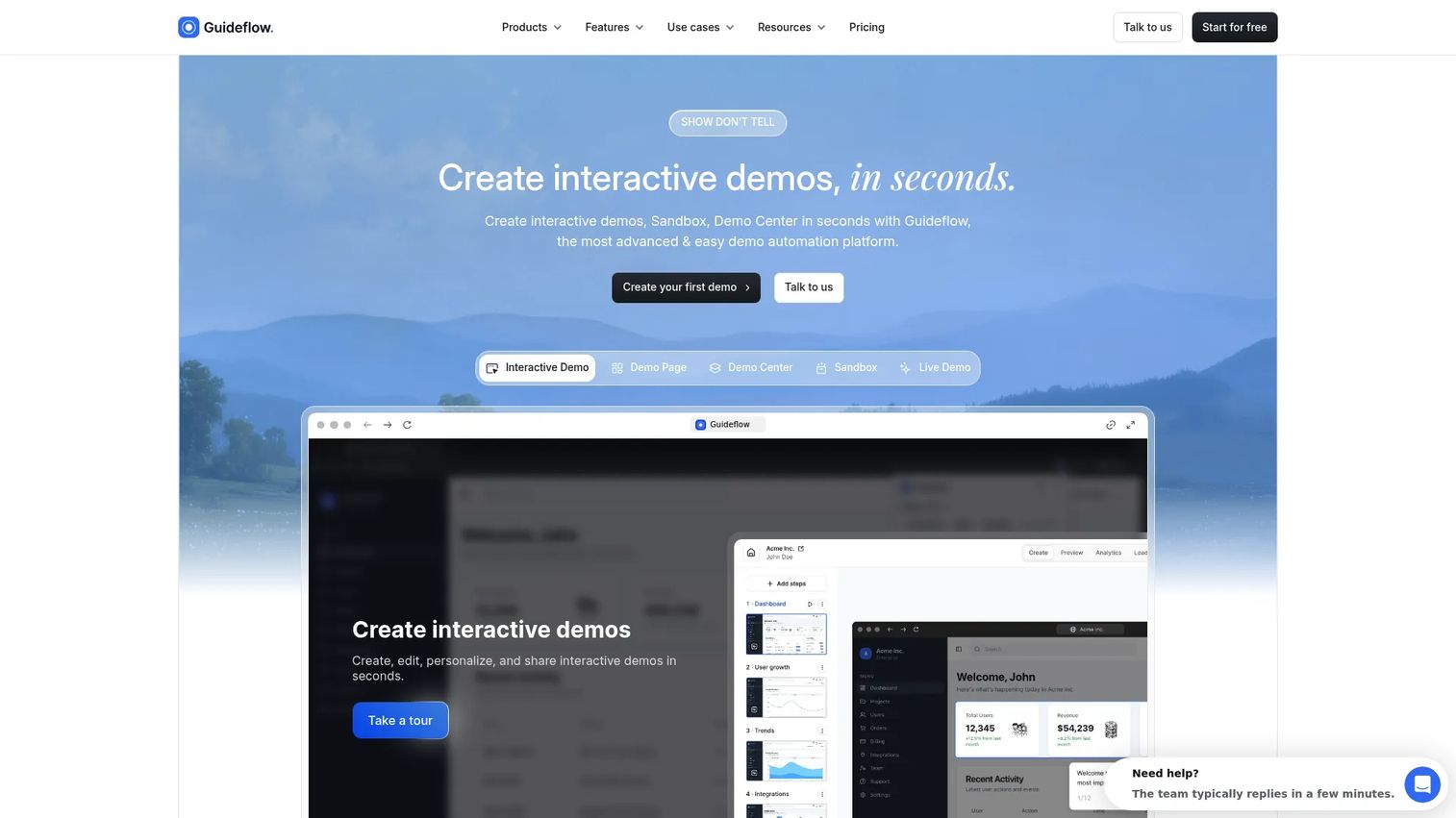
Guideflow is a demo automation platform used across product marketing, sales, onboarding, support, training, and product communication.
The formats cover different delivery needs:
- Interactive demos: guided, clickable product stories for landing pages, outbound email, onboarding, and customer education. The viewer follows a curated path at their own pace.
- Sandboxes: open, explorable replicas for technical validation, proof-of-concept work, customer training, and partner certification. A sandbox demo lets people dig around on their own.
- Demo centers: branded hubs for website exploration, sales enablement, customer education, and partner content, organized by persona or product area.
- Live demos: presenter-led sessions for discovery, technical deep dives, webinars, and training workshops, where the conversation runs alongside the product.
- Mobile demos: mobile-optimized experiences for app listings, messaging outreach, field sales, and mobile onboarding.
Capture runs in the browser and editing is no-code, so teams can change text, images, graphs, and interface elements, then share by link or embed.
Content generation and localization are handled for you, with voiceovers and avatars available. Analytics cover engagement and lead capture.
The operational question for sales demo automation is whether the team can own its own routine work. Test it: can PMM update a story, and can an AE send the approved version, without asking engineering?
The buy path needs governance too. Decide who approves content, review how data is handled, and work out how engagement reaches whoever follows up. A platform gives you capabilities; your operating model is what makes them useful.
Build vs buy demo automation: key differences
Compare ownership boundaries before you compare invoices. This table splits the responsibilities without pretending either option is automatically better.
| Decision factor | Build in-house | Buy a platform |
|---|---|---|
| Time to first usable demo | Needs defined scope and engineering delivery | Needs content prepared and the platform set up |
| Engineering dependency | Your team develops and supports the system | Work out which routine tasks GTM can own |
| Customization and control | Control over implementation and backend behavior | Configuration within what the platform supports |
| Demo environment maintenance | You own app changes, resets, hosting, instrumentation | Vendor maintains the software; you maintain content and configuration |
| Security and data exposure | You design and review the architecture | Review vendor controls next to your own sharing policy |
| Analytics and buyer intent | You implement events and wire them to business records | Assess the built-in analytics and how integrations behave |
| Cross-team adoption | Design a workflow for each internal group | Test usability with the teams who will run it |
| Cost profile | Development, operations, support, and displaced product work | Subscription, rollout, administration, content upkeep |
| Strategic fit | Product-specific infrastructure worth owning | Repeatable production and delivery across GTM |
Guideflow gives the evaluation a concrete buy-side option:
| Product | Implementation role | Relevant applications | Entry pricing |
|---|---|---|---|
| Guideflow | Demo creation, personalization, distribution, and measurement | Product marketing, sales follow-up, onboarding, and customer education | Free plan; Solo from $35/user/month, billed annually |
Building earns the investment when owning that behavior creates strategic value. Buying earns it when what you really need is a repeatable production workflow.
For founders, the useful part of the comparison is what gets displaced. Ask engineering to name the roadmap commitment that moves if the internal project goes ahead.
And keep the platform’s responsibilities separate from yours. Buying software doesn’t hand over responsibility for product accuracy or for deciding what can be shared.
When to build, buy, or combine both
Build when proprietary behavior deserves engineering investment
Build when a specific evaluation requirement depends on product-specific infrastructure you intend to own.
A proprietary simulation engine counts. So does custom integration behavior a buyer has to execute themselves. If the same environment also serves R&D or customer trials, the case gets stronger.
Write the requirement precisely. “Enterprise buyers need realism” is not a requirement. “Evaluators must execute policy changes against our authorization engine” gives engineering something they can test against.
Check purchased options against that requirement before you assume custom work is the only route. If building still wins, fund the ongoing ownership, not just the build.
The board-level version of the argument ties the investment to differentiation or to a requirement you can’t evaluate without it. Avoiding a software invoice is a much weaker case than owning something that matters.
Buy when commercial teams need repeatable execution
Buying fits when your bottleneck is the volume of requests landing on technical teams.
Maybe PMM needs approved launch content across several segments. Sales wants follow-up material that doesn’t vary by rep. CS needs reusable education, and partnerships needs current assets for resellers.
Then the thing to evaluate is whether those teams can work through one shared process in Guideflow. The proof is them producing and maintaining approved content, not a good demo from the vendor.
A buyer-led program also has to handle the handoff from self-service exploration to a human. Decide which behavior deserves outreach, and who gets it.
Here’s a clean buy signal: your requirements are mostly about content operations rather than proprietary application behavior.
Combine both when the ownership boundary is clear
A hybrid fits when one narrow technical component deserves custom ownership and the routine production work doesn’t.
Engineering might own a data generator or an integration simulator. GTM owns the content built around it.
Test the join between those layers. Write down how a change moves from the custom component into approved assets, and who checks that it’s still accurate.
Hybrid ownership needs an interface contract, not two teams promising to stay in touch. Specify the supported inputs and who escalates what.
A decision tree, if you want one:
- Does the requirement involve strategically important product behavior? If yes, look at building that component.
- Can a purchased platform meet the workflow requirements? If yes, test the buy path.
- Are both true, for different layers? Define the hybrid boundary and test the handoff.
- Still unclear who owns what? Settle that before you approve either one.
Common mistakes and their fixes
1. Pricing the prototype instead of the operating system
A working flow proves feasibility. It tells you nothing about what it costs to support five teams and absorb product changes.
Fix: ask for a 12-month estimate that includes maintenance and internal support, and have whoever built the prototype run one update cycle before they estimate.
2. Leaving accuracy ownership between departments
Product assumes PMM handles updates. Commercial teams assume engineering will notice every affected screen. Nobody does.
Fix: name one accountable content owner, plus a technical reviewer where claims need checking. Put an accuracy check in the release process and say when stale material gets retired.
3. Designing around the sales meeting alone
Build only for the meeting and you miss most of the work, which happens before and after it.
Fix: map outbound education, landing pages, sales follow-up, and onboarding before you set scope. Include partner enablement and support if those teams need reusable explanations too.
4. Instrumenting after launch
Add measurement later and your first evaluation period has no usable baseline. A completion event on its own also tells you very little about qualified pipeline.
Fix: agree what each event means and how attribution works before rollout. Decide which actions reach the CRM, and keep anonymous activity separate from identified engagement.
5. Treating salaried engineering as free capacity
The salary is already paid, but the capacity is being spent on this instead of something else. Leadership time counts too.
Fix: show the displaced initiative next to the cash budget. Keep opportunity cost separate from payroll so you’re not counting the same money twice.
6. Buying software without assigning a workflow
A purchase leaves the questions about approvals and follow-up exactly where they were, and those are what adoption actually turns on.
Fix: publish a light operating model before you invite the wider team. Who creates, who approves, how revisions reach people, and who owns engagement follow-up.
How to implement the decision
Step 1: Inventory the demo jobs
List your top 10 demo moments before anyone talks about implementation. Use real requests from the field, not a wish list.
| Team | Jobs to include |
|---|---|
| Marketing | Landing-page education and campaign experiences |
| SDRs and AEs | Pre-call context and follow-up material |
| Presales | Technical evaluation and objection handling |
| Product marketing | Launch storytelling and enablement |
| Customer success | Onboarding and feature education |
| Partnerships | Co-branded content and partner training |
For each one, write down the audience and the decision they’re trying to make. Add the current owner, how often it comes up, and what a delay costs.
What you get is a ranked backlog. Keep the rare exceptions visible, but don’t let them quietly design the whole system.
Step 2: Separate technical uniqueness from workflow requirements
Sort every requirement into product-specific infrastructure or commercial workflow.
Executing proprietary backend logic goes in the first pile. Editing a screen, approving content, sharing a link, and measuring engagement go in the second.
Then write acceptance criteria. “Useful analytics” becomes “an identified interaction reaches the right opportunity record with its source intact.”
Run both options against those tests. A custom build still has to satisfy the workflow requirements, and a platform still has to prove the capabilities your evaluation depends on.
What you get is a requirements sheet with names on it.
Step 3: Model 12-month ownership costs
Use your own labor rates and real vendor terms. Keep one-time implementation apart from recurring operations.
| Cost input | Build estimate | Buy estimate |
|---|---|---|
| Initial setup | Discovery, design, development, testing | Configuration, rollout planning, training |
| Content production | Initial assets and documentation | Initial assets and documentation |
| Technical operations | Hosting, resets, monitoring, fixes | Internal integration and admin work |
| Ongoing updates | Release testing and system maintenance | Content review and configuration changes |
| Governance | Security review and access administration | Vendor review and access administration |
| Subscription | Supporting services and infrastructure licenses | Platform contract and any add-ons |
| Exit planning | Documentation and ownership transfer | Export, migration, contract review |
Then calculate:
Build cash cost = implementation labor + recurring operations + infrastructure + supporting services.
Buy cash cost = subscription + rollout labor + recurring administration + content maintenance.
Show opportunity cost and GTM delay separately, with the assumptions written out, rather than adding speculative revenue straight into the budget.
Give a low and a high estimate for anything uncertain. The decision should still hold up when maintenance takes longer than anyone expected.
Step 4: Run a 30-day proof of value
Thirty days is a proposed evaluation window, not a deployment timeline.
On the buy path, pick one commercially important workflow. Build three to five representative assets and have the people who’ll actually own them use them.
Force an update during the evaluation. Can PMM make the change, get it approved, and get the current version out without engineering? That’s the test.
On the build path, constrain the prototype: one product flow, one personalization requirement, one analytics event, and one release-driven change.
Then track the effort after the first demo. The second cycle tells you about the support model; the first one only tells you someone can present well.
For a hybrid test, include the boundary. Change the custom component and watch what the platform-side owner has to redo.
Step 5: Score the evidence
Agree the weights before you look at results. Treat this as a meeting template, not a benchmark.
| Criterion | Evidence to review |
|---|---|
| Technical fit | The required behavior was demonstrated |
| GTM independence | The intended operators completed the routine work |
| Maintenance | An update cycle was completed, with effort recorded |
| Measurement | Engagement reached the agreed business record |
| Governance | Access and data-handling review completed |
| Economics | Ownership costs and displaced work documented |
Score each approach one to five against your acceptance criteria. Keep unresolved requirements listed separately: a mandatory security gap should not vanish inside an average.
Step 6: Fund the operating model
For a build, assign a product owner and reserve maintenance capacity. Write down the service expectations and the escalation path.
For a Guideflow rollout, appoint a GTM owner and settle who approves what. Organize the first library around your highest-priority jobs, then train the people who are expected to keep it current.
Either way, publish a release checklist and a cadence for reviewing the numbers. What you want at the end is an owned process, not an approved purchase or a finished sprint.
Measuring demo automation total cost of ownership and ROI
Measure operational independence alongside commercial outcomes. Early engagement is useful context, but it doesn’t prove revenue causation.
| Metric | What it tests | Measurement approach |
|---|---|---|
| Time to first demo | Initial delivery speed | Record kickoff and approval dates |
| Engineering hours per update | Technical dependency | Track the work across a product release |
| GTM owner hours per update | Ongoing operating effort | Include editing, review, and distribution |
| Completion rate | Progress through the intended experience | Define starts and completions consistently |
| Demo-to-meeting conversion | Response to the next action | Connect identified engagement to qualified meetings |
| Demo-to-close rate | Commercial progression | Compare equivalent opportunity cohorts |
| Sales cycle length | Deal velocity | Segment by deal size and buying motion |
| SE hours per opportunity | Presales allocation | Track preparation and evaluation support |
| Founder-assisted opportunities | Leadership dependency | Record where founder involvement is still needed |
| Product update lag | Content accuracy | Measure change-to-approved-update time |
Set a baseline before the proof of value, and compare like accounts, accounting for acquisition source and deal stage.
Resist treating every engaged account as evidence of lift. Buyers who were already interested are the ones most likely to go through your product material in the first place.
Calculate demo automation ROI as:
ROI = (measured benefit − total cost) ÷ total cost.
Keep realized savings apart from released capacity. Hours saved don’t reduce payroll by themselves; they turn into value when you reassign them to something useful.
For the demo automation break-even point, compare cumulative build and buy costs over the same period, with recurring development on one side and renewal assumptions on the other.
Buying has a payback calculation too: divide the incremental rollout investment by the monthly net benefit your evidence supports. If that benefit is still uncertain, give scenarios rather than announcing a date.
Review demo environment maintenance after both an ordinary release and a bigger product change. You need both to make an ownership estimate anyone should believe.
What to do in the next 24 hours
Give your revenue, product, and finance leaders a short decision packet, one that makes the assumptions visible without needing another presentation from you.
Start here:
- Rank the demo moments that are holding up campaigns or evaluations.
- Mark which requirements involve proprietary product behavior.
- Ask engineering for a maintained-system estimate, not a build estimate.
- Name the roadmap work an internal project would displace.
- Pick a proof-of-value owner and one commercial workflow.
- Agree the acceptance criteria before anyone argues for a preferred option.
Set a decision date, and say who breaks the tie when requirements conflict. An evaluation with no decision rights turns into another open-ended internal project.
Use the next leadership meeting to approve a test, not an architecture nobody has operated yet. Ask each function to bring evidence from its own work.
On the buy path, have the future content owner run the evaluation. Whether they can maintain the workflow matters more than how good the vendor’s demo was.
Choose the layer your company should own
Build when the technical behavior deserves product-grade investment, and give it the same ownership and funding discipline as any other strategic infrastructure.
Buy when what the company needs is a repeatable commercial workflow its GTM teams can run. Guideflow belongs in that evaluation across acquisition, sales, customer education, and partner enablement.
Go hybrid when the boundary is clear enough to maintain. Custom evaluation logic and purchased content operations can live together, as long as the responsibilities are written down.
For a founder, this is a question about capacity and accountability. Does the option you pick reduce dependency on you while making the team better at communicating product value?
Start with a constrained proof of value. Expand once the people who own it have shipped an update and the measurement is landing in your business systems.
Start your journey with Guideflow today!
FAQs
It depends on total ownership cost over the same period. Put internal support and release maintenance next to development, then compare that with subscription and operating costs. Keep displaced product work visible as a separate opportunity cost.
Build when an essential evaluation requirement depends on proprietary behavior you intend to own and maintain, like custom simulation or execution against a product-specific policy engine. Assign the ongoing engineering ownership before you approve it.
Buy when the main requirement is a repeatable production and delivery workflow across commercial teams. Check whether the intended operators can publish approved content and keep it current through product changes. Judge it against your requirements, not the length of a feature list.
Ongoing ownership, which an estimate focused on the first release almost always misses. Data refreshes, permission changes, instrumentation upkeep, internal support. Measure that during the prototype instead of assuming it stays small.
Yes. Keep the product-specific infrastructure and buy the workflow you use to create and distribute content. Define the interface between the two layers and test what happens when the custom component changes. Explicit update responsibility is what makes it work.
Start with a baseline, then measure benefit against total cost over a defined period. Track operating effort alongside qualified conversion and sales-cycle outcomes. Separate what you can attribute from what merely correlates, and keep cash savings apart from reassigned capacity.
It changes how their time is spent; it doesn’t remove the need for technical judgment. Presales still owns discovery and evaluation design, including the hard technical objections. The question is whether the new workflow frees more SE capacity for the deals that need that expertise.
Guideflow supplies the demo creation and delivery layer, so your team doesn’t have to build it. The formats cover landing-page education, sales evaluation, customer onboarding, and partner training. You keep responsibility for product accuracy and for the process around publishing.