An appraisal order should not need seven tools and three inboxes to move from intake to funding. But that is how most valuation operations actually run. Order routing lives in one system. Appraiser assignment happens over email. Review sits in a spreadsheet. Payments and reconciliation live somewhere in accounting. Compliance is a folder someone hopes is complete.
Every handoff between those systems is where turn time leaks. And turn time is the number lenders and appraisal management companies get measured on.
Appraisal management software exists to close those gaps. The category pulls order management, appraiser assignment, review, payment, and status tracking into one appraisal management system, so coordination stops depending on who remembered to forward the last email. The appraisal management software market was valued at roughly USD 7.2 billion in 2025 and is projected to reach USD 17.9 billion by 2034, according to IMARC Group (2025). Teams are consolidating for a reason.
This guide compares the platforms worth shortlisting, and how to pick by workflow model rather than feature count.
What's inside
This guide is for mortgage lenders, appraisal management companies, and valuation operations teams comparing an appraisal management platform for real work: order intake, assignment, review, compliance, and integrations.
We selected and evaluated tools on the criteria that actually move turn times and reduce manual coordination:
- Lifecycle coverage: How much of intake, assignment, inspection, review, and payment lives in one place
- Compliance support: Audit trails, review consistency, and regulatory workflow controls
- Integration depth: LOS integration and connections to the systems your team already runs
- Operational fit: Whether the platform matches your model as a lender, AMC, or appraisal firm
We did not rank by feature volume. We ranked by fit.
TL;DR
Short on time? Here are the decision shortcuts.
- Best overall for end-to-end workflow automation: Reggora, for lenders and appraisal vendors that want one platform spanning ordering, marketplace, review, and payments.
- Best for mobile and field workflow: Anow, for appraisal firms that need order tracking, automated fee calculation, and analytics in the office and on-site.
- Best for compliance and security-conscious teams: AppraisalWorks, for banks and credit unions prioritizing panel management, reporting, and controlled deployment.
- Best for AMC-specific routing and white labeling: Appraisal Scope, for appraisal management company software needs like branded portals, automated routing, and audit trails.
- Best for understanding the category itself: treat appraisal management software as an operational model, not a single product, and shortlist by workflow shape.
What is appraisal management software
Appraisal management software is a platform that manages real estate appraisal orders across their full lifecycle, from intake and appraiser assignment through inspection, review, payment, and status tracking. It gives lenders, AMCs, and appraisal firms one appraisal management system to coordinate every party in a valuation, instead of stitching the process across email, spreadsheets, and disconnected accounting tools.
The category overlaps with the broader term appraisal software, but there is a distinction worth holding. Appraisal software often refers to the tools an individual appraiser uses to produce a report. An appraisal management platform sits above that, orchestrating the operational workflow around the report: who gets the order, when it is due, whether it passed review, and whether the appraiser got paid.
Common capabilities include:
- Order management: Centralized intake, status tracking, and due-date visibility across every active order
- Appraiser assignment: Rules-based or manual routing to the right appraiser or panel
- Review workflows: Structured review steps, often with appraisal review automation to flag issues before delivery
- Audit trails: Time-stamped records of every action for compliance and defensibility
- LOS integration: Direct connection to the loan origination system so orders and status sync without rekeying
- Payment processing: Automated fee calculation, collection, and payment and reconciliation
- Portals: A lender portal and an appraiser portal so each party sees only what they need
- Analytics: Turn time, cycle stage, and vendor performance reporting
The practical goal is turn time reduction. Each capability above removes a manual handoff, and every handoff removed is time and error taken out of the cycle. That is the whole case for appraisal workflow automation.
When to use appraisal management software
Reduce manual order coordination
When your order volume outgrows spreadsheets and email threads, coordination becomes the bottleneck. You know you have hit this point when someone spends most of a day chasing status updates, or when an order stalls because a handoff was missed. A platform centralizes intake, assignment, and status so nobody is reconstructing where an order stands from a thread.
Standardize review and compliance checks
When auditability and consistency start to matter, ad hoc review does not hold up. Regulators and investors expect defensible, repeatable processes. Appraisal management software applies the same review steps to every order and records who did what and when. That consistency is hard to fake with manual review, and it is exactly what compliance and audit trails are built to produce.
Connect lenders, AMCs, and appraisers
When multiple parties touch the same order, disconnected tools multiply the friction. A lender portal, an appraiser portal, and LOS integration let each party act in one shared workflow. Orders and status sync automatically instead of being rekeyed, which cuts both delay and error across the chain.
Comparison table
A quick side-by-side before the detailed breakdowns. Pricing for most platforms in this category is demo-based, so verify current figures directly with each vendor.
| # | Product | Best for | Key differentiator | Pricing | G2 rating |
|---|---|---|---|---|---|
| 1 | Reggora | Mortgage lenders and appraisal vendors | End-to-end lifecycle with marketplace and AI-powered review | Free tier available; lender platform demo-based | Not rated |
| 2 | Anow | Appraisal firms and field teams | Custom workflows, fee automation, client portals | Free trial; plan pricing not public | Not listed |
| 3 | AppraisalWorks | Banks, credit unions, and lenders | Panel management, reporting, and compliance | Demo-based | Not listed |
| 4 | Appraisal Scope | Appraisal management companies | White-labeled AMC workflow with audit trails | Demo-based | Not listed |
Best appraisal management software tools for 2026
1. Reggora
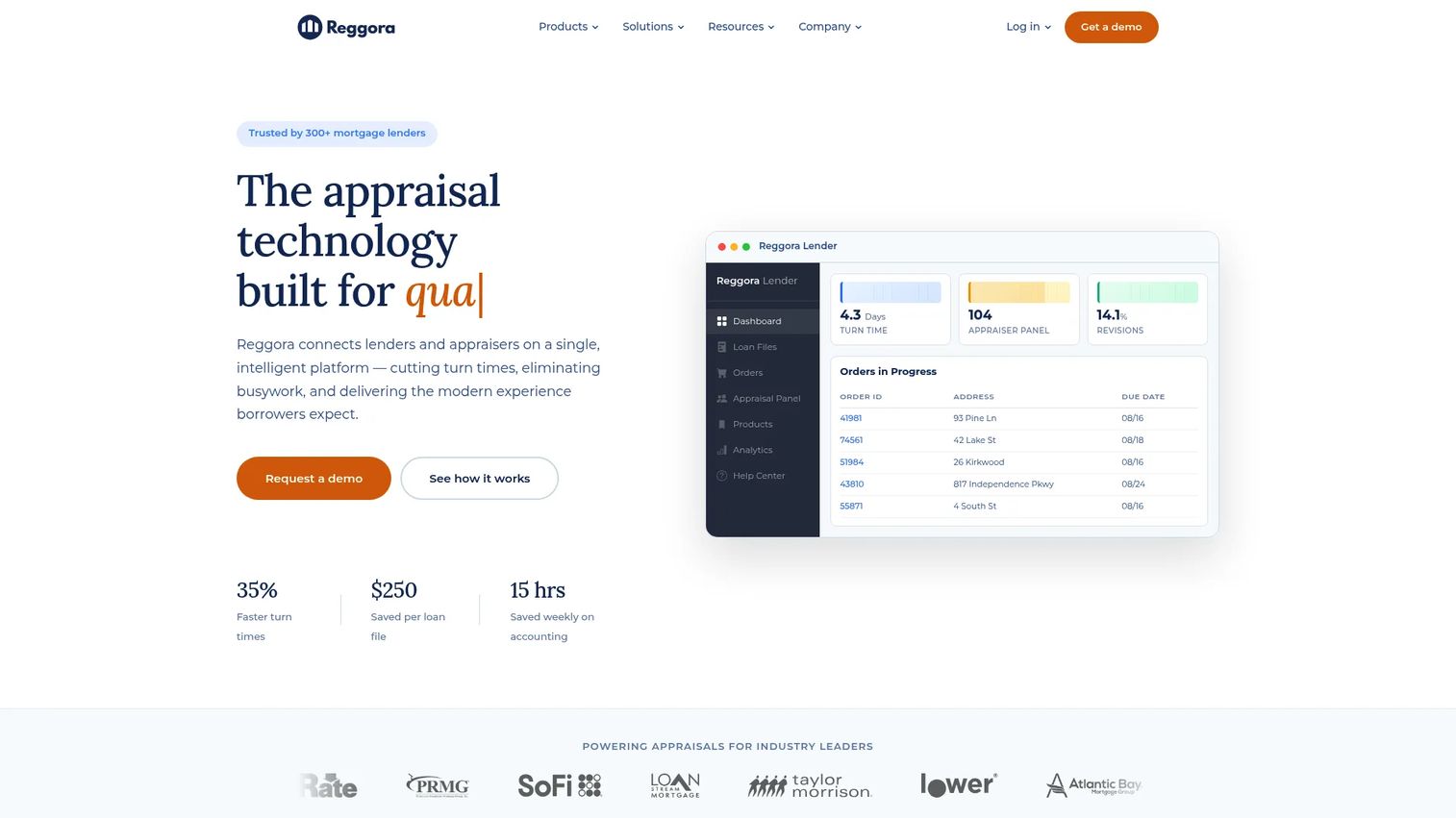
Reggora is appraisal management software built for mortgage lenders and appraisal vendors that want the full valuation lifecycle in one platform. It spans order management, an appraisal marketplace for matching orders to appraisers, AI-powered review, LOS integration, and payments. The pitch is consolidation: instead of running ordering, review, and reconciliation across separate systems, the whole flow sits under one roof.
Best for: Lenders and vendors that want a single platform connecting both sides of the appraisal, from order to funded loan.
Key strengths
- Order management: centralized intake and status tracking
- Appraisal marketplace: matches orders to available appraisers
- AI-powered review: flags issues before delivery
- Payments: automated fee handling and reconciliation
Why choose Reggora: If your operation touches both the lender and appraiser sides, Reggora's end-to-end coverage means fewer systems and fewer handoffs. It fits teams that want appraisal workflow automation across the full cycle rather than a point tool for one stage.
Reggora pricing: Reggora Forms is offered at $0 per appraisal order, and there is a free offering for appraisers. Pricing for the lender platform is not publicly listed and appears demo-based, so request a quote directly.
Reggora's G2 listing does not currently show a substantive buyer rating, so weigh the platform on capability fit and a hands-on evaluation rather than review scores.
2. Anow
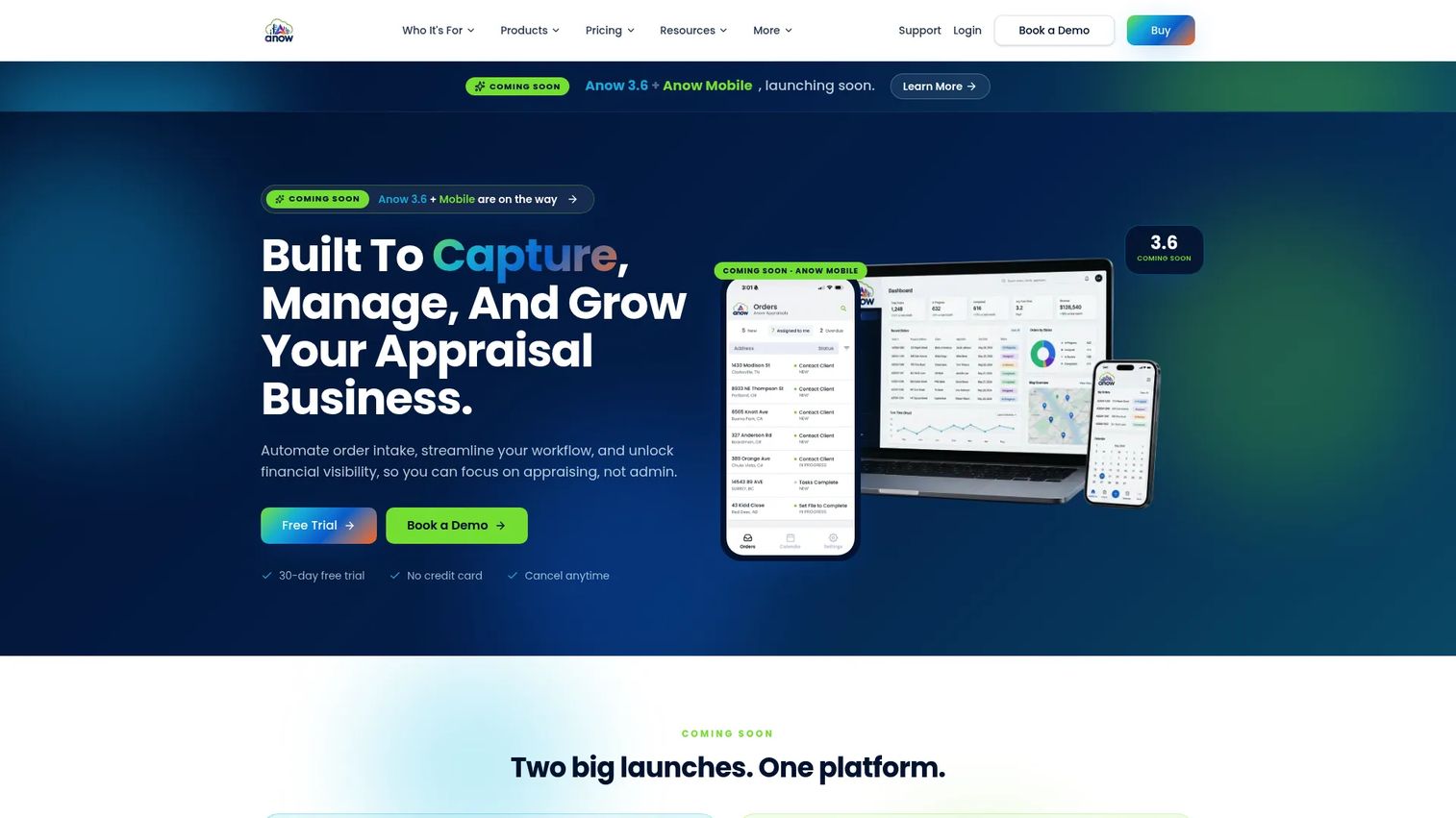
Anow is appraisal management software built for appraisal businesses that run work across the office and the field. It focuses on custom workflows, order and pipeline tracking, automated fee calculation, business analytics, and client collaboration. For firms that need operational visibility wherever the work happens, Anow leans into mobile and field-friendly workflow.
Best for: Appraisal firms that need order tracking, fee automation, and analytics that follow the team on-site.
Key strengths
- Custom workflows: tailored steps with automated fee calculation
- Client ordering portal: branded client emails and self-serve ordering
- Business analytics: reporting on pipeline and performance
- Field-ready workflow: order and status visibility in and out of the office
Why choose Anow: For appraisal firms, the draw is running the whole business, not just one order, from a single system. Custom workflows and analytics give operational visibility, while the client portal cuts the back-and-forth of intake.
Anow pricing: Anow lists Essentials as its standard plan, with Grow and Accelerate adding more capability. The homepage advertises a 30-day free trial with no credit card required, though public plan prices were not visible, so confirm current pricing with Anow directly.
Independent review coverage for Anow appears on Capterra rather than as a verified G2 score, so treat third-party ratings as directional and validate with a trial.
3. AppraisalWorks
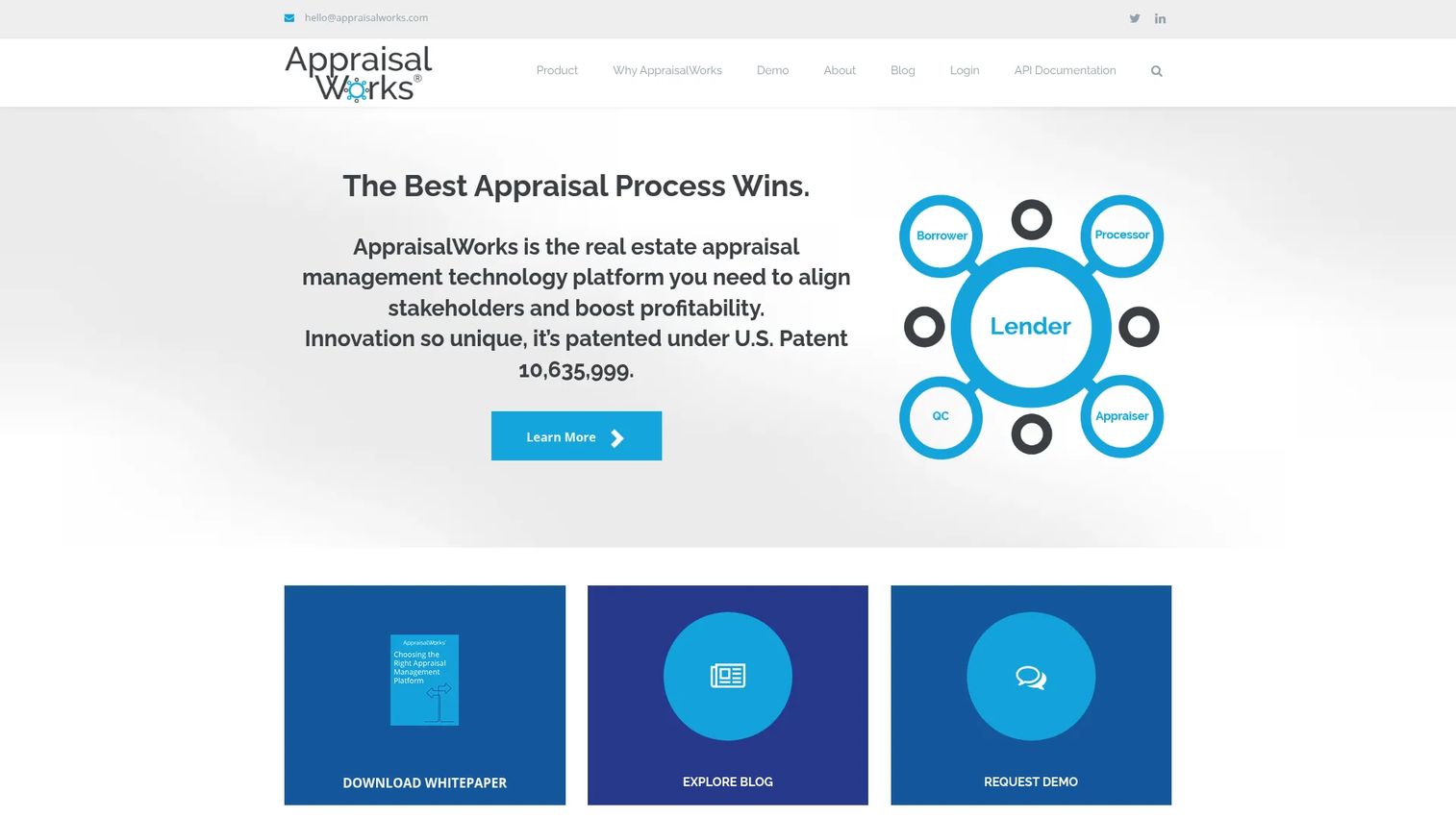
AppraisalWorks is cloud-based real estate appraisal management technology built for banks, credit unions, loan servicers, and mortgage lenders. It centers on order management, panel management, reporting, and compliance. The positioning leans toward institutions that need controlled, defensible appraisal operations rather than a lightweight point tool.
Best for: Banks, credit unions, and lenders that prioritize panel control, reporting, and compliance in their appraisal operations.
Key strengths
- Order management: centralized order intake and tracking
- Panel management: control over the appraiser panel
- Reporting: operational and compliance reporting
- Compliance: workflow controls for defensible processes
Why choose AppraisalWorks: For regulated institutions, the appeal is compliance and panel control built into the workflow. Teams that answer to auditors and investors value reporting and audit-ready processes over feature breadth for its own sake.
AppraisalWorks pricing: Pricing appears to be demo or contact-sales only, so plan for a sales conversation to get accurate figures for your volume.
A current, product-specific G2 or Capterra rating for AppraisalWorks was not verifiable, so base your evaluation on a scoped demo against your compliance requirements.
4. Appraisal Scope

Appraisal Scope is white-labeled appraisal workflow software built for appraisal management companies. It focuses on a customizable AMC experience, automated order routing, secure communications, a vendor portal, compliance, and built-in audit trails. The site presents it as part of Cotality's Valuation Workflow Solution platform, aimed at AMCs that need branded, role-based operational control.
Best for: AMCs that need a customizable, white-labeled workflow with automated routing and audit trails.
Key strengths
- White-labeling: a branded experience for AMC clients
- Automated routing: order routing, communications, and tracking
- Audit trails: built-in compliance and audit records
- Vendor portal: role-based access for appraisers and vendors
Why choose Appraisal Scope: For AMCs, the differentiator is customization and white labeling. If your clients expect a branded portal and your operation needs role-based control with defensible audit trails, this is built for that model.
Appraisal Scope pricing: No actual pricing numbers or plan details show up on the site. Since nothing's published, you'll need to contact the vendor for figures based on your volume and setup.
A verifiable G2 or Capterra rating for this exact product was not found, so weigh it through a demo focused on your routing and white-label requirements.
Considerations
Before you commit, run the shortlist through this checklist. The goal is to buy the model that fits your operation, not the longest feature list.
Workflow coverage
Map your actual process first: intake, assignment, inspection, review, payment, and status. Then check how much of it each platform covers natively versus what stays manual. A tool that automates four of six stages still leaves two handoffs where turn time leaks.
Compliance and auditability
Verify that the platform produces time-stamped audit trails and applies consistent review steps to every order. Ask how compliance and audit trails are surfaced for examiners and investors. If you cannot export a defensible record easily, the compliance value is thinner than it looks.
Integration depth
LOS integration is the difference between orders syncing automatically and staff rekeying data. Confirm which loan origination systems and accounting tools each platform connects to, and how deep the sync goes. Shallow integrations that only pass a few fields still leave manual work.
Portal and stakeholder experience
A good lender portal and appraiser portal reduce the coordination load on your team. Test each portal from the perspective of the party who uses it daily. If appraisers find the appraiser portal clunky, adoption drops and you are back to email.
Implementation and support
Ask how long onboarding takes, who owns migration, and what support looks like after launch. For a lean operation, a long implementation is a real cost. Get specifics on first-week setup and ongoing responsiveness before signing.
Conclusion
The right appraisal management software depends less on which platform wins a feature checklist and more on your operating model. Reggora fits lenders and vendors that want the full lifecycle in one place. Anow suits appraisal firms running office and field work with fee automation and analytics. AppraisalWorks fits compliance-focused institutions like banks and credit unions. Appraisal Scope is built for AMCs that need white-labeled, role-based workflow with audit trails.
The pattern to notice: fit beats breadth. A platform that covers your exact workflow with clean LOS integration will cut turn times more than a broader tool that leaves handoffs manual.
Next step: shortlist two platforms by workflow model, then validate integrations and compliance needs in a scoped demo against your real order flow. Confirm pricing directly with each vendor, since most sell through demo-led conversations rather than public pricing.
FAQs
Appraisal management software manages real estate appraisal orders from intake through assignment, inspection, review, payment, and status tracking. It centralizes coordination between lenders, AMCs, and appraisers so the process stops depending on scattered email and spreadsheets. The result is fewer manual handoffs and clearer visibility into every order.
It removes the manual handoffs where time leaks. Automated assignment, structured review, LOS integration, and status tracking mean orders move without someone forwarding an email or rekeying data. Each automated step compresses the cycle, which is why turn time reduction is the category's core promise.
Appraisal management software is the broad category for managing the appraisal workflow. An AMC platform, or appraisal management company software, is a subset built specifically for AMCs, with features like white-labeling, branded portals, and role-based routing. Lenders and appraisal firms may not need those AMC-specific features.
Prioritize workflow coverage, LOS integration, compliance and audit trails, and a usable lender portal. Confirm how much of your intake-to-payment process the platform automates natively. Then validate that it produces defensible, exportable records for examiners and investors.
Very important for lenders. LOS integration lets orders and status sync between the appraisal management system and the loan origination system without rekeying. Without it, staff manually copy data between systems, which reintroduces the delay and error the platform is supposed to remove.
An appraiser portal gives appraisers a single place to receive orders, upload reports, and track status, cutting the email back-and-forth. For AMCs, a branded lender portal and vendor portal keep each party in one shared workflow. That shared workflow is what reduces coordination load and speeds the cycle.