Your organic rankings look stable, but search traffic is falling. Leadership wants to know whether buyers still see your brand inside AI answers.
Adding another dashboard won’t answer that question unless it shows which sources influence those responses. AI citation tracking connects that visibility problem to pages your team can improve.
Pew Research Center’s 2025 research found users clicked traditional results in 8% of searches with AI summaries, versus 15% without them. That gap makes clicks an incomplete measure of search exposure.
For digital marketers, the buying decision comes down to useful evidence. An AI citation tracker should help you identify competitive gaps and decide what deserves work. It also needs to fit the reporting stack you already fund.
The practical question is straightforward. Which platform helps you turn AI search visibility into a defensible content decision, rather than another metric nobody owns?
What’s inside
This comparison examines AI citation tracking tools and adjacent platforms for marketing teams, agencies, and enterprise search programs.
The evaluation focuses on four buying criteria:
- Coverage: Supported answer engines and the prompts your buyers use
- Source depth: Exact cited pages, domain analysis, and competitive context
- Workflow fit: Connections between AI search monitoring and content execution
- Commercial fit: Pricing units, reporting requirements, and existing subscriptions
Tools to track AI citations vary considerably in scope. Some specialize in source monitoring; others combine visibility with SEO or commerce intelligence. Slate’s entry also addresses an important category mismatch.
Product and pricing research is dated November 24, 2026. Relevant vendor pages and G2 listings are linked throughout.
TL;DR
- Best for broader market context: Similarweb fits competitive intelligence programs. Evaluate its citation reporting separately from its established market and search capabilities.
- Best for dedicated monitoring: OmniSEO tracks mentions and citations. Peec AI adds documented domain and URL source analytics.
- Best for enterprise AI visibility: Profound combines citation tracking with research and recurring marketing workflows.
- Best starting point for lean teams: Otterly.AI offers focused monitoring with a lower paid entry price than several enterprise-oriented options here.
- Best for stack consolidation: Semrush and Ahrefs Brand Radar deserve attention when your team already uses their broader SEO products.
- Best for specialized operations: Rankability connects visibility with content work; GrowByData serves commerce intelligence. Slate at slate.ai serves construction, not AI citation monitoring.
What is AI citation tracking?
AI citation tracking monitors which domains, URLs, brands, and third-party sources AI answer engines cite when responding to prompts or search queries.
A citation is a referenced source, often with a link. A brand mention names a company without necessarily citing its website. Backlinks connect web pages, while AI referral traffic measures visits arriving from AI platforms.
Those distinctions matter for attribution. A cited page can influence an answer without receiving a visit. Equally, a brand can appear because an external review discusses it.
An AI citation tracking tool connects the question to the generated response and its supporting sources. That relationship makes AI citation analysis useful for content planning.
Look for these capabilities:
- Engine coverage: Tracking across the answer engines relevant to your buyers
- Prompt monitoring: Repeated observations of selected questions and discovered queries
- AI source attribution: Identification of cited domains and specific URLs
- Competitive benchmarking: Comparison of citation share of voice and co-cited competitors
- Response context: Evidence showing how a source supports an answer
- Historical reporting: Visibility changes across a consistent measurement period
- Execution support: Recommendations or exports that feed content and outreach work
Useful metrics include AI citation frequency, cited URL count, and source coverage. Keep their definitions explicit. Frequency calculated across responses differs from coverage calculated across unique prompts.
For example, a competitor repeatedly cited for a purchasing question deserves a different response from one appearing in broad educational queries. Commercial relevance should determine priority.
AI search citation analytics supports AI answer engine optimization and generative engine optimization. These practices seek to improve how brands and content appear in generated answers.
However, monitoring alone doesn’t establish causation or revenue impact. Treat AI search citation source tracking as evidence for decisions, then connect resulting changes to separate business measurements.
An effective report distinguishes exposure from downstream behavior. Show citation trends alongside referral sessions and qualified conversions, without assuming every movement shares the same cause.
When to use AI citation tracking
Measure AI search visibility beyond rankings
Use citation monitoring when conventional rank reports leave unanswered questions about brand exposure. An answer engine can reference your content without producing a search visit.
Keep organic reporting alongside the new dataset. Compare visibility on commercially important prompts with landing-page engagement and qualified inquiries, rather than presenting citation counts as attributed pipeline.
Find content gaps competitors already own
Competitor citation benchmarking identifies questions where another brand repeatedly appears. Inspect the supporting source before assigning a writing task.
A competitor’s comparison page suggests one response; an independent publisher’s recommendation suggests another. Separate owned-content opportunities from third-party influence, then prioritize gaps connected to your target buyers.
Prioritize source outreach and content refreshes
Turn AI search citation analytics into a work queue with an owner for each action. Refresh category pages, clarify definitions, update review profiles, or pitch relevant publishers.
Where credibility is weak, improve author information and supporting evidence. Record the original observation before making changes, then watch whether visibility persists across later measurements.
The objective is a repeatable decision process. Every finding should end with an action, a reason to wait, or a documented explanation.
AI citation tracking tools comparison
The table separates dedicated monitoring products from broader platforms. An AI citation tracker with exact source URLs serves a different job from general competitive intelligence.
For AI search citation source tracking, compare evidence depth before comparing subscription prices. ChatGPT citation tracking and Perplexity citation tracking also need consistent prompt sets to support meaningful comparisons.
Prices below reflect different billing units and packages. A custom-prompt allowance isn’t equivalent to access across an entire visibility index.
G2 scores describe the listed product or vendor profile, not a controlled test of citation accuracy. Ahrefs’ score covers its broader platform. Slate has no reliably matched rating here.
One important distinction: Slate at slate.ai is construction project intelligence software. Its entry explains that mismatch rather than recommending it for this category.
| # | Product | Best for | Key differentiator | Pricing | G2 rating |
|---|---|---|---|---|---|
| 1 | Similarweb | Broader competitive intelligence | Market and search context | Custom business pricing; free tools | 4.4/5 |
| 2 | OmniSEO | Dedicated AI visibility monitoring | Citation tracking and placement recommendations | From $89/month | 5.0/5 |
| 3 | Slate | Construction project intelligence | Project risk and schedule analysis; different category | Contact Slate for a quote | N/A |
| 4 | Profound | Enterprise AI visibility programs | Citation tracking, FactCheck, and marketing agents | Custom pricing | 4.5/5 |
| 5 | Peec AI | Source-level AI analytics | Domain and URL citation analysis | From $95/month | 4.7/5 |
| 6 | Semrush | SEO stack consolidation | SEO and AI visibility reporting | SEO from $117.33/month, billed annually | 4.4/5 |
| 7 | Ahrefs Brand Radar | Prompt and index-based monitoring | Custom checks plus visibility indexes | Custom prompts from $50/month | 4.5/5, Ahrefs overall |
| 8 | Otterly.AI | Lean monitoring programs | Citation analysis and content audits | From $29/month; free tier | 4.7/5 |
| 9 | Rankability | Agency content execution | Search tracking and optimization workflows | From $97/month | 5.0/5 |
| 10 | Scrunch AI | AI visibility and website optimization | Response monitoring and Agent Pages | From $250/month | 4.6/5 |
| 11 | AthenaHQ | Cross-functional AI reporting | Source analysis and executive dashboards | Free; paid from $295/month | 4.9/5 |
| 12 | Goodie | Monitoring through attribution | AI traffic analytics and optimization actions | From $295/month | 4.9/5 |
| 13 | GrowByData | Enterprise commerce intelligence | Search visibility connected with product and marketplace data | Contact GrowByData for a quote | 4.9/5 |
Best 13 tools to evaluate for AI citation tracking
1. Similarweb
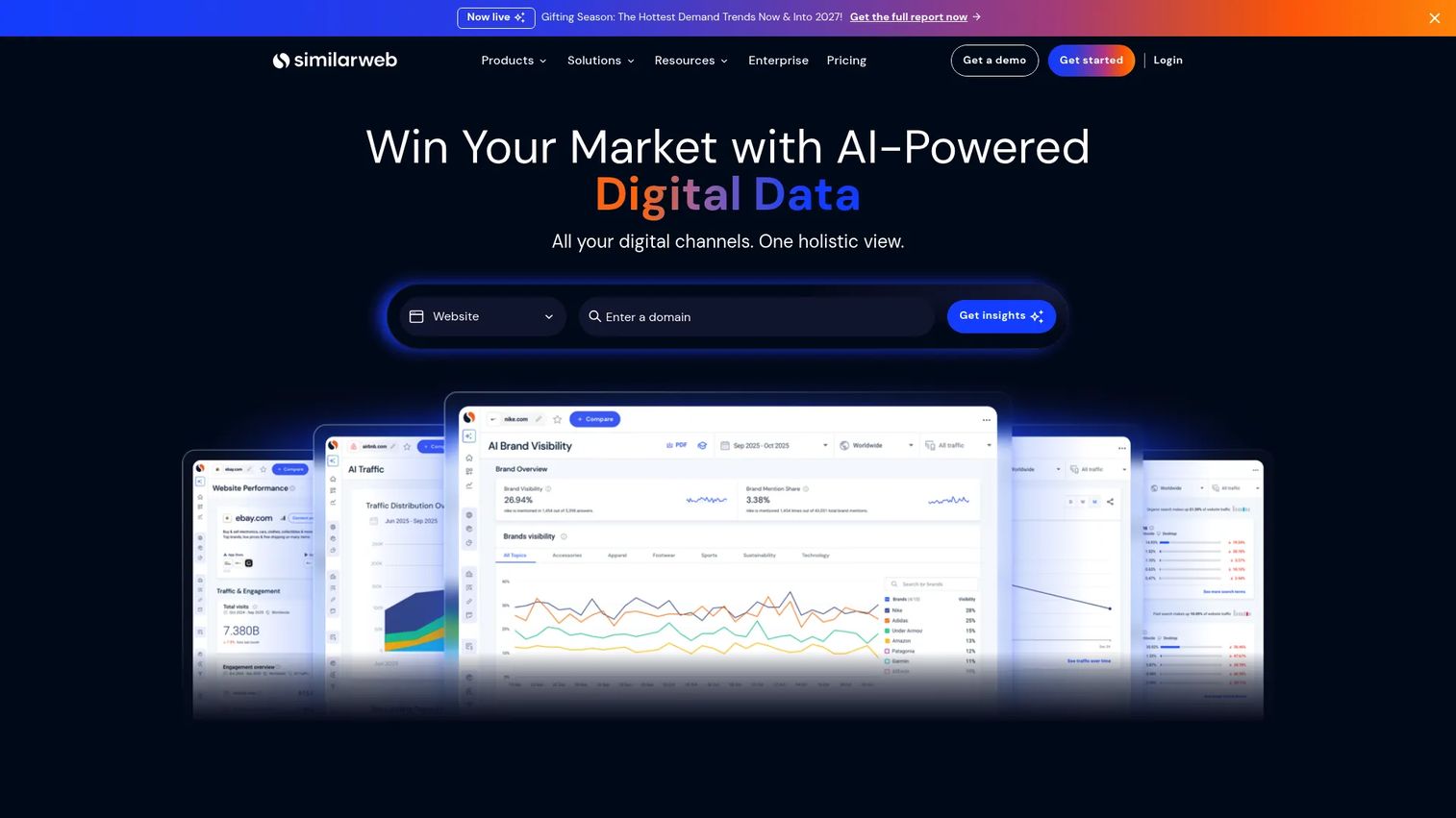
Similarweb provides digital intelligence covering markets, audiences, search, advertising, and other commercial research. Its strongest documented fit here is helping marketers understand competitors within a wider market context. Treat source-level AI citation analysis as a specific purchasing requirement rather than assuming every intelligence package includes it.
Best for: Enterprise marketing teams that need competitive context alongside their search visibility reporting.
Key features
- Competitive benchmarking and market research
- Keyword research and SEO analysis
- Rank tracking and SERP analysis
- Paid search and publisher advertising analysis
For a growth leader, the useful question is whether competitive research changes resource allocation. Ask how the platform helps distinguish a category-wide shift from a company-specific visibility problem.
During evaluation, request evidence for the exact citation workflow you intend to run. Start with a buyer question and ask to see its supporting pages.
Keep that test separate from the broader sales presentation. Domain influence scoring, prompt-level citation insights, and Reddit or Quora monitoring each deserve explicit confirmation.
This distinction protects the budget. A team buying market intelligence has different requirements from one buying a focused source-monitoring subscription.
Also decide who will consume the output. Strategy stakeholders may value category comparisons, while content managers need individual URLs and an actionable backlog.
Why choose Similarweb: Choose it when competitive market research already informs your marketing decisions. For citation-only requirements, compare the relevant package against a dedicated tracker.
Similarweb pricing: Business and enterprise packages use custom pricing. Free tools and self-service packages are also available.
G2 rating: 4.4/5.
2. OmniSEO
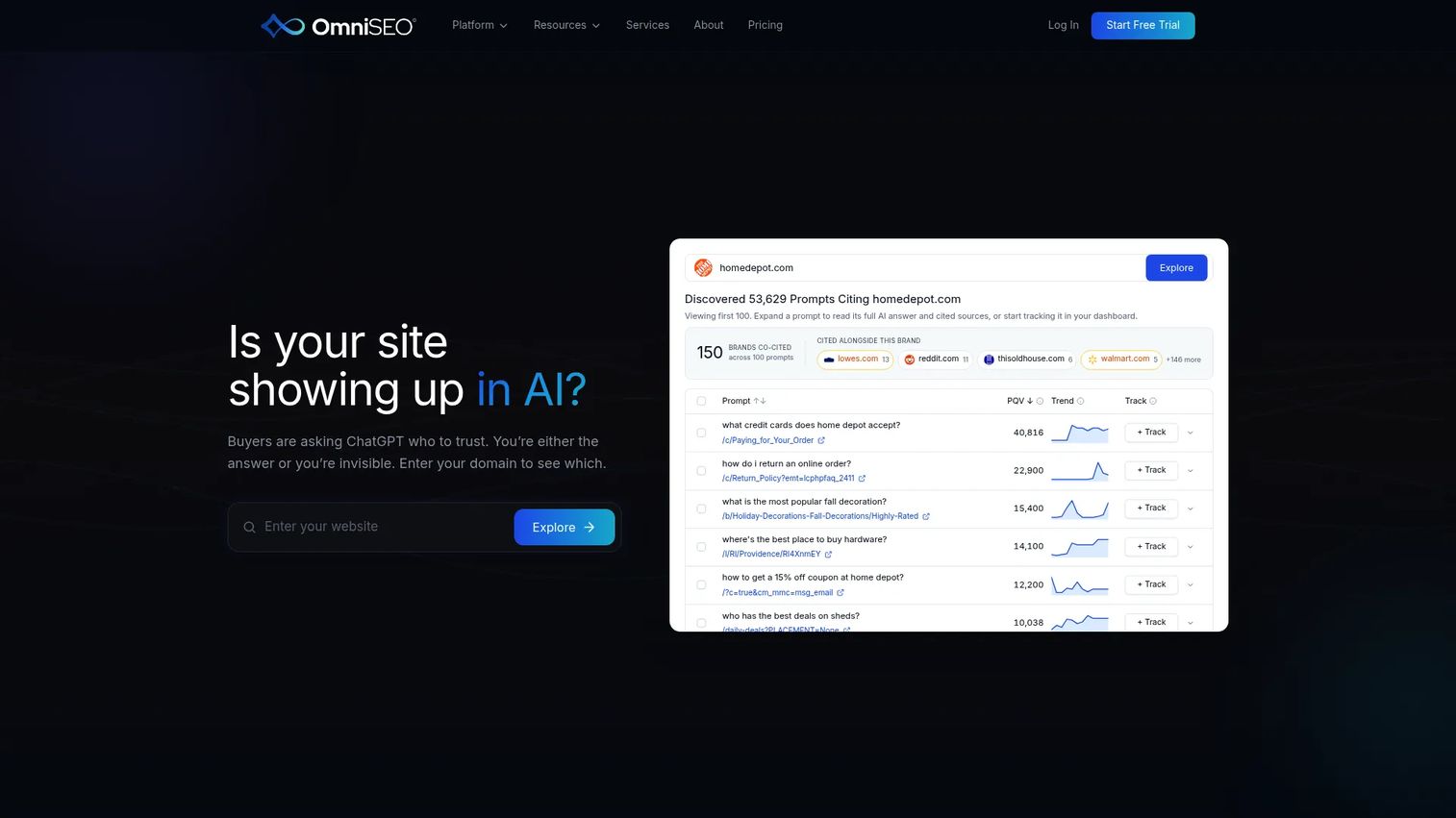
OmniSEO focuses on brand presence across generative AI answer engines. It combines citation and mention monitoring with competitor benchmarking. Prompt research and placement recommendations connect the observation to potential action.
Best for: Marketing teams seeking a dedicated AI citation tracker rather than a broad research suite.
Key features
- Brand mention and citation tracking
- Competitor visibility benchmarking
- Prompt research
- Placement recommendations
The distinction between a mention and a citation should be central to your evaluation. Ask for examples where your company appears without a link.
Then inspect what happens when an external source supplies the evidence. Your next task may belong to PR rather than the website team.
For a practical pilot, choose questions tied to a campaign or product category. Assign each visibility gap to the person who can influence its source.
Evaluate recommendations against that operating model. A suggestion becomes useful when someone can explain the proposed change and how its effect will be monitored.
Before committing, request the engine coverage and response history included in your selected subscription. Also inspect exports using your own reporting structure.
This approach suits a marketer who wants a focused measurement layer. It avoids rebuilding the whole SEO stack before establishing whether citation data changes decisions.
Why choose OmniSEO: Its dedicated focus fits teams organizing their first repeatable AI visibility program. Evaluate recommendation quality using prompts your buyers would recognize.
OmniSEO pricing: Essentials costs $89 monthly or $890 annually; Professional costs $349 monthly or $3,490 annually. A seven-day free trial is available.
G2 rating: 5.0/5
3. Slate
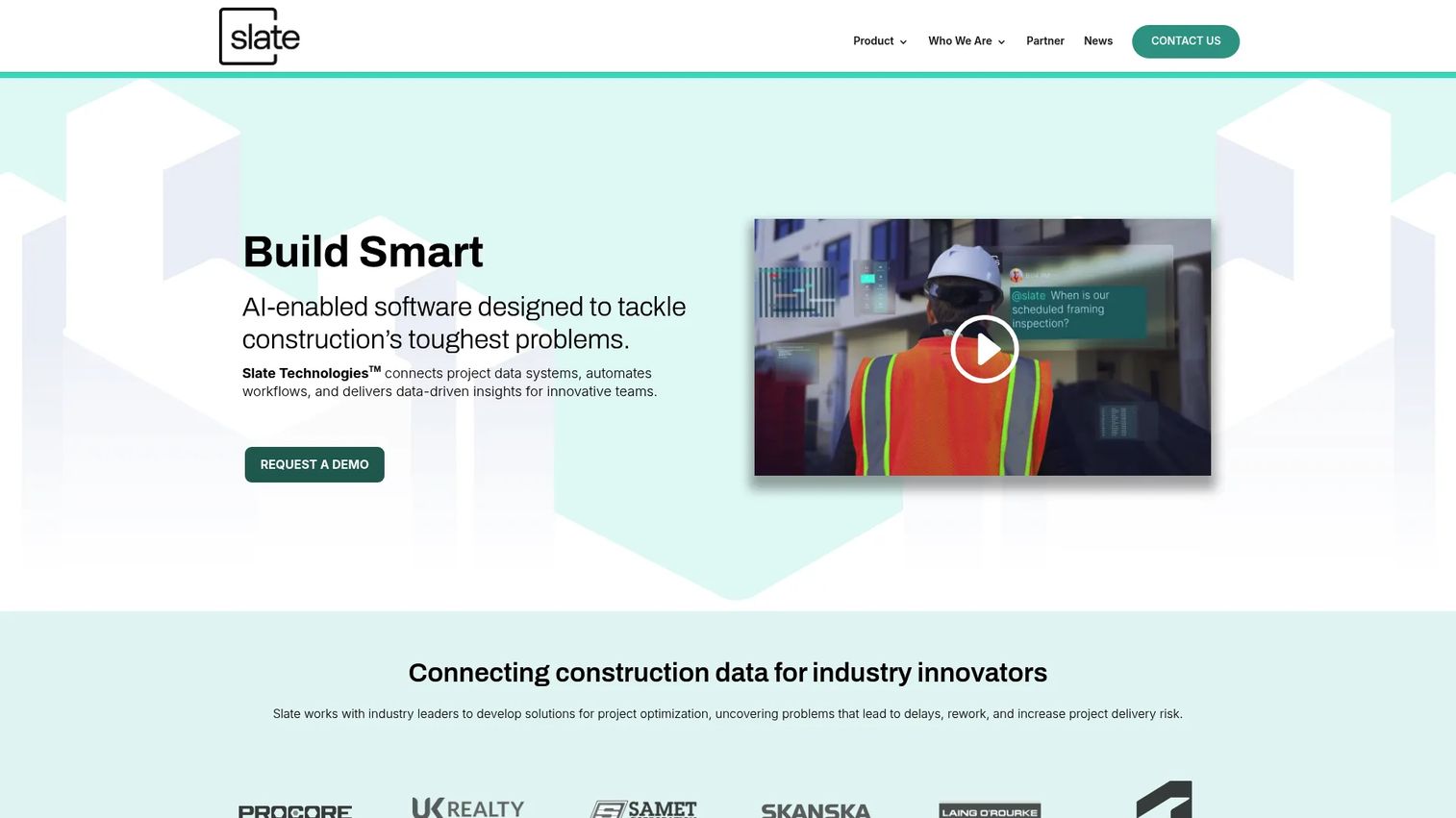
Slate is construction project intelligence software. It connects project data to identify risks and support operational decisions. Its documented capabilities concern construction schedules and historical project learning, rather than AI search citations.
Best for: Construction and development teams assessing project risk, not marketers purchasing citation monitoring.
Key features
- Project risk identification and prioritization
- Historical project analysis
- Lessons-learned database
- Construction system integrations
- Schedule impact dashboards
The naming distinction matters when researching software. A comparison article associated with a name doesn’t establish that the underlying product performs the category’s job.
For this purchase, ask whether a platform can show a prompt alongside its generated answer and cited source. Construction progress reporting answers a different question.
Slate’s integrations include Procore and P6, alongside Autodesk and ACONEX. Those connections reinforce its operational focus.
A marketing team should therefore separate this product from its citation-monitoring evaluation. Its project intelligence features provide no basis for assuming source attribution or competitive AI visibility reporting.
The same discipline applies to review scores. Products sharing a name can have unrelated buyers and capabilities. A rating belongs in a comparison only when the product identity matches.
If your organization also evaluates construction software, route that assessment to the relevant operations team. Combining unrelated requirements would make both purchasing decisions harder to justify.
Why choose Slate: Consider it for connected construction data and project-risk decisions. It isn’t a supported recommendation for AI citation tracking.
Slate pricing: Contact Slate for a quote.
4. Profound
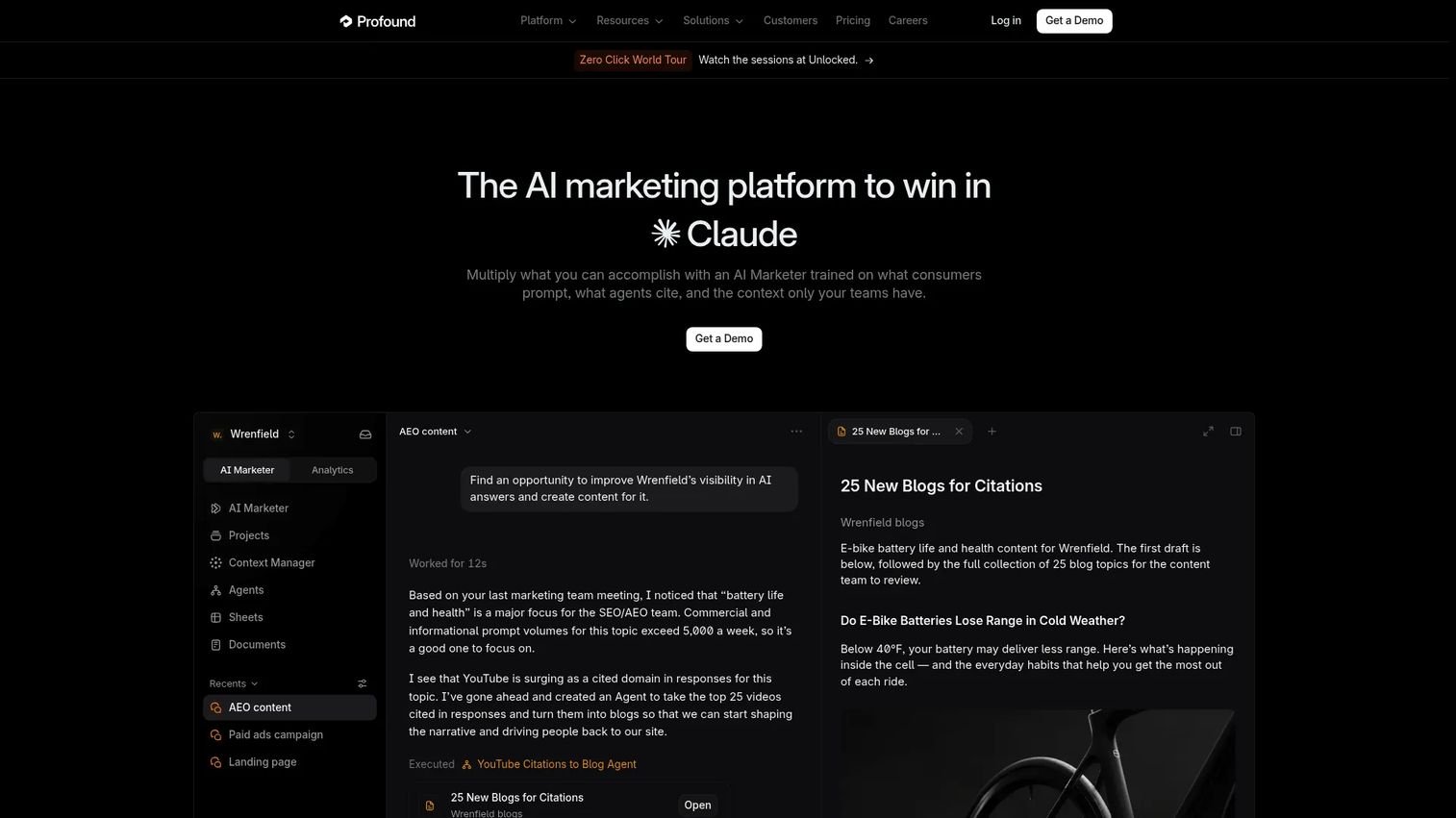
Profound is an AI marketing platform for managing visibility and brand representation across answer engines. Its capabilities extend from citation tracking into prompt research and content workflows. FactCheck addresses inaccurate AI claims, adding a brand-management dimension to measurement.
Best for: Enterprise teams treating AI search visibility as an ongoing marketing program.
Key features
- AI visibility and share-of-voice tracking
- Prompt volume and topic research
- Citation tracking and FactCheck
- AI Marketer agents
- Competitive platform comparisons
This breadth is useful when different departments need different answers. Content teams investigate missing coverage, while communications teams examine how the company is represented.
Set responsibilities before buying. An inaccurate statement needs a different response from a competitor’s citation advantage, even when both appear in the same report.
Profound’s Enterprise package supports tracking across up to 10 answer engines. Dedicated support and SSO/SAML also feature in its current packaging.
For procurement, evaluate those requirements alongside the team’s reporting cadence. Ask who will administer prompts and who will approve actions generated from the findings.
A worthwhile pilot should include both a source opportunity and a representation issue. Assess whether each can move from discovery to an assigned task.
Bring existing content operations into that test. Recurring automation creates value when the output meets your editorial standards and reaches the people responsible for publishing.
Why choose Profound: It fits organizations coordinating AI visibility across content and brand functions. Choose it when there’s an owner for the broader program.
Profound pricing: Enterprise uses custom pricing. Starter and Growth plans for brands were retired in September 2026.
G2 rating: 4.5/5.
5. Peec AI
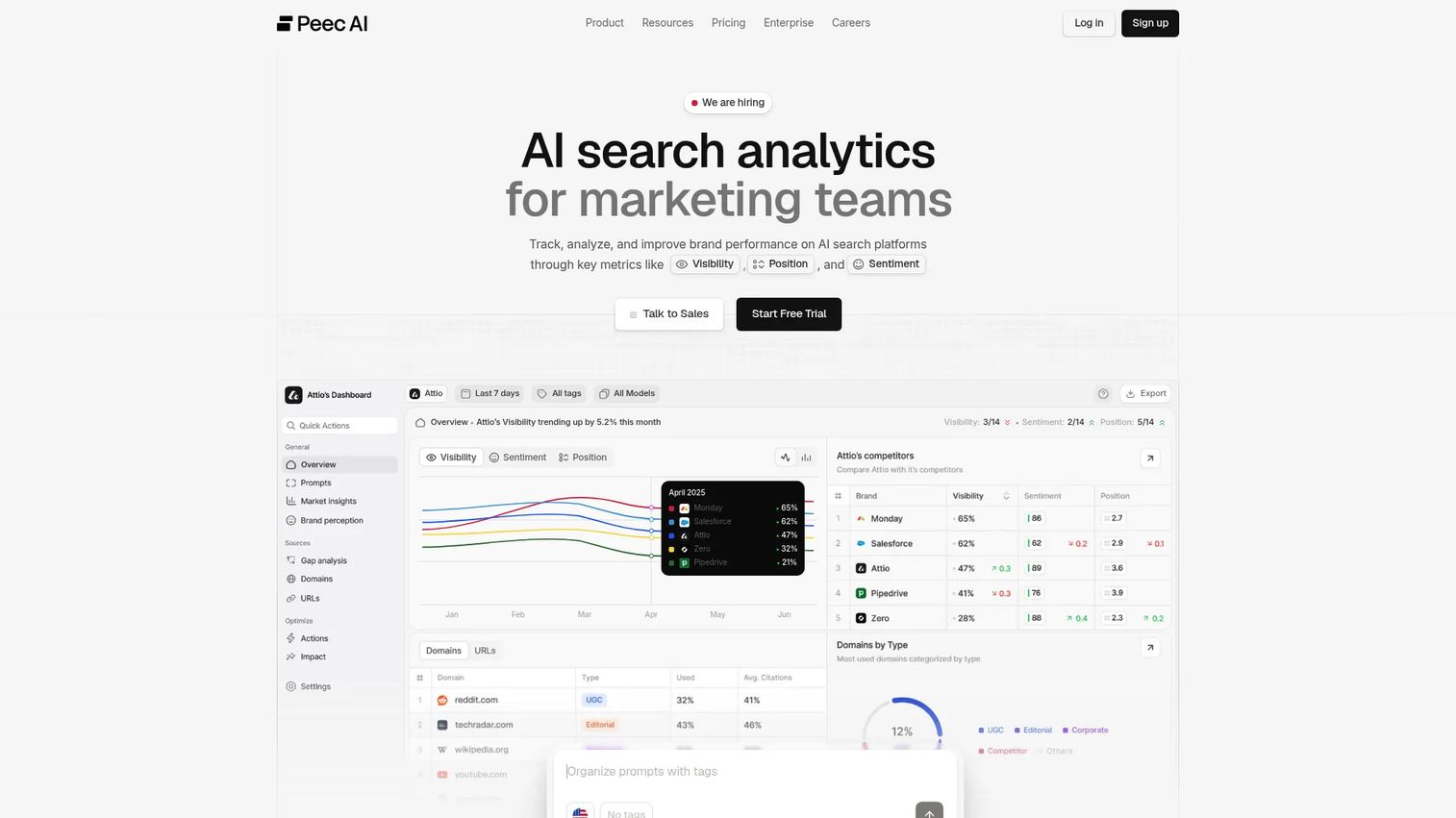
Peec AI is an AI search analytics platform for marketing and agency teams. It tracks visibility alongside position, sentiment, and competitive share of voice. Domain and URL source analytics make it relevant when your next decision depends on the exact page cited.
Best for: Teams that need source-level evidence and reporting connections for ongoing analysis.
Key features
- Domain and URL citation analytics
- Prompt discovery and management
- Competitor benchmarking
- AI shopping and SKU visibility
- CSV, API, MCP, and Looker Studio connections
The distinction between a cited domain and a cited URL is important here. A publisher may influence your category through several articles with different editorial purposes.
Use page-level evidence to decide whether to refresh owned content or approach an external source. Avoid treating every citation gap as a request for another blog post.
Peec AI also documents product-level shopping visibility. Commerce teams can evaluate that separately from general brand performance.
During a pilot, test how source findings travel into your reporting process. An export should preserve enough context for another analyst to understand the original observation.
Compare project limits with your organizational structure. Separate brands or client accounts can require distinct workspaces even when their combined prompt volume looks modest.
For international programs, establish the required language and location settings before selecting a plan. Don’t infer market coverage from the presence of multiple models.
Why choose Peec AI: Its documented source granularity suits marketers who need to explain why a particular page deserves attention. Reporting connections support further analysis.
Peec AI pricing: Starter costs $95/month for 50 prompts and one project. Pro costs $245/month; Advanced costs $495/month; a free trial is available.
G2 rating: 4.7/5.
6. Semrush
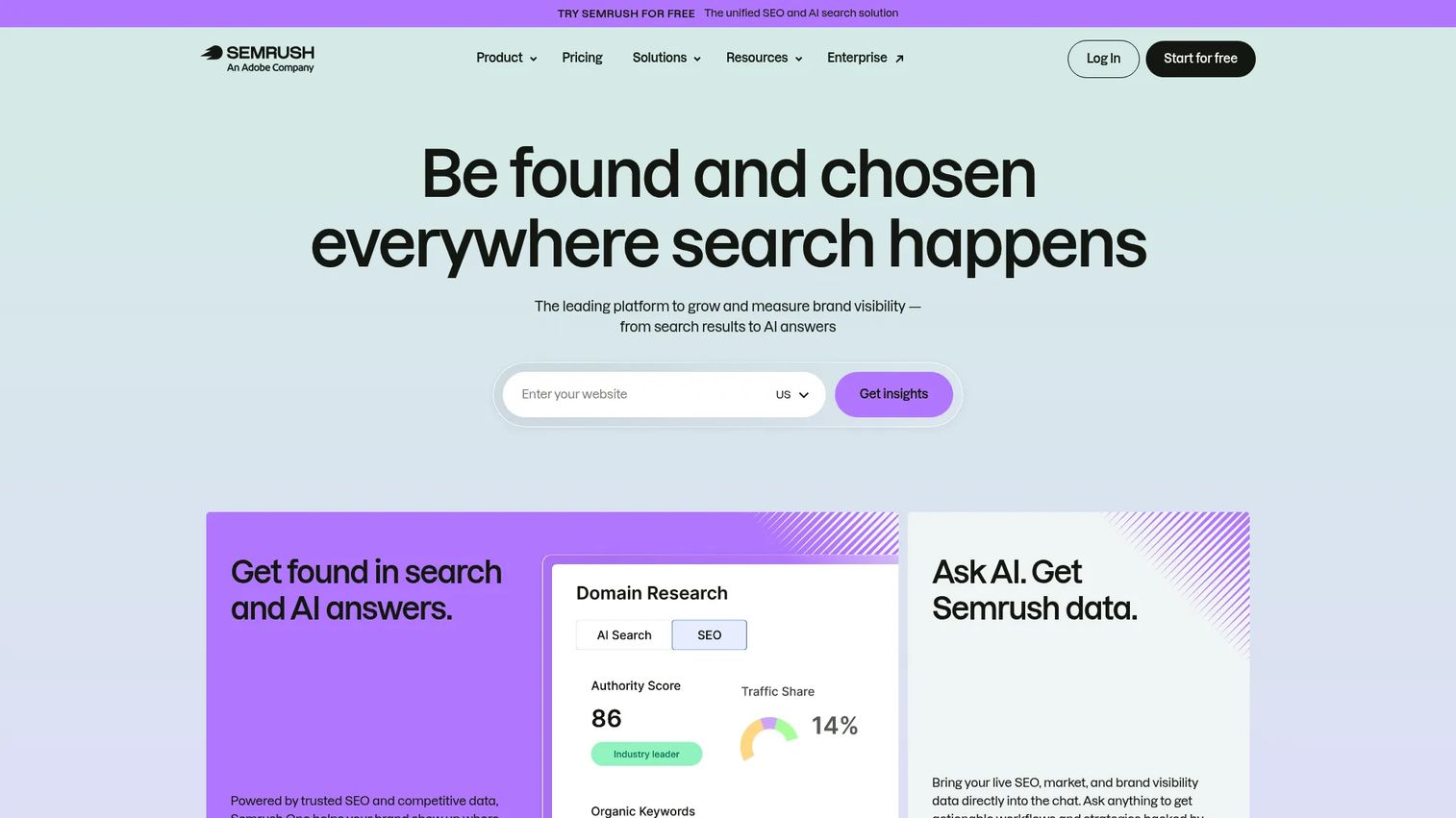
Semrush combines established SEO capabilities with AI visibility and brand sentiment monitoring. Its broader platform also covers content and competitive research. For existing customers, the purchasing question is whether the relevant package covers the new reporting requirement without another subscription.
Best for: SEO teams evaluating AI visibility within an existing marketing platform.
Key features
- Keyword research and competitor analysis
- Technical site auditing
- Rank tracking
- AI visibility monitoring
- Brand sentiment monitoring
Start with a capability audit of your current account. Separate features you already use from those needed for the AI search program.
Then test the same commercial question across both reporting contexts. Your team should understand how conventional organic performance relates to generated-answer visibility without combining them into one ambiguous score.
Exact-source access deserves particular attention. A brand visibility chart and a cited-page report support different tasks.
For Google AI Overviews citation tracking, request an example that preserves the query and source destination. Assess the evidence before treating the platform as your AI overview citation tracker.
Consolidation is valuable when it removes duplicated work. It’s less useful if analysts still reconstruct the missing context in spreadsheets.
Include the people who produce monthly reporting in the evaluation. Ask them to build a sample presentation and identify any manual steps that remain.
Why choose Semrush: Evaluate it first when your SEO operating process already runs there. The benefit is workflow continuity if its AI reporting meets your requirements.
Semrush pricing: Annual-billed plans list SEO at $117.33/month, Starter at $165.17/month, and Pro+ at $248.17/month. A limited free plan is available.
G2 rating: 4.4/5.
7. Ahrefs Brand Radar
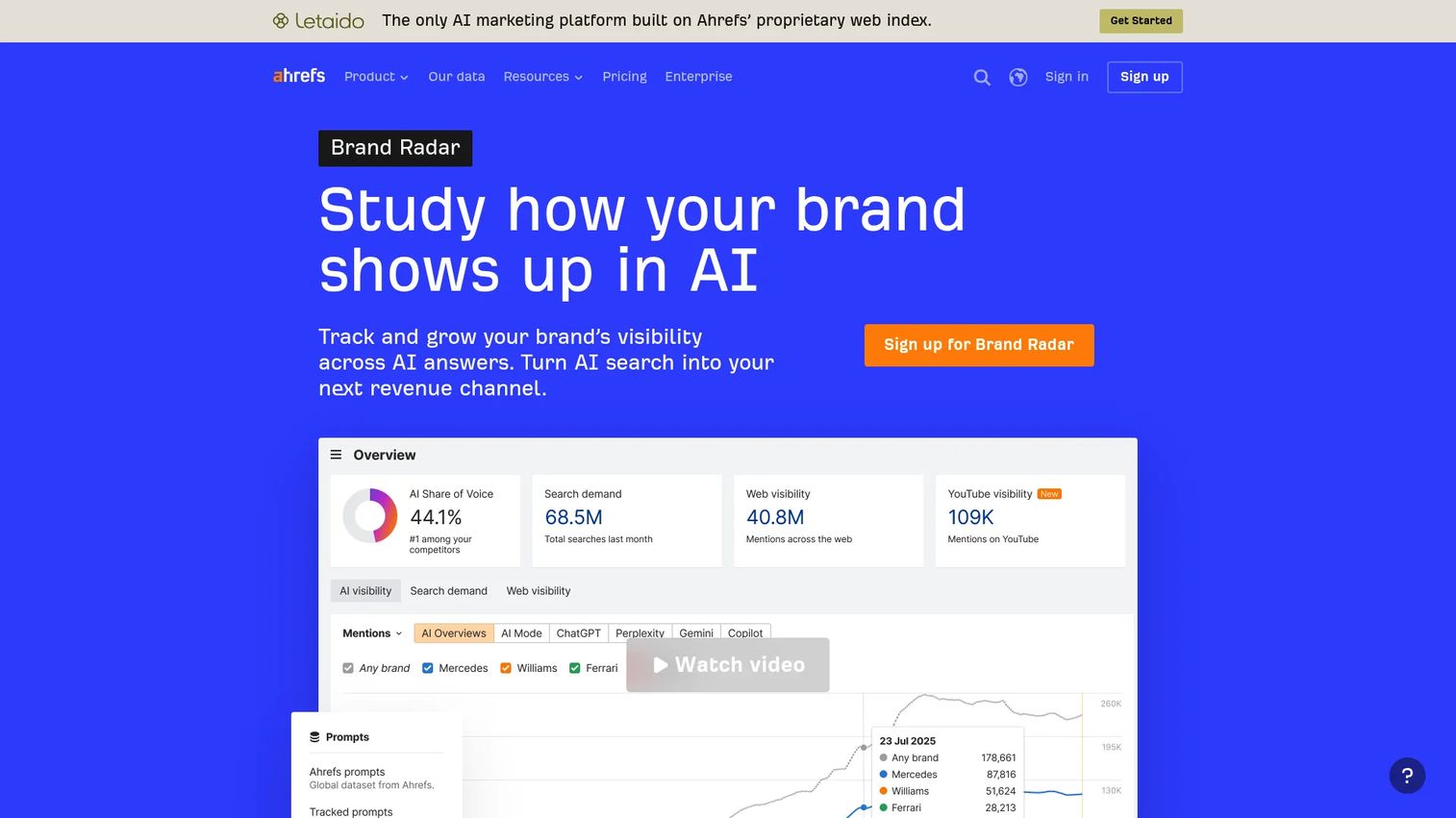
Ahrefs Brand Radar tracks brand presence across AI answers and other discovery channels. It supports custom buyer prompts and identifies cited pages or domains. Its packaging distinguishes targeted monitoring from broader visibility-index access.
Best for: SEO teams comparing custom prompt monitoring with wider market discovery.
Key features
- Custom buyer-prompt tracking
- Citation and sentiment benchmarking
- Cited page and domain identification
- Search and social visibility monitoring
- AI traffic and crawler analysis
The first decision is what you want to observe. A defined prompt portfolio measures questions you select; an index supports broader discovery.
Those approaches answer different management questions. Campaign owners may need consistent monitoring, while strategy teams want to discover where the brand appears across a larger dataset.
Build your budget around checks rather than prompt names alone. Repeated observations and additional platforms can change consumption.
Custom Prompts Basic includes 2,500 monthly checks. Larger packages increase that allowance, while overage charges introduce another cost variable.
Ask the vendor to model your intended monitoring schedule. Include the number of competitors and any planned expansion into additional markets.
Its wider discovery context also deserves a focused test. Reddit visibility, for example, shouldn’t automatically be interpreted as Reddit citation tracking inside every supported answer engine.
Keep those measurements clearly labeled in stakeholder reports.
Why choose Ahrefs Brand Radar: It suits teams that want a choice between targeted monitoring and broader discovery. Existing Ahrefs users can evaluate it within familiar research workflows.
Ahrefs Brand Radar pricing: Custom Prompts Basic costs $50/month; AI Visibility Index access starts at $199/month per index. All-platform Brand Radar costs $699/month.
G2 rating: 4.5/5
8. Otterly.AI
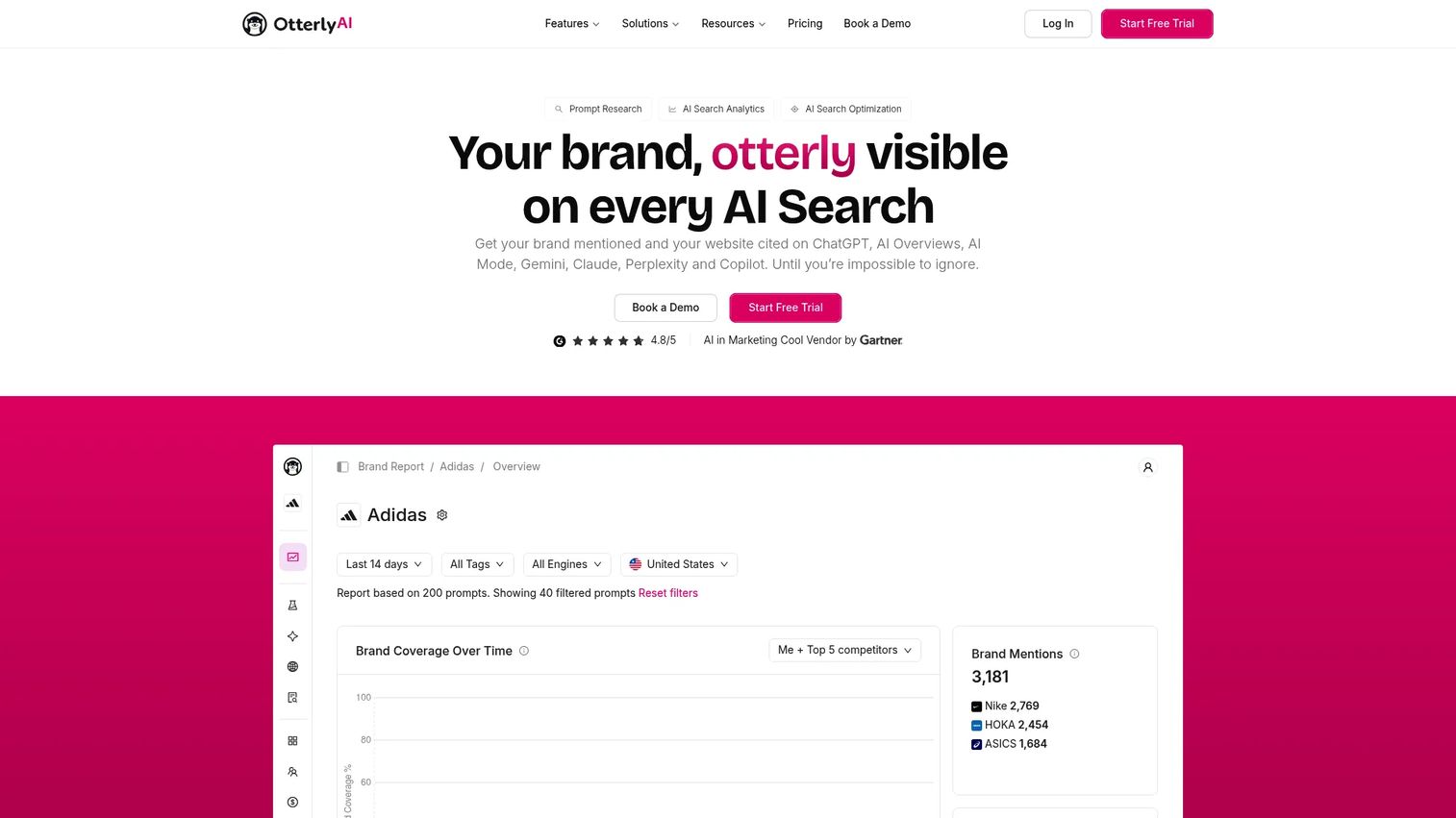
Otterly.AI combines AI search monitoring with content audits and optimization recommendations. It documents citation and domain ranking analysis alongside brand visibility tracking. The entry package gives lean teams a defined starting scope.
Best for: Small marketing teams and agencies establishing their first citation-monitoring routine.
Key features
- AI prompt research
- Citation and domain ranking analysis
- Brand visibility analytics
- Content audits
- GEO optimization recommendations
Documented coverage includes ChatGPT, Perplexity, Gemini, Claude, Microsoft Copilot, Google AI Overviews, and Google AI Mode. Confirm which surfaces are included in your chosen package.
Start with a focused commercial topic rather than a large collection of loosely related questions. This makes findings easier to assign and interpret.
The Lite package includes 15 search prompts. Standard expands to 100, while Premium includes 400.
Use those limits to design the pilot before upgrading. A smaller portfolio with a clear owner can provide more operational value than an unmaintained collection.
Evaluate content recommendations against your existing editorial backlog. Ask whether they identify a missing answer, a weak explanation, or a source opportunity.
Those are different assignments. Your writers should receive the original prompt and supporting evidence, rather than a generic instruction to “improve AI visibility.”
For agencies, repeat the test using a client-facing report. Check whether the explanation remains understandable without access to the dashboard.
Why choose Otterly.AI: Its entry package suits teams learning which prompts deserve regular monitoring. Expand after establishing a reliable reporting and action cadence.
Otterly.AI pricing: Lite costs $29/month, Standard $189/month, and Premium $489/month. A free tier and seven-day trial are available.
G2 rating: 4.7/5.
9. Rankability
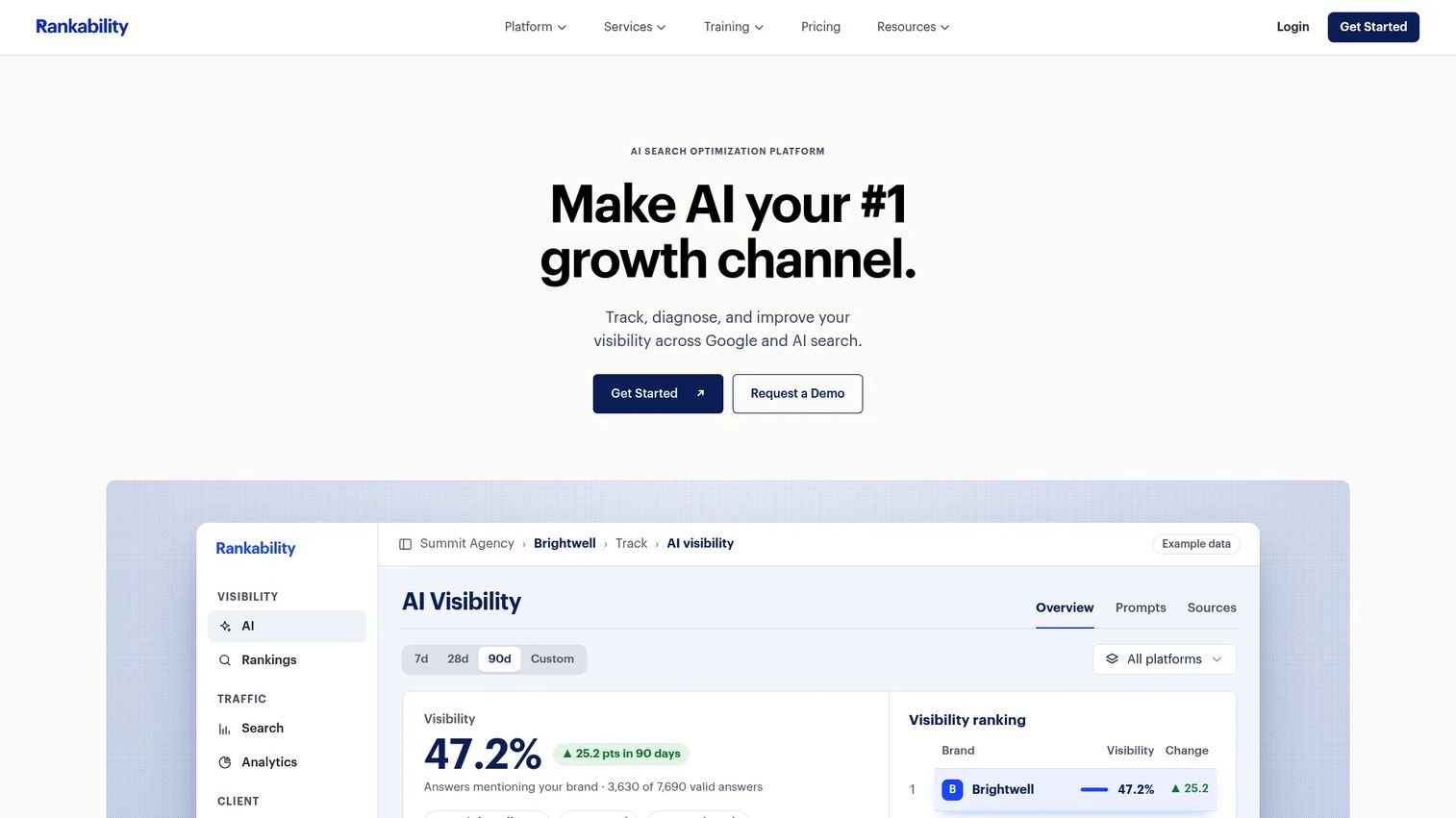
Rankability combines AI search and SEO tracking with content creation, optimization, audits, and reporting. Its positioning centers on agency execution. Evaluate it as a connected workflow platform rather than assuming every source-analysis capability matches a dedicated citation product.
Best for: Agencies that want search findings to feed content production and client reporting.
Key features
- Keyword and topic research
- AI-assisted content optimization
- AI visibility and Google ranking tracking
- Website, local, and brand audits
- Workflow automation and Serena AI strategist
The operational appeal is the path from observation to assignment. An agency can evaluate research and production requirements within the same buying decision.
Use a client’s existing page as the test case. Ask the team to identify the problem, produce an optimization brief, and prepare a reporting update.
Then examine where citation evidence enters that process. If exact sources drive your strategy, require a sample showing the underlying URL and response context.
Paid plans document unlimited client workspaces and team members. That structure is relevant when agency access requirements grow independently of campaign volume.
However, workspace availability doesn’t answer every capacity question. Match tracking and content allowances to the client work you intend to deliver.
Include account managers in the pilot. They need to explain what changed and why the recommendation matters commercially.
A useful workflow should reduce interpretation work between the analyst and writer. Judge the handoff quality, not just the number of available modules.
Why choose Rankability: It fits teams accountable for publishing improvements after finding a visibility gap. Its agency-oriented packaging supports shared delivery processes.
Rankability pricing: Starter costs $97/month, Agency $297/month, and Agency Pro $497/month. Annual prices are $970, $2,970, and $4,970 respectively.
G2 rating: 5.0/5.
10. Scrunch AI
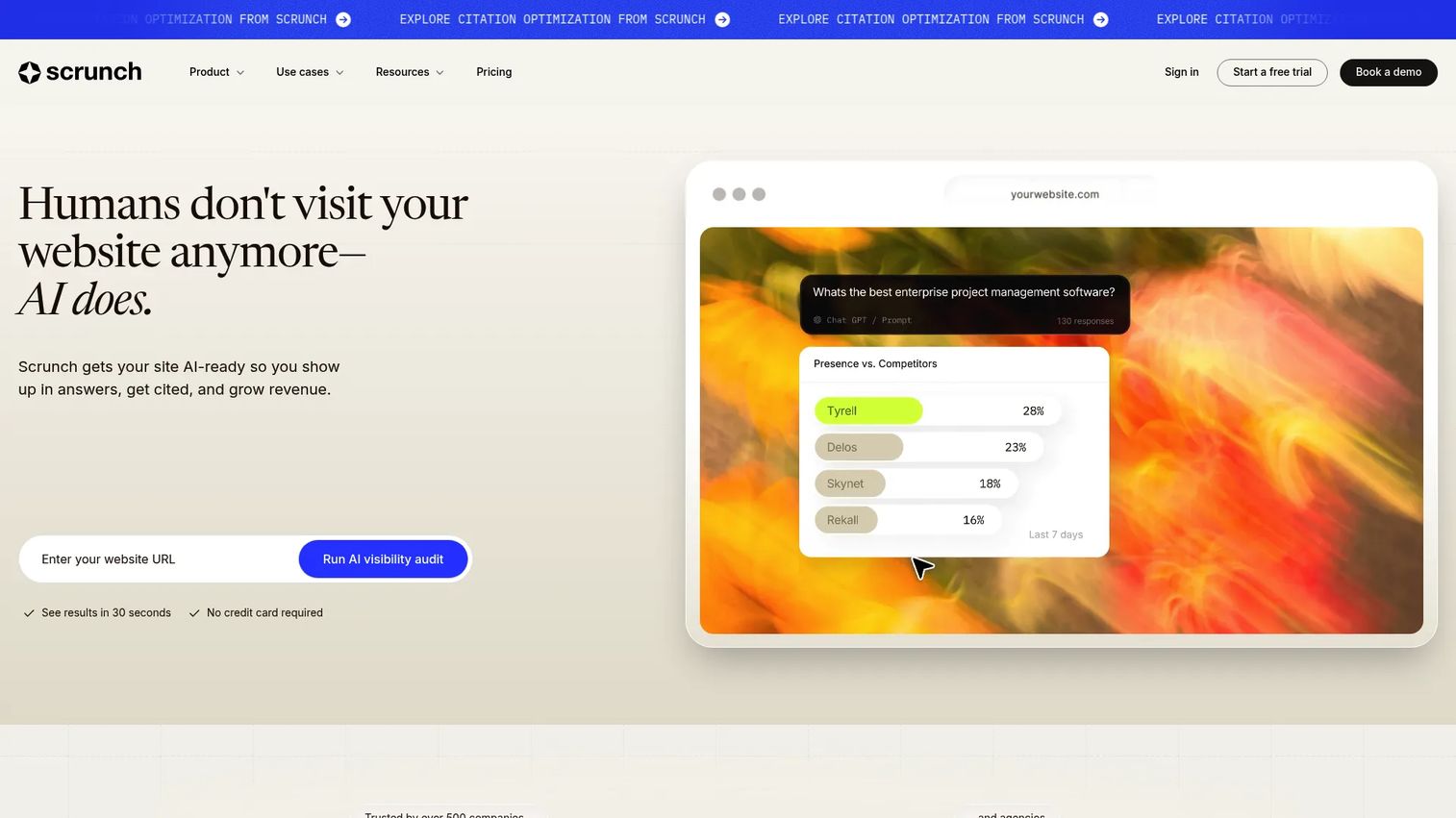
Scrunch AI connects AI response monitoring with website and content optimization. Its Agent Pages capability addresses content delivery for AI systems. The platform also documents agent traffic analysis and product-level search performance.
Best for: Marketing teams investigating how website content and AI visibility interact.
Key features
- AI response and citation monitoring
- Visibility trend analysis
- Website and content optimization
- Agent Pages
- AI agent traffic analysis
This scope makes implementation ownership an important purchasing criterion. Monitoring can sit with marketing, while changes to content delivery require coordination with website stakeholders.
Include both groups in evaluation. Ask what the optimization workflow changes and how those changes will be reviewed.
The Core package includes one brand and five seats. Its usage allowances cover AI responses, citation targets, and page-related work.
Those units deserve separate attention. More monitored responses won’t necessarily provide the capacity needed for a larger optimization backlog.
Design a pilot around one specific website question. For example, investigate whether an important product explanation is represented consistently in monitored answers.
Keep observation and intervention separate in your records. Save the original response, document the content change, and monitor later results.
Agent traffic provides additional context, but crawler activity should remain distinct from citation performance. A visit from an automated system doesn’t prove that a particular response used the page.
Why choose Scrunch AI: It fits teams ready to connect visibility monitoring with website execution. Involve technical owners before selecting the package.
Scrunch AI pricing: Core costs $250/month; Enterprise uses custom annual pricing. There is no free plan.
G2 rating: 4.6/5
11. AthenaHQ
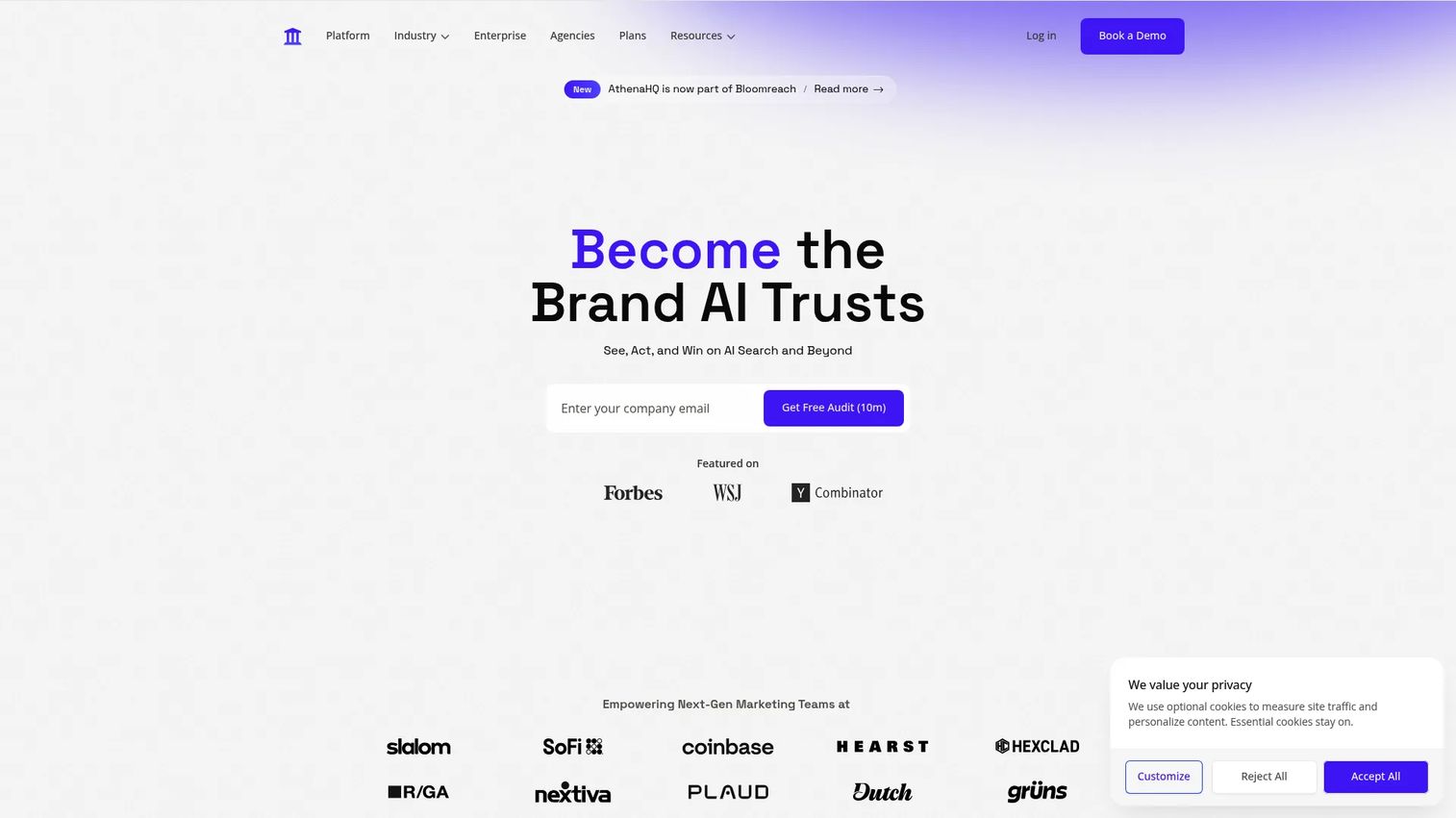
AthenaHQ provides AI search optimization with citation source analysis and competitive intelligence. Its reporting extends to executive dashboards. Content recommendations and prompt analysis connect measurement with operational follow-up.
Best for: Marketing organizations coordinating AI visibility across several departments.
Key features
- Cross-platform AI visibility tracking
- Citation source analysis
- Prompt and response analysis
- Brand mention and sentiment monitoring
- Executive dashboards
Different stakeholders need different evidence. Leadership wants a credible trend, while the content owner needs a specific page and a proposed change.
Use the evaluation to test both views. The executive summary should remain traceable to individual observations.
AthenaHQ’s Essential plan includes 300 credits. Starter increases the allowance to 3,600 and documents coverage across 11 models.
Credits require careful budgeting because the unit alone doesn’t describe your expected workload. Ask for a consumption model using your planned prompts and reporting frequency.
Enterprise packaging adds advanced security and multi-region support. Evaluate those requirements before procurement rather than assuming every organization needs the largest package.
Also establish ownership for source outreach. Citation analysis can identify external pages, but someone still needs responsibility for publisher relationships or profile updates.
A shared dashboard is useful only when departments agree on metric definitions. Resolve how you will distinguish a company mention from a cited company page.
Why choose AthenaHQ: It fits teams that need both working-level analysis and leadership reporting. Its free entry plan offers a way to explore the measurement model.
AthenaHQ pricing: Essential is free; Starter costs $295/month. Enterprise uses custom pricing.
G2 rating: 4.9/5.
12. Goodie
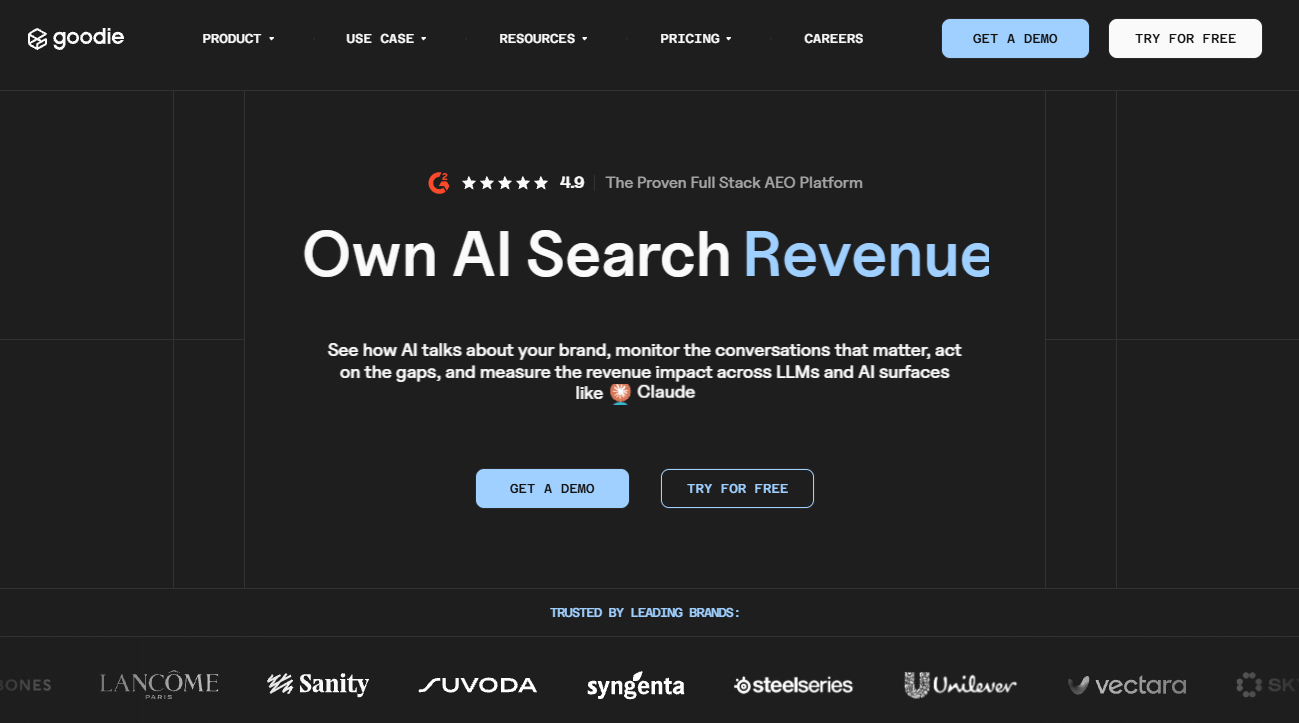
Goodie is an AI search visibility and answer engine optimization platform. It combines prompt research with optimization actions and content generation. AI traffic analytics and revenue attribution extend its scope beyond exposure reporting.
Best for: Brands and agencies evaluating visibility alongside downstream traffic measurement.
Key features
- Prompt research and visibility monitoring
- Optimization actions
- AI-optimized content generation
- Agentic commerce visibility
- AI crawler and traffic analytics
For a demand generation team, the attribution component deserves careful inspection. Ask how observed visits connect to conversions and which interactions remain unobservable.
A citation without a click belongs in visibility reporting. It shouldn’t become attributed revenue simply because both metrics appear in the same platform.
Goodie’s Core package tracks five models with 110 prompts. Pro expands to eight models and 250 prompts.
Match those limits to the questions your program must answer. Adding coverage is useful when it represents buyer behavior, rather than increasing a headline count.
Commerce teams should separately evaluate the agentic-shopping capabilities. Product discovery and brand recommendation can require different reporting structures.
During a trial, ask an analyst to reconcile a sample report with your existing analytics. Document any differences in definitions before presenting results to leadership.
Also test the action workflow. The value lies in whether recommendations become useful changes, with enough context to explain their purpose.
Why choose Goodie: Its scope suits teams connecting monitoring with optimization and traffic analysis. Evaluate attribution methodology as carefully as source coverage.
Goodie pricing: Core costs $295/month, Pro $999/month, and Enterprise uses custom pricing. Core offers a seven-day trial; there is no free plan.
G2 rating: 4.9/5, from its G2 seller profile.
13. GrowByData
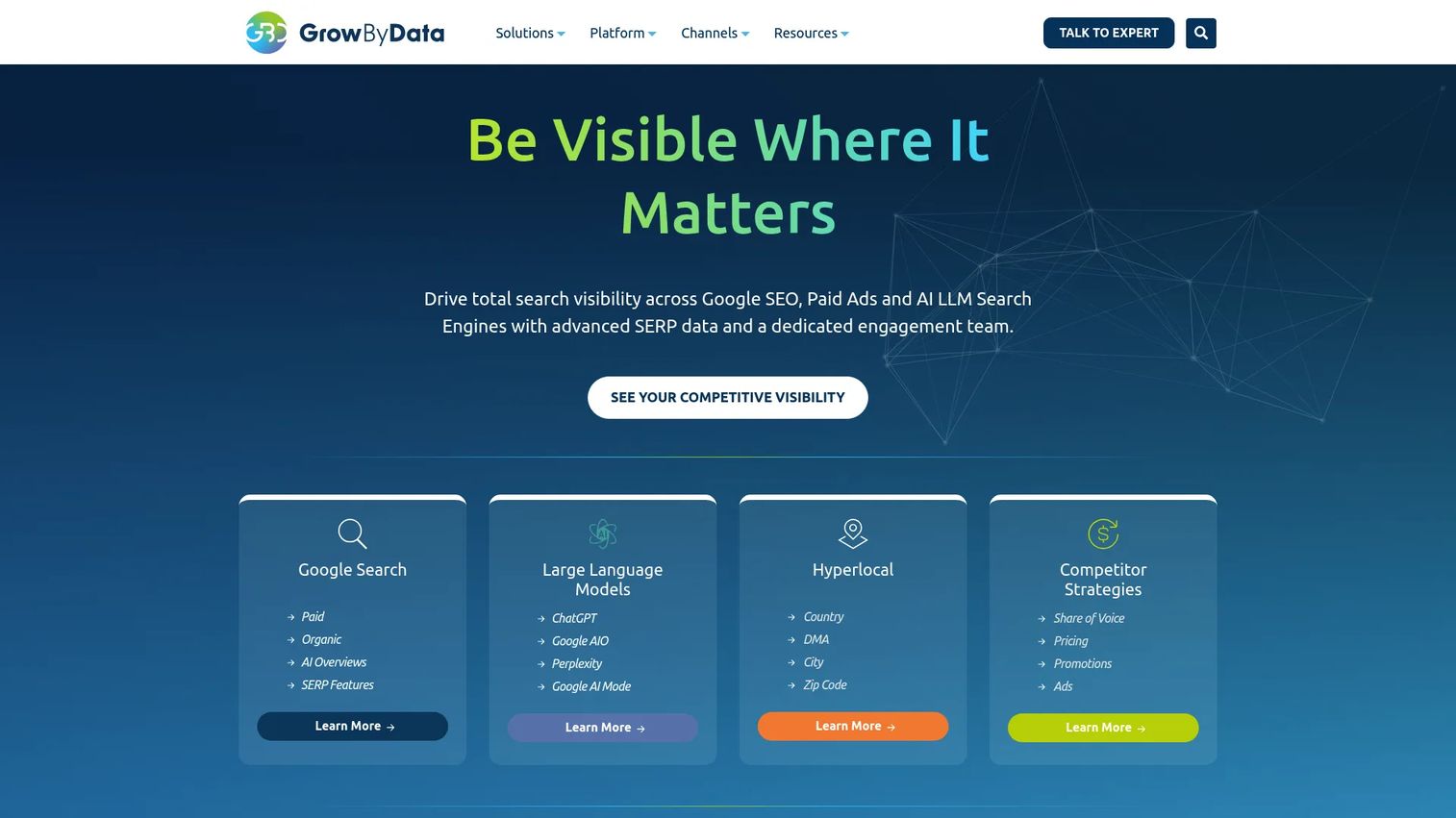
GrowByData provides search and marketplace intelligence alongside product and pricing data. Its documented scope includes AI visibility. The clearest fit is enterprise commerce analysis rather than a narrowly defined citation-monitoring subscription.
Best for: Retailers, brands, and agencies connecting search performance with marketplace conditions.
Key features
- Search and AI visibility intelligence
- Competitive pricing and promotion monitoring
- Product intelligence
- Marketplace and brand monitoring
- Product-feed enrichment
Commerce teams often need to interpret visibility alongside the offer itself. Product descriptions and pricing context can belong in the same investigation.
That makes the evaluation different from a publisher’s source-monitoring project. Start with the commercial decision you need to make.
Ask for a sample connecting the search observation to the relevant product record. Then inspect how your team would act on that finding.
If exact AI citations are essential, require a demonstration of source-level output. Broader AI visibility coverage doesn’t establish every page-attribution capability.
The same applies to AI crawler monitoring and referral reporting. Treat them as explicit requirements rather than inferring their availability from the platform’s category.
For enterprise buying, involve the team responsible for catalog quality. A recommendation that depends on product-feed changes needs an owner outside the SEO report.
Assess the proposed deliverable against your existing research process. The strongest case is replacing fragmented commerce analysis with information that supports a specific decision.
Why choose GrowByData: It fits organizations whose AI visibility questions sit inside a wider commerce intelligence program. Citation-only buyers should evaluate source granularity directly.
GrowByData pricing: Contact GrowByData for a quote.
G2 rating: 4.9/5
Considerations when choosing AI citation tracking tools
Match engine coverage to buyer behavior
Request examples from the platforms your audience uses. Gemini citation tracking and Microsoft Copilot citation tracking shouldn’t be assumed from a generic multi-engine claim.
Document the location and settings behind each observation. Compare like-for-like results before combining them.
Require exact source evidence
AI source attribution should identify the supporting page and its relationship to the answer. Domain totals alone leave content owners guessing.
Ask whether the report distinguishes your website from third-party coverage about your company.
Preserve a consistent measurement baseline
AI-generated answer variability makes isolated prompt tests weak evidence. Maintain recurring observations and record changes to the monitored portfolio.
For citation recapture work, save the original source loss and subsequent interventions. That history helps separate persistent improvement from a temporary appearance.
Assign work before adding another dashboard
AI citation monitoring needs an operational owner. Content refreshes, publisher outreach, and review-profile corrections require different responsibilities.
Choose software that supports your handoff process. Ask the receiving team whether the evidence is sufficient to act.
Model the cost of your intended program
Compare prompts with checks, credits, and platform indexes. Include reporting requirements and future account expansion in the calculation.
Start with the smallest package that supports a meaningful test. Enterprise governance is valuable when the organization needs it, not as a substitute for clear ownership.
Choose the tool that changes your next decision
Dedicated tracking platforms suit teams building a repeatable monitoring practice. OmniSEO and Peec AI deserve attention for that job, while Otterly.AI offers a focused starting scope.
For wider programs, Profound connects visibility with brand and marketing operations. AthenaHQ supports cross-functional reporting, and Goodie adds traffic measurement to the evaluation.
Existing SEO customers should assess Semrush or Ahrefs Brand Radar before adding another subscription. Rankability deserves consideration when the larger bottleneck is content execution.
Similarweb and GrowByData serve broader intelligence needs. Their value should be judged against those requirements, with citation-specific capabilities evaluated directly.
Start your selection with 20 commercially important prompts and three competitors. Ask shortlisted vendors to show the evidence behind those questions.
Then assign the resulting gaps to concrete work. Some will justify page updates; others will point toward external sources. Track the intervention and report the subsequent trend without claiming unsupported revenue attribution.
The best purchase gives your team a clearer next action and a reporting process it can maintain.
Start your journey with Guideflow today!
FAQs
AI citation tracking monitors the sources answer engines reference when responding to prompts or search queries. An AI citation tracking tool can connect those observations to domains, specific URLs, and brand references. For marketers, its value is identifying which cited pages influence commercially relevant answers. Evaluate tools to track AI citations by the evidence they preserve, rather than the size of their visibility score.
Coverage can include ChatGPT, Perplexity, Gemini, Claude, Microsoft Copilot, Google AI Overviews, and Google AI Mode. Available engines vary by product and subscription. If you need an AI overview citation tracker, request a sample showing the triggering query and cited destination. Also confirm whether the platform records the answer context needed to explain the result to a colleague.
A backlink is a link from one web page to another. An AI citation references a source within a generated answer, sometimes without producing a visit to that source. Keep backlink acquisition and answer-engine visibility separate in reporting because they measure different relationships. Their overlap can inform investigation, but one shouldn’t be treated as a substitute for the other.
A brand mention names your company, while a citation identifies a source supporting the answer. The two can occur independently, including when an external review supplies information about your product. Ask whether a tracker separates mentions of your company from citations pointing to your own domain. That distinction helps you decide whether website content or third-party representation deserves attention.
Track citation frequency and coverage across commercially relevant prompts, alongside the exact URLs receiving citations. Add competitive share of voice and source overlap when the underlying prompt set remains consistent. Record response context and observation dates so another analyst can understand changes without repeating the test. Keep AI referral traffic and qualified conversions alongside these indicators, with their separate definitions visible.
AI citation tracking can reveal which sources answer engines select and where competing content appears for your target questions. Use those findings to investigate missing information or identify relevant external publishers. Generative engine optimization work should connect each observation to a specific editorial or outreach decision. After publishing, monitor comparable prompts over time rather than declaring success from the next favorable answer.
Yes, tools with competitor benchmarking can compare appearances and cited sources across a shared prompt portfolio. Keep the engine and observation conditions consistent when calculating relative performance. Co-cited competitors can also reveal whether an answer discusses your category broadly or selects a narrower group. Use that context to prioritize commercially important gaps instead of competing for every possible mention.
Their results describe the answers observed under particular conditions, rather than every response every buyer receives. Prompt wording, location, timing, personalization, and browsing behavior can affect what appears. Preserve those conditions and use repeated measurements to evaluate trends. AI citation tracking tools are most useful when their evidence supports a reproducible decision, with uncertainty kept visible in stakeholder reporting.