The resident is waiting on the phone. Their online payment cleared the bank, but the account still shows a past due balance. The clerk has three systems open and no clear explanation.
Disconnected billing data turns routine questions into long calls, repeat contacts, and manual corrections. Payment preferences also keep changing. KUBRA reported in 2025 that 42% of surveyed U.S. consumers used a digital wallet to pay a bill.
The best utility billing software brings account history, meter data, payments, notices, and service activity into a usable workflow. The right system helps staff answer questions while the resident is still on the line.
What’s inside
This guide compares utility billing software for municipalities, districts, utility authorities, and property operators. Each platform was evaluated through a customer service and billing operations lens.
- Who the tools fit: Small districts, cities, regional utilities, counties, and property operators
- What we evaluated: Billing workflows, portals, metering, integrations, reporting, and service visibility
- What buyers should verify: Pricing, implementation, migration, cloud hosting, and support
- How the categories differ: Municipal finance suites, billing platforms, and enterprise customer information systems
TL;DR
- Best overall for local government billing: CivicPlus prioritizes resident self-service, while Springbrook connects billing with government finance workflows
- Best utility billing software for small water districts: Muni-Link supports billing, account management, payments, and field service
- Best for property operators: VITALITY targets utility cost recovery rather than municipal customer information management
- Best for municipal finance suites: gWorks, Edmunds GovTech, BS&A Software, and Caselle connect billing with wider government operations
- Best for complex utilities: Tyler Technologies, SpryPoint, Cayenta CIS, and Itineris support broader customer and operational requirements
- Best focused shortlist: MuniBilling, El Dorado, and Diversified Billing suit buyers that do not need a full municipal ERP
What is utility billing software?
Utility billing software helps municipalities, utility districts, property operators, and service providers calculate charges, issue bills, collect payments, and manage customer accounts.
A utility billing system usually covers the meter-to-cash billing process. That process starts with meter readings or service charges. It continues through validation, rate calculation, bill delivery, payment posting, collections, and revenue reporting.
Municipal utility billing software can support water, sewer, electricity, gas, stormwater, trash, and refuse services. Some platforms handle several services on one account. Others specialize in water and sewer billing software or property utility recovery.
The customer record is central. Staff need access to addresses, deposits, account notes, meter history, payment plans, notices, and move-in or move-out activity. A complete record helps agents explain a disputed bill without searching across disconnected databases.
Integrations also shape the daily workflow. Common connections include:
- Enterprise resource planning and fund accounting
- Geographic information systems
- Advanced metering infrastructure
- Automated meter reading systems
- Payment processors and lockbox services
- Print vendors and property management platforms
Deployment options include cloud utility billing software and hosted systems. Buyers should also check whether a vendor supports hybrid or local deployment when required.
Key features utility billing software should include
- Customer information management
- Meter reading imports
- Usage validation and calculation
- Tiered and seasonal rates
- Bill generation and delivery
- Online payment collection
- Resident account portal
- Delinquency and notice workflows
- Service order management
- Field crew coordination
- Accounting and ERP connections
- GIS, AMI, and AMR integrations
- Audit trails and permissions
- Billing and revenue reports
When to use utility billing software
Replace spreadsheet heavy billing workflows
Use dedicated software when clerks calculate charges manually or reconcile payment files by hand. Scattered records make disputed bills harder to explain and corrections easier to miss.
A shared account history can shorten handle time and reduce callbacks. Staff can see the charge, payment, adjustment, and notice sequence without rebuilding it from separate files.
Move residents to self-service payments
An online payment portal for utility billing lets residents view balances, payment history, usage, and due dates. Depending on the platform, residents may also enroll in autopay or electronic billing.
Self-service is especially useful after bill runs and delinquency notices. Clear payment status can prevent avoidable “did my payment go through?” calls.
Connect meter reads, service orders, and accounting
Choose an integrated platform when meter imports, work orders, payment posting, and general ledger activity run in separate systems. Delays between those systems create stale account information.
Connected workflows help the billing office and field crews work from the same service history. They also make adjustments easier to trace during audits or customer disputes.
Utility billing software comparison
The best utility billing software depends on your service mix, account volume, rate complexity, and existing finance stack. Customer service requirements matter too.
Use this table to narrow the field. Then test each finalist with a resident payment dispute, a bad meter read, and a move-out final bill.
| # | Product | Best for | Key differentiator | Pricing | G2 rating |
|---|---|---|---|---|---|
| 1 | CivicPlus Utility Billing | Small and midsized local governments | Connected billing, resident self-service, and field workflows | Custom pricing | N/A |
| 2 | Springbrook Cirrus Utility Billing | Municipalities and special districts | Government billing with finance and accounting context | Custom pricing | N/A |
| 3 | Muni-Link | Water and wastewater utilities | Cloud billing with customer and field service workflows | Custom pricing | N/A |
| 4 | VITALITY | Property operators | Property utility cost recovery focus | Custom pricing | N/A |
| 5 | gWorks Financials | Small and midsized local governments | Municipal fund accounting and financial management | Custom pricing | N/A |
| 6 | Edmunds GovTech | Municipalities seeking broad ERP coverage | Billing, finance, payments, and community services | Custom pricing | N/A |
| 7 | BS&A Software | U.S. local governments | Cloud municipal ERP with utility operations | Custom pricing | 4.8/5 |
| 8 | Tyler Technologies Utility Billing | Mid-size and large municipalities | Utility billing within a broad public sector portfolio | Custom pricing | 4.0/5 |
| 9 | Caselle Utility Management | Municipalities and special districts | Configurable billing connected to finance workflows | Custom pricing | N/A |
| 10 | SpryPoint | Multi-service utilities | Cloud meter-to-cash platform with customer engagement | Custom pricing | N/A |
| 11 | Cayenta CIS | Utilities with configurable billing requirements | Flexible rates and integrated meter-to-cash operations | Custom pricing | 3.5/5 |
| 12 | Itineris | Large energy and water utilities | Enterprise CIS, CRM, ERP, and operational management | Custom pricing | N/A |
| 13 | MuniBilling | Municipalities and private utilities | Configurable billing without a full municipal ERP | Custom pricing | 1.0/5 |
| 14 | El Dorado Utility Billing Software | Small and medium utilities | Meter reading, billing, and customer service workflows | Custom pricing | N/A |
| 15 | Diversified Billing | Municipalities and utility authorities | Transparent annual per-property packages | From $3 per property yearly | N/A |
Best 15 tools for utility billing software
1. CivicPlus Utility Billing
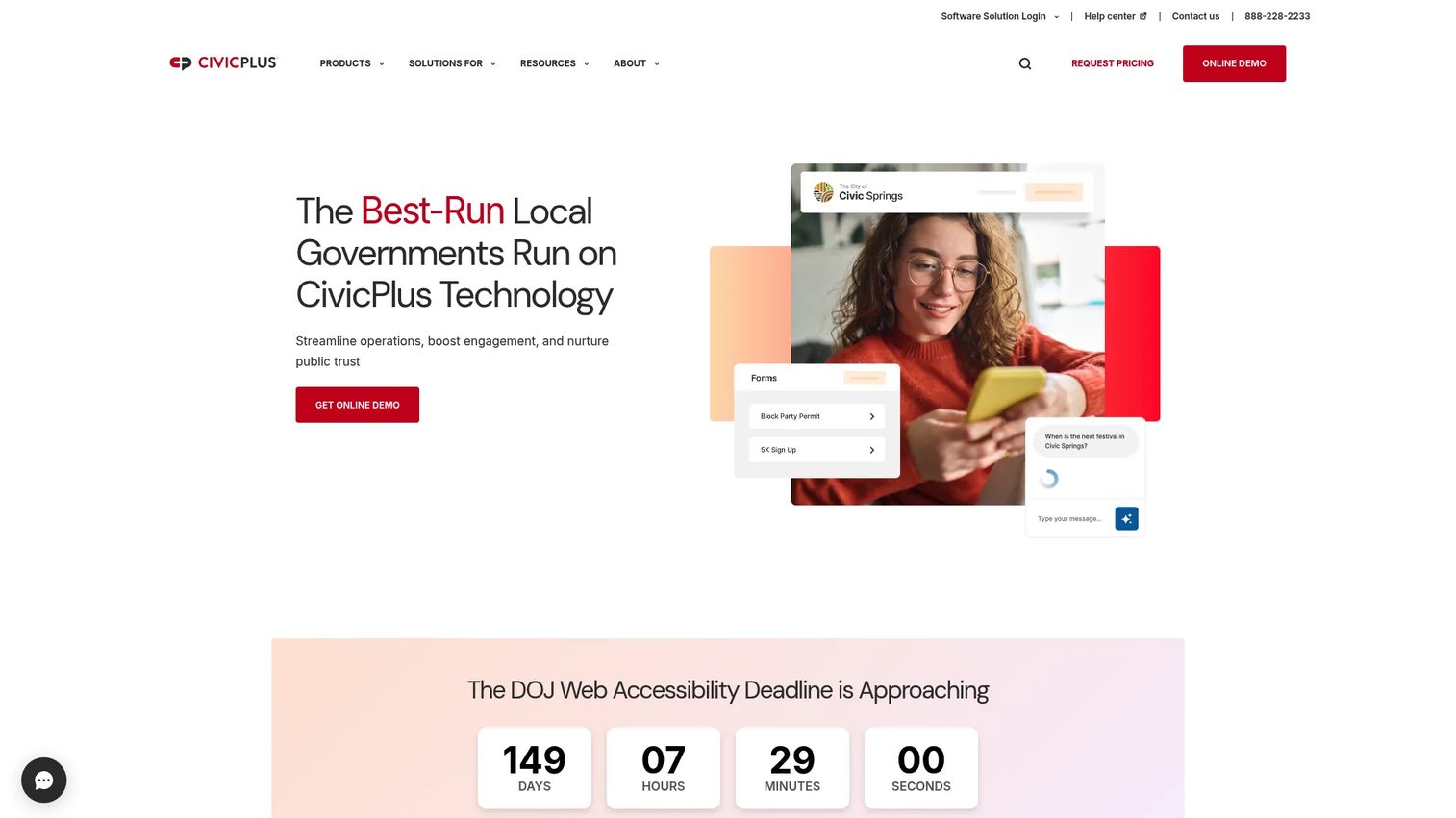
CivicPlus Utility Billing is cloud based software for local governments. It connects utility billing, payments, resident account information, and field operations.
The resident portal provides access to billing information, usage history, and payment options. GIS powered work orders help staff connect service activity with account records.
Best for: Small and midsized local governments seeking connected billing, resident self-service, payments, and field service workflows.
Key features
- Resident billing and payment portal
- Usage history access
- GIS powered work orders
- ERP and metering integrations
- Payment system connections
Why choose CivicPlus Utility Billing: Choose it when resident experience and support deflection carry substantial weight. Online account access can answer basic billing questions before a resident calls.
The connected field workflow also helps when a billing dispute involves service activity. Staff can investigate account and work order information with fewer handoffs.
CivicPlus Utility Billing pricing
Custom pricing. Ask sales for software, implementation, portal, payment, and integration costs.
2. Springbrook Cirrus Utility Billing
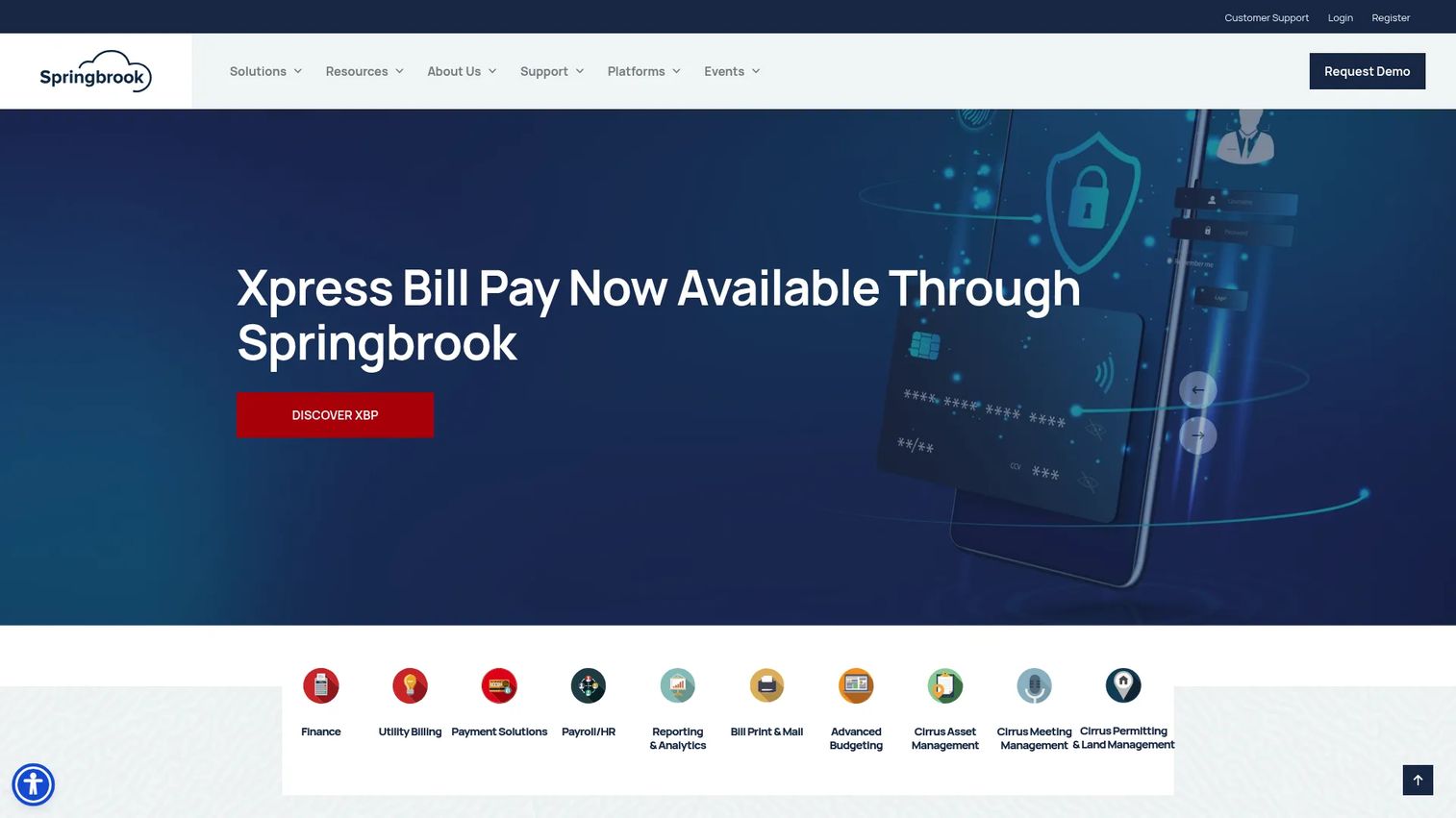
Springbrook Cirrus Utility Billing is cloud based software for municipalities and special districts. It supports water, sewer, electric, refuse, stormwater, and other billable services.
The platform handles tiered rates, winter averaging, and credit based deposits. Payment channels include online, counter, lockbox, and mail acceptance.
Springbrook also connects past due collections with service requests, accounts payable refunds, and the general ledger. That structure suits billing teams working inside public sector finance controls.
Best for: Municipalities needing utility billing connected to government finance, payment, collection, and audit workflows.
Key features
- Meter-to-cash billing
- Tiered and seasonal rates
- AMI system integrations
- Past due collections
- General ledger connections
Why choose Springbrook Cirrus Utility Billing: Choose Springbrook when billing cannot sit apart from municipal accounting. Its finance context helps teams trace charges and refunds through the wider record.
The platform also fits multi-service municipalities with complex rate structures. Support staff can investigate usage, billing, and collection activity within a connected process.
Springbrook Cirrus Utility Billing pricing
Custom pricing. Ask sales how modules, implementation, migration, and service volume affect the quote.
3. Muni-Link
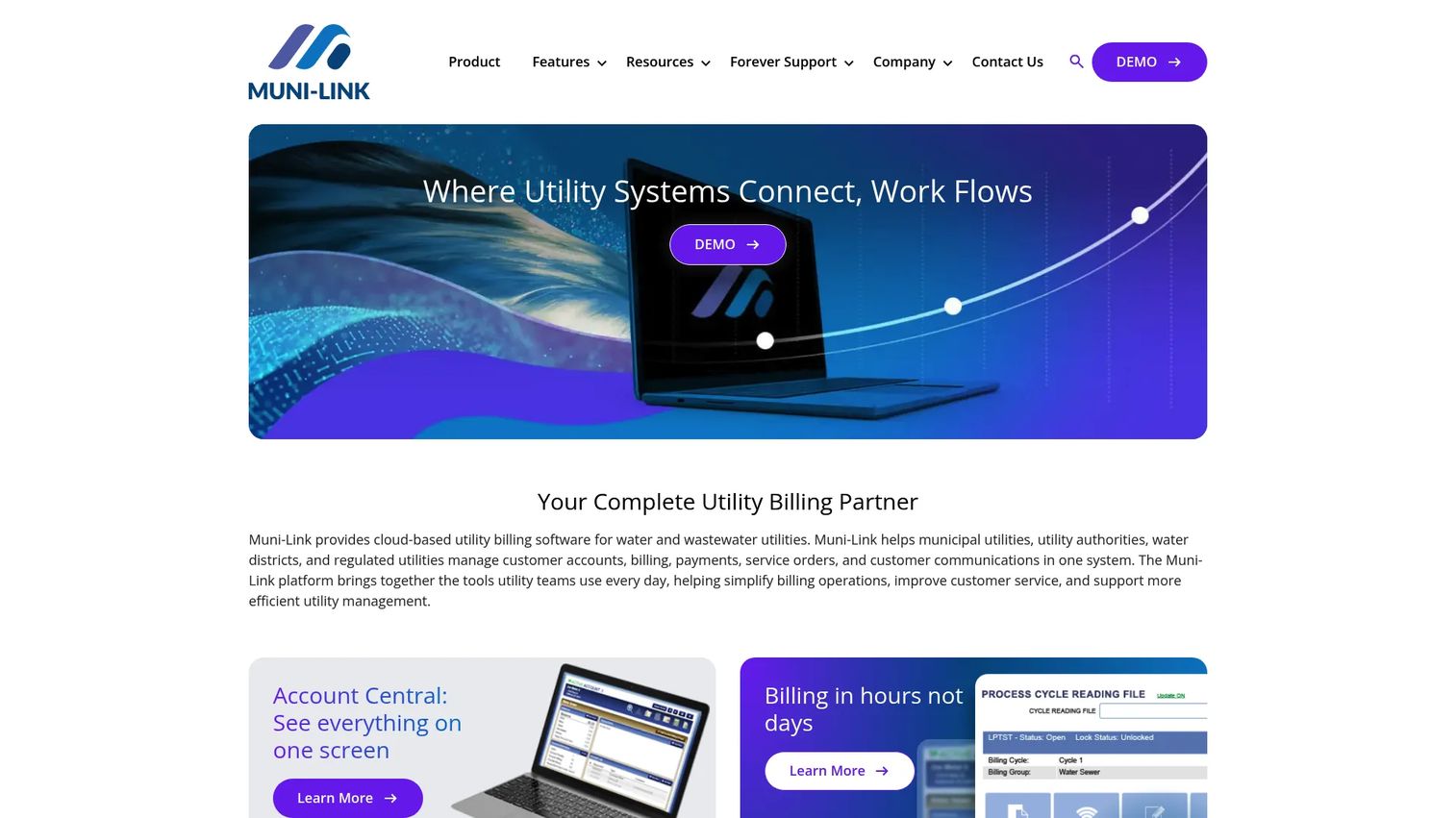
Muni-Link is cloud based utility billing and management software for water and wastewater providers. It combines billing automation with account records, payments, and field service workflows.
Its customer information system includes usage, service orders, notifications, and account activity. The white labeled portal supports payments, autopay, electronic billing, and account management.
That combination makes Muni-Link a practical candidate for the best utility billing software for small water districts. Lean teams can manage resident questions without adopting a broad municipal ERP.
Best for: Municipal water and wastewater utilities needing billing, account management, payments, and field service visibility.
Key features
- Billing and delinquency workflows
- Customer account histories
- Service order visibility
- White labeled customer portal
- Meter reading integrations
Why choose Muni-Link: Muni-Link fits offices where clerks handle billing, customer calls, and service coordination. Account Central gives residents another route for routine payment and account tasks.
The customer record also brings usage and service information closer together. That matters when a high bill leads to a meter investigation or field visit.
Muni-Link pricing
Custom pricing. Ask sales about account volume, portal costs, migration, integrations, and support.
4. VITALITY
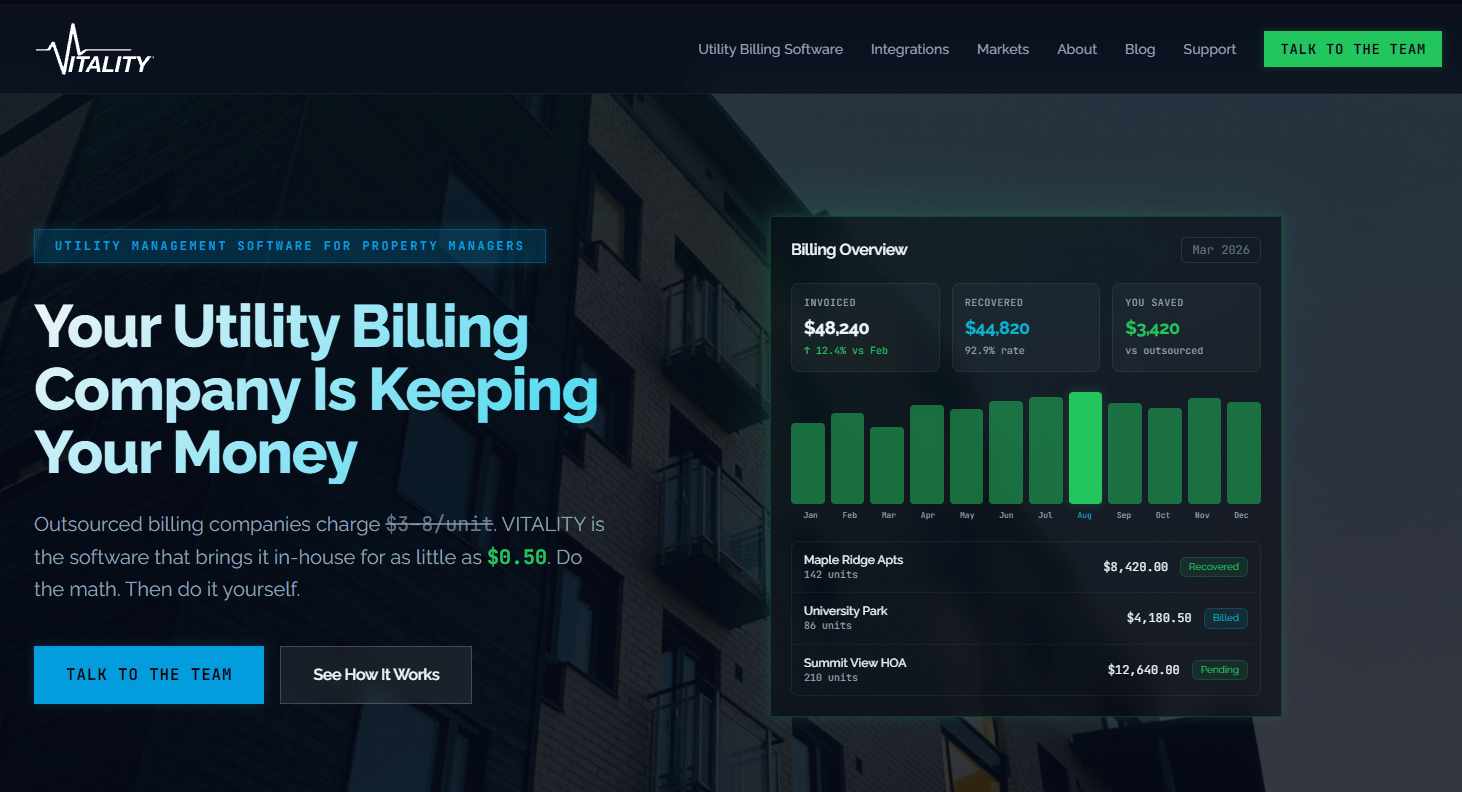
VITALITY is included for property operators evaluating utility recovery platforms. Current first-party product documentation was inaccessible during research, so its present capabilities require direct vendor confirmation.
This category differs from municipal billing. Property operators commonly focus on unit level cost recovery, resident allocations, vacant units, and move-out charges.
Buyers should verify whether the current product supports their property management stack and billing method. Ask for a complete resident dispute workflow rather than relying on a feature checklist.
Best for: Property operators comparing utility cost recovery software rather than municipal customer information systems.
Key features
- Metered billing support: Confirm availability with sales
- Property integrations: Request named supported systems
- Move-out billing: Ask for a live workflow
- Resident allocations: Verify current calculation methods
Why choose VITALITY: Keep VITALITY on the shortlist when the billing problem concerns rental units and utility recovery. Municipalities should prioritize platforms built around public utility accounts and government finance.
Property operators should test final bills, occupancy changes, and payment adjustments. Those scenarios reveal more than a standard product overview.
VITALITY pricing
Custom pricing. Request current charges, contract terms, implementation fees, and support costs.
5. gWorks Financials
gWorks Financials provides cloud based financial management software for small and midsized local governments. Its verified capabilities cover fund accounting, budgets, accounts payable, and accounts receivable.
The platform also supports audit ready reporting and bank reconciliation. GASB compliant fund accounting makes it relevant when utility revenue must fit municipal reporting requirements.
Best for: Small and midsized local governments seeking connected municipal financial workflows.
Key features
- Fund based general ledger
- Accounts payable workflows
- Accounts receivable management
- Budget amendment tracking
- Audit ready financial reports
Why choose gWorks Financials: Choose gWorks when finance alignment drives the purchase. A connected ledger can reduce manual reconciliation between billing revenue and municipal accounts.
Buyers should confirm the exact utility billing capabilities included in their proposed package. Test payment posting and account correction workflows before signing.
gWorks Financials pricing
Custom pricing based on community size and selected modules. Ask sales for implementation, migration, training, and support costs.
6. Edmunds GovTech
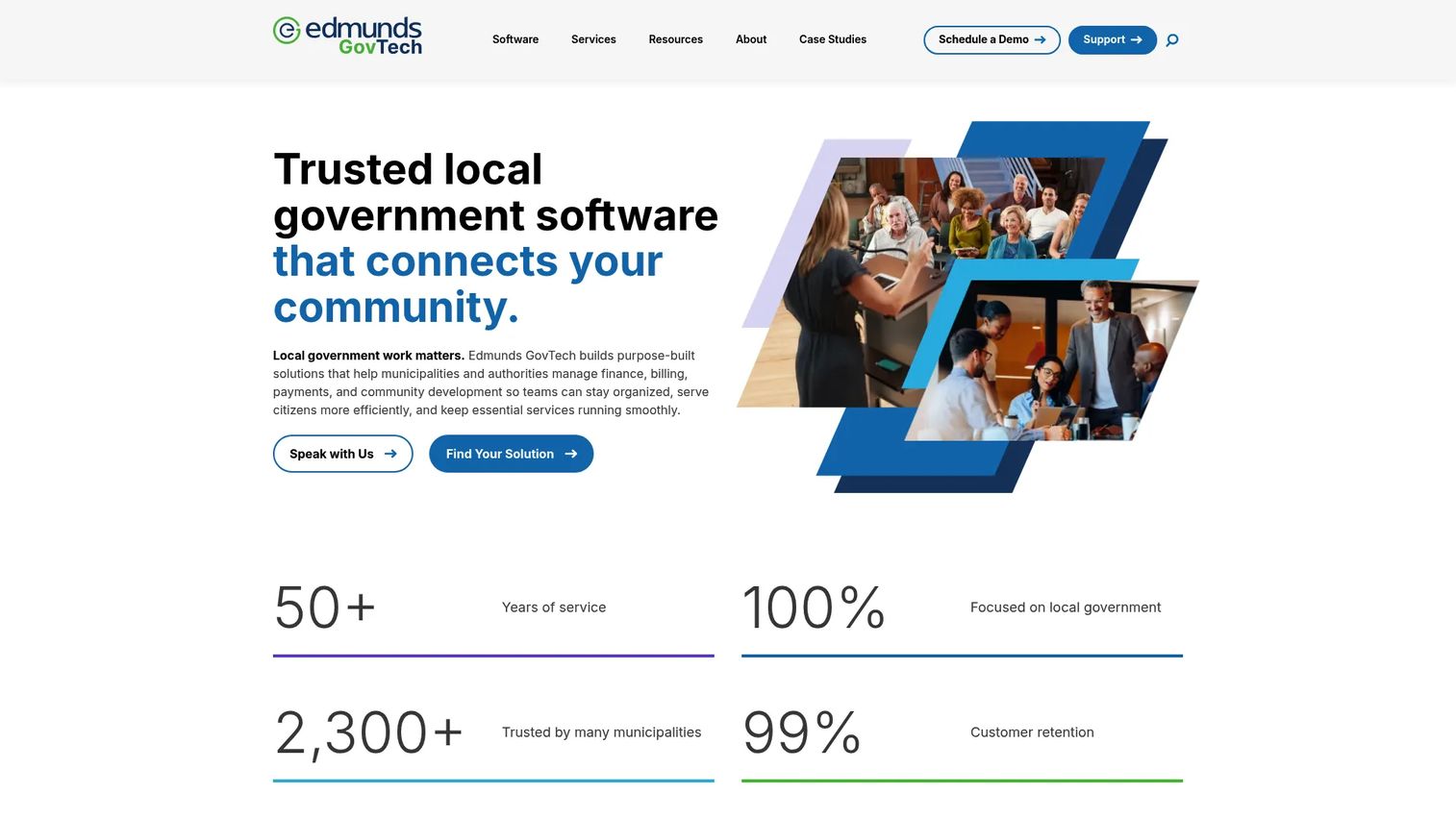
Edmunds GovTech provides software for local government finance, billing, payments, and community development. Utility billing capabilities include collections, meter reading, and usage tracking.
The wider product scope covers online accounts, revenue collection, payroll, and municipal reporting. This breadth suits buyers seeking a government ERP rather than a billing-only platform.
Best for: Municipalities and public agencies seeking integrated local government ERP, billing, payment, and community service software.
Key features
- Utility billing and collections
- Meter reading and usage tracking
- Finance and accounting
- Online accounts and payments
- Tax and revenue reporting
Why choose Edmunds GovTech: Choose Edmunds when several municipal departments need a shared operational environment. The broader footprint can help when billing questions touch revenue records or other government services.
A larger system requires careful workflow testing. Ask agents and clerks to run payment corrections, disputed usage, and account transfer scenarios.
Edmunds GovTech pricing
Custom pricing. Ask sales for module packaging, hosting, migration, implementation, and support costs.
7. BS&A Software
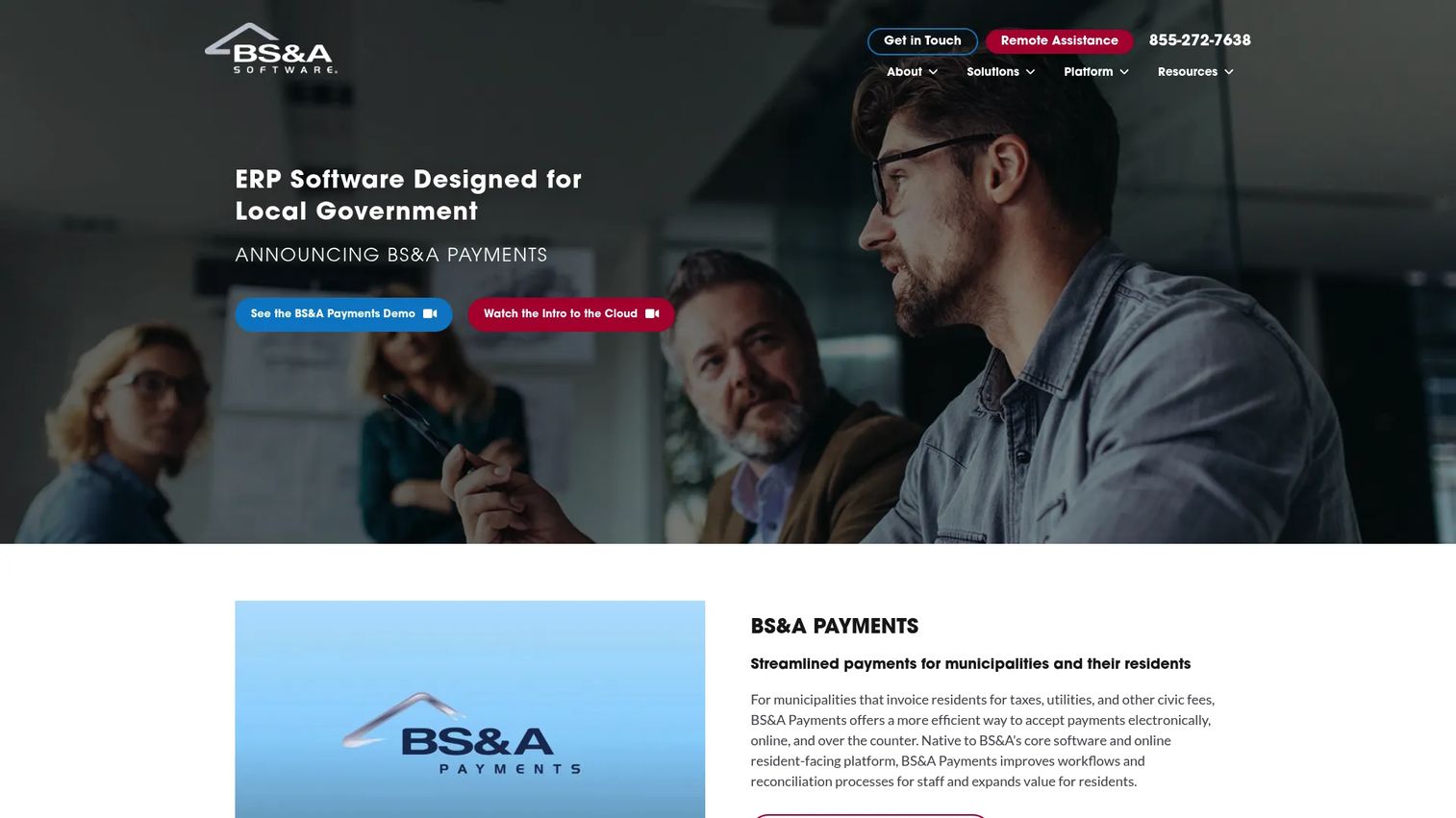
BS&A Software offers cloud based enterprise software for U.S. municipalities and counties. Its portfolio covers utility management, financials, property tax, and community development.
Utility capabilities include customer information, billing data, and work orders. BS&A Payments supports electronic, online, and counter transactions.
The cloud platform includes automatic updates and real-time access. Broader municipal modules cover permits, inspections, licensing, and code compliance.
Best for: U.S. local governments seeking connected municipal administration and utility operations.
Key features
- Utility customer and billing records
- Work order information
- Municipal financial management
- Electronic and counter payments
- Cloud software updates
Why choose BS&A Software: BS&A fits municipalities where billing questions often cross departmental boundaries. Connected property and financial data can reduce internal transfers during complex resident inquiries.
Its broad scope also warrants a structured implementation review. Confirm which teams own account data, work orders, payment exceptions, and resident communications.
BS&A Software pricing
Custom pricing. Ask sales how modules, users, implementation, migration, and hosting affect cost.
G2 rating: 4.8/5
8. Tyler Technologies Utility Billing
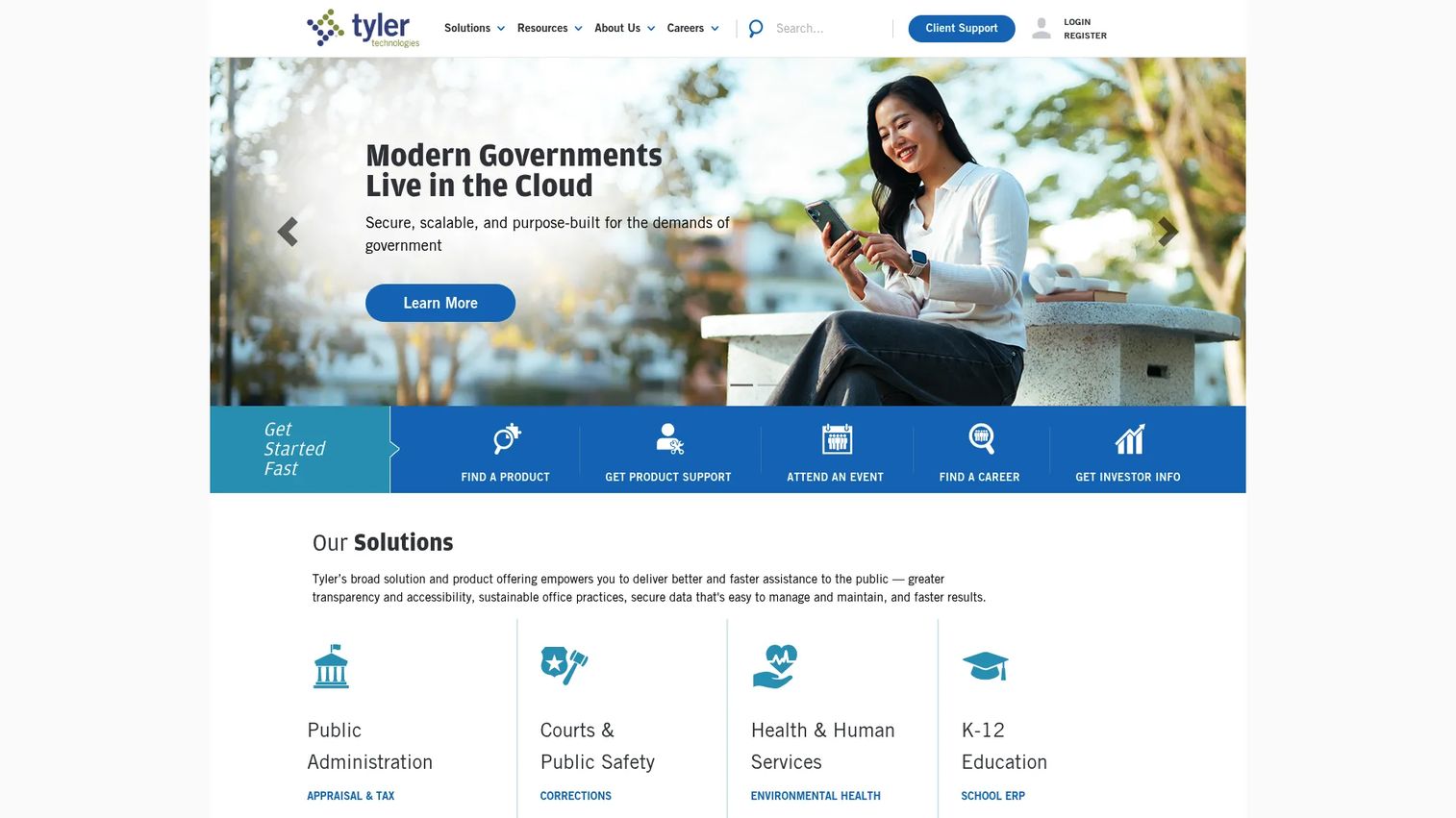
Tyler Technologies Utility Billing supports billing and account management for municipal and independent utilities. It handles metered services, non-metered charges, flexible rates, and multiple billing cycles.
Service order processing includes current service data. The software also supports automated adjustments, reporting, online payments, IVR, and Text-to-Pay integrations.
Tyler’s wider public sector portfolio makes this option relevant for organizations standardizing around one vendor. That alignment can matter more than billing functionality alone.
Best for: Mid-size and large municipalities needing billing, revenue management, and citizen payment services.
Key features
- Metered and non-metered billing
- Flexible rate structures
- Multiple billing cycles
- Service order processing
- Digital payment integrations
Why choose Tyler Technologies Utility Billing: Choose Tyler when existing public sector systems shape the procurement decision. The vendor footprint may support broader operational alignment across departments.
Run detailed implementation diligence before committing. Confirm integration responsibilities, data ownership, support routing, and contract costs.
Tyler Technologies Utility Billing pricing
Custom pricing. Ask sales for licensing, implementation, integration, migration, and ongoing support costs.
G2 rating: 4.0/5
9. Caselle Utility Management
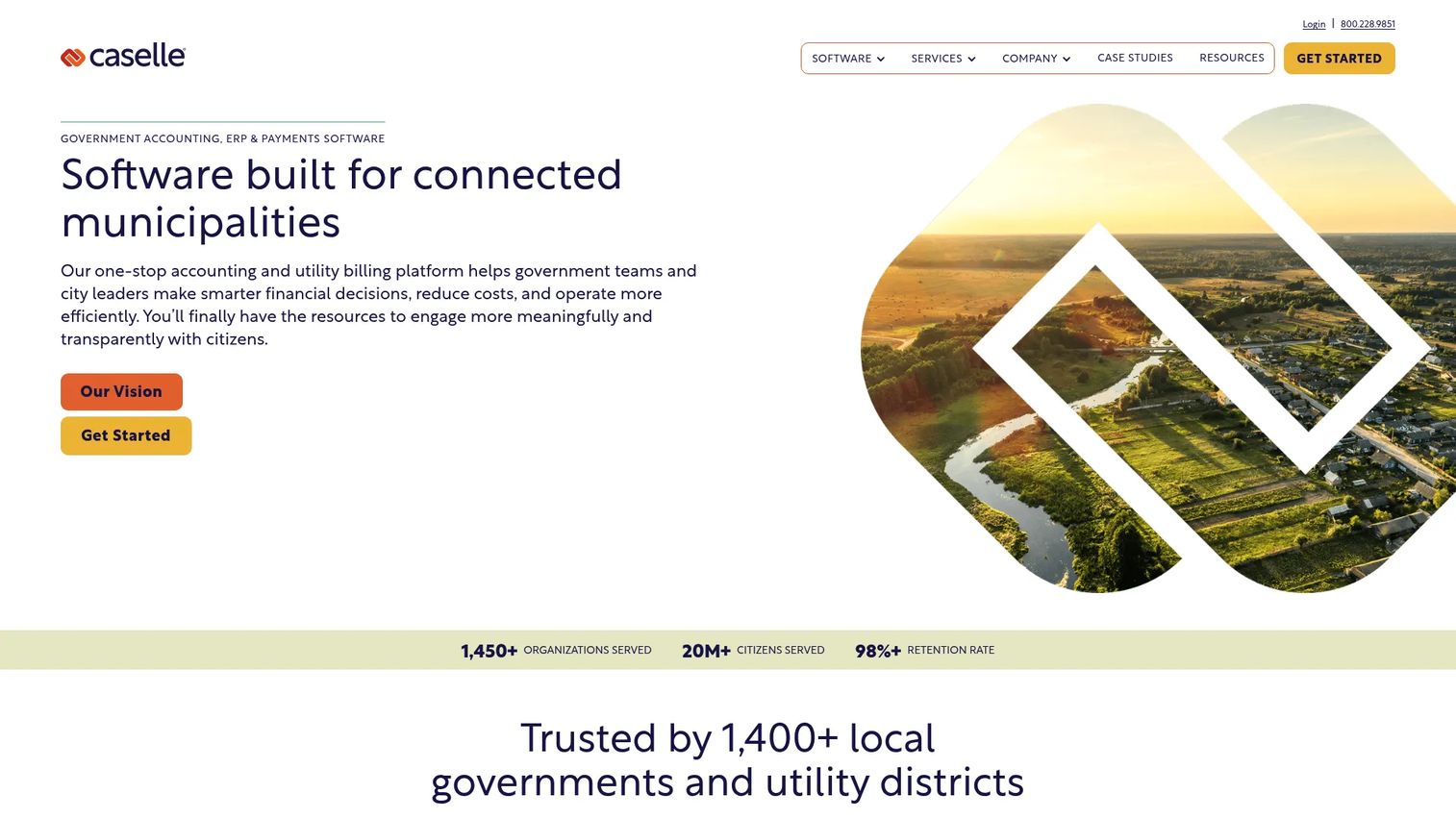
Caselle Utility Management supports metered and non-metered billing for local governments and special districts. Teams can configure rates, billing frequency, and due dates.
Customer records cover locations, meters, contracts, deposits, loans, and transaction history. Available connections include online payments, mobile service orders, GIS, and meter reading systems.
This operational coverage helps when a caller questions both usage and a service visit. Agents can trace more of the account story without leaving the billing workflow.
Best for: Municipalities and special districts managing billing, meters, collections, and related field operations.
Key features
- Configurable utility rates
- Detailed account histories
- Online payment portal
- Mobile service orders
- Meter and GIS integrations
Why choose Caselle Utility Management: Caselle fits buyers that want utility management close to municipal accounting and field activity. Its configurable rate support also suits varied billing policies.
Ask the vendor to demonstrate a disputed bill from meter reading through adjustment. Include portal and service order records in the test.
Caselle Utility Management pricing
Custom pricing. Request module, implementation, migration, portal, integration, and support costs.
10. SpryPoint
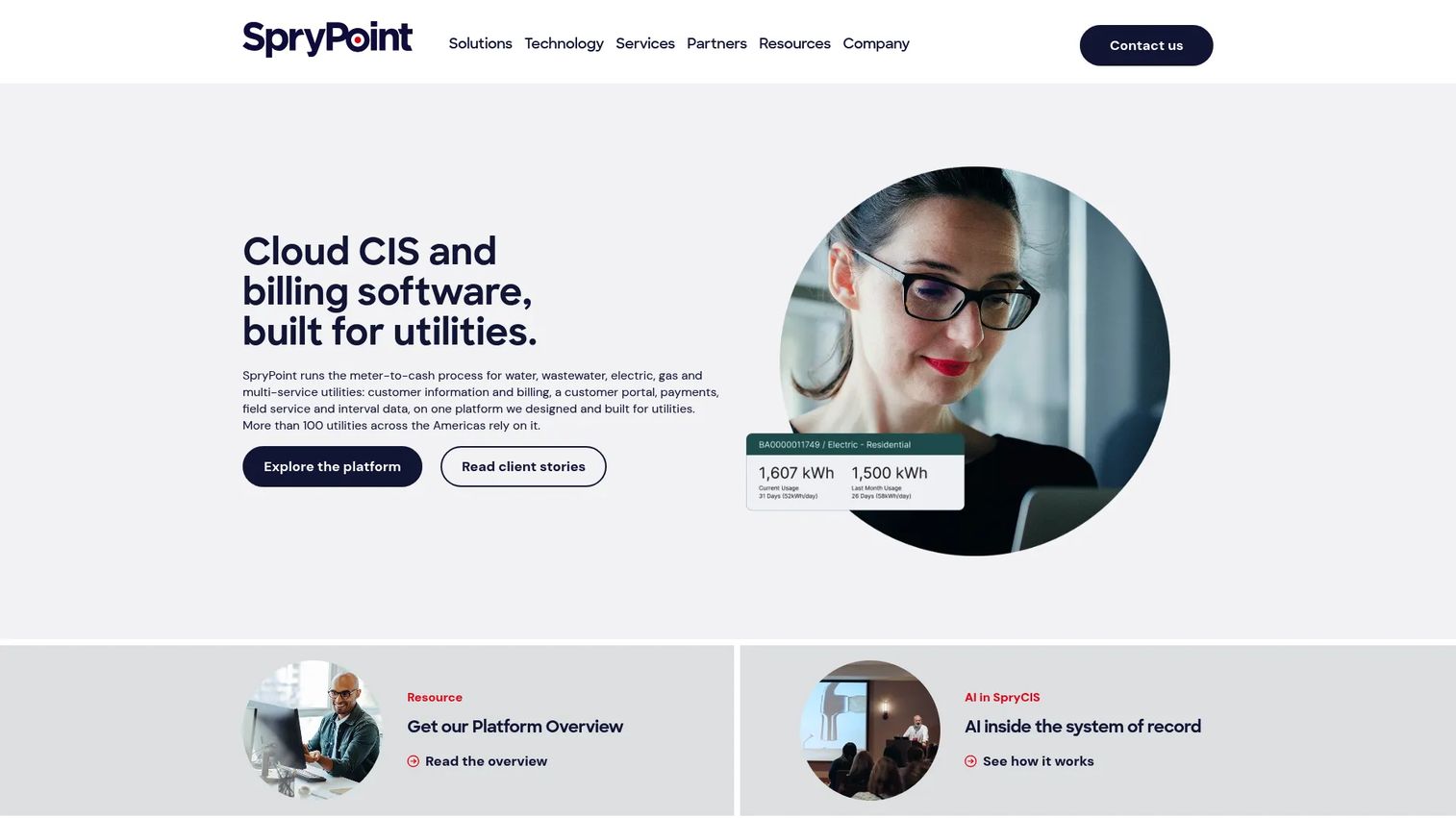
SpryPoint provides cloud native customer information, billing, payment, engagement, and field operations software for utilities. SpryCIS handles customer information and utility billing.
SpryEngage provides a customer portal with alerts and account insights. SpryWallet covers payment processing, while other modules support field service and interval data.
The platform serves water, wastewater, electric, gas, and multi-service providers. Its connected meter-to-cash billing scope suits utilities replacing legacy customer information systems.
Best for: Multi-service utilities seeking an integrated cloud platform for billing and customer operations.
Key features
- Cloud customer information system
- Utility billing through SpryCIS
- Customer portal and alerts
- Integrated payment processing
- Mobile field service
Why choose SpryPoint: Choose SpryPoint when the project is a wider CIS modernization. Customer service teams gain a broader view across billing, payments, engagement, and field operations.
This is a different buying motion from replacing a small billing application. Evaluate data migration, integration ownership, staff training, and cutover support in detail.
SpryPoint pricing
Custom pricing. Ask sales about service territory, modules, migration, implementation, and integration costs.
11. Cayenta CIS
Cayenta CIS is a utility focused customer information system. It supports customer service, billing, account insight, and meter-to-cash operations.
A flexible rates engine addresses configurable billing requirements. The platform also connects customer data with financial and field operations.
Its 360 degree customer view is relevant for support teams handling complex account inquiries. Staff can investigate a resident’s billing and service context from a wider record.
Best for: Utilities needing configurable customer information, billing, and meter-to-cash capabilities.
Key features
- 360 degree customer view
- Flexible rates engine
- Streamlined service workflows
- Integrated billing and financials
- Meter-to-cash lifecycle support
Why choose Cayenta CIS: Choose Cayenta when rate configuration and operational scale exceed a smaller municipal billing tool. It is designed for utility wide customer information management.
Ask the vendor to demonstrate collections, bill adjustments, and field activity from the agent’s view. Those workflows expose usability gaps quickly.
Cayenta CIS pricing
Custom pricing. Request details for modules, implementation, integrations, migration, training, and support.
G2 rating: 3.5/5
12. Itineris
Itineris provides UMAX, a cloud utility suite built on Microsoft technology. The platform combines CIS, CRM, ERP, and data capabilities.
UMAX supports billing, payments, collections, and meter data management. Its CRM functions cover customer service, self-service, field work, and customer communications.
Additional capabilities include real-time pricing, configurable dashboards, and what-if simulations. This scope fits large energy, water, and EV utilities with complex operational requirements.
Best for: Large utilities needing enterprise customer information, billing, finance, and operational management.
Key features
- Enterprise customer information system
- Billing and payment management
- Collections and meter data
- Customer service CRM
- Real-time pricing tools
Why choose Itineris: Choose Itineris when the organization needs a utility CIS rather than a municipal billing application. Its enterprise scope supports complex service territories and customer operations.
Plan for a detailed evaluation process. Include billing operations, finance, customer service, field teams, IT, and procurement in scenario testing.
Itineris pricing
Custom pricing. Ask sales for platform, module, implementation, migration, integration, and support costs.
13. MuniBilling
MuniBilling is cloud based billing software for municipalities, private utilities, property managers, and other organizations. Its billing engine supports unlimited rates and tiers.
The platform provides reporting for accounts receivable, meters, billing, and payments. It also supports meter reading connections, mobile readings, accounting feeds, and service orders.
Payment options include cards, ACH, and lockbox processing. A customer portal gives account holders access to payment and billing functions.
Best for: Organizations needing configurable utility billing without adopting a full municipal ERP.
Key features
- Unlimited rates and tiers
- Meter reading integrations
- Billing and payment reports
- Online card and ACH payments
- Customer portal and service orders
Why choose MuniBilling: MuniBilling suits lean teams that want fewer moving parts. Its focused scope can fit offices where billing remains the central requirement.
Buyers should examine customer support processes carefully. Test a rate correction, payment reversal, and disputed meter reading before selecting it.
MuniBilling pricing
Custom pricing based on account volume and selected services. Ask about migration, support, payment processing, and meter integrations.
G2 rating: 1.0/5
14. El Dorado Utility Billing Software
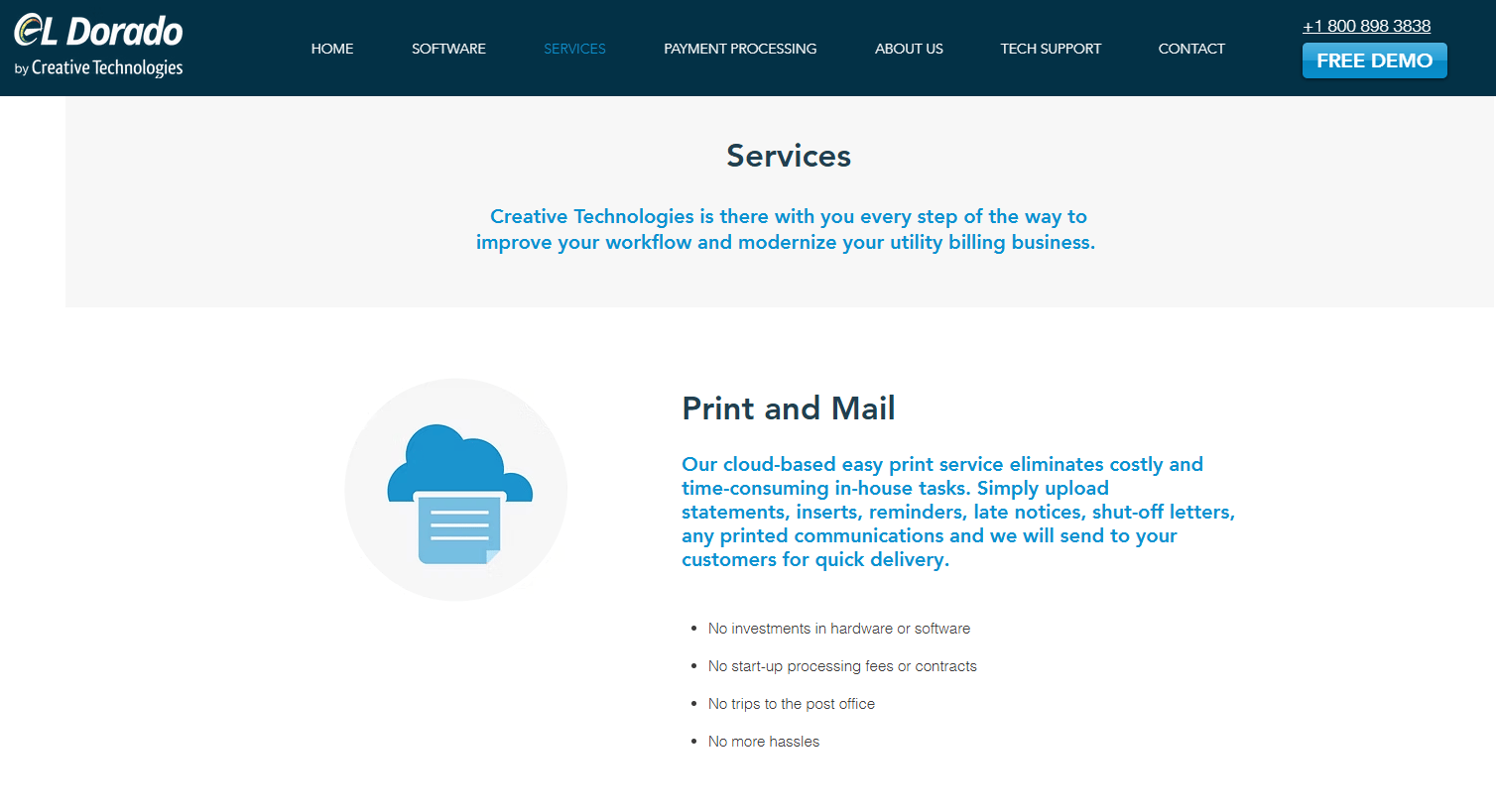
El Dorado Utility Billing Software serves small and medium cities, towns, municipalities, property managers, and accounting firms. Verified capabilities cover meter reading, billing, payment collection, and customer service management.
Its Intuity portal gives customers online account access. The system supports water, wastewater, gas, electric, and property management billing contexts.
This tool belongs on a shortlist for teams focused on daily billing execution. Buyers seeking broad government ERP coverage should compare wider municipal suites.
Best for: Small and medium utilities managing meter reading, billing, payments, and customer service.
Key features
- Meter reading workflows
- Utility bill generation
- Intuity customer portal
- Payment collection
- Customer service management
Why choose El Dorado Utility Billing Software: Choose El Dorado when core billing and meter workflows drive the project. Its fit is clearest for teams that do not require enterprise CIS breadth.
Ask for a complete demonstration of meter import, exception handling, bill creation, and payment posting. Include a customer portal payment in the script.
El Dorado Utility Billing Software pricing
Custom pricing. Ask sales about implementation, support, meter imports, portal access, and payment processing.
15. Diversified Billing
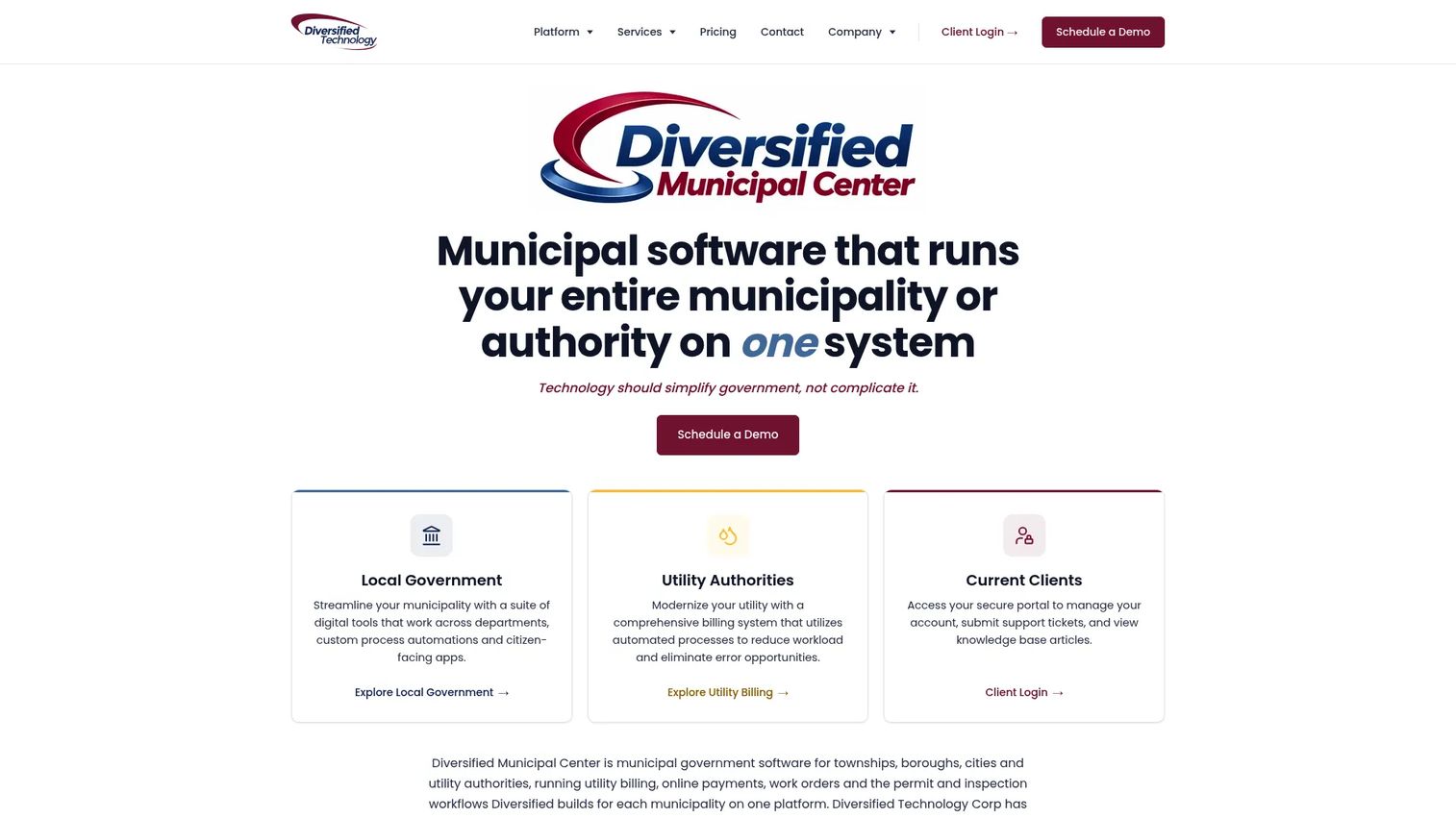
Diversified Billing provides cloud based utility billing software for municipalities and utility authorities. Its platform supports automated billing, payment processing, notices, and audit trails.
Meter exception reports can trigger reread work orders. Residents can use an online portal for account access and payments.
The vendor also offers billing service packages. This option differs from software-only platforms because buyers can select additional operational support.
Best for: Municipalities and utility authorities seeking recurring billing, payments, meter workflows, and resident self-service.
Key features
- Automated billing and payments
- Meter exception reports
- Automated reread work orders
- Citizen payment portal
- Rule based notices
Why choose Diversified Billing: Diversified Billing stands out for transparent base pricing. It suits buyers that want predictable per-property charges before starting a sales conversation.
The billing service options also deserve attention. Clarify which tasks remain with municipal staff and which the vendor performs.
Diversified Billing pricing
Utility Authority costs $3 per property yearly. Local Government costs $6 per property yearly, while billing services use custom pricing.
Considerations when choosing utility billing software
Match the system to your utility type
Water and sewer billing differs from electric, gas, stormwater, refuse, or multifamily recovery. Document every service, rate structure, account type, and billing cycle before comparing platforms.
A focused billing system may suit a small district. A multi-service utility may need a full CIS with enterprise integrations.
Test the customer service workflow
Run a live scenario where a resident disputes a bill. Ask the vendor to show payment status, meter readings, notices, account notes, and service orders.
Count how many screens the agent opens. Look for clear history, useful search, and permission controls that match staff roles.
Verify integrations before signing
Request named examples for your ERP, general ledger, payment processor, GIS, AMI, and AMR systems. Include lockbox services, print vendors, and property software where relevant.
An integration label does not explain data direction or update frequency. Ask who monitors failures and corrects rejected records.
Scrutinize implementation and data migration
Migration may include balances, deposits, rate tables, meter histories, notices, and delinquency records. Decide who cleans each dataset before the project starts.
Schedule testing around a complete billing cycle. Parallel bill comparison can reveal calculation or rounding differences before residents receive incorrect statements.
Review security, permissions, and audit trails
Evaluate multifactor authentication, role based access, backups, encryption, audit logs, and disaster recovery documentation. Ask how long the vendor retains billing and activity records.
Public accountability also requires traceable changes. Confirm that supervisors can identify who adjusted a charge or changed a rate.
Conclusion
The strongest utility billing software for municipalities matches the operating model behind the bill.
CivicPlus fits local governments prioritizing resident self-service and connected field workflows. Springbrook suits municipalities that need billing inside a government finance context.
Muni-Link deserves attention from small water and wastewater utilities. VITALITY belongs in property operator evaluations rather than traditional municipal CIS projects.
gWorks, Edmunds GovTech, BS&A Software, and Caselle connect billing with broader municipal administration. Tyler, SpryPoint, Cayenta, and Itineris serve larger or more complex utility operations.
MuniBilling, El Dorado, and Diversified Billing provide more focused billing paths.
Shortlist three to five vendors using your service mix, population, integration stack, and support workflow. Then test each platform with these scenarios:
- Resident payment dispute
- Incorrect meter reading
- Move-out final bill
- Delinquency notice explanation
If your organization sells or supports complex software, interactive demos can explain workflows in help centers, onboarding, support replies, and customer education.
Start your journey with Guideflow today!
FAQs
Utility billing software calculates charges, manages customer accounts, imports meter readings, issues bills, and records payments. It can also support collections, service orders, resident portals, and revenue reporting.
Municipalities, utility districts, property operators, and private providers use these systems. The required feature set depends on the services being billed.
Muni-Link is a strong candidate for small water and wastewater utilities needing billing, customer accounts, payments, and field service visibility. MuniBilling and El Dorado offer more focused billing workflows.
gWorks may suit districts that also need municipal financial management. Diversified Billing offers transparent per-property packages and optional billing services.
A connected utility billing system gives agents access to account history, meter readings, payment status, notices, notes, and service orders. That visibility helps staff explain bills without searching several systems.
Resident portals also support self-service account access and payments. Evaluate deflection through call reasons, repeat contact rates, and portal completion data.
Many utility billing platforms connect with general ledgers, accounts payable, accounts receivable, and fund accounting systems. Integration coverage varies by vendor and product tier.
Buyers should also verify payment processor, GIS, AMI, AMR, lockbox, and print vendor connections. Ask for a documented data flow using the systems your organization already operates.
The system should support the methods used by your utility. Common examples include flat charges, metered billing, tiered rates, seasonal calculations, deposits, penalties, and payment plans.
Stormwater fees may follow parcel or impervious surface rules. Property operators may also require RUBS or convergent billing.
Implementation length depends on data quality, rate complexity, integrations, testing, training, and billing cycle timing. A focused billing replacement and an enterprise CIS migration require different project plans.
Ask each vendor for milestones, customer responsibilities, and acceptance criteria. Do not approve the cutover until the team has tested a complete billing cycle.
Ask the vendor to show a disputed bill from initial meter reading through payment adjustment. Then import readings, post an online payment, and create a service order.
The demonstration should also cover delinquency notices, rate changes, final bills, permissions, and revenue reporting. Include frontline billing staff in the session.
Security depends on the vendor’s controls and your organization’s requirements. Review multifactor authentication, role based permissions, encryption, audit logs, backups, retention, and disaster recovery.
Request current security documentation and incident response procedures. Your IT and procurement teams should assess the evidence before contract approval.