You are not short on floor plans. You are short on a way to connect those floor plans to planograms, sales data, and inventory without rebuilding a spreadsheet every time a category shifts.
That is the real problem with most store planning work. The layout looks fine on paper. Then the assortment changes, a new store opens, a promotion lands, and the plan drifts out of sync with what is actually happening on the shelf. Retail store planning software exists to close that gap, turning space decisions into performance decisions instead of static diagrams.
The category is moving fast. The global store planning software market sat at roughly USD 1.2 billion in 2024 and is forecast to reach USD 4.8 billion by 2033, growing at about 19.5% CAGR, according to a 2024 LinkedIn market analysis. Cloud-based retail space planning solutions already account for over 65% of deployments as of 2023 per a related LinkedIn market report, which tells you where the buying is headed: scalable, connected, multi-location systems rather than desktop-only drawing tools.
If you are a product-minded operator, the evaluation logic here will feel familiar. Multiple stakeholders. Messy data across systems. A need to tie workflow to measurable outcomes like sales per square foot and GMROI. This list is built to help you match a tool to that reality, not just to a feature checklist.
What's inside
This guide covers store planning software used for floor planning, space planning, planogram alignment, merchandising collaboration, and retail analytics. It spans point solutions built for store layout and category space through to enterprise retail planning and allocation software that connects merchandising, supply, and finance.
We selected tools based on four things that matter to buyers: planning depth, integration with sales and inventory data, collaboration across teams and locations, and business impact. The promise is simple. By the end, you should know which tool fits your workflow, not which one has the longest feature page.
TL;DR
- Best overall for retail planning workflows: RELEX Solutions, for connecting floor planning to assortment, pricing, and inventory in one system.
- Best for AutoCAD-native planning: StoreSpace, for teams that build store layouts directly inside AutoCAD files.
- Best for enterprise planning orchestration: Board, when you need merchandising, supply, and finance in one operating model.
- Best for flexible, configurable planning: Anaplan, for teams modeling retail planning and allocation scenarios.
- Best for supply chain alignment: Blue Yonder, when store planning has to fit replenishment and inventory decisions.
- Best for AI-assisted optimization: Impact Analytics, for data-driven merchandising and assortment calls.
- Best for category management and planograms: DotActiv, for translating assortment strategy into shelf-ready execution.
What is store planning software?
Store planning software is a tool that helps retailers design store layouts, allocate category space, align planograms, and connect those decisions to sales and inventory data across one or many locations.
At its core, it does four things:
- Maps physical space. Floor plans, fixture placement, traffic flow, and category zones for new stores and remodels.
- Connects space to merchandising. It links macro space and planograms so category priorities, assortment, and shelf decisions inform how square footage gets allocated.
- Ties layout to data. Sales data integration and inventory alignment let planners see which categories earn their space and which do not.
- Coordinates teams. Planners, merchandisers, and store teams work from one plan, with a collaboration workflow that scales across multi-location retail.
Why does AI-assisted planning matter in 2026? Because the manual version does not scale. AI helps with demand forecasting, space optimization, scenario testing, and exception detection, so planners spend less time reconciling spreadsheets and more time on the calls that move sales per square foot.
Here is how the adjacent terms fit together, since search engines and buyers often blur them:
| Term | What it focuses on |
|---|---|
| Retail space planning software | Macro space and how total square footage is allocated across categories |
| Retail floor planning software | The physical floor plan, fixtures, and traffic flow inside a store |
| Planogram software | Shelf-level merchandising: exactly where each product sits on the fixture |
| Merchandising planning software | Assortment, ranging, and financial plans that feed space decisions |
Most serious buyers end up wanting a system that spans several of these, or a stack that connects them. That is where retail planning and allocation software and broader retail planning orchestration platforms come in, sitting above the floor plan and tying it to open to buy, allocation, and financial targets.
When to use store planning software
Plan new stores or remodels
When you open or remodel a store, you are making bets on layout before a single customer walks in. Store planning software lets you map fixtures, zones, and traffic flow, then test variations before you commit budget. The outcome you want here is fewer costly rework cycles and a layout that supports the categories you actually want to grow.
Align space decisions with merchandising
Space is only as good as what sits in it. This is where planogram alignment, sales data, and category priorities come together. If a category is shrinking but still holds prime real estate, the software should surface that. The outcome is space allocated by productivity, measured against GMROI and sales per square foot, not by habit.
Coordinate across locations and teams
A plan that works in one store rarely copies cleanly to 50. Multi-location retailers need standardization with room for local variation, plus a governance layer so changes roll out consistently. The outcome is execution consistency: what planners design is what store teams actually build, tracked with a shared collaboration workflow.
Comparison table
The tools below sit at different layers of the retail planning stack. Some are built for floor planning and category space. Others are enterprise planning and allocation software that connect merchandising to finance. Pricing across this category is largely quote-based, so figures reflect what each vendor publishes.
| # | Product | Intent | Key differentiation | Pricing | G2 rating |
|---|---|---|---|---|---|
| 1 | StoreSpace | AutoCAD-native floor planning | Store layouts built directly in AutoCAD, tied to planograms and sales data | Not publicly listed; Lite available under 250 stores | Not listed |
| 2 | RELEX Solutions | Unified merchandising and floor execution | Floor plans connected to assortment, pricing, promotions, and inventory | Not publicly listed | 4.6/5 |
| 3 | Board | Enterprise retail planning orchestration | Replicates a retailer's full operating model across planning and finance | Custom quote | 4.4/5 |
| 4 | Anaplan | Merchandise planning and allocation | Configurable, connected planning across finance, supply, and sales | Custom quote | 4.6/5 |
| 5 | Blue Yonder | Supply chain and planning alignment | End-to-end supply chain planning with retail category management | Custom quote | 4.1/5 |
| 6 | Impact Analytics | AI-assisted planning and optimization | AI-native pricing, forecasting, and merchandise planning | Contact-based | 4.5/5 |
| 7 | DotActiv | Category management and planogram alignment | Planograms, assortment, and floor planning with public per-license tiers | From $0 to $7,500/license per year | 4.5/5 |
1. StoreSpace

StoreSpace is retail space planning software built for teams that live inside AutoCAD. Instead of exporting layouts into a separate diagramming tool, planners work directly within AutoCAD files, using intelligent block libraries and toolsets to build store layouts fast without losing accuracy. It connects category space with planograms and sales data, so the floor plan is not just a drawing, it is a performance view.
That AutoCAD-native angle matters for a specific kind of retailer. If your space planners already produce CAD-grade layouts and your merchandising team needs those layouts tied to category performance, StoreSpace keeps both in one workflow rather than two.
Best for: Retailers needing store layout and category space planning across multiple locations, especially where AutoCAD is already the standard.
Key strengths
- AutoCAD-based floor planning: Build and edit store layouts directly in native CAD files, keeping precision intact.
- Online portal for reporting and two-way communication: StoreSpaceOnline gives store teams and planners a shared space for reporting and feedback.
- Data integration and heatmaps: Connects planograms and sales data into the layout, with heatmaps and reporting to see how space performs.
Why choose StoreSpace: Choose it when your space planning starts in AutoCAD and you want category space, planogram alignment, and store-level reporting connected to that same source. It serves verticals like grocery, fashion, and pharmacy, where accurate macro space planning across many sites is the daily job.
StoreSpace pricing: StoreSpace does not publish a public price. The company states that license cost depends on store count and number of users, and asks buyers to get in touch. A Lite option is available for retailers with fewer than 250 stores, but no public figure is shown for it.
2. RELEX Solutions
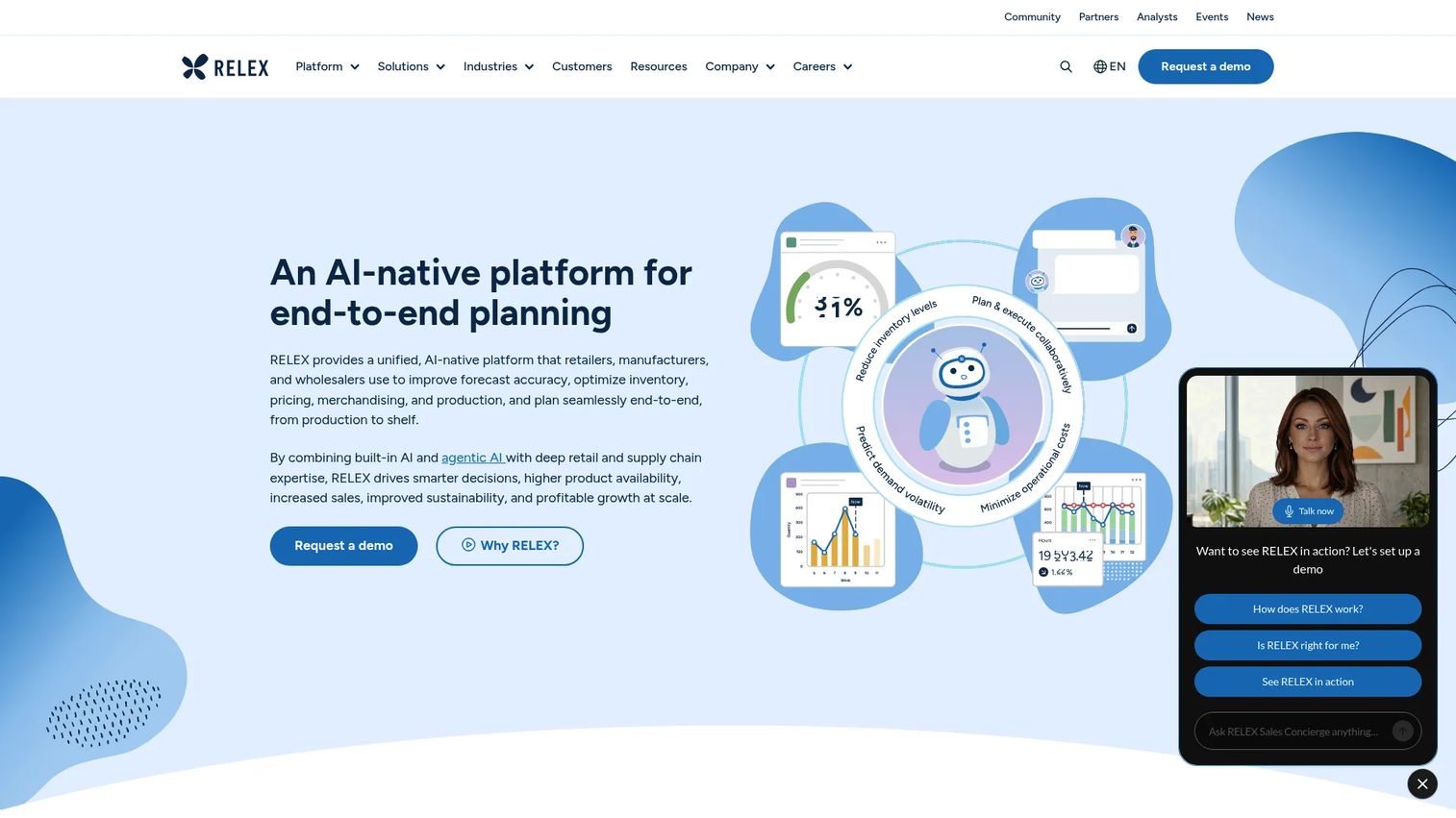
RELEX Solutions is AI-native retail and supply chain planning software that connects floor planning to the rest of the merchandising picture. Where a standalone floor planning tool stops at the layout, RELEX ties floor plans to assortment, pricing, promotions, and inventory, so a space decision immediately reflects what demand and replenishment tell you. That is the unified merchandising angle: planning and execution in one system.
For retailers that want space planning to feed and draw from real-time demand and inventory signals, this is the strongest fit on the list. The floor planning workflow supports real-time collaboration, and merchandising reports connect into tools like Power BI for downstream analysis.
Best for: Large retailers, manufacturers, and wholesalers needing unified planning across demand, inventory, pricing, and supply.
Key strengths
- Demand forecasting and replenishment: Space and assortment decisions are grounded in forecasted demand, not last season's guess.
- Pricing and promotion optimization: Promotions and pricing feed directly into how space and inventory get planned.
- Supply chain and production planning: Connects merchandising decisions through to the wider supply chain for end-to-end alignment.
Why choose RELEX Solutions: Choose it when you want floor planning to be part of a connected merchandising system rather than a separate diagram. It fits enterprise retail formats where the cost of a disconnected plan, out of sync with inventory, is high. RELEX holds a 4.6/5 rating on G2.
RELEX Solutions pricing: RELEX does not expose public pricing on its site or G2 listing. Expect an enterprise, quote-based engagement scoped to your formats, categories, and store count.
3. Board
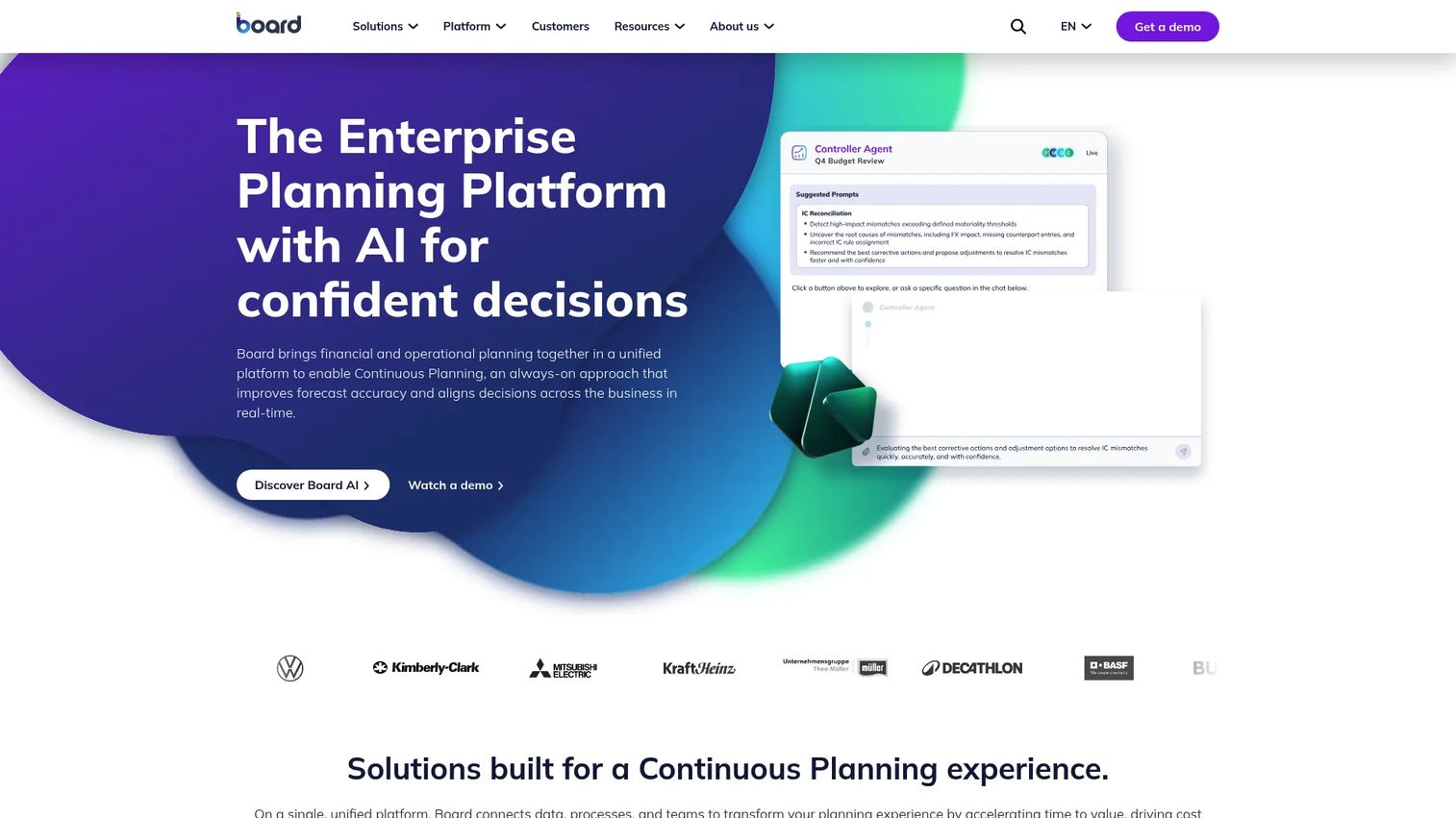
Board is an enterprise planning platform that treats store planning as one part of a larger operating model. Board's retail planning capabilities replicate a retailer's full operating model, connecting merchandising, supply, and finance rather than focusing purely on the floor plan. It is strongest when the question is not "where does this fixture go" but "how do space, assortment, and financial targets line up across the business."
That makes Board a retail planning orchestration option. It leans into 2026-style continuous planning: scenario modeling, forecasting, and cross-functional coordination so merchandise financial planning, open to buy, and space decisions move together instead of in separate cycles.
Best for: Large organizations needing unified enterprise planning across finance and operations.
Key strengths
- Planning and forecasting: Connects merchandise and financial planning in one continuous model.
- Analytics and reporting: Surfaces performance across categories, stores, and financial targets.
- Simulation and scenario modeling: Test allocation, space, and financial scenarios before committing.
Why choose Board: Choose it when your bottleneck is orchestration across teams, not the floor plan itself. It differs from execution-focused tools by sitting above them, aligning merchandising, supply, and finance. Board holds a 4.4/5 rating on G2.
Board pricing: Board provides customized quotes and does not display public plan prices. Pricing is scoped per engagement.
4. Anaplan
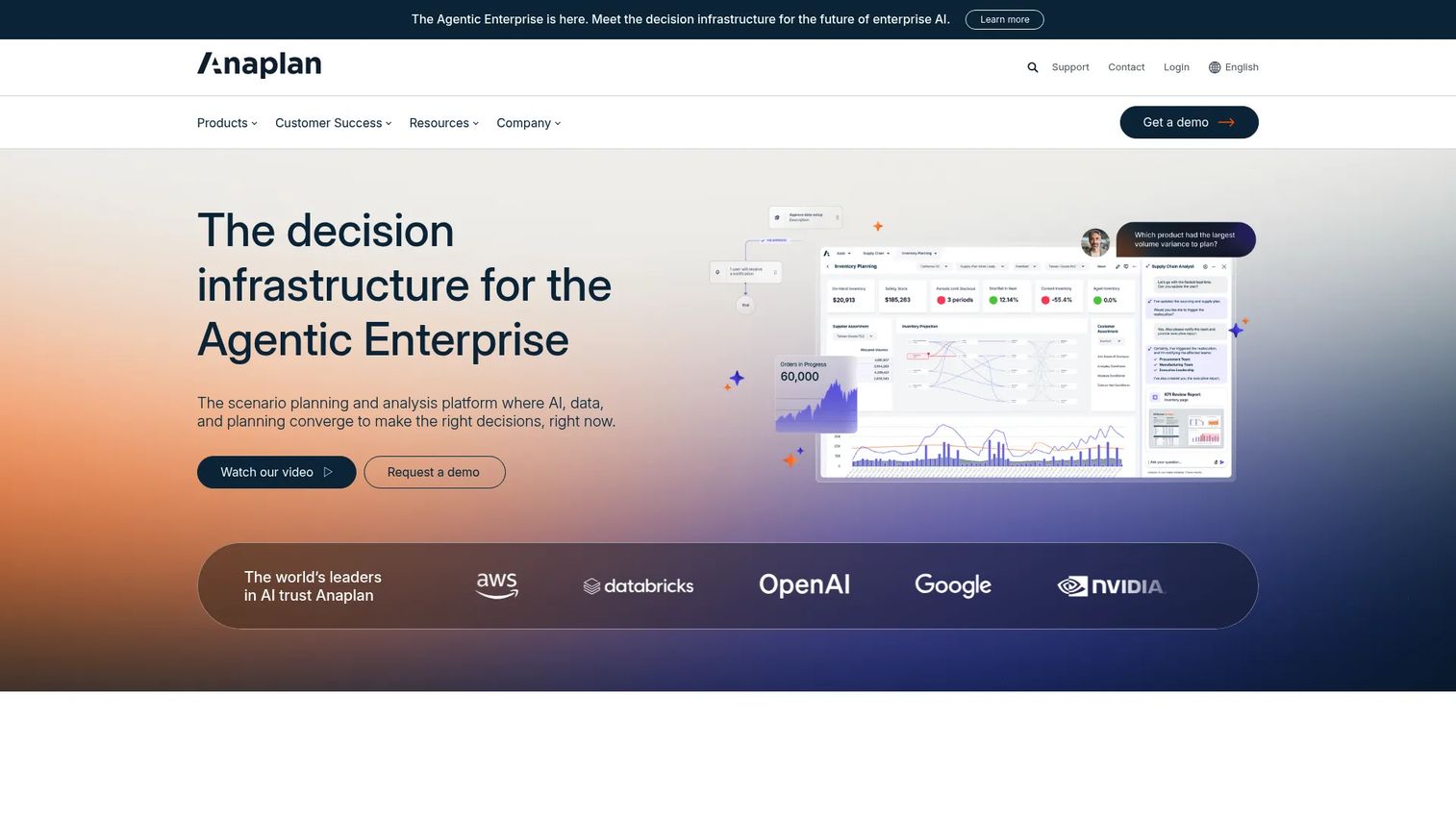
Anaplan is an AI-driven scenario planning and analysis platform that acts as a flexible planning layer for retail. Rather than shipping a fixed space planning feature set, Anaplan lets teams configure connected planning workflows across retail planning and allocation software use cases, from merchandise financial planning to scenario modeling. If your planning logic is unique and you want to model it your way, that configurability is the draw.
This is a planning system first, not a floor plan drawing tool. It fits teams that need connected data, role-based workflows, and the ability to run allocation and scenario models across finance, supply chain, sales, and operations.
Best for: Large organizations needing connected planning across finance, supply chain, sales, and operations.
Key strengths
- AI-driven scenario planning and analysis: Model multiple allocation and space scenarios and compare outcomes.
- Deterministic calculation engines: Plan at scale with fast, reliable recalculation across large data models.
- Connected data, workflows, and role-based agents: Keep planners, merchandisers, and finance working from one connected model.
Why choose Anaplan: Choose it when you need configurable planning and allocation across the business and want to shape the model to your process. It is a fit as a planning system rather than an execution-specific floor planning tool. Anaplan holds a 4.6/5 rating on G2.
Anaplan pricing: Anaplan does not publish public pricing on its site; the flow routes to a demo or contact request. Pricing is quote-based.
5. Blue Yonder

Blue Yonder is AI-powered supply chain planning and execution software with strong retail planning and category management capabilities. It matters when store planning cannot be separated from replenishment, inventory, and supply chain decisions. If your space and category plans have to reflect what is actually flowing through the supply chain, Blue Yonder puts those decisions in the same system.
This is the option for retailers who see store planning as one node in a broader planning network. It connects retail planning, category management, pricing, and promotions to end-to-end supply chain planning and multi-enterprise visibility.
Best for: Large enterprises needing integrated supply chain, retail planning, and execution software.
Key strengths
- End-to-end supply chain planning and execution: Connects store-level plans to the wider supply and fulfillment network.
- Blue Yonder Network for multi-enterprise visibility: Coordinate across suppliers and partners with shared visibility.
- Retail planning and category management: Includes pricing and promotions alongside category and space decisions.
Why choose Blue Yonder: Choose it when store planning has to fit inside broader planning, replenishment, and inventory decisions rather than stand alone. It fits enterprise retailers with complex supply chains. Blue Yonder holds a 4.1/5 rating on G2.
Blue Yonder pricing: Blue Yonder does not list public product pricing. Engagements are enterprise and quote-based.
6. Impact Analytics
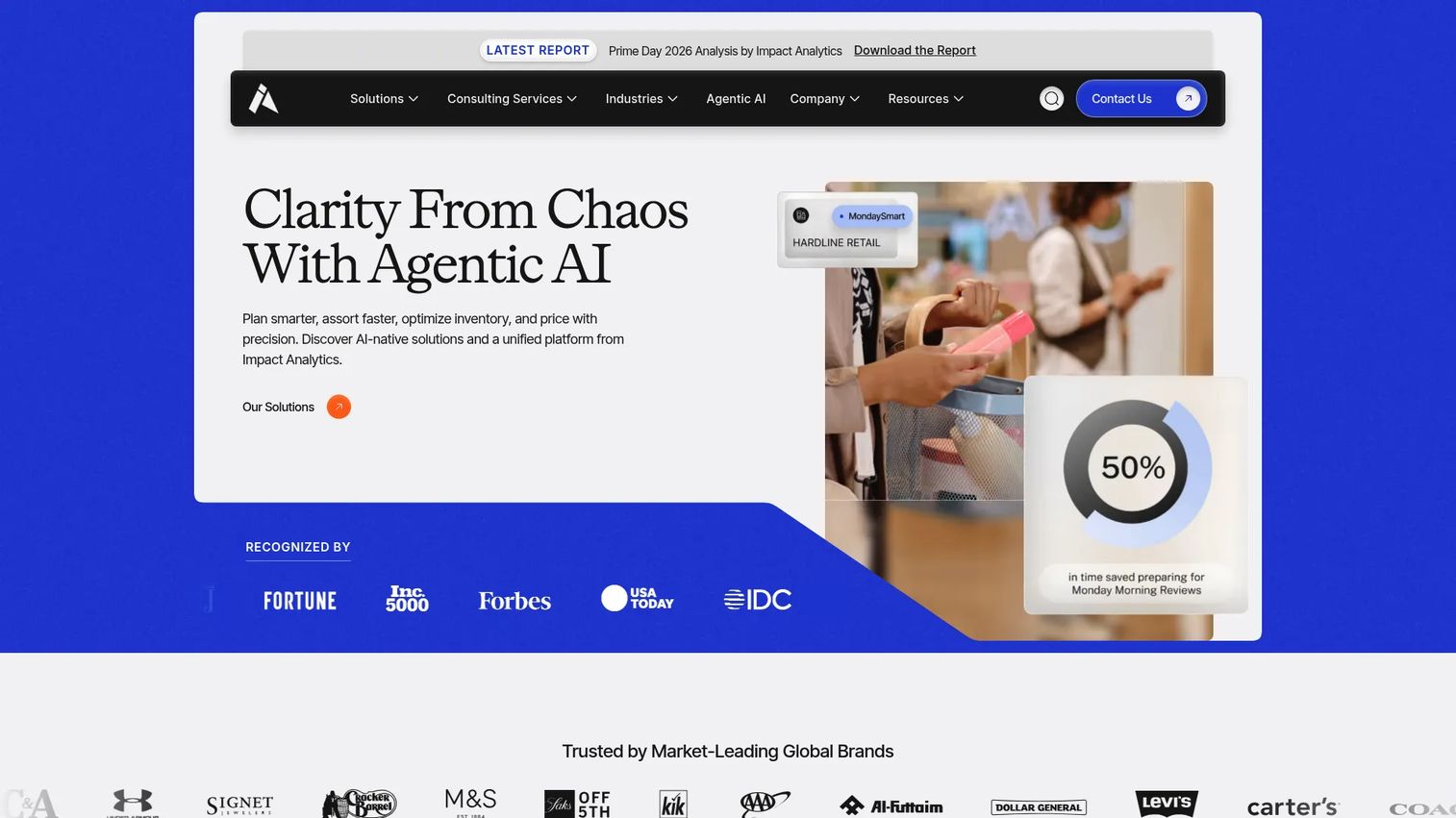
Impact Analytics is AI-native retail analytics software for teams that want data-driven merchandising and assortment decisions with less manual work. It supports AI-driven merchandise planning and optimized open to buy budgets, pulling forecasting and optimization into the core of planning rather than bolting it on afterward. For merchandising teams drowning in manual reconciliation, that is the pitch.
This one leans hard into AI-assisted planning. It is a fit when the job is making faster, better calls on pricing, assortment, and merchandise plans using retail analytics as the backbone.
Best for: Retailers needing AI-driven pricing, planning, and merchandising tools.
Key strengths
- AI-native pricing optimization: Optimize across base price, promotions, and markdowns from one system.
- Merchandise planning and forecasting: Build merchandise plans grounded in retail forecasting.
- Data engineering and retail analytics: Consulting and analytics support to get data clean enough to trust.
Why choose Impact Analytics: Choose it when AI-assisted forecasting and optimization are central to how you want to plan merchandise and assortment. It fits retailers ready to lead with analytics rather than spreadsheets. Impact Analytics holds a 4.5/5 rating on G2.
Impact Analytics pricing: Impact Analytics does not show public pricing; its pricing pages route to contact and demo requests. Pricing is contact-based.
7. DotActiv
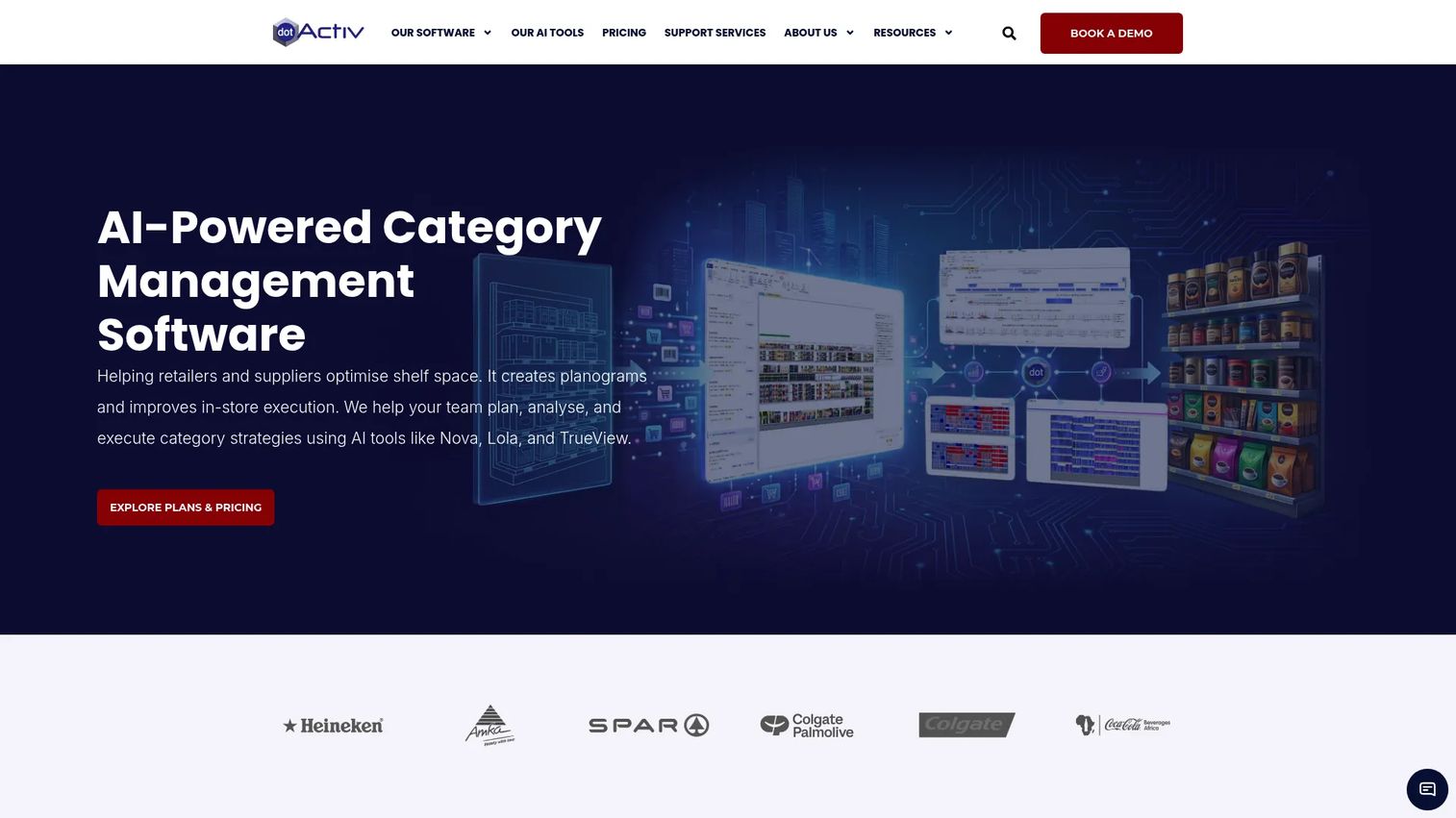
DotActiv is category management software for retailers and suppliers, built for the moment when assortment and merchandising strategy has to become store-ready execution. Its core job is planogram generation, assortment and cluster optimization, and floor planning, so the shelf reflects the strategy. It is also the one tool here with fully public per-license pricing, which makes it easy to scope.
This is the planogram alignment and category management option. When the work is translating a category plan into exact shelf and space decisions, and then reporting on it, DotActiv is purpose-built for that.
Best for: Retail teams and suppliers needing category management and planogram software.
Key strengths
- Planogram generation and reporting: Build planograms and report on compliance and performance.
- Assortment and cluster optimization: Optimize ranging and cluster stores by shared characteristics.
- Floor planning and retail analytics: Connect shelf-level planograms up to floor plans and analytics.
Why choose DotActiv: Choose it when the core job is category management and shelf execution rather than enterprise financial planning. It fits retailers and suppliers who need planogram alignment tied to assortment strategy. DotActiv holds a 4.5/5 rating on G2.
DotActiv pricing: DotActiv publishes annual per-license tiers on its pricing page: a FREE plan at $0/license per year, LITE at $800, PRO at $2,000, ENTERPRISE at $4,500, and ENTERPRISE AI at $7,500, all billed annually per license. Services are priced on request.
How to choose the right store planning software
The seven tools above are not really competing for the same job. They cluster by buyer need, so match the tool to your workflow, not to the longest feature list.
If your work starts in AutoCAD and you need precise store layouts tied to category space, StoreSpace is the natural fit. If you want floor planning fused with assortment, pricing, and inventory in one unified merchandising system, RELEX Solutions is the strongest overall pick.
When the real challenge is orchestration across merchandising, supply, and finance, Board and Anaplan operate at that level, with Board leaning toward a full retail operating model and Anaplan toward configurable, connected planning. If store planning has to sit inside supply chain and replenishment decisions, Blue Yonder is built for that scale.
For teams that want AI-assisted optimization at the center of merchandise and assortment planning, Impact Analytics leads. And when the job is translating strategy into shelf-level planograms and category execution, DotActiv is purpose-built, with the added advantage of transparent public pricing.
The practical next step: shortlist two tools that match your primary workflow, then pressure-test them against your actual data. Ask each vendor to show your categories, your store count, and your sales data inside their system. The right choice is the one that improves execution consistency and productivity metrics like sales per square foot and GMROI, not the one with the most modules.
FAQs
Store planning software helps retailers design store layouts, allocate category space, align planograms, and connect those decisions to sales and inventory data. In plain terms, it turns floor plans and store layouts into performance tools rather than static drawings, so you can see which categories earn their space across one or many stores.
Planogram software focuses on shelf-level merchandising: exactly where each product sits on a fixture. Store planning software usually covers broader space and layout decisions, including macro space allocation, floor plans, and traffic flow. Many retailers use both, with planograms feeding the wider space plan. Some platforms, like DotActiv, combine planogram and floor planning in one tool.
Prioritize planning depth, integration with sales and inventory data, collaboration across teams and locations, reporting, and the ability to scale across stores. For most buyers, sales data integration and inventory alignment are the difference between a nice diagram and a plan you can act on. Reporting and a clear collaboration workflow keep planners and store teams aligned.
Merchandising, store planning, retail operations, category management, and retail leadership all touch it. Space planners build the layouts, merchandisers set category priorities, operations handles execution across locations, and leadership watches outcomes like sales per square foot. That cross-functional reality is exactly why integration and collaboration features matter so much.
Yes, when it is paired with human judgment. AI-assisted planning helps with demand forecasting, space optimization, scenario testing, and exception detection, flagging categories or stores that are off plan. It works best as a way to cut manual reconciliation and surface decisions faster, not as a replacement for merchandising expertise. Tools like Impact Analytics and Anaplan lean heavily into AI-driven planning.
Focus on scale, standardization, workflow governance, and data alignment. You want a plan that copies cleanly across stores while allowing local variation, plus a governance layer so changes roll out consistently. Confirm the tool integrates with your sales, inventory, and merchandising systems, since retail planning and allocation software only delivers value when the underlying data flows cleanly.
The outcomes worth measuring are sales per square foot, GMROI, category productivity, inventory alignment, and execution consistency. A good store planning system connects space decisions to these metrics so you can see whether a layout or planogram change actually moved the number. If a tool cannot tie space to performance, it is a drawing tool, not a planning system.