If reps are still asking the same question in Slack, the problem is not access to content. The problem is that the answer never reached the moment of execution. Spekit alternatives come up when enablement teams realize a single in-context knowledge tool cannot cover every job on the list: Interactive software training, microlearning reinforcement, formal LMS programs, governed content libraries, CRM behavior change, and call coaching each require a different kind of platform.
This guide covers 20 Spekit alternatives across six categories: Interactive guide platform, digital adoption tools, microlearning tools, LMS platforms, sales content and readiness tools, knowledge management tools, and conversation intelligence. Guideflow is the top pick for interactive internal training and software SOPs. The rest of the list routes by job, so you can match the tool to the friction you are trying to fix.
TL;DR
- Best interactive guide platform: Guideflow, for recording software once and sharing interactive step-by-step demos for employee onboarding, internal training, and SOP delivery.
- Best digital adoption picks: WalkMe and Whatfix, for large enterprise teams running in-app guidance programs across complex software stacks.
- Best microlearning picks: Qstream, 7taps Microlearning, TalentCards, and 5Mins.ai, for short reinforcement and mobile-first learning bursts.
- Best sales content enablement picks: Seismic and Highspot, for governed content libraries and enterprise sales asset management.
- Best sales readiness picks: Mindtickle and 360Learning, for certifications, coaching workflows, and collaborative training.
- Best knowledge base picks: Bloomfire, Document360, Google Workspace, and Slack, for searchable internal knowledge and documentation.
- Best conversation intelligence pick: Gong, for coaching from call data and deal execution signals. The list spans 20 tools across categories, with pricing from $0 to quote-based for enterprise.
What's inside
- What Spekit does and why teams evaluate Spekit competitors
- A 20-tool shortlist labeled by category
- A comparison table with G2 ratings, free plan status, and starting prices
- Ranked tool cards with consistent fields across every entry
- Use-case routing by job, including interactive training, digital adoption, microlearning, and coaching
- FAQs for buyers comparing enablement, LMS, DAP, and knowledge tools
What is Spekit?
Spekit is an AI-powered revenue enablement platform that surfaces training, process guidance, and knowledge inside the tools sales teams already use. It sits in the in-context enablement category: Rather than sending reps to a separate portal, Spekit embeds knowledge cards, coaching nudges, and learning paths inside Salesforce, Gmail, Slack, and other daily tools.
Its AI Sidekick delivers contextual answers during active workflows. Governed content management keeps messaging current. Dynamic Learning Paths and knowledge checks support onboarding and ongoing readiness. AI Deal Rooms add buyer engagement analytics on top of the internal enablement layer.
Spekit earns a 4.6/5 on G2. Its strongest fit is teams that want just-in-time knowledge delivery embedded in their existing stack, particularly revenue, RevOps, and GTM teams where CRM adoption and process adherence are ongoing challenges.
Why teams look for Spekit alternatives
Teams look for Spekit alternatives when the enablement job expands beyond in-flow knowledge delivery into interactive process training, microlearning programs, LMS administration, content governance, CRM behavior change, or call-based coaching.
Reps need to practice the workflow, not just read the answer
A knowledge card can surface the right information at the right moment. For multi-step software workflows, reading an answer is not the same as clicking through the process. CRM hygiene checklists, quoting sequences, and onboarding flows in a new tool all benefit from interactive practice, where the rep executes each step rather than consuming a written explanation. G2 reviewers of in-context tools periodically note that static cards work for quick lookups but do not replace hands-on process learning.
Enablement jobs do not share a single platform
"Training" means different things to a new hire, a sales manager, and a RevOps analyst. Formal onboarding paths need an LMS. Skill reinforcement needs microlearning. Sales content governance needs a content enablement platform. Call coaching needs conversation intelligence. When a team's enablement scope grows, a single tool rarely covers all four.
Content governance becomes harder at scale
Spekit's pricing page lists per-seat, quoted packages. As teams scale to dozens of reps, stale battlecards and duplicated SOPs multiply. G2 reviewers on broader enablement platforms note that governance features, including versioning, ownership assignment, and expiration dates, become critical once the content library exceeds a few dozen assets.
Leaders need proof that training changes behavior
Completion rates measure activity. Win rate changes, stage conversion, and ramp time measure outcomes. According to WalkMe's 2025 research, enterprises lost over $104 million in 2024 to underused technology and poor productivity practices. That figure frames the stakes: Tool adoption without behavioral change is expensive. Teams evaluating alternatives often want platforms that connect training completion to measurable workflow adherence.
How we picked these Spekit alternatives
Each tool was selected for its fit with sales enablement and internal training workflows, its distinct category coverage, and its relevance to Spekit buyers comparing across the market. Pricing was drawn from each vendor's own pricing page. Ratings come from G2. The list includes tools from multiple adjacent categories because Spekit buyers regularly compare across digital adoption, LMS, microlearning, content enablement, and knowledge management before making a decision. Every entry carries a category label so the distinction between a direct swap and a different kind of tool stays visible.
Spekit alternatives at a glance
Guideflow leads the list as the interactive guide platform for internal software training. The remaining 19 tools span digital adoption, microlearning, LMS, sales content enablement, knowledge management, and conversation intelligence. Use the Category column to separate a like-for-like in-context knowledge swap from a different category of tool entirely.
| # | Tool | Category | Best for | G2 rating | Free plan | Starting price |
|---|---|---|---|---|---|---|
| 1 | Guideflow | Interactive guide platform | Internal software training, SOPs, and onboarding | 5.0/5 | Yes | Free; Solo $35/user/month (annual) |
| 2 | WalkMe | Digital adoption platform | Enterprise in-app guidance and software adoption | 4.6/5 | No | Quote-based |
| 3 | Whatfix | Digital adoption platform | In-app onboarding, self-help, and adoption analytics | 4.6/5 | No | Quote-based |
| 4 | Qstream | Microlearning and sales coaching | Knowledge reinforcement and manager coaching | 4.5/5 | No | Quote-based |
| 5 | iSpring LMS | LMS | Structured employee training and course creation | 4.6/5 | No | From $3.97/user/month (annual) |
| 6 | 7taps Microlearning | Microlearning | Mobile-first short-lesson delivery | 4.8/5 | Yes | Free; paid plans contact sales |
| 7 | TalentCards | Mobile learning | Deskless and distributed team training | 4.8/5 | Yes | Free; Standard $50/month |
| 8 | 5Mins.ai | AI learning platform | Short-form learning and AI-driven training recommendations | 4.6/5 | No | From £200/month (annual) |
| 9 | Thinkific | Course platform | Course-based internal or partner training programs | 4.4/5 | No | From $82/month (annual) |
| 10 | Seismic | Sales enablement platform | Enterprise sales content and buyer engagement | 4.7/5 | No | Quote-based |
| 11 | Highspot | Sales enablement platform | Sales content governance and guided selling | 4.7/5 | No | Quote-based |
| 12 | Mindtickle | Sales readiness platform | Certification, coaching, and readiness programs | 4.7/5 | No | From $15/user (G2-reported) |
| 13 | Supered | Revenue enablement and CRM guidance | Salesforce and HubSpot process adoption | 4.9/5 | No | From $13.50/user/month (annual) |
| 14 | Gong | Conversation intelligence | Call coaching and deal execution signals | 4.7/5 | No | Quote-based |
| 15 | 360Learning | Collaborative LMS | Peer-led learning and collaborative training | 4.6/5 | No | From $8/user/month (up to 100 users) |
| 16 | Bloomfire | Knowledge management | Searchable internal knowledge base | 4.6/5 | No | Quote-based |
| 17 | Document360 | Knowledge base software | SOP documentation and internal knowledge bases | 4.7/5 | No | Quote-based |
| 18 | ClickLearn | Digital adoption and documentation | Enterprise system documentation and training | 5.0/5 | No | Quote-based |
| 19 | Google Workspace | Productivity and knowledge tools | Basic docs, drives, and internal collaboration | 4.6/5 | No | From $7/user/month (annual) |
| 20 | Slack | Team messaging and knowledge sharing | Fast internal Q&A and enablement broadcasts | 4.5/5 | Yes | Free; Pro $7.25/user/month (annual) |
The best Spekit alternatives in 2026
1. Guideflow (interactive guide platform)
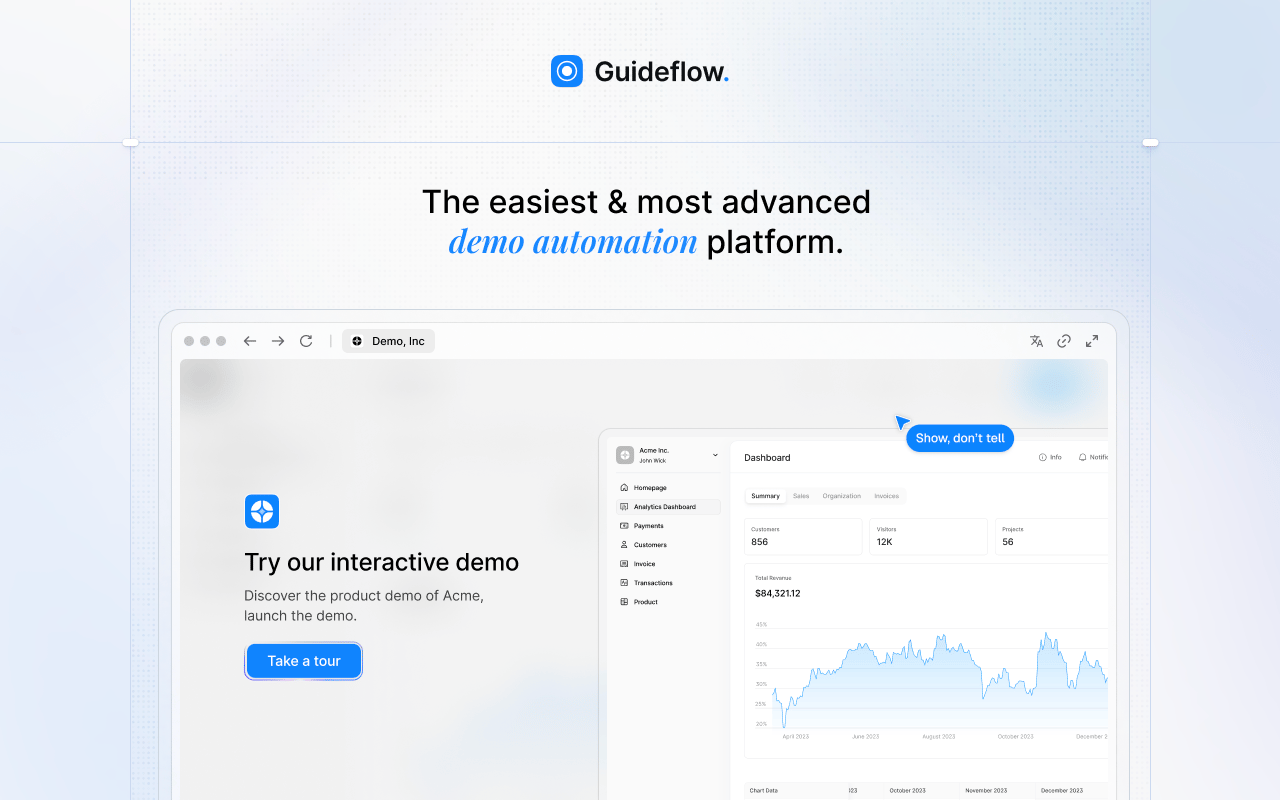
Guideflow is a demo automation platform that enablement teams use internally to turn software workflows into interactive, clickable demos. Record a process once through the Chrome extension or the native app, and the resulting interactive demo lets a rep click through each step on their own schedule, at their own pace. More than 500,000 guideflows have been created, and a first demo takes about two and a half minutes to build.
Best for: Sales enablement teams whose primary training problem is showing reps how to execute a software workflow, such as a CRM update sequence, a quoting process, or a tool handoff.
What it is: Guideflow is a demo automation platform. Its interactive demos are used by GTM and enablement teams for external buyer-facing delivery and for internal training, onboarding, and SOP documentation. For the internal use case, the demo functions as a clickable software guide rather than a static document.
Key features:
- Capture through the Chrome extension or native app, with screenshot, HTML, and video capture modes
- Editor supports text, images, graphs, and branching paths
- Step content and CTAs written automatically after capture
- Step-level completion, drop-off, and viewer flow analytics
- Integrations with HubSpot, Salesforce, Pipedrive, Zoho, and Marketo for identified viewer records
Where Guideflow falls short:
- Look elsewhere if the primary need is a formal LMS with SCORM administration, compliance training records, and course catalogs. Guideflow is not an LMS.
- Look elsewhere if the team only needs to store static documentation without any interactive practice component.
Pricing: Free plan available. Solo from $35 per user per month (annual). Growth $499 per month (annual). Advanced $1,499 per month (annual). Enterprise from $2,999 per month, adding SSO, advanced governance, and enterprise security.
G2 rating: 5.0/5
How it compares to Spekit: Spekit delivers knowledge cards inside the tools reps already use. Guideflow goes further for workflow training by letting reps click through the actual software process rather than reading about it.
Start your journey with Guideflow today!
2. WalkMe (digital adoption platform)
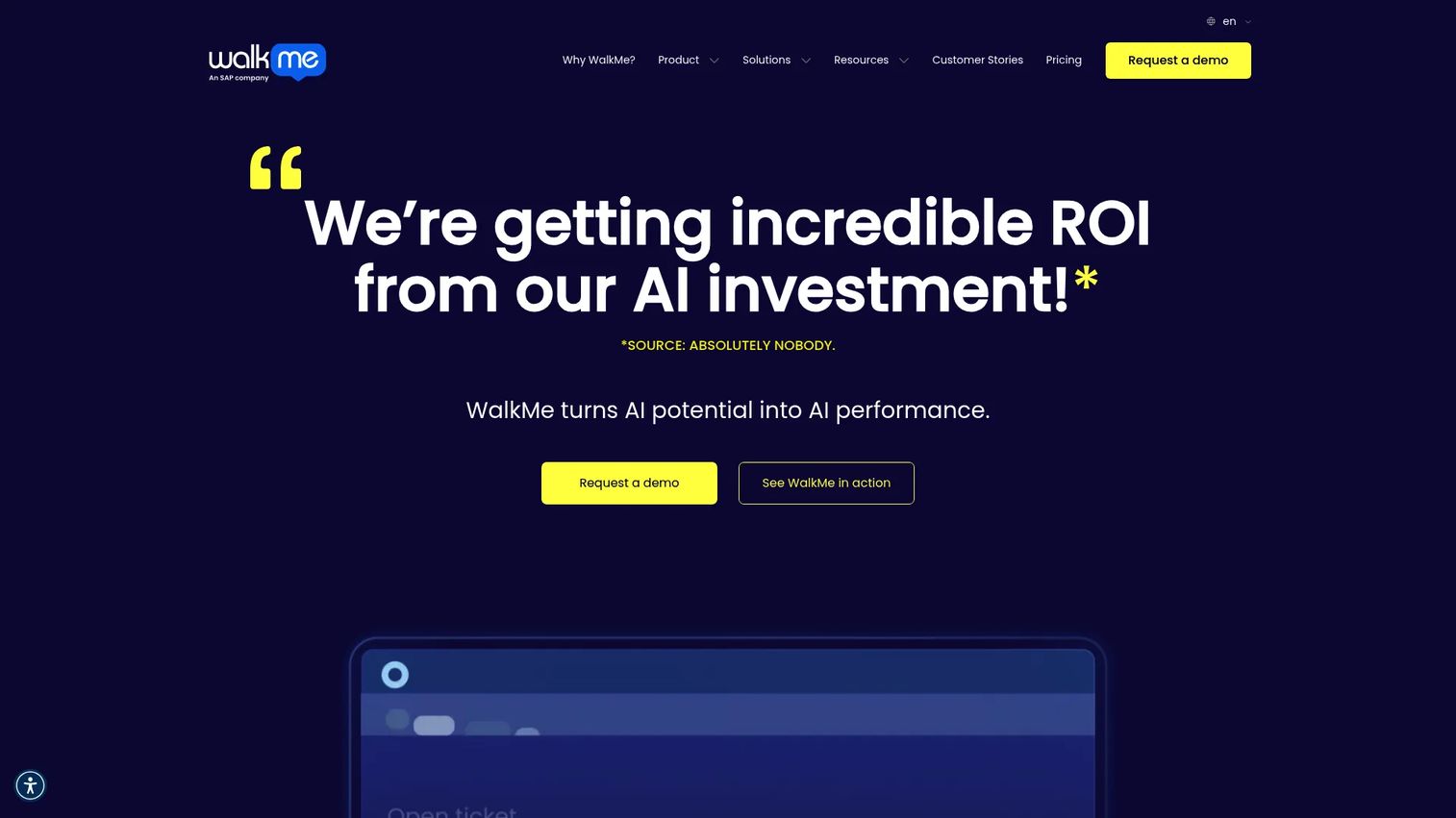
WalkMe is the market's most established digital adoption platform. It operates at the enterprise scale where software rollouts, change management programs, and IT-led adoption initiatives require a dedicated layer on top of the application.
Best for: Enterprise organizations running large-scale software adoption programs across complex application environments, including CRM, ERP, and internal tools.
What it is: WalkMe is a digital adoption platform that provides in-app step-by-step guidance, tooltips, workflow automation, behavioral analytics, and contextual AI assistance across web, desktop, and mobile applications. It is built for organizations where software underuse is a measurable cost. G2 rates it 4.6/5.
Key features:
- In-app guidance, tooltips, notifications, and onboarding task lists
- Flow Analytics, behavioral segmentation, and custom dashboards
- Contextual AI assistance including Pinned AI and On-Demand AI
- WalkMe Menu with enterprise search, onboarding, and AI Chat
- Surveys, localization, theming, and ActionBot
Where WalkMe falls short:
- G2 reviewers report that implementation complexity and time-to-value are significant for smaller teams without dedicated IT resources.
- Pricing is enterprise-only and quote-based, which creates friction for teams wanting to evaluate cost quickly.
- G2 reviewers note that content maintenance, particularly keeping guidance steps current with application updates, requires ongoing effort.
Pricing: Quote-based.
G2 rating: 4.6/5
How it compares to Spekit: WalkMe focuses on guiding users inside applications through the execution layer. Spekit focuses on surfacing knowledge and coaching. Teams choosing WalkMe are typically running an IT-led adoption program, not an enablement content strategy.
3. Whatfix (digital adoption platform)
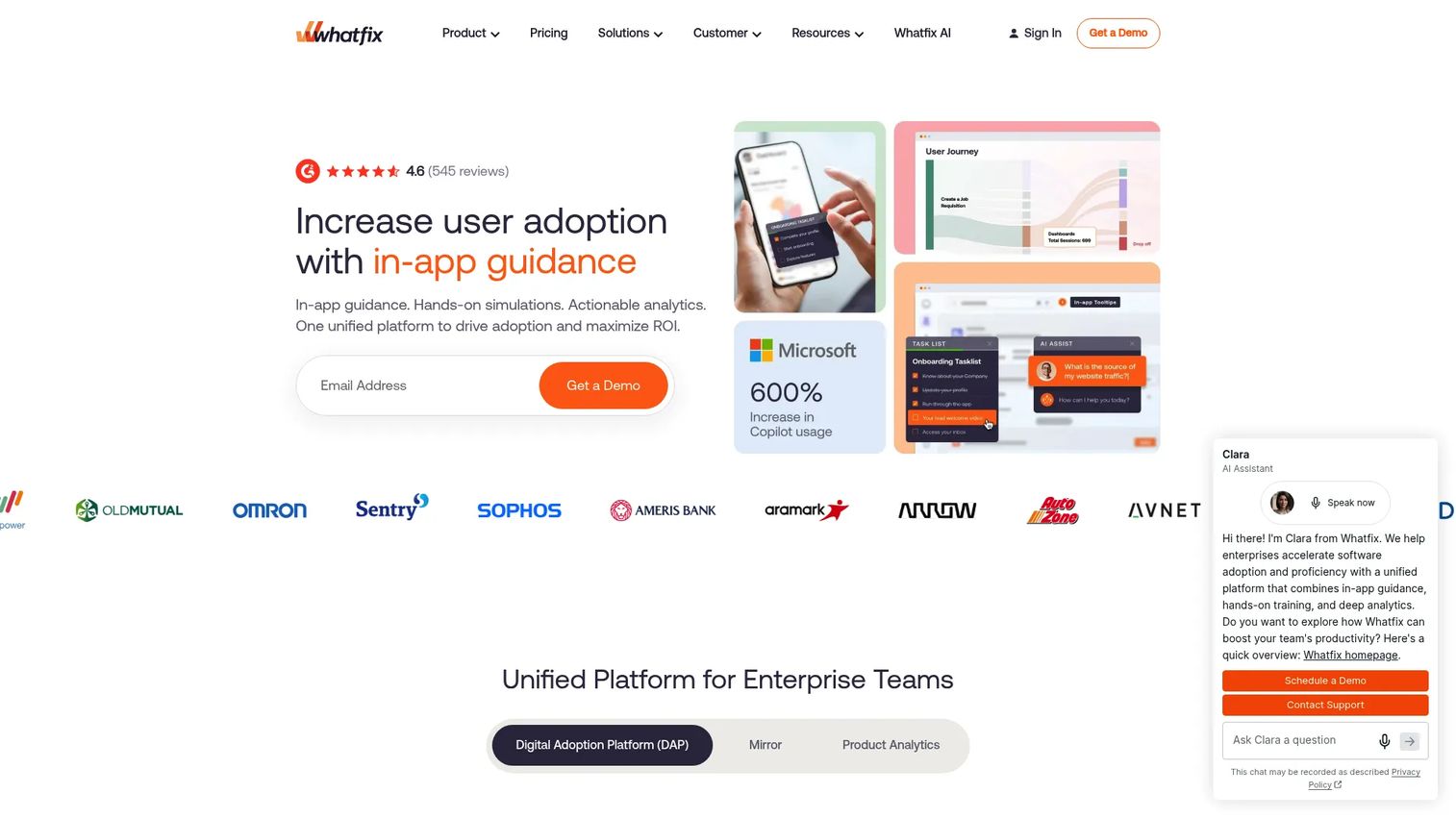
Whatfix takes the same in-app guidance category as WalkMe and applies it across enterprise applications including web, desktop, mobile, and Citrix environments.
Best for: Enterprise teams needing in-app support, onboarding, self-help, and analytics across multiple business applications, particularly where process compliance is a training goal.
What it is: Whatfix is an AI-powered digital adoption platform providing in-app flows, smart tips, pop-ups, task lists, self-help content, and application simulations. Its AI-assisted authoring tools and analytics suite support both guided onboarding and self-serve troubleshooting. G2 rates it 4.6/5.
Key features:
- In-app Flows, Smart Tips, Pop-Ups, and Task Lists
- Self-help and content aggregation
- Application simulations and AI roleplay
- Guidance and product analytics
- Cross-application support across web, desktop, mobile, and Citrix
Where Whatfix falls short:
- G2 reviewers flag that content creation for complex multi-step flows takes meaningful time to build and maintain.
- Pricing is flat-per-application plus user license fees, with no public starting price, making budget estimation difficult before a sales conversation.
- G2 reviewers note that the analytics dashboard, while comprehensive, has a learning curve for teams new to DAP reporting.
Pricing: Flat per-application fee plus user license fees. Standard, Premium, and Enterprise tiers, all quoted. A free trial is offered.
G2 rating: 4.6/5
How it compares to Spekit: Whatfix is a DAP, not an in-context knowledge tool. The comparison point is whether the buyer needs guidance embedded inside the application UI itself or knowledge cards surfaced on demand.
4. Qstream (microlearning and sales coaching)
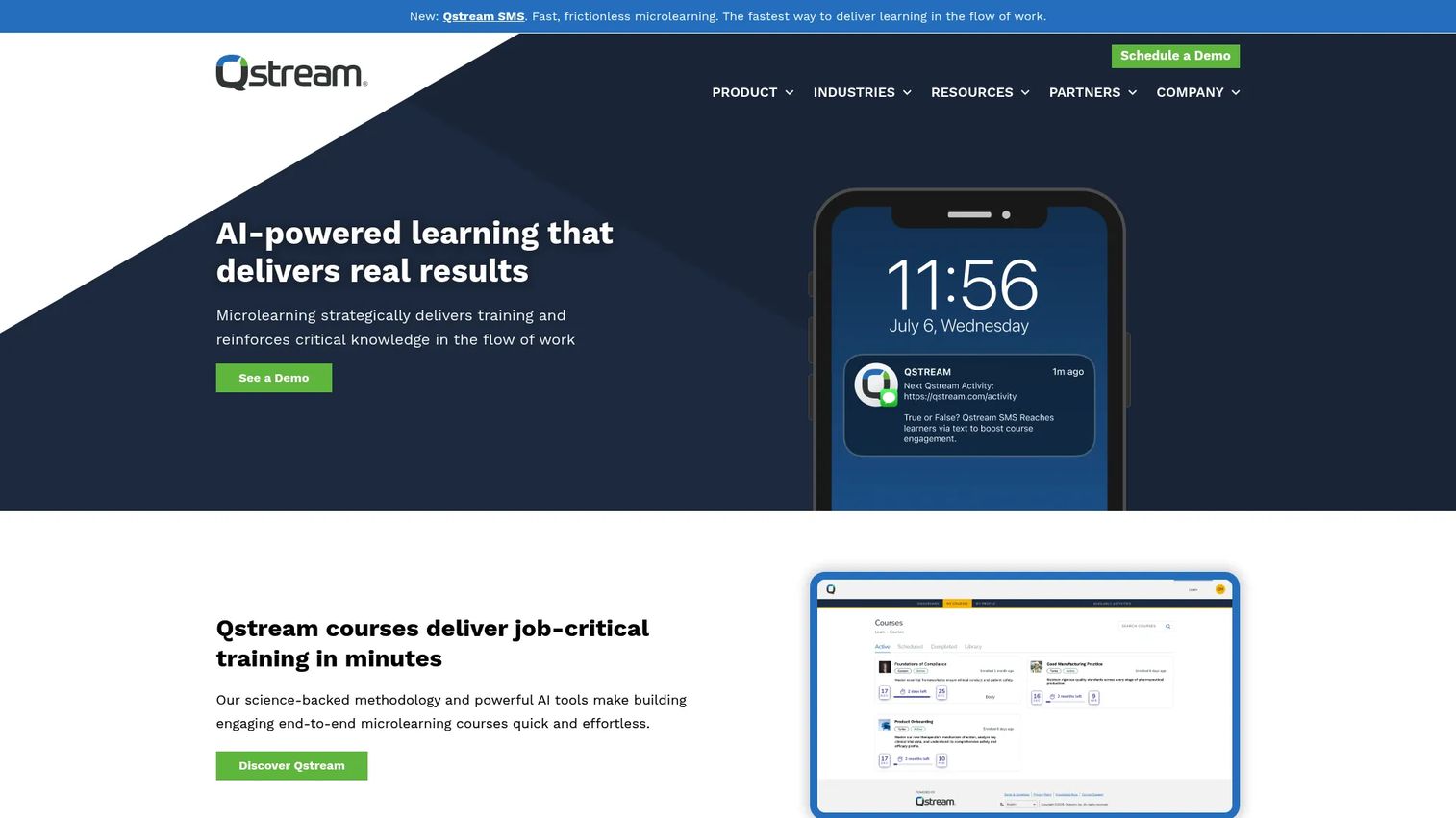
Qstream targets the specific problem of knowledge decay. Sales teams learn something in onboarding, and by week six it has faded. Qstream's spaced repetition model pushes short scenarios to reps over time to reinforce what sticks.
Best for: Knowledge-critical sales teams that need ongoing reinforcement of product knowledge, objection handling, and methodology adherence alongside manager coaching dashboards.
What it is: Qstream is an AI-powered microlearning and knowledge-reinforcement platform combining spaced learning, scenario-based testing, performance analytics, and manager coaching dashboards. It is designed for organizations where knowing the material is as important as knowing where to find it. G2 rates it 4.5/5.
Key features:
- Spaced learning and repetition
- Scenario-based testing and AI content generation
- Performance-readiness analytics
- Manager coaching dashboards
- Leaderboards and recognition
Where Qstream falls short:
- Qstream focuses on knowledge reinforcement and does not cover content governance, sales asset management, or conversation intelligence.
- G2 reviewers note that the platform excels at reinforcement but is not built for formal course delivery or compliance training.
Pricing: Quote-based.
G2 rating: 4.5/5
How it compares to Spekit: Spekit surfaces knowledge in the moment of need. Qstream reinforces knowledge over time through repeated practice. Teams that want retention, not just retrieval, find Qstream a better fit for the reinforcement job.
5. iSpring LMS (LMS)
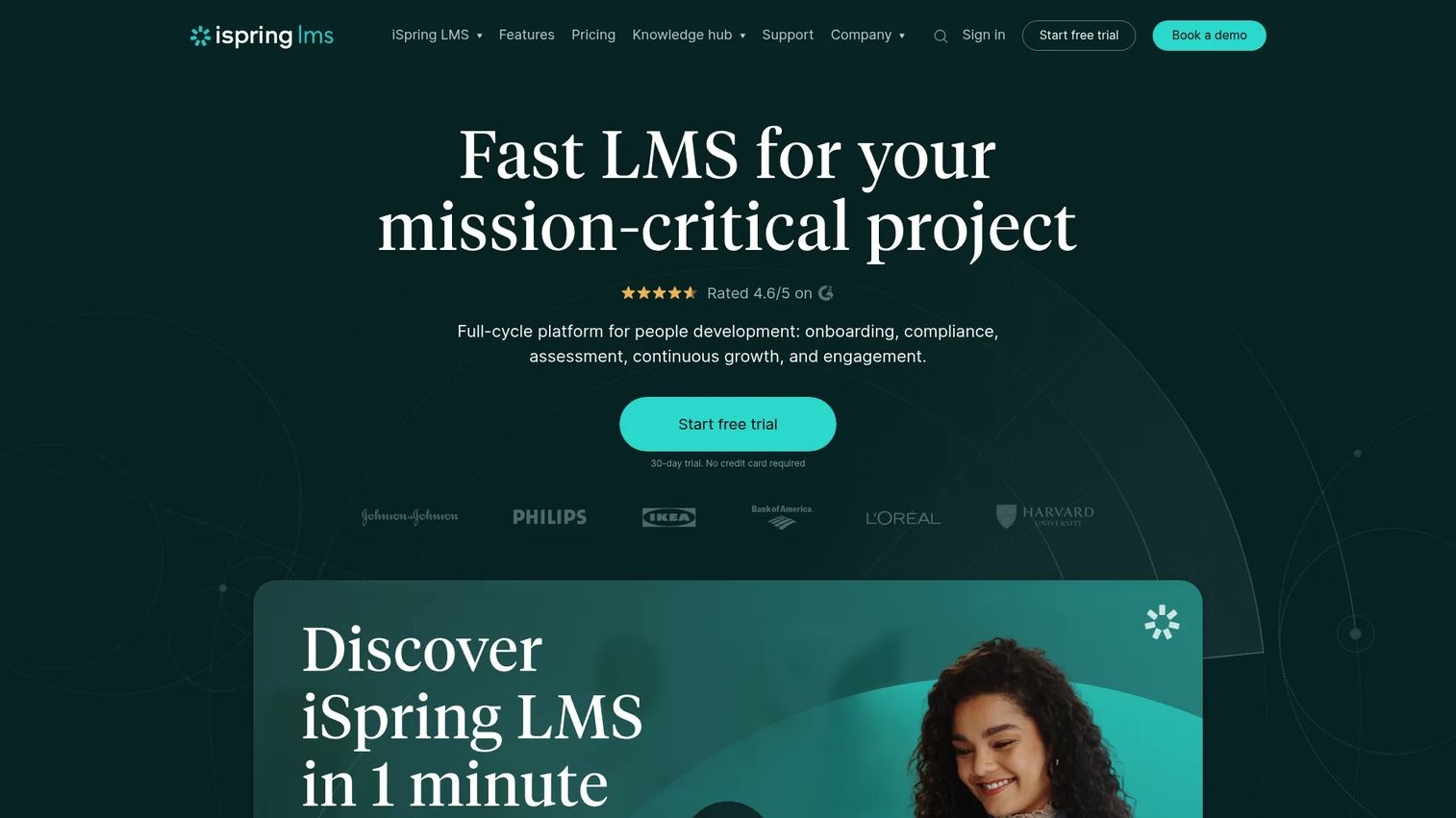
When a team needs structured courses, SCORM compatibility, learning tracks, and compliance records, iSpring LMS provides the administrative infrastructure that in-context tools are not designed to handle.
Best for: Organizations building structured employee training programs with formal courses, assessments, certifications, and training administration.
What it is: iSpring LMS is a full-featured corporate learning management system for onboarding, compliance, assessment, and employee development. It supports SCORM 1.2 and 2004, AI-assisted course creation, gamification, 360-degree performance reviews, and native mobile apps for offline learning. G2 rates it 4.6/5.
Key features:
- SCORM 1.2 and 2004 support with broad file-format compatibility
- AI-assisted course creation, quizzes, and translations
- Personalized learning tracks and onboarding checklists
- Real-time reporting and analytics
- Native iOS and Android apps with offline learning
Where iSpring LMS falls short:
- G2 reviewers note that the authoring environment, while capable, has a steeper learning curve compared to simpler course tools for teams without instructional design experience.
- Enterprise pricing is not publicly listed, requiring a sales conversation for larger team configurations.
- G2 reviewers flag that the UI feels less modern than newer LMS platforms, which can affect adoption for younger workforces.
Pricing: Business plans start at $3.97 per user per month for 500 users (annual). Smaller cohorts run higher per-user rates: 100 users at $6.91 per user per month (annual). Enterprise pricing requires contacting iSpring. A 30-day free trial is available.
G2 rating: 4.6/5
How it compares to Spekit: iSpring LMS handles formal structured learning that Spekit does not. If the team needs completion records, SCORM imports, and certification management, iSpring LMS covers what Spekit leaves out.
6. 7taps Microlearning (microlearning)
7taps is built for the moment after a training session, the product launch update that needs to reach 200 reps by Friday, or the refresher that runs in three minutes on a phone.
Best for: Teams that need to push short, mobile-first lessons quickly, without building a formal course or waiting for LMS administration.
What it is: 7taps is a learning delivery platform for creating and distributing short, phone-first microlearning courses. It includes interactive cards with quizzes, polls, role plays, and checklists, distributable via link, QR code, Slack, Microsoft Teams, or SMS. G2 rates it 4.8/5.
Key features:
- AI-powered course creation from prompts or uploaded documents
- Interactive cards including quizzes, polls, role plays, and checklists
- Distribution through links, QR codes, Slack, Teams, SMS, and WhatsApp
- Learning paths with scheduled or completion-based delivery
- SCORM/xAPI export and HRMS integration
Where 7taps falls short:
- G2 reviewers note that Starter and Enterprise paid plans require contacting sales, which adds friction for teams wanting to evaluate cost before a sales conversation.
- 7taps is focused on delivery, not content governance, asset management, or behavioral coaching.
- G2 reviewers flag that reporting is lighter than a full LMS for teams needing deep completion analytics across large learner populations.
Pricing: Free plan available. Starter and Enterprise plans require contacting sales for pricing.
G2 rating: 4.8/5
How it compares to Spekit: Spekit surfaces process knowledge in workflows. 7taps pushes structured short lessons on demand. Teams combine them when the in-flow knowledge card handles the lookup and 7taps handles the reinforcement cycle.
7. TalentCards (mobile learning)
TalentCards targets the rep who is not at a desk. Field sales, frontline workers, and distributed teams often skip learning portals because they require a laptop and a login. TalentCards puts flashcard-based training on the phone.
Best for: Deskless, field, or distributed teams that need mobile, offline-capable training without requiring reps to access a desktop LMS.
What it is: TalentCards is a mobile-first microlearning platform for bite-sized training delivered through flashcards with text, images, audio, video, and quizzes. It includes QR code course access, offline learning, spaced repetition, and AI course creation. G2 rates it 4.8/5.
Key features:
- Flashcard-based microlearning with text, images, audio, video, and quizzes
- AI course creation and AI-graded short-answer quizzes
- Spaced repetition
- QR-code course access and offline learner access
- Gamification, analytics, and reporting
Where TalentCards falls short:
- The free plan supports up to 5 users, which limits evaluation at team scale without a paid plan.
- TalentCards is a mobile training delivery tool, not a content enablement platform, sales coaching tool, or governance system.
- G2 reviewers note that the content editor is designed for simple card formats and does not support complex branching scenarios.
Pricing: Free plan for up to 5 users. Standard plan $50/month for 50 users, $1 per additional user. Premium plan $75/month for 50 users, $1.50 per additional user. Annual billing saves 20%.
G2 rating: 4.8/5
How it compares to Spekit: Spekit works inside desktop tools and CRM environments. TalentCards reaches the rep who is on the road. For frontline or field teams where Spekit's web-based embedding does not fit the workflow, TalentCards handles the mobile training layer.
8. 5Mins.ai (AI learning platform)
5Mins.ai applies a TikTok-style content feed to employee learning. Rather than assigning a course and hoping for completion, it surfaces short AI-recommended lessons in a feed reps actually open.
Best for: Organizations building a learning culture through short, AI-curated content rather than formal course programs, particularly for compliance, leadership, and skills development.
What it is: 5Mins.ai is an AI-powered employee learning platform combining an LMS and LXP with AI course creation, a short-lesson feed, AI roleplays, skills mapping, and HRIS integrations. Its Essentials, Advanced, and Accelerate plans add progressively deeper content libraries and AI capabilities. G2 rates it 4.6/5.
Key features:
- AI Course Creator that converts documents into training courses
- TikTok-style microlesson feed with gamification
- AI Roleplays and Hugo AI Assistant
- Skills mapping, gap analysis, and personalized recommendations
- Automated enrollment, reminders, and HRIS integrations
Where 5Mins.ai falls short:
- Pricing is in GBP, starting at £200 per month (annual), which introduces currency friction for US-based buyers expecting USD pricing.
- A free tier is not available; a free trial is offered, but teams need to engage sales to access it.
- G2 reviewers note that the content library skews toward general professional development and may not cover highly specific sales methodology or product knowledge without custom content creation.
Pricing: Essentials from £200/month (annual). Advanced £250/month (annual). Accelerate £350/month (annual). No free plan.
G2 rating: 4.6/5
How it compares to Spekit: Spekit delivers point-in-time knowledge inside workflows. 5Mins.ai builds learning habits through daily content consumption. Teams looking to shift from lookup-based to habit-based learning find 5Mins.ai addresses a different motivational problem.
9. Thinkific (course platform)

Thinkific started as an external course-selling platform and extended into internal learning. For teams building partner academies or external customer education programs, it covers what an internal-only LMS does not.
Best for: Teams building structured course programs for partners, customers, or internal audiences where course monetization, community features, or branded academies are part of the scope.
What it is: Thinkific is an online learning commerce platform for creating, selling, and managing courses, communities, and digital learning products. Its Start, Grow, and Expand plans support course building, subscriptions, bundling, and community spaces. G2 rates it 4.4/5.
Key features:
- Drag-and-drop course builder
- Communities with discussions, events, and spaces
- Built-in commerce with subscriptions, bundles, and payment plans
Where Thinkific falls short:
- Thinkific's core design is for selling or distributing courses, not governing sales content assets, coaching reps on live calls, or delivering in-workflow knowledge.
- G2 reviewers note that SCORM import and advanced compliance reporting are limited compared to dedicated corporate LMS platforms.
- No free plan is available; the entry Start plan begins at $82/month (annual).
Pricing: Start $82/month (annual). Grow $164/month (annual). Expand $374/month (annual). Thinkific Plus is custom-priced.
G2 rating: 4.4/5
How it compares to Spekit: Thinkific handles course-based program delivery, particularly for external audiences. Spekit handles internal in-workflow knowledge. These serve different training scenarios and are more often complementary than competitive.
10. Seismic (sales enablement platform)
Seismic is the enterprise standard for sales content governance. When the problem is pitch decks that live in 14 different Drives, battlecards that reps cannot find, and no way to know which assets influenced a won deal, Seismic is the category answer.
Best for: Enterprise revenue organizations that need a governed library for sales content, buyer engagement tools including digital sales rooms, and analytics on which assets drive pipeline.
What it is: Seismic is an AI-powered sales enablement platform for content management, learning, coaching, buyer engagement, and enablement analytics. It covers asset discovery, personalization, digital sales rooms, and program management for large revenue teams. G2 rates it 4.7/5.
Key features:
- Sales content management and AI-powered content discovery
- Learning, onboarding, and coaching
- Buyer engagement including Digital Sales Rooms
- Enablement strategy and program analytics
- Integrations with CRM, email, collaboration, and content-authoring tools
Where Seismic falls short:
- Pricing is entirely quote-based with no public figures, which delays budget planning for teams early in their evaluation.
- G2 reviewers note that the platform's depth comes with implementation complexity; onboarding Seismic for a large team requires dedicated project time.
- G2 reviewers flag that the content authoring experience inside Seismic is better suited to asset management than to building interactive software training.
Pricing: Quote-based. Standard, Partner, and Viewer license types are described on Seismic's product pages; no monetary pricing is published.
G2 rating: 4.7/5
How it compares to Spekit: Spekit focuses on surfacing knowledge in context. Seismic focuses on governing, delivering, and measuring sales assets at scale. Teams choosing Seismic have typically outgrown informal content management and need a system of record for sales collateral.
11. Highspot (sales enablement platform)
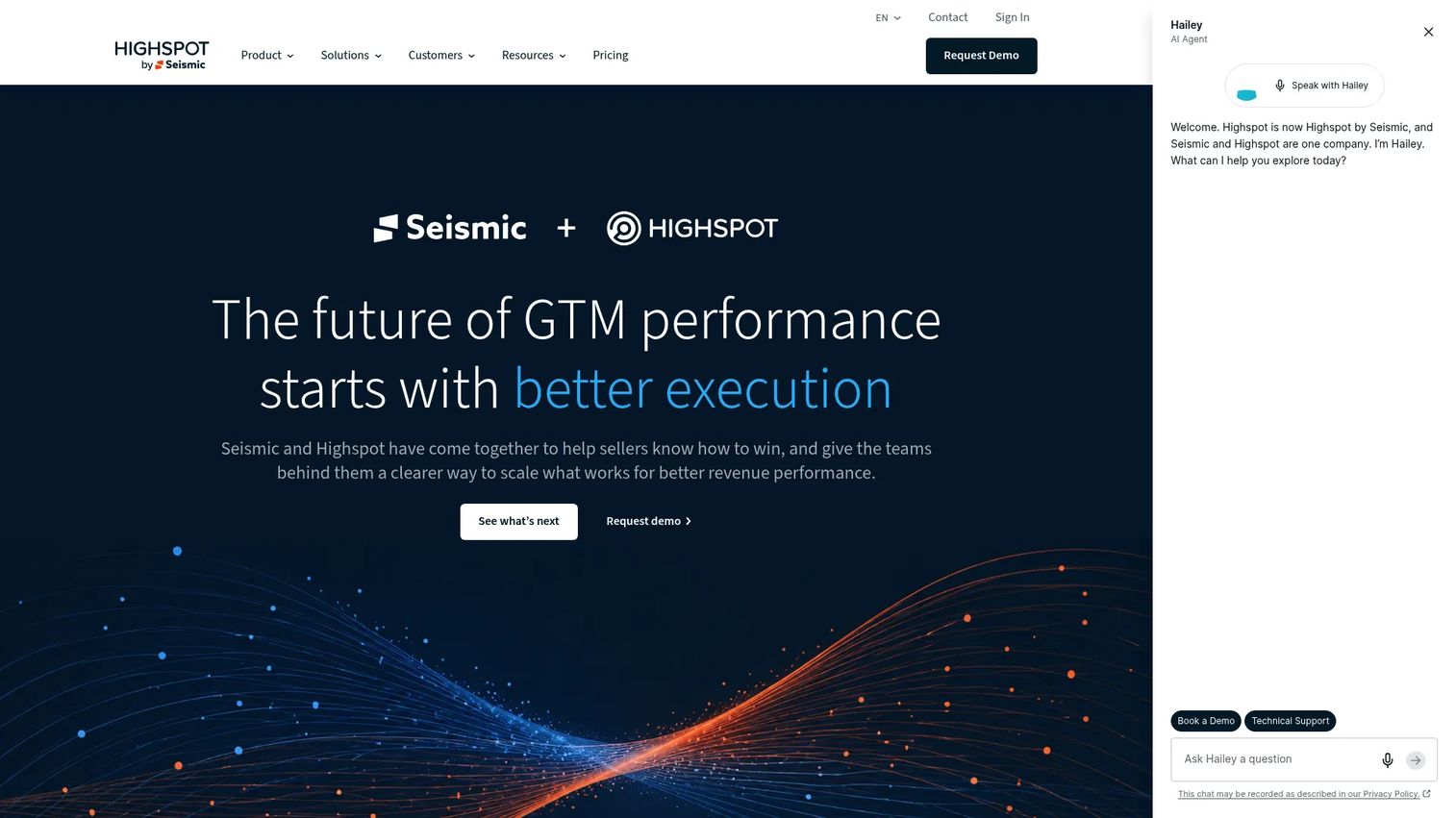
Highspot, now branded as Highspot by Seismic, competes directly with Seismic for the enterprise sales enablement category. Its core differentiation has been AI-powered content search, guided selling plays, and rep adoption analytics.
Best for: Enterprise go-to-market teams that need unified sales content, training, deal guidance, and performance analytics in a single platform with strong rep adoption design.
What it is: Highspot is an AI-powered go-to-market platform for sales enablement, training, deal guidance, coaching, and revenue analytics. Its three plan tiers cover content and engagement, training and practice, and coaching and reinforcement. G2 rates it 4.7/5.
Key features:
- AI-supported content organization, search, and recommendations
- Sales Plays and Digital Sales Rooms
- Training, adaptive learning, Role Play, and AI feedback
- Deal guidance and coaching
- GTM analytics
Where Highspot falls short:
- Pricing is contact-only across all three plan tiers, making early-stage cost comparison impossible without a sales conversation.
- G2 reviewers note that content uploads and metadata management require ongoing administration as the library scales.
- G2 reviewers flag that integrating Highspot with less common CRM and marketing platforms outside the core Salesforce and HubSpot ecosystem can require custom configuration.
Pricing: Equip and engage, Train and practice, and Coach and reinforce tiers, all contact-only.
G2 rating: 4.7/5
How it compares to Spekit: Highspot replaces scattered content and informal playbooks with a governed, analytics-backed enablement system. Spekit surfaces answers in context. Teams upgrading from Spekit to Highspot are typically growing their content library and need asset governance alongside in-flow delivery.
12. Mindtickle (sales readiness platform)
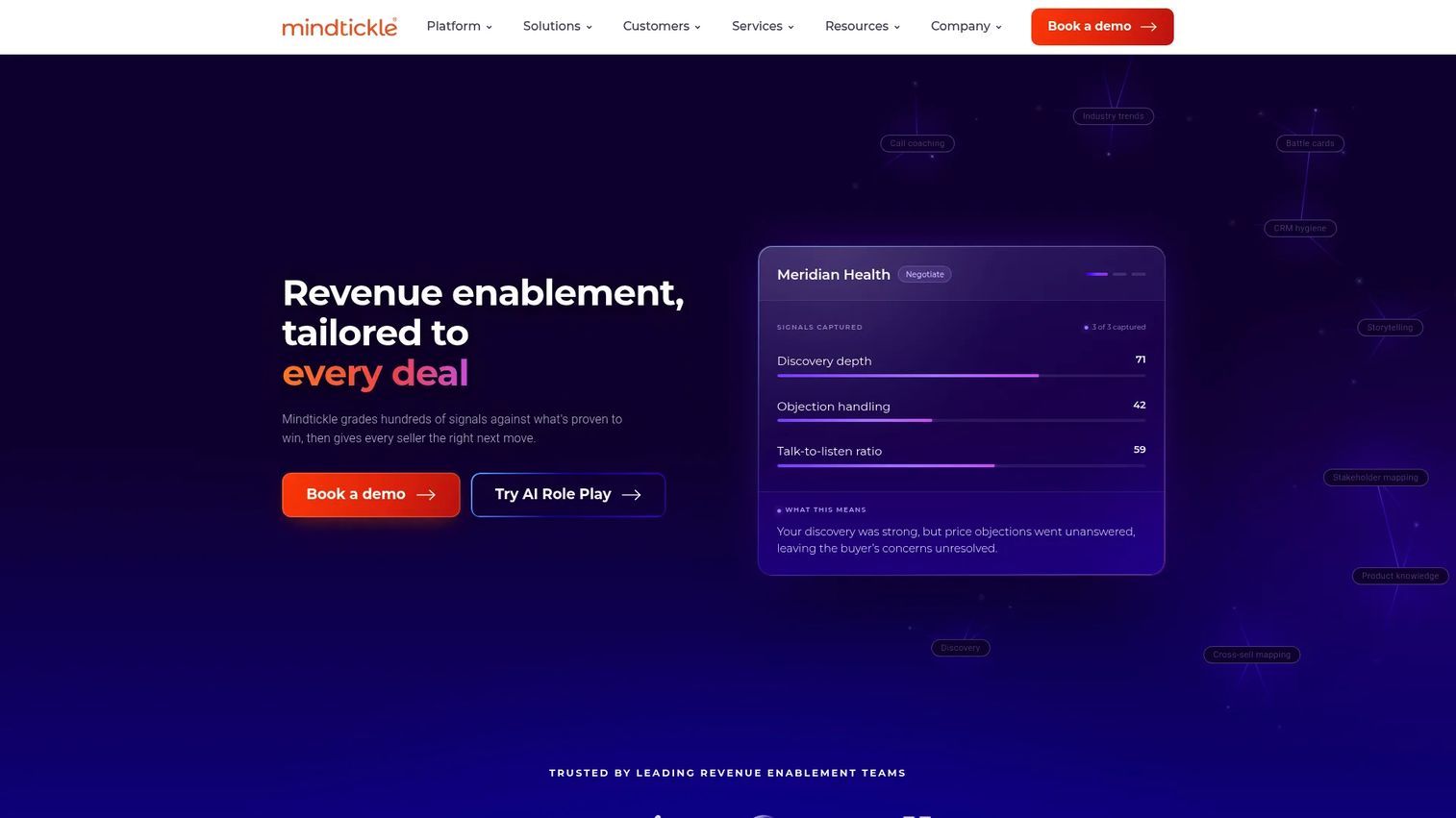
Mindtickle addresses the gap between training completion and behavioral readiness. A rep can complete an onboarding program and still score poorly on a mock call. Mindtickle connects formal training to AI role play, manager coaching, and a readiness score.
Best for: Enterprise and mid-market revenue teams that need structured onboarding, role play practice, skill certifications, manager coaching workflows, and readiness scoring alongside conversation intelligence.
What it is: Mindtickle is an AI-powered revenue enablement platform combining sales training, content management, digital sales rooms, coaching, and conversation intelligence into a readiness-focused system. G2 rates it 4.7/5.
Key features:
- AI role play and scenario practice
- Sales training and onboarding paths
- Sales content management and digital sales rooms
- Coaching workflows and conversation intelligence
- Readiness Index scoring
Where Mindtickle falls short:
- First-party pricing is not publicly displayed; the G2-reported Basic price of $15 per user is the only public data point, and enterprise pricing requires a sales conversation.
- G2 reviewers report that the platform's breadth can feel overwhelming for smaller enablement teams without dedicated program management capacity.
- G2 reviewers note that the conversation intelligence module is less mature than standalone conversation intelligence platforms like Gong.
Pricing: G2 reports a Basic price of $15 per user.
G2 rating: 4.7/5
How it compares to Spekit: Spekit delivers knowledge in flow. Mindtickle builds and measures rep readiness through structured programs, practice, and coaching. Teams comparing the two are typically asking whether the core problem is knowledge access or behavioral change.
13. Supered (revenue enablement and CRM guidance)
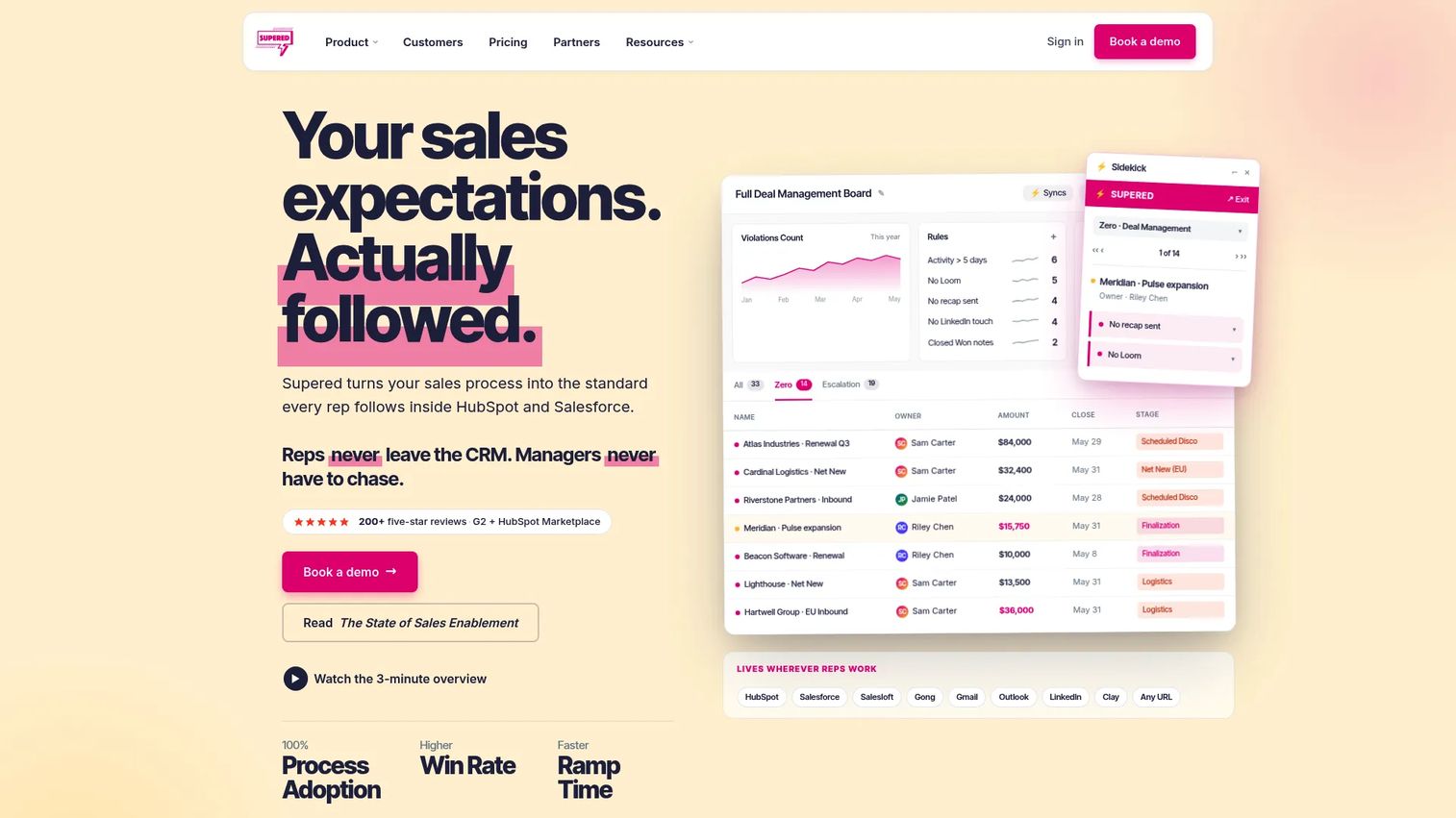
Supered lives inside HubSpot and Salesforce and delivers process enforcement at the field level, pushing next-best actions, knowledge cards, and validation rules to reps during active deal work.
Best for: Mid-market sales teams using HubSpot or Salesforce that need CRM process consistency, field validation, and in-app coaching alongside formal knowledge management.
What it is: Supered is a sales process enforcement and digital adoption platform operating inside HubSpot, Salesforce, and other cloud applications. It delivers knowledge cards, step-by-step guides, action plans, process rules, and CRM validation through a Chrome/Edge extension. G2 rates it 4.9/5.
Key features:
- Knowledge Cards and searchable process documentation
- Step-by-step guides and in-app enablement
- Action Plans, tasks, and knowledge checks
- Process Rules, Rulesets, Boards, and analytics
- HubSpot and Salesforce connectors with inline editing and cross-object validation
Where Supered falls short:
- Supered's integration footprint centers on HubSpot and Salesforce; teams using other CRMs need to evaluate connector availability before committing.
- No free plan is available. The Digital Adoption plan starts at $13.50 per user per month (annual) with a minimum commitment.
- G2 reviewers note that Supered's depth is strongest for CRM-heavy sales teams; teams whose enablement needs span L&D, content governance, and conversation coaching will need additional platforms alongside it.
Pricing: Digital Adoption $13.50/user/month (annual). Process Compliance $40/user/month (annual, 5-user minimum).
G2 rating: 4.9/5
How it compares to Spekit: Supered embeds inside daily sales tools like Spekit, but its differentiation is process enforcement and CRM field validation, which extends in-context knowledge delivery into behavioral compliance.
14. Gong (conversation intelligence)
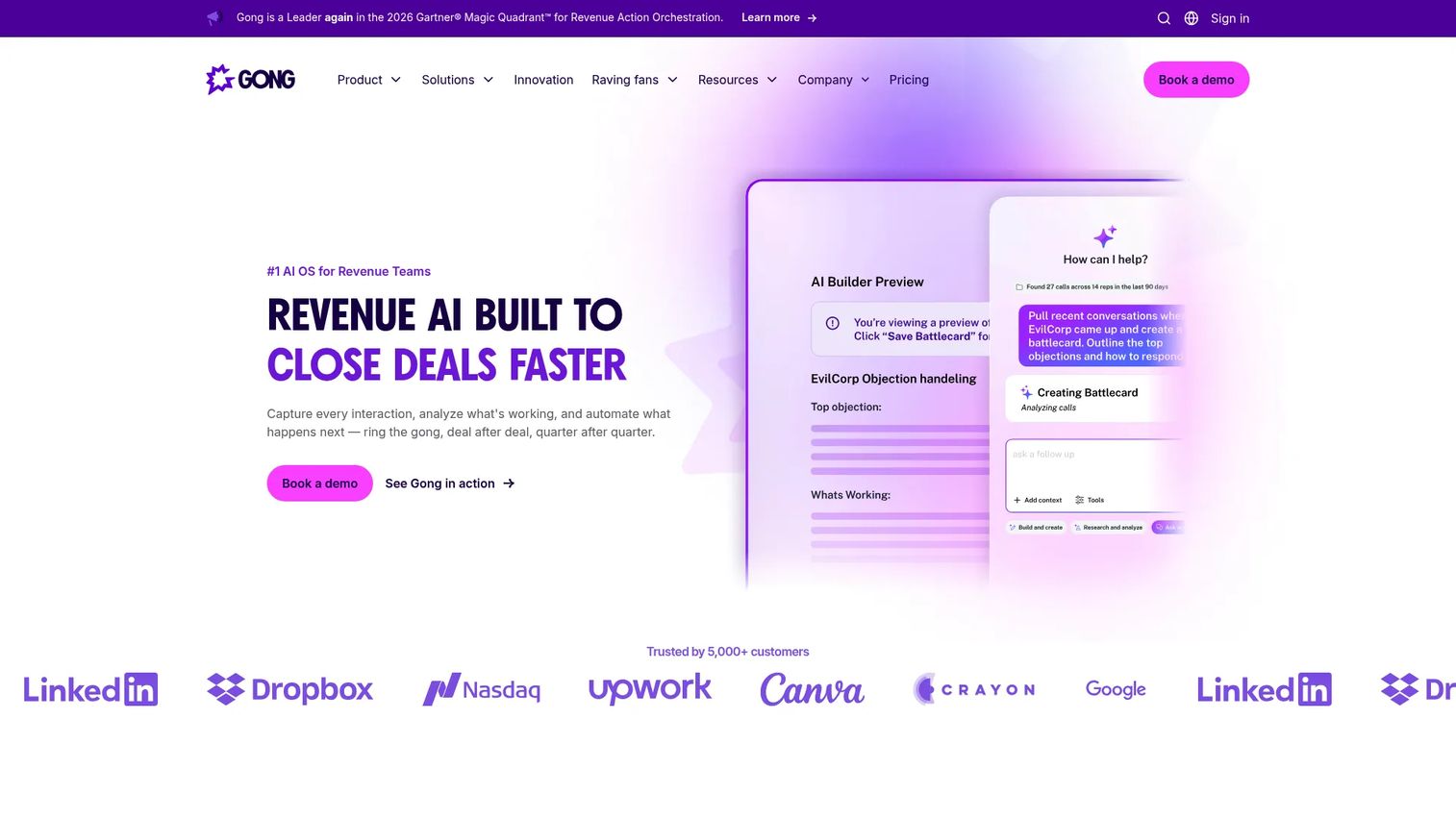
Gong is not a training platform in the traditional sense. It is a coaching platform built on what actually happens in customer conversations, and for teams where the training problem starts on the call, that distinction matters.
Best for: Revenue teams that want coaching rooted in real call data, deal signals, and talk-track adherence rather than prescribed training content.
What it is: Gong is a Revenue AI Operating System that captures and analyzes customer calls, emails, and meetings. It surfaces deal risks, coaching moments, and forecast signals automatically. G2 rates it 4.7/5.
Key features:
- Automatic capture and transcription of calls, emails, and meetings
- AI-powered conversation, deal, and pipeline insights
- Sales engagement, forecasting, coaching, and enablement applications
Where Gong falls short:
- Pricing is entirely quote-based.
- Gong does not provide interactive software training, microlearning, or formal course delivery. It is a coaching and intelligence tool, not a learning management system.
- G2 reviewers note that organizations with smaller call volumes sometimes find the depth of analytics more than their coaching program currently uses.
Pricing: Quote-based.
G2 rating: 4.7/5
How it compares to Spekit: Spekit delivers knowledge before the call. Gong captures what happens during the call and turns it into coaching. Teams running both cover the full readiness loop: Prep, execution, and reinforcement.
15. 360Learning (collaborative LMS)
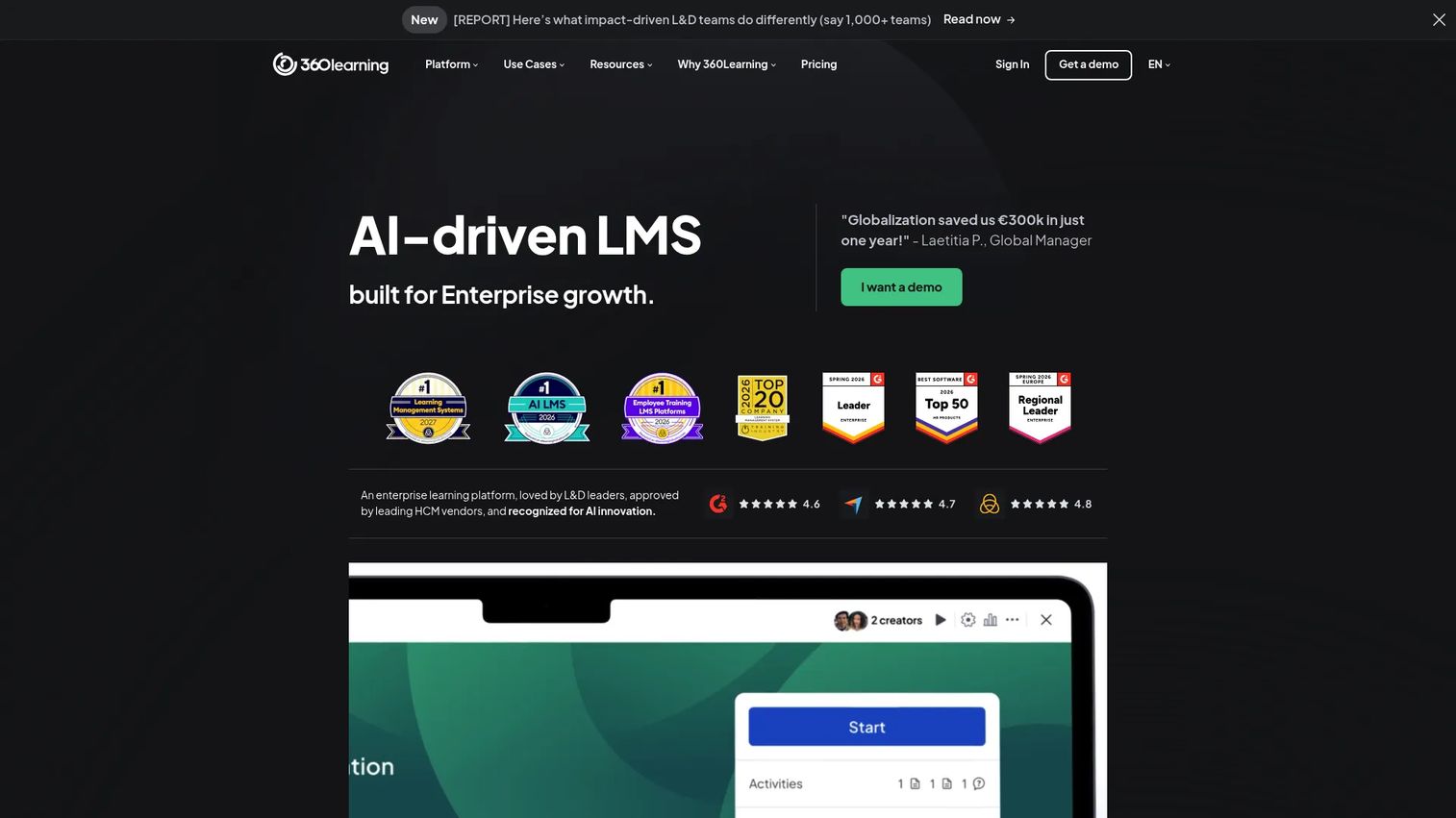
360Learning makes the case that the people closest to the subject matter, the top reps, the product experts, the seasoned managers, should build the training rather than waiting for an instructional designer. Its collaborative authoring model accelerates course creation by putting it in the hands of internal experts.
Best for: Mid-market and enterprise organizations that want subject-matter experts inside the team to create and iterate on training, rather than relying solely on a central L&D function.
What it is: 360Learning is an AI-driven enterprise learning platform combining collaborative LMS capabilities with AI-assisted content creation, learning analytics, and skills development. Its Team plan supports up to 100 users. Business and Enterprise plans are custom-priced. G2 rates it 4.6/5.
Key features:
- AI-powered course creation from prompts and uploaded documents
- Collaborative authoring with internal experts, feedback forums, and versioning
- AI Companion for search, insights, and catalog management
- Learning needs analysis and AI-generated knowledge checks
- SSO, SCORM, xAPI, and content integrations
Where 360Learning falls short:
- G2 reviewers report that the user interface, while functional, can feel cluttered for learners unfamiliar with the platform, which affects early adoption.
- Business and Enterprise pricing is custom, requiring a sales conversation beyond the Team plan.
- 360Learning is a learning platform, not a sales content governance or in-flow knowledge delivery tool. Teams needing those jobs still need separate platforms.
Pricing: Team plan $8/user/month for up to 100 users. Business and Enterprise plans are custom-priced. A 30-day free trial is offered on the Team plan.
G2 rating: 4.6/5
How it compares to Spekit: Spekit delivers knowledge on demand inside workflows. 360Learning builds and delivers structured learning programs through internal expert collaboration. Teams use both when they want both just-in-time lookup and structured skills development.
16. Bloomfire (knowledge management)
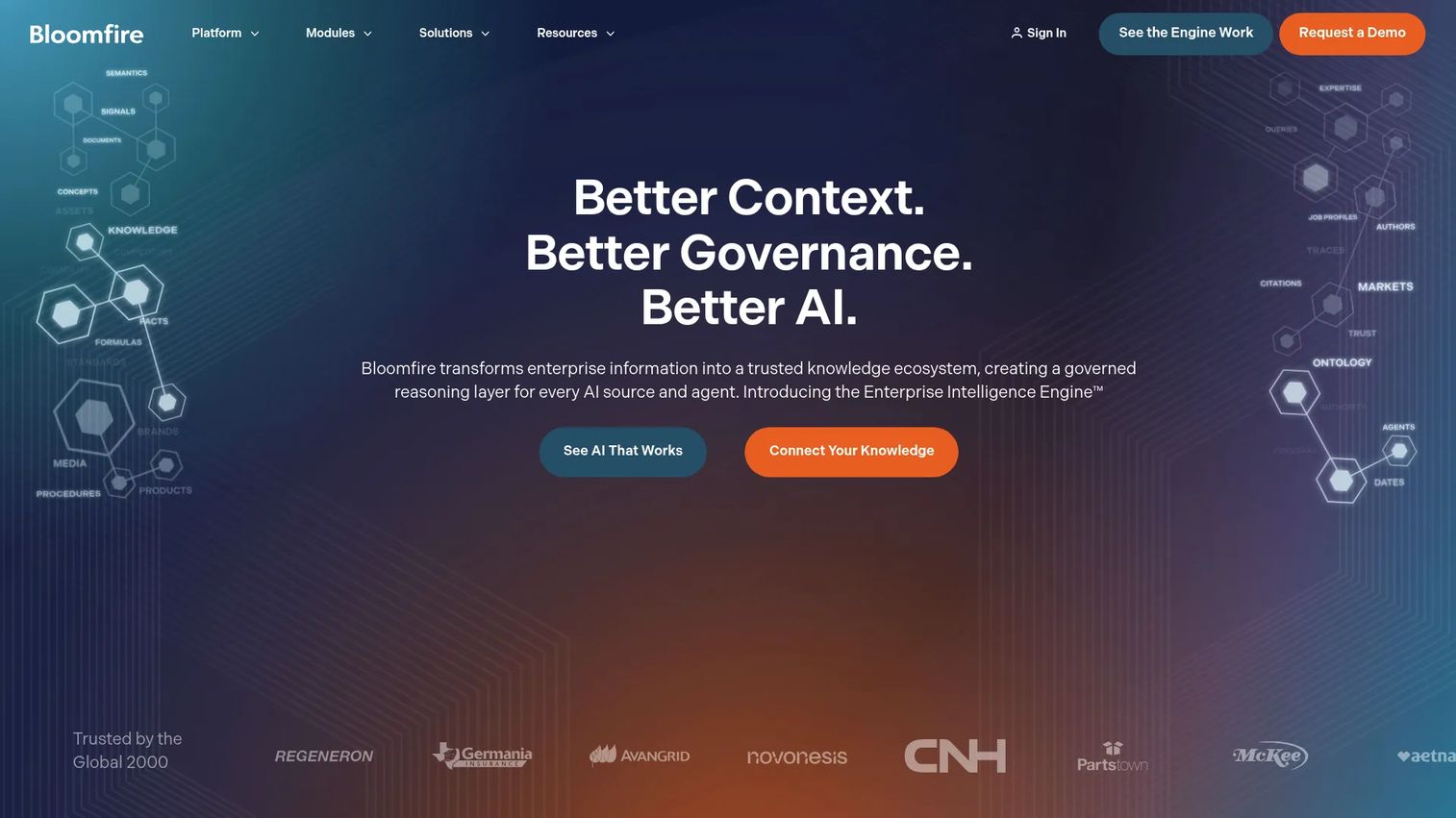
Bloomfire addresses the problem of company knowledge sitting in email threads, Confluence pages, and individual people's heads. Its AI-powered search and Q&A engine centralizes that knowledge into a governed, searchable library.
Best for: Mid-size and enterprise organizations that need a governed, searchable internal knowledge base with community Q&A and AI-assisted content discovery.
What it is: Bloomfire is an AI-powered enterprise knowledge management platform for creating, governing, searching, and sharing organizational knowledge. It includes AI-powered search, Q&A collective intelligence, content moderation, and integrations with enterprise systems. G2 rates it 4.6/5.
Key features:
- AI-powered enterprise search
- Q&A collective knowledge engine
- AI-powered authoring tools
- Content moderation and approval workflows
- Knowledge base health and governance
Where Bloomfire falls short:
- Pricing is entirely custom with no published figures; all plans require contacting Bloomfire for a quote.
- Bloomfire is a knowledge storage and discovery tool, not an interactive training platform, coaching tool, or content governance system for sales assets.
- G2 reviewers note that content curation requires ongoing administration to prevent the knowledge base from accumulating outdated or low-quality entries.
Pricing: Quote-based.
G2 rating: 4.6/5
How it compares to Spekit: Bloomfire and Spekit both centralize knowledge, but Bloomfire serves the broader knowledge management use case across the organization. Spekit focuses specifically on revenue workflows and CRM integration. Teams with an organization-wide knowledge problem often find Bloomfire more appropriate than Spekit.
17. Document360 (knowledge base software)
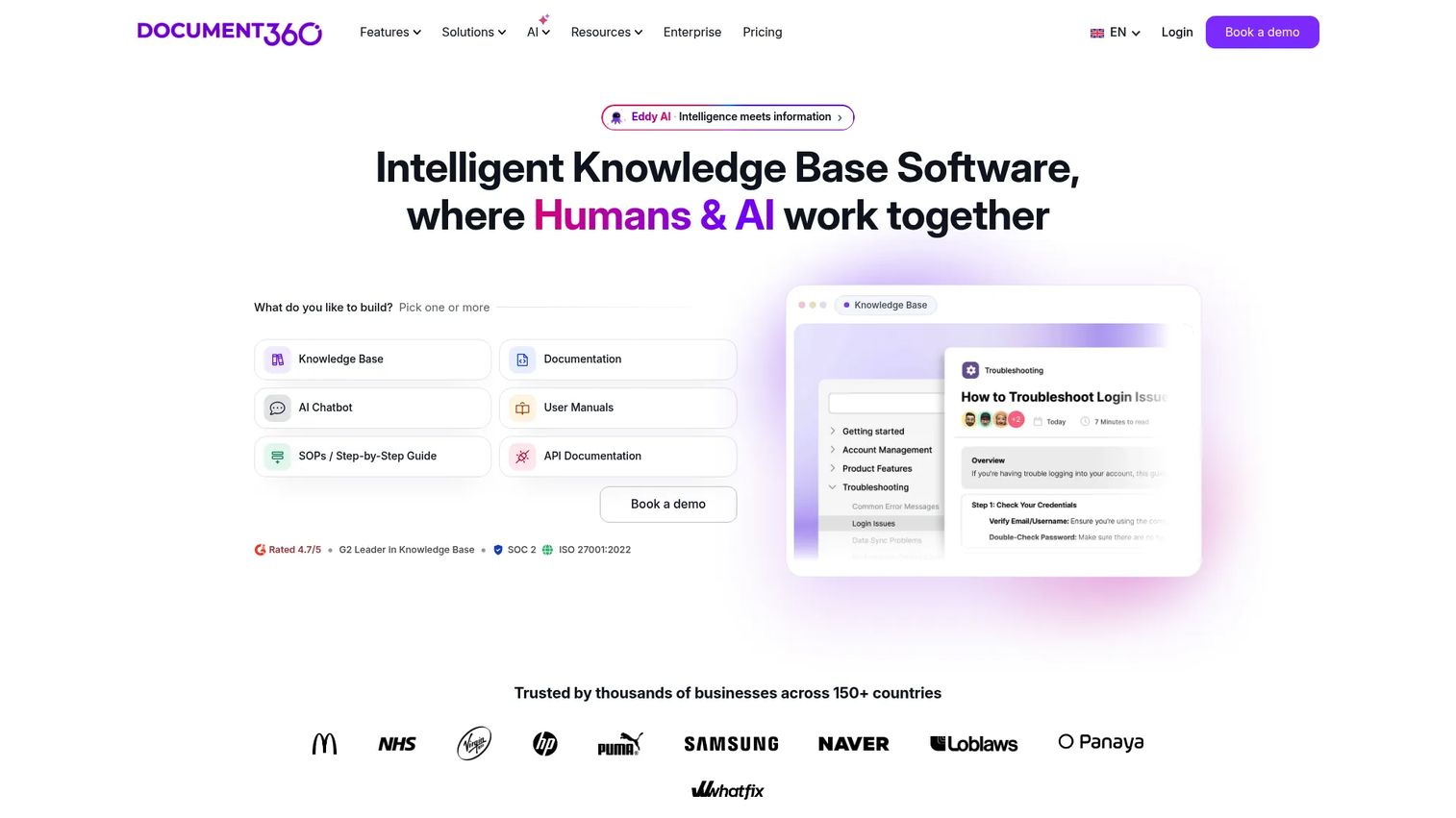
Document360 is built for teams that need structured, versioned documentation rather than a social knowledge base or a training platform. SOPs, support docs, internal process guides, and product documentation all fit its design.
Best for: Organizations building structured internal documentation, versioned SOPs, support knowledge bases, or product documentation that needs custom review workflows.
What it is: Document360 is AI-powered knowledge base software for creating, managing, and publishing customer-facing and internal documentation. It includes advanced editors, custom content review workflows, and AI-powered search, writing, and translation capabilities. G2 rates it 4.7/5.
Key features:
- Advanced WYSIWYG and Markdown editors
- Custom workflows for content review and approval
- AI-powered search, writing, translation, and chatbot
Where Document360 falls short:
- Pricing is quote-based for all plans, with no public starting price, requiring a sales conversation before budget planning.
- Document360 is a documentation platform. It does not provide interactive training, microlearning, coaching, or sales content governance.
- G2 reviewers note that the platform's design favors structured documentation over informal knowledge sharing or Q&A, so teams with both needs may want a complementary tool.
Pricing: Quote-based. A 14-day free trial is offered.
G2 rating: 4.7/5
How it compares to Spekit: Spekit serves the in-flow knowledge lookup job. Document360 serves the structured SOP and documentation job. Teams that need both a quick answer in context and a versioned process document often run them alongside each other.
18. ClickLearn (digital adoption and documentation)
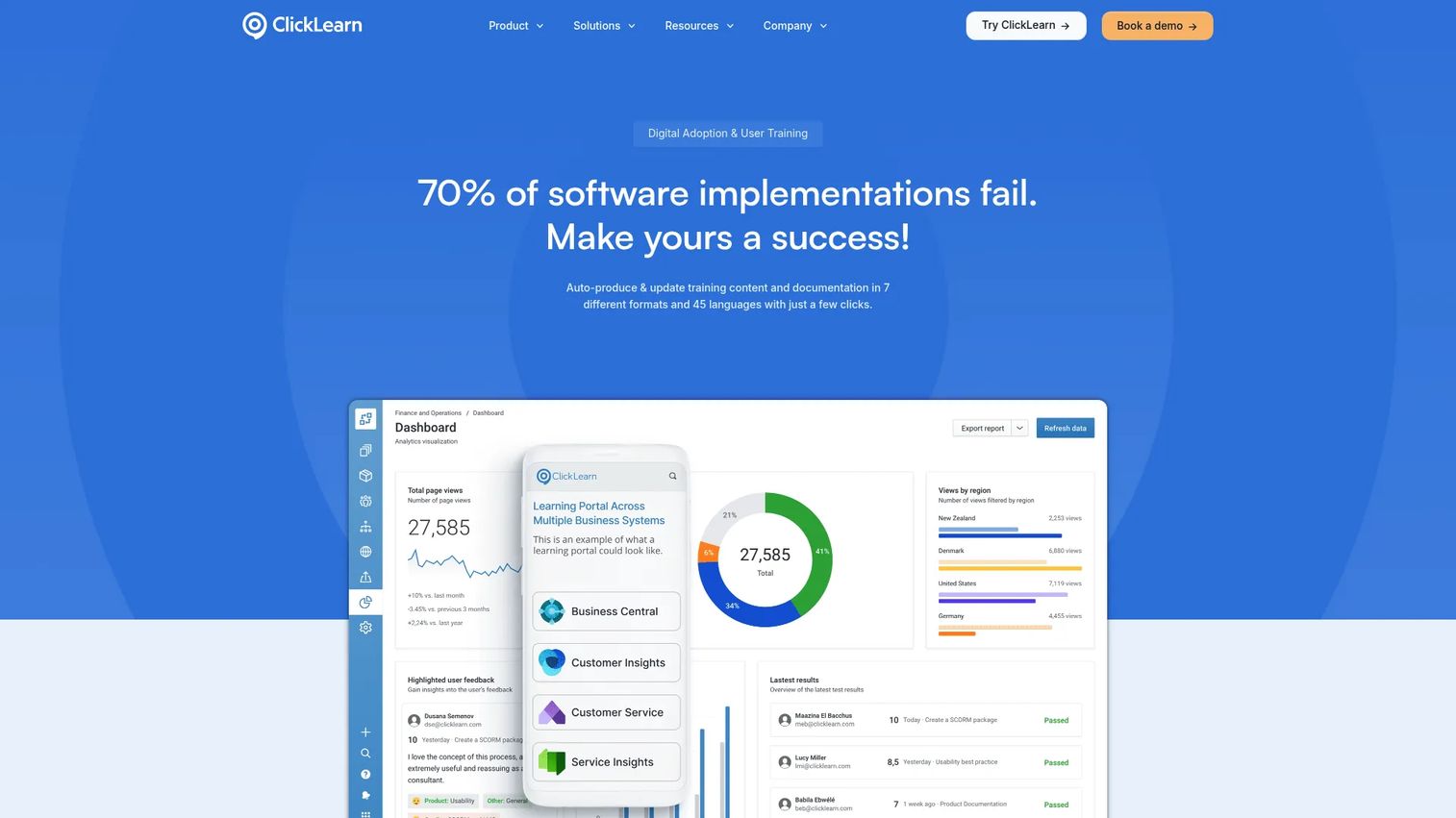
ClickLearn sits between the DAP and the documentation platform categories. It records a business process once and automatically produces training content, documentation, and in-app guidance across the same captured workflow.
Best for: Enterprise organizations managing complex business software such as Microsoft Dynamics, SAP, or Salesforce that need multilingual training content, process documentation, and in-app guidance generated from the same recording.
What it is: ClickLearn creates and maintains business-software training content, documentation, eLearning, and in-app guidance from recorded work processes. Its Replay feature automatically updates documentation as the application changes. G2 rates it 5.0/5.
Key features:
- Records work processes and automatically produces seven learning formats
- Publishes content to an eLearning portal with search, tracking, and analytics
- Automatically updates documentation through Replay
- Cross-platform recording across SAP, Dynamics, Salesforce, Oracle, and web applications
- In-app guidance through the Virtual Assistant and User eXperience Panel
Where ClickLearn falls short:
- Pricing is quote-based across all tiers (Basic, Essentials, Professional, Enterprise), with no public numeric price despite page listings showing €0/month.
- ClickLearn is built for enterprise system documentation, not for microlearning delivery, sales content governance, or conversation coaching.
- G2 reviewers note that initial setup requires dedicated project time, particularly for teams new to process recording across multiple enterprise systems.
Pricing: Quote-based across all tiers.
G2 rating: 5.0/5
How it compares to Spekit: ClickLearn and Spekit serve adjacent but distinct jobs. ClickLearn automates the creation of documentation and training from recorded processes. Spekit surfaces existing knowledge in context. Teams running complex ERP or Dynamics environments often find ClickLearn's auto-generation capability more appropriate for the documentation layer than Spekit.
19. Google Workspace (productivity and knowledge tools)
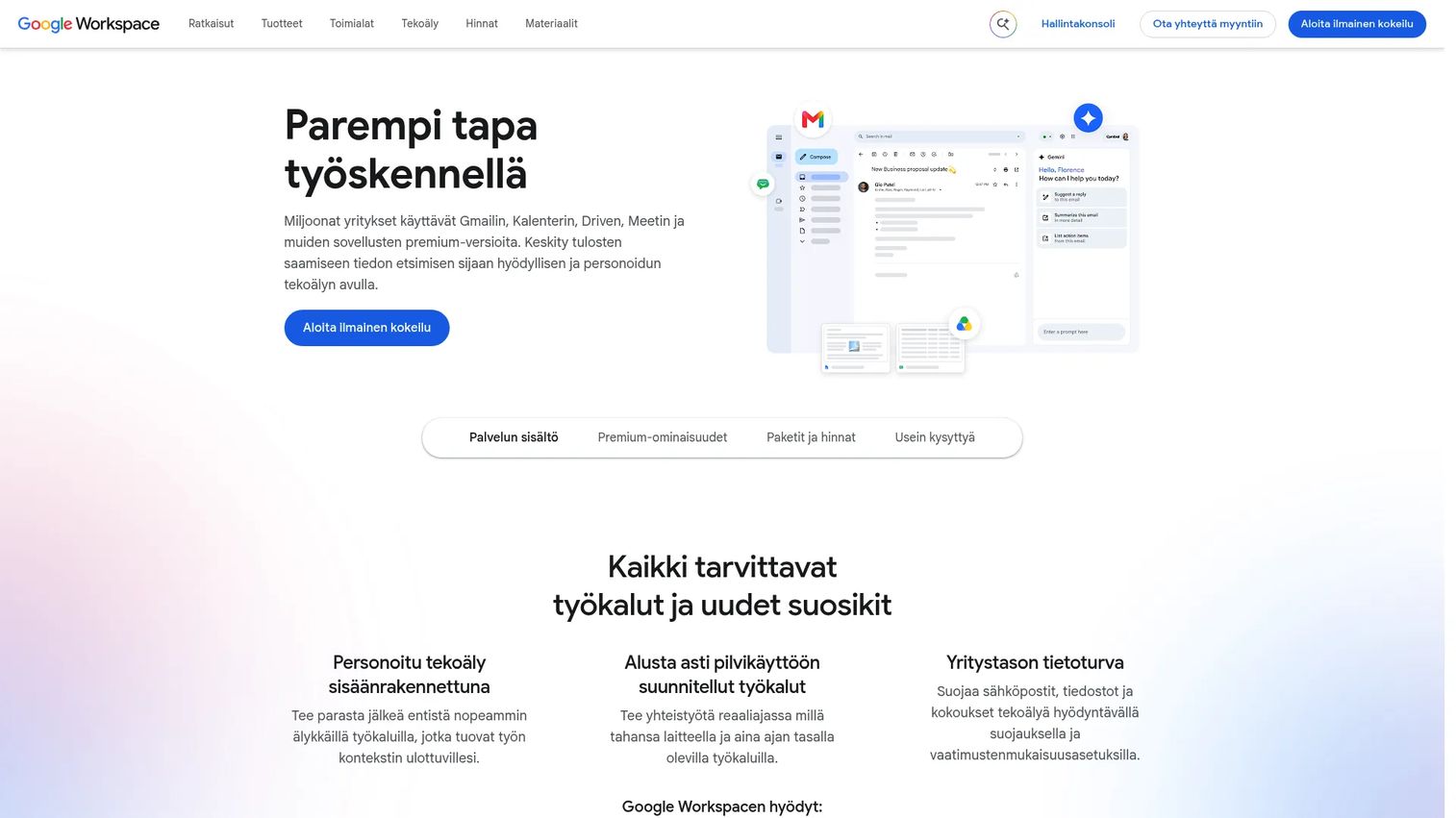
Most enablement teams already have Google Workspace. It is the default baseline for SOP drafts, training decks, shared folders, and the enablement wiki that lives in a Drive someone built two years ago.
Best for: Teams that need basic documentation and internal collaboration infrastructure without a dedicated enablement platform, particularly where Google is already the primary productivity suite.
What it is: Google Workspace is a cloud-based productivity and collaboration suite combining Gmail, Google Drive, Docs, Sheets, Slides, and Meet. For enablement teams, Drive and Docs serve as a lightweight internal knowledge store. G2 rates it 4.6/5.
Key features:
- Custom business email with Gmail
- Cloud storage and file sharing with Google Drive
- Real-time collaboration in Docs, Sheets, and Slides
- Video meetings with Google Meet
- AI assistance through Gemini
Where Google Workspace falls short:
- Google Workspace is not a purpose-built enablement platform. It has no content governance, no asset expiration, no training tracking, and no analytics on who used which document.
- G2 reviewers note that Drive becomes difficult to navigate at scale without deliberate folder taxonomy management; content sprawl is a common outcome.
- It does not support microlearning delivery, interactive training, coaching, or CRM-integrated knowledge surfacing.
Pricing: Business Starter $7/user/month (annual). Business Standard $14/user/month (annual). Business Plus $22/user/month (annual). Enterprise pricing requires contacting sales.
G2 rating: 4.6/5
How it compares to Spekit: Google Workspace is a collaboration tool that many teams repurpose as a knowledge store. Spekit is a purpose-built enablement platform with governance, CRM integration, and in-flow delivery. Teams moving from Google Drive as their primary enablement system to Spekit or any alternative here are addressing the sprawl problem.
20. Slack (team messaging and knowledge sharing)
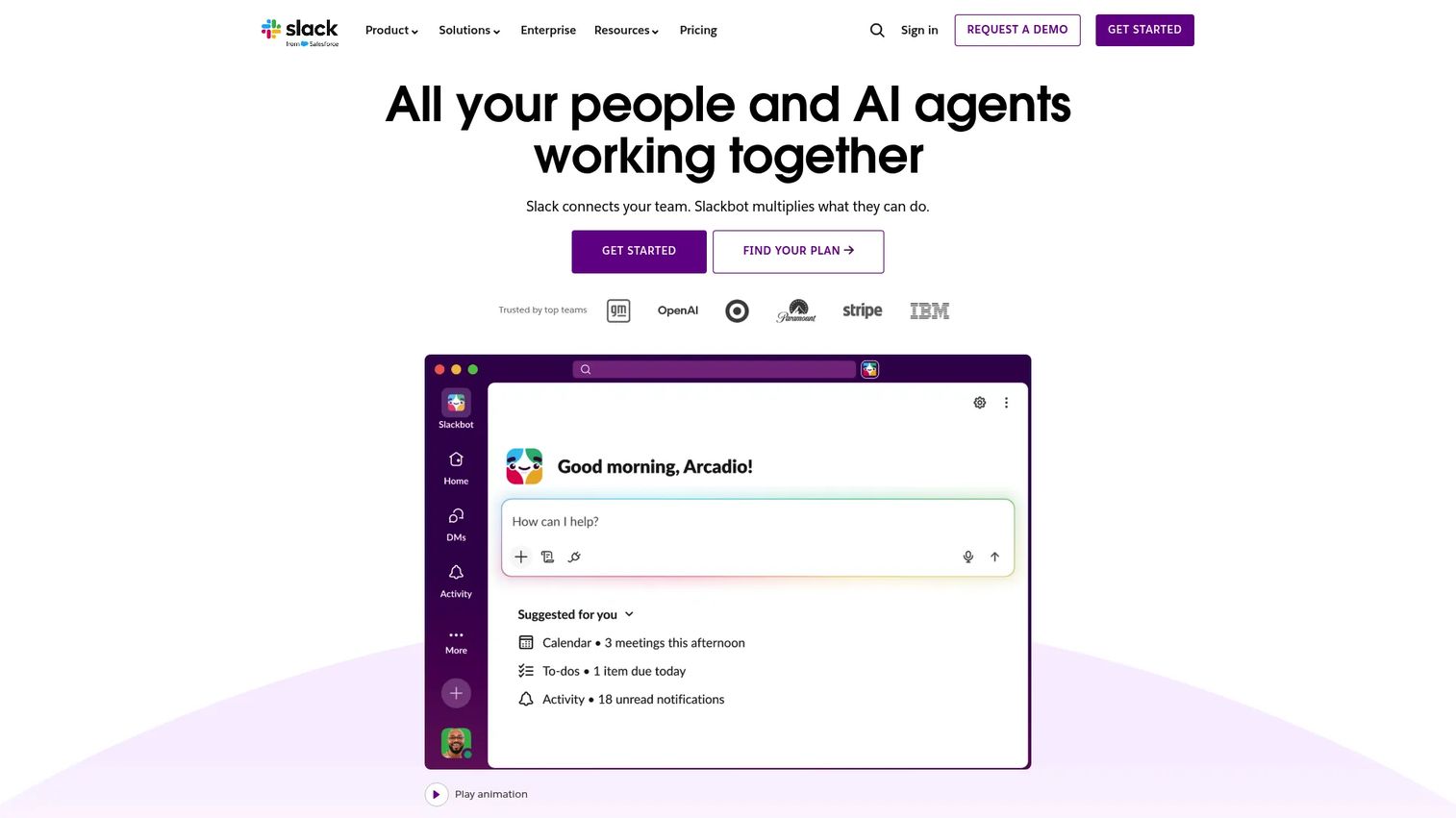
Slack is what enablement looks like when there is no enablement system. The answer to every rep question lives in a channel somewhere, buried under three months of messages that nobody can search reliably.
Best for: Teams that need fast internal Q&A, launch announcements, and enablement broadcasts as a communication layer alongside a dedicated enablement or knowledge platform.
What it is: Slack is a workplace collaboration platform for organized communication, project coordination, integrations, automation, and AI-powered work. For enablement purposes, it functions as a broadcast channel, a quick Q&A surface, and a launch communication tool. G2 rates it 4.5/5.
Key features:
- Channels, messaging, and direct collaboration
- File sharing, canvases, lists, and templates
- App integrations and Workflow Builder
- AI conversation summaries, search, recaps, and Slackbot
Where Slack falls short:
- Slack is not a system of record for enablement. Knowledge shared in a Slack thread is effectively unsearchable and ungoverned six months later.
- G2 reviewers note that critical information shared in Slack gets buried quickly in active channels, leading to repeated questions and inconsistent answers.
- Slack does not provide training delivery, content governance, interactive software practice, or behavioral analytics on rep adoption.
Pricing: Free plan available. Pro $7.25/user/month (annual). Business+ $15/user/month (annual). Enterprise+ requires contacting sales.
G2 rating: 4.5/5
How it compares to Spekit: Slack is where enablement questions go when there is no better destination. Spekit and the other tools on this list exist to give those questions a better answer by moving knowledge into the moment of need, with governance and tracking that Slack cannot provide.
What is the best Spekit alternative for interactive internal training?
Guideflow is the best fit when the enablement job is showing reps how a software workflow works and letting them click through each step.
Employee onboarding, CRM hygiene training, quoting process walkthroughs, and tool handoff checklists all benefit from interactive software demos rather than static documentation. Guideflow lets enablement teams capture software once and distribute interactive demos that reps complete on their own schedule. The platform pairs well with an LMS for formal program management and with a knowledge base for reference documentation; it is not a replacement for either, but it handles the hands-on practice layer that both categories leave out.
Which Spekit alternative is best for enterprise digital adoption?
WalkMe and Whatfix are the strongest fits when the primary job is enterprise-scale in-app guidance across complex software stacks.
Both platforms embed step-by-step guidance directly inside applications during active use. WalkMe is the more established name for large-scale IT-led rollouts; Whatfix competes on cross-environment coverage including Citrix and desktop applications. Teams evaluating both for CRM adoption, ERP training, or enterprise software change management should request pilots from each to compare content maintenance requirements against their internal bandwidth.
Which Spekit alternative is best for microlearning?
Qstream, 7taps Microlearning, TalentCards, and 5Mins.ai each serve a different microlearning scenario.
Qstream targets knowledge retention through spaced repetition, which suits product knowledge and objection handling reinforcement. 7taps is built for distributing short lessons fast via SMS, Slack, or QR code. TalentCards reaches field and deskless teams on mobile with offline-capable flashcard training. 5Mins.ai applies AI recommendations to daily learning habits. The right pick depends on whether the reinforcement problem is retention, distribution speed, mobile reach, or content discoverability.
Which Spekit alternative is best for sales content enablement?
Seismic and Highspot are best for teams whose core problem is content governance, asset findability, and buyer-facing sales material.
Both platforms provide governed content libraries, AI-assisted asset discovery, Digital Sales Rooms, and analytics on which content influences pipeline. Seismic and Highspot are enterprise-tier platforms with quote-based pricing. Teams comparing the two should evaluate integration depth with their CRM, the size of the content library they need to govern, and which platform's training modules better fit their existing enablement program.
Which Spekit alternative is best for sales coaching?
Gong fits teams coaching from real customer conversations. Mindtickle fits teams building structured readiness programs with practice and certification.
Gong captures what happens on actual calls and surfaces coaching moments from that data. Mindtickle builds and measures readiness through role play, formal training paths, and a Readiness Index score. Teams running both cover the preparation side (Mindtickle) and the execution side (Gong) of the coaching loop.
What is the cheapest Spekit alternative?
The cheapest starting point depends on what job the tool needs to do.
For basic internal documentation and collaboration, Google Workspace starts at $7 per user per month (annual). Slack's free plan handles Q&A and broadcast communication with no cost for small teams. Guideflow has a free plan. TalentCards has a free plan for up to 5 users and a Standard plan from $50/month for 50 users. 7taps offers a free plan for limited course creation. The lowest price point rarely includes governance, analytics, or behavioral change measurement, so cost should be weighed against the specific job the team is trying to solve.
When should you stay with Spekit?
Stay with Spekit if the core enablement job is delivering knowledge and coaching inside the tools reps use every day, particularly Salesforce, Gmail, and Slack. If in-flow knowledge cards are driving rep behavior and the team is already adopted, the switching cost of moving to a different category platform likely outweighs the incremental benefit. Spekit earns its place when the problem is "reps cannot find the answer fast enough in context," and the existing content library is current and well-mapped. If the job expands into interactive software practice, formal LMS programs, or call-based coaching, Spekit pairs well with a complementary tool rather than requiring a full replacement.
Why teams switch from Spekit to Guideflow
Teams switch to Guideflow when the enablement problem shifts from "where is the answer?" to "how do I do this workflow correctly?" Four patterns drive that switch:
Interactive training for software workflows. Reps clicking through a CRM update, a quoting process, or an onboarding checklist retain the process better than reading a knowledge card about it. Guideflow's interactive demos let reps execute each step in a safe practice environment.
Record once, distribute across training scenarios. Capture runs through the Chrome extension or native app using screenshot, HTML, or video modes. The same capture serves onboarding, refresher training, SOP documentation, and new-tool rollouts without rebuilding assets for each scenario.
Update training without rebuilding it. The editor supports text, images, graphs, and branching inside the captured demo. When a CRM field changes or a process is updated, editing the relevant step is faster than recapturing the full workflow.
Measure where learners drop off. Step-level completion, drop-off points, and viewer flow analytics show which steps in a process cause confusion. CRM records are created when a viewer identifies through an in-demo form or personalized link, which connects training engagement to your existing sales data in HubSpot, Salesforce, Pipedrive, Zoho, or Marketo.
Guideflow is not the right tool if the team primarily needs a formal LMS with SCORM administration and compliance tracking. For teams whose training problem centers on interactive software education rather than course management, Guideflow closes the gap that static documentation and in-context knowledge cards leave open.
Start your journey with Guideflow today!
FAQs
The best fit depends on which enablement job needs solving. Guideflow fits interactive internal software training and SOP delivery. Seismic and Highspot fit sales content governance and asset management. Mindtickle fits structured readiness programs with coaching and certification. Gong fits coaching from real customer call data. Most enterprise enablement teams run more than one platform across these categories.
Onboarding typically requires multiple tools covering different training scenarios. Guideflow fits software process onboarding where reps need to click through workflows rather than read about them. iSpring LMS and 360Learning fit structured course-based onboarding paths with completion tracking. Bloomfire and Document360 fit reference documentation that new hires need to access throughout ramp.
Guideflow, WalkMe, Whatfix, and Supered each address CRM training from a different angle. Guideflow lets enablement teams build interactive step-by-step demos of CRM workflows reps can practice independently. WalkMe and Whatfix embed in-app guidance directly inside the CRM during active use. Supered enforces CRM process consistency through field validation and next-best-action prompts inside Salesforce and HubSpot.
Spekit focuses on in-context knowledge delivery: Surfacing answers, coaching nudges, and learning content inside tools reps already use. Digital adoption platforms like WalkMe and Whatfix focus on guiding users through software workflows step by step during active application use. Spekit's strength is knowledge access; DAPs' strength is process execution guidance. Some enterprise teams run both.
Spekit supports in-flow knowledge access and contextual learning moments inside daily tools. An LMS manages structured learning programs with courses, quizzes, completion records, certifications, and compliance reporting. Enablement teams often compare them because both touch onboarding and readiness, but they serve different governance and delivery models. Teams needing SCORM-compatible courses and formal training records need an LMS alongside or instead of Spekit.
Guideflow replaces Spekit specifically for the interactive software training use case: Recording workflows and distributing clickable demos for onboarding, internal training, and SOP practice. For in-flow knowledge cards, contextual coaching inside Salesforce or Gmail, and governed GTM content management, Spekit covers ground that Guideflow does not. Teams whose primary training problem is hands-on software practice often find Guideflow a better fit than Spekit for that specific job, while keeping or adding other tools for knowledge management.
Qstream suits knowledge retention through spaced repetition for product and methodology reinforcement. 7taps Microlearning suits fast lesson delivery via SMS, QR codes, and messaging tools. TalentCards suits mobile-first training for deskless and field teams. 5Mins.ai suits AI-curated daily learning feeds for broader skills development. The right microlearning tool depends on whether the driver is retention, distribution speed, mobile reach, or content volume.
Small enablement teams should start with the job causing the most friction. Guideflow for interactive software process training, 7taps or TalentCards for quick mobile lessons, Document360 for structured SOP documentation, and Google Workspace or Slack for basic knowledge sharing cover most small-team enablement scenarios without enterprise-tier investment. Supered's Digital Adoption plan at $13.50 per user per month (annual) is worth evaluating for teams using HubSpot or Salesforce who need CRM process guidance without full DAP complexity.