Your HR leader wants a structured way to support neurodivergent employees. Your clinical partner needs defensible domain testing with automated scoring. Your learning support team needs actionable student reports that go somewhere after printing. These are three different jobs, and most neurodiversity cognitive assessment software serves only one of them well.
According to CIPD (2024), around 20% of people may be neurodivergent. Meanwhile, 85% of employers reported increased demand for neurodiversity support over the prior 18 months, according to Neurodiversity in Business and Birkbeck (2026). The market is moving fast, but the software landscape is messy: Clinical instruments, workplace profilers, school assessment systems, and cognitive training platforms all get grouped under the same category label.
A digital assessment can support screening and decision making, but it does not independently establish a diagnosis. Before you shortlist any tool, you need to know which decision it is meant to support. This guide gives you the framework to figure that out.
What's inside
- A definition of neurodiversity cognitive assessment software and how the four product categories differ
- The distinction between cognitive screening, diagnostic assessment, and support planning
- A side-by-side comparison of 10 platforms across clinical, workplace, school, and research contexts
- A buyer checklist covering reporting quality, accessibility, data governance, and professional oversight requirements
- Practical guidance for founders deciding which internal team should own procurement and implementation
TL;DR
- Best for research-grade cognitive domain testing: CANTAB, used in pharmaceutical trials and academic studies, covers attention, executive function, memory, and psychomotor speed with validated digital tasks
- Best for digital cognitive health workflows: Creyos Health, built for healthcare practices needing repeatable cognitive measurement and longitudinal monitoring
- Best for functional rehabilitation and return-to-work planning: BrainFx, with plans from $25/month (annual contract), covers 30+ cognitive and functional skills
- Best for workplace and learner support profiling: Do-IT Profiler, with per-licence pricing from £82.50 +VAT, helps organizations build structured neurodiversity support conversations
- Best for school assessment data: GL Assessment, covering reasoning, literacy, attainment, and wellbeing across student cohorts
- Best for education and workplace inclusion at scale: Cognassist, rated 4.0/5 on G2, built specifically for further education colleges and apprenticeship providers
What is neurodiversity cognitive assessment software?
Neurodiversity cognitive assessment software is digital software used by qualified professionals, schools, workplaces, or researchers to measure cognitive functions, identify support needs, organize screening data, or produce structured reports.
The category spans four distinct product types, and knowing which one you need decides everything downstream.
Cognitive domain assessment platforms
These tools measure specific brain functions, including attention, executive function, memory, processing speed, and social cognition, through standardized digital tasks. They are common in clinical care, pharmaceutical research, and cognitive health monitoring. Scores require professional interpretation.
Neurodiversity screening and support profiling tools
These tools identify self-reported traits, learning needs, or areas that may benefit from further assessment. They help organizations start structured support conversations and signpost next steps. They are not standalone diagnostic systems.
Workplace and education assessment tools
These platforms document accommodation needs, learning support requirements, or functional workplace adjustments. The output is practical guidance, not a clinical score. They are designed to make support conversations structured and evidence-informed.
Cognitive training and rehabilitation platforms
Some tools combine assessment with exercises or rehabilitation workflows. Assessment and intervention are different functions, and a platform that does both is not automatically better for either job.
Key features to look for:
- Cognitive domain coverage and validated test batteries
- Age range and normative population data
- Remote and supervised delivery options
- Automated scoring and report generation
- Accessibility settings and accommodation support
- Consent workflows and data controls
- Referral and support planning pathways
- Integration with clinical, school, or HR systems
| Format | Primary output | Professional oversight needed | Scales to an organization |
|---|---|---|---|
| Cognitive domain platform | Domain scores and profiles | Yes, for interpretation | Yes, with study or clinical workflows |
| Screening and profiling tool | Support guidance and next steps | Recommended for escalation | Yes |
| Workplace or education tool | Accommodation or support plan | Recommended | Yes |
| Training and rehabilitation | Progress tracking | Depends on clinical context | Varies |
When to use neurodiversity cognitive assessment software
Measure cognitive domains with repeatable tasks
Use a cognitive domain platform when the decision depends on objective, standardized performance data. Clinical screening, research participation, cognitive health monitoring, and rehabilitation progress all require this level of measurement. The output informs clinical judgment, it does not replace it.
Build a workplace support or accommodations plan
An employer asking "what adjustments does this person need?" needs a different tool from one asking "what is this person's working memory score?" Profiling tools that surface practical guidance are better fits for reasonable adjustments conversations. Keep assessment data separate from employment decision making.
Identify learning support needs earlier
Schools and learning support teams use assessment results to determine where teaching adaptations, further evaluation, or family conversations may be needed. Earlier identification changes outcomes, but a score without a support pathway creates more work than it resolves.
Neurodiversity cognitive assessment software comparison
Tools in this table were selected for identifiable professional use cases, cognitive domain coverage or support profiling depth, reporting quality, deployment options, and clarity about assessment purpose. Verify current pricing and G2 ratings directly with each vendor before procurement, as figures change.
| # | Product | Best for | Key use case | Pricing | G2 rating |
|---|---|---|---|---|---|
| 1 | CANTAB | Clinical and research cognitive testing | Validated cognitive domain assessment | Custom pricing | Not listed on G2 |
| 2 | Creyos Health | Digital cognitive health workflows | Remote and in-clinic cognitive measurement | Custom pricing | Not listed on G2 |
| 3 | BrainFx | Functional rehabilitation planning | Return-to-work and rehabilitation assessment | From $25/month | Not listed on G2 |
| 4 | Cognistat Assessment System | Clinical cognitive screening | Structured clinician-administered assessment | From $35 per item | Not listed on G2 |
| 5 | Do-IT Profiler | Workplace and learner support profiling | Neurodiversity screening and support reports | From £82.50/licence | Not listed on G2 |
| 6 | Pearson Clinical | Professional psychological assessment | Broad clinical assessment portfolio | Custom pricing | Not listed on G2 |
| 7 | GL Assessment | Schools and learning support | Literacy, reasoning, and cognitive assessment | Custom pricing | Not listed on G2 |
| 8 | CogniFit | Digital assessment with training elements | Cognitive screening and brain training | From $19.99/month | Not listed on G2 |
| 9 | Cognassist | Education and workplace inclusion | Learning needs and neurodiversity support | Custom pricing | 4.0/5 |
| 10 | CNS Vital Signs | Clinical computerized cognitive testing | Neurocognitive assessment with EMR export | From $35/session | Not listed on G2 |
Best 10 neurodiversity cognitive assessment software tools for 2026
1. CANTAB
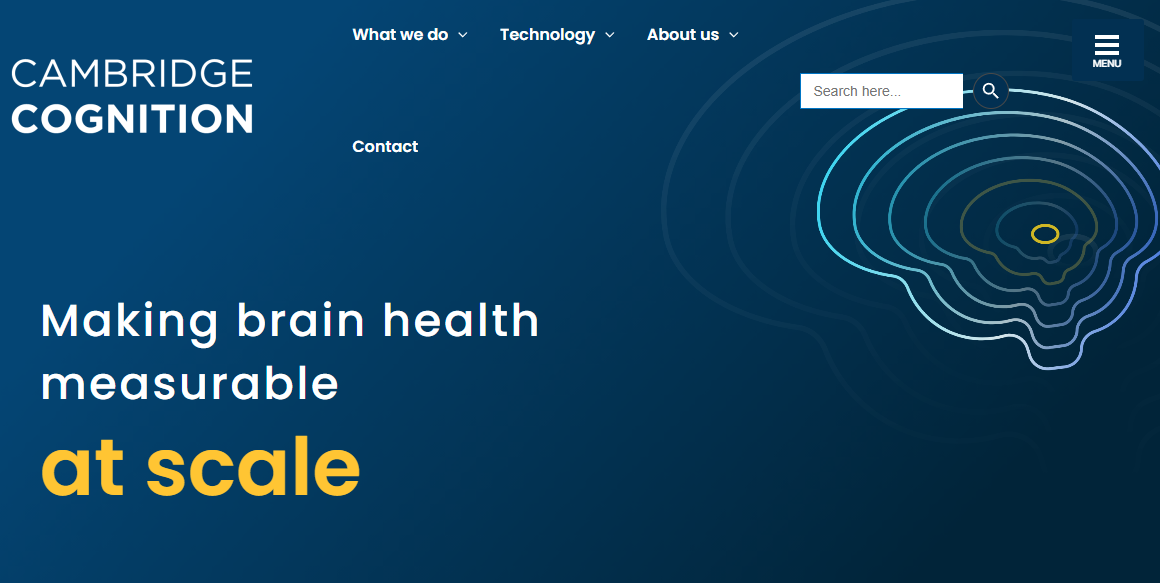
CANTAB, developed by Cambridge Cognition, is a platform of scientifically validated digital cognitive assessments used in clinical research, pharmaceutical trials, and academic studies. It measures attention, executive function, memory, psychomotor speed, and emotion and social cognition through standardized tasks delivered via web or supervised iPad. The platform has appeared in thousands of peer-reviewed publications and supports the regulatory and data requirements of large study programs.
Best for: Academic researchers, pharmaceutical companies, and specialist clinical teams that need validated, domain-specific cognitive testing with research and study management workflows.
Key features
- Validated batteries covering attention, memory, executive function, and social cognition
- Web-based and supervised iPad delivery
- Automated test administration and scoring
- Customizable batteries combining cognitive tasks, voice assessments, and questionnaires
- ISO 27001-compliant CANTAB Connect Research platform
Why choose CANTAB: Choose CANTAB when your requirement is repeatable, validated cognitive measurement for a research protocol or specialist clinical program, not a general workplace neurodiversity initiative. The depth of validation here earns its place in regulated study environments.
CANTAB pricing: Cambridge Cognition directs buyers to contact its team for study-specific licensing, as cost varies by study scope and services required.
2. Creyos Health
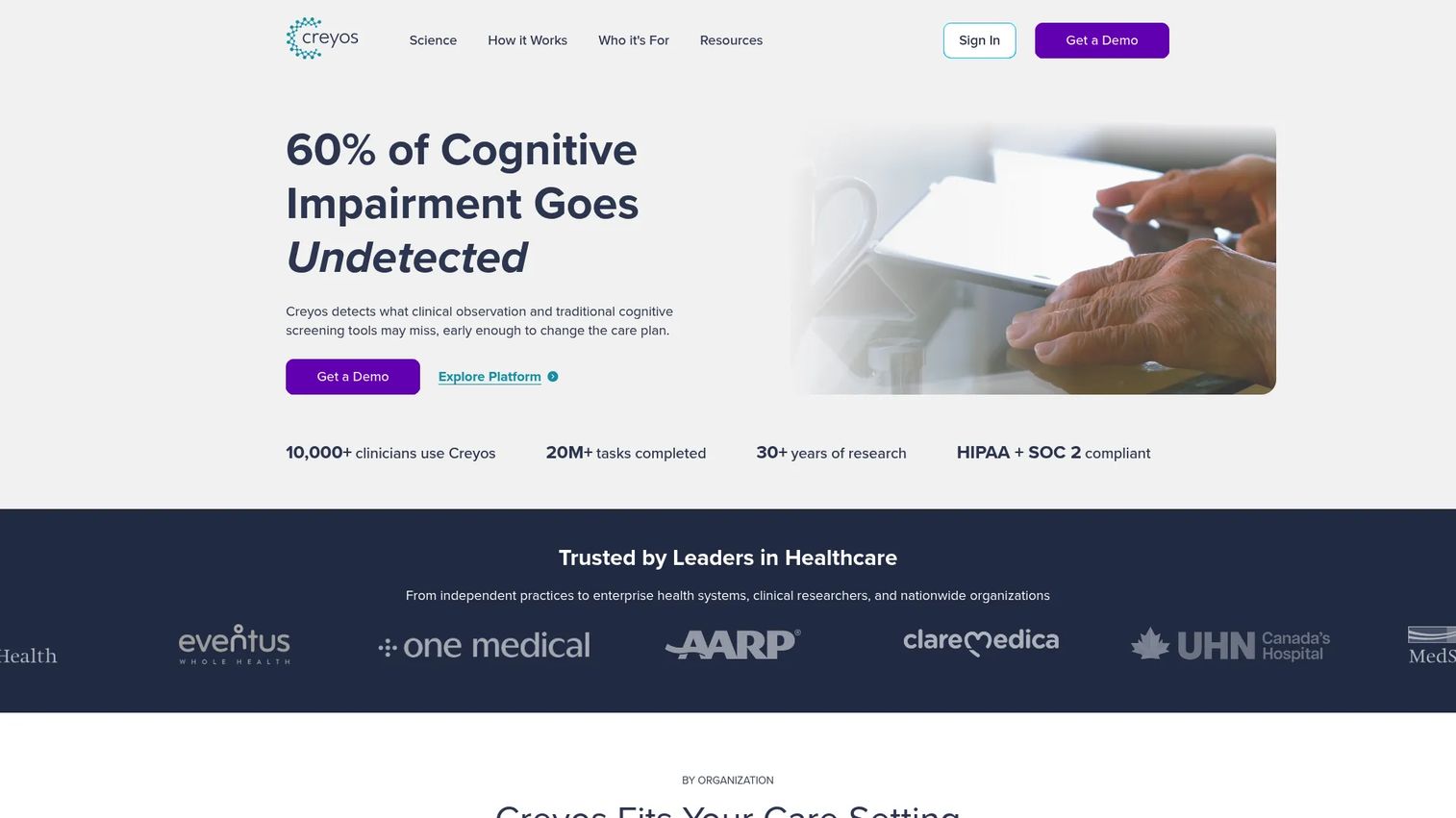
Creyos Health is a healthcare cognitive and behavioral health assessment platform for objectively measuring and monitoring patient brain health. It uses digitized cognitive tasks, including short-term memory, reasoning, concentration, and verbal ability, alongside behavioral health questionnaires covering ADHD, PHQ-9, GAD-7, substance misuse, and brain-injury screening. Reports generate instantly with normative benchmarking, so clinicians have interpretable data without manual scoring.
Best for: Healthcare practices, health systems, payers, and research teams that need repeatable digital cognitive and behavioral health assessment with EHR integration.
Key features
- Cognitive tasks measuring memory, reasoning, concentration, and verbal ability
- Behavioral health questionnaires including ADHD and PHQ-9 screeners
- Instant normative reports for clinicians
- Remote or in-clinic delivery across computer, tablet, and mobile
- EHR integration and workflow automation
Why choose Creyos Health: Creyos Health fits teams that need a digital workflow around cognitive measurement and longitudinal monitoring. It is a stronger fit for healthcare settings than for workplace support programs that need accommodation guidance rather than clinical scores.
Creyos Health pricing: Creyos describes a flat annual subscription model. Contact the sales team for organization-specific pricing, as figures are not displayed publicly.
3. BrainFx
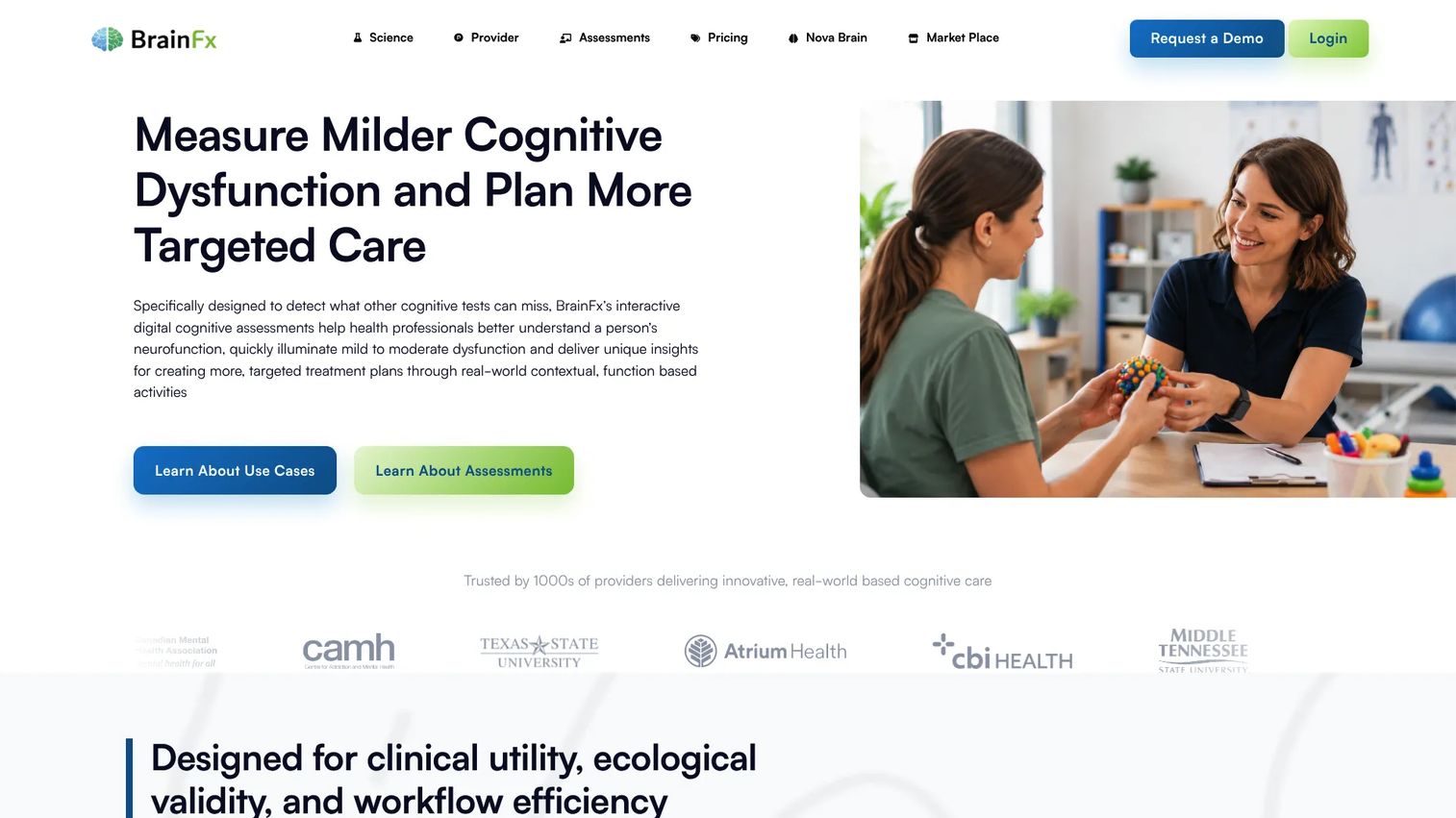
BrainFx focuses on functional cognitive assessment in rehabilitation, return-to-work, and care planning contexts. Where a cognitive domain platform gives you a memory score, BrainFx tells you how cognitive performance affects real-world task demands, drawing on 30+ cognitive, physical, sensory, psychosocial, and behavioral factors. Assessment activities are delivered digitally using performance-based tasks that mirror everyday functioning.
Best for: Rehabilitation providers, occupational health teams, and organizations supporting functional return-to-work decisions that need more than a domain score.
Key features
- Assesses 30+ cognitive and functional factors
- Performance-based activities reflecting real-world tasks
- Automated scoring, normative comparisons, and progress tracking
- Rehabilitation planning reports
- Outcome tracking over time
Why choose BrainFx: BrainFx earns its place when the decision concerns work readiness or rehabilitation goals, not research-grade domain scores. The functional framing makes reports more actionable for occupational health conversations.
BrainFx pricing: The Practitioner plan starts at $25/month (or $270/year) on an annual contract. Clinic plans are $20/member/month ($215/member annually). Enterprise pricing requires contacting BrainFx directly.
4. Cognistat Assessment System
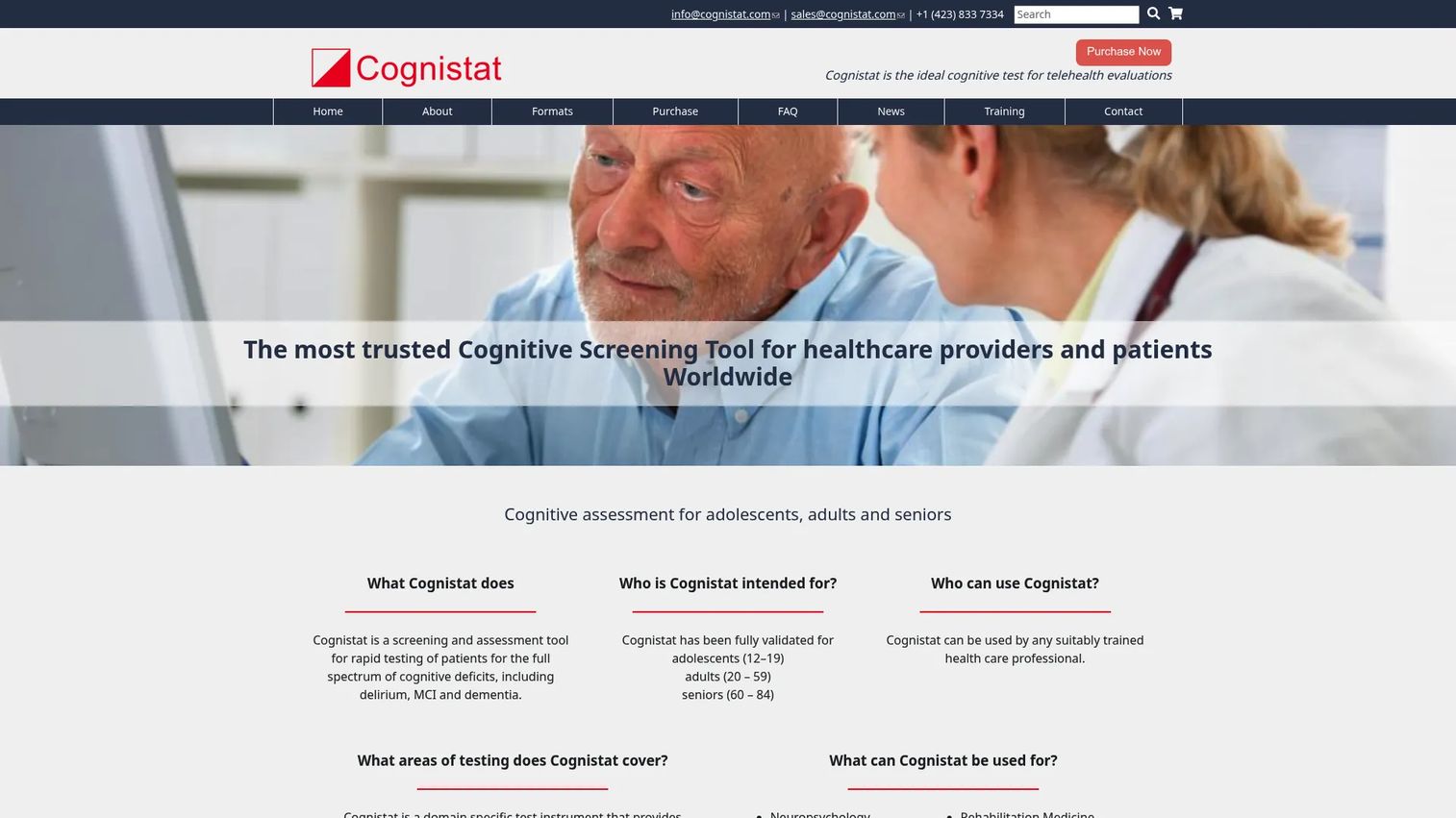
Cognistat Assessment System is a computer-assisted cognitive screening and assessment system for healthcare professionals. It evaluates language, spatial skills, memory, calculations, and reasoning, and it produces automatic scoring with graphical impairment profiles. Electronic data records allow longitudinal comparison, and the system runs on Windows, Mac, and iPad, with remote administration supported via online video. Languages include English, Spanish, French, Czech, and Arabic.
Best for: Clinical teams in healthcare, rehabilitation, geriatric, neurological, psychiatric, or telehealth settings that need a structured multi-domain cognitive assessment process.
Key features
- Multi-domain screening: Language, spatial, memory, calculations, reasoning
- Automatic scoring and graphical impairment profiles
- Electronic records for longitudinal comparison
- Remote administration via video
- Available in five languages
Why choose Cognistat: Choose Cognistat when you need an established clinical assessment format that keeps administration close to healthcare workflows and produces interpretable profiles alongside the raw scores.
Cognistat pricing: Components are purchased individually. A set of tokens or a stimulus booklet each costs $35. A pack of 25 online tests is $425. The full starter kit is $525. All purchases are one-time, with no recurring subscription.
5. Do-IT Profiler
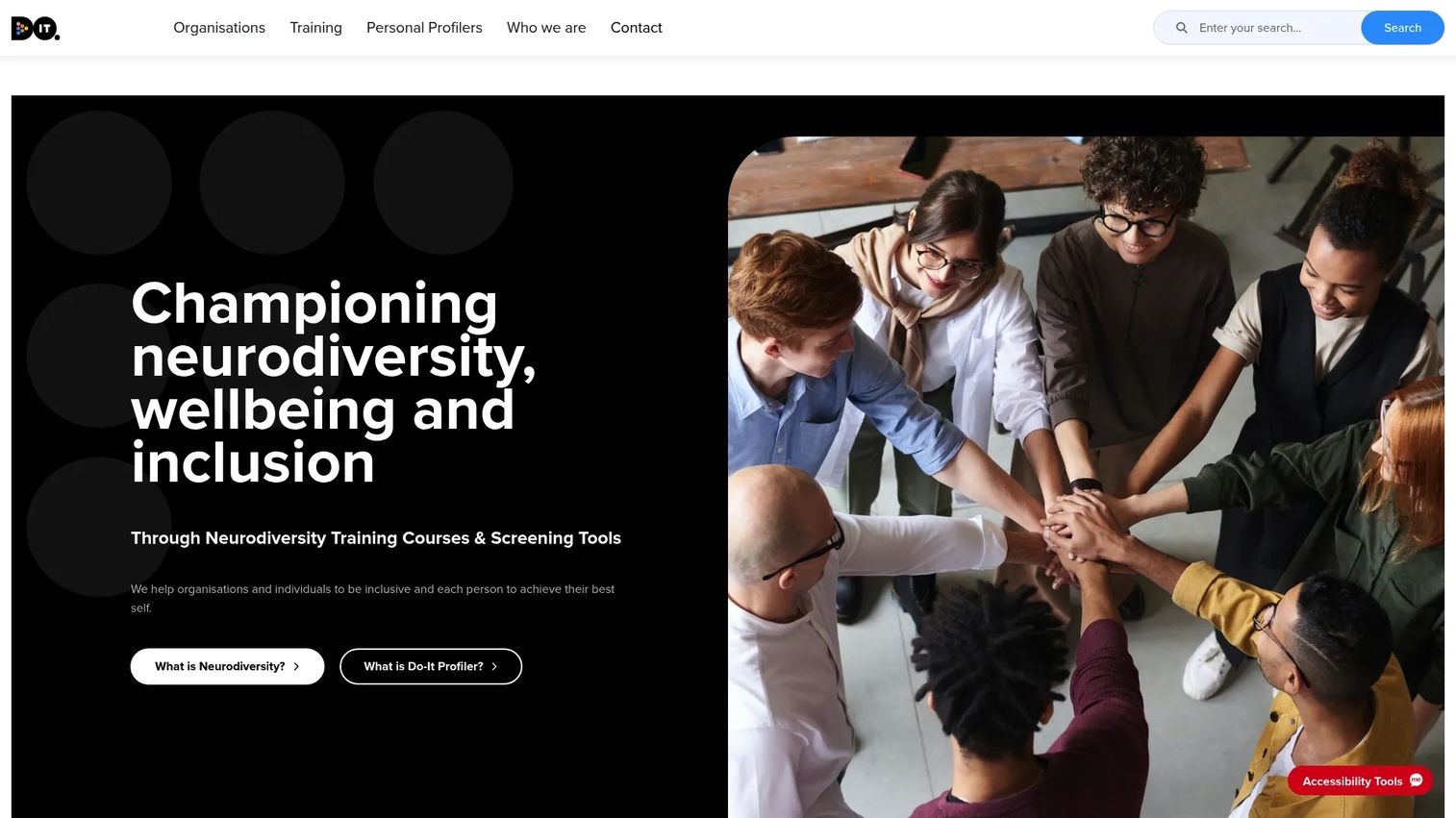
Do-IT Profiler provides web-based neurodiversity screening and profiling tools for individuals, employers, and education providers. Respondents complete an online questionnaire covering neurodivergent traits, strengths, challenges, and wellbeing. The output is a personalized report with practical guidance, support tools, and a Work With Me Passport designed for workplace adjustment conversations. It also offers e-learning modules for line managers and educators.
Best for: Employers, colleges, and support teams that need a scalable starting point for neurodiversity support planning, with clear signposting to further assessment where needed.
Key features
- Online neurodiversity screening across traits, strengths, and challenges
- Personalized reports with practical guidance and support tools
- Workplace profiling with adjustment guidance and a Work With Me Passport
- Signposting for further assessment where appropriate
- E-learning modules for line managers and educators
Why choose Do-IT Profiler: Do-IT Profiler gives organizations a structured starting point for support conversations without requiring a clinical program. A profile informs next steps; it does not settle a clinical question or substitute for a formal diagnostic pathway.
Do-IT Profiler pricing: The Neurodiversity Workplace Profiler costs £82.50 +VAT per 12-month licence. The Neurodiversity Profiler+ is £99 per licence. Licences are available in quantities of 1, 5, or 10. Organization platform pricing for larger deployments requires contacting Do-IT directly.
6. Pearson Clinical
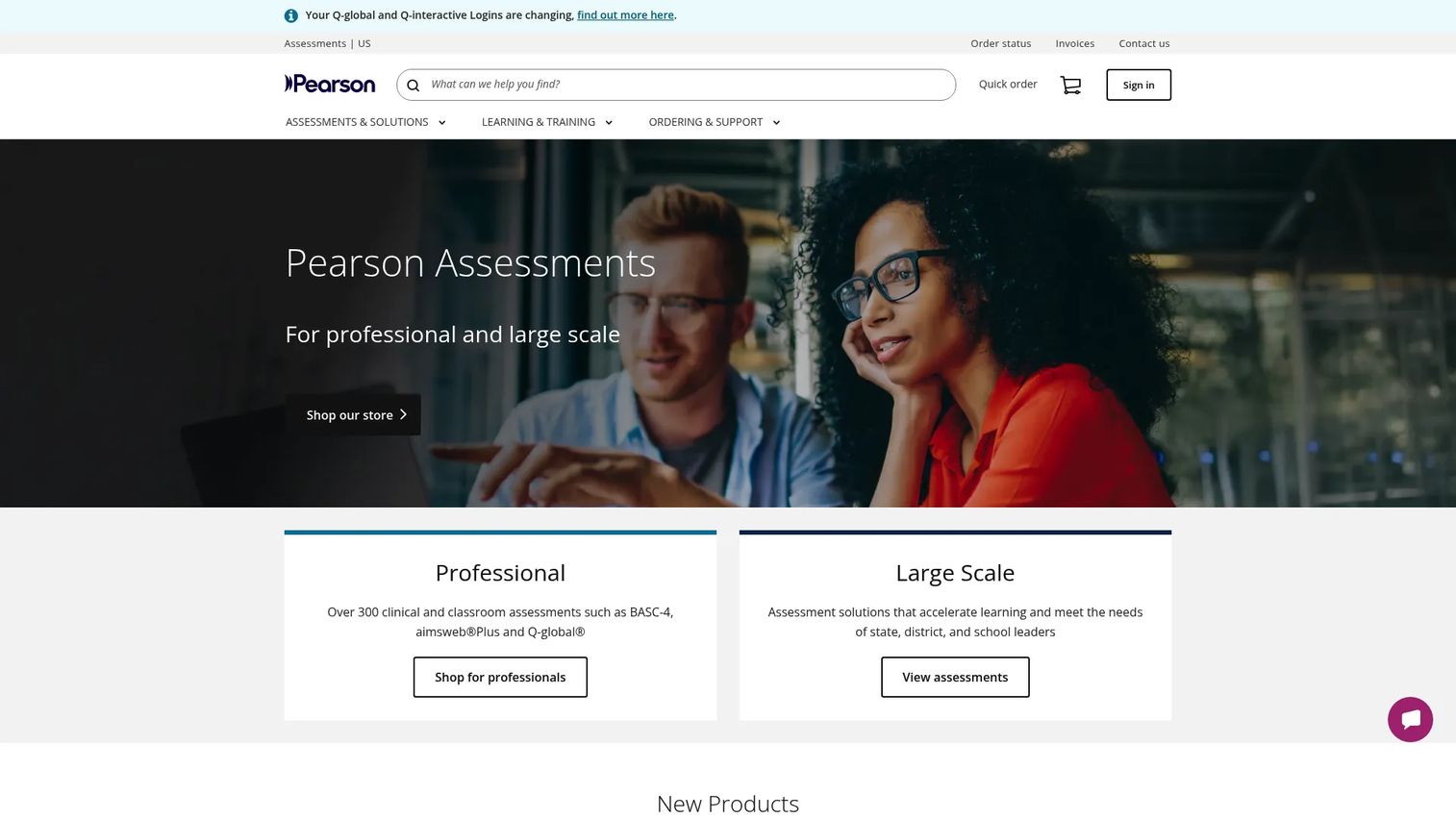
Pearson Clinical is one of the largest professional assessment publishers, covering cognitive, intelligence, memory, neuropsychology, behavior, personality, achievement, and speech-language assessments. Digital delivery runs through Q-global for web-based administration and Q-interactive for iPad-based examiner use. The catalog spans clinical and educational instruments backed by decades of norming and standardization work.
Best for: Psychologists, speech-language pathologists, occupational therapists, and school psychologists that need access to a broad portfolio of standardized assessments under appropriate professional administration.
Key features
- Broad catalog: Cognitive, neuropsychology, behavior, achievement, speech-language
- Digital delivery via Q-global (web) and Q-interactive (iPad)
- Scoring and report workflows built into the digital platforms
- Educational and clinical instruments with research-grade norming
- Professional training and development resources
Why choose Pearson Clinical: Choose Pearson when breadth matters more than one narrow neurodiversity platform. Professional qualification requirements shape what your team can purchase and administer, so confirm those requirements before procurement.
Pearson Clinical pricing: Pricing varies by instrument, digital administration credits, report packs, and format. Pearson directs buyers to request a quote through its ordering portal, as there is no single starting price across its catalog.
7. GL Assessment
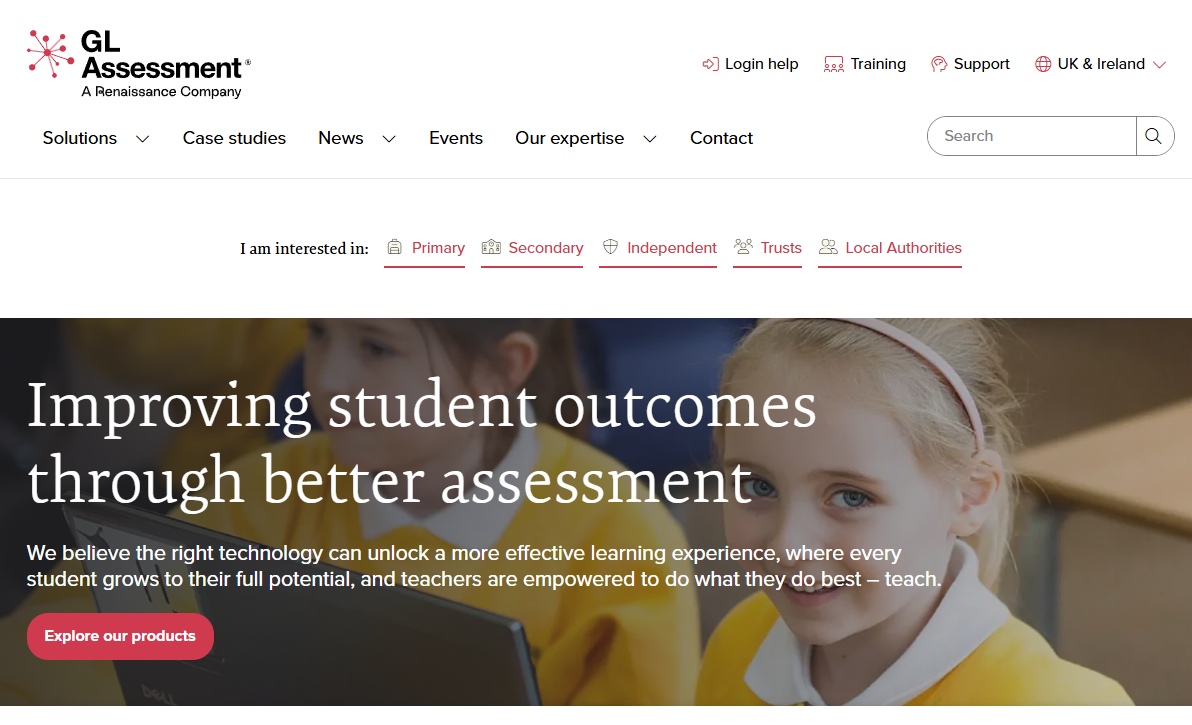
GL Assessment serves education teams with standardized assessments covering pupil ability, attainment, progress, literacy, numeracy, and wellbeing. The CAT4 reasoning assessment is widely used across UK schools and multi-academy trusts. Digital scoring and cohort reporting dashboards help learning support leads identify students who may need additional intervention or a referral for further assessment.
Best for: Schools, multi-academy trusts, and learning support teams that need structured, cohort-level student assessment data to inform teaching adaptations and support planning.
Key features
- CAT4 reasoning and cognitive ability assessment
- Attainment and progress testing across English, maths, and science
- Adaptive reading and spelling assessments
- Student attitude and wellbeing assessment via PASS
- Digital scoring, cohort reporting, and dashboards
Why choose GL Assessment: GL Assessment fits education systems where cohort-level insight and structured learner support planning drive purchasing, not individual clinical measurement. Assessment data should feed into professional judgment, not label a learner on its own.
GL Assessment pricing: Pricing varies by product family, student population size, and contract. GL Assessment does not display fixed prices on its website; contact the team for a school or trust-level quote.
8. CogniFit
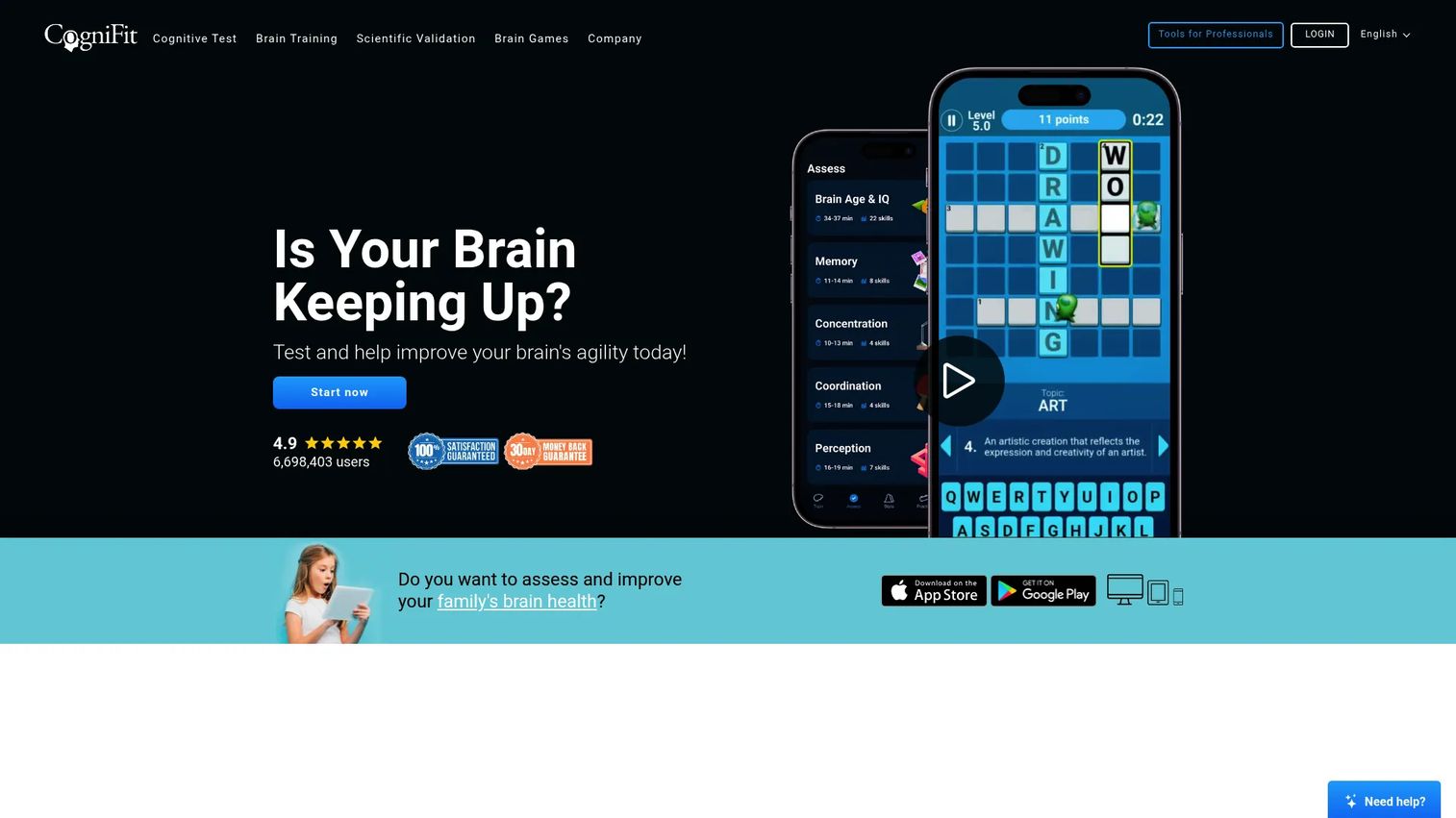
CogniFit is a digital cognitive health platform combining assessment across 20+ cognitive skills with personalized brain training programs. Users complete assessments and then follow adaptive training sequences designed to target identified weaker domains. The platform is available via web and mobile, with programs for individuals, families, healthcare professionals, and researchers.
Best for: Individuals, organizations, and research teams seeking accessible digital cognitive activities alongside assessment or screening insights, with a consumer-friendly experience.
Key features
- Assessments across 20+ cognitive skills
- Personalized adaptive brain training programs
- Progress tracking, cognitive profiles, and session evaluations
- Web and mobile access
- Individual, professional, and organizational program options
Why choose CogniFit: CogniFit is the right choice when the program objective includes cognitive engagement and training alongside basic assessment, not when your team needs formal clinical assessment or workplace adjustment recommendations backed by validated clinical instruments.
CogniFit pricing: A free registration gives limited access. The Basic plan is $19.99/month or $119.99/year, covering one training program and 20+ games. The Premium plan is $29.99/month, $169.99/year, or $249.99 for three years, covering all programs and 60+ games. Business and professional plans are available separately.
9. Cognassist
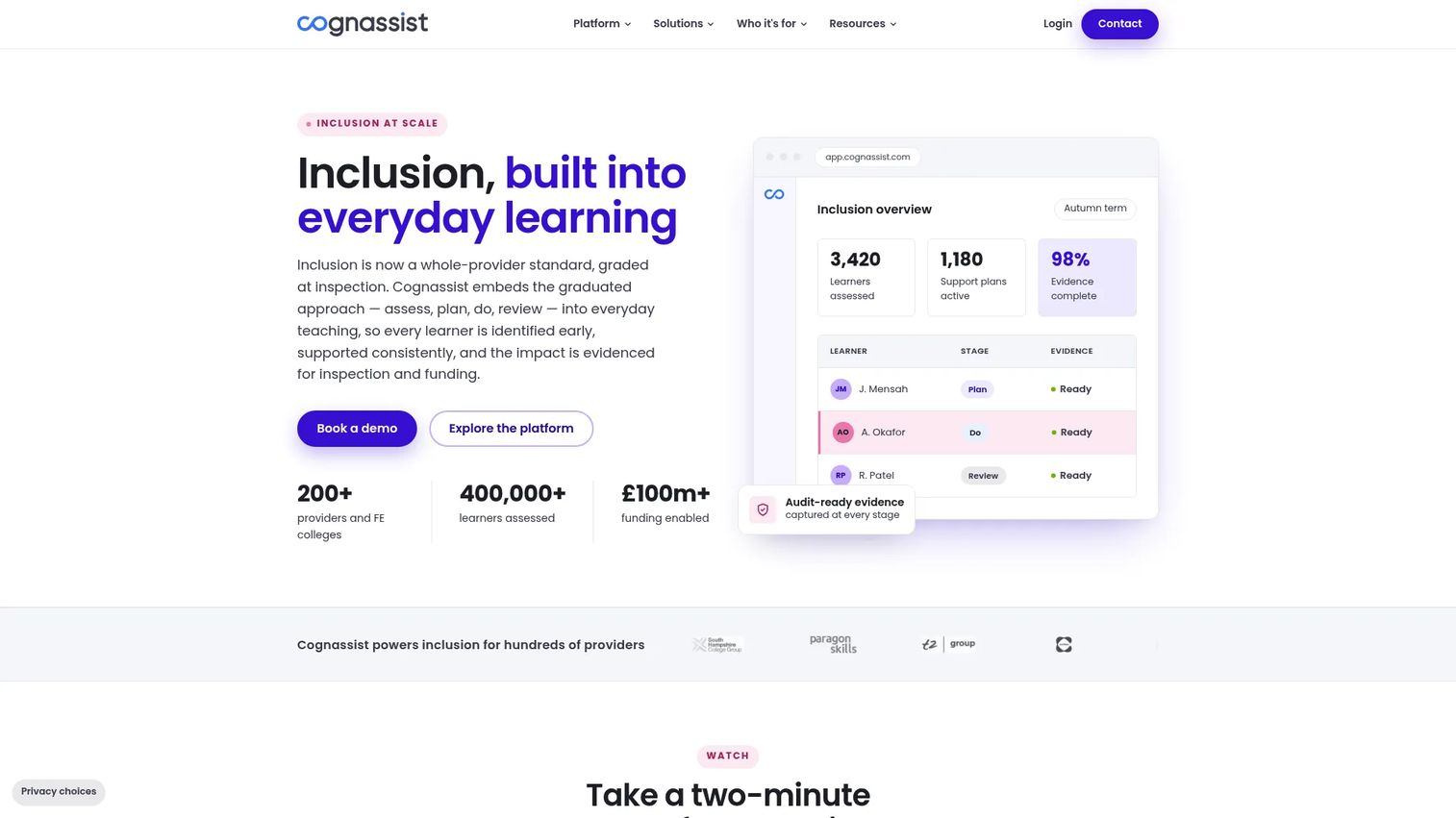
Cognassist is an inclusion platform built specifically for further education colleges, apprenticeship providers, and universities. It runs whole-cohort cognitive assessment across nine domains and three indexes, then co-creates personalized support plans with learners. The platform generates course-personalized reasonable adjustments and produces audit-grade support evidence that satisfies Ofsted and ESFA requirements in the UK.
Best for: Further education colleges, apprenticeship programs, and universities that need scalable, evidence-based learner inclusion with regulatory audit support.
Key features
- Whole-cohort cognitive assessment across nine domains and three indexes
- Personalized support plans co-created with learners
- Course-specific reasonable adjustments
- Audit-grade support evidence for regulatory purposes
- Staff training resources built into the platform
Why choose Cognassist: Cognassist fits buyers whose objective is to operationalize inclusion at scale, not to produce clinical diagnostic reports. It is particularly strong where regulatory evidence requirements and cohort size make manual support planning impractical.
Cognassist pricing: Cognassist prices by cohort size through a scoped conversation. No fixed plan prices are displayed on the website. Contact Cognassist directly for a quote based on your learner numbers.
G2 rating: 4.0/5 on G2.
10. CNS Vital Signs
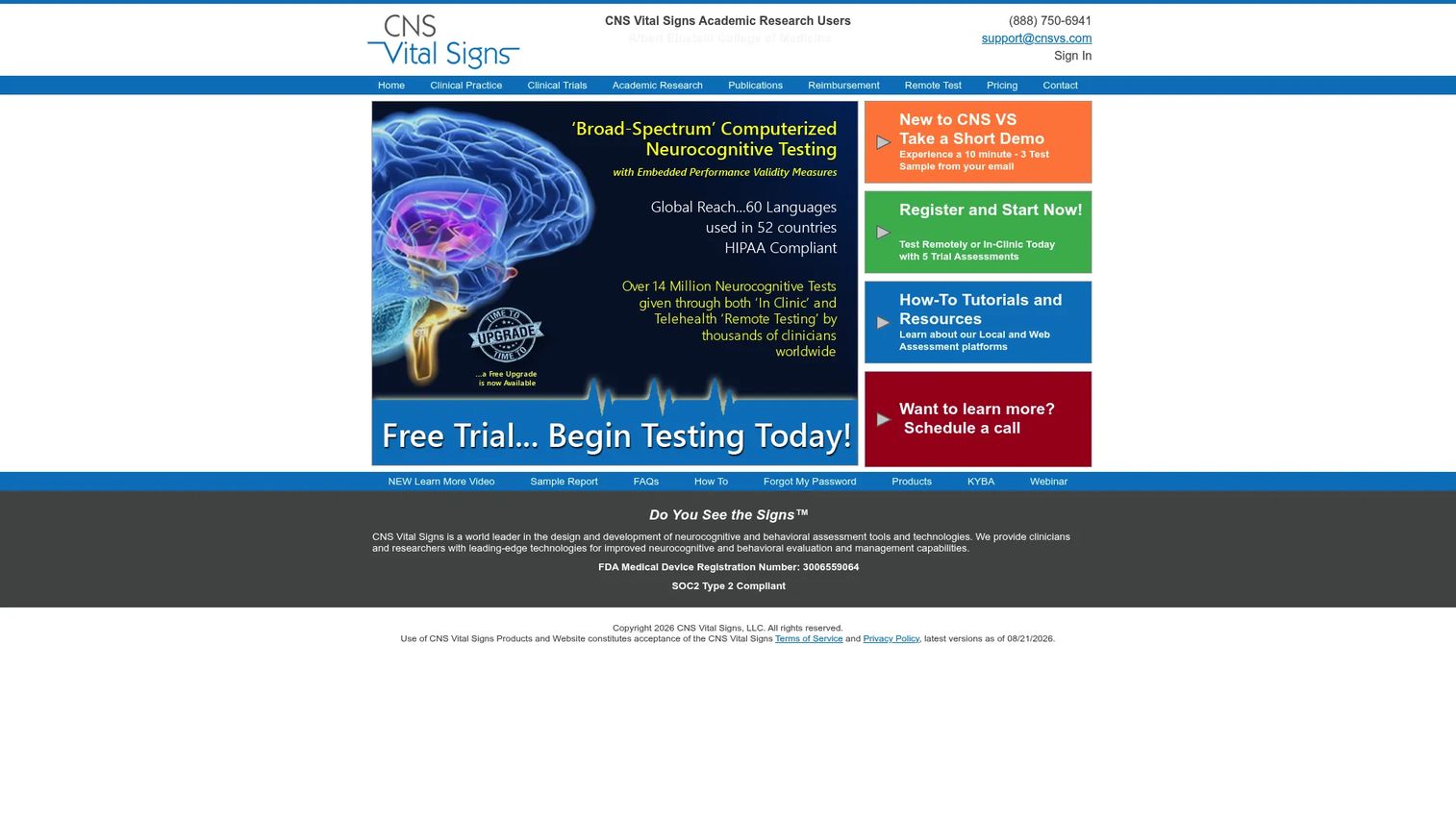
CNS Vital Signs is computerized neurocognitive and behavioral assessment software for clinicians and researchers. It delivers standardized testing across multiple cognitive domains, generates automated real-time reports, and supports longitudinal graphing for treatment tracking. Telemedicine-enabled testing, EMR export, performance validity indicators, and over 50 clinical rating scales are included. Five fully functional assessment administrations are provided for trial and training purposes.
Best for: Clinics, hospitals, and research teams needing objective computerized neurocognitive assessment with immediate reporting, longitudinal monitoring, and EMR integration.
Key features
- Multi-domain computerized neurocognitive assessment
- Automated real-time reports and longitudinal graphing
- Telemedicine-enabled testing
- Export to EMR, Excel, or databases
- Performance validity indicators and 50+ clinical rating scales
Why choose CNS Vital Signs: CNS Vital Signs earns its place when a specialist team needs computerized domain results within a clinical workflow, including longitudinal tracking and EMR integration. It requires trained interpretation and appropriate patient selection for accurate results.
CNS Vital Signs pricing: Single assessment sessions cost $35 each. Volume packs are available: 10 sessions for $350, 25 for $850, 50 for $1,650, and 100 for $3,000. Volume discounts apply for larger purchases.
Considerations when choosing neurodiversity cognitive assessment software
Match the tool to the decision
Start with the decision your organization must make after the assessment, not with a feature checklist. A clinical testing platform, a school assessment system, and a workplace profiler can all produce reports, but they answer different questions. Buying the wrong category creates work rather than resolving it.
Separate screening from diagnosis
State this clearly before procurement: Screening identifies whether further assessment may be appropriate. Diagnosis requires a qualified process that considers history, context, and professional judgment. No software in this list independently establishes a diagnosis of ADHD, autism, dyslexia, or any other neurodevelopmental condition.
Check accessibility before you commit
Ask vendors for evidence of accommodations across reading load, timed tasks, sensory demands, device compatibility, remote supervision options, language availability, and assistive technology support. A platform that creates barriers for the population it is meant to assess defeats its purpose.
Evaluate reporting and actionability
A score without a clear next step creates administrative overhead. Review sample reports before procurement and confirm that outputs support referrals, support plans, learning interventions, or workplace conversations, depending on your use case.
Establish data governance before launch
Assessment data is sensitive. Confirm consent flows, role-based access, retention periods, data hosting location, and who owns interpretation. For workplace programs, keep employment decision making completely separate from self-disclosure and support data. Mishandling this creates legal exposure and damages trust with the people the program is meant to help.
Conclusion
The right tool here is the one that supports the specific decision your team needs to make. For clinical research and pharmaceutical studies, CANTAB and CNS Vital Signs are the strongest options for validated domain measurement. Creyos Health fits healthcare practices that need digital cognitive measurement and longitudinal monitoring. BrainFx suits occupational health and rehabilitation teams focused on return-to-work decisions.
For workplace support programs, Do-IT Profiler provides structured profiling and adjustment guidance at a per-licence cost. Cognassist serves education and training providers that need audit-grade inclusion evidence at scale. GL Assessment belongs in schools and multi-academy trusts that need cohort-level data across reasoning, literacy, and wellbeing. Pearson Clinical serves qualified practitioners who need access to a broader assessment portfolio. CogniFit is worth considering when cognitive training is part of the program alongside screening.
Before you finalize a shortlist: Ask each vendor for a sample report, accessibility documentation, a summary of data processing and consent workflows, and a clear explanation of how their outputs become a real support action. The answer to that last question separates tools that create reports from tools that change outcomes.
Start your journey with Guideflow today!
FAQs
Neurodiversity cognitive assessment software is digital software used by qualified professionals, schools, workplaces, or researchers to measure cognitive functions, organize screening data, identify support needs, or produce structured reports. The specific purpose varies widely: Some tools are designed for clinical research, others for workplace inclusion, and others for school learning support. The category does not describe a single type of product.
No software in this category independently establishes a diagnosis of ADHD, autism, dyslexia, or other neurodevelopmental conditions. Some tools support screening or contribute evidence to a broader assessment process, but diagnosis requires a qualified clinician, a full developmental and contextual history, and professional judgment. Software produces data; the diagnosis belongs to the qualified professional interpreting it.
Cognitive screening is shorter and narrower. It identifies whether someone may benefit from further assessment, but it does not characterize the full pattern of cognitive strengths and difficulties. A full neuropsychological assessment is broader, more contextual, and administered and interpreted by a qualified neuropsychologist. The outputs of a screening tool should inform a referral decision, not replace the clinical assessment that follows.
The answer depends on the assessment question. Common domains include attention, executive function, working memory, processing speed, language-related abilities, social cognition, and functional skills. A workplace profiler and a clinical research battery may both claim to assess "executive function," but the depth, validation, and norming population will differ significantly. Confirm that the tool's domain coverage matches the decision you need to support.
Yes, but the framing matters. Employers should use assessment tools to support voluntary self-disclosure, guide accommodation conversations, and improve inclusive workplace design. Assessment data should never be used to make hiring, performance management, or disciplinary decisions. According to Understood.org and The Harris Poll (2025), 51% of employed neurodivergent U.S. adults had requested a workplace accommodation, which signals both demand and the importance of getting this process right.
Schools should evaluate age range and normative data, accessibility for students with sensory or reading differences, report clarity for teachers and parents, the pathway from results to learning support actions, and whether the platform meets local regulatory or inspection requirements. A result that lives in a spreadsheet without a follow-up pathway does not help students.
Most platforms covered here offer browser-based or tablet-based delivery that can run remotely. The key variables are whether remote administration requires a supervisor, what the device and bandwidth requirements are, how the participant environment might affect results, and whether the platform's validity data was collected under remote or in-person conditions. Ask vendors directly about the evidence base for their remote delivery protocols.
Ask who will own implementation and interpretation, not just procurement. Ask for a sample report and confirm that the output connects to a real action your team can take. Ask about consent workflows, data retention, and hosting location. Ask whether the tool requires ongoing clinical oversight and whether your team has the capacity to provide it. Ask what happens when a result indicates that someone needs further assessment and confirm there is a referral pathway in place before you launch.