
A single missing bearing can stop a production line. So the maintenance team overstocks. Now you have cash frozen in shelves of parts that may sit untouched for three years.
That is the core tension of spare parts management. Understock a critical part and you eat unplanned downtime. Overstock and you tie up working capital in inventory that depreciates while it waits. Most teams solve this by guessing high, because a stockout feels more expensive than a full shelf.
The spare parts management market reflects how seriously operations teams now take this problem. It reached USD 1.02 billion in 2025 and is projected to hit USD 1.82 billion by 2030, a 12.3% CAGR, according to MarketsandMarkets (2025). Software held 67.8% of that market in 2025, per Grand View Research (2026).
The right spare parts management software sits between three decisions: how you control inventory, how you forecast irregular demand, and how tightly you connect maintenance, procurement, and inventory data. Get those three right and you cut both downtime and carrying cost at the same time. This guide walks through seven tools that do it in different ways.
What's inside
This guide is for maintenance leaders, operations managers, inventory planners, and procurement teams evaluating spare parts inventory management software. It is also useful for product managers studying how operations software gets bought.
We selected tools based on four criteria that separate real spare parts platforms from generic inventory apps:
- ERP and CMMS integration quality, not just feature checkboxes
- Replenishment controls like reorder points, min max levels, and low-stock alerts
- Demand forecasting that handles slow-moving and intermittent parts
- Procurement and multi-site workflows for transfers, approvals, and POs
No single tool wins every category. The best fit depends on whether your team leads with maintenance, finance, or dedicated inventory planning.
TL;DR
- Best for maintenance-led teams: eMaint connects work orders, PM schedules, and parts inventory in one CMMS.
- Best for forecasting and optimization: INFORM applies AI-supported planning to intermittent and slow-moving parts.
- Best for a dedicated spare-parts platform: Verdantis sits above your ERP or CMMS with purpose-built MRO logic.
- Best for practical CMMS parts operations: Fiix pairs QR scanning, vendor coordination, and a free tier.
- Best for ERP-standardized enterprises: SAP keeps material and purchasing workflows inside one system.
- Best for finance-led operations: Oracle NetSuite and Sage Intacct tie parts inventory to accounting and reporting.
What spare parts management software is
Spare parts management software is a system that tracks maintenance, repair, and operations (MRO) inventory, plans replenishment, and connects parts availability to work orders and procurement. It answers one operational question at every moment: do you have the right part, in the right place, at the right time, without holding more cash than you need to.
Unlike general inventory management software built for finished goods, a spare parts management system handles irregular, low-volume demand. A part might be pulled twice a year or once a decade, yet its absence stops a machine. That changes the math on safety stock, reorder points, and criticality.
Core capabilities of a parts management system include:
- Inventory tracking: real-time stock levels, locations, bins, and part lookup across storerooms
- Replenishment planning: min max levels, reorder points, and automated low-stock alerts
- Demand forecasting: methods tuned for intermittent, sporadic, and slow-moving parts
- Work-order linkage: parts reserved, issued, and consumed against maintenance jobs
- Procurement workflows: requisitions, approvals, RFQs, and purchase orders
- Analytics and control: cycle counts, audit trails, fill rate, and inventory accuracy dashboards
The strongest tools treat these as one connected loop. A work order consumes a part, stock drops below its reorder point, an alert fires, a requisition routes for approval, and a PO goes out, without anyone re-keying data between systems.
When to use spare parts management software
Prevent stockouts on critical parts
Downtime is the expensive failure mode. When a critical spare hits zero and the next delivery is two weeks out, the machine waits. Spare parts software prevents this with reorder points tied to lead time and consumption, plus low-stock alerts that fire before you run dry. Criticality ranking ensures the parts that stop production get tighter safety stock than the ones that do not.
Manage intermittent demand
Fast-moving retail SKUs follow predictable curves. Spare parts do not. A pump seal might sit for 18 months, then get pulled three times in a quarter. Standard forecasting overreacts to that noise, either overstocking or missing the next spike. Purpose-built demand forecasting uses methods designed for intermittent and sporadic demand, so you carry safety stock where the risk is real and free up working capital where it is not.
Coordinate maintenance, purchasing, and inventory
Parts data lives in three places at most companies: the maintenance team's work orders, the storeroom's inventory counts, and procurement's POs. When those systems do not talk, you get duplicate orders, emergency buys, and parts nobody can find. Spare parts software links work orders to inventory to procurement automation, so consumption triggers replenishment and approvals route without manual handoffs.
Spare parts management software comparison
The table below sorts tools by how directly they solve spare parts management, from maintenance-led CMMS platforms to dedicated MRO tools to ERP and finance suites. Use it to shortlist by team maturity: CMMS-led if maintenance owns parts, ERP-led if you are standardized on one enterprise system, dedicated if planning depth is the priority.
| # | Product | Best for | Key differentiator | Pricing | G2 rating |
|---|---|---|---|---|---|
| 1 | eMaint | Maintenance-led teams wanting parts and work orders together | Configurable CMMS with multi-site inventory control | From $69/user/mo | 4.5/5 |
| 2 | INFORM | Forecasting and optimization of irregular demand | AI-supported planning for spare parts | Custom quote | 4.6/5 |
| 3 | Verdantis | Dedicated spare-parts platform above ERP or CMMS | MRO360 plus master data governance | Custom quote | 4.7/5 |
| 4 | Fiix | Practical CMMS parts operations | QR scanning, vendor coordination, free tier | From $0 | 4.6/5 |
| 5 | SAP | Enterprises standardized on SAP | Native material and purchasing workflows in ERP | Custom quote | Not listed |
| 6 | Oracle NetSuite | Finance-led operations wanting unified data | Cloud ERP with inventory and procurement | Custom quote | 4.1/5 |
| 7 | Sage Intacct | Mid-market finance teams | Multi-entity accounting with inventory visibility | Custom quote | 4.3/5 |
Best 7 tools for spare parts management
1. eMaint

eMaint is a cloud-based CMMS and EAM platform that keeps parts inventory and maintenance work in one system. For teams where maintenance owns the storeroom, that single source of truth is the whole point. A technician pulls a part against a work order, stock updates in real time, and the reorder logic reacts without a separate inventory app.
The platform's strength is configurability. You can shape work order fields, PM schedules, and inventory views to match how your team actually works, then roll that across multiple sites. Multi-site inventory management gives you shared visibility and transfer workflows so a part sitting idle at one plant can cover a need at another.
Best for: maintenance teams that want inventory, work orders, and preventive maintenance managed in a single CMMS.
Key strengths
- Work order management linked to parts consumption
- Preventive maintenance scheduling with parts reservation
- Multi-site and global inventory control
- Configurable fields, views, and workflows
- Low-stock alerts and reorder points
Why choose eMaint: if your parts problem is really a maintenance problem, eMaint puts replenishment where the work happens. It fits teams that value configuration and PM linkage over standalone financial reporting.
eMaint pricing: Team starts at $69/user/mo and Professional at $85/user/mo, both billed per user. Enterprise pricing is a custom quote based on user count, contract length, and configuration.
2. INFORM
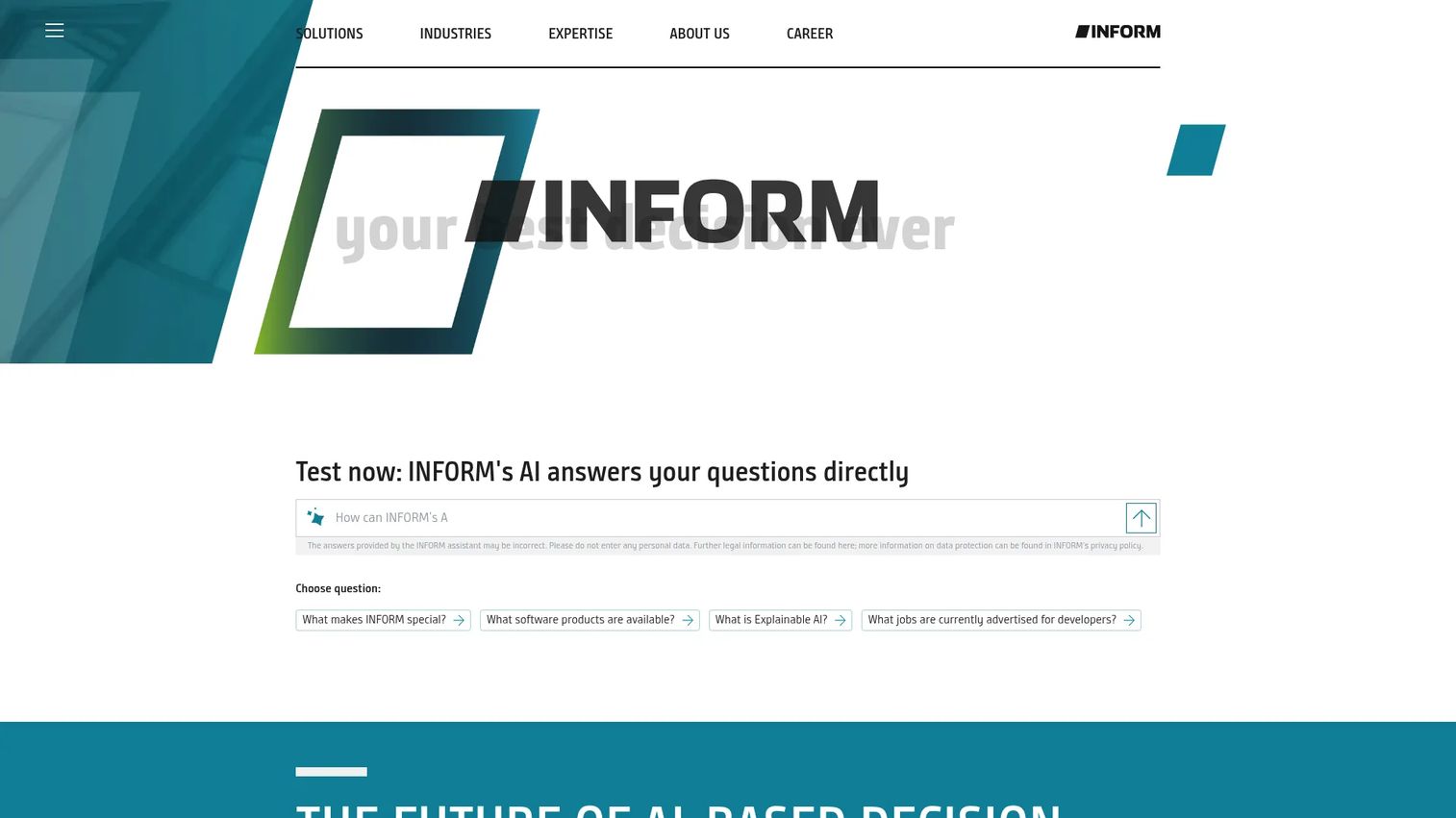
INFORM approaches spare parts as an optimization problem, not just a tracking one. Its AI and operations-research software plans and schedules complex processes, which maps well to the messy reality of intermittent parts demand. Rather than react to stockouts, INFORM models consumption patterns and recommends stock levels that balance availability against carrying cost.
This is the tool for teams that have outgrown simple min max rules. When you manage thousands of SKUs with sporadic demand, static reorder points either overstock or leave gaps. INFORM's real-time optimization adjusts to the pattern of each part, which is where the working capital savings live.
Best for: operations and after-sales teams that need forecasting and inventory optimization, not just a place to log stock.
Key strengths
- AI-supported decision-making for stock levels
- Process planning and scheduling for parts flow
- Real-time optimization and automation
- Forecasting tuned for irregular demand
Why choose INFORM: it fits teams whose main pain is planning quality across a large, irregular parts catalog. If you already have a system of record and need smarter replenishment logic on top, this is the specialist.
INFORM pricing: INFORM does not publish public pricing. Plans are quote-based, so you will work with their sales team to scope by process and scale.
3. Verdantis
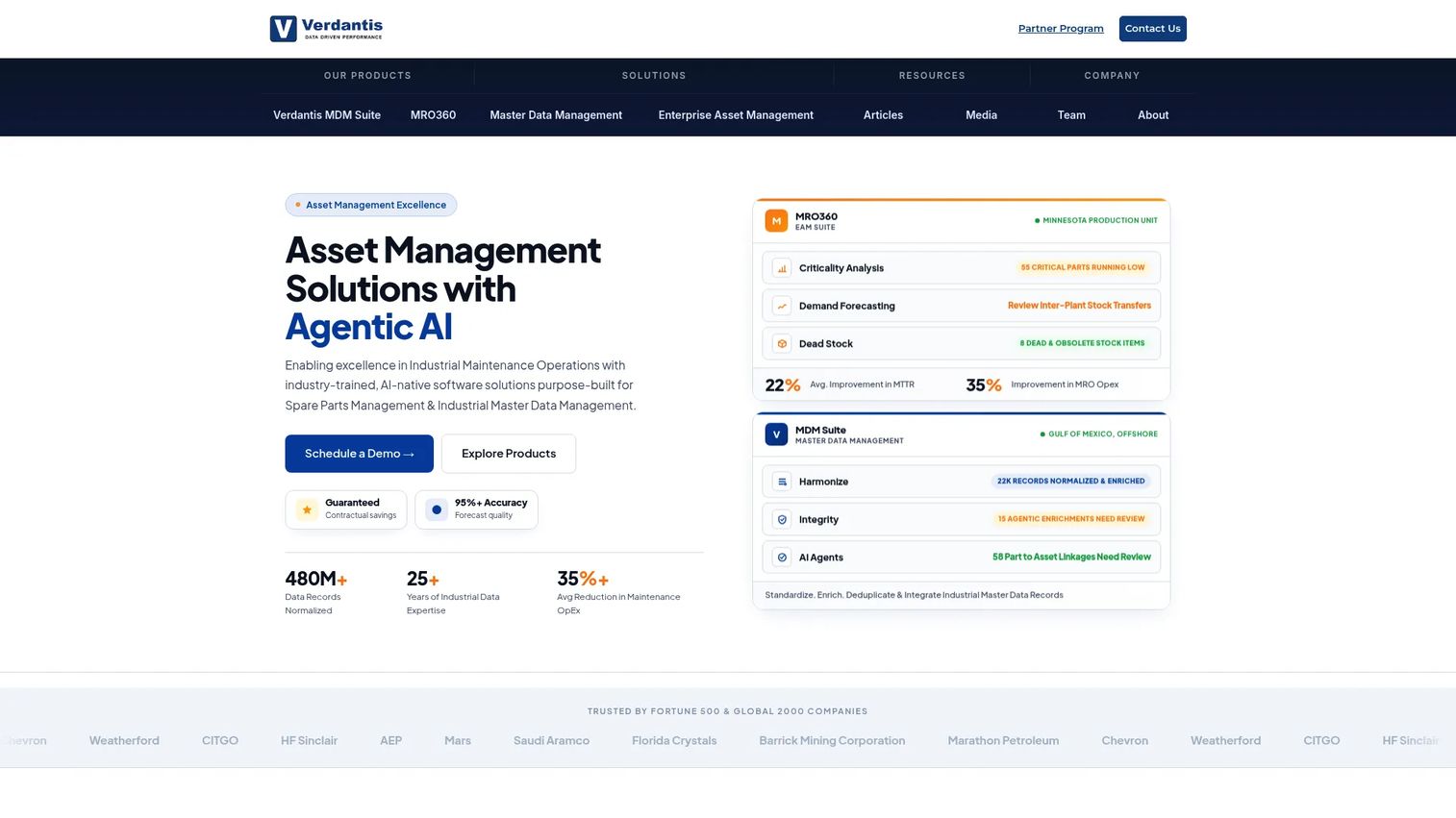
Verdantis builds a dedicated spare-parts layer that sits above your ERP or CMMS rather than replacing it. Its MRO360 product handles spare parts, inventory, work orders, and forecasting, while its MDM Suite cleanses, standardizes, and governs the master data underneath. That combination matters because most parts problems start with dirty data: duplicate part numbers, inconsistent descriptions, and records nobody trusts.
For asset-intensive enterprises, Verdantis targets the decision layer. It uses AI agents and deep ERP and CMMS integration to feed better forecasting for sporadic demand and cleaner inventory decisions. You keep your existing system of record and add purpose-built MRO logic on top.
Best for: large asset-intensive organizations that want a dedicated spare-parts platform with master data governance and deeper decision support.
Key strengths
- MRO360 for spare parts, inventory, work orders, and forecasting
- MDM Suite for cleansing, standardization, and enrichment
- AI agents for master data and maintenance workflows
- ERP and EAM integrations
- Forecasting for sporadic, intermittent demand
Why choose Verdantis: if your ERP or CMMS holds the transactions but the parts data is a mess, Verdantis fixes the layer that everything else depends on. It suits mature teams ready to invest in data quality and MRO optimization.
Verdantis pricing: Verdantis does not list public pricing. MRO360 and the MDM Suite are priced by number of plants, records under management, and modules, so pricing comes through sales.
4. Fiix
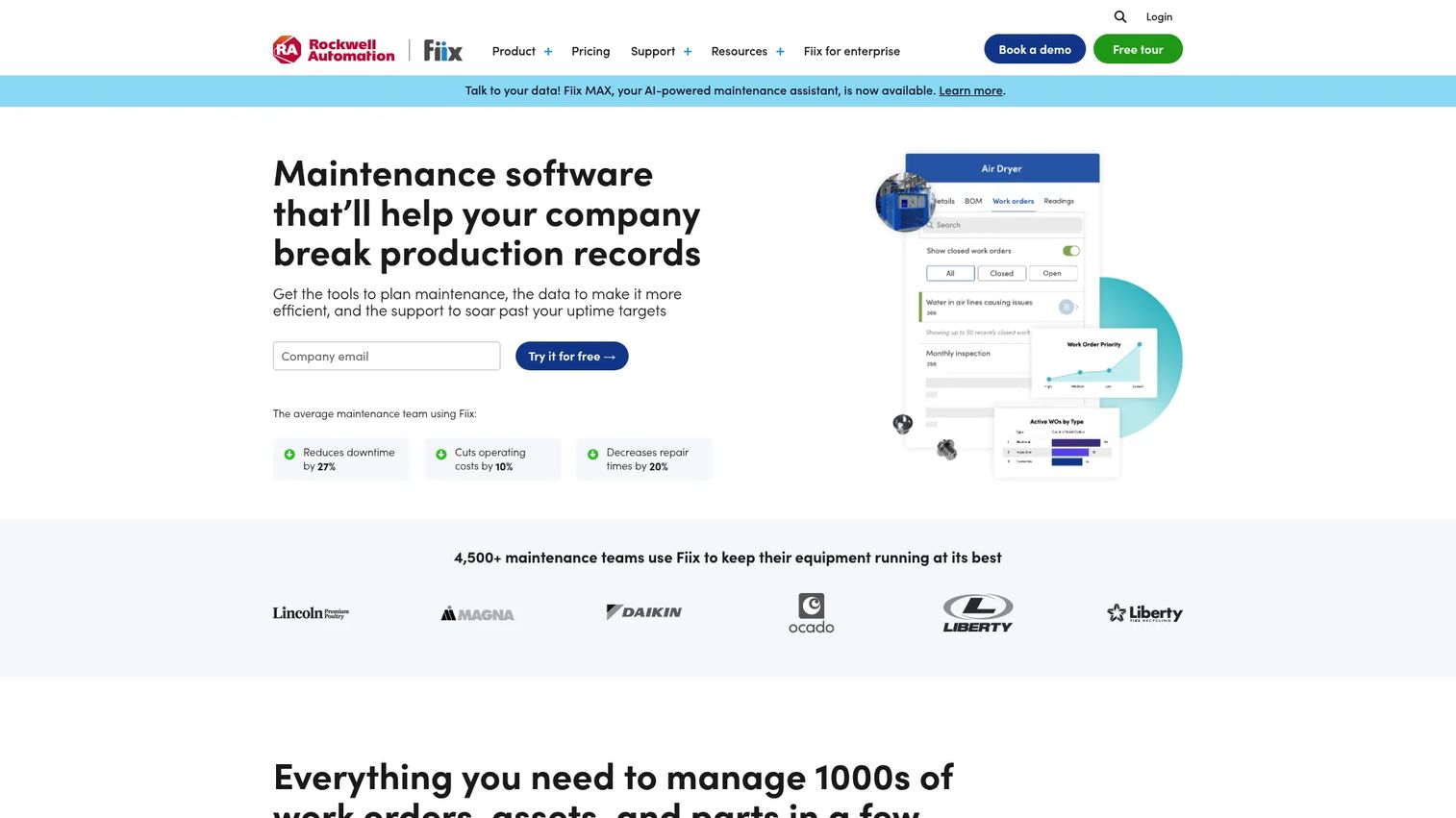
Fiix is a cloud CMMS with practical parts operations built in. Where it earns its place is the day-to-day mechanics: QR scanning to pull parts fast, vendor coordination for purchasing, and cross-facility sharing so stock moves where it is needed. Its mobile app, including offline mode, keeps technicians updating inventory from the floor rather than back at a terminal.
Fiix connects inventory and parts management to work orders, asset records, and reporting, then syncs with ERP systems so procurement and finance stay aligned. Fiix Foresight adds analytics on top. The free tier makes it a low-risk starting point for smaller teams testing a CMMS-led approach to spare parts software.
Best for: maintenance teams that want hands-on parts workflows, mobile scanning, and a free entry point.
Key strengths
- Inventory and parts management with QR scanning
- Work order and asset management
- Vendor coordination for purchasing
- Offline mobile maintenance app
- ERP integration and reporting analytics
Why choose Fiix: it balances practical maintenance features with a genuine free tier, so you can validate the workflow before committing budget. Good fit for teams that live on the shop floor and want mobile-first parts operations.
Fiix pricing: Free plan at $0, Basic at $45 per user per month, and Professional at $75 per user per month. Enterprise is custom pricing, and a Lite License for operator access is a contact-for-pricing add-on.
5. SAP

SAP manages spare parts inside its broader enterprise system rather than as a standalone tool. If your organization already runs on SAP, parts inventory, material master data, and purchasing all live in the same place as finance and production. That native connection removes the integration work other approaches require, because there is no second system to sync.
The trade-off is scope. SAP is built for enterprise-wide standardization, so parts management is one workflow inside a large platform. Teams that want it get scalable material and purchasing workflows, tight financial alignment, and the ability to run spare parts at global scale alongside everything else the business tracks.
Best for: large enterprises already standardized on SAP that want parts management inside the ERP stack.
Key strengths
- Business applications spanning material and purchasing workflows
- Native inventory inside the ERP system of record
- Business AI for process automation
- Enterprise-scale data across finance and operations
Why choose SAP: the case is consolidation. When parts data already sits next to your material master and procurement, keeping it there avoids sync headaches. Best suited to enterprises that treat spare parts as one process among many.
SAP pricing: SAP does not publish a single public price for parts management. Product pages route to request-a-quote and demo flows, so pricing is scoped through SAP directly.
6. Oracle NetSuite
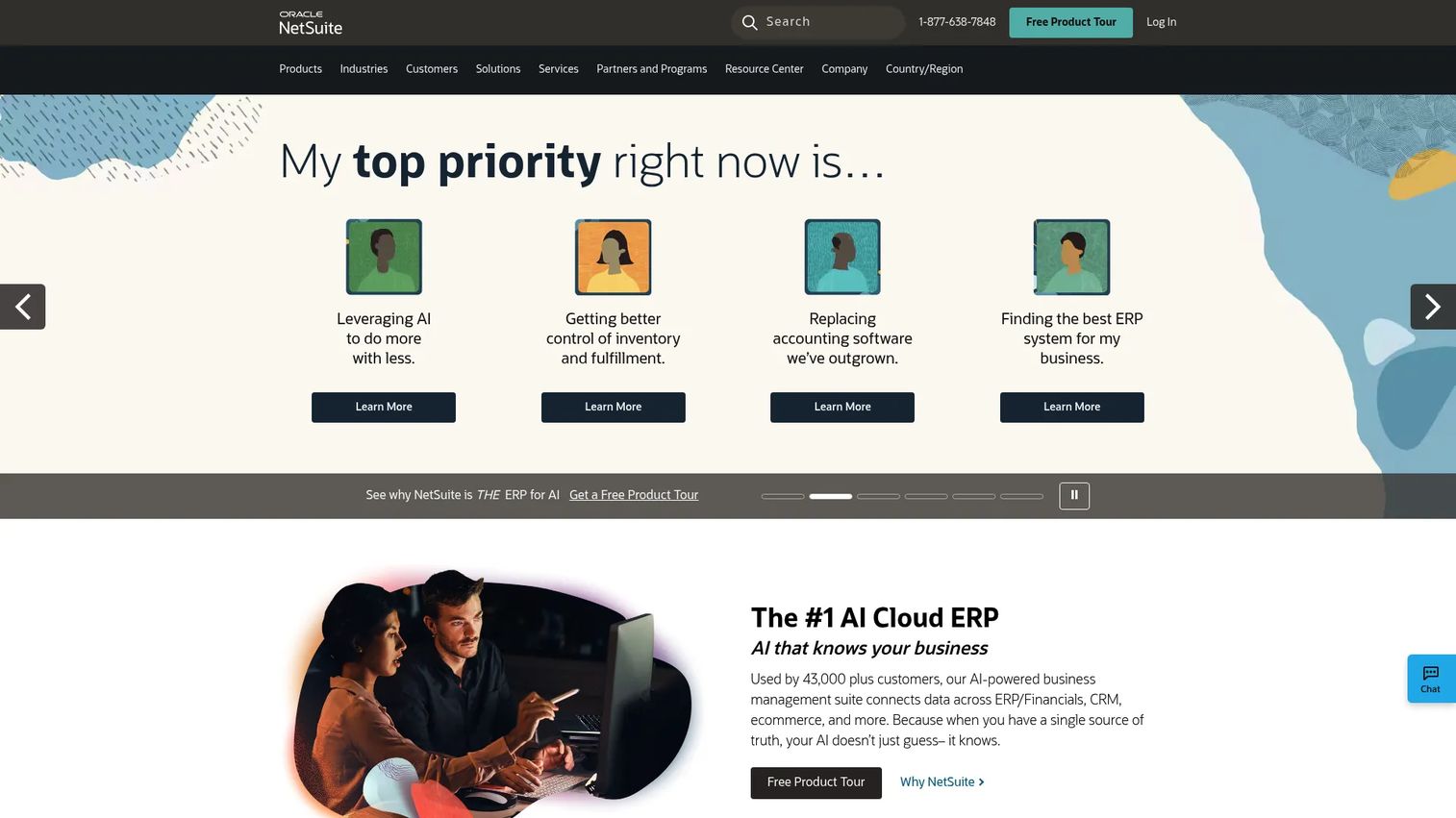
Oracle NetSuite is a cloud ERP suite that ties inventory and procurement to accounting and operations in one system. For finance-led teams, that alignment is the draw. Parts inventory shows up in the same platform as your financials, so working capital tied up in spares is visible to the people who manage cash, not buried in a separate maintenance tool.
NetSuite handles inventory, warehouse, and order management with multi-entity visibility, which suits organizations running parts across several locations or business units. It is less a maintenance planning tool and more a way to keep parts inventory connected to broader financial and inventory processes across the company.
Best for: finance-led operations that want parts inventory connected to accounting, procurement, and multi-entity reporting.
Key strengths
- Cloud ERP with global financial functionality
- Inventory, warehouse, and order management
- Multi-entity inventory visibility
- Procurement and accounting alignment
Why choose Oracle NetSuite: if finance owns the inventory conversation and you value one system for cash and stock, NetSuite fits. It leans toward financial control rather than deep maintenance planning.
Oracle NetSuite pricing: NetSuite does not publish public pricing on its accessible pages. Pricing is scoped through Oracle based on modules, users, and configuration.
7. Sage Intacct
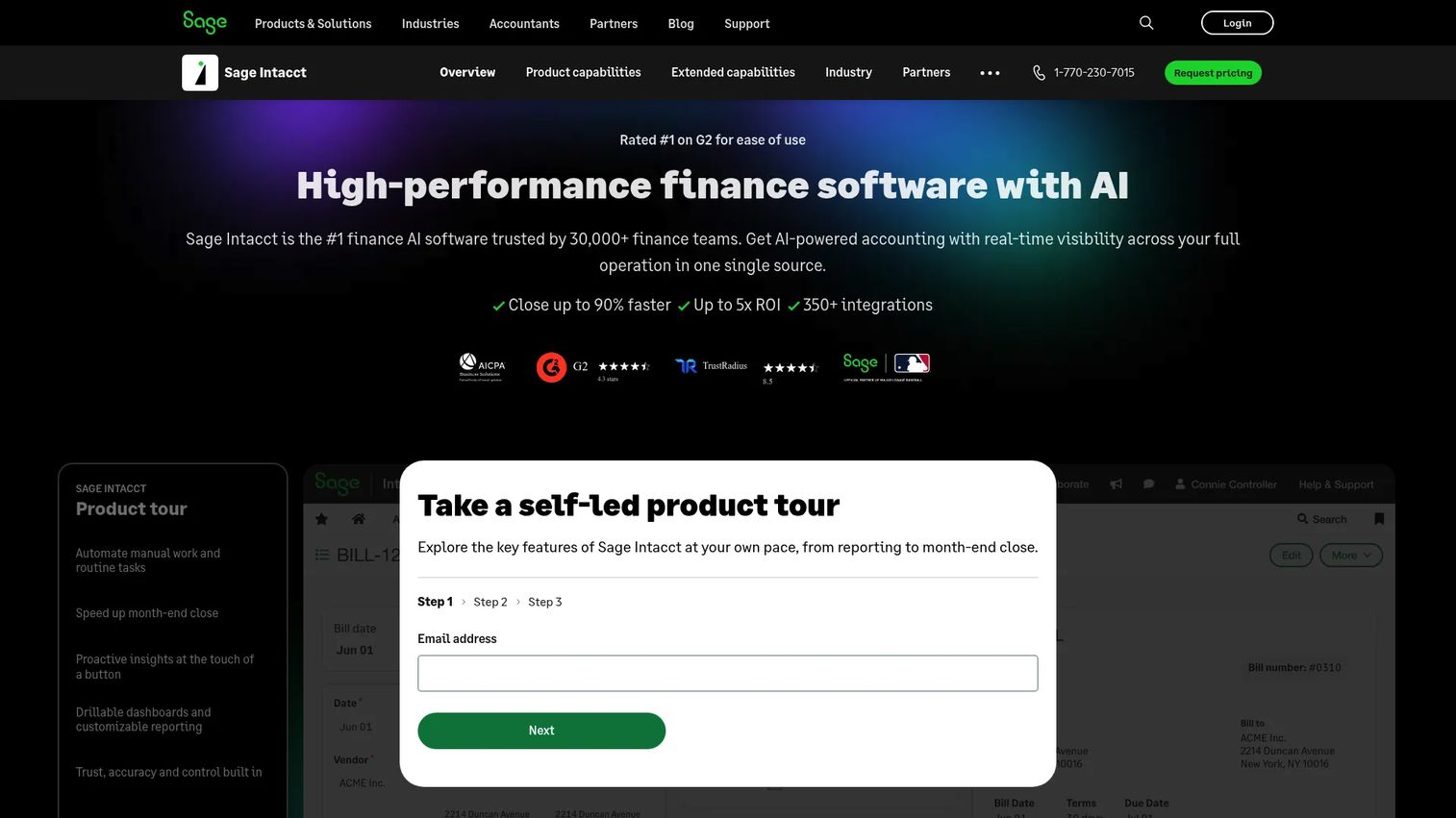
Sage Intacct is cloud financial management software with inventory visibility built for finance teams. Its strength is accounting depth: multi-entity accounting, shared dashboards, and real-time reporting that keep parts inventory value tied to the books. For mid-market organizations, that means replenishment oversight and inventory accuracy sit inside the same system as financial control.
This is a finance-first choice, not a maintenance planning platform. If your priority is accounting-linked control over inventory value, reporting, and multi-entity oversight rather than work-order-driven parts planning, Sage Intacct delivers that with less operational overhead than a full ERP.
Best for: mid-sized finance teams that need accounting-linked inventory control and reporting, not deep maintenance planning.
Key strengths
- Multi-entity accounting with inventory visibility
- Shared dashboards and real-time reporting
- Replenishment and inventory value oversight
- AP automation for procurement
Why choose Sage Intacct: it fits finance teams at mid-market scale that want strong reporting and multi-entity control. Pair it with a CMMS if you also need maintenance planning depth.
Sage Intacct pricing: Sage Intacct uses customized pricing and does not display a public price. You contact sales for a quote tailored to entities, users, and modules.
What to look for before you buy
ERP and CMMS integration
Feature lists lie. Two tools can both claim ERP integration and deliver wildly different results. What matters is sync quality: does parts consumption in the maintenance system update inventory and trigger procurement without manual re-keying? Ask vendors how the integration handles part master data, whether it is real-time or batch, and what breaks when a part number changes. Weak sync creates the exact duplicate-order and stockout problems you bought the tool to fix.
Replenishment controls
Look past generic min max levels. Good replenishment logic ties reorder points to actual lead time and consumption, not a static number someone set once. Check whether low-stock alerts account for open POs and in-transit stock, so you do not double-order. The best systems let you set different rules for critical versus non-critical parts.
Forecasting for slow-moving parts
This is the differentiator most buyers underweight. Standard forecasting assumes steady demand and falls apart on parts pulled twice a year. Ask whether the tool uses methods built for intermittent and sporadic demand. Without them, you will overstock slow movers and still get caught short on the parts that matter.
Procurement workflow automation
Evaluate the full chain: requisitions, approvals, RFQs, and PO generation. Can approvals route by dollar threshold? Does the system support vendor coordination and emergency buys without breaking the audit trail? Procurement automation is where manual effort and errors pile up, so treat it as a first-class buying criterion, not an afterthought.
Multi-site visibility
If you run more than one location, native parts transfer workflows and shared multi-site inventory visibility are non-negotiable. You want to see a part idle at one plant before you order a new one for another. Confirm transfers, shared visibility, and storeroom controls are built in, not bolted on through spreadsheets.
Reporting and inventory accuracy
Cycle counts, audit trails, and analytics dashboards keep the data trustworthy. Verify the tool supports cycle counts rather than only full physical counts, and check that it tracks the KPIs you care about: fill rate, stockout rate, and inventory value. Inventory accuracy is the foundation every other feature depends on.
Conclusion
The right spare parts management software depends on who owns the parts problem at your company.
If maintenance owns it, a CMMS-led tool like eMaint or Fiix keeps work orders and inventory in one place, with Fiix offering a free tier to start. If planning quality is the pain, INFORM brings forecasting built for irregular demand, and Verdantis adds a dedicated MRO layer with master data governance on top of your existing systems. If you lead with finance or already run one enterprise system, SAP, Oracle NetSuite, or Sage Intacct keep parts inventory connected to procurement and the books.
Your next step: decide whether maintenance, finance, or dedicated planning leads. That single choice narrows seven options to two or three. From there, pressure-test integration sync quality and intermittent-demand forecasting in a real trial, because those two capabilities separate tools that reduce downtime and working capital from tools that just track stock.
FAQs
Spare parts management software tracks MRO inventory, plans replenishment, and links parts availability to work orders and procurement. It handles the irregular, low-volume demand typical of spares, using reorder points, low-stock alerts, and forecasting to keep critical parts available without tying up excess working capital. Core workflows include inventory tracking, replenishment, work-order linkage, and procurement automation.
For maintenance-led teams, a CMMS inventory module is often enough. It links parts to work orders and PM schedules, handles reorder points, and fires low-stock alerts. A CMMS starts to fall short when you manage thousands of intermittent SKUs across many sites, or need advanced demand forecasting. At that scale, a dedicated spares management software layer or optimization tool adds planning depth a standard CMMS does not.
Use ERP when you are already standardized on one enterprise system and want parts inventory, purchasing, and finance in the same place. SAP or Oracle NetSuite make sense when consolidation and financial alignment matter more than specialized planning. Choose dedicated spare-parts software when intermittent-demand forecasting and MRO-specific logic are the priority, and you are willing to integrate that layer with your ERP.
It reduces downtime by keeping critical parts available. Reorder points tied to lead time and consumption trigger replenishment before stock runs out, and low-stock alerts flag risk early. Work-order linkage means the parts a maintenance job needs are reserved and tracked, so technicians are not waiting on a shelf that turned out to be empty. Criticality ranking focuses safety stock where a stockout would stop production.
Forecasting logic built for sporadic demand is the key feature. Standard methods assume steady consumption and fail on parts pulled a few times a year. Look for criticality classification, so high-risk parts get tighter safety stock, and safety stock calculations that account for lead-time variability. Together these prevent overstocking slow movers while protecting availability on the parts that stop machines.
Multi-site teams rely on shared multi-site inventory visibility and native parts transfer workflows. Before ordering new stock, they check whether the part sits idle at another location and transfer it instead. Good systems show real-time stock across all storerooms, support transfer requests with approvals, and apply storeroom controls so inventory accuracy holds across sites. This cuts both emergency buys and duplicate orders.
Track fill rate to measure how often you have the part when a job needs it, and stockout rate to catch availability gaps. Monitor total inventory value to control working capital, and emergency buys as a signal that planning is reactive. Cycle count accuracy tells you whether the system data matches the shelf, which underpins every other metric. Together these show whether you are balancing availability against carrying cost.
It depends on integration complexity and data cleanup. A CMMS-led tool with a free tier can be running in weeks for a single site. Full ERP-integrated deployments across multiple sites take months, largely because of master data work: deduplicating part numbers, standardizing descriptions, and validating counts. The cleaner your existing parts data, the faster any tool goes live, which is why data quality often drives the timeline more than the software itself.