You changed the pricing on one enterprise deal. Someone approved a discount over Slack. The offer went out with the wrong terms. Nobody caught it until the customer flagged it.
That is not a rare event. It is what happens when offers live in spreadsheets, email threads, and one-off approvals. The friction is not the pricing itself. It is the lack of a system connecting who approved what, what was actually sent, and whether it moved revenue.
The global offer management market hit $3.8 billion in 2025 and is projected to reach $8.9 billion by 2034, growing at 11.2% annually, according to MarketIntelo (2025). That growth is a signal. Revenue teams are done treating offer execution as a manual chore.
Good offer management software turns pricing, discounts, promotions, and approvals into infrastructure. It gives you governance, visibility, and a clean loop between offer changes and outcomes. This guide breaks down the category and the four tools worth evaluating for 2026.
What's inside
This guide is for founders, revenue leaders, RevOps owners, and pricing teams who want offer execution to stop being chaotic. Here is what we cover:
- A clear definition of offer management software and systems
- Why offer execution affects revenue optimization for SaaS teams
- Core features to check before you buy, including approval workflows and offer analytics
- A side-by-side comparison of four tools with pricing and G2 ratings
- Deep-dive breakdowns of each platform by use case
We selected tools based on feature depth, governance controls, integration options, and how well each fits a specific commercial workflow.
TL;DR
Short on time? Here are the quick decisions:
- Best for recruiting offer workflows: Pinpoint handles templates, approvals, e-signatures, and live offer tracking inside an applicant tracking system.
- Best for AI-driven hiring operations: MokaHR runs cloud-based offer management with recruitment automation and workflow analytics.
- Best for complex promotion logic: Talon.One gives you API-first rule building for promotions, loyalty, and dynamic pricing at scale.
- Best for programmable promotions: Voucherify offers incentive APIs, coupons, referrals, and bundling for marketing-friendly teams.
What is offer management software
Offer management software is a category of tools that help teams create, launch, track, and optimize commercial offers across pricing, packaging, promotions, and approvals from a single system.
Instead of scattering offer logic across spreadsheets and inboxes, it centralizes the entire offer lifecycle. That includes building an offer, routing it through approval workflows, sending it, and measuring what happened after.
The category is often described as an execution-focused view: emphasizing workflows, integrations, and governance across the offer lifecycle.
Core capabilities most buyers look for include:
- Dynamic pricing and promotion rule engines
- Discount management with governance controls
- Approval workflows for offer sign-off
- Offer analytics and reporting on what drove revenue
- Segmentation and offer personalization by customer
- CRM integration and ERP integration
- Offer automation to reduce manual steps
- A/B testing for offer variants
Some buyers confuse this category with CPQ. There is overlap. CPQ focuses on configuring and quoting products, while offer management is broader, covering promotions, campaigns, and post-send tracking alongside quoting.
Why offer management matters for SaaS revenue teams
SaaS revenue is recurring, which means every offer decision compounds. A sloppy discount does not just cost you margin on one deal. It sets a precedent that erodes pricing power across a whole segment.
Manual offer execution creates three quiet problems. Approvals slow deals down. Discount governance breaks, so reps hand out margin without oversight. And nobody can see which offers actually drove conversion, expansion, or retention.
Better offer execution changes the math. Here is the feature-to-outcome mapping:
| Capability | Revenue outcome |
|---|---|
| Approval workflows | Faster sign-off, fewer deal delays |
| Discount management | Protected margin, consistent pricing |
| Offer analytics | Clear line from offer to conversion and CLV |
| Offer personalization | Higher relevance, better segment conversion |
| Offer tracking | Visibility into what was sent and what worked |
For a founder trying to build repeatable GTM, this is infrastructure for revenue quality. It removes confusion from the buyer's side and reduces the number of deals that route through you personally. That is the difference between growth that holds up quarter over quarter and growth that spikes on one-off heroics.
Core features to look for
Treat this as a buyer checklist, not a feature dump. When you evaluate offer management software, verify each of these against your actual commercial workflow.
- Dynamic pricing: Can the tool adjust prices by segment, volume, or rule, not just a single fixed number?
- Promotion rules: Does it support conditional logic, so promotions trigger on the right criteria?
- Discount management: Are there guardrails and caps that stop margin leakage?
- Offer analytics: Can you see which offers converted, and tie that back to revenue?
- Offer automation: Does it remove manual steps in building and sending offers?
- Segmentation: Can you target offers by persona, tier, industry, or behavior?
- Approval workflows: Are sign-offs structured, tracked, and auditable?
- CRM integration and ERP integration: Does offer data flow into your systems of record?
- A/B testing: Can you test offer variants and measure lift?
- Bundling: Can you package products and price them as a unit?
The tools that matter clear most of this list. The ones that do not force you to stitch offers together manually, which is the exact problem you are trying to escape.
When to use offer management software
Not every situation calls for a dedicated platform. Here are the moments when it earns its place.
Launch new pricing without chaos
When you roll out new pricing or packaging, you need every offer to reflect the change instantly and consistently. Offer management software propagates pricing updates across teams and channels so reps never quote the old model.
Manage discounts with governance
If reps hand out discounts without oversight, margin leaks quietly. Use offer management software to set caps, route exceptions through approval workflows, and keep a record of who approved what.
Support segment-specific offers
Different segments respond to different offers. When you run offer personalization by tier, region, or industry, the software handles segmentation and keeps each variant tracked and measurable.
Standardize approvals across the team
When offers route through Slack and email, sign-off is invisible and inconsistent. A system-level approval workflow makes offer governance repeatable, which matters most as your team grows past the founder-in-every-deal stage.
Comparison table
Here is a side-by-side view of the four tools in this guide. Pricing and ratings reflect verified values where publicly available.
| # | Product | Best for | Key differentiator | Pricing | G2 rating |
|---|---|---|---|---|---|
| 1 | Pinpoint | Recruiting offer workflows | ATS-native templates, approvals, e-signatures | Custom quote | 4.7/5 |
| 2 | MokaHR | AI-driven hiring operations | Cloud-based recruitment and HR automation | Custom quote | N/A |
| 3 | Talon.One | Complex promotion logic | API-first promotion and loyalty engine | Custom pricing | 4.5/5 |
| 4 | Voucherify | Programmable promotions | Incentive APIs, coupons, referrals, bundling | From $1300/month | 4.6/5 |
Best 4 offer management tools for 2026
1. Pinpoint
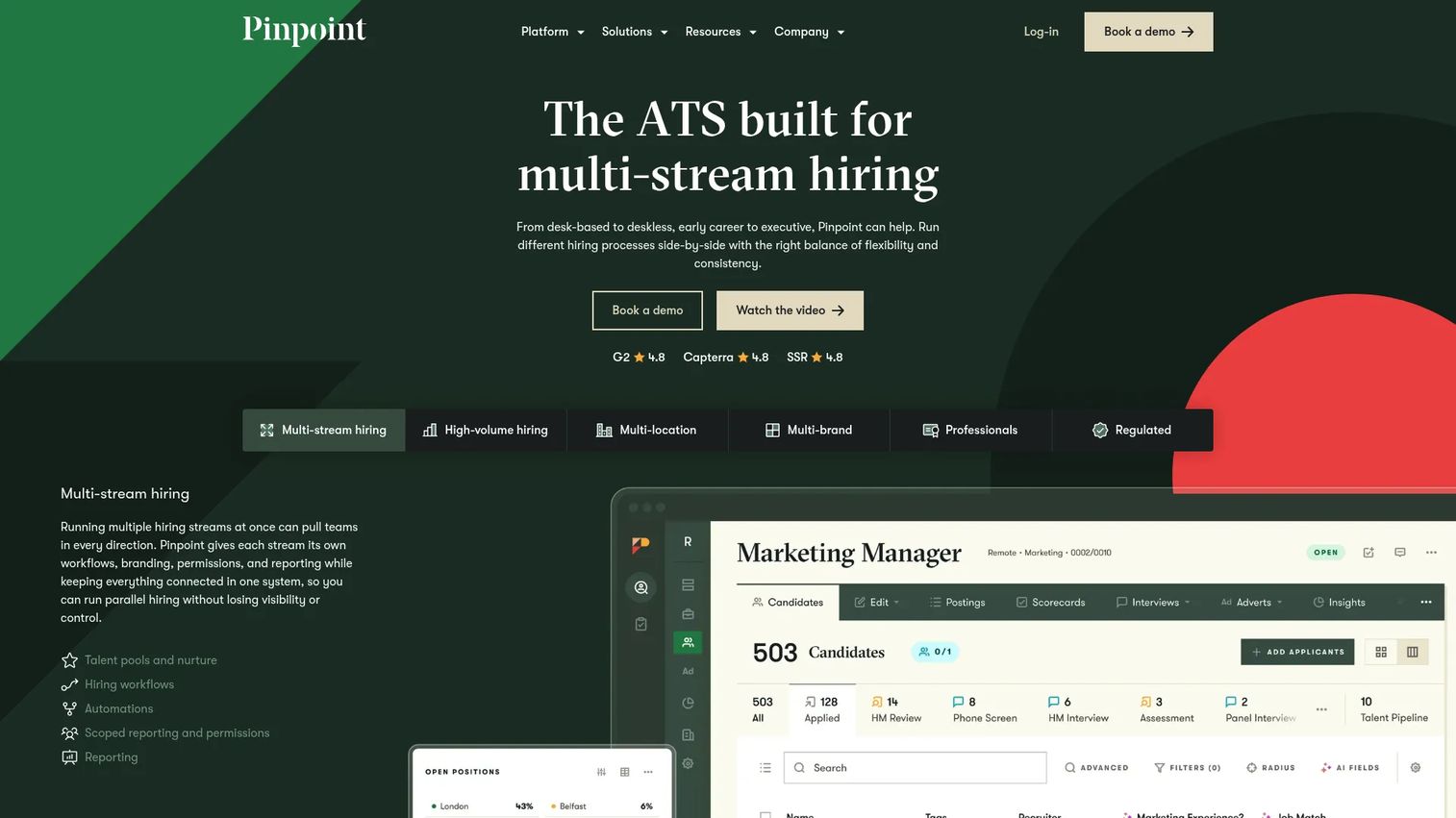
Pinpoint is applicant tracking software with strong offer management built for recruiting teams. It handles multi-stream hiring across planning, sourcing, engagement, selection, and onboarding, with offer creation and tracking woven into the hiring flow.
For recruiting, the offer is the closing document. Pinpoint gives you branded offer templates, structured approvals, e-signatures, and live offer tracking so hiring managers always know where a candidate stands.
Best for: Mid-market and enterprise recruiting teams managing multiple hiring streams in one applicant tracking system.
Key strengths
- Branded careers site and application forms
- AI Candidate Companion, AI Candidate Filters, AI Hiring Copilot
- Interview scheduling, scorecards, and onboarding
- Offer management with approvals and e-signatures
- Live offer tracking across the hiring pipeline
Why choose Pinpoint: If your offers are job offers, Pinpoint keeps offer templates, approvals, and tracking native to the same system where you run hiring, so nothing falls through the cracks.
Pinpoint pricing: Pinpoint uses quote-on-request pricing tailored to organization size and hiring needs. No fixed price is published on the site.
2. MokaHR

MokaHR is an AI-powered HR SaaS platform for recruiting and human resources management. Its offer management sits inside a broader recruitment and people-management suite, with workflow automation across the hiring lifecycle.
The pull here is campaign-style execution and AI-driven workflow. MokaHR handles recruitment management, people management, and the analytics that connect hiring activity to outcomes, with offer steps automated inside the flow.
Best for: Mid-market and enterprise teams that want unified hiring and HR workflows with AI-driven automation.
Key strengths
- Recruitment management and pipeline automation
- People and HR management in one suite
- Workflow automation across hiring steps
- Analytics on recruitment activity
- AI-driven offer and hiring operations
Why choose MokaHR: If you want offer management inside a broader AI-powered HR system rather than a standalone recruiting tool, MokaHR connects offers to the wider people workflow.
MokaHR pricing: MokaHR does not publish public pricing on its site. Reach out to the vendor for a quote based on your team size and requirements.
3. Talon.One
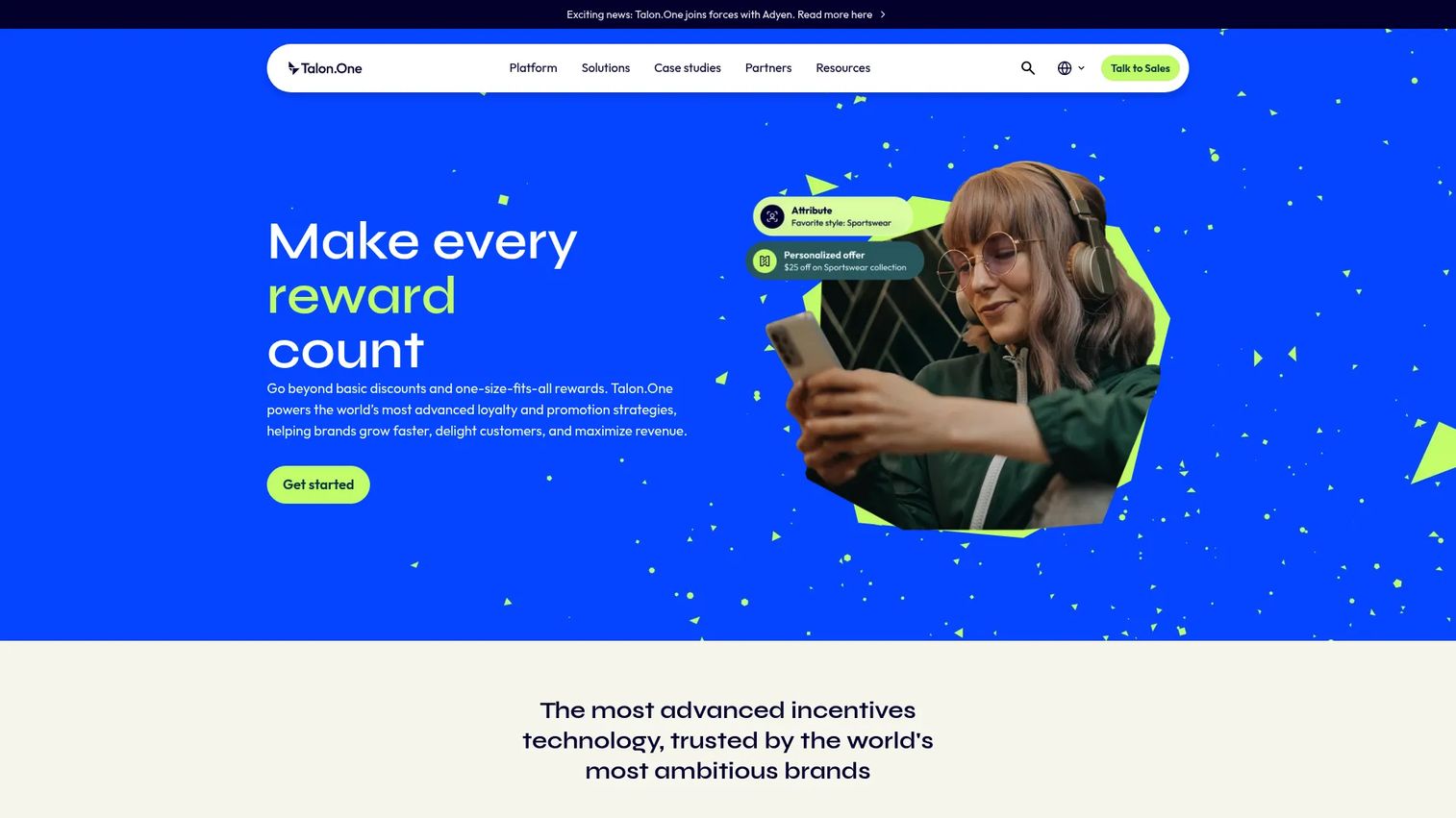
Talon.One is an enterprise incentives engine for loyalty, promotions, and gamification. It gives you API-first control over promotion logic, which makes it a strong fit when your offers need real rule complexity.
The differentiator is flexibility. Talon.One lets you build intricate promotion rules, personalized promotions, and dynamic pricing logic through an API, then execute them across channels. Its Predict capability layers AI-driven analytics onto offer targeting.
Best for: Large brands that need a flexible platform for promotions, loyalty, and incentives at scale.
Key strengths
- Enterprise loyalty management
- Offer management and execution
- Personalized promotions and rule logic
- Talon.One Predict for AI-driven targeting
- API-first control for complex offers
Why choose Talon.One: When your promotions demand deep conditional logic and API-level control rather than a template builder, Talon.One handles complexity that simpler tools cannot.
Talon.One pricing: Pricing is customized based on data volume. The entry Starter plan requires at least 500k coupons, with Professional and Enterprise tiers available on request. No public numeric price is shown.
4. Voucherify
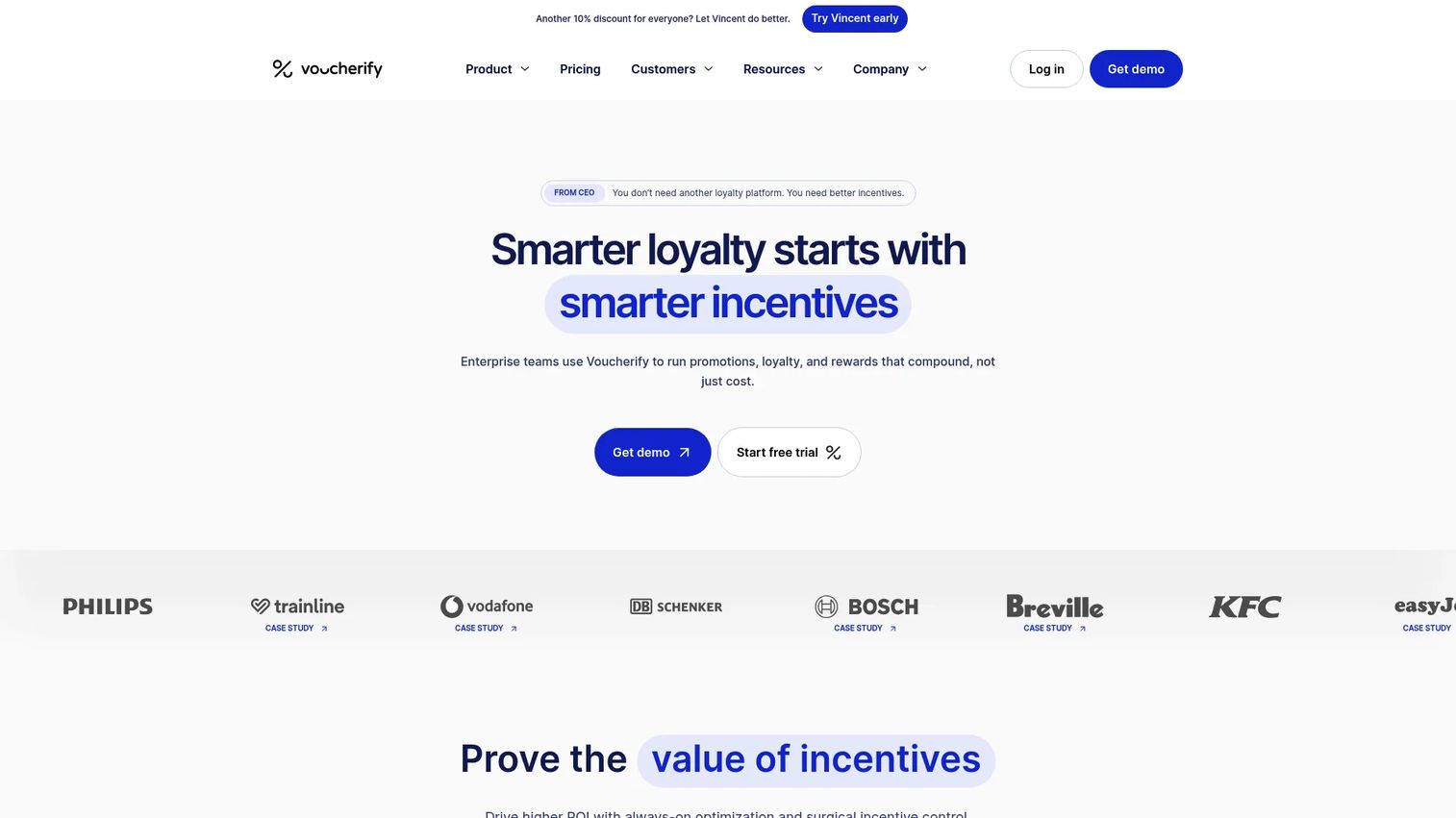
Voucherify is API-first incentive optimization software for coupons, promotions, loyalty, referrals, gift cards, and bundling. It is built for teams that want programmable promotions without heavy engineering overhead per campaign.
The strength is developer-friendly flexibility paired with marketing usability. Voucherify exposes incentive APIs and SDKs, supports webhooks and event streaming, and offers an extensible data model for targeting and promotion rules.
Best for: Teams that need programmable promotions and loyalty infrastructure at scale.
Key strengths
- Flexible incentive APIs and SDKs
- Webhooks and event streaming
- Extensible data model for targeting and rules
- Coupons, referrals, and bundling support
- Marketing-friendly offer orchestration
Why choose Voucherify: If you want promotion mechanics that developers can build against and marketers can run, Voucherify balances API flexibility with campaign usability.
Voucherify pricing: Voucherify publishes an Organization plan at $1300/month, with Enterprise available as custom pricing. Pricing is based on API usage and number of projects. A 60-day free trial is available, but there is no free tier.
Considerations
Before you commit to any offer management software, run through this checklist. Each item is something a founder or revenue leader should verify, not assume.
Integrations
Confirm the tool connects to your CRM and ERP. If offer data does not flow into your systems of record, you lose the analytics loop that makes offer management worth it. Ask about native integrations versus custom builds.
Customization
Check whether the tool bends to your commercial workflow or forces you to bend to it. Rigid promotion rules and fixed approval paths will slow you down. Look for configurable discount management and flexible segmentation.
Scalability
Evaluate whether the tool holds up as your offer volume and team grow. A system that works for ten deals a month may buckle at a thousand. Ask about volume limits and performance at scale.
Analytics depth
Verify you can trace an offer to conversion, expansion, and CLV. Shallow reporting tells you what was sent. Real offer analytics tells you what worked and why, which is the whole point.
Security and ease of use
Confirm the tool meets your security and compliance needs, then pressure-test usability. If your team finds it painful, adoption stalls and offers drift back to spreadsheets. Both matter before purchase.
Conclusion
The right offer management software depends on the job in front of you. If your offers are job offers, Pinpoint and MokaHR keep offer creation, approvals, and tracking native to your hiring workflow. If your offers are promotions, Talon.One handles complex rule logic while Voucherify balances programmable APIs with marketing usability.
The category itself points at the same goal: turn manual offer chaos into governed, measurable infrastructure. That means faster approvals, protected margin, and a clean loop between offer changes and revenue.
For a founder or revenue leader, this is about building repeatable GTM that does not route every offer through you. Start by mapping your actual offer workflow, then shortlist the two or three tools that fit it, and verify integrations, analytics depth, and scalability before you buy.
Start your journey with Guideflow today!
FAQs
Offer management software helps teams create, launch, track, and optimize commercial offers from one system. It covers pricing, discounts, promotions, and approval workflows, then reports on what drove revenue. The goal is to replace manual offer chaos with governed, measurable execution.
Offer management focuses on how you package, price, and present offers to buyers, including discounts, promotions, and approvals. Product management focuses on building and improving the product itself. They intersect on packaging and pricing, but offer management owns the commercial execution layer, not the roadmap.
The highest-value features are approval workflows, discount management, dynamic pricing, offer analytics, and CRM and ERP integration. Together they give you governance, visibility, and a clean loop from offer to revenue. Offer personalization and segmentation matter most when you run segment-specific campaigns.
Revenue leaders, RevOps, pricing teams, and product marketers use it to govern commercial offers. Recruiting teams use offer management inside applicant tracking systems for job offers. Marketing and growth teams use promotion-focused tools to run coupons, referrals, and campaign offers at scale.
It centralizes pricing management and discount management so every offer reflects current rules. You can set dynamic pricing by segment, cap discounts to protect margin, and route exceptions through approval workflows. That combination stops margin leakage and keeps pricing consistent across the team.
Expect CRM integration and ERP integration as a baseline, so offer data syncs with your systems of record. Many tools also connect to marketing automation, analytics, and billing tools. Verify native integrations versus custom builds before you buy, since integration depth drives the analytics loop.
Yes. SaaS revenue is recurring, so every offer decision compounds across renewals and expansion. Offer management software protects margin, speeds approvals, and shows which offers drove conversion and CLV. For teams building repeatable GTM, it removes offer chaos and improves revenue visibility.
Start by mapping your actual offer workflow, then match it to a tool. Recruiting offers point to Pinpoint or MokaHR, complex promotions point to Talon.One, and programmable incentives point to Voucherify. Verify integrations, analytics depth, scalability, and security before committing.