Your product is ready for a new market. The campaign calendar is set. Then the first user in that market encounters clipped button labels, dates formatted for the wrong locale, and help docs that describe a UI they can't find.
That's the gap between translation and software localization. Translation gets words into another language. Software localization makes the product usable, credible, and conversion-ready in that market. According to CSA Research (2020), 76% of online shoppers prefer products with information in their native language, and 40% say they will never buy from websites in other languages. The business case isn't abstract.
The global software localization market was valued at US$5.2 billion in 2025 and is projected to reach US$8.2 billion by 2032, according to Research and Markets (2026). For growth marketers running multilingual product launches, the question isn't whether to localize. It's which provider can keep pace with your release cadence without breaking your attribution stack or pulling engineers into file cleanup.
This guide compares seven software localization services for 2026 so you can shortlist faster.
What's inside
This guide covers seven software localization services and platforms for SaaS teams, growth marketers, and product organizations preparing multilingual product launches. Items were chosen based on:
- Software and SaaS workflow fit, including continuous localization support
- AI plus human review model and translation quality accountability
- Localization engineering depth: Strings, keys, variables, placeholders, and locale logic
- Localization QA coverage and release readiness
- Enterprise security, integrations, and pricing transparency
Pricing and G2 ratings reflect verified sources as of November 2026.
TL;DR
- Best for enterprise AI-assisted localization: LILT pairs adaptive AI with human expert verification for high-volume, regulated programs
- Best for web and app localization at scale: Smartling combines a visual context editor with enterprise translation management workflows
- Best for large translation operations: RWS brings the Trados ecosystem and deep language technology infrastructure to complex programs
- Best for managed global language services: Lionbridge covers software, content, marketing, and interpretation under one delivery model
- Best for developer-led continuous localization: Phrase connects to repositories, APIs, and CI/CD pipelines so releases don't wait on localization queues
- Best for marketplace and vendor-payment workflows: Smartcat gives lean teams access to 500,000+ linguists with automated global payments
- Best for SaaS product and marketing localization: Lokalise supports product, design, and marketing teams from a single collaborative platform
What are software localization services?
Software localization services adapt software products for specific languages, regions, and cultural contexts. The scope covers product UI strings, resource files, help content, app store listings, locale behavior, and quality testing across every language the product ships.
It's worth separating three terms that often get conflated:
| Concept | What it means |
|---|---|
| Software translation | Converting source text into another language |
| Software localization | Adapting the full product experience: Text, formats, layout, culture, and QA |
| Internationalization | Engineering work that prepares software for localization before it happens |
A provider that handles translation only will return words. A full-service software localization company handles the engineering, QA, and release integration that turns those words into a product that actually works in market.
Key capabilities to look for in a software localization service:
- UI string translation with in-context review
- Resource file handling across common formats
- Translation memory and terminology management
- AI or machine translation with human review
- Continuous localization workflows integrated with development
- Developer integrations: APIs, CLI tools, repositories, CI/CD
- Locale behavior validation (dates, currencies, numbers, RTL)
- Linguistic, cosmetic, functional, and regression QA
- Cultural adaptation for icons, layouts, and regional examples
- Security controls for sensitive software content
The distinction between a managed service and a translation management platform also matters for buyer decisions. Managed services supply vendor execution, project management, and linguist resources. Platforms supply workflow tooling that your team operates. Many enterprise programs use both together, with a platform handling developer integrations and a managed service handling review and QA.
When to use software localization services
Launch software in a new market
Before entering a new market, every buyer touchpoint needs to work: Product UI, onboarding flows, app store listing, support content, and acquisition campaign pages. Localization services help teams adapt all of these before launch, not after the first user complains.
For growth marketers, the warning here is specific. Localized acquisition campaigns fail when the product experience feels translated but not market-ready. A well-localized landing page that leads to a broken in-app flow will cost you more conversions than a delayed launch.
Ship product updates across languages continuously
Agile teams release frequently, and every release that changes product strings, screenshots, or help content creates a localization queue. Continuous localization keeps translation and review aligned with your sprint cadence rather than bunching work at the end.
Providers that fit this model integrate directly with repositories, issue trackers, and CI/CD pipelines. The right localization engineering setup means strings go out for translation automatically and come back reviewed before the next release ships.
Reduce localization defects before release
Localization QA catches what a translator cannot catch alone. UI strings that fit in English may truncate in German or overflow in Finnish. Placeholders may break if a translator edits the syntax. RTL languages like Arabic and Hebrew require layout testing, not just text review.
Before any multilingual release, test for truncated text, broken placeholders, invalid currency formats, date and calendar errors, and screenshots that no longer match the product UI.
Software localization services comparison
Use this table to shortlist. It is not a final procurement decision. Each provider's strengths and fit vary by operating model, release cadence, and language volume.
| # | Product | Best for | Key differentiator | Pricing | G2 rating |
|---|---|---|---|---|---|
| 1 | LILT | Enterprise AI-assisted localization | Adaptive AI with human expert verification | Contact sales | 4.3/5 |
| 2 | Smartling | Web and app localization at scale | Visual context editor and enterprise TMS | Free to start; Enterprise: Contact sales | 4.4/5 |
| 3 | RWS | Large translation operations | Trados ecosystem and language technology depth | From £24/month (Trados Go) | 4.0/5 |
| 4 | Lionbridge | Managed global language services | Broad managed delivery across content types | From $0.09/word (Gengo Standard) | 4.5/5 |
| 5 | Phrase | Developer-led continuous localization | API, CLI, and localization workflow automation | From $27/month (Freelancer, billed annually) | 4.5/5 |
| 6 | Smartcat | Marketplace and vendor-payment workflows | 500,000+ linguist marketplace with automated payments | From $1,200/year (Adapt) | 4.6/5 |
| 7 | Lokalise | SaaS product and marketing localization | Cross-functional collaboration across product, design, and marketing | From $149/month (Explorer) | 4.7/5 |
Best 7 software localization services for 2026
1. LILT
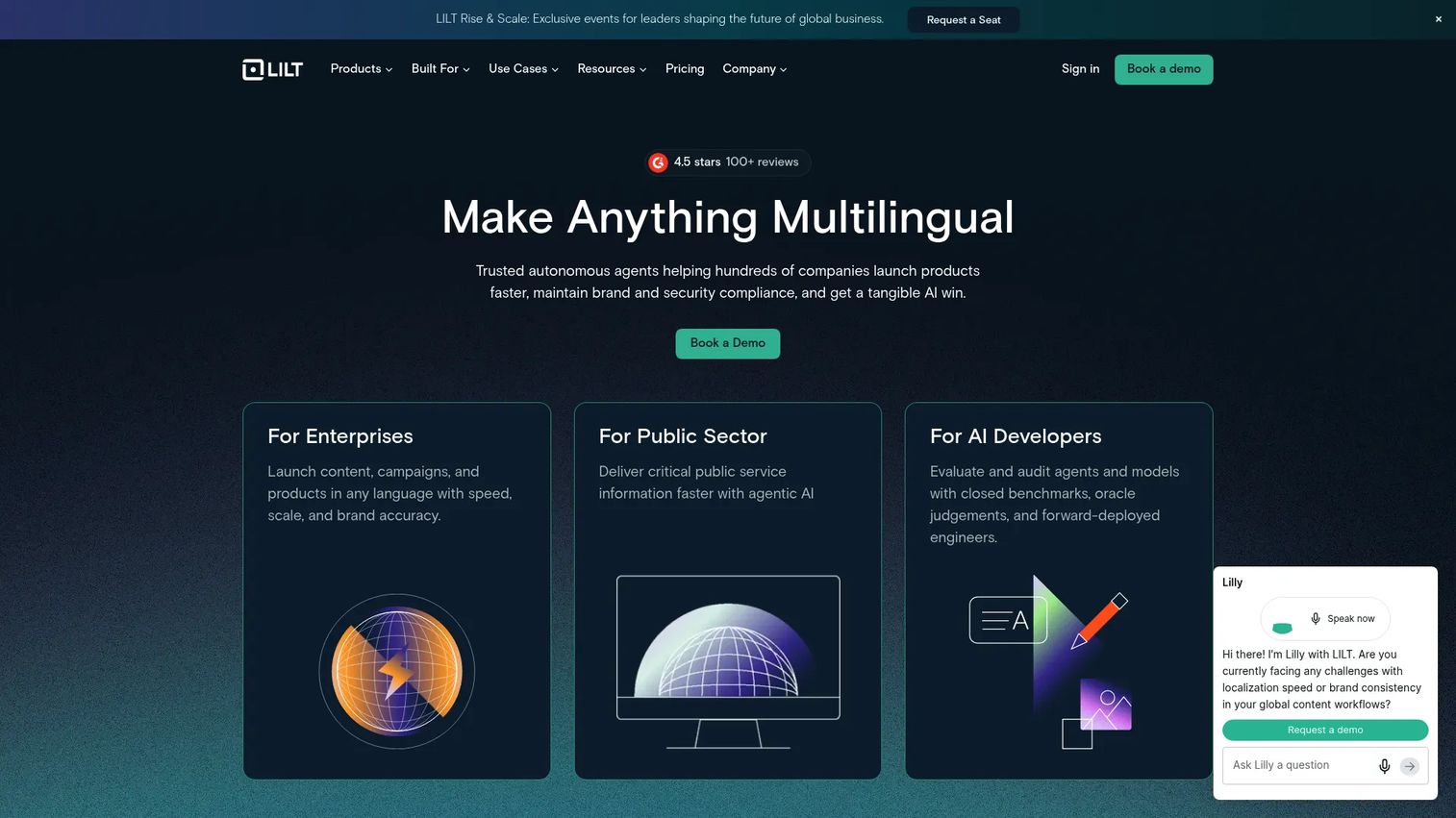
LILT is an enterprise AI platform built for high-volume multilingual content, translation, and localization programs. It combines adaptive AI model building with agentic workflows and human expert verification, covering everything from product UI strings to legal and support content. The platform supports secure cloud, on-premises, and air-gapped deployment, which makes it relevant for government and regulated enterprise buyers.
Best for: Large enterprises and government organizations managing secure, high-volume multilingual localization programs with accountability requirements.
Key features
- Adaptive AI model building and fine-tuning
- Agentic translation workflows with human verification
- Workflow analytics, governance, and observability
- Multilingual content creation across formats
- Cloud, on-premises, and air-gapped deployment options
Why choose LILT: LILT fits organizations that need AI-assisted localization at scale but cannot accept raw machine translation without human accountability. For growth teams, the governance and observability layer means localization quality can be tracked and defended internally, not just assumed.
LILT pricing: All plans are sold through sales. LILT offers Team, Business, Enterprise, and Government tiers. Ask sales about language volume, content types, review model, and security or deployment requirements when requesting a quote.
G2 rating: 4.3/5
2. Smartling
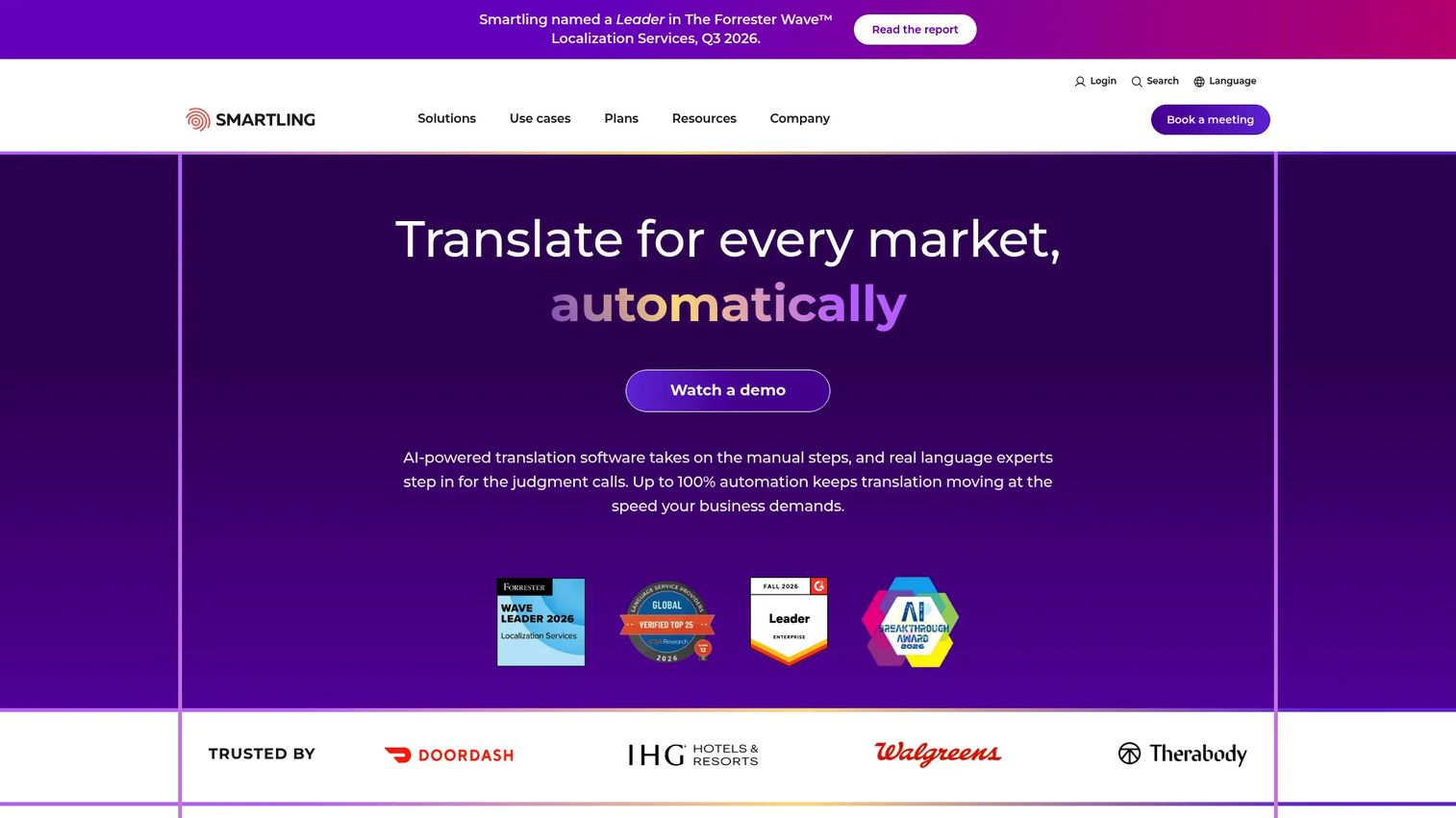
Smartling is a translation management and localization platform for websites, apps, product content, and enterprise content operations. Its visual context editor shows translators the UI while they translate, which reduces truncation and contextual errors before QA. The platform includes a Global Delivery Network for website localization, translation memory, glossary management, and AI translation services alongside a linguist network.
Best for: Teams localizing high-volume web, app, and digital content across many markets who need both platform tooling and translation services from a single vendor.
Key features
- Visual context editor for in-context translation
- Translation management workflows and project management
- Global Delivery Network for website localization
- AI, LLM, and machine translation options
- Linguistic quality assurance and reporting
Why choose Smartling: Smartling suits marketers who need campaign and product content localized at speed without separating platform management from language services. The visual context capability specifically reduces the back-and-forth between translators and developers when UI changes break translations.
Smartling pricing: The Core plan is free to start and covers individuals or small teams with basic workflow and project management. Translation services are priced per word separately: Machine translation from $0.0075/word, AI translation from $0.06/word, and human translation from $0.20/word. Enterprise pricing is set through sales based on usage, workflows, and enterprise requirements.
G2 rating: 4.4/5
3. RWS
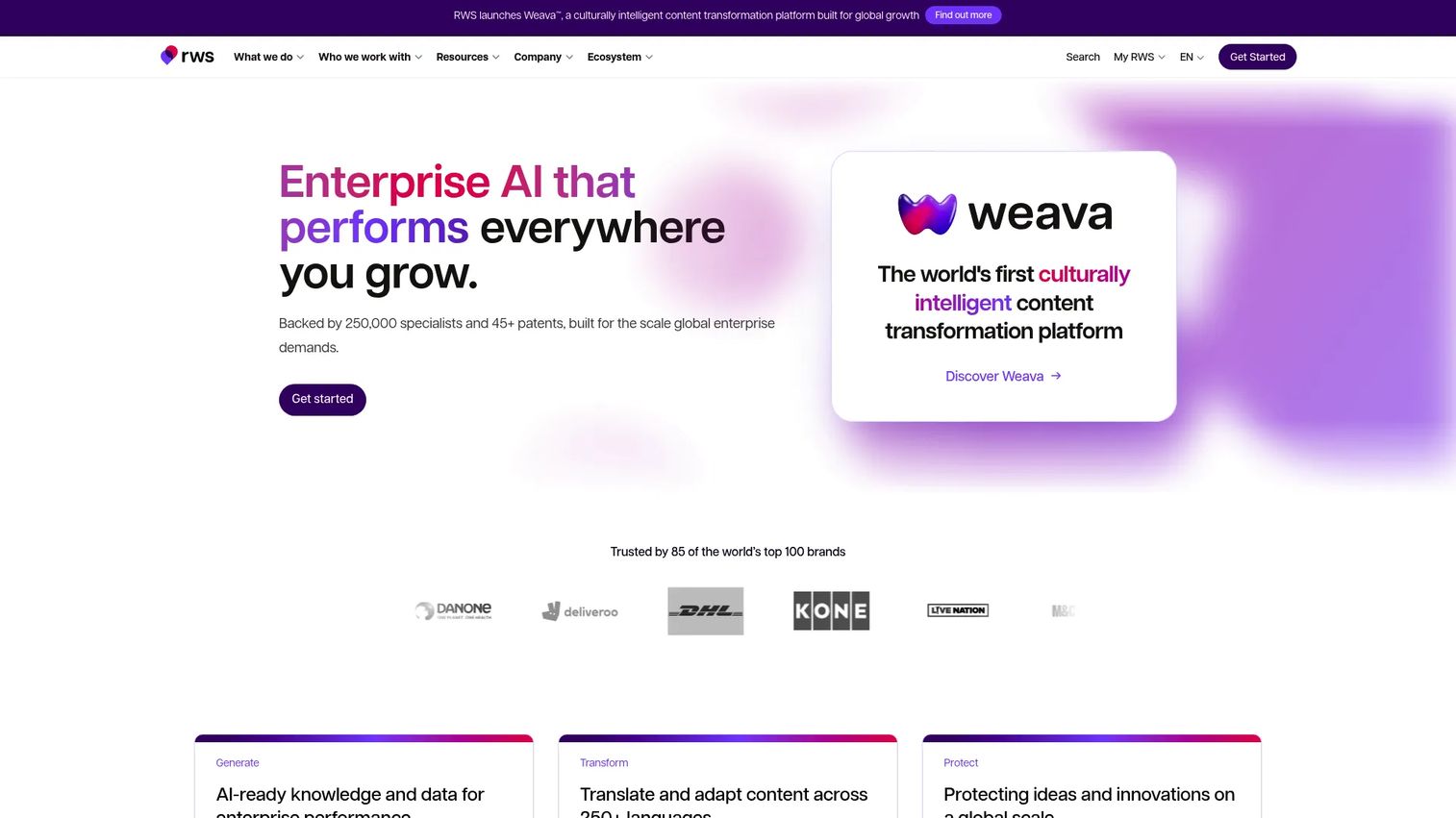
RWS is an enterprise AI solutions company providing language services, localization technology, and intellectual property services. Its Trados product line is one of the most established translation management platforms in the industry, covering 250+ languages with translation memory, terminology management, quality assurance, and workflow automation. The company also provides Language Weaver, its neural machine translation engine, alongside managed language services.
Best for: Mid-market and enterprise organizations with complex translation operations, legacy translation memory investments, or regulated content requiring deep language technology infrastructure.
Key features
- Trados translation management ecosystem
- 250+ language coverage with translation memory and terminology tools
- Language Weaver neural machine translation
- Workflow automation and quality assurance controls
- IP protection and enterprise content management services
Why choose RWS: RWS fits teams that already run large localization programs and need a provider with both platform depth and managed services. It's particularly relevant when translation memory portability, terminology governance, or regulated content handling are non-negotiable requirements.
RWS pricing: Trados Go starts at £24/month and Trados Freelance at £34/month, both available on monthly or annual billing. Trados Enterprise and managed services use contact-sales pricing. Buyers evaluating RWS for software localization should compare Trados licensing, managed services scope, and machine translation needs as separate cost drivers.
G2 rating: 4.0/5
4. Lionbridge
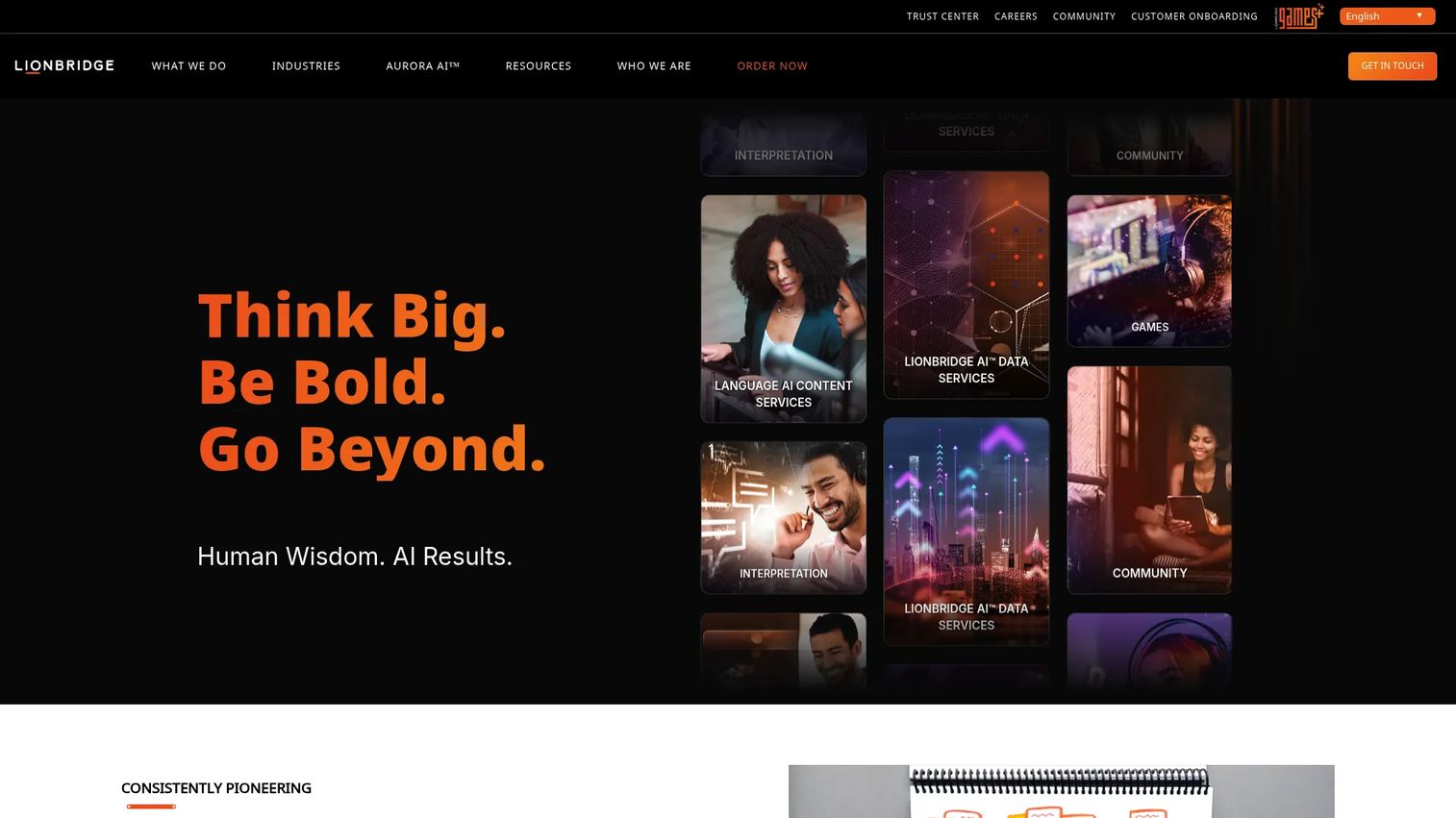
Lionbridge is a global managed language services provider covering translation, localization, interpretation, AI language services, and language and product testing. Its software localization capabilities include website, app, document, and multimedia localization alongside machine translation and over-the-phone and video interpretation. The Language Cloud platform supports AI-powered content automation and workflow management across content types.
Best for: Companies that want a managed localization partner across software, marketing content, support portals, and regulated workflows rather than a platform they operate themselves.
Key features
- Managed translation and localization services across content types
- AI-powered content automation through Language Cloud
- Multiple machine translation engine options
- Language and product testing services
- Over-the-phone, video, and AI interpretation
Why choose Lionbridge: Lionbridge suits growth teams that need a services-led partner to run localization operations, not just tooling to manage internally. For enterprise demand generation teams entering new markets, the breadth of delivery across product content, campaign copy, and customer support content reduces the number of vendor relationships to manage.
Lionbridge pricing: Gengo translation services (a Lionbridge offering) are priced per word: Standard from $0.09/word and Advanced from $0.18/word. Additional services and enterprise localization programs are sold through sales. Ask about language pairs, content volume, turnaround requirements, testing scope, and service model when requesting a quote.
G2 rating: 4.5/5
5. Phrase
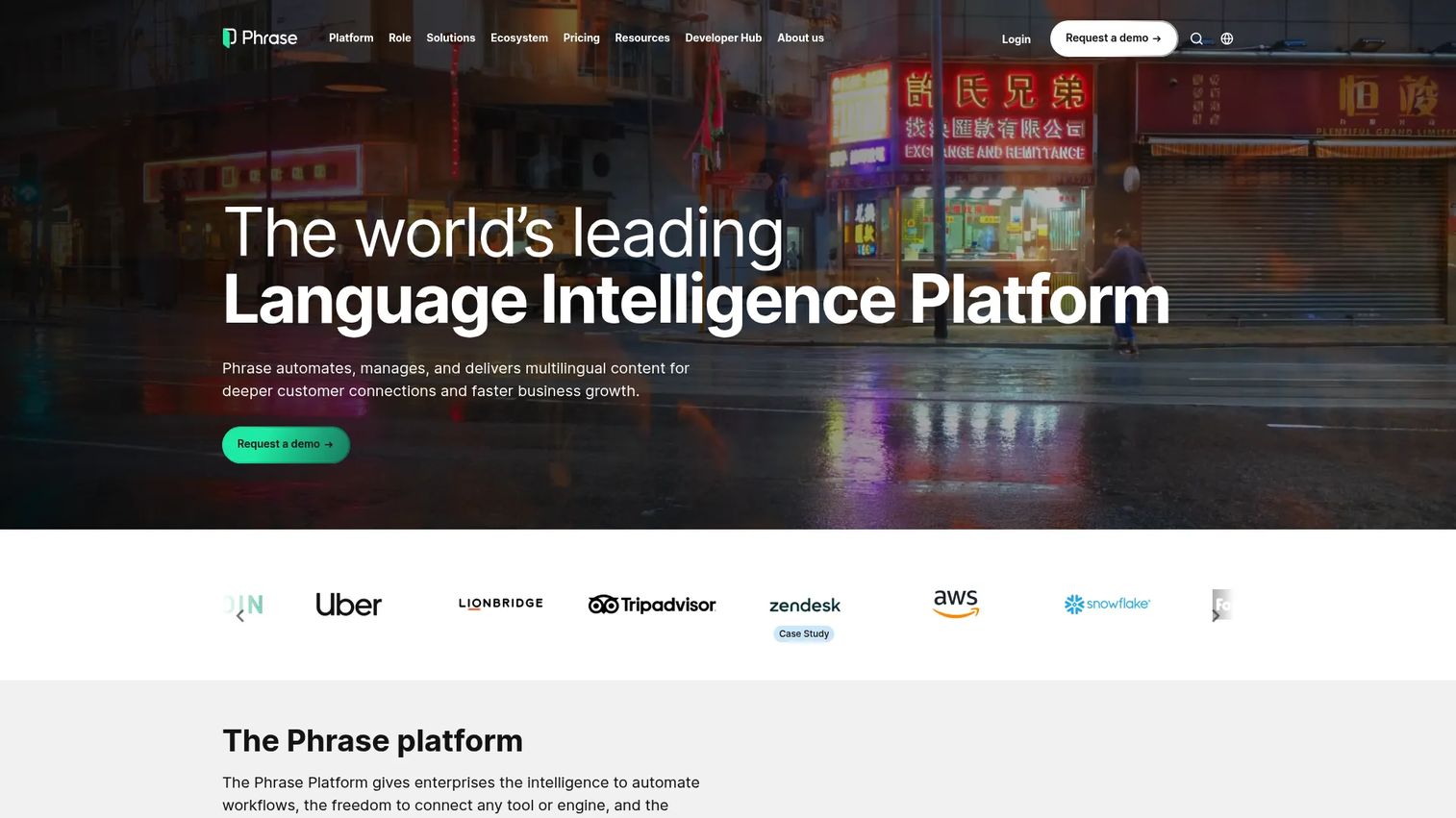
Phrase is an AI-led translation and localization platform built around software string management, developer workflows, and continuous localization. It supports 200+ integrations including REST APIs, CLI tools, and MCP support, connecting directly to repositories and CI/CD pipelines so localization runs alongside development rather than after it. The platform includes AI-powered translation, intelligent model routing, quality evaluation, visual workflow orchestration, and translation memories and term bases.
Best for: Product and engineering teams that need continuous localization inside development workflows, with marketing teams benefiting from the shared string management infrastructure.
Key features
- API, CLI, and 200+ integrations including CI/CD support
- AI-powered translation with intelligent model routing
- Visual workflow orchestration for localization processes
- Translation memories, term bases, and style guides
- Automated quality evaluation with AI and rule-based checks
Why choose Phrase: Phrase is the strongest fit when release velocity is the primary constraint. For growth marketers, the benefit is indirect but real: Fewer localization bottlenecks mean product updates, lifecycle emails, and regional campaign copy can ship together rather than staggered across quarters.
Phrase pricing: A 14-day free trial is available. The Freelancer plan starts at $27/month billed annually. Professional and Software UI/UX plans start at $525/month billed annually. The Team plan starts at $1,245/month billed annually. Business and Enterprise use custom pricing.
G2 rating: 4.5/5
6. Smartcat
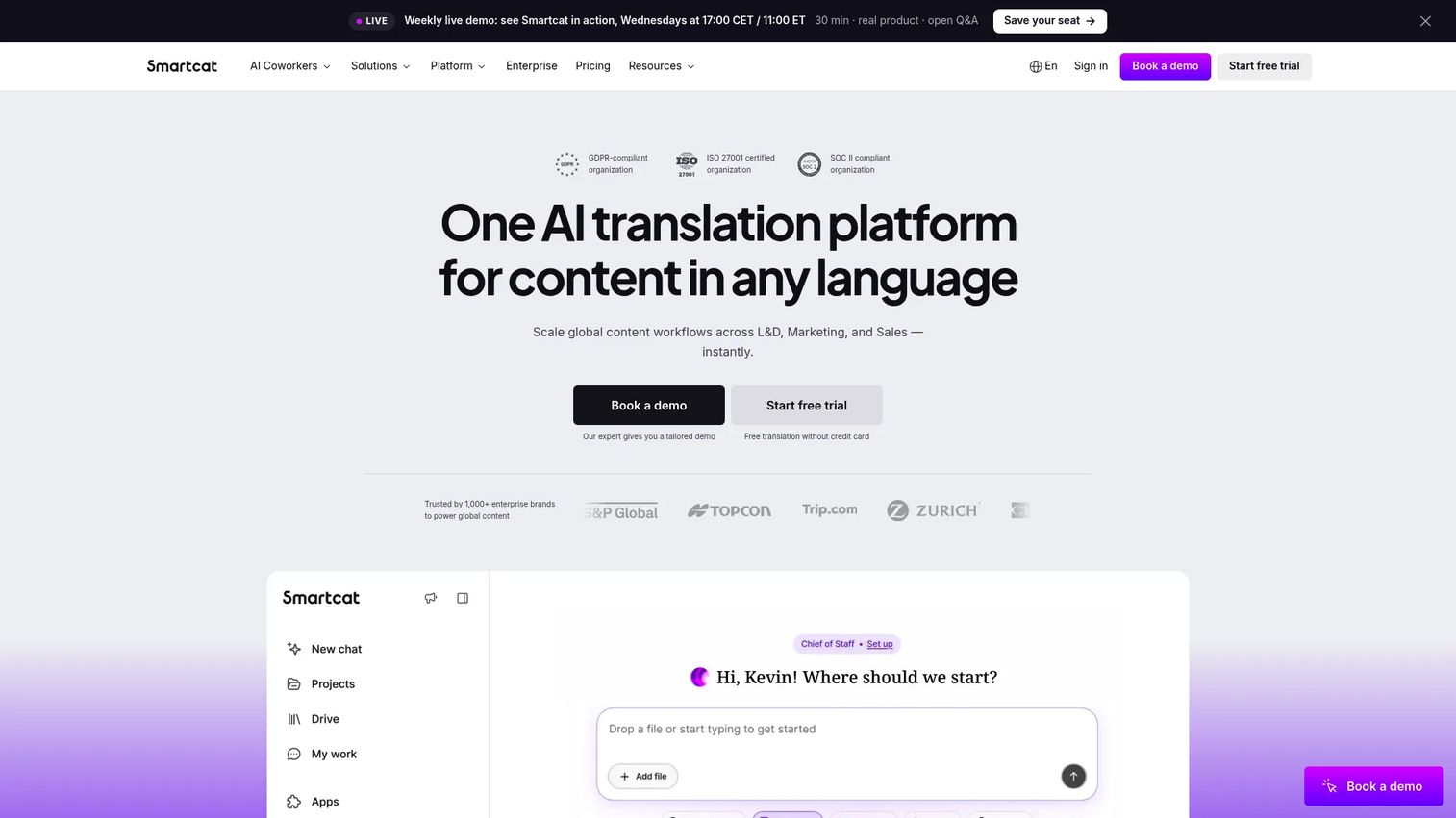
Smartcat is an AI-powered global content platform combining translation management, AI translation across 280+ languages, a marketplace of 500,000+ human language experts, and automated global payments. The platform covers content translation, creation, review, and quality assurance, with integrations into content, design, developer, CMS, and business tools. AI coworkers handle translation, content updates, and QA tasks within the same environment.
Best for: Organizations managing multilingual content workflows at scale that need flexible linguist access and want to avoid building a separate vendor management function.
Key features
- AI translation across 280+ languages
- Marketplace access to 500,000+ human language experts
- Automated global payments to linguists
- Translation management and CAT tooling
- Integrations with CMS, design, and developer tools
Why choose Smartcat: Smartcat fits lean marketing teams that need language coverage across many markets without full vendor management overhead. The marketplace model means you can spin up coverage for a new language quickly, and the automated payment infrastructure removes a common operational bottleneck when working with freelance linguists at volume.
Smartcat pricing: The Adapt plan starts at $1,200/year billed annually and includes unlimited users, all content types, and standard SLA. Higher tiers (Accelerate, Anticipate, Autonomous) add marketplace access, partner collaboration, API access, SSO, advanced workflows, and enterprise support. Those tiers use custom pricing through sales.
G2 rating: 4.6/5
7. Lokalise
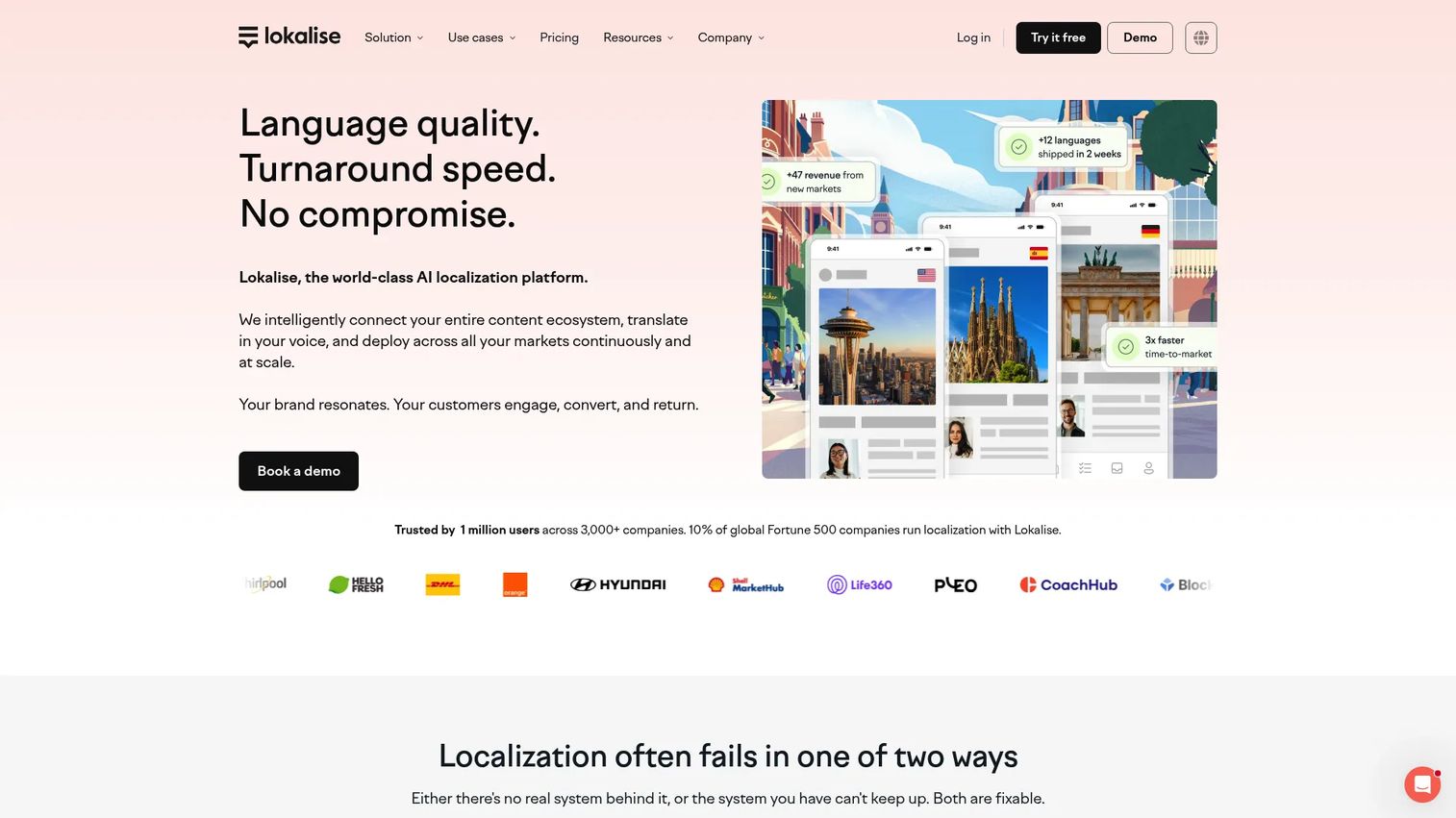
Lokalise is an AI-powered localization platform for managing and automating multilingual software and digital content. It supports product, design, developer, and marketing workflows from a single environment, covering AI-powered contextual translation, automated localization workflows, quality assurance, approvals, and publishing. Translation management includes glossary, translation memory, screenshots, and in-context editors.
Best for: SaaS teams that want continuous localization across product, website, and marketing from a collaborative platform without fully separating product strings from campaign copy.
Key features
- AI-powered contextual translation with multi-LLM routing
- Automated localization workflows with QA and approvals
- Translation management with glossary, TM, screenshots, and in-context editors
- Developer integrations and API access
- Design tool collaboration
Why choose Lokalise: Lokalise is a strong fit when product, design, and marketing teams need to work from a shared localization environment. For growth marketers, the ability to manage app store listings, landing page copy, and product strings in one place reduces handoff friction and keeps messaging consistent across surfaces.
Lokalise pricing: A 14-day free trial is available with no credit card required. Explorer starts at $149/month, Growth at $379/month, and Advanced at $1,049/month, all with monthly or annual billing options. Enterprise uses custom pricing through sales.
G2 rating: 4.7/5
Considerations when choosing software localization services
Match the provider to your release workflow
Agile SaaS teams need a provider that integrates with how software ships, not one that creates a separate localization queue. Confirm whether the provider supports repository integrations, issue trackers, API automation, and sprint-aligned review cycles. A campaign translation vendor that cannot handle software strings cleanly will slow every release that touches localized content.
Check localization engineering depth
Translation quality and localization engineering are different capabilities. Ask providers specifically how they handle keys, variables, placeholders, tags, encoding, plurals, gender forms, and locale rules. These details determine whether a localized build compiles and behaves correctly, not just whether the text reads well. Generic translation services often skip this layer entirely.
Separate translation quality from product QA
Linguistic review confirms whether a translation is accurate. Product QA confirms whether the localized build works. The two are not the same. Before any release, test for truncated UI strings, broken placeholder syntax, RTL layout issues, invalid currency formats, and screenshots that no longer match the current UI. Confirm which of these testing types the provider covers and which your team owns.
Verify security and deployment requirements
Enterprise localization programs frequently involve confidential product roadmaps, unreleased features, and customer-facing content. Check whether the provider supports SOC 2, ISO 27001, data residency requirements, role-based access controls, or private deployment for sensitive content. Do not treat security as a post-selection concern.
Run a scoped pilot before committing
Before signing an enterprise contract, run a pilot using one real product flow, one help article, and one campaign page. Ask the provider to demonstrate turnaround time, QA notes, issue handling, reporting, and feedback loops. A pilot surfaces workflow mismatches that a sales process won't reveal.
Conclusion
Choosing among software localization companies comes down to operating model and release cadence more than language count.
LILT is the choice for enterprise programs that need adaptive AI with human accountability. Smartling works for teams localizing web and app content at volume who want both platform and language services from one vendor. RWS fits organizations running mature translation operations with deep terminology and memory investments. Lionbridge suits teams that want a managed delivery partner across content types rather than a platform to operate. Phrase is the right fit when continuous localization inside development workflows is the primary requirement. Smartcat works well for teams that need flexible linguist marketplace access with automated payment handling. Lokalise is the strongest option for SaaS teams that want product, design, and marketing localization managed collaboratively.
Shortlist two or three providers based on your workflow fit, then run a scoped pilot. No vendor demo replaces a real localization cycle on actual product content.
If your team is also preparing localized product experiences for buyers, make the product story easier to explore across markets. Use interactive demos to show regional teams, stakeholders, and prospects how the product works in context, without requiring a live call or engineering support for every new market.
Start your journey with Guideflow today!
FAQs
Software localization services adapt software products for specific languages, regions, and local expectations. The scope includes product UI strings, resource files, help center content, app store listings, support portals, and locale behavior such as date formats, currencies, and RTL layout. The goal is a product that works correctly and feels native in each target market, not just one with text in a different language. Software localisation services (the UK spelling) refers to the same category.
Translation changes source text into another language. Localization adapts the full product experience, including UX flows, number and date formatting, cultural conventions, layout behavior, and QA across locales. A product can be fully translated and still fail in a market because the UI truncates, the dates look wrong, or the help content describes a flow that doesn't match the localized version. Localization engineering and product QA are what close that gap.
Continuous localization is an ongoing workflow that keeps translation and review aligned with product releases rather than treating localization as a one-time project. It typically involves connecting localization tooling to repositories, issue trackers, and CI/CD pipelines so strings go out for translation automatically and return reviewed before the next release ships. For agile SaaS teams, continuous localization is the difference between shipping localized updates with each sprint and accumulating a localization backlog that blocks market launches.
A complete software localization service covers string handling, translation memory, terminology management, in-context review, human review or expert verification, QA across linguistic and functional dimensions, developer integrations, security controls, and reporting. Many enterprise programs also need locale behavior validation, cultural adaptation for regional examples and screenshots, and regression testing to confirm localized builds work after each product update.
Pricing varies significantly by language pairs, word volume, turnaround speed, QA depth, managed services scope, and integration requirements. Per-word pricing typically ranges from around $0.09/word for standard translation to $0.20/word or more for human expert review. Platform subscriptions like Lokalise and Phrase start from under $200/month for small teams and scale to custom enterprise pricing based on seats, integrations, and workflow automation. High-volume enterprise programs from providers like LILT and Lionbridge are priced through sales and depend on program complexity and security requirements.
Most providers now combine AI or machine translation with human review rather than relying on either alone. AI handles high-volume, repetitive string translation at speed, while human experts verify quality, terminology, and contextual accuracy. The key differentiator is not whether a provider uses AI but how the AI and human review model is structured and what accountability exists when output quality falls short. For enterprise programs, governance and observability around AI usage matters as much as the AI capability itself.
Managed services supply vendor execution: Project management, linguist resources, and QA delivery. Your team directs requirements and reviews output. Localization platforms supply workflow tooling that your team operates internally, with or without connected language services. Managed services fit teams without internal localization capacity. Platforms fit teams with localization managers who want control over workflows and direct developer integrations. Many enterprise programs use both: A platform for developer-side string management and a managed service for review, QA, and specialized content types.
Before a multilingual launch, test for linguistic accuracy, UI string fit in each language, placeholder and variable syntax, RTL layout issues for Arabic and Hebrew markets, date and currency format correctness, form input method behavior, app store screenshots that match the localized UI, and regression behavior after any post-localization code changes. Functional QA confirms the localized build compiles and behaves correctly, not just that the text reads well. Assign clear ownership between the localization provider and your engineering team for each testing type before the release schedule is set.